
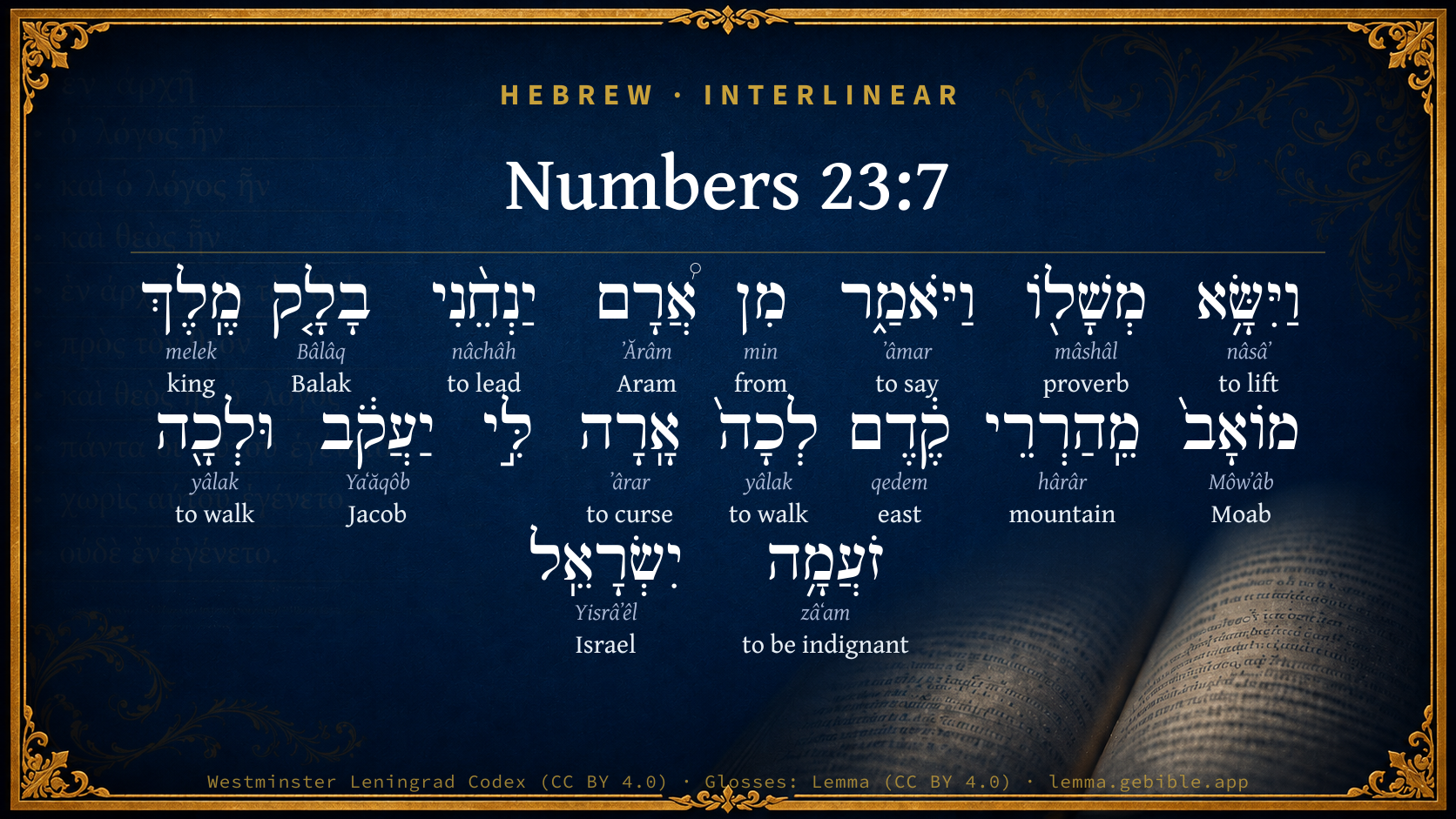
Numbers 23:7

Hebrew (Westminster Leningrad Codex) Numbers 23:7 appears in the Hebrew Old Testament. The text above is from the Westminster Leningrad Codex. Each word links to its Strong’s number, a concise gloss, and parsing drawn from the Open Scriptures Hebrew Bible morphology. Click any word for its full Brown-Driver-Briggs (BDB) entry.
Download image
Cite this verse

Numbers 23:7 (World English Bible). Public Domain. Lemma interlinear Bible study tool, https://lemma.gebible.app/v/numbers/23/7.

Show BibTeX & RIS
BibTeX
RIS
English Translation
He took up his parable, and said, From Aram has Balak brought me, The king of Moab from the mountains of the East: Come, curse me Jacob, Come, defy Israel.
World English Bible · Public Domain
Highlights
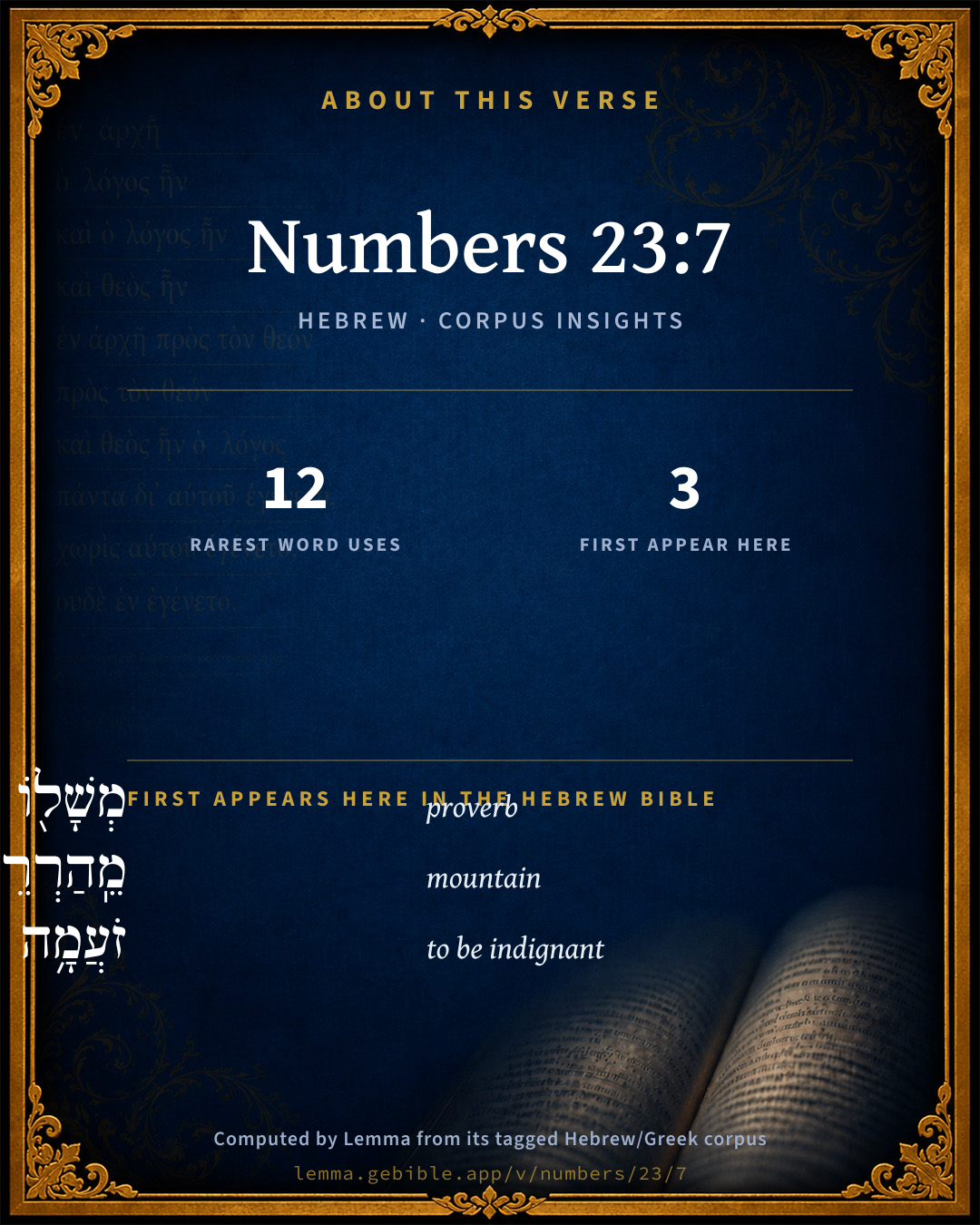
  • 3 first appearances in the Hebrew Bible
Full analysis ↓
Download a study sheet

One document with this verse’s original text, its word-by-word gloss line, the meaning frame, cross-references with their text, attributed commentary, and full source and license credits — printable, and it pastes into notes with its structure intact.

This verse Autodidact and up

Study sheet (.html) Plain text (.txt)

A passage Seminary Student

Up to 50 verses in one chapter. A passage sheet keeps up to 6 commentary sources and 12 cross-references per verse, in the order this page ranks them, and says so on the sheet whenever that leaves anything out. Ask for a single verse and you get the Autodidact verse sheet above.

Everything on this page stays free to read, with no account — the sheet is a download of what is already on screen, not access to it.

Want to remove ads? Support Godless Engineer
Compare translations 3

The same verse in 3 English versions, stacked beneath the original-language interlinear above. Click any original word for its lexicon entry.

Each is an independent rendering of the whole verse — the interlinear is not word-aligned to these translations.

Highlighted words mark where these versions differ — a whole-verse word diff, not a word-by-word alignment.

  • World English Bible Public Domain
    He took up his parable, and said, From Aram has Balak brought me, The king of Moab from the mountains of the East: Come, curse me Jacob, Come, defy Israel.
  • King James Version Public Domain
    And he took up his parable, and said, Balak the king of Moab hath brought me from Aram, out of the mountains of the east, saying, Come, curse me Jacob, and come, defy Israel.
  • unfoldingWord Literal Text CC BY-SA 4.0
    And he lifted up his discourse and said, “From Aram Balak has led me, the king of Moab from the mountains of the east: ‘Come, curse Jacob for me, and come, denounce Israel.’

unfoldingWord Literal Text — © unfoldingWord, licensed CC BY-SA 4.0. Word-aligned USFM3 via Door43 (git.door43.org/unfoldingWord/en_ult).

Versions to compare (up to 4)

3 of 4 selected

Show all 18 translations

Every available English version of this verse, each an independent rendering of the whole verse.

  • World English Bible Public Domain
    He took up his parable, and said, From Aram has Balak brought me, The king of Moab from the mountains of the East: Come, curse me Jacob, Come, defy Israel.
  • Berean Standard Bible Public Domain
    And Balaam lifted up an oracle, saying: “Balak brought me from Aram, the king of Moab from the mountains of the east. ‘Come,’ he said, ‘put a curse on Jacob for me; come and denounce Israel!’
  • Majority Standard Bible Public Domain
    And Balaam lifted up an oracle, saying: “Balak brought me from Aram, the king of Moab from the mountains of the east. ‘Come,’ he said, ‘put a curse on Jacob for me; come and denounce Israel!’
  • King James Version Public Domain
    And he took up his parable, and said, Balak the king of Moab hath brought me from Aram, out of the mountains of the east, saying, Come, curse me Jacob, and come, defy Israel.
  • American Standard Version (1901) Public Domain
    And he took up his parable, and said, From Aram hath Balak brought me, The king of Moab from the mountains of the East: Come, curse me Jacob, And come, defy Israel.
  • Revised Version (1885) Public Domain
    And he took up his parable, and said, From Aram hath Balak brought me, The king of Moab from the mountains of the East: Come, curse me Jacob, And come, defy Israel.
  • Geneva Bible (1599) Public Domain
    Then he vttered his parable, and sayde, Balak the king of Moab hath brought mee from Aram out of the mountaines of the East, saying, Come, curse Iaakob for my sake: come, and detest Israel.
  • Douay-Rheims (1899) Public Domain
    And taking up his parable, he said: Balac king of the Moabites hath brought me from Aram, from the mountains of the east: Come, said he, and curse Jacob: make haste and detest Israel.
  • Young's Literal Translation Public Domain
    And he taketh up his simile, and saith: `From Aram he doth lead me -- Balak king of Moab; From mountains of the east: Come -- curse for me Jacob, And come -- be indignant `with' Israel.
  • Literal Standard Version CC BY-SA 4.0
    And he takes up his allegory and says: “Balak king of Moab leads me from Aram; From mountains of the east. Come—curse Jacob for me, || And come—be indignant [with] Israel.
  • Unlocked Literal Bible CC BY-SA 4.0
    Then Balaam began to speak his prophecy and said, “Balak has brought me from Aram, the king of Moab from the eastern mountains. 'Come, curse Jacob for me,' he said. 'Come, defy Israel.'
  • unfoldingWord Literal Text CC BY-SA 4.0
    And he lifted up his discourse and said, “From Aram Balak has led me, the king of Moab from the mountains of the east: ‘Come, curse Jacob for me, and come, denounce Israel.’
  • Darby Bible Public Domain
    And he took up his parable, and said, Balak the king of Moab hath brought me from Aram, from the mountains of the east: Come, curse me Jacob, and come, denounce Israel!
  • World Messianic Bible Public Domain
    He took up his parable, and said, “From Aram has Balak brought me, the king of Moab from the mountains of the East. Come, curse Jacob for me. Come, defy Israel.
  • Webster's Bible Public Domain
    And he took up his parable, and said, Balak the king of Moab hath brought me from Aram, out of the mountains of the east, saying, Come, curse Jacob for me, and come, defy Israel.
  • Free Bible Version CC BY-SA 4.0
    This is the declaration that Balaam gave: “Balak brought me from Aram; the king of Moab brought me from the mountains of the east. He said, ‘Come and curse Jacob for me! Come and condemn Israel!’
  • Bible in Basic English Public Domain
    And in the words which the Lord had given him he said, From Aram Balak has sent for me, the king of Moab from the mountains of the East: come, put curses on Jacob for me and be angry with Israel.
  • JPS Tanakh (1917) Public Domain
    And he took up his parable, and said: From Aram Balak bringeth me, the king of Moab from the mountains of the East: 'Come, curse me Jacob, and come, execrate Israel.'

Literal Standard Version (2020), Covenant Press — licensed CC BY-SA 4.0. Text via the HelloAO Bible API (eBible.org). Unlocked Literal Bible (unfoldingWord) — licensed CC BY-SA 4.0. Text via the HelloAO Bible API (eBible.org). unfoldingWord Literal Text — © unfoldingWord, licensed CC BY-SA 4.0. Word-aligned USFM3 via Door43 (git.door43.org/unfoldingWord/en_ult). Free Bible Version, Dr. Jonathan Gallagher — licensed CC BY-SA 4.0. Text via the HelloAO Bible API (eBible.org).

Word by word

More ways to search: Search by grammar → Find every occurrence → Compare this word →

Practice this passage: Drill this verse → Learn its vocabulary →

מֵֽהַרְרֵי
hârâr
H2042
“from · mountains of”
Preposition + Noun, Common, Masculine, Plural, Construct
Part of Speech
Preposition + Noun
Type
Common
Gender
Masculine
Number
Plural
State
Construct
Full BDB Definition

Origin: from an unused root meaning to loom up

TWOT: 517

mountain, hill, hill country, mount
  1. וַיִּשָּׂ֥א nâsâʼ H5375 “and · to lift” Conjunction + Verb, Qal, Sequential Imperfect, 3rd Person, Masculine, Singular
  2. מְשָׁל֖וֹ mâshâl H4912 “proverb · his” Noun, Common, Masculine, Singular, Construct + Suffix, Personal, 3rd Person, Masculine, Singular
  3. וַיֹּאמַ֑ר ʼâmar H559 “and · to say” Conjunction + Verb, Qal, Sequential Imperfect, 3rd Person, Masculine, Singular
  4. מִן min H4480 “from” Preposition
  5. אֲ֠רָם ʼĂrâm H758 “Aram” Noun, Proper
  6. יַנְחֵ֨נִי nâchâh H5148 “to lead · me” Verb, Hiphil, Imperfect, 3rd Person, Masculine, Singular + Suffix, Personal, 1st Person, Common, Singular
  7. בָלָ֤ק Bâlâq H1111 “Balak” Noun, Proper
  8. מֶֽלֶךְ melek H4428 “king of” Noun, Common, Masculine, Singular, Construct
  9. מוֹאָב֙ Môwʼâb H4124 “Moab” Noun, Proper
  10. קֶ֔דֶם qedem H6924 “east” Noun, Common, Masculine, Singular, Absolute
  11. לְכָה֙ yâlak H3212 “walk” Verb, Qal, Imperative, 2nd Person, Masculine, Singular + Suffix, h
  12. אָֽרָה ʼârar H779 “curse” Verb, Qal, Imperative, 2nd Person, Masculine, Singular + Suffix, h
  13. יַעֲקֹ֔ב Yaʻăqôb H3290 “Jacob” Noun, Proper
  14. וּלְכָ֖ה yâlak H3212 “and · walk” Conjunction + Verb, Qal, Imperative, 2nd Person, Masculine, Singular + Suffix, h
  15. זֹעֲמָ֥ה zâʻam H2194 “be indignant” Verb, Qal, Imperative, 2nd Person, Masculine, Singular + Suffix, h
  16. יִשְׂרָאֵֽל Yisrâʼêl H3478 “Israel” Noun, Proper

About this verse

These counts appear in no published source. They are computed here, from the morphology-tagged text and Lemma’s own curated glosses. What Lemma adds →

18
words
16
distinct lemmas
Pentateuch
section

Notable vocabulary

The rarest word here is מֵֽהַרְרֵי mountain H2042 — appearing just 12 times in the whole Hebrew Bible.

First appearance in Scripture

These words make their first canonical appearance in the Hebrew Bible here:

  • מְשָׁל֖וֹ proverb H4912
  • מֵֽהַרְרֵי mountain H2042
  • זֹעֲמָ֥ה to be indignant H2194

Shared distinctive vocabulary

מֵֽהַרְרֵי mountain H2042 occurs in 12 verses of the Hebrew Bible. Also found in:

Grammatical profile

  • 7 verbs
  • 9 nouns
  • 2 prepositions

Verb forms

  • וַיִּשָּׂ֥א Qal · Sequential Imperfect
  • וַיֹּאמַ֑ר Qal · Sequential Imperfect
  • יַנְחֵ֨נִי Hiphil · Imperfect
  • לְכָה֙ Qal · Imperative
  • אָֽרָה Qal · Imperative
  • וּלְכָ֖ה Qal · Imperative
  • זֹעֲמָ֥ה Qal · Imperative

Repetition

A word recurs within this verse — often emphatic in Hebrew:

  • לְכָה֙ to walk H3212 ×2

Hebrew & Septuagint length

In English translation the verse runs 30 words from the Hebrew and 40 from the Septuagint (LXX English) — closely comparable.

A rough comparison of the two English renderings, which tokenize alike — not a word-level alignment.

Word counts can differ between the Hebrew and the Greek without any difference in meaning — e.g. the Hebrew direct-object marker אֵת has no separate Greek word, and Greek often adds the article ὁ.

Cross-references

29

Topical passages linked to Numbers 23:7 in the Treasury of Scripture Knowledge — connected by theme and wording, ordered by reader-vote popularity; previews shown in the World English Bible.

  • Numbers 22:5–6 He sent messengers to Balaam the son of Beor, to Pethor, which is by the River, to the land of the children of his people, to call him, saying, Behold, there is a people come out from Egypt: behold, they cover the surface of the earth, and they abide over against me.
  • Numbers 23:18 He took up his parable, and said, Rise up, Balak, and hear; Listen to me, you son of Zippor:
  • Numbers 24:3 He took up his parable, and said, Balaam the son of Beor says, The man whose eye was closed says;
  • Deuteronomy 23:4 because they didn't meet you with bread and with water in the way, when you came forth out of Egypt, and because they hired against you Balaam the son of Beor from Pethor of Mesopotamia, to curse you.
  • Numbers 24:15 He took up his parable, and said, Balaam the son of Beor says, The man whose eye was closed says;
  • Numbers 24:23 He took up his parable, and said, Alas, who shall live when God does this?
  • Job 29:1 Job again took up his parable, and said,
  • Psalms 78:2 I will open my mouth in a parable. I will utter dark sayings of old,
  • Micah 2:4 In that day they will take up a parable against you, And lament with a doleful lamentation, saying, 'We are utterly ruined! My people's possession is divided up. Indeed he takes it from me and assigns our fields to traitors!'"
  • 1 Samuel 17:45 Then said David to the Philistine, You come to me with a sword, and with a spear, and with a javelin: but I come to you in the name of Yahweh of hosts, the God of the armies of Israel, whom you have defied.
  • 2 Samuel 23:9 After him was Eleazar the son of Dodai the son of an Ahohite, one of the three mighty men with David, when they defied the Philistines who were there gathered together to battle, and the men of Israel were gone away.
  • Job 27:1 Job again took up his parable, and said,
  • Proverbs 26:2 Like a fluttering sparrow, Like a darting swallow, So the undeserved curse doesn't come to rest.
  • Matthew 13:33 He spoke another parable to them. "The Kingdom of Heaven is like yeast, which a woman took, and hid in three measures of meal, until it was all leavened."
  • Matthew 13:35 that it might be fulfilled which was spoken through the prophet, saying, "I will open my mouth in parables; I will utter things hidden from the foundation of the world."
  • Mark 12:12 They tried to seize him, but they feared the multitude; for they perceived that he spoke the parable against them. They left him, and went away.
  • Genesis 10:22 The sons of Shem: Elam, Asshur, Arpachshad, Lud, and Aram.
  • Genesis 28:2 Arise, go to Paddan Aram, to the house of Bethuel your mother's father. Take a wife from there from the daughters of Laban, your mother's brother.
  • Genesis 28:7 and that Jacob obeyed his father and his mother, and was gone to Paddan Aram.
  • Numbers 22:11 Behold, the people that is come out of Egypt, it covers the surface of the earth: now, come curse me them; peradventure I shall be able to fight against them, and shall drive them out.
  • Numbers 22:17 for I will promote you to very great honor, and whatever you say to me I will do. Please come therefore, and curse this people for me.
  • Numbers 24:21 He looked at the Kenite, and took up his parable, and said, Strong is your dwelling-place, Your nest is set in the rock.
  • 1 Samuel 17:10 The Philistine said, I defy the armies of Israel this day; give me a man, that we may fight together.
  • 1 Samuel 17:25–26 The men of Israel said, Have you seen this man who is come up? surely to defy Israel is he come up: and it shall be, that the man who kills him, the king will enrich him with great riches, and will give him his daughter, and make his father's house free in Israel.
  • 1 Samuel 17:36 Your servant struck both the lion and the bear: and this uncircumcised Philistine shall be as one of them, seeing he has defied the armies of the living God.
  • 2 Samuel 21:21 When he defied Israel, Jonathan the son of Shimei, David's brother, killed him.
  • Ezekiel 17:2 Son of man, put forth a riddle, and speak a parable to the house of Israel;
  • Ezekiel 20:49 Then said I, Ah Lord Yahweh! they say of me, Isn't he a speaker of parables?
  • Habakkuk 2:6 Won't all these take up a parable against him, and a taunting proverb against him, and say, 'Woe to him who increases that which is not his, and who enriches himself by extortion! How long?'

Cross-references courtesy of OpenBible.info (CC BY 4.0).

Hebrew and Greek witnesses Masoretic Hebrew ↔ Greek Septuagint

The same verse in the two great witnesses to the Old Testament, shown verse-for-verse.

These are two independent witnesses, not word-aligned to each other, and the Septuagint is shown in lemma (dictionary) form.

Hebrew Numbers 23:7 Masoretic · Westminster Leningrad Codex

וַיִּשָּׂ֥א מְשָׁל֖וֹ וַיֹּאמַ֑ר מִן אֲ֠רָם יַנְחֵ֨נִי בָלָ֤ק מֶֽלֶךְ מוֹאָב֙ מֵֽהַרְרֵי קֶ֔דֶם לְכָה֙ אָֽרָה לִּ֣י יַעֲקֹ֔ב וּלְכָ֖ה זֹעֲמָ֥ה יִשְׂרָאֵֽל

He took up his parable, and said, From Aram has Balak brought me, The king of Moab from the mountains of the East: Come, curse me Jacob, Come, defy Israel.

World English Bible · Public Domain

Greek LXX Numbers 23:7 Septuagint · lemma form

καί γίγνομαι πνεῦμα θεός ἐπί αὐτός καί ἀναλαμβάνω ὁ παραβολή αὐτός εἶπον ἐκ μεσοποταμία μεταπέμπω ἐγώ βαλακ βασιλεύς μωαβ ἐκ ὄρος ἀπό ἀνατολή λέγω δεῦρο ἀράομαι ἐγώ ὁ ἰακώβ καί δεῦρο ἐπι καταἀράομαι ἐγώ ὁ ἰσραήλ

And he took up his parable, and said, Balac king of Moab sent for me out of Mesopotamia, out of the mountains of the east, saying, Come, curse me Jacob, and Come, call for a curse for me upon Israel.

LXX2012 (modern English Septuagint) · Public Domain

On this verse, John Gill's Exposition discusses the Septuagint’s reading. Read the note in Commentary ↓

Hebrew: Westminster Leningrad Codex (CC BY 4.0). Greek: Septuagint (public domain); English from LXX2012 (modern English Septuagint) (Public Domain). How the Septuagint differs from the Hebrew →

Targum (Aramaic paraphrase)

2

The Targum is the ancient Jewish Aramaic paraphrase of the Hebrew Scriptures — an interpretive translation, not the Hebrew text itself. Onkelos (literal) and Pseudo-Jonathan (expansive) render the Torah, and Jonathan the Prophets. Coverage is partial: where no permissively-licensed English translation exists for a verse, only the Aramaic is shown. This is verse-level text, not a word-by-word alignment to the Hebrew.

  1. Targum Onkelos Torah (Genesis–Deuteronomy)
    וּנְטַל מַתְלֵיהּ וַאֲמַר מִן אֲרָם דַבְּרַנִי בָלָק מַלְכָּא דְמוֹאָב מִטוּרֵי מַדִנְחָא אִיתָא לוֹטּ לִי יַעֲקֹב וְאִיתָא תָּרֵיךְ לִי יִשְׂרָאֵל

    (no public-domain English translation for this verse)

    Targum Onkelos — Aramaic: “Onkelos Genesis” (public domain); “Onkelos Exodus” (public domain); “Onkelos Leviticus” (public domain); “Onkelos Numbers” (public domain); “Onkelos Deuteronomy” (public domain). English: “Sefaria Community Translation” (CC0 1.0 (public-domain dedication)); “J.W. Etheridge. The Targums of Onkelos and Jonathan Ben Uzziel on the Pentateuch. London: Longmans, Green, 1862” (public domain). Text via Sefaria.

  2. Targum Pseudo-Jonathan Torah (Genesis–Deuteronomy)
    וּנְטַל מְתַל נְבוּתֵיהּ וַאֲמַר מִן אֲרַם דְעַל פְּרָת דַבְּרַנִי בָּלָק מַלְכָּא דְמוֹאֲבָאֵי מִן טַוְורֵי מַדִינְחָא אִיתָא לוֹט בְּגִנִי דְבֵית יַעֲקב וְאִיתָא זְעֵיר לִי יִשְרָאֵל

    And he took up the parable of his prophecy, and said: From Aram on Euphrates hath Balak king of the Moabaee brought me; from the mountains of the east come, curse for me the house of Jakob; come, for me make Israel small.

    Targum Pseudo-Jonathan — Aramaic: “Targum Jonathan on Genesis” (public domain); “Targum Jonathan on Exodus” (public domain); “Targum Jonathan on Leviticus” (public domain); “Targum Jonathan on Numbers” (public domain); “Targum Jonathan on Deuteronomy” (public domain). English: “The Targum of Jonathan ben Uzziel, trans. J. W. Etheridge, London, 1862” (public domain). Text via Sefaria.

Commentary

Notes on Numbers 23:7 from classic Christian and Jewish commentators (each source and its license shown beneath its notes). The classic Christian expositions comment on the surrounding passage and are grouped to its opening verse, so a note may address several verses; the Jewish commentaries on the Tanakh (Rashi and others) are per-verse, so they appear only where the commentator wrote on this verse.

Lemma curates 59 commentaries, every one of them public domain or Creative Commons licensed, each selected and text-cleaned for this edition rather than reprinted as found. About our sources →

The Cambridge Bible for Schools and Colleges

gen. ed. J. J. S. Perowne

7. he took up his parable] i.e. he took up upon his lips, he uttered; Num_23:18, Num_24:3; Num_24:15; Num_24:20 f., Num_24:23. Cf. Job_27:1; Job_29:1, Amo_5:1 and frequently. On the Heb. mâshâl (‘parable’), a didactic or artistic utterance, see Num_21:27.

Aram] i.e. Aram-naharaim. See on Num_22:5. The short form Aram (cf. Hos_12:12, where the meaning is the same as here) usually denotes the more westerly regions of which Damascus was the capital.

the mountains of the East] The high ranges of the Syrian desert, the country of the nomad ‘children of the east’ (Jer_49:28, Eze_25:4; Eze_25:10), who wandered E . of Ammon, Moab, and Edom.

7–10. Balaam’s first prophetic message. This consists of seven short couplets. Balaam declares the uselessness of Balak’s action in fetching him for the purpose of cursing (Num_23:7 f.); the security of Israel, their separateness from other nations, and their great numbers (Num_23:9-10 a); and he prays that his end may be like theirs (Num_23:10 b).

The Cambridge Bible for Schools and Colleges (gen. ed. J. J. S. Perowne; Cambridge University Press, 1878–1918) — public domain. Text from a community e-Sword module.

Trapp's Complete Commentary

John Trapp

Num 23:7 And he took up his parable, and said, Balak the king of Moab hath brought me from Aram, out of the mountains of the east, [saying], Come, curse me Jacob, and come, defy Israel.

Ver. 7. And he took up his parable.] Or, Pithy and powerful speech, uttered in numerous and sententious terms, and taken among the heathen for prophecies or oracles: poemata pro vaticiniis, &c. Poets were taken for prophets, {Tit 1:12} and poems for prophecies. Hence their στοιχομαντεια, wherein opening a book of Homer, Hesiod, &c., they took upon them, by the first verse they lighted upon, to divine. Tragedians also, for their parables, or master sentences, were highly esteemed of old, insomuch as, after the discomfit of the Athenians in Sicily, they were relieved who could repeat somewhat of Euripides.

Out of Aram.] Aram Naharim, or Mesopotamia, so called, because it is situated between those two rivers of Paradise, Tigris and Euphrates. This was Abraham’s country, where, while he was in it, he "served strange gods." {Jos 24:2}

John Trapp, A Commentary or Exposition upon All the Books of the Old and New Testament (1647–1656) — public domain. Text from a community e-Sword module.

Joseph Benson's Commentary

Num 23:7. His parable — That is, his oracular and prophetical speech; which he calls a parable, because of the weightiness of the matter, and the liveliness of the expressions which is usual in parables. Jacob — The posterity of Jacob.

Joseph Benson's Commentary on the Old and New Testaments (1811–1818) — public domain. Text from a community e-Sword module.

Whedon's Commentary on the Bible

Daniel D. Whedon

BALAAM’S FIRST PROPHECY, Num_23:7-12.

7. Parable — Hebrew mashal, a simile. Hengstenberg makes the use of this word in reference to the prophecies of Balaam an indication of the difference between them and real prophecy. All these oracular speeches of Balaam are, in the Hebrew, in a highly poetic form. They are dignified and sublime productions immediately caused by the Spirit of God. The mental eye of the speaker was fixed only upon what he saw, and this he uttered without the least regard to the expectations and desires of his hearers. The very first utterance must have extinguished all hope in the mind of the Moabite king. Aram literally signifies the high land. The Seventy render it Mesopotamia. See Num_22:5, note; Deu_23:4; Gen_29:1, note. When Aram is used alone it generally denotes Western Syria, and when Mesopotamia is designated the word naharayim, of the two rivers, is added. This high land swarmed with soothsayers.

Of the east — The exact direction was northeast. The Hebrews were accustomed to specify only the four principal points of the compass.

Defy — Rather detest, with angry threats and fierce indignation. See Dan_11:30.

Daniel D. Whedon (gen. ed.), Commentary on the Old and New Testaments (1874–1909) — public domain. Text from a community e-Sword module.

Keil & Delitzsch

C. F. Keil & F. Delitzsch

Balaam's first saying. - Having come back to the burnt-offering, Balaam commenced his utterance before the king and the assembled princes. משׁל, lit., a simile, then a proverb, because the latter consists of comparisons and figures, and lastly a sentence or saying. The application of this term to the announcements made by Balaam (Num 23:7, Num 23:18, Num 24:3, Num 24:15, Num 24:20), whereas it is never used of the prophecies of the true prophets of Jehovah, but only of certain songs and similes inserted in them (cf. Isa 14:4; Eze 17:2; Eze 24:3; Mic 2:4), is to be accounted for not merely from the poetic form of Balaam's utterances, the predominance of poetical imagery, the sustained parallelism, the construction of the whole discourse in brief pointed sentences, and other peculiarities of poetic language (e.g., בּנו, Num 24:3, Num 24:15), but it points at the same time to the difference which actually exists between these utterances and the predictions of the true prophets. The latter are orations addressed to the congregation, which deduce from the general and peculiar relation of Israel to the Lord and to His law, the conduct of the Lord towards His people either in their own or in future times, proclaiming judgment upon the ungodly and salvation to the righteous. "Balaam's mental eye," on the contrary, as Hengstenberg correctly observes, "was simply fixed upon what he saw; and this he reproduced without any regard to the impression that it was intended to make upon those who heard it." But the very first utterance was of such a character as to deprive Balak of all hope that his wishes would be fulfilled.

Num 23:7

"Balak, the king of Moab, fetches me from Aram, from the mountains of the East," i.e., of Mesopotamia, which was described, as far back as Gen 29:1, as the land of the sons of the East (cf. Num 22:5). Balaam mentions the mountains of his home in contradistinction to the mountains of the land of the Moabites upon which he was then standing. "Come, curse me Jacob, and come threaten Israel." Balak had sent for him for this purpose (see Num 22:11, Num 22:17). זעמה, for זעמה, imperative (see Ewald, 228, b.). זעם, to be angry, here to give utterance to the wrath of God, synonymous with נקב or קבב, to curse. Jacob: a poetical name for the nation, equivalent to Israel.

Num 23:8-10

"How shall I curse whom God does not curse, and how threaten whom Jehovah does not threaten?" Balak imagined, like all the heathen, that Balaam, as a goetes and magician, could distribute blessings and curses according to his own will, and put such constraint upon his God as to make Him subservient to his own will (see at Num 22:6). The seer opposes this delusion: The God of Israel does not curse His people, and therefore His servant cannot curse them. The following verses (Num 23:9 and Num 23:10) give the reason why: "For from the top of the rocks I see him, and from the hills I behold him. Lo, it is a people that dwelleth apart, and is not numbered among the heathen. Who determines the dust of Jacob, and in number the fourth part of Israel? Let my soul die the death of the righteous, and my end be like his?" There were two reasons which rendered it impossible for Balaam to curse Israel: (1) Because they were a people both outwardly and inwardly different from other nations, and (2) because they were a people richly blessed and highly favoured by God. From the top of the mountains Balaam looked down upon the people of Israel. The outward and earthly height upon which he stood was the substratum of the spiritual height upon which the Spirit of God had placed him, and had so enlightened his mental sight, that he was able to discern all the peculiarities and the true nature of Israel. In this respect the first thing that met his view was the fact that this people dwelt alone. Dwelling alone does not denote a quiet and safe retirement, as many commentators have inferred from Deu 33:28; Jer 49:31, and Mic 7:14; but, according to the parallel clause, "it is not reckoned among the nations," it expresses the separation of Israel from the rest of the nations. This separation was manifested outwardly to the seer's eye in the fact that "the host of Israel dwelt by itself in a separate encampment upon the plain. In this his spirit discerned the inward and essential separation of Israel from all the heathen" (Baumgarten). This outward "dwelling alone" was a symbol of their inward separation from the heathen world, by virtue of which Israel was not only saved from the fate of the heathen world, but could not be overcome by the heathen; of course only so long as they themselves should inwardly maintain this separation from the heathen, and faithfully continue in covenant with the Lord their God, who had separated them from among the nations to be His own possession. As soon as Israel lost itself in heathen ways, it also lost its own external independence. This rule applies to the Israel of the New Testament as well as the Israel of the Old, to the congregation or Church of God of all ages. יתחשּׁב לע, "it does not reckon itself among the heathen nations," i.e., it does not share the lot of the other nations, because it has a different God and protector from the heathen (cf. Deu 4:8; Deu 33:29). The truth of this has been so marvellously realized in the history of the Israelites, notwithstanding their falling short of the idea of their divine calling, "that whereas all the mightier kingdoms of the ancient world, Egypt, Assyria, Babel, etc., have perished without a trace, Israel, after being rescued from so many dangers which threatened utter destruction under the Old Testament, still flourishes in the Church of the New Testament, and continues also to exist in that part which, though rejected now, is destined one day to be restored" (Hengstenberg).

In this state of separation from the other nations, Israel rejoiced in the blessing of its God, which was already visible in the innumerable multitude into which it had grown. "Who has ever determined the dust of Jacob?" As the dust cannot be numbered, so is the multitude of Israel innumerable. These words point back to the promise in Gen 13:16, and applied quite as much to the existing state as to the future of Israel. The beginning of the miraculous fulfilment of the promise given to the patriarchs of an innumerable posterity, was already before their eyes (cf. Deu 10:22). Even now the fourth part of Israel is not to be reckoned. Balaam speaks of the fourth part with reference to the division of the nation into four camps (ch. 2), of which he could see only one from his point of view (Num 22:41), and therefore only the fourth part of the nation. מספּר is an accusative of definition, and the subject and verb are to be repeated from the first clause; so that there is no necessity to alter מספּר into ספר מי. - But Israel was not only visibly blessed by God with an innumerable increase; it was also inwardly exalted into a people of ישׁרים, righteous or honourable men. The predicate ישׁרים is applied to Israel on account of its divine calling, because it had a God who was just and right, a God of truth and without iniquity (Deu 32:4), or because the God of Israel was holy, and sanctified His people (Lev 20:7-8; Exo 31:13) and made them into a Jeshurun (Deu 32:15; Deu 33:5, Deu 33:26). Righteousness, probity, is the idea and destination of this people, which has never entirely lost it, though it has never fully realized it. Even in times of general apostasy from the Lord, there was always an ἐκλογή in the nation, of which probity and righteousness could truly be predicated (cf. Kg1 19:18). The righteousness of the Israelites was "a product of the institutions which God had established among them, of the revelation of His holy will which He had given them in His law, of the forgiveness of sins which He had linked on to the offering of sacrifices, and of the communication of His Spirit, which was ever living and at work in His Church, and in it alone" (Hengstenberg). Such a people Balaam could not curse; he could only wish that the end of his own life might resemble the end of these righteous men. Death is introduced here as the end and completion of life. "Balaam desires for himself the entire, full, indestructible, and inalienable blessedness of the Israelite, of which death is both the close and completion, and also the seal and attestation" (Kurtz). This desire did not involve the certain hope of a blessed life beyond the grave, which the Israelites themselves did not then possess; it simply expressed the thought that the death of a pious Israelite was a desirable good. And this it was, whether viewed in the light of the past, the present, or the future. In the hour of death the pious Israelite could look back with blessed satisfaction to a long life, rich "in traces of the beneficent, forgiving, delivering, and saving grace of God;" he could comfort himself with the delightful hope of living on in his children and his children's children, and in them of participating in the future fulfilment of the divine promises of grace; and lastly, when dying in possession of the love and grace of God, he could depart hence with the joyful confidence of being gathered to his fathers in Sheol (Gen 25:8).

Keil & Delitzsch — Biblical Commentary on the Old Testament (1861–1891) — public domain (CC PDM 1.0). Text via the HelloAO Bible API. (Old Testament only.)

Tyndale Open Study Notes

Tyndale Open Resources

23:7-10 In his first oracle from God (23:5, 16), Balaam rehearsed the circumstances that brought him to Moab, emphasized God’s special relation with Israel, and declared his intention of protecting them from harm. • These poetic oracles illustrate the parallelism of Hebrew poetry. Parallel lines reinforce the content by repeating important concepts in a highly structured pattern. • Aram: Aram-naharaim (Gen 24:10) is another name for North Mesopotamia, where Balaam’s home of Pethor was located (Num 22:5). • The eastern hills are a line of mountains in North Syria.

23:7-8 Instead of cursing Israel, the seer noted their special status (cp. Exod 19:5-6; Deut 7:6-9) and observed that God’s blessing had turned a humble people into a great nation (cp. Gen 12:2-3; 13:16; 28:14). Balaam wished for similar good fortune to come his way (Num 23:10).

Tyndale Open Study Notes — © Tyndale Open Resources, licensed CC BY-SA 4.0. Text via the HelloAO Bible API.

Geneva Bible (1599)

Geneva Bible translators

Cause that all may hate and detest them.

Or, Syria.

Or, prophecy.

Geneva Bible (1599) marginal notes — public domain. Text via Bolls.life.

Jamieson, Fausset & Brown

Robert Jamieson, A. R. Fausset & David Brown

took up his parable--that is, spoke under the influence of inspiration, and in the highly poetical, figurative, and oracular style of a prophet.

brought me from Aram--This word joined with "the mountains of the East," denotes the upper portion of Mesopotamia, lying on the east of Moab. The East enjoyed an infamous notoriety for magicians and soothsayers (Isa 2:6).

Jamieson, Fausset & Brown — Commentary Critical and Explanatory on the Whole Bible (1871) — public domain (CC PDM 1.0). Text via the HelloAO Bible API.

Adam Clarke's Commentary

Verse 7. And he took up his parable] משלו meshalo, see on Nu 21:27. All these oracular speeches of Balaam are in hemistich metre in the original. They are highly dignified, and may be considered as immediate poetic productions of the Spirit of God; for it is expressly said, Nu 23:5, that God put the word in Balaam's mouth, and that the Spirit of God came upon him, Nu 24:2.

Adam Clarke's Commentary on the Bible (1810–1826) — public domain. Text from a community e-Sword/MySword module.

John Gill's Exposition

And he took up his parable, and said,.... Pronounced the word, the prophetic word, which God had put into his mouth; so the Targums of Jonathan and Jerusalem call it, the parable of his prophecy; so called, because, in prophecies, often figurative and enigmatical expressions are used, and also sententious and weighty ones, either of which are sometimes called parables; see Psa 78:2,

Balak the king of Moab hath brought me from Aram; or Syria, that is, from Mesopotamia, as the Septuagint translate it; and so the Targum of Jonathan, from Aram or Syria, which is by Euphrates:

out of the mountains of the east: it being the mountainous part of Mesopotamia or Chaldea, where Balaam dwelt, which lay to the east of the land of Moab:

saying, come, curse me Jacob, and come, defy Israel; he owns that this was Balak's view in sending for him; nor does he deny that be himself came with such an intention, could he be able to execute it; even curse the people of Israel, with the utmost abhorrence and detestation of them, and in the most furious and wrathful manner, as the last word used signifies.

John Gill's Exposition of the Whole Bible (1746–1763) — public domain (CC PDM 1.0). Text via the HelloAO Bible API.

Albert Barnes' Notes on the Bible

Aram - Or, “highland.” This term denotes the whole elevated region, from the northeastern frontier of Palestine to the Euphrates and the Tigris. The country between these streams was especially designated “Aram-naharaim,” or “Aram of the two rivers:” the Greeks called it Mesopotamia; and here, according to Deu 23:4, was Balaam’s home. Compare Num 22:5 note.

Albert Barnes' Notes on the Bible (1834–1885) — public domain. Text from a community e-Sword/MySword module.

Haydock's Catholic Bible Commentary

Parable. Beginning to speak in a beautiful and poetic style, like a man inspired. (Calmet) --- Mashal, denotes a striking and elegant prophecy. (Menochius) --- Aram, when placed alone, properly means Syria; but when Padan or Naharaim are added, Mesopotamia is meant, whence Balaam came, Deuteronomy xxii. 5. --- East of Moab, though lying to the north, or higher part of Mesopotamia. (Calmet)

George Leo Haydock (1774–1849), Haydock's Catholic Family Bible and Commentary, 1859 edition — public domain. Excludes Psalms (Douay-Rheims chapter numbering differs from Protestant) and Deuterocanonical books (Catholic canon only).

Matthew Poole's English Annotations

He took up, to wit, into his mouth; he expressed or spoke.

His parable, i.e. his oracular and prophetical speech; which he calls a parable, because of the weightiness of the matter, and the majesty and smartness of the expressions which is usual in parables.

From Aram; from Aram, Naharaim, or Mesopotamia, Deu 23:4. See Gen 10:22. Aram lay

towards the mountains of the east: the east was infamous for charmers or soothsayers, Isa 2:6.

Jacob; the posterity of Jacob, i.e. Israel, as it here follows.

Matthew Poole's English Annotations on the Holy Bible (1683–1685) — public domain. Text from a community e-Sword/MySword module.

The Pulpit Commentary

Took up his parable. lvm. (cf. Num_21:27) Balaam"s utterances were in the highest degree poetical, according to the antithetic form of the poetry of that day, which delighted in sustained parallelisms, in lofty figures, and in abrupt turns. The "mashal of Balaam resembled the "burden" of the later prophets in this, that it was not a discourse uttered to men, but a thing revealed in him of which he had to deliver himself as best he might in such words as came to him. His inward eye was fixed on this revelation, and he gave utterance to it without consideration of those who heard. Aram, i.e., Aram-Naharaim, or Mesopotamia. (cf. Gen_29:1 Deu_23:4) Defy, or "threaten," i.e., with the wrath of Heaven. Jacob. The use of this name as the poetical equivalent of Israel shows that Balaam was familiar with the story of the patriarch, and understood his relation to the people before him.

The Pulpit Commentary (1880–1919), ed. H.D.M. Spence-Jones & Joseph S. Exell — public domain. Text from a community e-Sword module.

John Wesley's Explanatory Notes

His parable - That is, his oracular and prophetical speech; which he calls a parable, because of the weightiness of the matter, and the liveliness of the expressions which is usual in parables. Jacob - The posterity of Jacob.

John Wesley, Explanatory Notes Upon the Whole Bible (1754–1765) — public domain. Text via the GEBible commentary corpus.

Scofield Reference Notes

C. I. Scofield

and said

In the prophecies of Balaam God testifies on behalf of His people rather than (as usual) to them. It is the divine testimony to their standing as a redeemed people in view of the serpent "lifted up," and of the water from the smitten rock. Num 21:5-9; Num 20:11. Their state was morally bad, but this was a matter concerning the discipline of God, not His judgment. The interpretation of the prophecies is literal as to Israel, typical as to Christians. Through Christ "lifted up" Joh 3:14 our standing is eternally secure and perfect, though our state may require the Father’s discipline; 1Co 11:30-32; 2Co 1:4-9; 2Co 1:10-13 meantime, against all enemies, God is "for us." Rom 8:31.

The Scofield Reference Bible (1917 edition), notes by C. I. Scofield — public domain. Text from a community e-Sword module.

unfoldingWord translationNotes

Door43 World Missions Community

Balak has brought me from Aram ... the king of Moab from the eastern mountains

These phrases mean the same thing. (See: Parallelism)

'Come, curse Jacob for me,' ... 'Come, defy Israel.'

Both of these statements mean the same thing. They emphasize that Balak wants Balaam to curse the people of Israel. (See: Parallelism)

How can I curse those whom God has not cursed? How can I oppose those whom Yahweh does not oppose?

These rhetorical questions emphasize Balaam's refusal to disobey God. They can be translated as statements. AT: "But I cannot curse those whom God has not cursed. I cannot fight against those whom Yahweh does not fight!" (See: Rhetorical Question)

translationWords

prophet

Aram

king

curse

Jacob

Israel

unfoldingWord translationNotes — © Distant Shores Media and the Door43 World Missions Community, licensed CC BY-SA 4.0. Source: git.door43.org/Door43/en_tn.

Rashi

Rabbi Shlomo Yitzchaki (Rashi)

ארה לי יעקב ולכה זעמה ישראל CURSE JACOB FOR ME AND COME EXECRATE ISRAEL — by their two names did he bid him curse them, for perhaps one of them was not distinctive enough to point them out beyond all doubt as being the people against whom the curse was directed.

Rashi on the Tanakh — English translations: “The Judaica Press complete Tanach with Rashi, translated by A. J. Rosenberg” (CC BY 4.0); “Pentateuch with Rashi's commentary by M. Rosenbaum and A.M. Silbermann, 1929-1934” (public domain); “The Metsudah Tanach series, Lakewood, N.J” (CC BY 4.0); and “The Book of Joshua, Metsudah Publications, 1997” (CC BY 4.0). Text via Sefaria.

Lesson kit

Teaching starters — assembled from the data on this page, not authored interpretation. Every prompt links to the verse data it draws on. Edit before teaching.

Numbers, in the Pentateuch, opens this verse with 18 words (16 distinct Hebrew lemmas). Its most distinctive word is hârâr (“mountain”). A historical commentator’s framing appears above. Read the whole chapter for the surrounding context.

Discussion questions

  1. The word hârâr carries the sense “mountain.” How does it shape the verse?
  2. 3 words here appear for the first time in Scripture. What is being introduced at this debut?
  3. Deuteronomy 8:9 shares the word «mountain» with this verse. How do the two illuminate each other?
  4. “to walk” occurs 2× in this one verse. What is the effect of the repetition?
  5. These translations render this verse differently. What is at stake in choosing one wording over another?
  6. The verb «וַיִּשָּׂ֥א» is Qal Sequential Imperfect. How does its form color the action?
  7. Reading how The Cambridge Bible for Schools and Colleges and Trapp's Complete Commentary read this verse, where do the two commentators agree and where do they part?

Things to notice

  • 3 words make their first canonical appearance in Scripture here.
  • These translations choose different wording for 11 words in this verse.
  • “to walk” occurs 2× in this single verse.
  • 16 distinct Hebrew lemmas span 18 words in this verse.

Reading settings

Reading text

Shown beneath each verse's original-language words.

Old Testament
Old Testament edition

Read the OT as the Masoretic Hebrew (MT) or the Greek Septuagint (LXX).

English shown for the Greek Septuagint (in the Hebrew ↔ Greek comparison).

Comparing translations? Open the Compare panel on any verse page to stack up to four side by side.