

Genesis 31:22

Hebrew (Westminster Leningrad Codex) Genesis 31:22 appears in the Hebrew Old Testament. The text above is from the Westminster Leningrad Codex. Each word links to its Strong’s number, a concise gloss, and parsing drawn from the Open Scriptures Hebrew Bible morphology. Click any word for its full Brown-Driver-Briggs (BDB) entry.
Download image
Cite this verse

Genesis 31:22 (World English Bible). Public Domain. Lemma interlinear Bible study tool, https://lemma.gebible.app/v/genesis/31/22.

Show BibTeX & RIS
BibTeX
RIS
English Translation
Laban was told on the third day that Jacob had fled.
World English Bible · Public Domain
Download a study sheet

One document with this verse’s original text, its word-by-word gloss line, the meaning frame, cross-references with their text, attributed commentary, and full source and license credits — printable, and it pastes into notes with its structure intact.

This verse Autodidact and up

Study sheet (.html) Plain text (.txt)

A passage Seminary Student

Up to 50 verses in one chapter. A passage sheet keeps up to 6 commentary sources and 12 cross-references per verse, in the order this page ranks them, and says so on the sheet whenever that leaves anything out. Ask for a single verse and you get the Autodidact verse sheet above.

Everything on this page stays free to read, with no account — the sheet is a download of what is already on screen, not access to it.

Want to remove ads? Support Godless Engineer
Compare translations 3

The same verse in 3 English versions, stacked beneath the original-language interlinear above. Click any original word for its lexicon entry.

Each is an independent rendering of the whole verse — the interlinear is not word-aligned to these translations.

Highlighted words mark where these versions differ — a whole-verse word diff, not a word-by-word alignment.

  • World English Bible Public Domain
    Laban was told on the third day that Jacob had fled.
  • King James Version Public Domain
    And it was told Laban on the third day that Jacob was fled.
  • unfoldingWord Literal Text CC BY-SA 4.0
    And on the third day it was told to Laban that Jacob had fled.

unfoldingWord Literal Text — © unfoldingWord, licensed CC BY-SA 4.0. Word-aligned USFM3 via Door43 (git.door43.org/unfoldingWord/en_ult).

Versions to compare (up to 4)

3 of 4 selected

Show all 18 translations

Every available English version of this verse, each an independent rendering of the whole verse.

  • World English Bible Public Domain
    Laban was told on the third day that Jacob had fled.
  • Berean Standard Bible Public Domain
    On the third day Laban was informed that Jacob had fled.
  • Majority Standard Bible Public Domain
    On the third day Laban was informed that Jacob had fled.
  • King James Version Public Domain
    And it was told Laban on the third day that Jacob was fled.
  • American Standard Version (1901) Public Domain
    And it was told Laban on the third day that Jacob was fled.
  • Revised Version (1885) Public Domain
    And it was told Laban on the third day that Jacob was fled.
  • Geneva Bible (1599) Public Domain
    And the third day after was it told Laban, that Iaakob fled.
  • Douay-Rheims (1899) Public Domain
    It was told Laban on the third day that Jacob fled.
  • Young's Literal Translation Public Domain
    And it is told to Laban on the third day that Jacob hath fled,
  • Literal Standard Version CC BY-SA 4.0
    And it is told to Laban on the third day that Jacob has fled,
  • Unlocked Literal Bible CC BY-SA 4.0
    On the third day Laban was told that Jacob had fled.
  • unfoldingWord Literal Text CC BY-SA 4.0
    And on the third day it was told to Laban that Jacob had fled.
  • Darby Bible Public Domain
    And it was told Laban on the third day that Jacob had fled.
  • World Messianic Bible Public Domain
    Laban was told on the third day that Jacob had fled.
  • Webster's Bible Public Domain
    And it was told Laban on the third day that Jacob had fled.
  • Free Bible Version CC BY-SA 4.0
    Three days later Laban found out that Jacob had run away.
  • Bible in Basic English Public Domain
    And on the third day Laban had news of Jacob's flight.
  • JPS Tanakh (1917) Public Domain
    And it was told Laban on the third day that Jacob was fled.

Literal Standard Version (2020), Covenant Press — licensed CC BY-SA 4.0. Text via the HelloAO Bible API (eBible.org). Unlocked Literal Bible (unfoldingWord) — licensed CC BY-SA 4.0. Text via the HelloAO Bible API (eBible.org). unfoldingWord Literal Text — © unfoldingWord, licensed CC BY-SA 4.0. Word-aligned USFM3 via Door43 (git.door43.org/unfoldingWord/en_ult). Free Bible Version, Dr. Jonathan Gallagher — licensed CC BY-SA 4.0. Text via the HelloAO Bible API (eBible.org).

Word by word

More ways to search: Search by grammar → Find every occurrence → Compare this word →

Practice this passage: Drill this verse → Learn its vocabulary →

About this verse

These counts appear in no published source. They are computed here, from the morphology-tagged text and Lemma’s own curated glosses. What Lemma adds →

7
words
7
distinct lemmas
Pentateuch
section

Shared distinctive vocabulary

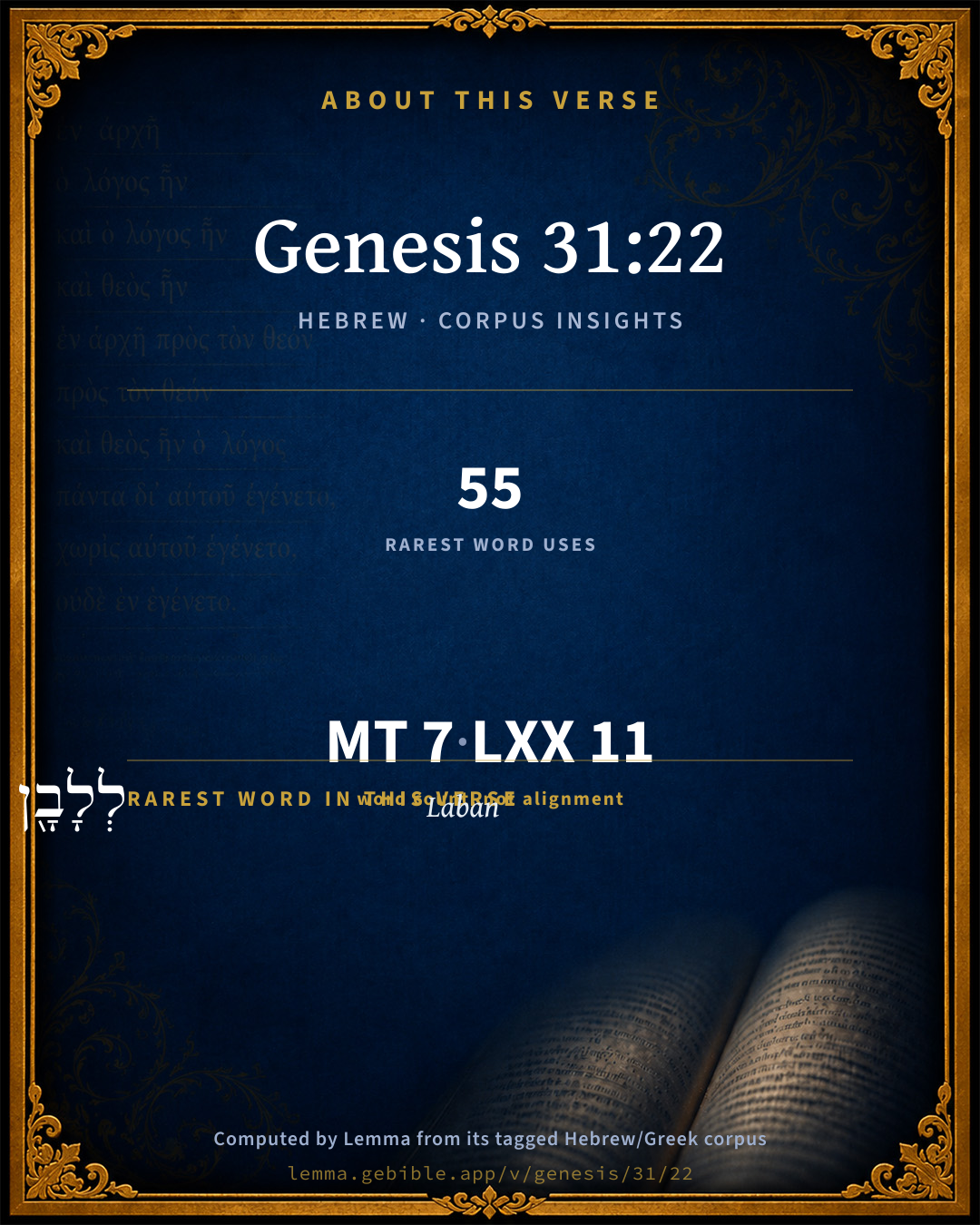
לְלָבָ֖ן Laban H3837 occurs in 47 verses of the Hebrew Bible. Also found in:

Grammatical profile

  • 2 verbs
  • 3 nouns
  • 1 adjective
  • 1 conjunction

Verb forms

  • וַיֻּגַּ֥ד Hophal · Sequential Imperfect
  • בָרַ֖ח Qal · Perfect

Hebrew & Septuagint length

In English translation the verse runs 11 words from the Hebrew and 15 from the Septuagint (LXX English) — closely comparable.

A rough comparison of the two English renderings, which tokenize alike — not a word-level alignment.

Word counts can differ between the Hebrew and the Greek without any difference in meaning — e.g. the Hebrew direct-object marker אֵת has no separate Greek word, and Greek often adds the article ὁ.

In the original languages it is 7 Hebrew tokens and 11 Greek tokens — but the two are counted differently (Hebrew bundles its prefixes and suffixes into one token; the Greek is in lemma form), so that isn’t a like-for-like length.

Cross-references

3

Topical passages linked to Genesis 31:22 in the Treasury of Scripture Knowledge — connected by theme and wording, ordered by reader-vote popularity; previews shown in the World English Bible.

  • Genesis 30:36 He set three days' journey between himself and Jacob, and Jacob fed the rest of Laban's flocks.
  • Exodus 14:5–31 It was told the king of Egypt that the people had fled; and the heart of Pharaoh and of his servants was changed towards the people, and they said, "What is this we have done, that we have let Israel go from serving us?"
  • Job 5:12–13 He frustrates the devices of the crafty, So that their hands can't perform their enterprise.

Cross-references courtesy of OpenBible.info (CC BY 4.0).

Hebrew and Greek witnesses Masoretic Hebrew ↔ Greek Septuagint

The same verse in the two great witnesses to the Old Testament, shown verse-for-verse.

These are two independent witnesses, not word-aligned to each other, and the Septuagint is shown in lemma (dictionary) form.

Hebrew Genesis 31:22 Masoretic · Westminster Leningrad Codex

וַיֻּגַּ֥ד לְלָבָ֖ן בַּיּ֣וֹם הַשְּׁלִישִׁ֑י כִּ֥י בָרַ֖ח יַעֲקֹֽב

Laban was told on the third day that Jacob had fled.

World English Bible · Public Domain

Greek LXX Genesis 31:22 Septuagint · lemma form

ἀναἀγγέλλω δέ λαβαν ὁ σύρος ὁ τρίτος ἡμέρα ὅτι ἀποδιδράσκω ἰακώβ

But it was told Laban the Syrian on the third day, that Jacob was fled.

LXX2012 (modern English Septuagint) · Public Domain

Hebrew: Westminster Leningrad Codex (CC BY 4.0). Greek: Septuagint (public domain); English from LXX2012 (modern English Septuagint) (Public Domain). How the Septuagint differs from the Hebrew →

Targum (Aramaic paraphrase)

2

The Targum is the ancient Jewish Aramaic paraphrase of the Hebrew Scriptures — an interpretive translation, not the Hebrew text itself. Onkelos (literal) and Pseudo-Jonathan (expansive) render the Torah, and Jonathan the Prophets. Coverage is partial: where no permissively-licensed English translation exists for a verse, only the Aramaic is shown. This is verse-level text, not a word-by-word alignment to the Hebrew.

  1. Targum Onkelos Torah (Genesis–Deuteronomy)
    וְאִתְחַוָא לְלָבָן בְּיוֹמָא תְלִיתָאָה אֲרֵי אֲזַל יַעֲקֹב

    (no public-domain English translation for this verse)

    Targum Onkelos — Aramaic: “Onkelos Genesis” (public domain); “Onkelos Exodus” (public domain); “Onkelos Leviticus” (public domain); “Onkelos Numbers” (public domain); “Onkelos Deuteronomy” (public domain). English: “Sefaria Community Translation” (CC0 1.0 (public-domain dedication)); “J.W. Etheridge. The Targums of Onkelos and Jonathan Ben Uzziel on the Pentateuch. London: Longmans, Green, 1862” (public domain). Text via Sefaria.

  2. Targum Pseudo-Jonathan Torah (Genesis–Deuteronomy)
    וּבָתַר דְאָזַל יַעֲקב קָמוּ רַעֲיָא עַל בֵּירָא וְלָא אַשְׁכָּחוּ מַיָא וְאַמְתִּינוּ תְלָתָא יוֹמִין דִילְמָא תְהֵי טַיְיפָא וְלָא טָפַת וּבְכֵן אִיתוֹי לְלָבָן בְּיוֹמָא תְּלִיתָאָה וִידַע אֲרוּם עָרַק יַעֲקב דְבִזְכוּתֵיהּ הֲוָה טַיְיפָא עֶשְרִין שְׁנִין

    But after Jakob had gone, the shepherds went to the well, but found no water; and they waited three days, if that it might (again) overflow; but it overflowed not; and then came they to Laban on the third day, and he knew that Jakob had fled; because through his righteousness it had flowed twenty years.

    Targum Pseudo-Jonathan — Aramaic: “Targum Jonathan on Genesis” (public domain); “Targum Jonathan on Exodus” (public domain); “Targum Jonathan on Leviticus” (public domain); “Targum Jonathan on Numbers” (public domain); “Targum Jonathan on Deuteronomy” (public domain). English: “The Targum of Jonathan ben Uzziel, trans. J. W. Etheridge, London, 1862” (public domain). Text via Sefaria.

Commentary

Notes on Genesis 31:22 from classic Christian and Jewish commentators (each source and its license shown beneath its notes). The classic Christian expositions comment on the surrounding passage and are grouped to its opening verse, so a note may address several verses; the Jewish commentaries on the Tanakh (Rashi and others) are per-verse, so they appear only where the commentator wrote on this verse.

Lemma curates 59 commentaries, every one of them public domain or Creative Commons licensed, each selected and text-cleaned for this edition rather than reprinted as found. About our sources →

Jamieson, Fausset & Brown

Robert Jamieson, A. R. Fausset & David Brown

LABAN PURSUES JACOB--THEIR COVENANT AT GILEAD. (Gen. 31:22-55)

it was told Laban on the third day--No sooner did the news reach Laban than he set out in pursuit, and he being not encumbered, advanced rapidly; whereas Jacob, with a young family and numerous flocks, had to march slowly, so that he overtook the fugitives after seven days' journey as they lay encamped on the brow of mount Gilead, an extensive range of hills forming the eastern boundary of Canaan. Being accompanied by a number of his people, he might have used violence had he not been divinely warned in a dream to give no interruption to his nephew's journey. How striking and sudden a change! For several days he had been full of rage, and was now in eager anticipation that his vengeance would be fully wreaked, when lo! his hands are tied by invisible power (Psa 76:10). He did not dare to touch Jacob, but there was a war of words.

Jamieson, Fausset & Brown — Commentary Critical and Explanatory on the Whole Bible (1871) — public domain (CC PDM 1.0). Text via the HelloAO Bible API.

Trapp's Complete Commentary

John Trapp

Gen 31:22 And it was told Laban on the third day that Jacob was fled.

Ver. 22. That Jacob was fled.] Here was verified that saying of Eliphaz, Job 5:12-13.

John Trapp, A Commentary or Exposition upon All the Books of the Old and New Testament (1647–1656) — public domain. Text from a community e-Sword module.

The Biblical Illustrator

Joseph S. Exell

Gen_31:22-42

Laban said to Jacob, What hast thou done, that thou hast stolen away unawares to me, and carried away my daughters,

. . . ?

--

Labans expostulation with Jacob, and Jacobs defence

I. LABANS EXPOSTULATION WITH JACOB.

1. There was, apparently, cause for just complaint.

(1) There were some criminal elements in the conduct of Jacob.

(2) There was unkindness and a breach of social obligations.

2. But this complaint was, really, the disguise of Labans own evil nature.

II. JACOBS DEFENCE.

1. He challenges proof of his dishonesty.

2. He appeals to many years of faithful and honest service. (T. H. Leale.)

Lessons

1. Laban, upon tidings of Jacobs deliverance, haste in fury to avenge themselves on them.

2. Wicked men of might join to themselves their allies, to help on their furious revenges.

3. Injustice and cruelty will spur souls on to the persecution of the innocent many days.

4. Envy and revenge will not give over pursuing the innocent until they overtake their prey (Gen_31:23). (G. Hughes, B. D.)

I. THE FLIGHT of Jacob from Laban.

1. Cause.

(1) Jealousy of Jacobs prosperity amongst Labans family (Gen_31:1).

(2) Jacob had himself been not very kindly treated by Laban (Gen_31:7).

(3) Command of God that he should return (Gen_31:13). Added to this, Rachael and Leah, also, were willing to depart, as feeling that they were not so welcome at home as formerly (Gen_31:14-15);

(4) and yet could not go away openly. Laban would have hindered him, or have prevented his carrying away the whole of his property (Gen_31:42).

2. Time. Sheepshearing. So important a duty that Laban must himself superintend it. He goes some distance from home. While Laban is absent, Jacob steals away. Collects his flocks and herds, servants and substance, and sets out over the desert which he had traversed some twenty-one years before with only his staff in his hand.

II. THE PURSUIT. Of Laban after Jacob. Laban did not hear of Jacobs flight till three days had passed. This part of the journey Jacob would naturally travel with all speed. So large a caravan could not march without leaving the plain track behind. Laban in pursuit for seven days, i.e., until ten days after Jacob had started. Reaching the mountains of Gilead and their defiles, and not overtaken; Jacob might think the pursuit had not been undertaken, or if so, then abandoned. Evening of tenth day Laban and his band approach. Too exhausted by the march to bring matters to an issue at once. The two camps retired to rest. Night settles down on the hills of Gilead, and watch fires, &c. Probably it was this night that Laban had a wonderful vision, in which he was warned respecting his treatment of Jacob. From the nature of the vision it is plain how murderous his intentions were.

III. THE PARTING. Of Jacob and Laban.

1. The controversy between Laban and Jacob. Labans charge against Jacob. Going by stealth. Leading his daughters as captives (comp. Verses 14, 15 with 26). Pretence of great affection (Gen_31:27-28). Assertion of power. Acknowledgment of Divine interference. Charge of stealing the idols.

2. Jacobs reply. Tells the truth (Gen_31:31), but not all the truth (comp. Verses 1-16). Repudiates, sternly and prompt]y, the charge of carrying off the images.

3. The search for the idols, which are not found.

4. They set up a memorial pillar, and so part at Mizpah. The two camps remaining there another night, and travelling, east and west, early in the morning, to meet no more. Learn:

I. Be thankful for the domestic relations of life, and that ours do not demand our flight from home and kindred.

II. Jacob bore cruel usage for twenty years, and even then did not prepare for flight till God had given him the command.

III. The vision sent to Laban shows that God would have family meetings peaceably conducted, and those who have had unkind thoughts, He would have them lay them aside.

IV. Christ Jesus, the Prince of Peace, is the Great Reconciler. (J. C. Gray.)

Lessons

1. The Almighty God appears seasonably to stop the rage of cruel oppressors against His saints.

2. Night apparitions in dreams God can make to terrify wicked enemies from their purposes.

3. God warns envious spirits, that they look to themselves, if they oppress His saints.

4. God curbs the spirits of wicked men sometimes, and charges them not to speak an evil word to His people (Gen_31:24). (G Hughes, B. D.)

Lessons

1. It is no harm for the wicked to overtake the righteous, while they are curbed by God.

2. Providence may bring enemies near to His saints, and yet keep mischief far off from them.

3. God can cause the righteous to pitch near their oppressors, and yet secure them (Gen_31:25). (G. Hughes, B. D. )

Lessons

1. The worst dealers are most apt to question others for their doings though good.

2. Violence questions innocency for escaping from its heart, though God call it.

3. The interrogatories of oppression pretend captivity of daughters, when they go freely (Gen_31:26).

4. Unreasonable oppressors require a reason of the innocents escape, where there needs none to be rendered; it being apparent.

5. Injurious men are displeased when the righteous escape without their knowledge.

6. Hypocritical violence may pretend a free dismission of the righteous, which it never meant. Labans music (Gen_31:27).

7. Unnatural fathers are apt to question others as causes of their unnaturalness to children.

8. Wicked and foolish men are very forward to charge the innocent with doing wickedly (Gen_31:28). (G. Hughes, B. D. )

Lessons

1. It is the property of wicked oppressors to boast of their strength, which is more than they have.

2. Wicked injurious men boast that they can do mischief against the righteous (Psa_52:1).

3. The hand of the wicked is ready to oppress the innocent, if God hinder not.

4. Wicked oppressors complain that God hinders them in their cruel designs.

5. The ungodly will not learn to own God, though they find Him too mighty for them.

6. Fear of self-destruction keeps oppressors from destroying saints.

7. God worshipped in truth by His, is stronger than God falsified by the wicked.

8. God maketh the wicked enemy confess His sovereignty sometimes against their will (Deu_31:1-30; Deu_32:29). (G. Hughes, B. D. )

Lessons

1. Plain and ready answers become the saints against the charges of the wicked.

2. Just fear of violence is a just ground of the saints escaping it, under Gods call.

3. Gods call and saints fear of dangers from men may well consist together.

4. Violent rapture of wives and children by cruel men may make the saints afraid of, and fly from it (Gen_31:31).

5. Holy souls abhor idols, and much more the covering of them.

6. Innocency is not afraid to put itself upon trial of life.

7. Plain honest hearts dare put themselves upon the search and judgment of their enemies.

8. Good fathers of families would have all with them innocent its themselves.

9. Good men may be too confident of the goodness of such as are under them.

10. Ignorance of others hearts and actions makes men so rash and confident of them (Gen_31:32). (G. Hughes, B. D. )

Lessons

1. False accusers of the saints are willing to turn every stone, to make good their charge upon them (Gen_31:33).

2. God in His wisdom useth the sins of one creature to frustrate the sin of others (Gen_31:31).

3. Sin once committed putteth souls upon more sin to conceal it.

4. Hypocrisy and lying is the way that sinners use to cover stealing.

5. God may bear with the iniquity of some to clear the innocency of others.

6. Such as seek occasion against the saints, God so orders, that they find it not (Gen_31:35). (G. Hughes, B. D. )

Jacob at Haran; or, The disciplinary retributions of life

I. THE RETRIBUTIONS THAT MARKED THE LIFE OF JACOB.

1. Jacob had sought by fraud, position and possession in his fathers house. He is now an exile from his fathers house--an outcast and a wanderer.

2. He who had defrauded Esau, is now himself defrauded by Laban.

3. He who had deceived his father was afterwards himself deceived by his sons.

4. Another form of retribution that awaited Jacob, was the having to encounter and deal with the brother whom he had so cruelly and foully wronged.

II. THE DISCIPLINARY CHARACTER OF THE RETRIBUTIONS THAT MARKED THE LIFE OF JACOB. We are slow to learn the lessons of a godly life by precept. God therefore teaches us them by experience. Jacobs character did certainly advance under the discipline.

1. At Haran he applied himself at once to honest industry, instead of having recourse to artifice and cunning.

2. A spirit of magnanimity marked many of his dealings with his uncle, contrasting favourably with his earlier indications of self-seeking. (W. Roberts.)

The years of servitude

I. THE RELIGIOUS CONSISTENCY OF JACOB.

1. His trials. And among these we should rank, as of the first importance, that he had been compelled by circumstances to dwell beyond the range of true piety, and to sojourn in an idolatrous land, and with an idolatrous family. Another of the trials to which Jacob was exposed, was the footing on which he stood in the family of Laban. The whole period had been to him a time of affliction; and, but for the favour of his God, this lengthened service, hard as it was, would have terminated in poverty. Except the God of my father, the God of Abraham, and the fear of Isaac, had been with me, surely thou hadst sent me away now empty. Jacob had no reason to expect such treatment as this from a cousin and a father-in-law. A third trial which Jacob had to endure was, to a feeling mind, peculiarly severe. His attachment to Rachel appears to have been sincere and ardent. He could not, then, but feel deeply the deception that was practised upon him. Among Jacobs trials we must enumerate also many of the scenes of domestic life.

2. We come to notice Jacobs errors.

3. But we turn now to a more gratifying subject of consideration, when we notice, the personal piety of Jacob--the influence which, during twenty years of trial, his principles had upon his personal character.

(1) With reference to his sobriety, excepting the error of polygamy, which was indirectly sanctioned, there is nothing on record against him. He was not guilty of any of that violence which had filled the earth, or of those vices which were too general all around him.

(2) With reference to the righteousness of his dealings with his fellow-men, he was zealous in the service of his master, moderate beyond measure in his requirements, and faithful in his engagements. He could appeal to Rachel and to Leah, Ye know that, with all my power, I have served your father. And he had their testimony, and even that of Laban, to the faithfulness of his service.

(3) Of his godliness there can be no question. It is manifest that he dwelt with God, and God with him. His habits were those of piety and communion with God; and even the language of Leah and of Rachel show that, by his influence, they were led to cultivate the same spirit. We are told that they prayed, and that God hearkened to them. The God of my fathers hath been with me, God suffered him not to hurt me. God hath taken away the cattle of your father, and given them to me. And again, Except the God of my father, the God of Abraham, and the fear of Isaac, had been with me, surely thou hadst sent me away now empty. God hath seen my affliction, and the labour of mine hands, and rebuked thee yesternight. And this view of Jacobs devotional habits is confirmed by the testimony of the sacred writer, that God really was with him.

II. But before we draw a practical conclusion from these things, there is another point on which we shall do well for a moment to delay. IT IS THE FAITHFULNESS OF GOD TO HIS SERVANT. God had made a covenant with Jacob by promise; and when Jacob journeyed onward from Bethel, the promise of Divine favour rested upon him. Jacob was pious, because God was gracious. Jacob persevered, because God was faithful. His God had promised to be with him, and to keep him in all places whither he should go; and not one word failed of all that the Lord had spoken to him of. The secret agency of Gods providence availed for his protection, and for his correction in righteousness. From this period, then, of the Patriarchs life, let us learn the wisdom of confiding ourselves to the care of the Almighty God. He careth for us. You, then, who are only entering upon the world, or are now struggling with its cares and its temptations--who feel how difficult it is to walk humbly, circumspectly, and without offence--let the twenty years of Jacobs hard service teach you a useful lesson. The path of probity and rectitude is the path of honour, happiness, and success. It is not man, but God that you serve, and He will not forget you. At the same time this history will administer to you a salutary caution. You must not expect deliverance precisely when you wish it, nor in the way most satisfactory to yourself. Clouds may gather when you look for sunshine. Look to the covenant of His grace, and lean upon it, for it shall not be moved; and determine, that by His grace you will faithfully fulfil all the relative duties of life, however painful and distressing. (E. Craig.)

Lessons

1. Faithfulness in good servants makes them undergo day and night labours for the good of their rulers.

2. Heat and cold consumptions with restless nights will grace incline to endure to honour God in service.

3. Such faithful service is a testimony against the wrongs and injustice of cruel masters (Gen_31:40).

4. Unwearied doth grace make souls to be in the service to which they are called by God.

5. Faithfulness will not let a soul to take wages or receive good gratis.

6. The best service may be repaid with hardest measure from griping masters.

7. Good service will rise in judgment against the hard dealings of evil rulers (Gen_31:41).

8. Where man is injurious God Himself will plead for righteous servants.

9. The true God is known to be the God of Abraham, Isaac, and Jacob.

10. Propriety in God and fear of Him is the best way of knowing God.

11. It is the design of wicked men to undo those in this world whom God doth own and will prosper in it.

12. God takes special notice of the sufferings and faithful doings of His servants towards wicked men.

13. God rebukes the envious and malicious spirit of cruel men against His righteous servants.

14. Gods approbation of His own and reprehension of the wicked is a full defence against false charges or criminations (Gen_31:42). (G. Hughes, B. D.)

Laban

Laban seeks to get Gods blessing, as it were, at second-hand. If men could be related to God indirectly, as if in law and not by blood, that would suit Laban. If God would admit men to His inheritance on any other terms than being sons in the direct line, if there were some relationship once removed, a kind of sons-in-law, so that mere connection with the godly, though not with God, would win His blessing, this would suit Laban. Laban is the man who appreciates the social value of virtue, truthfulness, fidelity, temperance, godliness, but wishes to enjoy their fruits without the pain of cultivating the qualities themselves. He is scrupulous as to the character of those he takes into his employment, and seeks to connect himself in business with good men. In his domestic life he acts on the idea which his experience has suggested to him, that persons really godly will make his home more peaceful, better regulated, safer than otherwise it might be. If he holds a position of authority, he knows how to make use, for the preservation of order and for the promotion of his own ends, of the voluntary efforts of Christian societies, of the trustworthiness of Christian officials, and of the support of the Christian community. But with all this recognition of the reality and influence of godliness, he never for one moment entertains the idea of himself becoming a godly man. In all ages there are Labans who clearly recognize the utility and worth of a connection with God, who have been much mixed up with persons in whom that worth was very conspicuous, and who yet, at the last, depart and return unto their place, like Jacobs father-in-law, without having themselves entered into any affectionate relations with God. (M. Dods, D. D.)

The Biblical Illustrator, edited by Joseph S. Exell (c. 1880s–1900s) — public domain. Text from a community e-Sword module.

Whedon's Commentary on the Bible

Daniel D. Whedon

LABAN’S PURSUIT, AND COVENANT WITH JACOB, Gen_31:22-55.

22. It was told Laban — Such a movement as Jacob’s, whose family and herds made a large caravan, could not long be kept a secret.

Daniel D. Whedon (gen. ed.), Commentary on the Old and New Testaments (1874–1909) — public domain. Text from a community e-Sword module.

The Pulpit Commentary

CHAPTER 31:22-44

And it was told Laban on the third dayi.e. the third after Jacob"s departure, the distance between the two sheep-stations being a three days" journey (vide Gen_30:36) that Jacob was fled. And he took his brethreni.e. his kinsmen, or nearest relations (cf. Gen_13:8 Gen_29:15) with him, and pursued after him (Jacob) seven days" journey (literally, a way of seven days); and they overtook him in the mount Gilead. The distance between Padan-aram and mount Gilead was a little over 300 miles, to perform which Jacob must at least have taken ten days, though Laban, who was less encumbered than his son-in-law, accomplished it in seven, which might easily be done by traveling from forty to forty-five miles a day, by no means a great feat for a camel.

Vers. 22-44.

Laban"s pursuit of Jacob.

I THE HOSTILE PREPARATION. Learning of his son-in-law"s departure, Laban at once determines on pursuit; not alone for the purpose of recovering his household gods, but chiefly with the view of wreaking his pent-up vengeance on Jacob, whom he now regarded as the spoiler of his fortunes, and if possible to capture and detain the much-coveted flocks and herds which he considered had been practically stolen by his nephew. Mustering his kinsmen by either force or fraud, by command enjoining those belonging to his household, and by misrepresentation probably beguiling such as were independent of his authority, he loses not a moment, but starts upon the trail of the fugitives. Worldly men are seldom slow in seeking to repair their lost fortunes, and angry men are seldom laggard in exacting revenge, it is only God"s vengeance that is slow-footed.

II THE DIVINE INTERPOSITION. Six days the wrathful Laban follows in pursuit of Jacob, and now the distance of one day is all that parts him from the fugitives. In a dream by night he is warned by Elohim to speak neither good nor bad to Jacob. The incident reminds us of the Divine superintendence of mundane affairs in general, and of God"s care for his people in particular; of the access which God ever has to the minds of his dependent creatures, and of the many different ways in which he can communicate his will; of his ability at all times to restrain the wrath of wicked men, and check the hands of evil-doers, who meditate the spoiling of his Church or the persecution of his saints.

III THE STORMY INTERVIEW.

I The pompous harangue of Laban. Laban gives way to

(1) Passionate reproach; charging Jacob with having clandestinely departed from his service and violently carried off his daughters, in the first of which Jacob did nothing wrong, while the second was a pure exaggeration ( vide ver. 16).

(2) Hypocritical affection; declaring that Jacob, had he, Laban, only known, might have been sent away with public demonstrations of rejoicing, while Rachel and Leah might have carried with them a parent"s kiss, if not a father"s blessing. But if Jacob"s leave-taking would in any way have excited Laban"s jubilation, it is doubtful if this would not have been traceable less to Laban"s regard for his son-in-law than to Laban"s anxiety about his flocks, which, in the absence of the spoiler, he might hope would become prolific as before; while as for Laban"s love for his daughters, one might fairly claim indemnity for suspecting an affection so recent in its origin, and so palpably contradicted by his previous behavior.

(3) Boastful assertion; passing on, like all weak natures who love to be considered formidable, to brag about his power to inflict injury on Jacob (ver. 29), and to hint that he only forbears to do so out of respect for God, who had appeared to him on the previous night.

(4) Direct accusation; ere he closes his oration, deliberately impeaching Jacob with having abstracted his teraphim.

2. The ingenuous response of Jacob. In this are discernible virtues worthy of imitation, if also infirmities deserving reprobation. If Jacob"s candor in declaring the reasons of his flight (ver. 31) and willingness to restore to Laban whatever property belonged to him (ver. 32) are examples to be copied, on the other hand, the over-confident assertion that no one had Laban"s gods, and the over-hasty imprecation on any who should be found possessing them, are not to be commended.

IV THE FRUITLESS SEARCH.

1. The missing gods. On the nature, probable origin, and uses of the teraphim see Exposition, ver. 19. The existence of these silver or wooden images in Laban"s tent was a proof of the religious declension, if not complete apostasy, of this branch of the family of Terah. Scripture never represents idolatry as an upward effort of the human heart, as a further development in the onward evolution of the soul (Sir J. Lubbock on the "Origin of Civilisation," p. 256); but always as a deterioration, or a retrogression, or a falling away of the human spirit from its rightful allegiance. The loss of Laban"s manufactured deities was a ridiculous commentary on the folly of worshipping or trusting in a god that could be stolen a complete reductio ad absurdum of the whole superstructure of idolatry (cf. 1Ki_18:27; Psa_115:4, Psa_115:8; Isa_43:19 Isa_46:6, Isa_46:7; Jer_10:5)

2. The anxious devotee. Invited by Jacob to make a search for his lost teraphim, Laban begins with Jacob"s tent, then with the tents of Bilhah and Zilpah, after which he passes into Leah"s, and finally comes to Rachel"s; but everywhere his efforts to recover his gods are defeated. What a spectacle of infinite humor, if it were not rather of ineffable sadness a man seeking for his lost gods! The gospel presents us with the opposite picture the ever-present God seeking for his lost children.

3. The lying daughter. If the conduct of Rachel in carrying off the images of her father was open to serious question (vide Exposition, ver. 19), her behavior towards her father in the tent was utterly inexcusable. Even if she spoke the truth in describing her condition, she was guilty of bare-faced deception. This particular passage in-Rachel"s history is painfully suggestive of the disastrous results of worldliness and irreligion in the training of children. Laban"s craft and Laban"s superstition had both been factors in Rachel"s education.

4. The deceived parent. Worse than being disappointed in his gods, Laban was dishonored by his daughter. But what else could he expect? Laban was only reaping as he had sowed. Marvelous and appropriate are God"s pro vide ntial retributions.

V THE PASSIONATE INVECTIVE. It was now Jacob"s turn to pour out the vials of his wrath upon Laban, and certainly it burned all the hotter because of its previous suppression.

1. He upbraids Laban with the unreasonableness of his persecution (ver. 36).

2. He taunts Laban with the fruitlessness of his search (ver. 37).

3. He reminds Laban of the faithful service he had given for twenty years (vers. 38-41).

4. He recalls the crafty attempts to defraud him of which Laban had been guilty (ver. 41).

5. He assures Laban that it was God"s gracious care, and neither his honesty nor affection, that had prevented him from being that day a poor man instead of a rich emir (ver. 42).

6. He somewhat fiercely bids Laban accept the rebuke which God had addressed to him the previous night.

VI THE AMICABLE SETTLEMENT. Doubtless much to Jacob"s surprise, the wrath of Laban all at once subsided, and a proposal came from him to bury past animosities, to strike a covenant of friendship with one another, and to part in peace. The seven days" journey, affording time for reflection; the Divine interposition, inspiring him with fear; the mortification resulting from his fruitless search, convincing him that he had really overstepped the bounds of moderation in accusing Jacob; the voice of conscience within his breast re-echoing the words of Jacob, and declaring them to be true; and perhaps the sight of his daughters at last touching a chord in the old man"s heart; all these may have contributed to this unexpected collapse in Laban; but whether or not, Jacob, as became him, cordially assented to the proposition.

Lessons:

1. The reality of God"s care for his people illustrated by the appearances of Elohim to Jacob and to Laban.

2. The miserable outcome of a worldly life exemplified in Laban.

3. The efficacy of a soft answer in turning away wrath proved by Jacob"s first response.

4. The difficulty of restraining angry speech within just bounds exemplified by both.

5. The folly of idolatry, as seen in Laban s lost teraphim.

6. The evil fruits of bad parental training, as they appear in Rachel.

7. The proper way of ending quarrels exhibited by Laban and Jacob in their covenant agreement.

The Pulpit Commentary (1880–1919), ed. H.D.M. Spence-Jones & Joseph S. Exell — public domain. Text from a community e-Sword module.

The Preacher's Complete Homiletical Commentary

Joseph S. Exell (gen. ed.)

CRITICAL NOTES.—

Gen_31:34. The camel’s furniture.] “This was a packsaddle, in the recesses of which articles might be deposited, and on which was a seat or couch for the rider.” (Murphy.)—

Gen_31:40. In the day the drought consumed me, and the frost by night.] In the East the hotter the day, the colder the night. (Jer_36:30; Psa_121:6.)—

Gen_31:42. The fear of Isaac.] “This is used as a name of God in His covenant relation. He who is the object of Isaac’s fear or reverential awe; like the Hope of Israel.” (Jer_14:8.) There is a similar use of the word “fear” as an object of fear, in Psa_31:11.; Pro_1:26-27.—Rebuked thee.]—“Judged thee, by giving forewarning against violent language.” (Jacobus.)—

MAIN HOMILETICS OF THE PARAGRAPH.—Gen_31:22-42

LABAN’S EXPOSTULATION WITH JACOB, AND JACOB’S DEFENCE

I. Laban’s Expostulation with Jacob. Jacob stole away “unawares,” taking with him his family, goods, and cattle. Laban, who overtook him, after seven days’ pursuit, complains of his conduct and expostulates with him.

1. There was, apparently, cause for just complaint.

(1.) There were some criminal elements in the conduct of Jacob. Laban complains that he had not only committed a serious moral fault, but also something of the nature of a crime and violent wrong against society. He accuses Jacob of acting like a thief in carrying off his daughters as booty. (Gen_31:26.)

(2.) There was unkindness and a breach of social obligations. Jacob by his conduct in this matter had denied Laban the opportunity of taking affectionate leave of his daughters. He had sinned against the tender charities of domestic life, and neglected his plain duty towards the family with whom he had cast his lot. (Gen_31:27-28.)

2. But this complaint was, really, the disguise of Laban’s own evil nature. Thus Laban complains that he had been robbed, when he was only envious and suspicious. Men are often that very thing themselves which they suspect in others. And they are quick to spy those very faults in others for which they themselves are notorious. Laban’s affection for his daughters was only a pretence. Consider his conduct towards them while they dwelt with him. He had kept them penniless, and now he wants to dismiss them with a generous feast. (Gen_31:14-15; Gen_31:27.) He is also passionate and revengeful while he appears to be pious. He asserts that his superior power puts Jacob at his mercy, but that he is restrained from hurting him by God’s injunction. (Gen_31:29.) But all this time he feels the passion of revenge burning within him, as if he would say to Jacob,—“I could crush you if I pleased, only that God has forbidden me.”

II. Jacob’s Defence.

1. He challenges proof of his dishonesty. He asserts that there was no ground for these accusations. Nothing was found in his possession that he had wrongly taken. (Gen_31:37).

2. He appeals to many many years of faithful and honest service. He had been scrupulous in his attention to every duty. Throughout his long service he had maintained a high sense of justice, and had even suffered loss himself rather than run the risk of committing a wrong, (Gen_31:38-39). He had led a hard and trying life. (Gen_31:40). And all this was the more praiseworthy, as it was for a bad and unthankful master. Jacob, in truth, owed nothing to Laban. He had fairly earned all that he had received. He had served Laban for twenty years, fourteen years of these for his two daughters, and six for the cattle. And all this time Laban had treated him with manifest injustice, changing his wages as often as he had the chance. (Gen_31:41). And only for the special favour of God, Jacob would have nothing, even now. (Gen_31:42). He could appeal to the fact that God was on his side, who had seen his affliction and rebuked his oppressor. (Gen_31:42).

SUGGESTIVE COMMENTS ON THE VERSES

Gen_31:22-23. He heard of it no earlier on account of the distance that intervened between his flocks and Jacob’s (compare ch. Gen_30:36 with ch. Gen_31:19). But no sooner does he hear of his son-in-law’s abrupt departure, than he collects a sufficient force from among his kinsmen and adherents, and sets out in hot pursuit of him. It is easy to see from this with what reception a formal request or proposal to be dismissed from his service that he might return to Canaan would have met at the hand of Laban. The patriarch was no doubt fully satisfied in his own mind that he must leave his employer clandestinely if he left him at all.—(Bush).

Gen_31:24. Such communications were anciently made to man independently of their moral character. The Divine influence, which makes known the will of God, or the coming events of His providence, is entirely different from that which is put forth in the renewal of men’s characters, and making them heirs of eternal life. Accordingly, we find such men as Abimelech, Laban, Balaam, and Nebuchadnezzar, made on particular occasions, and for particular purposes, the recipients of Divine revelations.—(Bush).

Gen_31:25. Seeing Laban so near, he set himself in as good order as he could, fearing the worst. But God was better to him than his fears. He spake for him, and so He can and doth oft for us in the hearts of our enemies. (Is. 41:9.)—(Trapp.)

Gen_31:26. Part of this accusation was unjust. The daughters of Laban had gone, of their own free will, with Jacob, and he had a right to take them with him.

The unjust and the oppressive are the most forward to question sharply the conduct of others.

Gen_31:27. The Easterns used to set out, at least on their long journeys, with music and valedictory songs. If we consider them, as they probably were, used not on common, but more solemn occasions, there appears peculiar propriety in the complaint of Laban.—(Harmer.)

Gen_31:28. His words are obviously full of hypocrisy and cant. However he may talk about his children and grandchildren, that which lay nearest his heart was the substance which Jacob had taken with him, and which he, no doubt, meant in some way to recover. But he acts the part of thousands, who, when galled by an evil conscience, endeavour to ease themselves of its reproaches by transferring the blame from themselves to the persons they have wronged.—(Bush.)

Gen_31:29. Truth will in the end make itself to appear, whatever may have been the disguises in which it was wrapped. Laban here virtually acknowledges the violent purpose with which he had undertaken the pursuit; but in the same breath he would fain make a merit of abstaining from the harm which he meditated. He would impress Jacob that he acted very religiously in paying so much deference to the warning voice of Jacob’s God. Thus do men sometimes vainly magnify as a virtue that which is imposed upon them through sheer necessity.—(Bush.)

Gen_31:30. Goodly gods that could not save themselves from the thief. (Jer_10:5; Jer_10:11; Jer_10:15.) Joseph suffered as a dishonest person; Elisha, as a troubler of the State; Jeremiah, as a traitor; Luther, as the trumpet of rebellion.—(Trapp.)

It must have gone sore against the heart of Jacob when he found that he was accused of stealing idols which he abhorred as an abomination.

Gen_31:31-32. With respect to the reiterated complaints of the secrecy of his departure, Jacob answers all in a few words. It was, “because I was afraid,” etc. This was admitting his power, but impeaching his justice; and as he had dwelt only upon the taking away of his daughters, so Jacob in answer confines himself to them. With respect to the goods, his answer is expressive of the strongest indignation. He will not deign to disown the charge; but desires that all his company might be searched. It was worthy of an upright man to feel indignant at the charge of stealing, and of a servant of God at that of stealing idols. But unless he had been as well assured of the innocence of all about him, as he was of his own, he ought not to have spoken as he did. His words might have proved a sorer trial to him than he was aware of.—(Fuller.)

It is wise not to be too confident in the goodness of those connected with us. Hasty speech may work much woe. How sorry would Jacob have been if Laban had found the images under Rachel, and taken him at his word! What a snare befel Jephthah by his rash speaking! Let, therefore, thy words be few, true, and ponderous.—(Trapp.)

Gen_31:33-34. Kitto thinks that it was under the common pack-saddle of the camel, which is high, and shaped so as to suit the ridge of the camel’s back; and that under this, or among the shawls, cloaks and rugs which are used to make the saddle easy for women, the teraphim were concealed. There was room enough under this for the small teraphim, or busts of human form, and Rachel, cunning as ever, did not lack a device and pretence to give her success. Laban could not think that in such circumstances she would sit upon his gods.—(Jacobus.)

Jacob finds himself pursued, accused, and searched. How painful to a man conscious of innocence! How little confidence Laban had in his veracity!

Gen_31:35. This apology was very necessary according to existing usages and feelings in the East, which inculcate the greatest external deference on the part of the children towards their parents. In Quintus Curtius, Alexander is represented as saying to the queen mother of Persia, “Understanding that it is in Persia considered a great offence for a son to be seated in the presence of his mother unless by her permission, I have always in my visits to you remained standing till you authorised me to sit.”—(Bush.)

Gen_31:36. A righteous man may feel unjust imputations keenly, and defend himself with the warmth and courage inspired by conscious innocence. The difficulty is to keep the storm, even of a noble passion, from stirring up evil. (Eph_4:26.)

Jacob now takes greater boldness, grows indignant, and retorts upon Laban with the sharpest crimination. He demands now the cause of such hot pursuit, and the ground of such severe accusations, which he could not at all prove. Little did Jacob dream of what Rachel had done, and of how the search might have turned the tables against him to the triumph of Laban. He had better not have been quite so sure of the innocence of all his family. Alas! he thinks they could do no such wrong; but he should rather not so freely offer the wrong-doer’s life as a forfeit.—(Jacobus.)

Gen_31:37. See the confidence of a clear conscience! Happy is he that can be acquitted by himself in private; in public by others; in both by God.—(Trapp.)

Gen_31:38. Jacob’s fidelity in this respect will appear more striking when contrasted with the opposite conduct of shepherds, whose neglected duties and abused functions are so graphically portrayed by the prophet. (Eze_34:1-5.)—(Bush.)

Gen_31:39-41. When one can show that he has been faithful, upright, and diligent in his office, he can stand up with a clear conscience and assert his innocence. A good conscience and a gracious God gives one boldness and consolation.—(Lange.)

In many parts of Asia very severe and even frosty nights are, even in winter, succeeded by very warm days; and it may be said, indeed, that the only experience of what we should call winter weather which the inhabitants obtain, is exclusively during the night-time. (Pictorial Bible.) Mr. Bruce, the Abyssinian traveller, lost all his camels by the cold in one night in the deserts of Senaar; and Volney relates an affecting story of a hapless wanderer who was like Jacob frozen by the north wind at night, and burnt by the dreadful heat of the sun by day. (Jer_36:30.)—(Bush.)

Gen_31:42. Laban had made a merit of obeying the dream, but Jacob shows that this Divine visitation was in itself an evidence of his evil designs. God intended thereby to rebuke him, and thus to plead the cause of the injured.

God is the perpetual and sure portion of His departed saints, and an object of holy fear to His saints on earth.

The Preacher's Complete Homiletical Commentary (gen. ed. Joseph S. Exell; Funk & Wagnalls, c. 1892) — public domain (pre-1929). A full-Bible homiletical/sermon-outline anthology covering 65 of 66 books (2 John is absent from the source module). Text from a community e-Sword module.

Keil & Delitzsch

C. F. Keil & F. Delitzsch

Laban's Pursuit, Reconciliation, and Covenant with Jacob. - As Laban was not told till the third day after the flight, though he pursued the fugitives with his brethren, i.e., his nearest relations, he did not overtake Jacob for seven days, by which time he had reached the mountains of Gilead (Gen 31:22-24). The night before he overtook them, he was warned by God in a dream, "not to speak to Jacob from good to bad," i.e., not to say anything decisive and emphatic for the purpose of altering what had already occurred (vid., Gen 31:29, and the note on Gen 24:50). Hence he confined himself, when they met, "to bitter reproaches combining paternal feeling on the one hand with hypocrisy on the other;" in which he told them that he had the power to do them harm, if God had not forbidden him, and charged them with stealing his gods (the teraphim).

Keil & Delitzsch — Biblical Commentary on the Old Testament (1861–1891) — public domain (CC PDM 1.0). Text via the HelloAO Bible API. (Old Testament only.)

Tyndale Open Study Notes

Tyndale Open Resources

31:22-23 The theft of the idols (31:19) was probably the main reason that Laban and his men chased Jacob. It was one thing for Jacob to take his family and flocks—Laban probably still believed they were all his—but another matter entirely to take his household gods. Laban may have feared that Jacob would return someday to claim all of Laban’s estate. When he failed to find the gods, he asked for a treaty to keep Jacob away (31:43-53). • It took Laban seven days to catch up with Jacob.

Tyndale Open Study Notes — © Tyndale Open Resources, licensed CC BY-SA 4.0. Text via the HelloAO Bible API.

John Gill's Exposition

And God came to Laban the Syrian in a dream by night,.... It is probable that Laban came to Mount Gilead late in the evening, and so had no sight of, or conversation with Jacob until the morning; and that night God came to him, and in a dream advised him as follows: or it may be rendered, "and God had come", &c. (f); in one of the nights in which he had lain upon the road; though the former seems best to agree with Gen 31:29; the Targum of Jonathan has it, an angel came; and the Jews (g) say it was Michael; by whom, if they understand the uncreated Angel, the Son of God, it is right:

and said unto him, take heed that thou speak not to, Jacob either good or bad; not that he should keep an entire silence, and enter into no discourse with him on any account, but that he should say nothing to him about his return to Haran again; for it was the will of God he should go onward towards Canaan's land; and therefore Laban should not attempt to persuade him to return, with a promise of good things, or of what great things he would do for him; nor threaten him with evil things, or what he would do to him if he would not comply to return with him.

(f) "et venerat", Pagninus, Montanus, Tigurine version; so Aben Ezra. (g) Pirke Eliezer, c. 36.

John Gill's Exposition of the Whole Bible (1746–1763) — public domain (CC PDM 1.0). Text via the HelloAO Bible API.

Haydock's Catholic Bible Commentary

Third day. He was gone to shear his sheep, distant three days’ journey.

George Leo Haydock (1774–1849), Haydock's Catholic Family Bible and Commentary, 1859 edition — public domain. Excludes Psalms (Douay-Rheims chapter numbering differs from Protestant) and Deuterocanonical books (Catholic canon only).

Matthew Poole's English Annotations

That he heard of it no sooner must be ascribed to the great distance which Laban had put between his and Jacob’s flocks, Gen 30:36, and to the care and art which Jacob used to prevent a sooner discovery.

Matthew Poole's English Annotations on the Holy Bible (1683–1685) — public domain. Text from a community e-Sword/MySword module.

unfoldingWord translationNotes

Door43 World Missions Community

On the third day

It was Jewish custom to count the day of departure as day one. AT: "Two days after they had left"

Laban was told

This can be stated in active form. AT: "someone told Laban" (See: Active or Passive)

that Jacob had fled

Only Jacob is mentioned because he is the leader of the family. It can be made explicit that his family went with him. AT: "that Jacob had fled with his wives and children" (See: Assumed Knowledge and Implicit Information)

So he took

"So Laban took"

pursued him

"chased after Jacob"

for a seven days' journey

Laban spent seven days walking to catch up to Jacob.

He overtook him

"He caught up to him"

translationWords

day

Laban

Jacob

Gilead

unfoldingWord translationNotes — © Distant Shores Media and the Door43 World Missions Community, licensed CC BY-SA 4.0. Source: git.door43.org/Door43/en_tn.

Rashi

Rabbi Shlomo Yitzchaki (Rashi)

ביום השלישי ON THE THIRD DAY—for there was a journey of three days between them.

Rashi on the Tanakh — English translations: “The Judaica Press complete Tanach with Rashi, translated by A. J. Rosenberg” (CC BY 4.0); “Pentateuch with Rashi's commentary by M. Rosenbaum and A.M. Silbermann, 1929-1934” (public domain); “The Metsudah Tanach series, Lakewood, N.J” (CC BY 4.0); and “The Book of Joshua, Metsudah Publications, 1997” (CC BY 4.0). Text via Sefaria.

Ramban (Nachmanides)

Rabbi Moshe ben Nachman (Ramban / Nachmanides)

ON THE THIRD DAY. For there was a journey of three days between them. Seven days’ journey— throughout these three days during which the messenger had travelled to tell Laban that Jacob had proceeded on his journey, Jacob was consequently a six days’ journey distance from Laban. On the seventh day, [that is, on the day during which Jacob covered the stretch of ground which made him seven days’ journey distance from Laban’s starting point, Laban] overtook him. We may thus infer that the entire distance which Jacob covered in six days, Laban covered in one day. These are the words of Rashi quoting Bereshith Rabbah. It is correct that Laban should proceed as a strong man to run his course, for such is the way of pursuers. However, Laban had set a three days’ journey between his flock and the flock which was in Jacob’s care, not between the city and his flock. Thus if Laban tended his flocks to the east of the city, Jacob did so to the west, and between them there was a three days’ journey. Now Jacob began his journey from the city, in which were his wives, sons and daughters, and all his belongings with the exception of the flocks. The fact of his flight was told to Laban on the third day since they were not aware of it on the first day, and then Laban returned to his nearby city and took his brethren from there, and starting from his city he pursued him for seven days. [Hence, it should have been said that what Jacob covered in ten days Laban covered in seven days!] We must say then, according to the opinion of Bereshith Rabbah, that it was from the field where the flocks were that Jacob left for the journey, and that Laban took his brethren with him from the shearers of his flocks. [Since there was a three days’ journey between them at the outset and Jacob had already travelled for three days, they were thus six travel days apart. On that day Laban was informed, and the following day he pursued him and overtook him. Jacob meanwhile had covered an additional day’s distance, with the result that the distance Jacob travelled in seven days, Laban covered in one day].In Pirkei d’Rabbi Eliezer it appears that Laban returned to his city, and from there he took all mighty men and all valiant ones, and he pursued Jacob from there.

Ramban (Nachmanides) on the Tanakh — English translation: “Commentary on the Torah by Ramban (Nachmanides). Translated and annotated by Charles B. Chavel. New York, Shilo Pub. House, 1971-1976” (CC BY 4.0). Text via Sefaria.

Radak

Rabbi David Kimhi (Radak)

ויגד...ביום השלישי, we explained this construction vayugad in 27,42.

Radak on the Tanakh — English translations: “Sefaria Community Translation” (CC0 1.0 (public-domain dedication)); “Eliyahu Munk, HaChut Hameshulash” (CC BY 4.0); “Rabbi Mike Feuer, Jerusalem Anthology” (CC BY 4.0); and “R. David Kimhi on the first book of Psalms, Translated by R.G. Finch, London, 1919” (public domain). Text via Sefaria.

Lesson kit

Teaching starters — assembled from the data on this page, not authored interpretation. Every prompt links to the verse data it draws on. Edit before teaching.

Genesis, in the Pentateuch, opens this verse with 7 words (7 distinct Hebrew lemmas). Its most distinctive word is Lâbân (“Laban”). A historical commentator’s framing appears above. Read the whole chapter for the surrounding context.

Discussion questions

  1. How does “Laban” (Lâbân) shape what this verse is saying?
  2. Genesis 24:29 shares the word «Laban» with this verse. How do the two illuminate each other?
  3. The translations on this page render this verse differently — a whole-verse word diff, not a word-by-word alignment. What might account for the different wordings?
  4. The verb «וַיֻּגַּ֥ד» is Hophal Sequential Imperfect. How does its form color the action?
  5. Reading how Jamieson, Fausset & Brown and Trapp's Complete Commentary read this verse, where do the two commentators agree and where do they part?

Things to notice

Reading settings

Reading text

Shown beneath each verse's original-language words.

Old Testament
Old Testament edition

Read the OT as the Masoretic Hebrew (MT) or the Greek Septuagint (LXX).

English shown for the Greek Septuagint (in the Hebrew ↔ Greek comparison).

Comparing translations? Open the Compare panel on any verse page to stack up to four side by side.