Psalms 78:5

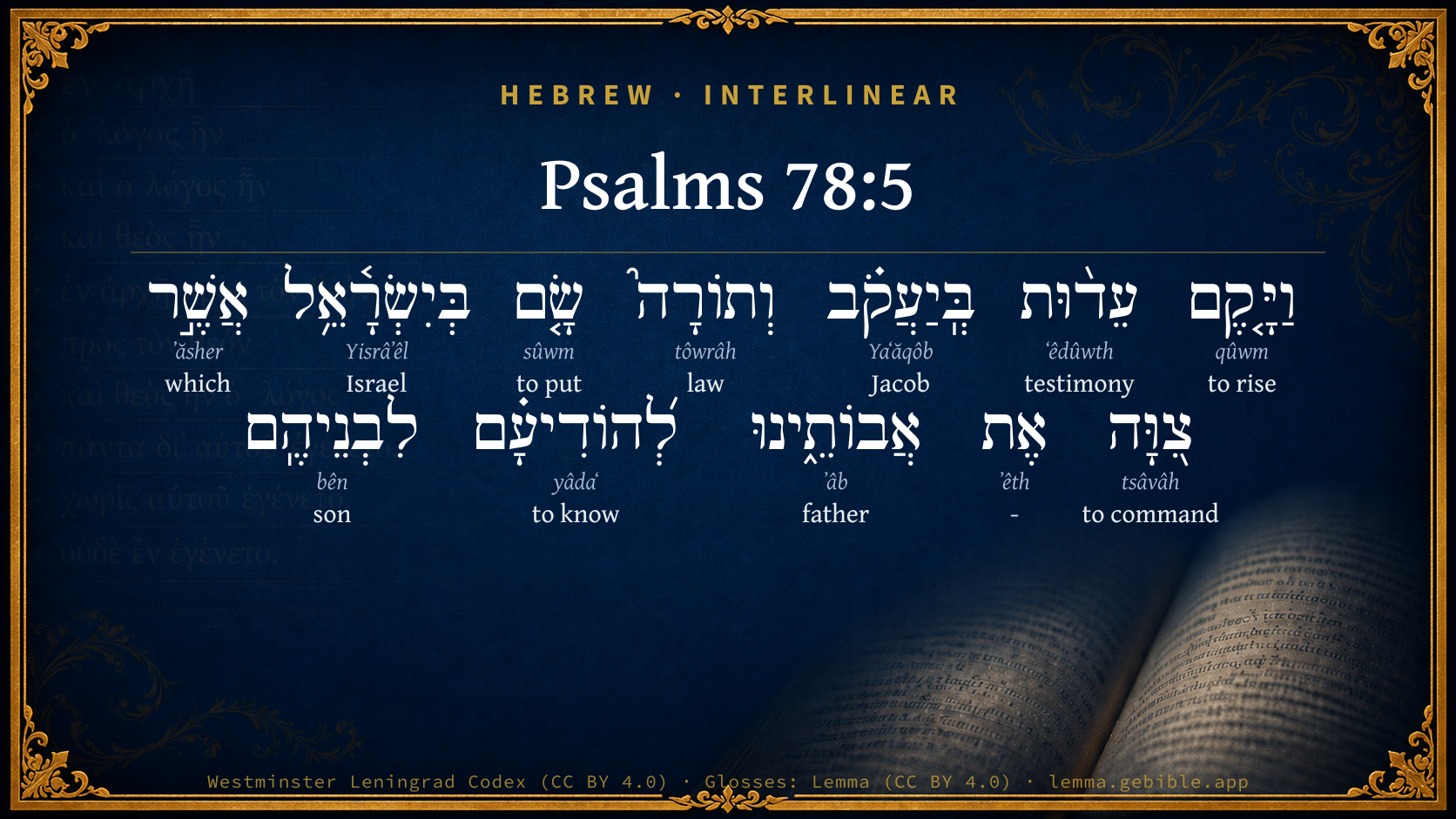
Hebrew (Westminster Leningrad Codex) Psalms 78:5 appears in the Hebrew Old Testament. The text above is from the Westminster Leningrad Codex. Each word links to its Strong’s number, a concise gloss, and parsing drawn from the Open Scriptures Hebrew Bible morphology. Click any word for its full Brown-Driver-Briggs (BDB) entry.
Download image
Cite this verse

Psalms 78:5 (World English Bible). Public Domain. Lemma interlinear Bible study tool, https://lemma.gebible.app/v/psalms/78/5.

Show BibTeX & RIS
BibTeX
RIS
English Translation
For he established a testimony in Jacob, And appointed a law in Israel, Which he commanded our fathers, That they should make them known to their children;
World English Bible · Public Domain
Download a study sheet

One document with this verse’s original text, its word-by-word gloss line, the meaning frame, cross-references with their text, attributed commentary, and full source and license credits — printable, and it pastes into notes with its structure intact.

This verse Autodidact and up

Study sheet (.html) Plain text (.txt)

A passage Seminary Student

Up to 50 verses in one chapter. A passage sheet keeps up to 6 commentary sources and 12 cross-references per verse, in the order this page ranks them, and says so on the sheet whenever that leaves anything out. Ask for a single verse and you get the Autodidact verse sheet above.

Everything on this page stays free to read, with no account — the sheet is a download of what is already on screen, not access to it.

Want to remove ads? Support Godless Engineer
Compare translations 3

The same verse in 3 English versions, stacked beneath the original-language interlinear above. Click any original word for its lexicon entry.

Each is an independent rendering of the whole verse — the interlinear is not word-aligned to these translations.

Highlighted words mark where these versions differ — a whole-verse word diff, not a word-by-word alignment.

  • World English Bible Public Domain
    For he established a testimony in Jacob, And appointed a law in Israel, Which he commanded our fathers, That they should make them known to their children;
  • King James Version Public Domain
    For he established a testimony in Jacob, and appointed a law in Israel, which he commanded our fathers, that they should make them known to their children:
  • unfoldingWord Literal Text CC BY-SA 4.0
    And he established a testimony in Jacob and appointed a law in Israel, which he commanded our fathers to teach them to their children,

unfoldingWord Literal Text — © unfoldingWord, licensed CC BY-SA 4.0. Word-aligned USFM3 via Door43 (git.door43.org/unfoldingWord/en_ult).

Versions to compare (up to 4)

3 of 4 selected

Show all 18 translations

Every available English version of this verse, each an independent rendering of the whole verse.

  • World English Bible Public Domain
    For he established a testimony in Jacob, And appointed a law in Israel, Which he commanded our fathers, That they should make them known to their children;
  • Berean Standard Bible Public Domain
    For He established a testimony in Jacob and appointed a law in Israel, which He commanded our fathers to teach to their children,
  • Majority Standard Bible Public Domain
    For He established a testimony in Jacob and appointed a law in Israel, which He commanded our fathers to teach to their children,
  • King James Version Public Domain
    For he established a testimony in Jacob, and appointed a law in Israel, which he commanded our fathers, that they should make them known to their children:
  • American Standard Version (1901) Public Domain
    For he established a testimony in Jacob, And appointed a law in Israel, Which he commanded our fathers, That they should make them known to their children;
  • Revised Version (1885) Public Domain
    For he established a testimony in Jacob, and appointed a law in Israel, which he commanded our fathers, that they should make them known to their children:
  • Geneva Bible (1599) Public Domain
    How he established a testimonie in Iaakob, and ordeined a Law in Israel, which he commanded our fathers, that they shoulde teache their children:
  • Douay-Rheims (1899) Public Domain
    And he set up a testimony in Jacob: and made a law in Israel. How great things he commanded our fathers, that they should make the same known to their children:
  • Young's Literal Translation Public Domain
    And He raiseth up a testimony in Jacob, And a law hath placed in Israel, That He commanded our fathers, To make them known to their sons.
  • Literal Standard Version CC BY-SA 4.0
    And He raises up a testimony in Jacob, || And has placed a law in Israel, || That He commanded our fathers, || To make them known to their sons.
  • Unlocked Literal Bible CC BY-SA 4.0
    For he established covenant decrees in Jacob and appointed a law in Israel. He commanded our ancestors that they were to teach them to their children.
  • unfoldingWord Literal Text CC BY-SA 4.0
    And he established a testimony in Jacob and appointed a law in Israel, which he commanded our fathers to teach them to their children,
  • Darby Bible Public Domain
    For he established a testimony in Jacob, and appointed a law in Israel, which he commanded our fathers, that they should make them known to their children;
  • World Messianic Bible Public Domain
    For he established a covenant in Jacob, and appointed a teaching in Israel, which he commanded our fathers, that they should make them known to their children;
  • Webster's Bible Public Domain
    For he established a testimony in Jacob, and appointed a law in Israel, which he commanded our fathers, that they should make them known to their children:
  • Free Bible Version CC BY-SA 4.0
    He gave his laws to the descendants of Jacob; his instructions to the people of Israel. He commanded our forefathers to teach them to their children,
  • Bible in Basic English Public Domain
    He put up a witness in Jacob, and made a law in Israel; which he gave to our fathers so that they might give knowledge of them to their children;
  • JPS Tanakh (1917) Public Domain
    For He established a testimony in Jacob, and appointed a law in Israel, which He commanded our fathers, that they should make them known to their children;

Literal Standard Version (2020), Covenant Press — licensed CC BY-SA 4.0. Text via the HelloAO Bible API (eBible.org). Unlocked Literal Bible (unfoldingWord) — licensed CC BY-SA 4.0. Text via the HelloAO Bible API (eBible.org). unfoldingWord Literal Text — © unfoldingWord, licensed CC BY-SA 4.0. Word-aligned USFM3 via Door43 (git.door43.org/unfoldingWord/en_ult). Free Bible Version, Dr. Jonathan Gallagher — licensed CC BY-SA 4.0. Text via the HelloAO Bible API (eBible.org).

Word by word

More ways to search: Search by grammar → Find every occurrence → Compare this word →

Practice this passage: Drill this verse → Learn its vocabulary →

עֵד֨וּת
ʻêdûwth
H5715
“testimony”
Noun, Common, Feminine, Singular, Absolute
Part of Speech
Noun
Type
Common
Gender
Feminine
Number
Singular
State
Absolute
Full BDB Definition

Origin: from H5707

TWOT: 1576f

testimony
  1. וַיָּ֤קֶם qûwm H6965 “and · to rise” Conjunction + Verb, Hiphil, Sequential Imperfect, 3rd Person, Masculine, Singular
  2. בְּֽיַעֲקֹ֗ב Yaʻăqôb H3290 “in/at · Jacob” Preposition + Noun, Proper
  3. וְתוֹרָה֮ tôwrâh H8451 “and · law” Conjunction + Noun, Common, Feminine, Singular, Absolute
  4. שָׂ֤ם sûwm H7760 “to put” Verb, Qal, Perfect, 3rd Person, Masculine, Singular
  5. בְּיִשְׂרָ֫אֵ֥ל Yisrâʼêl H3478 “in/at · Israel” Preposition + Noun, Proper
  6. אֲשֶׁ֣ר ʼăsher H834 “which” Particle, Relative
  7. צִ֭וָּה tsâvâh H6680 “to command” Verb, Piel, Perfect, 3rd Person, Masculine, Singular
  8. אֶת ʼêth H853 “-” Particle, Direct Object
  9. אֲבוֹתֵ֑ינוּ ʼâb H1 “fathers · our” Noun, Common, Masculine, Plural, Construct + Suffix, Personal, 1st Person, Common, Plural
  10. לְ֝הוֹדִיעָ֗ם yâdaʻ H3045 “to know · them” Preposition + Verb, Hiphil, Infinitive Construct + Suffix, Personal, 3rd Person, Masculine, Plural
  11. לִבְנֵיהֶֽם bên H1121 “to/for · sons · their” Preposition + Noun, Common, Masculine, Plural, Construct + Suffix, Personal, 3rd Person, Masculine, Plural

About this verse

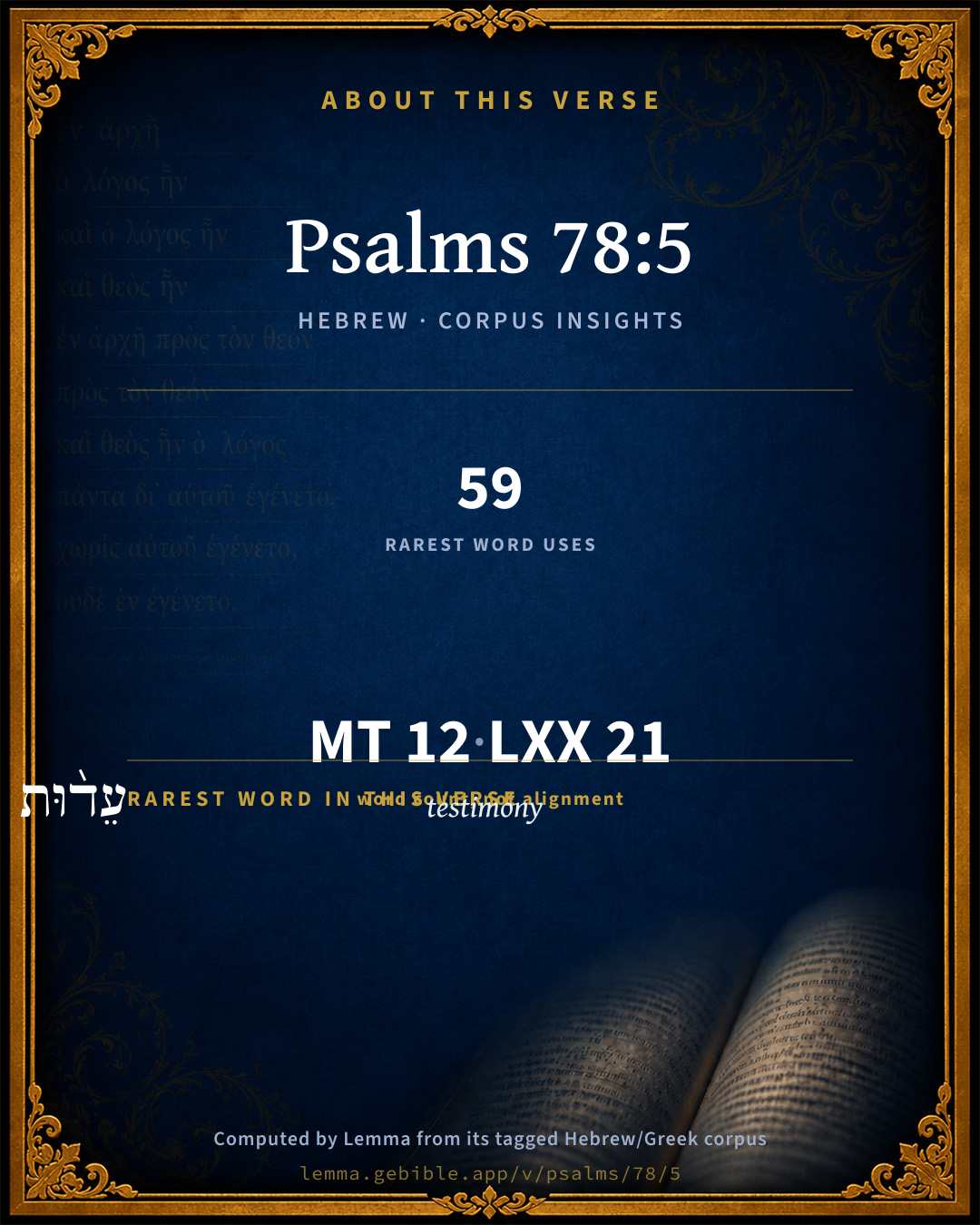
These counts appear in no published source. They are computed here, from the morphology-tagged text and Lemma’s own curated glosses. What Lemma adds →

12
words
12
distinct lemmas
Wisdom
section

Shared distinctive vocabulary

עֵד֨וּת testimony H5715 occurs in 57 verses of the Hebrew Bible. Also found in:

Grammatical profile

  • 4 verbs
  • 6 nouns
  • 2 particles

Verb forms

  • וַיָּ֤קֶם Hiphil · Sequential Imperfect
  • שָׂ֤ם Qal · Perfect
  • צִ֭וָּה Piel · Perfect
  • לְ֝הוֹדִיעָ֗ם Hiphil · Infinitive Construct

Hebrew & Septuagint length

In English translation the verse runs 27 words from the Hebrew and 26 from the Septuagint (LXX English) — closely comparable.

A rough comparison of the two English renderings, which tokenize alike — not a word-level alignment.

Word counts can differ between the Hebrew and the Greek without any difference in meaning — e.g. the Hebrew direct-object marker אֵת has no separate Greek word, and Greek often adds the article ὁ.

In the original languages it is 12 Hebrew tokens and 21 Greek tokens — but the two are counted differently (Hebrew bundles its prefixes and suffixes into one token; the Greek is in lemma form), so that isn’t a like-for-like length.

Cross-references

18

Topical passages linked to Psalms 78:5 in the Treasury of Scripture Knowledge — connected by theme and wording, ordered by reader-vote popularity; previews shown in the World English Bible.

  • Ephesians 6:4 You fathers, don't provoke your children to wrath, but nurture them in the discipline and instruction of the Lord.
  • Genesis 18:19 For I have known him, to the end that he may command his children and his household after him, that they may keep the way of Yahweh, to do righteousness and justice; to the end that Yahweh may bring on Abraham that which he has spoken of him."
  • Deuteronomy 4:45 these are the testimonies, and the statutes, and the ordinances, which Moses spoke to the children of Israel, when they came forth out of Egypt,
  • Deuteronomy 6:7 and you shall teach them diligently to your children, and shall talk of them when you sit in your house, and when you walk by the way, and when you lie down, and when you rise up.
  • Psalms 81:5 He appointed it in Joseph for a testimony, When he went out over the land of Egypt, I heard a language that I didn't know.
  • Deuteronomy 11:19 You shall teach them your children, talking of them, when you sit in your house, and when you walk by the way, and when you lie down, and when you rise up.
  • Isaiah 8:20 To the law and to the testimony! if they don't speak according to this word, surely there is no morning for them.
  • Isaiah 38:19 The living, the living, he shall praise you, as I do this day: The father to the children shall make known your truth.
  • Romans 3:2 Much in every way! Because first of all, they were entrusted with the oracles of God.
  • Exodus 25:21 You shall put the mercy seat on top of the ark, and in the ark you shall put the testimony that I will give you.
  • Exodus 40:3 You shall put the ark of the testimony in it, and you shall screen the ark with the veil.
  • Psalms 19:7 Yahweh's law is perfect, restoring the soul. Yahweh's testimony is sure, making wise the simple.
  • Psalms 78:3–4 Which we have heard and known, And our fathers have told us.
  • 1 John 5:9–12 If we receive the witness of men, the witness of God is greater; for this is God's testimony which he has testified concerning his Son.
  • Exodus 25:16 You shall put the testimony which I shall give you into the ark.
  • Psalms 119:152 Of old I have known from your testimonies, That you have founded them forever.
  • Psalms 147:19 He shows his word to Jacob; His statutes and his ordinances to Israel.
  • Exodus 40:20 He took and put the testimony into the ark, and set the poles on the ark, and put the mercy seat above on the ark.

Cross-references courtesy of OpenBible.info (CC BY 4.0).

Hebrew and Greek witnesses Masoretic Hebrew ↔ Greek Septuagint

The same verse in the two great witnesses to the Old Testament, shown verse-for-verse.

You’re reading Greek Psalm 77 (Hebrew Psalm 78). The Septuagint counts the superscription, so verse numbers can differ from the Hebrew — chapter-level alignment, not verse-by-verse. Numbering follows Rahlfs.

These are two independent witnesses, not word-aligned to each other, and the Septuagint is shown in lemma (dictionary) form.

Hebrew Psalms 78:5 Masoretic · Westminster Leningrad Codex

וַיָּ֤קֶם עֵד֨וּת בְּֽיַעֲקֹ֗ב וְתוֹרָה֮ שָׂ֤ם בְּיִשְׂרָ֫אֵ֥ל אֲשֶׁ֣ר צִ֭וָּה אֶת אֲבוֹתֵ֑ינוּ לְ֝הוֹדִיעָ֗ם לִבְנֵיהֶֽם

For he established a testimony in Jacob, And appointed a law in Israel, Which he commanded our fathers, That they should make them known to their children;

World English Bible · Public Domain

Greek LXX Greek Psalm 77:5 Septuagint · lemma form

καί ἀναἵστημι μαρτύριον ἐν ἰακώβ καί νόμος τίθημι ἐν ἰσραήλ ὅσος ἐντέλλομαι ὁ πατήρ ἐγώ ὁ γνωρίζω αὐτός ὁ υἱός αὐτός

And he raised up a testimony in Jacob, and appointed a law in Israel, which he commanded our fathers, to make it known to their children:

LXX2012 (modern English Septuagint) · Public Domain

Hebrew: Westminster Leningrad Codex (CC BY 4.0). Greek: Septuagint (public domain); English from LXX2012 (modern English Septuagint) (Public Domain). How the Septuagint differs from the Hebrew →

Commentary

Notes on Psalms 78:5 from classic Christian and Jewish commentators (each source and its license shown beneath its notes). The classic Christian expositions comment on the surrounding passage and are grouped to its opening verse, so a note may address several verses; the Jewish commentaries on the Tanakh (Rashi and others) are per-verse, so they appear only where the commentator wrote on this verse.

Lemma curates 59 commentaries, every one of them public domain or Creative Commons licensed, each selected and text-cleaned for this edition rather than reprinted as found. About our sources →

Trapp's Complete Commentary

John Trapp

Psa 78:5 For he established a testimony in Jacob, and appointed a law in Israel, which he commanded our fathers, that they should make them known to their children:

Ver. 5. For he established a testimony in Jacob, &c.] Lest any should attribute too much to ancient traditions, and to show that antiquity must have no more authority than what it can maintain; the psalmist here (as afterwards the prophet Isaiah) calleth them to the law and to the testimonies; for if any speak not according to this word, it is because there is no light in them, Isa 8:20.

John Trapp, A Commentary or Exposition upon All the Books of the Old and New Testament (1647–1656) — public domain. Text from a community e-Sword module.

The Biblical Illustrator

Joseph S. Exell

Psa_78:5-8

For He established a testimony in Jacob, and appointed a law in Israel . . . that they should make them known to their children.

The parents prerogative: how is it used

Dr. Adam Clarke reminds us that there are no less than five generations specified in these verses. God has blessed no age for its own sake only. There is a chain of Divine purposes in the history of Gods dealings with men, one link of which joins another in continuous progression until all, in their united and related capacity, present one completed purpose which is all-embracing and Godlike. This truth was repeatedly emphasized in the earliest days of Gods special dealings with the Jewish people. Moreover, the duty of handing down to succeeding generations the truth which they had received was specially enforced in the case of parents, the natural guardians of the rising race, and, therefore, according to the law of Moses, the first special custodians of Divine truth. It is important to notice how tenaciously the Jewish people clung to the title the Children of Israel, and how frequently in later days, when the title Children of Israel had fallen into comparative disuse, they nevertheless clung to the memory of their fathers, especially the three great primitive fathers of the race--Abraham, Isaac, and Jacob. All this shows what a large place the family and its associations and relationships occupied in the life of the nation. There can be no doubt that it is Gods will that the parent should be the first teacher and guide of the family, and if this is neglected by the parent no one else can fully compensate for that neglect. Hence the repeated emphasis placed in the Old Testament on the duties of parents. I say parents because the law demanded filial honour alike to father and mother. Now, in the household of the Jew there were certain religious duties to be performed by the mother. For instance, the lighting of the Sabbath lamp, as also the preparation of the Sabbath meal, and the fastening of the scroll of parchment upon the door-post, was done, not by the father, but the mother. Thus Jewish children from their earliest age learnt to associate certain religious acts commemorative of great facts in the history of Gods dealings with the nation with some of the mothers duties. The child would ask, Mother, what are you doing? She would reply, Kindling the Sabbath lamp, or Preparing the Sabbath meal, or Fastening the parchment upon the door-post so that all may know we love and serve the Lord God of Israel. She would also tell the child the spiritual significance of all these customs. Thus the mother was a mighty power in Israel in forming the character, and determining the destiny, of the rising race. Moreover, the mother was the privileged teacher of the child during the earliest and most impressionable period of his life, and, oh, how wonderfully the Jewish mother availed herself of this opportunity! We find a striking instance of the mothers influence, even in a home, far away from any synagogue, where, moreover, the father was a heathen man, in Pauls allusion to Timothy, who from a child had known the Holy Scriptures. Now, parents, will you relinquish that vantage ground upon which God has placed you? Will you give it up instead of availing yourself of your prerogative to the fully Are you willing to send your children forth to the world without the advantage of your unique influence? Is it your will that, though you have the power placed in your hands so to influence your children that they shall find it exceptionally difficult to forget you and your teaching, they shall yet go forth into this fashionable, giddy, sinful world without the advantage of any such training as God calls upon you to give them, and all this because you idly trust that somehow or other some self-denying teacher may compensate for your neglect? Oh, parents, to have a conscience void of offence, and our hands clean so that not a spot of their blood shall remain upon us! (D. Davies.)

Bible education, and its safest guarantee

I. The real ground of the duty of transmitting knowledge from man to man. It is not a work of choice, to be done or not done, to be done partially or done heartily and entirely, at our option and after our judgment; but a positive duty laid down and imposed upon us by the express command of the Most High.

II. What kind of knowledge God has commanded to be imparted.

1. God has specially honoured and particularly prescribed religious knowledge. Indeed, what can be more inconsistent or unwise, than to educate man for time, add to leave his soul unfitted, unstored, untaught for the measureless eternity through which it will endure?

2. God has not excluded other instruction.

III. The time which God particularly specifies for imparting instruction (Deu_11:18-19; Isa_28:9, etc.). (C. Hebert, M. A.)

Children to be instructed in the Scriptures

I. The peculiar benefit which the Lord conferred upon Israel. He established a testimony in Jacob, and appointed a law in Israel. The law and the testimony may now be said to belong to us, and to belong to us in a far more eminent sense than they ever did to Israel. The canon of Scripture is now completed. We have not only Moses and the prophets, but also the evangelists and the apostles. We are favoured with all the revelations which in different ages of the world it has pleased God to communicate to His Church, and particularly with the glorious gospel of His grace.

II. The important duty which God required Israel to discharge in virtue of the benefit conferred upon them. Having established a testimony in Jacob, and appointed a law in Israel, He commanded the fathers, etc. In proportion as the glory of the Gospel excels that of the law, are our obligations to see that the minds of our children are well imbued with its truths. And is not a knowledge of those truths absolutely necessary to their well-being and happiness? Can they be saved without it? Must they not perish without it? What is the body to the soul? Or what are the concerns of time compared with those of eternity? Let us weigh them in the balances of the sanctuary, end we shall find them to be lighter than vanity. Shall these, then, engross our cares in reference to our children, while we overlook their best and highest interests? (D. Bees.)

The Biblical Illustrator, edited by Joseph S. Exell (c. 1880s–1900s) — public domain. Text from a community e-Sword module.

The Treasury of David

Charles H. Spurgeon

Ver. 5. For he established a testimony in Jacob. The favoured nation existed for the very purpose of maintaining God's truth in the midst of surrounding idolatry. Theirs were the oracles, they were the conservators and guardians of the truth.

And appointed a law in Israel, which he commanded our fathers, that they should make them known to their children. The testimony for the true God was to be transmitted from generation to generation by the careful instruction of succeeding families. We have the command for this oral transmission very frequently given in the Pentateuch, and it may suffice to quote one instance from De 6:7: "And thou shalt teach them diligently unto thy children, and shalt talk of them when thou sittest in thine house, and when thou walkest by the way, and when thou liest down, and when thou risest up." Reader, if you are a parent, have you conscientiously discharged this duty?

Ver. 5. He established a testimony in Jacob, etc. The meaning is, that God ordered a law, and commanded that the fathers should each one tell his children those things which he had learned from his parents. In this verse therefore we understand by testimony and law, that particular law which is written in De 4:9 in these words: "Only take heed to thyself, and keep thy soul diligently, lest thou forget the things which thine eyes have seen, and lest they depart from thy heart all the days of thy life: but teach them thy sons, and thy son's sons." Simon de Muis.

Ver. 5. By the testimony and law are meant the whole contents of the Pentateuch, the direct commandments contained in it, and the deeds of the Lord, which are to be considered as indirect commandments: for all the deeds of God contain a kernel of instruction, of duty, and of warning; "I have done this for thee, what dost thou for me?" E. W. Hengstenberg.

Ver. 5. To their children. He who learns the law in his youth, resembles him that writes easily on new and pliable parchment; but he who begins to learn it in his old age, is like a man that tries to write on old and shrivelled parchment. John Van den Driesche, (Drusius.) 1550-1616.

Ver. 5-6. Five generations appear to be mentioned:

1. Fathers;

2. Their children;

3. The generation to come;

4. And their children;

5. And their children. Adam Clarke.

Ver. 5. Scriptural tradition, or the heirloom of the gospel.

Ver. 5-8. Family religion.

I. The fathers' knowledge the children's heritage--

Ps 78:5-6.

II. The fathers' fall the children's preservation--

Ps 78:7-8.

Ver. 5-8.

I. Truth once started can never be arrested--Ps 78:5-6.

II. Truth received binds the soul to God--Ps 78:7.

III. Truth rejected lights up beacons for others--

Ps 78:8.

Psalms 78:6*

Ver. 5-6. Five generations appear to be mentioned:

1. Fathers;

2. Their children;

3. The generation to come;

4. And their children;

5. And their children. Adam Clarke.

Ver. 5-8. Family religion.

I. The fathers' knowledge the children's heritage--

Ps 78:5-6.

II. The fathers' fall the children's preservation--

Ps 78:7-8.

Ver. 5-8.

I. Truth once started can never be arrested--Ps 78:5-6.

II. Truth received binds the soul to God--Ps 78:7.

III. Truth rejected lights up beacons for others--

Ps 78:8.

Ver. 5-8. Family religion.

I. The fathers' knowledge the children's heritage--

Ps 78:5-6.

II. The fathers' fall the children's preservation--

Ps 78:7-8.

Ver. 5-8.

I. Truth once started can never be arrested--

Ps 78:5-6.

II. Truth received binds the soul to God--Ps 78:7.

III. Truth rejected lights up beacons for others--

Ps 78:8.

Charles H. Spurgeon's The Treasury of David (1869–1885) — public domain. Psalms only. Text from a community e-Sword/MySword module.

J. A. Alexander on Psalms

Joseph Addison Alexander

5. (Psa 78:5) And set up a testimony in Jacob, and a law established in Israel, which he commanded our fathers, to make them known unto their sons. The essential idea here conveyed still is, that the traditional transmission of God's mighty deeds entered into the very end or purpose for which Israel existed as a nation.

Joseph Addison Alexander, The Psalms Translated and Explained (1850) — public domain. Text from a community e-Sword module.

Tyndale Open Study Notes

Tyndale Open Resources

78:5-6 The telling of the story should motivate God’s people to obey what he commanded (Deut 6:4-9).

Tyndale Open Study Notes — © Tyndale Open Resources, licensed CC BY-SA 4.0. Text via the HelloAO Bible API.

Geneva Bible (1599)

Geneva Bible translators

By the testimony, and law, he meaneth the law written, which they were commanded to teach their children, Deut. 6:7.

Geneva Bible (1599) marginal notes — public domain. Text via Bolls.life.

Adam Clarke's Commentary

Verse 5. A testimony in Jacob] This may signify the various ordinances, rites, and ceremonies prescribed by the law; and the word law may mean the moral law, or system of religious instruction, teaching them their duty to God, to their neighbour, and to themselves. These were commanded to the fathers-the patriarchs and primitive Hebrews, that they should make them known to their children, who should make them known to the generation that was to come, whose children should also be instructed that they might declare them to their children; to the end that their hope might be in God, that they might not forget his works, and might keep his commandments: that they might not be as their fathers, but have their heart right and their spirit steadfast with God, Ps 78:6-8. Five generations appear to be mentioned above:

1. Fathers;

2. Their children;

3. The generation to come;

4. And their children;

5. And their children.

They were never to lose sight of their history throughout all their generations. Some think the testimony here may mean the tabernacle.

Adam Clarke's Commentary on the Bible (1810–1826) — public domain. Text from a community e-Sword/MySword module.

John Calvin's Commentaries

5. He established a testimony in Jacob. As the reception or approbation of any doctrine by men would not be a sufficient reason for yielding a firm assent to its truth, the prophet proceeds farther, and represents God as the author of what he brings forward. He declares, that the father’s were not led to instruct their children in these truths under the mere impulse of their own minds, but by the commandment of God. Some understand the words, He hath established a testimony in Jacob, and appointed a law in Israel, as implying that God had established a decree in Jacob, to be observed as an inviolable rule, which was, that the deliverance divinely wrought for the people should be at all times in the mouth of every Israelite; but this seems to give too restricted a sense. I therefore consider statute, or testimony, and law, as referring to the written law, which, however, was partly given for this end, that by the remembrance of their deliverance, the people, after having been once gathered into one body, might be kept in their allegiance to God. The meaning then is, that God not only acquired a right to the Jews as his people by his mighty power, but that he also sealed up his grace, that the knowledge of it might never be obliterated. And, undoubtedly, it was then registered as it were in public records, when the covenant was ratified by the written law, in order to assure the posterity of Abraham that they had been separated from all other nations. It would have been a matter of very small importance to have been acquainted with, or to have remembered the bare history of what had been done, had their eyes not been, at the same time, directed to the free adoption and the fruit of it. The decree then is this, That the fathers being instructed in the doctrine of the law themselves, should recount, as it were, from the mouth of God, to their children, that they had been not only once delivered, but also gathered into one body as his Church, that throughout all ages they might yield a holy and pure obedience to him as their deliverer. The reading of the beginning of the second clause of the verse properly is, Which he commanded, etc. But the relative אשר, asher, which, I have no doubt, is here put by way of exposition for namely, or that is, he commanded, etc. I have translated it for, which amounts to the same thing.

John Calvin's Commentaries (1540-1563) — public domain. Text from the Calvin Translation Society English edition (1840s-50s) via the Christian Classics Ethereal Library (ccel.org). Calvin's coverage is partial (roughly two-thirds of the Bible); uncommented books and verses are honest gaps, never fabricated. The 19th-century editor's footnotes and remarks are omitted so the notes are faithfully Calvin's own voice.

Ellicott's Commentary for English Readers

(5) For he . . .—Better, taking the relative of time (comp. Deu_11:6; Psa_139:15), For he established (it as) a testimony in Jacob and (as) a law appointed (it) in Israel when he commanded our forefathers to make them (the “wonderful works” of last verse) known to their children. For the custom see reference in margin.

A Bible Commentary for English Readers, edited by Charles John Ellicott (1878–1897) — public domain. Text from a community e-Sword module.

The Cambridge Bible for Schools and Colleges

gen. ed. J. J. S. Perowne

5. a testimony … a law] Not the Mosaic legislation generally, but the express precept which enjoined upon Israelite parents the duty of teaching their children the great facts of Israel’s history, that the remembrance of them might be handed down from generation to generation. See Exo_10:2; Exo_12:26-27; Exo_13:8 ff., Exo_13:14; Deu_4:9; Deu_6:20 ff. Cp. in the N.T. 2Ti_2:2.

that they should make them known] Them refers to “the things which we have heard and known” &c., Psa_78:3-4. Cp. Deu_4:9.

The Cambridge Bible for Schools and Colleges (gen. ed. J. J. S. Perowne; Cambridge University Press, 1878–1918) — public domain. Text from a community e-Sword module.

John Gill's Exposition

For he established a testimony in Jacob,.... So the law is called, being a testification of the divine will, Exo 25:16 and the Scriptures, the writings of the Old Testament, which testify of Christ, his person, office, sufferings, and death, Isa 8:20 and particularly the Gospel, which is the testimony of God, of our Lord Jesus Christ, and of his apostles, Ti2 1:8 which bears witness to the love and grace of God in the salvation of men by Christ; to the dignity of Christ's person, to the fulness of his grace, to each of the offices and relations he bears and stands in to his people; to the virtue of his obedience, sufferings, and death; to redemption, righteousness, peace and pardon by him: this is established in the house of Jacob, as the Targum; in the church, which is the pillar and ground of truth, among the saints and people of God, to whom it is delivered, and by whom it will be kept, and with whom it will remain throughout all ages; for it is the everlasting Gospel:

and appointed a law in Israel; the law given on Mount Sinai was peculiar to them, and so were the word and oracles, they were committed to them; and not only the writings of Moses, but the prophets, are called the law, Joh 10:34, but the Gospel seems to be here meant; see Gill on Psa 78:1, this was ordained before the world for our glory, and is put and placed in the hands and hearts of the faithful ministers of it, and is published among, and received by, the true Israel of God:

which he commanded our fathers that they should make them known to their children; that is, the testimony and the law, and the things contained in them; the Jewish fathers were frequently commanded to teach their children the law of Moses, Deu 4:9 and it was their practice to instruct them in the knowledge of the Scriptures, Ti2 3:15, and it becomes Christian parents to bring up their children in the nurture and admonition of the Lord, by making known to them the principles of the Christian religion, and the truths of the Gospel, Eph 6:4.

John Gill's Exposition of the Whole Bible (1746–1763) — public domain (CC PDM 1.0). Text via the HelloAO Bible API.

Albert Barnes' Notes on the Bible

For he established a testimony in Jacob - He ordained or appointed that which would be for a “witness” for him; that which would bear testimony to his character and perfections; that which would serve to remind them of what he was, and of his authority over them. Any law or ordinance of God is thus a standing and permanent witness in regard to his character as showing what he is.

And appointed a law in Israel - That is, He gave law to Israel, or to the Hebrew people. Their laws were not human enactments, but were the appointments of God.

Which he commanded our fathers ... - He made it a law of the land that these testimonies should be preserved and faithfully transmitted to future times. See Deu 4:9; Deu 6:7; Deu 11:19. They were not given for themselves only, but for the benefit of distant generations also.

Albert Barnes' Notes on the Bible (1834–1885) — public domain. Text from a community e-Sword/MySword module.

Matthew Poole's English Annotations

He established: this is justly put in the first place, as the chief of all the following mercies, and the foundation both of their temporal and of their eternal felicity.

A testimony, i.e. his law, as it is called in the next clause; which is very oft called a testimony, because it is a witness between God and men, declaring both the duties which God expects from man, and the promises and blessings which man in the performance of his duty may expect from God.

In Jacob, peculiarly; for no other nation enjoyed this privilege, as is more fully expressed, Psa 147:19,20. Which testimony or law God revealed to them, not for their own private use, but for the benefit of all their posterity, whom their parents were obliged to teach, Deu 6:7, and all their children to hear, and read, and study; by which we may see how contrary to the mind of God that foolish and wicked assertion is, that ignorance is the mother of devotion.

Matthew Poole's English Annotations on the Holy Bible (1683–1685) — public domain. Text from a community e-Sword/MySword module.

The Pulpit Commentary

For he established a testimony in Jacob, and appointed a law in Israel. The "testimony" and the "law" are the whole series of commands given by God to his people, beginning with the directions concerning circumcision in Genesis, (Gen_17:10-14) and terminating with the last precept in Deuteronomy. (Deu_32:46) They may include also the teachings of God through history. These he commanded our fathers, that they should make them known to their children. (see Exo_12:26, 27 13:8, 14, 15 Deu_4:9 Deu_6:7 Deu_11:19 Deu_32:46, etc.)

The Pulpit Commentary (1880–1919), ed. H.D.M. Spence-Jones & Joseph S. Exell — public domain. Text from a community e-Sword module.

John Wesley's Explanatory Notes

Established - This is justly put in first place, as the chief of all his mercies. A testimony - His law, called a testimony, because it is a witness between God and men, declaring the duties which God expects from man, and the blessings which man may expect from God.

John Wesley, Explanatory Notes Upon the Whole Bible (1754–1765) — public domain. Text via the GEBible commentary corpus.

unfoldingWord translationNotes

Door43 World Missions Community

he established

"Yahweh established"

covenant decrees

Other possible meanings are "testimonies" or "laws."

translationWords

covenant

decree

Jacob

appoint

law, laws

Israel

command

teach

generation

unfoldingWord translationNotes — © Distant Shores Media and the Door43 World Missions Community, licensed CC BY-SA 4.0. Source: git.door43.org/Door43/en_tn.

Lesson kit

Teaching starters — assembled from the data on this page, not authored interpretation. Every prompt links to the verse data it draws on. Edit before teaching.

Psalms, in the Wisdom, opens this verse with 12 words (12 distinct Hebrew lemmas). Its most distinctive word is ʻêdûwth (“testimony”). A historical commentator’s framing appears above. Read the whole chapter for the surrounding context.

Discussion questions

  1. The word ʻêdûwth carries the sense “testimony.” How does it shape the verse?
  2. Exodus 16:34 shares the word «testimony» with this verse. How do the two illuminate each other?
  3. These translations render this verse differently; the difference is in the English rendering, not the original. What questions does that raise?
  4. The verb «וַיָּ֤קֶם» is Hiphil Sequential Imperfect. How does its form color the action?
  5. Reading how Trapp's Complete Commentary and The Biblical Illustrator read this verse, where do the two commentators agree and where do they part?

Things to notice

Reading settings

Reading text

Shown beneath each verse's original-language words.

Old Testament
Old Testament edition

Read the OT as the Masoretic Hebrew (MT) or the Greek Septuagint (LXX).

English shown for the Greek Septuagint (in the Hebrew ↔ Greek comparison).

Comparing translations? Open the Compare panel on any verse page to stack up to four side by side.