
Genesis 25:33

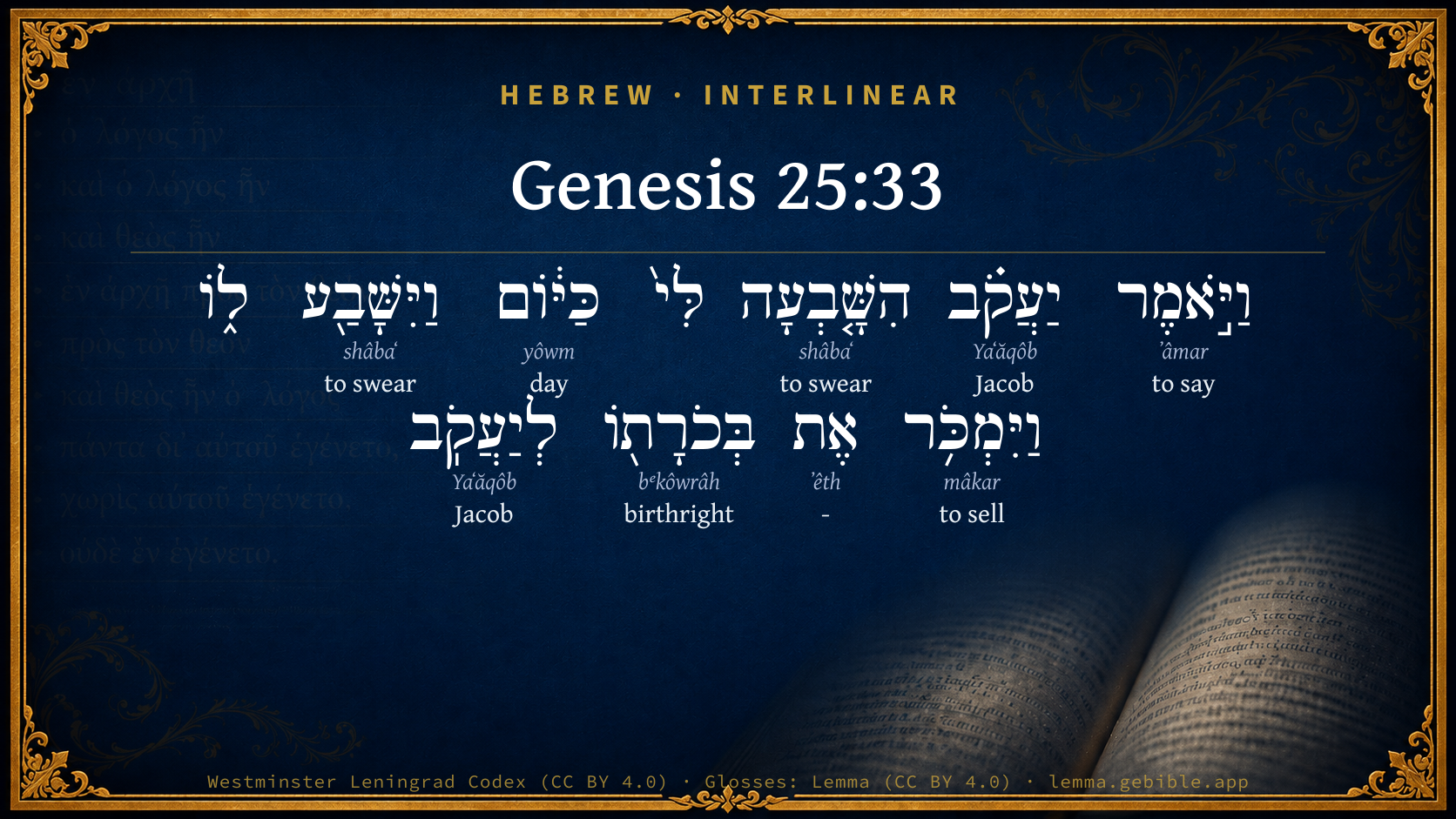
Hebrew (Westminster Leningrad Codex) Genesis 25:33 appears in the Hebrew Old Testament. The text above is from the Westminster Leningrad Codex. Each word links to its Strong’s number, a concise gloss, and parsing drawn from the Open Scriptures Hebrew Bible morphology. Click any word for its full Brown-Driver-Briggs (BDB) entry.
Download image
Cite this verse

Genesis 25:33 (World English Bible). Public Domain. Lemma interlinear Bible study tool, https://lemma.gebible.app/v/genesis/25/33.

Show BibTeX & RIS
BibTeX
RIS
English Translation
Jacob said, "Swear to me first." He swore to him. He sold his birthright to Jacob.
World English Bible · Public Domain
Download a study sheet

One document with this verse’s original text, its word-by-word gloss line, the meaning frame, cross-references with their text, attributed commentary, and full source and license credits — printable, and it pastes into notes with its structure intact.

This verse Autodidact and up

Study sheet (.html) Plain text (.txt)

A passage Seminary Student

Up to 50 verses in one chapter. A passage sheet keeps up to 6 commentary sources and 12 cross-references per verse, in the order this page ranks them, and says so on the sheet whenever that leaves anything out. Ask for a single verse and you get the Autodidact verse sheet above.

Everything on this page stays free to read, with no account — the sheet is a download of what is already on screen, not access to it.

Want to remove ads? Support Godless Engineer
Compare translations 3

The same verse in 3 English versions, stacked beneath the original-language interlinear above. Click any original word for its lexicon entry.

Each is an independent rendering of the whole verse — the interlinear is not word-aligned to these translations.

Highlighted words mark where these versions differ — a whole-verse word diff, not a word-by-word alignment.

  • World English Bible Public Domain
    Jacob said, "Swear to me first." He swore to him. He sold his birthright to Jacob.
  • King James Version Public Domain
    And Jacob said, Swear to me this day; and he sware unto him: and he sold his birthright unto Jacob.
  • unfoldingWord Literal Text CC BY-SA 4.0
    But Jacob said, “Swear to me on this day!” So he swore to him and sold his birthright to Jacob.

unfoldingWord Literal Text — © unfoldingWord, licensed CC BY-SA 4.0. Word-aligned USFM3 via Door43 (git.door43.org/unfoldingWord/en_ult).

Versions to compare (up to 4)

3 of 4 selected

Show all 18 translations

Every available English version of this verse, each an independent rendering of the whole verse.

  • World English Bible Public Domain
    Jacob said, "Swear to me first." He swore to him. He sold his birthright to Jacob.
  • Berean Standard Bible Public Domain
    “Swear to me first,” Jacob said. So Esau swore to Jacob and sold him the birthright.
  • Majority Standard Bible Public Domain
    “Swear to me first,” Jacob said. So Esau swore to Jacob and sold him the birthright.
  • King James Version Public Domain
    And Jacob said, Swear to me this day; and he sware unto him: and he sold his birthright unto Jacob.
  • American Standard Version (1901) Public Domain
    And Jacob said, Swear to me first. And he sware unto him. And he sold his birthright unto Jacob.
  • Revised Version (1885) Public Domain
    And Jacob said, Swear to me this day; and he sware unto him: and he sold his birthright unto Jacob.
  • Geneva Bible (1599) Public Domain
    Iaakob then said, Sweare to me euen now. And he sware to him, and solde his birthright vnto Iaakob.
  • Douay-Rheims (1899) Public Domain
    Jacob said: Swear therefore to me. Esau swore to him, and sold his first birthright.
  • Young's Literal Translation Public Domain
    and Jacob saith, `Swear to me to-day:' and he sweareth to him, and selleth his birthright to Jacob;
  • Literal Standard Version CC BY-SA 4.0
    And Jacob says, “Swear to me today”: and he swears to him, and sells his birthright to Jacob;
  • Unlocked Literal Bible CC BY-SA 4.0
    Jacob said, “First swear to me,” so Esau swore an oath and in that way he sold his birthright to Jacob.
  • unfoldingWord Literal Text CC BY-SA 4.0
    But Jacob said, “Swear to me on this day!” So he swore to him and sold his birthright to Jacob.
  • Darby Bible Public Domain
    And Jacob said, Swear unto me now. And he swore unto him, and sold his birthright to Jacob.
  • World Messianic Bible Public Domain
    Jacob said, “Swear to me first.” He swore to him. He sold his birthright to Jacob.
  • Webster's Bible Public Domain
    And Jacob said, Swear to me this day; and he swore to him: and he sold his birth-right to Jacob.
  • Free Bible Version CC BY-SA 4.0
    “First you have to swear to me,” Jacob demanded. So Esau swore an oath selling his rights of the firstborn to Jacob.
  • Bible in Basic English Public Domain
    And Jacob said, First of all give me your oath; and he gave him his oath, handing over his birthright to Jacob.
  • JPS Tanakh (1917) Public Domain
    And Jacob said: 'Swear to me first'; and he swore unto him; and he sold his birthright unto Jacob.

Literal Standard Version (2020), Covenant Press — licensed CC BY-SA 4.0. Text via the HelloAO Bible API (eBible.org). Unlocked Literal Bible (unfoldingWord) — licensed CC BY-SA 4.0. Text via the HelloAO Bible API (eBible.org). unfoldingWord Literal Text — © unfoldingWord, licensed CC BY-SA 4.0. Word-aligned USFM3 via Door43 (git.door43.org/unfoldingWord/en_ult). Free Bible Version, Dr. Jonathan Gallagher — licensed CC BY-SA 4.0. Text via the HelloAO Bible API (eBible.org).

Word by word

More ways to search: Search by grammar → Find every occurrence → Compare this word →

Practice this passage: Drill this verse → Learn its vocabulary →

בְּכֹרָת֖וֹ
bᵉkôwrâh
H1062
“birthright · his”
Noun, Common, Both, Singular, Construct + Suffix, Personal, 3rd Person, Masculine, Singular
Part of Speech
Noun
Type
Common
Gender
Both
Number
Singular
State
Construct
Full BDB Definition

Origin: from H1060

TWOT: 244c

birthright, primogeniture, right of the first-born
  1. וַיֹּ֣אמֶר ʼâmar H559 “and · to say” Conjunction + Verb, Qal, Sequential Imperfect, 3rd Person, Masculine, Singular
  2. יַעֲקֹ֗ב Yaʻăqôb H3290 “Jacob” Noun, Proper
  3. הִשָּׁ֤בְעָה shâbaʻ H7650 “swear” Verb, Niphal, Imperative, 2nd Person, Masculine, Singular + Suffix, h
  4. כַּיּ֔וֹם yôwm H3117 “like/as the · day” Preposition, Determined + Noun, Common, Masculine, Singular, Absolute
  5. וַיִּשָּׁבַ֖ע shâbaʻ H7650 “and · to swear” Conjunction + Verb, Niphal, Sequential Imperfect, 3rd Person, Masculine, Singular
  6. וַיִּמְכֹּ֥ר mâkar H4376 “and · to sell” Conjunction + Verb, Qal, Sequential Imperfect, 3rd Person, Masculine, Singular
  7. אֶת ʼêth H853 “-” Particle, Direct Object
  8. לְיַעֲקֹֽב Yaʻăqôb H3290 “to/for · Jacob” Preposition + Noun, Proper

About this verse

These counts appear in no published source. They are computed here, from the morphology-tagged text and Lemma’s own curated glosses. What Lemma adds →

11
words
7
distinct lemmas
Pentateuch
section

Notable vocabulary

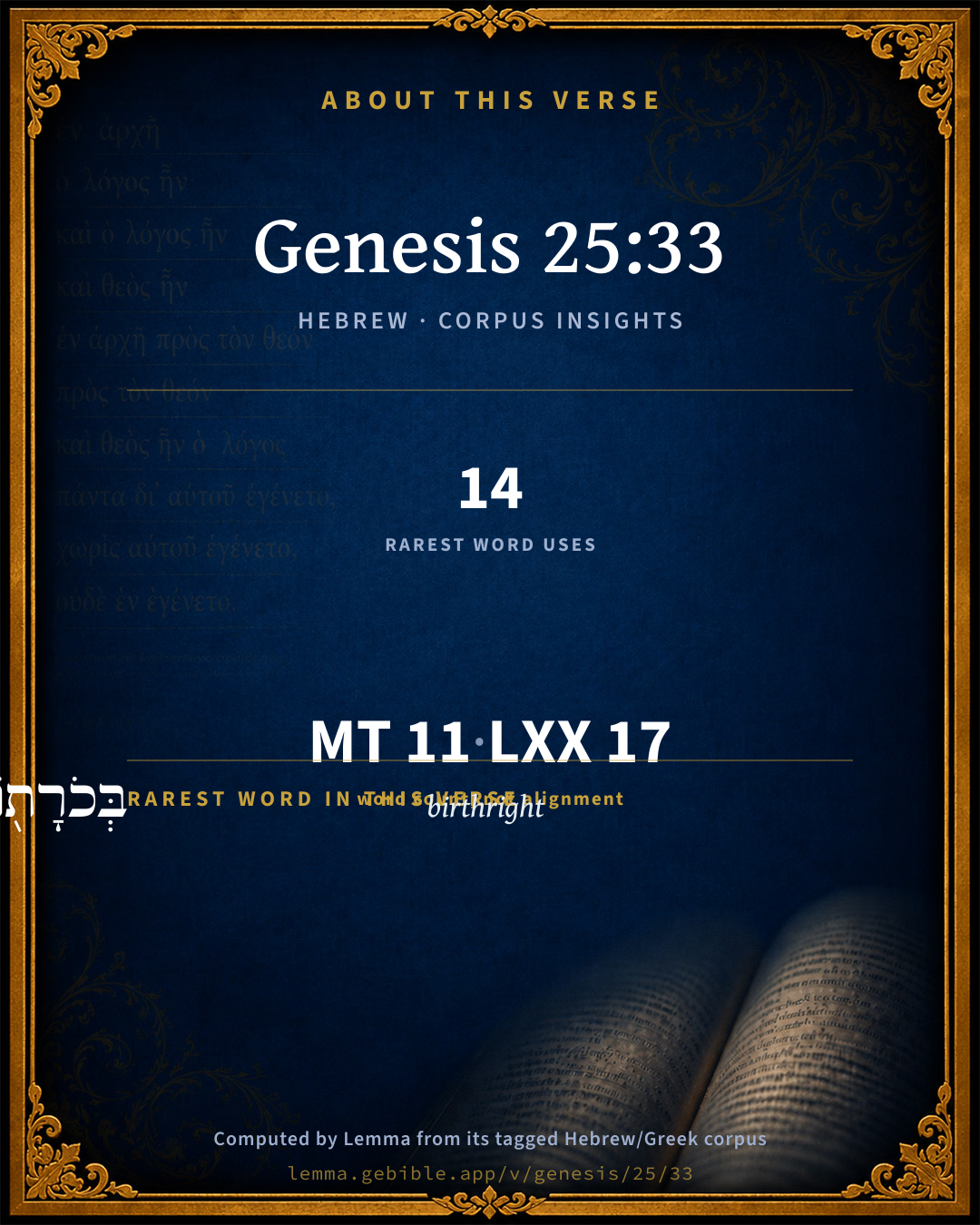
The rarest word here is בְּכֹרָת֖וֹ birthright H1062 — appearing just 14 times in the whole Hebrew Bible.

Shared distinctive vocabulary

בְּכֹרָת֖וֹ birthright H1062 occurs in 13 verses of the Hebrew Bible. Also found in:

Grammatical profile

  • 4 verbs
  • 4 nouns
  • 2 prepositions
  • 1 particle

Verb forms

  • וַיֹּ֣אמֶר Qal · Sequential Imperfect
  • הִשָּׁ֤בְעָה Niphal · Imperative
  • וַיִּשָּׁבַ֖ע Niphal · Sequential Imperfect
  • וַיִּמְכֹּ֥ר Qal · Sequential Imperfect

Repetition

Words recur within this verse — often emphatic in Hebrew:

  • יַעֲקֹ֗ב Jacob H3290 ×2
  • הִשָּׁ֤בְעָה to swear H7650 ×2

Hebrew & Septuagint length

In English translation the verse runs 16 words from the Hebrew and 22 from the Septuagint (LXX English) — closely comparable.

A rough comparison of the two English renderings, which tokenize alike — not a word-level alignment.

Word counts can differ between the Hebrew and the Greek without any difference in meaning — e.g. the Hebrew direct-object marker אֵת has no separate Greek word, and Greek often adds the article ὁ.

In the original languages it is 11 Hebrew tokens and 17 Greek tokens — but the two are counted differently (Hebrew bundles its prefixes and suffixes into one token; the Greek is in lemma form), so that isn’t a like-for-like length.

Cross-references

7

Topical passages linked to Genesis 25:33 in the Treasury of Scripture Knowledge — connected by theme and wording, ordered by reader-vote popularity; previews shown in the World English Bible.

  • Hebrews 12:16 lest there be any sexually immoral person, or profane person, as Esau, who sold his birthright for one meal.
  • Genesis 27:36 He said, "Isn't he rightly named Jacob? For he has supplanted me these two times. He took away my birthright. See, now he has taken away my blessing." He said, "Haven't you reserved a blessing for me?"
  • Hebrews 6:16 For men indeed swear by a greater one, and in every dispute of theirs the oath is final for confirmation.
  • Genesis 24:3 I will make you swear by Yahweh, the God of heaven and the God of the earth, that you shall not take a wife for my son of the daughters of the Canaanites, among whom I live.
  • Genesis 36:6–7 Esau took his wives, his sons, his daughters, and all the members of his household, with his cattle, all his animals, and all his possessions, which he had gathered in the land of Canaan, and went into a land away from his brother Jacob.
  • Mark 6:23 He swore to her, "Whatever you shall ask of me, I will give you, up to half of my kingdom."
  • Genesis 14:22 Abram said to the king of Sodom, "I have lifted up my hand to Yahweh, God Most High, possessor of heaven and earth,

Cross-references courtesy of OpenBible.info (CC BY 4.0).

Hebrew and Greek witnesses Masoretic Hebrew ↔ Greek Septuagint

The same verse in the two great witnesses to the Old Testament, shown verse-for-verse.

These are two independent witnesses, not word-aligned to each other, and the Septuagint is shown in lemma (dictionary) form.

Hebrew Genesis 25:33 Masoretic · Westminster Leningrad Codex

וַיֹּ֣אמֶר יַעֲקֹ֗ב הִשָּׁ֤בְעָה לִּי֙ כַּיּ֔וֹם וַיִּשָּׁבַ֖ע ל֑וֹ וַיִּמְכֹּ֥ר אֶת בְּכֹרָת֖וֹ לְיַעֲקֹֽב

Jacob said, "Swear to me first." He swore to him. He sold his birthright to Jacob.

World English Bible · Public Domain

Greek LXX Genesis 25:33 Septuagint · lemma form

καί εἶπον αὐτός ἰακώβ ὄμνυμι ἐγώ σήμερον καί ὄμνυμι αὐτός ἀποδίδωμι δέ ησαυ ὁ πρωτοτόκιον ὁ ἰακώβ

And Jacob said to him, Swear to me this day; and he swore to him; and Esau sold his birthright to Jacob.

LXX2012 (modern English Septuagint) · Public Domain

Hebrew: Westminster Leningrad Codex (CC BY 4.0). Greek: Septuagint (public domain); English from LXX2012 (modern English Septuagint) (Public Domain). How the Septuagint differs from the Hebrew →

Targum (Aramaic paraphrase)

2

The Targum is the ancient Jewish Aramaic paraphrase of the Hebrew Scriptures — an interpretive translation, not the Hebrew text itself. Onkelos (literal) and Pseudo-Jonathan (expansive) render the Torah, and Jonathan the Prophets. Coverage is partial: where no permissively-licensed English translation exists for a verse, only the Aramaic is shown. This is verse-level text, not a word-by-word alignment to the Hebrew.

  1. Targum Onkelos Torah (Genesis–Deuteronomy)
    וַאֲמַר יַעֲקֹב קַיֵּם לִי כְּיוֹם דִּלְהֵן וְקַיִּים לֵהּ וְזַבִּין יָת בְּכֵרוּתֵהּ לְיַעֲקֹב

    (no public-domain English translation for this verse)

    Targum Onkelos — Aramaic: “Onkelos Genesis” (public domain); “Onkelos Exodus” (public domain); “Onkelos Leviticus” (public domain); “Onkelos Numbers” (public domain); “Onkelos Deuteronomy” (public domain). English: “Sefaria Community Translation” (CC0 1.0 (public-domain dedication)); “J.W. Etheridge. The Targums of Onkelos and Jonathan Ben Uzziel on the Pentateuch. London: Longmans, Green, 1862” (public domain). Text via Sefaria.

  2. Targum Pseudo-Jonathan Torah (Genesis–Deuteronomy)
    וַאֲמַר יַעֲקב קַיֵים לִי כְּיוֹם דֵיהִי וְקַיֵים לֵיהּ וְזַבִּין יַת בְּכֵירוּתֵיהּ לְיַעֲקב

    And Jakob said, Swear to me today that so it shall be. And he sware to him, and sold his birthright to Jakob.

    Targum Pseudo-Jonathan — Aramaic: “Targum Jonathan on Genesis” (public domain); “Targum Jonathan on Exodus” (public domain); “Targum Jonathan on Leviticus” (public domain); “Targum Jonathan on Numbers” (public domain); “Targum Jonathan on Deuteronomy” (public domain). English: “The Targum of Jonathan ben Uzziel, trans. J. W. Etheridge, London, 1862” (public domain). Text via Sefaria.

Commentary

Notes on Genesis 25:33 from classic Christian and Jewish commentators (each source and its license shown beneath its notes). The classic Christian expositions comment on the surrounding passage and are grouped to its opening verse, so a note may address several verses; the Jewish commentaries on the Tanakh (Rashi and others) are per-verse, so they appear only where the commentator wrote on this verse.

Lemma curates 59 commentaries, every one of them public domain or Creative Commons licensed, each selected and text-cleaned for this edition rather than reprinted as found. About our sources →

Trapp's Complete Commentary

John Trapp

Gen 25:33 And Jacob said, Swear to me this day; and he sware unto him: and he sold his birthright unto Jacob.

Ver. 33. Swear to me.] With fickle men, make all firm and fast.

“Quo teneam vultus mutantem Protea nodo?” - Horat.

And he sold his birthright to Jacob.] And, with it, heaven also, as the Jerusalem Paraphrast addeth, whereof the birthright was a type and pledge. So his sin was in unthankfulness for such a dignity; in limiting it to this life; in selling it so very cheap; but especially, in his profane parting with a spiritual blessing for a temporal. Such a foolish bargain makes every impenitent person in the sale of his soul for a thing of nought; which Christ, who only went to the price of a soul, saith is more worth than a world. "Let there be no fornicator," as every worldling is, {Jas 4:4} "or profane person among us, as Esau". {Heb 12:16} And that there may not, let not men take pleasure in pleasure, spend too much time in it, shoot their affections too far into it. It is no wisdom, to go as far as we may. It was not simply a sin in Esau to go a hunting: but yet the more he used it the more profane he grew by it, and came at length to condemn his birthright. Adrian {a} the emperor was a great hunter; broke his leg in hunting; called a city that he built in Mysia, by the name of Adrian’s huntings: but how little care he took for his poor soul, that Animula vagula blandula of his, abundantly testifieth. The maddest hunter that ever I read of was Mithridates; who was so set upon it, that he came not into any house, either of city or country for seven years together. {b} To lawful delights and recreations, God allows men to stoop, for their bodies’ sake; as the eagle to the prey, or as Gideon’s soldiers, to soop their handful, not to gorge their bellyful. An honest man’s heart is where his calling is: such a one, when he is elsewhere, is like a fish in the air, whereunto if it leap for recreation or necessity, yet it soon returns to its own element.

{a} Dio in Vita.

{b} Adeo venandi rubie percitus ut septem continuis annis, nec urbis, nec ruris tecto sit usua.

John Trapp, A Commentary or Exposition upon All the Books of the Old and New Testament (1647–1656) — public domain. Text from a community e-Sword module.

Tyndale Open Study Notes

Tyndale Open Resources

25:33-34 Esau eagerly took Jacob’s bait and fell into the trap. He ate and left too quickly to have been near death (25:32). The final comment on the passage explains that Esau showed contempt for his birthright, considering it worthless (Heb 12:16). It is foolish to sacrifice spiritual blessings to satisfy physical appetites (cp. Gen 3:6).

Tyndale Open Study Notes — © Tyndale Open Resources, licensed CC BY-SA 4.0. Text via the HelloAO Bible API.

Geneva Bible (1599)

Geneva Bible translators

Thus the wicked prefer their worldly commodities to God’s spiritual graces: but the children of God do the contrary.

Geneva Bible (1599) marginal notes — public domain. Text via Bolls.life.

John Calvin's Commentaries

33. And Jacob said, Swear to me. Jacob did not act cruelly towards his brother, for he took nothing from him, but only desired a confirmation of that right which had been divinely granted to him; and he does this with a pious intention, that he may hereby the more fully establish the certainty of his own election. Meanwhile the infatuation of Esau is to be observed, who, in the name and presence of God, does not hesitate to set his birthright to sale. Although he had before rushed inconsiderately upon the food under the maddening impulse of hunger; now, at least, when an oath is exacted from him, some sense of religion should have stolen over him to correct his brutal cupidity. But he is so addicted to gluttony that he makes God himself a witness of his ingratitude.

John Calvin's Commentaries (1540-1563) — public domain. Text from the Calvin Translation Society English edition (1840s-50s) via the Christian Classics Ethereal Library (ccel.org). Calvin's coverage is partial (roughly two-thirds of the Bible); uncommented books and verses are honest gaps, never fabricated. The 19th-century editor's footnotes and remarks are omitted so the notes are faithfully Calvin's own voice.

The Cambridge Bible for Schools and Colleges

gen. ed. J. J. S. Perowne

33. Swear to me] Jacob is acute enough to secure the solemn ratification of his brother’s act, done in the thoughtless moment of exhaustion. When Esau recovers his self-control, he will not be able to repudiate his action.

this day] R.V. marg. rightly, first of all. Cf. Gen_25:31.

The Cambridge Bible for Schools and Colleges (gen. ed. J. J. S. Perowne; Cambridge University Press, 1878–1918) — public domain. Text from a community e-Sword module.

John Gill's Exposition

And Jacob said, swear unto me this day,.... For the more sure and certain confirmation of the bargain; and by this oath oblige himself to let him peaceably enjoy the birthright, nor seek to revoke it, or dispute it with him, or disturb him in the possession of it:

and he sware unto him; that he would abide by the bargain, and never give him any trouble on that account; and hereby he made it over to Jacob as firm as it could be; God himself being appealed to as a witness of it, whose will it was that Jacob should have the birthright, the blessing, and the promises:

and he sold his birthright unto Jacob; with all the privileges and appurtenances of it, and that for one morsel of meat, as in Heb 12:16.

John Gill's Exposition of the Whole Bible (1746–1763) — public domain (CC PDM 1.0). Text via the HelloAO Bible API.

Haydock's Catholic Bible Commentary

Swore; and still we find him enraged above measure, when Isaac had, by mistake, ratified the transfer of the birth-right to Jacob; (chap. xxvii. 41.) whence we may gather, that he did not intend to perform what he promised, even with the solemnity of an oath; which renders him still more deserving of the title profane, which St. Paul gives him. (Haydock)

George Leo Haydock (1774–1849), Haydock's Catholic Family Bible and Commentary, 1859 edition — public domain. Excludes Psalms (Douay-Rheims chapter numbering differs from Protestant) and Deuterocanonical books (Catholic canon only).

Matthew Poole's English Annotations

Jacob acted subtlely in this affair; he knew that delays were dangerous; and Esau’s consideration, or second thoughts, might have spoiled his bargain, and therefore he requires haste, as in the sale, so in his oath; wherein he addeth another sin, in hurrying his brother into an oath by precipitation, which neither his brother should have taken, nor Jacob should have advised him to take, without mature advice.

Matthew Poole's English Annotations on the Holy Bible (1683–1685) — public domain. Text from a community e-Sword/MySword module.

The Pulpit Commentary

And Jacob said, Swear to me this day. On the expression "this day" vide supra, ver. 31. The conduct of Jacob in this transaction is difficult to defend Though aware of the heavenly oracle that assigned to him the precedence in his father s house, he was far from being justified in endeavoring, by "cautious, prudent, and conciliatory proposals" (Murphy), but rather by unbelieving impatience, despicable meanness, and miserable craft, to anticipate Divine pro vide nce, which in due time without his assistance would have implemented its own designs. And he sware unto him. If Jacob"s demand of an oath evinced ungenerous suspicion, Esau"s giving of an oath showed a low sense of honor (Lange). And he sold his birthright unto Jacob thus meriting the appellation of bebhlov. (Heb_12:16)

The Pulpit Commentary (1880–1919), ed. H.D.M. Spence-Jones & Joseph S. Exell — public domain. Text from a community e-Sword module.

Ramban (Nachmanides)

Rabbi Moshe ben Nachman (Ramban / Nachmanides)

SWEAR TO ME THIS DAY. When Esau said, “What is this birthright to me? I do not desire it,” Jacob said to him, “Swear to me that you will not desire it, nor will you inherit it forever.” Thereupon he swore to him, and following that he sold it to him, and Jacob gave him the purchase price or the pottage he desired.It is possible that Esau said, “What is this birthright to me? It is sold to you,” and Jacob said, “Swear to me that you will never complain about the sale.” And when Scripture says that first he swore to him and then he sold it to him, its intent is as if it said that he sold it to him first and then swore to him.

Ramban (Nachmanides) on the Tanakh — English translation: “Commentary on the Torah by Ramban (Nachmanides). Translated and annotated by Charles B. Chavel. New York, Shilo Pub. House, 1971-1976” (CC BY 4.0). Text via Sefaria.

Radak

Rabbi David Kimhi (Radak)

ויאמר השבעה לי, he was afraid that Esau would have second thoughts after having eaten.

Radak on the Tanakh — English translations: “Sefaria Community Translation” (CC0 1.0 (public-domain dedication)); “Eliyahu Munk, HaChut Hameshulash” (CC BY 4.0); “Rabbi Mike Feuer, Jerusalem Anthology” (CC BY 4.0); and “R. David Kimhi on the first book of Psalms, Translated by R.G. Finch, London, 1919” (public domain). Text via Sefaria.

Lesson kit

Teaching starters — assembled from the data on this page, not authored interpretation. Every prompt links to the verse data it draws on. Edit before teaching.

Genesis, in the Pentateuch, opens this verse with 11 words (7 distinct Hebrew lemmas). Its most distinctive word is bᵉkôwrâh (“birthright”). A historical commentator’s framing appears above. Read the whole chapter for the surrounding context.

Discussion questions

  1. The word bᵉkôwrâh carries the sense “birthright.” How does it shape the verse?
  2. How does Genesis 4:4, which shares the word «birthright», read alongside this verse?
  3. What does the repetition of “Jacob” (2× in this one verse) do in this verse?
  4. These translations render this verse differently; the difference is in the English rendering, not the original. What questions does that raise?
  5. «וַיֹּ֣אמֶר» is a Qal Sequential Imperfect verb. How does that grammatical form shape the action described?
  6. Compare how Trapp's Complete Commentary and Tyndale Open Study Notes read this verse. Where do they agree or differ?

Things to notice

Reading settings

Reading text

Shown beneath each verse's original-language words.

Old Testament
Old Testament edition

Read the OT as the Masoretic Hebrew (MT) or the Greek Septuagint (LXX).

English shown for the Greek Septuagint (in the Hebrew ↔ Greek comparison).

Comparing translations? Open the Compare panel on any verse page to stack up to four side by side.