Joshua 24:4

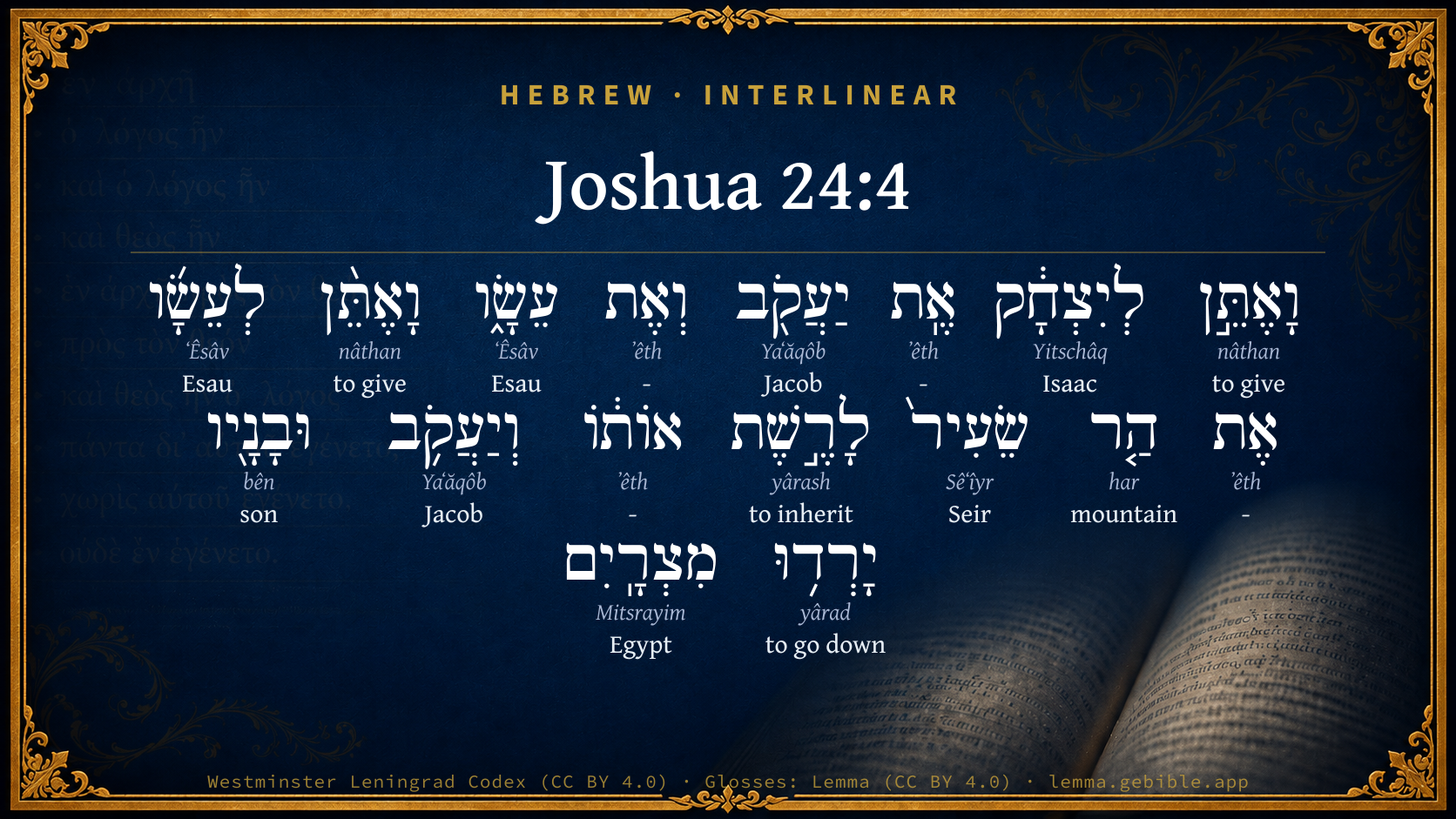
Hebrew (Westminster Leningrad Codex) Joshua 24:4 appears in the Hebrew Old Testament. The text above is from the Westminster Leningrad Codex. Each word links to its Strong’s number, a concise gloss, and parsing drawn from the Open Scriptures Hebrew Bible morphology. Click any word for its full Brown-Driver-Briggs (BDB) entry.
Download image
Cite this verse

Joshua 24:4 (World English Bible). Public Domain. Lemma interlinear Bible study tool, https://lemma.gebible.app/v/joshua/24/4.

Show BibTeX & RIS
BibTeX
RIS
English Translation
I gave to Isaac Jacob and Esau: and I gave to Esau Mount Seir, to possess it: and Jacob and his children went down into Egypt.
World English Bible · Public Domain
Download a study sheet

One document with this verse’s original text, its word-by-word gloss line, the meaning frame, cross-references with their text, attributed commentary, and full source and license credits — printable, and it pastes into notes with its structure intact.

This verse Autodidact and up

Study sheet (.html) Plain text (.txt)

A passage Seminary Student

Up to 50 verses in one chapter. A passage sheet keeps up to 6 commentary sources and 12 cross-references per verse, in the order this page ranks them, and says so on the sheet whenever that leaves anything out. Ask for a single verse and you get the Autodidact verse sheet above.

Everything on this page stays free to read, with no account — the sheet is a download of what is already on screen, not access to it.

Want to remove ads? Support Godless Engineer
Compare translations 3

The same verse in 3 English versions, stacked beneath the original-language interlinear above. Click any original word for its lexicon entry.

Each is an independent rendering of the whole verse — the interlinear is not word-aligned to these translations.

Highlighted words mark where these versions differ — a whole-verse word diff, not a word-by-word alignment.

  • World English Bible Public Domain
    I gave to Isaac Jacob and Esau: and I gave to Esau Mount Seir, to possess it: and Jacob and his children went down into Egypt.
  • King James Version Public Domain
    And I gave unto Isaac Jacob and Esau: and I gave unto Esau mount Seir, to possess it; but Jacob and his children went down into Egypt.
  • unfoldingWord Literal Text CC BY-SA 4.0
    And I gave Jacob and Esau to Isaac, and I gave to Esau the hill country of Seir to possess it, but Jacob and his sons went down to Egypt.

unfoldingWord Literal Text — © unfoldingWord, licensed CC BY-SA 4.0. Word-aligned USFM3 via Door43 (git.door43.org/unfoldingWord/en_ult).

Versions to compare (up to 4)

3 of 4 selected

Show all 18 translations

Every available English version of this verse, each an independent rendering of the whole verse.

  • World English Bible Public Domain
    I gave to Isaac Jacob and Esau: and I gave to Esau Mount Seir, to possess it: and Jacob and his children went down into Egypt.
  • Berean Standard Bible Public Domain
    and to Isaac I gave Jacob and Esau. I gave Esau Mount Seir to possess, but Jacob and his sons went down to Egypt.
  • Majority Standard Bible Public Domain
    and to Isaac I gave Jacob and Esau. I gave Esau Mount Seir to possess, but Jacob and his sons went down to Egypt.
  • King James Version Public Domain
    And I gave unto Isaac Jacob and Esau: and I gave unto Esau mount Seir, to possess it; but Jacob and his children went down into Egypt.
  • American Standard Version (1901) Public Domain
    And I gave unto Isaac Jacob and Esau: and I gave unto Esau mount Seir, to possess it: and Jacob and his children went down into Egypt.
  • Revised Version (1885) Public Domain
    And I gave unto Isaac Jacob and Esau: and I gave unto Esau mount Seir, to possess it; and Jacob and his children went down into Egypt.
  • Geneva Bible (1599) Public Domain
    And I gaue vnto Izhak, Iaakob and Esau: and I gaue vnto Esau mount Seir, to possesse it: but Iaakob and his children went downe into Egypt.
  • Douay-Rheims (1899) Public Domain
    And gave him Isaac: and to him again I gave Jacob and Esau. And I gave to Esau mount Seir for his possession: but Jacob and his children went down into Egypt.
  • Young's Literal Translation Public Domain
    And I give to Isaac, Jacob and Esau; and I give to Esau mount Seir, to possess it; and Jacob and his sons have gone down to Egypt.
  • Literal Standard Version CC BY-SA 4.0
    And I give Jacob and Esau to Isaac; and I give Mount Seir to Esau, to possess it; and Jacob and his sons have gone down to Egypt.
  • Unlocked Literal Bible CC BY-SA 4.0
    Then to Isaac I gave Jacob and Esau. I gave Esau the hill country of Seir to possess, but Jacob and his children went down to Egypt.
  • unfoldingWord Literal Text CC BY-SA 4.0
    And I gave Jacob and Esau to Isaac, and I gave to Esau the hill country of Seir to possess it, but Jacob and his sons went down to Egypt.
  • Darby Bible Public Domain
    And I gave unto Isaac Jacob and Esau; and I gave unto Esau mount Seir, to possess it; and Jacob and his sons went down into Egypt.
  • World Messianic Bible Public Domain
    I gave to Isaac Jacob and Esau: and I gave to Esau Mount Seir, to possess it. Jacob and his children went down into Egypt.
  • Webster's Bible Public Domain
    And I gave to Isaac Jacob and Esau: and I gave to Esau mount Seir, to possess it; but Jacob and his children went down into Egypt.
  • Free Bible Version CC BY-SA 4.0
    I gave to Isaac Jacob and Esau. I gave to Esau the hill country of Seir to own, but Jacob and his children went down to Egypt.
  • Bible in Basic English Public Domain
    And to Isaac I gave Jacob and Esau: to Esau I gave Mount Seir, as his heritage; but Jacob and his children went down to Egypt.
  • JPS Tanakh (1917) Public Domain
    And I gave unto Isaac Jacob and Esau; and I gave unto Esau mount Seir, to possess it; and Jacob and his children went down into Egypt.

Literal Standard Version (2020), Covenant Press — licensed CC BY-SA 4.0. Text via the HelloAO Bible API (eBible.org). Unlocked Literal Bible (unfoldingWord) — licensed CC BY-SA 4.0. Text via the HelloAO Bible API (eBible.org). unfoldingWord Literal Text — © unfoldingWord, licensed CC BY-SA 4.0. Word-aligned USFM3 via Door43 (git.door43.org/unfoldingWord/en_ult). Free Bible Version, Dr. Jonathan Gallagher — licensed CC BY-SA 4.0. Text via the HelloAO Bible API (eBible.org).

Word by word

More ways to search: Search by grammar → Find every occurrence → Compare this word →

Practice this passage: Drill this verse → Learn its vocabulary →

שֵׂעִיר֙
Sêʻîyr
H8165
“Seir”
Noun, Proper
Part of Speech
Noun
Type
Proper
Full BDB Definition

Origin: formed like H8163

TWOT: 2274h , 2274g

Seir = "hairy" or " shaggy" - patriarch of the Horites, the inhabitants of Edom before the descendants of Esau, the Edomites (noun proper masculine) - the land of Edom, south of the Dead Sea (noun proper territorial) - a mountain range in Edom extending from the Dead Sea to the Elanitic Gulf (noun proper mountain) - apparently also called 'Mount Seir' and extending most of the distance of the mountain range itself - a mountain in northern Judah lying westward from Kirjath-jearim (noun proper mountain)
  1. וָאֶתֵּ֣ן nâthan H5414 “and · to give” Conjunction + Verb, Qal, Sequential Imperfect, 1st Person, Common, Singular
  2. לְיִצְחָ֔ק Yitschâq H3327 “to/for · Isaac” Preposition + Noun, Proper
  3. אֶֽת ʼêth H853 “-” Particle, Direct Object
  4. יַעֲקֹ֖ב Yaʻăqôb H3290 “Jacob” Noun, Proper
  5. וְאֶת ʼêth H853 “and · -” Conjunction + Particle, Direct Object
  6. עֵשָׂ֑ו ʻÊsâv H6215 “Esau” Noun, Proper
  7. וָאֶתֵּ֨ן nâthan H5414 “and · to give” Conjunction + Verb, Qal, Sequential Imperfect, 1st Person, Common, Singular
  8. לְעֵשָׂ֜ו ʻÊsâv H6215 “to/for · Esau” Preposition + Noun, Proper
  9. אֶת ʼêth H853 “-” Particle, Direct Object
  10. הַ֤ר har H2022 “mountain of” Noun, Common, Masculine, Singular, Construct
  11. לָרֶ֣שֶׁת yârash H3423 “to inherit” Preposition + Verb, Qal, Infinitive Construct
  12. אוֹת֔וֹ ʼêth H853 “- · him” Particle, Direct Object + Suffix, Personal, 3rd Person, Masculine, Singular
  13. וְיַעֲקֹ֥ב Yaʻăqôb H3290 “and · Jacob” Conjunction + Noun, Proper
  14. וּבָנָ֖יו bên H1121 “and · sons · his” Conjunction + Noun, Common, Masculine, Plural, Construct + Suffix, Personal, 3rd Person, Masculine, Singular
  15. יָרְד֥וּ yârad H3381 “to go down” Verb, Qal, Perfect, 3rd Person, Common, Plural
  16. מִצְרָֽיִם Mitsrayim H4714 “Egypt” Noun, Proper

About this verse

These counts appear in no published source. They are computed here, from the morphology-tagged text and Lemma’s own curated glosses. What Lemma adds →

17
words
11
distinct lemmas
Historical
section

Shared distinctive vocabulary

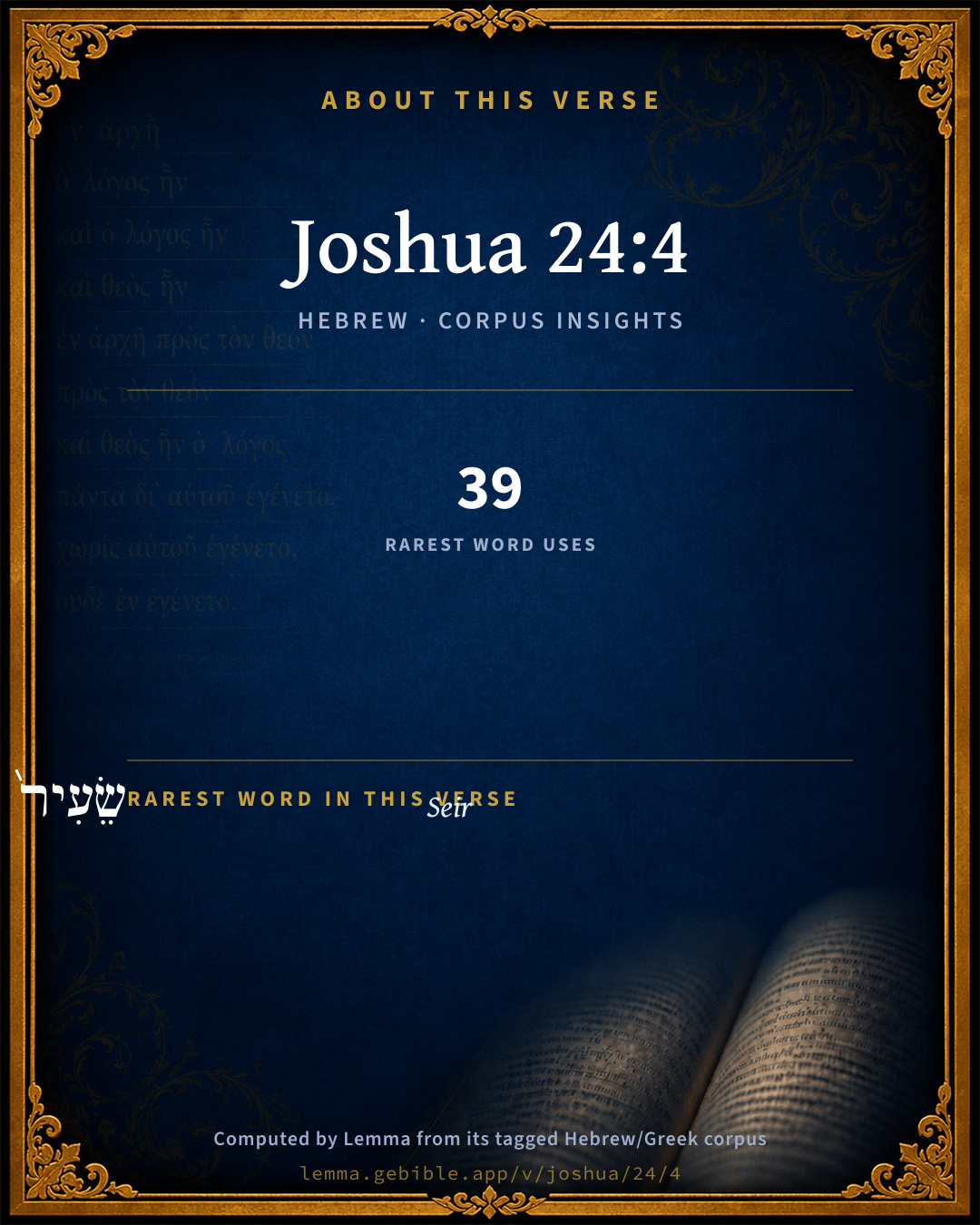
שֵׂעִיר֙ Seir H8165 occurs in 38 verses of the Hebrew Bible. Also found in:

Grammatical profile

  • 4 verbs
  • 9 nouns
  • 4 particles

Verb forms

  • וָאֶתֵּ֣ן Qal · Sequential Imperfect
  • וָאֶתֵּ֨ן Qal · Sequential Imperfect
  • לָרֶ֣שֶׁת Qal · Infinitive Construct
  • יָרְד֥וּ Qal · Perfect

Repetition

Words recur within this verse — often emphatic in Hebrew:

  • וָאֶתֵּ֣ן to give H5414 ×2
  • יַעֲקֹ֖ב Jacob H3290 ×2
  • עֵשָׂ֑ו Esau H6215 ×2

Hebrew & Septuagint length

In English translation the verse runs 26 words from the Hebrew and 47 from the Septuagint (LXX English) — the Septuagint runs noticeably longer here. See the side-by-side →

A rough comparison of the two English renderings, which tokenize alike — not a word-level alignment.

Word counts can differ between the Hebrew and the Greek without any difference in meaning — e.g. the Hebrew direct-object marker אֵת has no separate Greek word, and Greek often adds the article ὁ.

Cross-references

7

Topical passages linked to Joshua 24:4 in the Treasury of Scripture Knowledge — connected by theme and wording, ordered by reader-vote popularity; previews shown in the World English Bible.

  • Genesis 36:8 Esau lived in the hill country of Seir. Esau is Edom.
  • Deuteronomy 2:5 don't contend with them; for I will not give you of their land, no, not so much as for the sole of the foot to tread on; because I have given Mount Seir to Esau for a possession.
  • Genesis 25:24–26 When her days to be delivered were fulfilled, behold, there were twins in her womb.
  • Acts 7:15 Jacob went down into Egypt, and he died, himself and our fathers,
  • Genesis 32:3 Jacob sent messengers in front of him to Esau, his brother, to the land of Seir, the field of Edom.
  • Genesis 46:1–7 Israel traveled with all that he had, and came to Beersheba, and offered sacrifices to the God of his father, Isaac.
  • Psalms 105:23 Israel also came into Egypt. Jacob sojourned in the land of Ham.

Cross-references courtesy of OpenBible.info (CC BY 4.0).

Hebrew and Greek witnesses Masoretic Hebrew ↔ Greek Septuagint

The same verse in the two great witnesses to the Old Testament, shown verse-for-verse.

Here the Septuagint runs noticeably longer than the Hebrew — LXX2012 (modern English Septuagint) 47 words vs World English Bible 26. A rough length comparison of the two English translations, not a word-level alignment — read both below.

These are two independent witnesses, not word-aligned to each other, and the Septuagint is shown in lemma (dictionary) form.

Hebrew Joshua 24:4 Masoretic · Westminster Leningrad Codex

וָאֶתֵּ֣ן לְיִצְחָ֔ק אֶֽת יַעֲקֹ֖ב וְאֶת עֵשָׂ֑ו וָאֶתֵּ֨ן לְעֵשָׂ֜ו אֶת הַ֤ר שֵׂעִיר֙ לָרֶ֣שֶׁת אוֹת֔וֹ וְיַעֲקֹ֥ב וּבָנָ֖יו יָרְד֥וּ מִצְרָֽיִם

I gave to Isaac Jacob and Esau: and I gave to Esau Mount Seir, to possess it: and Jacob and his children went down into Egypt.

World English Bible · Public Domain

Greek LXX Joshua 24:4 Septuagint · lemma form

καί ὁ ισαακ ὁ ιακωβ καί ὁ ησαυ καί δίδωμι ὁ ησαυ ὁ ὄρος ὁ σηιρ κληρονομέω αὐτός καί ἰακώβ καί ὁ υἱός αὐτός καταβαίνω εἰς αἴγυπτος καί γίγνομαι ἐκεῖ εἰς ἔθνος μέγας καί πολύς καί κραταιός

and I gave to him Isaac, and to Isaac Jacob and Esau: and I gave to Esau mount Seir for him to inherit: and Jacob and his sons went down to Egypt, and became there a great and populous and mighty nation: and the Egyptians afflicted them.

LXX2012 (modern English Septuagint) · Public Domain

Hebrew: Westminster Leningrad Codex (CC BY 4.0). Greek: Septuagint (public domain); English from LXX2012 (modern English Septuagint) (Public Domain). How the Septuagint differs from the Hebrew →

Targum (Aramaic paraphrase)

1

The Targum is the ancient Jewish Aramaic paraphrase of the Hebrew Scriptures — an interpretive translation, not the Hebrew text itself. Onkelos (literal) and Pseudo-Jonathan (expansive) render the Torah, and Jonathan the Prophets. Coverage is partial: where no permissively-licensed English translation exists for a verse, only the Aramaic is shown. This is verse-level text, not a word-by-word alignment to the Hebrew.

  1. Targum Jonathan Prophets (Joshua–Malachi)
    וִיהָבִית לְיִצְחָק יַת יַעֲקֹב וְיַת עֵשָׂו וִיהָבִית לְעֵשָׂו יַת טוּרָא דְשֵׂעִיר לְמֵירַת יָתֵיהּ וְיַעֲקֹב וּבְנוֹהִי נְחָתוּ לְמִצְרָיִם:

    (no public-domain English translation for this verse)

    Targum Jonathan — Aramaic: “Mikraot Gedolot” (public domain). English: “Sefaria Community Translation” (CC0 1.0 (public-domain dedication)); “London "Chaldee Paraphrase," 1871” (public domain). Text via Sefaria.

Commentary

Notes on Joshua 24:4 from classic Christian and Jewish commentators (each source and its license shown beneath its notes). The classic Christian expositions comment on the surrounding passage and are grouped to its opening verse, so a note may address several verses; the Jewish commentaries on the Tanakh (Rashi and others) are per-verse, so they appear only where the commentator wrote on this verse.

Lemma curates 59 commentaries, every one of them public domain or Creative Commons licensed, each selected and text-cleaned for this edition rather than reprinted as found. About our sources →

Trapp's Complete Commentary

John Trapp

Jos 24:4 And I gave unto Isaac Jacob and Esau: and I gave unto Esau mount Seir, to possess it; but Jacob and his children went down into Egypt.

Ver. 4. But Jacob and his children went down into Egypt.] Where they were held under hard servitude, while Esau and his posterity flourished in mount Seir, having the fat of the earth’s good store, that they might fry the better in hell.

John Trapp, A Commentary or Exposition upon All the Books of the Old and New Testament (1647–1656) — public domain. Text from a community e-Sword module.

The Biblical Illustrator

Joseph S. Exell

Jos_24:4

I gave unto Isaac Jacob and Esau: and I gave unto Esau mount Seir.

Certain singular subjects

I. History and the hand of God in it. See: I gave; and then again, I gave. It is not merely that Esau and Jacob were born of Isaac and Rebekah, but the Lord says, I gave unto Isaac Jacob and Esau. How plainly doth this declare that the hand of God is in human history! At first sight history seems a great tangle, a confusion; but on looking at it more closely we perceive that it is only in appearance a maze, but in fact a marvellous piece of arrangement, exhibiting perfect precision and never-failing accuracy.

1. We see the hand of God in history very strikingly in the raising up of remarkable men at certain special periods. I gave unto Isaac Jacob and Esau: children are the gift of God. This is true not only of Isaac but of all mortal men. God gave to a worthy couple, George Washington; to another pair, John Howard; and to a third, George Whitefield. Each of these, in his own special way, was a Divine gift to men. Children are born with different talents and varied capacities, but all about them which will make them blessings is the gift of God.

2. So also is the hand of God distinctly to be seen in all great events. If Esau captures Mount Seir, then the setting up of the Edomite dominion, bad as it may have been, is from another point of view a matter in which Gods purpose and design are to be noted, for He says: I gave Esau mount Seir. In everything that happens, be it small or great, the Lord is present, and His will is done. It is so in all the plottings and manoeuvrings of kings and princes and senates, in the stirs of public opinion, in the marchings of armies, and in all that transpires among mortal men. Though the iniquity of man is seen abundantly, yet the overruling power of God is never absent.

3. To us the hand of God is very visible in our own case. Look at the hand of God that gave to you and to me such parents as we have: I mean those of us who have the great delight of having descended from Christian men and women. Had we anything to do with that? And yet the greatest part of mans future depends upon the parents of whom he is born. Is not the hand of God in it?

4. And do we not see the hand of God, again, in our children? Bring these gifts of God to God, and say, Here, Lord, are the children which Thou hast given me. O Lord, let Thy name be named on them, and let Thy grace be glorified in them.

5. Observe, further, that the Lords hand is in all the prosperity which He gives to any. He says, I gave unto Esau mount Seir, to possess it. It is by Gods allotment that temporal things fall as they do: even the ungodly have their portion in this life by Divine grant.

6. And, once more, Gods hand is to be seen in the place in which we live. If Esau lives in Mount Seir, it is because God appoints him to be there; and if Israel goes down to Egypt, it is for the selfsame reason. If you and I remove from one place to another, it is sweet to see the cloud moving before us, and to know that the Lord directs our way.

II. Birth and its disappointments. I gave unto Isaac Jacob and Esau, twin children born of godly parents. In that birth there was joy, but sorrow came by it as well as joy. Children are certain cares and doubtful comforts. They may bring to their parents such sorrow that they may be inclined to think the barren happier than the fruitful. Hence it is well for us to leave our hopes of posterity with God; and if we reckon that in a childless house we have missed a great joy, we ought also to reckon that we have missed a mint of trouble by the same fact.

III. Worldlings and their possessions. Why does God so often give possessions to ungodly men? Why do they flourish? Why do they have their portion in this life? Is it not, first, because God thinks little of these things, and therefore gives them to those of whom He thinks little? Why, said Luther in his day, the whole Turkish empire is but a basket of husks that God gives to the hogs, and therefore He hands it over to the unbelievers. Something infinitely better is reserved for the Lords own family. The rich blessing of true grace He reserves for His children and heirs. Do you wish that ungodly men should have less? For my part, I am reconciled to their present prosperity, for it is all they ever will have. Poor souls, let them have as much of it as they may here; they have nothing hereafter. Let those have the treasures of this present evil world who have nothing else. Never quarrel with the Lord for saying, I gave unto Esau mount Seir, to possess it. Besides, these comforts may lead them to reflect upon Gods bounty to them; and at any rate they ought to move them to repentance.

IV. The chosen of God and their trials. Esau reigns, but Israel serves; Esau set his nest on high, but Israel crouched by the reeds of the river. The worldling would read the Scripture as if it said, As many as I love, I caress and pamper; but the Lord speaketh not so; His word is, As many as I love, I rebuke and chasten; Whom the Lord loveth He chasteneth. To carnal reason this seems strange; faith alone can explain it.

1. Israel and his children went down into Egypt, first, for their preservation. Sanctified afflictions are spiritual promotions. The salt and bitterness of sorrow often preserves men from the gall and bitterness of sin.

2. They went down into Egypt, next, for their improvement. God often thrusts His people into adversity that He may improve them, arouse them, instruct them, and ennoble them. See to it, that the Lords design be fulfilled in you to the full. May the fire and the file, the crucible and the flame, work in you a clearance of dross and rust, and make you pure and bright.

3. They also went down into Egypt for their education. The chosen seed needed teaching; they were getting to be rustic, not to say barbarous, in their manners; acquirements and knowledge were scant among them. They must go down into the seat of ancient learning to acquire arts and sciences and civilisation. For future usefulness it is well that we bear present sorrow, and like Jacob go down into Egypt.

4. And they went down to Egypt, again, that God might display His great power in them. It is worth while to go down into Egypt to come out of it with a high hand and an outstretched arm. Oh, the glory of the Lord in His redeemed! Oh, the lofty destiny of the tried people of God! Oh, the sublimity of their lives even now! There is God in them; there is God about them. Jacob and his children went down into Egypt. That is where the story ends, according to my text; but you know the story does not end there after all; for out of Jacob and his children came the Star, the Sceptre, and the Throne. (C. H. Spurgeon.)

The Biblical Illustrator, edited by Joseph S. Exell (c. 1880s–1900s) — public domain. Text from a community e-Sword module.

Joseph Benson's Commentary

Jos 24:4. I gave unto Esau mount Seir — That he might leave Canaan entire to his brother Jacob and his posterity, Gen 36:7-8. But Jacob went down into Egypt — Compelled by a grievous famine, and because the time was not come when God intended to plant him and his posterity in Canaan. In Egypt they suffered a long and grievous bondage, from which God having delivered us, I shall now pass it over.

Joseph Benson's Commentary on the Old and New Testaments (1811–1818) — public domain. Text from a community e-Sword module.

Tyndale Open Study Notes

Tyndale Open Resources

24:4 Jacob and Esau: See Gen 25:19-26. • The mountains of Seir stood at the heart of Edom, the homeland of Esau’s descendants (Gen 36:8-9).

Tyndale Open Study Notes — © Tyndale Open Resources, licensed CC BY-SA 4.0. Text via the HelloAO Bible API.

Jamieson, Fausset & Brown

Robert Jamieson, A. R. Fausset & David Brown

I gave unto Esau mount Seir--(See on Gen 36:8). In order that he might be no obstacle to Jacob and his posterity being the exclusive heirs of Canaan.

Jamieson, Fausset & Brown — Commentary Critical and Explanatory on the Whole Bible (1871) — public domain (CC PDM 1.0). Text via the HelloAO Bible API.

John Calvin's Commentaries

4. But Jacob and his children went down, etc After mentioning the rejection of Esau, he proceeds to state how Jacob went down into Egypt, and though he confines himself to a single expression, it is one which indicates the large and exuberant and clear manifestation of the paternal favor of God. It cannot be doubted, that although the sacred historian does not speak in lofty terms of each miracle performed, Joshua gave the people such a summary exposition of their deliverance as might suffice. First, he points to the miracles performed in Egypt; next, he celebrates the passage of the Red Sea, where God gave them the aid of his inestimable power; and thirdly, he reminds them of the period during which they wandered in the desert.

John Calvin's Commentaries (1540-1563) — public domain. Text from the Calvin Translation Society English edition (1840s-50s) via the Christian Classics Ethereal Library (ccel.org). Calvin's coverage is partial (roughly two-thirds of the Bible); uncommented books and verses are honest gaps, never fabricated. The 19th-century editor's footnotes and remarks are omitted so the notes are faithfully Calvin's own voice.

The Cambridge Bible for Schools and Colleges

gen. ed. J. J. S. Perowne

4. And I gave unto Isaac Jacob] After he too and Rebekah had been childless upwards of nineteen years.

Jacob] = he that holds by the heel, or supplanter (Gen_25:26).

Esau] = hairy, rough; whose robust frame and rough aspect were the type of a wild and daring nature.

mount Seir] = “rough” or “rugged,” extended along the east side of the valley of Arabah, from the Dead Sea to the Elamitic Gulf. The name may either have been derived from Seir the Horite, who appears to have been the chief of the aboriginal inhabitants (Gen_36:20), or, what is perhaps more probable, from the rough aspect of the whole country. These Horites, the excavators of those singular rock-dwellings found in such numbers in the ravines and cliffs around Petra, were dispossessed by the descendants of Esau (Deu_2:12; Deu_2:22), they were divided into tribes under a sheikh, or “duke” (Gen_36:20-30).

but Jacob] who alone was to have Canaan for himself and his posterity, “went down into Egypt,” as is related in Gen_45:1-28; Gen_46:6; Act_7:15.

The Cambridge Bible for Schools and Colleges (gen. ed. J. J. S. Perowne; Cambridge University Press, 1878–1918) — public domain. Text from a community e-Sword module.

John Gill's Exposition

And I gave unto Isaac Jacob and Esau,.... When Rebekah was barren, so that the children appeared the more to be the gift of God; though Esau perhaps is mentioned, for the sake of what follows:

and I gave unto Esau Mount Seir to possess it; that Jacob and his posterity alone might inherit Canaan, and Esau and his seed make no pretension to it:

but Jacob and his children went down into Egypt; where they continued many years, and great part of the time in bondage and misery, which is here taken no notice of; and this was in order to their being brought into the land of Canaan, and that the power and goodness of God might be the more conspicuous in it.

John Gill's Exposition of the Whole Bible (1746–1763) — public domain (CC PDM 1.0). Text via the HelloAO Bible API.

Haydock's Catholic Bible Commentary

Isaac, the promised seed and heir of the blessings, (Calmet) after Ismael was born. (Haydock)

George Leo Haydock (1774–1849), Haydock's Catholic Family Bible and Commentary, 1859 edition — public domain. Excludes Psalms (Douay-Rheims chapter numbering differs from Protestant) and Deuterocanonical books (Catholic canon only).

Matthew Poole's English Annotations

I gave unto Esau Mount Seir to possess it, that he might leave Canaan entire to his brother Jacob and his posterity, Gen 36:7,8.

Jacob and his children went down into Egypt, where they long lived in grievous bondage; which God having delivered us from, I shall now pass it over.

Matthew Poole's English Annotations on the Holy Bible (1683–1685) — public domain. Text from a community e-Sword/MySword module.

Whedon's Commentary on the Bible

Daniel D. Whedon

4. Mount Seir is a rugged ridge extending along the east side of the Valley of Arabah, from the Dead Sea to the Elanitic Gulf. It was afterwards called Edom. Compare marginal references.

Daniel D. Whedon (gen. ed.), Commentary on the Old and New Testaments (1874–1909) — public domain. Text from a community e-Sword module.

John Wesley's Explanatory Notes

Mount Seir - That he might leave Canaan entire to his brother Jacob and his posterity, Gen. xxxvi, 7, 8. Into Egypt - Where they long lived in grievous bondage; which God having delivered us from, I shall now pass it over. 7. Your eyes - He speaketh this to the elders, ver. 1, who were so, not only by power and dignity, but many of them by age; and there being now not sixty years past since those Egyptian plagues, it is very probable that a considerable number of those present, had seen those things in Egypt, and being not twenty years old, were exempted from that dreadful sentence passed upon all who were older, Num. xiv, 29.

John Wesley, Explanatory Notes Upon the Whole Bible (1754–1765) — public domain. Text via the GEBible commentary corpus.

Lesson kit

Teaching starters — assembled from the data on this page, not authored interpretation. Every prompt links to the verse data it draws on. Edit before teaching.

Joshua, in the Historical, opens this verse with 17 words (11 distinct Hebrew lemmas). Its most distinctive word is Sêʻîyr (“Seir”). The Greek Septuagint runs longer here. A historical commentator’s framing appears above. Read the whole chapter for the surrounding context.

Discussion questions

  1. How does “Seir” (Sêʻîyr) shape what this verse is saying?
  2. Genesis 14:6 shares the word «Seir» with this verse. How do the two illuminate each other?
  3. “to give” occurs 2× in this one verse. What is the effect of the repetition?
  4. Compared with the Hebrew, the Septuagint runs longer here. What questions does that raise?
  5. These translations render this verse differently; the difference is in the English rendering, not the original. What questions does that raise?
  6. The verb «וָאֶתֵּ֣ן» is Qal Sequential Imperfect. How does its form color the action?
  7. Reading how Trapp's Complete Commentary and The Biblical Illustrator read this verse, where do the two commentators agree and where do they part?

Things to notice

Reading settings

Reading text

Shown beneath each verse's original-language words.

Old Testament
Old Testament edition

Read the OT as the Masoretic Hebrew (MT) or the Greek Septuagint (LXX).

English shown for the Greek Septuagint (in the Hebrew ↔ Greek comparison).

Comparing translations? Open the Compare panel on any verse page to stack up to four side by side.