
Amos 6:8

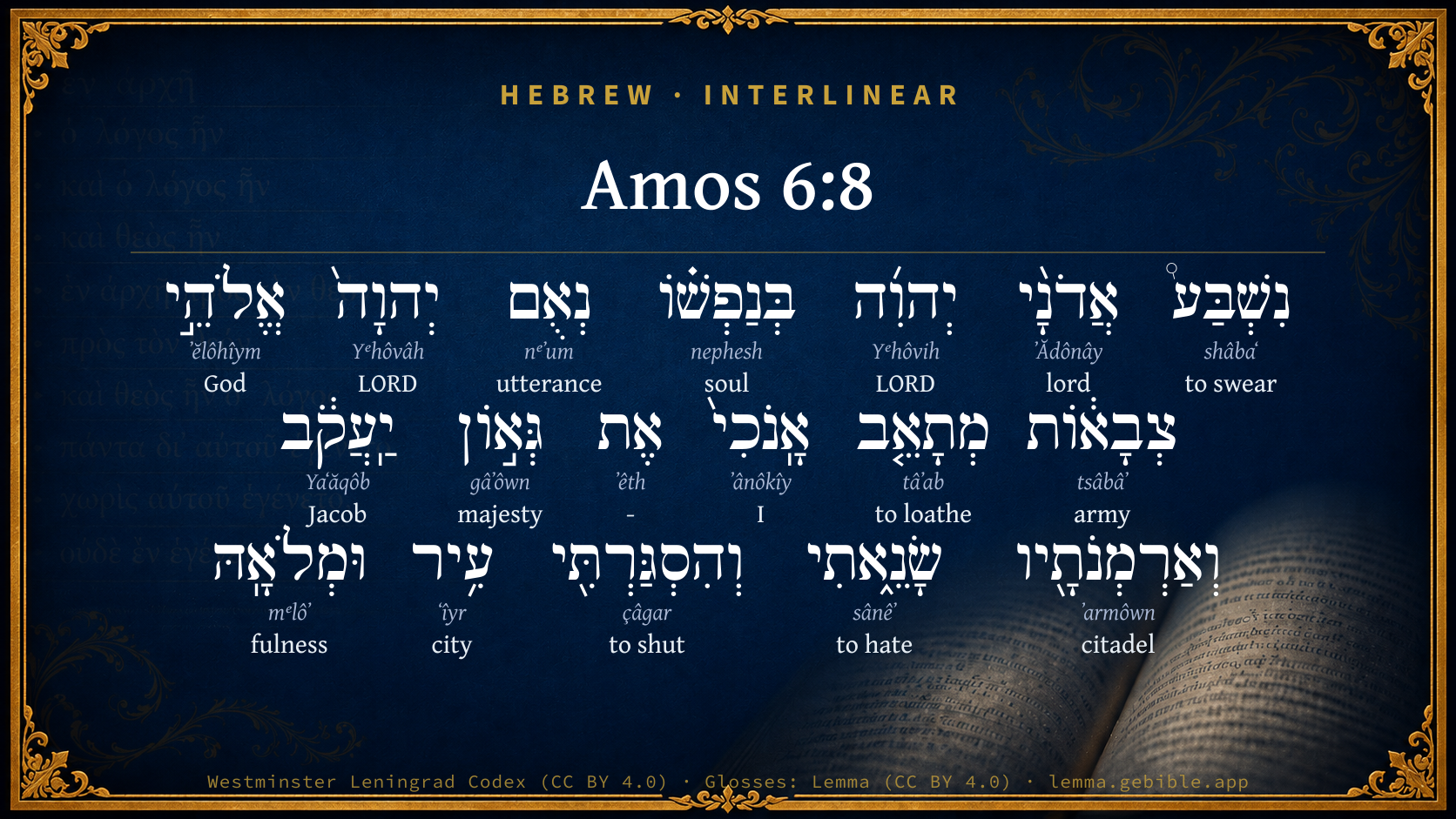
Hebrew (Westminster Leningrad Codex) Amos 6:8 appears in the Hebrew Old Testament. The text above is from the Westminster Leningrad Codex. Each word links to its Strong’s number, a concise gloss, and parsing drawn from the Open Scriptures Hebrew Bible morphology. Click any word for its full Brown-Driver-Briggs (BDB) entry.
Download image
Cite this verse

Amos 6:8 (World English Bible). Public Domain. Lemma interlinear Bible study tool, https://lemma.gebible.app/v/amos/6/8.

Show BibTeX & RIS
BibTeX
RIS
English Translation
"The Lord Yahweh has sworn by himself," says Yahweh, the God of hosts: "I abhor the pride of Jacob, And detest his fortresses. Therefore I will deliver up the city with all that is in it.
World English Bible · Public Domain
Highlights
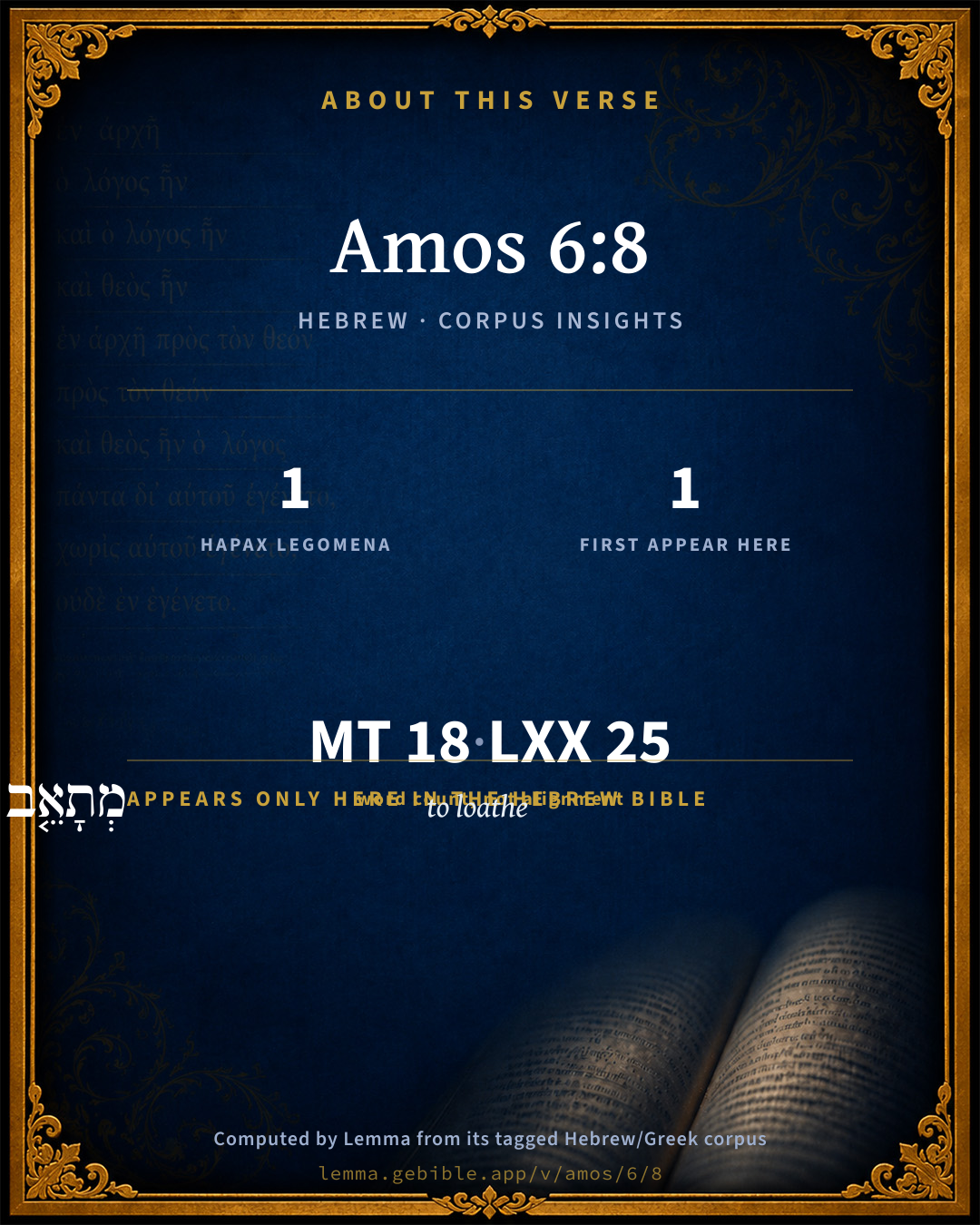
  • 1 hapax legomenon — only here in the Hebrew Bible
  • 1 first appearance in the Hebrew Bible
Full analysis ↓
Download a study sheet

One document with this verse’s original text, its word-by-word gloss line, the meaning frame, cross-references with their text, attributed commentary, and full source and license credits — printable, and it pastes into notes with its structure intact.

This verse Autodidact and up

Study sheet (.html) Plain text (.txt)

A passage Seminary Student

Up to 50 verses in one chapter. A passage sheet keeps up to 6 commentary sources and 12 cross-references per verse, in the order this page ranks them, and says so on the sheet whenever that leaves anything out. Ask for a single verse and you get the Autodidact verse sheet above.

Everything on this page stays free to read, with no account — the sheet is a download of what is already on screen, not access to it.

Want to remove ads? Support Godless Engineer
Compare translations 3

The same verse in 3 English versions, stacked beneath the original-language interlinear above. Click any original word for its lexicon entry.

Each is an independent rendering of the whole verse — the interlinear is not word-aligned to these translations.

Highlighted words mark where these versions differ — a whole-verse word diff, not a word-by-word alignment.

  • World English Bible Public Domain
    "The Lord Yahweh has sworn by himself," says Yahweh, the God of hosts: "I abhor the pride of Jacob, And detest his fortresses. Therefore I will deliver up the city with all that is in it.
  • King James Version Public Domain
    The Lord GOD hath sworn by himself, saith the LORD the God of hosts, I abhor the excellency of Jacob, and hate his palaces: therefore will I deliver up the city with all that is therein.
  • unfoldingWord Literal Text CC BY-SA 4.0
    “I, the Lord Yahweh, have sworn by myself— this is the declaration of Yahweh, the God of hosts, I detest the pride of Jacob; I hate his fortresses. Therefore I will deliver up the city with all that is in it.”

unfoldingWord Literal Text — © unfoldingWord, licensed CC BY-SA 4.0. Word-aligned USFM3 via Door43 (git.door43.org/unfoldingWord/en_ult).

Versions to compare (up to 4)

3 of 4 selected

Show all 18 translations

Every available English version of this verse, each an independent rendering of the whole verse.

  • World English Bible Public Domain
    "The Lord Yahweh has sworn by himself," says Yahweh, the God of hosts: "I abhor the pride of Jacob, And detest his fortresses. Therefore I will deliver up the city with all that is in it.
  • Berean Standard Bible Public Domain
    The Lord GOD has sworn by Himself—the LORD, the God of Hosts, has declared: “I abhor Jacob’s pride and detest his citadels, so I will deliver up the city and everything in it.”
  • Majority Standard Bible Public Domain
    The Lord GOD has sworn by Himself—the LORD, the God of Hosts, has declared: “I abhor Jacob’s pride and detest his citadels, so I will deliver up the city and everything in it.”
  • King James Version Public Domain
    The Lord GOD hath sworn by himself, saith the LORD the God of hosts, I abhor the excellency of Jacob, and hate his palaces: therefore will I deliver up the city with all that is therein.
  • American Standard Version (1901) Public Domain
    The Lord Jehovah hath sworn by himself, saith Jehovah, the God of hosts: I abhor the excellency of Jacob, and hate his palaces; therefore will I deliver up the city with all that is therein.
  • Revised Version (1885) Public Domain
    The Lord GOD hath sworn by himself, saith the LORD, the God of hosts; I abhor the excellency of Jacob, and hate his palaces: therefore will I deliver up the city with all that is therein.
  • Geneva Bible (1599) Public Domain
    The Lord God hath sworne by himselfe, saith the Lord God of hostes, I abhorre the excellencie of Iaakob, and hate his palaces: therefore wil I deliuer vp the citie with all that is therein.
  • Douay-Rheims (1899) Public Domain
    The Lord God hath sworn by his own soul, saith the Lord the God of hosts: I detest the pride of Jacob, and I hate his houses, and I will deliver up the city with the inhabitants thereof.
  • Young's Literal Translation Public Domain
    Sworn hath the Lord Jehovah by Himself, An affirmation of Jehovah, God of Hosts: I am abominating the excellency of Jacob, And his high places I have hated, And I have delivered up the city and its fulness.
  • Literal Standard Version CC BY-SA 4.0
    Lord YHWH has sworn by Himself, || A declaration of YHWH, God of Hosts: “I am abominating the excellence of Jacob, || And his high places I have hated, || And I have delivered up the city and its fullness.”
  • Unlocked Literal Bible CC BY-SA 4.0
    “I, the Lord Yahweh, have sworn by myself —this is the declaration of the Lord Yahweh, the God of hosts, I detest the pride of Jacob; I hate his fortresses. Therefore I will deliver up the city with all that is in it.”
  • unfoldingWord Literal Text CC BY-SA 4.0
    “I, the Lord Yahweh, have sworn by myself— this is the declaration of Yahweh, the God of hosts, I detest the pride of Jacob; I hate his fortresses. Therefore I will deliver up the city with all that is in it.”
  • Darby Bible Public Domain
    The Lord Jehovah hath sworn by himself, saith Jehovah, the God of hosts, I abhor the pride of Jacob, and hate his palaces; and I will deliver up the city with all that is therein.
  • World Messianic Bible Public Domain
    “The Lord GOD has sworn by himself,” says the LORD, the God of Hosts: “I abhor the pride of Jacob, and detest his fortresses. Therefore I will deliver up the city with all that is in it.
  • Webster's Bible Public Domain
    The Lord GOD hath sworn by himself, saith the LORD the God of hosts, I abhor the excellence of Jacob, and hate his palaces: therefore I will deliver up the city with all its abundance.
  • Free Bible Version CC BY-SA 4.0
    The Lord God has sworn an oath on his own life. This is what the Lord God of power declares: I detest Jacob's arrogance and I hate his fortresses; I will hand over this city and all in it to the enemy.
  • Bible in Basic English Public Domain
    The Lord God has taken an oath by himself, says the Lord, the God of armies: the pride of Jacob is disgusting to me, and I have hate for his great houses: so I will give up the town with everything in it.
  • JPS Tanakh (1917) Public Domain
    The Lord GOD hath sworn by Himself, saith the LORD, the God of hosts: I abhor the pride of Jacob, and hate his palaces; and I will deliver up the city with all that is therein.

Literal Standard Version (2020), Covenant Press — licensed CC BY-SA 4.0. Text via the HelloAO Bible API (eBible.org). Unlocked Literal Bible (unfoldingWord) — licensed CC BY-SA 4.0. Text via the HelloAO Bible API (eBible.org). unfoldingWord Literal Text — © unfoldingWord, licensed CC BY-SA 4.0. Word-aligned USFM3 via Door43 (git.door43.org/unfoldingWord/en_ult). Free Bible Version, Dr. Jonathan Gallagher — licensed CC BY-SA 4.0. Text via the HelloAO Bible API (eBible.org).

Word by word

More ways to search: Search by grammar → Find every occurrence → Compare this word →

Practice this passage: Drill this verse → Learn its vocabulary →

מְתָאֵ֤ב
tâʼab
H8374
“loathing”
Verb, Piel, Participle Active, Masculine, Singular, Absolute
Part of Speech
Verb
Stem
Piel
Form
Participle Active
Gender
Masculine
Number
Singular
State
Absolute
Full BDB Definition

Origin: a primitive root [probably identical with H8373 through the idea of puffing disdainfully at

TWOT: 2486

(Piel) to loathe, abhor
  1. נִשְׁבַּע֩ shâbaʻ H7650 “to swear” Verb, Niphal, Perfect, 3rd Person, Masculine, Singular
  2. אֲדֹנָ֨י ʼĂdônây H136 “Lord · my” Noun, Common, Masculine, Plural, Construct + Suffix, Personal, 1st Person, Common, Singular
  3. יְהוִ֜ה Yᵉhôvih H3069 “LORD” Noun, Proper
  4. בְּנַפְשׁ֗וֹ nephesh H5315 “in/at · soul · his” Preposition + Noun, Common, Both, Singular, Construct + Suffix, Personal, 3rd Person, Masculine, Singular
  5. נְאֻם nᵉʼum H5002 “utterance of” Noun, Common, Masculine, Singular, Construct
  6. יְהוָה֙ Yᵉhôvâh H3068 “LORD” Noun, Proper
  7. אֱלֹהֵ֣י ʼĕlôhîym H430 “God(s) of” Noun, Common, Masculine, Plural, Construct
  8. צְבָא֔וֹת tsâbâʼ H6635 “armies” Noun, Common, Both, Plural, Absolute
  9. אָֽנֹכִי֙ ʼânôkîy H595 “I” Pronoun, Personal, 1st Person, Common, Singular
  10. אֶת ʼêth H853 “-” Particle, Direct Object
  11. גְּא֣וֹן gâʼôwn H1347 “majesty of” Noun, Common, Masculine, Singular, Construct
  12. יַֽעֲקֹ֔ב Yaʻăqôb H3290 “Jacob” Noun, Proper
  13. וְאַרְמְנֹתָ֖יו ʼarmôwn H759 “and · citadels · his” Conjunction + Noun, Common, Masculine, Plural, Construct + Suffix, Personal, 3rd Person, Masculine, Singular
  14. שָׂנֵ֑אתִי sânêʼ H8130 “to hate” Verb, Qal, Perfect, 1st Person, Common, Singular
  15. וְהִסְגַּרְתִּ֖י çâgar H5462 “and · to shut” Conjunction + Verb, Hiphil, Sequential Perfect, 1st Person, Common, Singular
  16. עִ֥יר ʻîyr H5892 “city” Noun, Common, Feminine, Singular, Absolute
  17. וּמְלֹאָֽהּ mᵉlôʼ H4393 “and · fulness · her” Conjunction + Noun, Common, Masculine, Singular, Construct + Suffix, Personal, 3rd Person, Feminine, Singular

About this verse

These counts appear in no published source. They are computed here, from the morphology-tagged text and Lemma’s own curated glosses. What Lemma adds →

18
words
18
distinct lemmas
Prophets
section

Notable vocabulary

1 hapax legomenon — a word that appears only here in the entire Hebrew Bible:

  • מְתָאֵ֤ב to loathe H8374

First appearance in Scripture

This word makes its first canonical appearance in the Hebrew Bible here:

  • מְתָאֵ֤ב to loathe H8374

Shared distinctive vocabulary

וְאַרְמְנֹתָ֖יו citadel H759 occurs in 31 verses of the Hebrew Bible. Also found in:

Grammatical profile

  • 4 verbs
  • 12 nouns
  • 1 pronoun
  • 1 particle

Verb forms

  • נִשְׁבַּע֩ Niphal · Perfect
  • מְתָאֵ֤ב Piel · Participle Active
  • שָׂנֵ֑אתִי Qal · Perfect
  • וְהִסְגַּרְתִּ֖י Hiphil · Sequential Perfect

Hebrew & Septuagint length

In English translation the verse runs 36 words from the Hebrew and 34 from the Septuagint (LXX English) — closely comparable.

A rough comparison of the two English renderings, which tokenize alike — not a word-level alignment.

Word counts can differ between the Hebrew and the Greek without any difference in meaning — e.g. the Hebrew direct-object marker אֵת has no separate Greek word, and Greek often adds the article ὁ.

In the original languages it is 18 Hebrew tokens and 25 Greek tokens — but the two are counted differently (Hebrew bundles its prefixes and suffixes into one token; the Greek is in lemma form), so that isn’t a like-for-like length.

Cross-references

18

Topical passages linked to Amos 6:8 in the Treasury of Scripture Knowledge — connected by theme and wording, ordered by reader-vote popularity; previews shown in the World English Bible.

  • Jeremiah 51:14 Yahweh of Hosts has sworn by himself, [saying], Surely I will fill you with men, as with the canker-worm; and they shall lift up a shout against you.
  • Amos 4:2 The Lord Yahweh has sworn by his holiness that behold, "The days shall come on you that they will take you away with hooks, And the last of you with fish hooks.
  • Psalms 47:4 He chooses our inheritance for us, The glory of Jacob whom he loved. Selah.
  • Jeremiah 22:5 But if you will not hear these words, I swear by myself, says Yahweh, that this house shall become a desolation.
  • Amos 8:7 Yahweh has sworn by the pride of Jacob, "Surely I will never forget any of their works.
  • Amos 3:11 Therefore thus says the Lord Yahweh: "An adversary will overrun the land; And he will pull down your strongholds, And your fortresses will be plundered."
  • Psalms 106:40 Therefore Yahweh burned with anger against his people. He abhorred his inheritance.
  • Genesis 22:16 and said, "I have sworn by myself, says Yahweh, because you have done this thing, and have not withheld your son, your only son,
  • Leviticus 26:11 I will set my tent among you: and my soul won't abhor you.
  • Leviticus 26:30 I will destroy your high places, and cut down your incense altars, and cast your dead bodies upon the bodies of your idols; and my soul will abhor you.
  • Deuteronomy 32:19 Yahweh saw [it], and abhorred [them], Because of the provocation of his sons and his daughters.
  • Psalms 50:12 If I were hungry, I would not tell you, For the world is mine, and all that is in it.
  • Psalms 78:59 When God heard this, he was angry, And greatly abhorred Israel;
  • Lamentations 2:5 The Lord is become as an enemy, he has swallowed up Israel; He has swallowed up all her palaces, he has destroyed his strongholds; He has multiplied in the daughter of Judah mourning and lamentation.
  • Ezekiel 24:21 Speak to the house of Israel, Thus says the Lord Yahweh: Behold, I will profane my sanctuary, the pride of your power, the desire of your eyes, and that which your soul pities; and your sons and your daughters whom you have left behind shall fall by the sword.
  • Micah 1:6–9 Therefore I will make Samaria like a rubble heap of the field, Like places for planting vineyards; And I will pour down its stones into the valley, And I will uncover its foundations.
  • Zechariah 11:8 I cut off the three shepherds in one month; for my soul was weary of them, and their soul also loathed me.
  • Hebrews 6:13–17 For when God made a promise to Abraham, since he could swear by none greater, he swore by himself,

Cross-references courtesy of OpenBible.info (CC BY 4.0).

Hebrew and Greek witnesses Masoretic Hebrew ↔ Greek Septuagint

The same verse in the two great witnesses to the Old Testament, shown verse-for-verse.

These are two independent witnesses, not word-aligned to each other, and the Septuagint is shown in lemma (dictionary) form.

Hebrew Amos 6:8 Masoretic · Westminster Leningrad Codex

נִשְׁבַּע֩ אֲדֹנָ֨י יְהוִ֜ה בְּנַפְשׁ֗וֹ נְאֻם יְהוָה֙ אֱלֹהֵ֣י צְבָא֔וֹת מְתָאֵ֤ב אָֽנֹכִי֙ אֶת גְּא֣וֹן יַֽעֲקֹ֔ב וְאַרְמְנֹתָ֖יו שָׂנֵ֑אתִי וְהִסְגַּרְתִּ֖י עִ֥יר וּמְלֹאָֽהּ

"The Lord Yahweh has sworn by himself," says Yahweh, the God of hosts: "I abhor the pride of Jacob, And detest his fortresses. Therefore I will deliver up the city with all that is in it.

World English Bible · Public Domain

Greek LXX Amos 6:8 Septuagint · lemma form

ὅτι ὄμνυμι κύριος κατά ἑαυτοῦ διότι βδελύσσω ἐγώ πᾶς ὁ ὕβρις ἰακώβ καί ὁ χώρα αὐτός μισέω καί ἐκαἴρω πόλις σύν πᾶς ὁ καταοἰκέω αὐτός

For the Lord has sworn by himself, saying, Because I abhor all the pride of Jacob, I do also hate his countries, and I will cut off his city with all who inhabit it.

LXX2012 (modern English Septuagint) · Public Domain

On this verse, The Pulpit Commentary discusses the Septuagint’s reading. Read the note in Commentary ↓

Hebrew: Westminster Leningrad Codex (CC BY 4.0). Greek: Septuagint (public domain); English from LXX2012 (modern English Septuagint) (Public Domain). How the Septuagint differs from the Hebrew →

Targum (Aramaic paraphrase)

1

The Targum is the ancient Jewish Aramaic paraphrase of the Hebrew Scriptures — an interpretive translation, not the Hebrew text itself. Onkelos (literal) and Pseudo-Jonathan (expansive) render the Torah, and Jonathan the Prophets. Coverage is partial: where no permissively-licensed English translation exists for a verse, only the Aramaic is shown. This is verse-level text, not a word-by-word alignment to the Hebrew.

  1. Targum Jonathan Prophets (Joshua–Malachi)
    קַיֵים יְיָ אֱלֹהִים בְּמֵימְרֵיהּ אָמַר יְיָ אֱלָהָא דְיִשְׂרָאֵל מְנַבֵּל אֲנָא יַת בֵית מַקְדְשָׁא דְבוּתֵיהּ דְיַעֲקֹב וּבִרְנְיָתֵיהּ רָחֲקֵית וְאֶמְסַר קַרְתָּא וּמְלָאָהּ:

    (no public-domain English translation for this verse)

    Targum Jonathan — Aramaic: “Mikraot Gedolot” (public domain). English: “Sefaria Community Translation” (CC0 1.0 (public-domain dedication)); “London "Chaldee Paraphrase," 1871” (public domain). Text via Sefaria.

Commentary

Notes on Amos 6:8 from classic Christian and Jewish commentators (each source and its license shown beneath its notes). The classic Christian expositions comment on the surrounding passage and are grouped to its opening verse, so a note may address several verses; the Jewish commentaries on the Tanakh (Rashi and others) are per-verse, so they appear only where the commentator wrote on this verse.

Lemma curates 59 commentaries, every one of them public domain or Creative Commons licensed, each selected and text-cleaned for this edition rather than reprinted as found. About our sources →

Matthew Henry's Commentary

In the former part of the chapter we had these secure Israelites loading themselves with pleasures, as if they could never be made merry enough; here we have God loading them with punishments, as if they could never be made miserable enough. And observe,

I. How strongly this burden is bound on, not to be shaken off by their presumption and security; for it is bound by the Lord the God of hosts, by his mighty, his almighty, hand, which none can resist; it is bound with an oath, which puts the sentence past revocation: The Lord God has sworn, and he will not repent, and, since he could swear by no greater, he has sworn by himself. How dreadful, how miserable, is the case of those whose ruin, whose eternal ruin, God himself has sworn, who can execute his purpose and cannot alter it!

II. How heavily this burden lies! Let us see the particulars. 1. God will abhor and abandon them, and that implies misery enough, all misery: I abhor the excellency of Jacob, all that which they are proud of, and value themselves upon, and for which they call and count themselves the chief of nations. Their visible church-membership, and the privileges of that, their temple, altar, and priesthood, these were, more than any thing, the excellencies of Jacob; but, when these were profaned and polluted by sin, God abhorred them; he hated and despised them, Amo 5:21. Note, God abhors that form of godliness which hypocrites keep up, while they abhor the power of it. And if he abhors their temple, for the iniquity of that, no marvel that he hates their palaces, for the injustices and oppression he finds there. Note, that creature which we take such a complacency and put such a confidence in as to make it a rival with God is thereby made abominable to him. He hates the palaces of sinners, for the sake of wickedness of those that dwell therein. Pro 3:33, The curse of the Lord is in the house of the wicked. And, if God abhor them, immediately it follows, He will deliver up the city with all that is therein, deliver it up into the hands of the enemy, that will lay it waste, and make a prey of all its wealth. Note, Those that are abhorred and abandoned of God are undone to all intents and purposes. 2. There shall be a great and general mortality among them (Amo 6:9): If there remain ten men in one house, that have escaped the sword of the enemy, yet they shall be met with another way; they shall all die by famine or pestilence. In the most sickly times, if there be ten in a house, one may hope that at least the one-half of them will escape, according to the proportion of two in a bed, one taken and the other left; but here not one of ten shall live to bury the rest. Another instance of the greatness of the mortality is (Amo 6:10) that the nearest relations of the dead shall be forced with their own hands to wind up their bodies, and bury them, for want of other hands to be employed in it; that is all that the next of kin, to whom the right of redemption belongs, can do for them, and with great reluctance will they do that. It intimates that the young people shall be cut off soonest; for the uncle that survives is, ordinarily, the senior relation. "When the uncle comes with the sexton (or him that burns), to bring out the bones out of the house, he shall say to him that he sees next about the house, 'Is there any yet with thee? Are there any left alive?' And he shall say, 'No, this is the last; now the whole family is cut off by death, and neither root nor branch remains."' But that which makes the judgment the more grievous is that their hearts seem to be hardened under it. "When he that is found by the sides of the house begin to enter into discourse with those that are carrying off the dead, they shall say, 'Hold thy tongue; do not stand preaching to us about the hand of Providence in this calamity, for we may not make mention of the name of the Lord; God is so angry with us that there is no speaking to him; he is so extreme to mark what we do amiss that we dare not so much as make mention of his name."' Thus the foolishness of men perverts their way, and brings them into distress, and then their heart frets against the Lord. Even then they will not take notice of his hand, nor suffer those about them to do it. Perhaps it was forbidden by some of the idolatrous kings to make mention of the name of Jehovah, as by the law of Moses it was forbidden to make mention of the names of the heathen-gods: "We may not do it without incurring the penalty." Note, Those hearts are wretchedly hardened indeed that will not be brought to make mention of God's name, and to worship him, when the hand of God has gone out against them, and when, as here, sickness and death are in their families. Thus those heap up wrath who cry not when God binds them. 3. Their houses shall be destroyed, Amo 6:11. God will smite the great house with breaches, and the little house with clefts; they shall both be cracked so as to lose their beauty and strength, and to be hastening towards a fall. The princes' palaces are not above the rebuke of divine justice, nor the poor men's cottages beneath it; neither shall escape. When sin has marked them for ruin God will find ways to bring it about. It is by order from him that breaches are made.

III. How justly they are thus burdened. If we understand the matter aright, we shall say, The Lord is righteous. 1. The methods used for their reformation had been all fruitless and ineffectual (Amo 6:12): Shall horses run upon the rock, to hurl or harrow the ground there? Or will one plough there with oxen? No, for there will be no profit to countervail the pains. God has sent them his prophets, to break up their fallow-ground; but they found them as hard and inflexible as the rock, rough and rugged, and they could do no good with them, nor work upon them, and therefore they shall not attempt it any more. They will not be reclaimed, and therefore shall not be reproved, but quite abandoned. Note, Those who will not be cultivated as fields and vineyards shall be rejected as barren rocks and deserts, Heb 6:7, Heb 6:8. 2. They had abused their power to the wrong and oppression of many, whose injured cause the sovereign Judge would not only right, but revenge: You have turned judgment into gall, which is nauseous, and the fruit of righteousness into hemlock, which is noxious; it would make one sick to see how those that were entrusted with the administration of public justice bore down equity with that power which they out to have defended and supported it, and so turned its own artillery against itself. Note, When our services of God are soured with sin his providences will justly be embittered to us. 3. They had set the judgments of God at defiance, and, confiding in their own strength, thought themselves a match for Omnipotence, Amo 6:13. They rejoiced in a thing of nought, pleased themselves with a fancy that no evil should befal them, though they had no ground at all for that confidence, nothing to trust to that would bear any weight. They said, "Have we not taken to us horns; have we not arrived to great dignity and dominion, have we not pushed down our enemies and pushed on our victories, and this by our own strength, our own skill and courage, our own wealth and military force? Who then need we be afraid of? Who then need we make court to? Not God himself." Note, Prosperity and success commonly make men secure and haughty; and those that have done much think they can do any thing, any thing without God, nay, any thing against him. But those who trust in their own strength rejoice in a thing of nought, and so they will find. Probably they did not say this with their lips, totidem verbis - in so many words, but it was the language of their hearts and of their actions, both which God understands.

IV. How easily and effectually this burden shall be brought upon them, Amo 6:14. He that brings it upon them is the Lord the God of hosts, who both may do and can do what he pleases, who has all creatures at his command, and who, when he has work to do, will not be at a loss for instruments to do it with; though they are the house of Israel, yet he will raise up against them a nation which they feared not, but had many a time hoped in, even the Assyrians, and this nation shall afflict them, bring them into straits, and put them to pain, from the entering in of Hamath, in the north, to the river of the wilderness, the river of Egypt, Sihor or Nile, in the south. The whole nation has shared in the iniquity, and therefore must expect to share in the calamity. Note, When men are in any way instruments of affliction to us we must see God raising them up against us, for they are in his hand - the rod, the sword, in his hand. The Lord has bidden Shimei curse David.

Matthew Henry's Commentary on the Whole Bible (1708–1710) — public domain (CC PDM 1.0). Text via the HelloAO Bible API.

The Cambridge Bible for Schools and Colleges

gen. ed. J. J. S. Perowne

8. The contemplation of such strange moral obliquity excites the prophet’s indignation, which finds expression in the oath (cf. Amo_4:2, Amo_8:7), in which Jehovah solemnly affirms that He abhors Israel.

by himself] Lit. by his soul: the same oath, Jer_51:14 only. (Jehovah’s ‘soul,’ Isa_1:14; Isa_42:1, Jer_5:9; Jer_6:8 al.)

abhor] From being Israel’s guardian and protector He is turned into its foe. Comp. for the general thought Deu_28:63; Hos_5:12; Hos_5:14; Hos_13:7 f.; Isa_63:10; and below, ch. Amo_9:4.

excellency] pride,—whether of Israel’s vain-glorious temper itself (Isa_9:9), or of the objects of which it is proud, its affluence, material splendour, military efficiency, &c. The word will bear either sense: see (a) Hos_5:5; Hos_7:10, Isa_16:6; and (b) Nah_2:3, Psa_47:4, Zec_9:6. On the feeble and very inadequate rendering ‘excellency,’ see the Additional Note, p. 238.

his palaces] in which Israel’s pride is only too manifest; the homes of the nonchalant nobles, founded on oppression (cf. Jer_22:13-17, of Jehoiakim), and enriched by what had been wrung from the indigent (cf. ch. Amo_3:10).

and I will deliver up &c.] As in Amo_2:14-16, Amo_3:11 f., Amo_4:2 f., Amo_5:16, there rises before the prophet’s eye a vision of invasion, one of the accompaniments of which would be naturally the siege of the strong cities.

Additional Note on Chap. Amo_6:8 (excellent, excellency)

The words excellency and excellent are unfortunately, to the great detriment of the sense, used frequently in both the Authorized and the Revised Versions, to represent various Hebrew words expressive of majesty, pride, glory[230]. Excellency is thus used (as here) for gâ’ôn, majesty, pride (in a good or a bad sense according to the context), in Exo_15:7 (“in the greatness of thy majesty (cognate with the verb rendered ‘hath triumphed gloriously’ in v. 1, 21; lit. hath risen up majestically) thou overthrowest them that rise up against thee”); Isa_13:19 (A.V. pride), Isa_60:15 (“an everlasting pride”); Eze_24:21 (R.V. pride, as Lev_26:19 in A.V., in the same phrase); Amo_8:7; Nah_2:2; Psa_47:4; Job_37:4 (R.V. majesty); for ga’ãwâh, majesty, Deu_33:26; Deu_33:29, Psa_68:34; for gôbah, loftiness, Job_40:10 (R.V. dignity, using ‘excellency’ for gâ’ôn); for hâdâr, splendour, glory, Isa_35:2 (‘the splendour of Carmel,’ ‘the splendour of our God’); and excellent for gâ’ôn, Isa_4:2 (read this verse, “In that day shall the sprouting of Jehovah be for an ornament and for a glory, and the fruit of the land for majesty and for beauty, to them that escape of Israel,” and it both expresses more exactly the original, and also exhibits more clearly the prophet’s thought that a true glory is to take the place of the false glory which, as ch. 2, 3 has shewn, is to vanish away); for gç’ûth, also majesty, Isa_12:5 (R.V. marg. gloriously); for ’addîr, noble or glorious, Psa_8:1; Psa_8:9 (“How glorious is thy name in all the earth!”), Psa_16:3 (the saints of God are the nobles, in whom the Psalmist delights), Psa_76:4 (“all-bright (?)[231] art thou, and glorious, (coming down) from the mountains of prey”); for nisgâb, exalted (so R.V.), Psa_148:13 : in the Prayer-Book Version of the Psalms, it stands similarly for ’addîr, Psa_8:1; Psa_8:9, for nikbâdôth, ‘glorious things,’ Psa_87:2, for nisgâb, exalted, Psa_139:5 (i.e. here, too high for me), Psa_148:12 : cf. excel for ’addîr, Psa_16:3. These renderings are the more to be regretted, as the Hebrew words in question are elsewhere expressed quite correctly: thus gâ’ôn is pride in A.V., R.V., of Isa_23:9, Jer_13:9 (‘the pride of Judah’), Hos_5:5; Hos_7:10, Zec_9:6; Zec_10:11 &c.; majesty in Isa_2:10; Isa_2:19; Isa_2:21, Mic_5:4; gç’ûth is majesty, Isa_26:10, Psa_93:1;’addîr is glorious in Isa_33:21 (R.V. in majesty); noble, Jer_14:3; Jer_30:21 (R.V. here prince), and the cognate verb is glorious in Exo_15:6; Exo_15:11; hâdâr is majesty in Psa_21:6; Psa_29:4; Psa_96:6 and frequently; and nisgâb is constantly exalted (as Isa_2:11; Isa_2:17 &c.), and with name (exactly as Psa_148:13), Isa_12:4. It is of course true that idiom sometimes imposes limits to the principle of representing the same Hebrew word uniformly by the same English one (for the corresponding words in two languages seldom develope their meanings quite symmetrically); but the use of excellent, and excellency, for the words here in question, is thoroughly gratuitous, and affords simply an “excellent” illustration of that needless and often misleading creation of “artificial distinctions” which the late Bishop Lightfoot criticized with such justice (On a Fresh Revision of the English New Testament, chap. IV. § 2).

[230] The root-idea of gâ’ôn, ga’ãwâh, gç’ûth is, it is true, to rise up, grow tall (see Eze_47:5; Job_8:11), which is also that of the Lat. excello: but no one can pretend that this sense is perceptible in the English words excellent and excellency; and in the Hebrew words also the primary physical sense has largely given way to the derived metaphorical one. The writer formerly thought it possible that these English words had become weakened in meaning since 1611; but the quotations in Murray’s English Dictionary lend no support to this supposition.

[231] Read probably (cf. Amo_6:8) terrible (נורא for נאור).

The Cambridge Bible for Schools and Colleges (gen. ed. J. J. S. Perowne; Cambridge University Press, 1878–1918) — public domain. Text from a community e-Sword module.

Trapp's Complete Commentary

John Trapp

Amo 6:8 The Lord GOD hath sworn by himself, saith the LORD the God of hosts, I abhor the excellency of Jacob, and hate his palaces: therefore will I deliver up the city with all that is therein.

Ver. 8. The Lord God hath sworn by himself] Heb. by his soul, which is himself; since whatsoever is in God is God. So Amo 5:2 Gen 22:16 Heb 6:16-17. Or, He hath sworn by his soul, that is, Serie et ex animo, Seriously and heartily. Among the heathens ex animi sui sententia was instead of an oath.

Saith the Lord God of hosts] Who hath power enough in his hand to perform what he hath so solemnly assured.

I abhor the excellency (or, the pomp and pride) of Jacob] So Basil, speaking of the Western Church, Odi fastum istius Ecclesiae, saith he, I hate their pride. This he elsewhere calleth οφρυν δυτικην, the Western brow, from the forehead, that seat of pride and arrogance, which at length occasioned that lamentable separation of the Eastern or Greek Church from communion with the Latin; the other four patriarchs dividing themselves from the bishop of Rome. Pride is an odious evil; fitly compared by one to a great swelling in the body, which unfits it for any good service; and is apt to putrify, and break, and run with loathsome and foul matter; so doth pride disable the soul from doing duty, and at last breaks forth into odious deeds, abominable to God and man. There are those who by excellence or glory here understand their glorious temple and other privileges, wherein they so much gloried, see Psa 47:5; but Mercer thinks it rather meant of the ten tribes than of the two, whose crown of pride is elsewhere taxed, Isa 28:1 Hos 7:10. "The pride of Israel testifieth to his face," it breaketh out in his forehead, as a great master pock.

Therefore will I deliver up the city with all that is therein] Heb. with the fulness thereof; both persons and things are all forfeited, and shall be seized by the enemy; be the city of Samaria never so rich a Cargazon, so full a magazine of men and means, I will shut them up (so the word signifieth), after a strait siege, into the enemies’ hand, who shall make a spoil of them.

John Trapp, A Commentary or Exposition upon All the Books of the Old and New Testament (1647–1656) — public domain. Text from a community e-Sword module.

Whedon's Commentary on the Bible

Daniel D. Whedon

The extent of the judgment, 8-14.

The divine indignation finds expression in an oath that Jehovah will destroy the entire city (Amo_6:8). The threat is followed by an episode illustrating the completeness of the destruction and the resulting consternation (Amo_6:9-10).

The sentence is expanded in Amo_6:11, and in the next two verses the prophet tries to impress upon the people the absurdity of their boastful attitude toward Jehovah and of their immoral deeds (Amo_6:12-13). Jehovah will raise up an enemy that will scourge the whole land (Amo_6:14).

8, 9. Lord Jehovah — See on Amo_1:8.

Hath sworn — See on Amo_4:2.

By himself — Literally, by his soul. The most solemn oath, since there is no greater than Jehovah (see also on Amo_4:2; compare Jer_51:14).

Jehovah the God of hosts — See on Hos_12:5. The oath embodies a threat and the justification of the same. The threat is the result of God’s abhorrence for Israel, which is due to their arrogant attitude toward him. Once their father, protector, and friend (Amo_3:2), now their enemy. How great must have been the provocation! (Amo_9:4; Hos_5:12; Hos_5:14; Hos_13:7-8.)

Excellency — Better, R.V. margin, “pride,” that is, the arrogant attitude which led them to rebel against Jehovah (Hos_5:5) and to trust in wealth and human defenses.

Palaces — See on Amo_3:10-11 (compare Isa_3:14).

Deliver up — To the enemy, for plunder (Amo_3:11) and destruction (Amo_6:11; Amo_2:14-16; Amo_3:11 ff.). Again the prophet thinks of a foreign invasion.

The city — Samaria (Amo_6:1), the capital; it will suffer most heavily from the invasion.

All that is therein — Men, cattle, and possessions of every kind. The originality of Amo_6:9-10 is questioned by some modern commentators. “This verse (9) and the following introduce a new element into the description of the future punishment, and at the same time a new form and a new style. After these verses the old idea, style, and form recur. The new element is the plague, the new form is the individual experience, the new style, conversational prose, the poetic form being abandoned” (Harper). Marti retains the verses, Oettli rearranges them, reading them in the order 7, 11, 8, 9, 10, which in some respects is an improvement over the present arrangement. As the verses stand now they illustrate the extent of the judgment and the resulting terror.

It shall come to pass — When the city is delivered up to the invader. While there is agreement concerning the general import of Amo_6:9, there is difference of opinion respecting details. Some interpret: Even large families, having as many as ten members, will be completely blotted out. Others see in house a reference to the large households of the nobles. If of these, numbering perhaps hundreds of people, ten should escape the terrors of the siege, they will be slain in the slaughter following the capture. Or, if ten should escape the slaughter, they will surely perish in the pestilence following the slaughter.

Amo_6:10 carries further the thoughts of Amo_6:9, calling special attention to the effect of the judgment upon the survivors. R.V. translates more accurately, “And when a man’s uncle shall take him up, even he that burneth him, to bring out the bones out of the house, and shall say unto him that is in the innermost parts of the house, Is there yet any with thee?

and he shall say, No; then shall he say, Hold thy peace; for we may not make mention of the name of Jehovah.”

Uncle — Perhaps better, R.V. margin, “kinsman.” All the members of the immediate family having perished, a more distant relative comes to care for the body.

He that burneth him — Literally, his burner. A.V. considers this a separate person, accompanying the kinsman. R.V., more correctly, identifies the two. It would seem most natural to see here a reference to cremation; but that method of disposing of the dead does not seem to have been prevalent among the Israelites. Criminals were, indeed, burned (Lev_20:14; Jos_7:15); so were Saul and his sons (1Sa_31:12), but these were exceptional cases. If cremation is in the mind of the prophet, it must be because he expected conditions to become such as to make burial impossible, either because the dead would be too numerous, or because the enemies would prevent it. An alternative rendering is, “who burneth for him,” that is, incense; which would make the expression a reference to the burning of incense in honor of the dead (Jer_34:5; 2Ch_16:14).

Bring out the bones — The corpse, to care for it.

The sides — Better R.V., “the innermost parts.” Set apart for the women (compare Psa_128:3); in this part the lone survivor has taken refuge. As the kinsman pursues his solemn task he discovers the terrified individual.

Is there yet any with thee — Dead or alive. The answer is, No. Hold thy tongue [“peace”] — Literally, hush. The speaker is the survivor who, in his anxiety and despair, attempts to silence the kinsman.

Then shall he say — Literally, and he shall say. The subject is again the survivor. The verb is repeated to separate “two parts of the answer which have no immediate connection with each other.”

We may not — Or, we must not. The reason for the prohibition is not quite clear. Perhaps the speaker had a superstitious fear that the mention of the divine name would result in additional judgment. The sense is little altered if the words “Hold thy peace…” are placed in the mouth of the kinsman, who, by the prohibition would seek to prevent the terrified survivor from adding to his No a formula of confirmation containing the divine name. To consider the words an explanatory statement by Amos is less natural.

Amo_6:11 is the continuation of the sentence in Amo_6:8.

For, behold, Jehovah commandeth — The invader (14). The words are added to make the transition between 10 and 11 less abrupt, but there is no reason for denying them to Amos.

Great house — Used collectively; the palaces of the nobles (Amo_3:15).

Little house — The less pretentious dwellings.

With breaches — Or, into fragments.

With clefts — Or, into splinters. Palaces and huts will suffer the same fate.

The connection of Amo_6:12-14 with the preceding does not appear on the surface; nevertheless there exists a logical connection. The threat seems to be without effect, and the people, boasting in their own strength, show no concern. Have they not been successful against the mighty Damascus? Let the invader come; they will soon drive him from their borders. Such boast, the prophet says, is absurd (12a), because they have forfeited the support of Jehovah through disobedience to his will (12b); besides, they overestimate their past successes and present resources (13). The invader will surely come and overrun the whole country (14).

Daniel D. Whedon (gen. ed.), Commentary on the Old and New Testaments (1874–1909) — public domain. Text from a community e-Sword module.

Keil & Delitzsch

C. F. Keil & F. Delitzsch

This threat is carried out still further in Amo 6:8-11. Amo 6:8. "The Lord Jehovah hath sworn by Himself, is the saying of Jehovah, the God of hosts: I abhor the pride of Jacob, and his palaces I hate; and give up the city, and the fulness thereof. Amo 6:9. And it will come to pass, if then men are left in a house, they shall die. Amo 6:10. And when his cousin lifts him up, and he that burieth him, to carry out the bones out of the house, and saith to the one in the hindermost corner of the house, Is there still any one with thee? and he says, Not one; then will he say, Hush; for the name of Jehovah is not to be invoked. Amo 6:11. For, behold, Jehovah commandeth, and men smite the great house to ruins, and the small house into shivers." In order to show the secure debauchees the terrible severity of the judgments of God, the Lord announces to His people with a solemn oath the rejection of the nation which is so confident in its own power (cf. Amo 6:13). The oath runs here as in Amo 4:2, with this exception, that instead of בּקדשׁו we have בּנפשׁו in the same sense; for the nephesh of Jehovah, His inmost being or self, is His holiness. מתאב, with the guttural softened, for מתעב. The participle describes the abhorrence as a continued lasting feeling, and not a merely passing emotion. גּאון יעקב, the loftiness or pride of Jacob, i.e., everything of which Jacob is proud, the true and imaginary greatness and pride of Israel, which included the palaces of the voluptuous great men, for which reason they are placed in parallelism with גאון יע. This glory of Israel Jehovah abhors, and He will destroy it by giving up the city (Samaria), and all that fills it (houses and men), to the enemies to be destroyed. גאון יע, to give up to the enemy, as in Deu 32:30 and Oba 1:14; not to surround, to which וּמלאהּ is unsuitable. The words not only threaten surrounding, or siege, but also conquest, and (Amo 6:11) the destruction of the city. And then, even if there are ten in one house, they will all perish. אנשׁים: people, men. Ten in one house is a large number, which the prophet assumes as the number, to give the stronger emphasis to the thought that not one will escape from death. This thought is still further explained in Amo 6:10. A relative comes into the house to bury his deceased blood-relation. The suffix to נשׂאו refers to the idea involved in מתוּ, a dead man. Dōd, literally the father's brother, here any near relation whose duty it was to see to the burial of the dead. מסרף for משׂרף, the burner, i.e., the burier of the dead. The Israelites were indeed accustomed to bury their dead, and not to burn the corpses. The description of the burier as mesârēph (a burner) therefore supposes the occurrence of such a multitude of deaths that it is impossible to bury the dead, whose corpses are obliged to be burned, for the purpose of preventing the air from being polluted by the decomposition of the corpses. Of course the burning did not take place at the house, as Hitzig erroneously infers from להוציא עצמים; for עצמים denotes the corpse here, as in Exo 13:19; Jos 24:32, and Kg2 13:21, and not the different bones of the dead which remained without decomposition or burning. The burier now asks the last living person in the house, who has gone to the very back of the house in order to save his life, whether there is any one still with him, any one still living in the house beside himself, and receives the answer, אפס (Adv.), "Nothing more;" whereupon he says to him, has, "Be still," answering to our Hush! because he is afraid that, if he goes on speaking, he may invoke the name of God, or pray for the mercy of God; and he explains his words by adding, "The name of Jehovah must not be mentioned." It is not Amos who adds this explanation, but the relation. Nor does it contain "the words of one who despairs of any better future, and whose mind is oppressed by the weight of the existing evils, as if he said, Prayers would be of no use, for we too must die" (Lievl., Ros.). לא להזכּיר, "it is not to (may not) be mentioned," would be unsuitable as an utterance of despair. It rather indicates the fear lest, by the invocation of the name of God, the eye of God should be drawn towards this last remaining one, and he also should fall a victim to the judgment of death. This judgment the Lord accomplishes not merely by a pestilence which breaks out during the siege, and rages all around (there is no ground for any such limitation of the words), but also by sword and plague during the siege and conquest of the town. For the reason assigned for the threat in Amo 6:11 points to the latter. כּי links the words to the main thought in Amo 6:11, or even Amo 6:10: "When the Lord delivers up the city and all that fills it, they will all perish; for, behold, He commands, orders the enemy (the nation in Amo 6:14), and it will smite in pieces the houses, great and small." The singular הבּית is used with indefinite generality: every house, great and small (cf. Amo 3:15).

Keil & Delitzsch — Biblical Commentary on the Old Testament (1861–1891) — public domain (CC PDM 1.0). Text via the HelloAO Bible API. (Old Testament only.)

Tyndale Open Study Notes

Tyndale Open Resources

6:8 The most solemn oath the Lord could pronounce was by his own name (see also Gen 22:16; Jer 51:14; cp. Amos 4:2; Ps 110:4; Heb 6:13-14). • arrogance of Israel (literally pride of Jacob; see study note on Amos 8:7): Jacob can mean cheat (Gen 27:36), whereas Israel means he struggles with God (Gen 32:28). Amos uses Jacob to express the obstinate arrogance that so often characterized the people of Israel.

Tyndale Open Study Notes — © Tyndale Open Resources, licensed CC BY-SA 4.0. Text via the HelloAO Bible API.

Geneva Bible (1599)

Geneva Bible translators

Read Jer. 51:14.

That is, the riches and pomp.

Geneva Bible (1599) marginal notes — public domain. Text via Bolls.life.

Jamieson, Fausset & Brown

Robert Jamieson, A. R. Fausset & David Brown

the excellency of Jacob-- (Psa 47:4). The sanctuary which was the great glory of the covenant-people [VATABLUS], (Eze 24:21). The priesthood, and kingdom, and dignity, conferred on them by God. These, saith God, are of no account in My eyes towards averting punishment [CALVIN].

hate his palaces--as being the storehouses of "robbery" (Amo 3:10, Amo 3:15). How sad a change from God's love of Zion's gates (Psa 87:2) and palaces (Psa 48:3, Psa 48:13), owing to the people's sin!

the city--collectively: both Zion and Samaria (Amo 6:1).

all that is therein--literally, "its fulness"; the multitude of men and of riches in it (compare Psa 24:1).

Jamieson, Fausset & Brown — Commentary Critical and Explanatory on the Whole Bible (1871) — public domain (CC PDM 1.0). Text via the HelloAO Bible API.

Adam Clarke's Commentary

Verse 8. The Lord God hath sworn by himself] בנפשו benaphsho, by his soul, his being, existence.

Adam Clarke's Commentary on the Bible (1810–1826) — public domain. Text from a community e-Sword/MySword module.

John Calvin's Commentaries

God here declares that he would not desist, because he had hitherto loaded his people with many benefits: for he had now changed his purpose, so that he would no longer continue his favors. And this was designedly added by the Prophet; for hypocrites, we know, grow hardened, when they consider what dignity had been conferred on them; for they think their possessions to be firm and perpetual: hence they become haughty towards God. Since then hypocrites act thus foolishly, the Prophet justly says that it would avail them nothing, that they had hitherto excelled in many endowments for God no longer regarded their excellency.

The word גאון, gaun, means in Hebrew pride and also excellency; but it is to be taken here in a good sense, as it is in many other places. In Isaiah 2:10, it cannot be taken otherwise than for glory, for it is applied to God. So also in Psalm 47:4, ‘The glory of Jacob, whom I loved; he had fixed the inheritance of God.’ The gifts of God ever deserve praise: hence the Prophet in this place inveighs not against pride; but, on the contrary, he shows that the Israelites were deceived; for they set up their excellency and nobility in opposition to God, as though they were to be thus exempt from all punishment. God then says that he had now rejected this excellency, which yet was his gift; but as the Israelites had abused his benefits, they were therefore to be esteemed of no account. The meaning then is, — that there is no acceptance of persons before God, that the dignity which had been conferred on the people of Israel was now of no moment; for it was a mere mask: they were unworthy of adoption, they were unworthy of the priesthood and kingdom. It was then the same as if the Prophet had said, “I will judge you as the common people and heathens; for your dignity, of which ye are stripped, is now of no account with me.” They had indeed long before departed from God; they were therefore wholly unworthy of being owned by God as his inheritance.

I detest then the excellency of Jacob, and his palaces; that is, all the wealth with which they have been hitherto adorned. But the Prophet does not take either palaces or excellency in a bad sense; on the contrary, he shows that God’s blessings are no safeguards to the wicked, so as to avoid the judgment which they deserve.

He afterwards adds, I will deliver up the city and its fullness; that is, “Though ye are now full of wealth, I will empty you of all your abundance”. Hence, I will deliver up the city together with its fullness, that is, its opulence.

But that this threatening might not be slighted, the Prophet confirms it by interposing an oath. Hence he says, that God had sworn. And as we know that God’s name is precious to him, it is certain that it was not in vain adduced here, but on account of the hardness and contumacy of those who were wont to set at nought all the prophecies, and were wont in particular to regard as nothing all threatenings. This was the reason why the Prophet wished thus to ratify what he had said: it was, that hypocrites might understand that they could not escape the vengeance which he had denounced. The form of swearing, as it is, may seem apparently improper; but God in this place puts on the character of man, as he does often in other places. He swears by his soul, that is, by his life, as though he were one of mankind. But we ought to accustom ourselves to such forms, in which God familiarly accommodates himself to our capacities: for what Hilary philosophizes about the soul, as though God the Father swore by his own wisdom, is frivolous: that good man certainly exposed his own doctrine to ridicule, while he was attempting to refute the Arians. “God the Father, he says, swears by his own wisdom. Now he who is wont to swear by himself, could not swear by an inferior; but wisdom is the only begotten Son of God: hence it follows, that the Son is equal to the Father.” These things at first sight seem plausible; but they are puerile trifles.

Let it then be observed, that God borrows from men this mode of swearing; as though he said, “If men be believed when swearing by their life, which yet is evanescent, of how much greater weight must that oath be, by which I pledge my own life?” Since God thus speaks, surely the whole world ought to tremble. We now apprehend the Prophet’s design. Let us go on —

John Calvin's Commentaries (1540-1563) — public domain. Text from the Calvin Translation Society English edition (1840s-50s) via the Christian Classics Ethereal Library (ccel.org). Calvin's coverage is partial (roughly two-thirds of the Bible); uncommented books and verses are honest gaps, never fabricated. The 19th-century editor's footnotes and remarks are omitted so the notes are faithfully Calvin's own voice.

Ellicott's Commentary for English Readers

(8) By himself.—Literally, by His soul. Jehovah swears by His life or soul because He could swear by no greater—the eternal “I Am.” (Comp. the formula of Divine asseveration: “As I live, saith the Lord,” which derives illustration from the custom of swearing by the life of a monarch; Gen_42:15-16.) With the eternal unchangeable being of the Supreme Monarch stands contrasted “the excellency of Jacob,” the false futile glory which Jehovah abhors. In Amo_8:7 the phrase is used for God Himself; not, however, in either passage God’s absolute perfection or objective glory, but the thoughts, sometimes wise, sometimes base, which men have entertained about Him. From the context we infer that the splendid shrine of Samaria, with its unacceptable offerings and calf-worship, is here meant. The reference to the coming destruction of buildings great and small (Amo_6:11) lends colour to this interpretation. (Comp. Amo_6:13.)

A Bible Commentary for English Readers, edited by Charles John Ellicott (1878–1897) — public domain. Text from a community e-Sword module.

John Gill's Exposition

The Lord God hath sworn by himself,.... Because he could swear by no greater, Heb 6:13; which shows the importance and certainty of the thing sworn to, and is as follows:

saith the Lord, the God of hosts, I abhor the excellency of Jacob; or, "the pride of Jacob" (c); of Israel, of the ten tribes, remarkable for their pride; hence called the crown of pride, Isa 28:3; it may include all that was glorious, valuable, and excellent among them, of which they were proud; their kingdom, riches, wealth, and strength, their fortified cities and towns: if Judah is comprehended in this, it may regard the temple, which was their excellency, and in which they gloried. So the Targum paraphrases it,

"the house of the sanctuary of the house of Jacob;''

and in like manner Jarchi, Kimchi, and Ben Melech, interpret it;

and hate his palaces; the palaces of the king and nobles, and great men, which should fall into the enemy's hand, and be plundered and destroyed; which is meant by the Lord's abhorrence and hatred of them, this being an evidence of it;

therefore will I deliver up the city, with all that is therein; or, "with its fulness" (d); with all its inhabitants and riches; according to Jarchi, the city of Jerusalem is meant; though rather the city of Samaria, unless both are intended, city for cities; since the chief men both of Israel and Judah seem to be addressed, Amo 6:1.

(c) "superbiam", V. L. Pagninus, Montanus; "fastium", Junius & Tremellius, Piscator, Drusius. (d) "et plenitudinem ejus", Mercerus, Piscator, Cocceius.

John Gill's Exposition of the Whole Bible (1746–1763) — public domain (CC PDM 1.0). Text via the HelloAO Bible API.

Albert Barnes' Notes on the Bible

The Lord God - He who alone is and who alone hath power, “hath sworn by Himself,” literally, “by His soul;” as our “self” comes from the same root as “soul.” Jerome: “So God saith in Isaiah, “Your new moons and your appointed feasts My soul hateth” Isa 1:14; not that God hath a soul, but that He speaks after the way of human feelings. Nor is it any marvel that He condescends to speak of Himself, as having a soul, seeing He speaks of Himself as having the other members, feet, hands, bowels, which are less precious than the soul. In God the Father, the head, hands, and the rest are not members, but by these words a diversity of powers is expressed. So also by the soul is intended not a substance, but the inward affections, and the seat of thought whereby God indicates His Will.” In truth, it is one and the same condescension in Almighty God, to use of Himself any words taken from our nature, our thoughts, acts, feelings, as those taken from the members of the body.

It is a yet greater condescension that God should confirm the truth of His word by an oath. For we call God to witness, lest, by reason of the vast reign of falsehood among people, we should be thought not to speak true. But for God to act as though He needed the assurance of an oath in order to be believed, is more condescending, than for Him to speak as though He had a soul or limbs, such as He gave to man. Yet God, “willing more abundantly to show unto the heirs of His promise the immutability of His counsel, confirmed it by an oath. He swore by Himself saying, surely blessing I will bless thee” Heb 6:17, Heb 6:13-14. “Now,” when Israel had, by apostasy, forfeited that blessing, and a portion of it was to be withdrawn from him, God, affirms by an oath that rejection of Israel. If the words, “by His soul,” are emphatic, they relate to those attributes in God of which man’s holy affections are an image. God’s love, justice, righteousness, holiness, were concerned, to vindicate the oppressed and punish the oppressor. To these He appeals. Our oaths mean, “As God is true, and as He avenges untruth, this which I say is true.” So God says, “As I am God, this is true.” God then must cease to be God, if He did not hate oppression.

I abhor the excellency of Jacob - The word “excellency” is used of the Majesty of God Himself; then, since man’s relation to God is his only real greatness, God speaks of Himself as “the Excellency of Jacob” Amo 8:7; then of that “excellency” which God had given to “Jacob” Psa 47:4. That “excellency of their strength,” He had forwarned them in the law, that He would break Lev 26:19. Now that Israel took as his own what he held from God, his “excellency” became pride, and God says, “I abhor” it, as a thing loathsome and abominable, and “hate his palaces.” For they had been built, adorned, inhabited, filled with luxury, in the midst of, and out of, oppression and hard-hearted exaction. He calls them Jacob, perhaps as Hosea does Hos 12:12, to remind them of the poverty and low estate of their forefather, out of which God had raised them, and the faithfulness of their forefather in it, in contrast with their luxury and unfaithfulness.

Therefore (And) I will deliver up - Originally, “shut up” (Lev 14:23; Lev 13:4-5, ...), then, “shut up in the hands of,” so that he should have no escape. Here, where the enemy is not spoken of, it may mean, that God “shut up the city,” so that there should be no going out or coming in, in the straithess of the siege, whereupon follows the fearful description of the ravages of the pestilence. “The city” is, what was to them, above others, “the” city, the place of their luxury pride and boast, where lay their strength, Samaria.

Albert Barnes' Notes on the Bible (1834–1885) — public domain. Text from a community e-Sword/MySword module.

Haydock's Catholic Bible Commentary

Jacob. God loved the humility of the patriarch, and hated the pride of his posterity. (Worthington)

George Leo Haydock (1774–1849), Haydock's Catholic Family Bible and Commentary, 1859 edition — public domain. Excludes Psalms (Douay-Rheims chapter numbering differs from Protestant) and Deuterocanonical books (Catholic canon only).

Matthew Poole's English Annotations

The secure, incredulous, and atheistical among the judges of Israel are here spoken to especially, and the prophet assures them that God had sworn by himself that they should be punished, and in the manner he had foretold.

Saith the Lord the God of hosts; God assureth his prophet, that the prophet might attest it to his hearers.

I abhor, I look with detestation, and remember with loathing,

the excellency of Jacob; all that the seed of Jacob account a glory and excellency to them, and in which they do put their trust, all their external privileges and ceremonious worship.

And hate his palaces; in which violence is stored up, in which luxury abounds.

I will deliver up the city; Jerusalem, Samaria, and all the other cities.

With all that is therein, both persons and things; Assyria first shall sweep away all out of Israel and Samaria, and Babylonians next shall carry away Judah, Jerusalem, and all in it.

Matthew Poole's English Annotations on the Holy Bible (1683–1685) — public domain. Text from a community e-Sword/MySword module.

The Pulpit Commentary

Hath sworn by himself (nephesh); in anima sua (Vulgate), "by his soul;" a concession to human language. (comp. Amo_4:2; Jer_51:14; Heb_6:13, Heb_6:17, Heb_6:18) God thus shows that the threat proceeds from him, and is immutable. The excellency; the pride (ubrin, Septuagint; superbiam, Vulgate); that of which Jacob is proud, (Hos_5:5) as, for instance, his palaces, built by exaction, maintained in voluptuous luxury. Will deliver up to the enemy for destruction. (Deu_32:30; Oba_1:14)

Vers. 8-11.

Wrath revealing itself in judgment.

The squaring of a sinner"s account with God is of necessity a bitter experience. It is the last fact in a wide induction, and completes our knowledge of what sin really is. The best and only adequate view of this is reached when a man reads it in the light of its punishment. We are enabled to perform this office for Israel"s crying and incredible wickedness here.

I THE WORD THAT CANNOT BE BROKEN. Accommodating himself to our mode of conceiving things, God condescends to give assurance of his faithfulness in three degrees of assertion. The word that cannot be broken is:

1. What God says. "Thy Word is truth." God can neither err nor lie. He does when he promises. (Num_23:19) He does as much as he promises. He does exactly the thing he promises, The fact of his truth lies at the foundation of all religion and all knowledge. Because he is true, we not only believe his testimony absolutely, but we believe absolutely the testimony of our own consciousness as being his gift.

2. What God swears. In itself his word is as good as his oath. But to our apprehension there may be a difference. For God to swear is an act of special condescension. It is making a great concession to our unbelief, and the limitation of our faculties, that God conforms to our human modes of making solemn affirmation, in order if possible to win our implicit credence for his words. (Heb_6:17) His oath, added to his word in any matter, is for fullness of confirmation and assurance, and is a specially gracious act. What he swears by himself. In default of a greater, God swears by himself. (Heb_6:13) He is "the true God," and a "God of truth." An oath in his name has the highest sanction possible, and assumes its most solemn form. God"s oath in his own name is as sure as his own existence is, in fact, a putting of his existence in pledge for the word of his mouth.

II THE ESSENTIAL ANTAGONISM BETWEEN DIVINE HOLINESS AND HUMAN SIN. This is extreme, utter, and necessary.

1. God does not hate men, but their sin. He is not said to do so here. The statements elsewhere, that he hates the wicked (Psa_5:5; Rom_9:13) must be taken in connection with the clearly revealed fact that he also loves them, (Joh_3:16) and loved his people while they were of them. It cannot be that he loves the wicked and hates them in the same sense. His love has reference to their humanity, his hatred to their sinfulness. (Rom_1:18) He hates them as sinners, yet loves them as men; forgives them often, yet takes vengeance on their inventions. (Psa_99:8)

2. Gods hatred of sin extends to the occasions of it. "I abhor the pride of Jacob." God"s abhorrence of sin extends to everything that tends to produce it. Pride or loftiness, being in itself sinful, and a fruitful occasion of sin, he must hate. Excellence or greatness, whether imaginary or real, is, in so far as it leads to pride, included in the reach of the Divine abhorrence. Sin, like a cesspool, fouls all approaches to it. It is spiritual treason, and attaints its nearest of kin.

3. It includes even the scenes of it. "And I hate his palaces." The palaces were closely connected with the sin. They were built with the wages of unrighteousness, for luxurious gratification, and as a means to further exaction. Accordingly, as at once an expression of sin and an accessory of it, they were hateful in God"s sight. God"s attitude in the matter is the model for ours. If we are baptized into his Spirit we shall "hate even the garments spotted by the flesh." Not only is sin hateful, but all that leads to it, all that borders on it, all that has any connection with it. Even the remotest contact with it will be hateful to the spiritually minded.

III THE SWEEPING JUDGMENTS THAT EXPRESS A HOLY WRATH. These are set forth in various forms and degrees of severity.

1. The capital would be delivered up. "And give up the city and the fulness thereof." Samaria, the capital, was the strength and pride of Israel. It was the impregnable metropolis, the great storehouse of national wealth, the seat of government, the home of luxury, the social, political, economical, and military centre of the kingdom. To destroy it was like taking the heart out of their kingdom at one fell stroke. Notwithstanding this, or rather perhaps because of this, it would be captured and pillaged. In sin it had set the example, and taken the lead, and in punishment its leading position would be retained.

2. Not even one out of ten should escape. (Ver. 9.) Such sweeping destruction as this was almost unheard of. Even Sodom and Gomorrah were not more utterly destroyed. This was due ultimately to the almost universal impenitence, and proximately to the length and stubbornness of the fighting. God would not allow the persistently impenitent to escape, and the Assyrian armies, his instruments, would not spare the obstinate defenders of Samaria, who had kept them three years at bay.

3. The straggling survivors should be in abject fear of the almost universal fate. (Ver. 10.) The solitary survivor is no nearer faith in God than those who have been destroyed. He does not cast himself on his mercy. He does not even in that dreadful hour seek his face. His stupid but thoroughly characteristic impulse is to hide away from his presence. Apart from Divine grace, sin committed drives away from God, (Gen_3:8) and punishment approaching drives further still. (Rev_6:16) In prosperity the wicked will not even fear God; in adversity, if they fear, they still refuse to trust him.

4. The work of destruction would be carried out systematically and in detail. (Ver. 11.) Neither palace nor cabin should escape. The great house would be broken into great pieces, and the small house into small pieces. God"s judgments are nothing if not effective. The greatest cannot defy, nor can the smallest elude them. The destruction of each shall be elaborately and circumstantially complete.

IV GOD THE AUTHOR OF THE PUNISHMENT PROCURES. "The Lord commandeth," etc.

1. The sin of man is often a factor in the accomplishment of Gods purpose. It was so with the transportation of Joseph, (Gen_45:5, 8 1:20) with the death of Christ, (Act_2:23 Act_4:28) and with the affliction of Israel by Assyria. (Isa_10:5-7) The actors are in each case impelled by their own evil motives, aim at their own evil ends, use their own evil means, and act altogether of their own free will; and yet, when they succeed, the result is found to serve some important collateral interest they think nothing of, and so to be part of the infinitely good purpose of God. It is thus that God accomplishes his wilt by the instrumentality of men, without infringing on their perfect freedom, or being implicated in the sin which, in unconscious furtherance of it, they commit. The Assyrian destroying Israel in an unjustifiable war was at once carrying out God"s purpose and sinning against him.

2. God destroys the chosen people, not as Israel," but as Jacob." "Israel," the covenant name, is given them in connection with promises of covenant treatment. God blesses them as "Israel," and afflicts them as "Israel," and even decimates them as "Israel," all these being elements of a gracious discipline. But destruction is not so. It is the penalty of a covenant already broken, and God marks them out for this by the uncovenanted name of "Jacob.

National depravity.

Lord God hath sworn by himself, saith the Lord the God of hosts, I abhor the excellency of Jacob, and hate his palaces: therefore will I deliver up the city with all that is therein." In order to show the voluptuous debauchees referred to in the preceding verses the terrible judgments that would overtake them, Jehovah is here represented as making a solemn oath. Whether the city here refers to Samaria or Jerusalem, or both, is of little moment. The subject is national depravity, and we infer from the words

I THAT DEPRAVITY MAY EXIST IN A NATION WHERE THERE IS MUCH THAT IS MAGNIFICENT. Here is a reference to the "excellency or, as some render it, the splendour Jacob;" and here is a reference to "palaces," the homes of princes, There was much that was magnificent amongst the Jewish people of old in their own land. Great cities and their palaces, and, above all, the temple at Jerusalem, beautiful in architecture and situation, with an organized priesthood and gorgeous ceremonies. Still, its depravity at this time was wide and deep and hideous. A nation may have much that is magnificent, and yet be deeply sunk in moral corruption. Witness ancient Greece and Rome; witness England today. The arts, sculpture, painting, architecture, music, have reached their perfection, and abound. On all hands our eyes are attracted by grand churches, splendid mansions, marts, banks, museums, colleges, and galleries of art. Albeit was depravity ever more rife in any age or country than this? Greed, ambition, selfishness, sensuality, fraud, falsehood, and self-indulgence, these, the elements of depravity and the fountains of crime, abound in all directions. It is true they do not appear in their naked deformity, as in barbaric lands. Our civilization not only spreads a veil over them, but paints and decorates them, and thus conceals their native hideousness. Still, though the devil robes himself in the garb of an angel, he is yet the devil. Poison is poison, however much you may flavour it.

II THAT DEPRAVITY UNDER THE MOST MAGNIFICENT FORM IS UTTERLY ABHORRENT TO THE GREAT GOD. "I abhor the excellency of Jacob, and hate his palaces." No veil can cover it from his eye; his glance pierces through all its decorations; to his view its ornamentations add to its ugliness. The same vices displayed in the hut of a savage chief, are more hideous to him when developed in the gorgeous palaces of Christian sovereigns. "I abhor the excellency splendour of Jacob." God has moral sensibility. He has not only a sensibility for the beautiful in form and the perfect in arrangement, but for the moral. He loves the true, the beautiful, and the good; he loathes the false, the selfish, and the corrupt. "Oh, do not this abominable thing, which I hate". (Jer_44:4)

III THAT DEPRAVITY, WHICH IS EVER ABHORRENT TO GOD, MUST BRING RUIN ON ITS SUBJECTS. "Therefore will I deliver up the city with all that is therein." Observe:

1. The completeness of the ruin. "All that is therein utter destruction.

2. The certainty of the ruin. "The Lord God hath sworn by himself.

CONCLUSION. What an argument does this subject furnish for national seriousness and investigation! The progress of civilization is not the true progress of humanity. A nation may advance in the arts, and go back in morals; may be robed in artistic beauty, and yet be loathsome in moral corruption. Heaven will not smile on a nation because it is externally grand, but only when it is internally good. D.T.

The Pulpit Commentary (1880–1919), ed. H.D.M. Spence-Jones & Joseph S. Exell — public domain. Text from a community e-Sword module.

John Wesley's Explanatory Notes

The excellency - All that the seed of Jacob accounts a glory and excellency to them, all their external privileges and worship.

John Wesley, Explanatory Notes Upon the Whole Bible (1754–1765) — public domain. Text via the GEBible commentary corpus.

Rashi

Rabbi Shlomo Yitzchaki (Rashi)

by Himself—With knowledge and intention.

abhor Heb. מְתָאֵב. Like מְתָעֵב And so did Jonathan render it: I abhor the Temple, the greatness of Jacob. For the Temple is called the pride of their strength, as is stated: (Ezekiel 24:21) “Behold I profane My Sanctuary, the pride of your strength.”

the city and the fullness thereof—Jerusalem and its inhabitants.

Rashi on the Tanakh — English translations: “The Judaica Press complete Tanach with Rashi, translated by A. J. Rosenberg” (CC BY 4.0); “Pentateuch with Rashi's commentary by M. Rosenbaum and A.M. Silbermann, 1929-1934” (public domain); “The Metsudah Tanach series, Lakewood, N.J” (CC BY 4.0); and “The Book of Joshua, Metsudah Publications, 1997” (CC BY 4.0). Text via Sefaria.

Lesson kit

Teaching starters — assembled from the data on this page, not authored interpretation. Every prompt links to the verse data it draws on. Edit before teaching.

Amos, in the Prophets, opens this verse with 18 words (18 distinct Hebrew lemmas). Its most distinctive word is tâʼab (“to loathe”). A historical commentator’s framing appears above. Read the whole chapter for the surrounding context.

Discussion questions

  1. The word tâʼab carries the sense “to loathe.” How does it shape the verse?
  2. This verse holds 1 word here found nowhere else in the Hebrew Bible. What might the rare word draw attention to?
  3. The word “to loathe” first appears here in Scripture. What is being introduced at this debut?
  4. 1 Kings 16:18 shares the word «citadel» with this verse. How do the two illuminate each other?
  5. These translations render this verse differently; the difference is in the English rendering, not the original. What questions does that raise?
  6. The verb «נִשְׁבַּע֩» is Niphal Perfect. How does its form color the action?
  7. Reading how Matthew Henry's Commentary and The Cambridge Bible for Schools and Colleges read this verse, where do the two commentators agree and where do they part?

Things to notice

Reading settings

Reading text

Shown beneath each verse's original-language words.

Old Testament
Old Testament edition

Read the OT as the Masoretic Hebrew (MT) or the Greek Septuagint (LXX).

English shown for the Greek Septuagint (in the Hebrew ↔ Greek comparison).

Comparing translations? Open the Compare panel on any verse page to stack up to four side by side.