Genesis 28:5

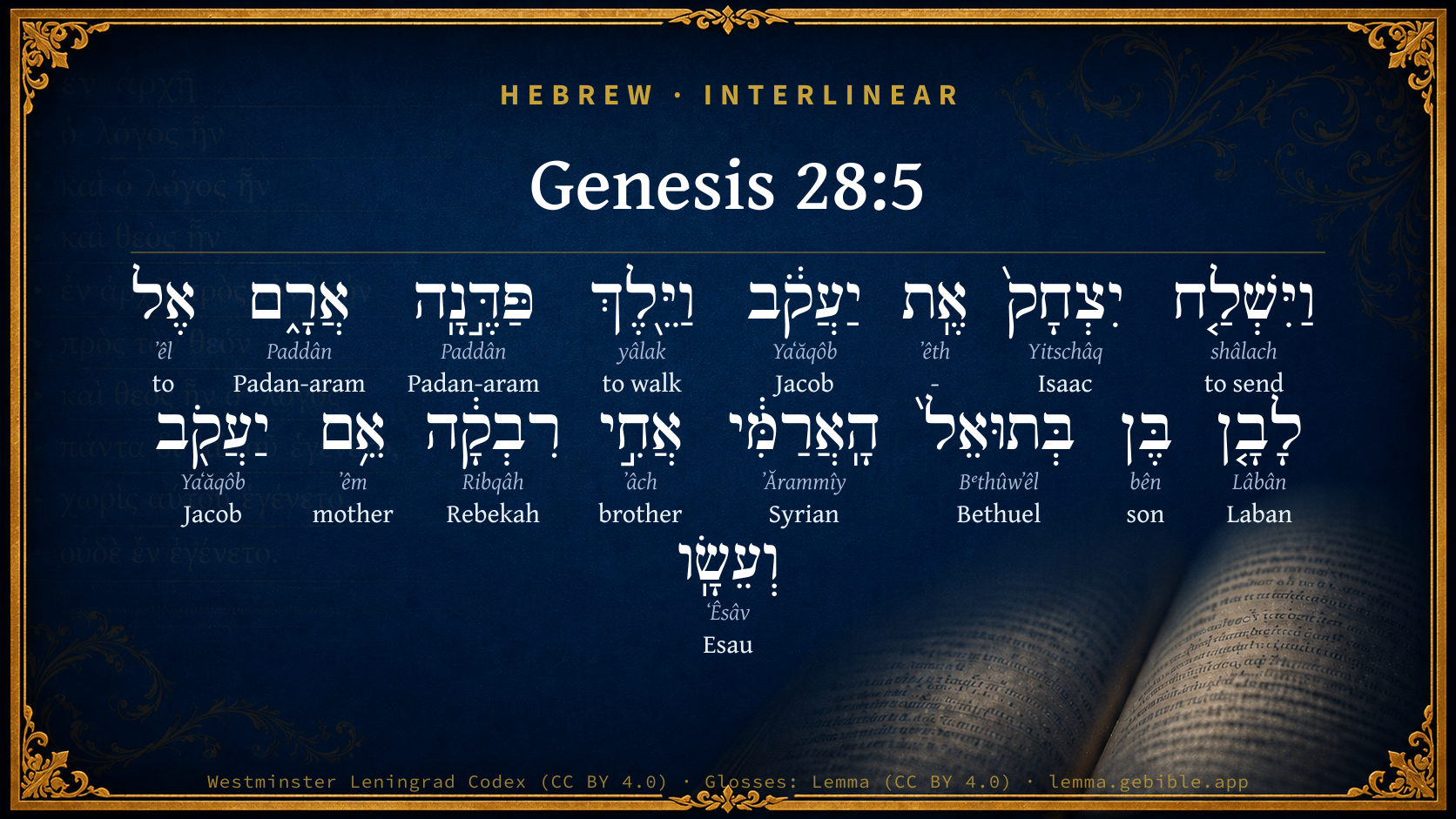
Hebrew (Westminster Leningrad Codex) Genesis 28:5 appears in the Hebrew Old Testament. The text above is from the Westminster Leningrad Codex. Each word links to its Strong’s number, a concise gloss, and parsing drawn from the Open Scriptures Hebrew Bible morphology. Click any word for its full Brown-Driver-Briggs (BDB) entry.
Download image
Cite this verse

Genesis 28:5 (World English Bible). Public Domain. Lemma interlinear Bible study tool, https://lemma.gebible.app/v/genesis/28/5.

Show BibTeX & RIS
BibTeX
RIS
English Translation
Isaac sent Jacob away. He went to Paddan Aram to Laban, son of Bethuel the Syrian, Rebekah's brother, Jacob's and Esau's mother.
World English Bible · Public Domain
Download a study sheet

One document with this verse’s original text, its word-by-word gloss line, the meaning frame, cross-references with their text, attributed commentary, and full source and license credits — printable, and it pastes into notes with its structure intact.

This verse Autodidact and up

Study sheet (.html) Plain text (.txt)

A passage Seminary Student

Up to 50 verses in one chapter. A passage sheet keeps up to 6 commentary sources and 12 cross-references per verse, in the order this page ranks them, and says so on the sheet whenever that leaves anything out. Ask for a single verse and you get the Autodidact verse sheet above.

Everything on this page stays free to read, with no account — the sheet is a download of what is already on screen, not access to it.

Want to remove ads? Support Godless Engineer
Compare translations 3

The same verse in 3 English versions, stacked beneath the original-language interlinear above. Click any original word for its lexicon entry.

Each is an independent rendering of the whole verse — the interlinear is not word-aligned to these translations.

Highlighted words mark where these versions differ — a whole-verse word diff, not a word-by-word alignment.

  • World English Bible Public Domain
    Isaac sent Jacob away. He went to Paddan Aram to Laban, son of Bethuel the Syrian, Rebekah's brother, Jacob's and Esau's mother.
  • King James Version Public Domain
    And Isaac sent away Jacob: and he went to Padanaram unto Laban, son of Bethuel the Syrian, the brother of Rebekah, Jacob's and Esau's mother.
  • unfoldingWord Literal Text CC BY-SA 4.0
    Then Isaac sent Jacob, and he went to Paddan Aram, to Laban, the son of Bethuel the Aramean and the brother of Rebekah, the mother of Jacob and Esau. Esau Takes Another Wife 28:6-9

unfoldingWord Literal Text — © unfoldingWord, licensed CC BY-SA 4.0. Word-aligned USFM3 via Door43 (git.door43.org/unfoldingWord/en_ult).

Versions to compare (up to 4)

3 of 4 selected

Show all 18 translations

Every available English version of this verse, each an independent rendering of the whole verse.

  • World English Bible Public Domain
    Isaac sent Jacob away. He went to Paddan Aram to Laban, son of Bethuel the Syrian, Rebekah's brother, Jacob's and Esau's mother.
  • Berean Standard Bible Public Domain
    So Isaac sent Jacob to Paddan-aram, to Laban son of Bethuel the Aramean, the brother of Rebekah, who was the mother of Jacob and Esau.
  • Majority Standard Bible Public Domain
    So Isaac sent Jacob to Paddan-aram, to Laban son of Bethuel the Aramean, the brother of Rebekah, who was the mother of Jacob and Esau.
  • King James Version Public Domain
    And Isaac sent away Jacob: and he went to Padanaram unto Laban, son of Bethuel the Syrian, the brother of Rebekah, Jacob's and Esau's mother.
  • American Standard Version (1901) Public Domain
    And Isaac sent away Jacob. And he went to Paddan-aram unto Laban, son of Bethuel the Syrian, the brother of Rebekah, Jacob's and Esau's mother.
  • Revised Version (1885) Public Domain
    And Isaac sent away Jacob: and he went to Paddan-aram unto Laban, son of Bethuel the Syrian, the brother of Rebekah, Jacob’s and Esau’s mother.
  • Geneva Bible (1599) Public Domain
    Thus Izhak sent forth Iaakob, and he went to Padan Aram vnto Laban sonne of Bethuel the Aramite, brother to Rebekah, Iaakobs and Esaus mother.
  • Douay-Rheims (1899) Public Domain
    And when Isaac had sent him away, he took his journey and went to Mesopotamia of Syria to Laban the son of Bathuel the Syrian, brother to Rebecca his mother.
  • Young's Literal Translation Public Domain
    And Isaac sendeth away Jacob, and he goeth to Padan-Aram, unto Laban, son of Bethuel the Aramaean, brother of Rebekah, mother of Jacob and Esau.
  • Literal Standard Version CC BY-SA 4.0
    And Isaac sends Jacob away, and he goes to Padan-Aram, to Laban, son of Bethuel the Aramean, brother of Rebekah, mother of Jacob and Esau.
  • Unlocked Literal Bible CC BY-SA 4.0
    So Isaac sent Jacob away. Jacob went to Paddan Aram, to Laban son of Bethuel the Aramean, the brother of Rebekah, Jacob's and Esau's mother.
  • unfoldingWord Literal Text CC BY-SA 4.0
    Then Isaac sent Jacob, and he went to Paddan Aram, to Laban, the son of Bethuel the Aramean and the brother of Rebekah, the mother of Jacob and Esau. Esau Takes Another Wife 28:6-9
  • Darby Bible Public Domain
    And Isaac sent away Jacob; and he went to Padan-Aram, to Laban the son of Bethuel the Syrian, the brother of Rebecca, Jacob's and Esau's mother.
  • World Messianic Bible Public Domain
    Isaac sent Jacob away. He went to Paddan Aram to Laban, son of Bethuel the Syrian, the brother of Rebekah, Jacob’s and Esau’s mother.
  • Webster's Bible Public Domain
    And Isaac sent away Jacob: and he went to Padan-aram, to Laban, son of Bethuel the Syrian, the brother of Rebekah, Jacob's and Esau's mother.
  • Free Bible Version CC BY-SA 4.0
    So Isaac sent Jacob on his way. He traveled to Paddan-aram, to Laban, son of Bethuel the Aramean. Laban was the brother of Rebekah, the mother of Jacob and Esau.
  • Bible in Basic English Public Domain
    So Isaac sent Jacob away: and he went to Paddan-aram, to Laban, son of Bethuel the Aramaean, the brother of Rebekah, the mother of Jacob and Esau.
  • JPS Tanakh (1917) Public Domain
    And Isaac sent away Jacob; and he went to Paddan-aram unto Laban, son of Bethuel the Aramean, the brother of Rebekah, Jacob's and Esau's mother.

Literal Standard Version (2020), Covenant Press — licensed CC BY-SA 4.0. Text via the HelloAO Bible API (eBible.org). Unlocked Literal Bible (unfoldingWord) — licensed CC BY-SA 4.0. Text via the HelloAO Bible API (eBible.org). unfoldingWord Literal Text — © unfoldingWord, licensed CC BY-SA 4.0. Word-aligned USFM3 via Door43 (git.door43.org/unfoldingWord/en_ult). Free Bible Version, Dr. Jonathan Gallagher — licensed CC BY-SA 4.0. Text via the HelloAO Bible API (eBible.org).

Word by word

More ways to search: Search by grammar → Find every occurrence → Compare this word →

Practice this passage: Drill this verse → Learn its vocabulary →

בְּתוּאֵל֙
Bᵉthûwʼêl
H1328
“Bethuel”
Noun, Proper
Part of Speech
Noun
Type
Proper
Full BDB Definition

Origin: apparently from the same as H1326 and H410

TWOT: None

Bethuel = "God destroys" or " man of God" or " dweller in God" - nephew of Abraham, son of Nahor by Milcah, father of Rebekah (noun proper masculine) - a town of Simeon in the south (noun proper locative)
  1. וַיִּשְׁלַ֤ח shâlach H7971 “and · to send” Conjunction + Verb, Qal, Sequential Imperfect, 3rd Person, Masculine, Singular
  2. יִצְחָק֙ Yitschâq H3327 “Isaac” Noun, Proper
  3. אֶֽת ʼêth H853 “-” Particle, Direct Object
  4. יַעֲקֹ֔ב Yaʻăqôb H3290 “Jacob” Noun, Proper
  5. וַיֵּ֖לֶךְ yâlak H3212 “and · to walk” Conjunction + Verb, Qal, Sequential Imperfect, 3rd Person, Masculine, Singular
  6. פַּדֶּ֣נָֽה Paddân H6307 “Padan-aram · toward” Noun, Proper + Suffix, Demonstrative
  7. אֲרָ֑ם Paddân H6307 “Padan-aram” Noun, Proper
  8. אֶל ʼêl H413 “to” Preposition
  9. לָבָ֤ן Lâbân H3837 “Laban” Noun, Proper
  10. בֶּן bên H1121 “son of” Noun, Common, Masculine, Singular, Construct
  11. הָֽאֲרַמִּ֔י ʼĂrammîy H761 “the · Syrian” Particle, Definite Article + Noun, Gentilic, Masculine, Singular, Absolute
  12. אֲחִ֣י ʼâch H251 “brother of” Noun, Common, Masculine, Singular, Construct
  13. רִבְקָ֔ה Ribqâh H7259 “Rebekah” Noun, Proper
  14. אֵ֥ם ʼêm H517 “mother of” Noun, Common, Feminine, Singular, Construct
  15. יַעֲקֹ֖ב Yaʻăqôb H3290 “Jacob” Noun, Proper
  16. וְעֵשָֽׂו ʻÊsâv H6215 “and · Esau” Conjunction + Noun, Proper

About this verse

These counts appear in no published source. They are computed here, from the morphology-tagged text and Lemma’s own curated glosses. What Lemma adds →

17
words
15
distinct lemmas
Pentateuch
section

Notable vocabulary

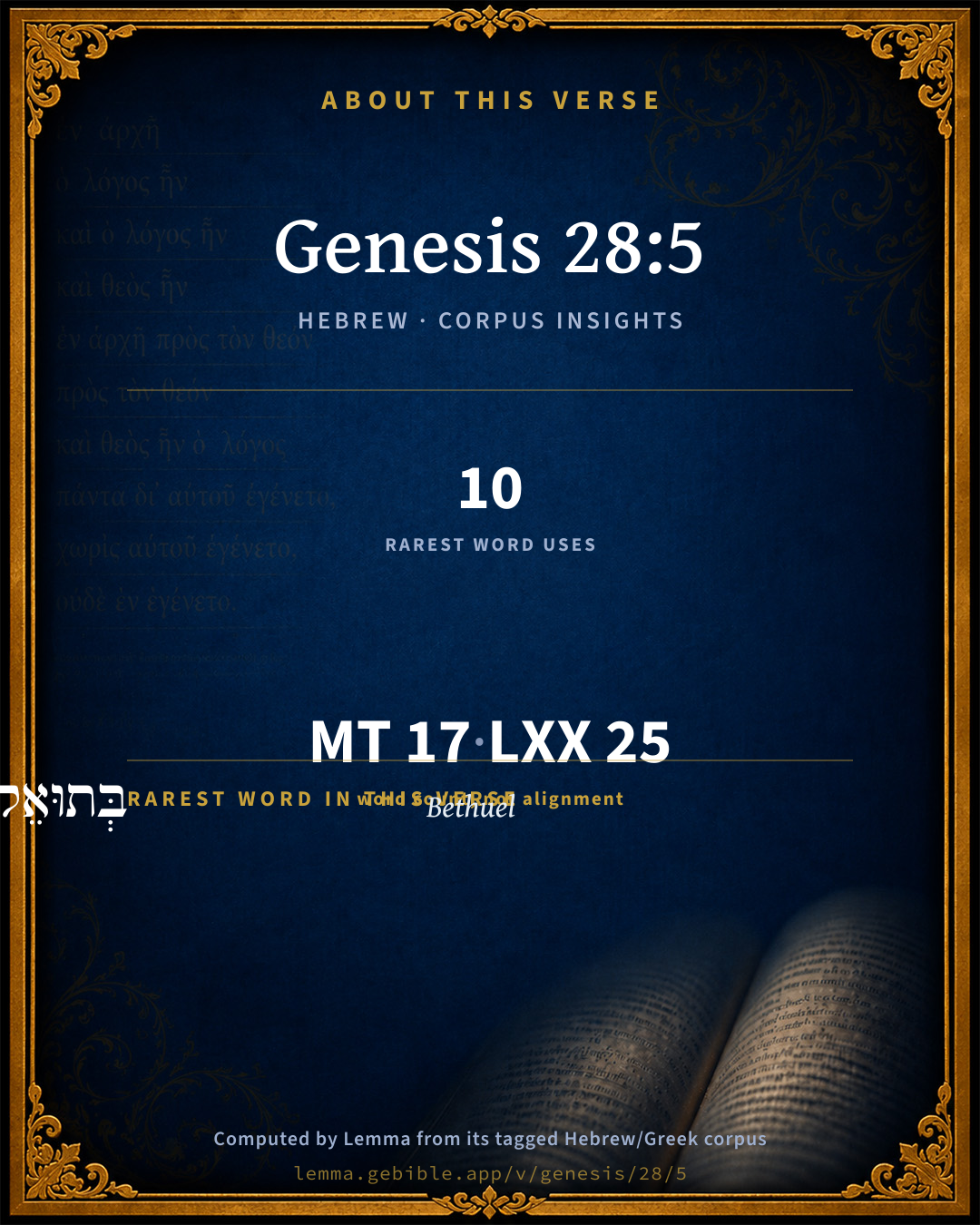
The rarest word here is בְּתוּאֵל֙ Bethuel H1328 — appearing just 10 times in the whole Hebrew Bible.

Shared distinctive vocabulary

בְּתוּאֵל֙ Bethuel H1328 occurs in 10 verses of the Hebrew Bible. Also found in:

Grammatical profile

  • 2 verbs
  • 13 nouns
  • 1 preposition
  • 1 particle

Verb forms

  • וַיִּשְׁלַ֤ח Qal · Sequential Imperfect
  • וַיֵּ֖לֶךְ Qal · Sequential Imperfect

Repetition

Words recur within this verse — often emphatic in Hebrew:

  • יַעֲקֹ֔ב Jacob H3290 ×2
  • פַּדֶּ֣נָֽה Padan-aram H6307 ×2

Hebrew & Septuagint length

In English translation the verse runs 22 words from the Hebrew and 28 from the Septuagint (LXX English) — closely comparable.

A rough comparison of the two English renderings, which tokenize alike — not a word-level alignment.

Word counts can differ between the Hebrew and the Greek without any difference in meaning — e.g. the Hebrew direct-object marker אֵת has no separate Greek word, and Greek often adds the article ὁ.

In the original languages it is 17 Hebrew tokens and 25 Greek tokens — but the two are counted differently (Hebrew bundles its prefixes and suffixes into one token; the Greek is in lemma form), so that isn’t a like-for-like length.

Hebrew and Greek witnesses Masoretic Hebrew ↔ Greek Septuagint

The same verse in the two great witnesses to the Old Testament, shown verse-for-verse.

These are two independent witnesses, not word-aligned to each other, and the Septuagint is shown in lemma (dictionary) form.

Hebrew Genesis 28:5 Masoretic · Westminster Leningrad Codex

וַיִּשְׁלַ֤ח יִצְחָק֙ אֶֽת יַעֲקֹ֔ב וַיֵּ֖לֶךְ פַּדֶּ֣נָֽה אֲרָ֑ם אֶל לָבָ֤ן בֶּן בְּתוּאֵל֙ הָֽאֲרַמִּ֔י אֲחִ֣י רִבְקָ֔ה אֵ֥ם יַעֲקֹ֖ב וְעֵשָֽׂו

Isaac sent Jacob away. He went to Paddan Aram to Laban, son of Bethuel the Syrian, Rebekah's brother, Jacob's and Esau's mother.

World English Bible · Public Domain

Greek LXX Genesis 28:5 Septuagint · lemma form

καί ἀποστέλλω ισαακ ὁ ἰακώβ καί πορεύομαι εἰς ὁ μεσοποταμία πρός λαβαν ὁ υἱός βαθουηλ ὁ σύρος ἀδελφός δέ ρεβεκκα ὁ μήτηρ ἰακώβ καί ησαυ

So Isaac sent away Jacob, and he went into Mesopotamia to Laban the son of Bethuel the Syrian, the brother of Rebecca the mother of Jacob and Esau.

LXX2012 (modern English Septuagint) · Public Domain

Hebrew: Westminster Leningrad Codex (CC BY 4.0). Greek: Septuagint (public domain); English from LXX2012 (modern English Septuagint) (Public Domain). How the Septuagint differs from the Hebrew →

Targum (Aramaic paraphrase)

2

The Targum is the ancient Jewish Aramaic paraphrase of the Hebrew Scriptures — an interpretive translation, not the Hebrew text itself. Onkelos (literal) and Pseudo-Jonathan (expansive) render the Torah, and Jonathan the Prophets. Coverage is partial: where no permissively-licensed English translation exists for a verse, only the Aramaic is shown. This is verse-level text, not a word-by-word alignment to the Hebrew.

  1. Targum Onkelos Torah (Genesis–Deuteronomy)
    וּשְׁלַח יִצְחָק יָת יַעֲקֹב וַאֲזַל לְפַדַּן אֲרָם לְוַת לָבָן בַּר בְּתוּאֵל אֲרַמָּאָה אֲחוּהָא דְרִבְקָה אִמֵּהּ דְּיַעֲקֹב וְעֵשָׂו

    (no public-domain English translation for this verse)

    Targum Onkelos — Aramaic: “Onkelos Genesis” (public domain); “Onkelos Exodus” (public domain); “Onkelos Leviticus” (public domain); “Onkelos Numbers” (public domain); “Onkelos Deuteronomy” (public domain). English: “Sefaria Community Translation” (CC0 1.0 (public-domain dedication)); “J.W. Etheridge. The Targums of Onkelos and Jonathan Ben Uzziel on the Pentateuch. London: Longmans, Green, 1862” (public domain). Text via Sefaria.

  2. Targum Pseudo-Jonathan Torah (Genesis–Deuteronomy)
    וְשָׁדַר יִצְחָק יַת יַעֲקב וְאָזַל לְפַדַן אֲרָם לְוַת לָבָן בַּר בְּתוּאֵל אֲרַמָאָה אָחוּהָא דְרִבְקָה אִימָא דְיַעֲקב וְעֵשָו

    And Izhak sent Jakob away, and he went to Padan Aram unto Laban bar Bethuel the Armaite, the brother of Rivekah the mother of Jakob and Esau.

    Targum Pseudo-Jonathan — Aramaic: “Targum Jonathan on Genesis” (public domain); “Targum Jonathan on Exodus” (public domain); “Targum Jonathan on Leviticus” (public domain); “Targum Jonathan on Numbers” (public domain); “Targum Jonathan on Deuteronomy” (public domain). English: “The Targum of Jonathan ben Uzziel, trans. J. W. Etheridge, London, 1862” (public domain). Text via Sefaria.

Commentary

Notes on Genesis 28:5 from classic Christian and Jewish commentators (each source and its license shown beneath its notes). The classic Christian expositions comment on the surrounding passage and are grouped to its opening verse, so a note may address several verses; the Jewish commentaries on the Tanakh (Rashi and others) are per-verse, so they appear only where the commentator wrote on this verse.

Lemma curates 59 commentaries, every one of them public domain or Creative Commons licensed, each selected and text-cleaned for this edition rather than reprinted as found. About our sources →

Trapp's Complete Commentary

John Trapp

Gen 28:5 And Isaac sent away Jacob: and he went to Padanaram unto Laban, son of Bethuel the Syrian, the brother of Rebekah, Jacob’s and Esau’s mother.

Ver. 5. Isaac sent away Jacob.] With his staff only, {Gen 32:10} and to "serve for a wife". {Hos 12:12} It was otherwise, when a wife was provided for Isaac. But Jacob went as privately as he could; "he fled into Syria," probably, that his brother Esau might not know of his journey, and wait him a shrewd turn by the way. Theodoret saith, it was that the divine providence might be the better declared toward him, no better attended or accommodated.

John Trapp, A Commentary or Exposition upon All the Books of the Old and New Testament (1647–1656) — public domain. Text from a community e-Sword module.

Adam Clarke's Commentary

Verse 5. Bethuel the Syrian] Literally the Aramean, so called, not because he was of the race of Aram the son of Shem, but because he dwelt in that country which had been formerly possessed by the descendants of Aram.

Adam Clarke's Commentary on the Bible (1810–1826) — public domain. Text from a community e-Sword/MySword module.

Ellicott's Commentary for English Readers

(5) Jacob’s and Esau’s mother.—This insertion of particulars already well known is in exact accordance with the Oriental manner of writing, which, moreover, is very careful in impressing all matters of family relation on the mind. (Comp. Gen_25:12.) It is worthy of notice that as Jacob has now been confirmed in the possession of the birthright by the father as well as by the mother, his name is placed first.

A Bible Commentary for English Readers, edited by Charles John Ellicott (1878–1897) — public domain. Text from a community e-Sword module.

The Cambridge Bible for Schools and Colleges

gen. ed. J. J. S. Perowne

5. and he went to Paddan-aram unto Laban] In this short sentence the narrative of P disposes of the journey of Jacob, which is described in much greater detail in the parallel narratives from J and E, preserved in Gen_28:10-22 and chap. 29.

the Syrian] Heb. Aramean. Cf. Gen_25:20; Deu_26:5.

The Cambridge Bible for Schools and Colleges (gen. ed. J. J. S. Perowne; Cambridge University Press, 1878–1918) — public domain. Text from a community e-Sword module.

John Gill's Exposition

And Isaac sent away Jacob,.... From Beersheba; not in anger, or in a dishonourable way, but took his leave of him no doubt in an affectionate manner; as it is clear he went with his blessing, and had his good wishes for a prosperous journey:

and he went to Padanaram; which from Beersheba, according to some (h), was four hundred and eighty miles:

unto Laban, son of Bethuel the Syrian; some versions make Laban to be the Syrian, others Bethuel; it is a matter of no great moment which is here so called, since they were both called Syrians, see Gen 25:20,

the brother of Rebekah; this refers to Laban, for Bethuel was her father:

Jacob's and Esau's mother; Jacob is set first, not only as being most beloved by his mother, but as now having the birthright and the blessing.

(h) Bunting's Travels, p. 72.

John Gill's Exposition of the Whole Bible (1746–1763) — public domain (CC PDM 1.0). Text via the HelloAO Bible API.

Matthew Poole's English Annotations

Bethuel the Syrian.

Object. He was no Syrian, but a Mesopotamian.

Answ. Syria is sometimes largely taken, and so it comprehends Mesopotamia, or Chaldea, yea, and Assyria, as appears from Isa 36:11; Dan 2:4.

Matthew Poole's English Annotations on the Holy Bible (1683–1685) — public domain. Text from a community e-Sword/MySword module.

The Pulpit Commentary

And Isaac sent away Jacob (Rebekah only counseled, Isaac commanded): and he went to Padan-aram unto Laban, son of Bethel the Syrian, (vide Hos_12:12) the brother of Rebekah, Jacob"s and Esau"s mother. The historian here perhaps intentionally gives the first place to Jacob.

The Pulpit Commentary (1880–1919), ed. H.D.M. Spence-Jones & Joseph S. Exell — public domain. Text from a community e-Sword module.

John Wesley's Explanatory Notes

Rebekah is here called Jacob's and Esau's mother - Jacob is named first, not only because he had always been his mother's darling, but because he was now made his father's heir, and Esau was postponed.

John Wesley, Explanatory Notes Upon the Whole Bible (1754–1765) — public domain. Text via the GEBible commentary corpus.

unfoldingWord translationNotes

Door43 World Missions Community

Paddan Aram

This was another name for the region of Mesopotamia, which about the same location as modern Iraq. See how this was translated in Genesis 25:20. (See: How to Translate Names)

Bethuel

Bethuel was Rebekah's father. See how you translated this name in Genesis 22:22. (See: How to Translate Names)

translationWords

Laban

Aram

Rebekah

Esau

unfoldingWord translationNotes — © Distant Shores Media and the Door43 World Missions Community, licensed CC BY-SA 4.0. Source: git.door43.org/Door43/en_tn.

Rashi

Rabbi Shlomo Yitzchaki (Rashi)

אם יעקב ועשו MOTHER OF JACOB AND ESAU — I do not know what the addition of these words is intended to tell us.

Rashi on the Tanakh — English translations: “The Judaica Press complete Tanach with Rashi, translated by A. J. Rosenberg” (CC BY 4.0); “Pentateuch with Rashi's commentary by M. Rosenbaum and A.M. Silbermann, 1929-1934” (public domain); “The Metsudah Tanach series, Lakewood, N.J” (CC BY 4.0); and “The Book of Joshua, Metsudah Publications, 1997” (CC BY 4.0). Text via Sefaria.

Ramban (Nachmanides)

Rabbi Moshe ben Nachman (Ramban / Nachmanides)

THE BROTHER OF REBEKAH, JACOB’s AND ESAU’s MOTHER. Because it stated, was, “I do not know what this intends to tell us.” Ramban then proceeds to offer an explanation. that Isaac commanded Jacob to get a wife from the daughters of Laban, his mother’s brother, Scripture mentions that he was also the brother of Esau’s mother. It would have been proper for Isaac to have commanded Esau likewise, but since he knew that the blessing of Abraham would apply only to Jacob and his seed, he did so only to Jacob. Now Scripture further mentions that Esau heard that his father had commanded Jacob not to take a wife from among the daughters of Canaan and that he should go to his mother’s brother Laban. He [Esau] heeded his father’s will that one not take a wife from among the daughters of Canaan, but he did not act properly and take a wife from the daughters of Laban, despite his [Laban’s] being his mother’s brother. Scripture further mentions that he took her besides his former wives, and he did not divorce the evil wives since he followed his heart’s desire more than he followed the will of his father.Vayeitzei

Ramban (Nachmanides) on the Tanakh — English translation: “Commentary on the Torah by Ramban (Nachmanides). Translated and annotated by Charles B. Chavel. New York, Shilo Pub. House, 1971-1976” (CC BY 4.0). Text via Sefaria.

Radak

Rabbi David Kimhi (Radak)

וישלח, he sent him off to proceed in the direction he had instructed him. Yaakov complied with his father’s instruction, as the Torah continues וילך פדנה ארם, he took with him sufficient supplies of money and food to last him until he would arrive there. His parents knew that once he would be at his uncle Lavan he would not be short of any of his needs.

אחי רבקה, Rivkah’s brother. He had ample reason to go there if he had to flee some place, seeing his uncle was a brother of his mother. In this phrase Yaakov is mentioned ahead of Esau, although he was the younger, because his relationship to Rivkah who was also his mother was much closer than that of Rivkah to Esau her older son. Everyone of her family in Padan Aram was aware of their sister Rivkah’s special fondness for Yaakov.

Radak on the Tanakh — English translations: “Sefaria Community Translation” (CC0 1.0 (public-domain dedication)); “Eliyahu Munk, HaChut Hameshulash” (CC BY 4.0); “Rabbi Mike Feuer, Jerusalem Anthology” (CC BY 4.0); and “R. David Kimhi on the first book of Psalms, Translated by R.G. Finch, London, 1919” (public domain). Text via Sefaria.

Lesson kit

Teaching starters — assembled from the data on this page, not authored interpretation. Every prompt links to the verse data it draws on. Edit before teaching.

Genesis, in the Pentateuch, opens this verse with 17 words (15 distinct Hebrew lemmas). Its most distinctive word is Bᵉthûwʼêl (“Bethuel”). A historical commentator’s framing appears above. Read the whole chapter for the surrounding context.

Discussion questions

  1. How does “Bethuel” (Bᵉthûwʼêl) shape what this verse is saying?
  2. How does Genesis 22:22, which shares the word «Bethuel», read alongside this verse?
  3. What does the repetition of “Jacob” (2× in this one verse) do in this verse?
  4. The translations on this page render this verse differently — a whole-verse word diff, not a word-by-word alignment. What might account for the different wordings?
  5. «וַיִּשְׁלַ֤ח» is a Qal Sequential Imperfect verb. How does that grammatical form shape the action described?
  6. Compare how Trapp's Complete Commentary and Adam Clarke's Commentary read this verse. Where do they agree or differ?

Things to notice

Reading settings

Reading text

Shown beneath each verse's original-language words.

Old Testament
Old Testament edition

Read the OT as the Masoretic Hebrew (MT) or the Greek Septuagint (LXX).

English shown for the Greek Septuagint (in the Hebrew ↔ Greek comparison).

Comparing translations? Open the Compare panel on any verse page to stack up to four side by side.