
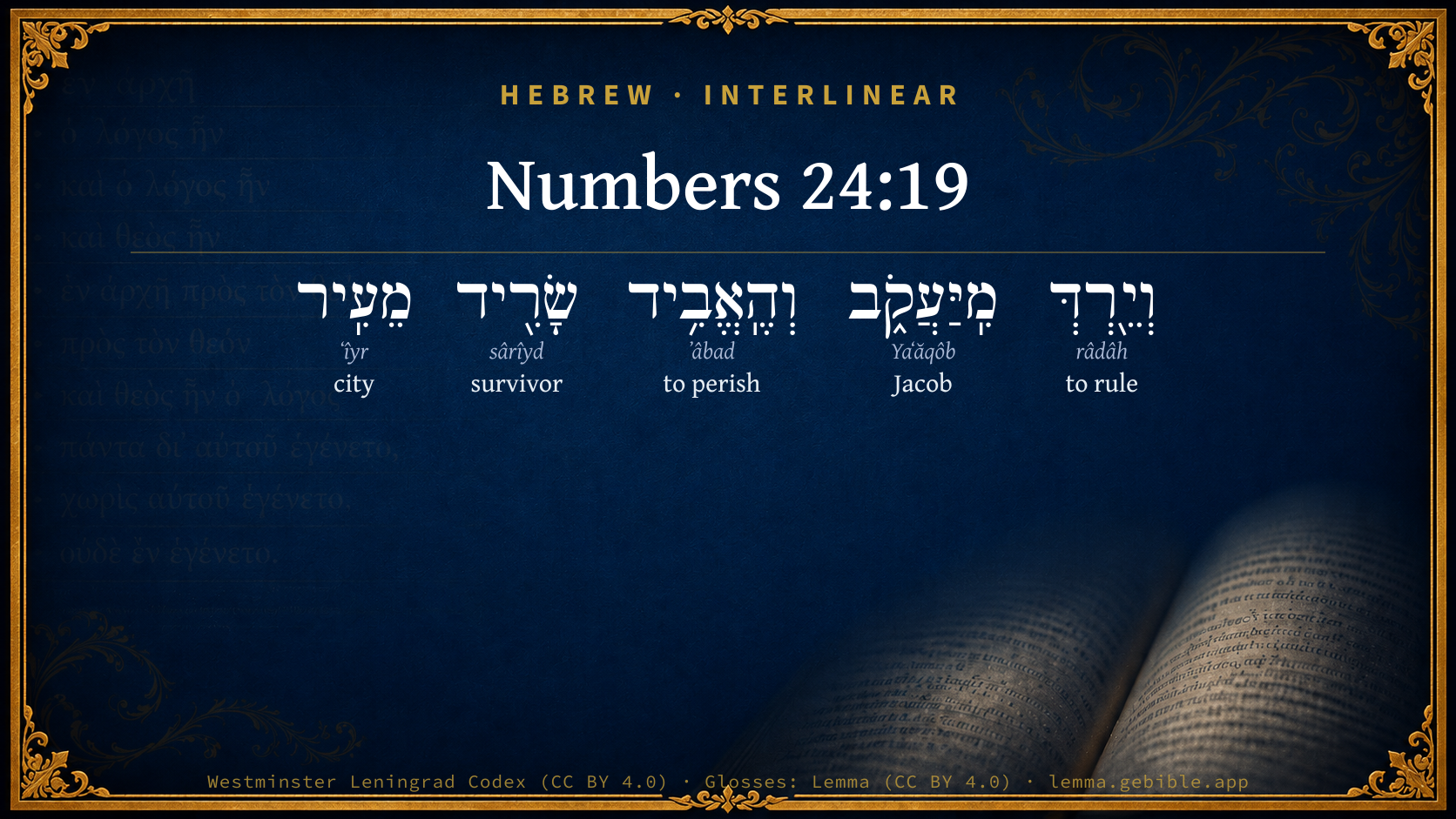
Numbers 24:19

Hebrew (Westminster Leningrad Codex) Numbers 24:19 appears in the Hebrew Old Testament. The text above is from the Westminster Leningrad Codex. Each word links to its Strong’s number, a concise gloss, and parsing drawn from the Open Scriptures Hebrew Bible morphology. Click any word for its full Brown-Driver-Briggs (BDB) entry.
Download image
Cite this verse

Numbers 24:19 (World English Bible). Public Domain. Lemma interlinear Bible study tool, https://lemma.gebible.app/v/numbers/24/19.

Show BibTeX & RIS
BibTeX
RIS
English Translation
Out of Jacob shall one have dominion, Shall destroy the remnant from the city.
World English Bible · Public Domain
Download a study sheet

One document with this verse’s original text, its word-by-word gloss line, the meaning frame, cross-references with their text, attributed commentary, and full source and license credits — printable, and it pastes into notes with its structure intact.

This verse Autodidact and up

Study sheet (.html) Plain text (.txt)

A passage Seminary Student

Up to 50 verses in one chapter. A passage sheet keeps up to 6 commentary sources and 12 cross-references per verse, in the order this page ranks them, and says so on the sheet whenever that leaves anything out. Ask for a single verse and you get the Autodidact verse sheet above.

Everything on this page stays free to read, with no account — the sheet is a download of what is already on screen, not access to it.

Want to remove ads? Support Godless Engineer
Compare translations 3

The same verse in 3 English versions, stacked beneath the original-language interlinear above. Click any original word for its lexicon entry.

Each is an independent rendering of the whole verse — the interlinear is not word-aligned to these translations.

Highlighted words mark where these versions differ — a whole-verse word diff, not a word-by-word alignment.

  • World English Bible Public Domain
    Out of Jacob shall one have dominion, Shall destroy the remnant from the city.
  • King James Version Public Domain
    Out of Jacob shall come he that shall have dominion, and shall destroy him that remaineth of the city.
  • unfoldingWord Literal Text CC BY-SA 4.0
    And he will rule from Jacob, and he will destroy the survivor from a city.”

unfoldingWord Literal Text — © unfoldingWord, licensed CC BY-SA 4.0. Word-aligned USFM3 via Door43 (git.door43.org/unfoldingWord/en_ult).

Versions to compare (up to 4)

3 of 4 selected

Show all 18 translations

Every available English version of this verse, each an independent rendering of the whole verse.

  • World English Bible Public Domain
    Out of Jacob shall one have dominion, Shall destroy the remnant from the city.
  • Berean Standard Bible Public Domain
    A ruler will come from Jacob and destroy the survivors of the city.”
  • Majority Standard Bible Public Domain
    A ruler will come from Jacob and destroy the survivors of the city.”
  • King James Version Public Domain
    Out of Jacob shall come he that shall have dominion, and shall destroy him that remaineth of the city.
  • American Standard Version (1901) Public Domain
    And out of Jacob shall one have dominion, And shall destroy the remnant from the city.
  • Revised Version (1885) Public Domain
    And out of Jacob shall one have dominion, And shall destroy the remnant from the city.
  • Geneva Bible (1599) Public Domain
    He also that shall haue dominion shall bee of Iaakob, and shall destroy the remnant of the citie.
  • Douay-Rheims (1899) Public Domain
    Out of Jacob shall he come that shall rule, and shall destroy the remains of the city.
  • Young's Literal Translation Public Domain
    And `one' doth rule out of Jacob, And hath destroyed a remnant from Ar.'
  • Literal Standard Version CC BY-SA 4.0
    And [One] rules out of Jacob, || And has destroyed a remnant from the city.”
  • Unlocked Literal Bible CC BY-SA 4.0
    Out of Jacob a king will come who will have dominion, and he will destroy the survivors of their city.”
  • unfoldingWord Literal Text CC BY-SA 4.0
    And he will rule from Jacob, and he will destroy the survivor from a city.”
  • Darby Bible Public Domain
    And one out of Jacob shall have dominion, and will destroy out of the city what remaineth.
  • World Messianic Bible Public Domain
    Out of Jacob shall one have dominion, and shall destroy the remnant from the city.”
  • Webster's Bible Public Domain
    Out of Jacob shall come he that shall have dominion, and shall destroy him that remaineth of the city.
  • Free Bible Version CC BY-SA 4.0
    A ruler from Jacob will come and destroy those left in the city.”
  • Bible in Basic English Public Domain
    And Israel will go on in strength, and Jacob will have rule over his haters.
  • JPS Tanakh (1917) Public Domain
    And out of Jacob shall one have dominion, and shall destroy the remnant from the city.

Literal Standard Version (2020), Covenant Press — licensed CC BY-SA 4.0. Text via the HelloAO Bible API (eBible.org). Unlocked Literal Bible (unfoldingWord) — licensed CC BY-SA 4.0. Text via the HelloAO Bible API (eBible.org). unfoldingWord Literal Text — © unfoldingWord, licensed CC BY-SA 4.0. Word-aligned USFM3 via Door43 (git.door43.org/unfoldingWord/en_ult). Free Bible Version, Dr. Jonathan Gallagher — licensed CC BY-SA 4.0. Text via the HelloAO Bible API (eBible.org).

Word by word

More ways to search: Search by grammar → Find every occurrence → Compare this word →

Practice this passage: Drill this verse → Learn its vocabulary →

וְיֵ֖רְדְּ
râdâh
H7287
“and · to rule”
Conjunction + Verb, Qal, Jussive, 3rd Person, Masculine, Singular
Part of Speech
Conjunction + Verb
Stem
Qal
Form
Jussive
Person
3rd Person
Gender
Masculine
Number
Singular
Full BDB Definition

Origin: a primitive root

TWOT: 2121 , 2122

to rule, have dominion, dominate, tread down - (Qal) to have dominion, rule, subjugate - (Hiphil) to cause to dominate - to scrape out - (Qal) to scrape, scrape out
  1. מִֽיַּעֲקֹ֑ב Yaʻăqôb H3290 “from · Jacob” Preposition + Noun, Proper
  2. וְהֶֽאֱבִ֥יד ʼâbad H6 “and · to perish” Conjunction + Verb, Hiphil, Sequential Perfect, 3rd Person, Masculine, Singular
  3. שָׂרִ֖יד sârîyd H8300 “survivor” Noun, Common, Masculine, Singular, Absolute
  4. מֵעִֽיר ʻîyr H5892 “from · city” Preposition + Noun, Common, Feminine, Singular, Absolute

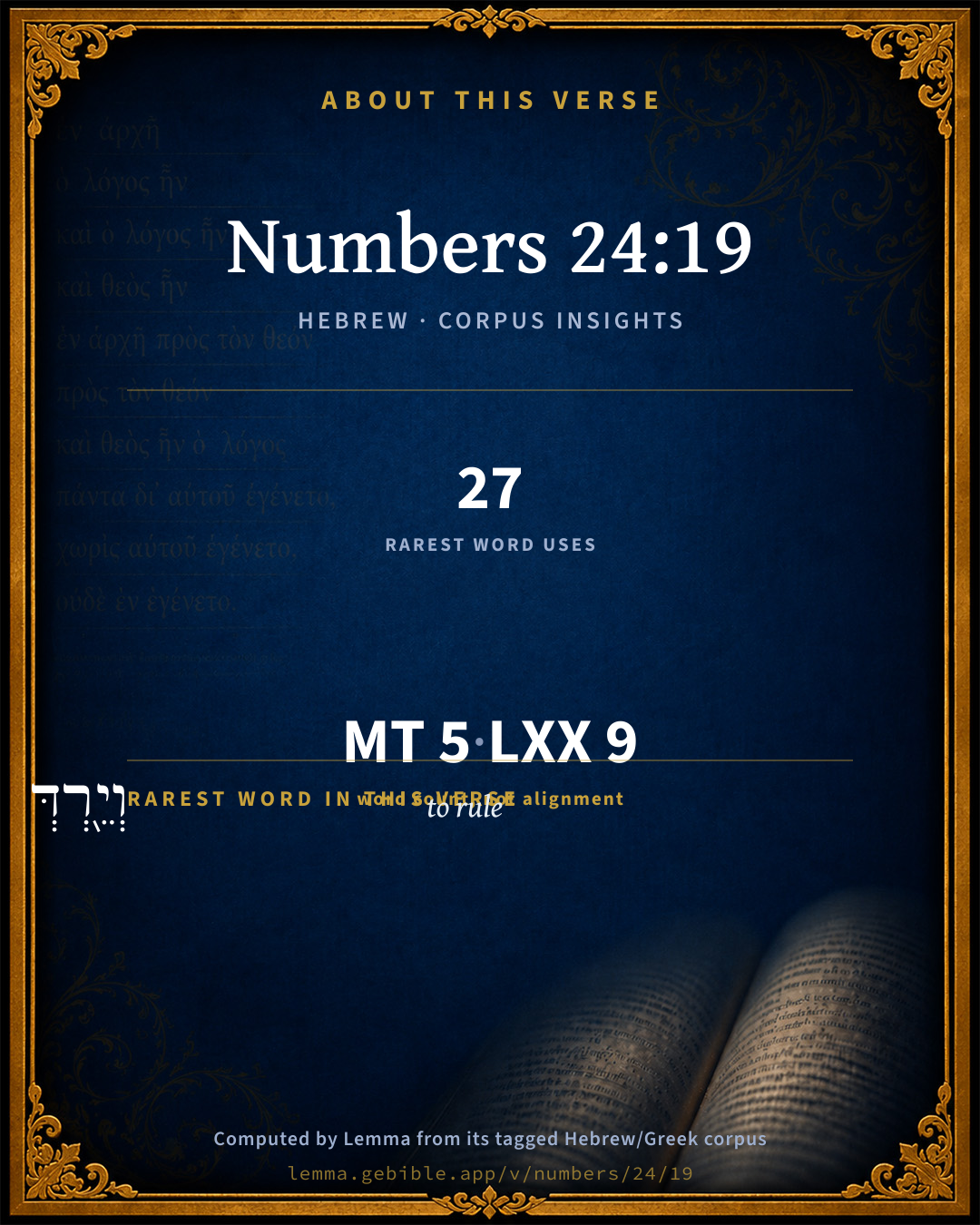
About this verse

These counts appear in no published source. They are computed here, from the morphology-tagged text and Lemma’s own curated glosses. What Lemma adds →

5
words
5
distinct lemmas
Pentateuch
section

Shared distinctive vocabulary

וְיֵ֖רְדְּ to rule H7287 occurs in 25 verses of the Hebrew Bible. Also found in:

Grammatical profile

  • 2 verbs
  • 3 nouns

Verb forms

  • וְיֵ֖רְדְּ Qal · Jussive
  • וְהֶֽאֱבִ֥יד Hiphil · Sequential Perfect

Hebrew & Septuagint length

In English translation the verse runs 14 words from the Hebrew and 16 from the Septuagint (LXX English) — closely comparable.

A rough comparison of the two English renderings, which tokenize alike — not a word-level alignment.

Word counts can differ between the Hebrew and the Greek without any difference in meaning — e.g. the Hebrew direct-object marker אֵת has no separate Greek word, and Greek often adds the article ὁ.

In the original languages it is 5 Hebrew tokens and 9 Greek tokens — but the two are counted differently (Hebrew bundles its prefixes and suffixes into one token; the Greek is in lemma form), so that isn’t a like-for-like length.

Cross-references

17

Topical passages linked to Numbers 24:19 in the Treasury of Scripture Knowledge — connected by theme and wording, ordered by reader-vote popularity; previews shown in the World English Bible.

  • Genesis 49:10 The scepter will not depart from Judah, Nor the ruler's staff from between his feet, Until he comes to whom it belongs. To him will the obedience of the peoples be.
  • Psalms 2:1–12 Why do the nations rage, And the peoples plot a vain thing?
  • Micah 5:2 But you, Bethlehem Ephrathah, Being small among the clans of Judah, Out of you one will come forth to me that is to be ruler in Israel; Whose goings forth are from of old, from everlasting.
  • Matthew 28:18 Jesus came to them and spoke to them, saying, "All authority has been given to me in heaven and on earth.
  • Psalms 21:7–10 For the king trusts in Yahweh. Through the loving kindness of the Most High, he shall not be moved.
  • Psalms 72:10–11 The kings of Tarshish and of the isles will bring tribute. The kings of Sheba and Seba shall offer gifts.
  • Isaiah 11:10 It shall happen in that day, that the root of Jesse, who stands for an ensign of the peoples, to him shall the nations seek; and his resting-place shall be glorious.
  • Micah 5:4 He shall stand, and shall shepherd in the strength of Yahweh, In the majesty of the name of Yahweh his God: And they will live, for then he will be great to the ends of the earth.
  • Matthew 25:46 These will go away into eternal punishment, but the righteous into eternal life."
  • Luke 19:27 But bring those enemies of mine who didn't want me to reign over them here, and kill them before me.'"
  • 1 Corinthians 15:25 For he must reign until he has put all his enemies under his feet.
  • Ephesians 1:20–22 which he worked in Christ, when he raised him from the dead, and made him to sit at his right hand in the heavenly places,
  • Philippians 2:10–11 that at the name of Jesus every knee should bow, of those in heaven, those on earth, and those under the earth,
  • 1 Peter 3:22 who is at the right hand of God, having gone into heaven, angels and authorities and powers being made subject to him.
  • Revelation 19:16 He has on his garment and on his thigh a name written, "KING OF KINGS, AND LORD OF LORDS."
  • Luke 19:12 He said therefore, "A certain nobleman went into a far country to receive for himself a kingdom, and to return.
  • Hebrews 1:8 but of the Son he says, "Your throne, O God, is forever and ever; The scepter of uprightness is the scepter of your Kingdom.

Cross-references courtesy of OpenBible.info (CC BY 4.0).

Hebrew and Greek witnesses Masoretic Hebrew ↔ Greek Septuagint

The same verse in the two great witnesses to the Old Testament, shown verse-for-verse.

These are two independent witnesses, not word-aligned to each other, and the Septuagint is shown in lemma (dictionary) form.

Hebrew Numbers 24:19 Masoretic · Westminster Leningrad Codex

וְיֵ֖רְדְּ מִֽיַּעֲקֹ֑ב וְהֶֽאֱבִ֥יד שָׂרִ֖יד מֵעִֽיר

Out of Jacob shall one have dominion, Shall destroy the remnant from the city.

World English Bible · Public Domain

Greek LXX Numbers 24:19 Septuagint · lemma form

καί ἐκἐγείρω ἐκ ἰακώβ καί ἀποὀλλύω σώζω ἐκ πόλις

And one shall arise out of Jacob, and destroy out of the city him that escapes.

LXX2012 (modern English Septuagint) · Public Domain

Hebrew: Westminster Leningrad Codex (CC BY 4.0). Greek: Septuagint (public domain); English from LXX2012 (modern English Septuagint) (Public Domain). How the Septuagint differs from the Hebrew →

Targum (Aramaic paraphrase)

2

The Targum is the ancient Jewish Aramaic paraphrase of the Hebrew Scriptures — an interpretive translation, not the Hebrew text itself. Onkelos (literal) and Pseudo-Jonathan (expansive) render the Torah, and Jonathan the Prophets. Coverage is partial: where no permissively-licensed English translation exists for a verse, only the Aramaic is shown. This is verse-level text, not a word-by-word alignment to the Hebrew.

  1. Targum Onkelos Torah (Genesis–Deuteronomy)
    וְיֵיחוּת חָד מִדְבֵית יַעֲקֹב וְיוֹבִיד מְשֵׁיזִיב מִקִרְיַת עַמְמַיָא

    (no public-domain English translation for this verse)

    Targum Onkelos — Aramaic: “Onkelos Genesis” (public domain); “Onkelos Exodus” (public domain); “Onkelos Leviticus” (public domain); “Onkelos Numbers” (public domain); “Onkelos Deuteronomy” (public domain). English: “Sefaria Community Translation” (CC0 1.0 (public-domain dedication)); “J.W. Etheridge. The Targums of Onkelos and Jonathan Ben Uzziel on the Pentateuch. London: Longmans, Green, 1862” (public domain). Text via Sefaria.

  2. Targum Pseudo-Jonathan Torah (Genesis–Deuteronomy)
    וִיקוּם שַׁלִיט מִדְבֵית יַעֲקב וְיוֹבִיד וִישֵׁיצֵי שֵׁיזְבוּתָא דְמִשְׁתַּיֵיר מִן קוּסְטַנְטִינֵי קַרְתָּא חַיַיבְתָּא וְיִצְדֵי וְיֶחֱרוֹב כְּרַכָּא מְרוֹדָא דְקִסְרִין תַּקִיף קִרְוֵי עַמְמַיָא

    And a prince of the house of Jakob will arise and destroy and consume the remnant that have escaped from Constantina the guilty city, and will lay waste and ruin the rebellious city, even Kaiserin the strong city of the Gentiles.

    Targum Pseudo-Jonathan — Aramaic: “Targum Jonathan on Genesis” (public domain); “Targum Jonathan on Exodus” (public domain); “Targum Jonathan on Leviticus” (public domain); “Targum Jonathan on Numbers” (public domain); “Targum Jonathan on Deuteronomy” (public domain). English: “The Targum of Jonathan ben Uzziel, trans. J. W. Etheridge, London, 1862” (public domain). Text via Sefaria.

Commentary

Notes on Numbers 24:19 from classic Christian and Jewish commentators (each source and its license shown beneath its notes). The classic Christian expositions comment on the surrounding passage and are grouped to its opening verse, so a note may address several verses; the Jewish commentaries on the Tanakh (Rashi and others) are per-verse, so they appear only where the commentator wrote on this verse.

Lemma curates 59 commentaries, every one of them public domain or Creative Commons licensed, each selected and text-cleaned for this edition rather than reprinted as found. About our sources →

Trapp's Complete Commentary

John Trapp

Num 24:19 Out of Jacob shall come he that shall have dominion, and shall destroy him that remaineth of the city.

Ver. 19. And shall destroy him.] David in the history, {1Ki 11:15-16} Christ in the mystery, {Oba 1:18} even all the antichristian rout and rabble. {Rev 19:21}

John Trapp, A Commentary or Exposition upon All the Books of the Old and New Testament (1647–1656) — public domain. Text from a community e-Sword module.

Joseph Benson's Commentary

Num 24:19. Out of Jacob — Out of his loins. He that shall have dominion — David, and especially Christ. Shall destroy him that remaineth of the city — Not only defeat them in the field, but destroy them even in their strongest cities. “We see,” Bishop Newton further observes, “how exactly this prophecy hath been fulfilled in the person and actions of David; but most Jewish as well as Christian writers apply it, primarily, perhaps, to David, but ultimately to the Messiah, as the person chiefly intended, in whom it was to receive its full and entire completion. Onkelos interprets it of the Messiah. Maimonides understands it partly of David, and partly of the Messiah, and with him agree other rabbis. It appears to have been generally understood by the Jews as a prophecy of the Messiah, because the false Christ, who appeared in the reign of the Roman emperor Adrian, assumed the title of Barchochebas, or Son of the Star, in allusion to this prophecy, and in order to have it believed that he was the star that Balaam had seen afar off. The Christian fathers, I think, are unanimous in applying this prophecy to our Saviour, and to the star which appeared at his nativity. Origen, in particular, produces it as one of the plainest and clearest prophecies of the Messiah; and both he and Eusebius affirm, that it was in consequence of Balaam’s prophecies, which were known and believed in the East, that the magi, upon the appearance of a new star, came to Jerusalem to worship him who was born king of the Jews. The stream of modern divines and commentators apply the prophecy principally to our Saviour; and by Moab and Edom they understand the enemies and persecutors of the church.”

Joseph Benson's Commentary on the Old and New Testaments (1811–1818) — public domain. Text from a community e-Sword module.

Geneva Bible (1599)

Geneva Bible translators

Of the Edomites.

Geneva Bible (1599) marginal notes — public domain. Text via Bolls.life.

Jamieson, Fausset & Brown

Robert Jamieson, A. R. Fausset & David Brown

Out of Jacob shall come he that shall have dominion--David, and particularly Christ.

that remaineth of the city--those who flee from the field to fortified places (Psa 60:9).

Jamieson, Fausset & Brown — Commentary Critical and Explanatory on the Whole Bible (1871) — public domain (CC PDM 1.0). Text via the HelloAO Bible API.

Adam Clarke's Commentary

Verse 19. Out of Jacob shall come, c.] This is supposed to refer to Christ, because of what is said Ge 49:10.

It is exceedingly difficult to fix the true sense of this prophecy in all its particulars. Probably the star, Nu 24:17, is only an emblem of kingly power. Among the Egyptians a star is said to have been the symbol of the Divine Being. The sceptre refers to the kingly power in exercise. The corners or outskirts may mean the petty Moabitish governments, as the Chaldee has understood the term. If karkar, which we translate utterly destroy, be not the name of a place here, as it is in Jdg 8:10, (which is not very likely), it may be taken in one of those senses assigned to it, (See Clarke on Nu 24:17,) and signify the blending together the children of Sheth, that is, all the inhabitants of the earth for so the children of Sheth must necessarily be understood, unless we consider it here as meaning some king of the Moabites, according to Grotius, or a city on the borders of Moab, according to Rabbi Nathan. As neither Israel nor the Messiah ever destroyed all the children of men, we must (in order to leave the children of Sheth what they are generally understood to be, all the inhabitants of the world) understand the whole as a prophecy of the final universal sway of the sceptre of Christ, when the middle wall of partition shall be broken down, and the Jews and Gentiles become one united, blended fold, under one shepherd and bishop of their souls.

I cannot think that the meteoric star which guided the wise men of the east to Bethlehem can be intended here; nor do I think that Peter refers to this prophecy when he calls Christ the day star, 2Pe 1:19; nor that Re 2:28, where Christ is called the morning star, nor Re 22:16, where he is called the bright and morning star, refers at all to this prophecy of Balaam. Nor do I think that the false Christ who rose in the time of Adrian, and who called himself Barcochab, which literally signifies the son of a star, did refer to this prophecy. If he had, he must have defeated his own intention, because the SON of the star is not THE STAR that should arise, but at the utmost a descendant; and then, to vindicate his right to the Jewish throne, he must show that the person who was called the star, and of whom he pretended to be the son or descendant, had actually reigned before him. As the sun, moon, stars, planets, light, splendours, effulgence, day, c., were always considered among the Asiatics as emblems of royalty, government, c., therefore many, both men and women, had these names given to them as titles, surnames, &c. So the queen of Alexander the Great, called Roxana by the Greeks, was a Persian princess, and in her native tongue her name was [Persian] Roushen, splendour. Hadassah, who became queen to Ahasuerus, in place of the repudiated Vashti, and is called Esther by Europeans in general, was called in the language of Persia [Persian] Sitareh from whence by corruption came both Esther, the Persian queen, and our word star. And to waive all farther examples, a Mohammedan prince, at first named Eesouf or Joseph, was called [Arabic] Roushen Akhter when he was raised to the throne, which signifies a splendid or luminous star. This prince, by a joyful reverse of fortune, was brought from a gloomy prison and exalted to the throne of Hindostan on which account the following couplet was made, in which there is a paronomasia or play on the name Roushen Akhter; and the last line alludes to the history of the patriarch Joseph, who was brought out of prison and exalted to the highest honours in Egypt.

[Arabic]

[Arabic]

Roushen Akhter bood, aknoon mah shud:

Yousef az zendan ber amd shah shud.

"He was a bright star, but is now become a moon.

Joseph is brought out of prison, and is become a

glorious king."

Adam Clarke's Commentary on the Bible (1810–1826) — public domain. Text from a community e-Sword/MySword module.

Ellicott's Commentary for English Readers

(19) He that shall have dominion.—The reference is explained in Psa_72:8, “He shall have dominion also from sea to sea, and from the river unto the ends of the earth,” where the same verb occurs which is in both places rendered in the Authorised Version “shall have dominion.”

And shall destroy him that remaineth of the city.—Or, and He shall destroy the remnant from the cities. The city, which is in the singular number here as in Psa_72:16, may be used collectively to denote cities generally, though some have understood the reference to be to the city of Jerusalem. But the reference seems to be rather to the chief city, or the cities generally, of Edom. (Comp. Obad., Num_24:18, where the same word occurs which is here rendered “him that remaineth,” and which is there rendered “any remaining.”)

A Bible Commentary for English Readers, edited by Charles John Ellicott (1878–1897) — public domain. Text from a community e-Sword module.

The Cambridge Bible for Schools and Colleges

gen. ed. J. J. S. Perowne

19. An obscure verse, which is perhaps a later addition to the song. It appears to look forward to a Messianic prospect of universal dominion. Some think that Num_24:18-19 are both entirely corrupt beyond restoration.

shall one have dominion] This and the following verb are impersonal. ‘And dominion will be exercised out of Jacob, and the remnant (of Israel’s enemies) will be destroyed out of the city.’ If the text is right, ‘out of the city’ is parallel with ‘out of Jacob.’ It is therefore the city of the conquerors, i.e. Zion.

The Cambridge Bible for Schools and Colleges (gen. ed. J. J. S. Perowne; Cambridge University Press, 1878–1918) — public domain. Text from a community e-Sword module.

John Gill's Exposition

And when he looked on Amalek,.... The country of Amalek, which lay to the south of the land of Canaan, Num 13:29 and which Balaam had a view of from the mountain of Peor, where he now was:

and he took up his parable, and said; the parable of his prophecy, as the Targum of Jonathan, and pronounced it aloud:

Amalek was the first of the nations; not the first nation in the world, nor the chief and principal for numbers, riches, or strength, but the first that made war with Israel, as all the three Targums paraphrase it, as they did, see Exo 17:8,

but his latter end shall be that he perish for ever; this was threatened to them by the Lord upon that battle, and is confirmed by this prophecy of Balaam: and after this, orders were given to Israel to blot out their remembrance, Deu 25:19, and which, in a good measure, though not completely, was done in the times of Saul, Sa1 15:8 and after that they were distressed by David, Sa1 27:9 and the rest of them were smitten by the sons of Simeon, in the days of Hezekiah, Ch1 4:41, after which we hear of them no more: Amalek may be considered as a type of antichrist, the son of perdition, who shall go into it, shall come to his end, and there shall be none to help him; which will be true of all the antichristian party, the enemies of Christ, who will be destroyed by him, and perish eternally; see Dan 11:45.

John Gill's Exposition of the Whole Bible (1746–1763) — public domain (CC PDM 1.0). Text via the HelloAO Bible API.

Albert Barnes' Notes on the Bible

Destroy him that remaineth of the city - i. e., shall destroy those of every city that had previously escaped. The phrase tersely describes a conqueror who first defeats his enemies in battle, and then hunts out the fugitives until he has cut off all of every place (compare 1Ki 11:16).

The victories of David were a partial accomplishment of the predictions Num 24:14, Num 24:18, but did not exhaust them.

It is apparent that Edom and Moab are named by Balaam, as they are also by the prophets (compare e. g., Isa 11:14), as representatives of the pagan nations Num 24:8 who were hostile to the theocracy. As Jacob therefore figures as a constant type of the kingdom of Messiah in the prophets, so do Edom and Joab of the enemies of that kingdom; and in the threatened ruin of Edom and Moab is indicated the eventual destruction of all that resist the kingdom of God in its power.

The “Star” and “Sceptre” of the prophecy, like the “Sceptre” and “Lawgiver” of Gen 49:10, point also naturally to a line of princes rather than to an individual; or rather are emblems of the kingdom of Israel generally. Thus, the victories of David and his successors, generation after generation, over Edom and Moab, are unquestionably recurring and progressive accomplishments of what Balaam foretold; but in addition the prophecy reaches forward to some further and culminating accomplishment; and that too in “the latter days” Num 24:14, the ordinary prophetic designation for the time of the Messiah (compare the marginal references).

To a Christian the connection between the Star and Seeptre of Balaam and the Star of the king of the Jews, which the wise men saw Mat 2:2, is self-evident.

Albert Barnes' Notes on the Bible (1834–1885) — public domain. Text from a community e-Sword/MySword module.

Haydock's Catholic Bible Commentary

City of this world. Jesus will destroy their evil habits, (Origen, hom. 18,) and will select some whose lives had been hitherto scandalous, to be his intimate friends. (Haydock) --- He will save those who abandoned paganism, which had fixed its seat at the great city of Rome, (Calmet) and he will raise up Constantine (Menochius; Tirinus) to rule over Jacob, his people. At his second coming, he will exterminate all who shall have refused to acknowledge his sovereignty, and who have remained out of the city of the Church. (Haydock) --- Those who have fled out of the cities for safety, shall be sought out by David, and destroyed. He slew all the male children of Edom, 3 Kings xv. 15. (Calmet) --- In this prophecy, some particulars relate to him, as that he hall subject Moab and Idumea by the valour of his troops, while other things can belong only to Christ, the star, who shall destroy the remains of the city. (Menochius) --- By changing one letter, Calmet would translate, "Princes shall spring from Jacob: but Seir shall perish from his cities." A long train of princes in Jacob prefigured the Messias, while the Idumeans have been unknown for many ages. (Calmet)

George Leo Haydock (1774–1849), Haydock's Catholic Family Bible and Commentary, 1859 edition — public domain. Excludes Psalms (Douay-Rheims chapter numbering differs from Protestant) and Deuterocanonical books (Catholic canon only).

Matthew Poole's English Annotations

Out of Jacob; out of Jacob’s loins.

He that shall have dominion; David, and especially Christ.

Of the city, or, from or out of this city, i.e. the cities, the singular number for the plural, which hath been oft noted before. The sense is, He shall not only subdue those Moabites and Edomites which meet him in the field, but he shall pursue them even to their strongest holds and cities, and shall pull them out thence. Possibly he may note some eminent city in which they confided most, their metropolis or royal city, as may be guessed from Psa 60:9.

Matthew Poole's English Annotations on the Holy Bible (1683–1685) — public domain. Text from a community e-Sword/MySword module.

Whedon's Commentary on the Bible

Daniel D. Whedon

19. He that shall have dominion — The same ruler as is symbolized by the Star and Sceptre. Num_24:17, note.

Him that remaineth — Thus producing the utter destruction of the people.

Daniel D. Whedon (gen. ed.), Commentary on the Old and New Testaments (1874–1909) — public domain. Text from a community e-Sword module.

The Pulpit Commentary

Shall come he that shall have dominion. Dryiw Literally, "one shall rule," the subject being indefinite. Of the city ryime; not apparently out of any city in particular, but "out of any hostile city." The expression implies not only conquest, but total destruction of the foe.

The Pulpit Commentary (1880–1919), ed. H.D.M. Spence-Jones & Joseph S. Exell — public domain. Text from a community e-Sword module.

John Wesley's Explanatory Notes

Out of Jacob - Out of Jacob's loins. He that shall have dominion - David, and especially Christ. Of the city - Or from or out of this city, that is, the cities, the singular number for the plural. He shall not subdue those Moabites and Edomites which meet him in the field, but he shall pursue them even to their strongest holds and cities.

John Wesley, Explanatory Notes Upon the Whole Bible (1754–1765) — public domain. Text via the GEBible commentary corpus.

Keil & Delitzsch

C. F. Keil & F. Delitzsch

"And a ruler shall come out of Jacob, and destroy what is left out of cities." The subject to ירדּ is indefinite, and to be supplied from the verb itself. We have to think of the ruler foretold as star and sceptre. The abbreviated form וירדּ is not used for the future ירדּה, but is jussive in its force. One out of Jacob shall rule. מעיר is employed in a collected and general sense, as in Psa 72:16. Out of every city in which there is a remnant of Edom, it shall be destroyed. שׁריד is equivalent to אדום שׁארית (Amo 9:12). The explanation, "destroy the remnant out of the city, namely, out of the holy city of Jerusalem" (Ewald and Baur), is forced, and cannot be sustained from the parallelism.

Keil & Delitzsch — Biblical Commentary on the Old Testament (1861–1891) — public domain (CC PDM 1.0). Text via the HelloAO Bible API. (Old Testament only.)

Rashi

Rabbi Shlomo Yitzchaki (Rashi)

וירד מיעקב AND OUT OF JACOB ONE SHALL RULE — and there will be yet another ruler from Jacob,

והאביד שריד מעיר AND HE WILL DESTROY THE REMNANT OF THE CITY — the most important city of Edom, and that is Rome. It is of King Messiah that he is thus speaking, of whom it is said, (Psalms 72:8) “And he shall have dominion (וירד) from sea to sea”; (Obadiah v. 18) “And there shall be no remnant (שריד) of the house of Esau".

Rashi on the Tanakh — English translations: “The Judaica Press complete Tanach with Rashi, translated by A. J. Rosenberg” (CC BY 4.0); “Pentateuch with Rashi's commentary by M. Rosenbaum and A.M. Silbermann, 1929-1934” (public domain); “The Metsudah Tanach series, Lakewood, N.J” (CC BY 4.0); and “The Book of Joshua, Metsudah Publications, 1997” (CC BY 4.0). Text via Sefaria.

Ramban (Nachmanides)

Rabbi Moshe ben Nachman (Ramban / Nachmanides)

And the meaning of the verse, and he shall destroy the remnant from ‘the’ city, is “from ‘every’ city,” for there will not be left a remnant of any city in the world [i.e. of those belonging to the Roman Empire, here referred to by the names Edom and Seir]. Thus at first [in Verse 17] Balaam said that [the Messiah] will break down all the sons of Seth, and now he is saying that he will not leave any remnant or survivor [of them]. Thus was completed Balaam’s counsel to Balak.

Ramban (Nachmanides) on the Tanakh — English translation: “Commentary on the Torah by Ramban (Nachmanides). Translated and annotated by Charles B. Chavel. New York, Shilo Pub. House, 1971-1976” (CC BY 4.0). Text via Sefaria.

Lesson kit

Teaching starters — assembled from the data on this page, not authored interpretation. Every prompt links to the verse data it draws on. Edit before teaching.

Numbers, in the Pentateuch, opens this verse with 5 words (5 distinct Hebrew lemmas). Its most distinctive word is râdâh (“to rule”). A historical commentator’s framing appears above. Read the whole chapter for the surrounding context.

Discussion questions

  1. How does “to rule” (râdâh) shape what this verse is saying?
  2. Genesis 1:26 shares the word «to rule» with this verse. How do the two illuminate each other?
  3. These translations render this verse differently. What is at stake in choosing one wording over another?
  4. The verb «וְיֵ֖רְדְּ» is Qal Jussive. How does its form color the action?
  5. Reading how Trapp's Complete Commentary and Joseph Benson's Commentary read this verse, where do the two commentators agree and where do they part?

Things to notice

Reading settings

Reading text

Shown beneath each verse's original-language words.

Old Testament
Old Testament edition

Read the OT as the Masoretic Hebrew (MT) or the Greek Septuagint (LXX).

English shown for the Greek Septuagint (in the Hebrew ↔ Greek comparison).

Comparing translations? Open the Compare panel on any verse page to stack up to four side by side.