Genesis 35:10

Hebrew (Westminster Leningrad Codex) Genesis 35:10 appears in the Hebrew Old Testament. The text above is from the Westminster Leningrad Codex. Each word links to its Strong’s number, a concise gloss, and parsing drawn from the Open Scriptures Hebrew Bible morphology. Click any word for its full Brown-Driver-Briggs (BDB) entry.
Download image
Cite this verse

Genesis 35:10 (World English Bible). Public Domain. Lemma interlinear Bible study tool, https://lemma.gebible.app/v/genesis/35/10.

Show BibTeX & RIS
BibTeX
RIS
English Translation
God said to him, "Your name is Jacob. Your name shall not be Jacob any more, but your name will be Israel." He named him Israel.
World English Bible · Public Domain
Download a study sheet

One document with this verse’s original text, its word-by-word gloss line, the meaning frame, cross-references with their text, attributed commentary, and full source and license credits — printable, and it pastes into notes with its structure intact.

This verse Autodidact and up

Study sheet (.html) Plain text (.txt)

A passage Seminary Student

Up to 50 verses in one chapter. A passage sheet keeps up to 6 commentary sources and 12 cross-references per verse, in the order this page ranks them, and says so on the sheet whenever that leaves anything out. Ask for a single verse and you get the Autodidact verse sheet above.

Everything on this page stays free to read, with no account — the sheet is a download of what is already on screen, not access to it.

Want to remove ads? Support Godless Engineer
Compare translations 3

The same verse in 3 English versions, stacked beneath the original-language interlinear above. Click any original word for its lexicon entry.

Each is an independent rendering of the whole verse — the interlinear is not word-aligned to these translations.

Highlighted words mark where these versions differ — a whole-verse word diff, not a word-by-word alignment.

  • World English Bible Public Domain
    God said to him, "Your name is Jacob. Your name shall not be Jacob any more, but your name will be Israel." He named him Israel.
  • King James Version Public Domain
    And God said unto him, Thy name is Jacob: thy name shall not be called any more Jacob, but Israel shall be thy name: and he called his name Israel.
  • unfoldingWord Literal Text CC BY-SA 4.0
    and God said to him, “Your name Jacob. Your name will not be called Jacob anymore, but Israel will be your name!” So he called his name Israel.

unfoldingWord Literal Text — © unfoldingWord, licensed CC BY-SA 4.0. Word-aligned USFM3 via Door43 (git.door43.org/unfoldingWord/en_ult).

Versions to compare (up to 4)

3 of 4 selected

Show all 18 translations

Every available English version of this verse, each an independent rendering of the whole verse.

  • World English Bible Public Domain
    God said to him, "Your name is Jacob. Your name shall not be Jacob any more, but your name will be Israel." He named him Israel.
  • Berean Standard Bible Public Domain
    And God said to him, “Though your name is Jacob, you will no longer be called Jacob. Instead, your name will be Israel.” So God named him Israel.
  • Majority Standard Bible Public Domain
    And God said to him, “Though your name is Jacob, you will no longer be called Jacob. Instead, your name will be Israel.” So God named him Israel.
  • King James Version Public Domain
    And God said unto him, Thy name is Jacob: thy name shall not be called any more Jacob, but Israel shall be thy name: and he called his name Israel.
  • American Standard Version (1901) Public Domain
    And God said unto him, Thy name is Jacob: thy name shall not be called any more Jacob, but Israel shall be thy name: and he called his name Israel.
  • Revised Version (1885) Public Domain
    And God said unto him, Thy name is Jacob: thy name shall not be called any more Jacob, but Israel shall be thy name: and he called his name Israel.
  • Geneva Bible (1599) Public Domain
    Moreouer God said vnto him, Thy name is Iaakob: thy name shalbe no more called Iaakob, but Israel shalbe thy name: and hee called his name Israel.
  • Douay-Rheims (1899) Public Domain
    Saying: Thou shalt not be called any more Jacob, but Israel shall be thy name. And he called him Israel.
  • Young's Literal Translation Public Domain
    and God saith to him, `Thy name `is' Jacob: thy name is no more called Jacob, but Israel is thy name;' and He calleth his name Israel.
  • Literal Standard Version CC BY-SA 4.0
    and God says to him, “Your name [is] Jacob: your name is no longer called Jacob, but Israel is your name”; and He calls his name Israel.
  • Unlocked Literal Bible CC BY-SA 4.0
    God said to him, “Your name is Jacob, but your name will no longer be called Jacob. Your name will be Israel.” So God called his name Israel.
  • unfoldingWord Literal Text CC BY-SA 4.0
    and God said to him, “Your name Jacob. Your name will not be called Jacob anymore, but Israel will be your name!” So he called his name Israel.
  • Darby Bible Public Domain
    And God said to him, Thy name is Jacob: thy name shall not henceforth be called Jacob, but Israel shall be thy name. And he called his name Israel.
  • World Messianic Bible Public Domain
    God said to him, “Your name is Jacob. Your name shall not be Jacob any more, but your name will be Israel.” He named him Israel.
  • Webster's Bible Public Domain
    And God said to him, Thy name is Jacob: thy name shall not be called any more Jacob, but Israel shall be thy name; and he called his name Israel.
  • Free Bible Version CC BY-SA 4.0
    God told him, “Jacob will not be your name any longer. Instead of Jacob your name will be Israel.” So God called him Israel.
  • Bible in Basic English Public Domain
    Jacob is your name, but it will be so no longer; from now your name will be Israel; so he was named Israel.
  • JPS Tanakh (1917) Public Domain
    And God said unto him: 'Thy name is Jacob: thy name shall not be called any more Jacob, but Israel shall be thy name'; and He called his name Israel.

Literal Standard Version (2020), Covenant Press — licensed CC BY-SA 4.0. Text via the HelloAO Bible API (eBible.org). Unlocked Literal Bible (unfoldingWord) — licensed CC BY-SA 4.0. Text via the HelloAO Bible API (eBible.org). unfoldingWord Literal Text — © unfoldingWord, licensed CC BY-SA 4.0. Word-aligned USFM3 via Door43 (git.door43.org/unfoldingWord/en_ult). Free Bible Version, Dr. Jonathan Gallagher — licensed CC BY-SA 4.0. Text via the HelloAO Bible API (eBible.org).

Word by word

More ways to search: Search by grammar → Find every occurrence → Compare this word →

Practice this passage: Drill this verse → Learn its vocabulary →

יַעֲקֹ֑ב
Yaʻăqôb
H3290
“Jacob”
Noun, Proper
Part of Speech
Noun
Type
Proper
Full BDB Definition

Origin: from H6117

TWOT: None

Jacob = "heel holder" or " supplanter" - son of Isaac, grandson of Abraham, and father of the 12 patriarchs of the tribes of Israel
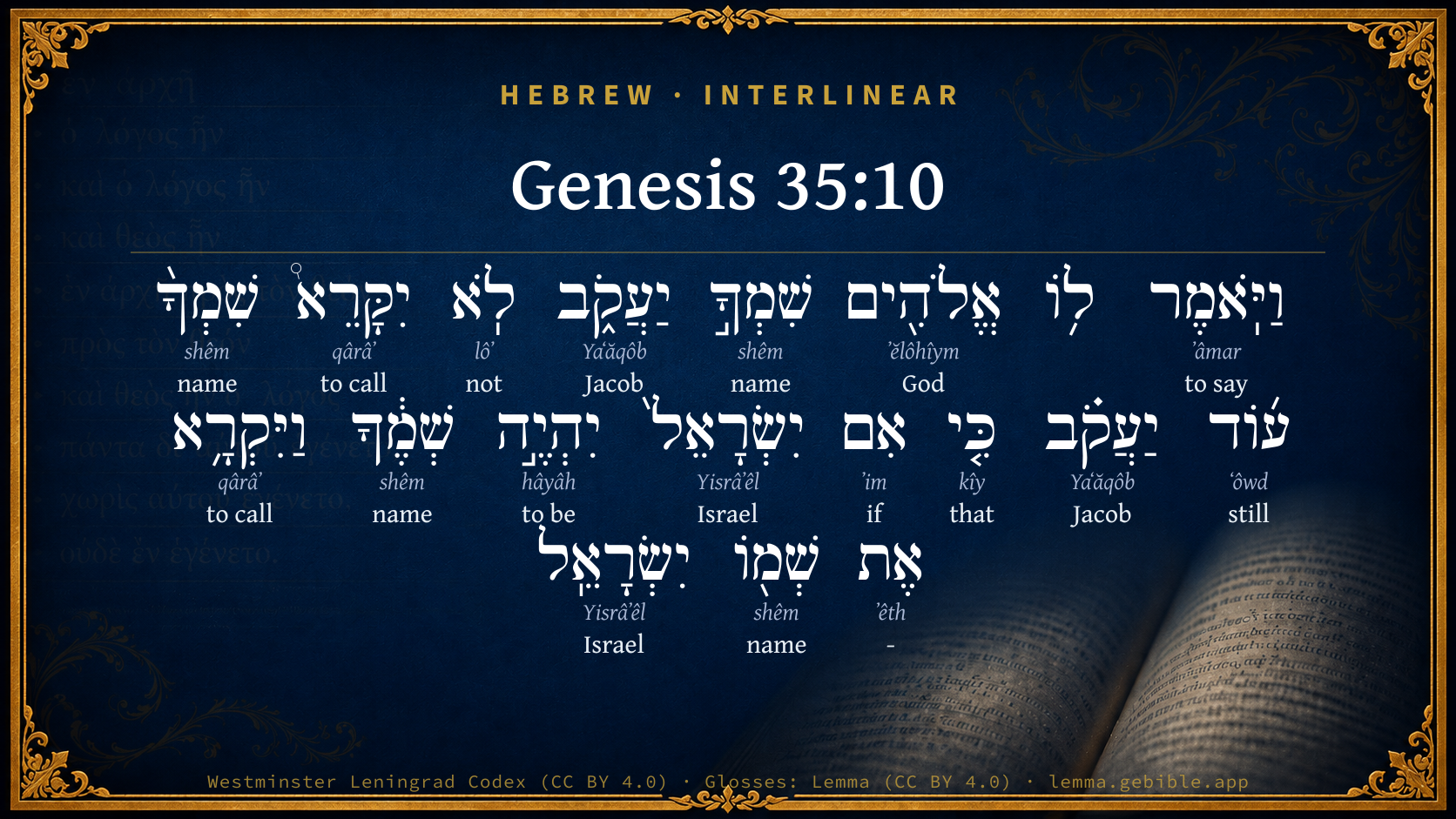
  1. וַיֹּֽאמֶר ʼâmar H559 “and · to say” Conjunction + Verb, Qal, Sequential Imperfect, 3rd Person, Masculine, Singular
  2. אֱלֹהִ֖ים ʼĕlôhîym H430 “God(s)” Noun, Common, Masculine, Plural, Absolute
  3. שִׁמְךָ֣ shêm H8034 “name · your” Noun, Common, Masculine, Singular, Construct + Suffix, Personal, 2nd Person, Masculine, Singular
  4. לֹֽא lôʼ H3808 “not” Particle, Negative
  5. יִקָּרֵא֩ qârâʼ H7121 “to call” Verb, Niphal, Imperfect, 3rd Person, Masculine, Singular
  6. שִׁמְךָ֨ shêm H8034 “name · your” Noun, Common, Masculine, Singular, Construct + Suffix, Personal, 2nd Person, Masculine, Singular
  7. ע֜וֹד ʻôwd H5750 “still” Adverb
  8. יַעֲקֹ֗ב Yaʻăqôb H3290 “Jacob” Noun, Proper
  9. כִּ֤י kîy H3588 “that” Conjunction
  10. אִם ʼim H518 “if” Conjunction
  11. יִשְׂרָאֵל֙ Yisrâʼêl H3478 “Israel” Noun, Proper
  12. יִהְיֶ֣ה hâyâh H1961 “to be” Verb, Qal, Imperfect, 3rd Person, Masculine, Singular
  13. שְׁמֶ֔ךָ shêm H8034 “name · your” Noun, Common, Masculine, Singular, Construct + Suffix, Personal, 2nd Person, Masculine, Singular
  14. וַיִּקְרָ֥א qârâʼ H7121 “and · to call” Conjunction + Verb, Qal, Sequential Imperfect, 3rd Person, Masculine, Singular
  15. אֶת ʼêth H853 “-” Particle, Direct Object
  16. שְׁמ֖וֹ shêm H8034 “name · his” Noun, Common, Masculine, Singular, Construct + Suffix, Personal, 3rd Person, Masculine, Singular
  17. יִשְׂרָאֵֽל Yisrâʼêl H3478 “Israel” Noun, Proper

About this verse

These counts appear in no published source. They are computed here, from the morphology-tagged text and Lemma’s own curated glosses. What Lemma adds →

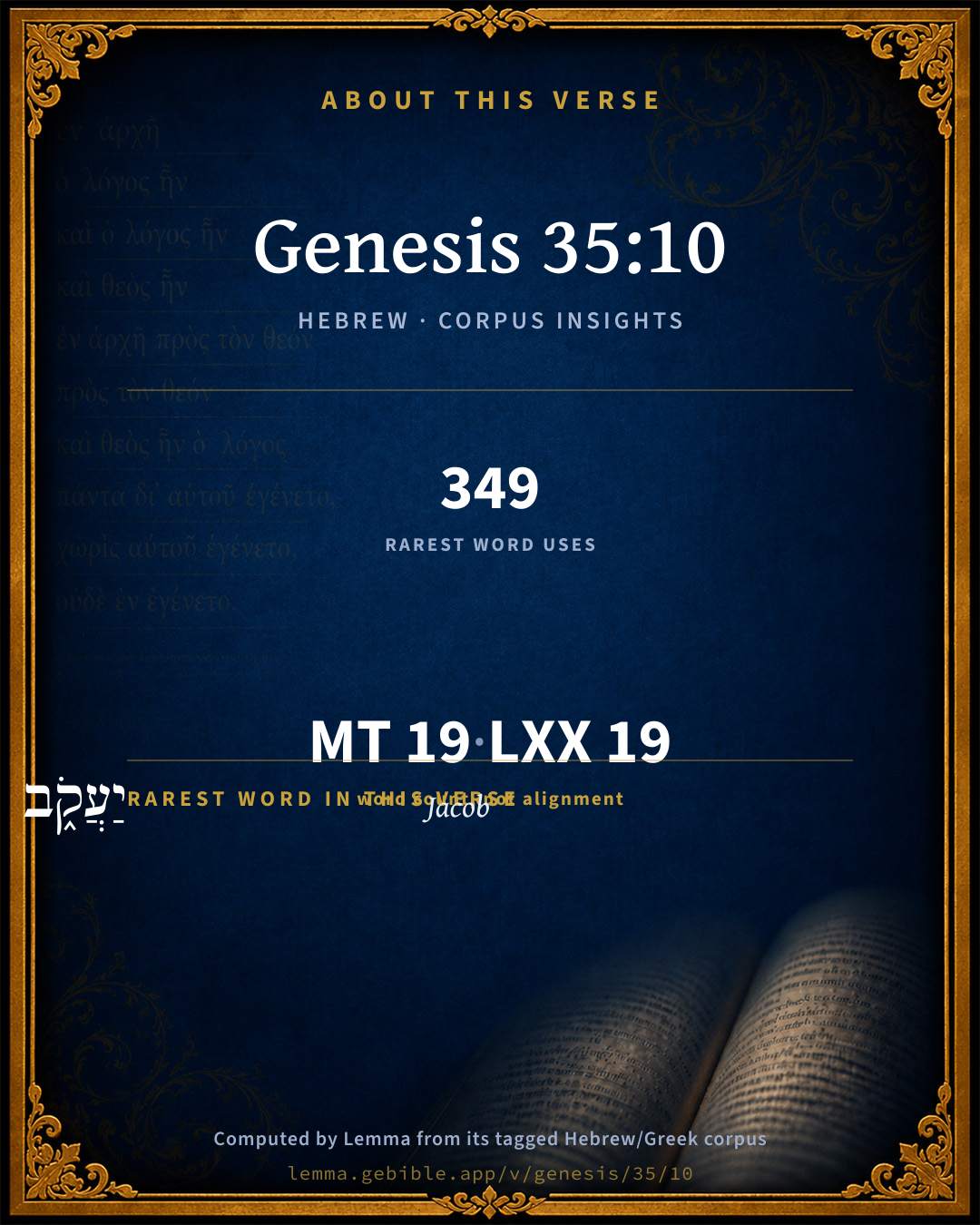
19
words
12
distinct lemmas
Pentateuch
section

Grammatical profile

  • 4 verbs
  • 9 nouns
  • 1 preposition
  • 2 conjunctions
  • 1 adverb
  • 2 particles

Verb forms

  • וַיֹּֽאמֶר Qal · Sequential Imperfect
  • יִקָּרֵא֩ Niphal · Imperfect
  • יִהְיֶ֣ה Qal · Imperfect
  • וַיִּקְרָ֥א Qal · Sequential Imperfect

Repetition

Words recur within this verse — often emphatic in Hebrew:

  • שִׁמְךָ֣ name H8034 ×4
  • יַעֲקֹ֑ב Jacob H3290 ×2
  • יִקָּרֵא֩ to call H7121 ×2
  • יִשְׂרָאֵל֙ Israel H3478 ×2

Hebrew & Septuagint length

In English translation the verse runs 26 words from the Hebrew and 24 from the Septuagint (LXX English) — closely comparable.

A rough comparison of the two English renderings, which tokenize alike — not a word-level alignment.

Word counts can differ between the Hebrew and the Greek without any difference in meaning — e.g. the Hebrew direct-object marker אֵת has no separate Greek word, and Greek often adds the article ὁ.

In the original languages it is 19 Hebrew tokens and 19 Greek tokens — but the two are counted differently (Hebrew bundles its prefixes and suffixes into one token; the Greek is in lemma form), so that isn’t a like-for-like length.

Cross-references

5

Topical passages linked to Genesis 35:10 in the Treasury of Scripture Knowledge — connected by theme and wording, ordered by reader-vote popularity; previews shown in the World English Bible.

  • Genesis 17:5 Neither will your name any more be called Abram, but your name will be Abraham; for the father of a multitude of nations have I made you.
  • Genesis 32:27–28 He said to him, "What is your name?" He said, "Jacob."
  • Genesis 17:15 God said to Abraham, "As for Sarai your wife, you shall not call her name Sarai, but her name will be Sarah.
  • 1 Kings 18:31 Elijah took twelve stones, according to the number of the tribes of the sons of Jacob, to whom the word of Yahweh came, saying, Israel shall be your name.
  • 2 Kings 17:34 To this day they do after the former manner: they don't fear Yahweh, neither do they after their statutes, or after their ordinances, or after the law or after the commandment which Yahweh commanded the children of Jacob, whom he named Israel;

Cross-references courtesy of OpenBible.info (CC BY 4.0).

Hebrew and Greek witnesses Masoretic Hebrew ↔ Greek Septuagint

The same verse in the two great witnesses to the Old Testament, shown verse-for-verse.

These are two independent witnesses, not word-aligned to each other, and the Septuagint is shown in lemma (dictionary) form.

Hebrew Genesis 35:10 Masoretic · Westminster Leningrad Codex

וַיֹּֽאמֶר ל֥וֹ אֱלֹהִ֖ים שִׁמְךָ֣ יַעֲקֹ֑ב לֹֽא יִקָּרֵא֩ שִׁמְךָ֨ ע֜וֹד יַעֲקֹ֗ב כִּ֤י אִם יִשְׂרָאֵל֙ יִהְיֶ֣ה שְׁמֶ֔ךָ וַיִּקְרָ֥א אֶת שְׁמ֖וֹ יִשְׂרָאֵֽל

God said to him, "Your name is Jacob. Your name shall not be Jacob any more, but your name will be Israel." He named him Israel.

World English Bible · Public Domain

Greek LXX Genesis 35:10 Septuagint · lemma form

καί εἶπον αὐτός ὁ θεός ὁ ὄνομα σύ ἰακώβ οὐ καλέω ἔτι ἰακώβ ἀλλά ἰσραήλ εἰμί ὁ ὄνομα σύ

And God said to him, Your name shall not be called Jacob, but Israel shall be your name; and he called his name Israel.

LXX2012 (modern English Septuagint) · Public Domain

Hebrew: Westminster Leningrad Codex (CC BY 4.0). Greek: Septuagint (public domain); English from LXX2012 (modern English Septuagint) (Public Domain). How the Septuagint differs from the Hebrew →

Targum (Aramaic paraphrase)

2

The Targum is the ancient Jewish Aramaic paraphrase of the Hebrew Scriptures — an interpretive translation, not the Hebrew text itself. Onkelos (literal) and Pseudo-Jonathan (expansive) render the Torah, and Jonathan the Prophets. Coverage is partial: where no permissively-licensed English translation exists for a verse, only the Aramaic is shown. This is verse-level text, not a word-by-word alignment to the Hebrew.

  1. Targum Onkelos Torah (Genesis–Deuteronomy)
    וַאֲמַר לֵהּ יְיָ שְׁמָךְ יַעֲקֹב לָא יִתְקְרֵי שְׁמָךְ עוֹד יַעֲקֹב אֶלָהֵין יִשְׂרָאֵל יְהֵא שְׁמָךְ וּקְרָא יָת שְׁמֵהּ יִשְׂרָאֵל

    (no public-domain English translation for this verse)

    Targum Onkelos — Aramaic: “Onkelos Genesis” (public domain); “Onkelos Exodus” (public domain); “Onkelos Leviticus” (public domain); “Onkelos Numbers” (public domain); “Onkelos Deuteronomy” (public domain). English: “Sefaria Community Translation” (CC0 1.0 (public-domain dedication)); “J.W. Etheridge. The Targums of Onkelos and Jonathan Ben Uzziel on the Pentateuch. London: Longmans, Green, 1862” (public domain). Text via Sefaria.

  2. Targum Pseudo-Jonathan Torah (Genesis–Deuteronomy)
    וַאֲמַר לֵיהּ יְיָ עַד כְּדוּן הֲוָה שְׁמָךְ יַעֲקב לָא יִתְקְרֵי שְׁמָךְ תּוּב יַעֲקב אֱלָהֵן יִשְרָאֵל יְהֵי שְׁמָךְ וּקְרָא יַת שְׁמֵיהּ יִשְרָאֵל

    And the Lord said to him, Heretofore was thy name Jakob: thy name shall be no more called Jakob, but Israel shall be thy name.

    Targum Pseudo-Jonathan — Aramaic: “Targum Jonathan on Genesis” (public domain); “Targum Jonathan on Exodus” (public domain); “Targum Jonathan on Leviticus” (public domain); “Targum Jonathan on Numbers” (public domain); “Targum Jonathan on Deuteronomy” (public domain). English: “The Targum of Jonathan ben Uzziel, trans. J. W. Etheridge, London, 1862” (public domain). Text via Sefaria.

Commentary

Notes on Genesis 35:10 from classic Christian and Jewish commentators (each source and its license shown beneath its notes). The classic Christian expositions comment on the surrounding passage and are grouped to its opening verse, so a note may address several verses; the Jewish commentaries on the Tanakh (Rashi and others) are per-verse, so they appear only where the commentator wrote on this verse.

Lemma curates 59 commentaries, every one of them public domain or Creative Commons licensed, each selected and text-cleaned for this edition rather than reprinted as found. About our sources →

Trapp's Complete Commentary

John Trapp

Gen 35:10 And God said unto him, Thy name [is] Jacob: thy name shall not be called any more Jacob, but Israel shall be thy name: and he called his name Israel.

Ver. 10. And God said unto him, &c.] It is usual with God to revive and renew the promises with fresh supplies of comforts upon the hearts of his faithful servants, for the further confirmation of their faith and hope. Thus he seals to us at every sacrament, besides those sweet supplies of the Spirit of promise, {επιχορηγια, Php 1:19} whereby we are daily sealed to the day of redemption, as the merchant’s goods are signed with his seal. {Eph 1:13; Eph 4:30}

John Trapp, A Commentary or Exposition upon All the Books of the Old and New Testament (1647–1656) — public domain. Text from a community e-Sword module.

Joseph Benson's Commentary

Gen 35:10-11. He called his name Israel — So he had been named by the angel that wrestled with him, (Gen 32:28,) and the change of his name, then made, is here confirmed and ratified by the Divine Majesty, to encourage him against the fear of the Canaanites, and to assure him that, as he had prevailed over Esau, so he should now prevail over those of whom he was afraid. And he here renews and ratifies the covenant with him by the name of El-Shaddai, God all-sufficient, to fulfil his promises in due time, and to protect and provide for him at the present. Two things are here promised him; 1st, That he should be the father of a great nation; great in number, a company of nations shall be of thee. Every tribe of Israel was a nation, and all the twelve, a company of nations; great in honour and power; kings shall come out of thy loins. 2d, That he should be master of a good land, (Gen 35:12,) the land that was given to Abraham and Isaac being here entailed on Jacob and his seed. These two promises had also a spiritual signification, which we may suppose Jacob himself had some notion of; for, without doubt, Christ is the promised seed, and heaven is the promised land; the former is the foundation, and the latter the top-stone of all God’s favours.

Joseph Benson's Commentary on the Old and New Testaments (1811–1818) — public domain. Text from a community e-Sword module.

John Calvin's Commentaries

10. Thy name shall not be called any more Jacob. We have before given the meaning of these words. The former name is not abolished, but the dignity of the other, which was afterwards put upon him, is preferred: for he was called Jacob from the womb, because he had strongly wrestled with his brother; but he was afterwards called Israel, because he entered into contest with God, and obtained the victory; not that he had prevailed by his own power, (for he had borrowed courage and strength and arms from God alone,) but because it was the Lord’s will freely to confer upon him this honor. He therefore speaks comparatively, showing that the name Jacob is obscure and ignoble when compared with the name Israel. Some understand it thus, “Not only shalt thou be called Jacob, but the surname of Israel shall be added;” yet the former exposition seems to me the more simple; namely, that the old name, having in it less of splendor, should give place to the second. What Augustine adduces is specious rather than solid; namely, that he was called Jacob in reference to his present life, but Israel in reference to his future life. Let this, however, be regarded as settled, that a double name was given to the holy man, of which one was by far the most excellent; for we see that the prophets often combine them both, thus marking the constancy of God’s grace from the beginning to the end.

John Calvin's Commentaries (1540-1563) — public domain. Text from the Calvin Translation Society English edition (1840s-50s) via the Christian Classics Ethereal Library (ccel.org). Calvin's coverage is partial (roughly two-thirds of the Bible); uncommented books and verses are honest gaps, never fabricated. The 19th-century editor's footnotes and remarks are omitted so the notes are faithfully Calvin's own voice.

The Cambridge Bible for Schools and Colleges

gen. ed. J. J. S. Perowne

10. Israel shall be thy name] This change of name has been mentioned by J in Gen_32:28. For the change, cf. Gen_17:5; Gen_17:15, where Abraham and Sarah receive a change of name associated with a special promise.

The Cambridge Bible for Schools and Colleges (gen. ed. J. J. S. Perowne; Cambridge University Press, 1878–1918) — public domain. Text from a community e-Sword module.

John Gill's Exposition

And God said unto him, thy name is Jacob,.... Which his parents gave him at his birth, and by, which he had been always called:

thy name shall not be called any more Jacob, but Israel shall be thy name; not Jacob only, as Aben Ezra and Ben Melech interpret it, but Israel also, and that more commonly and frequently, and not only he himself personally, but his posterity also:

and he called his name Israel; confirmed the name he had before given him, Gen 32:28; and by this confirmation of it signifying, that as he had prevailed over his brother Esau, and escaped his hands, so he should prevail over all that rose up against him, and opposed him, even as he had power with God, and prevailed: though some think this name was only promised him before, but now actually given him; but then they take the angel that appeared wrestling with him in the likeness of a man to be a created angel, and that what he promised in the name of God was now made, good by God himself; there is great reason to believe that that angel was the increased one, the Son of God, as here also.

John Gill's Exposition of the Whole Bible (1746–1763) — public domain (CC PDM 1.0). Text via the HelloAO Bible API.

Haydock's Catholic Bible Commentary

Israel. This name signifies one that prevaileth with God; (Challoner) and is more honourable and expressive than that of Jacob. God confirms what had been declared by his angel, chap. xxxii. 28.

George Leo Haydock (1774–1849), Haydock's Catholic Family Bible and Commentary, 1859 edition — public domain. Excludes Psalms (Douay-Rheims chapter numbering differs from Protestant) and Deuterocanonical books (Catholic canon only).

Matthew Poole's English Annotations

Israel shall be thy name. I do not repent of the change which I made of thy name, but I do again confirm it; and as then thou didst prevail over thy brother Esau, so now thou shalt prevail over those of whom thou art afraid.

Matthew Poole's English Annotations on the Holy Bible (1683–1685) — public domain. Text from a community e-Sword/MySword module.

John Wesley's Explanatory Notes

God now confirmed the change of his name. It was done before by the angel that wrestled with him, chap. xxxii, 28, and here it was ratified by the divine majesty, to encourage him against the fear of the Canaanites. Who can be too hard for Israel, a prince with God?

John Wesley, Explanatory Notes Upon the Whole Bible (1754–1765) — public domain. Text via the GEBible commentary corpus.

Rashi

Rabbi Shlomo Yitzchaki (Rashi)

לא יקרא שמך עוד יעקב THY NAME SHALL NOT BE CALLED ANY MORE JACOB— which means a man who comes as a lurker and trickster, but it shall be Israel (ישראל), which signifies Prince and Chief.

Rashi on the Tanakh — English translations: “The Judaica Press complete Tanach with Rashi, translated by A. J. Rosenberg” (CC BY 4.0); “Pentateuch with Rashi's commentary by M. Rosenbaum and A.M. Silbermann, 1929-1934” (public domain); “The Metsudah Tanach series, Lakewood, N.J” (CC BY 4.0); and “The Book of Joshua, Metsudah Publications, 1997” (CC BY 4.0). Text via Sefaria.

Ramban (Nachmanides)

Rabbi Moshe ben Nachman (Ramban / Nachmanides)

THY NAME IS JACOB. G-d is saying, “Now you are still called Jacob even though the lord of Esau has changed your name, Verse 24, that it was “the lord of Esau” who strove with Jacob and then finally blessed him. because he was not sent to you to change your name. However, from now on, thy name shall not be called any more Jacob, but Israel shall be thy name,” this being the meaning of the end of the verse, and He called his name Israel. It may be that it alludes to the fact that He called his name Israel in addition to the name Jacob, but not that it be forbidden for him to be called Jacob.

Ramban (Nachmanides) on the Tanakh — English translation: “Commentary on the Torah by Ramban (Nachmanides). Translated and annotated by Charles B. Chavel. New York, Shilo Pub. House, 1971-1976” (CC BY 4.0). Text via Sefaria.

Lesson kit

Teaching starters — assembled from the data on this page, not authored interpretation. Every prompt links to the verse data it draws on. Edit before teaching.

Genesis, in the Pentateuch, opens this verse with 19 words (12 distinct Hebrew lemmas). Its most distinctive word is Yaʻăqôb (“Jacob”). A historical commentator’s framing appears above. Read the whole chapter for the surrounding context.

Discussion questions

  1. How does “Jacob” (Yaʻăqôb) shape what this verse is saying?
  2. How does Genesis 17:5, which shares this passage’s theme, read alongside this verse?
  3. What does the repetition of “name” (4× in this one verse) do in this verse?
  4. These translations render this verse differently. What is at stake in choosing one wording over another?
  5. «וַיֹּֽאמֶר» is a Qal Sequential Imperfect verb. How does that grammatical form shape the action described?
  6. Compare how Trapp's Complete Commentary and Joseph Benson's Commentary read this verse. Where do they agree or differ?

Things to notice

Reading settings

Reading text

Shown beneath each verse's original-language words.

Old Testament
Old Testament edition

Read the OT as the Masoretic Hebrew (MT) or the Greek Septuagint (LXX).

English shown for the Greek Septuagint (in the Hebrew ↔ Greek comparison).

Comparing translations? Open the Compare panel on any verse page to stack up to four side by side.