Jeremiah 51:19

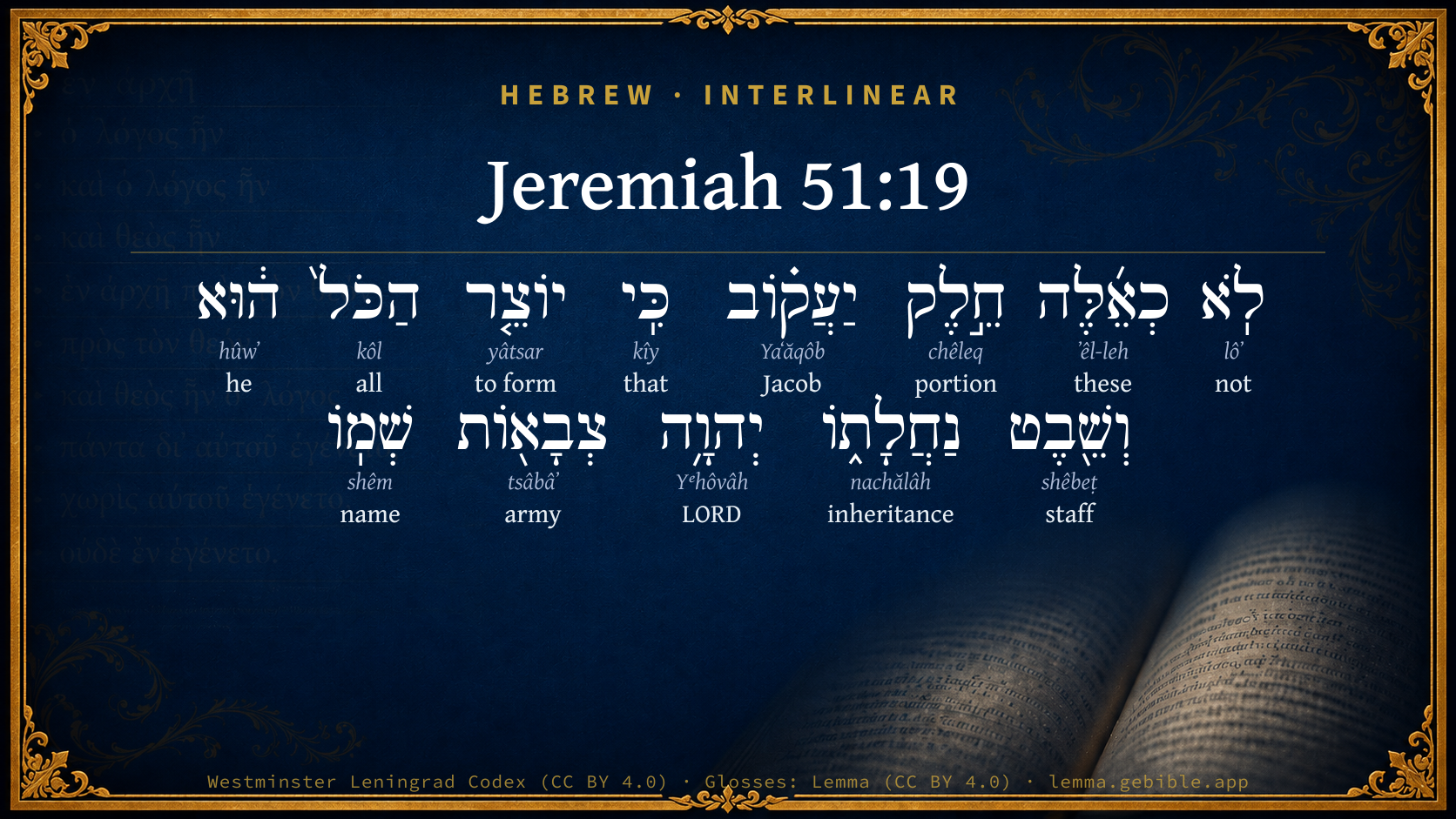
Hebrew (Westminster Leningrad Codex) Jeremiah 51:19 appears in the Hebrew Old Testament. The text above is from the Westminster Leningrad Codex. Each word links to its Strong’s number, a concise gloss, and parsing drawn from the Open Scriptures Hebrew Bible morphology. Click any word for its full Brown-Driver-Briggs (BDB) entry.
Download image
Cite this verse

Jeremiah 51:19 (World English Bible). Public Domain. Lemma interlinear Bible study tool, https://lemma.gebible.app/v/jeremiah/51/19.

Show BibTeX & RIS
BibTeX
RIS
English Translation
The portion of Jacob is not like these; for he is the former of all things; and [Israel] is the tribe of his inheritance: Yahweh of Hosts is his name.
World English Bible · Public Domain
Download a study sheet

One document with this verse’s original text, its word-by-word gloss line, the meaning frame, cross-references with their text, attributed commentary, and full source and license credits — printable, and it pastes into notes with its structure intact.

This verse Autodidact and up

Study sheet (.html) Plain text (.txt)

A passage Seminary Student

Up to 50 verses in one chapter. A passage sheet keeps up to 6 commentary sources and 12 cross-references per verse, in the order this page ranks them, and says so on the sheet whenever that leaves anything out. Ask for a single verse and you get the Autodidact verse sheet above.

Everything on this page stays free to read, with no account — the sheet is a download of what is already on screen, not access to it.

Want to remove ads? Support Godless Engineer
Compare translations 3

The same verse in 3 English versions, stacked beneath the original-language interlinear above. Click any original word for its lexicon entry.

Each is an independent rendering of the whole verse — the interlinear is not word-aligned to these translations.

Highlighted words mark where these versions differ — a whole-verse word diff, not a word-by-word alignment.

  • World English Bible Public Domain
    The portion of Jacob is not like these; for he is the former of all things; and [Israel] is the tribe of his inheritance: Yahweh of Hosts is his name.
  • King James Version Public Domain
    The portion of Jacob is not like them; for he is the former of all things: and Israel is the rod of his inheritance: the LORD of hosts is his name.
  • unfoldingWord Literal Text CC BY-SA 4.0
    But God, the portion of Jacob, is not like these, for he is the molder of all things. Israel is the tribe of his inheritance; Yahweh of hosts is his name.

unfoldingWord Literal Text — © unfoldingWord, licensed CC BY-SA 4.0. Word-aligned USFM3 via Door43 (git.door43.org/unfoldingWord/en_ult).

Versions to compare (up to 4)

3 of 4 selected

Show all 18 translations

Every available English version of this verse, each an independent rendering of the whole verse.

  • World English Bible Public Domain
    The portion of Jacob is not like these; for he is the former of all things; and [Israel] is the tribe of his inheritance: Yahweh of Hosts is his name.
  • Berean Standard Bible Public Domain
    The Portion of Jacob is not like these, for He is the Maker of all things, and of the tribe of His inheritance—the LORD of Hosts is His name.
  • Majority Standard Bible Public Domain
    The Portion of Jacob is not like these, for He is the Maker of all things, and of the tribe of His inheritance—the LORD of Hosts is His name.
  • King James Version Public Domain
    The portion of Jacob is not like them; for he is the former of all things: and Israel is the rod of his inheritance: the LORD of hosts is his name.
  • American Standard Version (1901) Public Domain
    The portion of Jacob is not like these; for he is the former of all things; and `Israel' is the tribe of his inheritance: Jehovah of hosts is his name.
  • Revised Version (1885) Public Domain
    The portion of Jacob is not like these; for he is the former of all things; and Israel is the tribe of his inheritance: the LORD of hosts is his name.
  • Geneva Bible (1599) Public Domain
    The portion of Iaakob is not like them: for he is the maker of all things, and Israel is the rodde of his inheritance: the Lord of hostes is his Name.
  • Douay-Rheims (1899) Public Domain
    The portion of Jacob is not like them: for he that made all things he it is, and Israel is the sceptre of his inheritance: the Lord of hosts is his name.
  • Young's Literal Translation Public Domain
    Not like these `is' the portion of Jacob, For He `is' former of all things, And `Israel is' the rod of His inheritance, Jehovah of Hosts `is' His name.
  • Literal Standard Version CC BY-SA 4.0
    The Portion of Jacob [is] not like these, || For He is forming the whole, || And [Israel is] the tribe of His inheritance, || YHWH of Hosts [is] His Name.
  • Unlocked Literal Bible CC BY-SA 4.0
    But God, the portion of Jacob, is not like these, for he is the molder of all things. Israel is the tribe of his inheritance; Yahweh of hosts is his name.
  • unfoldingWord Literal Text CC BY-SA 4.0
    But God, the portion of Jacob, is not like these, for he is the molder of all things. Israel is the tribe of his inheritance; Yahweh of hosts is his name.
  • Darby Bible Public Domain
    The portion of Jacob is not like them; for it is he that hath formed all things: and [Israel] is the rod of his inheritance: Jehovah of hosts is his name.
  • World Messianic Bible Public Domain
    The portion of Jacob is not like these, for he formed all things, including the tribe of his inheritance. The LORD of Hosts is his name.
  • Webster's Bible Public Domain
    The portion of Jacob is not like them; for he is the former of all things: and Israel is the rod of his inheritance: the LORD of hosts is his name.
  • Free Bible Version CC BY-SA 4.0
    The God of Jacob is not like these idols, for he is the creator of everything, including his own people that are special to him. The Lord Almighty is his name.
  • Bible in Basic English Public Domain
    The heritage of Jacob is not like these; for the maker of all things is his heritage: the Lord of armies is his name.
  • JPS Tanakh (1917) Public Domain
    The portion of Jacob is not like these; for He is the former of all things, and Israel is the tribe of His inheritance; the LORD of hosts is His name.

Literal Standard Version (2020), Covenant Press — licensed CC BY-SA 4.0. Text via the HelloAO Bible API (eBible.org). Unlocked Literal Bible (unfoldingWord) — licensed CC BY-SA 4.0. Text via the HelloAO Bible API (eBible.org). unfoldingWord Literal Text — © unfoldingWord, licensed CC BY-SA 4.0. Word-aligned USFM3 via Door43 (git.door43.org/unfoldingWord/en_ult). Free Bible Version, Dr. Jonathan Gallagher — licensed CC BY-SA 4.0. Text via the HelloAO Bible API (eBible.org).

Word by word

More ways to search: Search by grammar → Find every occurrence → Compare this word →

Practice this passage: Drill this verse → Learn its vocabulary →

יוֹצֵ֤ר
yâtsar
H3335
“forming”
Verb, Qal, Participle Active, Masculine, Singular, Construct
Part of Speech
Verb
Stem
Qal
Form
Participle Active
Gender
Masculine
Number
Singular
State
Construct
Full BDB Definition

Origin: probably identical with H3334 (through the squeezing into shape), ([compare H3331 ])

TWOT: 898

to form, fashion, frame - (Qal) to form, fashion - of human activity - of divine activity - of creation - of original creation - of individuals at conception - of Israel as a people - to frame, pre-ordain, plan (figuratively of divine) purpose of a situation) - (Niphal) to be formed, be created - (Pual) to be predetermined, be pre-ordained - (Hophal) to be formed
  1. לֹֽא lôʼ H3808 “not” Particle, Negative
  2. כְאֵ֜לֶּה ʼêl-leh H428 “like/as · these” Preposition + Pronoun, Demonstrative, Common, Plural
  3. חֵ֣לֶק chêleq H2506 “portion of” Noun, Common, Masculine, Singular, Construct
  4. יַעֲק֗וֹב Yaʻăqôb H3290 “Jacob” Noun, Proper
  5. כִּֽי kîy H3588 “that” Conjunction
  6. הַכֹּל֙ kôl H3605 “the · all” Particle, Definite Article + Noun, Common, Masculine, Singular, Absolute
  7. ה֔וּא hûwʼ H1931 “he” Pronoun, Personal, 3rd Person, Masculine, Singular
  8. וְשֵׁ֖בֶט shêbeṭ H7626 “and · staff of” Conjunction + Noun, Common, Masculine, Singular, Construct
  9. נַחֲלָת֑וֹ nachălâh H5159 “inheritance · his” Noun, Common, Feminine, Singular, Construct + Suffix, Personal, 3rd Person, Masculine, Singular
  10. יְהוָ֥ה Yᵉhôvâh H3068 “LORD” Noun, Proper
  11. צְבָא֖וֹת tsâbâʼ H6635 “armies” Noun, Common, Both, Plural, Absolute
  12. שְׁמֽוֹ shêm H8034 “name · his” Noun, Common, Masculine, Singular, Construct + Suffix, Personal, 3rd Person, Masculine, Singular

About this verse

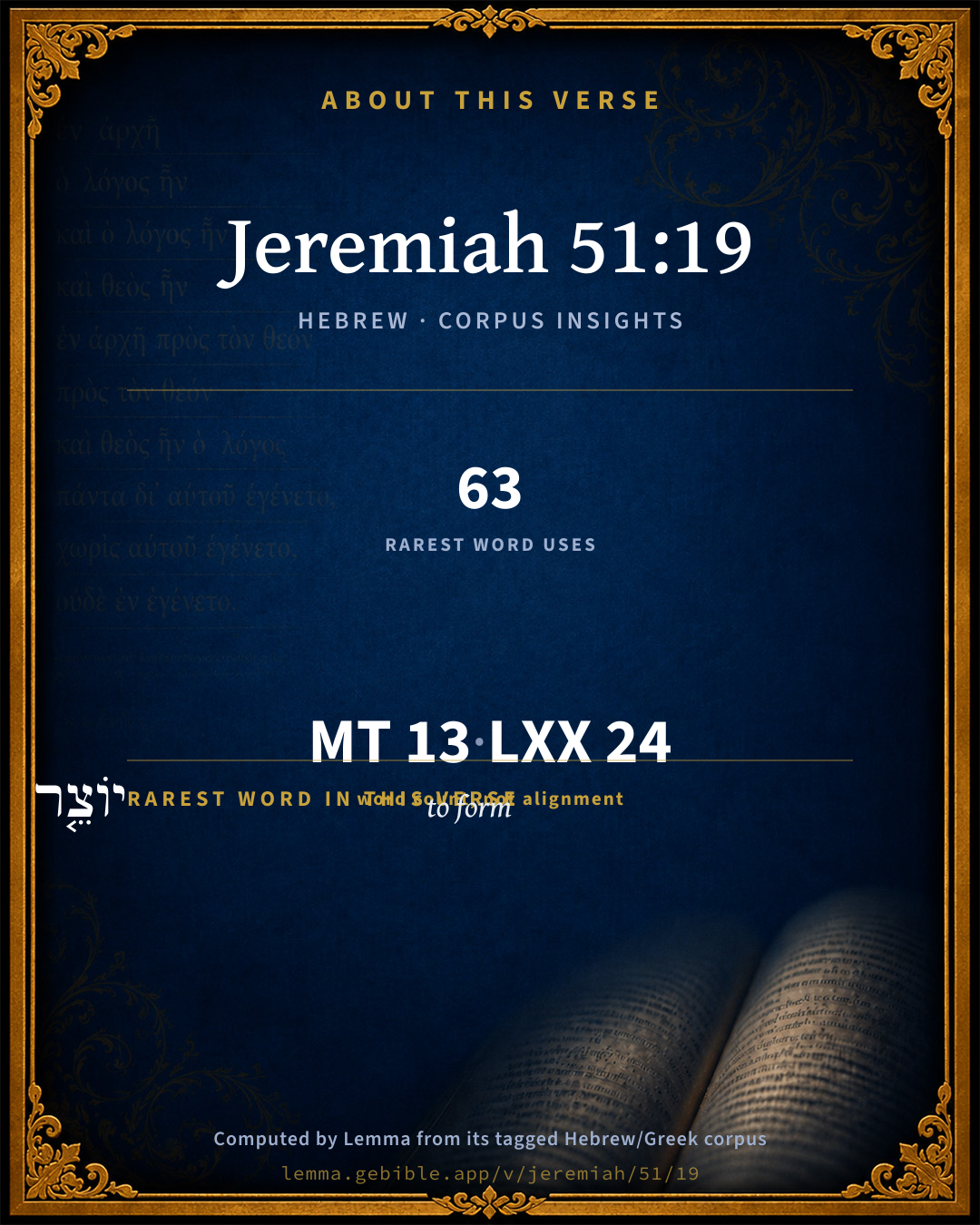
These counts appear in no published source. They are computed here, from the morphology-tagged text and Lemma’s own curated glosses. What Lemma adds →

13
words
13
distinct lemmas
Prophets
section

Grammatical profile

  • 1 verb
  • 8 nouns
  • 2 pronouns
  • 1 conjunction
  • 1 particle

Verb forms

  • יוֹצֵ֤ר Qal · Participle Active

Hebrew & Septuagint length

In the original languages it is 13 Hebrew tokens and 24 Greek tokens — but the two are counted differently (Hebrew bundles its prefixes and suffixes into one token; the Greek is in lemma form), so that isn’t a like-for-like length.

Cross-references

14

Topical passages linked to Jeremiah 51:19 in the Treasury of Scripture Knowledge — connected by theme and wording, ordered by reader-vote popularity; previews shown in the World English Bible.

  • Psalms 73:26 My flesh and my heart fails, But God is the strength of my heart and my portion forever.
  • Jeremiah 10:16 The portion of Jacob is not like these; for he is the former of all things; and Israel is the tribe of his inheritance: Yahweh of Hosts is his name.
  • Psalms 33:12 Blessed is the nation whose God is Yahweh, The people whom he has chosen for his own inheritance.
  • 1 Peter 2:9 But you are a chosen race, a royal priesthood, a holy nation, a people for God's own possession, that you may show forth the excellencies of him who called you out of darkness into his marvelous light:
  • Exodus 19:5–6 Now therefore, if you will indeed obey my voice, and keep my covenant, then you shall be my own possession from among all peoples; for all the earth is mine;
  • Isaiah 47:4 Our Redeemer, Yahweh of hosts is his name, the Holy One of Israel.
  • Deuteronomy 32:9 For Yahweh's portion is his people; Jacob is the lot of his inheritance.
  • Psalms 16:5 Yahweh assigned my portion and my cup. You made my lot secure.
  • Psalms 74:2 Remember your congregation, which you purchased of old, Which you have redeemed to be the tribe of your inheritance; Mount Zion, in which you have lived.
  • Psalms 115:3 But our God is in the heavens. He does whatever he pleases.
  • Psalms 135:4 For Yah has chosen Jacob for himself; Israel for his own possession.
  • Jeremiah 12:7–10 I have forsaken my house, I have cast off my heritage; I have given the dearly beloved of my soul into the hand of her enemies.
  • Jeremiah 50:11 Because you are glad, because you rejoice, O you who plunder my heritage, because you are wanton as a heifer that treads out [the grain], and neigh as strong horses;
  • Lamentations 3:24 Yahweh is my portion, says my soul; therefore will I hope in him.

Cross-references courtesy of OpenBible.info (CC BY 4.0).

Hebrew and Greek witnesses Masoretic Hebrew ↔ Greek Septuagint

The same verse in the two great witnesses to the Old Testament, shown verse-for-verse.

These are two independent witnesses, not word-aligned to each other, and the Septuagint is shown in lemma (dictionary) form.

Hebrew Jeremiah 51:19 Masoretic · Westminster Leningrad Codex

לֹֽא כְאֵ֜לֶּה חֵ֣לֶק יַעֲק֗וֹב כִּֽי יוֹצֵ֤ר הַכֹּל֙ ה֔וּא וְשֵׁ֖בֶט נַחֲלָת֑וֹ יְהוָ֥ה צְבָא֖וֹת שְׁמֽוֹ

The portion of Jacob is not like these; for he is the former of all things; and [Israel] is the tribe of his inheritance: Yahweh of Hosts is his name.

World English Bible · Public Domain

Greek LXX Structure differs

In the Septuagint, Jeremiah is about an eighth shorter than the Hebrew and arranges its material differently — the Oracles Against the Nations (Hebrew chapters 46–51) appear in the middle of the Greek book, after 25:13. Because the chapter and verse boundaries do not line up, a verse-for-verse comparison with the Hebrew is not shown.

A verse-for-verse comparison isn’t shown here because the chapters and verses don’t line up. Switch to the LXX edition with the MT / LXX toggle above to read the Greek directly.

Hebrew: Westminster Leningrad Codex (CC BY 4.0). Greek: Septuagint (public domain); English from a public-domain English Septuagint. How the Septuagint differs from the Hebrew →

Targum (Aramaic paraphrase)

1

The Targum is the ancient Jewish Aramaic paraphrase of the Hebrew Scriptures — an interpretive translation, not the Hebrew text itself. Onkelos (literal) and Pseudo-Jonathan (expansive) render the Torah, and Jonathan the Prophets. Coverage is partial: where no permissively-licensed English translation exists for a verse, only the Aramaic is shown. This is verse-level text, not a word-by-word alignment to the Hebrew.

  1. Targum Jonathan Prophets (Joshua–Malachi)
    לָא כְאִלֵין חוּלְקֵי דְיַעֲקֹב אֲרֵי דִי בְרָא כוֹלָא הוּא וְיִשְׂרָאֵל חוּלַק שִׁבְטָא דְאַחֲסַנְתֵּיהּ יְיָ צְבָאוֹת שְׁמֵיהּ:

    (no public-domain English translation for this verse)

    Targum Jonathan — Aramaic: “Mikraot Gedolot” (public domain). English: “Sefaria Community Translation” (CC0 1.0 (public-domain dedication)); “London "Chaldee Paraphrase," 1871” (public domain). Text via Sefaria.

Commentary

Notes on Jeremiah 51:19 from classic Christian and Jewish commentators (each source and its license shown beneath its notes). The classic Christian expositions comment on the surrounding passage and are grouped to its opening verse, so a note may address several verses; the Jewish commentaries on the Tanakh (Rashi and others) are per-verse, so they appear only where the commentator wrote on this verse.

Lemma curates 59 commentaries, every one of them public domain or Creative Commons licensed, each selected and text-cleaned for this edition rather than reprinted as found. About our sources →

Trapp's Complete Commentary

John Trapp

Jer 51:19 The portion of Jacob [is] not like them; for he [is] the former of all things: and [Israel is] the rod of his inheritance: the LORD of hosts [is] his name.

Ver. 19. The portion of Jacob, &c.] See Jer 10:16.

John Trapp, A Commentary or Exposition upon All the Books of the Old and New Testament (1647–1656) — public domain. Text from a community e-Sword module.

Geneva Bible (1599)

Geneva Bible translators

That is, the true God of Israel is not like to these idols: for he can help when all things are desperate.

Geneva Bible (1599) marginal notes — public domain. Text via Bolls.life.

John Calvin's Commentaries

Had the Prophet only said that idols were mere impostures and mockeries, it would have been indeed something; but this part of his teaching would have been cold and uninteresting, had he not, on the other hand, proclaimed the glory of the one and only true God. We ought, indeed, to know that idols are nothing, that men are most foolishly deceived, and are wholly infatuated, when they imagine that there is in them some divinity. But the main thing is, that the true God himself is brought before us, and that we are taught to direct all our thoughts to him. This, then, is what is now done by the Prophet; for after having exposed the folly of the heathens in worshipping idols, and having shown that the whole is nothing but deception and falsehood, he now says, Not as they, the fictitious gods, is the portion of Jacob; that is, the God who had revealed himself to the chosen people is very far different from all idols.

And, doubtless, the vanity which the Prophet before mentioned cannot be adequately understood, except the true God be known. For though some of the ancient philosophers ridiculed the grossest errors of the common people, yet they had nothing fixed or certain on which they could rest, like him, who, when asked, “What was God?” requested time to consider, and who after several delays confessed that the more he inquired into the nature of God, the more absorbed were all his thoughts. And this must necessarily be the case with men until they are taught what God is, which can never be done until he himself represents himself and his glory as it were in a mirror.

This is then the reason why the Prophet, while setting the only true God in opposition to idols and all the inventions of mortals, calls him the portion of Jacob, because the law was as it were the representation of the glory of God. As then he had plainly shown himself there, as far as it was needful for the salvation of the chosen people, the Prophet, in order to invite men to the true knowledge of the true God, calls him the portion of Jacob, as though he had set the law as a mirror before their eyes. The portion of Jacob then is God, who is not like fictitious gods; how so? because he is the framer of all things. It is indeed by a few words that he makes the distinction between the only true God and the fictitious gods; but in this brief sentence he includes what I have before explained, even that God is the fountain of life, and the life of all, and then that his essence is spiritual and also infinite; for as he has created the heaven and the earth, so of necessity he sustains both by his power.

We then see that the Prophet speaks briefly but not frigidly; and from this passage we learn a useful doctrine, even that God cannot be comprehended by us except in his works. As then vain men weary themselves with speculations, which have not in them, so to speak, any practical knowledge, it is no wonder that they run headlong into many delirious things. Let us then be sober in this respect, so that we may not inquire into the essence of God more than it becomes us. When therefore we seek to comprehend what God is, or how to attain the knowledge of him, let us direct all our thoughts, and eyes, and minds to his works.

So also by this passage, when the Prophet calls God the worker or framer of all things, is exposed the vanity of all superstitions; and how? because we hence learn that the power which made not the heaven and the earth, is vain and worthless; but the only maker of heaven and earth is God, then he is God alone. Since he is the only true God, it follows that the inventions or figments of men are altogether delirious, and are therefore the artifices and impostures of the devil to deceive mankind. We hence see that the doctrine of the Prophet is exclusive, when he says that God is the maker of all things; for where the maker of all things is not found, there certainly no divinity can be.

He adds, the rod of his inheritance This seems to refer to God, but in the tenth chapter the word Israel is introduced; otherwise these five verses literally agree, but in that passage the Prophet says that Israel was the rod of God’s inheritance Here the rod means a measuring pole; for the similitude is taken from lands being measured; for the ancients used poles of certain length for measuring. Hence the Hebrews called an inheritance the rod of inheritance, because it was what had been measured and had certain limits: as when one possesses a field, he knows how many acres it contains, it having been measured. But both things may be fitly and truly said, even that Israel is the rod of God’s inheritance, and also that God himself is a rod of inheritance; for there is a mutual union. For as God favors us with this honor, to make us his inheritance, and is pleased to have us as his own, so also he offers himself to us as an inheritance. David says often, “The Lord is my portion,” and “The Lord is the portion of mine inheritance,” that is, my hereditary portion. So in this place the meaning would not be unsuitable were we to apply the words to God. As, however, the word Israel is found in the former place, it may be deemed as understood here.

He says at last, Jehovah of hosts is his name There is implied a contrast here; for he does not honor God with this character, as though it was a common or ordinary name; but he claims for him his own right, and thus distinguishes him from all idols. By saying, then, that this name belongs only to the true God, even the God of Israel, he intimates that by this distinction he differs from all idols, and that men are sacrilegious when they transfer any power to idols, and expect safety from them, and flee to them. As then this name belongs only to God, it follows that in Him dwells a fullness of all power and might. Since it is so, then wholly worthless is everything that the world has ever imagined respecting the number and multitude of gods. It now follows, —

John Calvin's Commentaries (1540-1563) — public domain. Text from the Calvin Translation Society English edition (1840s-50s) via the Christian Classics Ethereal Library (ccel.org). Calvin's coverage is partial (roughly two-thirds of the Bible); uncommented books and verses are honest gaps, never fabricated. The 19th-century editor's footnotes and remarks are omitted so the notes are faithfully Calvin's own voice.

John Gill's Exposition

And with thee will I break in pieces the horse and his rider,.... Or, "have broken": meaning the cavalry of an army, wherein lies its chief strength:

and with thee will I break in pieces the chariot and his rider; which were also used in war.

John Gill's Exposition of the Whole Bible (1746–1763) — public domain (CC PDM 1.0). Text via the HelloAO Bible API.

Matthew Poole's English Annotations

We had these five verses all in Jer 10:12-16. See there the explication of the several passages in them; the scope of which is only to convince those to whom the prophet spoke, that notwithstanding all the power, and riches, and greatness, and alliances of the Chaldeans, yet that God who had threatened this ruin to them was able to bring it upon them, and all their idols were vanities, things of nought, that should not be able to protect them, and from whose power or impotency they must not measure nor make up a judgment of what God was able to do; for Israel’s God was that God who made the world, and the Lord of all the armies of the creatures, whether in heaven or earth.

Matthew Poole's English Annotations on the Holy Bible (1683–1685) — public domain. Text from a community e-Sword/MySword module.

The Pulpit Commentary

"The Portion of Jacob

cf. homily, vol. 1. p. 277. C.

The Portion of Jacob contrasted with the confidences of Babylon.

I THE NAME BY WHICH JEHOVAH IS HERE INDICATED. The Portion of Jacob. So the psalmist says, "My flesh and my heart faileth... but God is my Portion forever". (Psa_73:26; see also Psa_16:5) Men had their appointed portions, and no doubt they varied in value. But few were those who could rise above mere external things and look on the invisible God as their real Portion. And yet these were the only ones who had a portion and inheritance in the fullest sense of the words. For only so were they lifted above all temptation to envy, and above all the consequences of terrestrial impairments and losses. True, we have an inheritance of invisible and everlasting things, of which the present visible possessions give the preparatory conditions; but to possess these things we must possess God, must be sure of his interest, his spiritual providence, his sufficiency, for only in him can even spiritual possessions have their beginning and continuance. Nor must we fail to note what may be called the mutual character of this portion and inheritance. Jehovah being the Portion of Jacob, it is equally true that Jehovah"s portion is his people. (Deu_32:9) Even the best possessions of a natural man are not mere legal property, not mere intellectual knowledge, but those human beings whom he can call friends. Such a one is rich according to the quality of his friends, those on whom he has claims and who have claims on him. He is rich according to the opportunities he has of getting service from them; richer still according to his opportunities for rendering service, on the principle that it is more blessed to give than to receive. And so God will be our Inheritance just in proportion as we are God"s inheritance. We cannot get satisfaction out of God unless he is getting satisfaction out of us. Our faith, our obedience, our devotion, are the conditions of his peculiar and richest bounty.

II THE CONTRAST OF JACOB"S PORTION WITH THE PORTION OF OTHERS. They inherit a barren land. It may look promising; it may yield the appearance of fruit; but real and abiding fruit there is none. Babylon has taken Bel for its portion, and now the portion and the possessors are alike turned to confusion. Indeed, the portion has vanished into nothingness; for never was it anything but a name, an imposing fiction, a proof both of man"s need of a portion and how incompetent he is to make such a portion for himself. But Jehovah always remains a Portion. The typical Jacob, the typical people of God that is, were unable to keep Jehovah as their Portion; they never had any real grasp of him, never more than the merest external acquaintance. But for those who can lay bold of him he is surely a Portion still. Y.

The Pulpit Commentary (1880–1919), ed. H.D.M. Spence-Jones & Joseph S. Exell — public domain. Text from a community e-Sword module.

Rashi

Rabbi Shlomo Yitzchaki (Rashi)

and the tribe of His inheritance Jacob mentioned above at the beginning of the verse.

Rashi on the Tanakh — English translations: “The Judaica Press complete Tanach with Rashi, translated by A. J. Rosenberg” (CC BY 4.0); “Pentateuch with Rashi's commentary by M. Rosenbaum and A.M. Silbermann, 1929-1934” (public domain); “The Metsudah Tanach series, Lakewood, N.J” (CC BY 4.0); and “The Book of Joshua, Metsudah Publications, 1997” (CC BY 4.0). Text via Sefaria.

Lesson kit

Teaching starters — assembled from the data on this page, not authored interpretation. Every prompt links to the verse data it draws on. Edit before teaching.

Jeremiah, in the Prophets, opens this verse with 13 words (13 distinct Hebrew lemmas). Its most distinctive word is yâtsar (“to form”). A historical commentator’s framing appears above. Read the whole chapter for the surrounding context.

Discussion questions

  1. What does “to form” (yâtsar) contribute to the verse as a whole?
  2. How does Psalms 73:26, which shares this passage’s theme, read alongside this verse?
  3. These translations render this verse differently. What is at stake in choosing one wording over another?
  4. «יוֹצֵ֤ר» is a Qal Participle Active verb. How does that grammatical form shape the action described?
  5. Compare how Trapp's Complete Commentary and Geneva Bible (1599) read this verse. Where do they agree or differ?

Things to notice

Reading settings

Reading text

Shown beneath each verse's original-language words.

Old Testament
Old Testament edition

Read the OT as the Masoretic Hebrew (MT) or the Greek Septuagint (LXX).

English shown for the Greek Septuagint (in the Hebrew ↔ Greek comparison).

Comparing translations? Open the Compare panel on any verse page to stack up to four side by side.