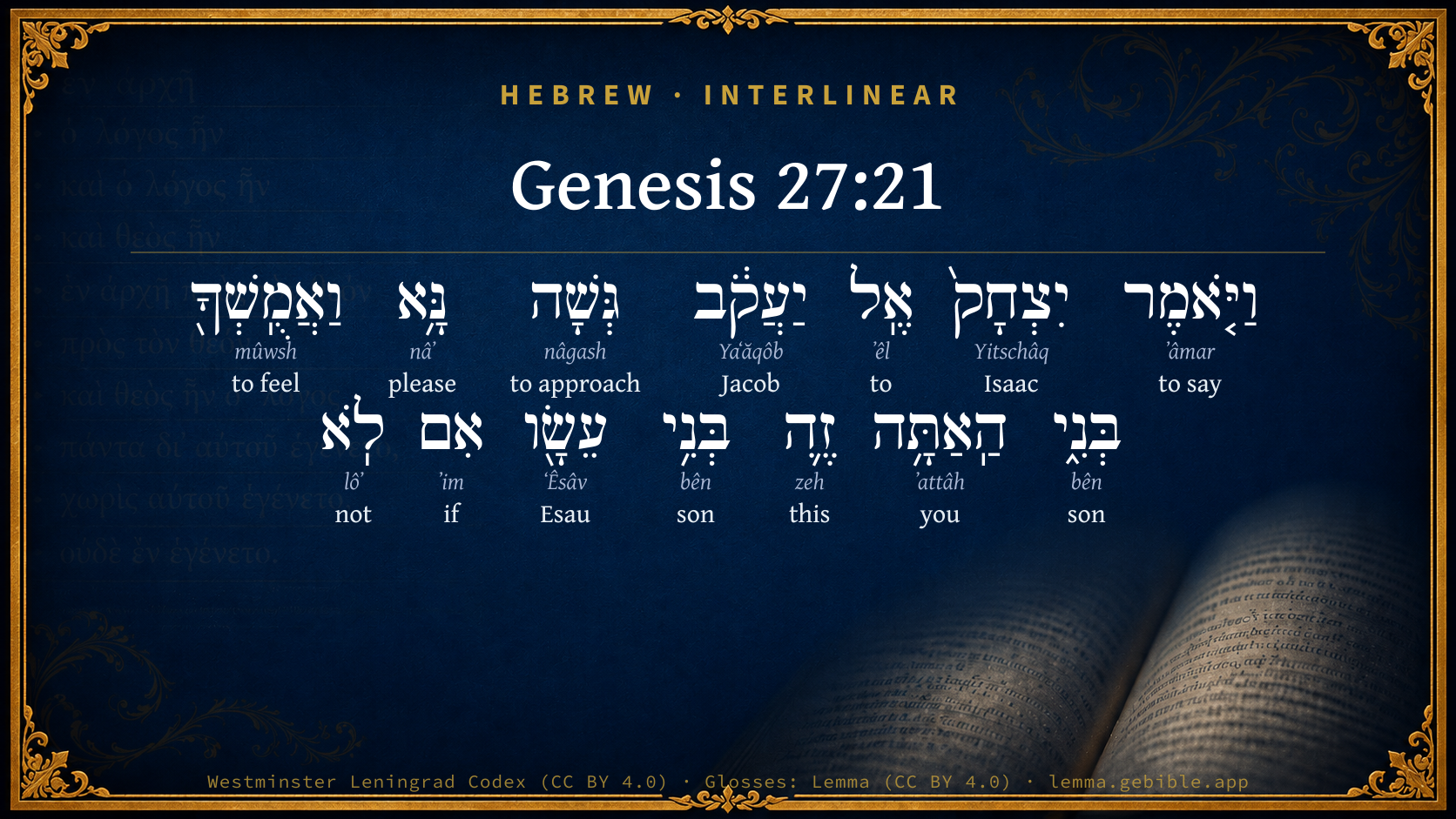
Genesis 27:21

Hebrew (Westminster Leningrad Codex) Genesis 27:21 appears in the Hebrew Old Testament. The text above is from the Westminster Leningrad Codex. Each word links to its Strong’s number, a concise gloss, and parsing drawn from the Open Scriptures Hebrew Bible morphology. Click any word for its full Brown-Driver-Briggs (BDB) entry.
Download image
Cite this verse

Genesis 27:21 (World English Bible). Public Domain. Lemma interlinear Bible study tool, https://lemma.gebible.app/v/genesis/27/21.

Show BibTeX & RIS
BibTeX
RIS
English Translation
Isaac said to Jacob, "Please come near, that I may feel you, my son, whether you are really my son Esau or not."
World English Bible · Public Domain
Highlights
  • 1 first appearance in the Hebrew Bible
Full analysis ↓
Download a study sheet

One document with this verse’s original text, its word-by-word gloss line, the meaning frame, cross-references with their text, attributed commentary, and full source and license credits — printable, and it pastes into notes with its structure intact.

This verse Autodidact and up

Study sheet (.html) Plain text (.txt)

A passage Seminary Student

Up to 50 verses in one chapter. A passage sheet keeps up to 6 commentary sources and 12 cross-references per verse, in the order this page ranks them, and says so on the sheet whenever that leaves anything out. Ask for a single verse and you get the Autodidact verse sheet above.

Everything on this page stays free to read, with no account — the sheet is a download of what is already on screen, not access to it.

Want to remove ads? Support Godless Engineer
Compare translations 3

The same verse in 3 English versions, stacked beneath the original-language interlinear above. Click any original word for its lexicon entry.

Each is an independent rendering of the whole verse — the interlinear is not word-aligned to these translations.

Highlighted words mark where these versions differ — a whole-verse word diff, not a word-by-word alignment.

  • World English Bible Public Domain
    Isaac said to Jacob, "Please come near, that I may feel you, my son, whether you are really my son Esau or not."
  • King James Version Public Domain
    And Isaac said unto Jacob, Come near, I pray thee, that I may feel thee, my son, whether thou be my very son Esau or not.
  • unfoldingWord Literal Text CC BY-SA 4.0
    Then Isaac said to Jacob, “Please come close, so that I can touch you, my son, whether you are really my son Esau or not.”

unfoldingWord Literal Text — © unfoldingWord, licensed CC BY-SA 4.0. Word-aligned USFM3 via Door43 (git.door43.org/unfoldingWord/en_ult).

Versions to compare (up to 4)

3 of 4 selected

Show all 18 translations

Every available English version of this verse, each an independent rendering of the whole verse.

  • World English Bible Public Domain
    Isaac said to Jacob, "Please come near, that I may feel you, my son, whether you are really my son Esau or not."
  • Berean Standard Bible Public Domain
    Then Isaac said to Jacob, “Please come closer so I can touch you, my son. Are you really my son Esau, or not?”
  • Majority Standard Bible Public Domain
    Then Isaac said to Jacob, “Please come closer so I can touch you, my son. Are you really my son Esau, or not?”
  • King James Version Public Domain
    And Isaac said unto Jacob, Come near, I pray thee, that I may feel thee, my son, whether thou be my very son Esau or not.
  • American Standard Version (1901) Public Domain
    And Isaac said unto Jacob, Come near, I pray thee, that I may feel thee, my son, whether thou be my very son Esau or not.
  • Revised Version (1885) Public Domain
    And Isaac said unto Jacob, Come near, I pray thee, that I may feel thee, my son, whether thou be my very son Esau or not.
  • Geneva Bible (1599) Public Domain
    Againe sayde Izhak vnto Iaakob, Come neere nowe, that I may feele thee, my sonne, whether thou be that my sonne Esau or not.
  • Douay-Rheims (1899) Public Domain
    And Isaac said: Come hither, that I may feel thee, my son, and may prove whether thou be my son Esau, or not.
  • Young's Literal Translation Public Domain
    And Isaac saith unto Jacob, `Come nigh, I pray thee, and I feel thee, my son, whether thou `art' he, my son Esau, or not.'
  • Literal Standard Version CC BY-SA 4.0
    And Isaac says to Jacob, “Please come near, and I feel you, my son, whether you [are] he, my son Esau, or not.”
  • Unlocked Literal Bible CC BY-SA 4.0
    Isaac said to Jacob, “Come near me, so I may touch you, my son, and learn whether you are my true son Esau or not.”
  • unfoldingWord Literal Text CC BY-SA 4.0
    Then Isaac said to Jacob, “Please come close, so that I can touch you, my son, whether you are really my son Esau or not.”
  • Darby Bible Public Domain
    And Isaac said to Jacob, Come near, I pray thee, that I may feel thee, my son, whether thou be really my son Esau or not.
  • World Messianic Bible Public Domain
    Isaac said to Jacob, “Please come near, that I may feel you, my son, whether you are really my son Esau or not.”
  • Webster's Bible Public Domain
    And Isaac said to Jacob, Come near, I pray thee, that I may feel thee, my son, whether thou art my very son Esau, or not.
  • Free Bible Version CC BY-SA 4.0
    “Come over here so I can touch you, my son,” Isaac told Jacob, “so I can tell if you're really my son Esau or not.”
  • Bible in Basic English Public Domain
    And Isaac said, Come near so that I may put my hand on you, my son, and see if you are truly my son Esau or not.
  • JPS Tanakh (1917) Public Domain
    And Isaac said unto Jacob: 'Come near, I pray thee, that I may feel thee, my son, whether thou be my very son Esau or not.'

Literal Standard Version (2020), Covenant Press — licensed CC BY-SA 4.0. Text via the HelloAO Bible API (eBible.org). Unlocked Literal Bible (unfoldingWord) — licensed CC BY-SA 4.0. Text via the HelloAO Bible API (eBible.org). unfoldingWord Literal Text — © unfoldingWord, licensed CC BY-SA 4.0. Word-aligned USFM3 via Door43 (git.door43.org/unfoldingWord/en_ult). Free Bible Version, Dr. Jonathan Gallagher — licensed CC BY-SA 4.0. Text via the HelloAO Bible API (eBible.org).

Word by word

More ways to search: Search by grammar → Find every occurrence → Compare this word →

Practice this passage: Drill this verse → Learn its vocabulary →

וַאֲמֻֽשְׁךָ֖
mûwsh
H4184
“and · to feel · you”
Conjunction + Verb, Qal, Cohortative, 1st Person, Common, Singular + Suffix, Personal, 2nd Person, Masculine, Singular
Part of Speech
Conjunction + Verb
Stem
Qal
Form
Cohortative
Person
1st Person
Gender
Common
Number
Singular
Full BDB Definition

Origin: a primitive root

TWOT: 1168

to feel - (Qal) to feel - (Hiphil) to feel
  1. וַיֹּ֤אמֶר ʼâmar H559 “and · to say” Conjunction + Verb, Qal, Sequential Imperfect, 3rd Person, Masculine, Singular
  2. יִצְחָק֙ Yitschâq H3327 “Isaac” Noun, Proper
  3. אֶֽל ʼêl H413 “to” Preposition
  4. יַעֲקֹ֔ב Yaʻăqôb H3290 “Jacob” Noun, Proper
  5. גְּשָׁה nâgash H5066 “approach” Verb, Qal, Imperative, 2nd Person, Masculine, Singular + Suffix, h
  6. נָּ֥א nâʼ H4994 “please” Particle, Interjection
  7. בְּנִ֑י bên H1121 “son · my” Noun, Common, Masculine, Singular, Construct + Suffix, Personal, 1st Person, Common, Singular
  8. הַֽאַתָּ֥ה ʼattâh H859 “you” Particle, Interrogative + Pronoun, Personal, 2nd Person, Masculine, Singular
  9. זֶ֛ה zeh H2088 “this” Pronoun, Demonstrative, Masculine, Singular
  10. בְּנִ֥י bên H1121 “son · my” Noun, Common, Masculine, Singular, Construct + Suffix, Personal, 1st Person, Common, Singular
  11. עֵשָׂ֖ו ʻÊsâv H6215 “Esau” Noun, Proper
  12. אִם ʼim H518 “if” Conjunction
  13. לֹֽא lôʼ H3808 “not” Particle, Negative

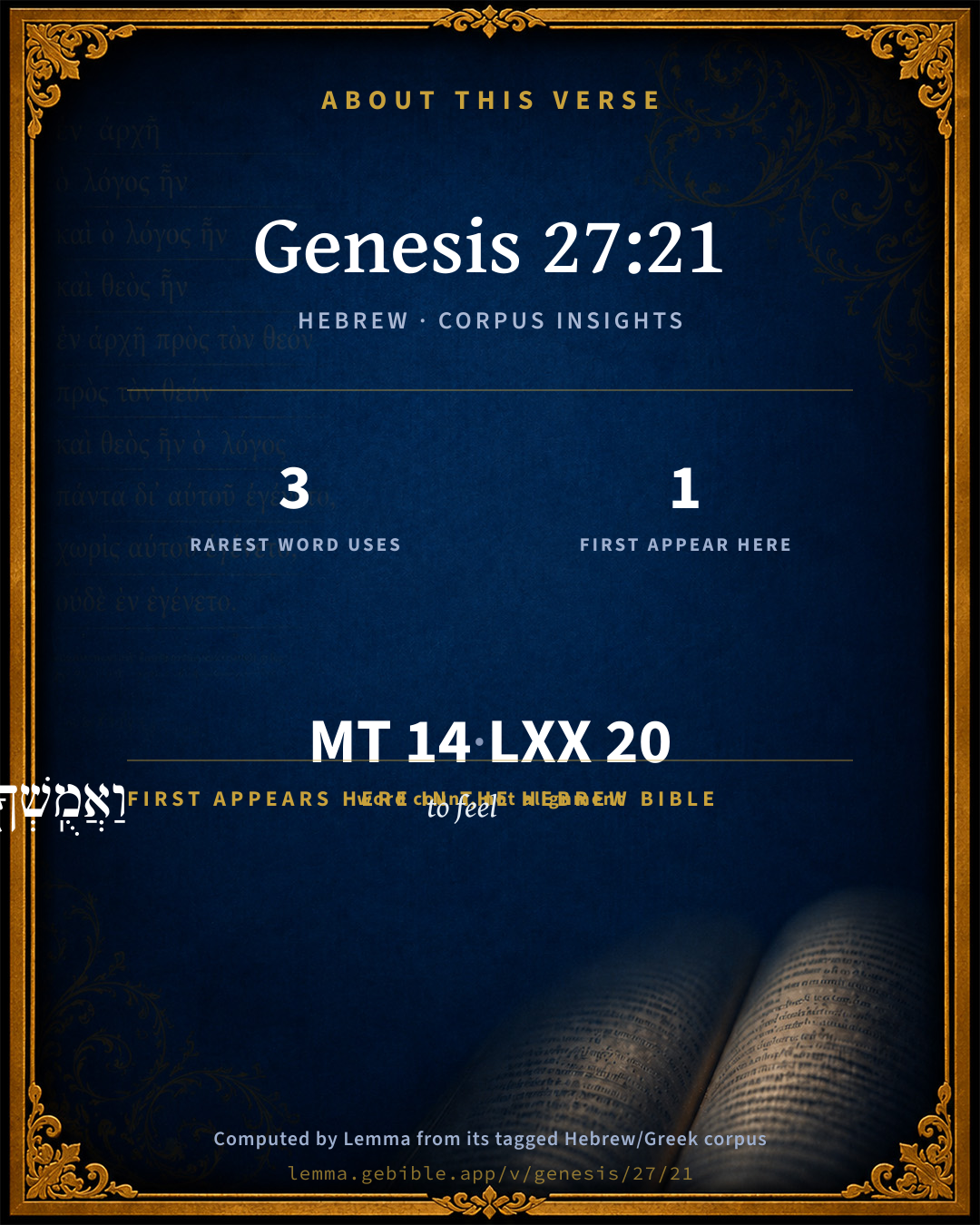
About this verse

These counts appear in no published source. They are computed here, from the morphology-tagged text and Lemma’s own curated glosses. What Lemma adds →

14
words
13
distinct lemmas
Pentateuch
section

Notable vocabulary

The rarest word here is וַאֲמֻֽשְׁךָ֖ to feel H4184 — appearing just 3 times in the whole Hebrew Bible.

First appearance in Scripture

This word makes its first canonical appearance in the Hebrew Bible here:

  • וַאֲמֻֽשְׁךָ֖ to feel H4184

Shared distinctive vocabulary

וַאֲמֻֽשְׁךָ֖ to feel H4184 occurs in 3 verses of the Hebrew Bible. Also found in:

Grammatical profile

  • 3 verbs
  • 5 nouns
  • 2 pronouns
  • 1 preposition
  • 1 conjunction
  • 2 particles

Verb forms

  • וַיֹּ֤אמֶר Qal · Sequential Imperfect
  • גְּשָׁה Qal · Imperative
  • וַאֲמֻֽשְׁךָ֖ Qal · Cohortative

Repetition

A word recurs within this verse — often emphatic in Hebrew:

  • בְּנִ֑י son H1121 ×2

Hebrew & Septuagint length

In English translation the verse runs 23 words from the Hebrew and 23 from the Septuagint (LXX English) — the same length.

A rough comparison of the two English renderings, which tokenize alike — not a word-level alignment.

Word counts can differ between the Hebrew and the Greek without any difference in meaning — e.g. the Hebrew direct-object marker אֵת has no separate Greek word, and Greek often adds the article ὁ.

In the original languages it is 14 Hebrew tokens and 20 Greek tokens — but the two are counted differently (Hebrew bundles its prefixes and suffixes into one token; the Greek is in lemma form), so that isn’t a like-for-like length.

Cross-references

4

Topical passages linked to Genesis 27:21 in the Treasury of Scripture Knowledge — connected by theme and wording, ordered by reader-vote popularity; previews shown in the World English Bible.

  • Isaiah 57:19 I create the fruit of the lips: Peace, peace, to him who is far off and to him who is near, says Yahweh; and I will heal him.
  • James 4:8 Draw near to God, and he will draw near to you. Cleanse your hands, you sinners; and purify your hearts, you double-minded.
  • Genesis 27:12 What if my father touches me? I will seem to him as a deceiver, and I would bring a curse on myself, and not a blessing."
  • Psalms 73:28 But it is good for me to come close to God. I have made the Lord Yahweh my refuge, That I may tell of all your works.

Cross-references courtesy of OpenBible.info (CC BY 4.0).

Hebrew and Greek witnesses Masoretic Hebrew ↔ Greek Septuagint

The same verse in the two great witnesses to the Old Testament, shown verse-for-verse.

These are two independent witnesses, not word-aligned to each other, and the Septuagint is shown in lemma (dictionary) form.

Hebrew Genesis 27:21 Masoretic · Westminster Leningrad Codex

וַיֹּ֤אמֶר יִצְחָק֙ אֶֽל יַעֲקֹ֔ב גְּשָׁה נָּ֥א וַאֲמֻֽשְׁךָ֖ בְּנִ֑י הַֽאַתָּ֥ה זֶ֛ה בְּנִ֥י עֵשָׂ֖ו אִם לֹֽא

Isaac said to Jacob, "Please come near, that I may feel you, my son, whether you are really my son Esau or not."

World English Bible · Public Domain

Greek LXX Genesis 27:21 Septuagint · lemma form

εἶπον δέ ισαακ ὁ ἰακώβ ἐγγίζω ἐγώ καί ψηλαφάω σύ τέκνον εἰ σύ εἰμί ὁ υἱός ἐγώ ησαυ ἤ οὐ

And Isaac said to Jacob, Draw near to me, and I will feel you, son, if you are my son Esau or not.

LXX2012 (modern English Septuagint) · Public Domain

Hebrew: Westminster Leningrad Codex (CC BY 4.0). Greek: Septuagint (public domain); English from LXX2012 (modern English Septuagint) (Public Domain). How the Septuagint differs from the Hebrew →

Targum (Aramaic paraphrase)

2

The Targum is the ancient Jewish Aramaic paraphrase of the Hebrew Scriptures — an interpretive translation, not the Hebrew text itself. Onkelos (literal) and Pseudo-Jonathan (expansive) render the Torah, and Jonathan the Prophets. Coverage is partial: where no permissively-licensed English translation exists for a verse, only the Aramaic is shown. This is verse-level text, not a word-by-word alignment to the Hebrew.

  1. Targum Onkelos Torah (Genesis–Deuteronomy)
    וַאֲמַר יִצְחָק לְיַעֲקֹב קְרֵיב כְּעַן וֶאֱמֻשִּׁנָּךְ בְּרִי הַאַתְּ דֵּין בְּרִי עֵשָׂו אִם לָא

    (no public-domain English translation for this verse)

    Targum Onkelos — Aramaic: “Onkelos Genesis” (public domain); “Onkelos Exodus” (public domain); “Onkelos Leviticus” (public domain); “Onkelos Numbers” (public domain); “Onkelos Deuteronomy” (public domain). English: “Sefaria Community Translation” (CC0 1.0 (public-domain dedication)); “J.W. Etheridge. The Targums of Onkelos and Jonathan Ben Uzziel on the Pentateuch. London: Longmans, Green, 1862” (public domain). Text via Sefaria.

  2. Targum Pseudo-Jonathan Torah (Genesis–Deuteronomy)
    וַאֲמַר יִצְחָק לְיַעֲקב קָרֵב כְּדוֹן וַאֲמוּשִׁינָךְ בְּרִי הַאַנְתְּ דֵין בְּרִי עֵשָו אִין לָא

    And Izhak said to Jakob, Come near now, and I will feel thee, my son, whether thou be my son Esau or not.

    Targum Pseudo-Jonathan — Aramaic: “Targum Jonathan on Genesis” (public domain); “Targum Jonathan on Exodus” (public domain); “Targum Jonathan on Leviticus” (public domain); “Targum Jonathan on Numbers” (public domain); “Targum Jonathan on Deuteronomy” (public domain). English: “The Targum of Jonathan ben Uzziel, trans. J. W. Etheridge, London, 1862” (public domain). Text via Sefaria.

Commentary

Notes on Genesis 27:21 from classic Christian and Jewish commentators (each source and its license shown beneath its notes). The classic Christian expositions comment on the surrounding passage and are grouped to its opening verse, so a note may address several verses; the Jewish commentaries on the Tanakh (Rashi and others) are per-verse, so they appear only where the commentator wrote on this verse.

Lemma curates 59 commentaries, every one of them public domain or Creative Commons licensed, each selected and text-cleaned for this edition rather than reprinted as found. About our sources →

Trapp's Complete Commentary

John Trapp

Gen 27:21 And Isaac said unto Jacob, Come near, I pray thee, that I may feel thee, my son, whether thou [be] my very son Esau or not.

Ver. 21. That I may feel thee, my son.] Here Isaac used all his senses, and yet is cozened. "There is neither wisdom nor counsel against the Lord". {Pro 21:30} Mihi hominum prudentia similis videtur talparum labori, non sine dexteritate sub terra fodientium, sed ad lumen Solis coecutientium. {a}

{a} Gasp. Ens.

John Trapp, A Commentary or Exposition upon All the Books of the Old and New Testament (1647–1656) — public domain. Text from a community e-Sword module.

Joseph Benson's Commentary

Gen 27:21. Come near, that I may feel thee — He had some suspicion from his voice, and too quick return, that it was not Esau.

Joseph Benson's Commentary on the Old and New Testaments (1811–1818) — public domain. Text from a community e-Sword module.

John Calvin's Commentaries

21. Come near, I pray thee, that I may feel thee. It hence appears that the holy man was suspicious of fraud, and therefore hesitated. Whence it may seem that the benediction was vain, seeing it had no support of faith. But it thus pleased God so to perform his work by the hand of Isaac, as not to make him, who was the instrument, a willing furtherer of his design. Nor is it absurd that Isaac, like a blind man, should ignorantly transfer the blessing to a different person from him whom he intended. The ordinary function of pastors has something of a similar kind; for since by the command of God, they reconcile men to him, yet they do not discern to whom this reconciliation comes; thus they cast abroad the seed, but are uncertain respecting the fruit. Wherefore God does not place the office and power with which he has invested them, under the control of their own judgment. In this way the ignorance of Isaac does not nullify the heavenly oracles; and God himself, although the senses of his servant fail, does not desist from the accomplishment of his purpose. Here we have a clear refutation of the figment of the Papists, that the whole force of the sacrament depends upon the intention of the man who consecrates; as if, truly, it were left to the will of man to frustrate the design of God. Nevertheless, what I have already so often said must be remembered, that however Isaac might be deceived in the person of his son, he yet did not pronounce the blessing in vain: because a general faith remained in his mind and in part governed his conduct. In forming his judgment from the touch, disregarding the voice, he did not act according to the nature of faith. And, therefore, with respect to the person, he was plainly in error. This, however, did not happen in consequence of negligence; since he diligently and even anxiously turned every way, that he might not deprive the firstborn of his right. But it pleased the Lord thus to render his senses dull, partly for the purpose of showing, how vain it is for men to strive to change what he has once decreed, (because it is impossible hut that his counsel should remain firm and stable though the whole world should oppose it,) and partly, for the purpose of correcting, by this kind of chastisement, the absurd attachment by which Isaac was too closely bound to his firstborn. For whence arose this minute investigation, except from the fact that an inordinate love of Esau, which had taken entire possession of his mind, turned him aside from the divine oracle? Therefore, since he yielded an excessive indulgence to natural feeling, he deserved in every way to be blinded. So much the greater care ought we to take that, in carrying on God’s work, we should not give the reins to our human affections.

John Calvin's Commentaries (1540-1563) — public domain. Text from the Calvin Translation Society English edition (1840s-50s) via the Christian Classics Ethereal Library (ccel.org). Calvin's coverage is partial (roughly two-thirds of the Bible); uncommented books and verses are honest gaps, never fabricated. The 19th-century editor's footnotes and remarks are omitted so the notes are faithfully Calvin's own voice.

Ellicott's Commentary for English Readers

(21) Come near . . . that I may feel thee.—Besides the answer, in a style very different from Esau’s way of thinking, Isaac was surprised at the short delay in bringing the savoury meat; for the game had to be sought at a distance away from the cattle-pastures. Though, too, the voices of the twins had a certain degree of similarity, yet they would also have their peculiarities, and Isaac detected the difference. But the artifice of the kid-skins fitted, no doubt, cleverly to Jacob’s hands and neck saved him from detection; for after Isaac had passed his hands over him, his doubt entirely vanished.

A Bible Commentary for English Readers, edited by Charles John Ellicott (1878–1897) — public domain. Text from a community e-Sword module.

The Cambridge Bible for Schools and Colleges

gen. ed. J. J. S. Perowne

21. Come near] Isaac’s shadow of suspicion has not yet been dispelled, even by the invocation of the Divine Name. He requires to be assured by the very test that Jacob, in Gen_27:12, had dreaded would defeat his mother’s stratagem. This point raises the excitement of the story.

The Cambridge Bible for Schools and Colleges (gen. ed. J. J. S. Perowne; Cambridge University Press, 1878–1918) — public domain. Text from a community e-Sword module.

John Gill's Exposition

And Isaac said unto Jacob, come near, I pray thee, that I may feel thee, my son,.... Still suspecting some fraud in the case; and whereas he knew that Esau was a hairy man, and Jacob smooth, he thought by feeling he could discover the imposture, if there was any:

whether thou be my very son Esau, or not; which he still pretty much questioned.

John Gill's Exposition of the Whole Bible (1746–1763) — public domain (CC PDM 1.0). Text via the HelloAO Bible API.

Rashi

Rabbi Shlomo Yitzchaki (Rashi)

גשה נא ואמשך STEP NEAR, I PRAY THEE, THAT I MAY FEEL THEE — Isaac said to himself, “It is not Esau’s way to mention the name of God so readily, and this one says, “Because the Lord thy God caused it thus to happen to me! קול יעקב (Genesis Rabbah 65:19).

Rashi on the Tanakh — English translations: “The Judaica Press complete Tanach with Rashi, translated by A. J. Rosenberg” (CC BY 4.0); “Pentateuch with Rashi's commentary by M. Rosenbaum and A.M. Silbermann, 1929-1934” (public domain); “The Metsudah Tanach series, Lakewood, N.J” (CC BY 4.0); and “The Book of Joshua, Metsudah Publications, 1997” (CC BY 4.0). Text via Sefaria.

Ramban (Nachmanides)

Rabbi Moshe ben Nachman (Ramban / Nachmanides)

COME NEAR, I PRAY THEE, THAT I MAY FEEL THEE. Rashi comments: “Isaac said to himself, ‘It is not Esau’s way to have the Name of Heaven so readily in his mouth.’” This interpretation is found in Bereshith Rabbah., as referring to the kind of language Jacob used.But I wonder about this for Esau was not wicked in his father’s eyes! Perhaps Isaac thought that since Esau is a man of the field and his heart is set on the hunt, he is not wont to mention the Name of Heaven for fear that he might mention it in some unclean place and without proper concentration. In the eyes of his father, this was considered a manifestation of his fear of Heaven. In line with the simple meaning of Scripture, this was because of vocal recognition.

Ramban (Nachmanides) on the Tanakh — English translation: “Commentary on the Torah by Ramban (Nachmanides). Translated and annotated by Charles B. Chavel. New York, Shilo Pub. House, 1971-1976” (CC BY 4.0). Text via Sefaria.

Radak

Rabbi David Kimhi (Radak)

ויאמר...ואמשך בני, the letter ש in the word ואמשך lacks the dagesh we would expect if it were in the transitive mode. It should have had this dagesh just as it is written with the dagesh in the word ימושני in verse 12 and in verse 22.

Radak on the Tanakh — English translations: “Sefaria Community Translation” (CC0 1.0 (public-domain dedication)); “Eliyahu Munk, HaChut Hameshulash” (CC BY 4.0); “Rabbi Mike Feuer, Jerusalem Anthology” (CC BY 4.0); and “R. David Kimhi on the first book of Psalms, Translated by R.G. Finch, London, 1919” (public domain). Text via Sefaria.

Lesson kit

Teaching starters — assembled from the data on this page, not authored interpretation. Every prompt links to the verse data it draws on. Edit before teaching.

Genesis, in the Pentateuch, opens this verse with 14 words (13 distinct Hebrew lemmas). Its most distinctive word is mûwsh (“to feel”). A historical commentator’s framing appears above. Read the whole chapter for the surrounding context.

Discussion questions

  1. What does “to feel” (mûwsh) contribute to the verse as a whole?
  2. The word “to feel” first appears here in Scripture. What is being introduced at this debut?
  3. Judges 16:26 shares the word «to feel» with this verse. How do the two illuminate each other?
  4. “son” occurs 2× in this one verse. What is the effect of the repetition?
  5. These translations render this verse differently. What is at stake in choosing one wording over another?
  6. The verb «וַיֹּ֤אמֶר» is Qal Sequential Imperfect. How does its form color the action?
  7. Reading how Trapp's Complete Commentary and Joseph Benson's Commentary read this verse, where do the two commentators agree and where do they part?

Things to notice

Reading settings

Reading text

Shown beneath each verse's original-language words.

Old Testament
Old Testament edition

Read the OT as the Masoretic Hebrew (MT) or the Greek Septuagint (LXX).

English shown for the Greek Septuagint (in the Hebrew ↔ Greek comparison).

Comparing translations? Open the Compare panel on any verse page to stack up to four side by side.