Genesis 35:14

Hebrew (Westminster Leningrad Codex) Genesis 35:14 appears in the Hebrew Old Testament. The text above is from the Westminster Leningrad Codex. Each word links to its Strong’s number, a concise gloss, and parsing drawn from the Open Scriptures Hebrew Bible morphology. Click any word for its full Brown-Driver-Briggs (BDB) entry.
Download image
Cite this verse

Genesis 35:14 (World English Bible). Public Domain. Lemma interlinear Bible study tool, https://lemma.gebible.app/v/genesis/35/14.

Show BibTeX & RIS
BibTeX
RIS
English Translation
Jacob set up a pillar in the place where he spoke with him, a pillar of stone. He poured out a drink-offering on it, and poured oil on it.
World English Bible · Public Domain
Highlights
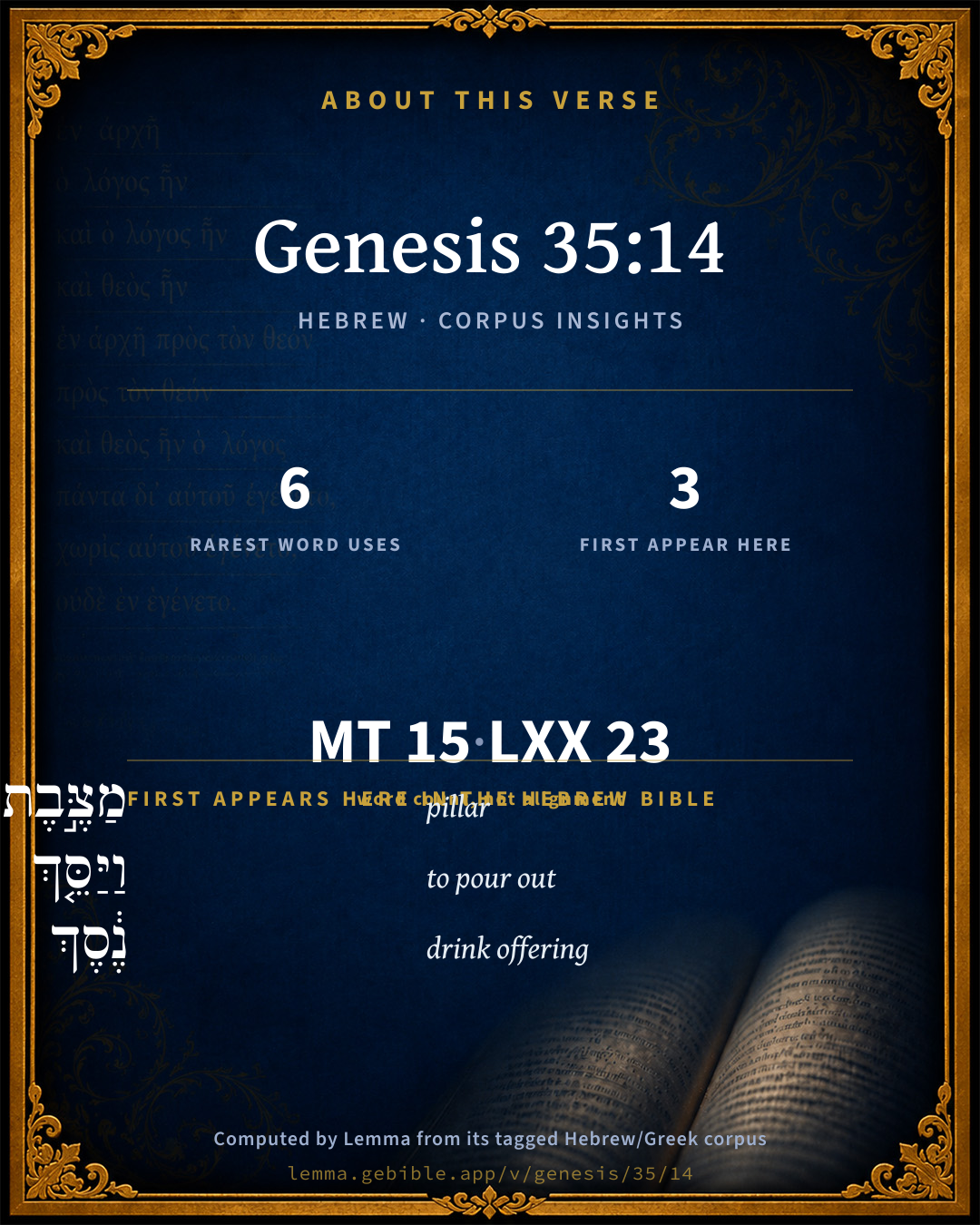
  • 3 first appearances in the Hebrew Bible
Full analysis ↓
Download a study sheet

One document with this verse’s original text, its word-by-word gloss line, the meaning frame, cross-references with their text, attributed commentary, and full source and license credits — printable, and it pastes into notes with its structure intact.

This verse Autodidact and up

Study sheet (.html) Plain text (.txt)

A passage Seminary Student

Up to 50 verses in one chapter. A passage sheet keeps up to 6 commentary sources and 12 cross-references per verse, in the order this page ranks them, and says so on the sheet whenever that leaves anything out. Ask for a single verse and you get the Autodidact verse sheet above.

Everything on this page stays free to read, with no account — the sheet is a download of what is already on screen, not access to it.

Want to remove ads? Support Godless Engineer
Compare translations 3

The same verse in 3 English versions, stacked beneath the original-language interlinear above. Click any original word for its lexicon entry.

Each is an independent rendering of the whole verse — the interlinear is not word-aligned to these translations.

Highlighted words mark where these versions differ — a whole-verse word diff, not a word-by-word alignment.

  • World English Bible Public Domain
    Jacob set up a pillar in the place where he spoke with him, a pillar of stone. He poured out a drink-offering on it, and poured oil on it.
  • King James Version Public Domain
    And Jacob set up a pillar in the place where he talked with him, even a pillar of stone: and he poured a drink offering thereon, and he poured oil thereon.
  • unfoldingWord Literal Text CC BY-SA 4.0
    Then Jacob set up a pillar at the place where he had spoken with him, a pillar of stone, and he poured a drink offering on it, and he poured oil on it.

unfoldingWord Literal Text — © unfoldingWord, licensed CC BY-SA 4.0. Word-aligned USFM3 via Door43 (git.door43.org/unfoldingWord/en_ult).

Versions to compare (up to 4)

3 of 4 selected

Show all 18 translations

Every available English version of this verse, each an independent rendering of the whole verse.

  • World English Bible Public Domain
    Jacob set up a pillar in the place where he spoke with him, a pillar of stone. He poured out a drink-offering on it, and poured oil on it.
  • Berean Standard Bible Public Domain
    So Jacob set up a pillar in the place where God had spoken with him—a stone marker—and he poured out a drink offering on it and anointed it with oil.
  • Majority Standard Bible Public Domain
    So Jacob set up a pillar in the place where God had spoken with him—a stone marker—and he poured out a drink offering on it and anointed it with oil.
  • King James Version Public Domain
    And Jacob set up a pillar in the place where he talked with him, even a pillar of stone: and he poured a drink offering thereon, and he poured oil thereon.
  • American Standard Version (1901) Public Domain
    And Jacob set up a pillar in the place where he spake with him, a pillar of stone: and he poured out a drink-offering thereon, and poured oil thereon.
  • Revised Version (1885) Public Domain
    And Jacob set up a pillar in the place where he spake with him, a pillar of stone: and he poured out a drink offering thereon, and poured oil thereon.
  • Geneva Bible (1599) Public Domain
    And Iaakob set vp a pillar in the place where he talked with him, a pillar of stone, and powred drinke offring thereon: also hee powred oyle thereon.
  • Douay-Rheims (1899) Public Domain
    But he set up a monument of stone, in the place where God had spoken to him: pouring drink offerings upon it, and pouring oil thereon:
  • Young's Literal Translation Public Domain
    And Jacob setteth up a standing pillar in the place where He hath spoken with him, a standing pillar of stone, and he poureth on it an oblation, and he poureth on it oil;
  • Literal Standard Version CC BY-SA 4.0
    And Jacob sets up a standing pillar in the place where He has spoken with him, a standing pillar of stone, and he pours on it an oblation, and he pours on it oil;
  • Unlocked Literal Bible CC BY-SA 4.0
    Jacob set up a pillar in the place where God had spoken to him, a pillar of stone. He poured out a drink offering over it and poured oil on it.
  • unfoldingWord Literal Text CC BY-SA 4.0
    Then Jacob set up a pillar at the place where he had spoken with him, a pillar of stone, and he poured a drink offering on it, and he poured oil on it.
  • Darby Bible Public Domain
    And Jacob set up a pillar in the place where he had talked with him, a pillar of stone, and poured on it a drink-offering, and poured oil on it.
  • World Messianic Bible Public Domain
    Jacob set up a pillar in the place where he spoke with him, a pillar of stone. He poured out a drink offering on it, and poured oil on it.
  • Webster's Bible Public Domain
    And Jacob set up a pillar in the place where he talked with him, even a pillar of stone: and he poured a drink-offering thereon, and he poured oil thereon.
  • Free Bible Version CC BY-SA 4.0
    Afterwards Jacob set up a stone pillar where God had spoken with him. He poured out a drink offering on it, and also olive oil.
  • Bible in Basic English Public Domain
    And Jacob put up a pillar in the place where he had been talking with God, and put a drink offering on it, and oil.
  • JPS Tanakh (1917) Public Domain
    And Jacob set up a pillar in the place where He spoke with him, a pillar of stone, and he poured out a drink-offering thereon, and poured oil thereon.

Literal Standard Version (2020), Covenant Press — licensed CC BY-SA 4.0. Text via the HelloAO Bible API (eBible.org). Unlocked Literal Bible (unfoldingWord) — licensed CC BY-SA 4.0. Text via the HelloAO Bible API (eBible.org). unfoldingWord Literal Text — © unfoldingWord, licensed CC BY-SA 4.0. Word-aligned USFM3 via Door43 (git.door43.org/unfoldingWord/en_ult). Free Bible Version, Dr. Jonathan Gallagher — licensed CC BY-SA 4.0. Text via the HelloAO Bible API (eBible.org).

Word by word

More ways to search: Search by grammar → Find every occurrence → Compare this word →

Practice this passage: Drill this verse → Learn its vocabulary →

מַצֶּ֣בֶת
matstsebeth
H4678
“pillar of”
Noun, Common, Feminine, Singular, Construct
Part of Speech
Noun
Type
Common
Gender
Feminine
Number
Singular
State
Construct
Full BDB Definition

Origin: from H5324

TWOT: 1398g

pillar, mastaba, stump - pillar - as monument, personal memorial - with an altar - (Hophal) stock, stump (of tree)
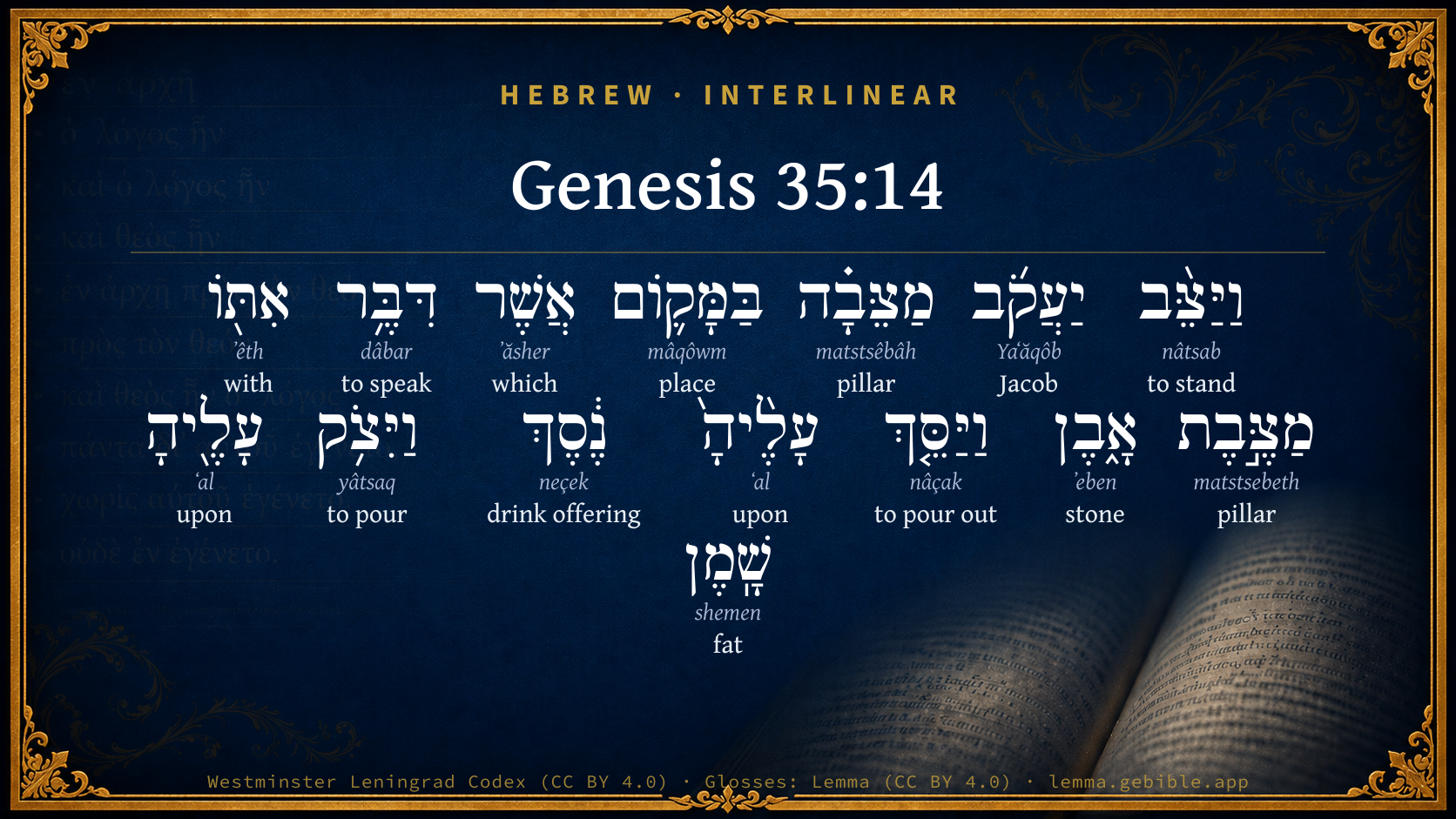
  1. וַיַּצֵּ֨ב nâtsab H5324 “and · to stand” Conjunction + Verb, Hiphil, Sequential Imperfect, 3rd Person, Masculine, Singular
  2. יַעֲקֹ֜ב Yaʻăqôb H3290 “Jacob” Noun, Proper
  3. מַצֵּבָ֗ה matstsêbâh H4676 “pillar” Noun, Common, Feminine, Singular, Absolute
  4. בַּמָּק֛וֹם mâqôwm H4725 “in/at the · place” Preposition, Determined + Noun, Common, Masculine, Singular, Absolute
  5. אֲשֶׁר ʼăsher H834 “which” Particle, Relative
  6. דִּבֶּ֥ר dâbar H1696 “to speak” Verb, Piel, Perfect, 3rd Person, Masculine, Singular
  7. אִתּ֖וֹ ʼêth H854 “with · him” Preposition + Suffix, Personal, 3rd Person, Masculine, Singular
  8. אָ֑בֶן ʼeben H68 “stone” Noun, Common, Feminine, Singular, Absolute
  9. וַיַּסֵּ֤ךְ nâçak H5258 “and · to pour out” Conjunction + Verb, Hiphil, Sequential Imperfect, 3rd Person, Masculine, Singular
  10. עָלֶ֨יהָ֙ ʻal H5921 “upon · her” Preposition + Suffix, Personal, 3rd Person, Feminine, Singular
  11. נֶ֔סֶךְ neçek H5262 “drink offering” Noun, Common, Masculine, Singular, Absolute
  12. וַיִּצֹ֥ק yâtsaq H3332 “and · to pour” Conjunction + Verb, Qal, Sequential Imperfect, 3rd Person, Masculine, Singular
  13. עָלֶ֖יהָ ʻal H5921 “upon · her” Preposition + Suffix, Personal, 3rd Person, Feminine, Singular
  14. שָֽׁמֶן shemen H8081 “fat” Noun, Common, Masculine, Singular, Absolute

About this verse

These counts appear in no published source. They are computed here, from the morphology-tagged text and Lemma’s own curated glosses. What Lemma adds →

15
words
14
distinct lemmas
Pentateuch
section

Notable vocabulary

The rarest word here is מַצֶּ֣בֶת pillar H4678 — appearing just 6 times in the whole Hebrew Bible.

First appearance in Scripture

These words make their first canonical appearance in the Hebrew Bible here:

  • מַצֶּ֣בֶת pillar H4678
  • וַיַּסֵּ֤ךְ to pour out H5258
  • נֶ֔סֶךְ drink offering H5262

Shared distinctive vocabulary

מַצֶּ֣בֶת pillar H4678 occurs in 4 verses of the Hebrew Bible. Also found in:

Grammatical profile

  • 4 verbs
  • 7 nouns
  • 3 prepositions
  • 1 particle

Verb forms

  • וַיַּצֵּ֨ב Hiphil · Sequential Imperfect
  • דִּבֶּ֥ר Piel · Perfect
  • וַיַּסֵּ֤ךְ Hiphil · Sequential Imperfect
  • וַיִּצֹ֥ק Qal · Sequential Imperfect

Repetition

A word recurs within this verse — often emphatic in Hebrew:

  • עָלֶ֨יהָ֙ upon H5921 ×2

Hebrew & Septuagint length

In English translation the verse runs 29 words from the Hebrew and 30 from the Septuagint (LXX English) — closely comparable.

A rough comparison of the two English renderings, which tokenize alike — not a word-level alignment.

Word counts can differ between the Hebrew and the Greek without any difference in meaning — e.g. the Hebrew direct-object marker אֵת has no separate Greek word, and Greek often adds the article ὁ.

In the original languages it is 15 Hebrew tokens and 23 Greek tokens — but the two are counted differently (Hebrew bundles its prefixes and suffixes into one token; the Greek is in lemma form), so that isn’t a like-for-like length.

Cross-references

5

Topical passages linked to Genesis 35:14 in the Treasury of Scripture Knowledge — connected by theme and wording, ordered by reader-vote popularity; previews shown in the World English Bible.

  • Genesis 28:18–19 Jacob rose up early in the morning, and took the stone that he had put under his head, and set it up for a pillar, and poured oil on the top of it.
  • Genesis 31:45 Jacob took a stone, and set it up for a pillar.
  • Genesis 35:20 Jacob set up a pillar on her grave. The same is the Pillar of Rachel's grave to this day.
  • Exodus 17:15 Moses built an altar, and called the name of it Yahweh our Banner.
  • 1 Samuel 7:12 Then Samuel took a stone, and set it between Mizpah and Shen, and called the name of it Ebenezer, saying, Hitherto has Yahweh helped us.

Cross-references courtesy of OpenBible.info (CC BY 4.0).

Hebrew and Greek witnesses Masoretic Hebrew ↔ Greek Septuagint

The same verse in the two great witnesses to the Old Testament, shown verse-for-verse.

These are two independent witnesses, not word-aligned to each other, and the Septuagint is shown in lemma (dictionary) form.

Hebrew Genesis 35:14 Masoretic · Westminster Leningrad Codex

וַיַּצֵּ֨ב יַעֲקֹ֜ב מַצֵּבָ֗ה בַּמָּק֛וֹם אֲשֶׁר דִּבֶּ֥ר אִתּ֖וֹ מַצֶּ֣בֶת אָ֑בֶן וַיַּסֵּ֤ךְ עָלֶ֨יהָ֙ נֶ֔סֶךְ וַיִּצֹ֥ק עָלֶ֖יהָ שָֽׁמֶן

Jacob set up a pillar in the place where he spoke with him, a pillar of stone. He poured out a drink-offering on it, and poured oil on it.

World English Bible · Public Domain

Greek LXX Genesis 35:14 Septuagint · lemma form

καί ἵστημι ἰακώβ στήλη ἐν ὁ τόπος ὅς λαλέω μετά αὐτός στήλη λίθινος καί σπένδω ἐπί αὐτός σπονδή καί ἐπιχέω ἐπί αὐτός ἔλαιον

And Jacob set up a pillar in the place where God spoke with him, even a pillar of stone; and offered a libation upon it, and poured oil upon it.

LXX2012 (modern English Septuagint) · Public Domain

On this verse, The Pulpit Commentary discusses the Septuagint’s reading. Read the note in Commentary ↓

Hebrew: Westminster Leningrad Codex (CC BY 4.0). Greek: Septuagint (public domain); English from LXX2012 (modern English Septuagint) (Public Domain). How the Septuagint differs from the Hebrew →

Targum (Aramaic paraphrase)

2

The Targum is the ancient Jewish Aramaic paraphrase of the Hebrew Scriptures — an interpretive translation, not the Hebrew text itself. Onkelos (literal) and Pseudo-Jonathan (expansive) render the Torah, and Jonathan the Prophets. Coverage is partial: where no permissively-licensed English translation exists for a verse, only the Aramaic is shown. This is verse-level text, not a word-by-word alignment to the Hebrew.

  1. Targum Onkelos Torah (Genesis–Deuteronomy)
    וַאֲקֵם יַעֲקֹב קַמְתָא בְּאַתְרָא דִי מַלִּיל עִמֵּהּ קָמַת אַבְנָא וְאַסִּיךְ עֲלַהּ נִסּוּכִין וַאֲרִיק עֲלַהּ מִשְׁחָא

    (no public-domain English translation for this verse)

    Targum Onkelos — Aramaic: “Onkelos Genesis” (public domain); “Onkelos Exodus” (public domain); “Onkelos Leviticus” (public domain); “Onkelos Numbers” (public domain); “Onkelos Deuteronomy” (public domain). English: “Sefaria Community Translation” (CC0 1.0 (public-domain dedication)); “J.W. Etheridge. The Targums of Onkelos and Jonathan Ben Uzziel on the Pentateuch. London: Longmans, Green, 1862” (public domain). Text via Sefaria.

  2. Targum Pseudo-Jonathan Torah (Genesis–Deuteronomy)
    וְאָקִים תַּמָן קָמָא בְּאַתְרָא דְמַלֵיל עִמֵיהּ קָמָא דְאַבְנָא וּנְסִיךְ עֲלָהּ נִיסוּךְ חֲמַר נְסוּךְ מוֹי אֲרוּם כְּדֵין עֲתִידִין לְמֶעֱבַד בְּחַגָא דִמְטָלַיָא וְאָרֵיק עֲלָהּ מְשַׁח זֵיתָא

    And Jakob erected there a pillar of stone in the place where He had spoken with him, a pillar of stone; and he outpoured upon it a libation of wine, and a libation of water, because thus it was to be done at the feast of Tabernacles; and he poured oil of olives thereupon.

    Targum Pseudo-Jonathan — Aramaic: “Targum Jonathan on Genesis” (public domain); “Targum Jonathan on Exodus” (public domain); “Targum Jonathan on Leviticus” (public domain); “Targum Jonathan on Numbers” (public domain); “Targum Jonathan on Deuteronomy” (public domain). English: “The Targum of Jonathan ben Uzziel, trans. J. W. Etheridge, London, 1862” (public domain). Text via Sefaria.

Commentary

Notes on Genesis 35:14 from classic Christian and Jewish commentators (each source and its license shown beneath its notes). The classic Christian expositions comment on the surrounding passage and are grouped to its opening verse, so a note may address several verses; the Jewish commentaries on the Tanakh (Rashi and others) are per-verse, so they appear only where the commentator wrote on this verse.

Lemma curates 59 commentaries, every one of them public domain or Creative Commons licensed, each selected and text-cleaned for this edition rather than reprinted as found. About our sources →

Trapp's Complete Commentary

John Trapp

Gen 35:14 And Jacob set up a pillar in the place where he talked with him, [even] a pillar of stone: and he poured a drink offering thereon, and he poured oil thereon.

Ver. 14. And Jacob set up a pillar.] Or, Had set up a pillar, had poured a drink offering, &c., - to wit, Gen 28:18-19. And now he either repeats it in the presence, and for the edification of his family; or else he repairs the pillar now ruinated, and new consecrates it, by the old name Bethel.

John Trapp, A Commentary or Exposition upon All the Books of the Old and New Testament (1647–1656) — public domain. Text from a community e-Sword module.

Joseph Benson's Commentary

Gen 35:14. And Jacob set up a pillar — When he was going to Padan-aram he set up that stone which he had laid his head on for a pillow; but now he took time to erect one more stately and durable, probably inserting that stone in it. And in token of his intending it for a sacred memorial of his communion with God, he poured oil, and the other ingredients of a drink- offering, upon it. And he confirmed the name he had formerly given to the place, Beth-el, the house of God. Yet this very place afterward lost the honour of its name, and became Beth-aven, a house of iniquity; for here it was that Jeroboam set up one of his calves. It is impossible for the best men to entail so much as the profession and form of religion upon a place.

Gen 35:16-17. She had hard labour — Harder than usual. Rachel had said when she bore Joseph, God shall give me another son, which now the midwife remembers, and tells her, her words were made good. Yet this did not avail; unless God command away fear, no one else can. We are apt in extreme perils to comfort ourselves and our friends with the hopes of a temporal deliverance, in which we may be disappointed; we had better ground our comforts on that which cannot fail us, the hope of eternal life. Rachel had passionately said, Give me children, or else I die; and now she had children (for this was her second) she died.

Joseph Benson's Commentary on the Old and New Testaments (1811–1818) — public domain. Text from a community e-Sword module.

The Pulpit Commentary

And Jacob set up a pillar the former pillar (Gen_28:18) having probably fallen down and disappearedin the place where he (God) talked with him (to commemorate the interview), even a pillar of stone. The setting up of pillars, according to Tuch a peculiarity of the Elohist, appears to have been a favorite practice of Jacob"s: witness the first pillar at Bethel, (Gen_28:18) the pillar on Galeed, (Gen_31:45) the second pillar at Bethel, (Gen_35:14) the pillar over Rachel"s grave. (Gen_35:20) And he poured a drink offering thereon. This is the first mention of those sacrificial libations which afterwards became so prominent in connection with the Mosaic ritual (Exo_29:40, Exo_29:41; Lev_23:13, Lev_23:18, Lev_23:37; Num_6:15; and elsewhere) Under the law the spondeion spondh (LXX) libamentum, libamen (Vulgate); frankopfer (Luther) consisted of a fourth part of a hin of wine, which was equal to about a third of a gallon. And he poured oil thereon as he did on the previous occasion. (Gen_28:18, q.v .)

The Pulpit Commentary (1880–1919), ed. H.D.M. Spence-Jones & Joseph S. Exell — public domain. Text from a community e-Sword module.

Tyndale Open Study Notes

Tyndale Open Resources

35:14-15 In fulfilling his vow (28:20-22), Jacob’s actions were almost identical to his actions in the earlier experience at Bethel (cp. 28:16-19).

Tyndale Open Study Notes — © Tyndale Open Resources, licensed CC BY-SA 4.0. Text via the HelloAO Bible API.

Adam Clarke's Commentary

Verse 14. A drink-offering] נסך nesech, a libation. These were afterwards very common in all countries. At first they consisted probably of water only, afterwards wine was used; see on Le 7:1, c. The pillar which Jacob set up was to commemorate the appearance of God to him the drink-offering and the oil were intended to express his gratitude and devotion to his preserver. It was probably the same pillar which he had set up before, which had since been thrown down, and which he had consecrated afresh to God.

Adam Clarke's Commentary on the Bible (1810–1826) — public domain. Text from a community e-Sword/MySword module.

John Calvin's Commentaries

14. And Jacob set up a pillar. Though it is possible that he may again have erected a sacred monument, in memory of the second vision; yet I readily subscribe to the opinion of those who think that reference is made to what had been done before; as if Moses should say, that was the ancient temple of God, in which Jacob had poured forth his libation: for he had not been commanded to come thither for the sake of dwelling there; but in order that a fresh view of the place might renew his faith in the ancient oracle, and more fully confirm it. We read elsewhere that altars were built by the holy fathers, where they intended to remain longer; but their reason for doing so was different: for whereas Jacob had made a solemn vow in Beth-el, on condition that he should be brought back by the Lord in safety; thanksgiving is now required of him, after he has become bound by his vow, that, being strengthened, he may pass onward on his journey.

John Calvin's Commentaries (1540-1563) — public domain. Text from the Calvin Translation Society English edition (1840s-50s) via the Christian Classics Ethereal Library (ccel.org). Calvin's coverage is partial (roughly two-thirds of the Bible); uncommented books and verses are honest gaps, never fabricated. The 19th-century editor's footnotes and remarks are omitted so the notes are faithfully Calvin's own voice.

Ellicott's Commentary for English Readers

(14) Jacob set up a pillar.—In doing this Jacob was imitating his previous action when God manifested Himself to him in his journey to Haran, Gen_28:18. This consecration of it by pouring on it oil, and offering to God a drink-offering, was in itself natural and right. But as these memorial pillars were subsequently worshipped, they were expressly forbidden by the Mosaic Law, the word correctly rendered “pillar” in this place being translated standing image in Lev_26:1, and image in Deu_16:22.

A Bible Commentary for English Readers, edited by Charles John Ellicott (1878–1897) — public domain. Text from a community e-Sword module.

The Cambridge Bible for Schools and Colleges

gen. ed. J. J. S. Perowne

14. And Jacob, &c.] This verse, probably from J, contains a parallel account to that of E in Gen_28:18. Jacob erects a pillar, or upright stone (maṣṣêbah): and this he consecrates with a libation of oil and a drink offering. Whether this is the account of another pillar at Bethel, or is a parallel version of the account in ch. 28, is uncertain.

The Cambridge Bible for Schools and Colleges (gen. ed. J. J. S. Perowne; Cambridge University Press, 1878–1918) — public domain. Text from a community e-Sword module.

John Gill's Exposition

And Jacob set up a pillar in the place where he talked with him,.... He had set up a pillar in this place before he went to Padanaram, Gen 28:18; and some, think this pillar is here referred to, and render the words, "had set up a pillar" (y); but as that was done thirty years ago, it is very likely it was demolished by the Heathens before this time, or was fallen to ruin, wherefore this must be at least a renewal or reparation of it: though it rather seems to be another pillar, and quite a new one, being set up in that very spot of ground, over or on which God had been talking with him: and the following account of it seems to confirm the same:

even a pillar of stone; made of several stones hewed and polished, and well put together; whereas the former was but a single stone, rude and unpolished, though it is probable it was one of these:

and he poured a drink offering thereon; of wine, of which drink offerings under the law were, thereby consecrating it to the worship and service of God. Aben Ezra says it was either of water or of wine, with which he washed it, and after that poured oil on it; and the Targum of Jonathan says, he poured a drink offering of wine, and a drink offering of water:

and he poured oil thereon; as he did before; See Gill on Gen 28:18.

(y) "erexerat", Vatablus; "et statuerat", Piscator; so Aben Ezra.

John Gill's Exposition of the Whole Bible (1746–1763) — public domain (CC PDM 1.0). Text via the HelloAO Bible API.

Haydock's Catholic Bible Commentary

Set up either a fresh altar, or restored the stone which he had formerly used for sacrifice. (St. Augustine q. 116.) --- Drink, wine. --- Oil. Theophrastus, speaking of a man addicted to superstition, says, "he adores every anointed stone." (Calmet)

George Leo Haydock (1774–1849), Haydock's Catholic Family Bible and Commentary, 1859 edition — public domain. Excludes Psalms (Douay-Rheims chapter numbering differs from Protestant) and Deuterocanonical books (Catholic canon only).

Matthew Poole's English Annotations

Either he repaired the old pillar set up by him, Gen 28:18, which was ruined by the injury of time, or by the neighbouring idolaters; or rather erected a new one, more stable and durable than he could do in that time, as a monument or witness of God’s manifold favours, and of his own gratitude. The

drink-offering was of wine, as may be gathered by comparing Exo 29:40; Num 28:14.

Matthew Poole's English Annotations on the Holy Bible (1683–1685) — public domain. Text from a community e-Sword/MySword module.

Whedon's Commentary on the Bible

Daniel D. Whedon

14. Set up a pillar — As he had done at the former time, (Gen_28:18,) but now with much more expense and ceremony.

Poured a drink-offering… poured oil — This is the first mention in the Scripture of a drink-offering, or libation of wine. They were afterwards common in the worship of Israel. “The stone designates the ideal house of God, and in this significance must be distinguished from the altar. Through the drink-offering Jacob consecrates the enjoyment of his prosperity to the Lord; through the oil he raises the stone, as well as his thanksgiving, to a lasting sacred remembrance.” — Lange.

Daniel D. Whedon (gen. ed.), Commentary on the Old and New Testaments (1874–1909) — public domain. Text from a community e-Sword module.

John Wesley's Explanatory Notes

And Jacob set up a pillar - When he was going to Padan-aram he set up that stone which he had laid his head on for a pillar; but now he took time to erect one more stately, and durable, probably inserting that stone into it. And in token of his intending it for a sacred memorial of his communion with God, he poured oil, and the other ingredients of a drink-offering upon it. This stone shall be God's house, that is, shall be set up for his honour, as houses to the praise of their builders; and here he performs it. And he confirmed the name he had formerly given to the place, Beth-el, the house of God. Yet this very place afterwards lost the honour of its name, and became Beth-aven, a house of iniquity, for here it was that Jeroboam set up one of his calves. It is impossible for the best men to entail so much as the profession and form of religion upon a place.

John Wesley, Explanatory Notes Upon the Whole Bible (1754–1765) — public domain. Text via the GEBible commentary corpus.

Scofield Reference Notes

C. I. Scofield

drink offering

The first mention of the drink-offering. It is not mentioned among the Levitical offerings of Leviticus 1-7, though included in the instructions for sacrifice in the land Num 15:5-7. It was always "poured out," never drunk, and may be considered a type of Christ in the sense of; Psa 22:14; Isa 53:12.

The Scofield Reference Bible (1917 edition), notes by C. I. Scofield — public domain. Text from a community e-Sword module.

unfoldingWord translationNotes

Door43 World Missions Community

pillar

This is a memorial pillar which was simply a large stone or boulder set up on its end.

He poured out a drink offering over it and poured oil on it

This is a sign that he is dedicating the pillar to God. (See: Symbolic Action)

Bethel

Translators may also add a footnote that says "The name Bethel means 'house of God.'"

translationWords

column

drink offering

oil

Bethel

unfoldingWord translationNotes — © Distant Shores Media and the Door43 World Missions Community, licensed CC BY-SA 4.0. Source: git.door43.org/Door43/en_tn.

Ramban (Nachmanides)

Rabbi Moshe ben Nachman (Ramban / Nachmanides)

AND JACOB SET UP A PILLAR. Rabbi Abraham ibn Ezra explained it as meaning: “And Jacob had previously, Verse 17. set up a pillar, and now he poured out a drink-offering thereon, and poured oil thereon.” This is correct.

Ramban (Nachmanides) on the Tanakh — English translation: “Commentary on the Torah by Ramban (Nachmanides). Translated and annotated by Charles B. Chavel. New York, Shilo Pub. House, 1971-1976” (CC BY 4.0). Text via Sefaria.

Radak

Rabbi David Kimhi (Radak)

ויצב, the reason why the Torah repeats once more “in the place where He had spoken to him,” is to tell us that Yaakov had come to realise that that place was singularly suitable for deserving people to receive prophetic insights. Even though Yaakov had already said on the original occasion that this place must be designated as a house of G’d, now that G’d’s promises to him had materialised, seeing that G’d had spoken to him in that very place this was even plainer.

מצבת אבן, a different stone, not the one he had anointed at the time, 34 years ago. He added one more stone to the monument he had erected then.

ויסך עליה נסך, a libation consisting of wine.

ויצוק עליה שמן, also intended as a gift offering.

Radak on the Tanakh — English translations: “Sefaria Community Translation” (CC0 1.0 (public-domain dedication)); “Eliyahu Munk, HaChut Hameshulash” (CC BY 4.0); “Rabbi Mike Feuer, Jerusalem Anthology” (CC BY 4.0); and “R. David Kimhi on the first book of Psalms, Translated by R.G. Finch, London, 1919” (public domain). Text via Sefaria.

Ibn Ezra

Rabbi Abraham ibn Ezra

He poured a libation on it. He washed it either with water or with wine before offering oil upon it. At the same time he also fulfilled his vow to separate a tenth for Hashem (28:22), which he then gave to whoever was most worthy of receiving it in those days.

Ibn Ezra on the Tanakh — English translations: “Sefaria Community Translation” (CC0 1.0 (public-domain dedication)); “Yalkut, Sifsei Chachomim Chumash, Metsudah Publications, 2009” (CC BY 4.0); and “Commentary of Ibn Ezra on Isaiah - trans. by M. Friedlander, 1873” (public domain). Text via Sefaria.

Lesson kit

Teaching starters — assembled from the data on this page, not authored interpretation. Every prompt links to the verse data it draws on. Edit before teaching.

Genesis, in the Pentateuch, opens this verse with 15 words (14 distinct Hebrew lemmas). Its most distinctive word is matstsebeth (“pillar”). A historical commentator’s framing appears above. Read the whole chapter for the surrounding context.

Discussion questions

  1. How does “pillar” (matstsebeth) shape what this verse is saying?
  2. 3 words make their first appearance in Scripture here. What does this debut establish?
  3. How does Genesis 35:20, which shares the word «pillar», read alongside this verse?
  4. What does the repetition of “upon” (2× in this one verse) do in this verse?
  5. These translations render this verse differently; the difference is in the English rendering, not the original. What questions does that raise?
  6. «וַיַּצֵּ֨ב» is a Hiphil Sequential Imperfect verb. How does that grammatical form shape the action described?
  7. Compare how Trapp's Complete Commentary and Joseph Benson's Commentary read this verse. Where do they agree or differ?

Things to notice

Reading settings

Reading text

Shown beneath each verse's original-language words.

Old Testament
Old Testament edition

Read the OT as the Masoretic Hebrew (MT) or the Greek Septuagint (LXX).

English shown for the Greek Septuagint (in the Hebrew ↔ Greek comparison).

Comparing translations? Open the Compare panel on any verse page to stack up to four side by side.