
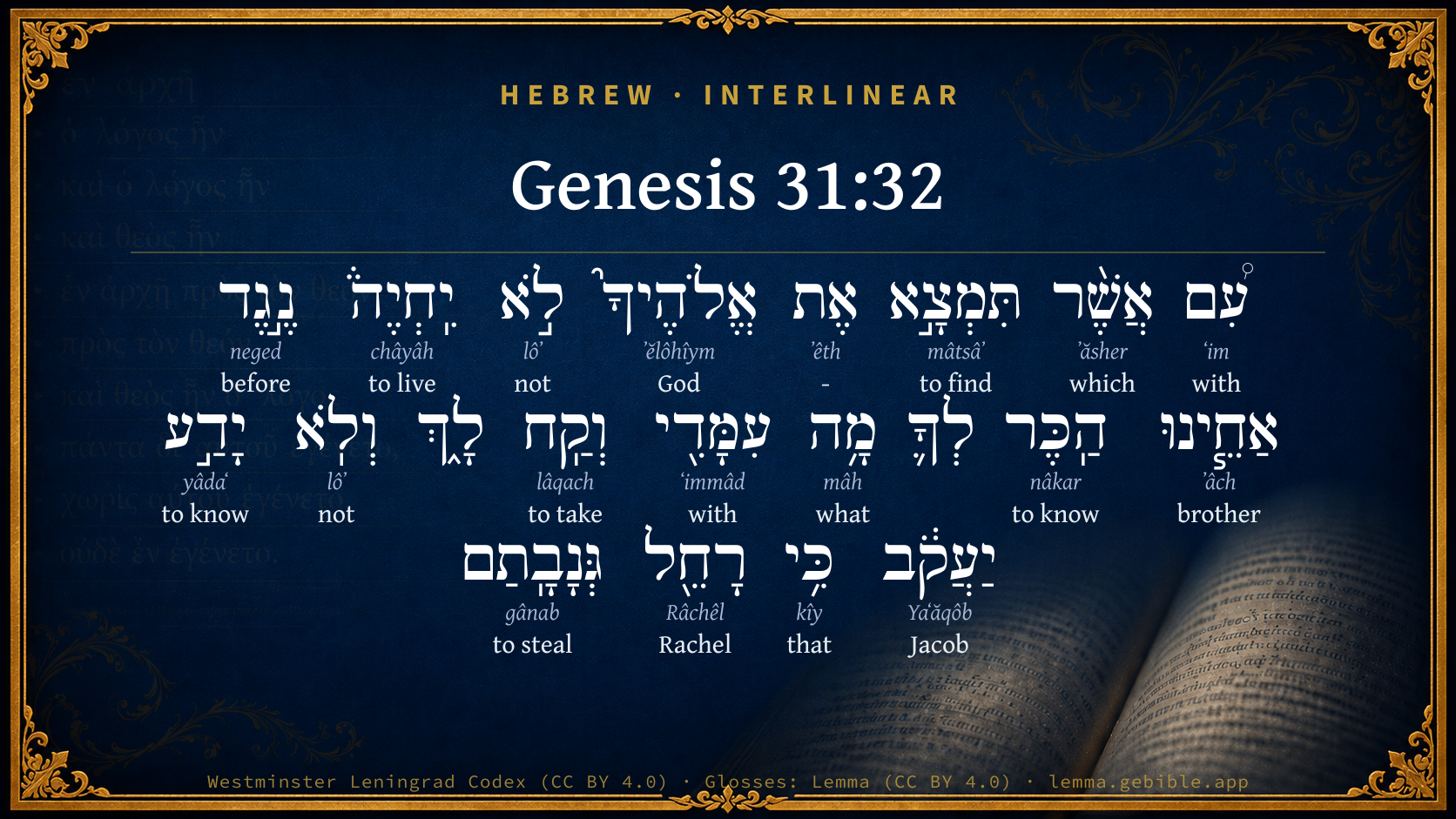
Genesis 31:32

Hebrew (Westminster Leningrad Codex) Genesis 31:32 appears in the Hebrew Old Testament. The text above is from the Westminster Leningrad Codex. Each word links to its Strong’s number, a concise gloss, and parsing drawn from the Open Scriptures Hebrew Bible morphology. Click any word for its full Brown-Driver-Briggs (BDB) entry.
Download image
Cite this verse

Genesis 31:32 (World English Bible). Public Domain. Lemma interlinear Bible study tool, https://lemma.gebible.app/v/genesis/31/32.

Show BibTeX & RIS
BibTeX
RIS
English Translation
With whoever you find your gods, he shall not live. Before our relatives, discern what is yours with me, and take it." For Jacob didn't know that Rachel had stolen them.
World English Bible · Public Domain
Download a study sheet

One document with this verse’s original text, its word-by-word gloss line, the meaning frame, cross-references with their text, attributed commentary, and full source and license credits — printable, and it pastes into notes with its structure intact.

This verse Autodidact and up

Study sheet (.html) Plain text (.txt)

A passage Seminary Student

Up to 50 verses in one chapter. A passage sheet keeps up to 6 commentary sources and 12 cross-references per verse, in the order this page ranks them, and says so on the sheet whenever that leaves anything out. Ask for a single verse and you get the Autodidact verse sheet above.

Everything on this page stays free to read, with no account — the sheet is a download of what is already on screen, not access to it.

Want to remove ads? Support Godless Engineer
Compare translations 3

The same verse in 3 English versions, stacked beneath the original-language interlinear above. Click any original word for its lexicon entry.

Each is an independent rendering of the whole verse — the interlinear is not word-aligned to these translations.

Highlighted words mark where these versions differ — a whole-verse word diff, not a word-by-word alignment.

  • World English Bible Public Domain
    With whoever you find your gods, he shall not live. Before our relatives, discern what is yours with me, and take it." For Jacob didn't know that Rachel had stolen them.
  • King James Version Public Domain
    With whomsoever thou findest thy gods, let him not live: before our brethren discern thou what is thine with me, and take it to thee. For Jacob knew not that Rachel had stolen them.
  • unfoldingWord Literal Text CC BY-SA 4.0
    Whomever you find your gods with will not live! In front of our relatives, observe for yourself what with me, and take to you.” Now Jacob did not know that Rachel had stolen them.

unfoldingWord Literal Text — © unfoldingWord, licensed CC BY-SA 4.0. Word-aligned USFM3 via Door43 (git.door43.org/unfoldingWord/en_ult).

Versions to compare (up to 4)

3 of 4 selected

Show all 18 translations

Every available English version of this verse, each an independent rendering of the whole verse.

  • World English Bible Public Domain
    With whoever you find your gods, he shall not live. Before our relatives, discern what is yours with me, and take it." For Jacob didn't know that Rachel had stolen them.
  • Berean Standard Bible Public Domain
    If you find your gods with anyone here, he shall not live! In the presence of our relatives, see for yourself if anything is yours, and take it back.” For Jacob did not know that Rachel had stolen the idols.
  • Majority Standard Bible Public Domain
    If you find your gods with anyone here, he shall not live! In the presence of our relatives, see for yourself if anything is yours, and take it back.” For Jacob did not know that Rachel had stolen the idols.
  • King James Version Public Domain
    With whomsoever thou findest thy gods, let him not live: before our brethren discern thou what is thine with me, and take it to thee. For Jacob knew not that Rachel had stolen them.
  • American Standard Version (1901) Public Domain
    With whomsoever thou findest thy gods, he shall not live: before our brethren discern thou what is thine with me, and take it to thee. For Jacob knew not that Rachel had stolen them.
  • Revised Version (1885) Public Domain
    With whomsoever thou findest thy gods, he shall not live: before our brethren discern thou what is thine with me, and take it to thee. For Jacob knew not that Rachel had stolen them.
  • Geneva Bible (1599) Public Domain
    But with whome thou findest thy gods, let him not liue. Search thou before our brethre what I haue of thine, and take it to thee, (but Iaakob wist not that Rahel had stolen them)
  • Douay-Rheims (1899) Public Domain
    But whereas thou chargest me with theft: with whomsoever thou shalt find thy gods, let him be slain before our brethren. Search, and if thou find any of thy things with me, take them away. Now when he said this, he knew not that Rachel had stolen the idols.
  • Young's Literal Translation Public Domain
    with whomsoever thou findest thy gods -- he doth not live; before our brethren discern for thyself what `is' with me, and take to thyself:' and Jacob hath not known that Rachel hath stolen them.
  • Literal Standard Version CC BY-SA 4.0
    with whomsoever you find your gods—he must not live; before our brothers discern for yourself what [is] with me, and take to yourself”: and Jacob has not known that Rachel has stolen them.
  • Unlocked Literal Bible CC BY-SA 4.0
    Whoever has stolen your gods will not continue to live. In the presence of our relatives, identify whatever with me is yours and take it.” For Jacob did not know that Rachel had stolen them.
  • unfoldingWord Literal Text CC BY-SA 4.0
    Whomever you find your gods with will not live! In front of our relatives, observe for yourself what with me, and take to you.” Now Jacob did not know that Rachel had stolen them.
  • Darby Bible Public Domain
    With whomsoever thou findest thy gods, he shall not live. Before our brethren discern what is thine with me, and take [it] to thee. But Jacob did not know that Rachel had stolen them.
  • World Messianic Bible Public Domain
    Anyone you find your gods with shall not live. Before our relatives, discern what is yours with me, and take it.” For Jacob didn’t know that Rachel had stolen them.
  • Webster's Bible Public Domain
    With whomsoever thou findest thy gods, let him not live: before our brethren discern thou what is thine with me, and take it to thee: for Jacob knew not that Rachel had stolen them.
  • Free Bible Version CC BY-SA 4.0
    As for your idols, anyone you find who has them will die. You can search everything in the presence of our relatives, and if you find I have anything that belongs to you, you can take it.” (Jacob didn't know that Rachel had stolen the household idols.)
  • Bible in Basic English Public Domain
    As for your gods, if anyone of us has them, let him be put to death: make search before us all for what is yours, and take it. For Jacob had no knowledge that Rachel had taken them.
  • JPS Tanakh (1917) Public Domain
    With whomsoever thou findest thy gods, he shall not live; before our brethren discern thou what is thine with me, and take it to thee.' — For Jacob knew not that Rachel had stolen them. —

Literal Standard Version (2020), Covenant Press — licensed CC BY-SA 4.0. Text via the HelloAO Bible API (eBible.org). Unlocked Literal Bible (unfoldingWord) — licensed CC BY-SA 4.0. Text via the HelloAO Bible API (eBible.org). unfoldingWord Literal Text — © unfoldingWord, licensed CC BY-SA 4.0. Word-aligned USFM3 via Door43 (git.door43.org/unfoldingWord/en_ult). Free Bible Version, Dr. Jonathan Gallagher — licensed CC BY-SA 4.0. Text via the HelloAO Bible API (eBible.org).

Word by word

More ways to search: Search by grammar → Find every occurrence → Compare this word →

Practice this passage: Drill this verse → Learn its vocabulary →

גְּנָבָֽתַם
gânab
H1589
“to steal · them”
Verb, Qal, Perfect, 3rd Person, Feminine, Singular + Suffix, Personal, 3rd Person, Masculine, Plural
Part of Speech
Verb
Stem
Qal
Form
Perfect
Person
3rd Person
Gender
Feminine
Number
Singular
Full BDB Definition

Origin: a primitive root

TWOT: 364

to steal, steal away, carry away - (Qal) to steal - (Niphal) to be stolen - (Piel) to steal away - (Pual) to be stolen away, be brought by stealth - (Hithpael) to go by stealth, steal away
  1. עִ֠ם ʻim H5973 “with” Preposition
  2. אֲשֶׁ֨ר ʼăsher H834 “which” Particle, Relative
  3. תִּמְצָ֣א mâtsâʼ H4672 “to find” Verb, Qal, Imperfect, 2nd Person, Masculine, Singular
  4. אֶת ʼêth H853 “-” Particle, Direct Object
  5. אֱלֹהֶיךָ֮ ʼĕlôhîym H430 “God(s) · your” Noun, Common, Masculine, Plural, Construct + Suffix, Personal, 2nd Person, Masculine, Singular
  6. לֹ֣א lôʼ H3808 “not” Particle, Negative
  7. יִֽחְיֶה֒ châyâh H2421 “to live” Verb, Qal, Imperfect, 3rd Person, Masculine, Singular
  8. נֶ֣גֶד neged H5048 “before” Preposition
  9. אַחֵ֧ינוּ ʼâch H251 “brothers · our” Noun, Common, Masculine, Plural, Construct + Suffix, Personal, 1st Person, Common, Plural
  10. הַֽכֶּר nâkar H5234 “know” Verb, Hiphil, Imperative, 2nd Person, Masculine, Singular
  11. מָ֥ה mâh H4100 “what” Particle, Interrogative
  12. עִמָּדִ֖י ʻimmâd H5978 “with · me” Preposition + Suffix, Personal, 1st Person, Common, Singular
  13. וְקַֽח lâqach H3947 “and · take” Conjunction + Verb, Qal, Imperative, 2nd Person, Masculine, Singular
  14. וְלֹֽא lôʼ H3808 “and · not” Conjunction + Particle, Negative
  15. יָדַ֣ע yâdaʻ H3045 “to know” Verb, Qal, Perfect, 3rd Person, Masculine, Singular
  16. יַעֲקֹ֔ב Yaʻăqôb H3290 “Jacob” Noun, Proper
  17. כִּ֥י kîy H3588 “that” Conjunction
  18. רָחֵ֖ל Râchêl H7354 “Rachel” Noun, Proper

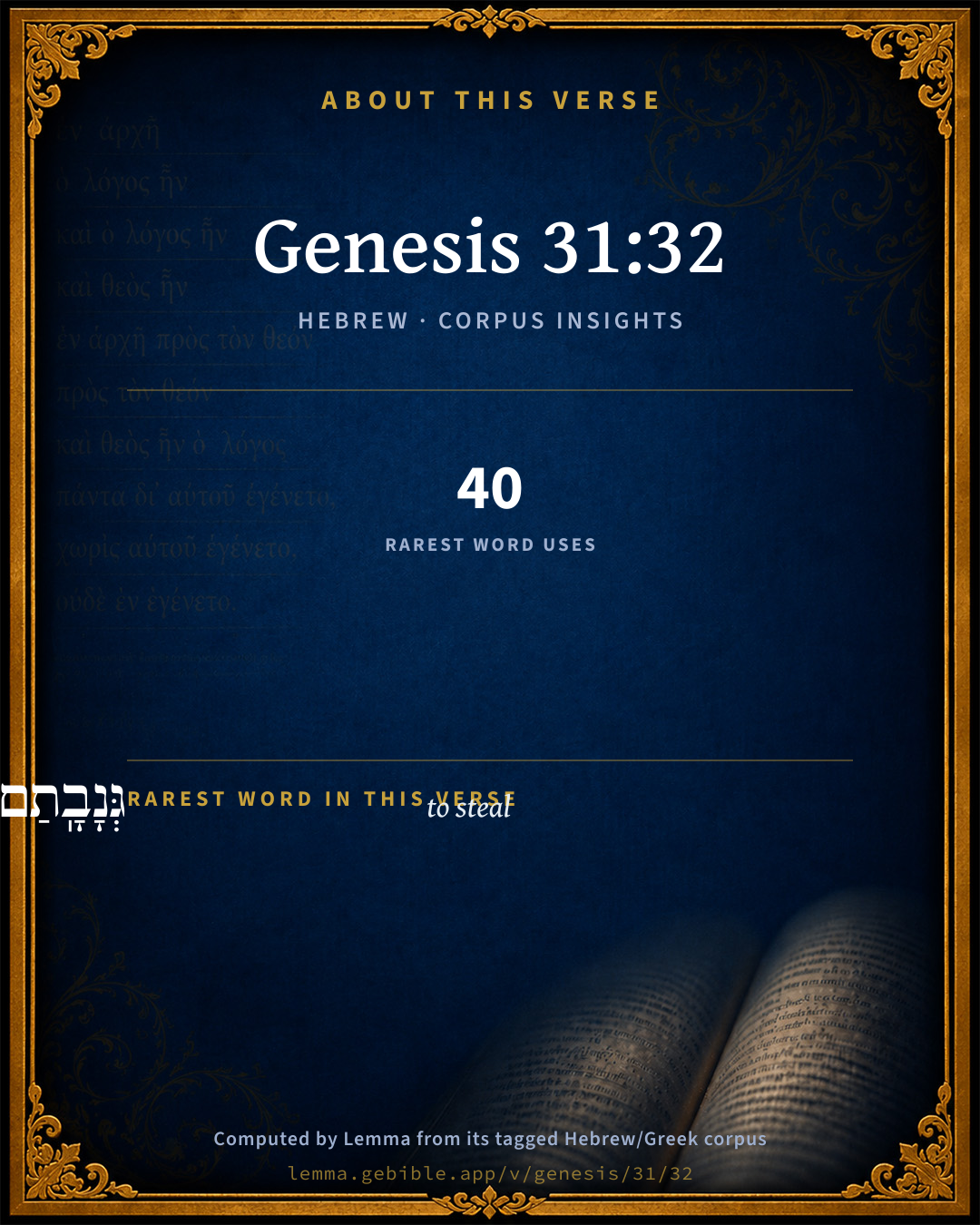
About this verse

These counts appear in no published source. They are computed here, from the morphology-tagged text and Lemma’s own curated glosses. What Lemma adds →

21
words
18
distinct lemmas
Pentateuch
section

Shared distinctive vocabulary

גְּנָבָֽתַם to steal H1589 occurs in 36 verses of the Hebrew Bible. Also found in:

Grammatical profile

  • 6 verbs
  • 4 nouns
  • 5 prepositions
  • 1 conjunction
  • 5 particles

Verb forms

  • תִּמְצָ֣א Qal · Imperfect
  • יִֽחְיֶה֒ Qal · Imperfect
  • הַֽכֶּר Hiphil · Imperative
  • וְקַֽח Qal · Imperative
  • יָדַ֣ע Qal · Perfect
  • גְּנָבָֽתַם Qal · Perfect

Repetition

A word recurs within this verse — often emphatic in Hebrew:

Hebrew & Septuagint length

In English translation the verse runs 31 words from the Hebrew and 49 from the Septuagint (LXX English) — the Septuagint runs noticeably longer here. See the side-by-side →

A rough comparison of the two English renderings, which tokenize alike — not a word-level alignment.

Word counts can differ between the Hebrew and the Greek without any difference in meaning — e.g. the Hebrew direct-object marker אֵת has no separate Greek word, and Greek often adds the article ὁ.

Cross-references

11

Topical passages linked to Genesis 31:32 in the Treasury of Scripture Knowledge — connected by theme and wording, ordered by reader-vote popularity; previews shown in the World English Bible.

  • Genesis 31:19 Now Laban had gone to shear his sheep: and Rachel stole the teraphim that were her father's.
  • Genesis 31:23 He took his relatives with him, and pursued after him seven days' journey. He overtook him in the mountain of Gilead.
  • Genesis 31:30 Now, you want to be gone, because you sore longed after your father's house, but why have you stolen my gods?"
  • Genesis 44:9–12 With whoever of your servants it be found, let him die, and we also will be my lord's bondservants."
  • 1 Samuel 12:3–5 Here I am: witness against me before Yahweh, and before his anointed: whose ox have I taken? or whose donkey have I taken? or whom have I defrauded? whom have I oppressed? or of whose hand have I taken a ransom to blind my eyes therewith? and I will restore it you.
  • Genesis 19:7 He said, "Please, my brothers, don't act so wickedly.
  • Genesis 30:33 So my righteousness will answer for me hereafter, when you come concerning my hire that is before you. Everyone that is not speckled and spotted among the goats, and black among the sheep, that might be with me, will be counted stolen."
  • 1 Samuel 14:24–29 The men of Israel were distressed that day; for Saul had adjured the people, saying, Cursed be the man who eats any food until it be evening, and I be avenged on my enemies. So none of the people tasted food.
  • 2 Corinthians 8:20–21 We are avoiding this, that any man should blame us concerning this abundance which is administered by us.
  • 2 Corinthians 12:17–19 Did I take advantage of you by anyone of them whom I have sent to you?
  • Genesis 13:8 Abram said to Lot, "Please, let there be no strife between me and you, and between my herdsmen and your herdsmen; for we are relatives.

Cross-references courtesy of OpenBible.info (CC BY 4.0).

Hebrew and Greek witnesses Masoretic Hebrew ↔ Greek Septuagint

The same verse in the two great witnesses to the Old Testament, shown verse-for-verse.

Here the Septuagint runs noticeably longer than the Hebrew — LXX2012 (modern English Septuagint) 49 words vs World English Bible 31. A rough length comparison of the two English translations, not a word-level alignment — read both below.

These are two independent witnesses, not word-aligned to each other, and the Septuagint is shown in lemma (dictionary) form.

Hebrew Genesis 31:32 Masoretic · Westminster Leningrad Codex

עִ֠ם אֲשֶׁ֨ר תִּמְצָ֣א אֶת אֱלֹהֶיךָ֮ לֹ֣א יִֽחְיֶה֒ נֶ֣גֶד אַחֵ֧ינוּ הַֽכֶּר לְךָ֛ מָ֥ה עִמָּדִ֖י וְקַֽח לָ֑ךְ וְלֹֽא יָדַ֣ע יַעֲקֹ֔ב כִּ֥י רָחֵ֖ל גְּנָבָֽתַם

With whoever you find your gods, he shall not live. Before our relatives, discern what is yours with me, and take it." For Jacob didn't know that Rachel had stolen them.

World English Bible · Public Domain

Greek LXX Genesis 31:32 Septuagint · lemma form

ἐπιγιγνώσκω τίς εἰμί ὁ σός παρά ἐγώ καί λαμβάνω καί οὐ ἐπιγιγνώσκω παρά αὐτός οὐδείς καί εἶπον αὐτός ἰακώβ παρά ὅς ἐάν εὑρίσκω ὁ θεός σύ οὐ ζάω ἐναντίον ὁ ἀδελφός ἐγώ οὐ οἶδα δέ ἰακώβ ὅτι ραχηλ ὁ γυνή αὐτός κλέπτω αὐτός

And Jacob said, With whoever you shall find your gods, he shall not live in the presence of our brethren; take notice of what I have of your property, and take it; and he observed nothing with him, but Jacob knew not that his wife Rachel had stolen them.

LXX2012 (modern English Septuagint) · Public Domain

Hebrew: Westminster Leningrad Codex (CC BY 4.0). Greek: Septuagint (public domain); English from LXX2012 (modern English Septuagint) (Public Domain). How the Septuagint differs from the Hebrew →

Targum (Aramaic paraphrase)

2

The Targum is the ancient Jewish Aramaic paraphrase of the Hebrew Scriptures — an interpretive translation, not the Hebrew text itself. Onkelos (literal) and Pseudo-Jonathan (expansive) render the Torah, and Jonathan the Prophets. Coverage is partial: where no permissively-licensed English translation exists for a verse, only the Aramaic is shown. This is verse-level text, not a word-by-word alignment to the Hebrew.

  1. Targum Onkelos Torah (Genesis–Deuteronomy)
    עִם (נ''י אֲתַר) דִּי תַשְׁכַּח יָת דַּחַלְתָּךְ לָא יִתְקַיַּם קֳדָם אֲחָנָא אִשְׁתְּמוֹדַע לָךְ מָה דְעִמִּי וְסַב לָךְ וְלָא יְדַע יַעֲקֹב אֲרֵי רָחֵל נְסִיבָתְהוֹן

    (no public-domain English translation for this verse)

    Targum Onkelos — Aramaic: “Onkelos Genesis” (public domain); “Onkelos Exodus” (public domain); “Onkelos Leviticus” (public domain); “Onkelos Numbers” (public domain); “Onkelos Deuteronomy” (public domain). English: “Sefaria Community Translation” (CC0 1.0 (public-domain dedication)); “J.W. Etheridge. The Targums of Onkelos and Jonathan Ben Uzziel on the Pentateuch. London: Longmans, Green, 1862” (public domain). Text via Sefaria.

  2. Targum Pseudo-Jonathan Torah (Genesis–Deuteronomy)
    עִם כָּל מָאן דְתִשְׁכַּח יַת צַלְמֵי טַעֲוָותָךְ יְמוּת בְּלָא זִימְנֵיהּ כָּל קְבֵיל אָחָנָא אִשְׁתְּמוֹדַע לָךְ מַאן דְעִמִי מִן דִילָךְ וְסַב לָךְ וְלָא יְדַע יַעֲקב אֲרוּם רָחֵל גְנָבַתְנוּן

    With whomsoever thou shalt find the images of thy idols, let him die before his time. Before all our brethren take knowledge of what with me is thine, and take it. But Jakob knew not that Rahel had stolen them.

    Targum Pseudo-Jonathan — Aramaic: “Targum Jonathan on Genesis” (public domain); “Targum Jonathan on Exodus” (public domain); “Targum Jonathan on Leviticus” (public domain); “Targum Jonathan on Numbers” (public domain); “Targum Jonathan on Deuteronomy” (public domain). English: “The Targum of Jonathan ben Uzziel, trans. J. W. Etheridge, London, 1862” (public domain). Text via Sefaria.

Commentary

Notes on Genesis 31:32 from classic Christian and Jewish commentators (each source and its license shown beneath its notes). The classic Christian expositions comment on the surrounding passage and are grouped to its opening verse, so a note may address several verses; the Jewish commentaries on the Tanakh (Rashi and others) are per-verse, so they appear only where the commentator wrote on this verse.

Lemma curates 59 commentaries, every one of them public domain or Creative Commons licensed, each selected and text-cleaned for this edition rather than reprinted as found. About our sources →

Trapp's Complete Commentary

John Trapp

Gen 31:32 With whomsoever thou findest thy gods, let him not live: before our brethren discern thou what [is] thine with me, and take [it] to thee. For Jacob knew not that Rachel had stolen them.

Ver. 32. Let him not live.] This was a rash sentence. Hasty speech may work much woe. How sorry would Jacob have been if Laban had found the images under Rachel, and taken him at his word! What a snare befell Jephthah by his rash speaking! It is a proverb among the Arabians, Cave ne feriat lingua tua collum tuum .{ a} "He is a perfect man that offends not in word," saith St James; for "the tongue is an unruly evil". {Jas 3:2; Jas 3:8} Sooner may a man teach a camel to dance upon a rope, than bridle his tongue from evil speaking. Pareus {b} reckons up five virtues of the tongue that perfect a man: but Peraldus {c} recounts twenty-four various vices of it, that, if not restrained, will work his ruth (distress) and ruin. It should seem by that of our Saviour {Mat 12:37} that a man’s most and worst sins are his words. And St Paul, making the anatomy of a natural man, stands more upon the organ of speaking than on all the other members: {Rom 3:9-18} Let therefore thy words be few, true, and ponderous. An open mouth is a purgatory to the master. Carry a pair of balances betwixt thy lips. Nescit poenitenda loqui, qui proferenda prius suo tradidit examini , saith Cassiodone. {d} Jacob might have learned of the heathen Romans, to speak warily in passing sentence on, or giving testimony of, another. Romani semper Videri in sententiis, in testimoniis Arbitrari, dicebant, saith Cicero.

{a} Scal., Prov. Arab., cent. i. Pro 75.

{b} Veracitas, constantia, docilitas, taciturnitas, urbanitas . - Pareus on James iii. 5.

{c} Perald., tom. i., p. 264.

{d} Cassiod., lib. x., Eph 4:1-32.

John Trapp, A Commentary or Exposition upon All the Books of the Old and New Testament (1647–1656) — public domain. Text from a community e-Sword module.

Tyndale Open Study Notes

Tyndale Open Resources

31:32 Jacob, so convinced that he didn’t have the gods, used an oath that unwittingly put Rachel under a death sentence.

Tyndale Open Study Notes — © Tyndale Open Resources, licensed CC BY-SA 4.0. Text via the HelloAO Bible API.

Geneva Bible (1599)

Geneva Bible translators

Or, let him die.

Geneva Bible (1599) marginal notes — public domain. Text via Bolls.life.

Adam Clarke's Commentary

Verse 32. Let him not live] It appears that anciently theft was punished by death; and we know that the patriarchs had the power of life and death in their hands. But previously to the law, the punishment of death was scarcely ever inflicted but for murder. The rabbins consider that this was an imprecation used by Jacob, as if he had said, Let God take away the life of the person who has stolen them! And that this was answered shortly after in the death of Rachel, Ge 35:16-19.

Adam Clarke's Commentary on the Bible (1810–1826) — public domain. Text from a community e-Sword/MySword module.

John Calvin's Commentaries

32. That Rachel had stolen them. Moses relates the manner in which Rachel had concealed her theft; namely, by sitting on the idols, and pretending the custom of women as her excuse. It is a question, whether she did this through shame or pertinacity. It was disgraceful to be caught in the act of theft; she also dreaded the severe sentence of her husband. Yet to me it appears probable that fear did not so much influence her as the obstinate love of idolatry. For we know how greatly superstition infatuates the mind. Therefore, as if she had obtained an incomparable treasure, she thinks that she must attempt anything rather than allow herself to be deprived of it. Moreover, she chooses rather to incur the displeasure of her father and her husband, than to relinquish the object of her superstition. To her stratagem she also adds lying words, so that she deserves manifold censure.

John Calvin's Commentaries (1540-1563) — public domain. Text from the Calvin Translation Society English edition (1840s-50s) via the Christian Classics Ethereal Library (ccel.org). Calvin's coverage is partial (roughly two-thirds of the Bible); uncommented books and verses are honest gaps, never fabricated. The 19th-century editor's footnotes and remarks are omitted so the notes are faithfully Calvin's own voice.

The Cambridge Bible for Schools and Colleges

gen. ed. J. J. S. Perowne

32. our brethren] Cf. Gen_31:23.

The Cambridge Bible for Schools and Colleges (gen. ed. J. J. S. Perowne; Cambridge University Press, 1878–1918) — public domain. Text from a community e-Sword module.

John Gill's Exposition

Now Rachel had taken the images,.... Hearing her father inquire about them, and her husband having given leave to search for them, and to put to death whoever should be found to have them, took them from the place where she had before laid them:

and put them into the camel's furniture; perhaps the camel's furniture she rode on, and therefore it was in her tent, which some understand of the saddle on which she rode; rather, it seems to be the saddle cloth or housing, in which she might wrap the images and put them under her clothes; though some interpret it of the straw or litter of the camel, which is not so probable:

and sat upon them; the images, which, if she had the veneration for, as some suggest, she would never have used in such a manner:

and Laban searched all the tent, but found them not; excepting the place where Rachel sat; but Aben Ezra thinks she was not in the tent, but in some place without it, and if so, there needs no exception.

John Gill's Exposition of the Whole Bible (1746–1763) — public domain (CC PDM 1.0). Text via the HelloAO Bible API.

Haydock's Catholic Bible Commentary

Slain. Homer says, "the father judges his children and wives;" and thus Jacob pronounces sentence. The Rabbins pretend it and its effect soon after in the death of Rachel, chap. xxxv. 18. (Calmet)

George Leo Haydock (1774–1849), Haydock's Catholic Family Bible and Commentary, 1859 edition — public domain. Excludes Psalms (Douay-Rheims chapter numbering differs from Protestant) and Deuterocanonical books (Catholic canon only).

Matthew Poole's English Annotations

Let him not live; I give my consent that he shall die by the hands of justice. A rash and inconsiderate sentence.

Matthew Poole's English Annotations on the Holy Bible (1683–1685) — public domain. Text from a community e-Sword/MySword module.

Rashi

Rabbi Shlomo Yitzchaki (Rashi)

לא יחיה LET HIM NOT LIVE — In consequence of this curse Rachel died on the journey (Genesis Rabbah 74:9).

מה עמדי WHAT IS WITH ME that belongs to you.

Rashi on the Tanakh — English translations: “The Judaica Press complete Tanach with Rashi, translated by A. J. Rosenberg” (CC BY 4.0); “Pentateuch with Rashi's commentary by M. Rosenbaum and A.M. Silbermann, 1929-1934” (public domain); “The Metsudah Tanach series, Lakewood, N.J” (CC BY 4.0); and “The Book of Joshua, Metsudah Publications, 1997” (CC BY 4.0). Text via Sefaria.

Lesson kit

Teaching starters — assembled from the data on this page, not authored interpretation. Every prompt links to the verse data it draws on. Edit before teaching.

Genesis, in the Pentateuch, opens this verse with 21 words (18 distinct Hebrew lemmas). Its most distinctive word is gânab (“to steal”). The Greek Septuagint runs longer here. A historical commentator’s framing appears above. Read the whole chapter for the surrounding context.

Discussion questions

  1. What does “to steal” (gânab) contribute to the verse as a whole?
  2. How does Genesis 30:33, which shares the word «to steal», read alongside this verse?
  3. What does the repetition of “not” (2× in this one verse) do in this verse?
  4. The Septuagint runs longer here than the Hebrew. What might account for the difference?
  5. The translations on this page render this verse differently — a whole-verse word diff, not a word-by-word alignment. What might account for the different wordings?
  6. «תִּמְצָ֣א» is a Qal Imperfect verb. How does that grammatical form shape the action described?
  7. Compare how Trapp's Complete Commentary and Tyndale Open Study Notes read this verse. Where do they agree or differ?

Things to notice

Reading settings

Reading text

Shown beneath each verse's original-language words.

Old Testament
Old Testament edition

Read the OT as the Masoretic Hebrew (MT) or the Greek Septuagint (LXX).

English shown for the Greek Septuagint (in the Hebrew ↔ Greek comparison).

Comparing translations? Open the Compare panel on any verse page to stack up to four side by side.