Psalms 99:4

Hebrew (Westminster Leningrad Codex) Psalms 99:4 appears in the Hebrew Old Testament. The text above is from the Westminster Leningrad Codex. Each word links to its Strong’s number, a concise gloss, and parsing drawn from the Open Scriptures Hebrew Bible morphology. Click any word for its full Brown-Driver-Briggs (BDB) entry.
Download image
Cite this verse

Psalms 99:4 (World English Bible). Public Domain. Lemma interlinear Bible study tool, https://lemma.gebible.app/v/psalms/99/4.

Show BibTeX & RIS
BibTeX
RIS
English Translation
The King's strength also loves justice. You do establish equity. You execute justice and righteousness in Jacob.
World English Bible · Public Domain
Download a study sheet

One document with this verse’s original text, its word-by-word gloss line, the meaning frame, cross-references with their text, attributed commentary, and full source and license credits — printable, and it pastes into notes with its structure intact.

This verse Autodidact and up

Study sheet (.html) Plain text (.txt)

A passage Seminary Student

Up to 50 verses in one chapter. A passage sheet keeps up to 6 commentary sources and 12 cross-references per verse, in the order this page ranks them, and says so on the sheet whenever that leaves anything out. Ask for a single verse and you get the Autodidact verse sheet above.

Everything on this page stays free to read, with no account — the sheet is a download of what is already on screen, not access to it.

Want to remove ads? Support Godless Engineer
Compare translations 3

The same verse in 3 English versions, stacked beneath the original-language interlinear above. Click any original word for its lexicon entry.

Each is an independent rendering of the whole verse — the interlinear is not word-aligned to these translations.

Highlighted words mark where these versions differ — a whole-verse word diff, not a word-by-word alignment.

  • World English Bible Public Domain
    The King's strength also loves justice. You do establish equity. You execute justice and righteousness in Jacob.
  • King James Version Public Domain
    The king's strength also loveth judgment; thou dost establish equity, thou executest judgment and righteousness in Jacob.
  • unfoldingWord Literal Text CC BY-SA 4.0
    And the strength of the king: he loves justice. You, you have established fairness; you, you have done justice and righteousness in Jacob.

unfoldingWord Literal Text — © unfoldingWord, licensed CC BY-SA 4.0. Word-aligned USFM3 via Door43 (git.door43.org/unfoldingWord/en_ult).

Versions to compare (up to 4)

3 of 4 selected

Show all 18 translations

Every available English version of this verse, each an independent rendering of the whole verse.

  • World English Bible Public Domain
    The King's strength also loves justice. You do establish equity. You execute justice and righteousness in Jacob.
  • Berean Standard Bible Public Domain
    The mighty King loves justice. You have established equity; You have exercised justice and righteousness in Jacob.
  • Majority Standard Bible Public Domain
    The mighty King loves justice. You have established equity; You have exercised justice and righteousness in Jacob.
  • King James Version Public Domain
    The king's strength also loveth judgment; thou dost establish equity, thou executest judgment and righteousness in Jacob.
  • American Standard Version (1901) Public Domain
    The king's strength also loveth justice; Thou dost establish equity; Thou executest justice and righteousness in Jacob.
  • Revised Version (1885) Public Domain
    The king’s strength also loveth judgment; thou dost establish equity, thou executest judgment and righteousness in Jacob.
  • Geneva Bible (1599) Public Domain
    And the Kings power, that loueth iudgement: for thou hast prepared equitie: thou hast executed iudgement and iustice in Iaakob.
  • Douay-Rheims (1899) Public Domain
    and the king's honour loveth judgment. Thou hast prepared directions: thou hast done judgment and justice in Jacob.
  • Young's Literal Translation Public Domain
    And the strength of the king Hath loved judgment, Thou -- Thou hast established uprightness; Judgment and righteousness in Jacob, Thou -- Thou hast done.
  • Literal Standard Version CC BY-SA 4.0
    And the strength of the king || Has loved judgment, || You have established uprightness; Judgment and righteousness in Jacob, || You have done.
  • Unlocked Literal Bible CC BY-SA 4.0
    The king is strong, and he loves justice. You have established fairness; you have done righteousness and justice in Jacob.
  • unfoldingWord Literal Text CC BY-SA 4.0
    And the strength of the king: he loves justice. You, you have established fairness; you, you have done justice and righteousness in Jacob.
  • Darby Bible Public Domain
    And the strength of the king that loveth justice. *Thou* hast established equity: it is thou that executest judgment and righteousness in Jacob.
  • World Messianic Bible Public Domain
    The King’s strength also loves justice. You establish equity. You execute justice and righteousness in Jacob.
  • Webster's Bible Public Domain
    The king's strength also loveth judgment; thou dost establish equity, thou executest judgment and righteousness in Jacob.
  • Free Bible Version CC BY-SA 4.0
    having kingly power. You love justice; you make impartial decisions. You have made sure everything is done in fairness and according to what's right.
  • Bible in Basic English Public Domain
    The king's power is used for righteousness; you give true decisions, judging rightly in the land of Jacob.
  • JPS Tanakh (1917) Public Domain
    The strength also of the king who loveth justice — Thou hast established equity, Thou hast executed justice and righteousness in Jacob.

Literal Standard Version (2020), Covenant Press — licensed CC BY-SA 4.0. Text via the HelloAO Bible API (eBible.org). Unlocked Literal Bible (unfoldingWord) — licensed CC BY-SA 4.0. Text via the HelloAO Bible API (eBible.org). unfoldingWord Literal Text — © unfoldingWord, licensed CC BY-SA 4.0. Word-aligned USFM3 via Door43 (git.door43.org/unfoldingWord/en_ult). Free Bible Version, Dr. Jonathan Gallagher — licensed CC BY-SA 4.0. Text via the HelloAO Bible API (eBible.org).

Word by word

More ways to search: Search by grammar → Find every occurrence → Compare this word →

Practice this passage: Drill this verse → Learn its vocabulary →

מֵישָׁרִ֑ים
mêyshâr
H4339
“uprightness”
Noun, Common, Masculine, Plural, Absolute
Part of Speech
Noun
Type
Common
Gender
Masculine
Number
Plural
State
Absolute
Full BDB Definition

Origin: from H3474

TWOT: 930e

evenness, uprightness, straightness, equity - evenness, level, smoothness - uprightness, equity - rightly (as adverb)
  1. וְעֹ֥ז ʻôz H5797 “and · strength of” Conjunction + Noun, Common, Masculine, Singular, Construct
  2. מֶלֶךְ֮ melek H4428 “king” Noun, Common, Masculine, Singular, Absolute
  3. מִשְׁפָּ֪ט mishpâṭ H4941 “judgment” Noun, Common, Masculine, Singular, Absolute
  4. אָ֫הֵ֥ב ʼâhab H157 “to love” Verb, Qal, Perfect, 3rd Person, Masculine, Singular
  5. אַ֭תָּה ʼattâh H859 “you” Pronoun, Personal, 2nd Person, Masculine, Singular
  6. כּוֹנַ֣נְתָּ kûwn H3559 “to be established” Verb, Polel, Perfect, 2nd Person, Masculine, Singular
  7. מִשְׁפָּ֥ט mishpâṭ H4941 “judgment” Noun, Common, Masculine, Singular, Absolute
  8. וּ֝צְדָקָ֗ה tsᵉdâqâh H6666 “and · righteousness” Conjunction + Noun, Common, Feminine, Singular, Absolute
  9. בְּיַעֲקֹ֤ב Yaʻăqôb H3290 “in/at · Jacob” Preposition + Noun, Proper
  10. אַתָּ֬ה ʼattâh H859 “you” Pronoun, Personal, 2nd Person, Masculine, Singular
  11. עָשִֽׂיתָ ʻâsâh H6213 “to do” Verb, Qal, Perfect, 2nd Person, Masculine, Singular

About this verse

These counts appear in no published source. They are computed here, from the morphology-tagged text and Lemma’s own curated glosses. What Lemma adds →

12
words
10
distinct lemmas
Wisdom
section

Notable vocabulary

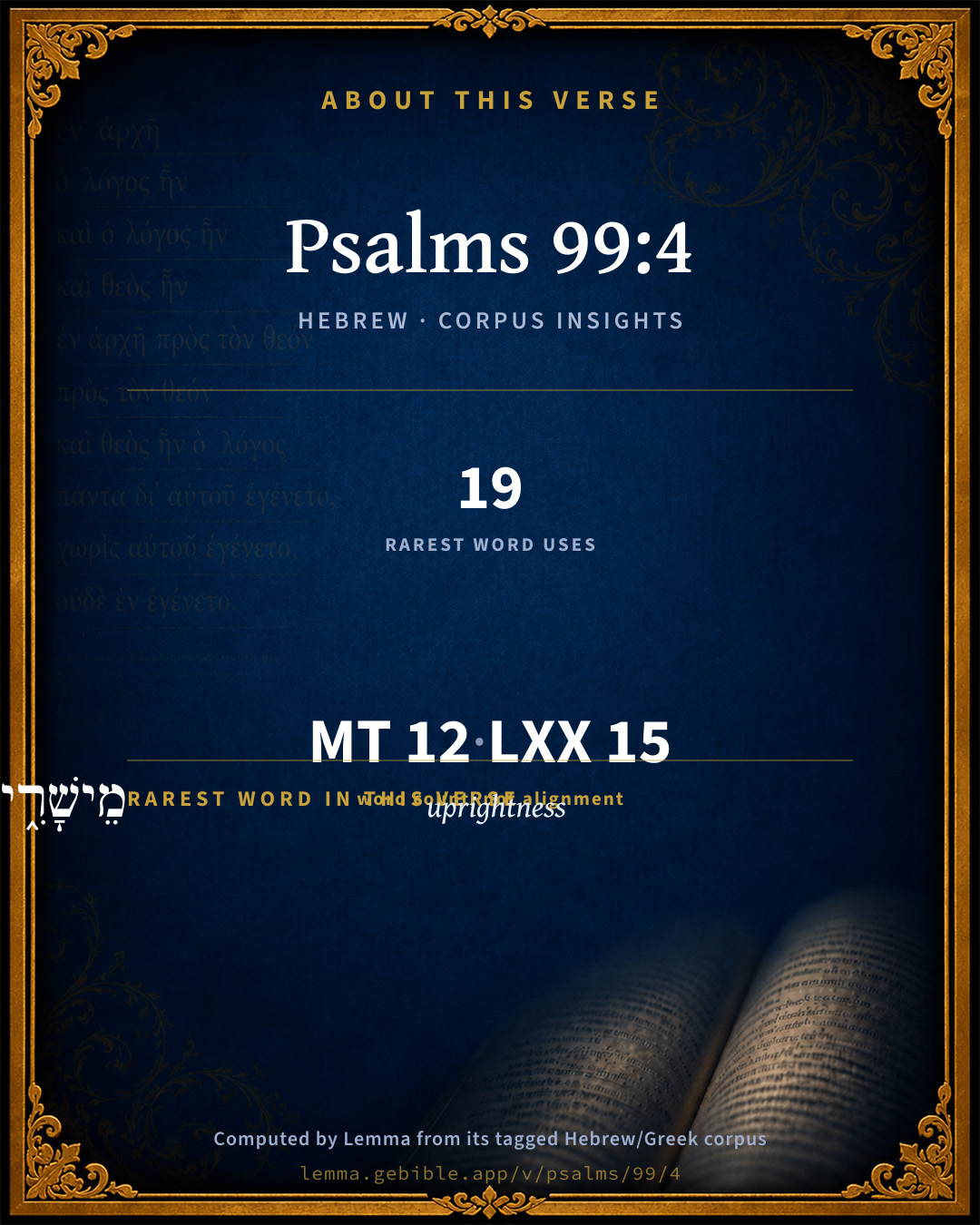
The rarest word here is מֵישָׁרִ֑ים uprightness H4339 — appearing just 19 times in the whole Hebrew Bible.

Shared distinctive vocabulary

מֵישָׁרִ֑ים uprightness H4339 occurs in 19 verses of the Hebrew Bible. Also found in:

Grammatical profile

  • 3 verbs
  • 7 nouns
  • 2 pronouns

Verb forms

  • אָ֫הֵ֥ב Qal · Perfect
  • כּוֹנַ֣נְתָּ Polel · Perfect
  • עָשִֽׂיתָ Qal · Perfect

Repetition

Words recur within this verse — often emphatic in Hebrew:

  • מִשְׁפָּ֪ט judgment H4941 ×2
  • אַ֭תָּה you H859 ×2

Hebrew & Septuagint length

In English translation the verse runs 17 words from the Hebrew and 18 from the Septuagint (LXX English) — closely comparable.

A rough comparison of the two English renderings, which tokenize alike — not a word-level alignment.

Word counts can differ between the Hebrew and the Greek without any difference in meaning — e.g. the Hebrew direct-object marker אֵת has no separate Greek word, and Greek often adds the article ὁ.

In the original languages it is 12 Hebrew tokens and 15 Greek tokens — but the two are counted differently (Hebrew bundles its prefixes and suffixes into one token; the Greek is in lemma form), so that isn’t a like-for-like length.

Cross-references

17

Topical passages linked to Psalms 99:4 in the Treasury of Scripture Knowledge — connected by theme and wording, ordered by reader-vote popularity; previews shown in the World English Bible.

  • Psalms 11:7 For Yahweh is righteous. He loves righteousness. The upright shall see his face.
  • Job 36:5–7 "Behold, God is mighty, and doesn't despise anyone. He is mighty in strength of understanding.
  • Jeremiah 23:5 Behold, the days come, says Yahweh, that I will raise to David a righteous Branch, and he shall reign as king and deal wisely, and shall execute justice and righteousness in the land.
  • Psalms 45:6–7 Your throne, God, is forever and ever. A scepter of equity is the scepter of your kingdom.
  • Deuteronomy 32:3–4 For I will proclaim the name of Yahweh: Ascribe greatness to our God.
  • Isaiah 11:3–5 His delight shall be in the fear of Yahweh; and he shall not judge after the sight of his eyes, neither decide after the hearing of his ears;
  • Revelation 19:16 He has on his garment and on his thigh a name written, "KING OF KINGS, AND LORD OF LORDS."
  • Deuteronomy 10:18 He does execute justice for the fatherless and widow, and loves the foreigner, in giving him food and clothing.
  • 2 Samuel 23:3–4 The God of Israel said, The Rock of Israel spoke to me: One who rules over men righteously, Who rules in the fear of God,
  • Job 37:23 We can't reach the Almighty, He is exalted in power; In justice and great righteousness he will not oppress.
  • Psalms 72:1–2 God, give the king your justice; Your righteousness to the royal son.
  • Isaiah 9:7 Of the increase of his government and of peace there shall be no end, on the throne of David, and on his kingdom, to establish it, and to uphold it with justice and with righteousness from henceforth even forever. The zeal of Yahweh of Hosts will perform this.
  • Psalms 98:9 Let them sing before Yahweh, For he comes to judge the earth. He will judge the world with righteousness, And the peoples with equity.
  • Isaiah 42:4 He will not fail nor be discouraged, until he have set justice in the earth; and the isles shall wait for his law.
  • Isaiah 61:11 For as the earth brings forth its bud, and as the garden causes the things that are sown in it to spring forth; so the Lord Yahweh will cause righteousness and praise to spring forth before all the nations.
  • Jude 1:15 to execute judgment on all, and to convict all the ungodly of all their works of ungodliness which they have done in an ungodly way, and of all the hard things which ungodly sinners have spoken against him."
  • Revelation 19:11 I saw the heaven opened, and behold, a white horse, and he who sat on it is called Faithful and True. In righteousness he judges and makes war.

Cross-references courtesy of OpenBible.info (CC BY 4.0).

Hebrew and Greek witnesses Masoretic Hebrew ↔ Greek Septuagint

The same verse in the two great witnesses to the Old Testament, shown verse-for-verse.

You’re reading Greek Psalm 98 (Hebrew Psalm 99). The Septuagint counts the superscription, so verse numbers can differ from the Hebrew — chapter-level alignment, not verse-by-verse. Numbering follows Rahlfs.

These are two independent witnesses, not word-aligned to each other, and the Septuagint is shown in lemma (dictionary) form.

Hebrew Psalms 99:4 Masoretic · Westminster Leningrad Codex

וְעֹ֥ז מֶלֶךְ֮ מִשְׁפָּ֪ט אָ֫הֵ֥ב אַ֭תָּה כּוֹנַ֣נְתָּ מֵישָׁרִ֑ים מִשְׁפָּ֥ט וּ֝צְדָקָ֗ה בְּיַעֲקֹ֤ב אַתָּ֬ה עָשִֽׂיתָ

The King's strength also loves justice. You do establish equity. You execute justice and righteousness in Jacob.

World English Bible · Public Domain

Greek LXX Greek Psalm 98:4 Septuagint · lemma form

καί τιμή βασιλεύς κρίσις ἀγαπάω σύ ἑτοιμάζω εὐθύτης κρίσις καί δικαιοσύνη ἐν ἰακώβ σύ ποιέω

And the king's honor loves judgment; you have prepared equity, you have wrought judgment and justice in Jacob.

LXX2012 (modern English Septuagint) · Public Domain

On this verse, Albert Barnes' Notes on the Bible discusses the Septuagint’s reading. Read the note in Commentary ↓

Hebrew: Westminster Leningrad Codex (CC BY 4.0). Greek: Septuagint (public domain); English from LXX2012 (modern English Septuagint) (Public Domain). How the Septuagint differs from the Hebrew →

Commentary

Notes on Psalms 99:4 from classic Christian and Jewish commentators (each source and its license shown beneath its notes). The classic Christian expositions comment on the surrounding passage and are grouped to its opening verse, so a note may address several verses; the Jewish commentaries on the Tanakh (Rashi and others) are per-verse, so they appear only where the commentator wrote on this verse.

Lemma curates 59 commentaries, every one of them public domain or Creative Commons licensed, each selected and text-cleaned for this edition rather than reprinted as found. About our sources →

Trapp's Complete Commentary

John Trapp

Psa 99:4 The king’s strength also loveth judgment; thou dost establish equity, thou executest judgment and righteousness in Jacob.

Ver. 4. The king’s strength also loveth judgment] i.e. Abest a Tyrannide. God abuseth not his kingly power to tyranny, but joineth it with his justice and uprightness. Regiment without righteousness is but robbery with authority. The Arabic hath it, Magnificentia regis est, ut diligat aequitatem.

John Trapp, A Commentary or Exposition upon All the Books of the Old and New Testament (1647–1656) — public domain. Text from a community e-Sword module.

Joseph Benson's Commentary

Psa 99:4. The king’s strength also loveth judgment — “Although the strength of our king be infinite, yet is it never exerted but in righteousness and just judgment, which are his delight. They compose the firm basis of his throne, and direct his whole administration.” “Whoever peruses this Psalm,” says Dr. Dodd, “will find that David here, as everywhere else, considers God as the king of Israel, and himself only as his deputy. To this purpose are these expressions in the beginning of it, The Lord reigneth: The Lord is great in Zion. It is true David delighted to exert all the power that God had given him to its true purposes. He loved judgment and righteousness: but it was, in reality, God who executed them all.” Thou dost establish equity — God gave them the excellent laws by which they were governed, and acted toward them with equity in all his proceedings. Thou executest judgment in Jacob — Among thy own people, whom, when they act amiss, thou punishest no less than thou dost other people, (see Psa 99:8,) whereby thou showest that thou art no respecter of persons, but a righteous and impartial judge to all sorts of men. He intends also that God, not only by his immediate providences often executed and enforced his own laws, but that he took care for the administration of justice among them by civil magistrates, who reigned by him, and by him did decree justice. These judges judged for God, and their judgment was his, 2Ch 19:6.

Joseph Benson's Commentary on the Old and New Testaments (1811–1818) — public domain. Text from a community e-Sword module.

J. A. Alexander on Psalms

Joseph Addison Alexander

4. (Psa 99:4) And the king's strength loves judgment; thou hast established equity: judgment and justice in, Jacob thou hast done. Some continue the construction from the preceding sentence; they shall acknowledge thy name and the king's strength loving judgment. But as sentences of this length are unusual in Hebrew, and is not elsewhere a participle or verbal adjective, the best construction is the old one, which makes this an independent proposition. The meaning of the first clause seems to be, that God's power is controlled in its exercise by his love of justice. To establish equity is to give it permanence by a habitually pure administration of justice. The terms of the last clause are the same by which the history describes the judicial fidelity of David, 2Sa 8:15, as if to indicate that it was a mere type of God's more perfect and infallible administration of impartial justice.

Joseph Addison Alexander, The Psalms Translated and Explained (1850) — public domain. Text from a community e-Sword module.

Tyndale Open Study Notes

Tyndale Open Resources

99:4 The qualities of the Lord’s rule include strength, justice, love, fairness, and righteousness (see 93:4; 97:2, 6-7, 12; 98:2-3, 9; 138:6).

Tyndale Open Study Notes — © Tyndale Open Resources, licensed CC BY-SA 4.0. Text via the HelloAO Bible API.

Adam Clarke's Commentary

Verse 4. The king's strength] If this Psalm were written by David, he must mean by it that he was God's vicegerent or deputy, and that, even as king, God was his strength, and the pattern according to which equity, judgment, and righteousness should be executed in Jacob.

Adam Clarke's Commentary on the Bible (1810–1826) — public domain. Text from a community e-Sword/MySword module.

John Calvin's Commentaries

4 The king’s strength also loves judgment This may be viewed as a threatening designed to fill his enemies with dismay; as if he should say, such is God’s regard for righteousness and equity, that he hath clothed himself with power to avenge the injuries which his enemies have done to him. I think it preferable, however, to apply it to the Church, because she is under the government of God for the express purpose of practicing righteousness and holiness. There is another interpretation which is by no means objectionable, namely, that which does not associate ideas of tyranny with the government of God, because there is constant concord between his power and justice. But when I consider the whole context, I have no doubt, that the prophet, after having introduced God as established upon his royal throne, now speaks of the manner in which he governs his kingdom; for he adds, thou hast established equity and righteousness. This clause is susceptible of two interpretations; either that God in his law has commanded his people to practice perfect equity, or that, in supporting and defending them, he has uniformly testified his great regard for his justice and equity. It is most true that the highest equity has always characterized the works and judgments of God, yet it appears more probable that it refers to that system, that form of government which God, who loves justice, appointed among the people of Israel, and which was the best rule for leading a life of honesty and integrity. And hence the word to do is improperly taken to signify to order or command. Should any one choose to consider this last clause as relating to God’s government, I am by no means disposed to disagree with him. For there is nothing that more animates and encourages the faithful to render obedience to God, or inspires them with greater zeal to observe his law, than to find in this course of action that they are the objects of his paternal care, and that the righteousness, which he requires from his own people in words, is on his part reciprocated by kind deeds.

John Calvin's Commentaries (1540-1563) — public domain. Text from the Calvin Translation Society English edition (1840s-50s) via the Christian Classics Ethereal Library (ccel.org). Calvin's coverage is partial (roughly two-thirds of the Bible); uncommented books and verses are honest gaps, never fabricated. The 19th-century editor's footnotes and remarks are omitted so the notes are faithfully Calvin's own voice.

The Cambridge Bible for Schools and Colleges

gen. ed. J. J. S. Perowne

4. The king’s strength also loveth judgment] The construction of this clause is doubtful, but this is the simplest way of taking it. The objection that strength cannot properly be said to love is prosaic. The rendering, And the strength of a king who loveth judgement hast thou established in equity, is possible but cumbrous. The king is Jehovah Himself (cp. Isa_61:8). Thou is emphatic: it is He Himself Who has established a kingdom of righteousness, fulfilling the ideal of the Davidic kingdom (Isa_16:5): and by the recent deliverance of Israel He has given proof of its character.

4, 5. The righteous character of Jehovah’s kingdom.

The Cambridge Bible for Schools and Colleges (gen. ed. J. J. S. Perowne; Cambridge University Press, 1878–1918) — public domain. Text from a community e-Sword module.

John Gill's Exposition

The King's strength also loveth judgment,.... Or he who is a strong and mighty King, as Christ is; which appears by saving his people, and preserving them to his kingdom and glory, and by destroying all his and their enemies; but, though he is so potent and victorious a Prince, yet no tyrannical one, he loves and does what is just and righteous; he loved the righteous law of God, and obeyed it in the whole course of his life; he wrought out a perfect righteousness for his people, and encourages and loves righteousness in them; he will judge the world in righteousness hereafter; and is now on his throne, and in his kingdom, ordering it with judgment and justice; all the administrations of his kingly office are just and true, and herein he delights:

thou dost establish equity, or "equities" (a); uprightnesses, righteousnesses; a perfect and a complete righteousness:

this he has prepared (b), as the word signifies, by his obedience, sufferings, and death, and has established as an everlasting one; moreover, equity, righteousness, and justice, are the settled rules and laws of his government; see Isa 9:7,

thou executest judgment and righteousness in Jacob; among the true Israel and people of God, as David his type did, Sa2 8:15, thereby keeping them in due order, in the observance of his righteous judgments and statutes, and defending them from their enemies.

(a) "rectitudines", Montanus, Gejerus, Michaelis; "aequitates", Vatablus; "recta", Musculus. (b) "parasti", Pagninus, Montanus, Vatablus, Gejerus; "praeparasti", Tigure version.

John Gill's Exposition of the Whole Bible (1746–1763) — public domain (CC PDM 1.0). Text via the HelloAO Bible API.

Albert Barnes' Notes on the Bible

The king’s strength - The word king here undoubtedly refers to God as a king, Psa 99:1. The word rendered “strength,” means power, force; and the reference here is to what constitutes the main strength or power of his character and government. It is rendered in the Septuagint, τιμή timē - “honor.” So in the Latin Vulgate - ”honor.” DeWette renders it, “The praise of the king who loves judgment.” So Rosenmuller, “Let them praise the strength - the power - of the king who loves judgment.” But perhaps our common version best expresses the sense, that whatever there is in the character of the “king,” that is God, which constitutes strength, or gives power to his administration, is favorable to justice, or will be exerted in the cause of right. God’s essential character; all the acts of his power; all the demonstrations of his authority, will be in favor of justice, and may be relied on as sustaining the righteous cause. It is not the “mere” exertion of power - it is power that is always exercised in favor of right; and this lays the foundation of praise. We could not praise a being of “mere” power, or one who was merely “almighty,” without respect to his moral character. It is only when the character is such that power will be exerted in favor of that which is right and just that it becomes the proper subject of praise.

Loveth judgment - Is always on the side of justice and right. He so loves justice that his power will be put forth only in behalf of that which is right. God shows this by his law, and by all the acts of his administration.

Thou dost establish equity - That which is equal and just; alike by thy law, and by thine interpositions. All that thou doest, and all that thou dost appoint, is in favor of that which is equal and just.

Thou executest judgment and righteousness in Jacob - That which is just; that which ought to be done. Thou doest this among thy people; thou doest it in their relation to the surrounding nations. All the acts of thy administration tend to the establishment of that which is right.

Albert Barnes' Notes on the Bible (1834–1885) — public domain. Text from a community e-Sword/MySword module.

Matthew Poole's English Annotations

The King’s strength also loveth judgment; though his dominion be absolute and uncontrollable, and his power irresistible, yet he doth not abuse it to tyranny and oppression, as the princes of the world commonly do, but tempers and manageth it with righteousness; and not only doth judge justly, but, which is more, loves to do so. The King’s strength is by a known Hebraism put for the strong or powerful King.

Establish equity, to wit, in all thy proceedings. Equity is thy constant and stable course. In Jacob; amongst thine own people; who, when they do amiss, he punisheth no less than other people, as he notes below, Psa 99:8, whereby he showeth that he is no respecter of persons, but a righteous and impartial Judge to all sorts of men.

Matthew Poole's English Annotations on the Holy Bible (1683–1685) — public domain. Text from a community e-Sword/MySword module.

The Treasury of David

Charles H. Spurgeon

Ver. 4. The king's strength also loveth judgment. God is the king, the mercy-seat is his throne, and the sceptre which he sways is holy like himself. His power never exerts itself tyrannically; he is a sovereign, and he is absolute in his government, but his might delights in right, his force is used for just purposes only. Men in these days are continually arranging the Lord's government, and setting up to judge whether he does right or not; but saintly men in the olden time were of another mind, they were sure that what the Lord did was just, and instead of calling him to account they humbly submitted themselves to his will, rejoicing in the firm persuasion that with his whole omnipotence God was pledged to promote righteousness, and work justice among all his creatures.

Thou dost establish equity. Not a court of equity merely, but equity itself thou dost set up, and that not for a time or upon an occasion, but as an established institution, stable as thy throne. Not even for the sake of mercy does the Lord remove or injure the equity of his moral government: both in providence and in grace he is careful to conserve the immaculate purity of his justice. Most kingdoms have an establishment of some kind, and generally it is inequitable; here we have an establishment which is equity itself. The Lord our God demolishes every system of injustice, and right alone is made to stand.

Thou executest judgment and righteousness in Jacob. Justice is not merely established, but executed in God's kingdom; the laws are carried out, the executive is as righteous as the legislative. Herein let all the oppressed, yea, and all who love that which is right, find large occasion for praise. Other nations under their despots were the victims and the perpetrators of grievous wrong, but when the tribes were faithful to the Lord they enjoyed an upright government within their own borders, and acted with integrity towards their neighbours. That kingcraft which delights in cunning, favouritism, and brute force is as opposite to the divine Kingship as darkness to light. The palace of Jehovah is no robber's fortress nor despot's castle, built on dungeons, with stones carved by slaves, and cemented with the blood of toiling serfs. The annals of most human governments have been written in the tears of the downtrodden, and the curses of the oppressed: the chronicles of the Lord's kingdom are of another sort, truth shines in each line, goodness in every syllable, and justice in every letter. Glory be to the name of the King, whose gentle glory beams from between the cherubic wings.

Ver. 4. The king's strength. They will remember his strength with joy, because he loveth judgment, and there is no reason, therefore, to be afraid of him in consequence of his great strength, so long as they continue to walk in the good way. George Phillips.

Ver. 4-5. Our King loveth righteousness:he will execute perfect justice, tempered with perfect mercy. He will judge every man according to his works, summing up and completing the unnoticed righteousness of his providence by an open manifestation to the universe of his holiness and equity. "We believe that he will come to be our judge, "therefore let us magnify and exalt him with our lips and hearts; and let us fall down and worship the man Christ Jesus, who took our nature, even his manhood, from the earth, which is his footstool, into the eternity of the Godhead, in which he is equal to the Father. As heaven, which is the throne of God, and earth, which is his footstool, form one universe, so is God and man one Christ, the everlasting Lord, "holy and true, "in whom we sinners may appeal from the throne of eternal justice to the footstool of eternal mercy. "Plain Commentary."

Ver. 4.

1. Trace the process of the working of right principles through three stagesLove, Establishment, Execution.

2. Illustrate from God's character and action.

3. Apply to national, and to daily, life. C. D.

Psalms 99:5*

Charles H. Spurgeon's The Treasury of David (1869–1885) — public domain. Psalms only. Text from a community e-Sword/MySword module.

Whedon's Commentary on the Bible

Daniel D. Whedon

4. The king’s strength also loveth judgment— “The meaning seems to be, that God’s power is controlled in its exercise by his love of justice.”— Alexander. But who is the “king?” The most natural construction would refer it to David, (or Solomon,) whose administration is regarded as the type and expression of the true theocracy. The language conforms to the description given of David’s reign, (2Sa_8:15,) “And David reigned over all Israel; and David executed judgment and justice unto all his people.” Also David’s charge to Solomon, (2Sa_23:3,) “He that ruleth over men must be just, ruling in the fear of God.” The next sentence is an address to Jehovah:

Thou dost establish equity—That is, a government thus conformed to thine, and of thine appointment, thou wilt render firm and effective against all hostility.

In Jacob—An enlargement of “in Zion,” (Psa_99:2,) but prophetically the true Church. And so, from the ground idea found in the history of David’s throne, above given, we must advance to the conception of Messiah’s kingdom. The verbs in the last clause are in the preterit, but equally apply to the future kingdom of Messiah, because they affirm what God has always done, and hence what is abstractly fit that he should always do.

Daniel D. Whedon (gen. ed.), Commentary on the Old and New Testaments (1874–1909) — public domain. Text from a community e-Sword module.

The Pulpit Commentary

The King"s strength also loveth judgment. "The king" is here the Lord, Jehovah. (see Psa_98:3) His "strength," or might, "loves," and is always combined with, right. (comp. Isa_61:8, "I the Lord love judgment Thou dost establish equity. The pronoun is emphatic: "Thou, even thou nearly equivalent to "thou only establish equity." Thou again emphatic even thouexecutest judgment and righteousness in Jacob; i.e. governest thy people Israel with strict and absolute justice.

The Pulpit Commentary (1880–1919), ed. H.D.M. Spence-Jones & Joseph S. Exell — public domain. Text from a community e-Sword module.

John Wesley's Explanatory Notes

Judgment - Though his dominion be absolute, and his power irresistible, yet he manages it with righteousness. The king's strength is by a known Hebraism put for the strong, or powerful king. Equity - In all thy proceedings.

John Wesley, Explanatory Notes Upon the Whole Bible (1754–1765) — public domain. Text via the GEBible commentary corpus.

Keil & Delitzsch

C. F. Keil & F. Delitzsch

The second Sanctus celebrates Jahve with respect to His continuous righteous rule in Israel. The majority of expositors construe it: "And (they shall praise) the might of the king, who loves right;" but this joining of the clause on to יודוּ over the refrain that stands in the way is hazardous. Neither can ועז מלך משׁפּט אהב, however, be an independent clause, since אהב cannot be said of עז, but only of its possessor. And the dividing of the verse at אהב, adopted by the lxx, will therefore not hold good. משפט אהב is an attributive clause to מלך in the same position as in Psa 11:7; and עז, with what appertains to it, is the object to כּוננתּ placed first, which has the king's throne as its object elsewhere (Psa 9:8, Sa2 7:13; Ch1 17:12), just as it here has the might of the king, which, however, here at the same time in מישׁרים takes another and permutative object (cf. the permutative subject in Psa 72:17), as Hitzig observes; or rather, since מישׁרים is most generally used as an adverbial notion, this מישׁרים (Psa 58:2; Psa 75:3; Psa 9:9, and frequently), usually as a definition of the mode of the judging and reigning, is subordinated: and the might of a king who loves the right, i.e., of one who governs not according to dynastic caprice but moral precepts, hast Thou established in spirit and aim (directed to righteousness and equity). What is meant is the theocratic kingship, and Psa 11:4 says what Jahve has constantly accomplished by means of this kingship: He has thus maintained right and righteousness (cf. e.g., Sa2 8:15; Ch1 18:14; Kg1 10:9; Isa 16:5) among His people. Out of this manifestation of God's righteousness, which is more conspicuous, and can be better estimated, within the nation of the history of redemption than elsewhere, grows the call to highly exalt Jahve the God of Israel, and to bow one's self very low at His footstool. להדם רגליו, as in Psa 132:7, is not a statement of the object (for Isa 45:14 is of another kind), but (like אל in other instances) of the place in which, or of the direction (cf. Psa 7:14) in which the προσκύνησις is to take place. The temple is called Jahve's footstool (Ch1 28:2, cf. Lam 2:1; Isa 60:13) with reference to the ark, the capporeth of which corresponds to the transparent sapphire (Exo 24:10) and to the crystal-like firmament of the mercaba (Eze 1:22, cf. Ch1 28:18).

Keil & Delitzsch — Biblical Commentary on the Old Testament (1861–1891) — public domain (CC PDM 1.0). Text via the HelloAO Bible API. (Old Testament only.)

unfoldingWord translationNotes

Door43 World Missions Community

he loves justice

The abstract noun "justice" can be translated using the phrase "what is just." AT: "he loves doing what is just" (See: Abstract Nouns)

You have established fairness

The abstract noun "fairness" is a metonym for the laws that are fair. AT: "The laws you have established are fair" (See: Abstract Nouns and Metonymy)

worship at his footstool

Here the word "footstool" likely refers to the ark of the covenant, which the biblical writers often spoke of as if it were Yahweh's footstool upon which he rested his feet as he sat on his throne in heaven above. The translation can make explicit that the people are to worship Yahweh. AT: "worship Yahweh at his footstool" or "worship Yahweh before his throne in the temple" (See: Assumed Knowledge and Implicit Information)

translationWords

king

love

just

create

Jacob

God

worship

footstool

unfoldingWord translationNotes — © Distant Shores Media and the Door43 World Missions Community, licensed CC BY-SA 4.0. Source: git.door43.org/Door43/en_tn.

Rashi

Rabbi Shlomo Yitzchaki (Rashi)

and the might of the King Who loves judgment This refers back to the preceding verse.

You founded equity You founded compromise and peacemaking between persons, by Your statement (Exod. 23:5): “Should you see your enemy’s donkey lying etc.”; (ibid. verse 4), “Should you come upon Your enemy’s ox, etc.” Now who is it who sees his enemy being kind to him, whose heart will not be inspired to embrace him and kiss him? (Tanchuma).

Rashi on the Tanakh — English translations: “The Judaica Press complete Tanach with Rashi, translated by A. J. Rosenberg” (CC BY 4.0); “Pentateuch with Rashi's commentary by M. Rosenbaum and A.M. Silbermann, 1929-1934” (public domain); “The Metsudah Tanach series, Lakewood, N.J” (CC BY 4.0); and “The Book of Joshua, Metsudah Publications, 1997” (CC BY 4.0). Text via Sefaria.

Lesson kit

Teaching starters — assembled from the data on this page, not authored interpretation. Every prompt links to the verse data it draws on. Edit before teaching.

Psalms, in the Wisdom, opens this verse with 12 words (10 distinct Hebrew lemmas). Its most distinctive word is mêyshâr (“uprightness”). A historical commentator’s framing appears above. Read the whole chapter for the surrounding context.

Discussion questions

  1. What does “uprightness” (mêyshâr) contribute to the verse as a whole?
  2. 1 Chronicles 29:17 shares the word «uprightness» with this verse. How do the two illuminate each other?
  3. “judgment” occurs 2× in this one verse. What is the effect of the repetition?
  4. The translations on this page render this verse differently — a whole-verse word diff, not a word-by-word alignment. What might account for the different wordings?
  5. The verb «אָ֫הֵ֥ב» is Qal Perfect. How does its form color the action?
  6. Reading how Trapp's Complete Commentary and Joseph Benson's Commentary read this verse, where do the two commentators agree and where do they part?

Things to notice

Reading settings

Reading text

Shown beneath each verse's original-language words.

Old Testament
Old Testament edition

Read the OT as the Masoretic Hebrew (MT) or the Greek Septuagint (LXX).

English shown for the Greek Septuagint (in the Hebrew ↔ Greek comparison).

Comparing translations? Open the Compare panel on any verse page to stack up to four side by side.