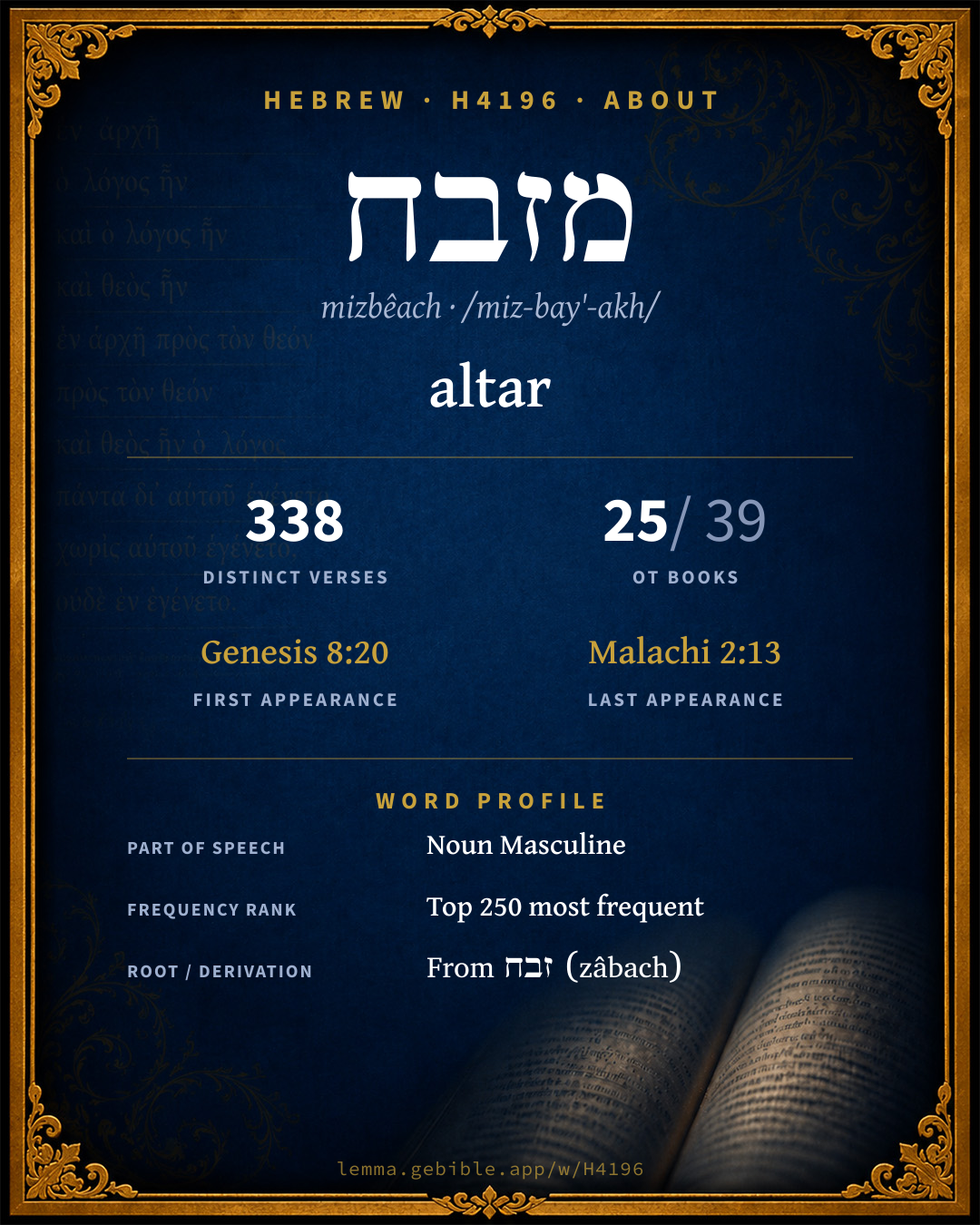
מִזְבֵּחַ
altar
Full lexicon entry — Brown-Driver-Briggs (BDB)
From Brown-Driver-Briggs (BDB)
Where this word appears
See every Absolute-state word in the Hebrew Bible →
Grammar key — what these labels mean
Part of speech
- Noun
- A naming word — a person, place, thing, or idea.
Noun type
- Common
- A common noun — a general class of person, place, or thing (“king,” “city,” “water”), not a specific name.
State
- Absolute
- The independent form of a noun, not bound to a following word.
- Construct
- A noun bound to a following noun in a possessive / “of” relationship (the construct chain).
Gender
- Masculine
- Grammatically masculine.
Number
- Singular
- One.
- Plural
- More than one (in Hebrew, generally three or more).
Grammatical forms
- Noun, Common, Masculine, Singular, Absolute 256 times (64%)
- Noun, Common, Masculine, Singular, Construct 93 times (23%)
- Noun, Common, Masculine, Plural, Absolute 28 times (7%)
- Noun, Common, Masculine, Plural, Construct 26 times (6%)
Parsed forms decoded from the imported morphology (morphhb / Westminster Leningrad Codex — WLC text public domain, morphhb tagging CC BY 4.0), counted across 403 parsed occurrences — not distinct verses.
Page 1 of 2 — showing verses 1–200 of 338 distinct verses where H4196 appears, across 25 books. Click any verse to open its interlinear word-by-word view. Verse text shown in the World English Bible for context — . Each verse’s Hebrew form is shown with its reference; the English is not keyword-highlighted, since the data carries no word-level English alignment. Use “Compare translations” on any verse to read it across multiple English versions. This concordance covers the Hebrew Bible; Septuagint (Greek Old Testament) occurrences are not indexed here.
Genesis 11 verses
- Genesis 8:20 מִזְבֵּ֖חַ בַּ/מִּזְבֵּֽחַ n c ms prep det + n c ms Noah built an altar to Yahweh, and took of every clean animal, and of every clean bird, and offered burnt offerings on the altar.
- Genesis 12:7 מִזְבֵּ֔חַ n c ms Yahweh appeared to Abram, and said, "I will give this land to your seed." He built an altar there to Yahweh, who appeared to him.
- Genesis 12:8 מִזְבֵּ֨חַ֙ n c ms He left from there to the mountain on the east of Bethel, and pitched his tent, having Bethel on the west, and Ai on the east. There he built an altar to Yahweh, and called on the name of Yahweh.
- Genesis 13:4 הַ/מִּזְבֵּ֔חַ ptcl def.art + n c ms to the place of the altar, which he had made there at the first. There Abram called on the name of Yahweh.
- Genesis 13:18 מִזְבֵּ֖חַ n c ms Abram moved his tent, and came and lived by the oaks of Mamre, which are in Hebron, and built an altar there to Yahweh.
- Genesis 22:9 הַ/מִּזְבֵּ֔חַ הַ/מִּזְבֵּ֔חַ ptcl def.art + n c ms ptcl def.art + n c ms They came to the place which God had told him of. Abraham built the altar there, and laid the wood in order, bound Isaac his son, and laid him on the altar, on the wood.
- Genesis 26:25 מִזְבֵּ֗חַ n c ms He built an altar there, and called on the name of Yahweh, and pitched his tent there. There Isaac's servants dug a well.
- Genesis 33:20 מִזְבֵּ֑חַ n c ms He erected an altar there, and called it El Elohe Israel.
- Genesis 35:1 מִזְבֵּ֔חַ n c ms God said to Jacob, "Arise, go up to Bethel, and live there. Make there an altar to God, who appeared to you when you fled from the face of Esau your brother."
- Genesis 35:3 מִזְבֵּ֗חַ n c ms Let us arise, and go up to Bethel. I will make there an altar to God, who answered me in the day of my distress, and was with me in the way which I went."
- Genesis 35:7 מִזְבֵּ֔חַ n c ms He built an altar there, and called the place El Beth El; because there God was revealed to him, when he fled from the face of his brother.
Exodus 51 verses
- Exodus 17:15 מִזְבֵּ֑חַ n c ms Moses built an altar, and called the name of it Yahweh our Banner.
- Exodus 20:24 מִזְבַּ֣ח n c ms cs You shall make an altar of earth for me, and shall sacrifice on it your burnt offerings and your peace-offerings, your sheep and your oxen. In every place where I record my name I will come to you and I will bless you.
- Exodus 20:25 מִזְבַּ֤ח n c ms cs If you make me an altar of stone, you shall not build it of hewn stones; for if you lift up your tool on it, you have polluted it.
- Exodus 20:26 מִזְבְּחִ֑/י n c ms cs + sfx pers 1cs Neither shall you go up by steps to my altar, that your nakedness may not be exposed to it.'
- Exodus 21:14 מִזְבְּחִ֔/י n c ms cs + sfx pers 1cs If a man schemes and comes presumptuously on his neighbor to kill him, you shall take him from my altar, that he may die.
- Exodus 24:4 מִזְבֵּ֖חַ n c ms Moses wrote all the words of Yahweh, and rose up early in the morning, and built an altar under the mountain, and twelve pillars for the twelve tribes of Israel.
- Exodus 24:6 הַ/מִּזְבֵּֽחַ ptcl def.art + n c ms Moses took half of the blood and put it in basins, and half of the blood he sprinkled on the altar.
- Exodus 27:1 הַ/מִּזְבֵּ֖חַ הַ/מִּזְבֵּ֔חַ ptcl def.art + n c ms ptcl def.art + n c ms "You shall make the altar of acacia wood, five cubits long, and five cubits broad; the altar shall be foursquare: and its height shall be three cubits.
- Exodus 27:5 הַ/מִּזְבֵּ֖חַ הַ/מִּזְבֵּֽחַ ptcl def.art + n c ms ptcl def.art + n c ms You shall put it under the ledge around the altar beneath, that the net may reach halfway up the altar.
- Exodus 27:6 לַ/מִּזְבֵּ֔חַ prep det + n c ms You shall make poles for the altar, poles of acacia wood, and overlay them with brass.
- Exodus 27:7 הַ/מִּזְבֵּ֖חַ ptcl def.art + n c ms Its poles shall be put into the rings, and the poles shall be on the two sides of the altar, when carrying it.
- Exodus 28:43 הַ/מִּזְבֵּ֨חַ֙ ptcl def.art + n c ms They shall be on Aaron, and on his sons, when they go in to the tent of meeting, or when they come near to the altar to minister in the holy place; that they don't bear iniquity, and die: it shall be a statute forever to him and to his descendants after him.
- Exodus 29:12 הַ/מִּזְבֵּ֖חַ הַ/מִּזְבֵּֽחַ ptcl def.art + n c ms ptcl def.art + n c ms You shall take of the blood of the bull, and put it on the horns of the altar with your finger; and you shall pour out all the blood at the base of the altar.
- Exodus 29:13 הַ/מִּזְבֵּֽחָ/ה ptcl def.art + n c ms + sfx dem You shall take all the fat that covers the innards, the cover of the liver, the two kidneys, and the fat that is on them, and burn them on the altar.
- Exodus 29:16 הַ/מִּזְבֵּ֖חַ ptcl def.art + n c ms You shall kill the ram, and you shall take its blood, and sprinkle it around on the altar.
- Exodus 29:18 הַ/מִּזְבֵּ֔חָ/ה ptcl def.art + n c ms + sfx dem You shall burn the whole ram on the altar: it is a burnt offering to Yahweh; it is a sweet savor, an offering made by fire to Yahweh.
- Exodus 29:20 הַ/מִּזְבֵּ֖חַ ptcl def.art + n c ms Then you shall kill the ram, and take some of its blood, and put it on the tip of the right ear of Aaron, and on the tip of the right ear of his sons, and on the thumb of their right hand, and on the big toe of their right foot, and sprinkle the blood on the altar round about.
- Exodus 29:21 הַ/מִּזְבֵּחַ֮ ptcl def.art + n c ms You shall take of the blood that is on the altar, and of the anointing oil, and sprinkle it on Aaron, and on his garments, and on his sons, and on the garments of his sons with him: and he shall be made holy, and his garments, and his sons, and his sons' garments with him.
- Exodus 29:25 הַ/מִּזְבֵּ֖חָ/ה ptcl def.art + n c ms + sfx dem You shall take them from their hands, and burn them on the altar on the burnt offering, for a sweet savor before Yahweh: it is an offering made by fire to Yahweh.
- Exodus 29:36 הַ/מִּזְבֵּ֔חַ ptcl def.art + n c ms Every day shall you offer the bull of sin-offering for atonement: and you shall cleanse the altar, when you make atonement for it; and you shall anoint it, to sanctify it.
- Exodus 29:37 הַ/מִּזְבֵּ֔חַ הַ/מִּזְבֵּ֨חַ֙ בַּ/מִּזְבֵּ֖חַ ptcl def.art + n c ms ptcl def.art + n c ms prep det + n c ms Seven days you shall make atonement for the altar, and sanctify it: and the altar shall be most holy; whatever touches the altar shall be holy.
- Exodus 29:38 הַ/מִּזְבֵּ֑חַ ptcl def.art + n c ms "Now this is that which you shall offer on the altar: two lambs a year old day by day continually.
- Exodus 29:44 הַ/מִּזְבֵּ֑חַ ptcl def.art + n c ms I will sanctify the tent of meeting and the altar: Aaron also and his sons I will sanctify, to minister to me in the priest's office.
- Exodus 30:1 מִזְבֵּ֖חַ n c ms "You shall make an altar to burn incense on. You shall make it of acacia wood.
- Exodus 30:18 הַ/מִּזְבֵּ֔חַ ptcl def.art + n c ms "You shall also make a basin of brass, and the base of it of brass, in which to wash. You shall put it between the tent of meeting and the altar, and you shall put water in it.
- Exodus 30:20 הַ/מִּזְבֵּ֨חַ֙ ptcl def.art + n c ms When they go into the tent of meeting, they shall wash with water, that they not die; or when they come near to the altar to minister, to burn an offering made by fire to Yahweh.
- Exodus 30:27 מִזְבַּ֥ח n c ms cs the table and all its articles, the lampstand and its accessories, the altar of incense,
- Exodus 30:28 מִזְבַּ֥ח n c ms cs the altar of burnt offering with all its utensils, and the basin with its base.
- Exodus 31:8 מִזְבַּ֥ח n c ms cs the table and its vessels, the pure lampstand with all its vessels, the altar of incense,
- Exodus 31:9 מִזְבַּ֥ח n c ms cs the altar of burnt offering with all its vessels, the basin and its base,
- Exodus 32:5 מִזְבֵּ֖חַ n c ms When Aaron saw this, he built an altar before it; and Aaron made a proclamation, and said, "Tomorrow shall be a feast to Yahweh."
- Exodus 34:13 מִזְבְּחֹתָ/ם֙ n c mp cs + sfx pers 3mp but you shall break down their altars, and dash in pieces their pillars, and you shall cut down their Asherim;
- Exodus 35:15 מִזְבַּ֤ח n c ms cs and the altar of incense with its poles, the anointing oil, the sweet incense, the screen for the door, at the door of the tent;
- Exodus 35:16 מִזְבַּ֣ח n c ms cs the altar of burnt offering, with its grating of brass, it poles, and all its vessels, the basin and its base;
- Exodus 37:25 מִזְבַּ֥ח n c ms cs He made the altar of incense of acacia wood. It was square: its length was a cubit, and its breadth a cubit. Its height was two cubits. Its horns were of one piece with it.
- Exodus 38:1 מִזְבַּ֥ח n c ms cs He made the altar of burnt offering of acacia wood. It was square. Its length was five cubits, its breadth was five cubits, and its height was three cubits.
- Exodus 38:3 הַ/מִּזְבֵּ֗חַ ptcl def.art + n c ms He made all the vessels of the altar, the pots, the shovels, the basins, the flesh-hooks, and the fire pans. He made all its vessels of brass.
- Exodus 38:4 לַ/מִּזְבֵּ֨חַ֙ prep det + n c ms He made for the altar a grating of a network of brass, under the ledge around it beneath, reaching halfway up.
- Exodus 38:7 הַ/מִּזְבֵּ֔חַ ptcl def.art + n c ms He put the poles into the rings on the sides of the altar, with which to carry it. He made it hollow with planks.
- Exodus 38:30 מִזְבַּ֣ח הַ/מִּזְבֵּֽחַ n c ms cs ptcl def.art + n c ms With this he made the sockets to the door of the tent of meeting, the brazen altar, the brazen grating for it, all the vessels of the altar,
- Exodus 39:38 מִזְבַּ֣ח n c ms cs the golden altar, the anointing oil, the sweet incense, the screen for the door of the Tent,
- Exodus 39:39 מִזְבַּ֣ח n c ms cs the brazen altar, its grating of brass, its poles, all of its vessels, the basin and its base,
- Exodus 40:5 מִזְבַּ֤ח n c ms cs You shall set the golden altar for incense before the ark of the testimony, and put the screen of the door to the tent.
- Exodus 40:6 מִזְבַּ֣ח n c ms cs You shall set the altar of burnt offering before the door of the tent of the tent of meeting.
- Exodus 40:7 הַ/מִּזְבֵּ֑חַ ptcl def.art + n c ms You shall set the basin between the tent of meeting and the altar, and shall put water therein.
- Exodus 40:10 מִזְבַּ֥ח הַ/מִּזְבֵּ֔חַ הַ/מִּזְבֵּ֖חַ n c ms cs ptcl def.art + n c ms ptcl def.art + n c ms You shall anoint the altar of burnt offering, with all its vessels, and sanctify the altar: and the altar will be most holy.
- Exodus 40:26 מִזְבַּ֥ח n c ms cs He put the golden altar in the tent of meeting before the veil;
- Exodus 40:29 מִזְבַּ֣ח n c ms cs He set the altar of burnt offering at the door of the tent of the tent of meeting, and offered on it the burnt offering and the meal-offering, as Yahweh commanded Moses.
- Exodus 40:30 הַ/מִּזְבֵּ֑חַ ptcl def.art + n c ms He set the basin between the tent of meeting and the altar, and put water therein, with which to wash.
- Exodus 40:32 הַ/מִּזְבֵּ֖חַ ptcl def.art + n c ms When they went into the tent of meeting, and when they came near to the altar, they washed, as Yahweh commanded Moses.
- Exodus 40:33 וְ/לַ/מִּזְבֵּ֔חַ conj + prep det + n c ms He raised up the court around the tent and the altar, and set up the screen of the gate of the court. So Moses finished the work.
Leviticus 71 verses
- Leviticus 1:5 הַ/מִּזְבֵּ֨חַ֙ ptcl def.art + n c ms He shall kill the bull before Yahweh. Aaron's sons, the priests, shall present the blood and sprinkle the blood around on the altar that is at the door of the Tent of Meeting.
- Leviticus 1:7 הַ/מִּזְבֵּ֑חַ ptcl def.art + n c ms The sons of Aaron the priest shall put fire on the altar, and lay wood in order on the fire;
- Leviticus 1:8 הַ/מִּזְבֵּֽחַ ptcl def.art + n c ms and Aaron's sons, the priests, shall lay the pieces, the head, and the fat in order on the wood that is on the fire which is on the altar;
- Leviticus 1:9 הַ/מִּזְבֵּ֔חָ/ה ptcl def.art + n c ms + sfx dem but its innards and its legs he shall wash with water. The priest shall burn the whole on the altar, for a burnt offering, an offering made by fire, of a sweet savor to Yahweh.
- Leviticus 1:11 הַ/מִּזְבֵּ֛חַ הַ/מִּזְבֵּ֖חַ ptcl def.art + n c ms ptcl def.art + n c ms He shall kill it on the north side of the altar before Yahweh. Aaron's sons, the priests, shall sprinkle its blood around on the altar.
- Leviticus 1:12 הַ/מִּזְבֵּֽחַ ptcl def.art + n c ms He shall cut it into its pieces, with its head and its fat. The priest shall lay them in order on the wood that is on the fire which is on the altar,
- Leviticus 1:13 הַ/מִּזְבֵּ֔חָ/ה ptcl def.art + n c ms + sfx dem but the innards and the legs he shall wash with water. The priest shall offer the whole, and burn it on the altar. It is a burnt offering, an offering made by fire, of a sweet savor to Yahweh.
- Leviticus 1:15 הַ/מִּזְבֵּ֔חַ הַ/מִּזְבֵּ֑חָ/ה הַ/מִּזְבֵּֽחַ ptcl def.art + n c ms ptcl def.art + n c ms + sfx dem ptcl def.art + n c ms The priest shall bring it to the altar, and wring off its head, and burn it on the altar; and its blood shall be drained out on the side of the altar;
- Leviticus 1:16 הַ/מִּזְבֵּ֨חַ֙ ptcl def.art + n c ms and he shall take away its crop with its filth, and cast it beside the altar on the east part, in the place of the ashes.
- Leviticus 1:17 הַ/מִּזְבֵּ֔חָ/ה ptcl def.art + n c ms + sfx dem He shall tear it by its wings, but shall not divide it apart. The priest shall burn it on the altar, on the wood that is on the fire. It is a burnt offering, an offering made by fire, of a sweet savor to Yahweh.
- Leviticus 2:2 הַ/מִּזְבֵּ֔חָ/ה ptcl def.art + n c ms + sfx dem He shall bring it to Aaron's sons the priests; and he shall take his handful of its fine flour, and of its oil, with all its frankincense; and the priest shall burn the memorial of it on the altar, an offering made by fire, of a sweet savor to Yahweh.
- Leviticus 2:8 הַ/מִּזְבֵּֽחַ ptcl def.art + n c ms You shall bring the meal offering that is made of these things to Yahweh: and it shall be presented to the priest, and he shall bring it to the altar.
- Leviticus 2:9 הַ/מִּזְבֵּ֑חָ/ה ptcl def.art + n c ms + sfx dem The priest shall take from the meal offering its memorial, and shall burn it on the altar, an offering made by fire, of a sweet savor to Yahweh.
- Leviticus 2:12 הַ/מִּזְבֵּ֥חַ ptcl def.art + n c ms As an offering of firstfruits you shall offer them to Yahweh: but they shall not come up for a sweet savor on the altar.
- Leviticus 3:2 הַ/מִּזְבֵּ֖חַ ptcl def.art + n c ms He shall lay his hand on the head of his offering, and kill it at the door of the tent of meeting: and Aaron's sons the priests shall sprinkle the blood on the altar round about.
- Leviticus 3:5 הַ/מִּזְבֵּ֔חָ/ה ptcl def.art + n c ms + sfx dem Aaron's sons shall burn it on the altar on the burnt offering, which is on the wood that is on the fire: it is an offering made by fire, of a sweet savor to Yahweh.
- Leviticus 3:8 הַ/מִּזְבֵּ֖חַ ptcl def.art + n c ms and he shall lay his hand on the head of his offering, and kill it before the tent of meeting: and Aaron's sons shall sprinkle its blood on the altar round about.
- Leviticus 3:11 הַ/מִּזְבֵּ֑חָ/ה ptcl def.art + n c ms + sfx dem The priest shall burn it on the altar: it is the food of the offering made by fire to Yahweh.
- Leviticus 3:13 הַ/מִּזְבֵּ֖חַ ptcl def.art + n c ms and he shall lay his hand on its head, and kill it before the tent of meeting; and the sons of Aaron shall sprinkle its blood on the altar round about.
- Leviticus 3:16 הַ/מִּזְבֵּ֑חָ/ה ptcl def.art + n c ms + sfx dem The priest shall burn them on the altar: it is the food of the offering made by fire, for a sweet savor; all the fat is Yahweh's.
- Leviticus 4:7 מִזְבַּ֨ח מִזְבַּ֣ח n c ms cs n c ms cs The priest shall put some of the blood on the horns of the altar of sweet incense before Yahweh, which is in the tent of meeting; and he shall pour out all the blood of the bull out at the base of the altar of burnt offering, which is at the door of the Tent of Meeting.
- Leviticus 4:10 מִזְבַּ֥ח n c ms cs as it is taken off of the ox of the sacrifice of peace offerings. The priest shall burn them on the altar of burnt offering.
- Leviticus 4:18 הַ/מִּזְבֵּ֗חַ מִזְבַּ֣ח ptcl def.art + n c ms n c ms cs He shall put some of the blood on the horns of the altar which is before Yahweh, that is in the Tent of Meeting; and the rest of the blood he shall pour out at the base of the altar of burnt offering, which is at the door of the Tent of Meeting.
- Leviticus 4:19 הַ/מִּזְבֵּֽחָ/ה ptcl def.art + n c ms + sfx dem All its fat he shall take from it, and burn it on the altar.
- Leviticus 4:25 מִזְבַּ֣ח מִזְבַּ֥ח n c ms cs n c ms cs The priest shall take some of the blood of the sin offering with his finger, and put it on the horns of the altar of burnt offering. He shall pour out the rest of its blood at the base of the altar of burnt offering.
- Leviticus 4:26 הַ/מִּזְבֵּ֔חָ/ה ptcl def.art + n c ms + sfx dem All its fat he shall burn on the altar, like the fat of the sacrifice of peace offerings; and the priest shall make atonement for him concerning his sin, and he will be forgiven.
- Leviticus 4:30 מִזְבַּ֣ח הַ/מִּזְבֵּֽחַ n c ms cs ptcl def.art + n c ms The priest shall take some of its blood with his finger, and put it on the horns of the altar of burnt offering; and the rest of its blood he shall pour out at the base of the altar.
- Leviticus 4:31 הַ/מִּזְבֵּ֔חָ/ה ptcl def.art + n c ms + sfx dem All its fat he shall take away, like the fat is taken away from off of the sacrifice of peace offerings; and the priest shall burn it on the altar for a sweet savor to Yahweh; and the priest shall make atonement for him, and he will be forgiven.
- Leviticus 4:34 מִזְבַּ֣ח הַ/מִּזְבֵּֽחַ n c ms cs ptcl def.art + n c ms The priest shall take some of the blood of the sin offering with his finger, and put it on the horns of the altar of burnt offering; and all the rest of its blood he shall pour out at the base of the altar.
- Leviticus 4:35 הַ/מִּזְבֵּ֔חָ/ה ptcl def.art + n c ms + sfx dem All its fat he shall take away, like the fat of the lamb is taken away from the sacrifice of peace offerings; and the priest shall burn them on the altar, on the offerings of Yahweh made by fire; and the priest shall make atonement for him concerning his sin that he has sinned, and he will be forgiven.
- Leviticus 5:9 הַ/מִּזְבֵּ֔חַ הַ/מִּזְבֵּ֑חַ ptcl def.art + n c ms ptcl def.art + n c ms He shall sprinkle some of the blood of the sin offering on the side of the altar; and the rest of the blood shall be drained out at the base of the altar. It is a sin offering.
- Leviticus 5:12 הַ/מִּזְבֵּ֔חָ/ה ptcl def.art + n c ms + sfx dem He shall bring it to the priest, and the priest shall take his handful of it as the memorial portion, and burn it on the altar, on the offerings of Yahweh made by fire. It is a sin offering.
- Leviticus 6:9 הַ/מִּזְבֵּ֤חַ הַ/מִּזְבֵּ֖חַ ptcl def.art + n c ms ptcl def.art + n c ms "Command Aaron and his sons, saying, 'This is the law of the burnt offering: the burnt offering shall be on the hearth on the altar all night until the morning; and the fire of the altar shall be kept burning on it.
- Leviticus 6:10 הַ/מִּזְבֵּ֑חַ הַ/מִּזְבֵּֽחַ ptcl def.art + n c ms ptcl def.art + n c ms The priest shall put on his linen garment, and he shall put on his linen breeches upon his body; and he shall remove the ashes from where the fire has consumed the burnt offering on the altar, and he shall put them beside the altar.
- Leviticus 6:12 הַ/מִּזְבֵּ֤חַ ptcl def.art + n c ms The fire on the altar shall be kept burning on it, it shall not go out; and the priest shall burn wood on it every morning: and he shall lay the burnt offering in order upon it, and shall burn on it the fat of the peace offerings.
- Leviticus 6:13 הַ/מִּזְבֵּ֖חַ ptcl def.art + n c ms Fire shall be kept burning on the altar continually; it shall not go out.
- Leviticus 6:14 הַ/מִּזְבֵּֽחַ ptcl def.art + n c ms "'This is the law of the meal offering: the sons of Aaron shall offer it before Yahweh, before the altar.
- Leviticus 6:15 הַ/מִּזְבֵּ֗חַ ptcl def.art + n c ms He shall take from there his handful of the fine flour of the meal offering, and of its oil, and all the frankincense which is on the meal offering, and shall burn it on the altar for a sweet savor, as its memorial, to Yahweh.
- Leviticus 7:2 הַ/מִּזְבֵּ֖חַ ptcl def.art + n c ms In the place where they kill the burnt offering, he shall kill the trespass offering; and its blood he shall sprinkle on the altar round about.
- Leviticus 7:5 הַ/מִּזְבֵּ֔חָ/ה ptcl def.art + n c ms + sfx dem and the priest shall burn them on the altar for an offering made by fire to Yahweh: it is a trespass offering.
- Leviticus 7:31 הַ/מִּזְבֵּ֑חָ/ה ptcl def.art + n c ms + sfx dem The priest shall burn the fat on the altar, but the breast shall be Aaron's and his sons'.
- Leviticus 8:11 הַ/מִּזְבֵּ֖חַ הַ/מִּזְבֵּ֜חַ ptcl def.art + n c ms ptcl def.art + n c ms He sprinkled it on the altar seven times, and anointed the altar and all its vessels, and the basin and its base, to sanctify them.
- Leviticus 8:15 הַ/מִּזְבֵּ֤חַ הַ/מִּזְבֵּ֑חַ הַ/מִּזְבֵּ֔חַ ptcl def.art + n c ms ptcl def.art + n c ms ptcl def.art + n c ms He killed it; and Moses took the blood, and put it on the horns of the altar round about with his finger, and purified the altar, and poured out the blood at the base of the altar, and sanctified it, to make atonement for it.
- Leviticus 8:16 הַ/מִּזְבֵּֽחָ/ה ptcl def.art + n c ms + sfx dem He took all the fat that was on the innards, and the cover of the liver, and the two kidneys, and their fat; and Moses burned it on the altar.
- Leviticus 8:19 הַ/מִּזְבֵּ֖חַ ptcl def.art + n c ms He killed it; and Moses sprinkled the blood on the altar round about.
- Leviticus 8:21 הַ/מִּזְבֵּ֗חָ/ה ptcl def.art + n c ms + sfx dem He washed the innards and the legs with water; and Moses burned the whole ram on the altar. It was a burnt offering for a sweet savor. It was an offering made by fire to Yahweh; as Yahweh commanded Moses.
- Leviticus 8:24 הַֽ/מִּזְבֵּ֖חַ ptcl def.art + n c ms He brought Aaron's sons; and Moses put some of the blood on the tip of their right ear, and on the thumb of their right hand, and on the great toe of their right foot; and Moses sprinkled the blood on the altar round about.
- Leviticus 8:28 הַ/מִּזְבֵּ֖חָ/ה ptcl def.art + n c ms + sfx dem Moses took them from their hands, and burned them on the altar on the burnt offering. They were a consecration for a sweet savor. It was an offering made by fire to Yahweh.
- Leviticus 8:30 הַ/מִּזְבֵּחַ֒ ptcl def.art + n c ms Moses took some of the anointing oil, and some of the blood which was on the altar, and sprinkled it on Aaron, on his garments, and on his sons, and on his sons' garments with him, and sanctified Aaron, his garments, and his sons, and his sons' garments with him.
- Leviticus 9:7 הַ/מִּזְבֵּ֨חַ֙ ptcl def.art + n c ms Moses said to Aaron, "Draw near to the altar, and offer your sin offering, and your burnt offering, and make atonement for yourself, and for the people; and offer the offering of the people, and make atonement for them; as Yahweh commanded."
- Leviticus 9:8 הַ/מִּזְבֵּ֑חַ ptcl def.art + n c ms So Aaron drew near to the altar, and killed the calf of the sin offering, which was for himself.
- Leviticus 9:9 הַ/מִּזְבֵּ֑חַ הַ/מִּזְבֵּֽחַ ptcl def.art + n c ms ptcl def.art + n c ms The sons of Aaron presented the blood to him; and he dipped his finger in the blood, and put it on the horns of the altar, and poured out the blood at the base of the altar:
- Leviticus 9:10 הַ/מִּזְבֵּ֑חָ/ה ptcl def.art + n c ms + sfx dem but the fat, and the kidneys, and the cover from the liver of the sin offering, he burned upon the altar; as Yahweh commanded Moses.
- Leviticus 9:12 הַ/מִּזְבֵּ֖חַ ptcl def.art + n c ms He killed the burnt offering; and Aaron's sons delivered the blood to him, and he sprinkled it on the altar round about.
- Leviticus 9:13 הַ/מִּזְבֵּֽחַ ptcl def.art + n c ms They delivered the burnt offering to him, piece by piece, and the head: and he burned them upon the altar.
- Leviticus 9:14 הַ/מִּזְבֵּֽחָ/ה ptcl def.art + n c ms + sfx dem He washed the innards and the legs, and burned them on the burnt offering on the altar.
- Leviticus 9:17 הַ/מִּזְבֵּ֑חַ ptcl def.art + n c ms He presented the meal offering, and filled his hand from there, and burned it upon the altar, besides the burnt offering of the morning.
- Leviticus 9:18 הַ/מִּזְבֵּ֖חַ ptcl def.art + n c ms He also killed the ox and the ram, the sacrifice of peace offerings, which was for the people: and Aaron's sons delivered to him the blood, which he sprinkled on the altar round about,
- Leviticus 9:20 הַ/מִּזְבֵּֽחָ/ה ptcl def.art + n c ms + sfx dem and they put the fat upon the breasts, and he burned the fat on the altar:
- Leviticus 9:24 הַ/מִּזְבֵּ֔חַ ptcl def.art + n c ms There came forth fire from before Yahweh, and consumed the burnt offering and the fat upon the altar: and when all the people saw it, they shouted, and fell on their faces.
- Leviticus 10:12 הַ/מִּזְבֵּ֑חַ ptcl def.art + n c ms Moses spoke to Aaron, and to Eleazar and to Ithamar, his sons who were left, "Take the meal offering that remains of the offerings of Yahweh made by fire, and eat it without yeast beside the altar; for it is most holy;
- Leviticus 14:20 הַ/מִּזְבֵּ֑חָ/ה ptcl def.art + n c ms + sfx dem and the priest shall offer the burnt offering and the meal offering on the altar. The priest shall make atonement for him, and he shall be clean.
- Leviticus 16:12 הַ/מִּזְבֵּ֨חַ֙ ptcl def.art + n c ms He shall take a censer full of coals of fire from off the altar before Yahweh, and two handfuls of sweet incense beaten small, and bring it within the veil:
- Leviticus 16:18 הַ/מִּזְבֵּ֛חַ הַ/מִּזְבֵּ֖חַ ptcl def.art + n c ms ptcl def.art + n c ms "He shall go out to the altar that is before Yahweh and make atonement for it, and shall take some of the bull's blood, and some of the goat's blood, and put it on the horns of the altar round about.
- Leviticus 16:20 הַ/מִּזְבֵּ֑חַ ptcl def.art + n c ms "When he has made an end of atoning for the Holy Place, the Tent of Meeting, and the altar, he shall present the live goat.
- Leviticus 16:25 הַ/מִּזְבֵּֽחָ/ה ptcl def.art + n c ms + sfx dem The fat of the sin offering he shall burn on the altar.
- Leviticus 16:33 הַ/מִּזְבֵּ֖חַ ptcl def.art + n c ms Then he shall make atonement for the Holy Sanctuary; and he shall make atonement for the Tent of Meeting and for the altar; and he shall make atonement for the priests and for all the people of the assembly.
- Leviticus 17:6 מִזְבַּ֣ח n c ms cs The priest shall sprinkle the blood on the altar of Yahweh at the door of the Tent of Meeting, and burn the fat for a sweet savor to Yahweh.
- Leviticus 17:11 הַ/מִּזְבֵּ֔חַ ptcl def.art + n c ms For the life of the flesh is in the blood; and I have given it to you on the altar to make atonement for your souls: for it is the blood that makes atonement by reason of the life.
- Leviticus 21:23 הַ/מִּזְבֵּ֛חַ ptcl def.art + n c ms He shall not come near to the veil, nor come near to the altar, because he has a blemish; that he may not profane my sanctuaries, for I am Yahweh who sanctifies them.'"
- Leviticus 22:22 הַ/מִּזְבֵּ֖חַ ptcl def.art + n c ms Blind, injured, maimed, having a wart, festering, or having a running sore, you shall not offer these to Yahweh, nor make an offering by fire of them on the altar to Yahweh.
Numbers 26 verses
- Numbers 3:26 הַ/מִּזְבֵּ֖חַ ptcl def.art + n c ms and the hangings of the court, and the screen for the door of the court, which is by the tabernacle, and around the altar, and its cords for all of its service.
- Numbers 3:31 וְ/הַֽ/מִּזְבְּחֹ֔ת conj + ptcl def.art + n c mp Their charge shall be the ark, the table, the lamp stand, the altars, the vessels of the sanctuary with which they minister, and the screen, and all its service.
- Numbers 4:11 מִזְבַּ֣ח n c ms cs On the golden altar they shall spread a blue cloth, and cover it with a covering of sealskin, and shall put in its poles.
- Numbers 4:13 הַ/מִּזְבֵּ֑חַ ptcl def.art + n c ms They shall take away the ashes from the altar, and spread a purple cloth on it.
- Numbers 4:14 הַ/מִּזְבֵּ֑חַ ptcl def.art + n c ms They shall put on it all its vessels, with which they minister about it, the fire pans, the flesh hooks, the shovels, and the basins; all the vessels of the altar; and they shall spread on it a covering of sealskin, and put in its poles.
- Numbers 4:26 הַ/מִּזְבֵּ֨חַ֙ ptcl def.art + n c ms and the hangings of the court, and the screen for the door of the gate of the court, which is by the tabernacle and around the altar, and their cords, and all the instruments of their service, and whatever shall be done with them. Therein shall they serve.
- Numbers 5:25 הַ/מִּזְבֵּֽחַ ptcl def.art + n c ms The priest shall take the meal offering of jealousy out of the woman's hand, and shall wave the meal offering before Yahweh, and bring it to the altar.
- Numbers 5:26 הַ/מִּזְבֵּ֑חָ/ה ptcl def.art + n c ms + sfx dem The priest shall take a handful of the meal offering, as the memorial of it, and burn it on the altar, and afterward shall make the woman drink the water.
- Numbers 7:1 הַ/מִּזְבֵּ֖חַ ptcl def.art + n c ms It happened on the day that Moses had finished setting up the tabernacle, and had anointed it and sanctified it, with all its furniture, and the altar with all its vessels, and had anointed and sanctified them;
- Numbers 7:10 הַ/מִּזְבֵּ֔חַ הַ/מִּזְבֵּֽחַ ptcl def.art + n c ms ptcl def.art + n c ms The princes gave offerings for the dedication of the altar in the day that it was anointed, even the princes gave their offerings before the altar.
- Numbers 7:11 הַ/מִּזְבֵּֽחַ ptcl def.art + n c ms Yahweh said to Moses, "They shall offer their offering, each prince on his day, for the dedication of the altar."
- Numbers 7:84 הַ/מִּזְבֵּ֗חַ ptcl def.art + n c ms This was the dedication of the altar, on the day when it was anointed, by the princes of Israel: twelve silver platters, twelve silver bowls, twelve golden ladles;
- Numbers 7:88 הַ/מִּזְבֵּ֔חַ ptcl def.art + n c ms and all the oxen for the sacrifice of peace offerings twenty-four bulls, the rams sixty, the male goats sixty, the male lambs a year old sixty. This was the dedication of the altar, after it was anointed.
- Numbers 16:38 לַ/מִּזְבֵּ֔חַ prep det + n c ms even the censers of these sinners against their own lives; and let them be made beaten plates for a covering of the altar: for they offered them before Yahweh; therefore they are holy; and they shall be a sign to the children of Israel.
- Numbers 16:39 לַ/מִּזְבֵּֽחַ prep det + n c ms Eleazar the priest took the brazen censers, which those who were burnt had offered; and they beat them out for a covering of the altar,
- Numbers 16:46 הַ/מִּזְבֵּ֨חַ֙ ptcl def.art + n c ms Moses said to Aaron, Take your censer, and put fire therein from off the altar, and lay incense thereon, and carry it quickly to the congregation, and make atonement for them: for there is wrath gone out from Yahweh; the plague is begun.
- Numbers 18:3 הַ/מִּזְבֵּ֨חַ֙ ptcl def.art + n c ms They shall keep your charge, and the charge of all the Tent: only they shall not come near to the vessels of the sanctuary and to the altar, that they not die, neither they, nor you.
- Numbers 18:5 הַ/מִּזְבֵּ֑חַ ptcl def.art + n c ms You shall keep the charge of the sanctuary, and the charge of the altar; that there be wrath no more on the children of Israel.
- Numbers 18:7 הַ/מִּזְבֵּ֛חַ ptcl def.art + n c ms You and your sons with you shall keep your priesthood for everything of the altar, and for that within the veil; and you shall serve: I give you the priesthood as a service of gift: and the stranger who comes near shall be put to death.
- Numbers 18:17 הַ/מִּזְבֵּ֨חַ֙ ptcl def.art + n c ms But the firstborn of a cow, or the firstborn of a sheep, or the firstborn of a goat, you shall not redeem; they are holy: you shall sprinkle their blood on the altar, and shall burn their fat for an offering made by fire, for a sweet savor to Yahweh.
- Numbers 23:1 מִזְבְּחֹ֑ת n c mp Balaam said to Balak, Build me here seven altars, and prepare me here seven bulls and seven rams.
- Numbers 23:2 בַּ/מִּזְבֵּֽחַ prep det + n c ms Balak did as Balaam had spoken; and Balak and Balaam offered on every altar a bull and a ram.
- Numbers 23:4 הַֽ/מִּזְבְּחֹת֙ בַּ/מִּזְבֵּֽחַ ptcl def.art + n c mp prep det + n c ms God met Balaam: and he said to him, I have prepared the seven altars, and I have offered up a bull and a ram on every altar.
- Numbers 23:14 מִזְבְּחֹ֔ת בַּ/מִּזְבֵּֽחַ n c mp prep det + n c ms He took him into the field of Zophim, to the top of Pisgah, and built seven altars, and offered up a bull and a ram on every altar.
- Numbers 23:29 מִזְבְּחֹ֑ת n c mp Balaam said to Balak, Build me here seven altars, and prepare me here seven bulls and seven rams.
- Numbers 23:30 בַּ/מִּזְבֵּֽחַ prep det + n c ms Balak did as Balaam had said, and offered up a bull and a ram on every altar.
Deuteronomy 8 verses
- Deuteronomy 7:5 מִזְבְּחֹתֵי/הֶ֣ם n c mp cs + sfx pers 3mp But thus shall you deal with them: you shall break down their altars, and dash in pieces their pillars, and hew down their Asherim, and burn their engraved images with fire.
- Deuteronomy 12:3 מִזְבּחֹתָ֗/ם n c mp cs + sfx pers 3mp and you shall break down their altars, and dash in pieces their pillars, and burn their Asherim with fire; and you shall cut down the engraved images of their gods; and you shall destroy their name out of that place.
- Deuteronomy 12:27 מִזְבַּ֖ח מִזְבַּח֙ n c ms cs n c ms cs and you shall offer your burnt offerings, the flesh and the blood, on the altar of Yahweh your God; and the blood of your sacrifices shall be poured out on the altar of Yahweh your God; and you shall eat the flesh.
- Deuteronomy 16:21 מִזְבַּ֛ח n c ms cs You shall not plant you an Asherah of any kind of tree beside the altar of Yahweh your God, which you shall make you.
- Deuteronomy 26:4 מִזְבַּ֖ח n c ms cs The priest shall take the basket out of your hand, and set it down before the altar of Yahweh your God.
- Deuteronomy 27:5 מִזְבֵּ֔חַ מִזְבַּ֣ח n c ms n c ms cs There shall you build an altar to Yahweh your God, an altar of stones: you shall lift up no iron [tool] on them.
- Deuteronomy 27:6 מִזְבַּ֖ח n c ms cs You shall build the altar of Yahweh your God of uncut stones; and you shall offer burnt offerings thereon to Yahweh your God:
- Deuteronomy 33:10 מִזְבְּחֶֽ/ךָ n c ms cs + sfx pers 2ms They shall teach Jacob your ordinances, Israel your law: They shall put incense before you, Whole burnt offering on your altar.
Joshua 12 verses
- Joshua 8:30 מִזְבֵּ֔חַ n c ms Then Joshua built an altar to Yahweh, the God of Israel, in Mount Ebal,
- Joshua 8:31 מִזְבַּח֙ n c ms cs as Moses the servant of Yahweh commanded the children of Israel, as it is written in the book of the law of Moses, an altar of uncut stones, on which no man had lifted up any iron: and they offered thereon burnt offerings to Yahweh, and sacrificed peace-offerings.
- Joshua 9:27 וּ/לְ/מִזְבַּ֤ח conj + prep + n c ms cs That day Joshua made those wood cutters and drawers of water for the congregation, and for the altar of Yahweh, to this day, in the place which he should choose.
- Joshua 22:10 מִזְבֵּ֨חַ֙ מִזְבֵּ֥חַ n c ms n c ms When they came to the region about the Jordan, that is in the land of Canaan, the children of Reuben and the children of Gad and the half-tribe of Manasseh built there an altar by the Jordan, a great altar to look on.
- Joshua 22:11 הַ/מִּזְבֵּ֗חַ ptcl def.art + n c ms The children of Israel heard say, Behold, the children of Reuben and the children of Gad and the half-tribe of Manasseh have built an altar in the forefront of the land of Canaan, in the region about the Jordan, on the side that pertains to the children of Israel.
- Joshua 22:16 מִזְבֵּ֔חַ n c ms Thus says the whole congregation of Yahweh, What trespass is this that you have committed against the God of Israel, to turn away this day from following Yahweh, in that you have built you an altar, to rebel this day against Yahweh?
- Joshua 22:19 מִזְבֵּ֔חַ מִזְבַּ֖ח n c ms n c ms cs However, if the land of your possession be unclean, then pass over to the land of the possession of Yahweh, in which Yahweh's tent dwells, and take possession among us: but don't rebel against Yahweh, nor rebel against us, in building you an altar besides the altar of Yahweh our God.
- Joshua 22:23 מִזְבֵּ֔חַ n c ms that we have built us an altar to turn away from following Yahweh; or if to offer thereon burnt offering or meal-offering, or if to offer sacrifices of peace-offerings thereon, let Yahweh himself require it;
- Joshua 22:26 הַ/מִּזְבֵּ֑חַ ptcl def.art + n c ms Therefore we said, Let us now prepare to build us an altar, not for burnt offering, nor for sacrifice:
- Joshua 22:28 מִזְבַּ֨ח n c ms cs Therefore said we, It shall be, when they so tell us or to our generations in time to come, that we shall say, Behold the pattern of the altar of Yahweh, which our fathers made, not for burnt offering, nor for sacrifice; but it is a witness between us and you.
- Joshua 22:29 מִזְבֵּ֔חַ מִזְבַּח֙ n c ms n c ms cs Far be it from us that we should rebel against Yahweh, and turn away this day from following Yahweh, to build an altar for burnt-offering, for meal-offering, or for sacrifice, besides the altar of Yahweh our God that is before his tent.
- Joshua 22:34 לַ/מִּזְבֵּ֑חַ prep det + n c ms The children of Reuben and the children of Gad called the altar [Ed]: For, [said they], it is a witness between us that Yahweh is God.
Judges 10 verses
- Judges 2:2 מִזְבְּחוֹתֵי/הֶ֖ם n c mp cs + sfx pers 3mp and you shall make no covenant with the inhabitants of this land; you shall break down their altars. But you have not listened to my voice: why have you done this?
- Judges 6:24 מִזְבֵּ֨חַ֙ n c ms Then Gideon built an altar there to Yahweh, and called it Yahweh-shalom: to this day it is yet in Ophrah of the Abiezrites.
- Judges 6:25 מִזְבַּ֤ח n c ms cs It happened the same night, that Yahweh said to him, Take your father's bull, even the second bull seven years old, and throw down the altar of Baal that your father has, and cut down the Asherah that is by it;
- Judges 6:26 מִזְבֵּ֜חַ n c ms and build an altar to Yahweh your God on the top of this stronghold, in the orderly manner, and take the second bull, and offer a burnt offering with the wood of the Asherah which you shall cut down.
- Judges 6:28 מִזְבַּ֣ח הַ/מִּזְבֵּ֖חַ n c ms cs ptcl def.art + n c ms When the men of the city arose early in the morning, behold, the altar of Baal was broken down, and the Asherah was cut down that was by it, and the second bull was offered on the altar that was built.
- Judges 6:30 מִזְבַּ֣ח n c ms cs Then the men of the city said to Joash, Bring out your son, that he may die, because he has broken down the altar of Baal, and because he has cut down the Asherah that was by it.
- Judges 6:31 מִזְבְּחֽ/וֹ n c ms cs + sfx pers 3ms Joash said to all who stood against him, Will you contend for Baal? Or will you save him? he who will contend for him, let him be put to death while [it is yet] morning: if he be a god, let him contend for himself, because one has broken down his altar.
- Judges 6:32 מִזְבְּחֽ/וֹ n c ms cs + sfx pers 3ms Therefore on that day he named him Jerubbaal, saying, Let Baal contend against him, because he has broken down his altar.
- Judges 13:20 הַ/מִּזְבֵּ֨חַ֙ הַ/מִּזְבֵּ֑חַ ptcl def.art + n c ms ptcl def.art + n c ms For it happened, when the flame went up toward the sky from off the altar, that the angel of Yahweh ascended in the flame of the altar: and Manoah and his wife looked on; and they fell on their faces to the ground.
- Judges 21:4 מִזְבֵּ֑חַ n c ms It happened on the next day that the people rose early, and built there an altar, and offered burnt offerings and peace-offerings.
1 Samuel 4 verses
- 1 Samuel 2:28 מִזְבְּחִ֗/י n c ms cs + sfx pers 1cs and did I choose him out of all the tribes of Israel to be my priest, to go up to my altar, to burn incense, to wear an ephod before me? and did I give to the house of your father all the offerings of the children of Israel made by fire?
- 1 Samuel 2:33 מִזְבְּחִ֔/י n c ms cs + sfx pers 1cs The man of yours, [whom] I shall not cut off from my altar, [shall be] to consume your eyes, and to grieve your heart; and all the increase of your house shall die in the flower of their age.
- 1 Samuel 7:17 מִזְבֵּ֖חַ n c ms His return was to Ramah, for there was his house; and there he judged Israel: and he built there an altar to Yahweh.
- 1 Samuel 14:35 מִזְבֵּ֖חַ מִזְבֵּ֖חַ n c ms n c ms Saul built an altar to Yahweh: the same was the first altar that he built to Yahweh.
2 Samuel 3 verses
- 2 Samuel 24:18 מִזְבֵּ֔חַ n c ms Gad came that day to David, and said to him, Go up, rear an altar to Yahweh in the threshing floor of Araunah the Jebusite.
- 2 Samuel 24:21 מִזְבֵּ֨חַ֙ n c ms Araunah said, Why is my lord the king come to his servant? David said, To buy the threshing floor of you, to build an altar to Yahweh, that the plague may be stayed from the people.
- 2 Samuel 24:25 מִזְבֵּ֨חַ֙ n c ms David built there an altar to Yahweh, and offered burnt offerings and peace-offerings. So Yahweh was entreated for the land, and the plague was stayed from Israel.
1 Kings 29 verses
- 1 Kings 1:50 הַ/מִּזְבֵּֽחַ ptcl def.art + n c ms Adonijah feared because of Solomon; and he arose, and went, and caught hold on the horns of the altar.
- 1 Kings 1:51 הַ/מִּזְבֵּ֨חַ֙ ptcl def.art + n c ms It was told Solomon, saying, Behold, Adonijah fears king Solomon; for, behold, he has laid hold on the horns of the altar, saying, Let king Solomon swear to me first that he will not kill his servant with the sword.
- 1 Kings 1:53 הַ/מִּזְבֵּ֔חַ ptcl def.art + n c ms So king Solomon sent, and they brought him down from the altar. He came and did obeisance to king Solomon; and Solomon said to him, Go to your house.
- 1 Kings 2:28 הַ/מִּזְבֵּֽחַ ptcl def.art + n c ms The news came to Joab; for Joab had turned after Adonijah, though he didn't turn after Absalom. Joab fled to the Tent of Yahweh, and caught hold on the horns of the altar.
About this entry
At a glance — auto-summarized from this page’s data, not written by a person. Every figure links to its source below. This summary describes the numbers; it doesn’t interpret them.
מזבח — transliterated mizbêach — is a Hebrew noun carrying the sense “altar.” Its earliest occurrence is Genesis 8:20. Spanning 338 verses in 25 books, it ranks among the common words of the Hebrew Bible. Sharing its root, it stands alongside זבח, דבח and זבח. See the sense tree, 338-verse concordance, and the renderings breakdown below.
Gloss history
Strong's 1890 vs modern scholarship
About this word
Strong's H4196 catalogs a Hebrew word from the Hebrew Old Testament.
These counts are not copied from any lexicon or concordance. They are computed here, from the morphology-tagged Hebrew Old Testament. What Lemma adds →
- 338
- distinct verses
- The word appears in 338 distinct verses.
- 25 / 39
- OT books
- The word appears in 25 of 39 Old Testament books.
- #123
- by frequency
- Top 250 most frequent Hebrew words (rank 123 of 8,640 Hebrew words by occurrence).
View all 338 occurrences in the concordance →
Most concentrated in
- Leviticus 71 verses 21%
- Exodus 51 verses 15%
- 2 Chronicles 35 verses 10%
By section of the Old Testament
By traditional corpus
Conventional, traditional groupings — biblical authorship is debated, so this is a traditional corpus grouping, not an authorship claim. Each share is this word’s portion of its verses in that division of the Hebrew canon. Each figure is a share of the word’s 338 distinct verses.
- Torah (Pentateuch) 167 verses · 49%
- Prophets (Nevi'im) 119 verses · 35%
- Writings (Ketuvim) 52 verses · 15%
How translations render this word
Counts come from each version’s own published word-to-Strong’s tagging or interlinear alignment — an approximate guide to how each version renders this word, not a word-level alignment the data otherwise carries. Because each total is that version’s own tagged count, the per-version totals vary from one another and need not match the appearance or distinct-verse counts above. These counts may also differ from a printed concordance because Lemma counts each distinctly tagged rendering and does not collapse phrase taggings into a single head-word total. This is a fixed set of word-tagged versions (KJV, ASV, BSB, ULT) and does not change with the reading translation you choose elsewhere. Each version’s license is shown beside its name below (and on Sources).
- King James Version: Altar 311×, Altars 49×, Every altar 5×
- American Standard Version: Altar 277×, Altars 43×, Every altar 5×
- Berean Standard Bible: Altar 330×, Altars 49×, Each altar 4×
- unfoldingWord Literal Text: Altar 278×, Altar of 70×, Altars 48×
King James Version Public Domain
Renders H4196 across 402 tagged occurrences — most commonly:
Plus 17 renderings that appear only once — usually multi-word phrases or single function words the recovered tagging swept in, not distinct renderings.
American Standard Version Public Domain
Renders H4196 across 401 tagged occurrences — most commonly:
Plus other, less common renderings. Plus 44 renderings that appear only once — usually multi-word phrases or single function words the recovered tagging swept in, not distinct renderings.
Berean Standard Bible Public Domain
Renders H4196 across 393 tagged occurrences — most commonly:
Plus 8 renderings that appear only once — usually multi-word phrases or single function words the recovered tagging swept in, not distinct renderings. Not rendered by a distinct English word in 8 further occurrences.
unfoldingWord Literal Text CC BY-SA 4.0
Renders H4196 across 411 tagged occurrences — most commonly:
Plus 5 renderings that appear only once — usually multi-word phrases or single function words the recovered tagging swept in, not distinct renderings.
20 senses and sub-senses in the full BDB
What do BDB’s symbols mean?
BDB uses these scholarly abbreviations:
| Symbol | Meaning |
|---|---|
| 𝔊 | the Septuagint (the ancient Greek translation, LXX) |
| 𝔙 | the Vulgate (the Latin translation) |
| 𝔖 | the Syriac version (the Peshitta) |
| 𝔗 | the Targum (the Aramaic translation) |
| ψ | the Psalms |
| √ | root (the underlying root or stem) |
| ‖ | parallel passage (a synonymous or contrasted parallel) |
| † | the dagger: every passage where the word occurs is cited |
The 20 senses and sub-senses the full Brown-Driver-Briggs lexicon distinguishes for this word, in lexicon order (not ranked by frequency), with BDB’s own verbatim wording and sub-sense lettering. Shown in Hebrew script with BDB’s own scholarly abbreviations. The condensed entry is in the Lexicon Entry tab. See also the Forms in the corpus table below.
- 1. JE narrate that altars were built by Noah after leaving the ark Gn 8:20; by Abraham at Shechem 12:7, Bethel 12:8, Hebron 13:18, mt. in land Moriah 22:9; by Isaac at Beersheba 26:25; by Jacob at Shechem 33:20 (yet this perhaps mistake for מַצֵּבָה, being obj. of וַיַּצֶּב־שָׁם, not elsewhere with מזבח, cf. also Di), at Bethel 35:7, by Moses at Rephidim Ex 17:15, Horeb 24:4, by Balak at Bamoth Baal, Pisgah, $ Peor Nu 23:1, 14, 29; by Joshua on Mt. Ebal Jos 8:30: the prophetic histories narrate that altars were built by Gideon at Ophra Ju 6:24; by a man of God at Bethel Ju 21:4; by Samuel at Ramah 1 S 7:17; by Saul after Michmash 1 S 14:35; by David on the threshing floor of Ornan 2 S 24:25 = 1 Ch 21:18, 1 Ch 22:1; that Solomon sacrificed on the altar at Gibeon 1 K 3:4 and built altars in the temple at Jerusalem 1 K 6:20; 8:64; that Jeroboam built an altar at Bethel 1 K 12:32 (which was destroyed by Josiah 2 K 23:15); and that Elijah repaired an ancient altar on Carmel 1 K 18:30. An altar in Egypt is predicted Is 19:19. All this accords with the law of the Covenant code Ex 20:24–26 which recognises a plurality of altars and prescribes that they shall be built of אֲדָמָה, or of unhewn stones, and without steps. So אֲבָנִים Dt 27:5 (JE), אֲבָנִים שְׁלֵמוֹת Dt 25:6 Jos 8:31, and twelve stones 1 K 18:31; cf. Is 27:9. The altar was also a place of refuge Ex 21:14 (JE) 1 K 1:50, 51; 2:28. e.g. Genesis 8:20
- 2. D prescribes one central altar Dt 12:5 f., 27; but no attempt to enforce this principle appears before Hezekiah (2 K 18:4, 22), and Josiah, whose reform is more effectual, 2 K 23:8–20. e.g. Deuteronomy 12:5
- 3. P limits sacrifices to the altars of the tabernacle. A great altar was built E. of the Jordan, but it was according to P only as an עֵד after the pattern of the altar before the Tabernacle Jos 22:10–34. P describes two altars: e.g. Joshua 22:10
- a. the מִזְבַּח הָעֹלָה Ex 30:28; 31:9; 35:16; 38:1; 40:6, 10, 29 Lv 4:7, 10, 25(×2), 30, 34 = מ׳ הַנְּחשֶׁת Ex 38:30; 39:39, made of acacia wood plated with brass, 5 × 5 × 3 cubits in size, with four horns and a network of brass, on which all sacrifices by fire were made Ex 27:1–8; 38:1–7; e.g. Exodus 30:28
- b. מ׳ מִקְטַר קְטֹרֶת made of acacia wood plated with gold, 1 × 1 × 2 cubits in size, with four horns and a crown of gold Ex 30:1–6 = מ׳ הקטרת Ex 30:27; 31:8; 35:15; 37:25 = מ׳ הזהב Ex 39:38; 40:5, 26 Nu 4:11 = מ׳ קטרת הַסַּמִּים Lv 4:7; these altars are named elsewhere only in Chr. 1 Ch 6:34; 16:40; 21:29; 2 Ch 1:5, 6. e.g. Exodus 30:1
- 4. Solomon made two altars for the temple at Jerusalem:
- a. מ׳ הַנְּחשֶׁת for the court 1 K 8:64 (which was laid aside by Ahaz 2 K 16:14, 15, who made an altar after the model of one he saw in Damascus 2 K 16:11); in v 14 הַמִּזְבַּח הַנּ׳ (cstr. form c. art.) is erron., read prob. מִזְבַּח cf. Ges§ 127. 4 a ad fin.; this altar, according to Chr, measured 20 × 20 × 10 cubits 2 Ch 4:1; this מזבח (ה)נחשׁת also 7:7 $ Ez 9:2; = מ׳ העולה 2 Ch 29:18, repaired by Asa 2 Ch 15:8; e.g. 1 Kings 8:64
- b. an altar of cedar, plated with gold, in the temple before the דְּבִיר 1 K 6:20, 22; 7:48; = מ׳ הזהב 2 Ch 4:19; = מ׳ הַקְּטֹרֶת 1 Ch 28:18; 2 Ch 26:16. e.g. 1 Kings 6:20
- 5. Ezekiel plans two altars for the new temple:
- a. a table of wood 3 × 2 cubits Ez 41:22; e.g. Ezekiel 41:22
- b. an altar for the court, prob. same dimensions as 4 a, with stairs Ez 43:13–17. e.g. Ezekiel 43:13
- 6. after the return Jeshua built an altar on the ancient site in the court of the temple Ezr 3:2. e.g. Ezra 3:2
- 7. besides these altars used in the worship of Yahweh, Ahab built an altar to Baal in Samaria 1 K 16:32; Ahaz made an altar on the roof of the upper chamber, and other kings of Judah made altars in the two courts, all of which were destroyed by Josiah 2 K 23:12. e.g. 1 Kings 16:32
- 8. the ancient and most common term for making altars was בָּנָה Gn 35:7 (E) 8:20 (J) Dt 27:5, 6 Ex 32:5 (JE) +, implying building material; other vbs. are הֵקִים 2 S 24:18 1 K 16:32 2 K 21:3 1 Ch 21:18 2 Ch 33:3; הֵכִין Ezr 3:3 (sq. עַל־מְכוֹנֹתָו֯); שִׂים Je 11:13; וַיַּצֶּב־ Gn 33:20 (but cf. 1); Nu 23:4 (E) has עָרַךְ arrange, prepare; עָשָׂה Gn 35:1, 3 Ex 20:24 (E) Gn 13:4 (J) Jos 22:28 1 K 12:33; 18:26; this becomes usual in P, Ex 27:1; 30:1; 37:25; 38:1, 30, so 2 Ch 4:1, 19; 7:7; 28:24. e.g. Genesis 35:7
- 9. the dedication of the altar was חֲנֻכַּת המזבח Nu 7:10, 11, 84, 88 2 Ch 7:9; it was anointed with oil מָשַׁח Ex 40:10 Lv 8:11 Nu 7:10 (all P). e.g. Numbers 7:10
- 10. removal of unlawful altars is expr. by נָתַץ Ex 34:13 (JE) Dt 7:5 Ju 2:2; 6:30, 31, 32 2 K 11:18; 23:12, 15; נִתַּץ (Pi) Dt 12:3 2 Ch 31:1; 34:4, 7; נֻתַּץ Ju 6:28; הָרַס Ju 6:25 1 K 19:10, 14; שִׁבַּר 2 Ch 23:17; הֵסִיר 2 K 18:22 = Is 36:7, 2 Ch 14:2; 30:14; 32:12; 33:15. e.g. Exodus 34:13
- 11. ministry at the altar was מִשְׁמֶרֶת הַמּ׳ Nu 18:5 Ez 40:46, cf. Nu 3:31 (P), מְשָֽׁרְתֵי מ׳ Jo 1:13; עָמַד עַל is said of officiating priest 1 K 13:1, עָלָה עַל Ex 20:26 1 S 2:28 1 K 12:33 + (cf. יָרַד Lv 9:22); sacrifices were usually offered עַל־הַמִּזְבֵּחַ Gn 22:9 Dt 12:27 +; v. especially the phrases with זָרַק Ex 29:16, 20 + (v. זרק); הִקְטִיר Lv 4:10 (v. קטר Hiph.); הֶעֱלָה Lv 6:3 + (v. עלה Hiph.) לְבַעֵר Ne 10:35; but בַּמִּזְבֵּחַ Gn 8:20 (J) Nu 23:2, 4, 14, 30 (E); one touching the altar is הַנֹּגֵעַ בַּמּ׳ Ex 29:37 (P); לפני המ׳ of placing, or standing before altar Dt 26:4 1 K 8:22; as acc.loc. הַמִּזְבֵּ֫חָה in phrases especially c. הִקְטִיר Ex 29:13 +, and הֶעֱלָה Lv 14:20. e.g. Numbers 18:5
- 12. the horns of the altar were especially for the application of the blood of the sin-offering in the ritual; sin is represented as graven לְקַרְנוֹת מִזְבְּחוֹתֵיכֶם Je 17:1; therefore of blood for cleansing it was said †נָתַן על קרנות המ׳ Ex 29:12 Lv 4:7, 18, 25, 30, 34; 8:15; 9:9; 16:18 (all P). An ancient custom is referred to, ψ 118:27 אִסְרוּ־חַג בַּעֲבֹתִ֑ים עַד־קרנות המזבח bind the festal victim with cords, unto the horns of the altar: Ainsworth paraphrases: ‘that is, all the court over, untill you come even to the hornes of the altar, intending hereby many sacrifices,’ so De; but Che ‘bind the procession with branches, (step on) to the altar-horns,’ that is in sacred procession round the altar. e.g. Jeremiah 17:1
- 13. the יְסוֹד (q.v.) is also referred to in the ritual of the sin-offerings in the phrases יָצַק אל יסוד Lv 8:15; 9:9 $ שָׂפַךְ אל יסוד Ex 29:12 Lv 4:7, 18, 25, 30, 34 (all P) יִמָּצֵה אל יסוד Lv 5:9. e.g. Leviticus 8:15
- 14. the altar was קֹדֶשׁ קָדָשִׁים Ex 29:37; 40:10 (P); but repeated sin-offerings were necessary to keep it pure and cleanse it from the pollution of the people in whose midst it was situated. This is expressed by חִטֵּא Lv 8:15 (P) Ez 43:22; כִּפֶּר Lv 16:20, 33 (P) Ez 43:26; קִדַּשׂ Ex 29:44; 40:10 Lv 8:15 Nu 7:1 (P); טִהַר 2 Ch 29:18. e.g. Exodus 29:37
Senses from the full Brown-Driver-Briggs lexicon (Brown, Driver, Briggs; Oxford 1906 — public domain), digitized via Sefaria, supplemented by the OpenScriptures HebrewLexicon (CC BY 4.0). Full attribution on Sources.
Word origin
מִזְבֵּחַ401 n.m. Jos 22:10 altar (Arabic مَذْبَحٌ, place of slaughter, trench made by torrent, Sab. מדֿבח DHMEpigr. Denkm. 24); מ׳ abs. 2 K 18:22 + 223 times, הַמִּזְבֵּ֑חָה Ex 29:13 + 31 times; cstr. מִזְבַּח Ex 20:24 + 76 times, sf. מִזְבְּחִי Ex 20:26 + 7 times, מִזְבַּחֲךָ 1 K 8:31 + 3 times, מִזְבְּחֶ֑ךָ Dt 33:10; מִזְבְּחוֹ Ju 6:31 + 2 times; pl. מִזְבְּחֹת Nu 23:1 + 5 times, מִזְבְּחוֹת 2 K 21:3 + 23 times, sf. מִזְבְּחוֹתֶיךָ ψ 84:4, other sfs. 21 times;—
— Brown-Driver-Briggs (Oxford 1906, public domain), digitized via Sefaria, supplemented by the OpenScriptures HebrewLexicon (CC BY 4.0). See Sources.
Derived from זבח (zâbach) (H2076) — to sacrifice.
Jastrow Dictionary
A second Hebrew/Aramaic lexicon for comparison, covering Aramaic and post-biblical (Talmudic, Targumic, Midrashic) usage that the biblical-Hebrew BDB does not. Matched by lemma rather than by Strong’s number, so a lemma may carry more than one Jastrow headword (shown separately below), and the entries cover usage well beyond the Bible.
מִזְבֵּחַ
- altar. Zeb. V, 1, a. fr. מ׳ החיצון, v. חִיצוֹן Tam. III, 1, a. fr. מ׳ הפנימי the inner altar (in the interior of the Temple).—Gitt. V, 5 מפני תקון המ׳ in order to prevent neglect of the altar. Ib. 55ᵇ שלא יאמרו מ׳ אוכל וכ׳ lest people say, the altar receives stolen goods. Ber. 55ᵃ, v. כָּפַר. Gen. R. s. 80 כמ׳ כן כהניו as the altar, so are its priests; Y. Snh. II, end, 20ᵈ; a. v. fr.—Ab. Zar. 53ᵇ; Tosef. ib. V (VI), 8, a. e. (of an idolatrous altar), v. בִּימוּס.—Pl. מִזְבְּחוֹת. Lam. R. to I, 16 הרי אמנו בנתה שבעה מ׳ וכ׳ behold, our mother built seven altars and offered seven children on one day (as martyrs of their faith). Num. R. s. 20; a. e.
A Dictionary of the Targumim, the Talmud Babli and Yerushalmi, and the Midrashic Literature (Marcus Jastrow; London, Luzac, 1903) — Public Domain. Digitized via Sefaria. Digitized via Sefaria. Full attribution on Sources.
Forms in the corpus
The 110 distinct written forms H4196 takes in the Hebrew Bible, most frequent first — each parse links to that state’s occurrences in the concordance. Hebrew forms include their vowel points and cantillation, so a single lemma takes many written forms.
The 60 most common forms are shown; 50 rarer forms follow in the full concordance.
Same root — word family
Other BDB entries built from the same root as H4196, grouped by Strong’s listed origin. These share a root / origin per the lexicon — not necessarily a shared meaning. Each links to that word’s own entry.
Derives from
Shares the same root
Compare all same-root words → They share a root, not necessarily a meaning.
Septuagint verse parallels
This word appears in 322 verses that also exist in the Greek Old Testament (Septuagint), out of the 338 Hebrew verses it occurs in. You can read those verses in Greek by switching the Old Testament edition to the Septuagint.
Read these verses in the Septuagint
- Genesis 8:20
- Exodus 17:15
- Leviticus 1:5
- Numbers 3:26
- Deuteronomy 7:5
- Joshua 9:27
- Judges 2:2
- 1 Samuel 2:28
- 2 Samuel 24:18
- 1 Kings 1:50
- 2 Kings 11:11
- 1 Chronicles 6:49
This is a verse-level parallel only — the same verses exist in both the Hebrew and Greek Old Testaments. No word-level Hebrew↔Greek correspondence is claimed: the data carries no such alignment, so no Greek word is shown as this Hebrew word’s translation. Coverage is not total — the Septuagint omits the deuterocanon and renumbers the Psalms, so some Hebrew verses have no direct Greek parallel.