
2 Chronicles 23:10

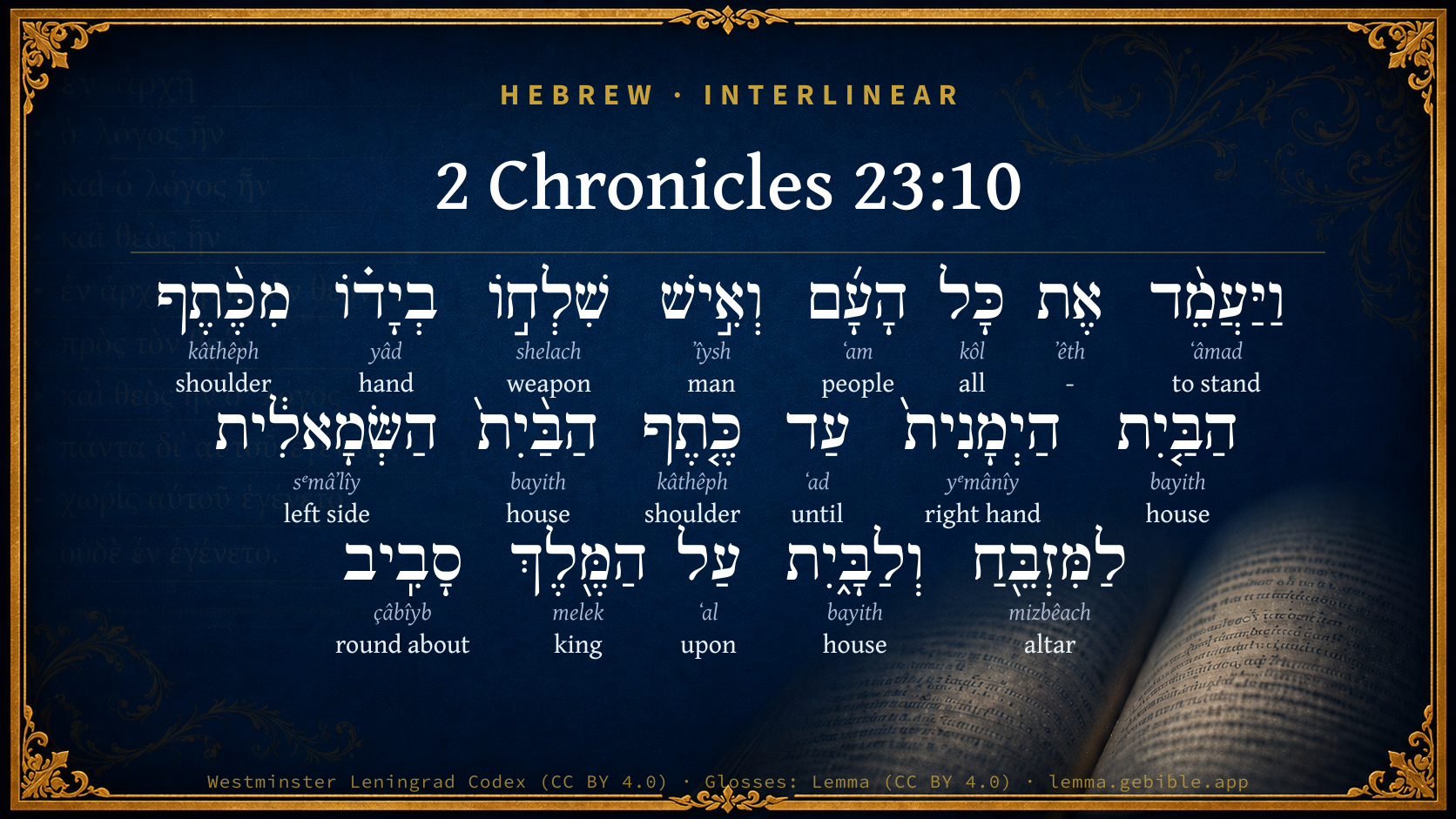
Hebrew (Westminster Leningrad Codex) 2 Chronicles 23:10 appears in the Hebrew Old Testament. The text above is from the Westminster Leningrad Codex. Each word links to its Strong’s number, a concise gloss, and parsing drawn from the Open Scriptures Hebrew Bible morphology. Click any word for its full Brown-Driver-Briggs (BDB) entry.
Download image
Cite this verse

2 Chronicles 23:10 (World English Bible). Public Domain. Lemma interlinear Bible study tool, https://lemma.gebible.app/v/2-chronicles/23/10.

Show BibTeX & RIS
BibTeX
RIS
English Translation
He set all the people, every man with his weapon in his hand, from the right side of the house to the left side of the house, along by the altar and the house, by the king round about.
World English Bible · Public Domain
Highlights
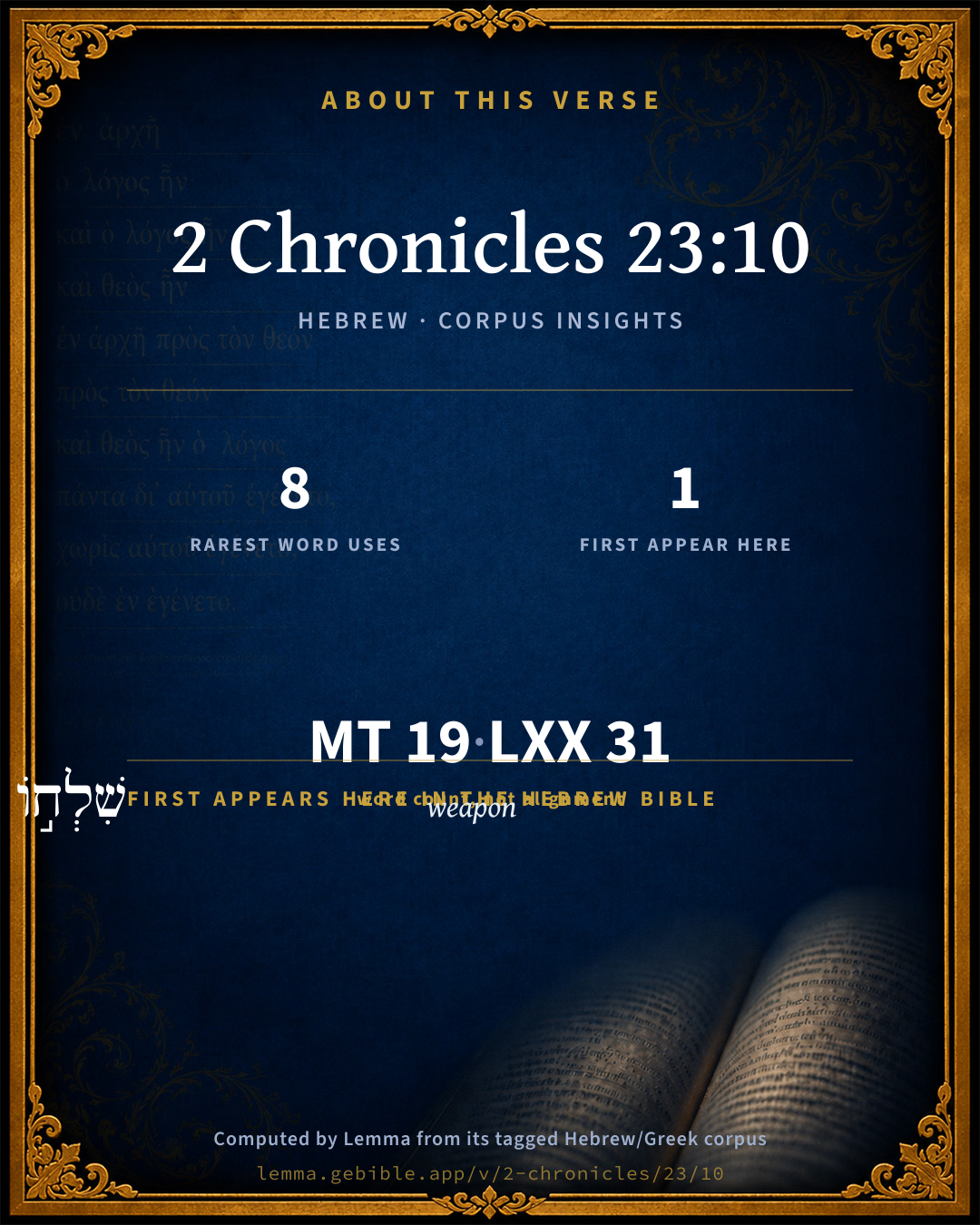
  • 1 first appearance in the Hebrew Bible
Full analysis ↓
Download a study sheet

One document with this verse’s original text, its word-by-word gloss line, the meaning frame, cross-references with their text, attributed commentary, and full source and license credits — printable, and it pastes into notes with its structure intact.

This verse Autodidact and up

Study sheet (.html) Plain text (.txt)

A passage Seminary Student

Up to 50 verses in one chapter. A passage sheet keeps up to 6 commentary sources and 12 cross-references per verse, in the order this page ranks them, and says so on the sheet whenever that leaves anything out. Ask for a single verse and you get the Autodidact verse sheet above.

Everything on this page stays free to read, with no account — the sheet is a download of what is already on screen, not access to it.

Want to remove ads? Support Godless Engineer
Compare translations 3

The same verse in 3 English versions, stacked beneath the original-language interlinear above. Click any original word for its lexicon entry.

Each is an independent rendering of the whole verse — the interlinear is not word-aligned to these translations.

Highlighted words mark where these versions differ — a whole-verse word diff, not a word-by-word alignment.

  • World English Bible Public Domain
    He set all the people, every man with his weapon in his hand, from the right side of the house to the left side of the house, along by the altar and the house, by the king round about.
  • King James Version Public Domain
    And he set all the people, every man having his weapon in his hand, from the right side of the temple to the left side of the temple, along by the altar and the temple, by the king round about.
  • unfoldingWord Literal Text CC BY-SA 4.0
    And he stationed all the people, and each, his weapon in his hand, from the right side of the house to the left side of the house, at the altar and at the house, about the king all around.

unfoldingWord Literal Text — © unfoldingWord, licensed CC BY-SA 4.0. Word-aligned USFM3 via Door43 (git.door43.org/unfoldingWord/en_ult).

Versions to compare (up to 4)

3 of 4 selected

Show all 18 translations

Every available English version of this verse, each an independent rendering of the whole verse.

  • World English Bible Public Domain
    He set all the people, every man with his weapon in his hand, from the right side of the house to the left side of the house, along by the altar and the house, by the king round about.
  • Berean Standard Bible Public Domain
    He stationed all the troops, with their weapons in hand, surrounding the king by the altar and the temple, from the south side to the north side of the temple.
  • Majority Standard Bible Public Domain
    He stationed all the troops, with their weapons in hand, surrounding the king by the altar and the temple, from the south side to the north side of the temple.
  • King James Version Public Domain
    And he set all the people, every man having his weapon in his hand, from the right side of the temple to the left side of the temple, along by the altar and the temple, by the king round about.
  • American Standard Version (1901) Public Domain
    And he set all the people, every man with his weapon in his hand, from the right side of the house to the left side of the house, along by the altar and the house, by the king round about.
  • Revised Version (1885) Public Domain
    And he set all the people, every man with his weapon in his hand, from the right side of the house to the left side of the house, along by the altar and the house, by the king round about.
  • Geneva Bible (1599) Public Domain
    And he caused all the people to stand (euery man with his weapon in his hande) from the right side of the house, to ye left side of the house by the altar and by the house round about ye king.
  • Douay-Rheims (1899) Public Domain
    And he set all the people with swords in their hands from the right side of the temple, to the left side of the temple, before the altar, and the temple, round about the king.
  • Young's Literal Translation Public Domain
    and he stationeth the whole of the people, and each his dart in his hand, from the right shoulder of the house unto the left shoulder of the house, at the altar, and at the house, by the king, round about.
  • Literal Standard Version CC BY-SA 4.0
    and he stations the whole of the people, and each [with] his dart in his hand, from the right shoulder of the house to the left shoulder of the house, at the altar, and at the house, by the king, all around.
  • Unlocked Literal Bible CC BY-SA 4.0
    Jehoiada placed all the soldiers, each man with his weapon in his hand, from the right side of the temple to the left side of the temple, along by the altar and the temple, surrounding the king.
  • unfoldingWord Literal Text CC BY-SA 4.0
    And he stationed all the people, and each, his weapon in his hand, from the right side of the house to the left side of the house, at the altar and at the house, about the king all around.
  • Darby Bible Public Domain
    And he set all the people, every man with his javelin in his hand, from the right side of the house to the left side of the house, toward the altar and the house, by the king round about.
  • World Messianic Bible Public Domain
    He set all the people, every man with his weapon in his hand, from the right side of the house to the left side of the house, near the altar and the house, around the king.
  • Webster's Bible Public Domain
    And he set all the people, every man having his weapon in his hand, from the right side of the temple to the left side of the temple, along by the altar and the temple, by the king on all sides.
  • Free Bible Version CC BY-SA 4.0
    He placed them all, with their weapons in hand, to surround the king from the south side of the Temple to the north side, and near the altar and the Temple.
  • Bible in Basic English Public Domain
    And he put all the people in position, every man with his instruments of war in his hand, from the right side of the house to the left, by the altar and the house and all round the king.
  • JPS Tanakh (1917) Public Domain
    And he set all the people, every man with his weapon in his hand, from the right side of the house to the left side of the house, along by the altar and the house, by the king round about.

Literal Standard Version (2020), Covenant Press — licensed CC BY-SA 4.0. Text via the HelloAO Bible API (eBible.org). Unlocked Literal Bible (unfoldingWord) — licensed CC BY-SA 4.0. Text via the HelloAO Bible API (eBible.org). unfoldingWord Literal Text — © unfoldingWord, licensed CC BY-SA 4.0. Word-aligned USFM3 via Door43 (git.door43.org/unfoldingWord/en_ult). Free Bible Version, Dr. Jonathan Gallagher — licensed CC BY-SA 4.0. Text via the HelloAO Bible API (eBible.org).

Word by word

More ways to search: Search by grammar → Find every occurrence → Compare this word →

Practice this passage: Drill this verse → Learn its vocabulary →

שִׁלְח֣וֹ
shelach
H7973
“weapon · his”
Noun, Common, Masculine, Singular, Construct + Suffix, Personal, 3rd Person, Masculine, Singular
Part of Speech
Noun
Type
Common
Gender
Masculine
Number
Singular
State
Construct
Full BDB Definition

Origin: from H7971

TWOT: 2394a

weapon, missile, sprout - missile, weapon - sprout, shoot
  1. וַיַּעֲמֵ֨ד ʻâmad H5975 “and · to stand” Conjunction + Verb, Hiphil, Sequential Imperfect, 3rd Person, Masculine, Singular
  2. אֶת ʼêth H853 “-” Particle, Direct Object
  3. כָּל kôl H3605 “all of” Noun, Common, Masculine, Singular, Construct
  4. הָעָ֜ם ʻam H5971 “the · people” Particle, Definite Article + Noun, Common, Masculine, Singular, Absolute
  5. וְאִ֣ישׁ ʼîysh H376 “and · man” Conjunction + Noun, Common, Masculine, Singular, Absolute
  6. בְיָד֗וֹ yâd H3027 “in/at · hand · his” Preposition + Noun, Common, Both, Singular, Construct + Suffix, Personal, 3rd Person, Masculine, Singular
  7. מִכֶּ֨תֶף kâthêph H3802 “from · shoulder of” Preposition + Noun, Common, Feminine, Singular, Construct
  8. הַבַּ֤יִת bayith H1004 “the · house” Particle, Definite Article + Noun, Common, Masculine, Singular, Absolute
  9. הַיְמָנִית֙ yᵉmânîy H3233 “the · right hand” Particle, Definite Article + Adjective, Adjective, Feminine, Singular, Absolute
  10. עַד ʻad H5704 “until” Preposition
  11. כֶּ֤תֶף kâthêph H3802 “shoulder of” Noun, Common, Feminine, Singular, Construct
  12. הַבַּ֨יִת֙ bayith H1004 “the · house” Particle, Definite Article + Noun, Common, Masculine, Singular, Absolute
  13. הַשְּׂמָאלִ֔ית sᵉmâʼlîy H8042 “the · left side” Particle, Definite Article + Adjective, Adjective, Feminine, Singular, Absolute
  14. לַמִּזְבֵּ֖חַ mizbêach H4196 “to/for the · altar” Preposition, Determined + Noun, Common, Masculine, Singular, Absolute
  15. וְלַבָּ֑יִת bayith H1004 “and · to/for the · house” Conjunction + Preposition, Determined + Noun, Common, Masculine, Singular, Absolute
  16. עַל ʻal H5921 “upon” Preposition
  17. הַמֶּ֖לֶךְ melek H4428 “the · king” Particle, Definite Article + Noun, Common, Masculine, Singular, Absolute
  18. סָבִֽיב çâbîyb H5439 “round about” Noun, Common, Both, Singular, Absolute

About this verse

These counts appear in no published source. They are computed here, from the morphology-tagged text and Lemma’s own curated glosses. What Lemma adds →

19
words
16
distinct lemmas
Historical
section

Notable vocabulary

The rarest word here is שִׁלְח֣וֹ weapon H7973 — appearing just 8 times in the whole Hebrew Bible.

First appearance in Scripture

This word makes its first canonical appearance in the Hebrew Bible here:

  • שִׁלְח֣וֹ weapon H7973

Shared distinctive vocabulary

שִׁלְח֣וֹ weapon H7973 occurs in 8 verses of the Hebrew Bible. Also found in:

Grammatical profile

  • 1 verb
  • 13 nouns
  • 2 adjectives
  • 2 prepositions
  • 1 particle

Verb forms

  • וַיַּעֲמֵ֨ד Hiphil · Sequential Imperfect

Repetition

Words recur within this verse — often emphatic in Hebrew:

  • הַבַּ֤יִת house H1004 ×3
  • מִכֶּ֨תֶף shoulder H3802 ×2

Hebrew & Septuagint length

In English translation the verse runs 39 words from the Hebrew and 34 from the Septuagint (LXX English) — closely comparable.

A rough comparison of the two English renderings, which tokenize alike — not a word-level alignment.

Word counts can differ between the Hebrew and the Greek without any difference in meaning — e.g. the Hebrew direct-object marker אֵת has no separate Greek word, and Greek often adds the article ὁ.

In the original languages it is 19 Hebrew tokens and 31 Greek tokens — but the two are counted differently (Hebrew bundles its prefixes and suffixes into one token; the Greek is in lemma form), so that isn’t a like-for-like length.

Cross-references

3

Topical passages linked to 2 Chronicles 23:10 in the Treasury of Scripture Knowledge — connected by theme and wording, ordered by reader-vote popularity; previews shown in the World English Bible.

  • Exodus 40:6 You shall set the altar of burnt offering before the door of the tent of the tent of meeting.
  • 2 Kings 11:11 The guard stood, every man with his weapons in his hand, from the right side of the house to the left side of the house, along by the altar and the house, by the king round about.
  • 2 Chronicles 6:12 He stood before the altar of Yahweh in the presence of all the assembly of Israel, and spread forth his hands

Cross-references courtesy of OpenBible.info (CC BY 4.0).

Hebrew and Greek witnesses Masoretic Hebrew ↔ Greek Septuagint

The same verse in the two great witnesses to the Old Testament, shown verse-for-verse.

These are two independent witnesses, not word-aligned to each other, and the Septuagint is shown in lemma (dictionary) form.

Hebrew 2 Chronicles 23:10 Masoretic · Westminster Leningrad Codex

וַיַּעֲמֵ֨ד אֶת כָּל הָעָ֜ם וְאִ֣ישׁ שִׁלְח֣וֹ בְיָד֗וֹ מִכֶּ֨תֶף הַבַּ֤יִת הַיְמָנִית֙ עַד כֶּ֤תֶף הַבַּ֨יִת֙ הַשְּׂמָאלִ֔ית לַמִּזְבֵּ֖חַ וְלַבָּ֑יִת עַל הַמֶּ֖לֶךְ סָבִֽיב

He set all the people, every man with his weapon in his hand, from the right side of the house to the left side of the house, along by the altar and the house, by the king round about.

World English Bible · Public Domain

Greek LXX 2 Chronicles 23:10 Septuagint · lemma form

καί ἵστημι πᾶς ὁ λαός ἕκαστος ἐν ὁ ὅπλον αὐτός ἀπό ὁ ὠμία ὁ οἶκος ὁ δεξιός ἕως ὁ ὠμία ὁ ἀριστερός ὁ θυσιαστήριον καί ὁ οἶκος ἐπί ὁ βασιλεύς κύκλος

And he set the whole people, every man with his arms, from the right side of the house to the left side of the altar and the house, over against the king round about.

LXX2012 (modern English Septuagint) · Public Domain

On this verse, Ellicott's Commentary for English Readers discusses the Septuagint’s reading. Read the note in Commentary ↓

Hebrew: Westminster Leningrad Codex (CC BY 4.0). Greek: Septuagint (public domain); English from LXX2012 (modern English Septuagint) (Public Domain). How the Septuagint differs from the Hebrew →

Commentary

Notes on 2 Chronicles 23:10 from classic Christian and Jewish commentators (each source and its license shown beneath its notes). The classic Christian expositions comment on the surrounding passage and are grouped to its opening verse, so a note may address several verses; the Jewish commentaries on the Tanakh (Rashi and others) are per-verse, so they appear only where the commentator wrote on this verse.

Lemma curates 59 commentaries, every one of them public domain or Creative Commons licensed, each selected and text-cleaned for this edition rather than reprinted as found. About our sources →

Trapp's Complete Commentary

John Trapp

2Ch 23:10 And he set all the people, every man having his weapon in his hand, from the right side of the temple to the left side of the temple, along by the altar and the temple, by the king round about.

Ver. 10. And he set all the people … by the king round about.] Subjects should stand by their princes, and defend them to their utmost; resolving to live and die with them. See 2Ki 11:11.

John Trapp, A Commentary or Exposition upon All the Books of the Old and New Testament (1647–1656) — public domain. Text from a community e-Sword module.

Geneva Bible (1599)

Geneva Bible translators

Meaning, the most holy place where the Ark stood.

Geneva Bible (1599) marginal notes — public domain. Text via Bolls.life.

Ellicott's Commentary for English Readers

(10) And he set all the people.—2Ki_9:11 : “And the Couriers stood.” By “the people,” the chronicler obviously means, not the mass of the congregation, but the armed body who were to “compass the king round about, every man with his weapons in his hand” (2Ch_23:7).

His weapon.—Or, his missiles, arms. LXX., ὅπλοα. (Comp. 2Ch_32:5.) Kings has a commoner word. The remainder of the verse is identical with its parallel.

Along by.—Towards the altar.

A Bible Commentary for English Readers, edited by Charles John Ellicott (1878–1897) — public domain. Text from a community e-Sword module.

The Cambridge Bible for Schools and Colleges

gen. ed. J. J. S. Perowne

10. having his weapon] R.V. with his weapon. The Heb. word (shelaḥ) means a “missile weapon.”

the temple] R.V. the house.

The Cambridge Bible for Schools and Colleges (gen. ed. J. J. S. Perowne; Cambridge University Press, 1878–1918) — public domain. Text from a community e-Sword module.

Haydock's Catholic Bible Commentary

Altar of holocausts, in the court of the priests, while the people stood in their own court. T.

George Leo Haydock (1774–1849), Haydock's Catholic Family Bible and Commentary, 1859 edition — public domain. Excludes Psalms (Douay-Rheims chapter numbering differs from Protestant) and Deuterocanonical books (Catholic canon only).

The Pulpit Commentary

All the people; i.e. , again, all those, not being Levites and priests, who had been trusted to assist. The parallel (ver. 11) summarizes them under the name the guard. It may be just noted, in passing, that, while the Hebrew text has in both places "shoulder," i.e. for the "side" of this verse, and the "corner" of the parallel, the Revised Version has harmonized the rendering, electing the rendering side. From the right side of the temple to the left side. This is equivalent to saying, those composing the guard were placed on the south and north sides. Along by the altar. This was the altar of burnt offerings in front of the perch, and close by which the young "king stood at his pillar," or on his pedestal (ver. 13), the rows of the guard bristling with weapons before and behind and round about him.

The Pulpit Commentary (1880–1919), ed. H.D.M. Spence-Jones & Joseph S. Exell — public domain. Text from a community e-Sword module.

unfoldingWord translationNotes

Door43 World Missions Community

General Information:

Throughout chapter 23, Joash is referred to as "the king." It may be helpful to your readers to occasionally add "King Joash" or "Joash the king" to make his identity explicit. (See: Assumed Knowledge and Implicit Information)

with his weapon in his hand

This means they were ready to fight. See how you translated a similar phrase in 2 Chronicles 23:7.

the king's son

Here "king" refers to Joash's father. AT: "Joash, the son of the king"

put the crown on him

This is a symbolic act to show that they are making him king. (See: Symbolic Action)

gave him the covenant decrees

The symbolic act of giving him a scroll with the decrees shows that they expect him to obey them. It is unclear if these decrees were a portion of the law of Moses, or a separate set of rules for kings to obey. AT: "presented to him the covenant decrees that he should obey" (See: Symbolic Action)

anointed him

This was a symbolic act to show that he was chosen by God to be the king. (See: Symbolic Action)

Long live the king

"May the king live a long life"

translationWords

temple

altar

crown

decree

anoint

unfoldingWord translationNotes — © Distant Shores Media and the Door43 World Missions Community, licensed CC BY-SA 4.0. Source: git.door43.org/Door43/en_tn.

Rashi

Rabbi Shlomo Yitzchaki (Rashi)

and each one with his sword in his hand - Heb. שִׁלְחוֹ his weapon, like (Joel 2:8): “and upon the sword (הַשֶּׁלַח).”

Rashi on the Tanakh — English translations: “The Judaica Press complete Tanach with Rashi, translated by A. J. Rosenberg” (CC BY 4.0); “Pentateuch with Rashi's commentary by M. Rosenbaum and A.M. Silbermann, 1929-1934” (public domain); “The Metsudah Tanach series, Lakewood, N.J” (CC BY 4.0); and “The Book of Joshua, Metsudah Publications, 1997” (CC BY 4.0). Text via Sefaria.

Lesson kit

Teaching starters — assembled from the data on this page, not authored interpretation. Every prompt links to the verse data it draws on. Edit before teaching.

2 Chronicles, in the Historical, opens this verse with 19 words (16 distinct Hebrew lemmas). Its most distinctive word is shelach (“weapon”). A historical commentator’s framing appears above. Read the whole chapter for the surrounding context.

Discussion questions

  1. The word shelach carries the sense “weapon.” How does it shape the verse?
  2. The word “weapon” first appears here in Scripture. What is being introduced at this debut?
  3. 2 Chronicles 32:5 shares the word «weapon» with this verse. How do the two illuminate each other?
  4. “house” occurs 3× in this one verse. What is the effect of the repetition?
  5. These translations render this verse differently. What is at stake in choosing one wording over another?
  6. The verb «וַיַּעֲמֵ֨ד» is Hiphil Sequential Imperfect. How does its form color the action?
  7. Reading how Trapp's Complete Commentary and Geneva Bible (1599) read this verse, where do the two commentators agree and where do they part?

Things to notice

Reading settings

Reading text

Shown beneath each verse's original-language words.

Old Testament
Old Testament edition

Read the OT as the Masoretic Hebrew (MT) or the Greek Septuagint (LXX).

English shown for the Greek Septuagint (in the Hebrew ↔ Greek comparison).

Comparing translations? Open the Compare panel on any verse page to stack up to four side by side.