
Joshua 22:11

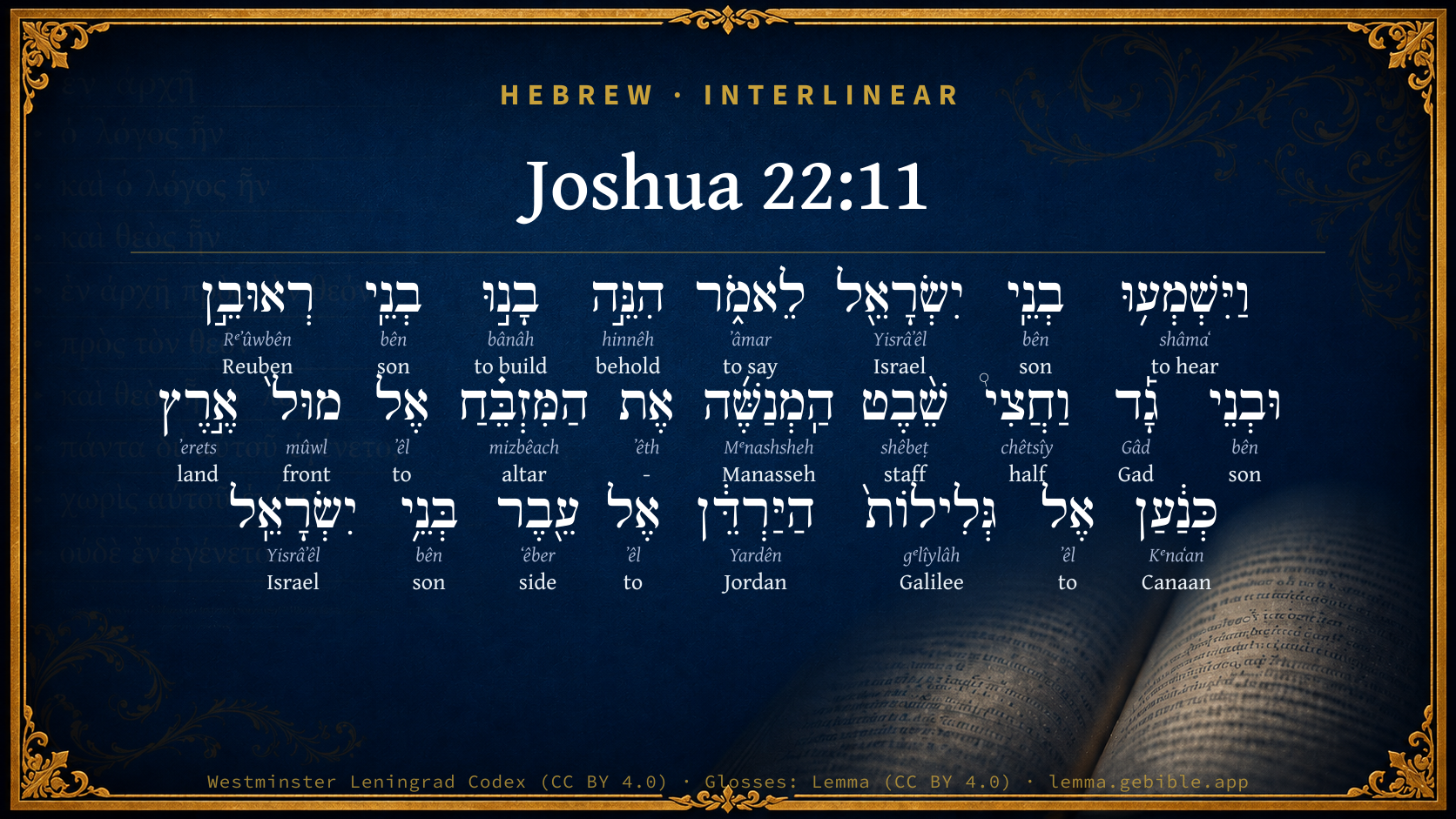
Hebrew (Westminster Leningrad Codex) Joshua 22:11 appears in the Hebrew Old Testament. The text above is from the Westminster Leningrad Codex. Each word links to its Strong’s number, a concise gloss, and parsing drawn from the Open Scriptures Hebrew Bible morphology. Click any word for its full Brown-Driver-Briggs (BDB) entry.
Download image
Cite this verse

Joshua 22:11 (World English Bible). Public Domain. Lemma interlinear Bible study tool, https://lemma.gebible.app/v/joshua/22/11.

Show BibTeX & RIS
BibTeX
RIS
English Translation
The children of Israel heard say, Behold, the children of Reuben and the children of Gad and the half-tribe of Manasseh have built an altar in the forefront of the land of Canaan, in the region about the Jordan, on the side that pertains to the children of Israel.
World English Bible · Public Domain
Download a study sheet

One document with this verse’s original text, its word-by-word gloss line, the meaning frame, cross-references with their text, attributed commentary, and full source and license credits — printable, and it pastes into notes with its structure intact.

This verse Autodidact and up

Study sheet (.html) Plain text (.txt)

A passage Seminary Student

Up to 50 verses in one chapter. A passage sheet keeps up to 6 commentary sources and 12 cross-references per verse, in the order this page ranks them, and says so on the sheet whenever that leaves anything out. Ask for a single verse and you get the Autodidact verse sheet above.

Everything on this page stays free to read, with no account — the sheet is a download of what is already on screen, not access to it.

Want to remove ads? Support Godless Engineer
Compare translations 3

The same verse in 3 English versions, stacked beneath the original-language interlinear above. Click any original word for its lexicon entry.

Each is an independent rendering of the whole verse — the interlinear is not word-aligned to these translations.

Highlighted words mark where these versions differ — a whole-verse word diff, not a word-by-word alignment.

  • World English Bible Public Domain
    The children of Israel heard say, Behold, the children of Reuben and the children of Gad and the half-tribe of Manasseh have built an altar in the forefront of the land of Canaan, in the region about the Jordan, on the side that pertains to the children of Israel.
  • King James Version Public Domain
    And the children of Israel heard say, Behold, the children of Reuben and the children of Gad and the half tribe of Manasseh have built an altar over against the land of Canaan, in the borders of Jordan, at the passage of the children of Israel.
  • unfoldingWord Literal Text CC BY-SA 4.0
    And the sons of Israel heard, saying, “Behold, the sons of Reuben and the sons of Gad and half of the tribe of Manasseh have built the altar at the front of the land of Canaan, in the regions of the Jordan, on the side of the sons of Israel.”

unfoldingWord Literal Text — © unfoldingWord, licensed CC BY-SA 4.0. Word-aligned USFM3 via Door43 (git.door43.org/unfoldingWord/en_ult).

Versions to compare (up to 4)

3 of 4 selected

Show all 18 translations

Every available English version of this verse, each an independent rendering of the whole verse.

  • World English Bible Public Domain
    The children of Israel heard say, Behold, the children of Reuben and the children of Gad and the half-tribe of Manasseh have built an altar in the forefront of the land of Canaan, in the region about the Jordan, on the side that pertains to the children of Israel.
  • Berean Standard Bible Public Domain
    Then the Israelites received the report: “Behold, the Reubenites, the Gadites, and the half-tribe of Manasseh have built an altar on the border of the land of Canaan, at Geliloth near the Jordan on the Israelite side.”
  • Majority Standard Bible Public Domain
    Then the Israelites received the report: “Behold, the Reubenites, the Gadites, and the half-tribe of Manasseh have built an altar on the border of the land of Canaan, at Geliloth near the Jordan on the Israelite side.”
  • King James Version Public Domain
    And the children of Israel heard say, Behold, the children of Reuben and the children of Gad and the half tribe of Manasseh have built an altar over against the land of Canaan, in the borders of Jordan, at the passage of the children of Israel.
  • American Standard Version (1901) Public Domain
    And the children of Israel heard say, Behold, the children of Reuben and the children of Gad and the half-tribe of Manasseh have built an altar in the forefront of the land of Canaan, in the region about the Jordan, on the side that pertaineth to the children of Israel.
  • Revised Version (1885) Public Domain
    And the children of Israel heard say, Behold, the children of Reuben and the children of Gad and the half tribe of Manasseh have built an altar in the forefront of the land of Canaan, in the region about Jordan, on the side that pertaineth to the children of Israel.
  • Geneva Bible (1599) Public Domain
    When the children of Israel heard say, Beholde, the children of Reuben, and the children of Gad, and the halfe tribe of Manasseh haue built an altar in the forefront of the lande of Canaan vpon the borders of Iorden at the passage of the children of Israel:
  • Douay-Rheims (1899) Public Domain
    And when the children of Israel had heard of it, and certain messengers had brought them an account that the children of Ruben, and of Cad, and the half tribe of Manasses had built an altar in the land of Chanaan, upon the banks of the Jordan, over against the children of Israel:
  • Young's Literal Translation Public Domain
    And the sons of Israel hear, saying, `Lo, the sons of Reuben, and the sons of Gad, and the half of the tribe of Manasseh, have built the altar over-against the land of Canaan, on the districts of the Jordan, at the passage of the sons of Israel.'
  • Literal Standard Version CC BY-SA 4.0
    And the sons of Israel hear, saying, “Behold, the sons of Reuben, and the sons of Gad, and the half-tribe of Manasseh, have built the altar at the frontier of the land of Canaan, in the districts of the Jordan, at the passage of the sons of Israel.”
  • Unlocked Literal Bible CC BY-SA 4.0
    The people of Israel heard about this and said, “Look! The people of Reuben, Gad, and the half tribe of Manasseh have built an altar at the front of the land of Canaan, at Geliloth, in the region near the Jordan, on the side that belongs to the people of Israel.”
  • unfoldingWord Literal Text CC BY-SA 4.0
    And the sons of Israel heard, saying, “Behold, the sons of Reuben and the sons of Gad and half of the tribe of Manasseh have built the altar at the front of the land of Canaan, in the regions of the Jordan, on the side of the sons of Israel.”
  • Darby Bible Public Domain
    And the children of Israel heard say, Behold, the children of Reuben and the children of Gad and the half tribe of Manasseh have built an altar over against the land of Canaan, in the districts of the Jordan, separately from the children of Israel.
  • World Messianic Bible Public Domain
    The children of Israel heard this, “Behold, the children of Reuben and the children of Gad and the half-tribe of Manasseh have built an altar along the border of the land of Canaan, in the region around the Jordan, on the side that belongs to the children of Israel.”
  • Webster's Bible Public Domain
    And the children of Israel heard it said, Behold, the children of Reuben, and the children of Gad, and the half-tribe of Manasseh, have built an altar over against the land of Canaan, in the borders of Jordan, at the passage of the children of Israel.
  • Free Bible Version CC BY-SA 4.0
    The Israelites were told, “Look, the tribes of Reuben and Gad, and the half-tribe of Manasseh have built an altar in the Jordan region of the land of Canaan, on the side belonging to the Israelites.”
  • Bible in Basic English Public Domain
    And news came to the children of Israel, See, the children of Reuben and the children of Gad and the half-tribe of Manasseh have put up an altar opposite the land of Canaan, in the country by Jordan on the side which is Israel's.
  • JPS Tanakh (1917) Public Domain
    And the children of Israel heard say: 'Behold, the children of Reuben and the children of Gad and the half-tribe of Manasseh have built an altar in the forefront of the land of Canaan, in the region about the Jordan, on the side that pertaineth to the children of Israel.'

Literal Standard Version (2020), Covenant Press — licensed CC BY-SA 4.0. Text via the HelloAO Bible API (eBible.org). Unlocked Literal Bible (unfoldingWord) — licensed CC BY-SA 4.0. Text via the HelloAO Bible API (eBible.org). unfoldingWord Literal Text — © unfoldingWord, licensed CC BY-SA 4.0. Word-aligned USFM3 via Door43 (git.door43.org/unfoldingWord/en_ult). Free Bible Version, Dr. Jonathan Gallagher — licensed CC BY-SA 4.0. Text via the HelloAO Bible API (eBible.org).

Word by word

More ways to search: Search by grammar → Find every occurrence → Compare this word →

Practice this passage: Drill this verse → Learn its vocabulary →

גְּלִילוֹת֙
gᵉlîylâh
H1552
“regions of”
Noun, Common, Feminine, Plural, Construct
Part of Speech
Noun
Type
Common
Gender
Feminine
Number
Plural
State
Construct
Full BDB Definition

Origin: from H1550

TWOT: 353g

Galilee = "circuit, district" - circuit, boundary, territory (noun feminine) - a territory in Naphtali largely occupied by heathen; a circuit of towns around Kedesh-Naphtali, in which were situated the 20 towns given by Solomon to Hiram king of Tyre as payment for his work in conveying timber from Lebanon to Jerusalem (noun proper locative)
  1. וַיִּשְׁמְע֥וּ shâmaʻ H8085 “and · to hear” Conjunction + Verb, Qal, Sequential Imperfect, 3rd Person, Masculine, Plural
  2. בְנֵֽי bên H1121 “sons of” Noun, Common, Masculine, Plural, Construct
  3. יִשְׂרָאֵ֖ל Yisrâʼêl H3478 “Israel” Noun, Proper
  4. לֵאמֹ֑ר ʼâmar H559 “to say” Preposition + Verb, Qal, Infinitive Construct
  5. הִנֵּ֣ה hinnêh H2009 “behold” Particle, Demonstrative
  6. בָנ֣וּ bânâh H1129 “to build” Verb, Qal, Perfect, 3rd Person, Common, Plural
  7. בְנֵֽי bên H1121 “sons of” Noun, Common, Masculine, Plural, Construct
  8. רְאוּבֵ֣ן Rᵉʼûwbên H7205 “Reuben” Noun, Proper
  9. וּבְנֵי bên H1121 “and · sons of” Conjunction + Noun, Common, Masculine, Plural, Construct
  10. גָ֡ד Gâd H1410 “Gad” Noun, Proper
  11. וַחֲצִי֩ chêtsîy H2677 “and · half of” Conjunction + Noun, Common, Masculine, Singular, Construct
  12. שֵׁ֨בֶט shêbeṭ H7626 “staff of” Noun, Common, Masculine, Singular, Construct
  13. הַֽמְנַשֶּׁ֜ה Mᵉnashsheh H4519 “the · Manasseh” Particle, Definite Article + Noun, Proper
  14. אֶת ʼêth H853 “-” Particle, Direct Object
  15. הַמִּזְבֵּ֗חַ mizbêach H4196 “the · altar” Particle, Definite Article + Noun, Common, Masculine, Singular, Absolute
  16. אֶל ʼêl H413 “to” Preposition
  17. מוּל֙ mûwl H4136 “front” Preposition
  18. אֶ֣רֶץ ʼerets H776 “land of” Noun, Common, Both, Singular, Construct
  19. כְּנַ֔עַן Kᵉnaʻan H3667 “Canaan” Noun, Proper
  20. אֶל ʼêl H413 “to” Preposition
  21. הַיַּרְדֵּ֔ן Yardên H3383 “the · Jordan” Particle, Definite Article + Noun, Proper
  22. אֶל ʼêl H413 “to” Preposition
  23. עֵ֖בֶר ʻêber H5676 “side of” Noun, Common, Masculine, Singular, Construct
  24. בְּנֵ֥י bên H1121 “sons of” Noun, Common, Masculine, Plural, Construct
  25. יִשְׂרָאֵֽל Yisrâʼêl H3478 “Israel” Noun, Proper

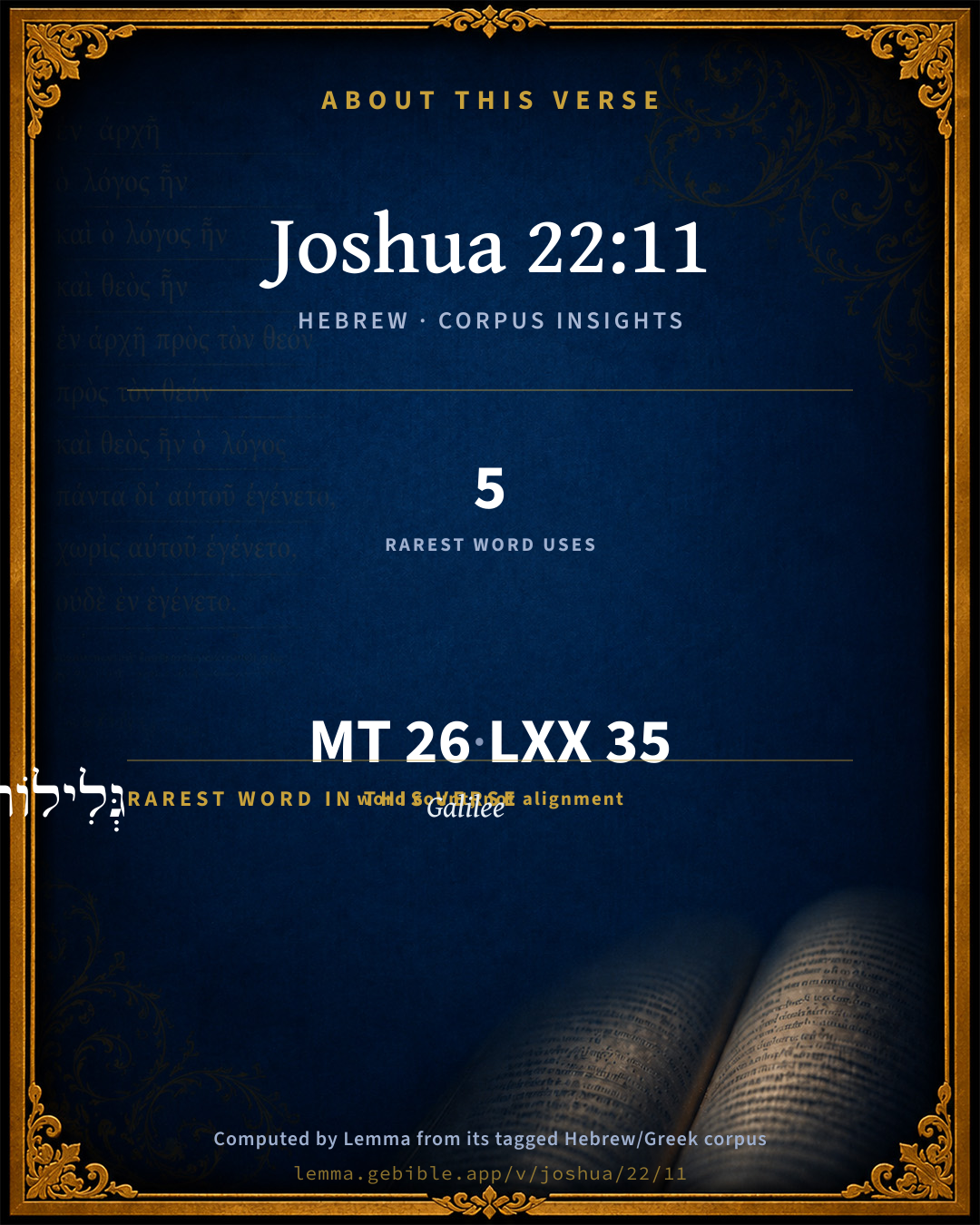
About this verse

These counts appear in no published source. They are computed here, from the morphology-tagged text and Lemma’s own curated glosses. What Lemma adds →

26
words
20
distinct lemmas
Historical
section

Notable vocabulary

The rarest word here is גְּלִילוֹת֙ Galilee H1552 — appearing just 5 times in the whole Hebrew Bible.

Shared distinctive vocabulary

גְּלִילוֹת֙ Galilee H1552 occurs in 5 verses of the Hebrew Bible. Also found in:

Grammatical profile

  • 3 verbs
  • 17 nouns
  • 4 prepositions
  • 2 particles

Verb forms

  • וַיִּשְׁמְע֥וּ Qal · Sequential Imperfect
  • לֵאמֹ֑ר Qal · Infinitive Construct
  • בָנ֣וּ Qal · Perfect

Repetition

Words recur within this verse — often emphatic in Hebrew:

  • בְנֵֽי son H1121 ×4
  • יִשְׂרָאֵ֖ל Israel H3478 ×2
  • אֶל to H413 ×3

Hebrew & Septuagint length

In English translation the verse runs 49 words from the Hebrew and 48 from the Septuagint (LXX English) — closely comparable.

A rough comparison of the two English renderings, which tokenize alike — not a word-level alignment.

Word counts can differ between the Hebrew and the Greek without any difference in meaning — e.g. the Hebrew direct-object marker אֵת has no separate Greek word, and Greek often adds the article ὁ.

In the original languages it is 26 Hebrew tokens and 35 Greek tokens — but the two are counted differently (Hebrew bundles its prefixes and suffixes into one token; the Greek is in lemma form), so that isn’t a like-for-like length.

Cross-references

9

Topical passages linked to Joshua 22:11 in the Treasury of Scripture Knowledge — connected by theme and wording, ordered by reader-vote popularity; previews shown in the World English Bible.

  • Deuteronomy 13:12–14 If you shall hear tell concerning one of your cities, which Yahweh your God gives you to dwell there, saying,
  • Leviticus 17:8–9 "You shall say to them, 'Any man there is of the house of Israel, or of the strangers who live as foreigners among them, who offers a burnt offering or sacrifice,
  • Deuteronomy 12:5–7 But to the place which Yahweh your God shall choose out of all your tribes, to put his name there, even to his habitation shall you seek, and there you shall come;
  • Joshua 2:7 The men pursued after them the way to the Jordan to the fords: and as soon as those who pursued after them were gone out, they shut the gate.
  • John 1:28 These things were done in Bethany beyond the Jordan, where John was baptizing.
  • Joshua 3:14–16 It happened, when the people removed from their tents, to pass over the Jordan, the priests who bore the ark of the covenant being before the people;
  • Judges 12:5 The Gileadites took the fords of the Jordan against the Ephraimites. It was so, that when [any of] the fugitives of Ephraim said, Let me go over, the men of Gilead said to him, Are you an Ephraimite? If he said, No;
  • John 20:1 Now on the first day of the week, Mary Magdalene went early, while it was still dark, to the tomb, and saw the stone taken away from the tomb.
  • John 20:12 and she saw two angels in white sitting, one at the head, and one at the feet, where the body of Jesus had lain.

Cross-references courtesy of OpenBible.info (CC BY 4.0).

Hebrew and Greek witnesses Masoretic Hebrew ↔ Greek Septuagint

The same verse in the two great witnesses to the Old Testament, shown verse-for-verse.

These are two independent witnesses, not word-aligned to each other, and the Septuagint is shown in lemma (dictionary) form.

Hebrew Joshua 22:11 Masoretic · Westminster Leningrad Codex

וַיִּשְׁמְע֥וּ בְנֵֽי יִשְׂרָאֵ֖ל לֵאמֹ֑ר הִנֵּ֣ה בָנ֣וּ בְנֵֽי רְאוּבֵ֣ן וּבְנֵי גָ֡ד וַחֲצִי֩ שֵׁ֨בֶט הַֽמְנַשֶּׁ֜ה אֶת הַמִּזְבֵּ֗חַ אֶל מוּל֙ אֶ֣רֶץ כְּנַ֔עַן אֶל גְּלִילוֹת֙ הַיַּרְדֵּ֔ן אֶל עֵ֖בֶר בְּנֵ֥י יִשְׂרָאֵֽל

The children of Israel heard say, Behold, the children of Reuben and the children of Gad and the half-tribe of Manasseh have built an altar in the forefront of the land of Canaan, in the region about the Jordan, on the side that pertains to the children of Israel.

World English Bible · Public Domain

Greek LXX Joshua 22:11 Septuagint · lemma form

καί ἀκούω ὁ υἱός ἰσραήλ λέγω ἰδού οἰκοδομέω ὁ υἱός γαδ καί ὁ υἱός ρουβην καί ὁ ἥμισυς φυλή μανασσή βωμός ἐπί ὅριον γῆ χανααν ἐπί ὁ γαλαάδ ὁ ἰορδάνης ἐν ὁ πέραν υἱός ἰσραήλ

And the children of Israel heard say, Behold, the sons of Ruben, and the sons of Gad, and the half tribe of Manasse have built an altar at the borders of the land of Chanaan at Galaad of Jordan, on the opposite side to the children of Israel.

LXX2012 (modern English Septuagint) · Public Domain

Hebrew: Westminster Leningrad Codex (CC BY 4.0). Greek: Septuagint (public domain); English from LXX2012 (modern English Septuagint) (Public Domain). How the Septuagint differs from the Hebrew →

Targum (Aramaic paraphrase)

1

The Targum is the ancient Jewish Aramaic paraphrase of the Hebrew Scriptures — an interpretive translation, not the Hebrew text itself. Onkelos (literal) and Pseudo-Jonathan (expansive) render the Torah, and Jonathan the Prophets. Coverage is partial: where no permissively-licensed English translation exists for a verse, only the Aramaic is shown. This is verse-level text, not a word-by-word alignment to the Hebrew.

  1. Targum Jonathan Prophets (Joshua–Malachi)
    וּשְׁמָעוּ בְנֵי יִשְׂרָאֵל לְמֵימָר הָא בְּנוֹ בְּנֵי רְאוּבֵן וּבְנֵי גָד וּפַלְגוּת שִׁבְטָא דִמְנַשֶׁה יַת מַדְבְּחָא לָקֳבֵיל אַרְעָא דִכְנָעַן בִּגְלִילֵי יַרְדְנָא דִלְעִבַּר בְּנֵי יִשְׂרָאֵל:

    (no public-domain English translation for this verse)

    Targum Jonathan — Aramaic: “Mikraot Gedolot” (public domain). English: “Sefaria Community Translation” (CC0 1.0 (public-domain dedication)); “London "Chaldee Paraphrase," 1871” (public domain). Text via Sefaria.

Commentary

Notes on Joshua 22:11 from classic Christian and Jewish commentators (each source and its license shown beneath its notes). The classic Christian expositions comment on the surrounding passage and are grouped to its opening verse, so a note may address several verses; the Jewish commentaries on the Tanakh (Rashi and others) are per-verse, so they appear only where the commentator wrote on this verse.

Lemma curates 59 commentaries, every one of them public domain or Creative Commons licensed, each selected and text-cleaned for this edition rather than reprinted as found. About our sources →

Jamieson, Fausset & Brown

Robert Jamieson, A. R. Fausset & David Brown

CONTENTION THEREUPON. (Jos. 22:11-29)

and the children of Israel heard say--Fame speedily spread intelligence of what the trans-jordanic tribes had done. The act being suspected of some idolatrous design, the tribes rose in a mass, and repairing to the tabernacle at Shiloh, resolved to declare war against the two tribes and a half as apostates from God. On calmer and more mature consideration, however, they determined, in the first instance, to send a deputation consisting of the son of the high priest, and ten eminent persons from each tribe, to make inquiry into this rumored rebellion against God (Deu 13:13-15). The quality of the deputies evinced the deep solicitude that was felt on the occasion to maintain the purity of the divine worship throughout Israel. In the presumptive belief that the two tribes and a half had really built an altar, the deputies expressed astonishment at their so soon falling into such a heinous crime as that of violating the unity of divine worship (Exo 20:24; Lev 17:8-9; Deu 12:5-13). They reminded their eastern brethren of the disastrous consequences that were entailed on the nation at large by the apostasy at Peor and by the sin of Achan, and finally exhorted them, if they felt the want of the tabernacle and altar and repented of their rash choice in preferring worldly advantages to religious privileges, to remove to the western side of the Jordan, where all the tribes would form a united and obedient community of worshippers.

Jamieson, Fausset & Brown — Commentary Critical and Explanatory on the Whole Bible (1871) — public domain (CC PDM 1.0). Text via the HelloAO Bible API.

Trapp's Complete Commentary

John Trapp

Jos 22:11 And the children of Israel heard say, Behold, the children of Reuben and the children of Gad and the half tribe of Manasseh have built an altar over against the land of Canaan, in the borders of Jordan, at the passage of the children of Israel.

Ver. 11. And the children of Israel heard say.] Fame had soon blown her trumpet: but is, mostly, a loud liar -

“ Tam ficti privique tenax quam nuncia veri. ” - Virg.

John Trapp, A Commentary or Exposition upon All the Books of the Old and New Testament (1647–1656) — public domain. Text from a community e-Sword module.

Tyndale Open Study Notes

Tyndale Open Resources

22:11 The tribes referred to here as the rest of Israel (literally the sons of Israel) consisted of the tribes given land west of the Jordan River, in Canaan proper. They already referred to themselves as Israel, excluding the tribes east of the Jordan.

Tyndale Open Study Notes — © Tyndale Open Resources, licensed CC BY-SA 4.0. Text via the HelloAO Bible API.

John Calvin's Commentaries

11. And the children of Israel heard say, etc There is no doubt that they were inflamed with holy zeal, nor ought their vehemence to seem excessive in taking up arms to destroy their countrymen on account of a pile of stones. For they truly and wisely judged that the lawful sanctuary of God was polluted and his worship profaned, that sacred things were violated, pious concord destroyed, and a door opened for the license of superstitious practices, if in two places victims were offered to God, who had for these reasons so solemnly bound the whole people to a single altar. Not rashly, therefore, do the ten tribes, on hearing of a profane altar, detest its sacrilegious audacity.

Here, then, we have an illustrious display of piety, teaching us that if we see the pure worship of God corrupted, we must be strenuous, to the utmost of our ability, in vindicating it. The sword, indeed, has not been committed to the hands of all; but every one must, according to his call and office, study manfully and firmly to maintain the purity of religion against all corruption’s. More especially deserving of the highest praise was the zeal of the half-tribe of Manasseh, who, setting aside all regard to the flesh, did not spare their own family. I admit, however, that this zeal, though pious, was not free from turbulent impetuosity, inasmuch as they hasten to declare war before they inquired concerning the mind of their brethren, and properly ascertained the state of the case. War, I admit, was declared only under conditions; for they send ambassadors to bring back word after they had carefully investigated the matter, and they move not a finger in the way of inflicting punishment till they are certified of the existence of the crime. Excuse, therefore, may be made for the fervor of their passion, while they prepare for battle in the event of any defection being discovered.

John Calvin's Commentaries (1540-1563) — public domain. Text from the Calvin Translation Society English edition (1840s-50s) via the Christian Classics Ethereal Library (ccel.org). Calvin's coverage is partial (roughly two-thirds of the Bible); uncommented books and verses are honest gaps, never fabricated. The 19th-century editor's footnotes and remarks are omitted so the notes are faithfully Calvin's own voice.

Ellicott's Commentary for English Readers

(11) Have built an altar.—Rather, have built the altar. As appears by Jos_22:28, it was a representation of the altar of Jehovah: a copy of the one altar which He had given to Israel for sacrifice. The design was to set up on the east of Jordan a likeness of that altar which was established on the west, that the tribes on the other side of Jordan might appeal to it as a proof that they also were the people of Jehovah.

A Bible Commentary for English Readers, edited by Charles John Ellicott (1878–1897) — public domain. Text from a community e-Sword module.

The Cambridge Bible for Schools and Colleges

gen. ed. J. J. S. Perowne

11–20. Embassy from Israel to the Two and a Half Tribes

11. heard] News of the step taken by the trans-Jordanic tribes so suddenly and without any consultation, reached the ears of their brethren, and gave rise to “great searchings of heart.”

in the borders] i.e. the circles of Jordan, as in Jos_22:10.

at the passage of the children of Israel] More literally, by the side of the sons of Israel. Comp. Exo_25:37; Exo_32:15.

The Cambridge Bible for Schools and Colleges (gen. ed. J. J. S. Perowne; Cambridge University Press, 1878–1918) — public domain. Text from a community e-Sword module.

John Gill's Exposition

And when the children of Israel heard of it,.... Of the building the altar in the above place, namely, the nine tribes and a half settled in the land of Canaan:

the whole congregation of the children of Israel gathered themselves together at Shiloh; where the tabernacle and altar of the Lord were, whose cause they undertook to avenge, being injured as they imagined by the altar the other tribes had built, and where they could consult the Lord by Urim and Thummim, if needful; hither they repaired from the several places around, where their tribes were settled; not the whole body of the people, but their heads and representatives:

to go up to war against them; to consult about it, and to prepare for it, which they were obliged to do by the law of God, as in the case of a city, so of a tribe drawn aside to idolatry; and which they imagined was the case of these tribes, or at least what they had done had a tendency to apostasy from the true worship of God, which they were zealous to defend at the hazard of their lives, and though it should issue in an extirpation of one or more of their tribes; see Deu 13:12.

John Gill's Exposition of the Whole Bible (1746–1763) — public domain (CC PDM 1.0). Text via the HelloAO Bible API.

Matthew Poole's English Annotations

Where they passed over Jordan, either at their first entrance into Canaan, or afterwards, and usually.

Matthew Poole's English Annotations on the Holy Bible (1683–1685) — public domain. Text from a community e-Sword/MySword module.

The Pulpit Commentary

Half tribe of Manasseh. Throughout this part of the narrative, when the body politic, rather than the descent of the tribe, is to be indicated, we have, not hFm, but fbv. See above, Jos_13:29.

An altar. The original has the altar. Over against lWmAla. It is difficult to fix the meaning of this expression. lWm seems to have meant the front of anything, and therefore lWmAla would naturally mean towards the front of, or in front of. Thus we have had the expression in Jos_8:33 (where see note), where it seems to mean, in the direction of, and in Jos_9:1, where it seems to have the same meaning. With verbs of motion it signifies towards, as in Exo_34:3, and 1Sa_17:30. Here it clearly cannot be pressed to mean across Jordan. See note below. The borders of Jordan. As above, ver. 10, the circles of Jordan. At the passage of the children of Israel. The word translated "the passage of," literally," unto over," has originally the sense of "across." Here, however, it means towards the region opposite to the sons of Israel," i.e., in the direction of the country on the other side Jordan. The country across Jordan was usually designated as rbeB or rbeme Jordan. rbeAla, the phrase used here, we find in Exo_28:26, apparently in the sense of across . (so Exo_39:19) In Deu_30:13 it is used of moving in the direction of a place, "across" or "over the sea." In Eze_1:9, Eze_1:12, with the addition of wynp, the phrase means "straight forward." In 1Sa_14:40 dha rbel means "on one side." In 1Ki 7 rbel means "over." Thus the altar was not necessarily on the other side Jordan.

The Pulpit Commentary (1880–1919), ed. H.D.M. Spence-Jones & Joseph S. Exell — public domain. Text from a community e-Sword module.

John Wesley's Explanatory Notes

At the passage - Where they passed over Jordan, either at their first entrance into Canaan, or afterwards, and usually.

John Wesley, Explanatory Notes Upon the Whole Bible (1754–1765) — public domain. Text via the GEBible commentary corpus.

Keil & Delitzsch

C. F. Keil & F. Delitzsch

The Israelites (on this side) heard that the tribes in question had built the altar "opposite to the land of Canaan" (lit. in the face or in front of the land of Canaan), אל־אבר, "at the opposite region of the children of Israel" (two descriptions which may be explained on the supposition that the name of Canaan is used in a restricted sense, the valley of the Jordan being expressly excepted, and Canaan considered as only extending to the valley of the Jordan). When they heard this, the whole congregation (in its heads and representatives) assembled at Shiloh, to go up, i.e., with the intention of going, to make war against them. The congregation supposed that the altar had been built as a place for sacrifice, and therefore regarded it as a wicked violation of the commandment of God with regard to the unity of the sacrificial altar (Lev 17:8-9; Deu 12:4.), which they ought to punish according to the law in Deu 13:13. This zeal was perfectly justifiable, and even praiseworthy, as the altar, even if not erected as a place for sacrifice, might easily be abused to that purpose, and thus become an occasion of sin to the whole nation. In any case, the two tribes and a half ought not to have erected such a building without the consent of Joshua or of the high priest.

(Note: "We know how sternly the law prohibited the use of two altars: because it was the will of God that His worship should be restricted to one place. When, therefore, from the very appearance it could not fail to occur to the mind of any one that they were establishing a second altar, who would not have condemned them as guilty of sacrilege, for introducing rites and ceremonies at variance with the law of God? And since it might so naturally be regarded as a wicked deed, they ought certainly to have consulted their brethren in so grave and important a matter; and it was especially wrong to pass by the high priest, when the will of God might have been learned from his lips. They were deserving of blame, therefore, because they acted as if they had been alone in the world, and did not consider what offence might easily arise from the novelty of their proceedings." - Calvin.)

Keil & Delitzsch — Biblical Commentary on the Old Testament (1861–1891) — public domain (CC PDM 1.0). Text via the HelloAO Bible API. (Old Testament only.)

Lesson kit

Teaching starters — assembled from the data on this page, not authored interpretation. Every prompt links to the verse data it draws on. Edit before teaching.

Joshua, in the Historical, opens this verse with 26 words (20 distinct Hebrew lemmas). Its most distinctive word is gᵉlîylâh (“Galilee”). A historical commentator’s framing appears above. Read the whole chapter for the surrounding context.

Discussion questions

  1. The word gᵉlîylâh carries the sense “Galilee.” How does it shape the verse?
  2. Joshua 13:2 shares the word «Galilee» with this verse. How do the two illuminate each other?
  3. “son” occurs 4× in this one verse. What is the effect of the repetition?
  4. These translations render this verse differently; the difference is in the English rendering, not the original. What questions does that raise?
  5. The verb «וַיִּשְׁמְע֥וּ» is Qal Sequential Imperfect. How does its form color the action?
  6. Reading how Jamieson, Fausset & Brown and Trapp's Complete Commentary read this verse, where do the two commentators agree and where do they part?

Things to notice

Reading settings

Reading text

Shown beneath each verse's original-language words.

Old Testament
Old Testament edition

Read the OT as the Masoretic Hebrew (MT) or the Greek Septuagint (LXX).

English shown for the Greek Septuagint (in the Hebrew ↔ Greek comparison).

Comparing translations? Open the Compare panel on any verse page to stack up to four side by side.