Exodus 29:38

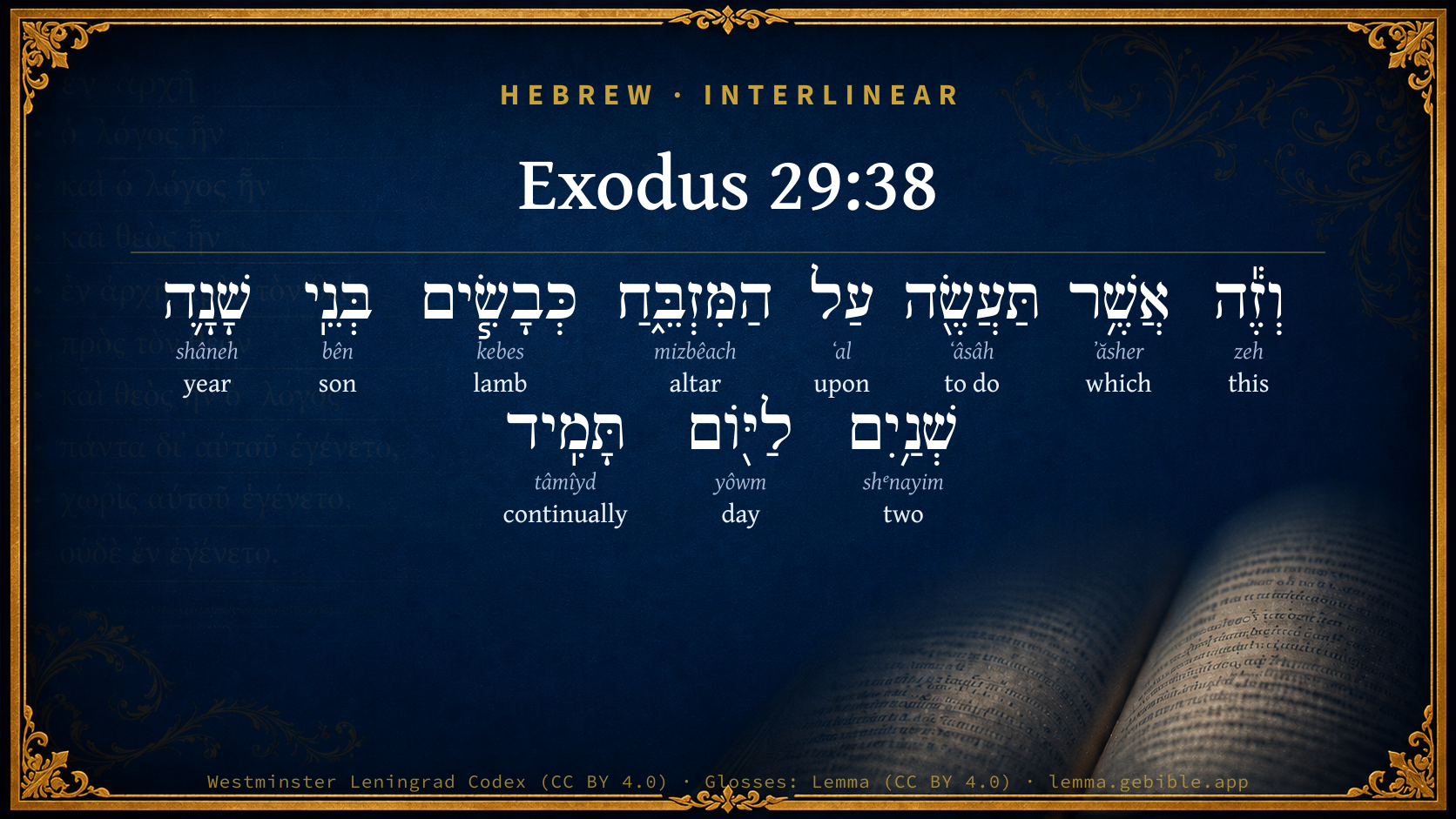
Hebrew (Westminster Leningrad Codex) Exodus 29:38 appears in the Hebrew Old Testament. The text above is from the Westminster Leningrad Codex. Each word links to its Strong’s number, a concise gloss, and parsing drawn from the Open Scriptures Hebrew Bible morphology. Click any word for its full Brown-Driver-Briggs (BDB) entry.
Download image
Cite this verse

Exodus 29:38 (World English Bible). Public Domain. Lemma interlinear Bible study tool, https://lemma.gebible.app/v/exodus/29/38.

Show BibTeX & RIS
BibTeX
RIS
English Translation
"Now this is that which you shall offer on the altar: two lambs a year old day by day continually.
World English Bible · Public Domain
Download a study sheet

One document with this verse’s original text, its word-by-word gloss line, the meaning frame, cross-references with their text, attributed commentary, and full source and license credits — printable, and it pastes into notes with its structure intact.

This verse Autodidact and up

Study sheet (.html) Plain text (.txt)

A passage Seminary Student

Up to 50 verses in one chapter. A passage sheet keeps up to 6 commentary sources and 12 cross-references per verse, in the order this page ranks them, and says so on the sheet whenever that leaves anything out. Ask for a single verse and you get the Autodidact verse sheet above.

Everything on this page stays free to read, with no account — the sheet is a download of what is already on screen, not access to it.

Want to remove ads? Support Godless Engineer
Compare translations 3

The same verse in 3 English versions, stacked beneath the original-language interlinear above. Click any original word for its lexicon entry.

Each is an independent rendering of the whole verse — the interlinear is not word-aligned to these translations.

Highlighted words mark where these versions differ — a whole-verse word diff, not a word-by-word alignment.

  • World English Bible Public Domain
    "Now this is that which you shall offer on the altar: two lambs a year old day by day continually.
  • King James Version Public Domain
    Now this is that which thou shalt offer upon the altar; two lambs of the first year day by day continually.
  • unfoldingWord Literal Text CC BY-SA 4.0
    And this is what you shall offer on the altar every day continually: two lambs, sons of a year.

unfoldingWord Literal Text — © unfoldingWord, licensed CC BY-SA 4.0. Word-aligned USFM3 via Door43 (git.door43.org/unfoldingWord/en_ult).

Versions to compare (up to 4)

3 of 4 selected

Show all 18 translations

Every available English version of this verse, each an independent rendering of the whole verse.

  • World English Bible Public Domain
    "Now this is that which you shall offer on the altar: two lambs a year old day by day continually.
  • Berean Standard Bible Public Domain
    This is what you are to offer regularly on the altar, each day: two lambs that are a year old.
  • Majority Standard Bible Public Domain
    This is what you are to offer regularly on the altar, each day: two lambs that are a year old.
  • King James Version Public Domain
    Now this is that which thou shalt offer upon the altar; two lambs of the first year day by day continually.
  • American Standard Version (1901) Public Domain
    Now this is that which thou shalt offer upon the altar: two lambs a year old day by day continually.
  • Revised Version (1885) Public Domain
    Now this is that which thou shalt offer upon the altar; two lambs of the first year day by day continually.
  • Geneva Bible (1599) Public Domain
    Nowe this is that which thou shalt present vpon the altar: euen two lambes of one yere olde, day by day continually.
  • Douay-Rheims (1899) Public Domain
    This is what thou shalt sacrifice upon the altar: Two lambs of a year old every day continually.
  • Young's Literal Translation Public Domain
    `And this `is' that which thou dost prepare on the altar; two lambs, sons of a year, daily continually;
  • Literal Standard Version CC BY-SA 4.0
    And this [is] that which you prepare on the altar: two lambs, sons of a year, daily continually;
  • Unlocked Literal Bible CC BY-SA 4.0
    You must regularly offer on the altar every day two lambs a year old.
  • unfoldingWord Literal Text CC BY-SA 4.0
    And this is what you shall offer on the altar every day continually: two lambs, sons of a year.
  • Darby Bible Public Domain
    And this is what thou shalt offer upon the altar -- two lambs of the first year, day by day continually.
  • World Messianic Bible Public Domain
    “Now this is that which you shall offer on the altar: two lambs a year old day by day continually.
  • Webster's Bible Public Domain
    Now this is that which thou shalt offer upon the altar; two lambs of the first year, day by day continually.
  • Free Bible Version CC BY-SA 4.0
    You are to offer two lambs that are a year old on the altar, daily and continually.
  • Bible in Basic English Public Domain
    Now this is the offering which you are to make on the altar: two lambs in their first year, every day regularly.
  • JPS Tanakh (1917) Public Domain
    Now this is that which thou shalt offer upon the altar: two lambs of the first year day by day continually.

Literal Standard Version (2020), Covenant Press — licensed CC BY-SA 4.0. Text via the HelloAO Bible API (eBible.org). Unlocked Literal Bible (unfoldingWord) — licensed CC BY-SA 4.0. Text via the HelloAO Bible API (eBible.org). unfoldingWord Literal Text — © unfoldingWord, licensed CC BY-SA 4.0. Word-aligned USFM3 via Door43 (git.door43.org/unfoldingWord/en_ult). Free Bible Version, Dr. Jonathan Gallagher — licensed CC BY-SA 4.0. Text via the HelloAO Bible API (eBible.org).

Word by word

More ways to search: Search by grammar → Find every occurrence → Compare this word →

Practice this passage: Drill this verse → Learn its vocabulary →

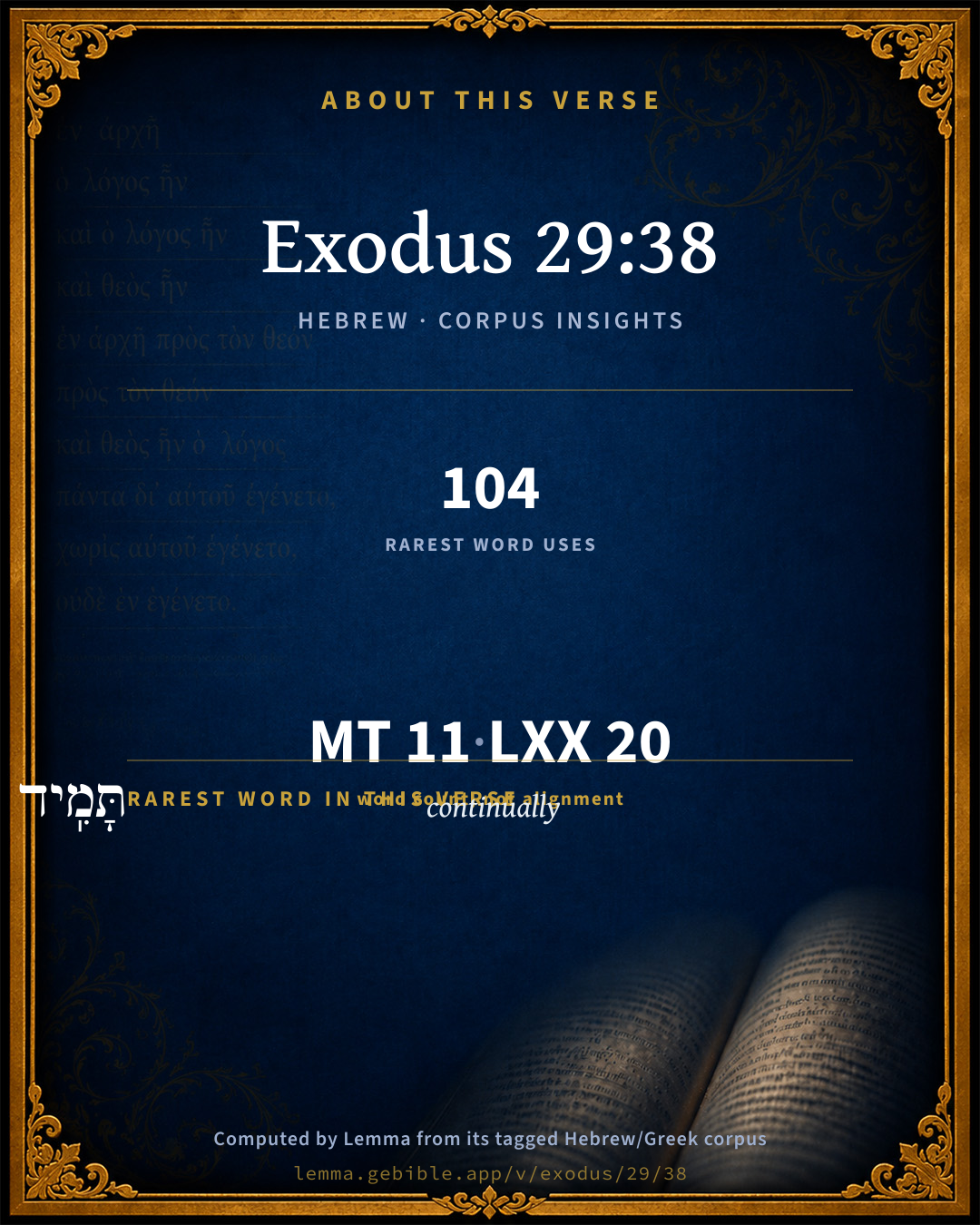
תָּמִֽיד
tâmîyd
H8548
“continually”
Noun, Common, Masculine, Singular, Absolute
Part of Speech
Noun
Type
Common
Gender
Masculine
Number
Singular
State
Absolute
Full BDB Definition

Origin: from an unused root meaning to stretch

TWOT: 1157a

continuity, perpetuity, to stretch - continually, continuously (as adverb) - continuity (substantive)
  1. וְזֶ֕ה zeh H2088 “and · this” Conjunction + Pronoun, Demonstrative, Masculine, Singular
  2. אֲשֶׁ֥ר ʼăsher H834 “which” Particle, Relative
  3. תַּעֲשֶׂ֖ה ʻâsâh H6213 “to do” Verb, Qal, Imperfect, 2nd Person, Masculine, Singular
  4. עַל ʻal H5921 “upon” Preposition
  5. הַמִּזְבֵּ֑חַ mizbêach H4196 “the · altar” Particle, Definite Article + Noun, Common, Masculine, Singular, Absolute
  6. כְּבָשִׂ֧ים kebes H3532 “lambs” Noun, Common, Masculine, Plural, Absolute
  7. בְּנֵֽי bên H1121 “sons of” Noun, Common, Masculine, Plural, Construct
  8. שָׁנָ֛ה shâneh H8141 “year” Noun, Common, Feminine, Singular, Absolute
  9. שְׁנַ֥יִם shᵉnayim H8147 “two” Adjective, Cardinal number, Masculine, Dual, Absolute
  10. לַיּ֖וֹם yôwm H3117 “to/for the · day” Preposition, Determined + Noun, Common, Masculine, Singular, Absolute

About this verse

These counts appear in no published source. They are computed here, from the morphology-tagged text and Lemma’s own curated glosses. What Lemma adds →

11
words
11
distinct lemmas
Pentateuch
section

Grammatical profile

  • 1 verb
  • 6 nouns
  • 1 adjective
  • 1 pronoun
  • 1 preposition
  • 1 particle

Verb forms

  • תַּעֲשֶׂ֖ה Qal · Imperfect

Hebrew & Septuagint length

In English translation the verse runs 20 words from the Hebrew and 27 from the Septuagint (LXX English) — closely comparable.

A rough comparison of the two English renderings, which tokenize alike — not a word-level alignment.

Word counts can differ between the Hebrew and the Greek without any difference in meaning — e.g. the Hebrew direct-object marker אֵת has no separate Greek word, and Greek often adds the article ὁ.

In the original languages it is 11 Hebrew tokens and 20 Greek tokens — but the two are counted differently (Hebrew bundles its prefixes and suffixes into one token; the Greek is in lemma form), so that isn’t a like-for-like length.

Cross-references

13

Topical passages linked to Exodus 29:38 in the Treasury of Scripture Knowledge — connected by theme and wording, ordered by reader-vote popularity; previews shown in the World English Bible.

  • Numbers 28:3–8 You shall tell them, This is the offering made by fire which you shall offer to Yahweh: he-lambs a year old without blemish, two day by day, for a continual burnt offering.
  • 1 Chronicles 16:40 to offer burnt offerings to Yahweh on the altar of burnt offering continually morning and evening, even according to all that is written in the law of Yahweh, which he commanded to Israel;
  • 2 Chronicles 2:4 Behold, I am about to build a house for the name of Yahweh my God, to dedicate it to him, and to burn before him incense of sweet spices, and for the continual show bread, and for the burnt offerings morning and evening, on the Sabbaths, and on the new moons, and on the set feasts of Yahweh our God. This is [an ordinance] forever to Israel.
  • Daniel 12:11 From the time that the continual [burnt offering] shall be taken away, and the abomination that makes desolate set up, there shall be one thousand two hundred ninety days.
  • 2 Chronicles 13:11 and they burn to Yahweh every morning and every evening burnt offerings and sweet incense: the show bread also [set they] in order on the pure table; and the lampstand of gold with the lamps of it, to burn every evening: for we keep the charge of Yahweh our God; but you have forsaken him.
  • 2 Chronicles 31:3 [He appointed] also the king's portion of his substance for the burnt-offerings, [to wit], for the morning and evening burnt offerings, and the burnt offerings for the Sabbaths, and for the new moons, and for the set feasts, as it is written in the law of Yahweh.
  • Ezra 3:3 They set the altar on its base; for fear was on them because of the peoples of the countries: and they offered burnt offerings thereon to Yahweh, even burnt offerings morning and evening.
  • Daniel 9:27 He shall make a firm covenant with many for one week: and in the midst of the week he shall cause the sacrifice and the offering to cease; and on the wing of abominations [shall come] one who makes desolate; and even to the full end, and that determined, shall [wrath] be poured out on the desolate.
  • Daniel 9:21 yes, while I was speaking in prayer, the man Gabriel, whom I had seen in the vision at the beginning, being caused to fly swiftly, touched me about the time of the evening offering.
  • John 1:29 The next day, he saw Jesus coming to him, and said, "Behold, the Lamb of God, who takes away the sin of the world!
  • Hebrews 7:27 who doesn't need, like those high priests, to daily offer up sacrifices, first for his own sins, and then for the sins of the people. For this he did once for all, when he offered up himself.
  • 1 Peter 1:19 but with precious blood, as of a lamb without spot, the blood of Christ;
  • Revelation 5:9–12 They sang a new song, saying, "You are worthy to take the book, And to open its seals: For you were killed, And bought us for God with your blood, Out of every tribe, language, people, and nation,

Cross-references courtesy of OpenBible.info (CC BY 4.0).

Hebrew and Greek witnesses Masoretic Hebrew ↔ Greek Septuagint

The same verse in the two great witnesses to the Old Testament, shown verse-for-verse.

These are two independent witnesses, not word-aligned to each other, and the Septuagint is shown in lemma (dictionary) form.

Hebrew Exodus 29:38 Masoretic · Westminster Leningrad Codex

וְזֶ֕ה אֲשֶׁ֥ר תַּעֲשֶׂ֖ה עַל הַמִּזְבֵּ֑חַ כְּבָשִׂ֧ים בְּנֵֽי שָׁנָ֛ה שְׁנַ֥יִם לַיּ֖וֹם תָּמִֽיד

"Now this is that which you shall offer on the altar: two lambs a year old day by day continually.

World English Bible · Public Domain

Greek LXX Exodus 29:38 Septuagint · lemma form

καί οὗτος εἰμί ὅς ποιέω ἐπί ὁ θυσιαστήριον ἀμνός ἐνιαύσιος ἄμωμος δύο ὁ ἡμέρα ἐπί ὁ θυσιαστήριον ἐνδελεχῶς κάρπωμα ἐνδελεχισμός

And these are the offerings which you shall offer upon the altar; two unblemished lambs of a year old daily on the altar continually, a constant offering.

LXX2012 (modern English Septuagint) · Public Domain

On this verse, Ellicott's Commentary for English Readers discusses the Septuagint’s reading. Read the note in Commentary ↓

Hebrew: Westminster Leningrad Codex (CC BY 4.0). Greek: Septuagint (public domain); English from LXX2012 (modern English Septuagint) (Public Domain). How the Septuagint differs from the Hebrew →

Targum (Aramaic paraphrase)

2

The Targum is the ancient Jewish Aramaic paraphrase of the Hebrew Scriptures — an interpretive translation, not the Hebrew text itself. Onkelos (literal) and Pseudo-Jonathan (expansive) render the Torah, and Jonathan the Prophets. Coverage is partial: where no permissively-licensed English translation exists for a verse, only the Aramaic is shown. This is verse-level text, not a word-by-word alignment to the Hebrew.

  1. Targum Onkelos Torah (Genesis–Deuteronomy)
    וְדֵין דִי תַעְבֵּד עַל מַדְבְּחָא אִמְרִין בְּנֵי שְׁנָא תְּרֵין לְיוֹמָא תְּדִירָא:

    (no public-domain English translation for this verse)

    Targum Onkelos — Aramaic: “Onkelos Genesis” (public domain); “Onkelos Exodus” (public domain); “Onkelos Leviticus” (public domain); “Onkelos Numbers” (public domain); “Onkelos Deuteronomy” (public domain). English: “Sefaria Community Translation” (CC0 1.0 (public-domain dedication)); “J.W. Etheridge. The Targums of Onkelos and Jonathan Ben Uzziel on the Pentateuch. London: Longmans, Green, 1862” (public domain). Text via Sefaria.

  2. Targum Pseudo-Jonathan Torah (Genesis–Deuteronomy)
    וְדֵין קוּרְבָּנָא דְתַעֲבֵיד עַל מַדְבְּחָא אִמְרִין בְּנֵי שְׁנָה תְּרֵין לְיוֹמָא תְדִירָא

    And this is the oblation which thou shalt perform upon the altar; two lambs of one year, daily, evermore.

    Targum Pseudo-Jonathan — Aramaic: “Targum Jonathan on Genesis” (public domain); “Targum Jonathan on Exodus” (public domain); “Targum Jonathan on Leviticus” (public domain); “Targum Jonathan on Numbers” (public domain); “Targum Jonathan on Deuteronomy” (public domain). English: “The Targum of Jonathan ben Uzziel, trans. J. W. Etheridge, London, 1862” (public domain). Text via Sefaria.

Commentary

Notes on Exodus 29:38 from classic Christian and Jewish commentators (each source and its license shown beneath its notes). The classic Christian expositions comment on the surrounding passage and are grouped to its opening verse, so a note may address several verses; the Jewish commentaries on the Tanakh (Rashi and others) are per-verse, so they appear only where the commentator wrote on this verse.

Lemma curates 59 commentaries, every one of them public domain or Creative Commons licensed, each selected and text-cleaned for this edition rather than reprinted as found. About our sources →

Matthew Henry's Commentary

In this paragraph we have,

I. The daily service appointed. A lamb was to be offered upon the altar every morning, and a lamb every evening, each with a meat-offering, both made by fire, as a continual burnt-offering throughout their generations, Exo 29:38-41. Whether there were any other sacrifices to be offered or not, these were sure to be offered, at the public charge, for the benefit and comfort of all Israel, to make atonement for their daily sins, and to be an acknowledgement to God of their daily mercies. This was that which the duty of every day required. The taking away of this daily sacrifice by Antiochus, for so many evenings and mornings, was that great calamity of the church which was foretold, Dan 8:11. Note, 1. This typified the continual intercession which Christ ever lives to make, in virtue of his satisfaction, for the continual sanctification of his church: though he offered himself once for all, yet that one offering thus becomes a continual offering. 2. This teaches us to offer up to God the spiritual sacrifices of prayer and praise every day, morning and evening, in humble acknowledgement of our dependence upon him and our obligations to him. Our daily devotions must be looked upon as the most needful of our daily works and the most pleasant of our daily comforts. Whatever business we have, this must never be omitted, either morning or evening; prayer-time must be kept up as duly as meat-time. The daily sacrifices were as the daily meals in God's house, and therefore they were always attended with bread and wine. Those starve their own souls that keep not up a constant attendance on the throne of grace.

II. Great and precious promises made of God's favour to Israel, and the tokens of his special presence with them, while they thus kept up his institutions among them. He speaks as one well pleased with the appointment of the daily sacrifice; for, before he proceeds to the other appointments that follow, he interposes these promises. It is constancy in religion that brings in the comfort of it. He promises, 1. That he would keep up communion with them; that he would not only meet Moses, and speak to him, but that he would meet the children of Israel, (Exo 29:43), to accept the daily sacrifices offered up on their behalf. Note, God will not fail to give those the meeting who diligently and conscientiously attend upon him in the ordinances of his own appointment. 2. That he would own his own institutions, the tabernacle, the altar, the priesthood (Exo 29:43, Exo 29:44); he would take possession of that which was consecrated to him. Note, What is sanctified to the glory of God shall be sanctified by his glory. If we do our part, God will do his, and will mark and fit that for himself which is in sincerity given up to him. 3. That he would reside among them as God in covenant with them, and would give them sure and comfortable tokens of his peculiar favour to them, and his special presence with them (Exo 29:45, Exo 29:46): I will dwell among the children of Israel. Note, Where God sets up the tabernacle of his ordinances he will himself dwell. Lo, I am with you always, Mat 28:20. Those that abide in God's house shall have God to abide with them. I will be their God, and they shall know that I am so. Note, Those are truly happy that have a covenant-interest in God as theirs and the comfortable evidence of that interest. If we have this, we have enough, and need no more to make us happy.

Matthew Henry's Commentary on the Whole Bible (1708–1710) — public domain (CC PDM 1.0). Text via the HelloAO Bible API.

Jamieson, Fausset & Brown

Robert Jamieson, A. R. Fausset & David Brown

INSTITUTION OF DAILY SERVICE. (Exo 29:38-46)

two lambs of the first year day by day continually--The sacred preliminaries being completed, Moses was instructed in the end or design to which these preparations were subservient, namely, the worship of God; and hence the institution of the morning and evening sacrifice. The institution was so imperative, that in no circumstances was this daily oblation to be dispensed with; and the due observance of it would secure the oft-promised grace and blessing of their heavenly King.

Next: Exodus Chapter 30

Jamieson, Fausset & Brown — Commentary Critical and Explanatory on the Whole Bible (1871) — public domain (CC PDM 1.0). Text via the HelloAO Bible API.

Trapp's Complete Commentary

John Trapp

Exo 29:38 Now this [is that] which thou shalt offer upon the altar; two lambs of the first year day by day continually.

Ver. 38. Day by day continually.] When this daily sacrifice was intermitted, - as in the days of Antiochus, that little Antichrist, - they counted it an "abomination of desolation." {Dan 12:11 Mat 24:15}

John Trapp, A Commentary or Exposition upon All the Books of the Old and New Testament (1647–1656) — public domain. Text from a community e-Sword module.

Albert Barnes' Notes on the Bible

Exo 29:38

The continual burnt-offering - The primary purpose of the national altar is here set forth. The victim slain every morning and every evening was an acknowledgment that the life of the people belonged to Yahweh; the offering of meal was an acknowledgment that all their works rightly done were His due (see Lev. 2); while the incense symbolized their daily prayers.

Exo 29:39

At even - See Exo 12:6.

Exo 29:40

A tenth deal - i. e. the tenth part of an Ephah; it is sometimes called an Omer (Exo 16:36; see Lev 23:13). The Ephah seems to have been rather less than four gallons and a half (see Lev 19:36 note); and the tenth deal of flour may have weighed about 3 lbs. 2 oz.

An hin - The word appears to be Egyptian. The measure was one-sixth of an ephah. The quarter of a bin was therefore about a pint and a half. See Lev 19:36 note.

Beaten oil - See Exo 27:20.

Wine for a drink offering - The earliest mention of the drink-offering is found in connection with Jacob’s setting up the stone at Bethel Gen 35:14. But it is here first associated with the rites of the altar. The law of the drink-offering is stated Num 15:5 following. Nothing whatever is expressly said in the Old Testament regarding the mode in which the wine was treated: but it would seem probable, from the prohibition that it should not be poured upon the altar of incense Exo 30:9, that it used to be poured on the altar of burnt-offering.

Exo 29:42

At the door of the tabernacle - At the entrance of the tent.

Exo 29:43

The (tabernacle) shall be sanctified - The word “tabernacle” is certainly not the right one to be here supplied. What is probably meant is the spot in which Yahweh promises to meet with the assembly of His people. The verse may be rendered, And in that place will I meet with the children of Israel, and it shall be sanctified with my glory. See also the margin.

Exo 29:44-45

The purpose of the formal consecration of the sanctuary and of the priests who served in it was, that the whole nation which Yahweh had set free from its bondage in Egypt might be consecrated in its daily life, and dwell continually in His presence as “a kingdom of priests and an holy nation.” Exo 19:6.

Exo 29:46

Compare Gen 17:7.

Albert Barnes' Notes on the Bible (1834–1885) — public domain. Text from a community e-Sword/MySword module.

The Biblical Illustrator

Joseph S. Exell

Exo_29:38-46

I will dwell among the children of Israel.

The Divine presence in the Church

I. The condition of the Divine presence, moral and spiritual condition: everything must be holy. Entirely, daily, permanently, must we yield ourselves to God.

II. The blessedness of the Divine presence.

1. Enlightening (Exo_29:42).

2. Glorifying (Exo_29:43-44).

3. Redeeming (Exo_29:46).

4. Abiding. Dwell. Pleasures for evermore. (J. S. Exell, M. A.)

.

The Biblical Illustrator, edited by Joseph S. Exell (c. 1880s–1900s) — public domain. Text from a community e-Sword module.

Joseph Benson's Commentary

Exo 29:38. Two lambs day by day continually — This daily service, a lamb offered upon the altar every morning, and also every evening, typified the continual intercession which Christ ever lives to make, in the virtue of his satisfaction, for the continual sanctification of his church: though he offered himself once for all, yet that one offering thus becomes a continual offering. And this teaches us to offer up to God the spiritual sacrifices of prayer and praise every day, morning and evening, in humble acknowledgment of our dependance upon him, and our obligations to him.

Joseph Benson's Commentary on the Old and New Testaments (1811–1818) — public domain. Text from a community e-Sword module.

Whedon's Commentary on the Bible

Daniel D. Whedon

THE CONTINUAL BURNT OFFERING, Exo_29:38-46.

38. Two lambs… day by day continually — In immediate connexion with the consecration of the altar, the main purpose for which it was established is now indicated, namely, the offering of continual sacrifices, meat offerings and drink offerings.

Daniel D. Whedon (gen. ed.), Commentary on the Old and New Testaments (1874–1909) — public domain. Text from a community e-Sword module.

Keil & Delitzsch

C. F. Keil & F. Delitzsch

The Daily Burnt-Offering, Meat-Offering, and Drink-Offering. - The directions concerning these are attached to the instructions for the consecration of the priests, because these sacrifices commenced immediately after the completion of the tabernacle, and, like the shew-bread (Exo 25:30), the daily trimming of the lamps (Exo 27:20-21), and the daily incense-offering (Exo 30:7.), were most intimately connected with the erection of the sanctuary.

Exo 29:38-40

"And this is what thou shalt make (offer) upon the altar; yearling lambs two a day continually," one in the morning, the other between the two evenings (see at Exo 12:6); to every one a meat-offering (minchah) of a tenth of fine wheaten flour (soleth, see at Lev 2:1), mixed with a quarter of a hin of beaten oil (cathith, see at Exo 27:20), and a drink-offering (nesek) of a quarter of a hin of wine. עשּׂרן (a tenth) is equivalent to האיפה עשׂירית, the tenth part of an ephah (Num 28:5), or 198-5 Parisian cubic inches according to Bertheau's measurement. Thenius, however, sets it down at 101-4 inches, whilst the Rabbins reckon it as equivalent to 43 hen's eggs of average size, i.e., somewhat more than 2 1/4 lbs. A hin (a word of Egyptian origin) is 330-9 inches according to Bertheau, 168-9 according to Thenius, or 72 eggs, so that a quarter of a hin would be 18 eggs.

Exo 29:41-46

להּ is to be understood ad sensum as referring to עולה. The daily morning and evening sacrifices were to be "for a sweet savour, a firing unto Jehovah" (see at Lev 1:9). In these Israel was to consecrate its life daily unto the Lord (see at Lev 1 and 2). In order that the whole of the daily life might be included, it was to be offered continually every morning and evening for all future time ("throughout your generations" as at Exo 12:14) at the door of the tabernacle, i.e., upon the altar erected there, before Jehovah, who would meet with the people and commune with them there (see Exo 25:22). This promise is carried out still further in Exo 29:43-46. First of all, for the purpose of elucidating and strengthening the words, "I will meet with you there" (Exo 29:42), the presence and communion of God, which are attached to the ark of the covenant in Exo 25:22, are ensured to the whole nation in the words, "And there I will meet with the children of Israel, and it (Israel) shall be sanctified through My glory." As the people were not allowed to approach the ark of the covenant, but only to draw near to the altar of burnt-offering in the sanctuary, it was important to declare that the Lord would manifest Himself to them even there, and sanctify them by His glory. Most of the commentators have taken the altar to be the subject of "shall be sanctified;" but this is certainly an error, not only because the altar is not mentioned in the previous clause, and only slightly hinted at in the להּ in Exo 29:41, but principally because the sanctification of the altar is noticed by itself afterwards in Exo 29:44. The correct exegesis is that adopted by Baumgarten and others, who supply the word Israel (viz., regarded as a nation), which they take from the expression "children of Israel" in the previous clause. In Exo 29:44, the sanctification of the tabernacle and altar on the part of God is promised, also that of His servants, and finally, in Exo 29:45, Exo 29:46, the abode of God in the midst of the children of Israel, with an allusion to the blessings that would follow from Jehovah's dwelling in the midst of them as their God (Gen 17:7).

Keil & Delitzsch — Biblical Commentary on the Old Testament (1861–1891) — public domain (CC PDM 1.0). Text via the HelloAO Bible API. (Old Testament only.)

Tyndale Open Study Notes

Tyndale Open Resources

29:38-41 Offering the daily sacrifices was one of the priest’s chief functions.

Tyndale Open Study Notes — © Tyndale Open Resources, licensed CC BY-SA 4.0. Text via the HelloAO Bible API.

Ellicott's Commentary for English Readers

THE LAW OF THE DAILY SACRIFICE, AND THE PROMISE OF GOD’S PRESENCE.

(38-42) The consecration of the altar, which took place during the consecration of the priests, was to be followed immediately by the establishment of the daily sacrifice. Two lambs were to be offered every day, one in the morning, the other “between the evenings” (Exo_29:39); partly in expiation of the daily sins of the nation, but mainly as a sign that the nation daily renewed its self-dedication to Jehovah, and offered itself afresh to be “a reasonable, holy, and lively sacrifice” to Him. Meat and drink offerings were to accompany the burnt sacrifice—signs of the gratitude due to God for His perpetual mercies, and acknowledgments of His protecting care and lovingkindness. At the same time incense was to be burnt upon the golden altar before the vail, as a figure of the perpetual prayer that it behoved the nation to send up to the Throne of Grace for a continuance of the Divine favour. (See Exo_30:7-8.)

(38) Two lambs of the first year.—See Note on Exo_12:5. The LXX. insert ἀμώμους, “without blemish;” but this general requirement (Lev_22:22; Lev_22:24-25), relaxed only in the case of free-will offerings (Lev_22:23), does not need to be perpetually repeated.

(39) At even.—Heb., between the two evenings. (On the meaning of the phrase, see Note 2 on Exo_12:6.)

(40) A tenth deal.—Heb., a tenth. A tenth of what measure is not said, but we may presume an ephah to be intended. The tenth part of an ephah was an omer (Exo_16:36). The omer is reckoned at rather less than half a gallon.

An hin.—The hin was, like the omer and the ephah, an Egyptian measure. It is estimated at about three-quarters of a gallon.

Beaten oil.—See Note 1 on Exo_27:20.

(41) The meat offering . . . the drink offering.—A “handful” of each meat offering was thrown upon the altar and burnt (Lev_2:2); the remainder belonged to the priests (Lev_2:3). Scripture says nothing of the disposal of the drink offering. According to Josephus (Ant. Jud. iii. 9, § 4), it was poured out in libation upon the altar. According to others, a portion only was thus disposed of, while the rest was the priests’. The latter view seems the more probable.

(42) The tabernacle of the congregation.—Rather, the tent of meeting.

Where I will meet you.—This passage determines the meaning of the expression, “tent of meeting.” It was not the place where the congregation met together, for the congregation were forbidden to enter it, but the place where God met His people through their mediator and representative, the high priest, who could there commune with God and obtain replies from Him on all practical matters that were of national importance. (See Exo_25:22 and Note ad loc.) The fact that all communication was to be through the high priest is indicated by the change of person: “Where I will meet you, to speak there unto thee.”

A Bible Commentary for English Readers, edited by Charles John Ellicott (1878–1897) — public domain. Text from a community e-Sword module.

The Cambridge Bible for Schools and Colleges

gen. ed. J. J. S. Perowne

38. the altar) the altar of burnt-offering, just referred to (v. 36 f.).

offer (twice)] lit. do, as v. 36 (see on Exo_10:25). So v. 41.

of the first year] see on Exo_12:5.

continually] i.e. regularly: see on Exo_27:20, and cf. v. 42.

38–42. The burnt-offering, to be offered daily, morning and evening, on behalf of the community. A law in great measure verbally identical, but somewhat fuller, recurs in Num_28:3-8, in a table, Numbers 28-29, of public sacrifices prescribed for different days in the year. Here it interrupts the connexion between vv. 37 and 43; so it is probable (Di. al.) that it has been introduced here from Numbers 28 with some abridgements, and adjustments in vv. 38a, 42b, fitting it to its new place, by a later hand, just as Exo_27:20 f. seems to have been similarly introduced from Lev_24:2 f. Its position (after v. 36 f.) is suitable: for the daily burnt-offering was a central and fundamental element in the worship (cf. Wellh. Hist. p. 80)—notice the terms in which its suspension by Antiochus Epiphanes is alluded to in Dan_8:12 f., Dan_11:31, Dan_12:11—and its proper maintenance was one of the chief duties to be performed on the altar of v. 36 f.

The law, like Num_28:3-8 (cf. also Lev_6:9), regulates the post exilic usage. Before the exile, as 2Ki_16:15 shews, it was the custom to offer a burnt-offering in the morning, but only a minḥâh, i.e. a cereal, or ‘meal,’ offering in the evening; Ezek. also (Eze_48:13-15) prescribes for the restored temple only a morning burnt-offering (with accompanying meal-offering: he prescribes no evening offering at all). Before the exile the minḥâh thus held an independent position, as the evening offering: the present law duplicates the burnt-offering, and at the same time subordinates the evening minḥâh to the evening burnt-offering (cf. on v. 40).

The Cambridge Bible for Schools and Colleges (gen. ed. J. J. S. Perowne; Cambridge University Press, 1878–1918) — public domain. Text from a community e-Sword module.

John Gill's Exposition

Now this is that which thou shalt offer upon the altar,.... An altar being ordered to be built, and this sanctified and expiated, and priests being appointed and consecrated to the service of it; an account is given of the offerings that should be offered up upon it every day, besides those that should be offered occasionally, and at other set times:

two lambs of the first year day by day continually; typical of Christ the Lamb of God, who continually, through the efficacy of his blood, and the virtue of his sacrifice, which are ever the same, takes away day by day the sins of his people. A lamb is a proper emblem of him for innocence and harmlessness, for meekness and humility, for patience, for usefulness for food and clothing, and especially for sacrifice; and these being of the

first year, may denote the tenderness of Christ, who as he grew up as a tender plant, so as a tender lamb, encompassed with infirmities, being in all things like unto his people, excepting sin; and as these were to be

without spot, Num 28:3 and so here, in the Septuagint version, it may point at the purity of Christ, who is the Lamb of God, without spot and blemish, and who offered himself without spot to God, and was a fit sacrifice to be offered up for the taking away of the sins of men.

John Gill's Exposition of the Whole Bible (1746–1763) — public domain (CC PDM 1.0). Text via the HelloAO Bible API.

Matthew Poole's English Annotations

This is that which thou shalt offer: this is the chief end and use of this altar, though it served also for other sacrifices.

Day by day continually; to show, partly, that men do daily contract new defilement, and daily need new pardons; and partly, that God is not only to be worshipped upon rite sabbath days, and other set and solemn times, but every day.

Matthew Poole's English Annotations on the Holy Bible (1683–1685) — public domain. Text from a community e-Sword/MySword module.

The Pulpit Commentary

Vers. 38-42. THE DAILY SACRIFICE. The consecration of the altar, which is made a part of the consecration of the priests, is to be followed immediately by the establishment of the daily sacrifice. Two lambs are to be offered day by day to the Lord, one in the morning and the other in the evening, as "a continual burnt-offering" (ver. 42), in acknowledgment that the life of the people belonged to Jehovah (Cook), aria that they were bound to offer perpetually "themselves, their souls and bodies, to be a reasonable holy, and lively sacrifice" to him. The burnt-offerings were to be accompanied by appropriate "meat and drink-offeringsi.e. , by a certain quantity of flour mingled with olive oil for the one, and a certain quantity of wine for the other indications of the debt of gratitude which the nation owed to God for his continual benefits

Lambs of the first year. Compare Exo_12:5. The LXX add "without blemish." But this is unnecessary, as all victims were tobe without blemish. (Lev_22:20; Deu_15:21, etc.)

HOMILETICS.

Vers. 38-42. The value of a daily service.

Perpetual remembrance of God is one of the greatest needs for the maintenance and furtherance of religion. "Pray without ceasing." "In everything by prayer and supplication with thanksgiving let your requests be made known unto God". (Php_4:6) "I have set the Lord alway before my face". (Psa_16:8) These and numerous other texts lay down the perfect law constant worship of the Almighty. But human weakness, and the pressing concerns of life, make literal compliance with the perfect law impossible. And in his mercy God relaxes the law. "At evening and morning, and at noonday, will I pray," says the man after his own heart; (Psa_55:17) "and he shall hear my voice." Daniel prayed "three times a day, with his window open towards Jerusalem". (Dan_6:10) Coldness and worldliness have in the Christian Church reduced, for the most part, the "three times" to twice; but still the obligation is acknowledged under all circumstances at morn and even to lift the heart to God, and "look up." Now, it is a great help towards maintaining this minimum that there should be, twice a day, a public service. The daily morning and evening sacrifice were a perpetual reminder to the Israelites of their duty in respect of prayer they felt the "lifting up of their hands" to be according to the time of it a morning or "an evening sacrifice". (Psa_141:2) And so, in the Christian Church, public service twice a day, which prevails widely, is of great value.

I AS REMINDING MEN OF THE DUTY OF SUCH CONSTANT SUPPLICATION as keeping it before them, by the sight of open church doors, and the sound of chiming bells, that God is, at the least, to be addressed twice a day, at morn and even, in earnest, heartfelt prayer; to be praised and thanked for his mercies, intreated for his forgiveness, besought for his support, and help, and blessing. What is done by public authority rouses attention, provokes inquiry, raises a general feeling that it would not be done unless it were right. Many a man, who has long neglected private prayer, has been led to acknowledge himself wrong, and to revert to the practice of it by the witness borne the protest made by those churches which persistently keep up the substitute for the morning and evening sacrifice of the tabernacle and temple, to wit that daily morning and evening service in the sanctuary, which the Church of England, among others, enjoins upon her ministers.

II AS ENABLING THEM TO PERFORM THE DUTY IN QUIETNESS, WITHOUT DISTRACTION. In many homes there is no quietness, no retired spot to which husband, or wife, or child can go for silent communion with the Almighty Father, or the Saviour. All is noise, tumult, bustle, hurry nay, sometimes, all is quarrel, angry words, cruel blows, threats, curses. Private prayer in such households, if it was ever known, drops out of use. Frequently, it is not allowed it provokes an outbreak if done at all, it has to be done secretly, hastily, in fear and trembling. In such cases, how great a blessing is it to those who feel the need of prayer, that there should be somewhere near them a sacred spot, whither they can, occasionally at any rate, betake themselves to pray their own prayers, or join in the prayers of others as may seem best to them, and feel the near presence of the Almighty! "How amiable are thy tabernacles, O Lord of Hosts! My soul longeth, yea, even fainteth for the courts of the Lord!" "One day in thy courts is better than a thousand" elsewhere.

HOMILIES BY J. ORR Vers. 38-43. The daily burnt-offering.

Symbol of consecration of life of the nation.

1. Offered at morn and even.

2. Continually.

3. With meat-offering-Medication of life in its practical activities. J.O.

The Pulpit Commentary (1880–1919), ed. H.D.M. Spence-Jones & Joseph S. Exell — public domain. Text from a community e-Sword module.

John Wesley's Explanatory Notes

This daily service, a lamb offered upon the altar every morning, and every evening, typified the continual intercession which Christ ever lives to make in the virtue of his satisfaction for the continual sanctification of his church: though he offered himself once for all, yet that one offering thus becomes a continual offering. And this teaches us to offer up to God the spiritual sacrifices of prayer and praise every day, morning and evening, in humble acknowledgment of our dependence upon him, and our obligations to him.

John Wesley, Explanatory Notes Upon the Whole Bible (1754–1765) — public domain. Text via the GEBible commentary corpus.

Kretzmann's Popular Commentary

Paul E. Kretzmann

The Daily Burnt Offering

v. 38. Now this is that which thou shalt offer upon the altar: two lambs of the first year day by day continually. This sacrifice is here ordered, because it was to be made daily just as soon as the Tabernacle should be finished and dedicated.

v. 39. The one lamb thou shalt offer in the morning; and the other lamb thou shalt offer at even, literally, between the evenings, at twilight, which the Jews later explained as referring to the time between noon and sundown, for which reason their evening worship took place about three o’clock in the afternoon.

v. 40. And with the one lamb a tenth deal (about two and one half quarts) of flour mingled with the fourth part of an hin (about one quart) of beaten oil, of the fine oil which was not forcibly pressed out of the olives, but allowed to flow out freely after they had been crushed or cut; and the fourth part of an hin of wine for a drink-offering.

v. 41. And the other lamb thou shalt offer at even, and shalt do thereto according to the meat-offering of the morning and according to the drink-offering thereof, for a sweet savor, an offering made by fire unto the Lord. This daily sacrifice signified that the life of the entire people was surrendered to Jehovah day by day.

v. 42. This shall be a continual burnt offering throughout your generations at the door of the Tabernacle of the congregation before the Lord, where I will meet you to speak there unto thee. At the altar of burnt offering the Lord wanted to give evidence of His presence with His people; there He would meet them by dealing with their representatives in person.

v. 43. And there I will meet with the children of Israel, and the Tabernacle (or rather, Israel) shall be sanctified by My glory.

v. 44. And I will sanctify the Tabernacle of the Congregation and the altar; I will sanctify also both Aaron and his sons to minister to Me in the priest’s office.

v. 45. And I will dwell among the children of Israel and will be their God. This gracious promise is all the more beautiful by reason of the fact that the Lord did not confine His presence in their midst to the Most Holy Place, but gave them the assurance that He would also look upon their daily burnt offering in mercy, thereby always emphasizing anew the covenant made with them.

v. 46. And they shall know that I am the Lord, their God, that brought them forth out of the land of Egypt, that I may dwell among them. I am the Lord, their God. As the Lord lived in the midst of His people of old in the Sanctuary dedicated to His name, so He dwells in the midst of His believers at the present time in His Word and Sacraments.

Paul E. Kretzmann, Popular Commentary of the Bible (1921–1924) — public domain. Text from a community e-Sword module.

unfoldingWord translationNotes

Door43 World Missions Community

General Information:

Yahweh continues speaking to Moses.

You must regularly offer on the altar every day

"You must daily offer on the altar"

translationWords

altar

lamb

unfoldingWord translationNotes — © Distant Shores Media and the Door43 World Missions Community, licensed CC BY-SA 4.0. Source: git.door43.org/Door43/en_tn.

Lesson kit

Teaching starters — assembled from the data on this page, not authored interpretation. Every prompt links to the verse data it draws on. Edit before teaching.

Exodus, in the Pentateuch, opens this verse with 11 words (11 distinct Hebrew lemmas). Its most distinctive word is tâmîyd (“continually”). A historical commentator’s framing appears above. Read the whole chapter for the surrounding context.

Discussion questions

  1. The word tâmîyd carries the sense “continually.” How does it shape the verse?
  2. Numbers 28:3–8 shares this passage’s theme. How do the two illuminate each other?
  3. These translations render this verse differently; the difference is in the English rendering, not the original. What questions does that raise?
  4. The verb «תַּעֲשֶׂ֖ה» is Qal Imperfect. How does its form color the action?
  5. Reading how Matthew Henry's Commentary and Jamieson, Fausset & Brown read this verse, where do the two commentators agree and where do they part?

Things to notice

Reading settings

Reading text

Shown beneath each verse's original-language words.

Old Testament
Old Testament edition

Read the OT as the Masoretic Hebrew (MT) or the Greek Septuagint (LXX).

English shown for the Greek Septuagint (in the Hebrew ↔ Greek comparison).

Comparing translations? Open the Compare panel on any verse page to stack up to four side by side.