Hosea 10:2

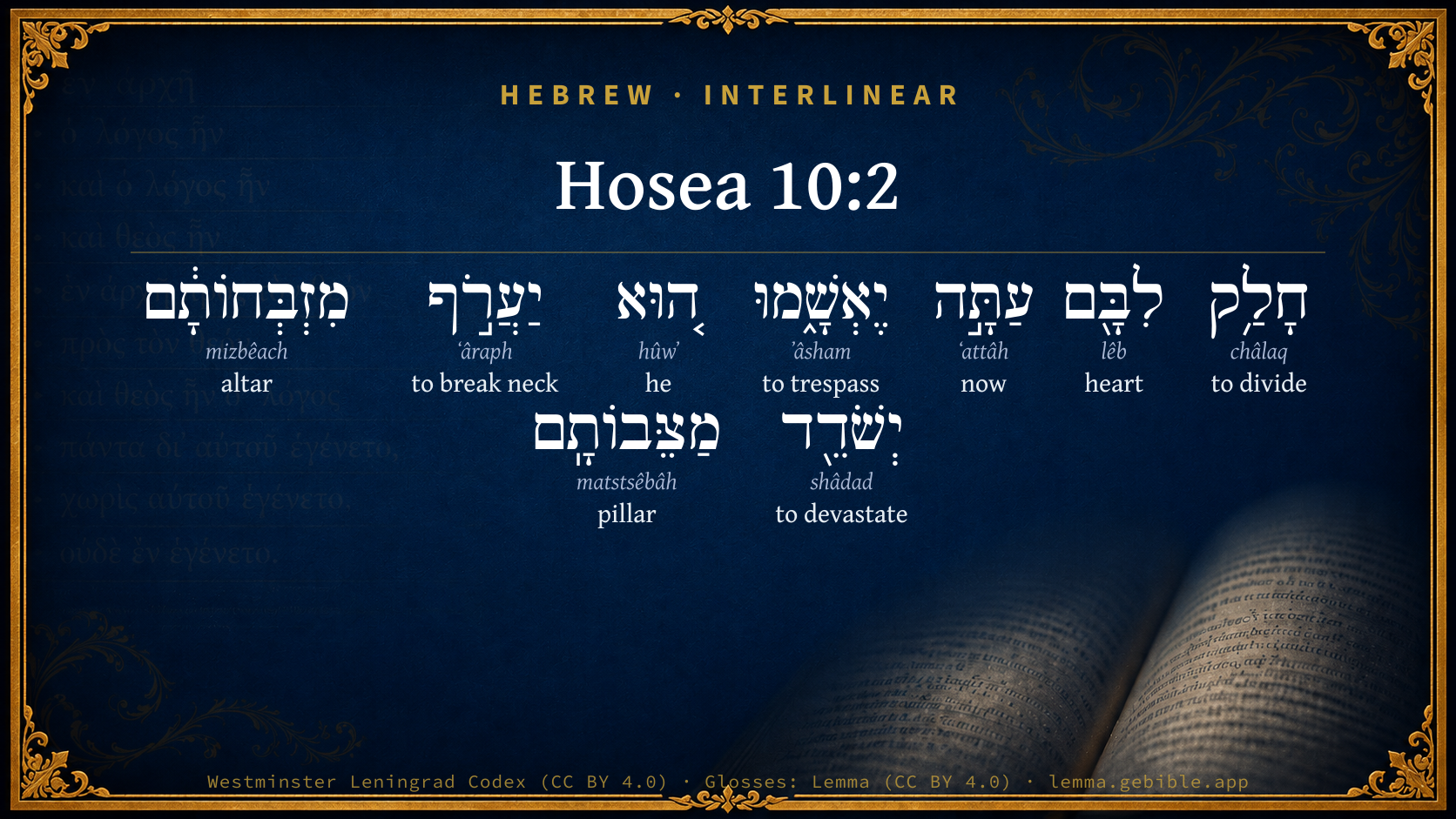
Hebrew (Westminster Leningrad Codex) Hosea 10:2 appears in the Hebrew Old Testament. The text above is from the Westminster Leningrad Codex. Each word links to its Strong’s number, a concise gloss, and parsing drawn from the Open Scriptures Hebrew Bible morphology. Click any word for its full Brown-Driver-Briggs (BDB) entry.
Download image
Cite this verse

Hosea 10:2 (World English Bible). Public Domain. Lemma interlinear Bible study tool, https://lemma.gebible.app/v/hosea/10/2.

Show BibTeX & RIS
BibTeX
RIS
English Translation
Their heart is divided. Now they will be found guilty. He will demolish their altars. He will destroy their sacred stones.
World English Bible · Public Domain
Download a study sheet

One document with this verse’s original text, its word-by-word gloss line, the meaning frame, cross-references with their text, attributed commentary, and full source and license credits — printable, and it pastes into notes with its structure intact.

This verse Autodidact and up

Study sheet (.html) Plain text (.txt)

A passage Seminary Student

Up to 50 verses in one chapter. A passage sheet keeps up to 6 commentary sources and 12 cross-references per verse, in the order this page ranks them, and says so on the sheet whenever that leaves anything out. Ask for a single verse and you get the Autodidact verse sheet above.

Everything on this page stays free to read, with no account — the sheet is a download of what is already on screen, not access to it.

Want to remove ads? Support Godless Engineer
Compare translations 3

The same verse in 3 English versions, stacked beneath the original-language interlinear above. Click any original word for its lexicon entry.

Each is an independent rendering of the whole verse — the interlinear is not word-aligned to these translations.

Highlighted words mark where these versions differ — a whole-verse word diff, not a word-by-word alignment.

  • World English Bible Public Domain
    Their heart is divided. Now they will be found guilty. He will demolish their altars. He will destroy their sacred stones.
  • King James Version Public Domain
    Their heart is divided; now shall they be found faulty: he shall break down their altars, he shall spoil their images.
  • unfoldingWord Literal Text CC BY-SA 4.0
    Their heart is slippery; now they will bear guilt. He, he will break the neck of their altars; he will destroy their pillars.

unfoldingWord Literal Text — © unfoldingWord, licensed CC BY-SA 4.0. Word-aligned USFM3 via Door43 (git.door43.org/unfoldingWord/en_ult).

Versions to compare (up to 4)

3 of 4 selected

Show all 18 translations

Every available English version of this verse, each an independent rendering of the whole verse.

  • World English Bible Public Domain
    Their heart is divided. Now they will be found guilty. He will demolish their altars. He will destroy their sacred stones.
  • Berean Standard Bible Public Domain
    Their hearts are devious; now they must bear their guilt. The LORD will break down their altars and demolish their sacred pillars.
  • Majority Standard Bible Public Domain
    Their hearts are devious; now they must bear their guilt. The LORD will break down their altars and demolish their sacred pillars.
  • King James Version Public Domain
    Their heart is divided; now shall they be found faulty: he shall break down their altars, he shall spoil their images.
  • American Standard Version (1901) Public Domain
    Their heart is divided; now shall they be found guilty: he will smite their altars, he will destroy their pillars.
  • Revised Version (1885) Public Domain
    Their heart is divided; now shall they be found guilty: he shall smite their altars, he shall spoil their pillars.
  • Geneva Bible (1599) Public Domain
    Their heart is deuided: nowe shall they be founde faultie: he shall breake downe their altars: he shall destroy their images.
  • Douay-Rheims (1899) Public Domain
    Their heart is divided: now they shall perish: he shall break down their idols, he shall destroy their altars.
  • Young's Literal Translation Public Domain
    Their heart hath been divided, now they are guilty, He doth break down their altars, He doth destroy their standing-pillars.
  • Literal Standard Version CC BY-SA 4.0
    Their heart has been divided, now they are guilty, || He breaks down their altars, || He destroys their standing-pillars.
  • Unlocked Literal Bible CC BY-SA 4.0
    Their heart is deceitful; now they must bear their guilt. Yahweh will demolish their altars; he will destroy their pillars.
  • unfoldingWord Literal Text CC BY-SA 4.0
    Their heart is slippery; now they will bear guilt. He, he will break the neck of their altars; he will destroy their pillars.
  • Darby Bible Public Domain
    Their heart is divided; now shall they be found guilty: he will break down their altars, he will destroy their statues.
  • World Messianic Bible Public Domain
    Their heart is divided. Now they will be found guilty. He will demolish their altars. He will destroy their sacred stones.
  • Webster's Bible Public Domain
    Their heart is divided; now shall they be found faulty: he shall break down their altars, he shall spoil their images.
  • Free Bible Version CC BY-SA 4.0
    The people have minds that are deceptive, and now they must take responsibility for their guilt. The Lord will break apart their altars and destroy their sacred pillars.
  • Bible in Basic English Public Domain
    Their mind is taken away; now they will be made waste: he will have their altars broken down, he will give their pillars to destruction.
  • JPS Tanakh (1917) Public Domain
    Their heart is divided; now shall they bear their guilt; He will break down their altars, He will spoil their pillars.

Literal Standard Version (2020), Covenant Press — licensed CC BY-SA 4.0. Text via the HelloAO Bible API (eBible.org). Unlocked Literal Bible (unfoldingWord) — licensed CC BY-SA 4.0. Text via the HelloAO Bible API (eBible.org). unfoldingWord Literal Text — © unfoldingWord, licensed CC BY-SA 4.0. Word-aligned USFM3 via Door43 (git.door43.org/unfoldingWord/en_ult). Free Bible Version, Dr. Jonathan Gallagher — licensed CC BY-SA 4.0. Text via the HelloAO Bible API (eBible.org).

Word by word

More ways to search: Search by grammar → Find every occurrence → Compare this word →

Practice this passage: Drill this verse → Learn its vocabulary →

יַעֲרֹ֣ף
ʻâraph
H6202
“to break neck”
Verb, Qal, Imperfect, 3rd Person, Masculine, Singular
Part of Speech
Verb
Stem
Qal
Form
Imperfect
Person
3rd Person
Gender
Masculine
Number
Singular
Full BDB Definition

Origin: a primitive root [identical with H6201 through the idea of sloping]

TWOT: 1700

(Qal) to break the neck (of an animal)
  1. חָלַ֥ק châlaq H2505 “to divide” Verb, Qal, Perfect, 3rd Person, Masculine, Singular
  2. לִבָּ֖ם lêb H3820 “heart · their” Noun, Common, Masculine, Singular, Construct + Suffix, Personal, 3rd Person, Masculine, Plural
  3. עַתָּ֣ה ʻattâh H6258 “now” Adverb
  4. יֶאְשָׁ֑מוּ ʼâsham H816 “to trespass” Verb, Qal, Imperfect, 3rd Person, Masculine, Plural
  5. ה֚וּא hûwʼ H1931 “he” Pronoun, Personal, 3rd Person, Masculine, Singular
  6. מִזְבְּחוֹתָ֔ם mizbêach H4196 “altars · their” Noun, Common, Masculine, Plural, Construct + Suffix, Personal, 3rd Person, Masculine, Plural
  7. יְשֹׁדֵ֖ד shâdad H7703 “to devastate” Verb, Poel, Imperfect, 3rd Person, Masculine, Singular
  8. מַצֵּבוֹתָֽם matstsêbâh H4676 “pillars · their” Noun, Common, Feminine, Plural, Construct + Suffix, Personal, 3rd Person, Masculine, Plural

About this verse

These counts appear in no published source. They are computed here, from the morphology-tagged text and Lemma’s own curated glosses. What Lemma adds →

9
words
9
distinct lemmas
Prophets
section

Notable vocabulary

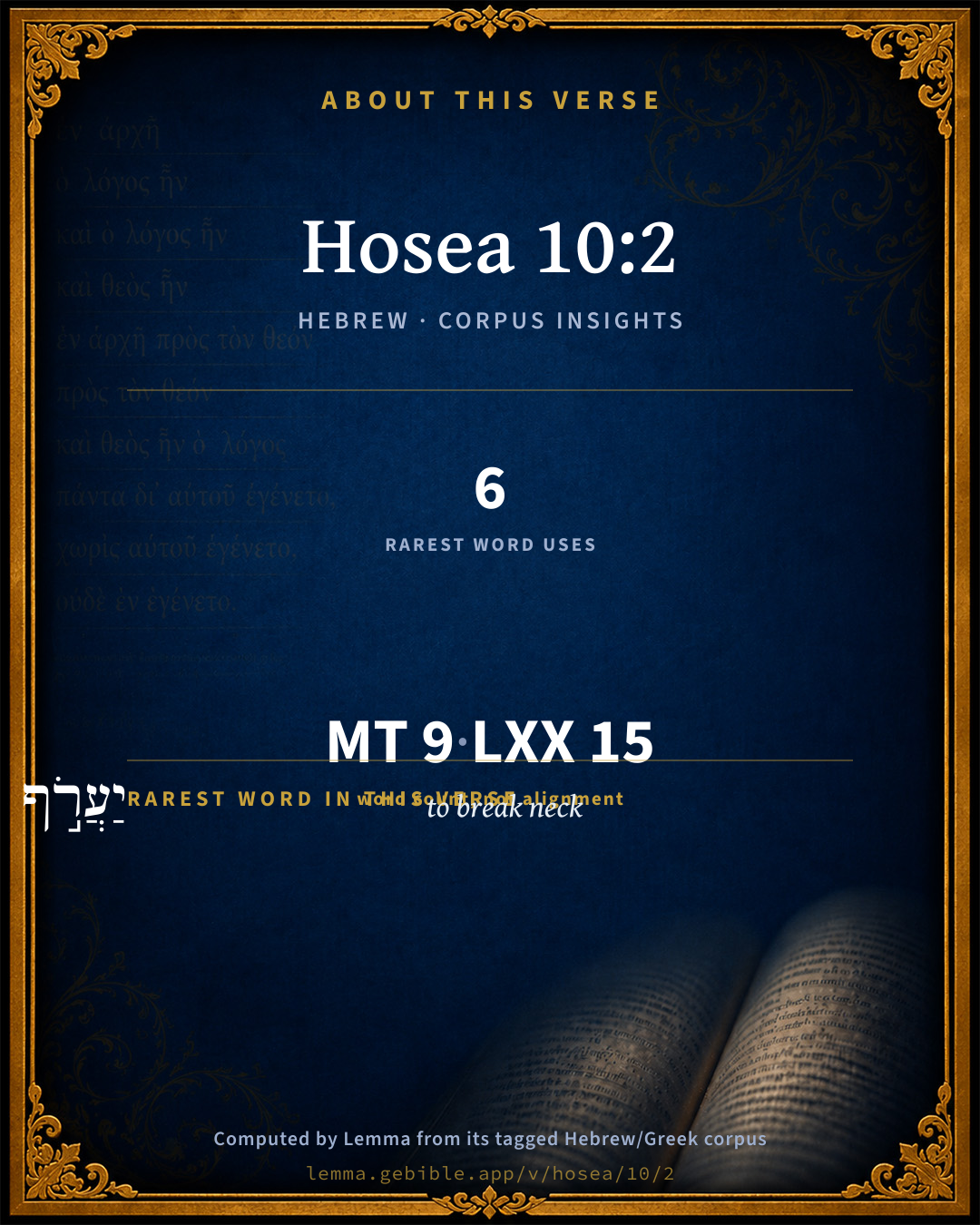
The rarest word here is יַעֲרֹ֣ף to break neck H6202 — appearing just 6 times in the whole Hebrew Bible.

Shared distinctive vocabulary

יַעֲרֹ֣ף to break neck H6202 occurs in 6 verses of the Hebrew Bible. Also found in:

Grammatical profile

  • 4 verbs
  • 3 nouns
  • 1 pronoun
  • 1 adverb

Verb forms

  • חָלַ֥ק Qal · Perfect
  • יֶאְשָׁ֑מוּ Qal · Imperfect
  • יַעֲרֹ֣ף Qal · Imperfect
  • יְשֹׁדֵ֖ד Poel · Imperfect

Hebrew & Septuagint length

In English translation the verse runs 21 words from the Hebrew and 21 from the Septuagint (LXX English) — the same length.

A rough comparison of the two English renderings, which tokenize alike — not a word-level alignment.

Word counts can differ between the Hebrew and the Greek without any difference in meaning — e.g. the Hebrew direct-object marker אֵת has no separate Greek word, and Greek often adds the article ὁ.

In the original languages it is 9 Hebrew tokens and 15 Greek tokens — but the two are counted differently (Hebrew bundles its prefixes and suffixes into one token; the Greek is in lemma form), so that isn’t a like-for-like length.

Cross-references

18

Topical passages linked to Hosea 10:2 in the Treasury of Scripture Knowledge — connected by theme and wording, ordered by reader-vote popularity; previews shown in the World English Bible.

  • 1 Kings 18:21 Elijah came near to all the people, and said, "How long will you waver between the two sides? If Yahweh is God, follow him; but if Baal, then follow him." The people answered him not a word.
  • Micah 5:13 I will cut off your engraved images and your pillars out of your midst; And you shall no more worship the work of your hands.
  • James 4:4 You adulterers and adulteresses, don't you know that friendship with the world is enmity with God? Whoever therefore wants to be a friend of the world makes himself an enemy of God.
  • Zephaniah 1:5 those who worship the host of the sky on the housetops, those who worship and swear by Yahweh and also swear by Malcam,
  • Luke 16:13 No servant can serve two masters, for either he will hate the one, and love the other; or else he will hold to one, and despise the other. You aren't able to serve God and mammon."
  • James 1:8 He is a double-minded man, unstable in all his ways.
  • Revelation 3:15–16 "I know your works, that you are neither cold nor hot. I wish you were cold or hot.
  • 1 Samuel 5:4 When they arose early on the next day morning, behold, Dagon was fallen on his face to the ground before the ark of Yahweh; and the head of Dagon and both the palms of his hands [lay] cut off on the threshold; only [the stump of] Dagon was left to him.
  • Isaiah 44:18 They don't know, neither do they consider: for he has shut their eyes, that they can't see; and their hearts, that they can't understand.
  • Jeremiah 43:13 He shall also break the pillars of Beth-shemesh, that is in the land of Egypt; and the houses of the gods of Egypt shall he burn with fire.
  • Hosea 7:8 Ephraim, he mixes himself among the nations. Ephraim is a pancake not turned over.
  • Hosea 8:5–6 Let Samaria throw out his calf-idol! My anger burns against them! How long will it be before the are capable of purity?
  • Hosea 10:5–8 The inhabitants of Samaria will be in terror for the calves of Beth Aven; For its people will mourn over it, Along with its priests who rejoiced over it, For its glory, because it has departed from it.
  • Hosea 13:16 Samaria will bear her guilt; For she has rebelled against her God. They will fall by the sword. Their infants will be dashed in pieces, And their pregnant women will be ripped open."
  • Zechariah 13:2 It will come to pass in that day, says Yahweh of Hosts, that I will cut off the names of the idols out of the land, and they will no more be remembered; and also I will cause the prophets and the spirit of impurity to pass out of the land.
  • Matthew 6:24 "No one can serve two masters, for either he will hate the one and love the other; or else he will be devoted to one and despise the other. You can't serve both God and Mammon.
  • 2 Thessalonians 2:11–12 Because of this, God sends them a working of error, that they should believe a lie;
  • 1 John 2:15 Don't love the world, neither the things that are in the world. If anyone loves the world, the Father's love isn't in him.

Cross-references courtesy of OpenBible.info (CC BY 4.0).

Hebrew and Greek witnesses Masoretic Hebrew ↔ Greek Septuagint

The same verse in the two great witnesses to the Old Testament, shown verse-for-verse.

These are two independent witnesses, not word-aligned to each other, and the Septuagint is shown in lemma (dictionary) form.

Hebrew Hosea 10:2 Masoretic · Westminster Leningrad Codex

חָלַ֥ק לִבָּ֖ם עַתָּ֣ה יֶאְשָׁ֑מוּ ה֚וּא יַעֲרֹ֣ף מִזְבְּחוֹתָ֔ם יְשֹׁדֵ֖ד מַצֵּבוֹתָֽם

Their heart is divided. Now they will be found guilty. He will demolish their altars. He will destroy their sacred stones.

World English Bible · Public Domain

Greek LXX Hosea 10:2 Septuagint · lemma form

μερίζω καρδία αὐτός νῦν ἀπο ἀναἵζω αὐτός κατασκάπτω ὁ θυσιαστήριον αὐτός ταλαιπωρέω ὁ στήλη αὐτός

They have divided their hearts; now shall they be utterly destroyed: he shall dig down their altars, their pillars shall mourn.

LXX2012 (modern English Septuagint) · Public Domain

On this verse, Ellicott's Commentary for English Readers discusses the Septuagint’s reading. Read the note in Commentary ↓

Hebrew: Westminster Leningrad Codex (CC BY 4.0). Greek: Septuagint (public domain); English from LXX2012 (modern English Septuagint) (Public Domain). How the Septuagint differs from the Hebrew →

Targum (Aramaic paraphrase)

1

The Targum is the ancient Jewish Aramaic paraphrase of the Hebrew Scriptures — an interpretive translation, not the Hebrew text itself. Onkelos (literal) and Pseudo-Jonathan (expansive) render the Torah, and Jonathan the Prophets. Coverage is partial: where no permissively-licensed English translation exists for a verse, only the Aramaic is shown. This is verse-level text, not a word-by-word alignment to the Hebrew.

  1. Targum Jonathan Prophets (Joshua–Malachi)
    אִתְפְּלַג לִבְּהוֹן מִן אוֹרַיְתָא כְּעַן יְחוֹבוּן כְּעַן אַיְתֵי עֲלֵיהוֹן סְנָאָה יְחַזֵר קְדַלְהוֹן דֶאֱגוֹרֵיהוֹן יִבּוֹז קָמָתְהוֹן:

    (no public-domain English translation for this verse)

    Targum Jonathan — Aramaic: “Mikraot Gedolot” (public domain). English: “Sefaria Community Translation” (CC0 1.0 (public-domain dedication)); “London "Chaldee Paraphrase," 1871” (public domain). Text via Sefaria.

Commentary

Notes on Hosea 10:2 from classic Christian and Jewish commentators (each source and its license shown beneath its notes). The classic Christian expositions comment on the surrounding passage and are grouped to its opening verse, so a note may address several verses; the Jewish commentaries on the Tanakh (Rashi and others) are per-verse, so they appear only where the commentator wrote on this verse.

Lemma curates 59 commentaries, every one of them public domain or Creative Commons licensed, each selected and text-cleaned for this edition rather than reprinted as found. About our sources →

Trapp's Complete Commentary

John Trapp

Hos 10:2 Their heart is divided; now shall they be found faulty: he shall break down their altars, he shall spoil their images.

Ver. 2. Their heart is divided] sc. from God; whose soul therefore is justly disjointed from them, Jer 6:8. They professed to worship the true God, and yet they transferred the honour due to him alone upon dumb idols; they halted between two, and would needs serve two lords; but God would have none of that. "Be the gods of the heathen good fellows," saith one, "the true God is a jealous God, and will not part stakes with another." The double-minded man is not for his service; for he will be served truly, that there be no halting; and, totally, that there be no halving. Good therefore and worthy of all acceptation is the counsel of St James to such, Jas 4:8, "Cleanse your hands, ye sinners; and purify your hearts, ye doubleminded," or ye cloven-hearted, διψυχοι. Out with the corruption that cleaveth to your hearts; and then there will be a constance and evenness in your minds, mouths, and manners; which is absolutely necessary to such as draw nigh to God in holy duties, and the contrary abominable, Isa 29:13.

Now shall they be found faulty] Sinners against their own souls, procurers of their own ruth and ruin. And this they shall so clearly be convinced of (as afflictio dat intellectum, smart makes wit), that they shall cry out, with Joseph’s brethren, We are verily guilty, Gen 42:21, and conscience awakened, shall answer as Reuben in the next verse, "Spake I not unto you, saying, Do not sin" (O do not this abominable thing): "and ye would not hear?" Did not the prophets foretell you what would be the fruit of your idolatries? did they not even slit up your hearts with the sacrificing knife of God’s word (sharper than any two-edged sword), and lay all your evil thoughts naked and open, or dissected, quartered, and cleft in the backbone (as the apostle’s word, τετραχηλισμενα, signifieth, Heb 4:13), but ye would not then be convinced of all, and falling down upon your face, worship God, as 1Co 14:24-25? Now you are found faulty, or guilty, and cry peccavi; I have sinned, or now you are, that is, shortly ye shall be, wasted and desolated, as some render it; or now shall they die ( interibunt, so the Vulgate), shall they perish; how should they do otherwise whose heart, that seat of life, is cut in twain; and whom the jealous and just God will cut in twain (διχοτομησει), tearing their souls from their bodies by death, Satan’s slaughter man, and appointing them their portion with hypocrites, Mat 24:51.

He shall break down their altars] He, that is, God, my God, Hos 9:17, for this chapter is a continuation of that (though Gualter makes it the beginning of Hosea’s seventh sermon). He, that excelleth he, that Aph-hu, 2Ki 2:14. Even he, proved by five reasons to be one of God’s attributes, by Mr Weemiss in his exposition of the moral law, Part I p. 162. Vide sis. Others render it thus: It shall break down their altars, Ipsum cor. It, that is, their heart (which indeed is the next antecedent), and happy had it been for them if their heart, divided from their wickedness, had been active in breakng down their altars in the prophet Isaiah’s sense, Isa 27:9, as a fruit of their true repentance: "By this therefore," that is, by their affliction sanctified, "shall the iniquity of Jacob be purged; and this is all the fruit" (and good fruit too) "to take away his sin; when" (in testimony of his sound repentance and self-abhorrency for former idolatry) "he maketh all the stones of the altar as chalk-stones that are beaten in sunder, the groves and images shall not stand up." But it appears not anywhere that Israel was so well affected, though grievously afflicted; that his divided heart prompted him to any such holy practice. Rather it brought ruin upon him to the decolling of his altars and spoiling of his images (which he so doted on and delighted in), and so might well say to him, as Apollodorus the tyrant’s heart did, who dreamed one night that he was flayed by the Scythians, and boiled in a caldron; and that his heart spake to him out of the kettle; It is I that have drawn thee to all this: thou mayest thank me for all, ‘Eγω σοι τουτων αιτια..

John Trapp, A Commentary or Exposition upon All the Books of the Old and New Testament (1647–1656) — public domain. Text from a community e-Sword module.

The Biblical Illustrator

Joseph S. Exell

Hos_10:2

Their heart is divided; now shall they be found faulty.

A divided heart

It is one grievous fault with the Church of Christ at the present day, that it is not merely divided somewhat in its creed, and somewhat also in the practice of its ordinances, but, alas! it is also somewhat divided in heart. When our doctrinal divisions grow to so great a head that we cease to co-operate, when our opinions upon mere ordinances become so acid towards each other that we can no longer extend the right hand of fellowship to those who differ from us, then indeed is the Church of God found faulty. Even Beelzebub, with all his craft, cannot stand when once his hosts are divided. The smallest church in the world is potent for good when it hath but one heart and one soul; when pastor, elders, deacons, and members are bound together by a threefold cord which cannot be broken. Union is strength. By union we live, and by disunion we expire. Apply the text to our individual condition.

I. A fearful disease. Their heart is divided.

1. The seat of the disease. It affects a vital part, a part so vital that it affects the whole man. There is no power, no passion, no motive, no principle which does not become vitiated when once the heart is diseased.

2. The disease touches this vital part after a most serious fashion. The heart is cleft in twain. Nothing can go right when that which should be one organ becomes two; when the one motive power begins to send forth its life-floods into two diverse channels, and so creates intestine strife and war.

3. It is a division in itself peculiarly loathsome. Men who are possessed of it do not feel themselves unclean; they will venture into the church, they will propose to receive her communion, and they will afterwards go and mingle with the world; and they do not feel that they have become dishonest. Take the glass and look into that mans heart, and you will discern that it is loathsome, because Satan and sin reign there. All the while that he is living in sin he is pretending that he is a child of God. Stand out in thy true colours. If thou art a worldling, be a worldling.

4. It is a disease always difficult to cure, because it is chronic. It is not an acute disease, which brings pain and suffering and sorrow with it. But it is chronic, it has got into the very nature of the man. What physician can join together a divided heart?

5. This disease is a very difficult one to deal with, because, it is a flattering disease. The most cunning of all flatterers is a mans own heart. A mans own heart will flatter him, even about his sins. He is contented and self-satisfied.

II. The usual symptoms of the disease.

1. Formality in religious worship. These men have no faith; they have only a creed. They have no life within, and they supply its place with outward ceremony. What wonder, therefore, that we fiercely defend that!

2. Inconsistency. You must not see him always if you would have a good opinion of him. You must be guarded as to the days on which you call upon him. You must have a divided heart if you live an inconsistent life.

3. Variableness in object. There are men who run first in one direction then in another. Their religion is all spasmodic. They are taken with it as men are taken with the ague. They take up with religion, and then they lay it down again.

4. Frivolity in religion is often a token of a divided heart. It is perhaps too common a sin with young persons to treat religion with a light and frivolous air. There is a seriousness which is well-becoming, especially in youthful Christians.

III. The sad effects of a divided heart. When a mans heart is divided he is at once everything that is bad.

1. With regard to himself, he is an unhappy man. Men who are neither this nor that, neither one thing nor another, are always uneasy and miserable.

2. He is useless in the Church. Of what good is such a man to us? We cannot put him in a pulpit or make him a deacon. We cannot commit to his charge spiritual matters, because we discern that he is not spiritual himself. We know that no man who is not united in his heart vitally and entirely to Christ can ever be of the slightest service to the Church of God.

3. He is dangerous to the world. He is like a leper going abroad in the midst of healthy people; he spreads the disease. Though outwardly whitewashed like a sepulchre, he is more dangerous to the world than the most vicious of men.

4. He is contemptible to everybody. When he is found out nobody receives him; scarcely will the world own him, and the Church will have nothing to administer to him but censure.

5. He is reprobate in the sight of God. To the eye of infinite purity he is one of the most obnoxious and detestable of beings. The holy God both hates his sin and the lies with which he endeavours to cover it.

IV. The future punishment of the man whose heart is divided. Unless he is rescued by a great salvation. Let me describe the terrible condition of the hypocrite when God shall come to judge the world. (C. H. Spurgeon.)

The divided heart

The root of the evil in Israel was, as always, a heart divided,--that is, between God and Baal,--or, perhaps, smooth, that is, dissimulating and insincere. In reality, Baal alone possesses the heart which its owner would share between him and Jehovah. All in all, or not at all is the law. Whether Baals or calves were set beside God, He was equally deposed. Then with a swift turn Hosea proclaims the impending judgment, setting himself and the people as if down in the future. He hears the first peal of the storm, and echoes it in that abrupt now. The first burst of the judgment scatters dreams of innocence, and the cowering wretches see their sin by the lurid light. That discovery awaits every man whose heart has been divided. To the gazers and to himself masks drop, and the true character stands out with appalling clearness. What will that light show us to be? The ruin of their projects teaches godless men at last that they have been fools to take their own way; for all defences, resources, and protectors, chosen in defiance of God, prove powerless when the strain comes. It is a dismal thing to have to bear the brunt of chastisement for what we see to have been a blunder as well as a crime. (A. Maclaren, D. D.)

Antagonistic principles

Solomon wanted to live a life of self-indulgence while posing as a servant of God. His offering costly sacrifices, and building a magnificent temple, and making a beautiful prayer, could not rectify the inconsistency. The two could not exist together in one person. It was like the ice palace built for an empress of Russia, which was beautiful as a dream, with elaborate architecture, and glistening like a jewel in the sun. But it was intensely cold, and the empress ordered a fire to be built in it. The architect had to explain to her that the fire would destroy the building. She could not have an ice palace and warmth at the same time. Neither can any one have a heart of icy selfishness along with the warmth of Gods love. (Christian Herald.)

A divided heart

You know there is what is called changeable silk, which looks now green and now brown, just as the light chances to strike it. It is neither brown nor green, as a matter of fact, but a commingling and compromise of the two: therefore you can get whichever colour you like, according as you present it to the sun. And I am sorry to say that it is so with a good many Christians. You can get a worldly shade or a heavenly shade on their piety, just according to the company they are in. (A. J. Gordon.)

Divided hearts

We are told that some of our scientists have recently been trying a very doubtful experiment. They take a section of one creature and fasten it upon another creature of an altogether different type. This is done by a delicate surgery when the creature is immature, and when it comes to perfection you have a strange monster. For instance, it is said that they fasten a section of a spider on the butterfly, and by and by you get an alarming and tragical organism. You may imagine what becomes of those antagonistic impulses and instincts. The creature has a feeling for the light and a passion for the darkness; it has a taste for blood, and loves the scent of roses; is afraid of itself and worries itself. Now, when you have seen the spider and the butterfly blended into one organism, you have seen a pale reflection of your own personality. One part of us sympathises with the low and another part with the lofty; one part of us looks into the firmament and another part cleaves to the dust. (W. L. Watkinson.)

A divided heart

In every age and country there are some found with divided hearts on the subject of religion. Such was Hiram, King of Tyre, who, while he blessed the Lord that Solomon was king, and gladly traded with him for some of the materials for building a temple to Jehovah, also contributed one hundred and twenty talents of gold towards its erection. And yet, in his own country, he dedicated a golden pillar to Jupiter, built the temples of Hercules and Astarte, the Ashtaroth of the Zidonians, and enriched the shrines of the god and goddess with valuable gifts. So Redwald, the King of East Anglia, when converted to Christianity, is said to have kept two altars, the one to the God of the Christians, the other to Woden, a Saxon idol, being afraid of the imaginary god whom he had so long worshipped. So there are some now, who appear very religious at times, and yet their hearts go after covetousness, and they are quite at home in the circles of the gay and in the indulgence of sinful pleasure.

Judgment on the divided heart

1. As the heart is a vital part, which cannot be divided without death, so men can have no life of God, nor acknowledgment of Him, when they are not solely and wholly for Him and His way.

2. When men do fall from Gods way, it is just with Him to give them up to start and multiply divisions without end in their own way.

3. Civil dissensions and commotions are the just fruits of mens divisions in the matter of God and His worship. (George Hutcheson.)

The Biblical Illustrator, edited by Joseph S. Exell (c. 1880s–1900s) — public domain. Text from a community e-Sword module.

Joseph Benson's Commentary

Hos 10:2-3. Their heart is divided — Between God and their idols, or between God and the world. Now shall they be found faulty — As this was their sin, so it is here threatened, that the effects thereof should prove, and be an open manifestation of their guilt. The Hebrew עתה יאשׁמו, may be rendered, now shall they be punished, or, treated as guilty. So the Vulgate, nunc interibunt, now, that is, forthwith, shall they perish. He shall break down their altars, &c. — That is, God shall cause their idolatrous altars to be broken down, namely, by the Assyrians. For now they shall say — They shall see and feel, and be compelled to own; We have no king — Absolutely none, or no such king as we need and expected. This is thought by some commentators to relate to the time of anarchy, or the interregnum which continued for eight or nine years between the murder of Pekah and the settlement of Hoshea on the throne; because we feared not the Lord — They shall be sensible that their forsaking the Lord for idols, and their casting off his fear, is the true cause of all their calamities; and particularly of their being deprived of the blessing of a wise, just, and good civil government. What then — Or rather, But what should a king do for us? A king could not save us without the help of God. The verse, however, seems rather to refer to the time of their captivity, and the sense probably is, “After Israel shall be carried captive into the country of their enemies, and shall have no king over their nation, they shall then acknowledge that this misfortune has happened to them through their own fault, and because they have not feared the Lord. And they shall acknowledge that it would profit them nothing to have kings, without having also the protection of God.” — Calmet.

Joseph Benson's Commentary on the Old and New Testaments (1811–1818) — public domain. Text from a community e-Sword module.

Geneva Bible (1599)

Geneva Bible translators

To wit, from God.

Geneva Bible (1599) marginal notes — public domain. Text via Bolls.life.

Jamieson, Fausset & Brown

Robert Jamieson, A. R. Fausset & David Brown

heart . . . divided-- (Kg1 18:21; Mat 6:24; Jam 4:8).

now--that is soon.

he--Jehovah.

break down--"cut off," namely the heads of the victims. Those altars, which were the scene of cutting off the victims' heads, shall be themselves cut off.

Jamieson, Fausset & Brown — Commentary Critical and Explanatory on the Whole Bible (1871) — public domain (CC PDM 1.0). Text via the HelloAO Bible API.

Adam Clarke's Commentary

Verse 2. Their heart is divided] They wish to serve God and Mammon, Jehovah and Baal: but this is impossible. Now GOD will do in judgment what they should have done in contrition, "break down their altars, and spoil their images."

Adam Clarke's Commentary on the Bible (1810–1826) — public domain. Text from a community e-Sword/MySword module.

John Calvin's Commentaries

He says first that their heart was divided, that is, from God; for this, we know, is principally required, that people should faithfully cleave to their God. “And now Israel, what does thy God require of thee, but to cleave to him with the whole heart?” Since God then binds us to himself by a holy union, it is the summit of all wickedness, when our heart is divided from him, as it is when an unchaste and perfidious wife alienates her affection from her husband. For as long as the husband keeps the heart of his wife, as it were, tied to himself, conjugal fidelity and chastity continue; but when her heart is divided from her husband, it is all over, and she abandons herself to lewdness. So also the Prophet says here that the heart of the people was divided from God; for they did not devote themselves to God with a pure and sincere affection, as they ought to have done. “This people then have withdrawn their heart from me.”

But he says, Now they shall be guilty; that is I will now show what they deserve, so that they shall not hereafter, as they are wont to do, sport with their cavils; for the verb אשם, ahsem, is not to be referred to the deeds but rather, as, they say, to its manifestation. Then he says that they shall be guilty, for they shall be convicted: as, to be justified means to be absolved, so also to be guilty means to be condemned. The meaning is, that as this people could not perceive the Lord’s wrath as long as their condition was easy to be borne, he would inflict such dreadful punishment as would convince them, so that they might no longer deceive and flatter themselves. They shall then be now condemned. How? For the Lord will overturn their altars. This may be referred to the minister of vengeance; but as no name is expressed, I prefer to understand God as being meant. God then shall overturn their altars and destroy, or reduce to nothing, their statues

This was added, because ungodly men, we know, trust in their own devices, and can never be brought to serious fear, except when they understand that they have been deceived by the crafts of Satan, while they gave themselves up to superstitions and idolatry. Hence the Prophet declares that their altars shall be overturned, and their statues reduced to nothing, that hypocrites might lay aside the confidence by which they had hitherto grown proud against God. But a confirmation of this view follows —

John Calvin's Commentaries (1540-1563) — public domain. Text from the Calvin Translation Society English edition (1840s-50s) via the Christian Classics Ethereal Library (ccel.org). Calvin's coverage is partial (roughly two-thirds of the Bible); uncommented books and verses are honest gaps, never fabricated. The 19th-century editor's footnotes and remarks are omitted so the notes are faithfully Calvin's own voice.

Ellicott's Commentary for English Readers

(2) Their heart is divided is the rendering of the LXX., Raschi, Aben-Ezra, and most ancient versions. But modern expositors prefer to translate “Their heart is treacherous (smooth).” The rest of the verse should run thus:—Now shall they suffer punishment. He shall break (the horns of) their altars; he shall destroy their pillars.

A Bible Commentary for English Readers, edited by Charles John Ellicott (1878–1897) — public domain. Text from a community e-Sword module.

The Cambridge Bible for Schools and Colleges

gen. ed. J. J. S. Perowne

2. Their heart is divided] viz., between Jehovah and idols. But this, which involves an alteration of the points, gives too weak a sense for such a context. It is better to keep the ordinary pointing, and render, Their heart is slippery (or deceitful; lit. ‘is smooth’; comp. Eze_12:24 smooth, i.e. flattering, divination).

be found faulty] Rather, be dealt with as guilty (as Hos_13:16).

he shall break down, &c.] The phrase is a bold one; it is literally ‘he shall break the necks of the altars’, i.e. perhaps strike off their horns (Amo_3:14), and so destroy them. ‘He’ is emphatically expressed in the Hebrew, to indicate the unseen observer of their thoughts and actions.

The Cambridge Bible for Schools and Colleges (gen. ed. J. J. S. Perowne; Cambridge University Press, 1878–1918) — public domain. Text from a community e-Sword module.

John Gill's Exposition

Their heart is divided,.... Some say from Hoshea their king, who would have reformed them from their idolatry, and returned them to the true worship of God; but of that there is no proof; better from one another, their affections being alienated from each other, by their discords and animosities, their conspiracies against their kings, and the murders of them, and the civil wars among themselves; they also not being of one mind, but disagreeing in their sentiments about their idols; some being for one, and some for another: or rather from God himself, from the fear of him, from his worship and service; or from the law, as the Targum; or their hearts were divided between God and their idols, as in Ahab's time between God and Baal; they pretended to worship God when they worshipped the calves, and so shared the service between them; or it may be rendered, "their heart flatters" (r) them; as if they had done that which was right and good, and were guilty of no evil, nor would any punishment be inflicted on them:

now shall they be found faulty; be convicted of their sin and folly, and appear guilty; when they shall be punished for their idolatry, and their idols not able to save them, as the destruction of them next mentioned will fully evince: or, "now shall they become desolate" (s) their land shall be desolate, and they carried captive:

he shall break down their altars, he shall spoil their images: that is, the king of Assyria shall do all this, or God by him: or, "behead their altars" (t); take off the top of them, as the Targum; the horns of them, which might be made of gold, or other ornaments which were of value; and therefore became the plunder of the enemy; and who also would break in pieces their images, for the sake of the metal, gold or silver, of which they were made; as was usually done by conquerors, and to show their entire power over the conquered, that even their gods could not deliver them out of their hands.

(r) "adblanditur cor eorum", Schmidt. (s) "nunc desolabuntur", Pagninus, Montanus, Munster, Drusius; so Kimchi and Ben Melech. (t) "decollabit", Drusius, Piscator, Tarnovius, De Dieu; "decervicabit", Cocceius.

John Gill's Exposition of the Whole Bible (1746–1763) — public domain (CC PDM 1.0). Text via the HelloAO Bible API.

Albert Barnes' Notes on the Bible

Their heart is divided - Between God and their idols, in that they would not wholly part with either, as Elijah upbraided them, “How long halt ye between the two opinions?” 1Ki 18:21. When the pagan, by whom the king of Assyria replaced them, had been taught by one of the priests whom the king sent back, in order to avert God’s judgments, they still propagated this division. Like Jeroboam 2Ki 17:32-33, 2Ki 17:41, they became fearers of the Lord,” His worshipers, “and made to themselves out of their whole number (i. e., indiscriminately) priests of the high places. They were fearers of the Lord, and they were servers of their gods, according to the manner of the nations whom they carried away from thence. These nations were fearers of the Lord, and they were servers of their idols, both their children and their children’s children. As did their fathers, so do they unto this day.”

This divided allegiance was their hereditary worship. These pagan, as taught by one of the priests of Israel, added the service of God to that of their idols, as Israel had added the service of the idols to that of God. But God rejecteth such half service; from where he adds, “now,” in a brief time, all but come, “they shall be found faulty,” literally, “they shall be guilty,” shall be convicted of guilt and shall bear it. They thought to “serve at once God and Mammon;” but, in truth, they served their idols only, whom they would not part with for God. God Himself then would turn away all their worship, bad, and, as they thought, good. “He,” from whom their heart was divided, He Himself, by His mighty power which no man can gain-say, “shall break down their altars,” literally, shall “behead” them. As they out of His gifts multiplied their altars and killed their sacrifices upon them against His will, so now should the altars themselves, be demolished; and “the images” which they had decked with the gold which He had given, should, on account of that very gold, tempt the spoiler, through whom God would spoil them.

He shall break down - He Himself. The word is emphatic. : “God willeth not that, when the merited vengeance of God is inflicted through man, it should be ascribed to man. Yea, if anyone ascribeth to himself what, by permission of God, he hath power to do against the people of God, he draweth down on him the displeasure of God, and, at times, on that very ground, can hurt the less” (see Deu 32:26, Deu 32:7; Isa 10:5 ff). The prophet then says very earnestly, “He Himself shall break,” meaning us to understand, not the lofty hand of the enemy, but that the Lord Himself did all these things.

Albert Barnes' Notes on the Bible (1834–1885) — public domain. Text from a community e-Sword/MySword module.

Haydock's Catholic Bible Commentary

Divided between the Lord and idols, 3 Kings xviii. 21. (Calmet) --- The Jews relate that Osee, the last king of Israel, gave the people leave to go to Jerusalem; (4 Kings xvii. 2.) and as they would not take advantage of it, their ruin was decreed. (St. Jerome)

George Leo Haydock (1774–1849), Haydock's Catholic Family Bible and Commentary, 1859 edition — public domain. Excludes Psalms (Douay-Rheims chapter numbering differs from Protestant) and Deuterocanonical books (Catholic canon only).

Matthew Poole's English Annotations

Their heart is divided from God and his worship, or between God and Baal, such as Zep 1:5 speaks of, or else divided one from another by parties, and factions, and civil wars, which tended to their ruin.

Now shall they be found faulty; as this was their sin, so the effects hereof should manifestly prove them faulty.

He, either God, or the king of Assyria stirred up by God to invade and destroy Ephraim,

shall break down their altars; utterly pull down those altars which they had multiplied to their idols: the Assyrians shall, as other conquering heathen idolaters, rage against the gods of the people they conquer, as well as against the people; such was the pride and atheism of these men.

He shall spoil their images; waste or destroy them; how goodly soever they had seemed to be, yet they should be broken to pieces; and where made of rich materials, as silver and gold, or if adorned with it, the enemy should the sooner spoil them; and then it will appear how sottish this people were to trust in them, or ascribe any praise to them, when Baal cannot defend his own images or people.

Matthew Poole's English Annotations on the Holy Bible (1683–1685) — public domain. Text from a community e-Sword/MySword module.

The Pulpit Commentary

Their heart is divided. Here their wickedness is traced to its fountainhead; its source was in the corrupt state of the heart. Their heart was

(1) divided, and so they halted between two opinions between the worship of Jehovah and idolatry. Chalaq is taken in this signification by the Chaldee, Syriac, Septuagint, and Jerome, as also by the Hebrew commentators. The LXX have

(a) emerisen in the singular, which affords some support to Hitzig"s rendering, "He (God) divided their heart, but this is unsuitable and unscriptural; another

(b) reading of the same version is emerisan , "They have divided their hearts," which is somewhat better, yet incorrect.

(c) The Authorized Version is also questionable, as the verb is not used intransitively in Qal.

(2) Kimchi, indeed, understands chalaq as equivalent to niehloq in the Niphal, and interprets, "From the fear of God and from his Law their heart is divided," i.e. separated; similarly Rashi: "Their heart is divided from me;" Aben Ezra somewhat peculiarly, though to the same purport: "They (their heart) has not one part (but several),"or is divided. But, notwithstanding this consensus in favor of the meaning of "divide," the rendering preferred, and justly so, by modern expositors in general, is "smooth." This is, indeed, the primary sense, that of "divide" being secondary, as division was made by lot or a smooth stone, cheleq, used for the purpose.

(3) "Their heart is smooth," that is, bland, deceitful, hypocritical; though it must be admitted that the word is mostly applied to the tongue, lip, throat, mouth, speech, and not to the heart. Their heart was hypocritical and faithless. Now shall they be found faulty; rather, they shall be dealt with as such, or punished; better still, perhaps, is the rendering, now shall they atone. The now" defines sharply the turning-point between God"s love and God"s wrath. The state of things hitherto existing cannot continue; it must soon come to an end. Ere long they are doomed to discover their guilt in its punishment; they shall find out their sin by suffering; suddenly and to their cost they shall have a fearful awaking to a sense of their iniquity by the inflictions of Divine wrath upon their guilty heads. He shall break down their altars, he shall spoil their images. The verb pd is peculiar; being a denominative from pr, the neck, it signifies "to break the neck of," like the Greek trachlizein , decollate, then figuratively "tear down," "break in pieces." This bold expression of breaking the neck of the altars may allude to their destruction by breaking off the horns of the altars, or rather to their beheading, cutting off the heads of victims at those altars. The Hebrew expositors make the heart of the people, not God, the immediate object of the verb. Their heart," says one of them, "shall tear down their altars and lay waste their pillars, because it is divided from me. It will tear down their altars which they are said also to have multiplied, and lay waste their pillars which they made so goodly." The means of sinning shall be taken from them and destroyed their altars broken down and their images spoiled. As the heads of victims had been cut off at these altars erected for idolatrous worship; so the heads of their altars would be broken off.

HOMILIES BY A. ROWLAND Ver. 2 (first clause). The divided heart.

The preceding verse describes the sin of the people; this points us to its source. Like a vine, luxuriant in branch yet yielding no sound fruit, Israel deserved the curse which, during the ministry of our Lord, fell on the barren fig tree. The first verse may be compared advantageously with the description given of Israel in Psa_80:8-15. The third clause in that verse does not continue to develop the figure, but makes a declaration which was literally true, viz. that in proportion as the fields were fruitful Israel multiplied idolatrous altars; and as the land was made good, so the images they worshipped were adorned with beauty. In other words, God"s gifts were abused, and were dedicated, not to him, but to false gods. The fear of Moses was justified. Now they enjoyed the goodly land they were forgetting the Lord their God. Point out the enervating effect of prosperity in such men as Hezekiah, and in the decline and fall of great nations. The cause of Israel"s sin was to be found in the fact that they were not wholehearted in the worship of God; but while they kept up still the outward forms of the old religion, with "divided hearts" they mingled with it, or supported beside it, idolatrous practices. The question of Elijah, "How long halt ye between two opinions?" needed repetition in those days, and in these Our Lord has distinctly declared that the frequent and sinful attempt of men to serve God and mammon is vain. Subject The divided heart.

I ITS CONDITION first demands consideration. Whether in the physical or in the moral life of man, if we are in doubt about the state of our heart, we cannot be too careful in diagnosis. Diseases assail it which are so occult that they may not reveal themselves till they become fatal in result. Other diseases may have outward signs which any onlooker can recognize. Some heart-diseases are as insidious as they are perilous, betraying themselves neither by rash nor by pain. As the heart is the center of our physical life, so here and elsewhere in Scripture it is alluded to as the center of moral life; and in that aspect of it the words are true, "The heart is deceitful above all things." (Some such idea underlies the Hebrew word which Keil translates "smooth," or "flattering.") None but God and a man"s own consciousness can declare whether this be true of any one, "his heart is divided." This is so, however, with any whose attitude towards God and his truth is as follows:

(1) If their minds are convinced;

(2) if their fears are aroused;

(3) if their consciences are disturbed; while yet they yield no genuine homage to him whose existence and claims they dare not deny.

II ITS EVIDENCES may be discovered in such characteristics as these:

1. Formality in worship. "This people draweth nigh to me with their mouth," etc. "God is a Spirit: and they that worship him must worship him in spirit and in truth." The scribes and Pharisees were examples of this, exposed and rebuked by our Lord.

2. Inconsistency in conduct. This may be glaringly conspicuous, or it may be that the unholiness or unrighteousness is too secretly practiced to be discovered by the world, or too subtle to be described and condemned by the Church, or ten generally practiced to be reprobated by society. Give examples of each in professional, or commercial, or social life.

3. Fickleness in effort. It is a sure sign of reality when we are "steadfast and immovable, always abounding in the work of the Lord;" when the world frowns as well as when it smiles; when the service is uncongenial as well as when it is delightful. He who readily takes up Christian work and then suddenly abandons it, may fairly ask himself whether his heart is not divided. The great Sower still sees the shallow soil of a sentimental character, where there is no depth and therefore no stability.

III ITS CAUSES.

1. The love of sin. We must lay aside "the sin that doth so easily beset us" if we would run the race and win the crown. He who will not give sin up for Christ"s sake has the" divided heart.

2. The fear of man. The lad at school, or the man in business, is often disloyal to conviction, and refuses to lay to heart the declaration of Christ, "He that is not with me is against me.

3. The habit of procrastination. The child says, "I will wait till I am old enough to take my own place in life;" the busy man or woman waits the leisure of old age; the vigorous delay till illness gives time for thought; and so life speeds away, and the words of Christ are unheeded, "My son, give me thine heart.

IV ITS EFFECTS.

1. Present unhappiness. The undecided man knows too much to find rest in the world, but he loves too little to find rest in Christ. The consciousness of being wrong, the thought of a solemn duty left undone, the fear of discovery by Christian friends, the dread of death and its issue, with more or less frequency and intensity, bring him misery.

2. Disastrous influence. If he professes to be a Christian, he dishonors his Lord by his conduct in the world far more titan one who avows himself to be an unbeliever. His Christian name injures the world, while his worldly character injures the Church. Examples: Judas, Demas, Ananias.

3. Certain retribution. "Some will awake... to everlasting contempt." "Let both grow together to the harvest," etc.

CONCLUSION. Encouragement to offer to our God the broken heart of true penitence, which he will not despise. A.R.

HOMILIES BY J.R. THOMSON Ver. 2. A divided heart.

The history of the people of Israel furnishes many an illustration of the state of mind vividly depicted in these words. For instance, in the time of Elijah, the heart of Israel was divided between Jehovah and Baal. Hosed had to complain of the same distraction of mind as characteristic of the generation to which he ministered. And what congregation is there addressed by a Christian preacher which does not contain many "a divided heart"?

I THE CAUSES OF A DIVIDED HEART.

1. Others beside the Lord lay claim to the heart. In the case of Israel, there were idols who were reputed by neighboring nations to be powerful and helpful. In the case of those professing Christianity, there are many rivals, in the person of earthly and human claimants, and in the shape of various preoccupations, pleasures, and pursuits.

2. There is native weakness and vacillation. Many natures are by constitution unstable; and many have encouraged weakness by yielding to temptation.

II THE SYMPTOMS OF A DIVIDED HEART. The case is not that of one who has actually renounced and abjured the worship and service of the Lord. But in hesitating between the two different and inconsistent allegiances, the divided heart is faithful to neither. We meet with instances of such indecision in domestic and social life, There may be a vigorous intellect where there is a vacillating heart, affections easily won and easily lost, prone to transference hither and thither. And in religion we find persons who strive to serve God and mammon at the same time; or who seem to be earnest in the service of God, and shortly after equally devoted to the incompatible service of God"s enemy.

III THE MISCHIEFS OF A DIVIDED HEART.

1. It is ruinous to the individual nature. No man can live an inconsistent life, such as a divided heart involves, without moral deterioration. He loses self-respect and moral dignity.

2. It is injurious to society. Men respect decision, but they are repelled by its opposite, and they despise a professor of religion whose spirit and demeanor are inconsistent with his profession.

3. It is hateful to God, who says, "Give me thy heart," and who will accept no compromise or composition.

IV THE CURE FOR A DIVIDED HEART. The only cure is a radical and severe one. The heart must be withdrawn from God"s rivals, and yielded, without reserve and without delay, to him who has a right to it, and who claims it as his own. Prone to wander, Lord, I feel it; Prone to leave the God I love! Here"s my heart, Lord; take and seal it Seal it from thy courts above. T.

The Pulpit Commentary (1880–1919), ed. H.D.M. Spence-Jones & Joseph S. Exell — public domain. Text from a community e-Sword module.

John Wesley's Explanatory Notes

Is divided - From God and his worship. Faulty - As this was their sin, so the effects hereof should manifestly prove them faulty. He - God.

John Wesley, Explanatory Notes Upon the Whole Bible (1754–1765) — public domain. Text via the GEBible commentary corpus.

Rashi

Rabbi Shlomo Yitzchaki (Rashi)

Their heart has parted from Me.

now they shall be desolate. That is the thing that shall demolish (וְעָרְפוּ) thier altars, i.e., it will destroy them. This is an expression similar to (Deut. 21:4) “and they shall dehead (יַעֲרֹף)”; (Ex. 13:13) “and you shall behead it (וְעֲרַפְתּוֹ).” He will break their neck. Another explanation according to Midrash Aggadah: Peace is great, for, even if Israel worships idols, but there is peace among them, Satan does not bring charges against them, as it is said: (above 4:17) “Ephraim is joined: although he worships idols, let him alone.” Strife, however, is hated, as it is said: “Their heart has parted; now they will be guilty.” Satan can open his mouth to bring charges. [from unknown Midrashic source]

Rashi on the Tanakh — English translations: “The Judaica Press complete Tanach with Rashi, translated by A. J. Rosenberg” (CC BY 4.0); “Pentateuch with Rashi's commentary by M. Rosenbaum and A.M. Silbermann, 1929-1934” (public domain); “The Metsudah Tanach series, Lakewood, N.J” (CC BY 4.0); and “The Book of Joshua, Metsudah Publications, 1997” (CC BY 4.0). Text via Sefaria.

Lesson kit

Teaching starters — assembled from the data on this page, not authored interpretation. Every prompt links to the verse data it draws on. Edit before teaching.

Hosea, in the Prophets, opens this verse with 9 words (9 distinct Hebrew lemmas). Its most distinctive word is ʻâraph (“to break neck”). A historical commentator’s framing appears above. Read the whole chapter for the surrounding context.

Discussion questions

  1. The word ʻâraph carries the sense “to break neck.” How does it shape the verse?
  2. How does Exodus 13:13, which shares the word «to break neck», read alongside this verse?
  3. These translations render this verse differently; the difference is in the English rendering, not the original. What questions does that raise?
  4. «חָלַ֥ק» is a Qal Perfect verb. How does that grammatical form shape the action described?
  5. Compare how Trapp's Complete Commentary and The Biblical Illustrator read this verse. Where do they agree or differ?

Things to notice

Reading settings

Reading text

Shown beneath each verse's original-language words.

Old Testament
Old Testament edition

Read the OT as the Masoretic Hebrew (MT) or the Greek Septuagint (LXX).

English shown for the Greek Septuagint (in the Hebrew ↔ Greek comparison).

Comparing translations? Open the Compare panel on any verse page to stack up to four side by side.