
Exodus 29:36

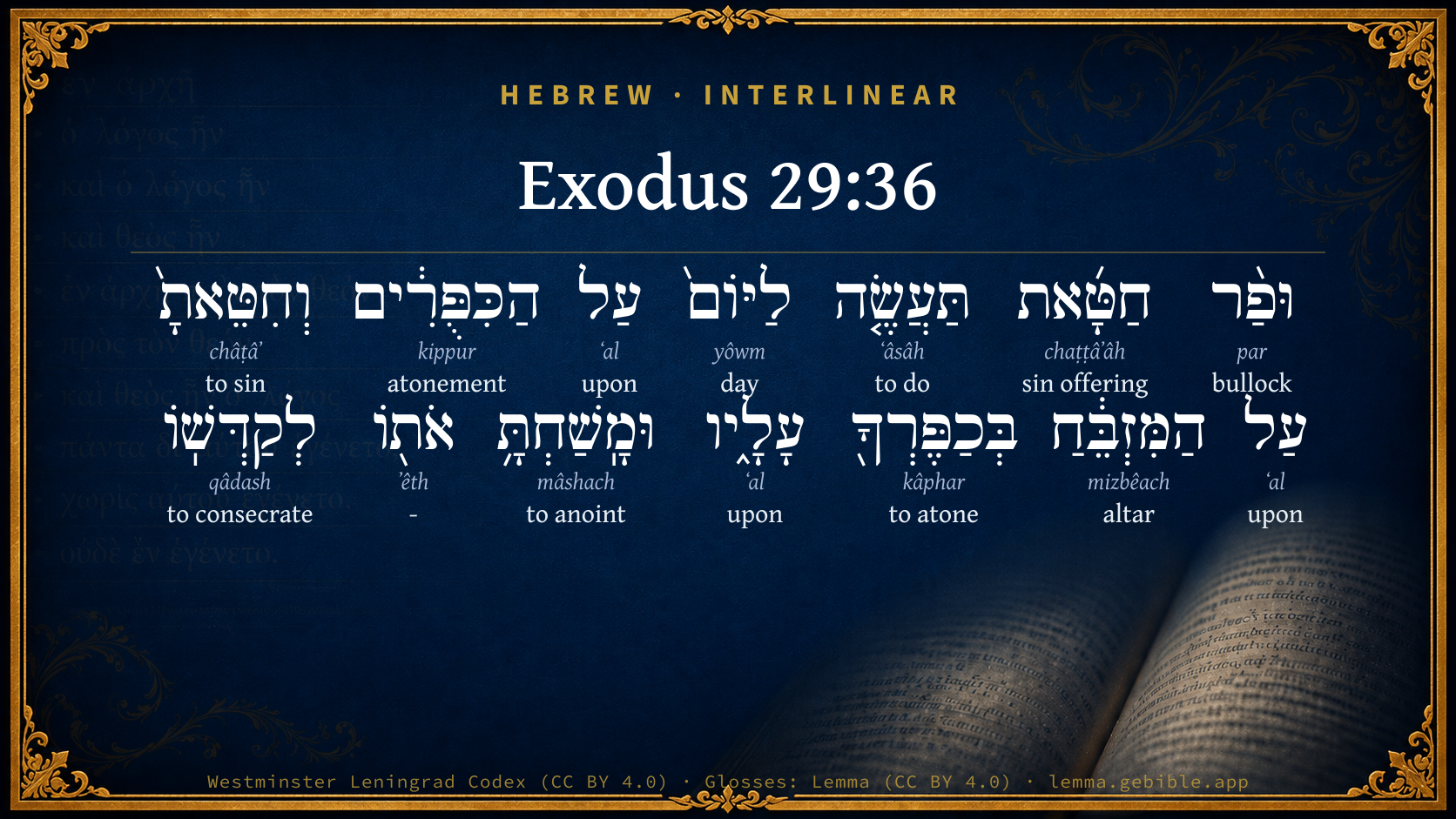
Hebrew (Westminster Leningrad Codex) Exodus 29:36 appears in the Hebrew Old Testament. The text above is from the Westminster Leningrad Codex. Each word links to its Strong’s number, a concise gloss, and parsing drawn from the Open Scriptures Hebrew Bible morphology. Click any word for its full Brown-Driver-Briggs (BDB) entry.
Download image
Cite this verse

Exodus 29:36 (World English Bible). Public Domain. Lemma interlinear Bible study tool, https://lemma.gebible.app/v/exodus/29/36.

Show BibTeX & RIS
BibTeX
RIS
English Translation
Every day shall you offer the bull of sin-offering for atonement: and you shall cleanse the altar, when you make atonement for it; and you shall anoint it, to sanctify it.
World English Bible · Public Domain
Highlights
  • 1 first appearance in the Hebrew Bible
Full analysis ↓
Download a study sheet

One document with this verse’s original text, its word-by-word gloss line, the meaning frame, cross-references with their text, attributed commentary, and full source and license credits — printable, and it pastes into notes with its structure intact.

This verse Autodidact and up

Study sheet (.html) Plain text (.txt)

A passage Seminary Student

Up to 50 verses in one chapter. A passage sheet keeps up to 6 commentary sources and 12 cross-references per verse, in the order this page ranks them, and says so on the sheet whenever that leaves anything out. Ask for a single verse and you get the Autodidact verse sheet above.

Everything on this page stays free to read, with no account — the sheet is a download of what is already on screen, not access to it.

Want to remove ads? Support Godless Engineer
Compare translations 3

The same verse in 3 English versions, stacked beneath the original-language interlinear above. Click any original word for its lexicon entry.

Each is an independent rendering of the whole verse — the interlinear is not word-aligned to these translations.

Highlighted words mark where these versions differ — a whole-verse word diff, not a word-by-word alignment.

  • World English Bible Public Domain
    Every day shall you offer the bull of sin-offering for atonement: and you shall cleanse the altar, when you make atonement for it; and you shall anoint it, to sanctify it.
  • King James Version Public Domain
    And thou shalt offer every day a bullock for a sin offering for atonement: and thou shalt cleanse the altar, when thou hast made an atonement for it, and thou shalt anoint it, to sanctify it.
  • unfoldingWord Literal Text CC BY-SA 4.0
    And you shall offer a bull of purification for atonement daily, and you shall purify the altar by making atonement for it. And you shall anoint it to set it apart.

unfoldingWord Literal Text — © unfoldingWord, licensed CC BY-SA 4.0. Word-aligned USFM3 via Door43 (git.door43.org/unfoldingWord/en_ult).

Versions to compare (up to 4)

3 of 4 selected

Show all 18 translations

Every available English version of this verse, each an independent rendering of the whole verse.

  • World English Bible Public Domain
    Every day shall you offer the bull of sin-offering for atonement: and you shall cleanse the altar, when you make atonement for it; and you shall anoint it, to sanctify it.
  • Berean Standard Bible Public Domain
    Sacrifice a bull as a sin offering each day for atonement. Purify the altar by making atonement for it, and anoint it to consecrate it.
  • Majority Standard Bible Public Domain
    Sacrifice a bull as a sin offering each day for atonement. Purify the altar by making atonement for it, and anoint it to consecrate it.
  • King James Version Public Domain
    And thou shalt offer every day a bullock for a sin offering for atonement: and thou shalt cleanse the altar, when thou hast made an atonement for it, and thou shalt anoint it, to sanctify it.
  • American Standard Version (1901) Public Domain
    And every day shalt thou offer the bullock of sin-offering for atonement: and thou shalt cleanse the altar, when thou makest atonement for it; and thou shalt anoint it, to sanctify it.
  • Revised Version (1885) Public Domain
    And every day shalt thou offer the bullock of sin offering for atonement: and thou shalt cleanse the altar, when thou makest atonement for it; and thou shalt anoint it, to sanctify it.
  • Geneva Bible (1599) Public Domain
    And shalt offer euery day a calfe for a sinne offring, for reconciliation: and thou shalt cleanse the altar, when thou hast offred vpon it for reconciliation, and shalt annoynt it, to sanctifie it.
  • Douay-Rheims (1899) Public Domain
    And thou shalt offer a calf for sin every day for expiation. And thou shalt cleanse the altar when thou hast offered the victim of expiation, and shalt anoint it to sanctify it.
  • Young's Literal Translation Public Domain
    and a bullock, a sin-offering, thou dost prepare daily for the atonements, and thou hast atoned for the altar, in thy making atonement on it, and hast anointed it to sanctify it;
  • Literal Standard Version CC BY-SA 4.0
    and a bullock, a sin-offering, you prepare daily for the atonements, and you have atoned for the altar in your making atonement on it, and have anointed it to sanctify it;
  • Unlocked Literal Bible CC BY-SA 4.0
    Every day you must offer a bull as a sin offering for atonement. You must purify the altar by making atonement for it, and you must anoint it in order to set it apart to me.
  • unfoldingWord Literal Text CC BY-SA 4.0
    And you shall offer a bull of purification for atonement daily, and you shall purify the altar by making atonement for it. And you shall anoint it to set it apart.
  • Darby Bible Public Domain
    And thou shalt offer every day a bullock as a sin-offering for atonement; and the altar shalt thou cleanse from sin, by making atonement for it, and shalt anoint it, to hallow it.
  • World Messianic Bible Public Domain
    Every day you shall offer the bull of sin offering for atonement. You shall cleanse the altar when you make atonement for it. You shall anoint it, to sanctify it.
  • Webster's Bible Public Domain
    And thou shalt offer every day a bullock for a sin-offering for atonement; and thou shalt cleanse the altar, when thou hast made an atonement for it, and thou shalt anoint it, to sanctify it.
  • Free Bible Version CC BY-SA 4.0
    Every day you are to sacrifice a bull as a sin offering for forgiveness. When you do this the altar needs to be purified. Anoint it to make it holy.
  • Bible in Basic English Public Domain
    Every day an ox is to be offered as a sin-offering, to take away sins: and by this offering on it, you will make the altar clean from sin; and you are to put oil on it and make it holy.
  • JPS Tanakh (1917) Public Domain
    And every day shalt thou offer the bullock of sin-offering, beside the other offerings of atonement; and thou shalt do the purification upon the altar when thou makest atonement for it; and thou shalt anoint it, to sanctify it.

Literal Standard Version (2020), Covenant Press — licensed CC BY-SA 4.0. Text via the HelloAO Bible API (eBible.org). Unlocked Literal Bible (unfoldingWord) — licensed CC BY-SA 4.0. Text via the HelloAO Bible API (eBible.org). unfoldingWord Literal Text — © unfoldingWord, licensed CC BY-SA 4.0. Word-aligned USFM3 via Door43 (git.door43.org/unfoldingWord/en_ult). Free Bible Version, Dr. Jonathan Gallagher — licensed CC BY-SA 4.0. Text via the HelloAO Bible API (eBible.org).

Word by word

More ways to search: Search by grammar → Find every occurrence → Compare this word →

Practice this passage: Drill this verse → Learn its vocabulary →

הַכִּפֻּרִ֔ים
kippur
H3725
“the · atonement”
Particle, Definite Article + Noun, Common, Masculine, Plural, Absolute
Part of Speech
Particle + Noun
Type
Common
Gender
Masculine
Number
Plural
State
Absolute
Full BDB Definition

Origin: from H3722

TWOT: 1023b

atonement
  1. וּפַ֨ר par H6499 “and · bullock of” Conjunction + Noun, Common, Masculine, Singular, Construct
  2. חַטָּ֜את chaṭṭâʼâh H2403 “sin offering” Noun, Common, Feminine, Singular, Absolute
  3. תַּעֲשֶׂ֤ה ʻâsâh H6213 “to do” Verb, Qal, Imperfect, 2nd Person, Masculine, Singular
  4. לַיּוֹם֙ yôwm H3117 “to/for the · day” Preposition, Determined + Noun, Common, Masculine, Singular, Absolute
  5. עַל ʻal H5921 “upon” Preposition
  6. וְחִטֵּאתָ֙ châṭâʼ H2398 “and · to sin” Conjunction + Verb, Piel, Sequential Perfect, 2nd Person, Masculine, Singular
  7. עַל ʻal H5921 “upon” Preposition
  8. הַמִּזְבֵּ֔חַ mizbêach H4196 “the · altar” Particle, Definite Article + Noun, Common, Masculine, Singular, Absolute
  9. בְּכַפֶּרְךָ֖ kâphar H3722 “in/at · to atone · you” Preposition + Verb, Piel, Infinitive Construct + Suffix, Personal, 2nd Person, Masculine, Singular
  10. עָלָ֑יו ʻal H5921 “upon · him” Preposition + Suffix, Personal, 3rd Person, Masculine, Singular
  11. וּמָֽשַׁחְתָּ֥ mâshach H4886 “and · to anoint” Conjunction + Verb, Qal, Sequential Perfect, 2nd Person, Masculine, Singular
  12. אֹת֖וֹ ʼêth H853 “- · him” Particle, Direct Object + Suffix, Personal, 3rd Person, Masculine, Singular
  13. לְקַדְּשֽׁוֹ qâdash H6942 “to consecrate · him” Preposition + Verb, Piel, Infinitive Construct + Suffix, Personal, 3rd Person, Masculine, Singular

About this verse

These counts appear in no published source. They are computed here, from the morphology-tagged text and Lemma’s own curated glosses. What Lemma adds →

14
words
12
distinct lemmas
Pentateuch
section

Notable vocabulary

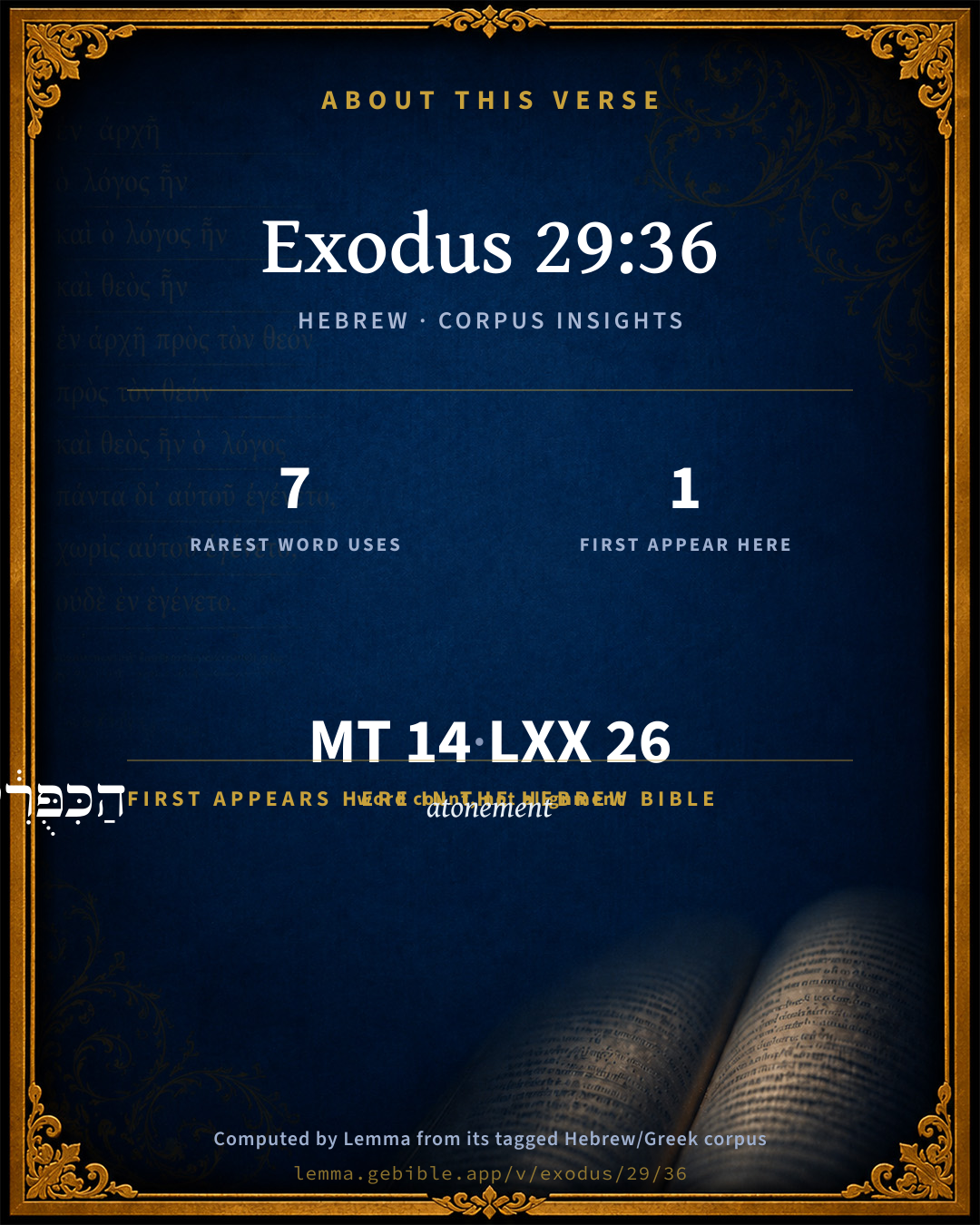
The rarest word here is הַכִּפֻּרִ֔ים atonement H3725 — appearing just 7 times in the whole Hebrew Bible.

First appearance in Scripture

This word makes its first canonical appearance in the Hebrew Bible here:

  • הַכִּפֻּרִ֔ים atonement H3725

Shared distinctive vocabulary

הַכִּפֻּרִ֔ים atonement H3725 occurs in 7 verses of the Hebrew Bible. Also found in:

Grammatical profile

  • 5 verbs
  • 5 nouns
  • 3 prepositions
  • 1 particle

Verb forms

  • תַּעֲשֶׂ֤ה Qal · Imperfect
  • וְחִטֵּאתָ֙ Piel · Sequential Perfect
  • בְּכַפֶּרְךָ֖ Piel · Infinitive Construct
  • וּמָֽשַׁחְתָּ֥ Qal · Sequential Perfect
  • לְקַדְּשֽׁוֹ Piel · Infinitive Construct

Repetition

A word recurs within this verse — often emphatic in Hebrew:

Hebrew & Septuagint length

In English translation the verse runs 31 words from the Hebrew and 37 from the Septuagint (LXX English) — closely comparable.

A rough comparison of the two English renderings, which tokenize alike — not a word-level alignment.

Word counts can differ between the Hebrew and the Greek without any difference in meaning — e.g. the Hebrew direct-object marker אֵת has no separate Greek word, and Greek often adds the article ὁ.

In the original languages it is 14 Hebrew tokens and 26 Greek tokens — but the two are counted differently (Hebrew bundles its prefixes and suffixes into one token; the Greek is in lemma form), so that isn’t a like-for-like length.

Cross-references

13

Topical passages linked to Exodus 29:36 in the Treasury of Scripture Knowledge — connected by theme and wording, ordered by reader-vote popularity; previews shown in the World English Bible.

  • Hebrews 10:11 Every priest indeed stands day by day ministering and often offering the same sacrifices, which can never take away sins,
  • Exodus 30:28–29 the altar of burnt offering with all its utensils, and the basin with its base.
  • Hebrews 9:22–23 According to the law, nearly everything is cleansed with blood, and apart from shedding of blood there is no remission.
  • Exodus 30:26 You shall use it to anoint the tent of meeting, the ark of the testimony,
  • Exodus 40:9–11 You shall take the anointing oil, and anoint the tent, and all that is in it, and shall make it holy, and all its furniture: and it will be holy.
  • Ezekiel 48:18–20 The remainder in the length, answerable to the holy offering, shall be ten thousand eastward, and ten thousand westward; and it shall be answerable to the holy offering; and the increase of it shall be for food to those who labor in the city.
  • Exodus 29:10–14 "You shall bring the bull before the tent of meeting: and Aaron and his sons shall lay their hands on the head of the bull.
  • Leviticus 8:10–11 Moses took the anointing oil, and anointed the tabernacle and all that was in it, and sanctified them.
  • Leviticus 16:16–19 and he shall make atonement for the Holy Place, because of the uncleanness of the children of Israel, and because of their transgressions, even all their sins; and so he shall do for the Tent of Meeting, that dwells with them in the midst of their uncleanness.
  • Leviticus 16:27 The bull for the sin offering, and the goat for the sin offering, whose blood was brought in to make atonement in the Holy Place, shall be carried forth outside the camp; and they shall burn their skins, their flesh, and their dung with fire.
  • Numbers 7:1 It happened on the day that Moses had finished setting up the tabernacle, and had anointed it and sanctified it, with all its furniture, and the altar with all its vessels, and had anointed and sanctified them;
  • Ezekiel 43:25 Seven days shall you prepare every day a goat for a sin-offering: they shall also prepare a young bull, and a ram out of the flock, without blemish.
  • Ezekiel 43:27 When they have accomplished the days, it shall be that on the eighth day, and forward, the priests shall make your burnt offerings on the altar, and your peace-offerings; and I will accept you, says the Lord Yahweh.

Cross-references courtesy of OpenBible.info (CC BY 4.0).

Hebrew and Greek witnesses Masoretic Hebrew ↔ Greek Septuagint

The same verse in the two great witnesses to the Old Testament, shown verse-for-verse.

These are two independent witnesses, not word-aligned to each other, and the Septuagint is shown in lemma (dictionary) form.

Hebrew Exodus 29:36 Masoretic · Westminster Leningrad Codex

וּפַ֨ר חַטָּ֜את תַּעֲשֶׂ֤ה לַיּוֹם֙ עַל הַכִּפֻּרִ֔ים וְחִטֵּאתָ֙ עַל הַמִּזְבֵּ֔חַ בְּכַפֶּרְךָ֖ עָלָ֑יו וּמָֽשַׁחְתָּ֥ אֹת֖וֹ לְקַדְּשֽׁוֹ

Every day shall you offer the bull of sin-offering for atonement: and you shall cleanse the altar, when you make atonement for it; and you shall anoint it, to sanctify it.

World English Bible · Public Domain

Greek LXX Exodus 29:36 Septuagint · lemma form

καί ὁ μοσχάριον ὁ ἁμαρτία ποιέω ὁ ἡμέρα ὁ καθαρισμός καί καθαρίζω ὁ θυσιαστήριον ἐν ὁ ἁγιάζω σύ ἐπί αὐτός καί χρίω αὐτός ὥστε ἁγιάζω αὐτός

And you shall sacrifice the calf of the sin-offering on the day of purification, and you shall purify the altar when you do perform consecration upon it, and you shall anoint it so as to sanctify it.

LXX2012 (modern English Septuagint) · Public Domain

Hebrew: Westminster Leningrad Codex (CC BY 4.0). Greek: Septuagint (public domain); English from LXX2012 (modern English Septuagint) (Public Domain). How the Septuagint differs from the Hebrew →

Targum (Aramaic paraphrase)

2

The Targum is the ancient Jewish Aramaic paraphrase of the Hebrew Scriptures — an interpretive translation, not the Hebrew text itself. Onkelos (literal) and Pseudo-Jonathan (expansive) render the Torah, and Jonathan the Prophets. Coverage is partial: where no permissively-licensed English translation exists for a verse, only the Aramaic is shown. This is verse-level text, not a word-by-word alignment to the Hebrew.

  1. Targum Onkelos Torah (Genesis–Deuteronomy)
    וְתוֹרָא דְחַטָאתָא תַּעְבֵּד לְיוֹמָא עַל כִּפּוּרַיָא וּתְדַכֵּי עַל מַדְבְּחָא בְּכַפָּרוּתָךְ עֲלוֹהִי וּתְרַבֵּי יָתֵהּ לְקַדָשׁוּתֵהּ:

    (no public-domain English translation for this verse)

    Targum Onkelos — Aramaic: “Onkelos Genesis” (public domain); “Onkelos Exodus” (public domain); “Onkelos Leviticus” (public domain); “Onkelos Numbers” (public domain); “Onkelos Deuteronomy” (public domain). English: “Sefaria Community Translation” (CC0 1.0 (public-domain dedication)); “J.W. Etheridge. The Targums of Onkelos and Jonathan Ben Uzziel on the Pentateuch. London: Longmans, Green, 1862” (public domain). Text via Sefaria.

  2. Targum Pseudo-Jonathan Torah (Genesis–Deuteronomy)
    וְתוֹרָא דְחַטָּאתָא תַּעֲבֵיד לְיוֹמָא עַל כִּיפּוּרַיָא וּתְרַבֵּי עַל מַדְבְּחָא בְּכַפָּרוּתָךְ עֲלוֹי וּתְרַבֵּי עֲלֵיהּ לְקַדָּשׁוּתֵיהּ

    And a bullock for a sin offering thou shalt offer daily for atonement, and shalt anoint the altar in offering the atonement upon it; thou shalt anoint it, to consecrate it.

    Targum Pseudo-Jonathan — Aramaic: “Targum Jonathan on Genesis” (public domain); “Targum Jonathan on Exodus” (public domain); “Targum Jonathan on Leviticus” (public domain); “Targum Jonathan on Numbers” (public domain); “Targum Jonathan on Deuteronomy” (public domain). English: “The Targum of Jonathan ben Uzziel, trans. J. W. Etheridge, London, 1862” (public domain). Text via Sefaria.

Commentary

Notes on Exodus 29:36 from classic Christian and Jewish commentators (each source and its license shown beneath its notes). The classic Christian expositions comment on the surrounding passage and are grouped to its opening verse, so a note may address several verses; the Jewish commentaries on the Tanakh (Rashi and others) are per-verse, so they appear only where the commentator wrote on this verse.

Lemma curates 59 commentaries, every one of them public domain or Creative Commons licensed, each selected and text-cleaned for this edition rather than reprinted as found. About our sources →

Jamieson, Fausset & Brown

Robert Jamieson, A. R. Fausset & David Brown

CONSECRATION OF THE ALTAR. (Exo 29:36-37)

and thou shalt cleanse the altar--The phrase, "when thou hast made an atonement for it," should be, upon it; and the purport of the direction is, that during all the time they were engaged as above from day to day in offering the appointed sacrifices, the greatest care was to be taken to keep the altar properly cleansed--to remove the ashes, and sprinkle it with the prescribed unction that, at the conclusion of the whole ceremonial, the altar itself should be consecrated as much as the ministers who were to officiate at it (Mat 23:19). It was thenceforth associated with the services of religion.

Jamieson, Fausset & Brown — Commentary Critical and Explanatory on the Whole Bible (1871) — public domain (CC PDM 1.0). Text via the HelloAO Bible API.

Trapp's Complete Commentary

John Trapp

Exo 29:36 And thou shalt offer every day a bullock [for] a sin offering for atonement: and thou shalt cleanse the altar, when thou hast made an atonement for it, and thou shalt anoint it, to sanctify it.

Ver. 36. Cleanse the altar.] Which, as well as the creatures, may be defiled by man’s sin. {Lev 16:16}

John Trapp, A Commentary or Exposition upon All the Books of the Old and New Testament (1647–1656) — public domain. Text from a community e-Sword module.

Joseph Benson's Commentary

Exo 29:36-37. The consecration of the altar seems to have been coincident with that of the priests; and the sin-offerings, which were offered every day for seven days together, had reference to the altar as well as the priests. An atonement was made for the altar — The altar was also sanctified; not only set apart itself to a sacred use, but made so holy as to sanctify the gifts that were offered upon it, Mat 23:19. Christ is our altar, for our sakes he sanctified himself, that we and our performances might be sanctified and recommended to God, Joh 17:19.

Joseph Benson's Commentary on the Old and New Testaments (1811–1818) — public domain. Text from a community e-Sword module.

Geneva Bible (1599)

Geneva Bible translators

To appease God’s wrath that sin may be pardoned.

Geneva Bible (1599) marginal notes — public domain. Text via Bolls.life.

Adam Clarke's Commentary

Verse 36. Thou shalt cleanse the altar] The altar was to be sanctified for seven days; and it is likely that on each day, previously to the consecration service, the altar was wiped clean, and the former day's ashes, &c., removed.

Adam Clarke's Commentary on the Bible (1810–1826) — public domain. Text from a community e-Sword/MySword module.

Ellicott's Commentary for English Readers

(36) Thou shalt cleanse the altar, when thou hast made an atonement for it.—Rather, by making an atonement for it. The atonement was made by smearing the blood of the bullock upon the horns of the altar (Exo_29:12, compared with Lev_8:15).

And thou shalt anoint it.—Comp. Lev_8:11, where we find that the altar was anointed by having the holy oil sprinkled upon it seven times. It is not quite clear at what period in the ceremonial this was done.

A Bible Commentary for English Readers, edited by Charles John Ellicott (1878–1897) — public domain. Text from a community e-Sword module.

The Cambridge Bible for Schools and Colleges

gen. ed. J. J. S. Perowne

36. offer] Heb. do: see on Exo_10:25.

the bullock] a bullock (so the Heb.): upon independent grounds, also, the bullock of vv. 1, 10–14 can hardly be meant; for vv. 1, 10 speak only of atonement for the priests; and the ceremonies enjoined in v. 12 are in particular those prescribed in Lev_4:7; Lev_4:18; Lev_4:25; Lev_4:30; Lev_4:34 for persons. It is true, two clauses referring to the altar (‘and un-sinned the altar,’ ‘and sanctified it by making atonement for it’) are found in Lev_8:15 (the || to v. 12 here); but the absence of any corresponding instructions in Exo_29:12 raises the suspicion that they are later additions to the text, based upon vv. 36 f. here.

cleanse the altar] free the altar from sin, or, if it is permissible to coin a word, corresponding approximately to the single word ḥiṭṭç’ (see G.-K. § 52h) of the Heb., un-sin the altar. Either cleanse or purge (RVm.) leaves out a distinctive part of the Heb. idea: the Hebrew understood ‘sin’ in a wider sense than we do, and regarded it as capable of infecting even a material object. The word occurs in the same sense Lev_8:15 (of the altar, as here), Lev_14:49 (of a leprous house), Lev_14:52, Num_19:19 (RV. purify); Eze_43:20; Eze_43:22 (twice), 23 (all of the altar, Eze_45:18 (of the sanctuary); Psa_51:7 (purge)†; and in the reflexive conj., Num_8:21; Num_19:12 (twice), Num_19:13, Num_19:20, Num_31:19-20; Num_31:23†.

by thy making (marg.) atonement for it] on account of its being regarded as infected with sin. For other cases of ‘atonement’ being made for a material object—regarded either as affected by the natural impurity of human workmanship, or as tainted by contact with a sinful people—see (of the altar of burnt-offering) Lev_Exo_8:15 (the execution of the present injunction), Eze_43:20; Eze_43:26, Lev_16:18; Lev_16:20; Lev_16:33; (of the altar of incense) ch. Exo_30:10 b; (of the sanctuary) Eze_45:20, Lev_16:16; Lev_16:20; Lev_16:33; (of a leprous house) Lev_14:53 (DB. iv. 131b).

thou shalt anoint it] Cf. Lev_Exo_8:11 (in the insertion referred to on v. 7 above, between the words corresponding to v. 7a and v. 7b here). See on Exo_30:26-29 (at the end).

36, 37. The altar to be fitted for sacred uses by atonement being made for it: the ceremony to be repeated, like the installation-ceremony, every day for seven days. The altar, as the work of human hands, was regarded as infected by a natural uncleanness, which had to be ceremonially removed before it could be used for sacred purposes. Cf. the atoning rites, to continue for seven days, prescribed by Ezek. for the installation of the altar of the restored Temple, Eze_43:18-27.

The Cambridge Bible for Schools and Colleges (gen. ed. J. J. S. Perowne; Cambridge University Press, 1878–1918) — public domain. Text from a community e-Sword module.

John Gill's Exposition

And thou shall offer every day a bullock for a sin offering for atonement,.... That is, every day of the seven days of consecration; denoting the full and complete atonement for sin by the sacrifice of Christ, which these sacrifices could not really obtain, and were therefore frequently repeated, in this case seven times; figuratively by that number pointing to the full expiation of sin by the atoning Saviour, who was made not only an offering for sin, but sin itself by imputation, for his people:

and thou shalt cleanse the altar when thou hast made atonement for it; which though not capable of sin, or of any moral guilt, yet, inasmuch as it was to be of sacred use, and to have sin offerings laid upon it, expiation and cleansing, in a ceremonial way, were to be made for it, to purge it from the uncleanness of the children of Israel, Lev 16:18. This altar was typical of Christ, who is that altar believers in him have a right to partake of; and though he had no sin of his own, no guilt of that kind to expiate, nor pollution to be cleansed from, yet as he had the guilt of his people transferred to him, and was clothed with their filthy garments, and had their uncleannesses on him; by the sacrifice of himself he purged away sin from himself and them, and was justified and cleared of all, and they in him:

and thou shalt anoint it, to sanctify it; anoint it, as it afterwards was, with the holy anointing oil, whereby it was sanctified, or set apart for holy uses; in which it was a figure of Christ anointed with the oil of gladness, the Holy Spirit, above his fellows; and was sanctified and set apart for his priestly office, in which he was both altar, sacrifice, and priest.

John Gill's Exposition of the Whole Bible (1746–1763) — public domain (CC PDM 1.0). Text via the HelloAO Bible API.

Matthew Poole's English Annotations

For atonement, as well for the priests as for the altar; both which, as they were or might be polluted, so they needed the sprinkling of this blood to sanctify them, to show that all persons and things were fitted for God’s service, and accepted by him only for and through the blood of Christ.

Matthew Poole's English Annotations on the Holy Bible (1683–1685) — public domain. Text from a community e-Sword/MySword module.

The Pulpit Commentary

Thou shalt cleanse the altar, when thou hast made an atonement for it. Rather, "thou shelf purify the altar by making an atonement for it." The sin-offering for the altar was the same bullock which served for Aaron and his sons. Its virtue was applied to the altar by smearing the blood upon its horns and pouring the remainder at its base (ver. 12). See Lev_8:15: Moses took the blood, and put it upon the horns of the altar round about with his finger, and purified the altar, and poured the blood at the bottom of the altar, and sanctified it." And thou shalt anoint it. In his execution of these directions, Moses separated the anointing of the altar from the cleansing, placing it even before the anointing of Aaron. He anointed it by sprinkling the holy oil upon it seven times. (Lev_8:11)

The Pulpit Commentary (1880–1919), ed. H.D.M. Spence-Jones & Joseph S. Exell — public domain. Text from a community e-Sword module.

John Wesley's Explanatory Notes

The consecration of the altar, seems to have been coincident with that of the priests; and the sin-offerings, which were offered every day for seven days together, had reference to the altar, as well as the priests. And atonement was made for the altar. The altar was also sanctified, not only set apart itself to a sacred use, but made so holy as to sanctify the gifts that were offered upon it, Matt. xxiii, 19. Christ is our altar, for our sakes he sanctified himself, that we and our performances might be sanctified and recommended to God, John xvii, 19.

John Wesley, Explanatory Notes Upon the Whole Bible (1754–1765) — public domain. Text via the GEBible commentary corpus.

Rashi

Rabbi Shlomo Yitzchaki (Rashi)

על הכפרים means for the purpose of expiation — to expiate for the altar for all that is “strange” (not holy) and objectionable that may happened to it. Now since it is said. (v. 35) “Seven days shalt thou consecrate them” after having stated that if a single thing is omitted the ceremony is invalid, I can infer nothing more than that this alludes to a thing that is offered on account of them personally as, for example, the rams and the bread, but as regards anything that is offered on account of the altar as, for example, the bullock, which is intended to serve as expiation for the altar, we cannot infer from that verse that if this is omitted the ceremony of initiation is invalid; consequently this verse is necessary to inform us of this. An explanation in Torath Cohanim (the Sifra) states: atonement for the altar was necessary because perhaps a man had donated for work in connection with the construction of the Tabernacle or the altar something which he had stolen (Sifra, Tzav, Mechilta d'Miluim 1 15).

וחטאת — The Targum translates this by ותדכי AND THOU SHALT PURIFY [THE ALTAR]; the expression for placing upon the altar the blood that is placed there with the finger is called חַטַּא (hence it is followed by the preposition על “upon”).

ומשחת אתו AND THOU SHALT ANOINT IT with the oil of anointing: every anointing was done in the form of a Greek Chi (X).

Rashi on the Tanakh — English translations: “The Judaica Press complete Tanach with Rashi, translated by A. J. Rosenberg” (CC BY 4.0); “Pentateuch with Rashi's commentary by M. Rosenbaum and A.M. Silbermann, 1929-1934” (public domain); “The Metsudah Tanach series, Lakewood, N.J” (CC BY 4.0); and “The Book of Joshua, Metsudah Publications, 1997” (CC BY 4.0). Text via Sefaria.

Ramban (Nachmanides)

Rabbi Moshe ben Nachman (Ramban / Nachmanides)

AND EVERY DAY SHALT THOU OFFER THE BULLOCK OF SIN-OFFERING ‘AL HAKIPURIM’ — “for atonement, to atone for the altar for anything strange [i.e., unholy] and abominable [that may happen to be brought upon it]. And in the Midrash of Torath Kohanim, Milu’im 1:15. it says: ‘atonement for the altar was necessary in case a person had donated for work in connection with the construction of the Tabernacle and [the sacrifices brought upon] the altar something he had acquired by robbery’” [or other unlawful means]. This is the language of Rashi. The correct interpretation of al hakipurim is, however, [that he is to bring the bullock of sin-offering] in addition to the two rams which were an atonement for Aaron and his sons, as He said here, And they shall eat those things wherewith atonement was made, and surely the [bullock] sin-offering was for the purpose of atonement. And it is further written, As hath been done this day, so the Eternal hath commanded to do, to make atonement for you. Such are the words of Rabbi Abraham ibn Ezra.

Ramban (Nachmanides) on the Tanakh — English translation: “Commentary on the Torah by Ramban (Nachmanides). Translated and annotated by Charles B. Chavel. New York, Shilo Pub. House, 1971-1976” (CC BY 4.0). Text via Sefaria.

Lesson kit

Teaching starters — assembled from the data on this page, not authored interpretation. Every prompt links to the verse data it draws on. Edit before teaching.

Exodus, in the Pentateuch, opens this verse with 14 words (12 distinct Hebrew lemmas). Its most distinctive word is kippur (“atonement”). A historical commentator’s framing appears above. Read the whole chapter for the surrounding context.

Discussion questions

  1. What does “atonement” (kippur) contribute to the verse as a whole?
  2. The word “atonement” first appears here in Scripture. What is being introduced at this debut?
  3. Exodus 30:10 shares the word «atonement» with this verse. How do the two illuminate each other?
  4. “upon” occurs 3× in this one verse. What is the effect of the repetition?
  5. These translations render this verse differently; the difference is in the English rendering, not the original. What questions does that raise?
  6. The verb «תַּעֲשֶׂ֤ה» is Qal Imperfect. How does its form color the action?
  7. Reading how Jamieson, Fausset & Brown and Trapp's Complete Commentary read this verse, where do the two commentators agree and where do they part?

Things to notice

Reading settings

Reading text

Shown beneath each verse's original-language words.

Old Testament
Old Testament edition

Read the OT as the Masoretic Hebrew (MT) or the Greek Septuagint (LXX).

English shown for the Greek Septuagint (in the Hebrew ↔ Greek comparison).

Comparing translations? Open the Compare panel on any verse page to stack up to four side by side.