
Joshua 9:27

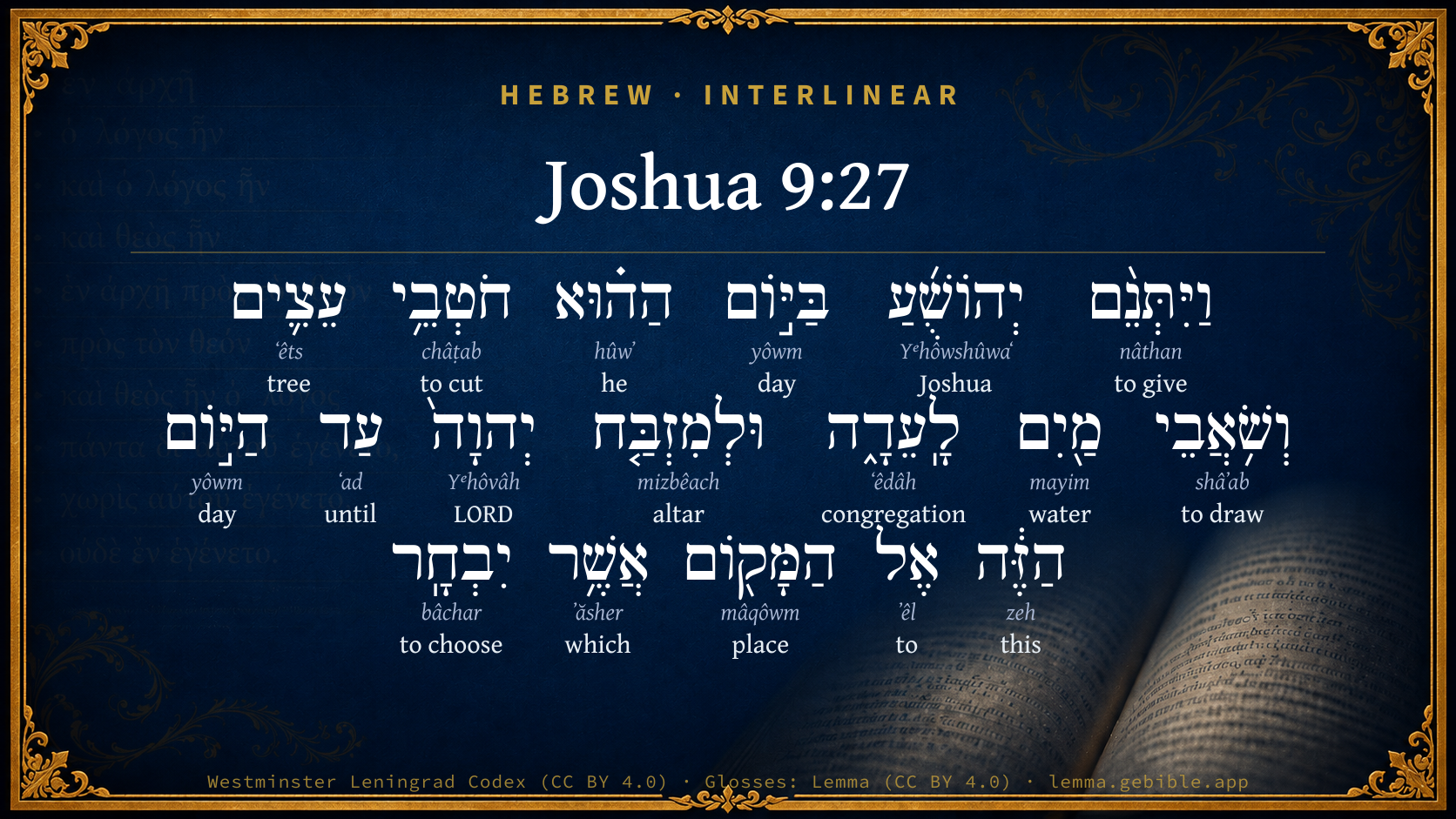
Hebrew (Westminster Leningrad Codex) Joshua 9:27 appears in the Hebrew Old Testament. The text above is from the Westminster Leningrad Codex. Each word links to its Strong’s number, a concise gloss, and parsing drawn from the Open Scriptures Hebrew Bible morphology. Click any word for its full Brown-Driver-Briggs (BDB) entry.
Download image
Cite this verse

Joshua 9:27 (World English Bible). Public Domain. Lemma interlinear Bible study tool, https://lemma.gebible.app/v/joshua/9/27.

Show BibTeX & RIS
BibTeX
RIS
English Translation
That day Joshua made those wood cutters and drawers of water for the congregation, and for the altar of Yahweh, to this day, in the place which he should choose.
World English Bible · Public Domain
Download a study sheet

One document with this verse’s original text, its word-by-word gloss line, the meaning frame, cross-references with their text, attributed commentary, and full source and license credits — printable, and it pastes into notes with its structure intact.

This verse Autodidact and up

Study sheet (.html) Plain text (.txt)

A passage Seminary Student

Up to 50 verses in one chapter. A passage sheet keeps up to 6 commentary sources and 12 cross-references per verse, in the order this page ranks them, and says so on the sheet whenever that leaves anything out. Ask for a single verse and you get the Autodidact verse sheet above.

Everything on this page stays free to read, with no account — the sheet is a download of what is already on screen, not access to it.

Want to remove ads? Support Godless Engineer
Compare translations 3

The same verse in 3 English versions, stacked beneath the original-language interlinear above. Click any original word for its lexicon entry.

Each is an independent rendering of the whole verse — the interlinear is not word-aligned to these translations.

Highlighted words mark where these versions differ — a whole-verse word diff, not a word-by-word alignment.

  • World English Bible Public Domain
    That day Joshua made those wood cutters and drawers of water for the congregation, and for the altar of Yahweh, to this day, in the place which he should choose.
  • King James Version Public Domain
    And Joshua made them that day hewers of wood and drawers of water for the congregation, and for the altar of the LORD, even unto this day, in the place which he should choose.
  • unfoldingWord Literal Text CC BY-SA 4.0
    But on that day Joshua made them hewers of wood and drawers of water for the congregation and for the altar of Yahweh, to this day, in the place that he would choose.

unfoldingWord Literal Text — © unfoldingWord, licensed CC BY-SA 4.0. Word-aligned USFM3 via Door43 (git.door43.org/unfoldingWord/en_ult).

Versions to compare (up to 4)

3 of 4 selected

Show all 18 translations

Every available English version of this verse, each an independent rendering of the whole verse.

  • World English Bible Public Domain
    That day Joshua made those wood cutters and drawers of water for the congregation, and for the altar of Yahweh, to this day, in the place which he should choose.
  • Berean Standard Bible Public Domain
    On that day he made them woodcutters and water carriers, as they are to this day for the congregation of the LORD and for the altar at the place He would choose.
  • Majority Standard Bible Public Domain
    On that day he made them woodcutters and water carriers, as they are to this day for the congregation of the LORD and for the altar at the place He would choose.
  • King James Version Public Domain
    And Joshua made them that day hewers of wood and drawers of water for the congregation, and for the altar of the LORD, even unto this day, in the place which he should choose.
  • American Standard Version (1901) Public Domain
    And Joshua made them that day hewers of wood and drawers of water for the congregation, and for the altar of Jehovah, unto this day, in the place which he should choose.
  • Revised Version (1885) Public Domain
    And Joshua made them that day hewers of wood and drawers of water for the congregation, and for the altar of the LORD, unto this day, in the place which he should choose.
  • Geneva Bible (1599) Public Domain
    And Ioshua appointed them that same day to be hewers of wood, and drawers of water for the Congregation, and for the altar of the Lord vnto this day, in the place which he should chuse.
  • Douay-Rheims (1899) Public Domain
    And he gave orders in that day that they should be in the service of all the people, and of the altar of the Lord, hewing wood and carrying water, until this present time, in the place which the Lord hath chosen.
  • Young's Literal Translation Public Domain
    and Joshua maketh them on that day hewers of wood and drawers of water for the company, and for the altar of Jehovah, unto this day, at the place which He doth choose.
  • Literal Standard Version CC BY-SA 4.0
    and on that day Joshua makes them hewers of wood and drawers of water for the congregation, and for the altar of YHWH, to this day, at the place which He chooses.
  • Unlocked Literal Bible CC BY-SA 4.0
    That day Joshua made the Gibeonites cutters of wood and drawers of water for the community, and for the altar of Yahweh, to this day, in the place that Yahweh chooses.
  • unfoldingWord Literal Text CC BY-SA 4.0
    But on that day Joshua made them hewers of wood and drawers of water for the congregation and for the altar of Yahweh, to this day, in the place that he would choose.
  • Darby Bible Public Domain
    And Joshua made them that day hewers of wood and drawers of water for the assembly, and for the altar of Jehovah, to this day, in the place which he should choose.
  • World Messianic Bible Public Domain
    That day Joshua made them wood cutters and drawers of water for the congregation and for the LORD’s altar to this day, in the place which he should choose.
  • Webster's Bible Public Domain
    And Joshua made them that day hewers of wood and drawers of water for the congregation, and for the altar of the LORD, even to this day, in the place which he should choose.
  • Free Bible Version CC BY-SA 4.0
    That day Joshua made them woodcutters and water-carriers in service to the entire assembly and for the altar of the Lord wherever the Lord should choose. That is what they do right up to this very day.
  • Bible in Basic English Public Domain
    And that day Joshua made them servants, cutting wood and getting water for the people and for the altar of the Lord, in the place marked out by him, to this day.
  • JPS Tanakh (1917) Public Domain
    And Joshua made them that day hewers of wood and drawers of water for the congregation, and for the altar of the LORD, unto this day, in the place which He should choose.

Literal Standard Version (2020), Covenant Press — licensed CC BY-SA 4.0. Text via the HelloAO Bible API (eBible.org). Unlocked Literal Bible (unfoldingWord) — licensed CC BY-SA 4.0. Text via the HelloAO Bible API (eBible.org). unfoldingWord Literal Text — © unfoldingWord, licensed CC BY-SA 4.0. Word-aligned USFM3 via Door43 (git.door43.org/unfoldingWord/en_ult). Free Bible Version, Dr. Jonathan Gallagher — licensed CC BY-SA 4.0. Text via the HelloAO Bible API (eBible.org).

Word by word

More ways to search: Search by grammar → Find every occurrence → Compare this word →

Practice this passage: Drill this verse → Learn its vocabulary →

חֹטְבֵ֥י
châṭab
H2404
“cutting”
Verb, Qal, Participle Active, Masculine, Plural, Construct
Part of Speech
Verb
Stem
Qal
Form
Participle Active
Gender
Masculine
Number
Plural
State
Construct
Full BDB Definition

Origin: a primitive root

TWOT: 639

to cut, gather - (Qal) to cut, gather (wood) - (Pual) to cut, carve
  1. וַיִּתְּנֵ֨ם nâthan H5414 “and · to give · them” Conjunction + Verb, Qal, Sequential Imperfect, 3rd Person, Masculine, Singular + Suffix, Personal, 3rd Person, Masculine, Plural
  2. יְהוֹשֻׁ֜עַ Yᵉhôwshûwaʻ H3091 “Joshua” Noun, Proper
  3. בַּיּ֣וֹם yôwm H3117 “in/at the · day” Preposition, Determined + Noun, Common, Masculine, Singular, Absolute
  4. הַה֗וּא hûwʼ H1931 “the · he” Particle, Definite Article + Pronoun, Personal, 3rd Person, Masculine, Singular
  5. עֵצִ֛ים ʻêts H6086 “trees” Noun, Common, Masculine, Plural, Absolute
  6. וְשֹׁ֥אֲבֵי shâʼab H7579 “and · drawing” Conjunction + Verb, Qal, Participle Active, Masculine, Plural, Construct
  7. מַ֖יִם mayim H4325 “water(s)” Noun, Common, Masculine, Plural, Absolute
  8. לָֽעֵדָ֑ה ʻêdâh H5712 “to/for the · congregation” Preposition, Determined + Noun, Common, Feminine, Singular, Absolute
  9. וּלְמִזְבַּ֤ח mizbêach H4196 “and · to/for · altar of” Conjunction + Preposition + Noun, Common, Masculine, Singular, Construct
  10. יְהוָה֙ Yᵉhôvâh H3068 “LORD” Noun, Proper
  11. עַד ʻad H5704 “until” Preposition
  12. הַיּ֣וֹם yôwm H3117 “the · day” Particle, Definite Article + Noun, Common, Masculine, Singular, Absolute
  13. הַזֶּ֔ה zeh H2088 “the · this” Particle, Definite Article + Pronoun, Demonstrative, Masculine, Singular
  14. אֶל ʼêl H413 “to” Preposition
  15. הַמָּק֖וֹם mâqôwm H4725 “the · place” Particle, Definite Article + Noun, Common, Masculine, Singular, Absolute
  16. אֲשֶׁ֥ר ʼăsher H834 “which” Particle, Relative
  17. יִבְחָֽר bâchar H977 “to choose” Verb, Qal, Imperfect, 3rd Person, Masculine, Singular

About this verse

These counts appear in no published source. They are computed here, from the morphology-tagged text and Lemma’s own curated glosses. What Lemma adds →

18
words
17
distinct lemmas
Historical
section

Notable vocabulary

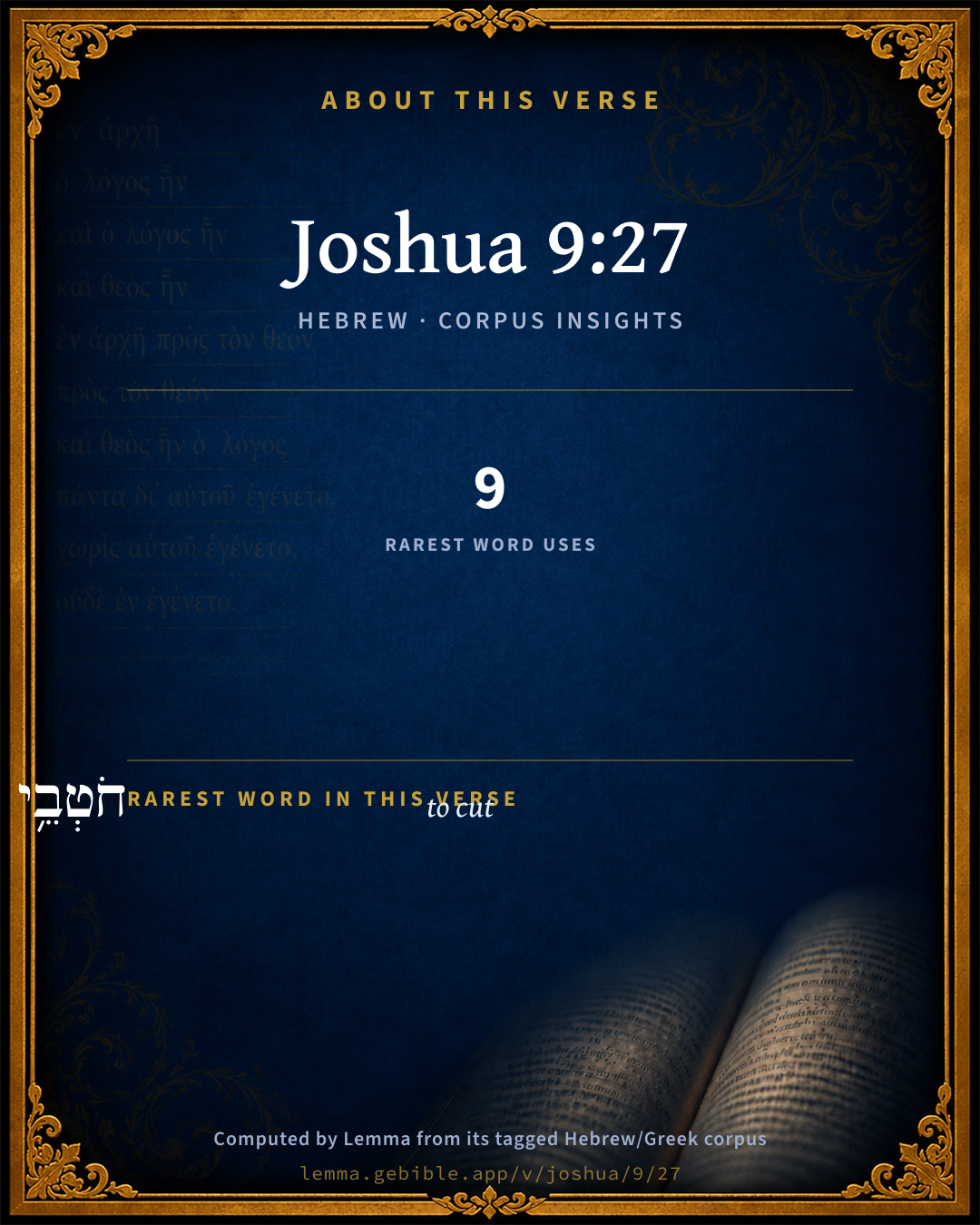
The rarest word here is חֹטְבֵ֥י to cut H2404 — appearing just 9 times in the whole Hebrew Bible.

Shared distinctive vocabulary

חֹטְבֵ֥י to cut H2404 occurs in 9 verses of the Hebrew Bible. Also found in:

Grammatical profile

  • 4 verbs
  • 9 nouns
  • 2 pronouns
  • 2 prepositions
  • 1 particle

Verb forms

  • וַיִּתְּנֵ֨ם Qal · Sequential Imperfect
  • חֹטְבֵ֥י Qal · Participle Active
  • וְשֹׁ֥אֲבֵי Qal · Participle Active
  • יִבְחָֽר Qal · Imperfect

Repetition

A word recurs within this verse — often emphatic in Hebrew:

  • בַּיּ֣וֹם day H3117 ×2

Hebrew & Septuagint length

In English translation the verse runs 30 words from the Hebrew and 54 from the Septuagint (LXX English) — the Septuagint runs noticeably longer here. See the side-by-side →

A rough comparison of the two English renderings, which tokenize alike — not a word-level alignment.

Word counts can differ between the Hebrew and the Greek without any difference in meaning — e.g. the Hebrew direct-object marker אֵת has no separate Greek word, and Greek often adds the article ὁ.

Cross-references

1

Topical passages linked to Joshua 9:27 in the Treasury of Scripture Knowledge — connected by theme and wording, ordered by reader-vote popularity; previews shown in the World English Bible.

  • Deuteronomy 12:5 But to the place which Yahweh your God shall choose out of all your tribes, to put his name there, even to his habitation shall you seek, and there you shall come;

Cross-references courtesy of OpenBible.info (CC BY 4.0).

Hebrew and Greek witnesses Masoretic Hebrew ↔ Greek Septuagint

The same verse in the two great witnesses to the Old Testament, shown verse-for-verse.

Here the Septuagint runs noticeably longer than the Hebrew — LXX2012 (modern English Septuagint) 54 words vs World English Bible 30. A rough length comparison of the two English translations, not a word-level alignment — read both below.

These are two independent witnesses, not word-aligned to each other, and the Septuagint is shown in lemma (dictionary) form.

Hebrew Joshua 9:27 Masoretic · Westminster Leningrad Codex

וַיִּתְּנֵ֨ם יְהוֹשֻׁ֜עַ בַּיּ֣וֹם הַה֗וּא חֹטְבֵ֥י עֵצִ֛ים וְשֹׁ֥אֲבֵי מַ֖יִם לָֽעֵדָ֑ה וּלְמִזְבַּ֤ח יְהוָה֙ עַד הַיּ֣וֹם הַזֶּ֔ה אֶל הַמָּק֖וֹם אֲשֶׁ֥ר יִבְחָֽר

That day Joshua made those wood cutters and drawers of water for the congregation, and for the altar of Yahweh, to this day, in the place which he should choose.

World English Bible · Public Domain

Greek LXX Joshua 9:27 Septuagint · lemma form

καί καταἵστημι αὐτός ἰησοῦς ἐν ὁ ἡμέρα ἐκεῖνος ξυλοκόπος καί ὑδροφόρος πᾶς ὁ συναγωγή καί ὁ θυσιαστήριον ὁ θεός διά οὗτος γίγνομαι ὁ καταοἰκέω γαβαων ξυλοκόπος καί ὑδροφόρος ὁ θυσιαστήριον ὁ θεός ἕως ὁ σήμερον ἡμέρα καί εἰς ὁ τόπος ὅς ἐάν ἐκλέγω κύριος

And Joshua made them in that day hewers of wood and drawers of water to the whole congregation, and for the altar of God: therefore the inhabitants of Gabaon became hewers of wood and drawers of water for the altar of God until this day, even for the place which the Lord should choose.

LXX2012 (modern English Septuagint) · Public Domain

Hebrew: Westminster Leningrad Codex (CC BY 4.0). Greek: Septuagint (public domain); English from LXX2012 (modern English Septuagint) (Public Domain). How the Septuagint differs from the Hebrew →

Targum (Aramaic paraphrase)

1

The Targum is the ancient Jewish Aramaic paraphrase of the Hebrew Scriptures — an interpretive translation, not the Hebrew text itself. Onkelos (literal) and Pseudo-Jonathan (expansive) render the Torah, and Jonathan the Prophets. Coverage is partial: where no permissively-licensed English translation exists for a verse, only the Aramaic is shown. This is verse-level text, not a word-by-word alignment to the Hebrew.

  1. Targum Jonathan Prophets (Joshua–Malachi)
    וּמַנִינוּן יְהוֹשֻׁעַ בְּיוֹמָא הַהוּא לָקְטֵי אָעִין וּמָלָן מַיָא לִכְנִשְׁתָּא וּלְמַדְבְּחָא דַייָ עַד יוֹמָא הָדֵין לְאַתְרָא דִי יִתְרְעֵי:

    (no public-domain English translation for this verse)

    Targum Jonathan — Aramaic: “Mikraot Gedolot” (public domain). English: “Sefaria Community Translation” (CC0 1.0 (public-domain dedication)); “London "Chaldee Paraphrase," 1871” (public domain). Text via Sefaria.

Commentary

Notes on Joshua 9:27 from classic Christian and Jewish commentators (each source and its license shown beneath its notes). The classic Christian expositions comment on the surrounding passage and are grouped to its opening verse, so a note may address several verses; the Jewish commentaries on the Tanakh (Rashi and others) are per-verse, so they appear only where the commentator wrote on this verse.

Lemma curates 59 commentaries, every one of them public domain or Creative Commons licensed, each selected and text-cleaned for this edition rather than reprinted as found. About our sources →

Trapp's Complete Commentary

John Trapp

Jos 9:27 And Joshua made them that day hewers of wood and drawers of water for the congregation, and for the altar of the LORD, even unto this day, in the place which he should choose.

Ver. 27. For the congregation.] To do those works belonging to God’s service, which otherwise the people should have done. Ut lignatores essent et lixae.

John Trapp, A Commentary or Exposition upon All the Books of the Old and New Testament (1647–1656) — public domain. Text from a community e-Sword module.

Joseph Benson's Commentary

Jos 9:27. And for the altar of the Lord — By which it appears, that they were not only to do this service in God’s house, but upon all other occasions, as the congregation needed their help.

Joseph Benson's Commentary on the Old and New Testaments (1811–1818) — public domain. Text from a community e-Sword module.

Geneva Bible (1599)

Geneva Bible translators

That is, for the service of the Temple, as verse 23.

Geneva Bible (1599) marginal notes — public domain. Text via Bolls.life.

Jamieson, Fausset & Brown

Robert Jamieson, A. R. Fausset & David Brown

hewers of wood and drawers of water--The menials who performed the lowest offices and drudgery in the sanctuary; whence they were called Nethinims (Ch1 9:2; Ezr 2:43; Ezr 8:20); that is, given, appropriated. Their chastisement thus brought them into the possession of great religious privileges (Psa 84:10).

Next: Joshua Chapter 10

Jamieson, Fausset & Brown — Commentary Critical and Explanatory on the Whole Bible (1871) — public domain (CC PDM 1.0). Text via the HelloAO Bible API.

The Cambridge Bible for Schools and Colleges

gen. ed. J. J. S. Perowne

27. made them that day] It is deserving of notice that the Gibeonites never appear to have betrayed their trust, or enticed Israel into idolatry.

The Cambridge Bible for Schools and Colleges (gen. ed. J. J. S. Perowne; Cambridge University Press, 1878–1918) — public domain. Text from a community e-Sword module.

John Gill's Exposition

And Joshua made them that day,.... Constituted and appointed them, ordered and settled them, in the post and office after mentioned; or "gave" them (u); hence some think they had the name Nethinim, persons given to the Levites for the service of the sanctuary: namely, to be

hewers of wood and drawers of water for the congregation, and for the altar of the Lord; some think they were employed both for the service of the congregation, when they wanted wood and water, and for the altar, and what belonged to it, that needed both. Abarbinel supposes that they served the congregation while they were engaged in war, and subduing the land, but after the division of the land they only served the sanctuary; See Gill on Jos 9:21,

even unto this day in the place which he should choose; to have the tabernacle pitched, and the altar set up therein, as it was in various places, before the temple built by Solomon at Jerusalem, which was the place the Lord chose; and this shows that the writer of this book lived before the building of the temple, or otherwise it, is highly probable he would have expressly mentioned it; whereas he uses only the phrase that Moses frequently expressed it by in his time; see Deu 12:5.

(u) "deditque eos", Montanus. Vatablus, Drusius.

Next: Joshua Chapter 10

John Gill's Exposition of the Whole Bible (1746–1763) — public domain (CC PDM 1.0). Text via the HelloAO Bible API.

Haydock's Catholic Bible Commentary

Chosen in the tabernacle and temple. (Menochius) --- In these Gabaonites, of the race of Chanaan, the prediction of Noe, that he should serve Sem, was fulfilled, Genesis ix. (Worthington)

George Leo Haydock (1774–1849), Haydock's Catholic Family Bible and Commentary, 1859 edition — public domain. Excludes Psalms (Douay-Rheims chapter numbering differs from Protestant) and Deuterocanonical books (Catholic canon only).

Matthew Poole's English Annotations

By which it appears that they were not only to do this service in God’s house, but upon all other occasions, as the congregation needed or required their help.

Matthew Poole's English Annotations on the Holy Bible (1683–1685) — public domain. Text from a community e-Sword/MySword module.

Whedon's Commentary on the Bible

Daniel D. Whedon

27. [Joshua made them — Rather, as the margin, gave them; that is, appointed them to the service named. Jewish tradition and most commentators agree that these Gibeonites, thus given to perform the menial service of the sanctuary, were the original caste or order who in later times were known as the Nethinim, that is, the given ones. See 1Ch_9:2; Ezr_2:43; Ezr_8:20, notes.]

For the congregation, and for the altar — They were never to be required to render personal service, nor to be employed for private purposes.

In the place which he should choose — Here is strong incidental evidence that the sanctuary had not, at the time this history was written, been permanently established at Jerusalem.

Daniel D. Whedon (gen. ed.), Commentary on the Old and New Testaments (1874–1909) — public domain. Text from a community e-Sword module.

The Pulpit Commentary

And for the altar (see note on ver. 21). In the place which he should choose. This phrase, and especially the use of the imperfect tense, implies that Solomon"s temple was not yet built. The ark of God, and the tabernacle which contained it, had several resting places before its final deposition in the temple. (see note on Jos_24:1) And the grammatical construction just referred to also implies that there was more than one place. It is also clear, from the language of 2Sa_21:1-6, that this narrative was already in existence when that chapter was penned. It is equally clear that the author of this passage knew nothing of that (see Introduction).

The Pulpit Commentary (1880–1919), ed. H.D.M. Spence-Jones & Joseph S. Exell — public domain. Text from a community e-Sword module.

John Wesley's Explanatory Notes

The altar of the Lord - By which appears, that they were not only to do this service in God's house, but upon all other occasions, as the congregation needed their help.

John Wesley, Explanatory Notes Upon the Whole Bible (1754–1765) — public domain. Text via the GEBible commentary corpus.

Lesson kit

Teaching starters — assembled from the data on this page, not authored interpretation. Every prompt links to the verse data it draws on. Edit before teaching.

Joshua, in the Historical, opens this verse with 18 words (17 distinct Hebrew lemmas). Its most distinctive word is châṭab (“to cut”). The Greek Septuagint runs longer here. A historical commentator’s framing appears above. Read the whole chapter for the surrounding context.

Discussion questions

  1. What does “to cut” (châṭab) contribute to the verse as a whole?
  2. Deuteronomy 19:5 shares the word «to cut» with this verse. How do the two illuminate each other?
  3. “day” occurs 2× in this one verse. What is the effect of the repetition?
  4. Compared with the Hebrew, the Septuagint runs longer here. What questions does that raise?
  5. These translations render this verse differently; the difference is in the English rendering, not the original. What questions does that raise?
  6. The verb «וַיִּתְּנֵ֨ם» is Qal Sequential Imperfect. How does its form color the action?
  7. Reading how Trapp's Complete Commentary and Joseph Benson's Commentary read this verse, where do the two commentators agree and where do they part?

Things to notice

Reading settings

Reading text

Shown beneath each verse's original-language words.

Old Testament
Old Testament edition

Read the OT as the Masoretic Hebrew (MT) or the Greek Septuagint (LXX).

English shown for the Greek Septuagint (in the Hebrew ↔ Greek comparison).

Comparing translations? Open the Compare panel on any verse page to stack up to four side by side.