1 Kings 3:4

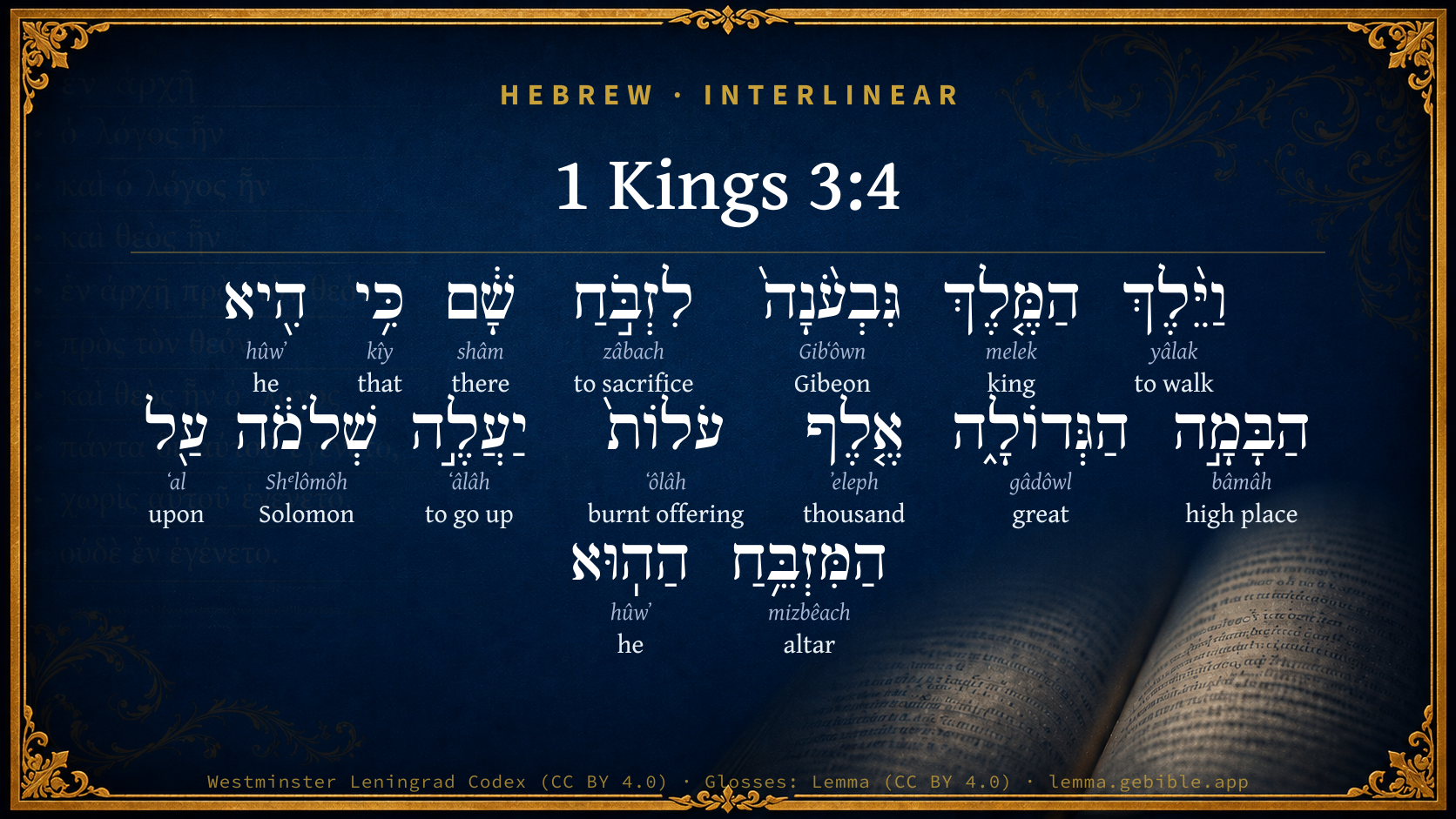
Hebrew (Westminster Leningrad Codex) 1 Kings 3:4 appears in the Hebrew Old Testament. The text above is from the Westminster Leningrad Codex. Each word links to its Strong’s number, a concise gloss, and parsing drawn from the Open Scriptures Hebrew Bible morphology. Click any word for its full Brown-Driver-Briggs (BDB) entry.
Download image
Cite this verse

1 Kings 3:4 (World English Bible). Public Domain. Lemma interlinear Bible study tool, https://lemma.gebible.app/v/1-kings/3/4.

Show BibTeX & RIS
BibTeX
RIS
English Translation
The king went to Gibeon to sacrifice there; for that was the great high place: a thousand burnt offerings did Solomon offer on that altar.
World English Bible · Public Domain
Download a study sheet

One document with this verse’s original text, its word-by-word gloss line, the meaning frame, cross-references with their text, attributed commentary, and full source and license credits — printable, and it pastes into notes with its structure intact.

This verse Autodidact and up

Study sheet (.html) Plain text (.txt)

A passage Seminary Student

Up to 50 verses in one chapter. A passage sheet keeps up to 6 commentary sources and 12 cross-references per verse, in the order this page ranks them, and says so on the sheet whenever that leaves anything out. Ask for a single verse and you get the Autodidact verse sheet above.

Everything on this page stays free to read, with no account — the sheet is a download of what is already on screen, not access to it.

Want to remove ads? Support Godless Engineer
Compare translations 3

The same verse in 3 English versions, stacked beneath the original-language interlinear above. Click any original word for its lexicon entry.

Each is an independent rendering of the whole verse — the interlinear is not word-aligned to these translations.

Highlighted words mark where these versions differ — a whole-verse word diff, not a word-by-word alignment.

  • World English Bible Public Domain
    The king went to Gibeon to sacrifice there; for that was the great high place: a thousand burnt offerings did Solomon offer on that altar.
  • King James Version Public Domain
    And the king went to Gibeon to sacrifice there; for that was the great high place: a thousand burnt offerings did Solomon offer upon that altar.
  • unfoldingWord Literal Text CC BY-SA 4.0
    And the king went to Gibeon to sacrifice there, for it was the great high place. Solomon offered a thousand burnt offerings on that altar.

unfoldingWord Literal Text — © unfoldingWord, licensed CC BY-SA 4.0. Word-aligned USFM3 via Door43 (git.door43.org/unfoldingWord/en_ult).

Versions to compare (up to 4)

3 of 4 selected

Show all 18 translations

Every available English version of this verse, each an independent rendering of the whole verse.

  • World English Bible Public Domain
    The king went to Gibeon to sacrifice there; for that was the great high place: a thousand burnt offerings did Solomon offer on that altar.
  • Berean Standard Bible Public Domain
    Now the king went to Gibeon to sacrifice there, for it was the great high place. Solomon offered a thousand burnt offerings on the altar there.
  • Majority Standard Bible Public Domain
    Now the king went to Gibeon to sacrifice there, for it was the great high place. Solomon offered a thousand burnt offerings on the altar there.
  • King James Version Public Domain
    And the king went to Gibeon to sacrifice there; for that was the great high place: a thousand burnt offerings did Solomon offer upon that altar.
  • American Standard Version (1901) Public Domain
    And the king went to Gibeon to sacrifice there; for that was the great high place: a thousand burnt-offerings did Solomon offer upon that altar.
  • Revised Version (1885) Public Domain
    And the king went to Gibeon to sacrifice there; for that was the great high place: a thousand burnt offerings did Solomon offer upon that altar.
  • Geneva Bible (1599) Public Domain
    And the King went to Gibeon to sacrifice there, for that was the chiefe hie place: a thousand burnt offrings did Salomon offer vpon that altar.
  • Douay-Rheims (1899) Public Domain
    He went therefore to Gabaon, to sacrifice there: for that was the great high place: a thousand victims for holocausts did Solomon offer upon that altar in Gabaon.
  • Young's Literal Translation Public Domain
    and the king goeth to Gibeon, to sacrifice there, for it `is' the great high place; a thousand burnt-offerings cause to ascend doth Solomon on that altar.
  • Literal Standard Version CC BY-SA 4.0
    and the king goes to Gibeon, to sacrifice there, for it [is] the great high place; Solomon causes one thousand burnt-offerings to ascend on that altar.
  • Unlocked Literal Bible CC BY-SA 4.0
    The king went to Gibeon to sacrifice there, for that was the great high place there. Solomon offered a thousand burnt offerings on that altar.
  • unfoldingWord Literal Text CC BY-SA 4.0
    And the king went to Gibeon to sacrifice there, for it was the great high place. Solomon offered a thousand burnt offerings on that altar.
  • Darby Bible Public Domain
    And the king went to Gibeon to sacrifice there; for that was the great high place: a thousand burnt-offerings did Solomon offer up upon that altar.
  • World Messianic Bible Public Domain
    The king went to Gibeon to sacrifice there, for that was the great high place. Solomon offered a thousand burnt offerings on that altar.
  • Webster's Bible Public Domain
    And the king went to Gibeon to sacrifice there; for that was the great high place: a thousand burnt-offerings did Solomon offer upon that altar.
  • Free Bible Version CC BY-SA 4.0
    The king went to Gibeon to sacrifice there, for it was the leading high place. Solomon presented one thousand burnt offerings on the altar there.
  • Bible in Basic English Public Domain
    And the king went to Gibeon to make an offering there, because that was the chief high place: it was Solomon's way to make a thousand burned offerings on that altar.
  • JPS Tanakh (1917) Public Domain
    And the king went to Gibeon to sacrifice there; for that was the great high place; a thousand burnt-offerings did Solomon offer upon that altar.

Literal Standard Version (2020), Covenant Press — licensed CC BY-SA 4.0. Text via the HelloAO Bible API (eBible.org). Unlocked Literal Bible (unfoldingWord) — licensed CC BY-SA 4.0. Text via the HelloAO Bible API (eBible.org). unfoldingWord Literal Text — © unfoldingWord, licensed CC BY-SA 4.0. Word-aligned USFM3 via Door43 (git.door43.org/unfoldingWord/en_ult). Free Bible Version, Dr. Jonathan Gallagher — licensed CC BY-SA 4.0. Text via the HelloAO Bible API (eBible.org).

Word by word

More ways to search: Search by grammar → Find every occurrence → Compare this word →

Practice this passage: Drill this verse → Learn its vocabulary →

גִּבְעֹ֨נָה֙
Gibʻôwn
H1391
“Gibeon · toward”
Noun, Proper + Suffix, Demonstrative
Part of Speech
Noun
Type
Proper
Full BDB Definition

Origin: from the same as H1387

TWOT: None

Gibeon = "hill city" - a Levitical city of Benjamin, modern 'el-Jib', which lies 5 miles or 8 kilometers from Jerusalem
  1. וַיֵּ֨לֶךְ yâlak H3212 “and · to walk” Conjunction + Verb, Qal, Sequential Imperfect, 3rd Person, Masculine, Singular
  2. הַמֶּ֤לֶךְ melek H4428 “the · king” Particle, Definite Article + Noun, Common, Masculine, Singular, Absolute
  3. לִזְבֹּ֣חַ zâbach H2076 “to sacrifice” Preposition + Verb, Qal, Infinitive Construct
  4. שָׁ֔ם shâm H8033 “there” Adverb
  5. כִּ֥י kîy H3588 “that” Conjunction
  6. הִ֖יא hûwʼ H1931 “he” Pronoun, Personal, 3rd Person, Feminine, Singular
  7. הַבָּמָ֣ה bâmâh H1116 “the · high place” Particle, Definite Article + Noun, Common, Feminine, Singular, Absolute
  8. הַגְּדוֹלָ֑ה gâdôwl H1419 “the · great” Particle, Definite Article + Adjective, Adjective, Feminine, Singular, Absolute
  9. אֶ֤לֶף ʼeleph H505 “thousand” Adjective, Cardinal number, Both, Singular, Absolute
  10. עֹלוֹת֙ ʻôlâh H5930 “burnt offerings” Noun, Common, Feminine, Plural, Absolute
  11. יַעֲלֶ֣ה ʻâlâh H5927 “to go up” Verb, Hiphil, Imperfect, 3rd Person, Masculine, Singular
  12. שְׁלֹמֹ֔ה Shᵉlômôh H8010 “Solomon” Noun, Proper
  13. עַ֖ל ʻal H5921 “upon” Preposition
  14. הַמִּזְבֵּ֥חַ mizbêach H4196 “the · altar” Particle, Definite Article + Noun, Common, Masculine, Singular, Absolute
  15. הַהֽוּא hûwʼ H1931 “the · he” Particle, Definite Article + Pronoun, Personal, 3rd Person, Masculine, Singular

About this verse

These counts appear in no published source. They are computed here, from the morphology-tagged text and Lemma’s own curated glosses. What Lemma adds →

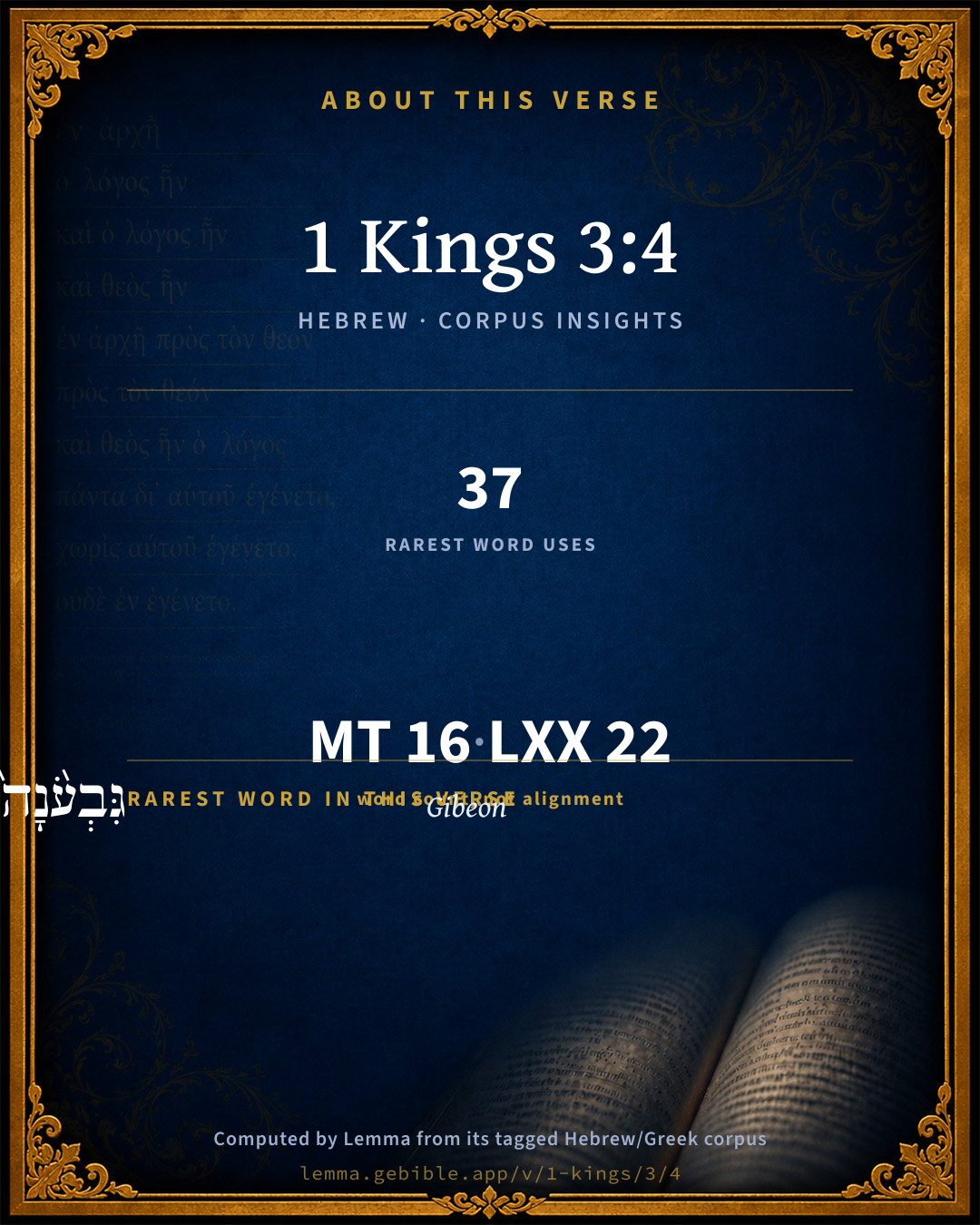
16
words
15
distinct lemmas
Historical
section

Shared distinctive vocabulary

גִּבְעֹ֨נָה֙ Gibeon H1391 occurs in 35 verses of the Hebrew Bible. Also found in:

Grammatical profile

  • 3 verbs
  • 6 nouns
  • 2 adjectives
  • 2 pronouns
  • 1 preposition
  • 1 conjunction
  • 1 adverb

Verb forms

  • וַיֵּ֨לֶךְ Qal · Sequential Imperfect
  • לִזְבֹּ֣חַ Qal · Infinitive Construct
  • יַעֲלֶ֣ה Hiphil · Imperfect

Repetition

A word recurs within this verse — often emphatic in Hebrew:

  • הִ֖יא he H1931 ×2

Hebrew & Septuagint length

In English translation the verse runs 25 words from the Hebrew and 33 from the Septuagint (LXX English) — closely comparable.

A rough comparison of the two English renderings, which tokenize alike — not a word-level alignment.

Word counts can differ between the Hebrew and the Greek without any difference in meaning — e.g. the Hebrew direct-object marker אֵת has no separate Greek word, and Greek often adds the article ὁ.

In the original languages it is 16 Hebrew tokens and 22 Greek tokens — but the two are counted differently (Hebrew bundles its prefixes and suffixes into one token; the Greek is in lemma form), so that isn’t a like-for-like length.

Cross-references

13

Topical passages linked to 1 Kings 3:4 in the Treasury of Scripture Knowledge — connected by theme and wording, ordered by reader-vote popularity; previews shown in the World English Bible.

  • 1 Chronicles 16:39 and Zadok the priest, and his brothers the priests, before the tent of Yahweh in the high place that was at Gibeon,
  • 2 Chronicles 1:3 So Solomon, and all the assembly with him, went to the high place that was at Gibeon; for there was the tent of meeting of God, which Moses the servant of Yahweh had made in the wilderness.
  • 2 Chronicles 7:5 King Solomon offered a sacrifice of twenty-two thousand oxen, and a hundred and twenty thousand sheep. So the king and all the people dedicated the house of God.
  • 1 Chronicles 21:29 For the tent of Yahweh, which Moses made in the wilderness, and the altar of burnt offering, were at that time in the high place at Gibeon.
  • 2 Chronicles 1:6–12 Solomon went up there to the brazen altar before Yahweh, which was at the tent of meeting, and offered one thousand burnt offerings on it.
  • Joshua 9:3 But when the inhabitants of Gibeon heard what Joshua had done to Jericho and to Ai,
  • Isaiah 40:16 Lebanon is not sufficient to burn, nor the animals of it sufficient for a burnt offering.
  • 1 Kings 8:63 Solomon offered for the sacrifice of peace-offerings, which he offered to Yahweh, two and twenty thousand oxen, and one hundred twenty thousand sheep. So the king and all the children of Israel dedicated the house of Yahweh.
  • 2 Chronicles 29:32–35 The number of the burnt offerings which the assembly brought was seventy bulls, one hundred rams, and two hundred lambs: all these were for a burnt offering to Yahweh.
  • 2 Chronicles 30:24 For Hezekiah king of Judah did give to the assembly for offerings one thousand bulls and seven thousand sheep; and the princes gave to the assembly a thousand bulls and ten thousand sheep: and a great number of priests sanctified themselves.
  • Joshua 10:2 that they feared greatly, because Gibeon was a great city, as one of the royal cities, and because it was greater than Ai, and all the men of it were mighty.
  • Micah 6:6–7 How shall I come before Yahweh, And bow myself before the exalted God? Shall I come before him with burnt offerings, With calves a year old?
  • 1 Kings 9:2 that Yahweh appeared to Solomon the second time, as he had appeared to him at Gibeon.

Cross-references courtesy of OpenBible.info (CC BY 4.0).

Hebrew and Greek witnesses Masoretic Hebrew ↔ Greek Septuagint

The same verse in the two great witnesses to the Old Testament, shown verse-for-verse.

These are two independent witnesses, not word-aligned to each other, and the Septuagint is shown in lemma (dictionary) form.

Hebrew 1 Kings 3:4 Masoretic · Westminster Leningrad Codex

וַיֵּ֨לֶךְ הַמֶּ֤לֶךְ גִּבְעֹ֨נָה֙ לִזְבֹּ֣חַ שָׁ֔ם כִּ֥י הִ֖יא הַבָּמָ֣ה הַגְּדוֹלָ֑ה אֶ֤לֶף עֹלוֹת֙ יַעֲלֶ֣ה שְׁלֹמֹ֔ה עַ֖ל הַמִּזְבֵּ֥חַ הַהֽוּא

The king went to Gibeon to sacrifice there; for that was the great high place: a thousand burnt offerings did Solomon offer on that altar.

World English Bible · Public Domain

Greek LXX 1 Kings 3:4 Septuagint · lemma form

καί ἀναἵστημι καί πορεύομαι εἰς γαβαων θύω ἐκεῖ ὅτι αὐτός ὑψηλός καί μέγας χίλιοι ὁλοκαύτωσις ἀναφέρω σαλωμών ἐπί ὁ θυσιαστήριον ἐν γαβαων

And he arose and went to Gabaon to sacrifice there, for that was the highest place, and great: Solomon offered a whole burnt offering of a thousand victims on the altar in Gabaon.

LXX2012 (modern English Septuagint) · Public Domain

Hebrew: Westminster Leningrad Codex (CC BY 4.0). Greek: Septuagint (public domain); English from LXX2012 (modern English Septuagint) (Public Domain). How the Septuagint differs from the Hebrew →

Targum (Aramaic paraphrase)

1

The Targum is the ancient Jewish Aramaic paraphrase of the Hebrew Scriptures — an interpretive translation, not the Hebrew text itself. Onkelos (literal) and Pseudo-Jonathan (expansive) render the Torah, and Jonathan the Prophets. Coverage is partial: where no permissively-licensed English translation exists for a verse, only the Aramaic is shown. This is verse-level text, not a word-by-word alignment to the Hebrew.

  1. Targum Jonathan Prophets (Joshua–Malachi)
    וַאֲזַל מַלְכָּא לְגִבְעוֹן לְדַבָּחָא תַמָן אֲרֵי הִיא בָּמָתָא רַבְּתָא אֶלֶף עַלְוָן יַסִיק שְׁלֹמֹה עַל מַדְבְּחָא הַהוּא:

    (no public-domain English translation for this verse)

    Targum Jonathan — Aramaic: “Mikraot Gedolot” (public domain). English: “Sefaria Community Translation” (CC0 1.0 (public-domain dedication)); “London "Chaldee Paraphrase," 1871” (public domain). Text via Sefaria.

Commentary

Notes on 1 Kings 3:4 from classic Christian and Jewish commentators (each source and its license shown beneath its notes). The classic Christian expositions comment on the surrounding passage and are grouped to its opening verse, so a note may address several verses; the Jewish commentaries on the Tanakh (Rashi and others) are per-verse, so they appear only where the commentator wrote on this verse.

Lemma curates 59 commentaries, every one of them public domain or Creative Commons licensed, each selected and text-cleaned for this edition rather than reprinted as found. About our sources →

Trapp's Complete Commentary

John Trapp

1Ki 3:4 And the king went to Gibeon to sacrifice there; for that [was] the great high place: a thousand burnt offerings did Solomon offer upon that altar.

Ver. 4. And the king went to Gibeon.] To seek God; and that he might be the better prepared to build the temple, whereunto he now thought it but time to address himself.

For that was the great high place.] Because there was the tabernacle {1Ch 16:39} and the altar of burnt offering; {1Ch 21:29} hence there was great resorting to it.

John Trapp, A Commentary or Exposition upon All the Books of the Old and New Testament (1647–1656) — public domain. Text from a community e-Sword module.

Joseph Benson's Commentary

1Ki 3:4. The king went to Gibeon — Because the tabernacle was there, and the great brazen altar which Moses made. For after Shiloh was destroyed, they were carried to Nob; and the priests being there slain by Saul, they were removed to Gibeon, 2Ch 1:3-6. That was the great high place — The most eminent and frequented; and, possibly, was a high and raised ground. A thousand burnt-offerings did Solomon offer — This undoubtedly includes the peace-offerings which were killed and dressed for the entertainment of the guests who were invited to the sacrifices; for it can hardly be supposed that so many were wholly consumed on the altar at one time of sacrificing.

Joseph Benson's Commentary on the Old and New Testaments (1811–1818) — public domain. Text from a community e-Sword module.

Whedon's Commentary on the Bible

Daniel D. Whedon

SOLOMON’S WISE CHOICE, 1Ki_3:4-15.

4. Gibeon — The modern el-Jib, a few miles northwest of Jerusalem. See note on Jos_9:3.

That was the great high place — The most distinguished and sacred of all the heights on which the people were wont to sacrifice, for there were the tabernacle and the brazen altar. 2Ch_1:3; 2Ch_1:5.

A thousand burnt offerings — This great number corresponded with the thousands of the congregation that went with Solomon to the high place, (see 1Ch_1:2-3,) and also denoted the national significance of the occasion. So at the dedication of the temple Solomon offered twenty-two thousand oxen, and one hundred and twenty thousand sheep, or, as elsewhere expressed, “Sheep and oxen, that could not be told nor numbered for multitude.” See 1Ki_8:5; 1Ki_8:63. We are not to suppose that all these offerings were made at the same instant or by one person; still less that Solomon offered them with his own hands. Scores of priests officiated on such occasions, and the sacred festival lasted many days.

Daniel D. Whedon (gen. ed.), Commentary on the Old and New Testaments (1874–1909) — public domain. Text from a community e-Sword module.

Tyndale Open Study Notes

Tyndale Open Resources

3:4-15 God’s gift of wisdom to Solomon is narrated as a chiasm (a symmetrical arrangement in which sections A and B are mirrored by sections B’ and A’), drawing the focus in on Solomon’s transaction with the Lord: A: While he sacrificed at Gibeon . . . the Lord appeared to Solomon in a dream (3:4-5). B: Solomon prayed for wisdom to govern his people equitably and efficiently (3:6-9). B’: The Lord favorably answered his request and granted additional blessings (3:10-14). A’: Solomon awoke from the dream and offered additional sacrifices to the Lord (3:15).

3:4 The city of Gibeon lay six miles northwest of Jerusalem. Its altar, the most important of these [local] places of worship (literally the great high place), accommodated sacrifices of royal proportions. Gibeon was also the site of the Tabernacle (1 Chr 16:39-40; 21:29; 2 Chr 1:2-6).

Tyndale Open Study Notes — © Tyndale Open Resources, licensed CC BY-SA 4.0. Text via the HelloAO Bible API.

Geneva Bible (1599)

Geneva Bible translators

For there the Tabernacle was, 2 Chron. 1:3.

Geneva Bible (1599) marginal notes — public domain. Text via Bolls.life.

Jamieson, Fausset & Brown

Robert Jamieson, A. R. Fausset & David Brown

the king went to Gibeon to sacrifice there--The old tabernacle and the brazen altar which Moses had made in the wilderness were there (Ch1 16:39; Ch1 21:29; Ch2 1:3-6). The royal progress was of public importance. It was a season of national devotion. The king was accompanied by his principal nobility (Ch2 1:2); and, as the occasion was most probably one of the great annual festivals which lasted seven days, the rank of the offerer and the succession of daily oblations may help in part to account for the immense magnitude of the sacrifices.

Jamieson, Fausset & Brown — Commentary Critical and Explanatory on the Whole Bible (1871) — public domain (CC PDM 1.0). Text via the HelloAO Bible API.

Ellicott's Commentary for English Readers

(4) Gibeon.—The name itself, signifying “belonging to a hill,” indicates its position on the central plateau of Israel, in the land of Benjamin, whence rise several round hills, on one of which the town stood. There was now reared the Tabernacle, with the brazen altar of sacrifice, to which the descendants of the old Gibeonites were attached as “hewers of wood and drawers of water” (Jos_9:23). It was therefore naturally “the great high place.”

A Bible Commentary for English Readers, edited by Charles John Ellicott (1878–1897) — public domain. Text from a community e-Sword module.

The Cambridge Bible for Schools and Colleges

gen. ed. J. J. S. Perowne

4. to Gibeon] The Hivite city which was assigned by Joshua to the tribe of Benjamin (Jos_18:21-25). It is most known in early times for the cunning device of its inhabitants to secure a treaty with Joshua and the Israelites (Joshua 9), and in later history because it was the place where the tabernacle of the congregation and the brazen altar of burnt-offering were set up until the completion of Solomon’s temple. Whether this position was chosen as a high place by the Israelites or whether it had been a place used for worship by the Hivites beforetime there is nothing to indicate.

the great high place] Probably because the tabernacle was there. This was likely to make it more famous than its neighbours at Ramah or Mizpeh.

a thousand burnt offerings] In the Chronicles (2Ch_1:2-3) we are told a little more about this sacrifice. The king had consulted all the people, and the great officers, and went up in a solemn procession with all the congregation. This accounts for the abundance of the offerings. After this occasion we hear no more of sacrifices at Gibeon.

The Cambridge Bible for Schools and Colleges (gen. ed. J. J. S. Perowne; Cambridge University Press, 1878–1918) — public domain. Text from a community e-Sword module.

John Gill's Exposition

And the king went to Gibeon to sacrifice there,.... About four or five miles from Jerusalem; See Gill on Kg1 2:28;

for that was the great high place; not that the place itself might be higher than others that were used; but here were the tabernacle of Moses, and the altar; so that it was a more dignified place, and more sacred because of them:

a thousand burnt offerings did Solomon offer upon that altar; the brazen altar of burnt offerings there; not at one time, but on several days successively; though Jarchi says on one day; and which was a prodigious number, never was known the like, unless at the dedication of the temple, Kg1 8:63.

John Gill's Exposition of the Whole Bible (1746–1763) — public domain (CC PDM 1.0). Text via the HelloAO Bible API.

Albert Barnes' Notes on the Bible

Gibeon - The transfer to Gibeon of the “tabernacle of the congregation,” and the brass “altar of burnt offerings” made by Moses, which were removed there from Nob (compare 1Sa 21:6, with marginal references “i,” “k”), had made it “the great high-place,” more sacred, i. e., than any other in the holy land, unless it were Mount Zion where the ark had been conveyed by David. For the position of Gibeon, see Jos 9:3 note.

A thousand burnt offerings did Solomon offer - Solomon presented the victims. The priests were the actual sacrificers 1Ki 8:5. A sacrifice of a thousand victims was an act of royal magnificence suited to the greatness of Solomon. So Xerxes offered 1,000 oxen at Troy. If the offerings in this case were “whole burnt offerings,” and were all offered upon the altar of Moses, the sacrifice must have lasted several days.

Albert Barnes' Notes on the Bible (1834–1885) — public domain. Text from a community e-Sword/MySword module.

Haydock's Catholic Bible Commentary

Victims. These he accompanied with most fervent prayer, Wisdom vii. 7., and 2 Paralipomenon i. 9.

George Leo Haydock (1774–1849), Haydock's Catholic Family Bible and Commentary, 1859 edition — public domain. Excludes Psalms (Douay-Rheims chapter numbering differs from Protestant) and Deuterocanonical books (Catholic canon only).

Matthew Poole's English Annotations

The great high place; the most eminent and frequented, because there was the tabernacle and the altar of Moses, 1Ch 16:39; 21:29; 2Ch 1:3,5,6, which possibly were placed upon a high or raised ground.

A thousand burnt offerings did Solomon offer upon that altar; thereby showing his special respect to this above all other places, and by his example teaching and inviting all his people to do so.

Matthew Poole's English Annotations on the Holy Bible (1683–1685) — public domain. Text from a community e-Sword/MySword module.

The Pulpit Commentary

And the king went to Gibeon (Jos_9:3 Jos_10:2 Jos_18:25 2Sa_21:1. Now known as El-Jib, a commanding eminence (as the name implies) some six miles north of Jerusalem. Strictly, it consists of two heights, on one of which, it is conjectured, the town stood, while the other was the high place. Solomon was accompanied to Gibeon by "all the congregation," including the captains, judges, governors, etc. (2Ch_1:2, 2Ch_1:3) to sacrifice there (This religious service was designed to inaugurate his reign, (2Ch_1:13) after the precedent of 1Sa_11:15; cf. 2Sa_6:2. His object was also to supplicate the Divine blessing on his undertakings. If his visit served at the same time as a farewell, or "honourable funeral to the tabernacle" (this was an accident); for that was the great high place (being the place of the tabernacle and brazen altar. In 1Sa_21:6 we find the tabernacle at Nob, though without the ark. (1Sa_4:2) After the massacre of the priests it lost the ephod. (1Sa_22:20 1Sa_23:6) It could hardly remain in a spot stained by so much blood; but how or when it found its way to Gibeon, we do not know: (See 1Ch_16:37, 39 2Ch_1:3-6) a thousand burnt offerings such numbers were not infrequent at festivals. See on 1Ki_8:62, and cf. 2Ch_29:33, 2Ch_29:34. Rawlinson reminds us that "Xerxes offered 1000 oxen at Troy" (Heb 7:43). did Solomon offer (not, of course, personally, as some (Ewald. e.g. ) have sup. posed. He is said to have "offered" them, because he (together with the congregation, perhaps) provided them. The immense number alone shows that he cannot have offered in person. The festival probably lasted for seven or eight days, but even then a thousand victims can hardly have been offered whole ( twl ) unless the altar was greatly enlarged, or additional temporary altars were erected. This latter supposition is not negatived by the next words. (See on 1Ki_8:63, 1Ki_8:64) upon that altar.

The Pulpit Commentary (1880–1919), ed. H.D.M. Spence-Jones & Joseph S. Exell — public domain. Text from a community e-Sword module.

Keil & Delitzsch

C. F. Keil & F. Delitzsch

Solomon's Sacrifice and Dream at Gibeon (cf. Ch2 1:1-13). - To implore the divine blessing upon his reign, Solomon offered to the Lord at Gibeon a great sacrifice - a thousand burnt-offerings; and, according to Ch2 1:2, the representatives of the whole nation took part in this sacrificial festival. At that time the great or principal bamah was at Gibeon (the present el Jib; see at Jos 9:3), namely, the Mosaic tabernacle (Ch2 1:3), which is called הבּמה, because the ark of the covenant, with which Jehovah had bound up His gracious presence, was not there now. "Upon that altar," i.e., upon the altar of the great bamah at Gibeon, the brazen altar of burnt-offering in the tabernacle (Ch2 1:6).

Kg1 3:5-8

The one thing wanting in the place of sacrifice at Gibeon, viz., the ark of the covenant with the gracious presence of Jehovah, was supplied by the Lord in the case of this sacrifice by a direct revelation in a dream, which Solomon received in the night following the sacrifice. There is a connection between the question which God addressed to Solomon in the dream, "What shall I give thee?" and the object of the sacrifice, viz., to seek the help of God for his reign. Solomon commences his prayer in Kg1 3:6 with an acknowledgment of the great favour which the Lord had shown to his father David, and had continued till now by raising his son to his throne (הזּה כּיּום, as it is this day: cf. Sa1 22:8; Deu 8:18, etc.); and then, in Kg1 3:7-9, in the consciousness of his incapacity for the right administration of government over so numerous a people, he asks the Lord for an obedient heart and for wisdom to rule His people. ועתּה introduces the petition, the reasons assigned for which are, (1) his youth and inexperience, and (2) the greatness or multitude of the nation to be governed. I am, says he, קטן נער, i.e., an inexperienced youth (Solomon was only about twenty years old): "I know not to go out and in," i.e., how to behave myself as king, or govern the people (for ובא צאת compare the note on Num 27:17). At Kg1 3:8 he describes the magnitude of the nation in words which recall to mind the divine promises in Gen 13:16 and Gen 32:13, to indicate how gloriously the Lord has fulfilled the promises which He made to the patriarchs.

Kg1 3:9

ונתתּ, therefore give. The prayer (commencing with ועתּה in Kg1 3:7) is appended in the form of an apodosis to the circumstantial clauses וגו ואנכי and וגו ועבדּך, which contain the grounds of the petition. שׁמע לב, a hearing heart, i.e., a heart giving heed to the law and right of God, "to judge Thy people, (namely) to distinguish between good and evil (i.e., right and wrong)." "For who could judge this Thy numerous people," sc. unless Thou gavest him intelligence? כּבד, heavy in multitude: in the Chronicles this is explained by גּדול.

Kg1 3:10-12

This prayer pleased God well. "Because thou hast asked this, and hast not asked for thyself long life, nor riches, nor the life (i.e., the destruction) of thy foes," all of them good things, which the world seeks to obtain as the greatest prize, "but intelligence to hear judgment (i.e., to foster it, inasmuch as the administration of justice rests upon a conscientious hearing of the parties), behold I have done according to thy word" (i.e., fulfilled thy request: the perfect is used, inasmuch as the hearkening has already begun; for הנּה in this connection compare Ewald, 307, e.), "and given thee a wise and understanding heart." The words which follow, "so that there has been none like thee before thee," etc., are not to be restricted to the kings of Israel, as Clericus supposes, but are to be understood quite universally as applying to all mankind (cf. Kg1 5:9-11).

Kg1 3:13-14

In addition to this, according to the promise that to him who seeks first the kingdom of God and His righteousness all other things shall be added (Mat 6:33), God will also give him the earthly blessings, for which he has not asked, and that in great abundance, viz., riches and honour such as no king of the earth has had before him; and if he adhere faithfully to God's commandments, long life also (והארכתּי, in this case I have lengthened). This last promise was not fulfilled, because Solomon did not observe the condition (cf. Kg1 11:42).

Kg1 3:15

Then Solomon awoke, and behold it was a dream; i.e., a dream produced by God, a revelation by dream, or a divine appearance in a dream. חלום as in Num 12:6. - Solomon thanked the Lord again for this promise after his return to Jerusalem, by offering burnt-offerings and thank-offerings before the ark of the covenant, i.e., upon the altar at the tent erected for the ark upon Zion, and prepared a meal for all his servants (viz., his court-servants), i.e., a sacrificial meal of the שׁלמים. - This sacrificial festival upon Zion is omitted in the Chronicles, as well as the following account in Num 12:16 -28; not, however, because in the chronicler's opinion no sacrifices had any legal validity but such as were offered upon the altar of the Mosaic tabernacle, as Thenius fancies, though without observing the account in Ch1 21:26., which overthrows this assertion, but because this sacrificial festival had no essential significance in relation to Solomon's reign.

Keil & Delitzsch — Biblical Commentary on the Old Testament (1861–1891) — public domain (CC PDM 1.0). Text via the HelloAO Bible API. (Old Testament only.)

unfoldingWord translationNotes

Door43 World Missions Community

General Information:

God asks Solomon what he can do for Solomon.

the great high place

"the most famous place for makings sacrifices" or "the most important altar"

Ask! What should I give you?

"Ask me for whatever you want and I will give it to you." or "What do you want? Ask and I will give it to you."

translationWords

Gibeon

burnt offering

altar

dream

unfoldingWord translationNotes — © Distant Shores Media and the Door43 World Missions Community, licensed CC BY-SA 4.0. Source: git.door43.org/Door43/en_tn.

Rashi

Rabbi Shlomo Yitzchaki (Rashi)

For that was the great improvised altar. That was the copper altar which Moshe made in the wilderness, and it was instituted in Shilo. Shilo was destroyed in Eili’s days, and then it came to Nov. Nov was destroyed in Shaul’s days, and they came to Givon.

Shlomo offered. Did Shlomo offer.

Upon that altar. In one day.

Rashi on the Tanakh — English translations: “The Judaica Press complete Tanach with Rashi, translated by A. J. Rosenberg” (CC BY 4.0); “Pentateuch with Rashi's commentary by M. Rosenbaum and A.M. Silbermann, 1929-1934” (public domain); “The Metsudah Tanach series, Lakewood, N.J” (CC BY 4.0); and “The Book of Joshua, Metsudah Publications, 1997” (CC BY 4.0). Text via Sefaria.

Lesson kit

Teaching starters — assembled from the data on this page, not authored interpretation. Every prompt links to the verse data it draws on. Edit before teaching.

1 Kings, in the Historical, opens this verse with 16 words (15 distinct Hebrew lemmas). Its most distinctive word is Gibʻôwn (“Gibeon”). A historical commentator’s framing appears above. Read the whole chapter for the surrounding context.

Discussion questions

  1. How does “Gibeon” (Gibʻôwn) shape what this verse is saying?
  2. Joshua 9:3 shares the word «Gibeon» with this verse. How do the two illuminate each other?
  3. “he” occurs 2× in this one verse. What is the effect of the repetition?
  4. The translations on this page render this verse differently — a whole-verse word diff, not a word-by-word alignment. What might account for the different wordings?
  5. The verb «וַיֵּ֨לֶךְ» is Qal Sequential Imperfect. How does its form color the action?
  6. Reading how Trapp's Complete Commentary and Joseph Benson's Commentary read this verse, where do the two commentators agree and where do they part?

Things to notice

Reading settings

Reading text

Shown beneath each verse's original-language words.

Old Testament
Old Testament edition

Read the OT as the Masoretic Hebrew (MT) or the Greek Septuagint (LXX).

English shown for the Greek Septuagint (in the Hebrew ↔ Greek comparison).

Comparing translations? Open the Compare panel on any verse page to stack up to four side by side.