
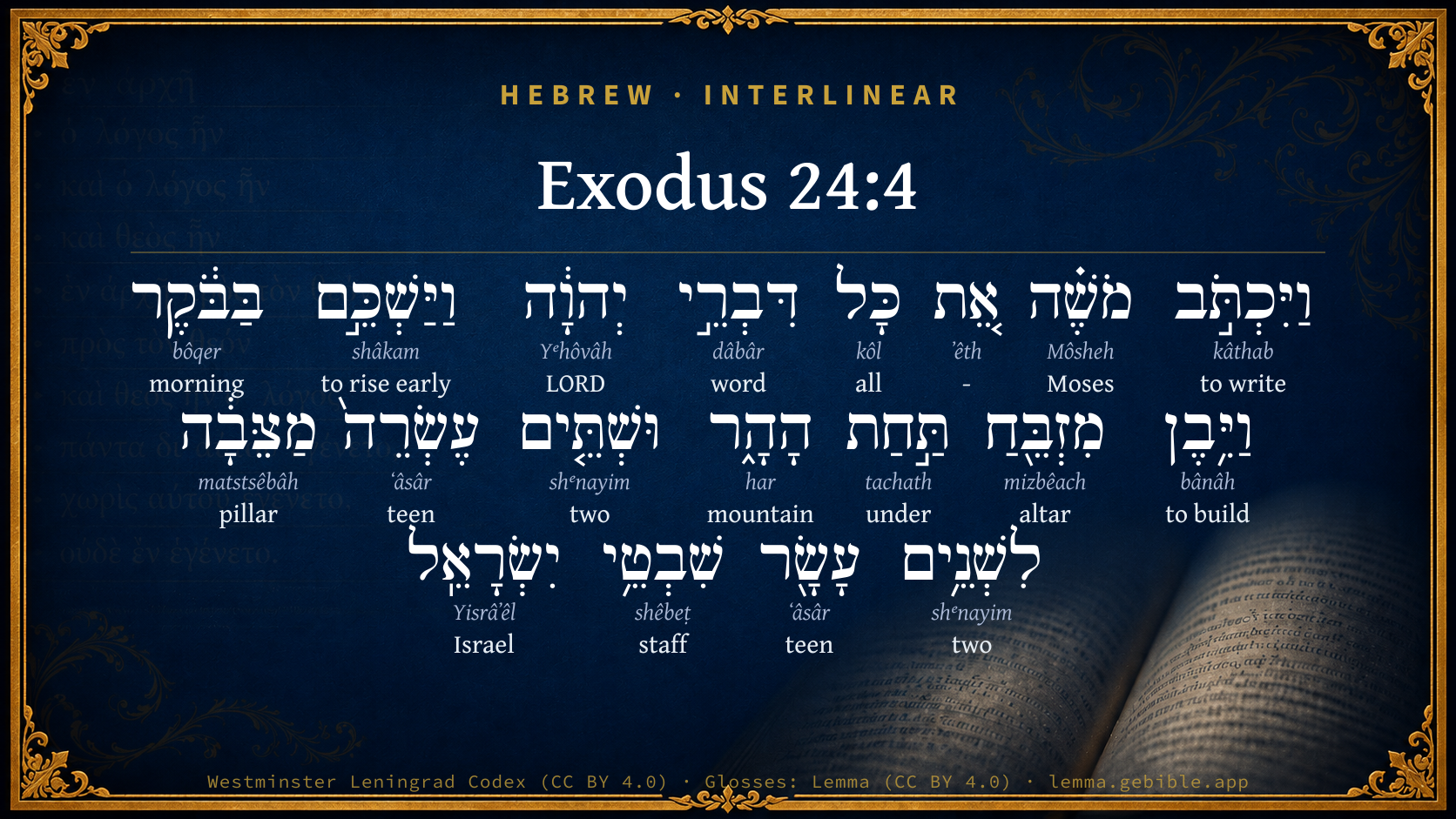
Exodus 24:4

Hebrew (Westminster Leningrad Codex) Exodus 24:4 appears in the Hebrew Old Testament. The text above is from the Westminster Leningrad Codex. Each word links to its Strong’s number, a concise gloss, and parsing drawn from the Open Scriptures Hebrew Bible morphology. Click any word for its full Brown-Driver-Briggs (BDB) entry.
Download image
Cite this verse

Exodus 24:4 (World English Bible). Public Domain. Lemma interlinear Bible study tool, https://lemma.gebible.app/v/exodus/24/4.

Show BibTeX & RIS
BibTeX
RIS
English Translation
Moses wrote all the words of Yahweh, and rose up early in the morning, and built an altar under the mountain, and twelve pillars for the twelve tribes of Israel.
World English Bible · Public Domain
Download a study sheet

One document with this verse’s original text, its word-by-word gloss line, the meaning frame, cross-references with their text, attributed commentary, and full source and license credits — printable, and it pastes into notes with its structure intact.

This verse Autodidact and up

Study sheet (.html) Plain text (.txt)

A passage Seminary Student

Up to 50 verses in one chapter. A passage sheet keeps up to 6 commentary sources and 12 cross-references per verse, in the order this page ranks them, and says so on the sheet whenever that leaves anything out. Ask for a single verse and you get the Autodidact verse sheet above.

Everything on this page stays free to read, with no account — the sheet is a download of what is already on screen, not access to it.

Want to remove ads? Support Godless Engineer
Compare translations 3

The same verse in 3 English versions, stacked beneath the original-language interlinear above. Click any original word for its lexicon entry.

Each is an independent rendering of the whole verse — the interlinear is not word-aligned to these translations.

Highlighted words mark where these versions differ — a whole-verse word diff, not a word-by-word alignment.

  • World English Bible Public Domain
    Moses wrote all the words of Yahweh, and rose up early in the morning, and built an altar under the mountain, and twelve pillars for the twelve tribes of Israel.
  • King James Version Public Domain
    And Moses wrote all the words of the LORD, and rose up early in the morning, and builded an altar under the hill, and twelve pillars, according to the twelve tribes of Israel.
  • unfoldingWord Literal Text CC BY-SA 4.0
    And Moses wrote all of the words of Yahweh. And he rose early in the morning and built an altar at the bottom of the mountain and 12 stone pillars according to the twelve tribes of Israel.

unfoldingWord Literal Text — © unfoldingWord, licensed CC BY-SA 4.0. Word-aligned USFM3 via Door43 (git.door43.org/unfoldingWord/en_ult).

Versions to compare (up to 4)

3 of 4 selected

Show all 18 translations

Every available English version of this verse, each an independent rendering of the whole verse.

  • World English Bible Public Domain
    Moses wrote all the words of Yahweh, and rose up early in the morning, and built an altar under the mountain, and twelve pillars for the twelve tribes of Israel.
  • Berean Standard Bible Public Domain
    And Moses wrote down all the words of the LORD. Early the next morning he got up and built an altar at the base of the mountain, along with twelve pillars for the twelve tribes of Israel.
  • Majority Standard Bible Public Domain
    And Moses wrote down all the words of the LORD. Early the next morning he got up and built an altar at the base of the mountain, along with twelve pillars for the twelve tribes of Israel.
  • King James Version Public Domain
    And Moses wrote all the words of the LORD, and rose up early in the morning, and builded an altar under the hill, and twelve pillars, according to the twelve tribes of Israel.
  • American Standard Version (1901) Public Domain
    And Moses wrote all the words of Jehovah, and rose up early in the morning, and builded an altar under the mount, and twelve pillars, according to the twelve tribes of Israel.
  • Revised Version (1885) Public Domain
    And Moses wrote all the words of the LORD, and rose up early in the morning, and builded an altar under the mount, and twelve pillars, according to the twelve tribes of Israel.
  • Geneva Bible (1599) Public Domain
    And Moses wrote all the wordes of the Lord, and rose vp early, and set vp an altar vnder the mountaine, and twelue pillars according to the twelue tribes of Israel.
  • Douay-Rheims (1899) Public Domain
    And Moses wrote all the words of the Lord: and rising in the morning he built an altar at the foot of the mount, and twelve titles according to the twelve tribes of Israel.
  • Young's Literal Translation Public Domain
    And Moses writeth all the words of Jehovah, and riseth early in the morning, and buildeth an altar under the hill, and twelve standing pillars for the twelve tribes of Israel;
  • Literal Standard Version CC BY-SA 4.0
    And Moses writes all the words of YHWH, and rises early in the morning, and builds an altar under the hill, and twelve standing pillars for the twelve tribes of Israel;
  • Unlocked Literal Bible CC BY-SA 4.0
    Then Moses wrote down all of Yahweh's words. Early in the morning, Moses built an altar at the foot of the mountain and arranged twelve stone pillars, so that the stones would represent the twelve tribes of Israel.
  • unfoldingWord Literal Text CC BY-SA 4.0
    And Moses wrote all of the words of Yahweh. And he rose early in the morning and built an altar at the bottom of the mountain and 12 stone pillars according to the twelve tribes of Israel.
  • Darby Bible Public Domain
    And Moses wrote all the words of Jehovah, and rose up early in the morning, and built an altar under the mountain, and twelve pillars, according to the twelve tribes of Israel.
  • World Messianic Bible Public Domain
    Moses wrote all the LORD’s words, then rose up early in the morning and built an altar at the base of the mountain, with twelve pillars for the twelve tribes of Israel.
  • Webster's Bible Public Domain
    And Moses wrote all the words of the LORD, and rose early in the morning, and built an altar under the hill, and twelve pillars according to the twelve tribes of Israel.
  • Free Bible Version CC BY-SA 4.0
    Moses wrote down everything the Lord had said. He got up early the following morning and built an altar at the bottom of the mountain, and set up twelve pillars for each of the twelve tribes of Israel.
  • Bible in Basic English Public Domain
    Then Moses put down in writing all the words of the Lord, and he got up early in the morning and made an altar at the foot of the mountain, with twelve pillars for the twelve tribes of Israel.
  • JPS Tanakh (1917) Public Domain
    And Moses wrote all the words of the LORD, and rose up early in the morning, and builded an altar under the mount, and twelve pillars, according to the twelve tribes of Israel.

Literal Standard Version (2020), Covenant Press — licensed CC BY-SA 4.0. Text via the HelloAO Bible API (eBible.org). Unlocked Literal Bible (unfoldingWord) — licensed CC BY-SA 4.0. Text via the HelloAO Bible API (eBible.org). unfoldingWord Literal Text — © unfoldingWord, licensed CC BY-SA 4.0. Word-aligned USFM3 via Door43 (git.door43.org/unfoldingWord/en_ult). Free Bible Version, Dr. Jonathan Gallagher — licensed CC BY-SA 4.0. Text via the HelloAO Bible API (eBible.org).

Word by word

More ways to search: Search by grammar → Find every occurrence → Compare this word →

Practice this passage: Drill this verse → Learn its vocabulary →

מַצֵּבָ֔ה
matstsêbâh
H4676
“pillar”
Noun, Common, Feminine, Singular, Absolute
Part of Speech
Noun
Type
Common
Gender
Feminine
Number
Singular
State
Absolute
Full BDB Definition

Origin: (causatively) participle of H5324

TWOT: 1398g

pillar, mastaba, stump - pillar - as monument, personal memorial - with an altar - (Hophal) stock, stump (of tree)
  1. וַיִּכְתֹּ֣ב kâthab H3789 “and · to write” Conjunction + Verb, Qal, Sequential Imperfect, 3rd Person, Masculine, Singular
  2. מֹשֶׁ֗ה Môsheh H4872 “Moses” Noun, Proper
  3. אֵ֚ת ʼêth H853 “-” Particle, Direct Object
  4. כָּל kôl H3605 “all of” Noun, Common, Masculine, Singular, Construct
  5. דִּבְרֵ֣י dâbâr H1697 “words of” Noun, Common, Masculine, Plural, Construct
  6. יְהוָ֔ה Yᵉhôvâh H3068 “LORD” Noun, Proper
  7. וַיַּשְׁכֵּ֣ם shâkam H7925 “and · to rise early” Conjunction + Verb, Hiphil, Sequential Imperfect, 3rd Person, Masculine, Singular
  8. בַּבֹּ֔קֶר bôqer H1242 “in/at the · morning” Preposition, Determined + Noun, Common, Masculine, Singular, Absolute
  9. וַיִּ֥בֶן bânâh H1129 “and · to build” Conjunction + Verb, Qal, Sequential Imperfect, 3rd Person, Masculine, Singular
  10. מִזְבֵּ֖חַ mizbêach H4196 “altar” Noun, Common, Masculine, Singular, Absolute
  11. תַּ֣חַת tachath H8478 “under” Preposition
  12. הָהָ֑ר har H2022 “the · mountain” Particle, Definite Article + Noun, Common, Masculine, Singular, Absolute
  13. וּשְׁתֵּ֤ים shᵉnayim H8147 “and · two” Conjunction + Adjective, Cardinal number, Feminine, Dual, Absolute
  14. עֶשְׂרֵה֙ ʻâsâr H6240 “teen” Adjective, Cardinal number, Feminine, Singular, Absolute
  15. לִשְׁנֵ֥ים shᵉnayim H8147 “to/for · two” Preposition + Adjective, Cardinal number, Masculine, Dual, Absolute
  16. עָשָׂ֖ר ʻâsâr H6240 “teen” Adjective, Cardinal number, Masculine, Singular, Absolute
  17. שִׁבְטֵ֥י shêbeṭ H7626 “staffs of” Noun, Common, Masculine, Plural, Construct
  18. יִשְׂרָאֵֽל Yisrâʼêl H3478 “Israel” Noun, Proper

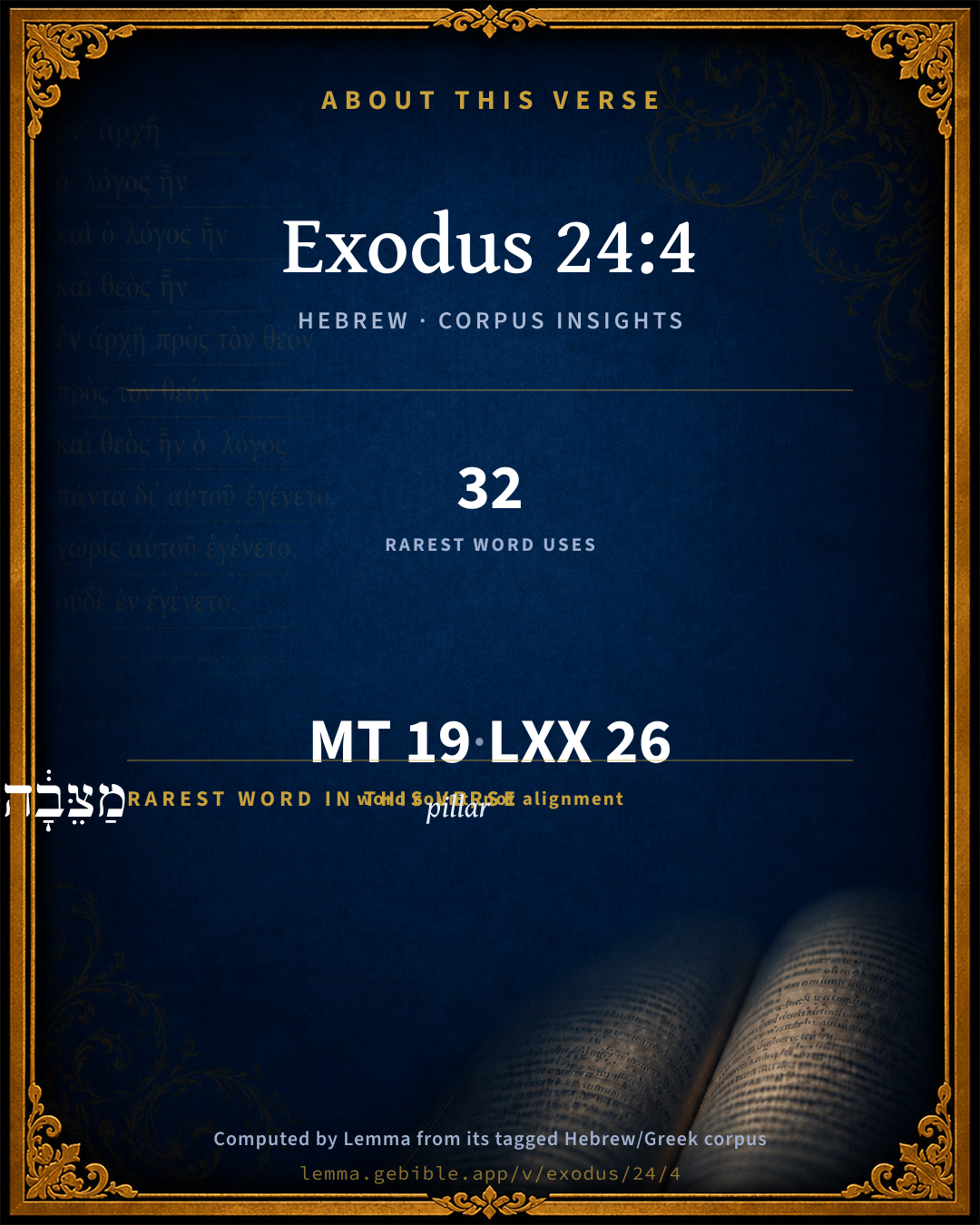
About this verse

These counts appear in no published source. They are computed here, from the morphology-tagged text and Lemma’s own curated glosses. What Lemma adds →

19
words
17
distinct lemmas
Pentateuch
section

Shared distinctive vocabulary

מַצֵּבָ֔ה pillar H4676 occurs in 31 verses of the Hebrew Bible. Also found in:

Grammatical profile

  • 3 verbs
  • 10 nouns
  • 4 adjectives
  • 1 preposition
  • 1 particle

Verb forms

  • וַיִּכְתֹּ֣ב Qal · Sequential Imperfect
  • וַיַּשְׁכֵּ֣ם Hiphil · Sequential Imperfect
  • וַיִּ֥בֶן Qal · Sequential Imperfect

Repetition

Words recur within this verse — often emphatic in Hebrew:

  • וּשְׁתֵּ֤ים two H8147 ×2
  • עֶשְׂרֵה֙ teen H6240 ×2

Hebrew & Septuagint length

In English translation the verse runs 30 words from the Hebrew and 35 from the Septuagint (LXX English) — closely comparable.

A rough comparison of the two English renderings, which tokenize alike — not a word-level alignment.

Word counts can differ between the Hebrew and the Greek without any difference in meaning — e.g. the Hebrew direct-object marker אֵת has no separate Greek word, and Greek often adds the article ὁ.

In the original languages it is 19 Hebrew tokens and 26 Greek tokens — but the two are counted differently (Hebrew bundles its prefixes and suffixes into one token; the Greek is in lemma form), so that isn’t a like-for-like length.

Cross-references

17

Topical passages linked to Exodus 24:4 in the Treasury of Scripture Knowledge — connected by theme and wording, ordered by reader-vote popularity; previews shown in the World English Bible.

  • Genesis 28:18 Jacob rose up early in the morning, and took the stone that he had put under his head, and set it up for a pillar, and poured oil on the top of it.
  • Deuteronomy 31:9 Moses wrote this law, and delivered it to the priests the sons of Levi, who bore the ark of the covenant of Yahweh, and to all the elders of Israel.
  • Joshua 4:8–9 The children of Israel did so as Joshua commanded, and took up twelve stones out of the midst of the Jordan, as Yahweh spoke to Joshua, according to the number of the tribes of the children of Israel; and they carried them over with them to the place where they lodged, and laid them down there.
  • Luke 22:30 that you may eat and drink at my table in my Kingdom. You will sit on thrones, judging the twelve tribes of Israel."
  • Galatians 2:9 and when they perceived the grace that was given to me, James and Cephas and John, they who were reputed to be pillars, gave to me and Barnabas the right hand of fellowship, that we should go to the Gentiles, and they to the circumcision.
  • Revelation 21:14 The wall of the city had twelve foundations, and on them twelve names of the twelve Apostles of the Lamb.
  • Genesis 28:22 then this stone, which I have set up for a pillar, will be God's house. Of all that you will give me I will surely give the tenth to you."
  • Genesis 31:45 Jacob took a stone, and set it up for a pillar.
  • Exodus 20:24–26 You shall make an altar of earth for me, and shall sacrifice on it your burnt offerings and your peace-offerings, your sheep and your oxen. In every place where I record my name I will come to you and I will bless you.
  • Exodus 28:21 The stones shall be according to the names of the children of Israel, twelve, according to their names; like the engravings of a signet, everyone according to his name, they shall be for the twelve tribes.
  • Leviticus 24:5 "You shall take fine flour, and bake twelve cakes of it: two tenth parts of an ephah shall be in one cake.
  • Numbers 17:2 Speak to the children of Israel, and take of them rods, one for each fathers' house, of all their princes according to their fathers' houses, twelve rods: write you every man's name on his rod.
  • Joshua 4:2–3 Take twelve men out of the people, out of every tribe a man,
  • Joshua 24:26–27 Joshua wrote these words in the book of the law of God; and he took a great stone, and set it up there under the oak that was by the sanctuary of Yahweh.
  • 1 Kings 11:30 Ahijah laid hold of the new garment that was on him, and tore it in twelve pieces.
  • Ezra 6:17 They offered at the dedication of this house of God one hundred bulls, two hundred rams, four hundred lambs; and for a sin-offering for all Israel, twelve male goats, according to the number of the tribes of Israel.
  • Joshua 4:20 Those twelve stones, which they took out of the Jordan, did Joshua set up in Gilgal.

Cross-references courtesy of OpenBible.info (CC BY 4.0).

Hebrew and Greek witnesses Masoretic Hebrew ↔ Greek Septuagint

The same verse in the two great witnesses to the Old Testament, shown verse-for-verse.

These are two independent witnesses, not word-aligned to each other, and the Septuagint is shown in lemma (dictionary) form.

Hebrew Exodus 24:4 Masoretic · Westminster Leningrad Codex

וַיִּכְתֹּ֣ב מֹשֶׁ֗ה אֵ֚ת כָּל דִּבְרֵ֣י יְהוָ֔ה וַיַּשְׁכֵּ֣ם בַּבֹּ֔קֶר וַיִּ֥בֶן מִזְבֵּ֖חַ תַּ֣חַת הָהָ֑ר וּשְׁתֵּ֤ים עֶשְׂרֵה֙ מַצֵּבָ֔ה לִשְׁנֵ֥ים עָשָׂ֖ר שִׁבְטֵ֥י יִשְׂרָאֵֽל

Moses wrote all the words of Yahweh, and rose up early in the morning, and built an altar under the mountain, and twelve pillars for the twelve tribes of Israel.

World English Bible · Public Domain

Greek LXX Exodus 24:4 Septuagint · lemma form

καί γράφω μωυσῆς πᾶς ὁ ῥῆμα κύριος ὀρθρίζω δέ μωυσῆς ὁ πρωΐ οἰκοδομέω θυσιαστήριον ὑπό ὁ ὄρος καί δώδεκα λίθος εἰς ὁ δώδεκα φυλή ὁ ἰσραήλ

And Moses wrote all the words of the Lord; and Moses rose up early in the morning, and built an altar under the mountain, and set up twelve stones for the twelve tribes of Israel.

LXX2012 (modern English Septuagint) · Public Domain

Hebrew: Westminster Leningrad Codex (CC BY 4.0). Greek: Septuagint (public domain); English from LXX2012 (modern English Septuagint) (Public Domain). How the Septuagint differs from the Hebrew →

Targum (Aramaic paraphrase)

2

The Targum is the ancient Jewish Aramaic paraphrase of the Hebrew Scriptures — an interpretive translation, not the Hebrew text itself. Onkelos (literal) and Pseudo-Jonathan (expansive) render the Torah, and Jonathan the Prophets. Coverage is partial: where no permissively-licensed English translation exists for a verse, only the Aramaic is shown. This is verse-level text, not a word-by-word alignment to the Hebrew.

  1. Targum Onkelos Torah (Genesis–Deuteronomy)
    וּכְתַב משֶׁה יָת כָּל פִּתְגָמַיָא דַיְיָ וְאַקְדֵם בְּצַפְרָא וּבְנָא מַדְבְּחָא בְּשִׁפּוֹלֵי טוּרָא וְתַרְתָּא עֶשְׂרֵי קָמָן לִתְרֵי עֲסַר שִׁבְטַיָא דְיִשְׂרָאֵל:

    (no public-domain English translation for this verse)

    Targum Onkelos — Aramaic: “Onkelos Genesis” (public domain); “Onkelos Exodus” (public domain); “Onkelos Leviticus” (public domain); “Onkelos Numbers” (public domain); “Onkelos Deuteronomy” (public domain). English: “Sefaria Community Translation” (CC0 1.0 (public-domain dedication)); “J.W. Etheridge. The Targums of Onkelos and Jonathan Ben Uzziel on the Pentateuch. London: Longmans, Green, 1862” (public domain). Text via Sefaria.

  2. Targum Pseudo-Jonathan Torah (Genesis–Deuteronomy)
    וּכְתַב משֶׁה יַת כָּל פִּתְגָמַיָא דַיְיָ וְאַקְדֵים בְּצַפְרָא וּבְנָא מַדְבְּחָא בְּשִׁיפּוֹלֵי טוּרָא וּתְרֵי סְרֵי קָמָן לִתְרֵי סְרֵי שִׁבְטַיָא דְיִשְרָאֵל

    And Mosheh wrote the words of the Lord, and arose in the morning and builded an altar at the lower part of the mountain; and twelve pillars for the twelve tribes of Israel.

    Targum Pseudo-Jonathan — Aramaic: “Targum Jonathan on Genesis” (public domain); “Targum Jonathan on Exodus” (public domain); “Targum Jonathan on Leviticus” (public domain); “Targum Jonathan on Numbers” (public domain); “Targum Jonathan on Deuteronomy” (public domain). English: “The Targum of Jonathan ben Uzziel, trans. J. W. Etheridge, London, 1862” (public domain). Text via Sefaria.

Commentary

Notes on Exodus 24:4 from classic Christian and Jewish commentators (each source and its license shown beneath its notes). The classic Christian expositions comment on the surrounding passage and are grouped to its opening verse, so a note may address several verses; the Jewish commentaries on the Tanakh (Rashi and others) are per-verse, so they appear only where the commentator wrote on this verse.

Lemma curates 59 commentaries, every one of them public domain or Creative Commons licensed, each selected and text-cleaned for this edition rather than reprinted as found. About our sources →

Trapp's Complete Commentary

John Trapp

Exo 24:4 And Moses wrote all the words of the LORD, and rose up early in the morning, and builded an altar under the hill, and twelve pillars, according to the twelve tribes of Israel.

Ver. 4. An altar.] Representing God on the one party, as the twelve pillars did the people on the other party. So here was a formal covenant.

John Trapp, A Commentary or Exposition upon All the Books of the Old and New Testament (1647–1656) — public domain. Text from a community e-Sword module.

Joseph Benson's Commentary

Exo 24:4. And Moses wrote the words of the Lord — That there might be no mistake; as God dictated them on the mount, where, it has been thought by many, God taught him the use of letters; these Moses taught the Israelites, from whom they afterward travelled to Greece and other nations. As soon as God had separated to himself a peculiar people, he governed them by a written word, as he has done ever since, and will do while the world stands. Pillars according to the number of the tribes — These were to represent the people, the other party to the covenant; and we may suppose they were set up over against the altar, and that Moses, as mediator, passed to and fro between them. Probably each tribe set up and knew its own pillar, and their elders stood by it. He then appointed sacrifices to be offered upon the altar.

Joseph Benson's Commentary on the Old and New Testaments (1811–1818) — public domain. Text from a community e-Sword module.

Tyndale Open Study Notes

Tyndale Open Resources

24:4 Pillars were erected as historical markers, witnessing in history that something momentous had occurred at a certain time at this place. In Hittite treaties, pagan gods were called upon to witness the agreement. In this case, the Hebrews were forbidden to recognize other gods, so pillars served the purpose.

Tyndale Open Study Notes — © Tyndale Open Resources, licensed CC BY-SA 4.0. Text via the HelloAO Bible API.

Geneva Bible (1599)

Geneva Bible translators

Or, at the foot of the mountain.

Geneva Bible (1599) marginal notes — public domain. Text via Bolls.life.

Adam Clarke's Commentary

Verse 4. Moses wrote all the words of the Lord] After the people had promised obedience, (Ex 24:3), and so entered into the bonds of the covenant, "it was necessary," says Calmet, "to draw up an act by which the memory of these transactions might be preserved, and confirm the covenant by authentic and solemn ceremonies." And this Moses does.

1. As legislator, he reduces to writing all the articles and conditions of the agreement, with the people's act of consent.

2. As their mediator and the deputy of the Lord, he accepts on his part the resolution of the people; and Jehovah on his part engages himself to Israel, to be their God, their King, and Protector, and to fulfil to them all the promises he had made to their fathers.

3. To make this the more solemn and affecting, and to ratify the covenant, which could not be done without sacrifice, shedding and sprinkling of blood, Moses builds an altar, probably of turf, as was commanded, Ex 20:24, and erects twelve pillars, no doubt of unhewn stone, and probably set round about the altar. The altar itself represented the throne of God; the twelve stones, the twelve tribes of Israel. These were the two parties, who were to contract, or enter into covenant, on this occasion.

Adam Clarke's Commentary on the Bible (1810–1826) — public domain. Text from a community e-Sword/MySword module.

Ellicott's Commentary for English Readers

(4) Moses wrote.—Comp. Exo_17:14. The familiarity of Moses with writing is throughout presumed in the Pentateuch. One “learned in all the wisdom of the Egyptians” under the nineteenth dynasty could not well be ignorant of this ordinary Egyptian accomplishment.

Under the hill.—Heb., the mountain. The Ras Sufsafeh is intended.

Twelve pillars.—As the altar symbolised and indicated the presence of Jehovah, one party to the Covenant, so the twelve pillars—probably long stones set up on end (Gen_28:18)—symbolised the presence of the twelve tribes, the other party. (For another instance of the employment of such symbolism see Jos_4:3; Jos_4:9; Jos_4:20.)

A Bible Commentary for English Readers, edited by Charles John Ellicott (1878–1897) — public domain. Text from a community e-Sword module.

The Cambridge Bible for Schools and Colleges

gen. ed. J. J. S. Perowne

4. wrote] that they might be preserved in a tangible form, and form the basis of a permanent covenant (v. 7).

builded an altar] Cf. Exo_17:15; and on Exo_20:24.

under the mount] Cf. Exo_19:17.

pillars] or standing-stones (see on Exo_23:24); partly, as the usual adjunct of an altar, partly, perhaps, that they might be witnesses of the ratification of the covenant (cf. Gen_31:45; also Jos_24:27).

The Cambridge Bible for Schools and Colleges (gen. ed. J. J. S. Perowne; Cambridge University Press, 1878–1918) — public domain. Text from a community e-Sword module.

John Gill's Exposition

And Moses wrote all the words of the Lord,.... Jarchi says, all from the creation, to the giving of the law, and the commands at Marah; but though these were written by him, yet not at this time; but as Aben Ezra more truly observes, what are mentioned in this "parashah", or section, or what is contained in the two preceding chapters, he not only related to them from his memory, but he wrote them in a book, which is after mentioned, that they might be seen and read hereafter; for these were not the ten commands, they were written as well as spoken by the Lord himself, but the judicial laws before mentioned:

and rose up early in the morning: not on the fifth of Sivan, as Jarchi, the day before the giving of the law, but on the eighth of that month, two days after it:

and built an altar under the hill: under Mount Sinai, about the place where the bounds were set, beyond which the people were not to go:

and twelve pillars, according to the twelve tribes of Israel: to answer to them, and which were to represent them, as seems by the following account; these probably were made of marble stone, of which Mount Sinai consisted, and of which there was plenty thereabout.

John Gill's Exposition of the Whole Bible (1746–1763) — public domain (CC PDM 1.0). Text via the HelloAO Bible API.

Albert Barnes' Notes on the Bible

Twelve pillars - As the altar was a symbol of the presence of Yahweh, so these twelve pillars represented the presence of the Twelve tribes with whom He was making the covenant.

Albert Barnes' Notes on the Bible (1834–1885) — public domain. Text from a community e-Sword/MySword module.

Haydock's Catholic Bible Commentary

Titles. That is, pillars; (Challoner) or altars, round that made of turf; (chap. xx. 24); which represented God. Part of the blood was poured upon this altar, and the rest upon the Hebrews, to remind them, that if they proved rebellious, their blood should be spilt. (Calmet)

George Leo Haydock (1774–1849), Haydock's Catholic Family Bible and Commentary, 1859 edition — public domain. Excludes Psalms (Douay-Rheims chapter numbering differs from Protestant) and Deuterocanonical books (Catholic canon only).

Matthew Poole's English Annotations

Moses wrote, to wit, in a book, Heb 9:19. And the ten commandments God himself wrote also in tables of stone, Exo 31:18.

Builded an altar; representing God in Christ, as one party in the covenant.

Twelve pillars; representing the people of Israel, the other party. So here are the outward signs and symbols of a covenant made between God and the Israelites.

Matthew Poole's English Annotations on the Holy Bible (1683–1685) — public domain. Text from a community e-Sword/MySword module.

The Pulpit Commentary

Moses wrote all the words of the Lord. We may presume that they were miraculously brought to his remembrance by that Spirit of Truth which guided all the Prophets. (2Pe_1:21; Joh_14:26) Having written the words, he waited till the next day, and then rose up early and builded an altar, in preparation for the sacrifice without which no covenant was regarded as binding. And twelve pillars. Symbolical of the twelve tribes. Compare Jos_4:3, Jos_4:9, Jos_4:20.

HOMILIES BY G. A. GOODHART Ver. 4. If any man will do the will he shall know of the doctrine.

What a man receives must depend upon what he is able to receive. illustration. The sponge absorbs more water than the wood, because its pores are more open. To receive the light of revelation the spiritual pores must be well opened; and this depends upon inward conditions the will to obey, followed by obedience. Here a revelation is impending. Notice

I READINESS OF THE WOULD-BE RECIPIENTS. Moses had declared the Divine will. The hearers might have been indifferent, or they might have been disheartened by the stringency of the injunctions. In either case, through their imperfect condition, more perfect light must have been delayed. For a little, however, they were rapt out of self; and though, it may be, the momentary enthusiasm did not pierce clouds which years only could disperse, yet they were ready for the moment to gain a glimpse, at any rate, of the Divine glory. "All the words which the Lord hath said will we do:" such was the utterance of the people"s disposition at the moment. Temporary inclination, however, is not everything; at best it only marks out the way along which effort may compel habit. For a nation to speak with "one voice" is something; but it needs discipline and training to secure the "one heart" as well. The first step towards securing this has next to be taken:

II READINESS CONFIRMED AND ACCEPTED. A record needed to impress the memory; a sacramental symbol to impress the imagination.

1. The record. "Moses wrote all the words of the Lord," and, when he had read what he had written, the people confirmed their previous promise (ver. 7). A written reminder of the covenant as accepted by them was all-important; a dying enthusiasm goes hand in hand with a waning memory; only a record which will revive the memory can avail to rekindle the enthusiasm. Our own experience illustrates this. The diary, the marked Bible what a suggestive eloquence they have, not only to remind of old times, but to re-awaken old feelings!

2. The sacramental symbol. Burnt-offerings, the outward sign of dedication and obedience; peace offerings, the outward sign of gratitude and thanksgiving. Half the blood sprinkled on the people and half on the altar, symbol of the union between man and God so long as his commands were thankfully obeyed. So long as man is in the flesh he needs such sensible and visible emblems. His senses are a function of himself; to lay hold of them is to lay hold of him through them. The Bible is our record of what God requires of us; but baptism and the Lord"s Supper give outward expression to the teaching of the Bible. Each confirms the influence of the other; we need both to support our resolutions.

III THE PARTIAL REVELATION. The people had expressed their willingness to obey; and, further, they had openly confirmed that expression. Time, however, was needed to test and strengthen their resolution: they could not be admitted to the full blaze of light merely because, in partial darkness, they had for a little gazed towards its dawning. A few are selected to represent the multitude (vers. 1, 9-11); and even of these few, not all are admitted to equal nearness. Enough is revealed to help faith, more would probably have only injured its growth. illustration: Plants are kept from too much light until they are firmly rooted. Faith, here, needed rooting: until that was accomplished an economy of reserve was necessary.

Concluding considerations.

1. The honest promise of obedience is accepted by God as of moral value.He encourages sincerity by glimpses of the reward in store.

2. Only obedience tested by difficulty can win the realisation of the beatificvision. The people must share the life-long training of Moses before they can enjoy with the like freedom his privilege of intimacy with God. Willingness to obey brings knowledge; but full knowledge comes with full obedience. G.

The Pulpit Commentary (1880–1919), ed. H.D.M. Spence-Jones & Joseph S. Exell — public domain. Text from a community e-Sword module.

John Wesley's Explanatory Notes

And Moses wrote the words of the Lord - That there might be no mistake; as God dictated them on the mount, where, it is highly probable, God taught him the use of letters. These Moses taught the Israelites, from whom they afterwards travelled to Greece and other nations. As soon as God had separated to himself a peculiar people, he governed them by a written word, as he has done ever since, and will do while the world stands. Pillars according to the number of the tribes - These were to represent the people, the other party to the covenant; and we may suppose they were set up over against the altar, and that Moses as mediator passed to and fro between them. Probably each tribe set up and knew its own pillar, and their elders stood by it. He then appointed sacrifices to be offered upon the altar.

John Wesley, Explanatory Notes Upon the Whole Bible (1754–1765) — public domain. Text via the GEBible commentary corpus.

Scofield Reference Notes

C. I. Scofield

builded

Cf. Exo 33:7-11. This arrangement for worship was temporarily called the "tabernacle."

The Scofield Reference Bible (1917 edition), notes by C. I. Scofield — public domain. Text from a community e-Sword module.

Rashi

Rabbi Shlomo Yitzchaki (Rashi)

ויכתב משה AND MOSES WROTE [ALL THE WORDS OF THE LORD] — from בראשית up to (but not including) the account of the Giving of the Torah and he wrote down the commandments that were given to them in Marah (cf. Mekhilta on Exodus 19:10).

וישכם בבקר AND ROSE UP EARLY IN THE MORNING — on the fifth of Sivan (cf. Rashi on Exodus 19:11) (Shabbat 88a).

Rashi on the Tanakh — English translations: “The Judaica Press complete Tanach with Rashi, translated by A. J. Rosenberg” (CC BY 4.0); “Pentateuch with Rashi's commentary by M. Rosenbaum and A.M. Silbermann, 1929-1934” (public domain); “The Metsudah Tanach series, Lakewood, N.J” (CC BY 4.0); and “The Book of Joshua, Metsudah Publications, 1997” (CC BY 4.0). Text via Sefaria.

Lesson kit

Teaching starters — assembled from the data on this page, not authored interpretation. Every prompt links to the verse data it draws on. Edit before teaching.

Exodus, in the Pentateuch, opens this verse with 19 words (17 distinct Hebrew lemmas). Its most distinctive word is matstsêbâh (“pillar”). A historical commentator’s framing appears above. Read the whole chapter for the surrounding context.

Discussion questions

  1. What does “pillar” (matstsêbâh) contribute to the verse as a whole?
  2. Genesis 28:18 shares the word «pillar» with this verse. How do the two illuminate each other?
  3. “two” occurs 2× in this one verse. What is the effect of the repetition?
  4. These translations render this verse differently. What is at stake in choosing one wording over another?
  5. The verb «וַיִּכְתֹּ֣ב» is Qal Sequential Imperfect. How does its form color the action?
  6. Reading how Trapp's Complete Commentary and Joseph Benson's Commentary read this verse, where do the two commentators agree and where do they part?

Things to notice

Reading settings

Reading text

Shown beneath each verse's original-language words.

Old Testament
Old Testament edition

Read the OT as the Masoretic Hebrew (MT) or the Greek Septuagint (LXX).

English shown for the Greek Septuagint (in the Hebrew ↔ Greek comparison).

Comparing translations? Open the Compare panel on any verse page to stack up to four side by side.