
Ezekiel 41:22

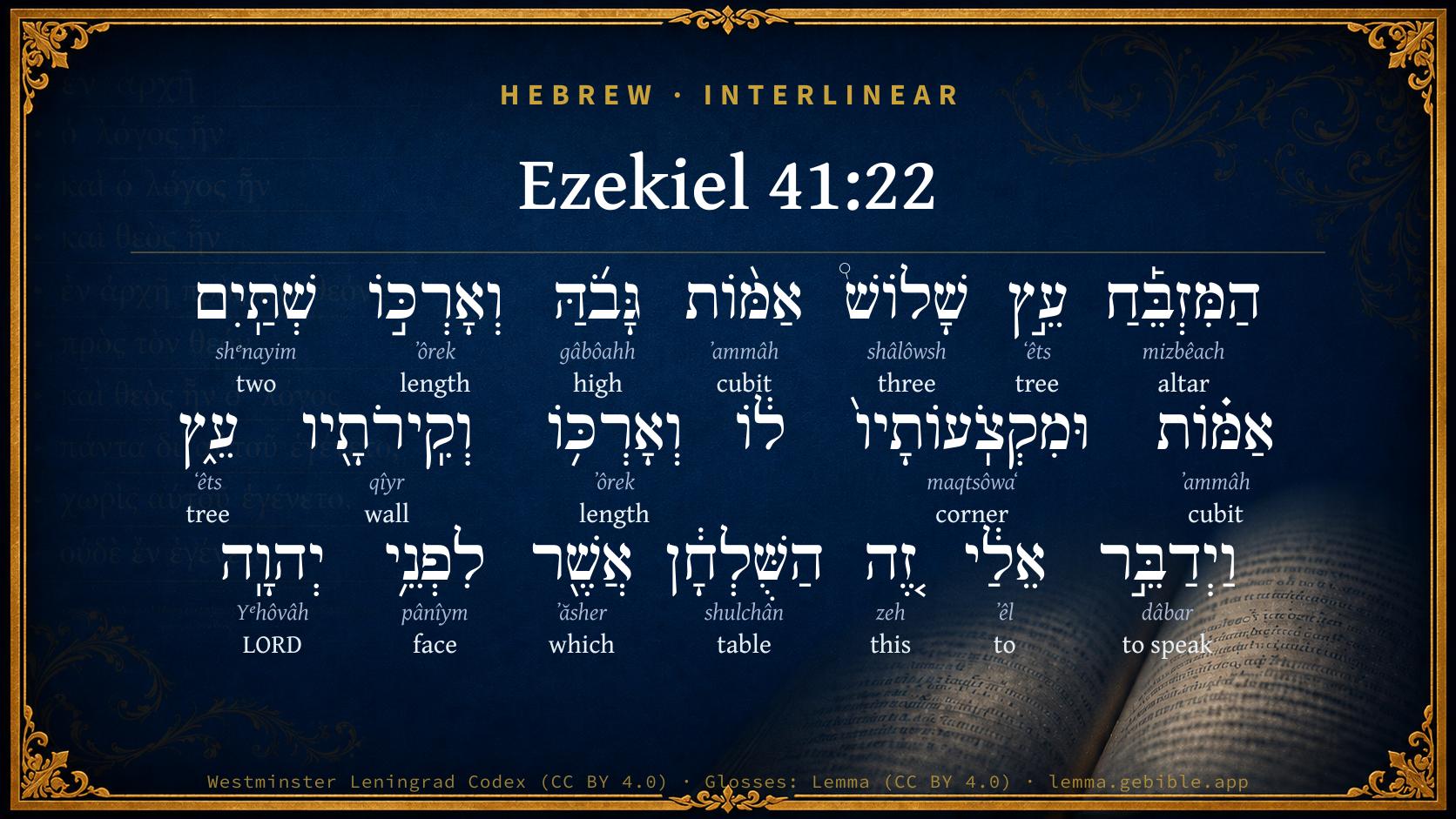
Hebrew (Westminster Leningrad Codex) Ezekiel 41:22 appears in the Hebrew Old Testament. The text above is from the Westminster Leningrad Codex. Each word links to its Strong’s number, a concise gloss, and parsing drawn from the Open Scriptures Hebrew Bible morphology. Click any word for its full Brown-Driver-Briggs (BDB) entry.
Download image
Cite this verse

Ezekiel 41:22 (World English Bible). Public Domain. Lemma interlinear Bible study tool, https://lemma.gebible.app/v/ezekiel/41/22.

Show BibTeX & RIS
BibTeX
RIS
English Translation
The altar was of wood, three cubits high, and the length of it two cubits; and the corners of it, and the length of it, and the walls of it, were of wood: and he said to me, This is the table that is before Yahweh.
World English Bible · Public Domain
Download a study sheet

One document with this verse’s original text, its word-by-word gloss line, the meaning frame, cross-references with their text, attributed commentary, and full source and license credits — printable, and it pastes into notes with its structure intact.

This verse Autodidact and up

Study sheet (.html) Plain text (.txt)

A passage Seminary Student

Up to 50 verses in one chapter. A passage sheet keeps up to 6 commentary sources and 12 cross-references per verse, in the order this page ranks them, and says so on the sheet whenever that leaves anything out. Ask for a single verse and you get the Autodidact verse sheet above.

Everything on this page stays free to read, with no account — the sheet is a download of what is already on screen, not access to it.

Want to remove ads? Support Godless Engineer
Compare translations 3

The same verse in 3 English versions, stacked beneath the original-language interlinear above. Click any original word for its lexicon entry.

Each is an independent rendering of the whole verse — the interlinear is not word-aligned to these translations.

Highlighted words mark where these versions differ — a whole-verse word diff, not a word-by-word alignment.

  • World English Bible Public Domain
    The altar was of wood, three cubits high, and the length of it two cubits; and the corners of it, and the length of it, and the walls of it, were of wood: and he said to me, This is the table that is before Yahweh.
  • King James Version Public Domain
    The altar of wood was three cubits high, and the length thereof two cubits; and the corners thereof, and the length thereof, and the walls thereof, were of wood: and he said unto me, This is the table that is before the LORD.
  • unfoldingWord Literal Text CC BY-SA 4.0
    the wooden altar in front of the holy place, which was three cubits high and two cubits in length on each side. Its corner posts, base, and frame were made of wood. Then the man said to me, “This is the table that stands before Yahweh.”

unfoldingWord Literal Text — © unfoldingWord, licensed CC BY-SA 4.0. Word-aligned USFM3 via Door43 (git.door43.org/unfoldingWord/en_ult).

Versions to compare (up to 4)

3 of 4 selected

Show all 18 translations

Every available English version of this verse, each an independent rendering of the whole verse.

  • World English Bible Public Domain
    The altar was of wood, three cubits high, and the length of it two cubits; and the corners of it, and the length of it, and the walls of it, were of wood: and he said to me, This is the table that is before Yahweh.
  • Berean Standard Bible Public Domain
    There was an altar of wood three cubits high and two cubits square. Its corners, base, and sides were of wood. And the man told me, “This is the table that is before the LORD.”
  • Majority Standard Bible Public Domain
    There was an altar of wood three cubits high and two cubits square. Its corners, base, and sides were of wood. And the man told me, “This is the table that is before the LORD.”
  • King James Version Public Domain
    The altar of wood was three cubits high, and the length thereof two cubits; and the corners thereof, and the length thereof, and the walls thereof, were of wood: and he said unto me, This is the table that is before the LORD.
  • American Standard Version (1901) Public Domain
    The altar was of wood, three cubits high, and the length thereof two cubits; and the corners thereof, and the length thereof, and the walls thereof, were of wood: and he said unto me, This is the table that is before Jehovah.
  • Revised Version (1885) Public Domain
    The altar was of wood, three cubits high, and the length thereof two cubits; and the corners thereof, and the length thereof, and the walls thereof, were of wood: and he said unto me, This is the table that is before the LORD.
  • Geneva Bible (1599) Public Domain
    The altar of wood was three cubites hie, and the length thereof two cubites, and the corners thereof and the length thereof and the sides thereof were of wood. And he sayd vnto me, This is the table that shalbe before the Lord.
  • Douay-Rheims (1899) Public Domain
    The altar of wood was three cubits high: and the length thereof was two cubits: and the corners thereof, and the length thereof, and the walls thereof were of wood. And he said to me: This is the table before the Lord.
  • Young's Literal Translation Public Domain
    Of the altar, the wood `is' three cubits in height, and its length two cubits; and its corners `are' to it, and its length, and its walls `are' of wood, and he speaketh unto me, `This `is' the table that `is' before Jehovah.'
  • Literal Standard Version CC BY-SA 4.0
    Of the altar, the wood [is] three cubits in height, and its length—two cubits; and its corners [are] to it, and its length, and its walls [are] of wood, and he speaks to me, “This [is] the table that [is] before YHWH.”
  • Unlocked Literal Bible CC BY-SA 4.0
    the wooden altar in front of the holy place, which was three cubits high and two cubits in length on each side. Its corner posts, base, and frame were made of wood. Then the man said to me, “This is the table that stands before Yahweh.”
  • unfoldingWord Literal Text CC BY-SA 4.0
    the wooden altar in front of the holy place, which was three cubits high and two cubits in length on each side. Its corner posts, base, and frame were made of wood. Then the man said to me, “This is the table that stands before Yahweh.”
  • Darby Bible Public Domain
    The altar was of wood, three cubits high, and its length two cubits; and its corners, and its length, and its walls were of wood. And he said unto me, This is the table which is before Jehovah.
  • World Messianic Bible Public Domain
    The altar was of wood, three cubits high, and its length two cubits. Its corners, its base, and its walls were of wood. He said to me, “This is the table that is before the LORD.”
  • Webster's Bible Public Domain
    The altar of wood was three cubits high, and its length two cubits; and its corners, and its length, and its walls, were of wood: and he said to me, This is the table that is before the LORD.
  • Free Bible Version CC BY-SA 4.0
    An altar made of wood stood there, three cubits high and two cubits long. All of it—its corners, base, and sides—were made of wood. The man told me, “This is the table that stands before the Lord.”
  • Bible in Basic English Public Domain
    The altar was made of wood, and was three cubits high and two cubits long; it had angles, and its base and sides were of wood; and he said to me, This is the table which is before the Lord.
  • JPS Tanakh (1917) Public Domain
    The altar, three cubits high, and the length thereof two cubits, was of wood, and so the corners thereof; the length thereof, and the walls thereof, were also of wood; and he said unto me: 'This is the table that is before the LORD.'

Literal Standard Version (2020), Covenant Press — licensed CC BY-SA 4.0. Text via the HelloAO Bible API (eBible.org). Unlocked Literal Bible (unfoldingWord) — licensed CC BY-SA 4.0. Text via the HelloAO Bible API (eBible.org). unfoldingWord Literal Text — © unfoldingWord, licensed CC BY-SA 4.0. Word-aligned USFM3 via Door43 (git.door43.org/unfoldingWord/en_ult). Free Bible Version, Dr. Jonathan Gallagher — licensed CC BY-SA 4.0. Text via the HelloAO Bible API (eBible.org).

Word by word

More ways to search: Search by grammar → Find every occurrence → Compare this word →

Practice this passage: Drill this verse → Learn its vocabulary →

וּמִקְצֹֽעוֹתָיו֙
maqtsôwaʻ
H4740
“and · corners · his”
Conjunction + Noun, Common, Masculine, Plural, Construct + Suffix, Personal, 3rd Person, Masculine, Singular
Part of Speech
Conjunction + Noun
Type
Common
Gender
Masculine
Number
Plural
State
Construct
Full BDB Definition

Origin: from H7106 in the denominative sense of bending

TWOT: 2057a

place of corner structure, corner buttress, inner corner-buttress - corner post, buttress-place, buttress
  1. הַמִּזְבֵּ֡חַ mizbêach H4196 “the · altar” Particle, Definite Article + Noun, Common, Masculine, Singular, Absolute
  2. עֵ֣ץ ʻêts H6086 “tree” Noun, Common, Masculine, Singular, Absolute
  3. שָׁלוֹשׁ֩ shâlôwsh H7969 “three” Adjective, Cardinal number, Feminine, Singular, Absolute
  4. אַמּ֨וֹת ʼammâh H520 “cubits” Noun, Common, Feminine, Plural, Absolute
  5. גָּבֹ֜הַּ gâbôahh H1364 “high” Adjective, Adjective, Masculine, Singular, Absolute
  6. וְאָרְכּ֣וֹ ʼôrek H753 “and · length · his” Conjunction + Noun, Common, Masculine, Singular, Construct + Suffix, Personal, 3rd Person, Masculine, Singular
  7. שְׁתַּֽיִם shᵉnayim H8147 “two” Adjective, Cardinal number, Feminine, Dual, Absolute
  8. אַמּ֗וֹת ʼammâh H520 “cubits” Noun, Common, Feminine, Plural, Absolute
  9. וְאָרְכּ֥וֹ ʼôrek H753 “and · length · his” Conjunction + Noun, Common, Masculine, Singular, Construct + Suffix, Personal, 3rd Person, Masculine, Singular
  10. וְקִֽירֹתָ֖יו qîyr H7023 “and · walls · his” Conjunction + Noun, Common, Masculine, Plural, Construct + Suffix, Personal, 3rd Person, Masculine, Singular
  11. עֵ֑ץ ʻêts H6086 “tree” Noun, Common, Masculine, Singular, Absolute
  12. וַיְדַבֵּ֣ר dâbar H1696 “and · to speak” Conjunction + Verb, Piel, Sequential Imperfect, 3rd Person, Masculine, Singular
  13. אֵלַ֔י ʼêl H413 “to · me” Preposition + Suffix, Personal, 1st Person, Common, Singular
  14. זֶ֚ה zeh H2088 “this” Pronoun, Demonstrative, Masculine, Singular
  15. הַשֻּׁלְחָ֔ן shulchân H7979 “the · table” Particle, Definite Article + Noun, Common, Masculine, Singular, Absolute
  16. אֲשֶׁ֖ר ʼăsher H834 “which” Particle, Relative
  17. לִפְנֵ֥י pânîym H6440 “to/for · face(s) of” Preposition + Noun, Common, Both, Plural, Construct
  18. יְהוָֽה Yᵉhôvâh H3068 “LORD” Noun, Proper

About this verse

These counts appear in no published source. They are computed here, from the morphology-tagged text and Lemma’s own curated glosses. What Lemma adds →

20
words
16
distinct lemmas
Prophets
section

Notable vocabulary

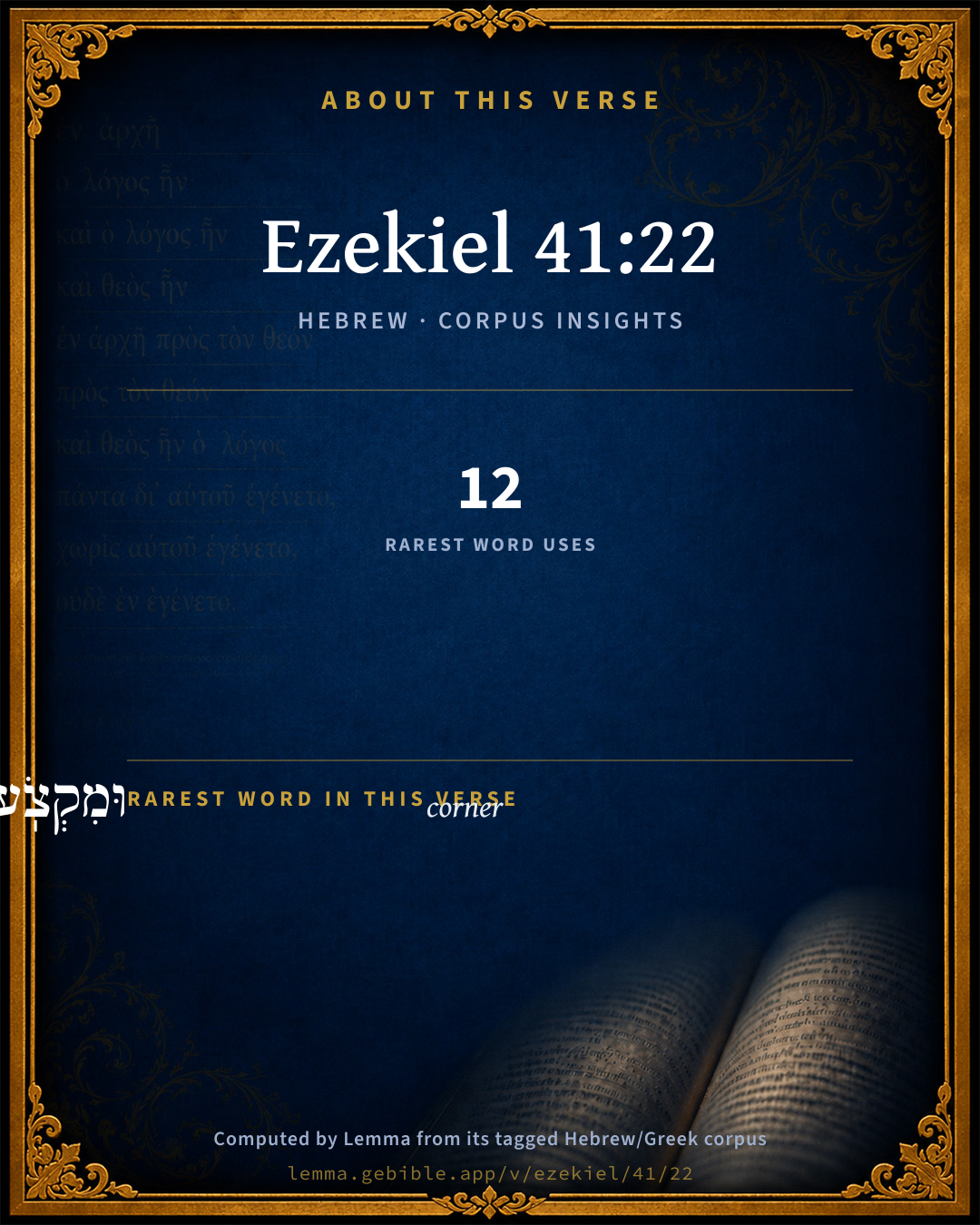
The rarest word here is וּמִקְצֹֽעוֹתָיו֙ corner H4740 — appearing just 12 times in the whole Hebrew Bible.

Shared distinctive vocabulary

וּמִקְצֹֽעוֹתָיו֙ corner H4740 occurs in 10 verses of the Hebrew Bible. Also found in:

Grammatical profile

  • 1 verb
  • 12 nouns
  • 3 adjectives
  • 1 pronoun
  • 2 prepositions
  • 1 particle

Verb forms

  • וַיְדַבֵּ֣ר Piel · Sequential Imperfect

Repetition

Words recur within this verse — often emphatic in Hebrew:

  • עֵ֣ץ tree H6086 ×2
  • אַמּ֨וֹת cubit H520 ×2
  • וְאָרְכּ֣וֹ length H753 ×2

Hebrew & Septuagint length

In English translation the verse runs 46 words from the Hebrew and 53 from the Septuagint (LXX English) — closely comparable.

A rough comparison of the two English renderings, which tokenize alike — not a word-level alignment.

Word counts can differ between the Hebrew and the Greek without any difference in meaning — e.g. the Hebrew direct-object marker אֵת has no separate Greek word, and Greek often adds the article ὁ.

Cross-references

18

Topical passages linked to Ezekiel 41:22 in the Treasury of Scripture Knowledge — connected by theme and wording, ordered by reader-vote popularity; previews shown in the World English Bible.

  • Ezekiel 23:41 and sit on a stately bed, with a table prepared before it, whereupon you did set my incense and my oil.
  • Ezekiel 44:16 they shall enter into my sanctuary, and they shall come near to my table, to minister to me, and they shall keep my charge.
  • Malachi 1:7 You offer polluted bread on my altar. You say, 'How have we polluted you?' In that you say, 'Yahweh's table contemptible.'
  • Malachi 1:12 "But you profane it, in that you say, 'Yahweh's table is polluted, and its fruit, even its food, is contemptible.'
  • Exodus 30:1–3 "You shall make an altar to burn incense on. You shall make it of acacia wood.
  • Leviticus 24:6 You shall set them in two rows, six on a row, on the pure gold table before Yahweh.
  • 1 Kings 6:20 Within the oracle was [a space of] twenty cubits in length, and twenty cubits in breadth, and twenty cubits in the height of it; and he overlaid it with pure gold: and he covered the altar with cedar.
  • Revelation 8:3 Another angel came and stood over the altar, having a golden censer. Much incense was given to him, that he should add it to the prayers of all the saints on the golden altar which was before the throne.
  • Exodus 25:23 "You shall make a table of acacia wood. Two cubits shall be its length, and a cubit its breadth, and one and a half cubits its height.
  • Exodus 25:28–30 You shall make the poles of acacia wood, and overlay them with gold, that the table may be carried with them.
  • Exodus 30:8 When Aaron lights the lamps at evening, he shall burn it, a perpetual incense before Yahweh throughout your generations.
  • 1 Kings 6:22 The whole house he overlaid with gold, until all the house was finished: also the whole altar that belonged to the oracle he overlaid with gold.
  • 1 Kings 7:48 Solomon made all the vessels that were in the house of Yahweh: the golden altar, and the table whereupon the show bread was, of gold;
  • 2 Chronicles 4:19 Solomon made all the vessels that were in the house of God, the golden altar also, and the tables whereon was the show bread;
  • Proverbs 9:2 She has prepared her meat. She has mixed her wine. She has also set her table.
  • Song of Solomon 1:12 While the king sat at his table, My perfume spread its fragrance.
  • 1 Corinthians 10:21 You can't both drink the cup of the Lord and the cup of demons. You can't both partake of the table of the Lord, and of the table of demons.
  • Revelation 3:20 Behold, I stand at the door and knock. If anyone hears my voice and opens the door, then I will come in to him, and will dine with him, and he with me.

Cross-references courtesy of OpenBible.info (CC BY 4.0).

Hebrew and Greek witnesses Masoretic Hebrew ↔ Greek Septuagint

The same verse in the two great witnesses to the Old Testament, shown verse-for-verse.

These are two independent witnesses, not word-aligned to each other, and the Septuagint is shown in lemma (dictionary) form.

Hebrew Ezekiel 41:22 Masoretic · Westminster Leningrad Codex

הַמִּזְבֵּ֡חַ עֵ֣ץ שָׁלוֹשׁ֩ אַמּ֨וֹת גָּבֹ֜הַּ וְאָרְכּ֣וֹ שְׁתַּֽיִם אַמּ֗וֹת וּמִקְצֹֽעוֹתָיו֙ ל֔וֹ וְאָרְכּ֥וֹ וְקִֽירֹתָ֖יו עֵ֑ץ וַיְדַבֵּ֣ר אֵלַ֔י זֶ֚ה הַשֻּׁלְחָ֔ן אֲשֶׁ֖ר לִפְנֵ֥י יְהוָֽה

The altar was of wood, three cubits high, and the length of it two cubits; and the corners of it, and the length of it, and the walls of it, were of wood: and he said to me, This is the table that is before Yahweh.

World English Bible · Public Domain

Greek LXX Ezekiel 41:22 Septuagint · lemma form

θυσιαστήριον ξύλινος πηχύς τρεῖς ὁ ὕψος αὐτός καί ὁ μῆκος πηχύς δύο καί ὁ εὖρος πηχύς δύο καί κέρας ἔχω καί ὁ βάσις αὐτός καί ὁ τοῖχος αὐτός ξύλινος καί εἶπον πρός ἐγώ οὗτος ὁ τράπεζα ὁ πρό πρόσωπον κύριος

a wooden altar, the height of it three cubits, and the length two cubits, and the breadth two cubits; and it had horns, and the base of it and the sides of it were of wood: and he said to me, This is the table, which is before the face of the Lord.

LXX2012 (modern English Septuagint) · Public Domain

On this verse, The Cambridge Bible for Schools and Colleges discusses the Septuagint’s reading. Read the note in Commentary ↓

Hebrew: Westminster Leningrad Codex (CC BY 4.0). Greek: Septuagint (public domain); English from LXX2012 (modern English Septuagint) (Public Domain). How the Septuagint differs from the Hebrew →

Targum (Aramaic paraphrase)

1

The Targum is the ancient Jewish Aramaic paraphrase of the Hebrew Scriptures — an interpretive translation, not the Hebrew text itself. Onkelos (literal) and Pseudo-Jonathan (expansive) render the Torah, and Jonathan the Prophets. Coverage is partial: where no permissively-licensed English translation exists for a verse, only the Aramaic is shown. This is verse-level text, not a word-by-word alignment to the Hebrew.

  1. Targum Jonathan Prophets (Joshua–Malachi)
    לָקֳבֵל מַדְבְּחָא פְּתוֹרָא דְאָעָא תְּלַת אַמִין רוּמָה וְאוּרְכֵּהּ תַּרְתִּין אַמִין וְזִיוְיָן לֵיהּ וְאוּרְכֵּיהּ וְכָתְלוֹהִי דְאָעָא וּמַלֵיל עִמִי דֵין פָּתוֹרָא דִקֳדָם יְיָ:

    (no public-domain English translation for this verse)

    Targum Jonathan — Aramaic: “Mikraot Gedolot” (public domain). English: “Sefaria Community Translation” (CC0 1.0 (public-domain dedication)); “London "Chaldee Paraphrase," 1871” (public domain). Text via Sefaria.

Commentary

Notes on Ezekiel 41:22 from classic Christian and Jewish commentators (each source and its license shown beneath its notes). The classic Christian expositions comment on the surrounding passage and are grouped to its opening verse, so a note may address several verses; the Jewish commentaries on the Tanakh (Rashi and others) are per-verse, so they appear only where the commentator wrote on this verse.

Lemma curates 59 commentaries, every one of them public domain or Creative Commons licensed, each selected and text-cleaned for this edition rather than reprinted as found. About our sources →

Trapp's Complete Commentary

John Trapp

Eze 41:22 The altar of wood [was] three cubits high, and the length thereof two cubits; and the corners thereof, and the length thereof, and the walls thereof, [were] of wood: and he said unto me, This [is] the table that [is] before the LORD.

Ver. 22. The altar,] scil., That for incense, whereof see Exo 30:6-7, but here of a much larger size. See on Eze 40:1. This altar of wood and square was a type of Christ (not of the cross, as Vilalpandus doateth), in whom our prayers come before God as incense, and he is the propitiation for our sins. {1Jn 2:2 Exo 30:1 Psa 141:1-10 : 2Ki 5:8} The size of this altar above that of old, showeth that the saints under the gospel would make much more improvement of the Lord Jesus in prayer, and make use of his mediation and intercession by faith in their heavenly sublimated supplications, than the saints of old were ordinarily wont to do. {a}

This is the table.] One and the same Christ is all in all to his people - an altar to sanctify them and their offerings; a table also to feed and feast them with the most precious provisions. See Psa 23:5-6; Psa 36:9; Psa 65:5 Pro 9:1-2 Isa 25:6-8.

{a} Cobbet, Of Prayer, p. 235.

John Trapp, A Commentary or Exposition upon All the Books of the Old and New Testament (1647–1656) — public domain. Text from a community e-Sword module.

The Biblical Illustrator

Joseph S. Exell

Eze_41:22

The altar of wood was three cubits high.

The enlarged altar

That for incense, whereof see Exo_30:6, but here of a much larger size. See in chap. 12:1. This altar of wood, and four-square, was a type of Christ (not of the Cross), in whom our prayers come before God as incense, and He is the propitiation for our sins (1Jn_2:2; Exo_30:1; Psa_141:2; Rev_5:8). The largeness of this altar above that of old, showeth that the saints under the Gospel would make much more improvement of the Lord Jesus in prayer, and make use of His mediation and intercession by faith in their heavenly supplications, than the saints of old were ordinarily wont to do. (J. Trapp.)

.

The Biblical Illustrator, edited by Joseph S. Exell (c. 1880s–1900s) — public domain. Text from a community e-Sword module.

Tyndale Open Study Notes

Tyndale Open Resources

41:22 The only piece of furniture was an altar made of wood, the table that stands in the Lord’s presence. This is presumably where the bread of the presence was daily laid out by the priests before the Lord (Exod 25:30). The description of this table as an altar highlights the focus on sacrifice in Ezekiel’s Temple.

Tyndale Open Study Notes — © Tyndale Open Resources, licensed CC BY-SA 4.0. Text via the HelloAO Bible API.

Jamieson, Fausset & Brown

Robert Jamieson, A. R. Fausset & David Brown

table . . . before the Lord--the altar of incense (Eze 44:16). At it, not at the table of showbread, the priests daily ministered. It stood in front of the veil, and is therefore said to be "before the Lord." It is called a table, as being that at which the Lord will take delight in His people, as at a feast. Hence its dimensions are larger than that of old--three cubits high, two broad, instead of two and one.

Jamieson, Fausset & Brown — Commentary Critical and Explanatory on the Whole Bible (1871) — public domain (CC PDM 1.0). Text via the HelloAO Bible API.

Adam Clarke's Commentary

Verse 22. The altar of wood] This was the altar of incense, and was covered with plates of gold.

Adam Clarke's Commentary on the Bible (1810–1826) — public domain. Text from a community e-Sword/MySword module.

Ellicott's Commentary for English Readers

(22) The altar of wood.—This is what was known in the tabernacle (Exo_30:1-3) as the altar of incense, and in the Temple as the altar of gold (1Ki_7:48), although here its dimensions are enlarged.

The corners thereof.—This doubtless includes the “horns,” or projecting pieces at the corners, which were always an important part of the symbolism of the altar. The expression “length” in its repetition is generally thought to mean (by a slight change in the text) “the stand” or “base.” Table and altar are used synonymously, as in Mal_1:7.

A Bible Commentary for English Readers, edited by Charles John Ellicott (1878–1897) — public domain. Text from a community e-Sword module.

The Cambridge Bible for Schools and Colleges

gen. ed. J. J. S. Perowne

22. The altar was 3 cubits high and 2 long. LXX. adds that it was 2 broad.

the length thereof … of wood] and the base thereof, a simple emendation, after LXX., cf. Exo_26:19 seq. The altar had corners, probably somewhat raised, but not horns. It was wholly of wood, and is called the table which is before the Lord. The term table is applied to the altar of burnt-offering Eze_44:16 (cf. Mal_1:7; Mal_1:12). This is quite natural, as the flesh was the bread of Jehovah (Eze_44:7). Ezek. does not name any other object in the holy place besides this table, and it is probable that he refers here to the altar-like table of shewbread, the cakes on which would also be considered an offering of bread for the Lord.

The Cambridge Bible for Schools and Colleges (gen. ed. J. J. S. Perowne; Cambridge University Press, 1878–1918) — public domain. Text from a community e-Sword module.

John Gill's Exposition

The altar of wood was three cubits high, and the length thereof two cubits,.... This was the altar of incense, and was typical of Christ in his intercession and mediation. It was made of "wood"; that in the tabernacle of Moses was of shittim wood, a kind of cedar; and that in Solomon's temple was of cedar, Exo 30:1 and may signify the human nature of Christ, in which he mediates and intercedes; which is excellent as the cedars: fair and beautiful, strong, durable, and incorruptible: though its original is of the earth, as wood: or was made of a woman; of the earth, earthly; but produced without sin. This altar, both in the tabernacle and temple, was covered with gold; as it was fit it should be with some hard substance that would bear incense to be burned on it; and therefore was called the golden altar, Exo 30:3 and so the altar at which our Lord officiates as Mediator and Intercessor is called a golden one, Rev 8:3, which may denote the deity of Christ, that gives virtue to his mediation; or the glorification of his human nature in heaven, in which he ministers; and also the preciousness of his intercession, and the duration of it. The incense burnt on this altar may signify both the mediation of Christ, which is pure and holy, though for sinners; large and frequent, continually made, and very fragrant and acceptable; and the prayers of the saints which are offered up on this altar, which sanctifies them; and through the much incense, which perfumes them, whereby they ascend up to God, and are sweet odours to him, being fragrant and fervent, pure and holy. This altar in the tabernacle of Moses, and probably in the temple of Solomon, though its dimensions there are not given, was foursquare, Exo 30:2 very likely so was this; and indeed the Septuagint version adds,

and the breadth two cubits; which, being the same with its length, made it foursquare; and so may point at the firmness, unchangeableness and perfection of this part of Christ's priesthood, his intercession, which is true of the whole of it, Heb 7:19 and it may be observed, that the altar here was a cubit longer, and a cubit broader, as well as a cubit higher, than the Mosaic one, Exo 30:2. Kimchi says this altar was not like to that which Moses or Solomon, or the children of the captivity, made; it was larger than any of them; which shows that the intercession of Christ our high priest is larger and more extensive than that of the priests under the law; they offered incense only for the people of Israel: but Christ, as he is the propitiation, so the advocate for Gentiles, as well as Jews; though not for the whole world of men, yet for the world of the elect; and of all blessings of grace and glory for them, Jo1 2:1 and, moreover, that under the Gospel dispensation there would be more praying souls, and more use made of the Mediator, of his name, blood, righteousness, sacrifice, and intercession; and a greater spirit of grace and supplication poured out, especially in the latter day; hence we read of Christ's much incense, Joh 16:23,

and the corners thereof, and the length thereof, and the walls thereof, were of wood; that is, the horns that were at the four corners of it; and the top of it, which was its length and breadth; and the sides of it, called its walls, were all of wood, though covered with gold. The mystical sense of which has been given; only it may be observed, that the four corners or horns of it may denote the strength of Christ's intercession; and to which men have recourse, and lay hold on for their relief, even from all parts of the world, east, west, north, and south:

and he said unto me, this is the table that is before the Lord; that is, either the altar before described is the table before the Lord, which he has spread, and where his people feed in his presence; the intercession of Christ being a feast to the faith of saints: or it may be, that the divine guide of the prophet, turning himself to the right hand of the altar, pointed to the table of shewbread, which stood in the same place; and said this or that which stands yonder is the table before the Lord; and which also was typical of Christ, the true bread that comes down from heaven, who is the food of his people; for quality, the finest of the wheat; for quantity, enough and to spare; for savour, such as gracious souls desire always to have; for duration, continual bread, set forth by priests, and only eaten by them; and, like that,

bread of faces, as the shewbread is called (p); denoting the intercession of Christ, the Angel of God's presence; and who always appears in the presence of God for his people, bearing on him the names of the children of Israel, to which the twelve shewbread loaves answered. The "table" on which they were set signifies the communion saints have with Christ in his word and ordinances; which are called a feast, of which Christ is the sum and substance; and where, as at a table, he sits and favours them with fellowship with himself; see Pro 9:2 The Jews (q) have an observation upon this text, that it begins with an altar, and ends with a table; and further observe, that, while the temple stood, the altar atoned for a man, but now a man's table atones for him: but this is not a man's table, but the Lord's table; and Christ the sacrifice held forth on this table does indeed atone for a man.

(p) "panis facierum", Exod. xxv. 30. (q) T. Bab. Beracot, fol. 55. 1. Chagiga, fol. 26. 1. Menachot, fol. 97. 1.

John Gill's Exposition of the Whole Bible (1746–1763) — public domain (CC PDM 1.0). Text via the HelloAO Bible API.

Albert Barnes' Notes on the Bible

The altar of wood - The altar for incense (marginal reference); “altar of gold” (see 1Ki 7:48).

Walls - The corner pieces of the altar, rising into projections called in Exodus horns, here corners.

Table - “table and altar” were convertible terms Mal 1:7.

Albert Barnes' Notes on the Bible (1834–1885) — public domain. Text from a community e-Sword/MySword module.

Haydock's Catholic Bible Commentary

Table, or altar of incense, larger than that of Moses, Exodus xxx. 1.

George Leo Haydock (1774–1849), Haydock's Catholic Family Bible and Commentary, 1859 edition — public domain. Excludes Psalms (Douay-Rheims chapter numbering differs from Protestant) and Deuterocanonical books (Catholic canon only).

Matthew Poole's English Annotations

The altar of incense.

Of wood; so the inward parts were made, and covered with gold, Exo 30:1-10; 1Ki 6:20,22; and from this covering of gold it was called the

golden altar. Three cubits high; one cubit higher than that in the tabernacle of Moses, Exo 30:2.

The length thereof two cubits; as long again as Moses’s altar of incense in the tabernacle.

The corners; the horns framed out of the four posts at each angle on the top of the altar. The sides of this altar, for it was made up on all sides, are here called

the walls thereof, made of wood, but covered with gold.

The table; some say it is spoken of this altar of incense; others say, the angel pointed him to the table of shew-bread, and spake of that.

Before the Lord; in the temple, not in the oracle, or holy of holies: this incense altar was placed without the oracle, as appears from the priests’ offering incense at it by courses, whereas none but the high priest might enter into the holy of holies.

Matthew Poole's English Annotations on the Holy Bible (1683–1685) — public domain. Text from a community e-Sword/MySword module.

The Pulpit Commentary

The altar. This was the altar of incense, (Exo_30:1, etc.) which stood in the holy place in contradistinction to the altar of burnt offering, which was located in the outer court. The altar of burnt offering in Solomon"s temple was of brass, (2Ch_4:1) and in the tabernacle of shittim wood; (Exo_27:1) the altar of incense in the tabernacle (Exo_30:1) and in Solomon"s temple (1Ki_7:48) was constructed of wood overlaid with gold, but in this temple only of wood. Plumptre, commenting on this, writes, "Possibly Ezekiel shared the feelings of Daniel, (Dan_9:25) that the rebuilding would be "in troublous times," and did not contemplate an abundance of gold as likely to be the outcome of the scant offerings of an impoverished people." The dimensions of this altar in the tabernacle were two cubits high and one cubit long and broad; in the Solomonic temple, though not stated, they were probably the same as in the tabernacle; in Ezekiel"s temple they were three cubits high, two cubits long (and probably two cubits broad). The corners of the altar were most likely "the horns, or horn-shaped points projecting at the cornets." The length. Ewald, Keil, Smend, and others, after the LXX, change into "base," "stand," or "pedestal," on the ground that the length has been already mentioned, and that one does not usually speak of a length being of wood; but it does not strike one as peculiarly objectionable to say that the altar had corner pieces, a length, and walls (or sides) of wood, meaning thereby to intimate that it was wholly constructed of timber. When the prophet"s attention had been directed to it, the guide who accompanied him observed, This is the table that is before the Lord, not because, as Bottcher conjectured, the altar was regarded as including the table of showbread, but because in the Law the offerings laid upon the altar had been spoken of as the bread of God. (see Lev_26:6, Lev_26:8, Lev_26:17, Lev_26:21, Lev_26:22; and comp.; Mal_1:7) and because in this vision table and altar appear to be used inter-changeably. (see Eze_44:16)

The table that is before the Lord.

There can be no question that by this table Ezekiel intends the altar of incense, which stood in the holy place, but which, on account of its sacredness and value, is mentioned by the author of the Epistle to the Hebrews as part of the furniture of the holy of holies. This altar in the tabernacle was of acacia wood covered with gold; that in the temple of Solomon was of cedar wood covered with the same pure and costly metal. Upon this table was burned, every morning and evening, the incense which represented the devotions of Israel. Upon the day of atonement the horns of the altar of incense were touched with the blood of sacrifice. But as no sacrifice, in the strict meaning of that term, was offered upon it, it seems appropriately designated "the table that is before the Lord." Remembering the symbolical intention of the offering of incense as described in the Apocalypse, we cannot fail to understand by this table the appointment that prayer and praise, as an acceptable offering to God, should ever be presented by the Church through the priestly mediation of the Lord Jesus Christ.

I A SPIRITUAL OFFERING. The costly and fragrant incense had value in the sight of God, as representing the spiritual sacrifices with which he is ever well pleased. Prayer is not only natural to man as a needy and dependent being; it is enjoined by God as an exercise profitable to man and as the wisely ordained means of securing spiritual and promised blessings. Thanksgiving and praise are becoming to those who are ever receiving from Heaven more than they desire or deserve. We are not to understand merely verbal offerings, but those which proceed from a devout, grateful, confiding, and affectionate heart.

II AN APPOINTED OFFERING. In the thirtieth chapter of Exodus we find minute directions concerning the presentation as well as the preparation of incense. This service was not an invention of man; it was prescribed by Divine authority. In the Church it is God"s will that there should be constant presentation of devotion incense and a pure offering." From the altar of Christian hearts such sacrifices are to ascend to heaven. God will be "inquired of" by his people. "Whoso offereth praise glorifieth God.

III AN ACCEPTABLE OFFERING. We have abundant testimony in Scripture to the Lord"s indifference to the merely material gifts of men. If such gifts are not the expression of faith and loyalty, he disdains and rejects them. But, on the other hand, nothing is more clearly revealed in Scripture than the delight of the Supreme in the offering of true and loving and reverent hearts. This is a "sweet-smelling savor" to him.

Vainly we offer each ample oblation, Vainly with gifts would his favor secure; Sweeter by far is the heart"s adoration, Dearer to God are the prayers of the poor.

IV A PERPETUAL OFFERING. Incense was offered by the Jewish priest daily every morning and every evening. Not leas frequent should be the offering of prayer and praise by God"s people-in the Church and in the home, above all in the heart. There is no cessation of God"s favors; there should be no cessation of our thanksgivings. There is no intermission of our needs; there should be no interruption of our prayers. "Pray without ceasing.

V A HEAVENLY OFFERING. It is observable that the one altar mentioned in the Book of the Revelation as existing in the celestial temple is the altar of incense. The purpose of sacrifice is answered and accomplished upon earth. There remains no more offering for sin. In heaven, accordingly, is no altar of sacrifice. But the altar of incense is imperishable. From it ascend immortally the praises and the prayers of the redeemed and glorified. In heaven fellowship with God is never suspended; there harps are never unstrung and voices are never silent. T.

The Pulpit Commentary (1880–1919), ed. H.D.M. Spence-Jones & Joseph S. Exell — public domain. Text from a community e-Sword module.

John Wesley's Explanatory Notes

The altar - Of incense. The corners - The horns framed out of the four posts at each angle on the top of the altar. The walls - The sides. Before the Lord - In the temple, not in the holy of holies.

John Wesley, Explanatory Notes Upon the Whole Bible (1754–1765) — public domain. Text via the GEBible commentary corpus.

Keil & Delitzsch

C. F. Keil & F. Delitzsch

The Altar of Burnt-Offering in the holy place (see Plate III n). "The abrupt style of writing is still continued." The altar wood for the altar was of wood three cubits high; its length, i.e., the expanse of the wall from one corner to the other, was two cubits; the breadth (thickness), which is not expressly mentioned, was the same, because the square form is presupposed from the shape of this altar in the tabernacle and Solomon's temple. Under the term מקצעותיו, its corner-pieces, the horns projecting at the corners, or the horn-shaped points, are probably included, as the simple mention of the corners appears superfluous, and the horns, which were symbolically significant features in the altar, would certainly not have been wanting. There is something strange in the occurrence of וארכוּ before and along with קירות, as the length is already included in the walls, and it would not be appropriately said of the length that it was of wood. ארכוּ is therefore certainly a copyist's error for אדנוּ, ἡ βάσις αὐτοῦ (lxx), its stand or pedestal. The angel describes this altar as the "table which stands before Jehovah" - in perfect harmony with the epithet already applied to the sacrifices in the Pentateuch, the "bread (לחם) of God," though not "because the altar table was intended to combine the old table of shewbread and the altar of incense" (Bttcher). The table of shewbread is not mentioned any more than the candlestick and other portions of the temple furniture. - The altar of burnt-offering stood before Jehovah, i.e., before the entrance into the holy of holies. This leads in Eze 41:23. to the notice of the doors of the sanctuary, the character of which is also described as simply openings (פּתח), since the doorway had been mentioned before. delet דּלת signifies a moveable door, and the plural דּלתות, doors, whether they consist of one leaf or two, i.e., whether they are single or folding doors. Here the דּלתות in Eze 41:23 and Eze 41:24 (לדלתות) are folding doors; on the other hand, the first דּלתות in Eze 41:24 and דּלת ibid. are used for the wings of the door, and מוּסבּות for the swinging portions (leaves) of the separate wings. The meaning is this: the holy place (היכל) and the holy of holies (הקּדשׁ) had two folding doors (i.e., each of these rooms had one). These doors had two wings, and each of these wings, in the one door and in the other, had two reversible door-leaves, so that when going in and out there was no necessity to throw open on every occasion the whole of the wing, which was at least three or four cubits broad. There is no foundation for the objection raised by Kliefoth to the interpretation of להיכל ולקּדשׁ as signifying the holy place and the holy of holies; since he cannot deny that the two words are so used, היכל in Kg1 6:5, Kg1 6:17, Kg1 6:31, Kg1 6:33, and קדשׁ in Lev 16:2-3, etc. And the artificial explanation, "to the temple space, and indeed to the holy place," not only passes without notice the agreement between our verses and Kg1 6:31-34, but gains nothing further than a side door, which does violence to the dignity of the sanctuary, a passage from the side chambers into the holy place, with which Bttcher has presented Solomon's temple. - These doors were ornamented, like the walls, with figures of cherubim and palms. - Other remarks are added in vv. 25b and 26 concerning the porch in front of the holy place. The first is, that on the front of the porch outside there was עב אץ. The only other passage in which the word עב occurs in a similar connection is Kg1 7:6, where it refers to wood-work in front of the Ulam of Solomon's porch of pillars; and it cannot be determined whether it signifies threshold, or moulding, or threshold-mouldings. On the shoulders, i.e., on the right and left side walls of the front porch, there were closed windows and figures of palms. The cherubim were omitted here. - The last words of Eze 41:26 are very obscure. וצלעות הבּ may be taken in connection with the preceding clause, "and on the side-rooms of the temple," as there is no necessity to repeat the preposition in the case of closely continuous clauses (vid., Ewald, 351a); and the side-rooms not only must have had windows, but might also be ornamented with figures of palms. But if the words be taken in this sense, the עבּים must also signify something which presented, like the walls of the porch and of the side chambers, a considerable extent of surface capable of receiving a similar decoration; although nothing definite has hitherto been ascertained with regard to the meaning of the word, and our rendering "beams" makes no pretension to correctness.

Keil & Delitzsch — Biblical Commentary on the Old Testament (1861–1891) — public domain (CC PDM 1.0). Text via the HelloAO Bible API. (Old Testament only.)

Rashi

Rabbi Shlomo Yitzchaki (Rashi)

The altar was wood Jonathan renders: “Standing for the altar was the table,” i.e., the table is called an altar because nowadays it atones like an altar.

and its corners its legs; and the words “its length,” mentioned in the verse refer to its roof, the main part of the Table.

and its walls its frames.

Rashi on the Tanakh — English translations: “The Judaica Press complete Tanach with Rashi, translated by A. J. Rosenberg” (CC BY 4.0); “Pentateuch with Rashi's commentary by M. Rosenbaum and A.M. Silbermann, 1929-1934” (public domain); “The Metsudah Tanach series, Lakewood, N.J” (CC BY 4.0); and “The Book of Joshua, Metsudah Publications, 1997” (CC BY 4.0). Text via Sefaria.

Lesson kit

Teaching starters — assembled from the data on this page, not authored interpretation. Every prompt links to the verse data it draws on. Edit before teaching.

Ezekiel, in the Prophets, opens this verse with 20 words (16 distinct Hebrew lemmas). Its most distinctive word is maqtsôwaʻ (“corner”). A historical commentator’s framing appears above. Read the whole chapter for the surrounding context.

Discussion questions

  1. How does “corner” (maqtsôwaʻ) shape what this verse is saying?
  2. Exodus 26:24 shares the word «corner» with this verse. How do the two illuminate each other?
  3. “tree” occurs 2× in this one verse. What is the effect of the repetition?
  4. The translations on this page render this verse differently — a whole-verse word diff, not a word-by-word alignment. What might account for the different wordings?
  5. The verb «וַיְדַבֵּ֣ר» is Piel Sequential Imperfect. How does its form color the action?
  6. Reading how Trapp's Complete Commentary and The Biblical Illustrator read this verse, where do the two commentators agree and where do they part?

Things to notice

Reading settings

Reading text

Shown beneath each verse's original-language words.

Old Testament
Old Testament edition

Read the OT as the Masoretic Hebrew (MT) or the Greek Septuagint (LXX).

English shown for the Greek Septuagint (in the Hebrew ↔ Greek comparison).

Comparing translations? Open the Compare panel on any verse page to stack up to four side by side.