
Hosea 10:8

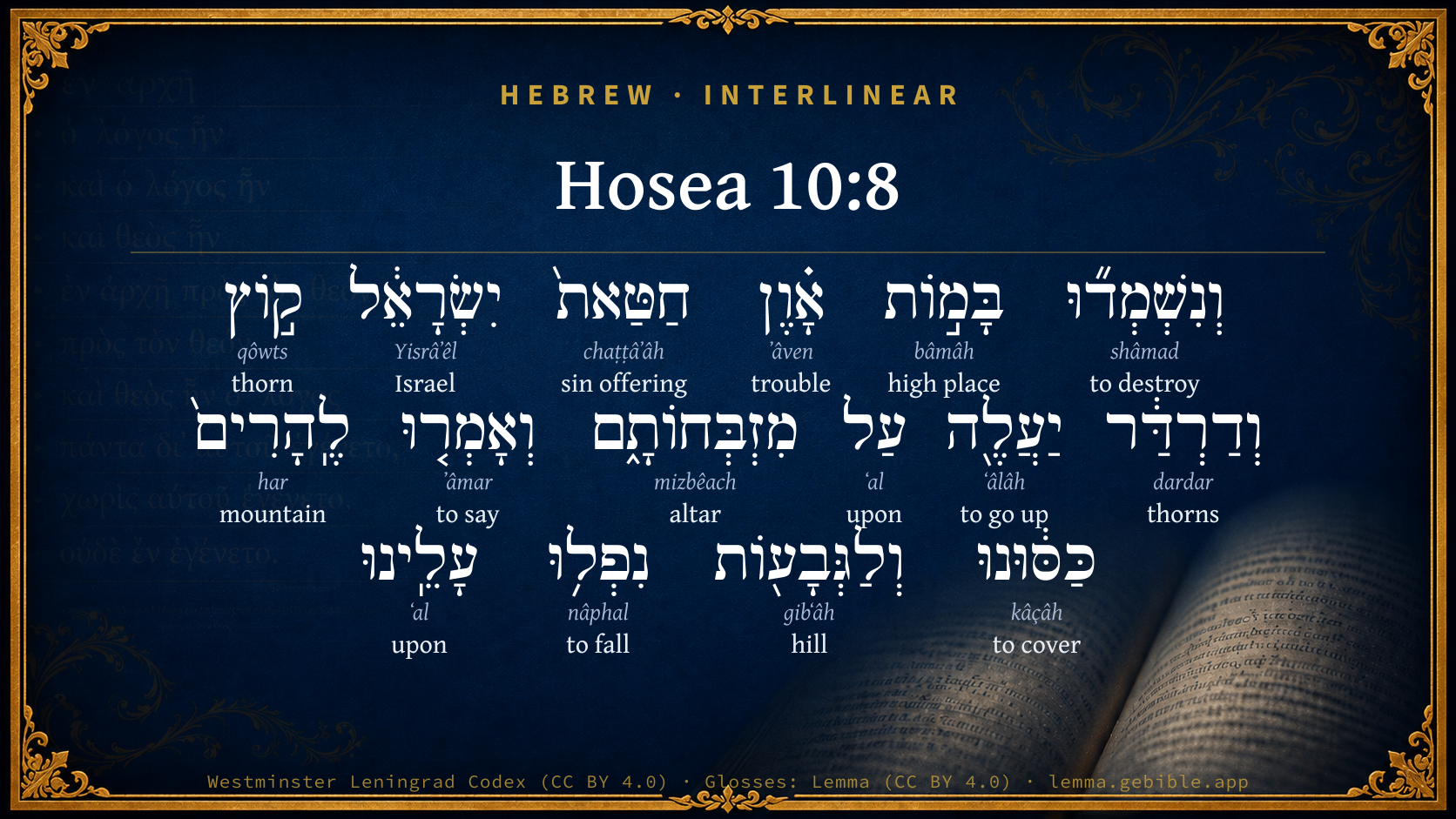
Hebrew (Westminster Leningrad Codex) Hosea 10:8 appears in the Hebrew Old Testament. The text above is from the Westminster Leningrad Codex. Each word links to its Strong’s number, a concise gloss, and parsing drawn from the Open Scriptures Hebrew Bible morphology. Click any word for its full Brown-Driver-Briggs (BDB) entry.
Download image
Cite this verse

Hosea 10:8 (World English Bible). Public Domain. Lemma interlinear Bible study tool, https://lemma.gebible.app/v/hosea/10/8.

Show BibTeX & RIS
BibTeX
RIS
English Translation
The high places also of Aven, the sin of Israel, will be destroyed. The thorn and the thistle will come up on their altars. They will tell the mountains, "Cover us!" and the hills, "Fall on us!"
World English Bible · Public Domain
Download a study sheet

One document with this verse’s original text, its word-by-word gloss line, the meaning frame, cross-references with their text, attributed commentary, and full source and license credits — printable, and it pastes into notes with its structure intact.

This verse Autodidact and up

Study sheet (.html) Plain text (.txt)

A passage Seminary Student

Up to 50 verses in one chapter. A passage sheet keeps up to 6 commentary sources and 12 cross-references per verse, in the order this page ranks them, and says so on the sheet whenever that leaves anything out. Ask for a single verse and you get the Autodidact verse sheet above.

Everything on this page stays free to read, with no account — the sheet is a download of what is already on screen, not access to it.

Want to remove ads? Support Godless Engineer
Compare translations 3

The same verse in 3 English versions, stacked beneath the original-language interlinear above. Click any original word for its lexicon entry.

Each is an independent rendering of the whole verse — the interlinear is not word-aligned to these translations.

Highlighted words mark where these versions differ — a whole-verse word diff, not a word-by-word alignment.

  • World English Bible Public Domain
    The high places also of Aven, the sin of Israel, will be destroyed. The thorn and the thistle will come up on their altars. They will tell the mountains, "Cover us!" and the hills, "Fall on us!"
  • King James Version Public Domain
    The high places also of Aven, the sin of Israel, shall be destroyed: the thorn and the thistle shall come up on their altars; and they shall say to the mountains, Cover us; and to the hills, Fall on us.
  • unfoldingWord Literal Text CC BY-SA 4.0
    And the high places of Aven will be destroyed, the sin of Israel. Thorn and thistle will grow up on their altars, and they will say to the mountains, “Cover us!” and to the hills, “Fall on us!”

unfoldingWord Literal Text — © unfoldingWord, licensed CC BY-SA 4.0. Word-aligned USFM3 via Door43 (git.door43.org/unfoldingWord/en_ult).

Versions to compare (up to 4)

3 of 4 selected

Show all 18 translations

Every available English version of this verse, each an independent rendering of the whole verse.

  • World English Bible Public Domain
    The high places also of Aven, the sin of Israel, will be destroyed. The thorn and the thistle will come up on their altars. They will tell the mountains, "Cover us!" and the hills, "Fall on us!"
  • Berean Standard Bible Public Domain
    The high places of Aven will be destroyed—it is the sin of Israel; thorns and thistles will overgrow their altars. Then they will say to the mountains, “Cover us!” and to the hills, “Fall on us!”
  • Majority Standard Bible Public Domain
    The high places of Aven will be destroyed—it is the sin of Israel; thorns and thistles will overgrow their altars. Then they will say to the mountains, “Cover us!” and to the hills, “Fall on us!”
  • King James Version Public Domain
    The high places also of Aven, the sin of Israel, shall be destroyed: the thorn and the thistle shall come up on their altars; and they shall say to the mountains, Cover us; and to the hills, Fall on us.
  • American Standard Version (1901) Public Domain
    The high places also of Aven, the sin of Israel, shall be destroyed: the thorn and the thistle shall come up on their altars; and they shall say to the mountains, Cover us; and to the hills, Fall on us.
  • Revised Version (1885) Public Domain
    The high places also of Aven, the sin of Israel, shall be destroyed: the thorn and the thistle shall come up on their altars; and they shall say to the mountains, Cover us; and to the hills, Fall on us.
  • Geneva Bible (1599) Public Domain
    The hie places also of Auen shall be destroied, euen the sinne of Israel: the thorne and the thistle shall growe vpon their altars, and they shall say to the mountaines, Couer vs, and to the hils, Fall vpon vs.
  • Douay-Rheims (1899) Public Domain
    And the high places of the idol, the sin of Israel shall be destroyed: the bur and the thistle shall grow up over their altars: and they shall say to the mountains: Cover us; and to the hills: Fall upon us.
  • Young's Literal Translation Public Domain
    And destroyed have been high places of Aven, the sin of Israel. Thorn and bramble go up on their altars, And they have said to hills, Cover us, And to heights, Fall upon us.
  • Literal Standard Version CC BY-SA 4.0
    And high places of Aven have been destroyed, the sin of Israel. Thorn and bramble go up on their altars, || And they have said to hills, Cover us, || And to heights, Fall on us.
  • Unlocked Literal Bible CC BY-SA 4.0
    The high places of wickedness will be destroyed. This is the sin of Israel! Thorns and thistles will grow over their altars. The people will say to the mountains, “Cover us!” and to the hills, “Fall on us!”
  • unfoldingWord Literal Text CC BY-SA 4.0
    And the high places of Aven will be destroyed, the sin of Israel. Thorn and thistle will grow up on their altars, and they will say to the mountains, “Cover us!” and to the hills, “Fall on us!”
  • Darby Bible Public Domain
    And the high places of Aven, the sin of Israel, shall be destroyed: the thorn and the thistle shall come up upon their altars; and they shall say to the mountains, Cover us! and to the hills, Fall on us!
  • World Messianic Bible Public Domain
    The high places also of Aven, the sin of Israel, will be destroyed. The thorn and the thistle will come up on their altars. They will tell the mountains, “Cover us!” and the hills, “Fall on us!”
  • Webster's Bible Public Domain
    The high places also of Aven, the sin of Israel, shall be destroyed: the thorn and the thistle shall come up on their altars; and they shall say to the mountains, Cover us; and to the hills, Fall on us.
  • Free Bible Version CC BY-SA 4.0
    The high places of Aven, where Israel sinned, will be demolished, and thorns and thistles will grow over their altars. Then they will call to the mountains, “Bury us!” and to the hills, “Fall on us!”
  • Bible in Basic English Public Domain
    And the high places of Aven, the sin of Israel, will come to destruction; thorns and waste plants will come up on their altars; they will say to the mountains, Be a cover over us; and to the hills, Come down on us.
  • JPS Tanakh (1917) Public Domain
    The high places also of Aven shall be destroyed, even the sin of Israel. The thorn and the thistle shall come up on their altars; and they shall say to the mountains: 'Cover us', and to the hills: 'Fall on us.'

Literal Standard Version (2020), Covenant Press — licensed CC BY-SA 4.0. Text via the HelloAO Bible API (eBible.org). Unlocked Literal Bible (unfoldingWord) — licensed CC BY-SA 4.0. Text via the HelloAO Bible API (eBible.org). unfoldingWord Literal Text — © unfoldingWord, licensed CC BY-SA 4.0. Word-aligned USFM3 via Door43 (git.door43.org/unfoldingWord/en_ult). Free Bible Version, Dr. Jonathan Gallagher — licensed CC BY-SA 4.0. Text via the HelloAO Bible API (eBible.org).

Word by word

More ways to search: Search by grammar → Find every occurrence → Compare this word →

Practice this passage: Drill this verse → Learn its vocabulary →

וְדַרְדַּ֔ר
dardar
H1863
“and · thorns”
Conjunction + Noun, Common, Masculine, Singular, Absolute
Part of Speech
Conjunction + Noun
Type
Common
Gender
Masculine
Number
Singular
State
Absolute
Full BDB Definition

Origin: of uncertain derivation

TWOT: 454e

thistles, thorns
  1. וְנִשְׁמְד֞וּ shâmad H8045 “and · to destroy” Conjunction + Verb, Niphal, Sequential Perfect, 3rd Person, Common, Plural
  2. בָּמ֣וֹת bâmâh H1116 “high places of” Noun, Common, Feminine, Plural, Construct
  3. אָ֗וֶן ʼâven H205 “trouble” Noun, Common, Masculine, Singular, Absolute
  4. חַטַּאת֙ chaṭṭâʼâh H2403 “sin offering of” Noun, Common, Feminine, Singular, Construct
  5. יִשְׂרָאֵ֔ל Yisrâʼêl H3478 “Israel” Noun, Proper
  6. ק֣וֹץ qôwts H6975 “thorn” Noun, Common, Masculine, Singular, Absolute
  7. יַעֲלֶ֖ה ʻâlâh H5927 “to go up” Verb, Qal, Imperfect, 3rd Person, Masculine, Singular
  8. עַל ʻal H5921 “upon” Preposition
  9. מִזְבְּחוֹתָ֑ם mizbêach H4196 “altars · their” Noun, Common, Masculine, Plural, Construct + Suffix, Personal, 3rd Person, Masculine, Plural
  10. וְאָמְר֤וּ ʼâmar H559 “and · to say” Conjunction + Verb, Qal, Sequential Perfect, 3rd Person, Common, Plural
  11. לֶֽהָרִים֙ har H2022 “to/for the · mountains” Preposition, Determined + Noun, Common, Masculine, Plural, Absolute
  12. כַּסּ֔וּנוּ kâçâh H3680 “cover · us” Verb, Piel, Imperative, 2nd Person, Masculine, Plural + Suffix, Personal, 1st Person, Common, Plural
  13. וְלַגְּבָע֖וֹת gibʻâh H1389 “and · to/for the · hills” Conjunction + Preposition, Determined + Noun, Common, Feminine, Plural, Absolute
  14. נִפְל֥וּ nâphal H5307 “fall” Verb, Qal, Imperative, 2nd Person, Masculine, Plural
  15. עָלֵֽינוּ ʻal H5921 “upon · us” Preposition + Suffix, Personal, 1st Person, Common, Plural

About this verse

These counts appear in no published source. They are computed here, from the morphology-tagged text and Lemma’s own curated glosses. What Lemma adds →

16
words
15
distinct lemmas
Prophets
section

Notable vocabulary

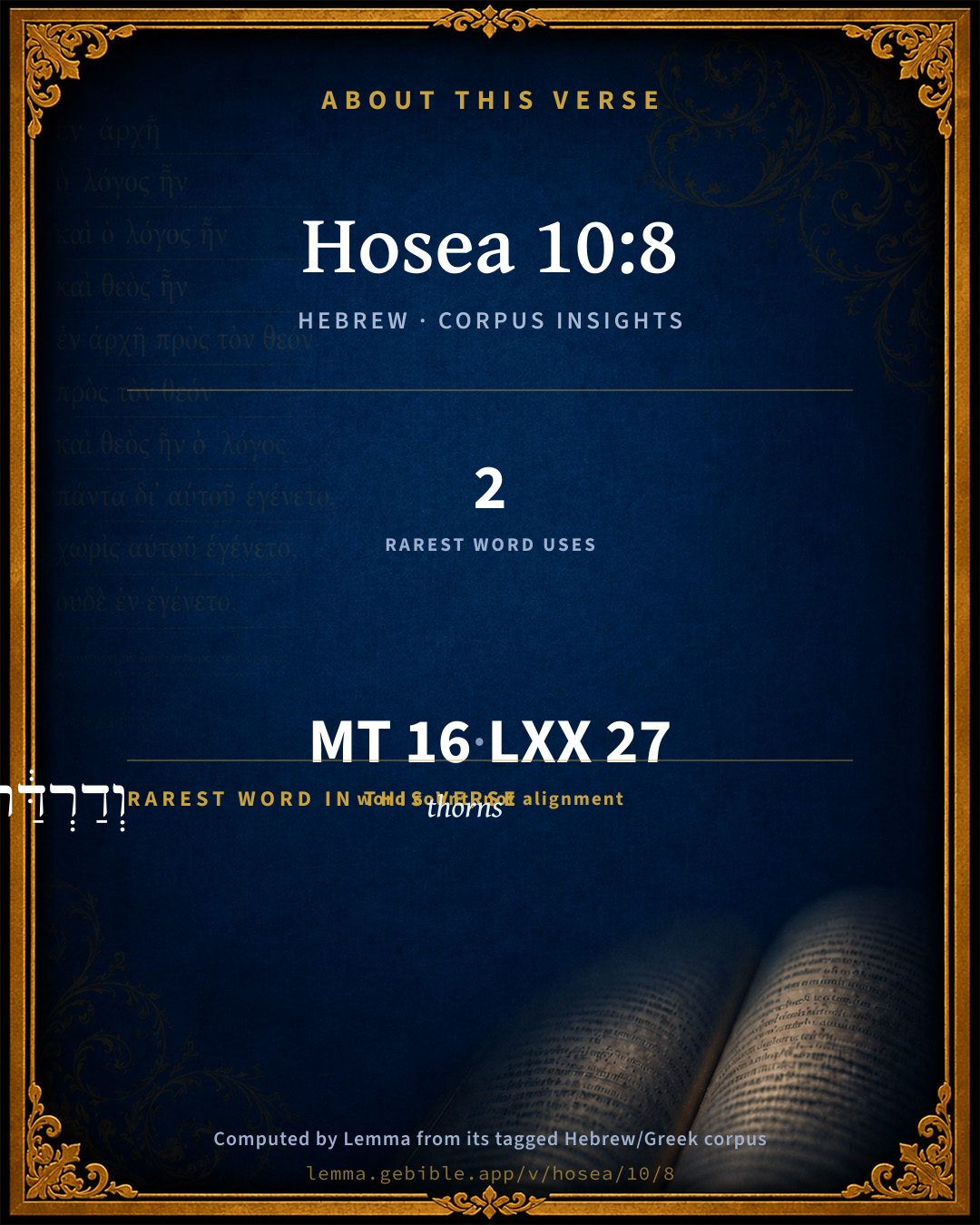
The rarest word here is וְדַרְדַּ֔ר thorns H1863 — appearing just 2 times in the whole Hebrew Bible.

Shared distinctive vocabulary

וְדַרְדַּ֔ר thorns H1863 occurs in 2 verses of the Hebrew Bible. Also found in:

Grammatical profile

  • 5 verbs
  • 9 nouns
  • 2 prepositions

Verb forms

  • וְנִשְׁמְד֞וּ Niphal · Sequential Perfect
  • יַעֲלֶ֖ה Qal · Imperfect
  • וְאָמְר֤וּ Qal · Sequential Perfect
  • כַּסּ֔וּנוּ Piel · Imperative
  • נִפְל֥וּ Qal · Imperative

Repetition

A word recurs within this verse — often emphatic in Hebrew:

Hebrew & Septuagint length

In English translation the verse runs 37 words from the Hebrew and 38 from the Septuagint (LXX English) — closely comparable.

A rough comparison of the two English renderings, which tokenize alike — not a word-level alignment.

Word counts can differ between the Hebrew and the Greek without any difference in meaning — e.g. the Hebrew direct-object marker אֵת has no separate Greek word, and Greek often adds the article ὁ.

In the original languages it is 16 Hebrew tokens and 27 Greek tokens — but the two are counted differently (Hebrew bundles its prefixes and suffixes into one token; the Greek is in lemma form), so that isn’t a like-for-like length.

Cross-references

23

Topical passages linked to Hosea 10:8 in the Treasury of Scripture Knowledge — connected by theme and wording, ordered by reader-vote popularity; previews shown in the World English Bible.

  • Luke 23:30 Then they will begin to tell the mountains, 'Fall on us!' and tell the hills, 'Cover us.'
  • Revelation 6:16 They told the mountains and the rocks, "Fall on us, and hide us from the face of him who sits on the throne, and from the wrath of the Lamb,
  • Isaiah 2:19 Men shall go into the caves of the rocks, And into the holes of the earth, From before the terror of Yahweh, And from the glory of his majesty, When he arises to shake the earth mightily.
  • 1 Kings 12:28–30 Whereupon the king took counsel, and made two calves of gold; and he said to them, It is too much for you to go up to Jerusalem: see your gods, Israel, which brought you up out of the land of Egypt.
  • Isaiah 32:13 On the land of my people shall come up thorns and briers; yes, on all the houses of joy in the joyous city.
  • Hosea 9:6 For, behold, they have gone away from destruction. Egypt will gather them up. Memphis will bury them. Nettles will possess their pleasant things of silver. Thorns will be in their tents.
  • Amos 8:14 Those who swear by the sin of Samaria, And say, 'As your god, Dan, lives;' And, 'As the way of Beersheba lives;' They will fall, and never rise up again."
  • Deuteronomy 9:21 I took your sin, the calf which you had made, and burnt it with fire, and stamped it, grinding it very small, until it was as fine as dust: and I cast the dust of it into the brook that descended out of the mountain.
  • 1 Kings 13:2 He cried against the altar by the word of Yahweh, and said, altar, altar, thus says Yahweh: Behold, a son shall be born to the house of David, Josiah by name; and on you shall he sacrifice the priests of the high places who burn incense on you, and men's bones shall they burn on you.
  • 1 Kings 13:34 This thing became sin to the house of Jeroboam, even to cut it off, and to destroy it from off the surface of the earth.
  • 1 Kings 14:16 He will give Israel up because of the sins of Jeroboam, which he has sinned, and with which he has made Israel to sin.
  • 2 Kings 23:15 Moreover the altar that was at Bethel, and the high place which Jeroboam the son of Nebat, who made Israel to sin, had made, even that altar and the high place he broke down; and he burned the high place and beat it to dust, and burned the Asherah.
  • 2 Chronicles 31:1 Now when all this was finished, all Israel who were present went out to the cities of Judah, and broke in pieces the pillars, and hewed down the Asherim, and broke down the high places and the altars out of all Judah and Benjamin, in Ephraim also and Manasseh, until they had destroyed them all. Then all the children of Israel returned, every man to his possession, into their own cities.
  • 2 Chronicles 34:5–7 He burnt the bones of the priests on their altars, and purged Judah and Jerusalem.
  • Isaiah 34:13 Thorns shall come up in its palaces, nettles and thistles in the fortresses of it; and it shall be a habitation of jackals, a court for ostriches.
  • Hosea 4:13 They sacrifice on the tops of the mountains, And burn incense on the hills, under oaks and poplars and terebinths, Because its shade is good. Therefore your daughters play the prostitute, And your brides commit adultery.
  • Hosea 4:15 "Though you, Israel, play the prostitute, Yet don't let Judah offend; And don't come to Gilgal, Neither go up to Beth Aven, Nor swear, 'As Yahweh lives.'
  • Hosea 5:8 "Blow the cornet in Gibeah, And the trumpet in Ramah! Sound a battle cry at Beth Aven, behind you, Benjamin!
  • Hosea 10:2 Their heart is divided. Now they will be found guilty. He will demolish their altars. He will destroy their sacred stones.
  • Hosea 10:5 The inhabitants of Samaria will be in terror for the calves of Beth Aven; For its people will mourn over it, Along with its priests who rejoiced over it, For its glory, because it has departed from it.
  • Micah 1:5 "All this is for the disobedience of Jacob, And for the sins of the house of Israel. What is the disobedience of Jacob? Isn't it Samaria? And what are the high places of Judah? Aren't they Jerusalem?
  • Micah 1:13 Harness the chariot to the swift steed, inhabitant of Lachish. She was the beginning of sin to the daughter of Zion; For the transgressions of Israel were found in you.
  • Revelation 9:6 In those days people will seek death, and will in no way find it. They will desire to die, and death will flee from them.

Cross-references courtesy of OpenBible.info (CC BY 4.0).

Hebrew and Greek witnesses Masoretic Hebrew ↔ Greek Septuagint

The same verse in the two great witnesses to the Old Testament, shown verse-for-verse.

These are two independent witnesses, not word-aligned to each other, and the Septuagint is shown in lemma (dictionary) form.

Hebrew Hosea 10:8 Masoretic · Westminster Leningrad Codex

וְנִשְׁמְד֞וּ בָּמ֣וֹת אָ֗וֶן חַטַּאת֙ יִשְׂרָאֵ֔ל ק֣וֹץ וְדַרְדַּ֔ר יַעֲלֶ֖ה עַל מִזְבְּחוֹתָ֑ם וְאָמְר֤וּ לֶֽהָרִים֙ כַּסּ֔וּנוּ וְלַגְּבָע֖וֹת נִפְל֥וּ עָלֵֽינוּ

The high places also of Aven, the sin of Israel, will be destroyed. The thorn and the thistle will come up on their altars. They will tell the mountains, "Cover us!" and the hills, "Fall on us!"

World English Bible · Public Domain

Greek LXX Hosea 10:8 Septuagint · lemma form

καί ἐκαἴρω βωμός ων ἁμάρτημα ὁ ἰσραήλ ἄκανθα καί τρίβολος ἀναβαίνω ἐπί ὁ θυσιαστήριον αὐτός καί εἶπον ὁ ὄρος καλύπτω ἐγώ καί ὁ βουνός πίπτω ἐπί ἐγώ

And the altars of On, the sins of Israel, shall be taken away: thorns and thistles shall come up on their altars; and they shall say to the mountains, Cover us; and to the hills, Fall on us.

LXX2012 (modern English Septuagint) · Public Domain

On this verse, Adam Clarke's Commentary discusses the Septuagint’s reading. Read the note in Commentary ↓

Hebrew: Westminster Leningrad Codex (CC BY 4.0). Greek: Septuagint (public domain); English from LXX2012 (modern English Septuagint) (Public Domain). How the Septuagint differs from the Hebrew →

Targum (Aramaic paraphrase)

1

The Targum is the ancient Jewish Aramaic paraphrase of the Hebrew Scriptures — an interpretive translation, not the Hebrew text itself. Onkelos (literal) and Pseudo-Jonathan (expansive) render the Torah, and Jonathan the Prophets. Coverage is partial: where no permissively-licensed English translation exists for a verse, only the Aramaic is shown. This is verse-level text, not a word-by-word alignment to the Hebrew.

  1. Targum Jonathan Prophets (Joshua–Malachi)
    וְיִצְדְיָן בָּמַת בֵּית אֵל חוֹבֵי יִשְׂרָאֵל גְרָמוּ לְהוֹן דְיִגְלוּן כּוּבִין וְאַטְדִין יִסְקוּן עַל אֱגוֹרֵיהוֹן כְּעַן אַיְתֵי עֲלֵיהוֹן עָקָא דְמוֹתָא דִיהוֹן דָמָן כְּאִילוּ טוּרַיָא חָפָן לְהוֹן וְרָמָתָא נְפָלוּ עֲלֵיהוֹן:

    (no public-domain English translation for this verse)

    Targum Jonathan — Aramaic: “Mikraot Gedolot” (public domain). English: “Sefaria Community Translation” (CC0 1.0 (public-domain dedication)); “London "Chaldee Paraphrase," 1871” (public domain). Text via Sefaria.

Commentary

Notes on Hosea 10:8 from classic Christian and Jewish commentators (each source and its license shown beneath its notes). The classic Christian expositions comment on the surrounding passage and are grouped to its opening verse, so a note may address several verses; the Jewish commentaries on the Tanakh (Rashi and others) are per-verse, so they appear only where the commentator wrote on this verse.

Lemma curates 59 commentaries, every one of them public domain or Creative Commons licensed, each selected and text-cleaned for this edition rather than reprinted as found. About our sources →

Trapp's Complete Commentary

John Trapp

Hos 10:8 The high places also of Aven, the sin of Israel, shall be destroyed: the thorn and the thistle shall come up on their altars; and they shall say to the mountains, Cover us; and to the hills, Fall on us.

Ver. 8. The high places also of Aven, &c.] Sept. the altars, ab Alto dicta ( במות whence Bωμοι). Of Aven, for Bethaven (whereof before), a place so hateful now, that God loathes at large to mention it; he even cuts off the head of it, as he had threatened to do by the altars, Hos 10:2. So Jeconiah degenerating is Coniah, &c.

The sin of Israel] That damning sin of idolatry here committed, that wickedness with a witness, which makes God abhor places as well as persons, and turns them into sin as it were. "What is the transgression of Jacob? is it not Samaria? and what are the high places of Judah? are they not Jerusalem," Mic 1:5.

Shall be destroyed] Thus, man’s sin brings destruction upon the creatures. It is as poison in a glass, that causeth the glass to be broken, and cast upon the dunghill. The vessels that held the sin offering, if made of earth, they were to be broken; if of brass, or other metals, to be purged with fire; as one day the earth and visible heavens also shall be for the defilement that man’s sin hath set upon them.

The thorn and the thistle shall come upon their altars] There shall be nil nisi solitude in terris, aegritudo in animis, &c. {See Trapp on "Hos 9:6"}

They shall say to the mountains, Cover us] This they shall say out of the sense and terror of God’s just judgments driving them to desperation. - tellus prius ima dehiseat, &c. Aristides commendeth Themistocles for this, that he never was so perplexed by any evil occurrence as to wish that the earth would swallow him up quick, or to pronounce the dead happy. Rivet well observeth here that Judea, as it was full of hills and rocks, so they were wont to dig themselves therein caves and dens, wherein to hide in time of danger. To these David often repaired, and so secured himself from Saul. And to these he alludeth when he calleth God his rock, Psa 18:2, and the rock of his refuge, Psa 94:22. And of these places of security Josephus writeth, describing the form of them (Antiq. 1. 14, cap. 26; B. J. i. 26). Now when they were in those holes of the hills, and were distressed by the enemy there, what wonder though they said to the mountains, Fall upon us, cover us, bury us alive, crush us to pieces, grind us to powder, rather than that we fall into the bloody fingers of these merciless monsters, who will put us haply to a lingering death, kill us piece meal, as Tiberius did those, he was angry with (Sueton.); and as the cannibals of America, when they take a prisoner, feed upon him alive, and by degrees, to the unutterable aggravation of his horror and torment. Our Saviour foretold his disciples, that at the last destruction of Jerusalem men should cry out to the mountains on this manner; and so shall the antichristian rout also do one day, Rev 6:16. They that would not worship the Lamb shall find him a lion; those that would not cast away their transgressions, but faced the heavens, shall run into the rocks to hide them; those that would not aspire to eternity shall despair of mercy; those that would not lift up their eyes to the everlasting mountains, from whence comes help, shall now in vain tire the deaf mountains, with Hide us, help us. Now what can the mountains do more than give an echo to such Help us; for they need help also; the wrath of God is upon the creature.

John Trapp, A Commentary or Exposition upon All the Books of the Old and New Testament (1647–1656) — public domain. Text from a community e-Sword module.

The Biblical Illustrator

Joseph S. Exell

Hos_10:8

The high places also of Aven, the sin of Israel, shall be destroyed.

Redeeming qualities gone

Beth-el means the house of God, and by iniquity, manifold and black, Beth-el was turned into Beth-aven, which means the house of vanity. This is an instance of deterioration, and more than mere deterioration; it is an instance of transformation from good to bad, from the heights of heaven to the depths of the world of fire. Such miracles can be accomplished in the individual character, and such miracles have been found possible in ecclesiastical relationship. But the case is worse. We now read of the high places also of Aven; the Beth is left out: once it was Beth-aven, the house of vanity; now nothing is left but the vanity itself. That is the process of unchecked, untaught, unsanctified nature. We say of a man, he has still one or two redeeming qualities; but the time comes when every redeeming feature is lost. Then men say of the abandoned one, Aven, vanity, all vanity and vexation of spirit. (Joseph Parker, D. D.)

Degeneration

When men degenerate from the pure teaching of God, they in vain cover their profanations with empty names. God loudly proclaims respecting Beth-el that it is Beth-aven, and the reason is well known; it is because Jeroboam erected temples and appointed new sacrifices without Gods command. The Lord approves of nothing but what He Himself commands. Hence the high places of Aven shall perish. (John Calvin.)

The Biblical Illustrator, edited by Joseph S. Exell (c. 1880s–1900s) — public domain. Text from a community e-Sword module.

Tyndale Open Study Notes

Tyndale Open Resources

10:8 The only response of Israelites who survived the coming catastrophe would be to implore the mountains and hills, “Bury us! . . . Fall on us!”

Tyndale Open Study Notes — © Tyndale Open Resources, licensed CC BY-SA 4.0. Text via the HelloAO Bible API.

Geneva Bible (1599)

Geneva Bible translators

This he speaketh in contempt of Bethel, read Hos. 4:15.

Geneva Bible (1599) marginal notes — public domain. Text via Bolls.life.

Jamieson, Fausset & Brown

Robert Jamieson, A. R. Fausset & David Brown

Aven--that is, Beth-aven.

the sin--that is, the occasion of sin (Deu 9:21; Kg1 12:30).

they shall say to . . . mountains, Cover us--So terrible shall be the calamity, that men shall prefer death to life (Luk 23:30; Rev 6:16; Rev 9:6). Those very hills on which were their idolatrous altars (one source of their confidence, as their "king," Hos 10:7, was the other), so far from helping them, shall be called on by them to overwhelm them.

Jamieson, Fausset & Brown — Commentary Critical and Explanatory on the Whole Bible (1871) — public domain (CC PDM 1.0). Text via the HelloAO Bible API.

Adam Clarke's Commentary

Verse 8. The high-places] Idol temples.

Of Aven] Beth-aven.

The thorn and the thistle shall come up on their altars] Owing to the uncultivated and unfrequented state of the land, and of their places of idol worship, the people being all carried away into captivity.

"And they shall say to the mountains, Cover us,

And to the hills, Fall on us."

"This sublime description of fear and distress our Lord had in view, Lu 23:30, which may be a reference, and not a quotation. However, the Septuagint, in the Codex Alexandrinus, has the same order of words as occurs in the evangelist. The parallelism makes the passages more beautiful than Re 6:16; and Isa 2:19 wants the animated dramatic form. That there is a reference to the caverns that abounded in the mountainous countries of Palestine, See Clarke on Isa 2:19." -Newcome.

Adam Clarke's Commentary on the Bible (1810–1826) — public domain. Text from a community e-Sword/MySword module.

John Calvin's Commentaries

We see how much the Prophet dwells on one thing: but, as I have already said, there was need of a strong hammer to beat this iron; for the hearts of the people were iron, or even steel. This hardness could not then be broken except with violence. This is the reason why the Prophet goes on with his threatening and places before their eyes in so many forms the vengeance of God; of which it would have been enough for him briefly to remind them, had they not been so perverse.

And first he says, The high places of Aven have perished, or shall perish. He now calls Bethel Aven, as he called it before Bethaven. We have stated the reason for changing the name. Jeroboam might indeed have disguised the worship, which he had profanely introduced by this pretext, that God had appeared in that place to holy Jacob, and we know its name was given to it by God: but in the meantime, as the people had made a wrong use of the Patriarch’s example, the place was called Bethaven. Bethaven, we know, is the house of iniquity; as though the Prophet had said, “God dwells not in this place, as superstitious men imagine; but it has been corrupted by ungodly worshipers.” He therefore says, “The high places of Aven;” that is, of impiety. But it may be expedient to repeat here what we have before said, namely, that when men degenerate from the pure teaching of God, they in vain cover their profanations with empty names, as we see the Papists doing at this day; for they adorn that profanation, the Mass, with the title of Sacrament, as if it was something allied to it. They wish even their own Mass to be regarded as the Holy Supper, as if it were in their power to abolish what has been prescribed by the Son of God, and to substitute in its place their own inventions. Hence, how much soever the Papists may dignify their profanations with honourable names they effect nothing. How so? Because God loudly proclaims respecting Bethel that it is Bethaven; and the reason is well known, because Jeroboam erected temples, and appointed new sacrifices, without God’s command. Whenever, then, men depart from the word of the Lord, it will avail them nothing to disguise their own dreams; for the Lord approves of nothing but what he himself commands. Hence the high places of Aven have perished, or “shall perish.”

He adds The sin of Israel This sentence, placed in apposition, belongs to the former. What is meant is, The sin of Israel shall perish. But, as it was said yesterday, the Israelites thought that they performed a service acceptable to God; and hence it was that they were so sedulously attentive to their holy rites; but God, on the contrary, pronounced them to be sin. How so? Because it is profanation and idolatry in men to leave off following God’s command, and to give way to their own fancies and inventions. We must then understand, that it is not in the power of men to form any modes of worship they please; nor is it in their power to decide on this or that worship, whether it be lawful or spurious; but nothing remains for us but to attend to what the Lord says. When, therefore, the Lord pronounces that to be profane which pleases us, we ought to acquiesce in his judgement; for it does not become us to dispute with him, and it would be vain to do so.

The thorn and the thistle, he says, shall come up on their altars It may be asked, Ought the Prophet simply, by these tokens, to have reproved the superstition of the people, seeing that the same thing happened to the temple a short time after, though not built by the counsel of men, but by that of God? Since, then, the grass grew where the temple was, was not that worship, which we know was founded by God, exposed to ridicule? It is only the same that can be said of the calves. We grant that the calves were carried into Assyria, as a price from the wretched Israelites to pacify the king, who was angry with them. Was not the ark of the covenant taken also into captivity by enemies? Did not king Nebuchadnezzar take away the vessels of the temple? And was not pious Hezekiah constrained to strip the doors of the temple of their ornaments? Then this seems not to have been fitly spoken by the Prophet. The answer to all this may be readily given: The Israelites promised to themselves what they saw, and found afterwards to be vain as is the case with hypocrites, who securely despise all judgements and all punishments. How so? Because they thought their own perverted worship to be sufficient for their safety; though they were in their whole life abominable yet as some form of religion was observed by them, they thought that God was bound to be with them: such and so supine was the security of that people. Very different was the case with the tribe of Judah. For God, by his Prophets, proclaimed aloud, “Trust not in words of falsehood; for ye boast continually, The temple of the Lord, The temple of the Lord, (Jeremiah 7:4,) but I no longer dwell in that temple:” and Ezekiel saw the glory of the Lord departing elsewhere, (Ezekiel 10:4.) What is said here could not then apply to the temple, nor to the true and lawful altar, nor to the true worshipers of God; but the Prophet justly reproaches the Israelites for expecting safety from their own altars, while yet they were provoking God’s wrath against themselves by such inventions. We ought, then to remember this difference between the tribe of Judah and the ten tribes.

But he adds, — They shall say to the mountains, Cover us: and to the hills, Fall on us. By this form of speaking, the Prophet intended to express the dreadful vengeance of God; as if he had said, that the destruction, which was at hand, would be so grievous that it would be better to perish a hundred times than to remain in that state alive. For when men say to hills, Fall on us, and to mountains, Cover us, they doubtless desire a death too dreadful to be spoken of; but it is the same as if the Prophet had said, that life and light, and the sight of the sun and the common air, would become a horror to them, for they would perceive the hand of God to be against them. And further, it is a sign of extreme despair, when men willingly seek the abyss, where they may sink to avoid the presence of God and present destruction. And hence Christ has also transferred this passage to set forth the last judgement, of which he speaks, — ‘They shall say to the mountains, Cover us; and to the hills, Fall on us;’ that is, what was once said by the Prophet shall then be again fulfilled; that the wicked will prefer a hundred deaths to one life; for both light and the vital air will be hated and detested by them; because they will perceive themselves to be oppressed by the dreadful hand of God. It follows —

John Calvin's Commentaries (1540-1563) — public domain. Text from the Calvin Translation Society English edition (1840s-50s) via the Christian Classics Ethereal Library (ccel.org). Calvin's coverage is partial (roughly two-thirds of the Bible); uncommented books and verses are honest gaps, never fabricated. The 19th-century editor's footnotes and remarks are omitted so the notes are faithfully Calvin's own voice.

Ellicott's Commentary for English Readers

(8) Aven.—On Beth-Aven, see Note on Hos_4:15. The “thorn and thistle” are part of the first curse upon apostate Adam (Gen_3:18), and the prophet not only predicts utter ruin for king and calf, temple and shrine, but the future desolation which should conceal all. Meanwhile, the people shall desire death rather than life. The awful words in the latter part of this verse are used by our Lord concerning the terrors of the impenitent in the fall of Jerusalem (Luk_23:30), and twice by St. John (Rev_6:16; Rev_9:6), to denote the extremity of despair.

A Bible Commentary for English Readers, edited by Charles John Ellicott (1878–1897) — public domain. Text from a community e-Sword module.

The Cambridge Bible for Schools and Colleges

gen. ed. J. J. S. Perowne

8. The high places also of Aven] Perhaps the same as Beth-aven, i.e. Bethel (Hos_4:15, Hos_10:5). But ‘the high places of idolatry’ (as Aben Ezra) is an equally admissible rendering of the phrase; all the local sanctuaries of the steer-god will then be referred to. The term ‘high place’ includes both the mound and the shrine and altar erected upon it.

they shall say …] Applied proverbially by our Lord (Luk_23:30) and by St John (Rev_6:16; Rev_9:6).

The Cambridge Bible for Schools and Colleges (gen. ed. J. J. S. Perowne; Cambridge University Press, 1878–1918) — public domain. Text from a community e-Sword module.

John Gill's Exposition

The high places also of Aven,.... Bethel, which is not only as before called Bethaven, the house of iniquity; but Aven, iniquity itself; the high places of it were the temple and altars built there for idolatrous service, which were usually set on hills and mountains:

the sin of Israel shall be destroyed; that is, which high places are the sin of Israel, the occasion of sin unto them; and where they committed sin, the sin of idolatry, in worshipping the calves; these should be thrown down, demolished, and no longer used:

the thorn and the thistle shall come up on their altars; lying in ruins, these shall grow upon them, the people and priests being carried captive that used to sacrifice upon them; but now they shall lie deserted by them, being destroyed by the enemy:

and they shall say to the mountains, cover us; and to the hills, fall on us; not that the high places and altars shall say so in a figurative sense, according to R. Moses in Aben Ezra; but, as Japhet, they that worshipped there, the priests and people of Samaria, Bethaven, and even of all Israel, because of their great distress; and, as persons in the utmost consternation, and in despair, and confounded, and ashamed, shall call to the mountains and hills where they have been guilty of idolatry to hide and cover them from the wrath of God; see Luk 23:30 Rev 6:16.

John Gill's Exposition of the Whole Bible (1746–1763) — public domain (CC PDM 1.0). Text via the HelloAO Bible API.

Albert Barnes' Notes on the Bible

The high places of Aven - that is, of vanity or iniquity. He had before called “Bethel, house of God,” by the name of “Bethaven, house of vanity;” now he calls it “Aven, vanity” or “iniquity,” as being the concentration of those qualities. Bethel was situated on a “hill,” the “mount of Bethel,” and, from different sides, people were said to “go up” (Jos 16:1; 1Sa 13:2; above Hos 4:13; Gen 35:1; Jdg 1:22; 1Sa 10:3; 2Ki 2:23) to it. “The high place” often means the shrine, or “the house of the high places.” Jeroboam had built such at Bethel 1Ki 12:31; many such already existed in his time, so that, “whoever would, he consecrated” as their “priests” 1Ki 13:32-33. The high place or shrine, is accordingly said to be “built” 1Ki 11:7, “broken down and burnt” 2Ki 23:15. At times, they were tents, and so said to be “woven 2Ki 23:7, made of garments of divers colors” Eze 16:16. The calf then, probably, became a center of idolatry; many such “idol-shrines” were formed around it, on its mount, until Bethel became a metropolis of idolatry. This was “the sin of Israel,” as being the source of all its sins.

The thorn and the thistle shall come up upon their altars - This pictures, not only the desolation of the place, as before Hos 9:6, but the forced cessation of idolatry. Fire destroys, down to the root, all vegetable life which it has once touched. The thorn, once blackened by fire, puts out no fresh shoot. But now, these idol fires having been put out forever, from amid the crevices of the broken altars, “thorn and thistle” should grow freely as in a fallow soil. Where the victims aforetime “went up” is also a sacrificial term), or were offered, now the wild briars and thistles alone should “go up,” and wave freely in undisputed possession. Ephraim had “multiplied altars,” as God multiplied their “goods;” now their altars should be but monunments of the defeat of idolatry. They remained, but only as the grave-stones of the idols, once worshiped there.

They shall say to the mountains, cover us - Samaria and Bethel, the seats of the idolatry and of the kingdom of Israel, themselves both on heights, had both, near them, mountains higher than themselves. Such was to Bethel, the mountain on the East, where Abraham built an altar to the Lord Gen 12:8; Samaria was encircled by them. Both were probably scenes of their idolatries; from both, the miseries of the dwellers of Bethel and Samaria could be seen. Samaria especially was in the center of a sort of amphitheater; itself, the spectacle. No help should those high places now bring to them in their need. The high hills round Samaria, when the tide of war had filled the valley around it, hemmed them in, the more hopelessly. There was no way, either to break through or to escape. The narrow passes, which might have been held, as flood gates against the enemy, would then be held against them. One only service could it seem, that their mountains could then render, to destroy them. So should they be freed from evils worse than the death of the body, and escape the gaze of people upon their misery. “They shall wish rather to die, than to see what will bring death.” “They shall say to the mountains on which they worshiped idols, fall on us, and anticipate the cruelty of the Assyrians and the extreme misery of captivity.” Nature abhors annihilation; man shrinks from the violent marring of his outward form; he clings, however debased, to the form which God gave him. What misery, then, when people long for, what their inmost being shrinks from!

The words of the prophet become a sort of proverbial saying for misery, which longs for death rather than life. The destruction of Samaria was the type of the destruction of Jerusalem by the Romans, and of every other final excision, when the measure of iniquity was filled, and there was neither hope nor remedy. This was the characteristic of the destruction of Samaria. They had been God’s people; they were to be so no more. This was the characteristic of the destruction of Jerusalem, not by the Babylonians, after which it was restored, but by the Romans, when they had rejected Christ, and prayed, “His Blood be on us and on our children.” So will it be in the end of the world. Hence, our Lord uses the words Luk 23:30, to forewarns of the miseries of the destruction of Jerusalem, when the Jews hid themselves in caves for fear of the Romans ; and John uses them to picture man’s despair at the end of the world Rev 6:16. “I dread” says Bernard , “the gnawing worm, and the living death. I dread to fall into the hands of a living death, and a dying life. This is “the second death,” which never out-killeth, yet which ever killeth. How would they long to die once, that they may not die forever! “They who say to the mountains, fall on us, and to the hills, cover us,” what do they will, but, by the aid of death, either to escape or to end death? “They shall seek death, but shall not find it, and shall desire to die, and death shall flee from them,” saith John” Rev 1:6.

Albert Barnes' Notes on the Bible (1834–1885) — public domain. Text from a community e-Sword/MySword module.

Haydock's Catholic Bible Commentary

Us, as the Jews would do at the last siege, and sinners before the day of judgment, Luke xxiii. 30., and Apocalypse vi. 14. Too happy, if they could by a speedy death escape eternal torments! (Calmet) --- People shall be in the utmost consternation at the approach of the Assyrians. (Haydock) --- They will not think themselves secure enough in their caverns.

George Leo Haydock (1774–1849), Haydock's Catholic Family Bible and Commentary, 1859 edition — public domain. Excludes Psalms (Douay-Rheims chapter numbering differs from Protestant) and Deuterocanonical books (Catholic canon only).

Matthew Poole's English Annotations

The high places; the temples and altars of Baal and other idols.

Aven, for Beth-aven, say most interpreters: what if. Aven, vanity, folly, be here put for all idol worship and rites, which was notoriously

the sin of Israel?

Shall be destroyed; utterly overthrown; and lie so long waste and desolate, that thorns and thistles shall spring up out of the places where their altars once stood within their stately temples. When this shall be brought to pass, the idolatrous Israelites shall be in such perplexity, that they shall wish the mountains and hills might fall on them, and bury them alive, that they might escape the troubles that they did foresee were coming upon them; or it may be an upbraiding them for praying to lifeless stocks or statues, and telling them in their distress, and when their gods are gone, and cannot help, they should cry to deaf mountains to cover them.

Matthew Poole's English Annotations on the Holy Bible (1683–1685) — public domain. Text from a community e-Sword/MySword module.

The Pulpit Commentary

The high places also of Avon, the sin of Israel, shall be destroyed. By Aven is generally understood Beth-aven, that is, Bethel; but some take the word as an appellative, and thus bamoth-aven would signify the "high places of iniquity." These unlawful places of sacrifice and unholy places of iniquity are further characterized by the appositional "the sin of Israel." By constructing and frequenting such places Israel had primarily and grievously sinned. By sacrificing to and worshipping even Jehovah on these high places instead of in Jerusalem, the only legal place for Divine service under the Law, their national sin in the matter of worship began; subsequently, however, things became worse, and these high places became scenes of most abominable idolatries and shamelessly sinful practices. Those places one and all are in the words before us doomed to destruction. The thorn and the thistle shall come up on their altars. The destruction is thus vividly described as total and complete; those bad eminences were devoted to entire wasteness and desolation. "It is a sign of extreme solitude," says Jerome, "so that no traces even of wall or buildings remained to be seen;" similarly Rashi says, "Thorns and thistles shall grow up upon their altars, because the worshippers thereof have departed and no one longer remains to attend to them" so Kimchi: "On the altars of Israel which they (the enemies) shall lay waste shall thorns spring up." And they shall say to the mountains, Cover us; and to the hills, Fall on us. The sight of such fearful ruin and desolation overwhelms the wretched inhabitants of the land with distress and dismay; in sheer despair and even desperation they invoke a sure and sudden death as much preferable to their remaining longer spectators of such heart-rending scenes. Their exclamation appears to be proverbial, and to have had its origin in the custom of the Israelites fleeing, in seasons of great calamities, to the mountains and clefts of the rocks to hide themselves; thus in Jud_1:4:2 we read that "because of the Midianites the children of Israel made them the dens which are in the mountains, and eaves, and strongholds." The object of their exclamation is to be buried under the hills or mountains rather than endure such calamities longer; or rather than the enemies should see them in their shame. Aben Ezra makes "altars" the subject of "shall say," as if it were the wish of the altars to be covered that they may never more be seen. Theodoret considers the sense of the passage to be that the multitude of calamities in the war occasioned by hostile invasion would be so great that there would be no one who would not prefer being overwhelmed in an earthquake or by the sudden fall of the mountains, rather than endure the calamities inflicted by the enemies. Similarly, but more concisely, Jerome says, "They are more willing to die than see the evils that bring death.

Despair.

The picture of the text is awful in the extreme. The condition of those to whom destruction and annihilation would be a relief is appalling to contemplate. What fearful vengeance must be overtaking those, what indescribable forebodings must have taken possession of their nature, who cry, "Mountains, cover us I Rocks, fall upon us!" It is the language of despair!

I THE CAUSES OF DESPAIR. Much must have transpired before such a state of mind could exist. There must have been

(1) sin committed,

(2) mercy rejected,

(3) authority defied,

(4) forbearance abused, before the soul of man could have abandoned itself to hopelessness like this.

II THE HORROR OF DESPAIR. This is not unnatural. It arises from reflection upon the rebellion and inexcusable willfulness of the past; from the declaration of conscience to the effect that God has observed that rebellion, that sinfulness, with indignation, and from the anticipation of impending judgment. Only such thoughts and feelings could account for the unparalleled horror declaring itself in such invocations and imprecations as these.

III THE CRY OF DESPAIR. The dreadful language proceeding from the lips of the hopeless is an appeal to nature to save the sinner from nature"s Lord. It is an appeal unreasonable and absurd, but not unnatural, as uttered by a bewildered, terrified, and unfriended soul. Can anything give a more awful and impressive representation of the wretchedness into which he is surely led who perseveres in sin, and hardens himself against both the Law and the Gospel?

IV THE PREVENTION OF DESPAIR. It may be well to see whither a certain course leads us, if the result be to save us from the issue, by saving us from what involves it. It is to be remembered with gratitude that hearers of the gospel of Christ have not reached the stage now described. They may be prisoners, but they are "prisoners of hope." The word of the Lord does indeed come as a word of warning, but it comes also as a word of promise. Neglected, it will be a sentence of condemnation; accepted, it will be an assurance of pardon and a pledge of life eternal. T.

The Pulpit Commentary (1880–1919), ed. H.D.M. Spence-Jones & Joseph S. Exell — public domain. Text from a community e-Sword module.

John Wesley's Explanatory Notes

The high places - The temples and altars of Baal. Of Aven - Or Beth-aven. They shall say - When this shall be brought to pass, the idolatrous Israelites shall be in such perplexity, that they shall wish the mountains and hills might fall on them.

John Wesley, Explanatory Notes Upon the Whole Bible (1754–1765) — public domain. Text via the GEBible commentary corpus.

Rashi

Rabbi Shlomo Yitzchaki (Rashi)

The high places of Aven i.e., the high places of Bethel.

thorns and thistles shall come up on their altars for their worshippers have gone into exile, and no one turns to them anymore.

and they shall say i.e., Israel shall say.

to the mountains, Cover us up lest our enemies see our shame.

Rashi on the Tanakh — English translations: “The Judaica Press complete Tanach with Rashi, translated by A. J. Rosenberg” (CC BY 4.0); “Pentateuch with Rashi's commentary by M. Rosenbaum and A.M. Silbermann, 1929-1934” (public domain); “The Metsudah Tanach series, Lakewood, N.J” (CC BY 4.0); and “The Book of Joshua, Metsudah Publications, 1997” (CC BY 4.0). Text via Sefaria.

Lesson kit

Teaching starters — assembled from the data on this page, not authored interpretation. Every prompt links to the verse data it draws on. Edit before teaching.

Hosea, in the Prophets, opens this verse with 16 words (15 distinct Hebrew lemmas). Its most distinctive word is dardar (“thorns”). A historical commentator’s framing appears above. Read the whole chapter for the surrounding context.

Discussion questions

  1. How does “thorns” (dardar) shape what this verse is saying?
  2. How does Genesis 3:18, which shares the word «thorns», read alongside this verse?
  3. What does the repetition of “upon” (2× in this one verse) do in this verse?
  4. These translations render this verse differently; the difference is in the English rendering, not the original. What questions does that raise?
  5. «וְנִשְׁמְד֞וּ» is a Niphal Sequential Perfect verb. How does that grammatical form shape the action described?
  6. Compare how Trapp's Complete Commentary and The Biblical Illustrator read this verse. Where do they agree or differ?

Things to notice

Reading settings

Reading text

Shown beneath each verse's original-language words.

Old Testament
Old Testament edition

Read the OT as the Masoretic Hebrew (MT) or the Greek Septuagint (LXX).

English shown for the Greek Septuagint (in the Hebrew ↔ Greek comparison).

Comparing translations? Open the Compare panel on any verse page to stack up to four side by side.