Amos 2:8

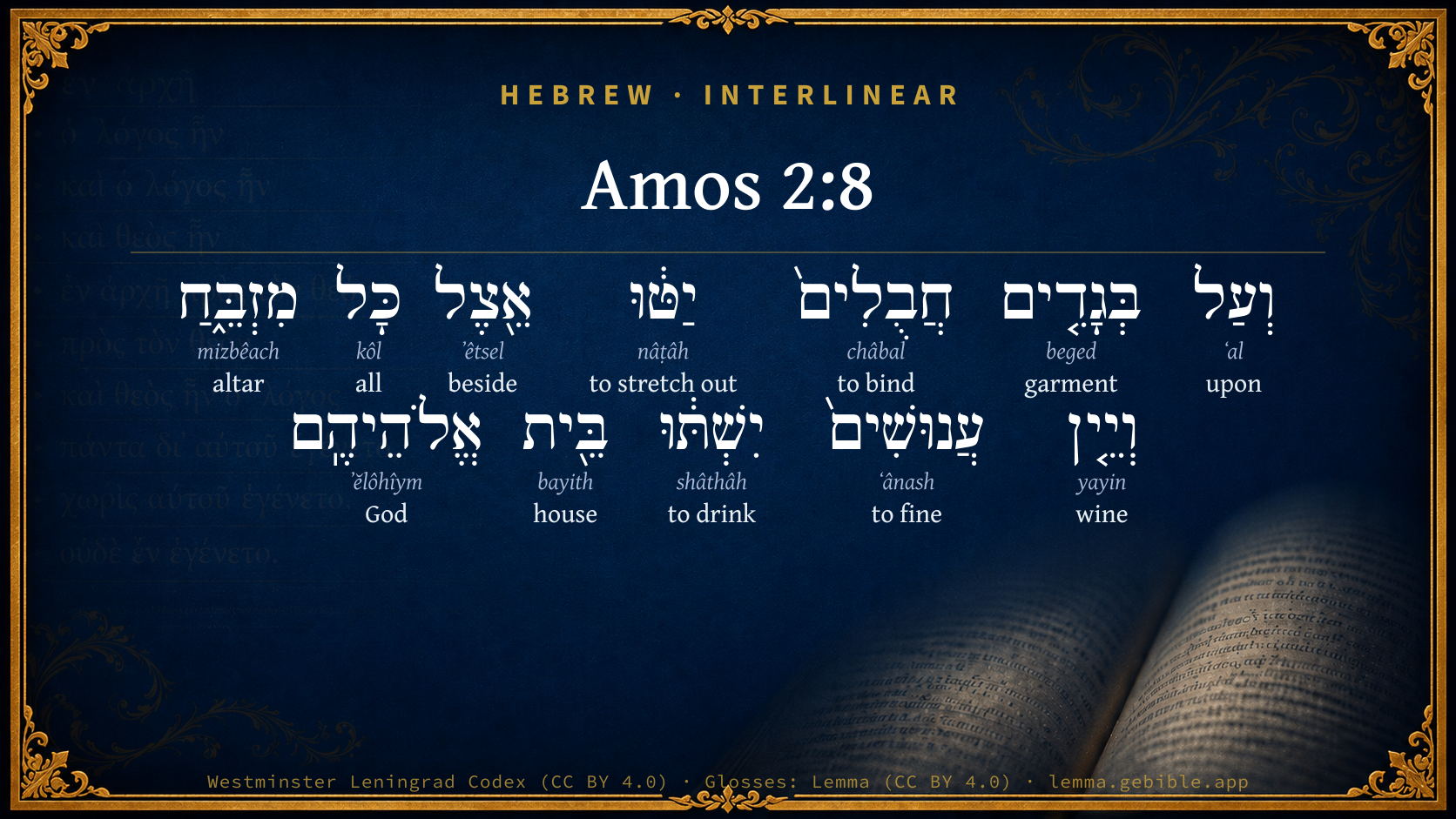
Hebrew (Westminster Leningrad Codex) Amos 2:8 appears in the Hebrew Old Testament. The text above is from the Westminster Leningrad Codex. Each word links to its Strong’s number, a concise gloss, and parsing drawn from the Open Scriptures Hebrew Bible morphology. Click any word for its full Brown-Driver-Briggs (BDB) entry.
Download image
Cite this verse

Amos 2:8 (World English Bible). Public Domain. Lemma interlinear Bible study tool, https://lemma.gebible.app/v/amos/2/8.

Show BibTeX & RIS
BibTeX
RIS
English Translation
And they lay themselves down beside every altar on clothes taken in pledge; And in the house of their God they drink the wine of those who have been fined.
World English Bible · Public Domain
Download a study sheet

One document with this verse’s original text, its word-by-word gloss line, the meaning frame, cross-references with their text, attributed commentary, and full source and license credits — printable, and it pastes into notes with its structure intact.

This verse Autodidact and up

Study sheet (.html) Plain text (.txt)

A passage Seminary Student

Up to 50 verses in one chapter. A passage sheet keeps up to 6 commentary sources and 12 cross-references per verse, in the order this page ranks them, and says so on the sheet whenever that leaves anything out. Ask for a single verse and you get the Autodidact verse sheet above.

Everything on this page stays free to read, with no account — the sheet is a download of what is already on screen, not access to it.

Want to remove ads? Support Godless Engineer
Compare translations 3

The same verse in 3 English versions, stacked beneath the original-language interlinear above. Click any original word for its lexicon entry.

Each is an independent rendering of the whole verse — the interlinear is not word-aligned to these translations.

Highlighted words mark where these versions differ — a whole-verse word diff, not a word-by-word alignment.

  • World English Bible Public Domain
    And they lay themselves down beside every altar on clothes taken in pledge; And in the house of their God they drink the wine of those who have been fined.
  • King James Version Public Domain
    And they lay themselves down upon clothes laid to pledge by every altar, and they drink the wine of the condemned in the house of their god.
  • unfoldingWord Literal Text CC BY-SA 4.0
    They lie down beside every altar on clothes taken as pledges, and in the house of their God they drink the wine of those who were fined.

unfoldingWord Literal Text — © unfoldingWord, licensed CC BY-SA 4.0. Word-aligned USFM3 via Door43 (git.door43.org/unfoldingWord/en_ult).

Versions to compare (up to 4)

3 of 4 selected

Show all 18 translations

Every available English version of this verse, each an independent rendering of the whole verse.

  • World English Bible Public Domain
    And they lay themselves down beside every altar on clothes taken in pledge; And in the house of their God they drink the wine of those who have been fined.
  • Berean Standard Bible Public Domain
    They lie down beside every altar on garments taken in pledge. And in the house of their God, they drink wine obtained through fines.
  • Majority Standard Bible Public Domain
    They lie down beside every altar on garments taken in pledge. And in the house of their God, they drink wine obtained through fines.
  • King James Version Public Domain
    And they lay themselves down upon clothes laid to pledge by every altar, and they drink the wine of the condemned in the house of their god.
  • American Standard Version (1901) Public Domain
    and they lay themselves down beside every altar upon clothes taken in pledge; and in the house of their God they drink the wine of such as have been fined.
  • Revised Version (1885) Public Domain
    and they lay themselves down beside every altar upon clothes taken in pledge, and in the house of their God they drink the wine of such as have been fined.
  • Geneva Bible (1599) Public Domain
    And they lye downe vpon clothes layde to pledge by euery altar: and they drinke the wine of the condemned in the house of their God.
  • Douay-Rheims (1899) Public Domain
    And they sat down upon garments laid to pledge by every altar: and drank the wine of the condemned in the house of their God.
  • Young's Literal Translation Public Domain
    And on pledged garments they stretch themselves near every altar, And the wine of fined ones they drink `in' the house of their gods.
  • Literal Standard Version CC BY-SA 4.0
    And they stretch themselves on pledged garments near every altar, || And the wine of fined ones they drink [in] the house of their gods.
  • Unlocked Literal Bible CC BY-SA 4.0
    They lie down beside every altar on clothes taken as pledges, and in the house of their God they drink the wine of those who were fined.
  • unfoldingWord Literal Text CC BY-SA 4.0
    They lie down beside every altar on clothes taken as pledges, and in the house of their God they drink the wine of those who were fined.
  • Darby Bible Public Domain
    And they lay [themselves] down by every altar upon clothes taken in pledge, and they drink [in] the house of their God the wine of the condemned.
  • World Messianic Bible Public Domain
    They lay themselves down beside every altar on clothes taken in pledge. In the house of their God they drink the wine of those who have been fined.
  • Webster's Bible Public Domain
    And they lay themselves down upon clothes laid to pledge by every altar, and they drink the wine of the condemned in the house of their god.
  • Free Bible Version CC BY-SA 4.0
    At every altar they stretch themselves out in clothes taken from debtors as collateral, in the temple of their god they drink wine taken from the people they fined.
  • Bible in Basic English Public Domain
    By every altar they are stretched on clothing taken from those who are in their debt, drinking in the house of their god the wine of those who have made payment for wrongdoing.
  • JPS Tanakh (1917) Public Domain
    And they lay themselves down beside every altar upon clothes taken in pledge, and in the house of their God they drink the wine of them that have been fined.

Literal Standard Version (2020), Covenant Press — licensed CC BY-SA 4.0. Text via the HelloAO Bible API (eBible.org). Unlocked Literal Bible (unfoldingWord) — licensed CC BY-SA 4.0. Text via the HelloAO Bible API (eBible.org). unfoldingWord Literal Text — © unfoldingWord, licensed CC BY-SA 4.0. Word-aligned USFM3 via Door43 (git.door43.org/unfoldingWord/en_ult). Free Bible Version, Dr. Jonathan Gallagher — licensed CC BY-SA 4.0. Text via the HelloAO Bible API (eBible.org).

Word by word

More ways to search: Search by grammar → Find every occurrence → Compare this word →

Practice this passage: Drill this verse → Learn its vocabulary →

עֲנוּשִׁים֙
ʻânash
H6064
“fined ones”
Noun, Common, Masculine, Plural, Absolute
Part of Speech
Noun
Type
Common
Gender
Masculine
Number
Plural
State
Absolute
Full BDB Definition

Origin: a primitive root

TWOT: 1659

to fine, amerce, punish, condemn, mulct - (Qal) to fine, punish - (Niphal) to be fined, be punished, be mulcted
  1. וְעַל ʻal H5921 “and · upon” Conjunction + Preposition
  2. בְּגָדִ֤ים beged H899 “garments” Noun, Common, Masculine, Plural, Absolute
  3. חֲבֻלִים֙ châbal H2254 “bound” Verb, Qal, Participle Passive, Masculine, Plural, Absolute
  4. יַטּ֔וּ nâṭâh H5186 “to stretch out” Verb, Hiphil, Imperfect, 3rd Person, Masculine, Plural
  5. אֵ֖צֶל ʼêtsel H681 “beside” Preposition
  6. כָּל kôl H3605 “all of” Noun, Common, Masculine, Singular, Construct
  7. מִזְבֵּ֑חַ mizbêach H4196 “altar” Noun, Common, Masculine, Singular, Absolute
  8. וְיֵ֤ין yayin H3196 “and · wine of” Conjunction + Noun, Common, Masculine, Singular, Construct
  9. יִשְׁתּ֔וּ shâthâh H8354 “to drink” Verb, Qal, Imperfect, 3rd Person, Masculine, Plural
  10. בֵּ֖ית bayith H1004 “house of” Noun, Common, Masculine, Singular, Construct
  11. אֱלֹהֵיהֶֽם ʼĕlôhîym H430 “God(s) · their” Noun, Common, Masculine, Plural, Construct + Suffix, Personal, 3rd Person, Masculine, Plural

About this verse

These counts appear in no published source. They are computed here, from the morphology-tagged text and Lemma’s own curated glosses. What Lemma adds →

12
words
12
distinct lemmas
Prophets
section

Notable vocabulary

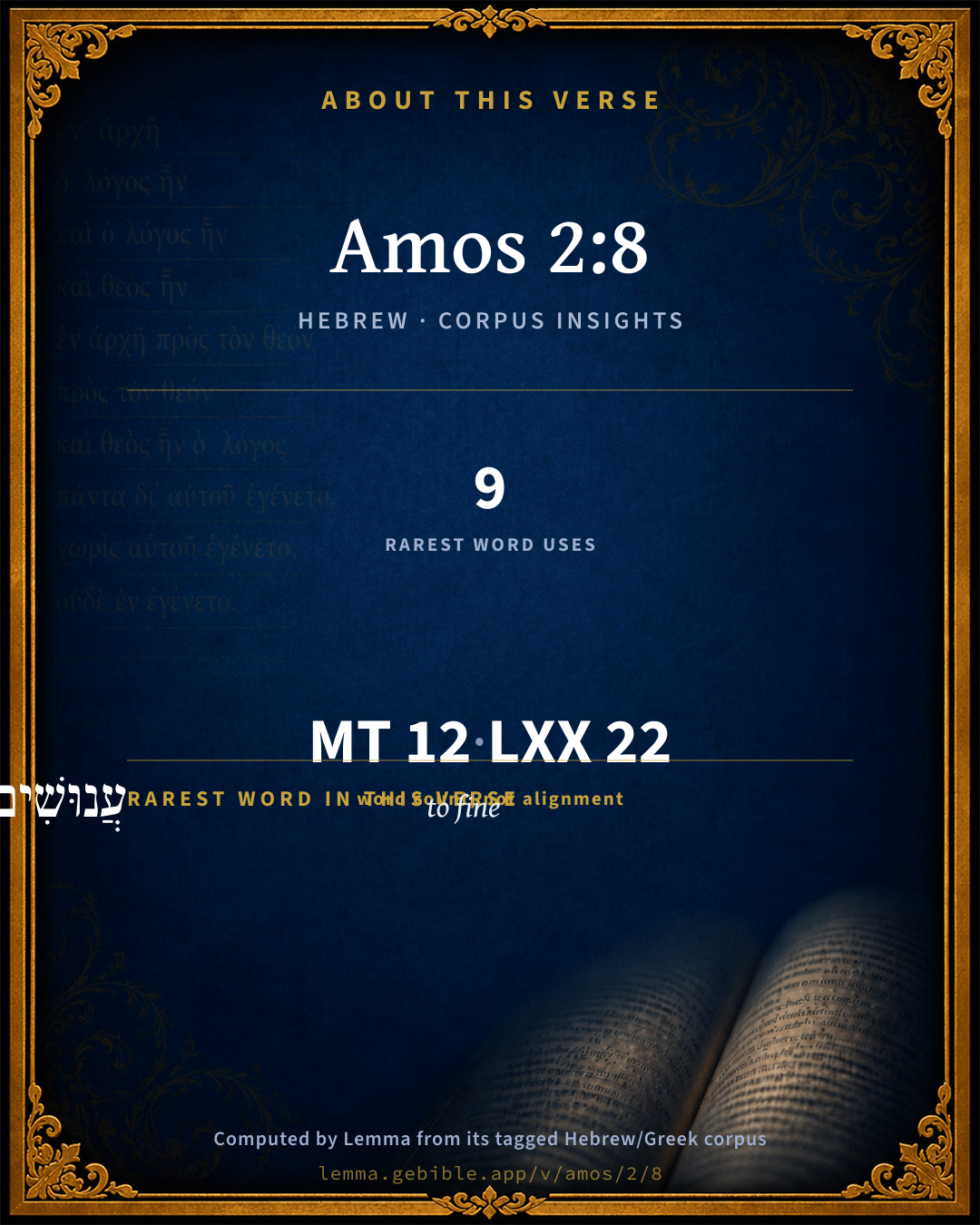
The rarest word here is עֲנוּשִׁים֙ to fine H6064 — appearing just 9 times in the whole Hebrew Bible.

Shared distinctive vocabulary

עֲנוּשִׁים֙ to fine H6064 occurs in 8 verses of the Hebrew Bible. Also found in:

Grammatical profile

  • 3 verbs
  • 7 nouns
  • 2 prepositions

Verb forms

  • חֲבֻלִים֙ Qal · Participle Passive
  • יַטּ֔וּ Hiphil · Imperfect
  • יִשְׁתּ֔וּ Qal · Imperfect

Hebrew & Septuagint length

In English translation the verse runs 30 words from the Hebrew and 28 from the Septuagint (LXX English) — closely comparable.

A rough comparison of the two English renderings, which tokenize alike — not a word-level alignment.

Word counts can differ between the Hebrew and the Greek without any difference in meaning — e.g. the Hebrew direct-object marker אֵת has no separate Greek word, and Greek often adds the article ὁ.

In the original languages it is 12 Hebrew tokens and 22 Greek tokens — but the two are counted differently (Hebrew bundles its prefixes and suffixes into one token; the Greek is in lemma form), so that isn’t a like-for-like length.

Cross-references

14

Topical passages linked to Amos 2:8 in the Treasury of Scripture Knowledge — connected by theme and wording, ordered by reader-vote popularity; previews shown in the World English Bible.

  • Deuteronomy 24:12–17 If he be a poor man, you shall not sleep with his pledge;
  • Exodus 22:26–27 If you take your neighbor's garment as collateral, you shall restore it to him before the sun goes down,
  • Amos 6:6 Who drink wine in bowls, And anoint themselves with the best oils; But they are not grieved for the affliction of Joseph.
  • Judges 9:27 They went out into the field, and gathered their vineyards, and trod [the grapes], and held festival, and went into the house of their god, and did eat and drink, and cursed Abimelech.
  • Ezekiel 18:7 and has not wronged any, but has restored to the debtor his pledge, has taken nothing by robbery, has given his bread to the hungry, and has covered the naked with a garment;
  • Ezekiel 18:12 has wronged the poor and needy, has taken by robbery, has not restored the pledge, and has lifted up his eyes to the idols, has committed abomination,
  • Ezekiel 23:41 and sit on a stately bed, with a table prepared before it, whereupon you did set my incense and my oil.
  • Hosea 4:8 They feed on the sin of my people, And set their heart on their iniquity.
  • Amos 4:1 Listen to this word, you cows of Bashan, who are on the mountain of Samaria, who oppress the poor, who crush the needy, who tell their lords, "Bring, and let us drink."
  • Amos 6:4 Who lie on beds of ivory, And stretch themselves on their couches, And eat the lambs out of the flock, And the calves out of the midst of the stall;
  • 1 Corinthians 8:10 For if a man sees you who have knowledge sitting in an idol's temple, won't his conscience, if he is weak, be emboldened to eat things sacrificed to idols?
  • 1 Corinthians 10:7 Neither be idolaters, as some of them were. As it is written, "The people sat down to eat and drink, and rose up to play."
  • 1 Corinthians 10:21 You can't both drink the cup of the Lord and the cup of demons. You can't both partake of the table of the Lord, and of the table of demons.
  • Isaiah 57:7 On a high and lofty mountain have you set your bed; there also you went up to offer sacrifice.

Cross-references courtesy of OpenBible.info (CC BY 4.0).

Hebrew and Greek witnesses Masoretic Hebrew ↔ Greek Septuagint

The same verse in the two great witnesses to the Old Testament, shown verse-for-verse.

These are two independent witnesses, not word-aligned to each other, and the Septuagint is shown in lemma (dictionary) form.

Hebrew Amos 2:8 Masoretic · Westminster Leningrad Codex

וְעַל בְּגָדִ֤ים חֲבֻלִים֙ יַטּ֔וּ אֵ֖צֶל כָּל מִזְבֵּ֑חַ וְיֵ֤ין עֲנוּשִׁים֙ יִשְׁתּ֔וּ בֵּ֖ית אֱלֹהֵיהֶֽם

And they lay themselves down beside every altar on clothes taken in pledge; And in the house of their God they drink the wine of those who have been fined.

World English Bible · Public Domain

Greek LXX Amos 2:8 Septuagint · lemma form

καί ὁ ἱμάτιον αὐτός δεσμεύω σχοινίον παραπέτασμα ποιέω ἔχω ὁ θυσιαστήριον καί οἶνος ἐκ συκοφαντία πίνω ἐν ὁ οἶκος ὁ θεός αὐτός

And binding their clothes with cords they have made them curtains near the altar, and they have drunk wine gained by extortion in the house of their God.

LXX2012 (modern English Septuagint) · Public Domain

On this verse, Ellicott's Commentary for English Readers discusses the Septuagint’s reading. Read the note in Commentary ↓

Hebrew: Westminster Leningrad Codex (CC BY 4.0). Greek: Septuagint (public domain); English from LXX2012 (modern English Septuagint) (Public Domain). How the Septuagint differs from the Hebrew →

Targum (Aramaic paraphrase)

1

The Targum is the ancient Jewish Aramaic paraphrase of the Hebrew Scriptures — an interpretive translation, not the Hebrew text itself. Onkelos (literal) and Pseudo-Jonathan (expansive) render the Torah, and Jonathan the Prophets. Coverage is partial: where no permissively-licensed English translation exists for a verse, only the Aramaic is shown. This is verse-level text, not a word-by-word alignment to the Hebrew.

  1. Targum Jonathan Prophets (Joshua–Malachi)
    וְעַל שַׁוְיָן דְמַשְׁכּוֹן מְסַחֲרִין בִּסְטַר כָּל אֱגוֹרֵיהוֹן וַחֲמַר אוֹנָסָא שָׁתָן בֵּית טַעֲוַתְהוֹן:

    (no public-domain English translation for this verse)

    Targum Jonathan — Aramaic: “Mikraot Gedolot” (public domain). English: “Sefaria Community Translation” (CC0 1.0 (public-domain dedication)); “London "Chaldee Paraphrase," 1871” (public domain). Text via Sefaria.

Commentary

Notes on Amos 2:8 from classic Christian and Jewish commentators (each source and its license shown beneath its notes). The classic Christian expositions comment on the surrounding passage and are grouped to its opening verse, so a note may address several verses; the Jewish commentaries on the Tanakh (Rashi and others) are per-verse, so they appear only where the commentator wrote on this verse.

Lemma curates 59 commentaries, every one of them public domain or Creative Commons licensed, each selected and text-cleaned for this edition rather than reprinted as found. About our sources →

Trapp's Complete Commentary

John Trapp

Amo 2:8 And they lay [themselves] down upon clothes laid to pledge by every altar, and they drink the wine of the condemned [in] the house of their god.

Ver. 8. And they lay themselves down upon clothes] i.e. table carpets, or bed coverlets, laid under those that sit at a meal; whether on the ground, with their legs gathered under then, (as the Turkish basbaws do to this day, and the Trojans of old, stratoque super discumbitur ostro), or at beds or tables, leaning on the left elbow, Est 1:6 Joh 13:23. Et cubito remanete presso.

Laid to pledge] These should have been restored, and not detained beyond the time prescribed, Deu 24:12-13 Exo 22:26-27.

By every altar] It was their fashion to feast in their idol temples, 1Co 8:10; 1Co 10:21. See Horat. Od. xxxvii, lib. 1. And this in imitation belike of God’s people, who were commanded to feast before the Lord, in the place that he should choose to place his name in. See Deu 14:23; Deu 14:26 1Sa 1:3-4, &c. And here paucis verbis multiplex scelus arguit, saith Gualther, in few words he accuseth them of much wickedness.

And they drink the wine of the condemned in the house of their god] A god they have of their own devising, a wooden god, and such as, if he had but a pair of horns clapped on his head, might make an excellent devil, as the Mayor of Doncaster told the wise men of Cockram, in Queen Mary’s days, that came to complain of the carver for making them an ugly crucifix. Next, they "drink wine in the house" of their god, besides their drink offerings (which David’s soul hated, Psa 16:4), they had their drunken compotations in their idol temples, as now they say in the Isle of Sardinia, after mass done they fall to drinking and dancing in the midst of the church; singing in the mean time songs too immodest for an alehouse. Lastly,

They drink the wine of the condemned] Or of such as they have fined or mulcted for not coming along with them to the idol temples. Diodati rendereth it, the wine of the amercements, that is bought with such money as they have unjustly fined and condemned the innocent in. There are those who here understood that wine that was wont to be given to malefactors led to execution, Pro 31:6, to cheer them up; but these wretches drank it off from them. The former sense is the better.

John Trapp, A Commentary or Exposition upon All the Books of the Old and New Testament (1647–1656) — public domain. Text from a community e-Sword module.

Joseph Benson's Commentary

Amo 2:8. They lay themselves down upon clothes laid to pledge — The Jews as well as the Romans used to lie along at their meals on couches, as appears by this verse, compared with Amo 6:4 : a custom which was continued in after times as is evident by divers passages in the gospels, read in the original, which speak, not of persons sitting, but lying down, or reclining, at meat. As the prophet here speaks of their laying themselves down by every altar, it is manifest he refers to the feasts which were made of part of their idolatrous sacrifices, and were eaten in some of the apartments of their temples, according to the custom both of the Jews and Gentiles. And the prophet reproves them for three abuses. 1st, That they kept the clothes which they had received as pledges from the poor, contrary to the law, which commanded that the clothes received in pledge should be returned by the going down of the sun: see Exo 22:6. 2d, That they made feasts in the houses, or temples, of their idols, or golden calves, no longer coming to the temple at Jerusalem; and, as if to insult the holiness of God’s laws, and to carry the marks of their iniquity even to the feet of their altars, they sat down in their temples upon the garments which they had received in pledge from the poor. 3d, That they caroused at the expense of those on whom they had unjustly laid fines, or, as it is expressed in the text, They drank the wine of the condemned in the house of their god — As drink-offerings, made with wine, were a necessary part of the sacrifices, so some portion of these was likewise reserved for the entertainments that followed. And this the prophet here signifies was bought with the fines or mulcts laid on the innocent.

Joseph Benson's Commentary on the Old and New Testaments (1811–1818) — public domain. Text from a community e-Sword module.

Tyndale Open Study Notes

Tyndale Open Resources

2:8 The irony is that the oppressors of the poor flaunted their sins at religious festivals. • The Torah allowed a lender to take a poor man’s cloak as security for a debt, but it was not to be kept overnight, because the nights were cold (Exod 22:26-27; Deut 24:12-13). A widow’s clothing was never to be taken as security for a debt (Deut 24:17). • unjust fines: The wealthy bribed judges and used their influence to keep the poor, who could not defend themselves, from obtaining a fair hearing (Amos 5:12).

Tyndale Open Study Notes — © Tyndale Open Resources, licensed CC BY-SA 4.0. Text via the HelloAO Bible API.

Geneva Bible (1599)

Geneva Bible translators

They spoil others and offer thereof unto God, thinking that he will dispense with them, when he is made partaker of their iniquity.

Thinking by these ceremonies, that is, by sacrificing, and being near mine altar, they may excuse all their other wickedness.

Geneva Bible (1599) marginal notes — public domain. Text via Bolls.life.

Jamieson, Fausset & Brown

Robert Jamieson, A. R. Fausset & David Brown

lay themselves . . . upon clothes laid to pledge--the outer garment, which Exo 22:25-27 ordered to be restored to the poor man before sunset, as being his only covering. It aggravated the crime that they lay on these clothes in an idol temple.

by every altar--They partook in a recumbent posture of their idolatrous feasts; the ancients being in the habit of reclining at full length in eating, the upper part of the body resting on the left elbow, not sitting as we do.

drink . . . wine of the condemned--that is, wine bought with the money of those whom they unjustly fined.

Jamieson, Fausset & Brown — Commentary Critical and Explanatory on the Whole Bible (1871) — public domain (CC PDM 1.0). Text via the HelloAO Bible API.

Adam Clarke's Commentary

Verse 8. See Clarke on Am 2:6.

Adam Clarke's Commentary on the Bible (1810–1826) — public domain. Text from a community e-Sword/MySword module.

John Calvin's Commentaries

Here the Prophet again inveighs against the people’s avariciousness, and addresses his discourse especially to the chief men; for what he mentions could not have been done by the common people, as the lower and humbler classes could not make feasts by means of spoils gained by judicial proceedings. The Prophet then condemns here, no doubt, the luxury and rapacity of men in high stations. They lie down, he says, on pledged clothes nigh every altar. God had forbidden, in his law, to take from a poor man a pledge, the need of which he had for the support of life and daily use, (Exodus 22:26) For instance, it was prohibited by the law to take from a poor man his cloak or his coat, or to take the covering of his bed, or any thing else of which he had need. But the Prophet now accuses the Israelites, that they took away pledges and clothes without any distinction, and lay down on them nigh their altars. This belonged to the rich.

Then follows another clause, which, strictly speaking, must be restricted to the judges and governors, They have drunk the wine of the condemned in the house, or in the temple, of their God This may also be understood of the rich, who were wont to indulge in luxury by means of ill-gotten spoils: for they litigated without cause; and when they gained judgment in their favor, they thought it lawful to fare more sumptuously. This expression of the Prophet may therefore be extended to any of the rich. But he seems here to condemn more specifically the cruelty and rapaciousness of the judges. We now then perceive what the Prophet had in view by saying, that they lay down on pledged garments.

He then says that they drank wine derived from fines, which had been laid on the condemned. But this circumstance, that is added, ought to be observed, — that they lay down near altars and drank in the very temple: for the Prophet here laughs to scorn the gross superstition of the Israelites, that they thought that they were discharging their duty towards God, provided they came to the temple and offered sacrifices at the altar. Thus, indeed, are hypocrites wont to appease God, as if one by puppets played with a child. This has been a wickedness very common in all ages, and is here laid to the charge of the Israelites by the Prophet: they dared with an open front to enter the temple, and there to bring the pledged garments, and to feast on their spoils. Hypocrites do ever make a den of thieves of God’s temple, (Matthew 21:13) for they think that all things are lawful for them, provided they put on the appearance, by external worship, of being devoted to God. Since, then, the Israelites promised themselves impunity and took liberty to sin, because they performed religious ceremonies, the Prophet here sharply reproves them: they even dared to make God a witness of their cruelty by bringing pledged garments and by blending their spoils with their sacrifices, as though God had a participation with robbers.

We hence see that rapaciousness and avarice are not alone condemned here by the Prophet, but that the gross superstition of the Israelites is also reprobated, because they thought that there would be no punishment for them, though they plundered and robbed the poor, provided they reserved a part of the spoil for God, as though a sacrifice from what had been unjustly got were not an abomination to him.

But it may be asked, Why does the Prophet thus condemn the Israelites for they had no sacred temple; and we also know (as it has been elsewhere stated) that the temples, in which they thought that they worshipped God, were filthy brothels, and full of all obscenity. How is it, then, that the Prophet now so sharply inveighs against them, because they mingled their spoils with their impure sacrifices? To this the answer is, That he had regard to their views, and derided the grossness of their minds, that they thus childishly trifled with the God whom they imagined for themselves. We say the same at this day to the Papists, — that they blend profane with sacred things, when they prostitute their masses, and also when they trifle with God in their ceremonies. It is certain that whatever the Papists do is an abomination; for the whole of religion is with them adulterated: but they yet cease not to wrong God, whose name they pretend to profess. Such also were then the Israelites: though they professed still to worship God, they were yet sacrilegious; though they offered sacrifices to the calves in Dan and in Bethel, they yet reproached God, for they ever abused his name. This, then, is the crime the Prophet now condemns in them. But what I have said must be remembered, — that this blind assurance is reprehended in the Israelites, that they thought spoils to be lawful provided they professed to worship God: but they thus rendered double their crime, as we have said; for they tried to make God the associate of robbers, mingling as they did their pollutions with their sacrifices. Let us proceed —

John Calvin's Commentaries (1540-1563) — public domain. Text from the Calvin Translation Society English edition (1840s-50s) via the Christian Classics Ethereal Library (ccel.org). Calvin's coverage is partial (roughly two-thirds of the Bible); uncommented books and verses are honest gaps, never fabricated. The 19th-century editor's footnotes and remarks are omitted so the notes are faithfully Calvin's own voice.

Ellicott's Commentary for English Readers

(8) Rapacity and cruelty follow on pride, selfishness, and lust. With this verse compare the provisions of the Mosaic law (Exo_22:25). Render, And upon garments received in pledge they stretch themselves, and for “condemned” adopt the marginal translation mulcted. The money that had been wrung from those who could not pay, or, who have been sold into slavery, is spent in rioting and feasting. The LXX. read this passage very differently, but the Masoretic text is justified by the translations of the Targum, Aquila, Symmachus, and Jerome.

In the house of their god.—Probably here, as in the previous verse, we are to understand the high places of syncretic, or heathenish, Jehovah worship as referred to. “They drank the wine of the amerced. Where? ‘In the house of their God.’ What hardheartedness to the wilfully forgotten poor is compensated by a little church-going! (Pusey.)

A Bible Commentary for English Readers, edited by Charles John Ellicott (1878–1897) — public domain. Text from a community e-Sword module.

The Cambridge Bible for Schools and Colleges

gen. ed. J. J. S. Perowne

8. The self-indulgence, practised by the worldly-minded Israelites in the name of religion, and at the expense of the poor.

upon clothes laid to pledge by every altar] R.V. beside every altar upon clothes taken in pledge. To be understood in connexion with the last clause: the carnally-minded Israelites visit their sanctuaries for the purposes indicated in Amo_2:7; they lay themselves down there, with their partners in sin (Hos_4:14), beside the altars; and to aggravate their offence they repose, not on their own garments, but on garments which they have taken in pledge from men poorer than themselves, and which, in contravention of the Law, Exo_22:26 f., they have neglected to return before nightfall. The large square outer garment, or cloak, called the salmah, thrown round the person by day, was used as a covering at night; and hence the provision that, if a poor man (whose sole covering it probably would be) were obliged to pawn it, it should be restored to him for the night.

every altar] Not only at Beth-el (Amo_3:14), Gilgal, and Dan (Amo_3:4 f., Amo_8:14), but also, no doubt, at local sanctuaries in many other parts of the land: comp. Hos_8:11; Hos_10:1-2; Hos_10:8; Hos_12:11.

drink the wine of the condemned] R.V. drink the wine of such as have been fined: the fines which they have received—if not, as the context suggests, unjustly extorted—from persons brought before them for some offence, are spent by them in the purchase of wine, to be consumed at a sacrificial feast in their temples. The peace-or thank-offering was followed by a sacred meal, in which the worshippers partook of such parts of the sacrificial victim as were not presented upon the altar or did not become the perquisite of the priest; and at such meals wine would naturally be drunk: cf. (in the same connexion) “to eat and drink,” Exo_24:11; Exo_32:6; Num_25:2; Jdg_9:27 (“in the house of their god”); also 1Sa_1:24; 1Sa_10:3. For fined cf. Exo_21:22, Deu_22:19 (A. V., R.V. amerce), Pro_17:26 (see R.V. marg.).

god] or gods, the Hebrew being ambiguous (as is sometimes the case with this word). It is not certain whether the practices referred to were carried on in sanctuaries nominally dedicated to Jehovah, but desecrated by the admixture of heathen rites (as the temple at Jerusalem was in Manasseh’s day), or in sanctuaries avowedly consecrated to Baal (2Ki_10:21 ff; 2Ki_11:18) or other Canaanitish deities.

The Cambridge Bible for Schools and Colleges (gen. ed. J. J. S. Perowne; Cambridge University Press, 1878–1918) — public domain. Text from a community e-Sword module.

John Gill's Exposition

And they laid themselves down upon clothes laid to pledge by every altar,.... That is, the clothes they took in pledge of poor people, which they should have restored before sun setting, Exo 22:26; these they spread by every altar, of which they had many erected to their idols, and on these as on carpets they slept by them, as was usual with the Gentiles; who not only in common used to lie and sleep on garments, or carpets, or skins spread on the floor (s), but upon such in the temples of their idols, in order to obtain good dreams; so in the temple of Amphiaraus in Greece, after purgations and sacrifices to him, and to the gods whose names were engraven on the same altar, they slew a ram, and spread the skin, on which they laid themselves down, and had dreams, the signification and events of which they presently interpreted (t); and Jerom says (u), they used to spread the skins of the sacrifices, and lie upon them, that they might by dreams know things to come, which custom in the temple of Aesculapius continued to his times; and this custom might be imitated by the Jews; and so they are described by such, "who sleep in the temples of idols", in the Vulgate Latin version of Isa 65:4; See Gill on Isa 65:4; but very false it is what Strabo (w) says, that the Jews were taught this custom by Moses; telling them that such as lived soberly and righteously ought to sleep in the temple, where they might expect good dreams for themselves and others, as good gifts and signs from God, which others might not expect: or else the sense is, they laid themselves down on these clothes, and feasted on them; it being their custom at meals not to sit upright, but to recline on couches; or as the manner of the Turks and other eastern nations to sit on carpets; and it was also the custom of the Heathens to feast in their temples, and by their altars, in honour of their gods. So Herodotus relates (x), that at a festival of June with the Argives, the mother of Cleobis and Biton prayed the goddess, whom they had drawn to the temple, oxen not being ready, that she would give to them what was best for men; after which prayer, it is said, they sacrificed and "feasted"; and the young men falling asleep in the temple, never rose more, but finished this life: the deity judging it better for a man to die than to live; and this custom of feasting in idols' temples obtained, in the times of the apostles, as appears from Co1 8:10; and which was now observed by the Israelites, with this aggravation of their sin, that they laid themselves on the garments of the poor they had taken for a pawn, when they were performing their idolatrous rites; which must be very provoking to God:

and they drink the wine of the condemned in the house of their god: either wine which used to be given to condemned malefactors to cheer and refresh them; which custom among the Jews was founded on Pro 31:6; See Gill on Pro 31:6; See Gill on Pro 31:7; The manner was to put a grain of frankincense into a cup of wine, which they gave to the malefactor just as he was going to be executed, that his mind might be disturbed and become insensible; and which was usually the free gift of honourable women, out of compassion to the sufferer; and if they did it not, it was provided at the expense of the public (y); but this seems to be done rather to intoxicate and stupefy them, that they might not feel their pain and misery, than to cheer; and is thought to be the potion which was offered to Christ, and he refused, Mar 15:23; but whether such a custom obtained in the times of the prophet is a question; nor does it seem very likely that these men would choose such sort of wine; wherefore rather wine bought with the money they received by the fines and amercements of those they unjustly condemned is intended. The Targum renders it the wine of rapine; and this they were not content to drink only in their own houses, but drank it at their festivals in the temples of their idols, such as were built for the calves of Dan and Bethel, and other idols.

(s) Vid. Gloss in Aristophan. Plutum, p. 55. & Nubes, p. 125. (t) Pausanias, Attica, sive l. 1. p. 65. Vid. Alex. ab Alex. Genial. Dier. l. 6. c. 2. (u) Comment. in Isa. lxv. 4. (w) Geograph. l. 16. p. 523. (x) Clio, sive l. 1. c. 31. (y) T. Bab. Sanhedrin, fol. 43. 1. Bemidbar Rabba, sect. 10. fol. 198. 4. Maimon. Hilchot Sanhedrin, c. 13. sect. 2, 3.

John Gill's Exposition of the Whole Bible (1746–1763) — public domain (CC PDM 1.0). Text via the HelloAO Bible API.

Albert Barnes' Notes on the Bible

They lay themselves down - They condensed sin. By a sort of economy in the toil of sinning, they blended many sins in one; idolatry, sensuality, cruelty, and, in all, the express breach of God’s commandments. The “clothes” here are doubtless the same as the “raiment” in the law, the large enfolding cloak, which by day was wrapped over the long loose shirt , the poor man’s only dress besides, and by night was his only bedding Exo 22:26-27. God had expressly commanded, “If the man be poor, thou shalt not sleep with his pledge” Deu 24:12-13; in any case “thou shalt deliver him the pledge again, when the sun goeth down, that he may sleep in his own raiment, and bless thee; and it shall be righteousness to thee before the Lord thy God.” Here the “garments laid to pledge” are treated as the entire property of the creditors.

They “stretch” their listless length along upon them in their idol-feasts “by every altar.” Ezekiel speaks of a “stately bed,” upon which they “sat, and a table prepared before it” Eze 23:41. Isaiah; “Upon a lofty and high mountain, hast thou set up thy bed; even thither wentest thou up to offer sacrifice; thou hast enlarged thy bed; thou hast loved their bed; thou providedst room” Isa 57:7-8. In luxury and state then, and withal in a shameless publicity, they “lay on the garments” of the despoiled “by every altar.” The multiplication of altars Hos 8:11; Hos 10:1; Hos 12:11 was, in itself, sin. By each of these multiplied places of sin they committed fresh sins of luxury and hard-heartedness, (perhaps, from the character of the worship of nature, yet grosser sins,) “and drink the wine of the condemned,” or (as the English margin more exactly) “the amerced,” those whom, unjustly, persons in any petty judicial authority had “amerced,” expending in revelry and debanchery in the idol’s temple what they had unjustly extorted from the oppressed.

There is no mask too transparent to serve to hide from himself one who does not wish to see himself. Nothing serves so well as religion for that self-deceit, and the less there is of it, or the more one-sided it is, the better it serves. For the narrower it is, the less risk of impinging on the awful reality of God’s truth; and half a truth as to God is mostly, a lie which its half-truth makes plausible. So this dreadful assemblage of cruelty, avarice, malice, mockery of justice, unnatural debauchery, hard-heartedness, was doubtless smoothed over to the conscience of the ten tribes by that most hideous ingredient of all, that “the house of their god” was the place of their ill-purchased revelry. People do not serve their idols for nothing; this costly service at Bethel was not for nought. They did all these things; but they did something for “the Deity” or “Nature” or “Ashtoreth;” and so “the Deity” was to be at peace with them. Amos, with wonderful irony, marks the ghastly mixture of sin and worship, “they drank the wine of the amerced” - where? “in the house of their God,” condemning in five words their luxury, oppression, perversion of justice, cruelty, profaneness, unreal service and real apostasy. What hard-heartedness to the willfully-forgotten poor is compensated by a little Church-going!

Albert Barnes' Notes on the Bible (1834–1885) — public domain. Text from a community e-Sword/MySword module.

Haydock's Catholic Bible Commentary

Altar. Herein they offended doubly, (Exodus xxii. 26.) as they used the garments of others to hide their shameful actions, 4 Kings xxiii. 7. (Calmet) --- Septuagint, "and tying up their garments with cords, they made veils touching the altar, and drank wine procured by calumnies," (Haydock) or "rapine," &c. (Chaldean) --- Condemned by them unjustly, though some think that a very delicious and intoxicating wine is meant, such as was given to people in grief, Proverbs xxxi. 6., and Mark xv. 23. Helena learnt in Egypt how to compose such wine. (Homer, Odyssey iv.) --- Feasting in temples on carpets was an ancient custom.

George Leo Haydock (1774–1849), Haydock's Catholic Family Bible and Commentary, 1859 edition — public domain. Excludes Psalms (Douay-Rheims chapter numbering differs from Protestant) and Deuterocanonical books (Catholic canon only).

Matthew Poole's English Annotations

The Jews of old did not, as we, sit upright at their feasts, and meals, but in a posture of greater ease did lean, or lie on one side; so here

they lay themselves down, i.e. put themselves in a feasting posture,

upon clothes laid to pledge, of which the law had expressly said none should detain files all night, Deu 14 12,13.

By every altar: impudent sinners, who dare thus before the altar, where they suppose that God is present, bring their crying, inexcusable oppressions; and feast in sacred places, on sacred viands, with bloody minds and oppressive practices; and seek mercy from God when they show, no mercy to the poor!

They drink the wine of the condemned in the house of their god; to complete their wickedness, they offer their drink offerings in wine which they bought with the fines and pecuniary mulcts laid on the innocent and guiltless, and thus rejoice in their violence, whilst God hates robbery for a burnt-offering.

Matthew Poole's English Annotations on the Holy Bible (1683–1685) — public domain. Text from a community e-Sword/MySword module.

The Pulpit Commentary

The prophet condemns the cruel luxury which, contrary to the Law, made the poor debtor"s necessities minister to the rich man"s pleasures. They lay themselves down upon; Vulgate, accubuerunt. Ewald translates, "they cast lots upon;" but the Authorized Version is supported by the highest authorities, and gives the most appropriate meaning. The Septuagint, with which the Syriac partly agrees, refers the clause to the immoralities practised in heathen worship, which the perpetrators desired to screen from observation, Tatia aujtwn desmeuontev scoinioiv parapetasmata ejpoioun ejcomena tou qusiasthriou, "Binding their clothes with cords, they made them curtains near the altar." This is far from the intention of the prophet"s words. Upon clothes laid to pledge; or, taken in pledge. The "clothes" (begadim) are the large outer garments which formed poor men"s dress by day and cover by night, and which, if pledged, were ordered to be returned by nightfall (Exo_22:26, etc.; Deu_24:12, etc.) These the hardhearted usurers kept as their own, and reclined luxuriously upon them at their feasts and carousals in their temples. By every altar. At the sacrificial feasts in the temples at Dan and Bethel. They drink the wine of the condemned; Septuagint, oi+non ejk sukofantiwn. Wine obtained by fines extorted from the oppressed. So it is better to translate, "of such as have been fined." In the house of their god. The true God, whom they worshipped there under the symbol of the calf.

The Pulpit Commentary (1880–1919), ed. H.D.M. Spence-Jones & Joseph S. Exell — public domain. Text from a community e-Sword module.

John Wesley's Explanatory Notes

Lay down - The Jews of old did not sit upright at their meals, but leaned on one side. Upon clothes - Of which the law had expressly said, none should detain them all night, Deut. xxiv, 12, 13. Every altar - Of their idols. Drink the wine - They offer their drink-offerings in wine, which they bought with the fines laid on the innocent.

John Wesley, Explanatory Notes Upon the Whole Bible (1754–1765) — public domain. Text via the GEBible commentary corpus.

Rashi

Rabbi Shlomo Yitzchaki (Rashi)

And they recline on pledged garments—Jonathan renders: On couches of a pledge they dine. They settle [the charge as] a loan upon the poor. and they take a pledge from them, and make their garments into couches and recline on them at the time of their meal.

they recline—An expression of dining, for all their meals were eaten while leaning, for he would lean on his left side.

and the wine of the fined ones—from whom they would exact money for fines and drink wine with it.

in the house of their god—In the house of the idol that they had beside the altar.

Rashi on the Tanakh — English translations: “The Judaica Press complete Tanach with Rashi, translated by A. J. Rosenberg” (CC BY 4.0); “Pentateuch with Rashi's commentary by M. Rosenbaum and A.M. Silbermann, 1929-1934” (public domain); “The Metsudah Tanach series, Lakewood, N.J” (CC BY 4.0); and “The Book of Joshua, Metsudah Publications, 1997” (CC BY 4.0). Text via Sefaria.

Lesson kit

Teaching starters — assembled from the data on this page, not authored interpretation. Every prompt links to the verse data it draws on. Edit before teaching.

Amos, in the Prophets, opens this verse with 12 words (12 distinct Hebrew lemmas). Its most distinctive word is ʻânash (“to fine”). A historical commentator’s framing appears above. Read the whole chapter for the surrounding context.

Discussion questions

  1. How does “to fine” (ʻânash) shape what this verse is saying?
  2. Exodus 21:22 shares the word «to fine» with this verse. How do the two illuminate each other?
  3. The translations on this page render this verse differently — a whole-verse word diff, not a word-by-word alignment. What might account for the different wordings?
  4. The verb «חֲבֻלִים֙» is Qal Participle Passive. How does its form color the action?
  5. Reading how Trapp's Complete Commentary and Joseph Benson's Commentary read this verse, where do the two commentators agree and where do they part?

Things to notice

Reading settings

Reading text

Shown beneath each verse's original-language words.

Old Testament
Old Testament edition

Read the OT as the Masoretic Hebrew (MT) or the Greek Septuagint (LXX).

English shown for the Greek Septuagint (in the Hebrew ↔ Greek comparison).

Comparing translations? Open the Compare panel on any verse page to stack up to four side by side.