Exodus 32:5

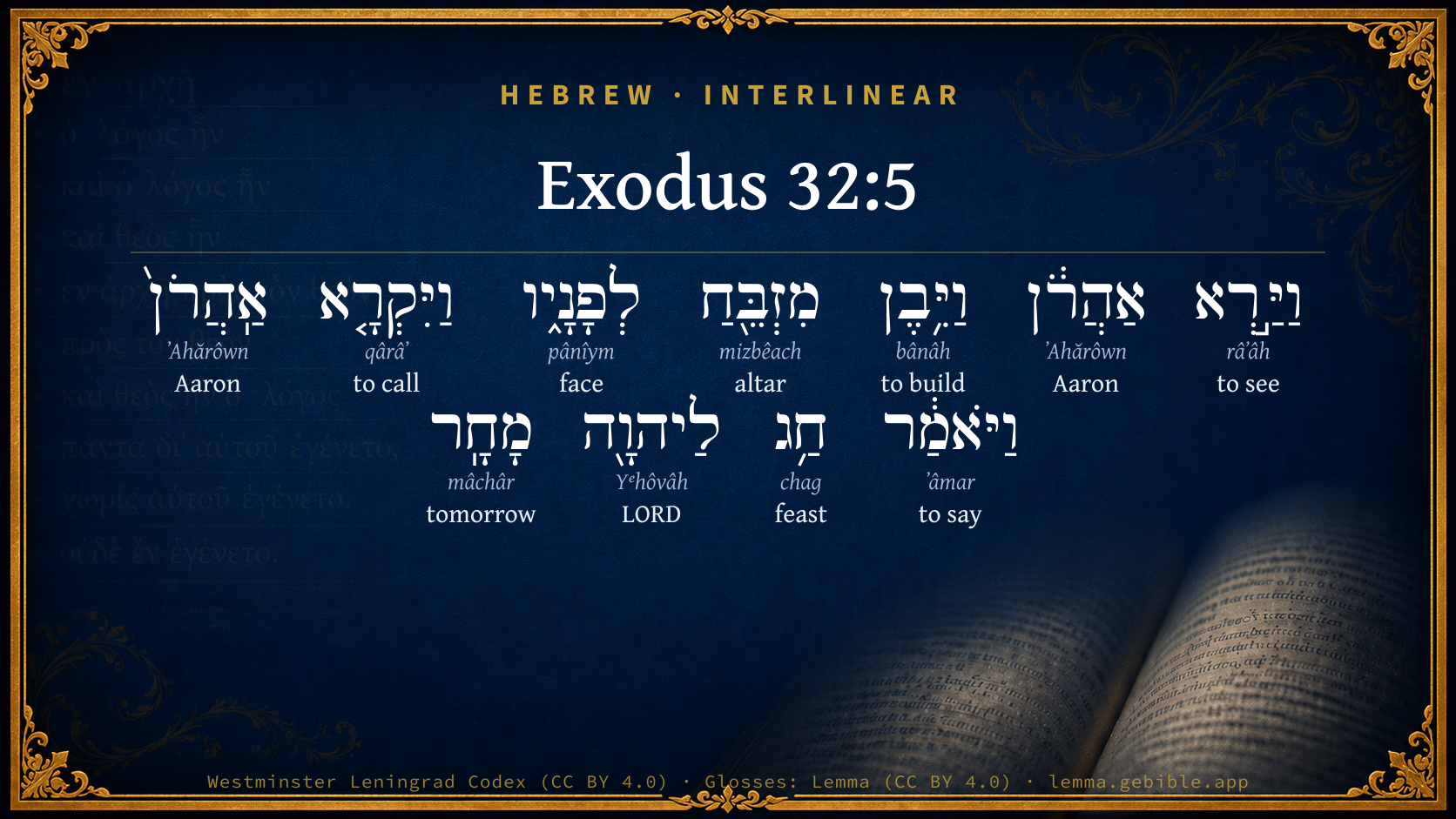
Hebrew (Westminster Leningrad Codex) Exodus 32:5 appears in the Hebrew Old Testament. The text above is from the Westminster Leningrad Codex. Each word links to its Strong’s number, a concise gloss, and parsing drawn from the Open Scriptures Hebrew Bible morphology. Click any word for its full Brown-Driver-Briggs (BDB) entry.
Download image
Cite this verse

Exodus 32:5 (World English Bible). Public Domain. Lemma interlinear Bible study tool, https://lemma.gebible.app/v/exodus/32/5.

Show BibTeX & RIS
BibTeX
RIS
English Translation
When Aaron saw this, he built an altar before it; and Aaron made a proclamation, and said, "Tomorrow shall be a feast to Yahweh."
World English Bible · Public Domain
Download a study sheet

One document with this verse’s original text, its word-by-word gloss line, the meaning frame, cross-references with their text, attributed commentary, and full source and license credits — printable, and it pastes into notes with its structure intact.

This verse Autodidact and up

Study sheet (.html) Plain text (.txt)

A passage Seminary Student

Up to 50 verses in one chapter. A passage sheet keeps up to 6 commentary sources and 12 cross-references per verse, in the order this page ranks them, and says so on the sheet whenever that leaves anything out. Ask for a single verse and you get the Autodidact verse sheet above.

Everything on this page stays free to read, with no account — the sheet is a download of what is already on screen, not access to it.

Want to remove ads? Support Godless Engineer
Compare translations 3

The same verse in 3 English versions, stacked beneath the original-language interlinear above. Click any original word for its lexicon entry.

Each is an independent rendering of the whole verse — the interlinear is not word-aligned to these translations.

Highlighted words mark where these versions differ — a whole-verse word diff, not a word-by-word alignment.

  • World English Bible Public Domain
    When Aaron saw this, he built an altar before it; and Aaron made a proclamation, and said, "Tomorrow shall be a feast to Yahweh."
  • King James Version Public Domain
    And when Aaron saw it, he built an altar before it; and Aaron made proclamation, and said, To morrow is a feast to the LORD.
  • unfoldingWord Literal Text CC BY-SA 4.0
    And Aaron saw, and he built an altar before the face of it, and Aaron proclaimed and said, “Tomorrow will be a festival to Yahweh.”

unfoldingWord Literal Text — © unfoldingWord, licensed CC BY-SA 4.0. Word-aligned USFM3 via Door43 (git.door43.org/unfoldingWord/en_ult).

Versions to compare (up to 4)

3 of 4 selected

Show all 18 translations

Every available English version of this verse, each an independent rendering of the whole verse.

  • World English Bible Public Domain
    When Aaron saw this, he built an altar before it; and Aaron made a proclamation, and said, "Tomorrow shall be a feast to Yahweh."
  • Berean Standard Bible Public Domain
    When Aaron saw this, he built an altar before the calf and proclaimed: “Tomorrow shall be a feast to the LORD.”
  • Majority Standard Bible Public Domain
    When Aaron saw this, he built an altar before the calf and proclaimed: “Tomorrow shall be a feast to the LORD.”
  • King James Version Public Domain
    And when Aaron saw it, he built an altar before it; and Aaron made proclamation, and said, To morrow is a feast to the LORD.
  • American Standard Version (1901) Public Domain
    And when Aaron saw `this', he built an altar before it; and Aaron made proclamation, and said, To-morrow shall be a feast to Jehovah.
  • Revised Version (1885) Public Domain
    And when Aaron saw this, he built an altar before it; and Aaron made proclamation, and said, Tomorrow shall be a feast to the LORD.
  • Geneva Bible (1599) Public Domain
    When Aaron sawe that, he made an Altar before it: and Aaron proclaimed, saying, To morow shalbe the holy day of the Lord.
  • Douay-Rheims (1899) Public Domain
    And when Aaron saw this, he built an altar before it, and made proclamation by a crier's voice, saying: To morrow is the solemnity of the Lord.
  • Young's Literal Translation Public Domain
    And Aaron seeth, and buildeth an altar before it, and Aaron calleth, and saith, `A festival to Jehovah -- to-morrow;'
  • Literal Standard Version CC BY-SA 4.0
    And Aaron sees, and builds an altar before it, and Aaron calls, and says, “A festival to YHWH—tomorrow”;
  • Unlocked Literal Bible CC BY-SA 4.0
    When Aaron saw this, he built an altar before the calf and made a proclamation; he said, “Tomorrow will be a festival in Yahweh's honor.”
  • unfoldingWord Literal Text CC BY-SA 4.0
    And Aaron saw, and he built an altar before the face of it, and Aaron proclaimed and said, “Tomorrow will be a festival to Yahweh.”
  • Darby Bible Public Domain
    And Aaron saw [it], and built an altar before it; and Aaron made a proclamation, and said, To-morrow is a feast to Jehovah!
  • World Messianic Bible Public Domain
    When Aaron saw this, he built an altar before it; and Aaron made a proclamation, and said, “Tomorrow shall be a feast to the LORD.”
  • Webster's Bible Public Domain
    And when Aaron saw it, he built an altar before it; and Aaron made proclamation, and said, To-morrow is a feast to the LORD.
  • Free Bible Version CC BY-SA 4.0
    When Aaron saw this, he built an altar in front of the golden calf and shouted out, “Tomorrow will be a festival to honor the Lord!”
  • Bible in Basic English Public Domain
    And when Aaron saw this, he made an altar before it, and made a public statement, saying, Tomorrow there will be a feast to the Lord.
  • JPS Tanakh (1917) Public Domain
    And when Aaron saw this, he built an altar before it; and Aaron made proclamation, and said: 'To-morrow shall be a feast to the LORD.'

Literal Standard Version (2020), Covenant Press — licensed CC BY-SA 4.0. Text via the HelloAO Bible API (eBible.org). Unlocked Literal Bible (unfoldingWord) — licensed CC BY-SA 4.0. Text via the HelloAO Bible API (eBible.org). unfoldingWord Literal Text — © unfoldingWord, licensed CC BY-SA 4.0. Word-aligned USFM3 via Door43 (git.door43.org/unfoldingWord/en_ult). Free Bible Version, Dr. Jonathan Gallagher — licensed CC BY-SA 4.0. Text via the HelloAO Bible API (eBible.org).

Word by word

More ways to search: Search by grammar → Find every occurrence → Compare this word →

Practice this passage: Drill this verse → Learn its vocabulary →

מָחָֽר
mâchâr
H4279
“tomorrow”
Noun, Common, Masculine, Singular, Absolute
Part of Speech
Noun
Type
Common
Gender
Masculine
Number
Singular
State
Absolute
Full BDB Definition

Origin: probably from H309

TWOT: 1185a

tomorrow, in time to come, in the future - tomorrow (as the day following the present day) - in future time
  1. וַיַּ֣רְא râʼâh H7200 “and · to see” Conjunction + Verb, Qal, Sequential Imperfect, 3rd Person, Masculine, Singular
  2. אַהֲרֹ֔ן ʼAhărôwn H175 “Aaron” Noun, Proper
  3. וַיִּ֥בֶן bânâh H1129 “and · to build” Conjunction + Verb, Qal, Sequential Imperfect, 3rd Person, Masculine, Singular
  4. מִזְבֵּ֖חַ mizbêach H4196 “altar” Noun, Common, Masculine, Singular, Absolute
  5. לְפָנָ֑יו pânîym H6440 “to/for · face(s) · his” Preposition + Noun, Common, Both, Plural, Construct + Suffix, Personal, 3rd Person, Masculine, Singular
  6. וַיִּקְרָ֤א qârâʼ H7121 “and · to call” Conjunction + Verb, Qal, Sequential Imperfect, 3rd Person, Masculine, Singular
  7. אַֽהֲרֹן֙ ʼAhărôwn H175 “Aaron” Noun, Proper
  8. וַיֹּאמַ֔ר ʼâmar H559 “and · to say” Conjunction + Verb, Qal, Sequential Imperfect, 3rd Person, Masculine, Singular
  9. חַ֥ג chag H2282 “feast” Noun, Common, Masculine, Singular, Absolute
  10. לַיהוָ֖ה Yᵉhôvâh H3068 “to/for · LORD” Preposition + Noun, Proper

About this verse

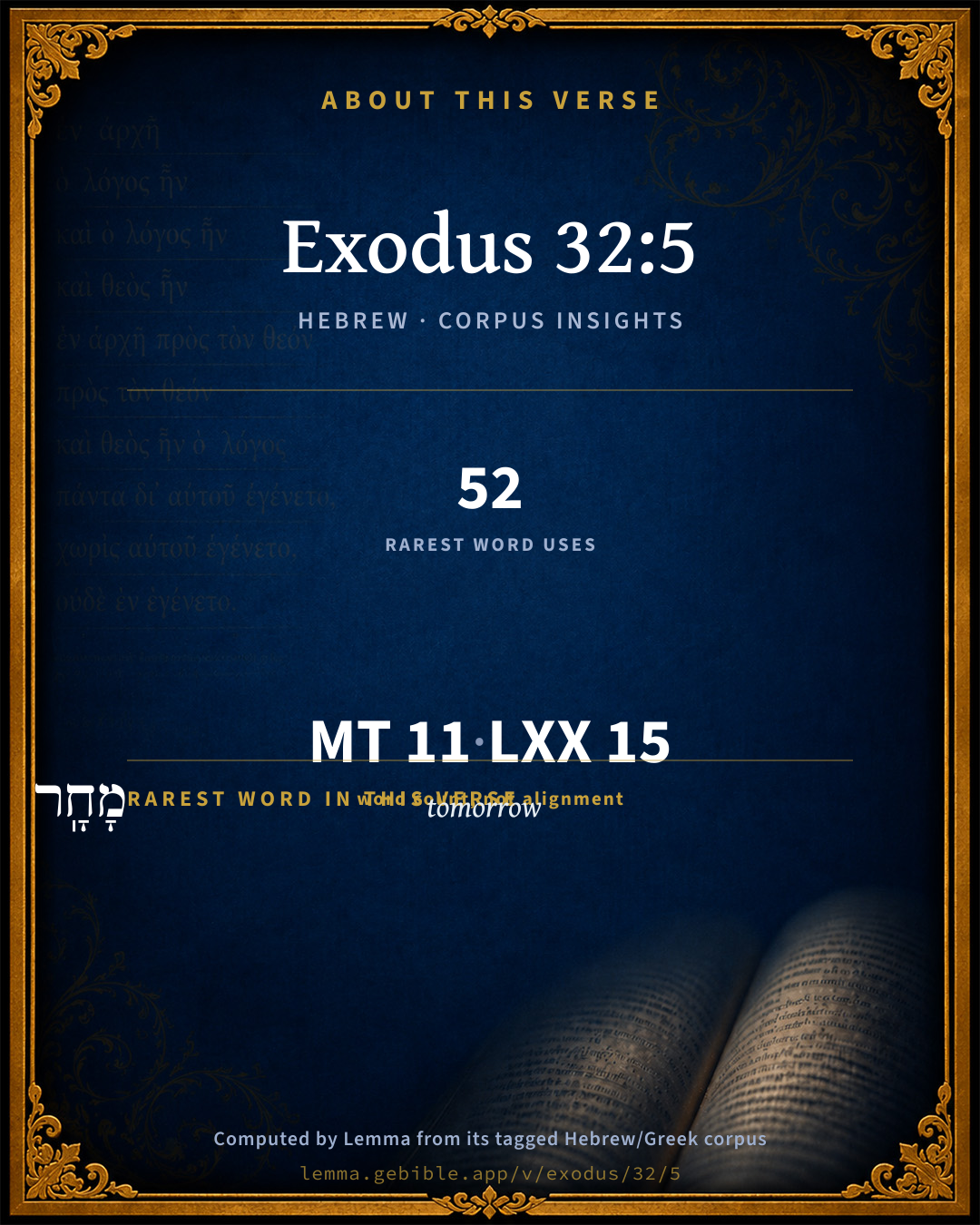
These counts appear in no published source. They are computed here, from the morphology-tagged text and Lemma’s own curated glosses. What Lemma adds →

11
words
10
distinct lemmas
Pentateuch
section

Shared distinctive vocabulary

מָחָֽר tomorrow H4279 occurs in 52 verses of the Hebrew Bible. Also found in:

Grammatical profile

  • 4 verbs
  • 7 nouns

Verb forms

  • וַיַּ֣רְא Qal · Sequential Imperfect
  • וַיִּ֥בֶן Qal · Sequential Imperfect
  • וַיִּקְרָ֤א Qal · Sequential Imperfect
  • וַיֹּאמַ֔ר Qal · Sequential Imperfect

Repetition

A word recurs within this verse — often emphatic in Hebrew:

  • אַהֲרֹ֔ן Aaron H175 ×2

Hebrew & Septuagint length

In English translation the verse runs 24 words from the Hebrew and 22 from the Septuagint (LXX English) — closely comparable.

A rough comparison of the two English renderings, which tokenize alike — not a word-level alignment.

Word counts can differ between the Hebrew and the Greek without any difference in meaning — e.g. the Hebrew direct-object marker אֵת has no separate Greek word, and Greek often adds the article ὁ.

In the original languages it is 11 Hebrew tokens and 15 Greek tokens — but the two are counted differently (Hebrew bundles its prefixes and suffixes into one token; the Greek is in lemma form), so that isn’t a like-for-like length.

Cross-references

16

Topical passages linked to Exodus 32:5 in the Treasury of Scripture Knowledge — connected by theme and wording, ordered by reader-vote popularity; previews shown in the World English Bible.

  • 2 Kings 10:20 Jehu said, Sanctify a solemn assembly for Baal. They proclaimed it.
  • Leviticus 23:2 "Speak to the children of Israel, and tell them, 'The set feasts of Yahweh, which you shall proclaim to be holy convocations, even these are my set feasts.
  • Leviticus 23:37 "'These are the appointed feasts of Yahweh, which you shall proclaim to be holy convocations, to offer an offering made by fire to Yahweh, a burnt offering, and a meal offering, a sacrifice, and drink offerings, each on its own day;
  • Exodus 12:14 This day shall be to you for a memorial, and you shall keep it a feast to Yahweh: throughout your generations you shall keep it a feast by an ordinance forever.
  • Exodus 32:4 He received what they handed him, and fashioned it with an engraving tool, and made it a molten calf; and they said, "These are your gods, Israel, which brought you up out of the land of Egypt."
  • Leviticus 23:4 "'These are the set feasts of Yahweh, even holy convocations, which you shall proclaim in their appointed season.
  • Leviticus 23:21 You shall make proclamation on the same day: there shall be a holy convocation to you; you shall do no regular work. This is a statute forever in all your dwellings throughout your generations.
  • 1 Samuel 14:35 Saul built an altar to Yahweh: the same was the first altar that he built to Yahweh.
  • 1 Kings 12:32–33 Jeroboam ordained a feast in the eighth month, on the fifteenth day of the month, like the feast that is in Judah, and he went up to the altar; so did he in Bethel, sacrificing to the calves that he had made: and he placed in Bethel the priests of the high places that he had made.
  • 1 Kings 21:9 She wrote in the letters, saying, Proclaim a fast, and set Naboth on high among the people:
  • 2 Kings 16:11 Urijah the priest built an altar: according to all that king Ahaz had sent from Damascus, so did Urijah the priest make it against the coming of king Ahaz from Damascus.
  • 2 Chronicles 30:5 So they established a decree to make proclamation throughout all Israel, from Beersheba even to Dan, that they should come to keep the Passover to Yahweh, the God of Israel, at Jerusalem: for they had not kept it in great numbers in such sort as it is written.
  • Hosea 8:11 Because Ephraim has multiplied altars for sinning, They became for him altars for sinning.
  • Hosea 8:14 For Israel has forgotten his Maker and built palaces; And Judah has multiplied fortified cities; But I will send a fire on his cities, And it will devour its fortresses."
  • 1 Corinthians 5:8 Therefore let us keep the feast, not with old yeast, neither with the yeast of malice and wickedness, but with the unleavened bread of sincerity and truth.
  • Exodus 10:9 Moses said, "We will go with our young and with our old; with our sons and with our daughters, with our flocks and with our herds will we go; for we must hold a feast to Yahweh."

Cross-references courtesy of OpenBible.info (CC BY 4.0).

Hebrew and Greek witnesses Masoretic Hebrew ↔ Greek Septuagint

The same verse in the two great witnesses to the Old Testament, shown verse-for-verse.

These are two independent witnesses, not word-aligned to each other, and the Septuagint is shown in lemma (dictionary) form.

Hebrew Exodus 32:5 Masoretic · Westminster Leningrad Codex

וַיַּ֣רְא אַהֲרֹ֔ן וַיִּ֥בֶן מִזְבֵּ֖חַ לְפָנָ֑יו וַיִּקְרָ֤א אַֽהֲרֹן֙ וַיֹּאמַ֔ר חַ֥ג לַיהוָ֖ה מָחָֽר

When Aaron saw this, he built an altar before it; and Aaron made a proclamation, and said, "Tomorrow shall be a feast to Yahweh."

World English Bible · Public Domain

Greek LXX Exodus 32:5 Septuagint · lemma form

καί ὁράω ααρων οἰκοδομέω θυσιαστήριον κατέναντι αὐτός καί κηρύσσω ααρων λέγω ἑορτή ὁ κύριος αὔριον

And Aaron having seen it built an altar before it, and Aaron made proclamation saying, To-morrow is a feast of the Lord.

LXX2012 (modern English Septuagint) · Public Domain

Hebrew: Westminster Leningrad Codex (CC BY 4.0). Greek: Septuagint (public domain); English from LXX2012 (modern English Septuagint) (Public Domain). How the Septuagint differs from the Hebrew →

Targum (Aramaic paraphrase)

2

The Targum is the ancient Jewish Aramaic paraphrase of the Hebrew Scriptures — an interpretive translation, not the Hebrew text itself. Onkelos (literal) and Pseudo-Jonathan (expansive) render the Torah, and Jonathan the Prophets. Coverage is partial: where no permissively-licensed English translation exists for a verse, only the Aramaic is shown. This is verse-level text, not a word-by-word alignment to the Hebrew.

  1. Targum Onkelos Torah (Genesis–Deuteronomy)
    וַחֲזָא אַהֲרֹן וּבְנָא מַדְבְּחָא קֳדָמוֹהִי וּקְרָא אַהֲרֹן וַאֲמַר חַגָא קֳדָם יְיָ מְחָר:

    (no public-domain English translation for this verse)

    Targum Onkelos — Aramaic: “Onkelos Genesis” (public domain); “Onkelos Exodus” (public domain); “Onkelos Leviticus” (public domain); “Onkelos Numbers” (public domain); “Onkelos Deuteronomy” (public domain). English: “Sefaria Community Translation” (CC0 1.0 (public-domain dedication)); “J.W. Etheridge. The Targums of Onkelos and Jonathan Ben Uzziel on the Pentateuch. London: Longmans, Green, 1862” (public domain). Text via Sefaria.

  2. Targum Pseudo-Jonathan Torah (Genesis–Deuteronomy)
    וַחֲמָא אַהֲרן יַת חוּר נְכִיס קֳדָמוֹי וּדְחִיל וּבְנָא מַדְבְּחָא קֳדָמוֹי וּקְרָא בְּקַל עָצִיב וַאֲמַר חַגָּא דַיְיָ מְחַר מִנִּכְסַת קְטוֹל בַּעֲלֵי דְבָבוֹי אִלֵּין דְּכָּפְרִין בְּמָרֵיהוֹן וּפָרְגוּ עִיקַר שְׁכִינְתֵּיהּ יְיָ בְּעִיגְלָא הָדֵין

    For Aharon had seen Hur slain before him, and was afraid; and he builded an altar before him, and Aharon cried with doleful voice, and said, Let there be a feast before the Lord tomorrow, of the sacrifice of the slain of these adversaries who have denied their Lord, and have changed the glory of the Shekinah of the Lord for this calf.

    Targum Pseudo-Jonathan — Aramaic: “Targum Jonathan on Genesis” (public domain); “Targum Jonathan on Exodus” (public domain); “Targum Jonathan on Leviticus” (public domain); “Targum Jonathan on Numbers” (public domain); “Targum Jonathan on Deuteronomy” (public domain). English: “The Targum of Jonathan ben Uzziel, trans. J. W. Etheridge, London, 1862” (public domain). Text via Sefaria.

Commentary

Notes on Exodus 32:5 from classic Christian and Jewish commentators (each source and its license shown beneath its notes). The classic Christian expositions comment on the surrounding passage and are grouped to its opening verse, so a note may address several verses; the Jewish commentaries on the Tanakh (Rashi and others) are per-verse, so they appear only where the commentator wrote on this verse.

Lemma curates 59 commentaries, every one of them public domain or Creative Commons licensed, each selected and text-cleaned for this edition rather than reprinted as found. About our sources →

Trapp's Complete Commentary

John Trapp

Exo 32:5 And when Aaron saw [it], he built an altar before it; and Aaron made proclamation, and said, To morrow [is] a feast to the LORD.

Ver. 5. A feast to Jehovah.] Whom these idolators pretended to worship in the golden calf; as did also Jehu, {2Ki 10:16; 2Ki 10:29 2Ch 11:15} and as the Papists at this day. But with what face can some of their Rabbis excuse this people from idolatry? or the Jesuits their image worshippers?

John Trapp, A Commentary or Exposition upon All the Books of the Old and New Testament (1647–1656) — public domain. Text from a community e-Sword module.

Joseph Benson's Commentary

Exo 32:5. Aaron built an altar — Being borne down with the stream; and proclaimed a feast — Namely, of dedication; yet he calls it a feast to Jehovah — By which it is still more evident that the people did not intend to terminate their adoration in the image, but designed to worship the true God in and by this calf, which they meant to consider as only a visible token of God’s presence with them, and a medium by which to convey their worship to him. And yet this did not excuse them from the sin of gross idolatry any more than it will excuse the Papists, whose plea it is that they do not worship the images which they use, but God, or Christ, by the images, so making themselves just such idolaters as the worshippers of the golden calf, whose feast was a feast to Jehovah, and proclaimed to be so, that the most ignorant and unthinking might not mistake it.

Joseph Benson's Commentary on the Old and New Testaments (1811–1818) — public domain. Text from a community e-Sword module.

Tyndale Open Study Notes

Tyndale Open Resources

32:5 Aaron attempted to control the process, but he was actually abdicating leadership by simply doing what he thought the people wanted. • Although the idol was referred to as “the gods” (32:4), Aaron also implied that it was a physical manifestation of the Lord.

Tyndale Open Study Notes — © Tyndale Open Resources, licensed CC BY-SA 4.0. Text via the HelloAO Bible API.

Jamieson, Fausset & Brown

Robert Jamieson, A. R. Fausset & David Brown

Aaron made proclamation, and said, To-morrow is a feast to the Lord--a remarkable circumstance, strongly confirmatory of the view that they had not renounced the worship of Jehovah, but in accordance with Egyptian notions, had formed an image with which they had been familiar, to be the visible symbol of the divine presence. But there seems to have been much of the revelry that marked the feasts of the heathen.

Jamieson, Fausset & Brown — Commentary Critical and Explanatory on the Whole Bible (1871) — public domain (CC PDM 1.0). Text via the HelloAO Bible API.

Adam Clarke's Commentary

Verse 5. To-morrow is a feast to the Lord] In Bengal the officiating Brahmin, or an appointed person proclaims, "To-morrow, or on -- day of -- , such a ceremony will be performed!"

Adam Clarke's Commentary on the Bible (1810–1826) — public domain. Text from a community e-Sword/MySword module.

Ellicott's Commentary for English Readers

(5) Aaron . . . built an altar before it.—Having once yielded to the popular cry. Aaron was carried on from one compliance to another. He caused the mould to be made for the idol, and the gold to be melted and run into it; and now he constructed, perhaps with his own hands, an altar of rough stones or turf (Exo_20:24-25), and placed it directly in front of the Image, thus encouraging the offering of sacrifice to it. Perhaps he flattered himself that by heading the movement he could control it, and hinder it from becoming downright apostacy from Jehovah. In his view no doubt the calf was an emblem of Jehovah, and the worship paid it was the worship of Jehovah. Hence the festival which he proclaimed was to be “a feast to Jehovah.” But how little able he was to guide events, or to hinder the worst evils of idolatry from speedily manifesting themselves, appears from Exo_32:6; Exo_32:25.

A Bible Commentary for English Readers, edited by Charles John Ellicott (1878–1897) — public domain. Text from a community e-Sword module.

The Cambridge Bible for Schools and Colleges

gen. ed. J. J. S. Perowne

5. Seeing the impression which the image made upon Israel, Aaron at once builds an altar before it, and proclaims a feast to Jehovah. The calf is thus clearly regarded, not as exclusive of Jehovah, but as representing Him.

The Cambridge Bible for Schools and Colleges (gen. ed. J. J. S. Perowne; Cambridge University Press, 1878–1918) — public domain. Text from a community e-Sword module.

John Gill's Exposition

And they rose up early in the morning,.... Being eager of, and intent upon their idol worship:

and offered burnt offerings; upon the altar Aaron had made, where they were wholly consumed:

and brought peace offerings: which were to make a feast to the Lord, and of which they partook:

and the people sat down to eat and to drink; as at a feast:

and rose up to play; to dance and sing, as was wont to be done by the Egyptians in the worship of their Apis or Ox; and Philo the Jew says (f), of the Israelites, that having made a golden ox, in imitation of the Egyptian Typho, he should have said Osiris, for Typho was hated by the Egyptians, being the enemy of Osiris; they sung and danced: the Targums of Jonathan and Jerusalem interpret it of idolatry; some understand this of their lewdness and uncleanness, committing fornication as in the worship of Peor, taking the word in the same sense as used by Potiphar's wife, Gen 39:14.

(f) Ut supra, (De Vita Mosis, l. 3. p. 677.) & de Temulentia, p. 254.

Next: Exodus Chapter 33

John Gill's Exposition of the Whole Bible (1746–1763) — public domain (CC PDM 1.0). Text via the HelloAO Bible API.

Haydock's Catholic Bible Commentary

The Lord. The most sacred name of God is prostituted, (Judges xvii. and xviii.; Wisdom xiv. 21,) and an altar is erected to this idol; though some pretend, that Aaron meant God to be adored under this similitude. His weakness was unaccountable, and God would have slain him, had not Moses interceded, Deuteronomy ix. 20. Those who undertake to justify him, enter not into the sentiments of God; and the offender himself pleads no excuse, but the violence of the people, ver. 23. (Salien.) --- To-morrow, when the 40 days expired, and Moses returned arrayed in terrors. (Haydock)

George Leo Haydock (1774–1849), Haydock's Catholic Family Bible and Commentary, 1859 edition — public domain. Excludes Psalms (Douay-Rheims chapter numbering differs from Protestant) and Deuterocanonical books (Catholic canon only).

Matthew Poole's English Annotations

When Aaron saw, i.e. observed with what applause they received it, and with what fury and resolution they prosecuted their former desire, he was borne down with the stream, and, as it is probable, by the people’s instigation, built an altar to it.

To the Lord, Heb. to Jehovah; which title being peculiar to the true God, and being here given by Aaron to the calf, with the approbation of the people, makes it more than probable that the people designed to worship the true God in this calf, which they made only as a visible token of God’s presence with them, and an image by which they might convey their worship to God.

Matthew Poole's English Annotations on the Holy Bible (1683–1685) — public domain. Text from a community e-Sword/MySword module.

Whedon's Commentary on the Bible

Daniel D. Whedon

5. When Aaron saw — No object of the verb saw is expressed, and we do best to understand what is implied in the words immediately preceding. When he saw the excitement and enthusiasm of the people, and their acceptance of the image as a symbol of their God, he was carried away by the scene, and proceeded further to erect an altar before it, and announce that on the morrow they would celebrate a feast to the Lord. Thus this man, so highly honoured of God, became a culpable partaker in the people’s sin.

Daniel D. Whedon (gen. ed.), Commentary on the Old and New Testaments (1874–1909) — public domain. Text from a community e-Sword module.

The Pulpit Commentary

He built an altar before it. Aaron thus proceeded to "follow a multitude to evil", (Exo_23:2) and encouraged the idolatry which he felt himself powerless to restrain. Still, he did not intend that the people should drift away from the worship of Jehovah, or view the calf as anything but a symbol of him. He therefore made proclamation and said, Tomorrow is a feast to the Lord (literally, "to Jehovah").

The Pulpit Commentary (1880–1919), ed. H.D.M. Spence-Jones & Joseph S. Exell — public domain. Text from a community e-Sword module.

John Wesley's Explanatory Notes

And Aaron built an altar before it, and proclaimed a feast - A feast of dedication; yet he calls it a feast to Jehovah; for, as brutish as they were, they did not design to terminate their adoration in the image; but they made it for a representation of the true God, whom they intended to worship in and through this image. And yet this did not excuse them from gross idolatry, no more than it will excuse the Papists, whose plea it is, that they do not worship the image, but God by the image; so making themselves just such idolaters as the worshippers of the golden calf, whose feast was a feast to Jehovah, and proclaimed to be so, that the most ignorant and unthinking might not mistake it.

John Wesley, Explanatory Notes Upon the Whole Bible (1754–1765) — public domain. Text via the GEBible commentary corpus.

unfoldingWord translationNotes

Door43 World Missions Community

When Aaron saw this

You may need to make explicit what he saw. "When Aaron saw what the people did" (See: Assumed Knowledge and Implicit Information)

to carouse in wild celebration

"to have a wild party." The people likely behaved in sexually immoral ways at the party.

translationWords

Aaron

altar

cow

preach

festival

Yahweh

honor

raise

burnt offering

fellowship offering

unfoldingWord translationNotes — © Distant Shores Media and the Door43 World Missions Community, licensed CC BY-SA 4.0. Source: git.door43.org/Door43/en_tn.

Rashi

Rabbi Shlomo Yitzchaki (Rashi)

וירא אהרן AND WHEN AARON SAW that there was the breath of life in it — as it is said with reference to the golden calf, (Psalms 106:20) “[They changed their glory] into a similitude of an ox that ate grass” — and he realized that Satan’s work had succeeded and that he had no argument (lit., mouth) to put them (the people) entirely off.

ויבן מזבח HE BUILDED AN ALTAR to put them off.

ויקרא חג לה׳ מחר AND CALLED OUT … TO-MORROW IS A FESTIVAL TO THE LORD — to-morrow, not to-day, for he hoped that Moses might return before they would worship it (the calf). This is the plain meaning of the verse. The Midrashic explanation of it in Leviticus Rabbah 10:3 (— it supplies an object to the verb וירא —) is: Aaron saw many things; he saw Hur, his sister’s son, who had reprimanded them, and whom they had killed. This is the meaning of ויבן מזבח, viz., וַיָבֶן, he realized (taking the word as from the root בון, to understand, to realize) מִזָּבוּחַ לפניו from him who lay slaughtered before him (מזבח is vowelled to be read as מִזָּבוּחַ) what would happen to him if he offered resistance. A further explanation of וירא אהרן in the Midrash is: He saw what the situation was and said: It is better that the offence should attach itself to me than to them. And yet a further Midrashic explanation of וירא is: He looked into the matter and said: If they build this altar themselves, one will bring a clod and another a stone and the result will be that their work will be accomplished all at once; through myself building it and being dilatory in my work, in the meantime Moses may come.

חג לה׳ A FESTIVAL TO THE LORD — not to the golden calf. In his heart it (the feast) was for Heaven (the Lord). He felt confident that Moses would return by the morrow and that they would worship the Omnipresent (Leviticus Rabbah 10:3).

Rashi on the Tanakh — English translations: “The Judaica Press complete Tanach with Rashi, translated by A. J. Rosenberg” (CC BY 4.0); “Pentateuch with Rashi's commentary by M. Rosenbaum and A.M. Silbermann, 1929-1934” (public domain); “The Metsudah Tanach series, Lakewood, N.J” (CC BY 4.0); and “The Book of Joshua, Metsudah Publications, 1997” (CC BY 4.0). Text via Sefaria.

Ramban (Nachmanides)

Rabbi Moshe ben Nachman (Ramban / Nachmanides)

AND AARON SAW. The meaning of this verse is that Aaron saw them set on evil, intent upon making the calf, and he arose and built an altar and proclaimed, Tomorrow shall be a feast to the Eternal, so that they should bring offerings to the Proper Name of G-d upon the altar which he built to His Name, and that they should not build altars to the shameful thing, and that their intent in the offerings should be [to none] save unto the Eternal only. It is possible that Aaron said, Tomorrow [shall be a feast], in order to delay them, thinking that perhaps Moses would come in the meantime and they would abandon the calf. But they rose up early in the morning and offered burnt-offerings, and brought peace-offerings. Now Scripture does not say “and they offered burnt-offerings to it, and brought peace-offerings to it.” The reason for that is that there were some people amongst them who intended them to be for the Name of the Holy One, blessed be He, as Aaron had said, but some of them became corrupted and sacrificed them to the calf. It is with reference to this latter group that the Holy One, blessed be He, said to Moses, they have worshipped it, and have sacrificed unto it, for it is they who were the sinners. And even if it was perhaps Aaron who performed the sacrifical rites, Scripture used an indefinite expression — saying, they offered burnt-offerings and brought peace-offerings — in order to suggest that Aaron’s intention was directed towards the Name of the Eternal, whilst they set their mind towards the calf which they had made, and thus the owners [of the sacrifices] invalidated them.

Ramban (Nachmanides) on the Tanakh — English translation: “Commentary on the Torah by Ramban (Nachmanides). Translated and annotated by Charles B. Chavel. New York, Shilo Pub. House, 1971-1976” (CC BY 4.0). Text via Sefaria.

Lesson kit

Teaching starters — assembled from the data on this page, not authored interpretation. Every prompt links to the verse data it draws on. Edit before teaching.

Exodus, in the Pentateuch, opens this verse with 11 words (10 distinct Hebrew lemmas). Its most distinctive word is mâchâr (“tomorrow”). A historical commentator’s framing appears above. Read the whole chapter for the surrounding context.

Discussion questions

  1. How does “tomorrow” (mâchâr) shape what this verse is saying?
  2. Genesis 30:33 shares the word «tomorrow» with this verse. How do the two illuminate each other?
  3. “Aaron” occurs 2× in this one verse. What is the effect of the repetition?
  4. These translations render this verse differently. What is at stake in choosing one wording over another?
  5. The verb «וַיַּ֣רְא» is Qal Sequential Imperfect. How does its form color the action?
  6. Reading how Trapp's Complete Commentary and Joseph Benson's Commentary read this verse, where do the two commentators agree and where do they part?

Things to notice

Reading settings

Reading text

Shown beneath each verse's original-language words.

Old Testament
Old Testament edition

Read the OT as the Masoretic Hebrew (MT) or the Greek Septuagint (LXX).

English shown for the Greek Septuagint (in the Hebrew ↔ Greek comparison).

Comparing translations? Open the Compare panel on any verse page to stack up to four side by side.