1 Samuel 7:17

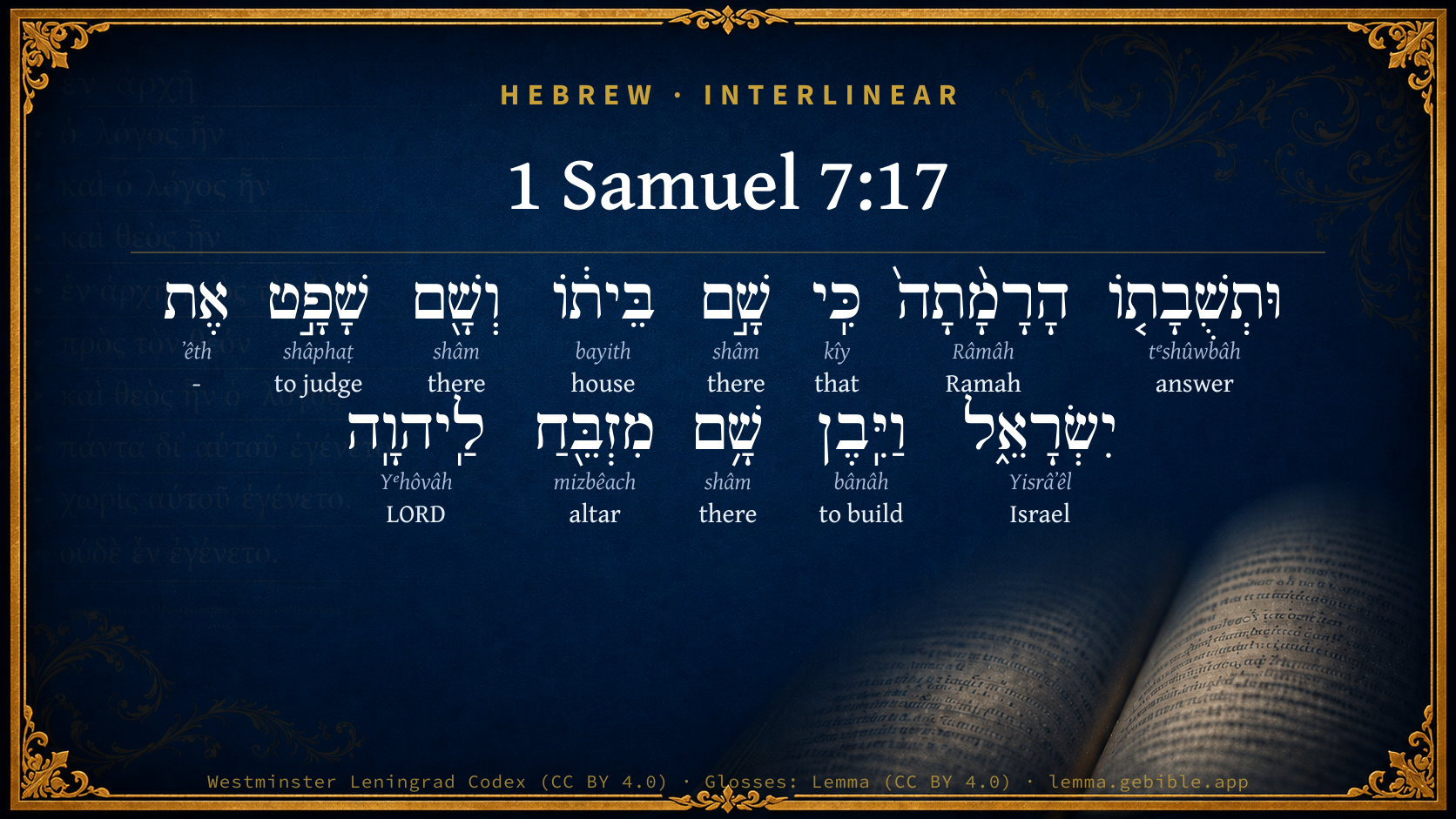
Hebrew (Westminster Leningrad Codex) 1 Samuel 7:17 appears in the Hebrew Old Testament. The text above is from the Westminster Leningrad Codex. Each word links to its Strong’s number, a concise gloss, and parsing drawn from the Open Scriptures Hebrew Bible morphology. Click any word for its full Brown-Driver-Briggs (BDB) entry.
Download image
Cite this verse

1 Samuel 7:17 (World English Bible). Public Domain. Lemma interlinear Bible study tool, https://lemma.gebible.app/v/1-samuel/7/17.

Show BibTeX & RIS
BibTeX
RIS
English Translation
His return was to Ramah, for there was his house; and there he judged Israel: and he built there an altar to Yahweh.
World English Bible · Public Domain
Highlights
  • 1 first appearance in the Hebrew Bible
Full analysis ↓
Download a study sheet

One document with this verse’s original text, its word-by-word gloss line, the meaning frame, cross-references with their text, attributed commentary, and full source and license credits — printable, and it pastes into notes with its structure intact.

This verse Autodidact and up

Study sheet (.html) Plain text (.txt)

A passage Seminary Student

Up to 50 verses in one chapter. A passage sheet keeps up to 6 commentary sources and 12 cross-references per verse, in the order this page ranks them, and says so on the sheet whenever that leaves anything out. Ask for a single verse and you get the Autodidact verse sheet above.

Everything on this page stays free to read, with no account — the sheet is a download of what is already on screen, not access to it.

Want to remove ads? Support Godless Engineer
Compare translations 3

The same verse in 3 English versions, stacked beneath the original-language interlinear above. Click any original word for its lexicon entry.

Each is an independent rendering of the whole verse — the interlinear is not word-aligned to these translations.

Highlighted words mark where these versions differ — a whole-verse word diff, not a word-by-word alignment.

  • World English Bible Public Domain
    His return was to Ramah, for there was his house; and there he judged Israel: and he built there an altar to Yahweh.
  • King James Version Public Domain
    And his return was to Ramah; for there was his house; and there he judged Israel; and there he built an altar unto the LORD.
  • unfoldingWord Literal Text CC BY-SA 4.0
    And his return was to Ramah, for his house was there, and there he judged Israel. And he built an altar there to Yahweh.

unfoldingWord Literal Text — © unfoldingWord, licensed CC BY-SA 4.0. Word-aligned USFM3 via Door43 (git.door43.org/unfoldingWord/en_ult).

Versions to compare (up to 4)

3 of 4 selected

Show all 18 translations

Every available English version of this verse, each an independent rendering of the whole verse.

  • World English Bible Public Domain
    His return was to Ramah, for there was his house; and there he judged Israel: and he built there an altar to Yahweh.
  • Berean Standard Bible Public Domain
    Then he would return to Ramah because his home was there, and there he judged Israel and built an altar to the LORD.
  • Majority Standard Bible Public Domain
    Then he would return to Ramah because his home was there, and there he judged Israel and built an altar to the LORD.
  • King James Version Public Domain
    And his return was to Ramah; for there was his house; and there he judged Israel; and there he built an altar unto the LORD.
  • American Standard Version (1901) Public Domain
    And his return was to Ramah, for there was his house; and there he judged Israel: and he built there an altar unto Jehovah.
  • Revised Version (1885) Public Domain
    And his return was to Ramah, for there was his house; and there he judged Israel: and he built there an altar unto the LORD.
  • Geneva Bible (1599) Public Domain
    Afterward hee returned to Ramah: for there was his house, and there he iudged Israel: also he built an altar there vnto the Lord.
  • Douay-Rheims (1899) Public Domain
    And he returned to Ramatha, for there was his house, and there he judged Israel: he built also there an altar to the Lord.
  • Young's Literal Translation Public Domain
    and his returning `is' to Ramath, for there `is' his house, and there he hath judged Israel, and he buildeth there an altar to Jehovah.
  • Literal Standard Version CC BY-SA 4.0
    and his returning [is] to Ramath, for his house [is] there, and he has judged Israel there, and he builds an altar to YHWH there.
  • Unlocked Literal Bible CC BY-SA 4.0
    Then he would return to Ramah, because his house was there; and there also he decided disputes for Israel. He also built an altar there to Yahweh.
  • unfoldingWord Literal Text CC BY-SA 4.0
    And his return was to Ramah, for his house was there, and there he judged Israel. And he built an altar there to Yahweh.
  • Darby Bible Public Domain
    And his return was to Ramah; for there was his house, and there he judged Israel; and there he built an altar to Jehovah.
  • World Messianic Bible Public Domain
    His return was to Ramah, for his house was there, and he judged Israel there; and he built an altar to the LORD there.
  • Webster's Bible Public Domain
    And his return was to Ramah; for there was his house; and there he judged Israel; and there he built an altar to the LORD.
  • Free Bible Version CC BY-SA 4.0
    Then he would return to Ramah because that was where he lived. He ruled Israel from there, and also built an altar to the Lord.
  • Bible in Basic English Public Domain
    And his base was at Ramah, where his house was; there he was judge of Israel and there he made an altar to the Lord.
  • JPS Tanakh (1917) Public Domain
    And his return was to Ramah, for there was his house; and there he judged Israel; and he built there an altar unto the LORD.

Literal Standard Version (2020), Covenant Press — licensed CC BY-SA 4.0. Text via the HelloAO Bible API (eBible.org). Unlocked Literal Bible (unfoldingWord) — licensed CC BY-SA 4.0. Text via the HelloAO Bible API (eBible.org). unfoldingWord Literal Text — © unfoldingWord, licensed CC BY-SA 4.0. Word-aligned USFM3 via Door43 (git.door43.org/unfoldingWord/en_ult). Free Bible Version, Dr. Jonathan Gallagher — licensed CC BY-SA 4.0. Text via the HelloAO Bible API (eBible.org).

Word by word

More ways to search: Search by grammar → Find every occurrence → Compare this word →

Practice this passage: Drill this verse → Learn its vocabulary →

וּתְשֻׁבָת֤וֹ
tᵉshûwbâh
H8666
“and · answer · his”
Conjunction + Noun, Common, Feminine, Singular, Construct + Suffix, Personal, 3rd Person, Masculine, Singular
Part of Speech
Conjunction + Noun
Type
Common
Gender
Feminine
Number
Singular
State
Construct
Full BDB Definition

Origin: from H7725

TWOT: 2340f

a recurrence, an answer, return - return - completion of a year, return of a year - at the return (construct) - answer, reply
  1. הָרָמָ֨תָה֙ Râmâh H7414 “the · Ramah · toward” Particle, Definite Article + Noun, Proper + Suffix, Demonstrative
  2. כִּֽי kîy H3588 “that” Conjunction
  3. שָׁ֣ם shâm H8033 “there” Adverb
  4. בֵּית֔וֹ bayith H1004 “house · his” Noun, Common, Masculine, Singular, Construct + Suffix, Personal, 3rd Person, Masculine, Singular
  5. וְשָׁ֖ם shâm H8033 “and · there” Conjunction + Adverb
  6. שָׁפָ֣ט shâphaṭ H8199 “to judge” Verb, Qal, Perfect, 3rd Person, Masculine, Singular
  7. אֶת ʼêth H853 “-” Particle, Direct Object
  8. יִשְׂרָאֵ֑ל Yisrâʼêl H3478 “Israel” Noun, Proper
  9. וַיִּֽבֶן bânâh H1129 “and · to build” Conjunction + Verb, Qal, Sequential Imperfect, 3rd Person, Masculine, Singular
  10. שָׁ֥ם shâm H8033 “there” Adverb
  11. מִזְבֵּ֖חַ mizbêach H4196 “altar” Noun, Common, Masculine, Singular, Absolute
  12. לַֽיהוָֽה Yᵉhôvâh H3068 “to/for · LORD” Preposition + Noun, Proper

About this verse

These counts appear in no published source. They are computed here, from the morphology-tagged text and Lemma’s own curated glosses. What Lemma adds →

13
words
11
distinct lemmas
Historical
section

Notable vocabulary

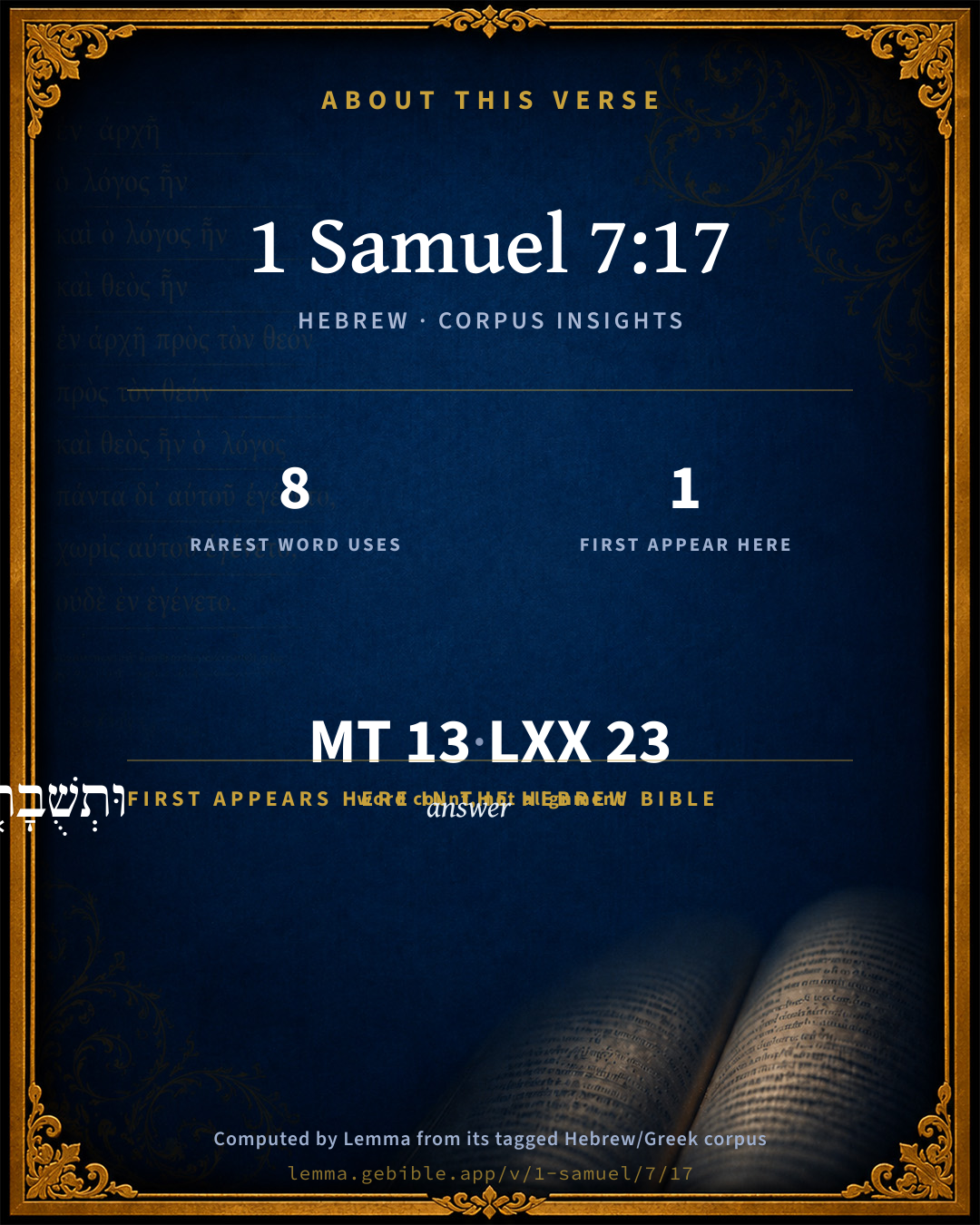
The rarest word here is וּתְשֻׁבָת֤וֹ answer H8666 — appearing just 8 times in the whole Hebrew Bible.

First appearance in Scripture

This word makes its first canonical appearance in the Hebrew Bible here:

  • וּתְשֻׁבָת֤וֹ answer H8666

Shared distinctive vocabulary

וּתְשֻׁבָת֤וֹ answer H8666 occurs in 8 verses of the Hebrew Bible. Also found in:

Grammatical profile

  • 2 verbs
  • 6 nouns
  • 1 conjunction
  • 3 adverbs
  • 1 particle

Verb forms

  • שָׁפָ֣ט Qal · Perfect
  • וַיִּֽבֶן Qal · Sequential Imperfect

Repetition

A word recurs within this verse — often emphatic in Hebrew:

  • שָׁ֣ם there H8033 ×3

Hebrew & Septuagint length

In English translation the verse runs 23 words from the Hebrew and 24 from the Septuagint (LXX English) — closely comparable.

A rough comparison of the two English renderings, which tokenize alike — not a word-level alignment.

Word counts can differ between the Hebrew and the Greek without any difference in meaning — e.g. the Hebrew direct-object marker אֵת has no separate Greek word, and Greek often adds the article ὁ.

In the original languages it is 13 Hebrew tokens and 23 Greek tokens — but the two are counted differently (Hebrew bundles its prefixes and suffixes into one token; the Greek is in lemma form), so that isn’t a like-for-like length.

Cross-references

10

Topical passages linked to 1 Samuel 7:17 in the Treasury of Scripture Knowledge — connected by theme and wording, ordered by reader-vote popularity; previews shown in the World English Bible.

  • 1 Samuel 1:19 They rose up in the morning early, and worshiped before Yahweh, and returned, and came to their house to Ramah: and Elkanah knew Hannah his wife; and Yahweh remembered her.
  • 1 Samuel 1:1 Now there was a certain man of Ramathaim Zophim, of the hill-country of Ephraim, and his name was Elkanah, the son of Jeroham, the son of Elihu, the son of Tohu, the son of Zuph, an Ephraimite:
  • 1 Samuel 8:4 Then all the elders of Israel gathered themselves together, and came to Samuel to Ramah;
  • Genesis 33:20 He erected an altar there, and called it El Elohe Israel.
  • Genesis 35:7 He built an altar there, and called the place El Beth El; because there God was revealed to him, when he fled from the face of his brother.
  • Judges 21:4–5 It happened on the next day that the people rose early, and built there an altar, and offered burnt offerings and peace-offerings.
  • 1 Samuel 11:15 All the people went to Gilgal; and there they made Saul king before Yahweh in Gilgal; and there they offered sacrifices of peace-offerings before Yahweh; and there Saul and all the men of Israel rejoiced greatly.
  • 1 Samuel 19:18–23 Now David fled, and escaped, and came to Samuel to Ramah, and told him all that Saul had done to him. He and Samuel went and lived in Naioth.
  • 1 Kings 18:30–36 Elijah said to all the people, Come near to me; and all the people came near to him. He repaired the altar of Yahweh that was thrown down.
  • Genesis 12:7–8 Yahweh appeared to Abram, and said, "I will give this land to your seed." He built an altar there to Yahweh, who appeared to him.

Cross-references courtesy of OpenBible.info (CC BY 4.0).

Hebrew and Greek witnesses Masoretic Hebrew ↔ Greek Septuagint

The same verse in the two great witnesses to the Old Testament, shown verse-for-verse.

These are two independent witnesses, not word-aligned to each other, and the Septuagint is shown in lemma (dictionary) form.

Hebrew 1 Samuel 7:17 Masoretic · Westminster Leningrad Codex

וּתְשֻׁבָת֤וֹ הָרָמָ֨תָה֙ כִּֽי שָׁ֣ם בֵּית֔וֹ וְשָׁ֖ם שָׁפָ֣ט אֶת יִשְׂרָאֵ֑ל וַיִּֽבֶן שָׁ֥ם מִזְבֵּ֖חַ לַֽיהוָֽה

His return was to Ramah, for there was his house; and there he judged Israel: and he built there an altar to Yahweh.

World English Bible · Public Domain

Greek LXX 1 Samuel 7:17 Septuagint · lemma form

ὁ δέ ἀποστροφή αὐτός εἰς αρμαθαιμ ὅτι ἐκεῖ εἰμί ὁ οἶκος αὐτός καί δικάζω ἐκεῖ ὁ ἰσραήλ καί οἰκοδομέω ἐκεῖ θυσιαστήριον ὁ κύριος

And his return was to Armathaim, because there was his house; and there he judged Israel, and built there an altar to the Lord.

LXX2012 (modern English Septuagint) · Public Domain

Hebrew: Westminster Leningrad Codex (CC BY 4.0). Greek: Septuagint (public domain); English from LXX2012 (modern English Septuagint) (Public Domain). How the Septuagint differs from the Hebrew →

Targum (Aramaic paraphrase)

1

The Targum is the ancient Jewish Aramaic paraphrase of the Hebrew Scriptures — an interpretive translation, not the Hebrew text itself. Onkelos (literal) and Pseudo-Jonathan (expansive) render the Torah, and Jonathan the Prophets. Coverage is partial: where no permissively-licensed English translation exists for a verse, only the Aramaic is shown. This is verse-level text, not a word-by-word alignment to the Hebrew.

  1. Targum Jonathan Prophets (Joshua–Malachi)
    וּבְמִתְבֵיהּ לְרָמָתָא אֲרֵי תַמָן בֵּיתֵיהּ וְתַמָן דָן יַת יִשְׂרָאֵל וּבְנָא תַמָן מִדְבְּחָא קֳדָם יְיָ:

    (no public-domain English translation for this verse)

    Targum Jonathan — Aramaic: “Mikraot Gedolot” (public domain). English: “Sefaria Community Translation” (CC0 1.0 (public-domain dedication)); “London "Chaldee Paraphrase," 1871” (public domain). Text via Sefaria.

Commentary

Notes on 1 Samuel 7:17 from classic Christian and Jewish commentators (each source and its license shown beneath its notes). The classic Christian expositions comment on the surrounding passage and are grouped to its opening verse, so a note may address several verses; the Jewish commentaries on the Tanakh (Rashi and others) are per-verse, so they appear only where the commentator wrote on this verse.

Lemma curates 59 commentaries, every one of them public domain or Creative Commons licensed, each selected and text-cleaned for this edition rather than reprinted as found. About our sources →

Trapp's Complete Commentary

John Trapp

1Sa 7:17 And his return [was] to Ramah; for there [was] his house; and there he judged Israel; and there he built an altar unto the LORD.

Ver. 17. And his return was to Ramah.] There was his house.

There he judged Israel.] Being ever in action for the public good.

And there he built an altar,] i.e., At Ramah, either for a monument of piety, or for extraordinary sacrifices.

John Trapp, A Commentary or Exposition upon All the Books of the Old and New Testament (1647–1656) — public domain. Text from a community e-Sword module.

Joseph Benson's Commentary

1Sa 7:17. Built an altar — That, by joining sacrifices with his prayers, he might the better obtain direction and assistance from God upon all emergencies. And this was done by prophetical inspiration, as appears by God’s acceptance of the sacrifices offered upon it. Indeed, Shiloh being now laid waste, and no other place yet appointed for them to bring their offerings to, the law which obliged them to one place was for the present suspended. Therefore, as the patriarchs did, he built an altar where he lived; and that not only for the use of his own family, but for the good of the country, who resorted to it.

Joseph Benson's Commentary on the Old and New Testaments (1811–1818) — public domain. Text from a community e-Sword module.

Tyndale Open Study Notes

Tyndale Open Resources

7:17 Ramah was Samuel’s hometown (see 1:1).

Tyndale Open Study Notes — © Tyndale Open Resources, licensed CC BY-SA 4.0. Text via the HelloAO Bible API.

Geneva Bible (1599)

Geneva Bible translators

Which was not contrary to the Law: for as yet a certain place was not appointed.

Geneva Bible (1599) marginal notes — public domain. Text via Bolls.life.

Ellicott's Commentary for English Readers

(17) Raman.—The same Ramah “of the Watchers” where Elkanah and Hannah had dwelt. After the destruction of Shiloh, Samuel seems to have fixed his abode in his father’s city.

And there he built an altar.—Thus following the old custom of the patriarchs. It must be remembered that at this period there was no national sanctuary, no formal seat of worship, where the high priest and his attendant priests and Levites served. The Ark, we know, was in safe keeping in the “city of woods,” Kirjath-jearim, but it was in private custody; and we hear of no priests and Levites, of no ritual or religious observances, in connection with the long sojourn of the holy Ark in that place. It is probable that the sacred vessels and furniture had been saved from the destruction of Shiloh by Samuel. These were, very likely, in the prophet-judge’s safe keeping at Bamah.

A Bible Commentary for English Readers, edited by Charles John Ellicott (1878–1897) — public domain. Text from a community e-Sword module.

The Cambridge Bible for Schools and Colleges

gen. ed. J. J. S. Perowne

17. to Ramah] See note on ch. 1Sa_1:1. Samuel chose his native place for his usual official residence, and made it a centre of religious worship by building an altar to Jehovah.

Here ends the first division of the book, which records Samuel’s life and work as the last of the Judges, in connexion with the old order of things. The next division opens by relating the steps which led to the establishment of a monarchy, and shews us Samuel as the Mediator between the old and the new régime, effecting a political change of the utmost importance in the history of Israel without the shock of revolution.

It has been conjectured (a) from the fact that this portion of the book ends with a summary account of Samuel’s whole life: (b) from the apparent (but not altogether inexplicable) contradiction between ch. 1Sa_7:13-15 and the subsequent narrative, that the compiler derived the history of Samuel and the history of Saul from different sources: but in the obscurity of the whole question of the compilation of the book, it must remain a hypothesis incapable of verification.

The Cambridge Bible for Schools and Colleges (gen. ed. J. J. S. Perowne; Cambridge University Press, 1878–1918) — public domain. Text from a community e-Sword module.

John Gill's Exposition

And his return was to Ramah,.... When he had gone his circuit, he came back to this city, which was his native place, and where his father and mother had dwelt, see Sa1 1:1.

for there was his house; and his father's house before him, and perhaps the same, Sa1 1:19 and there he judged Israel; here was his fixed residence, and here he was always to be met with, except when on his circuit; and hither the people of Israel might come from all parts, to have justice done them between man and man, or receive information in matters of difficulty and importance:

and there he built an altar unto the Lord: to offer his own sacrifices, and the sacrifices of the people, either by himself, or by a priest, when the people came to have justice administered to them; or to desire him to pray for them, teach and instruct them, or to give them advice. Shiloh being destroyed, and no place appointed for the tabernacle and altar, the Jews say, high places for a private altar were lawful, and even for one that was not a priest to offer; these things, though settled by law, yet were for a time dispensed with, until things could be fixed in their proper place and order.

Next: 1 Samuel Chapter 8

John Gill's Exposition of the Whole Bible (1746–1763) — public domain (CC PDM 1.0). Text via the HelloAO Bible API.

Albert Barnes' Notes on the Bible

And there he built an altar - Whether this altar was in connection with the tabernacle or not we have no means of deciding, since we are in complete ignorance as to where the tabernacle was at this time, or who was High Priest, or where he resided. It is quite possible that Samuel may have removed the tabernacle from Shiloh to some place near to Ramah; and indeed it is in itself improbable that, brought up as he was from infancy in the service of the tabernacle, he should have left it. At the beginning of Solomon’s reign we know it was at Gibeon, close to Raimah 1Ki 3:4; 2Ch 1:3, 2Ch 1:6. If the tabernacle had been at Shiloh at this time, it is likely that Shiloh would have been one of the places at which Samuel judged lsrael. But Shiloh was probably waste, and perhaps unsafe on account of the Philistines.

Albert Barnes' Notes on the Bible (1834–1885) — public domain. Text from a community e-Sword/MySword module.

Haydock's Catholic Bible Commentary

Ramatha; his native place. His high office would not allow him to remain always near the tabernacle, chap. i. 11., and 28. (Calmet) --- Lord, by his direction, (Menochius) both to satisfy his own devotion, and that he might consult the Lord when the people wanted advice. (Calmet)

George Leo Haydock (1774–1849), Haydock's Catholic Family Bible and Commentary, 1859 edition — public domain. Excludes Psalms (Douay-Rheims chapter numbering differs from Protestant) and Deuterocanonical books (Catholic canon only).

Matthew Poole's English Annotations

That by joining sacrifices with his prayers he might the better obtain direction and assistance from God upon all emergencies.

Object. It was unlawful to build another altar for sacrifice besides that before the tabernacle, Deu 12:5,13.

Answ. This was in part excused by the confusion of those times, wherein the tabernacle and its altar were destroyed, as is most probable; but most fully, because this was done by prophetical inspiration, and Divine dispensation, as appears by God’s approbation and acceptance of the sacrifices offered upon it.

Matthew Poole's English Annotations on the Holy Bible (1683–1685) — public domain. Text from a community e-Sword/MySword module.

Whedon's Commentary on the Bible

Daniel D. Whedon

17. There was his house — See on 1Sa_1:1. He probably lived at Shiloh till the time of Eli’s death, and then, upon the desolation of the tabernacle, he returned to the home of his infancy, and made it his permanent residence.

There he built an altar — For the principal seat of his judicial ministry must not be without the holy service. The law required all sacrifices to be offered at the tabernacle. Deu_12:13-14; but after the ark and tabernacle had become separated, and Shiloh lay desolate, there seems to have been a feeling that now that law was not binding. See note on 1Sa_9:12. And doubtless the shameful conduct of many of the priests at Shiloh had driven not a few in Israel to sacrifice elsewhere, even before the ark was captured. It is possible, however, that Samuel had the tabernacle removed at this time from Shiloh to Ramah. At a later time it was at Nob, (1Sa_21:1-7,) and still later at Gibeon. 1Ki_3:4.

Daniel D. Whedon (gen. ed.), Commentary on the Old and New Testaments (1874–1909) — public domain. Text from a community e-Sword module.

The Pulpit Commentary

His return was to Ramah. We have seen that Elkanah was a large landholder there, and Samuel had now apparently succeeded to his father"s place. And there he built an altar unto Jehovah. This old patriarchal custom (Gen_12:7) long continued, and it was only gradually that local shrines and worship on high places were superseded by attendance upon the temple services at Jerusalem. At this time there was especial need for such altars. The established worship at Shiloh had been swept away, the town destroyed, the priests put to the sword, and the ark, though restored, was resting in a private dwelling. Probably Samuel had saved the sacred vessels, and much even of the tabernacle, but no mention of them is here made. We see, however, both in the erection of this altar and all through Samuel"s life, that the Aaronic priesthood was in abeyance, and that he was not only prophet and judge, but also priest. In thus restoring the priesthood in his own person he was justified not merely by his powers as prophet, but by necessity. Gradually, with more prosperous times, matters returned to their regular channel; but even when Ahiah, the grandson of Eli, was with Saul, (1Sa_14:3) he was employed not for the offering of sacrifice, but for divining with the Urim and Thummim. On a most important occasion the offering of sacrifice is spoken of as undoubtedly Samuel"s right, and when he delayed his coming no mention is made of a priest, but Saul is said to have offered the victim himself. (1Sa_13:9) It is plain, therefore, that we must not tie down the priesthood too tightly to the house of Aaron; for throughout there lies in the background the idea of a higher priesthood, and with this Samuel was invested, as being a type of him who is a Priest forever after the order of Melchisedek. (comp. 1Sa_2:35)

The Pulpit Commentary (1880–1919), ed. H.D.M. Spence-Jones & Joseph S. Exell — public domain. Text from a community e-Sword module.

John Wesley's Explanatory Notes

Built an altar - That by joining sacrifices with his prayers, he might the better obtain direction and assistance from God upon all emergencies. And this was done by prophetical inspiration, as appears by God's acceptance of the sacrifices offered upon it. Indeed Shiloh being now laid waste, and no other place yet appointed for them to bring their offerings to, the law which obliged them to one place, was for the present suspended. Therefore, as the patriarchs did, he built an altar where he lived: and that not only for the use of his own family, but for the good of the country who resorted to it.

John Wesley, Explanatory Notes Upon the Whole Bible (1754–1765) — public domain. Text via the GEBible commentary corpus.

Lesson kit

Teaching starters — assembled from the data on this page, not authored interpretation. Every prompt links to the verse data it draws on. Edit before teaching.

1 Samuel, in the Historical, opens this verse with 13 words (11 distinct Hebrew lemmas). Its most distinctive word is tᵉshûwbâh (“answer”). A historical commentator’s framing appears above. Read the whole chapter for the surrounding context.

Discussion questions

  1. What does “answer” (tᵉshûwbâh) contribute to the verse as a whole?
  2. This is the first place “answer” appears in Scripture (first appears here). What does its debut here establish?
  3. How does 2 Samuel 11:1, which shares the word «answer», read alongside this verse?
  4. What does the repetition of “there” (3× in this one verse) do in this verse?
  5. These translations render this verse differently. What is at stake in choosing one wording over another?
  6. «שָׁפָ֣ט» is a Qal Perfect verb. How does that grammatical form shape the action described?
  7. Compare how Trapp's Complete Commentary and Joseph Benson's Commentary read this verse. Where do they agree or differ?

Things to notice

Reading settings

Reading text

Shown beneath each verse's original-language words.

Old Testament
Old Testament edition

Read the OT as the Masoretic Hebrew (MT) or the Greek Septuagint (LXX).

English shown for the Greek Septuagint (in the Hebrew ↔ Greek comparison).

Comparing translations? Open the Compare panel on any verse page to stack up to four side by side.