Exodus 31:8

Hebrew (Westminster Leningrad Codex) Exodus 31:8 appears in the Hebrew Old Testament. The text above is from the Westminster Leningrad Codex. Each word links to its Strong’s number, a concise gloss, and parsing drawn from the Open Scriptures Hebrew Bible morphology. Click any word for its full Brown-Driver-Briggs (BDB) entry.
Download image
Cite this verse

Exodus 31:8 (World English Bible). Public Domain. Lemma interlinear Bible study tool, https://lemma.gebible.app/v/exodus/31/8.

Show BibTeX & RIS
BibTeX
RIS
English Translation
the table and its vessels, the pure lampstand with all its vessels, the altar of incense,
World English Bible · Public Domain
Download a study sheet

One document with this verse’s original text, its word-by-word gloss line, the meaning frame, cross-references with their text, attributed commentary, and full source and license credits — printable, and it pastes into notes with its structure intact.

This verse Autodidact and up

Study sheet (.html) Plain text (.txt)

A passage Seminary Student

Up to 50 verses in one chapter. A passage sheet keeps up to 6 commentary sources and 12 cross-references per verse, in the order this page ranks them, and says so on the sheet whenever that leaves anything out. Ask for a single verse and you get the Autodidact verse sheet above.

Everything on this page stays free to read, with no account — the sheet is a download of what is already on screen, not access to it.

Want to remove ads? Support Godless Engineer
Compare translations 3

The same verse in 3 English versions, stacked beneath the original-language interlinear above. Click any original word for its lexicon entry.

Each is an independent rendering of the whole verse — the interlinear is not word-aligned to these translations.

Highlighted words mark where these versions differ — a whole-verse word diff, not a word-by-word alignment.

  • World English Bible Public Domain
    the table and its vessels, the pure lampstand with all its vessels, the altar of incense,
  • King James Version Public Domain
    And the table and his furniture, and the pure candlestick with all his furniture, and the altar of incense,
  • unfoldingWord Literal Text CC BY-SA 4.0
    the table and its utensils and the pure lampstand and all its equipment and the altar of incense

unfoldingWord Literal Text — © unfoldingWord, licensed CC BY-SA 4.0. Word-aligned USFM3 via Door43 (git.door43.org/unfoldingWord/en_ult).

Versions to compare (up to 4)

3 of 4 selected

Show all 18 translations

Every available English version of this verse, each an independent rendering of the whole verse.

  • World English Bible Public Domain
    the table and its vessels, the pure lampstand with all its vessels, the altar of incense,
  • Berean Standard Bible Public Domain
    the table with its utensils, the pure gold lampstand with all its utensils, the altar of incense,
  • Majority Standard Bible Public Domain
    the table with its utensils, the pure gold lampstand with all its utensils, the altar of incense,
  • King James Version Public Domain
    And the table and his furniture, and the pure candlestick with all his furniture, and the altar of incense,
  • American Standard Version (1901) Public Domain
    and the table and its vessels, and the pure candlestick with all its vessels, and the altar of incense,
  • Revised Version (1885) Public Domain
    and the table and its vessels, and the pure candlestick with all its vessels, and the altar of incense;
  • Geneva Bible (1599) Public Domain
    Also the Table and the instruments thereof, and the pure Candlesticke with all his instruments, and the Altar of perfume:
  • Douay-Rheims (1899) Public Domain
    And the table and the vessels thereof, the most pure candlestick with the vessels thereof, and the altars of incense,
  • Young's Literal Translation Public Domain
    and the table and its vessels, and the pure candlestick and all its vessels, and the altar of the perfume,
  • Literal Standard Version CC BY-SA 4.0
    and the table and its vessels, and the pure lampstand and all its vessels, and the altar of the incense,
  • Unlocked Literal Bible CC BY-SA 4.0
    the table and its utensils, the pure lampstand with all its equipment, the incense altar,
  • unfoldingWord Literal Text CC BY-SA 4.0
    the table and its utensils and the pure lampstand and all its equipment and the altar of incense
  • Darby Bible Public Domain
    and the table and its utensils, and the pure lamp-stand and all its utensils, and the altar of incense;
  • World Messianic Bible Public Domain
    the table and its vessels, the pure lamp stand with all its vessels, the altar of incense,
  • Webster's Bible Public Domain
    And the table and its furniture, and the pure candlestick with all its furniture, and the altar of incense,
  • Free Bible Version CC BY-SA 4.0
    the table with its equipment, the pure gold lampstand with all its equipment, the altar of incense,
  • Bible in Basic English Public Domain
    And the table with its vessels, and the holy light-support with all its vessels, and the altar for the burning of spices,
  • JPS Tanakh (1917) Public Domain
    and the table and its vessels, and the pure candlestick with all its vessels, and the altar of incense;

Literal Standard Version (2020), Covenant Press — licensed CC BY-SA 4.0. Text via the HelloAO Bible API (eBible.org). Unlocked Literal Bible (unfoldingWord) — licensed CC BY-SA 4.0. Text via the HelloAO Bible API (eBible.org). unfoldingWord Literal Text — © unfoldingWord, licensed CC BY-SA 4.0. Word-aligned USFM3 via Door43 (git.door43.org/unfoldingWord/en_ult). Free Bible Version, Dr. Jonathan Gallagher — licensed CC BY-SA 4.0. Text via the HelloAO Bible API (eBible.org).

Word by word

More ways to search: Search by grammar → Find every occurrence → Compare this word →

Practice this passage: Drill this verse → Learn its vocabulary →

הַמְּנֹרָ֥ה
mᵉnôwrâh
H4501
“the · lampstand”
Particle, Definite Article + Noun, Common, Feminine, Singular, Absolute
Part of Speech
Particle + Noun
Type
Common
Gender
Feminine
Number
Singular
State
Absolute
Full BDB Definition

Origin: from H4500 (in the original sense of H5216 )

TWOT: 1333c

lamp stand
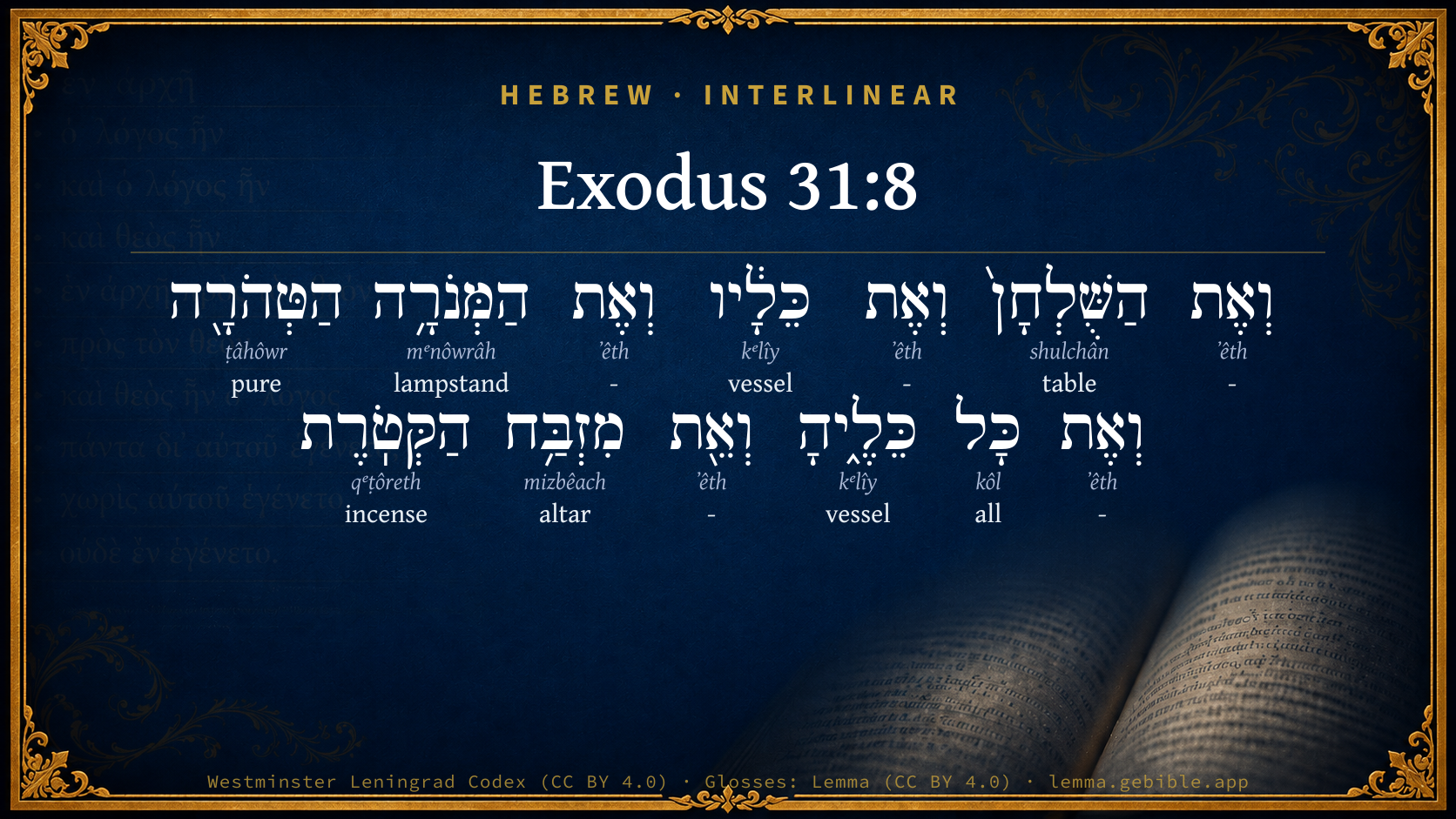
  1. וְאֶת ʼêth H853 “and · -” Conjunction + Particle, Direct Object
  2. הַשֻּׁלְחָן֙ shulchân H7979 “the · table” Particle, Definite Article + Noun, Common, Masculine, Singular, Absolute
  3. וְאֶת ʼêth H853 “and · -” Conjunction + Particle, Direct Object
  4. כֵּלָ֔יו kᵉlîy H3627 “vessels · his” Noun, Common, Masculine, Plural, Construct + Suffix, Personal, 3rd Person, Masculine, Singular
  5. וְאֶת ʼêth H853 “and · -” Conjunction + Particle, Direct Object
  6. הַטְּהֹרָ֖ה ṭâhôwr H2889 “the · pure” Particle, Definite Article + Adjective, Adjective, Feminine, Singular, Absolute
  7. וְאֶת ʼêth H853 “and · -” Conjunction + Particle, Direct Object
  8. כָּל kôl H3605 “all of” Noun, Common, Masculine, Singular, Construct
  9. כֵּלֶ֑יהָ kᵉlîy H3627 “vessels · her” Noun, Common, Masculine, Plural, Construct + Suffix, Personal, 3rd Person, Feminine, Singular
  10. וְאֵ֖ת ʼêth H853 “and · -” Conjunction + Particle, Direct Object
  11. מִזְבַּ֥ח mizbêach H4196 “altar of” Noun, Common, Masculine, Singular, Construct
  12. הַקְּטֹֽרֶת qᵉṭôreth H7004 “the · incense” Particle, Definite Article + Noun, Common, Feminine, Singular, Absolute

About this verse

These counts appear in no published source. They are computed here, from the morphology-tagged text and Lemma’s own curated glosses. What Lemma adds →

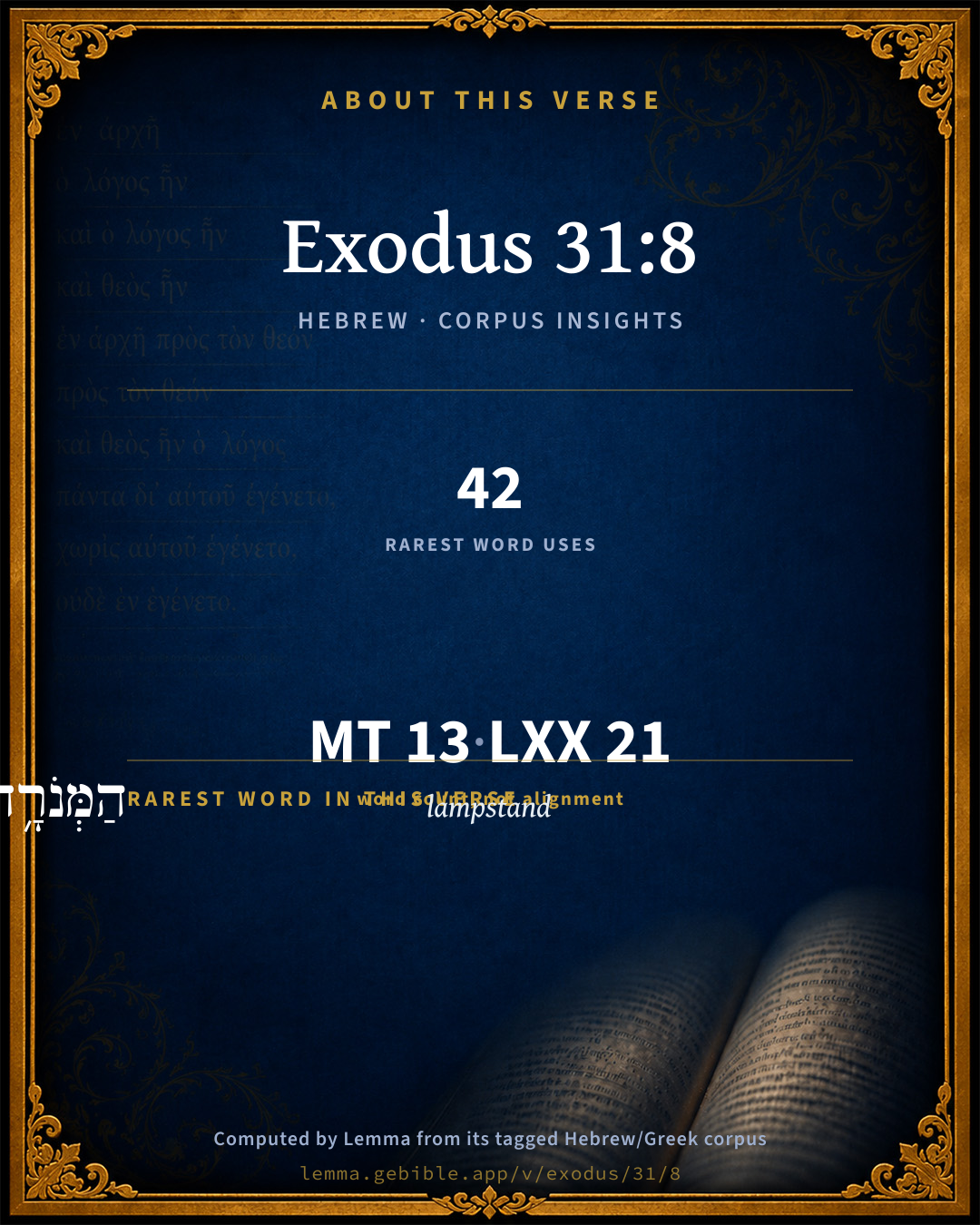
13
words
8
distinct lemmas
Pentateuch
section

Shared distinctive vocabulary

הַמְּנֹרָ֥ה lampstand H4501 occurs in 31 verses of the Hebrew Bible. Also found in:

Grammatical profile

  • 7 nouns
  • 1 adjective
  • 5 particles

Repetition

A word recurs within this verse — often emphatic in Hebrew:

  • כֵּלָ֔יו vessel H3627 ×2

Hebrew & Septuagint length

In English translation the verse runs 16 words from the Hebrew and 10 from the Septuagint (LXX English) — the Septuagint runs noticeably shorter here. See the side-by-side →

A rough comparison of the two English renderings, which tokenize alike — not a word-level alignment.

Word counts can differ between the Hebrew and the Greek without any difference in meaning — e.g. the Hebrew direct-object marker אֵת has no separate Greek word, and Greek often adds the article ὁ.

In the original languages it is 13 Hebrew tokens and 21 Greek tokens — but the two are counted differently (Hebrew bundles its prefixes and suffixes into one token; the Greek is in lemma form), so that isn’t a like-for-like length.

Cross-references

3

Topical passages linked to Exodus 31:8 in the Treasury of Scripture Knowledge — connected by theme and wording, ordered by reader-vote popularity; previews shown in the World English Bible.

  • Exodus 37:10–28 He made the table of acacia wood. Its length was two cubits, and its breadth was a cubit, and its height was a cubit and a half.
  • Exodus 25:23–40 "You shall make a table of acacia wood. Two cubits shall be its length, and a cubit its breadth, and one and a half cubits its height.
  • Exodus 30:1–10 "You shall make an altar to burn incense on. You shall make it of acacia wood.

Cross-references courtesy of OpenBible.info (CC BY 4.0).

Hebrew and Greek witnesses Masoretic Hebrew ↔ Greek Septuagint

The same verse in the two great witnesses to the Old Testament, shown verse-for-verse.

Here the Septuagint runs noticeably shorter than the Hebrew — LXX2012 (modern English Septuagint) 10 words vs World English Bible 16. A rough length comparison of the two English translations, not a word-level alignment — read both below.

These are two independent witnesses, not word-aligned to each other, and the Septuagint is shown in lemma (dictionary) form.

Hebrew Exodus 31:8 Masoretic · Westminster Leningrad Codex

וְאֶת הַשֻּׁלְחָן֙ וְאֶת כֵּלָ֔יו וְאֶת הַמְּנֹרָ֥ה הַטְּהֹרָ֖ה וְאֶת כָּל כֵּלֶ֑יהָ וְאֵ֖ת מִזְבַּ֥ח הַקְּטֹֽרֶת

the table and its vessels, the pure lampstand with all its vessels, the altar of incense,

World English Bible · Public Domain

Greek LXX Exodus 31:8 Septuagint · lemma form

καί ὁ θυσιαστήριον καί ὁ τράπεζα καί πᾶς ὁ σκεῦος αὐτός καί ὁ λυχνία ὁ καθαρός καί πᾶς ὁ σκεῦος αὐτός

and the altars, and the table and all its furniture,

LXX2012 (modern English Septuagint) · Public Domain

On this verse, Haydock's Catholic Bible Commentary discusses the Septuagint’s reading. Read the note in Commentary ↓

Hebrew: Westminster Leningrad Codex (CC BY 4.0). Greek: Septuagint (public domain); English from LXX2012 (modern English Septuagint) (Public Domain). How the Septuagint differs from the Hebrew →

Targum (Aramaic paraphrase)

2

The Targum is the ancient Jewish Aramaic paraphrase of the Hebrew Scriptures — an interpretive translation, not the Hebrew text itself. Onkelos (literal) and Pseudo-Jonathan (expansive) render the Torah, and Jonathan the Prophets. Coverage is partial: where no permissively-licensed English translation exists for a verse, only the Aramaic is shown. This is verse-level text, not a word-by-word alignment to the Hebrew.

  1. Targum Onkelos Torah (Genesis–Deuteronomy)
    וְיָת פָּתוֹרָא וְיָת מָנוֹהִי וְיָת מְנַרְתָּא דָכִיתָא וְיָת כָּל מָנָהָא וְיָת מַדְבְּחָא דִקְטּוֹרֶת בּוּסְמַיָא:

    (no public-domain English translation for this verse)

    Targum Onkelos — Aramaic: “Onkelos Genesis” (public domain); “Onkelos Exodus” (public domain); “Onkelos Leviticus” (public domain); “Onkelos Numbers” (public domain); “Onkelos Deuteronomy” (public domain). English: “Sefaria Community Translation” (CC0 1.0 (public-domain dedication)); “J.W. Etheridge. The Targums of Onkelos and Jonathan Ben Uzziel on the Pentateuch. London: Longmans, Green, 1862” (public domain). Text via Sefaria.

  2. Targum Pseudo-Jonathan Torah (Genesis–Deuteronomy)
    וְיַת פְּתוֹרָא וְיַת כָּל מָנוֹי וְיַת מְנַרְתָּא דָכִיתָא וְיַת כָּל מָנָהָא וְיַת מַדְבְּחָא דִקְטוֹרֶת בּוּסְמַיָא

    and the table, and all its vessels; and the altar of sweet incense,

    Targum Pseudo-Jonathan — Aramaic: “Targum Jonathan on Genesis” (public domain); “Targum Jonathan on Exodus” (public domain); “Targum Jonathan on Leviticus” (public domain); “Targum Jonathan on Numbers” (public domain); “Targum Jonathan on Deuteronomy” (public domain). English: “The Targum of Jonathan ben Uzziel, trans. J. W. Etheridge, London, 1862” (public domain). Text via Sefaria.

Commentary

Notes on Exodus 31:8 from classic Christian and Jewish commentators (each source and its license shown beneath its notes). The classic Christian expositions comment on the surrounding passage and are grouped to its opening verse, so a note may address several verses; the Jewish commentaries on the Tanakh (Rashi and others) are per-verse, so they appear only where the commentator wrote on this verse.

Lemma curates 59 commentaries, every one of them public domain or Creative Commons licensed, each selected and text-cleaned for this edition rather than reprinted as found. About our sources →

Joseph Benson's Commentary

Exo 31:8. The pure candlestick — Bright, resplendent, being of pure gold, and always kept clean and bright, Exo 29:37; Lev 24:4.

The same original word occurs Exo 24:10, where the divine glory is compared to the body of heaven in its clearness or splendour.

Joseph Benson's Commentary on the Old and New Testaments (1811–1818) — public domain. Text from a community e-Sword module.

Geneva Bible (1599)

Geneva Bible translators

So called, because of the cunning and art used therein, or because the whole was beaten out of the piece.

Geneva Bible (1599) marginal notes — public domain. Text via Bolls.life.

Adam Clarke's Commentary

Verse 8. The pure candlestick] Called so either because of the pure gold of which it was made, or the brightness and splendour of its workmanship, or of the light which it imparted in the tabernacle, as the purest, finest oil was always burnt in it.

Adam Clarke's Commentary on the Bible (1810–1826) — public domain. Text from a community e-Sword/MySword module.

The Cambridge Bible for Schools and Colleges

gen. ed. J. J. S. Perowne

8. the table] i.e. the table of the Presence-bread, Exo_25:23-30.

the pure candlestick] i.e. made of pure gold (Exo_25:31): so Exo_39:37, Lev_24:4.

The Cambridge Bible for Schools and Colleges (gen. ed. J. J. S. Perowne; Cambridge University Press, 1878–1918) — public domain. Text from a community e-Sword module.

John Gill's Exposition

And the table and his furniture,.... The shewbread table, with its dishes, spoons, and bowls, Exo 25:23.

and the pure candlestick with all his furniture; called "pure", because made of pure gold, and was to be kept pure and clean by the priests, and in which pure oil olive was burnt, and gave a clear light; its furniture were its lamps, tongs, and snuff dishes, Exo 25:31.

and the altar of incense: made of shittim wood covered with gold, Exo 30:1.

John Gill's Exposition of the Whole Bible (1746–1763) — public domain (CC PDM 1.0). Text via the HelloAO Bible API.

Haydock's Catholic Bible Commentary

Table and (all) the. The Samaritan copy retains the word col, "all," as well as the Samaritan, Septuagint, Syriac, and Arabic versions, and one Hebrew manuscript, though the printed editions have rejected it. In a Chaldaic manuscript it is also found. The omission, probably was occasioned by the custom of the Jews, who always fill up their lines with the initial letters of the next line; and as coliu followed, the transcriber supposed that col was in that predicament. (Kennicott, dis. 2.) --- Most pure gold, always giving light, or kept clean, chap. xxxix. 37.

George Leo Haydock (1774–1849), Haydock's Catholic Family Bible and Commentary, 1859 edition — public domain. Excludes Psalms (Douay-Rheims chapter numbering differs from Protestant) and Deuterocanonical books (Catholic canon only).

Matthew Poole's English Annotations

The pure candlestick; so called by way of eminency, notonly because it was made of pure gold, and was not defiled with blood, for so some other things were, but especially to mind the priests of their duty in keeping it neat and clean, it being more subject to defilement than other things.

Matthew Poole's English Annotations on the Holy Bible (1683–1685) — public domain. Text from a community e-Sword/MySword module.

Rashi

Rabbi Shlomo Yitzchaki (Rashi)

הטהרה THE (PURE [CANDELABRUM] — It is called טהרה because the term זהב טהר, pure gold, is used of it (cf. Exodus 25:31) (not טהרה in contrast to טמאה).

Rashi on the Tanakh — English translations: “The Judaica Press complete Tanach with Rashi, translated by A. J. Rosenberg” (CC BY 4.0); “Pentateuch with Rashi's commentary by M. Rosenbaum and A.M. Silbermann, 1929-1934” (public domain); “The Metsudah Tanach series, Lakewood, N.J” (CC BY 4.0); and “The Book of Joshua, Metsudah Publications, 1997” (CC BY 4.0). Text via Sefaria.

Lesson kit

Teaching starters — assembled from the data on this page, not authored interpretation. Every prompt links to the verse data it draws on. Edit before teaching.

Exodus, in the Pentateuch, opens this verse with 13 words (8 distinct Hebrew lemmas). Its most distinctive word is mᵉnôwrâh (“lampstand”). The Greek Septuagint runs shorter here. A historical commentator’s framing appears above. Read the whole chapter for the surrounding context.

Discussion questions

  1. The word mᵉnôwrâh carries the sense “lampstand.” How does it shape the verse?
  2. Exodus 25:31 shares the word «lampstand» with this verse. How do the two illuminate each other?
  3. “vessel” occurs 2× in this one verse. What is the effect of the repetition?
  4. Compared with the Hebrew, the Septuagint runs shorter here. What questions does that raise?
  5. The translations on this page render this verse differently — a whole-verse word diff, not a word-by-word alignment. What might account for the different wordings?
  6. Reading how Joseph Benson's Commentary and Geneva Bible (1599) read this verse, where do the two commentators agree and where do they part?

Things to notice

Reading settings

Reading text

Shown beneath each verse's original-language words.

Old Testament
Old Testament edition

Read the OT as the Masoretic Hebrew (MT) or the Greek Septuagint (LXX).

English shown for the Greek Septuagint (in the Hebrew ↔ Greek comparison).

Comparing translations? Open the Compare panel on any verse page to stack up to four side by side.