
2 Kings 23:17

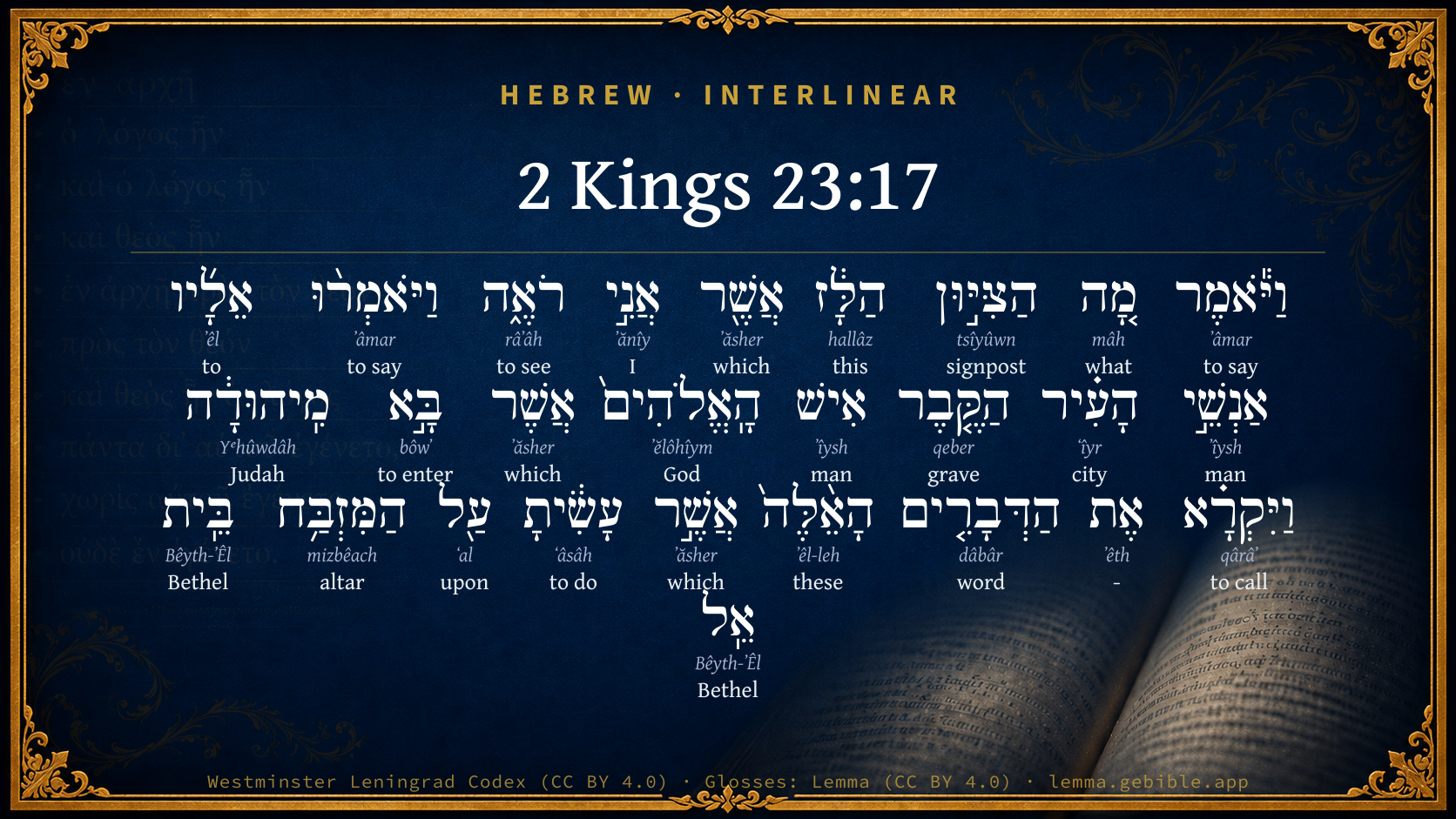
Hebrew (Westminster Leningrad Codex) 2 Kings 23:17 appears in the Hebrew Old Testament. The text above is from the Westminster Leningrad Codex. Each word links to its Strong’s number, a concise gloss, and parsing drawn from the Open Scriptures Hebrew Bible morphology. Click any word for its full Brown-Driver-Briggs (BDB) entry.
Download image
Cite this verse

2 Kings 23:17 (World English Bible). Public Domain. Lemma interlinear Bible study tool, https://lemma.gebible.app/v/2-kings/23/17.

Show BibTeX & RIS
BibTeX
RIS
English Translation
Then he said, What monument is that which I see? The men of the city told him, It is the tomb of the man of God, who came from Judah, and proclaimed these things that you have done against the altar of Bethel.
World English Bible · Public Domain
Highlights
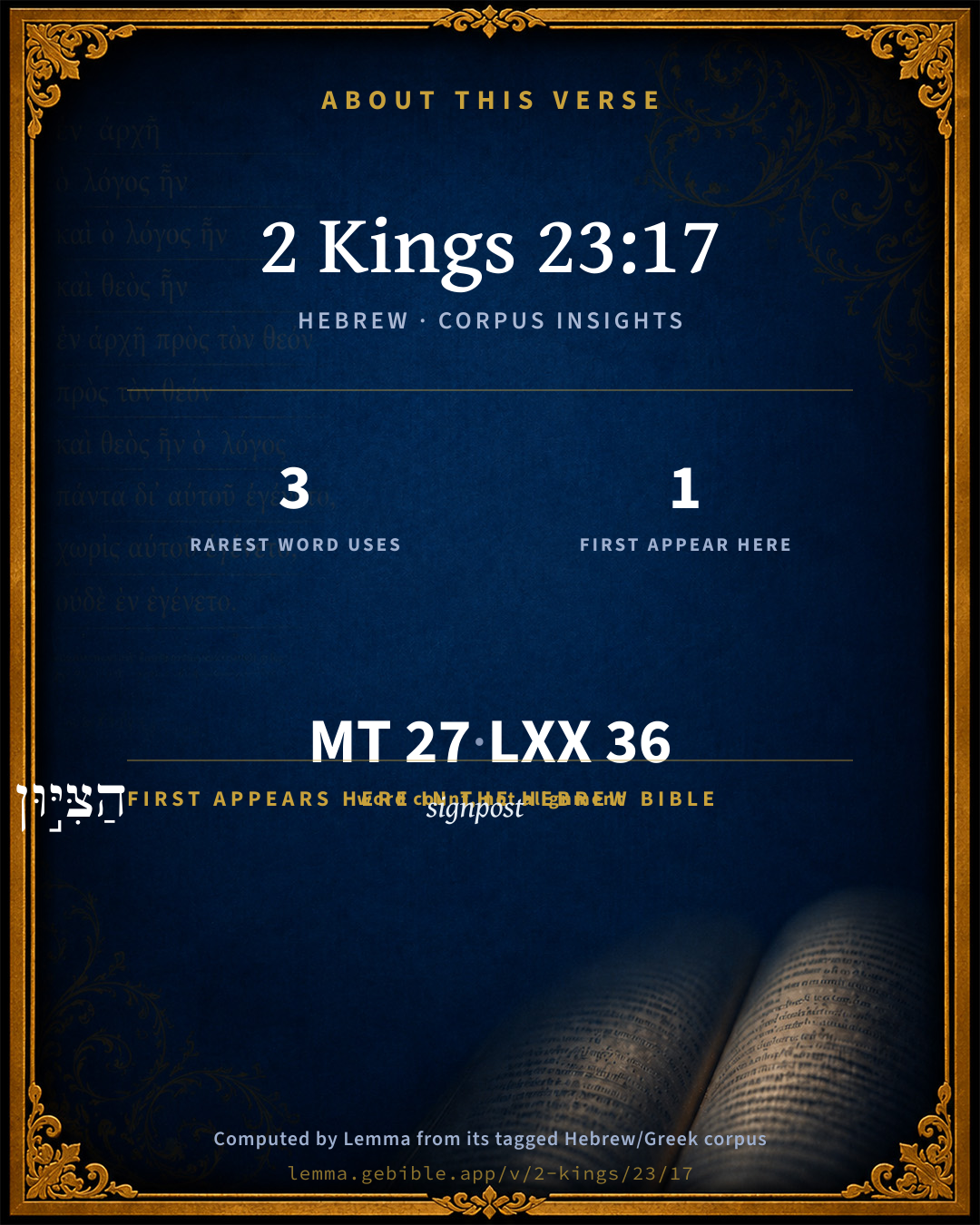
  • 1 first appearance in the Hebrew Bible
Full analysis ↓
Download a study sheet

One document with this verse’s original text, its word-by-word gloss line, the meaning frame, cross-references with their text, attributed commentary, and full source and license credits — printable, and it pastes into notes with its structure intact.

This verse Autodidact and up

Study sheet (.html) Plain text (.txt)

A passage Seminary Student

Up to 50 verses in one chapter. A passage sheet keeps up to 6 commentary sources and 12 cross-references per verse, in the order this page ranks them, and says so on the sheet whenever that leaves anything out. Ask for a single verse and you get the Autodidact verse sheet above.

Everything on this page stays free to read, with no account — the sheet is a download of what is already on screen, not access to it.

Want to remove ads? Support Godless Engineer
Compare translations 3

The same verse in 3 English versions, stacked beneath the original-language interlinear above. Click any original word for its lexicon entry.

Each is an independent rendering of the whole verse — the interlinear is not word-aligned to these translations.

Highlighted words mark where these versions differ — a whole-verse word diff, not a word-by-word alignment.

  • World English Bible Public Domain
    Then he said, What monument is that which I see? The men of the city told him, It is the tomb of the man of God, who came from Judah, and proclaimed these things that you have done against the altar of Bethel.
  • King James Version Public Domain
    Then he said, What title is that that I see? And the men of the city told him, It is the sepulchre of the man of God, which came from Judah, and proclaimed these things that thou hast done against the altar of Bethel.
  • unfoldingWord Literal Text CC BY-SA 4.0
    And he said, “What this monument that I am seeing?” And the men of the city said to him, “The grave of the man of God who came from Judah and proclaimed these things that you have done against the altar of Bethel.”

unfoldingWord Literal Text — © unfoldingWord, licensed CC BY-SA 4.0. Word-aligned USFM3 via Door43 (git.door43.org/unfoldingWord/en_ult).

Versions to compare (up to 4)

3 of 4 selected

Show all 18 translations

Every available English version of this verse, each an independent rendering of the whole verse.

  • World English Bible Public Domain
    Then he said, What monument is that which I see? The men of the city told him, It is the tomb of the man of God, who came from Judah, and proclaimed these things that you have done against the altar of Bethel.
  • Berean Standard Bible Public Domain
    Then the king asked, “What is this monument I see?” And the men of the city replied, “It is the tomb of the man of God who came from Judah and pronounced these things that you have done to the altar of Bethel.”
  • Majority Standard Bible Public Domain
    Then the king asked, “What is this monument I see?” And the men of the city replied, “It is the tomb of the man of God who came from Judah and proclaimed these things that you have done to the altar of Bethel.”
  • King James Version Public Domain
    Then he said, What title is that that I see? And the men of the city told him, It is the sepulchre of the man of God, which came from Judah, and proclaimed these things that thou hast done against the altar of Bethel.
  • American Standard Version (1901) Public Domain
    Then he said, What monument is that which I see? And the men of the city told him, It is the sepulchre of the man of God, who came from Judah, and proclaimed these things that thou hast done against the altar of Beth-el.
  • Revised Version (1885) Public Domain
    Then he said, What monument is that which I see? And the men of the city told him, It is the sepulchre of the man of God, which came from Judah, and proclaimed these things that thou hast done against the altar of Beth-el.
  • Geneva Bible (1599) Public Domain
    Then he sayde, What title is that which I see? And the men of the citie sayd vnto him, It is the sepulchre of the man of God, which came from Iudah, and tolde these things that thou hast done to the altar of Beth-el.
  • Douay-Rheims (1899) Public Domain
    And he said: What is that monument which I see? And the men of that city answered: It is the sepulchre of the man of God, who came from Juda, and foretold these things which thou hast done upon the altar of Bethel.
  • Young's Literal Translation Public Domain
    And he saith, `What `is' this sign that I see?' and the men of the city say unto him, `The grave of the man of God who hath come from Judah, and proclaimeth these things that thou hast done concerning the altar of Beth-El.'
  • Literal Standard Version CC BY-SA 4.0
    And he says, “What [is] this sign that I see?” And the men of the city say to him, “The grave of the man of God who has come from Judah, and proclaims these things that you have done concerning the altar of Beth-El.”
  • Unlocked Literal Bible CC BY-SA 4.0
    Then he said, “What monument is that I see?” The men of the city told him, “That is the grave of the man of God who came from Judah and spoke about these things that you have just done against the altar of Bethel.”
  • unfoldingWord Literal Text CC BY-SA 4.0
    And he said, “What this monument that I am seeing?” And the men of the city said to him, “The grave of the man of God who came from Judah and proclaimed these things that you have done against the altar of Bethel.”
  • Darby Bible Public Domain
    Then he said, What tombstone is that which I see? And the men of the city told him, It is the sepulchre of the man of God who came from Judah and proclaimed these things which thou hast done against the altar of Bethel.
  • World Messianic Bible Public Domain
    Then he said, “What monument is that which I see?” The men of the city told him, “It is the tomb of the man of God who came from Judah and proclaimed these things that you have done against the altar of Bethel.”
  • Webster's Bible Public Domain
    Then he said, What title is that which I see? And the men of the city told him, It is the sepulcher of the man of God, who came from Judah, and proclaimed these things that thou hast done against the altar of Beth-el.
  • Free Bible Version CC BY-SA 4.0
    Then he asked, “Whose gravestone is this that I see?” “It's the tomb of the man of God who came from Judah and proclaimed exactly what you have done to the altar of Bethel,” the townspeople replied.
  • Bible in Basic English Public Domain
    What is that headstone I see over there? And the men of the town said to him, It is the resting-place of the man of God who came from Judah and gave word of all these things which you have done to the altar of Beth-el.
  • JPS Tanakh (1917) Public Domain
    Then he said: 'What monument is that which I see?' And the men of the city told him: 'It is the sepulchre of the man of God, who came from Judah, and proclaimed these things that thou hast done against the altar of Beth-el.'

Literal Standard Version (2020), Covenant Press — licensed CC BY-SA 4.0. Text via the HelloAO Bible API (eBible.org). Unlocked Literal Bible (unfoldingWord) — licensed CC BY-SA 4.0. Text via the HelloAO Bible API (eBible.org). unfoldingWord Literal Text — © unfoldingWord, licensed CC BY-SA 4.0. Word-aligned USFM3 via Door43 (git.door43.org/unfoldingWord/en_ult). Free Bible Version, Dr. Jonathan Gallagher — licensed CC BY-SA 4.0. Text via the HelloAO Bible API (eBible.org).

Word by word

More ways to search: Search by grammar → Find every occurrence → Compare this word →

Practice this passage: Drill this verse → Learn its vocabulary →

הַצִּיּ֣וּן
tsîyûwn
H6725
“the · signpost”
Particle, Definite Article + Noun, Common, Masculine, Singular, Absolute
Part of Speech
Particle + Noun
Type
Common
Gender
Masculine
Number
Singular
State
Absolute
Full BDB Definition

Origin: from the same as H6723 in the sense of conspicuousness [compare H5329 ]

TWOT: 1887a

signpost, monument, market
  1. וַיֹּ֕אמֶר ʼâmar H559 “and · to say” Conjunction + Verb, Qal, Sequential Imperfect, 3rd Person, Masculine, Singular
  2. מָ֚ה mâh H4100 “what” Particle, Interrogative
  3. הַלָּ֔ז hallâz H1975 “this” Pronoun, Demonstrative, Common, Singular
  4. אֲשֶׁ֖ר ʼăsher H834 “which” Particle, Relative
  5. אֲנִ֣י ʼănîy H589 “I” Pronoun, Personal, 1st Person, Common, Singular
  6. רֹאֶ֑ה râʼâh H7200 “seeing” Verb, Qal, Participle Active, Masculine, Singular, Absolute
  7. וַיֹּאמְר֨וּ ʼâmar H559 “and · to say” Conjunction + Verb, Qal, Sequential Imperfect, 3rd Person, Masculine, Plural
  8. אֵלָ֜יו ʼêl H413 “to · him” Preposition + Suffix, Personal, 3rd Person, Masculine, Singular
  9. אַנְשֵׁ֣י ʼîysh H376 “men of” Noun, Common, Masculine, Plural, Construct
  10. הָעִ֗יר ʻîyr H5892 “the · city” Particle, Definite Article + Noun, Common, Feminine, Singular, Absolute
  11. הַקֶּ֤בֶר qeber H6913 “the · grave” Particle, Definite Article + Noun, Common, Masculine, Singular, Absolute
  12. אִישׁ ʼîysh H376 “man of” Noun, Common, Masculine, Singular, Construct
  13. הָֽאֱלֹהִים֙ ʼĕlôhîym H430 “the · God(s)” Particle, Definite Article + Noun, Common, Masculine, Plural, Absolute
  14. אֲשֶׁר ʼăsher H834 “which” Particle, Relative
  15. בָּ֣א bôwʼ H935 “to enter” Verb, Qal, Perfect, 3rd Person, Masculine, Singular
  16. מִֽיהוּדָ֔ה Yᵉhûwdâh H3063 “from · Judah” Preposition + Noun, Proper
  17. וַיִּקְרָ֗א qârâʼ H7121 “and · to call” Conjunction + Verb, Qal, Sequential Imperfect, 3rd Person, Masculine, Singular
  18. אֶת ʼêth H853 “-” Particle, Direct Object
  19. הַדְּבָרִ֤ים dâbâr H1697 “the · words” Particle, Definite Article + Noun, Common, Masculine, Plural, Absolute
  20. הָאֵ֨לֶּה֙ ʼêl-leh H428 “the · these” Particle, Definite Article + Pronoun, Demonstrative, Common, Plural
  21. אֲשֶׁ֣ר ʼăsher H834 “which” Particle, Relative
  22. עָשִׂ֔יתָ ʻâsâh H6213 “to do” Verb, Qal, Perfect, 2nd Person, Masculine, Singular
  23. עַ֖ל ʻal H5921 “upon” Preposition
  24. הַמִּזְבַּ֥ח mizbêach H4196 “the · altar of” Particle, Definite Article + Noun, Common, Masculine, Singular, Construct
  25. בֵּֽית Bêyth-ʼÊl H1008 “Bethel” Noun, Proper
  26. אֵֽל Bêyth-ʼÊl H1008 “Bethel” Noun, Proper

About this verse

These counts appear in no published source. They are computed here, from the morphology-tagged text and Lemma’s own curated glosses. What Lemma adds →

27
words
22
distinct lemmas
Historical
section

Notable vocabulary

The rarest word here is הַצִּיּ֣וּן signpost H6725 — appearing just 3 times in the whole Hebrew Bible.

First appearance in Scripture

This word makes its first canonical appearance in the Hebrew Bible here:

  • הַצִּיּ֣וּן signpost H6725

Shared distinctive vocabulary

הַצִּיּ֣וּן signpost H6725 occurs in 3 verses of the Hebrew Bible. Also found in:

Grammatical profile

  • 6 verbs
  • 11 nouns
  • 3 pronouns
  • 2 prepositions
  • 5 particles

Verb forms

  • וַיֹּ֕אמֶר Qal · Sequential Imperfect
  • רֹאֶ֑ה Qal · Participle Active
  • וַיֹּאמְר֨וּ Qal · Sequential Imperfect
  • בָּ֣א Qal · Perfect
  • וַיִּקְרָ֗א Qal · Sequential Imperfect
  • עָשִׂ֔יתָ Qal · Perfect

Repetition

Words recur within this verse — often emphatic in Hebrew:

  • וַיֹּ֕אמֶר to say H559 ×2
  • אַנְשֵׁ֣י man H376 ×2
  • בֵּֽית Bethel H1008 ×2
  • אֲשֶׁ֖ר which H834 ×3

Hebrew & Septuagint length

In English translation the verse runs 43 words from the Hebrew and 45 from the Septuagint (LXX English) — closely comparable.

A rough comparison of the two English renderings, which tokenize alike — not a word-level alignment.

Word counts can differ between the Hebrew and the Greek without any difference in meaning — e.g. the Hebrew direct-object marker אֵת has no separate Greek word, and Greek often adds the article ὁ.

In the original languages it is 27 Hebrew tokens and 36 Greek tokens — but the two are counted differently (Hebrew bundles its prefixes and suffixes into one token; the Greek is in lemma form), so that isn’t a like-for-like length.

Cross-references

2

Topical passages linked to 2 Kings 23:17 in the Treasury of Scripture Knowledge — connected by theme and wording, ordered by reader-vote popularity; previews shown in the World English Bible.

  • 1 Kings 13:1 Behold, there came a man of God out of Judah by the word of Yahweh to Beth El: and Jeroboam was standing by the altar to burn incense.
  • 1 Kings 13:30–31 He laid his body in his own grave; and they mourned over him, [saying], Alas, my brother!

Cross-references courtesy of OpenBible.info (CC BY 4.0).

Hebrew and Greek witnesses Masoretic Hebrew ↔ Greek Septuagint

The same verse in the two great witnesses to the Old Testament, shown verse-for-verse.

These are two independent witnesses, not word-aligned to each other, and the Septuagint is shown in lemma (dictionary) form.

Hebrew 2 Kings 23:17 Masoretic · Westminster Leningrad Codex

וַיֹּ֕אמֶר מָ֚ה הַצִּיּ֣וּן הַלָּ֔ז אֲשֶׁ֖ר אֲנִ֣י רֹאֶ֑ה וַיֹּאמְר֨וּ אֵלָ֜יו אַנְשֵׁ֣י הָעִ֗יר הַקֶּ֤בֶר אִישׁ הָֽאֱלֹהִים֙ אֲשֶׁר בָּ֣א מִֽיהוּדָ֔ה וַיִּקְרָ֗א אֶת הַדְּבָרִ֤ים הָאֵ֨לֶּה֙ אֲשֶׁ֣ר עָשִׂ֔יתָ עַ֖ל הַמִּזְבַּ֥ח בֵּֽית אֵֽל

Then he said, What monument is that which I see? The men of the city told him, It is the tomb of the man of God, who came from Judah, and proclaimed these things that you have done against the altar of Bethel.

World English Bible · Public Domain

Greek LXX 2 Kings 23:17 Septuagint · lemma form

καί εἶπον τίς ὁ σκόπελον ἐκεῖνος ὅς ἐγώ ὁράω καί εἶπον αὐτός ὁ ἀνήρ ὁ πόλις ὁ ἄνθρωπος ὁ θεός εἰμί ὁ ἐκἔρχομαι ἐκ ιουδα καί ἐπικαλέω ὁ λόγος οὗτος ὅς ἐπικαλέω ἐπί ὁ θυσιαστήριον βαιθηλ

And he said, What is that mound which I see? And the men of the city said to him, It is the grave of the man of God that came out of Juda, and uttered these imprecations which he imprecated upon the altar of Baethel.

LXX2012 (modern English Septuagint) · Public Domain

On this verse, Haydock's Catholic Bible Commentary discusses the Septuagint’s reading. Read the note in Commentary ↓

Hebrew: Westminster Leningrad Codex (CC BY 4.0). Greek: Septuagint (public domain); English from LXX2012 (modern English Septuagint) (Public Domain). How the Septuagint differs from the Hebrew →

Targum (Aramaic paraphrase)

1

The Targum is the ancient Jewish Aramaic paraphrase of the Hebrew Scriptures — an interpretive translation, not the Hebrew text itself. Onkelos (literal) and Pseudo-Jonathan (expansive) render the Torah, and Jonathan the Prophets. Coverage is partial: where no permissively-licensed English translation exists for a verse, only the Aramaic is shown. This is verse-level text, not a word-by-word alignment to the Hebrew.

  1. Targum Jonathan Prophets (Joshua–Malachi)
    וַאֲמַר מָה צִיוֹנָא הָדֵין דִי אֲנָא חֲזֵי וַאֲמַרוּ לֵיהּ אֱנָשֵׁי קַרְתָּא קִבְרָא דִנְבִיָא דַייָ דַאֲתָא מִשִׁבְטָא דִיהוּדָה וְאִתְנַבֵּי יַת פִּתְגָמַיָא הָאִלֵין דַעֲבַדְתָּא עַל אֱגוֹרַיָא בְּבֵית אֵל:

    (no public-domain English translation for this verse)

    Targum Jonathan — Aramaic: “Mikraot Gedolot” (public domain). English: “Sefaria Community Translation” (CC0 1.0 (public-domain dedication)); “London "Chaldee Paraphrase," 1871” (public domain). Text via Sefaria.

Commentary

Notes on 2 Kings 23:17 from classic Christian and Jewish commentators (each source and its license shown beneath its notes). The classic Christian expositions comment on the surrounding passage and are grouped to its opening verse, so a note may address several verses; the Jewish commentaries on the Tanakh (Rashi and others) are per-verse, so they appear only where the commentator wrote on this verse.

Lemma curates 59 commentaries, every one of them public domain or Creative Commons licensed, each selected and text-cleaned for this edition rather than reprinted as found. About our sources →

Trapp's Complete Commentary

John Trapp

2Ki 23:17 Then he said, What title [is] that that I see? And the men of the city told him, [It is] the sepulchre of the man of God, which came from Judah, and proclaimed these things that thou hast done against the altar of Bethel.

Ver. 17. What title is that that I see?] This was not the name Jehovah, or the sign of the cross, as some have doted; but either some pillar, orelse gravestone, with a superscription showing who lay there buried: such as was that on Scaliger’s tomb, Scaligeri quod reliquum est, &c.

And the men of the citytold him.] Historiae fidae monitrices: monumenta quasi mentem monentia. But the greatest wonder is, saith one, that these Bethelites, so well knowing what they here do relate to Josiah, were not moved to relinquish their idolatrous worship. But most probably they believed not till they saw it fulfilled.

John Trapp, A Commentary or Exposition upon All the Books of the Old and New Testament (1647–1656) — public domain. Text from a community e-Sword module.

Joseph Benson's Commentary

2Ki 23:17. He said, What title is that that I see? — It was the custom then, as it is now, to set up little pillars or stones by or upon the graves of the higher sort of men, upon which the names of the deceased persons, and some remarkable passages relating to them, were engraven. The king observing a stone or pillar of this kind more eminent than the rest, with an inscription upon it not legible, inquired whose title it was. And the men of the city told him — That is, some of the old inhabitants who had escaped the captivity; and not any of those new-comers, whom the king of Assyria had sent thither. For these could have given no account of the ancient history of the Israelites; neither can we suppose that the sepulchre itself, after so many years standing, could have been distinguishable, had not some pious person or other, with an intent to perpetuate the fact, taken care to preserve and repair it. See the note on 1Ki 13:1.

Joseph Benson's Commentary on the Old and New Testaments (1811–1818) — public domain. Text from a community e-Sword module.

Jamieson, Fausset & Brown

Robert Jamieson, A. R. Fausset & David Brown

What title is that that I see?--The king's attention probably, had been arrested by a tombstone more conspicuous than the rest around it, bearing on an inscription the name of him that lay beneath; and this prompted his curiosity to make the inquiry.

the men of the city--not the Assyrian colonists--for they could know nothing about the ancient transactions of the place--but some of the old people who had been allowed to remain, and perhaps the tomb itself might not then have been discoverable, through the effects of time and neglect, had not some "Old Mortality" garnished the sepulcher of the righteous.

Jamieson, Fausset & Brown — Commentary Critical and Explanatory on the Whole Bible (1871) — public domain (CC PDM 1.0). Text via the HelloAO Bible API.

Adam Clarke's Commentary

Verse 17. What title is that] There was either a stone, an image, or an inscription here: the old prophet no doubt took care to have the place made sufficiently remarkable.

Adam Clarke's Commentary on the Bible (1810–1826) — public domain. Text from a community e-Sword/MySword module.

Ellicott's Commentary for English Readers

(17) What title is this?—What is yonder monument, or memorial stone? Eze_39:15, “sign.” Jeremiah uses the same term of a sign-post (Jer_31:21, “waymarks”). (See 1Ki_13:29 seq.)

A Bible Commentary for English Readers, edited by Charles John Ellicott (1878–1897) — public domain. Text from a community e-Sword module.

The Cambridge Bible for Schools and Colleges

gen. ed. J. J. S. Perowne

17. What title [R.V. monument] is that that [R.V. which] I see?] The word is used in Jer_31:21 for ‘way marks’ to guide along a road, and in Eze_39:15 for a ‘sign’ to mark a spot where lay some object needing notice. So that ‘monument’ appears the better rendering, especially as in the reply the people do not speak to Josiah of a ‘title’ but of a ‘sepulchre’.

the sepulchre of the man of God] The prophet of Bethel who had deceived him, brought the carcase of the dead man back to Bethel and buried it (1Ki_13:29-31) in what must at that time have been a general burial-ground, and on which Jeroboam would never have built his altar.

The Cambridge Bible for Schools and Colleges (gen. ed. J. J. S. Perowne; Cambridge University Press, 1878–1918) — public domain. Text from a community e-Sword module.

John Gill's Exposition

And he said, let him alone, let no man move his bones,.... Not take them out of the grave, as they had done the rest:

so they let his bones alone, with the bones of the prophet that came out of Samaria; the old prophet, whereby his end was answered in being buried with him, Kg1 13:31.

John Gill's Exposition of the Whole Bible (1746–1763) — public domain (CC PDM 1.0). Text via the HelloAO Bible API.

Haydock's Catholic Bible Commentary

Monument. Hebrew tsiun, "an eminence" of "dry" earth, (Ezechiel xxxix. 15.) heaped upon a corpse; whence the Latin tumulus. (Servius) (Calmet) --- It seems some inscription was still to be seen on the tomb. (Menochius) --- Thou, &c. Septuagint, "which he proclaimed against the altar." (Haydock)

George Leo Haydock (1774–1849), Haydock's Catholic Family Bible and Commentary, 1859 edition — public domain. Excludes Psalms (Douay-Rheims chapter numbering differs from Protestant) and Deuterocanonical books (Catholic canon only).

Matthew Poole's English Annotations

What title is that that I see? It was the manner then, as now it is, to set up little pillars or stones by or upon the graves of the higher sort of men, upon which the name of the person, and some remarkable passages relating to him, were engraven.

Matthew Poole's English Annotations on the Holy Bible (1683–1685) — public domain. Text from a community e-Sword/MySword module.

Whedon's Commentary on the Bible

Daniel D. Whedon

17. Men of the city — Inhabitants of Beth-el, among whom the tradition of the man of God… from Judah lingered with all the impressiveness of a most thrilling tale. Perhaps among these men were a few faithful Israelites, true spiritual children of the seven thousand who, in Elijah’s time, had not bowed to Baal, (1Ki_19:18,) and who now greatly rejoiced in this signal fulfilment of prophecy.

Daniel D. Whedon (gen. ed.), Commentary on the Old and New Testaments (1874–1909) — public domain. Text from a community e-Sword module.

The Pulpit Commentary

Then he said, What title is that that I see? rather, What pillar is that that I see? Josiah"s eye caught sight of a "pillar" or obelisk (wOyxi) among the tombs, or in their neighborhood, and he had the curiosity to ask what it was. And the men of the city told him, It is the sepulcher of the man of God, which earns from Judah. (see 1Ki_13:1) The "pillar" could not have been the actual "sepulcher," but was no doubt a monument connected with it. Many of the Phoenician excavated tombs are accompanied by monuments above ground, which are very conspicuous (see Renan"s "Mission de Phenicie," pls. 11., et seq.). And proclaimed these things that thou hast done against the altar of Bethel. (see 1Ki_13:2) According to the present text of Kings, Josiah was prophesied of by name, as the king who would defile the altar; but it is possible that the words, "Josiah by name" (wOmc Whyviay), have crept in from the margin.

The Pulpit Commentary (1880–1919), ed. H.D.M. Spence-Jones & Joseph S. Exell — public domain. Text from a community e-Sword module.

unfoldingWord translationNotes

Door43 World Missions Community

monument

marker or statue that honors a person. A tomb is one kind of monument.

So they let his bones alone, along with the bones of

"So they did not touch his bones or the bones of"

translationWords

prophet

Samaria

unfoldingWord translationNotes — © Distant Shores Media and the Door43 World Missions Community, licensed CC BY-SA 4.0. Source: git.door43.org/Door43/en_tn.

Rashi

Rabbi Shlomo Yitzchaki (Rashi)

”What is this marker?” He saw a grave, one side of which was overgrown with thorns and thistles, and whose other side was graced with myrtles and spices. He wondered about it and said, “What is this?” And they replied.

”It is the grave of the man of God.” And the false prophet, who commanded his sons that they bury him next to him.

Rashi on the Tanakh — English translations: “The Judaica Press complete Tanach with Rashi, translated by A. J. Rosenberg” (CC BY 4.0); “Pentateuch with Rashi's commentary by M. Rosenbaum and A.M. Silbermann, 1929-1934” (public domain); “The Metsudah Tanach series, Lakewood, N.J” (CC BY 4.0); and “The Book of Joshua, Metsudah Publications, 1997” (CC BY 4.0). Text via Sefaria.

Lesson kit

Teaching starters — assembled from the data on this page, not authored interpretation. Every prompt links to the verse data it draws on. Edit before teaching.

2 Kings, in the Historical, opens this verse with 27 words (22 distinct Hebrew lemmas). Its most distinctive word is tsîyûwn (“signpost”). A historical commentator’s framing appears above. Read the whole chapter for the surrounding context.

Discussion questions

  1. How does “signpost” (tsîyûwn) shape what this verse is saying?
  2. This is the first place “signpost” appears in Scripture (first appears here). What does its debut here establish?
  3. How does Jeremiah 31:21, which shares the word «signpost», read alongside this verse?
  4. What does the repetition of “to say” (2× in this one verse) do in this verse?
  5. These translations render this verse differently. What is at stake in choosing one wording over another?
  6. «וַיֹּ֕אמֶר» is a Qal Sequential Imperfect verb. How does that grammatical form shape the action described?
  7. Compare how Trapp's Complete Commentary and Joseph Benson's Commentary read this verse. Where do they agree or differ?

Things to notice

Reading settings

Reading text

Shown beneath each verse's original-language words.

Old Testament
Old Testament edition

Read the OT as the Masoretic Hebrew (MT) or the Greek Septuagint (LXX).

English shown for the Greek Septuagint (in the Hebrew ↔ Greek comparison).

Comparing translations? Open the Compare panel on any verse page to stack up to four side by side.