Genesis 35:7

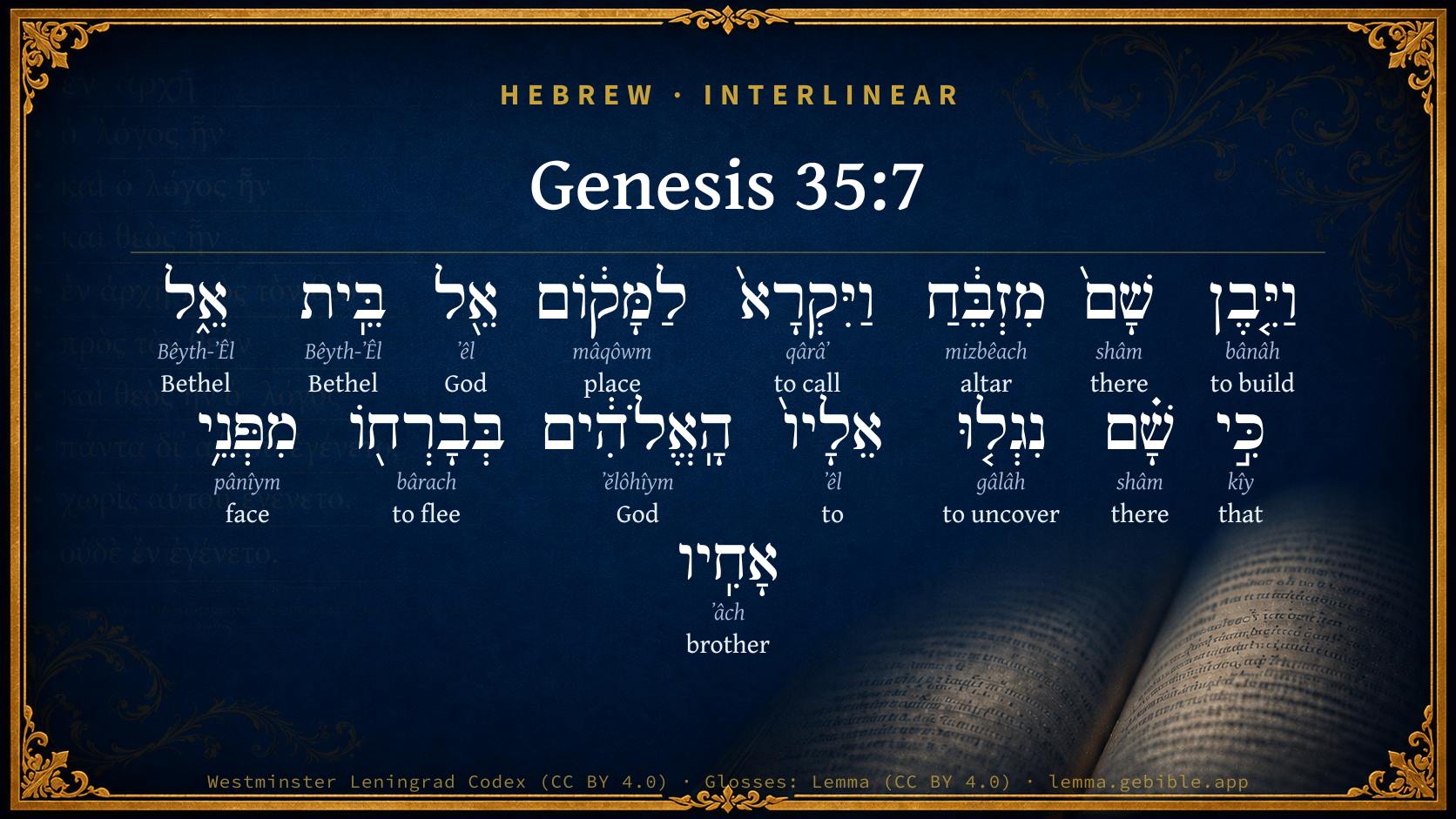
Hebrew (Westminster Leningrad Codex) Genesis 35:7 appears in the Hebrew Old Testament. The text above is from the Westminster Leningrad Codex. Each word links to its Strong’s number, a concise gloss, and parsing drawn from the Open Scriptures Hebrew Bible morphology. Click any word for its full Brown-Driver-Briggs (BDB) entry.
Download image
Cite this verse

Genesis 35:7 (World English Bible). Public Domain. Lemma interlinear Bible study tool, https://lemma.gebible.app/v/genesis/35/7.

Show BibTeX & RIS
BibTeX
RIS
English Translation
He built an altar there, and called the place El Beth El; because there God was revealed to him, when he fled from the face of his brother.
World English Bible · Public Domain
Download a study sheet

One document with this verse’s original text, its word-by-word gloss line, the meaning frame, cross-references with their text, attributed commentary, and full source and license credits — printable, and it pastes into notes with its structure intact.

This verse Autodidact and up

Study sheet (.html) Plain text (.txt)

A passage Seminary Student

Up to 50 verses in one chapter. A passage sheet keeps up to 6 commentary sources and 12 cross-references per verse, in the order this page ranks them, and says so on the sheet whenever that leaves anything out. Ask for a single verse and you get the Autodidact verse sheet above.

Everything on this page stays free to read, with no account — the sheet is a download of what is already on screen, not access to it.

Want to remove ads? Support Godless Engineer
Compare translations 3

The same verse in 3 English versions, stacked beneath the original-language interlinear above. Click any original word for its lexicon entry.

Each is an independent rendering of the whole verse — the interlinear is not word-aligned to these translations.

Highlighted words mark where these versions differ — a whole-verse word diff, not a word-by-word alignment.

  • World English Bible Public Domain
    He built an altar there, and called the place El Beth El; because there God was revealed to him, when he fled from the face of his brother.
  • King James Version Public Domain
    And he built there an altar, and called the place Elbethel: because there God appeared unto him, when he fled from the face of his brother.
  • unfoldingWord Literal Text CC BY-SA 4.0
    And there he built an altar, and he called the place El Bethel, because there God had revealed himself to him when he was fleeing from the presence of his brother.

unfoldingWord Literal Text — © unfoldingWord, licensed CC BY-SA 4.0. Word-aligned USFM3 via Door43 (git.door43.org/unfoldingWord/en_ult).

Versions to compare (up to 4)

3 of 4 selected

Show all 18 translations

Every available English version of this verse, each an independent rendering of the whole verse.

  • World English Bible Public Domain
    He built an altar there, and called the place El Beth El; because there God was revealed to him, when he fled from the face of his brother.
  • Berean Standard Bible Public Domain
    There Jacob built an altar, and he called that place El-bethel, because it was there that God had revealed Himself to Jacob as he fled from his brother.
  • Majority Standard Bible Public Domain
    There Jacob built an altar, and he called that place El-bethel, because it was there that God had revealed Himself to Jacob as he fled from his brother.
  • King James Version Public Domain
    And he built there an altar, and called the place Elbethel: because there God appeared unto him, when he fled from the face of his brother.
  • American Standard Version (1901) Public Domain
    And he built there an altar, and called the place El-beth-el; because there God was revealed unto him, when he fled from the face of his brother.
  • Revised Version (1885) Public Domain
    And he built there an altar, and called the place El-beth-el: because there God was revealed unto him, when he fled from the face of his brother.
  • Geneva Bible (1599) Public Domain
    And he built there an altar, and had called the place, The God of Beth-el, because that God appeared vnto him there, when he fled from his brother.
  • Douay-Rheims (1899) Public Domain
    And he built there an altar, and called the name of that place, The house of God: for there God appeared to him when he fled from his brother.
  • Young's Literal Translation Public Domain
    and he buildeth there an altar, and proclaimeth at the place the God of Bethel: for there had God been revealed unto him, in his fleeing from the face of his brother.
  • Literal Standard Version CC BY-SA 4.0
    and he builds there an altar, and proclaims at the place the God of Bethel: for there had God been revealed to him, in his fleeing from the face of his brother.
  • Unlocked Literal Bible CC BY-SA 4.0
    He built an altar there and called the place El Bethel, because there God had revealed himself to him, when he was fleeing from his brother.
  • unfoldingWord Literal Text CC BY-SA 4.0
    And there he built an altar, and he called the place El Bethel, because there God had revealed himself to him when he was fleeing from the presence of his brother.
  • Darby Bible Public Domain
    And he built there an altar, and called the place El-beth-el; because there God had appeared to him when he fled from the face of his brother.
  • World Messianic Bible Public Domain
    He built an altar there, and called the place El Beth El; because there God was revealed to him, when he fled from the face of his brother.
  • Webster's Bible Public Domain
    And he erected there an altar, and called the place El-beth-el; because there God appeared to him, when he fled from the face of his brother.
  • Free Bible Version CC BY-SA 4.0
    He built an altar there and called the place El-Bethel, because that was where God had appeared to him when he was running away from his brother Esau.
  • Bible in Basic English Public Domain
    And there he made an altar, naming the place El-beth-el: because it was there he had the vision of God when he was in flight from his brother.
  • JPS Tanakh (1917) Public Domain
    And he built there an altar, and called the place El-beth-el, because there God was revealed unto him, when he fled from the face of his brother.

Literal Standard Version (2020), Covenant Press — licensed CC BY-SA 4.0. Text via the HelloAO Bible API (eBible.org). Unlocked Literal Bible (unfoldingWord) — licensed CC BY-SA 4.0. Text via the HelloAO Bible API (eBible.org). unfoldingWord Literal Text — © unfoldingWord, licensed CC BY-SA 4.0. Word-aligned USFM3 via Door43 (git.door43.org/unfoldingWord/en_ult). Free Bible Version, Dr. Jonathan Gallagher — licensed CC BY-SA 4.0. Text via the HelloAO Bible API (eBible.org).

Word by word

More ways to search: Search by grammar → Find every occurrence → Compare this word →

Practice this passage: Drill this verse → Learn its vocabulary →

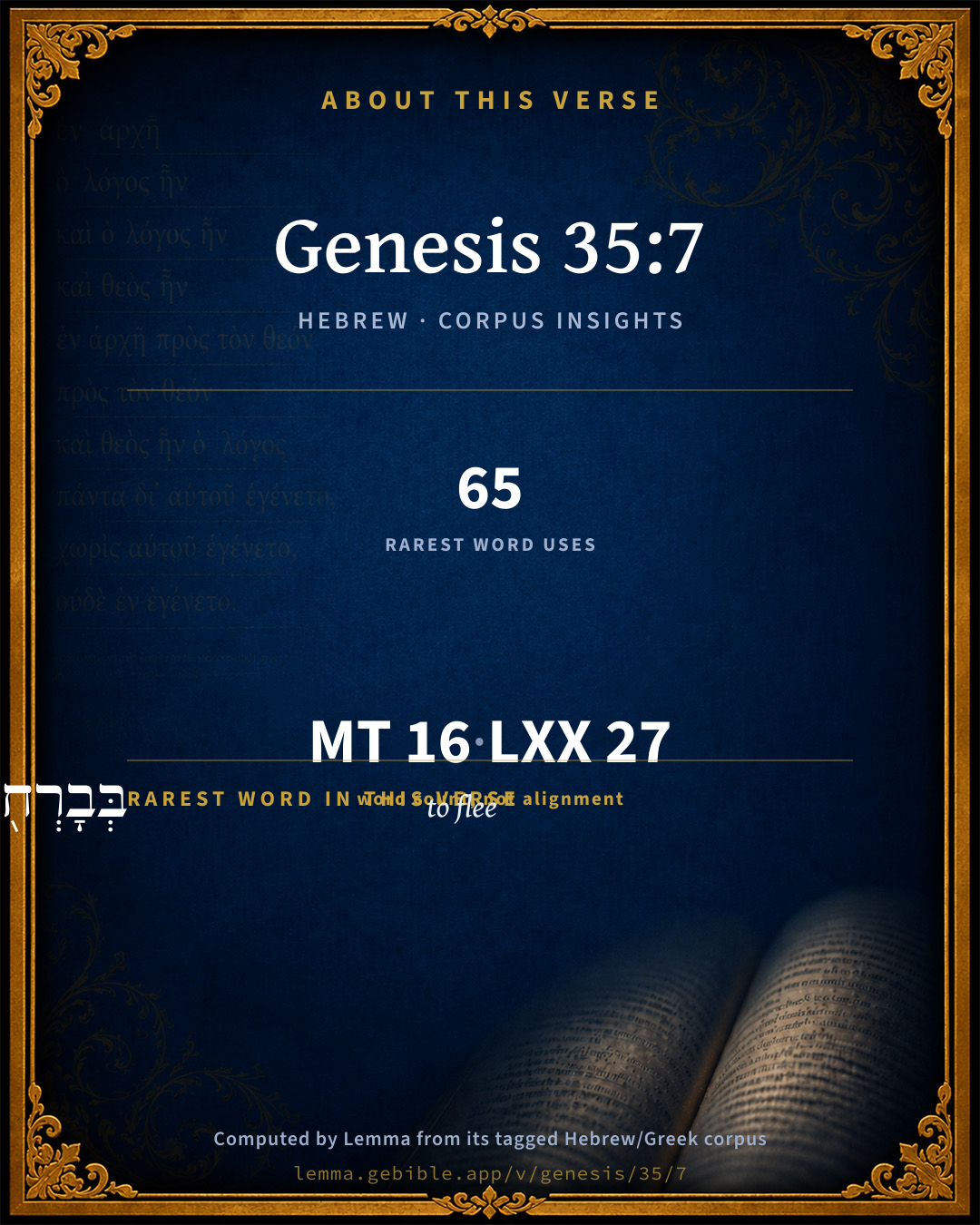
בְּבָרְח֖וֹ
bârach
H1272
“in/at · to flee · him”
Preposition + Verb, Qal, Infinitive Construct + Suffix, Personal, 3rd Person, Masculine, Singular
Part of Speech
Preposition + Verb
Stem
Qal
Form
Infinitive Construct
Full BDB Definition

Origin: a primitive root

TWOT: 284

to go through, flee, run away, chase, drive away, put to flight, reach, shoot (extend), hurry away - (Qal) - to go, pass through - to flee - to hasten, come quickly - (Hiphil) - to pass through - to cause to flee, put to flight - to drive away
  1. וַיִּ֤בֶן bânâh H1129 “and · to build” Conjunction + Verb, Qal, Sequential Imperfect, 3rd Person, Masculine, Singular
  2. שָׁם֙ shâm H8033 “there” Adverb
  3. מִזְבֵּ֔חַ mizbêach H4196 “altar” Noun, Common, Masculine, Singular, Absolute
  4. וַיִּקְרָא֙ qârâʼ H7121 “and · to call” Conjunction + Verb, Qal, Sequential Imperfect, 3rd Person, Masculine, Singular
  5. לַמָּק֔וֹם mâqôwm H4725 “to/for the · place” Preposition, Determined + Noun, Common, Masculine, Singular, Absolute
  6. אֵ֖ל ʼêl H410 “God of” Noun, Common, Masculine, Singular, Construct
  7. בֵּֽית Bêyth-ʼÊl H1008 “Bethel” Noun, Proper
  8. אֵ֑ל Bêyth-ʼÊl H1008 “Bethel” Noun, Proper
  9. כִּ֣י kîy H3588 “that” Conjunction
  10. שָׁ֗ם shâm H8033 “there” Adverb
  11. נִגְל֤וּ gâlâh H1540 “to uncover” Verb, Niphal, Perfect, 3rd Person, Common, Plural
  12. אֵלָיו֙ ʼêl H413 “to · him” Preposition + Suffix, Personal, 3rd Person, Masculine, Singular
  13. הָֽאֱלֹהִ֔ים ʼĕlôhîym H430 “the · God(s)” Particle, Definite Article + Noun, Common, Masculine, Plural, Absolute
  14. מִפְּנֵ֥י pânîym H6440 “from · face(s) of” Preposition + Noun, Common, Both, Plural, Construct
  15. אָחִֽיו ʼâch H251 “brother · his” Noun, Common, Masculine, Singular, Construct + Suffix, Personal, 3rd Person, Masculine, Singular

About this verse

These counts appear in no published source. They are computed here, from the morphology-tagged text and Lemma’s own curated glosses. What Lemma adds →

16
words
14
distinct lemmas
Pentateuch
section

Grammatical profile

  • 4 verbs
  • 8 nouns
  • 1 preposition
  • 1 conjunction
  • 2 adverbs

Verb forms

  • וַיִּ֤בֶן Qal · Sequential Imperfect
  • וַיִּקְרָא֙ Qal · Sequential Imperfect
  • נִגְל֤וּ Niphal · Perfect
  • בְּבָרְח֖וֹ Qal · Infinitive Construct

Repetition

Words recur within this verse — often emphatic in Hebrew:

  • שָׁם֙ there H8033 ×2
  • בֵּֽית Bethel H1008 ×2

Hebrew & Septuagint length

In English translation the verse runs 28 words from the Hebrew and 30 from the Septuagint (LXX English) — closely comparable.

A rough comparison of the two English renderings, which tokenize alike — not a word-level alignment.

Word counts can differ between the Hebrew and the Greek without any difference in meaning — e.g. the Hebrew direct-object marker אֵת has no separate Greek word, and Greek often adds the article ὁ.

In the original languages it is 16 Hebrew tokens and 27 Greek tokens — but the two are counted differently (Hebrew bundles its prefixes and suffixes into one token; the Greek is in lemma form), so that isn’t a like-for-like length.

Cross-references

9

Topical passages linked to Genesis 35:7 in the Treasury of Scripture Knowledge — connected by theme and wording, ordered by reader-vote popularity; previews shown in the World English Bible.

  • Genesis 28:13 Behold, Yahweh stood above it, and said, "I am Yahweh, the God of Abraham your father, and the God of Isaac. The land whereon you lie, to you will I give it, and to your seed.
  • Genesis 35:1 God said to Jacob, "Arise, go up to Bethel, and live there. Make there an altar to God, who appeared to you when you fled from the face of Esau your brother."
  • Genesis 35:3 Let us arise, and go up to Bethel. I will make there an altar to God, who answered me in the day of my distress, and was with me in the way which I went."
  • Genesis 28:19 He called the name of that place Bethel, but the name of the city was Luz at the first.
  • Genesis 28:22 then this stone, which I have set up for a pillar, will be God's house. Of all that you will give me I will surely give the tenth to you."
  • Exodus 17:15 Moses built an altar, and called the name of it Yahweh our Banner.
  • Judges 6:24 Then Gideon built an altar there to Yahweh, and called it Yahweh-shalom: to this day it is yet in Ophrah of the Abiezrites.
  • Ecclesiastes 5:4–5 When you vow a vow to God, don't defer to pay it; for he has no pleasure in fools. Pay that which you vow.
  • Ezekiel 48:35 It shall be eighteen thousand [reeds] round about: and the name of the city from that day shall be, Yahweh is there.

Cross-references courtesy of OpenBible.info (CC BY 4.0).

Hebrew and Greek witnesses Masoretic Hebrew ↔ Greek Septuagint

The same verse in the two great witnesses to the Old Testament, shown verse-for-verse.

These are two independent witnesses, not word-aligned to each other, and the Septuagint is shown in lemma (dictionary) form.

Hebrew Genesis 35:7 Masoretic · Westminster Leningrad Codex

וַיִּ֤בֶן שָׁם֙ מִזְבֵּ֔חַ וַיִּקְרָא֙ לַמָּק֔וֹם אֵ֖ל בֵּֽית אֵ֑ל כִּ֣י שָׁ֗ם נִגְל֤וּ אֵלָיו֙ הָֽאֱלֹהִ֔ים בְּבָרְח֖וֹ מִפְּנֵ֥י אָחִֽיו

He built an altar there, and called the place El Beth El; because there God was revealed to him, when he fled from the face of his brother.

World English Bible · Public Domain

Greek LXX Genesis 35:7 Septuagint · lemma form

καί οἰκοδομέω ἐκεῖ θυσιαστήριον καί καλέω ὁ ὄνομα ὁ τόπος βαιθηλ ἐκεῖ γάρ ἐπιφαίνω αὐτός ὁ θεός ἐν ὁ ἀποδιδράσκω αὐτός ἀπό πρόσωπον ησαυ ὁ ἀδελφός αὐτός

And he built there an altar, and called the name of the place Baethel; for there God appeared to him, when he fled from the face of his brother Esau.

LXX2012 (modern English Septuagint) · Public Domain

On this verse, Adam Clarke's Commentary discusses the Septuagint’s reading. Read the note in Commentary ↓

Hebrew: Westminster Leningrad Codex (CC BY 4.0). Greek: Septuagint (public domain); English from LXX2012 (modern English Septuagint) (Public Domain). How the Septuagint differs from the Hebrew →

Targum (Aramaic paraphrase)

2

The Targum is the ancient Jewish Aramaic paraphrase of the Hebrew Scriptures — an interpretive translation, not the Hebrew text itself. Onkelos (literal) and Pseudo-Jonathan (expansive) render the Torah, and Jonathan the Prophets. Coverage is partial: where no permissively-licensed English translation exists for a verse, only the Aramaic is shown. This is verse-level text, not a word-by-word alignment to the Hebrew.

  1. Targum Onkelos Torah (Genesis–Deuteronomy)
    וּבְנָא תַמָּן מַדְבְּחָא וּקְרָא לְאַתְרָא אֵל בֵּית אֵל אֲרֵי תַמָּן אִתְגְלֵי לֵהּ יְיָ בְּמֵעִרְקֵהּ מִן קֳדָם אָחוּהִי

    (no public-domain English translation for this verse)

    Targum Onkelos — Aramaic: “Onkelos Genesis” (public domain); “Onkelos Exodus” (public domain); “Onkelos Leviticus” (public domain); “Onkelos Numbers” (public domain); “Onkelos Deuteronomy” (public domain). English: “Sefaria Community Translation” (CC0 1.0 (public-domain dedication)); “J.W. Etheridge. The Targums of Onkelos and Jonathan Ben Uzziel on the Pentateuch. London: Longmans, Green, 1862” (public domain). Text via Sefaria.

  2. Targum Pseudo-Jonathan Torah (Genesis–Deuteronomy)
    וּבְנָא תַמָן מַדְבְּחָא וּקְרָא לְאַתְרָא הַהוּא אֵל דְאַשְׁרֵי שְׁכִינְתֵּיהּ בְּבֵית אֵל אֲרוּם תַּמָן אִתְגְלִיאוּ לֵיהּ מַלְאָכַיָא דַיְיָ בְּמֵעַרְקֵיהּ מִן קֳדָם עֵשָו אָחוֹי

    And he builded there an altar, and named that place, To God, who made His Shekinah to dwell in Bethel, because there had been revealed to him the angels of the Lord, in his flight from before Esau his brother.

    Targum Pseudo-Jonathan — Aramaic: “Targum Jonathan on Genesis” (public domain); “Targum Jonathan on Exodus” (public domain); “Targum Jonathan on Leviticus” (public domain); “Targum Jonathan on Numbers” (public domain); “Targum Jonathan on Deuteronomy” (public domain). English: “The Targum of Jonathan ben Uzziel, trans. J. W. Etheridge, London, 1862” (public domain). Text via Sefaria.

Commentary

Notes on Genesis 35:7 from classic Christian and Jewish commentators (each source and its license shown beneath its notes). The classic Christian expositions comment on the surrounding passage and are grouped to its opening verse, so a note may address several verses; the Jewish commentaries on the Tanakh (Rashi and others) are per-verse, so they appear only where the commentator wrote on this verse.

Lemma curates 59 commentaries, every one of them public domain or Creative Commons licensed, each selected and text-cleaned for this edition rather than reprinted as found. About our sources →

Trapp's Complete Commentary

John Trapp

Gen 35:7 And he built there an altar, and called the place Elbethel: because there God appeared unto him, when he fled from the face of his brother.

Ver. 7. Because there God appeared.] Heb., Revelavissent Dii. Not the angels, but the sacred Trinity. {See Trapp on "Gen 1:1"}

John Trapp, A Commentary or Exposition upon All the Books of the Old and New Testament (1647–1656) — public domain. Text from a community e-Sword module.

Joseph Benson's Commentary

Gen 35:7. He built an altar — And, no doubt, offered sacrifice upon it, perhaps the tenth of his cattle, according to his vow, I will give the tenth unto thee. And he called the place — That is, the altar, El-Beth-el — The God of Beth-el. As when he made a thankful acknowledgment of the honour God had done him in calling him Israel, he worshipped God by the name of El-elohe-Israel; so now he was making a grateful recognition of God’s former favour at Beth-el, he worships God by the name of the God of Beth-el, because there God appeared to him.

Joseph Benson's Commentary on the Old and New Testaments (1811–1818) — public domain. Text from a community e-Sword module.

Jamieson, Fausset & Brown

Robert Jamieson, A. R. Fausset & David Brown

El-Beth-el--that is, "the God of Beth-el."

Jamieson, Fausset & Brown — Commentary Critical and Explanatory on the Whole Bible (1871) — public domain (CC PDM 1.0). Text via the HelloAO Bible API.

Adam Clarke's Commentary

Verse 7. El-beth-el] אל בית אל the strong God, the house of the strong God. But the first אל el is wanting in one of De Rossi's MSS., as it is also in the Septuagint, Vulgate, Syriac, and some copies of the Arabic. The sentence reads much better without it, and much more consistent with the parallel passages.

Adam Clarke's Commentary on the Bible (1810–1826) — public domain. Text from a community e-Sword/MySword module.

John Calvin's Commentaries

7. And he built there an altar. It has been already stated why it behoved the holy fathers, wherever they came, to have an altar of their own, distinct from those of other nations; namely, to make it manifest that they did not worship gods of various kinds, a practice to which the world was then everywhere addicted, but that they had a God peculiar to themselves. For although God is worshipped with the mind, yet an external confession is the inseparable companion of faith. Besides, all acknowledge how very useful it is to us to be stirred up by outward helps to the worship of God. If any one object that these altars differed nothing from other altars in appearance; I answer, that whereas others rashly, and with inconsiderate zeal, built altars to unknown gods, Jacob always adhered to the word of God. And there is no lawful altar but that which is consecrated by the word; nor indeed did the worship of Jacob excel by any other mark than this, that he attempted nothing beyond the command of God. In calling the name of the place “The God of Beth-el,” he is thought to be too familiar; and yet this very title commends the faith of the holy man, and that rightly, since he confines himself within the divinely prescribed bounds. The Papists act foolishly in affecting the praise of humility by a modesty which is most degrading. But the humility of faith is praiseworthy, seeing it does not desire to know more than God permits. And as when God descends to us, he, in a certain sense, abases himself, and stammers with us, so he allows us to stammer with him. And this is to be truly wise, when we embrace God in the manner in which he accommodates himself to our capacity. For in this way, Jacob does not keenly dispute concerning the essence of God, but renders God familiar to himself by the oracle which he has received. And because he applies his senses to the revelation, this stammering and simplicity (as I have said) is acceptable to God. Now, though at this day, the knowledge of God has shined more clearly, yet since God, in the gospel, takes upon him the character of a nursing father, let us learn to subject our minds to him; only let us remember that he descends to us in order to raise us up to himself. For he does not speak to us in this earthly manner, to keep us at a distance from heaven, but rather by this vehicle, to draw us up thither. Meanwhile this rule must be observed, that since the name of the altar was given by a celestial oracle, the building of it was a proof of faith. For where the living voice of God does not sound, whatever pomps may be introduced will be like shadowy spectres; as in the Papacy nothing can be seen except bladders filled with wind. It may be added that Jacob shows the constant tenor of his faith, from the time that God began to manifest himself to him; because he keeps in view the fact, that the angels had appeared unto him. For since the word is in the plural number, I willingly interpret it of angels; and this is not contrary to the former doctrine; for although the majesty of God was then conspicuous, so far as he could comprehend it, yet Moses does not without reason mention the angels whom Jacob saw ascending and descending on the steps of the ladder. For he then beheld the glory of God in the angels, as we see the splendor of the sun flowing to us through his rays.

John Calvin's Commentaries (1540-1563) — public domain. Text from the Calvin Translation Society English edition (1840s-50s) via the Christian Classics Ethereal Library (ccel.org). Calvin's coverage is partial (roughly two-thirds of the Bible); uncommented books and verses are honest gaps, never fabricated. The 19th-century editor's footnotes and remarks are omitted so the notes are faithfully Calvin's own voice.

Ellicott's Commentary for English Readers

(7) El-beth-el.—That is, the God of the house of God: the God into whose house he had been admitted, and seen there the wonders of His providence.

God appeared.—The verb here, contrary to rule, is plural (see Note on Gen_20:13), but the Samaritan Pentateuch has the singular. No argument can be drawn either way from the versions, as the word for God is singular in them all, and the verb necessarily singular also. In no other language but Hebrew is the name of God plural, but joined with verbs and adjectives in the singular.

A Bible Commentary for English Readers, edited by Charles John Ellicott (1878–1897) — public domain. Text from a community e-Sword module.

The Cambridge Bible for Schools and Colleges

gen. ed. J. J. S. Perowne

7. the place] See notes on Gen_12:6, Gen_28:11.

El-beth-el] That is, the God of Beth-el. Here, as in Gen_33:20, the altar receives the name of the deity.

was revealed] Referring to Gen_28:12-13. In the Heb. “was revealed” is in the plural: see note on Gen_20:13, cf. Jos_24:19. Dillmann (Theologie d. A.T., p. 211) explains this by saying that “Elohim” here is “God with the angels.” The Divine Presence is regarded as hidden or covered, and needing to be “revealed”; cf. Num_24:4; Num_24:16.

The Cambridge Bible for Schools and Colleges (gen. ed. J. J. S. Perowne; Cambridge University Press, 1878–1918) — public domain. Text from a community e-Sword module.

John Gill's Exposition

And he built there an altar,.... As he was bid to do, and as he promised he would, Gen 35:1,

and called the place Elbethel; the God of Bethel; a title which God takes to himself, Gen 31:13; or rather the sense is, that he called the place with respect God, or because of his appearance to him there, Bethel, confirming the name he had before given it, Gen 36:19; see Gen 35:15; as the following reason shows:

because there God appeared; or the divine Persons, for both words are plural that are used; the Targum of Jonathan has it, the angels of God, and so Aben Ezra interprets it; but here, no doubt, the divine Being is meant, who appeared

unto him; to Jacob in this place, as he went to Mesopotamia, and comforted and encouraged him with many promises:

when he fled from the face of his brother; his brother Esau, who was wroth with him, and sought to take away his life, and therefore was forced to flee for it.

John Gill's Exposition of the Whole Bible (1746–1763) — public domain (CC PDM 1.0). Text via the HelloAO Bible API.

Haydock's Catholic Bible Commentary

To him. Hebrew literally, "He called that place the God of Bethel, because there God (or the angels) appeared to him." Haelohim, with a verb plural, generally refers to angels; when it is applied to God, the article is omitted, and the verb is singular. (Calmet)

George Leo Haydock (1774–1849), Haydock's Catholic Family Bible and Commentary, 1859 edition — public domain. Excludes Psalms (Douay-Rheims chapter numbering differs from Protestant) and Deuterocanonical books (Catholic canon only).

Matthew Poole's English Annotations

El-beth-el, i.e. He confirmed the name which he had formerly given to the place.

Matthew Poole's English Annotations on the Holy Bible (1683–1685) — public domain. Text from a community e-Sword/MySword module.

Whedon's Commentary on the Bible

Daniel D. Whedon

7. El-beth-el — God of the house of God. Everywhere he seeks to honour the divine Name. Compare the hallowed names El-Elohe-Israel (Gen_33:20) and Penuel, (Gen_32:30.)

Daniel D. Whedon (gen. ed.), Commentary on the Old and New Testaments (1874–1909) — public domain. Text from a community e-Sword module.

The Pulpit Commentary

And he built there an altar, thus redeeming his vow (cf. Ecc_5:4) and called the place El-beth-el:i.e. God of Bethel. Not he called the place of God, or the place sacred to God, Bethel (Michaelis, "Suppl.," p. 2174), nor he called the altar (Keil, Kalisch, Gerlach, &c.), but he called the place where the altar was El-beth-el; i.e. either he devoted the place as sacred to the El of Bethel (Rosenm or he gave to the place the name of (so. the place of) the El of Bethel, reading the first El as a genitive (Lange); or he called it El-Beth-el metaphorically, as Jerusalem afterwards was styled Jehovah Tsidkenu (Jer_33:16) and Jehovah Shammah. (Eze_48:35; Inglis) It has been proposed, after the LXX, to avoid the seeming incongruity of assigning such a name to a place, to read, he invoked upon the place the El of Bethel (Quarry, p. 513)because there God appeared unto him, the El of Bethel was Jehovah (vide Gen_28:13 Gen_31:13) when he fled from the face of his brother.

The Pulpit Commentary (1880–1919), ed. H.D.M. Spence-Jones & Joseph S. Exell — public domain. Text from a community e-Sword module.

John Wesley's Explanatory Notes

He built an altar - And no doubt offered sacrifice upon it, perhaps the tenth of his cattle, according to his vow, I will give the tenth unto thee. And he called the place, That is, the altar, El- beth-el, the God of Beth-el. As when he made a thankful acknowledgement of the honour God had done him in calling him Israel, he worshipped God by the name of El-elohe-israel, so now he was making a grateful recognition of God's former favour at Beth-el, he worships God by the name of El-beth-el, the God of Beth-el, because there God appeared to him.

John Wesley, Explanatory Notes Upon the Whole Bible (1754–1765) — public domain. Text via the GEBible commentary corpus.

Scofield Reference Notes

C. I. Scofield

El-beth-el

i.e. the God of Bethel. Cf. Gen 28:19. There it was the place as the scene of the ladder vision which impressed jacob. He called the place "Bethel," i.e. the house of God. Now it is the God of the place, rather than the place, and he calls it El-Bethel, i.e. "the God of the house of God." Cf. Gen 33:20.

The Scofield Reference Bible (1917 edition), notes by C. I. Scofield — public domain. Text from a community e-Sword module.

Rashi

Rabbi Shlomo Yitzchaki (Rashi)

אל בית אל EL-BETH-EL — the Holy One, blessed be He, is in Beth-El; i.e. His Divine Presence has revealed itself in Bethel. Sometimes the prefix ב “in” is omitted from a word: e.g., (2 Samuel 9:4) “Behold, he is (בית) in the house of Muchir, the son of Ammiel”, which is the same as בבית in the house of Machir; (24:13) בית אביך is the same as בבית אביך,‘in the house of thy father”.

נגלו אליו האלהים GOD WAS REVEALED UNTO Him — In many passages terms denoting Divine Power and Lordship are used in the plural e. g., (39:20) “Joseph’s master (אֲדֹנֵי)” (construct plural), and (Exodus 22:14) “If its owner (בעליו) be with it”, where it does not say בַּעֲלוֹ (the singular form). Similarly, forms of אלהים denoting Judge or Authority are expressed in the plural, but you will find none other of the Divine Names in the plural.

Rashi on the Tanakh — English translations: “The Judaica Press complete Tanach with Rashi, translated by A. J. Rosenberg” (CC BY 4.0); “Pentateuch with Rashi's commentary by M. Rosenbaum and A.M. Silbermann, 1929-1934” (public domain); “The Metsudah Tanach series, Lakewood, N.J” (CC BY 4.0); and “The Book of Joshua, Metsudah Publications, 1997” (CC BY 4.0). Text via Sefaria.

Radak

Rabbi David Kimhi (Radak)

ויבן שם מזבח, this means that he built the altar in the house he had built there at the site of the original monument of which he had said in 28,22 “this will become a house of G’d.” We explained this on that verse. It does not matter that the house itself was not mentioned here separately.

ויקרא למקום א-ל בית א-ל. He had already called it Bet El on a previous occasion, Now he only expanded the name. Compare our commentary on 33,20.

כי שם נגלו אליו האלוקים, a reference to the angels ascending and descending the ladder whom he had seen in his dream. Alternatively, the meaning of the word ה-אלוקים is a reference to G’d, Himself, not an intermediary. The reason why he used the plural mode נגלו instead of נגלה when the subject is only G’d Himself, is that this is a form of great respect and honour for the subject [known as pluralis majestatis when a king refers to himself in the plural. Ed.] compare Psalms 149,2 ישמח ישראל בעושיו, “Let Israel rejoice in its Maker.” A similar construction is found in Job 35,10 איה אלו-ה עושי?, “Where is the Lord, My Maker?” There are more such examples in Scripture.

Radak on the Tanakh — English translations: “Sefaria Community Translation” (CC0 1.0 (public-domain dedication)); “Eliyahu Munk, HaChut Hameshulash” (CC BY 4.0); “Rabbi Mike Feuer, Jerusalem Anthology” (CC BY 4.0); and “R. David Kimhi on the first book of Psalms, Translated by R.G. Finch, London, 1919” (public domain). Text via Sefaria.

Lesson kit

Teaching starters — assembled from the data on this page, not authored interpretation. Every prompt links to the verse data it draws on. Edit before teaching.

Genesis, in the Pentateuch, opens this verse with 16 words (14 distinct Hebrew lemmas). Its most distinctive word is bârach (“to flee”). A historical commentator’s framing appears above. Read the whole chapter for the surrounding context.

Discussion questions

  1. How does “to flee” (bârach) shape what this verse is saying?
  2. How does Genesis 28:13, which shares this passage’s theme, read alongside this verse?
  3. What does the repetition of “there” (2× in this one verse) do in this verse?
  4. The translations on this page render this verse differently — a whole-verse word diff, not a word-by-word alignment. What might account for the different wordings?
  5. «וַיִּ֤בֶן» is a Qal Sequential Imperfect verb. How does that grammatical form shape the action described?
  6. Compare how Trapp's Complete Commentary and Joseph Benson's Commentary read this verse. Where do they agree or differ?

Things to notice

Reading settings

Reading text

Shown beneath each verse's original-language words.

Old Testament
Old Testament edition

Read the OT as the Masoretic Hebrew (MT) or the Greek Septuagint (LXX).

English shown for the Greek Septuagint (in the Hebrew ↔ Greek comparison).

Comparing translations? Open the Compare panel on any verse page to stack up to four side by side.