Leviticus 4:10

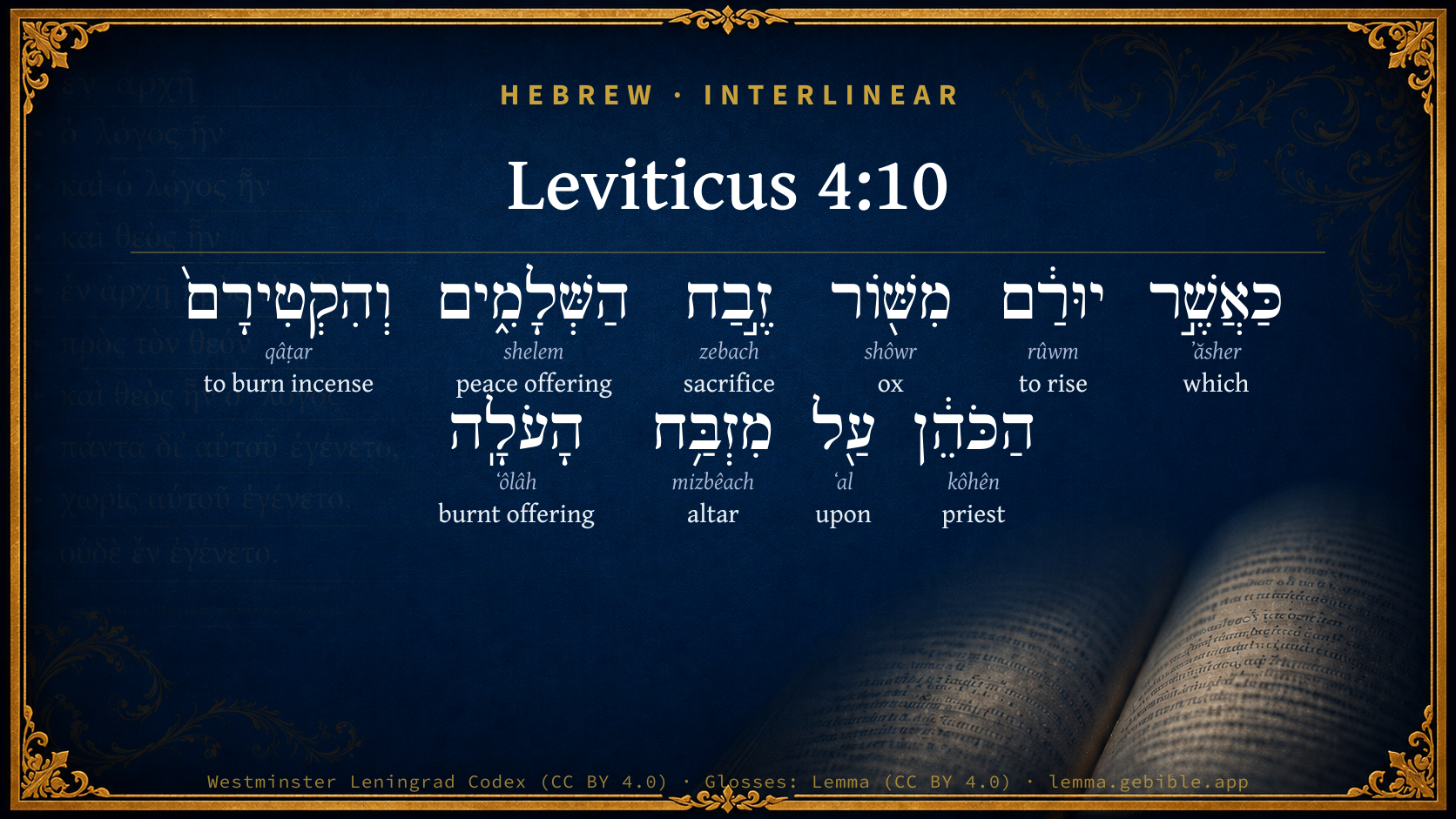
Hebrew (Westminster Leningrad Codex) Leviticus 4:10 appears in the Hebrew Old Testament. The text above is from the Westminster Leningrad Codex. Each word links to its Strong’s number, a concise gloss, and parsing drawn from the Open Scriptures Hebrew Bible morphology. Click any word for its full Brown-Driver-Briggs (BDB) entry.
Download image
Cite this verse

Leviticus 4:10 (World English Bible). Public Domain. Lemma interlinear Bible study tool, https://lemma.gebible.app/v/leviticus/4/10.

Show BibTeX & RIS
BibTeX
RIS
English Translation
as it is taken off of the ox of the sacrifice of peace offerings. The priest shall burn them on the altar of burnt offering.
World English Bible · Public Domain
Download a study sheet

One document with this verse’s original text, its word-by-word gloss line, the meaning frame, cross-references with their text, attributed commentary, and full source and license credits — printable, and it pastes into notes with its structure intact.

This verse Autodidact and up

Study sheet (.html) Plain text (.txt)

A passage Seminary Student

Up to 50 verses in one chapter. A passage sheet keeps up to 6 commentary sources and 12 cross-references per verse, in the order this page ranks them, and says so on the sheet whenever that leaves anything out. Ask for a single verse and you get the Autodidact verse sheet above.

Everything on this page stays free to read, with no account — the sheet is a download of what is already on screen, not access to it.

Want to remove ads? Support Godless Engineer
Compare translations 3

The same verse in 3 English versions, stacked beneath the original-language interlinear above. Click any original word for its lexicon entry.

Each is an independent rendering of the whole verse — the interlinear is not word-aligned to these translations.

Highlighted words mark where these versions differ — a whole-verse word diff, not a word-by-word alignment.

  • World English Bible Public Domain
    as it is taken off of the ox of the sacrifice of peace offerings. The priest shall burn them on the altar of burnt offering.
  • King James Version Public Domain
    As it was taken off from the bullock of the sacrifice of peace offerings: and the priest shall burn them upon the altar of the burnt offering.
  • unfoldingWord Literal Text CC BY-SA 4.0
    just as it is lifted up from the ox of the sacrifice of the peace offering. And the priest shall cause them to become smoke on the altar of the burnt offering.

unfoldingWord Literal Text — © unfoldingWord, licensed CC BY-SA 4.0. Word-aligned USFM3 via Door43 (git.door43.org/unfoldingWord/en_ult).

Versions to compare (up to 4)

3 of 4 selected

Show all 18 translations

Every available English version of this verse, each an independent rendering of the whole verse.

  • World English Bible Public Domain
    as it is taken off of the ox of the sacrifice of peace offerings. The priest shall burn them on the altar of burnt offering.
  • Berean Standard Bible Public Domain
    just as the fat is removed from the ox of the peace offering. Then the priest shall burn them on the altar of burnt offering.
  • Majority Standard Bible Public Domain
    just as the fat is removed from the ox of the peace offering. Then the priest shall burn them on the altar of burnt offering.
  • King James Version Public Domain
    As it was taken off from the bullock of the sacrifice of peace offerings: and the priest shall burn them upon the altar of the burnt offering.
  • American Standard Version (1901) Public Domain
    as it is taken off from the ox of the sacrifice of peace-offerings: and the priest shall burn them upon the altar of burnt-offering.
  • Revised Version (1885) Public Domain
    as it is taken off from the ox of the sacrifice of peace offerings: and the priest shall burn them upon the altar of burnt offering.
  • Geneva Bible (1599) Public Domain
    As it was taken away from the bullock of the peace offrings, and the Priest shall burne them vpon the altar of burnt offring.
  • Douay-Rheims (1899) Public Domain
    As it is taken off from the calf of the sacrifice of peace offerings, and he shall burn them upon the altar of holocaust.
  • Young's Literal Translation Public Domain
    as it is lifted up from the ox of the sacrifice of the peace-offerings; and the priest hath made them a perfume on the altar of the burnt-offering.
  • Literal Standard Version CC BY-SA 4.0
    as it is lifted up from the ox of the sacrifice of the peace-offerings; and the priest has made them an incense on the altar of the burnt-offering.
  • Unlocked Literal Bible CC BY-SA 4.0
    He will cut it all away, just as he cuts it off from the bull of the sacrifice of peace offerings. Then the priest will burn these parts on the altar for burnt offerings.
  • unfoldingWord Literal Text CC BY-SA 4.0
    just as it is lifted up from the ox of the sacrifice of the peace offering. And the priest shall cause them to become smoke on the altar of the burnt offering.
  • Darby Bible Public Domain
    as it is taken off from the ox of the sacrifice of peace-offering; and the priest shall burn them on the altar of burnt-offering.
  • World Messianic Bible Public Domain
    as it is removed from the bull of the sacrifice of peace offerings. The priest shall burn them on the altar of burnt offering.
  • Webster's Bible Public Domain
    As it was taken off from the bullock of the sacrifice of peace-offerings: and the priest shall burn them upon the altar of the burnt-offering.
  • Free Bible Version CC BY-SA 4.0
    in the same way as the fat is removed from the bull of the peace offering. Then the priest shall burn this on the altar of burnt offering.
  • Bible in Basic English Public Domain
    As it is taken from the ox of the peace-offering; and it is to be burned by the priest on the altar of burned offerings.
  • JPS Tanakh (1917) Public Domain
    as it is taken off from the ox of the sacrifice of peace-offerings; and the priest shall make them smoke upon the altar of burnt-offering.

Literal Standard Version (2020), Covenant Press — licensed CC BY-SA 4.0. Text via the HelloAO Bible API (eBible.org). Unlocked Literal Bible (unfoldingWord) — licensed CC BY-SA 4.0. Text via the HelloAO Bible API (eBible.org). unfoldingWord Literal Text — © unfoldingWord, licensed CC BY-SA 4.0. Word-aligned USFM3 via Door43 (git.door43.org/unfoldingWord/en_ult). Free Bible Version, Dr. Jonathan Gallagher — licensed CC BY-SA 4.0. Text via the HelloAO Bible API (eBible.org).

Word by word

More ways to search: Search by grammar → Find every occurrence → Compare this word →

Practice this passage: Drill this verse → Learn its vocabulary →

מִשּׁ֖וֹר
shôwr
H7794
“from · ox of”
Preposition + Noun, Common, Masculine, Singular, Construct
Part of Speech
Preposition + Noun
Type
Common
Gender
Masculine
Number
Singular
State
Construct
Full BDB Definition

Origin: from H7788

TWOT: 2355a

ox, bull, a head of cattle - for plowing, for food, as sacrifice
  1. כַּאֲשֶׁ֣ר ʼăsher H834 “like/as · which” Preposition + Particle, Relative
  2. יוּרַ֔ם rûwm H7311 “to rise” Verb, Hophal, Imperfect, 3rd Person, Masculine, Singular
  3. זֶ֣בַח zebach H2077 “sacrifice of” Noun, Common, Masculine, Singular, Construct
  4. הַשְּׁלָמִ֑ים shelem H8002 “the · peace offerings” Particle, Definite Article + Noun, Common, Masculine, Plural, Absolute
  5. וְהִקְטִירָם֙ qâṭar H6999 “and · to burn incense · them” Conjunction + Verb, Hiphil, Sequential Perfect, 3rd Person, Masculine, Singular + Suffix, Personal, 3rd Person, Masculine, Plural
  6. הַכֹּהֵ֔ן kôhên H3548 “the · priest” Particle, Definite Article + Noun, Common, Masculine, Singular, Absolute
  7. עַ֖ל ʻal H5921 “upon” Preposition
  8. מִזְבַּ֥ח mizbêach H4196 “altar of” Noun, Common, Masculine, Singular, Construct
  9. הָעֹלָֽה ʻôlâh H5930 “the · burnt offering” Particle, Definite Article + Noun, Common, Feminine, Singular, Absolute

About this verse

These counts appear in no published source. They are computed here, from the morphology-tagged text and Lemma’s own curated glosses. What Lemma adds →

10
words
10
distinct lemmas
Pentateuch
section

Grammatical profile

  • 2 verbs
  • 6 nouns
  • 1 preposition
  • 1 particle

Verb forms

  • יוּרַ֔ם Hophal · Imperfect
  • וְהִקְטִירָם֙ Hiphil · Sequential Perfect

Hebrew & Septuagint length

In English translation the verse runs 25 words from the Hebrew and 25 from the Septuagint (LXX English) — the same length.

A rough comparison of the two English renderings, which tokenize alike — not a word-level alignment.

Word counts can differ between the Hebrew and the Greek without any difference in meaning — e.g. the Hebrew direct-object marker אֵת has no separate Greek word, and Greek often adds the article ὁ.

Hebrew and Greek witnesses Masoretic Hebrew ↔ Greek Septuagint

The same verse in the two great witnesses to the Old Testament, shown verse-for-verse.

These are two independent witnesses, not word-aligned to each other, and the Septuagint is shown in lemma (dictionary) form.

Hebrew Leviticus 4:10 Masoretic · Westminster Leningrad Codex

כַּאֲשֶׁ֣ר יוּרַ֔ם מִשּׁ֖וֹר זֶ֣בַח הַשְּׁלָמִ֑ים וְהִקְטִירָם֙ הַכֹּהֵ֔ן עַ֖ל מִזְבַּ֥ח הָעֹלָֽה

as it is taken off of the ox of the sacrifice of peace offerings. The priest shall burn them on the altar of burnt offering.

World English Bible · Public Domain

Greek LXX Leviticus 4:10 Septuagint · lemma form

ὅς τρόπος ἀποαἱρέω ἀπό ὁ μόσχος ὁ ὁ θυσία ὁ σωτήριον καί ἀναφέρω ὁ ἱερεύς ἐπί ὁ θυσιαστήριον ὁ κάρπωσις

as he takes it away from the calf of the sacrifice of peace-offering, so shall the priest offer it on the altar of burnt offering.

LXX2012 (modern English Septuagint) · Public Domain

Hebrew: Westminster Leningrad Codex (CC BY 4.0). Greek: Septuagint (public domain); English from LXX2012 (modern English Septuagint) (Public Domain). How the Septuagint differs from the Hebrew →

Targum (Aramaic paraphrase)

2

The Targum is the ancient Jewish Aramaic paraphrase of the Hebrew Scriptures — an interpretive translation, not the Hebrew text itself. Onkelos (literal) and Pseudo-Jonathan (expansive) render the Torah, and Jonathan the Prophets. Coverage is partial: where no permissively-licensed English translation exists for a verse, only the Aramaic is shown. This is verse-level text, not a word-by-word alignment to the Hebrew.

  1. Targum Onkelos Torah (Genesis–Deuteronomy)
    כְּמָא דִי מִתַּפְרֵשׁ מִתּוֹר נִכְסַּת קוּדְשַׁיָא וְיַסֵקִנוּן כַּהֲנָא עַל מַדְבְּחָא דַעֲלָתָא

    (no public-domain English translation for this verse)

    Targum Onkelos — Aramaic: “Onkelos Genesis” (public domain); “Onkelos Exodus” (public domain); “Onkelos Leviticus” (public domain); “Onkelos Numbers” (public domain); “Onkelos Deuteronomy” (public domain). English: “Sefaria Community Translation” (CC0 1.0 (public-domain dedication)); “J.W. Etheridge. The Targums of Onkelos and Jonathan Ben Uzziel on the Pentateuch. London: Longmans, Green, 1862” (public domain). Text via Sefaria.

  2. Targum Pseudo-Jonathan Torah (Genesis–Deuteronomy)
    הֵיכְמָא דְמִתְפְּרֵשׁ מִתּוֹר נִכְסַת קוּדְשַׁיָא הֵיכְדֵין יִתְפַּרְשׁוּן מִן אִימְרָא וּמִן עִיזָא וִיסַקְיוּ כַּהֲנָא עַל מַדְבְּחָא דְעָלָתָא

    As it was separated from the bullock of the consecrated sacrifice, so shall (these things) be separated from the lambs and from the goats, and the priest shall burn them upon the altar of burnt offering.

    Targum Pseudo-Jonathan — Aramaic: “Targum Jonathan on Genesis” (public domain); “Targum Jonathan on Exodus” (public domain); “Targum Jonathan on Leviticus” (public domain); “Targum Jonathan on Numbers” (public domain); “Targum Jonathan on Deuteronomy” (public domain). English: “The Targum of Jonathan ben Uzziel, trans. J. W. Etheridge, London, 1862” (public domain). Text via Sefaria.

Commentary

Notes on Leviticus 4:10 from classic Christian and Jewish commentators (each source and its license shown beneath its notes). The classic Christian expositions comment on the surrounding passage and are grouped to its opening verse, so a note may address several verses; the Jewish commentaries on the Tanakh (Rashi and others) are per-verse, so they appear only where the commentator wrote on this verse.

Lemma curates 59 commentaries, every one of them public domain or Creative Commons licensed, each selected and text-cleaned for this edition rather than reprinted as found. About our sources →

Rashi

Rabbi Shlomo Yitzchaki (Rashi)

כאשר יורם AS IT WAS TAKEN [FROM THE OX OF THE SACRIFICE OF THE PEACE OFFERINGS] — i. e. from those fat portions which are specified in the case of an ox brought as a sacrifice of peace-offerings. But what is specified in the case of a sacrifice of peace-offerings that is not specified here? Nothing at all! (Cf. Leviticus 3:3—4 with here.) What then is the force of the words כאשר יורם? But they are intended to declare it analogous to the peace-offerings: What is the case with שלמים? They must be burnt as such! So, too, must this be burnt as such!) And again what is the case with שלמים? They are intended to promote peace for the world! So, too, is this intended to promote peace for the world (Sifra, Vayikra Dibbura d'Chovah, Chapter 4 2). In the Treatise on “the Slaughtering of Sacrifices” it (the passage 'כאשר יורם וכו‎) is stated to be necessary to deduce from it the rule that in the case of sacrifices we can derive no law from a law which is itself only derived from a text, and is not explicitly stated in Scripture. This is to be found in the chapter beginning with the words איזהו מקומן (Zevachim 49b).

על הכבד על הכליות. על ראשו ועל כרעיו — All these words (על) are an expression denoting an addition — they meat: as much as “besides”.

Rashi on the Tanakh — English translations: “The Judaica Press complete Tanach with Rashi, translated by A. J. Rosenberg” (CC BY 4.0); “Pentateuch with Rashi's commentary by M. Rosenbaum and A.M. Silbermann, 1929-1934” (public domain); “The Metsudah Tanach series, Lakewood, N.J” (CC BY 4.0); and “The Book of Joshua, Metsudah Publications, 1997” (CC BY 4.0). Text via Sefaria.

Lesson kit

Teaching starters — assembled from the data on this page, not authored interpretation. Every prompt links to the verse data it draws on. Edit before teaching.

Leviticus, in the Pentateuch, opens this verse with 10 words (10 distinct Hebrew lemmas). Its most distinctive word is shôwr (“ox”). A historical commentator’s framing appears above. Read the whole chapter for the surrounding context.

Discussion questions

  1. How does “ox” (shôwr) shape what this verse is saying?
  2. The translations on this page render this verse differently — a whole-verse word diff, not a word-by-word alignment. What might account for the different wordings?
  3. «יוּרַ֔ם» is a Hophal Imperfect verb. How does that grammatical form shape the action described?

Things to notice

Reading settings

Reading text

Shown beneath each verse's original-language words.

Old Testament
Old Testament edition

Read the OT as the Masoretic Hebrew (MT) or the Greek Septuagint (LXX).

English shown for the Greek Septuagint (in the Hebrew ↔ Greek comparison).

Comparing translations? Open the Compare panel on any verse page to stack up to four side by side.