
Judges 6:31

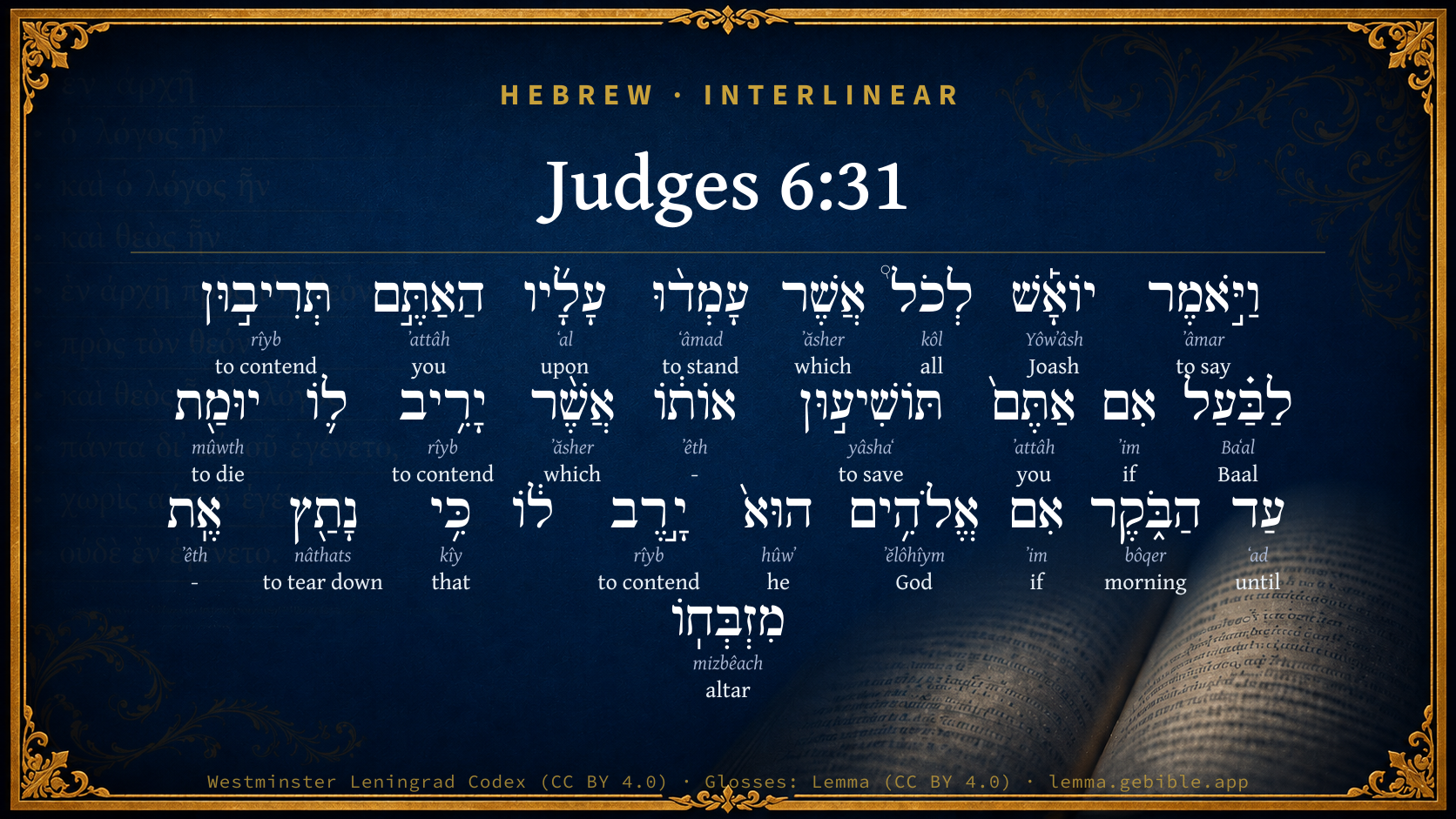
Hebrew (Westminster Leningrad Codex) Judges 6:31 appears in the Hebrew Old Testament. The text above is from the Westminster Leningrad Codex. Each word links to its Strong’s number, a concise gloss, and parsing drawn from the Open Scriptures Hebrew Bible morphology. Click any word for its full Brown-Driver-Briggs (BDB) entry.
Download image
Cite this verse

Judges 6:31 (World English Bible). Public Domain. Lemma interlinear Bible study tool, https://lemma.gebible.app/v/judges/6/31.

Show BibTeX & RIS
BibTeX
RIS
English Translation
Joash said to all who stood against him, Will you contend for Baal? Or will you save him? he who will contend for him, let him be put to death while [it is yet] morning: if he be a god, let him contend for himself, because one has broken down his altar.
World English Bible · Public Domain
Download a study sheet

One document with this verse’s original text, its word-by-word gloss line, the meaning frame, cross-references with their text, attributed commentary, and full source and license credits — printable, and it pastes into notes with its structure intact.

This verse Autodidact and up

Study sheet (.html) Plain text (.txt)

A passage Seminary Student

Up to 50 verses in one chapter. A passage sheet keeps up to 6 commentary sources and 12 cross-references per verse, in the order this page ranks them, and says so on the sheet whenever that leaves anything out. Ask for a single verse and you get the Autodidact verse sheet above.

Everything on this page stays free to read, with no account — the sheet is a download of what is already on screen, not access to it.

Want to remove ads? Support Godless Engineer
Compare translations 3

The same verse in 3 English versions, stacked beneath the original-language interlinear above. Click any original word for its lexicon entry.

Each is an independent rendering of the whole verse — the interlinear is not word-aligned to these translations.

Highlighted words mark where these versions differ — a whole-verse word diff, not a word-by-word alignment.

  • World English Bible Public Domain
    Joash said to all who stood against him, Will you contend for Baal? Or will you save him? he who will contend for him, let him be put to death while [it is yet] morning: if he be a god, let him contend for himself, because one has broken down his altar.
  • King James Version Public Domain
    And Joash said unto all that stood against him, Will ye plead for Baal? will ye save him? he that will plead for him, let him be put to death whilst it is yet morning: if he be a god, let him plead for himself, because one hath cast down his altar.
  • unfoldingWord Literal Text CC BY-SA 4.0
    But Joash said to all who stood against him, “Will you contend for Baal? Or will you save him? Whoever contends for him, may he die, still morning. If he a god, let him contend for himself, since one has torn down his altar.”

unfoldingWord Literal Text — © unfoldingWord, licensed CC BY-SA 4.0. Word-aligned USFM3 via Door43 (git.door43.org/unfoldingWord/en_ult).

Versions to compare (up to 4)

3 of 4 selected

Show all 18 translations

Every available English version of this verse, each an independent rendering of the whole verse.

  • World English Bible Public Domain
    Joash said to all who stood against him, Will you contend for Baal? Or will you save him? he who will contend for him, let him be put to death while [it is yet] morning: if he be a god, let him contend for himself, because one has broken down his altar.
  • Berean Standard Bible Public Domain
    But Joash said to all who stood against him, “Are you contending for Baal? Are you trying to save him? Whoever pleads his case will be put to death by morning! If Baal is a god, let him contend for himself with the one who has torn down his altar.”
  • Majority Standard Bible Public Domain
    But Joash said to all who stood against him, “Are you contending for Baal? Are you trying to save him? Whoever pleads his case will be put to death by morning! If Baal is a god, let him contend for himself with the one who has torn down his altar.”
  • King James Version Public Domain
    And Joash said unto all that stood against him, Will ye plead for Baal? will ye save him? he that will plead for him, let him be put to death whilst it is yet morning: if he be a god, let him plead for himself, because one hath cast down his altar.
  • American Standard Version (1901) Public Domain
    And Joash said unto all that stood against him, Will ye contend for Baal? Or will ye save him? he that will contend for him, let him be put to death whilst `it is yet' morning: if he be a god, let him contend for himself, because one hath broken down his altar.
  • Revised Version (1885) Public Domain
    And Joash said unto all that stood against him, Will ye plead for Baal? or will ye save him? he that will plead for him, let him be put to death whilst it is yet morning: if he be a god, let him plead for himself, because one hath broken down his altar.
  • Geneva Bible (1599) Public Domain
    And Ioash said vnto all that stood by him, Will ye pleade Baals cause? or will ye saue him? he that will contend for him, let him dye or the morning. If he be God, let him pleade for himselfe against him that hath cast downe his altar.
  • Douay-Rheims (1899) Public Domain
    And they said to Joas: Bring out thy son hither, that he may die: because he hath destroyed the altar of Baal, and hath cut down his grove.
  • Young's Literal Translation Public Domain
    And Joash saith to all who have stood against him, `Ye, do ye plead for Baal? ye -- do ye save him? he who pleadeth for him is put to death during the morning; if he `is' a god he himself doth plead against him, because he hath broken down his altar.'
  • Literal Standard Version CC BY-SA 4.0
    And Joash says to all who have stood against him, “You, do you plead for Ba‘al? You—do you save him? He who pleads for him is put to death during the morning; if he [is] a god he pleads against him himself, because he has broken down his altar.”
  • Unlocked Literal Bible CC BY-SA 4.0
    Joash said to all who opposed him, “Will you plead the case for Baal? Will you save him? Whoever pleads the case for him, let him be put to death while it is still morning. If Baal is a god, let him defend himself when someone pulls his altar apart.”
  • unfoldingWord Literal Text CC BY-SA 4.0
    But Joash said to all who stood against him, “Will you contend for Baal? Or will you save him? Whoever contends for him, may he die, still morning. If he a god, let him contend for himself, since one has torn down his altar.”
  • Darby Bible Public Domain
    But Jo'ash said to all who were arrayed against him, "Will you contend for Ba'al? Or will you defend his cause? Whoever contends for him shall be put to death by morning. If he is a god, let him contend for himself, because his altar has been pulled down."
  • World Messianic Bible Public Domain
    Joash said to all who stood against him, “Will you contend for Baal? Or will you save him? He who will contend for him, let him be put to death by morning! If he is a god, let him contend for himself, because someone has broken down his altar!”
  • Webster's Bible Public Domain
    And Joash said to all that stood against him, Will ye plead for Baal? will ye save him? he that will plead for him, let him be put to death whilst it is yet morning: if he is a god, let him plead for himself, because one hath cast down his altar.
  • Free Bible Version CC BY-SA 4.0
    Joash replied to all those confronting him, “Are you arguing on Baal's behalf? Do you have to save him? Anyone who argues for him will be put to death by morning! If he is a god let him fight for himself against those who tore down his altar.”
  • Bible in Basic English Public Domain
    But Joash said to all those who were attacking him, Will you take up the cause of Baal? will you be his saviour? Let anyone who will take up his cause be put to death while it is still morning: if he is a god, let him take up his cause himself because of the pulling down of his altar.
  • JPS Tanakh (1917) Public Domain
    And Joash said unto all that stood against him: 'Will ye contend for Baal? or will ye save him? he that will contend for him, shall be put to death before morning; if he be a god, let him contend for himself, because one hath broken down his altar.'

Literal Standard Version (2020), Covenant Press — licensed CC BY-SA 4.0. Text via the HelloAO Bible API (eBible.org). Unlocked Literal Bible (unfoldingWord) — licensed CC BY-SA 4.0. Text via the HelloAO Bible API (eBible.org). unfoldingWord Literal Text — © unfoldingWord, licensed CC BY-SA 4.0. Word-aligned USFM3 via Door43 (git.door43.org/unfoldingWord/en_ult). Free Bible Version, Dr. Jonathan Gallagher — licensed CC BY-SA 4.0. Text via the HelloAO Bible API (eBible.org).

Word by word

More ways to search: Search by grammar → Find every occurrence → Compare this word →

Practice this passage: Drill this verse → Learn its vocabulary →

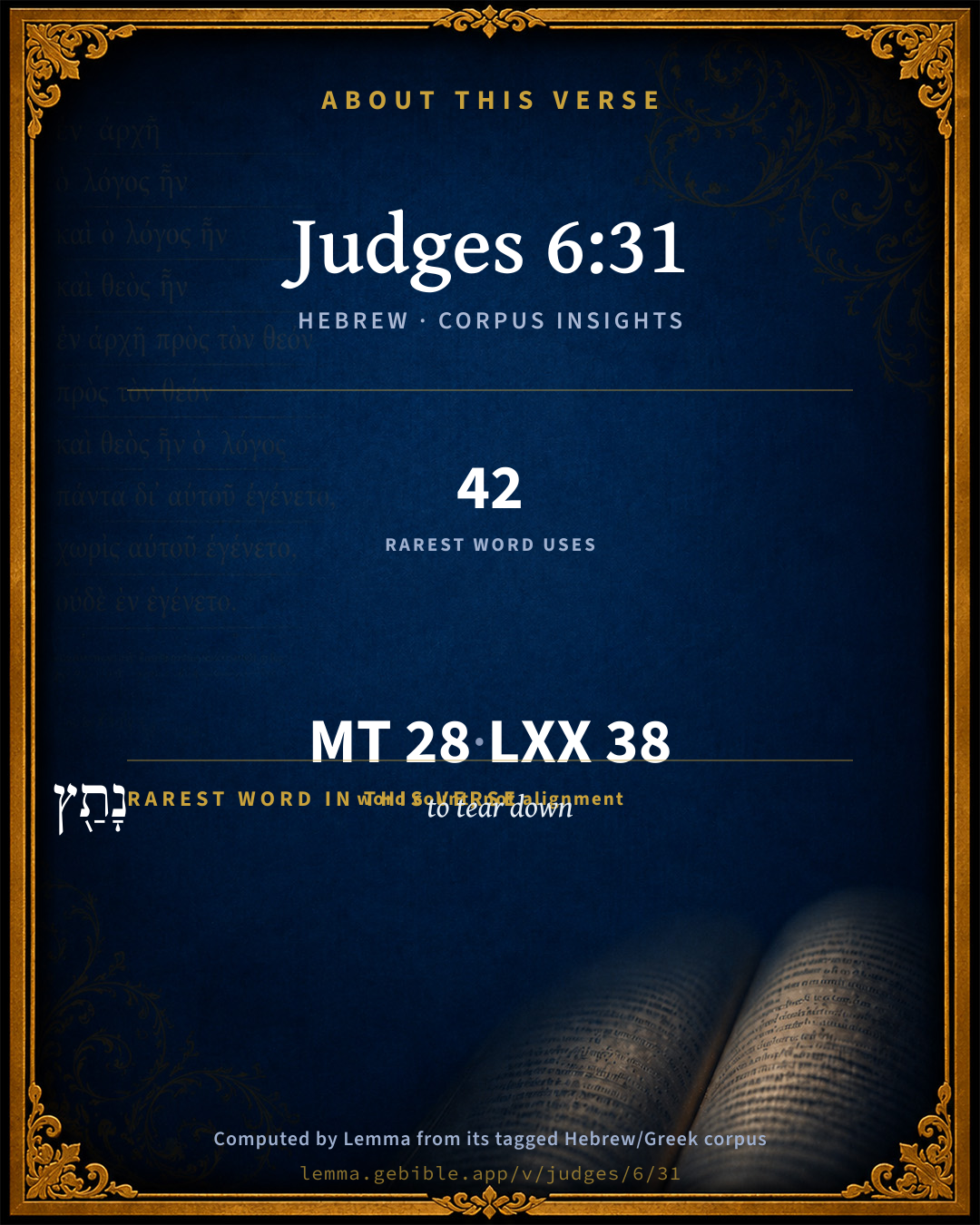
נָתַ֖ץ
nâthats
H5422
“to tear down”
Verb, Qal, Perfect, 3rd Person, Masculine, Singular
Part of Speech
Verb
Stem
Qal
Form
Perfect
Person
3rd Person
Gender
Masculine
Number
Singular
Full BDB Definition

Origin: a primitive root

TWOT: 1446

to pull down, break down, cast down, throw down, beat down, destroy, overthrow, break out (teeth) - (Qal) - to pull down - to break down, break off - (Niphal) to be pulled or broken down - (Piel) to tear down - (Pual) to be torn down - (Hophal) to be broken, be broken down
  1. וַיֹּ֣אמֶר ʼâmar H559 “and · to say” Conjunction + Verb, Qal, Sequential Imperfect, 3rd Person, Masculine, Singular
  2. יוֹאָ֡שׁ Yôwʼâsh H3101 “Joash” Noun, Proper
  3. לְכֹל֩ kôl H3605 “to/for · all” Preposition + Noun, Common, Masculine, Singular, Absolute
  4. אֲשֶׁר ʼăsher H834 “which” Particle, Relative
  5. עָמְד֨וּ ʻâmad H5975 “to stand” Verb, Qal, Perfect, 3rd Person, Common, Plural
  6. עָלָ֜יו ʻal H5921 “upon · him” Preposition + Suffix, Personal, 3rd Person, Masculine, Singular
  7. הַאַתֶּ֣ם ʼattâh H859 “you” Particle, Interrogative + Pronoun, Personal, 2nd Person, Masculine, Plural
  8. תְּרִיב֣וּן rîyb H7378 “to contend” Verb, Qal, Imperfect, 2nd Person, Masculine, Plural + Suffix, n
  9. לַבַּ֗עַל Baʻal H1168 “to/for the · Baal” Preposition, Determined + Noun, Proper
  10. אִם ʼim H518 “if” Conjunction
  11. אַתֶּם֙ ʼattâh H859 “you” Pronoun, Personal, 2nd Person, Masculine, Plural
  12. תּוֹשִׁיע֣וּן yâshaʻ H3467 “to save” Verb, Hiphil, Imperfect, 2nd Person, Masculine, Plural + Suffix, n
  13. אוֹת֔וֹ ʼêth H853 “- · him” Particle, Direct Object + Suffix, Personal, 3rd Person, Masculine, Singular
  14. אֲשֶׁ֨ר ʼăsher H834 “which” Particle, Relative
  15. יָרִ֥יב rîyb H7378 “to contend” Verb, Qal, Imperfect, 3rd Person, Masculine, Singular
  16. יוּמַ֖ת mûwth H4191 “to die” Verb, Hophal, Imperfect, 3rd Person, Masculine, Singular
  17. עַד ʻad H5704 “until” Preposition
  18. הַבֹּ֑קֶר bôqer H1242 “the · morning” Particle, Definite Article + Noun, Common, Masculine, Singular, Absolute
  19. אִם ʼim H518 “if” Conjunction
  20. אֱלֹהִ֥ים ʼĕlôhîym H430 “God(s)” Noun, Common, Masculine, Plural, Absolute
  21. הוּא֙ hûwʼ H1931 “he” Pronoun, Personal, 3rd Person, Masculine, Singular
  22. יָ֣רֶב rîyb H7378 “to contend” Verb, Qal, Jussive, 3rd Person, Masculine, Singular
  23. כִּ֥י kîy H3588 “that” Conjunction
  24. אֶֽת ʼêth H853 “-” Particle, Direct Object
  25. מִזְבְּחֽוֹ mizbêach H4196 “altar · his” Noun, Common, Masculine, Singular, Construct + Suffix, Personal, 3rd Person, Masculine, Singular

About this verse

These counts appear in no published source. They are computed here, from the morphology-tagged text and Lemma’s own curated glosses. What Lemma adds →

28
words
20
distinct lemmas
Historical
section

Shared distinctive vocabulary

נָתַ֖ץ to tear down H5422 occurs in 41 verses of the Hebrew Bible. Also found in:

Grammatical profile

  • 8 verbs
  • 6 nouns
  • 3 pronouns
  • 4 prepositions
  • 3 conjunctions
  • 4 particles

Verb forms

  • וַיֹּ֣אמֶר Qal · Sequential Imperfect
  • עָמְד֨וּ Qal · Perfect
  • תְּרִיב֣וּן Qal · Imperfect
  • תּוֹשִׁיע֣וּן Hiphil · Imperfect
  • יָרִ֥יב Qal · Imperfect
  • יוּמַ֖ת Hophal · Imperfect
  • יָ֣רֶב Qal · Jussive
  • נָתַ֖ץ Qal · Perfect

Repetition

Words recur within this verse — often emphatic in Hebrew:

  • תְּרִיב֣וּן to contend H7378 ×3
  • אֲשֶׁר which H834 ×2
  • הַאַתֶּ֣ם you H859 ×2
  • אִם if H518 ×2

Hebrew & Septuagint length

In English translation the verse runs 52 words from the Hebrew and 55 from the Septuagint (LXX English) — closely comparable.

A rough comparison of the two English renderings, which tokenize alike — not a word-level alignment.

Word counts can differ between the Hebrew and the Greek without any difference in meaning — e.g. the Hebrew direct-object marker אֵת has no separate Greek word, and Greek often adds the article ὁ.

In the original languages it is 28 Hebrew tokens and 38 Greek tokens — but the two are counted differently (Hebrew bundles its prefixes and suffixes into one token; the Greek is in lemma form), so that isn’t a like-for-like length.

Cross-references

15

Topical passages linked to Judges 6:31 in the Treasury of Scripture Knowledge — connected by theme and wording, ordered by reader-vote popularity; previews shown in the World English Bible.

  • Jeremiah 10:5 They are like a palm tree, of turned work, and don't speak: they must be carried, because they can't go. Don't be afraid of them; for they can't do evil, neither is it in them to do good."
  • Jeremiah 10:11 Thus shall you say to them, The gods that have not made the heavens and the earth, these shall perish from the earth, and from under the heavens.
  • 1 Corinthians 8:4 Therefore concerning the eating of things sacrificed to idols, we know that no idol is anything in the world, and that there is no other God but one.
  • Ephesians 5:11 Have no fellowship with the unfruitful works of darkness, but rather even reprove them.
  • Exodus 23:2 You shall not follow a crowd to do evil; neither shall you testify in court to side with a multitude to pervert justice;
  • Numbers 14:6 Joshua the son of Nun and Caleb the son of Jephunneh, who were of those who spied out the land, tore their clothes:
  • Deuteronomy 13:5–18 That prophet, or that dreamer of dreams, shall be put to death, because he has spoken rebellion against Yahweh your God, who brought you out of the land of Egypt, and redeemed you out of the house of bondage, to draw you aside out of the way which Yahweh your God commanded you to walk in. So shall you put away the evil from the midst of you.
  • Deuteronomy 17:2–7 If there be found in the midst of you, within any of your gates which Yahweh your God gives you, man or woman, who does that which is evil in the sight of Yahweh your God, in transgressing his covenant,
  • 1 Kings 18:27 It happened at noon, that Elijah mocked them, and said, Cry aloud; for he is a god: either he is musing, or he is gone aside, or he is on a journey, or peradventure he sleeps and must be awakened.
  • 1 Kings 18:29 It was so, when midday was past, that they prophesied until the time of the offering of the [evening] offering; but there was neither voice, nor any to answer, nor any who regarded.
  • 1 Kings 18:40 and Elijah said to them, Take the prophets of Baal; don't let one of them escape. They took them; and Elijah brought them down to the brook Kishon, and killed them there.
  • Psalms 115:4–7 Their idols are silver and gold, The work of men's hands.
  • Isaiah 41:23 Declare the things that are to come hereafter, that we may know that you are gods: yes, do good, or do evil, that we may be dismayed, and see it together.
  • Isaiah 46:1 Bel bows down, Nebo stoops; their idols are on the animals, and on the cattle: the things that you carried about are made a load, a burden to the weary [animal].
  • Isaiah 46:7 They bear it on the shoulder, they carry it, and set it in its place, and it stands, from its place it shall not move: yes, one may cry to it, yet it can not answer, nor save him out of his trouble.

Cross-references courtesy of OpenBible.info (CC BY 4.0).

Hebrew and Greek witnesses Masoretic Hebrew ↔ Greek Septuagint

The same verse in the two great witnesses to the Old Testament, shown verse-for-verse.

These are two independent witnesses, not word-aligned to each other, and the Septuagint is shown in lemma (dictionary) form.

Hebrew Judges 6:31 Masoretic · Westminster Leningrad Codex

וַיֹּ֣אמֶר יוֹאָ֡שׁ לְכֹל֩ אֲשֶׁר עָמְד֨וּ עָלָ֜יו הַאַתֶּ֣ם תְּרִיב֣וּן לַבַּ֗עַל אִם אַתֶּם֙ תּוֹשִׁיע֣וּן אוֹת֔וֹ אֲשֶׁ֨ר יָרִ֥יב ל֛וֹ יוּמַ֖ת עַד הַבֹּ֑קֶר אִם אֱלֹהִ֥ים הוּא֙ יָ֣רֶב ל֔וֹ כִּ֥י נָתַ֖ץ אֶֽת מִזְבְּחֽוֹ

Joash said to all who stood against him, Will you contend for Baal? Or will you save him? he who will contend for him, let him be put to death while [it is yet] morning: if he be a god, let him contend for himself, because one has broken down his altar.

World English Bible · Public Domain

Greek LXX Judges 6:31 Septuagint · lemma form

καί εἶπον ιωας ὁ ἀνήρ πᾶς ὅς ἐπι ἀναἵστημι αὐτός μή σύ νῦν δικάζω ὑπέρ ὁ βααλ ἤ σύ σώζω αὐτός ὅς ἐάν δικάζω αὐτός θανατόω ἕως πρωΐ εἰ θεός εἰμί δικάζω αὐτός ὅτι κατααἱρέω ὁ θυσιαστήριον αὐτός

And Gedeon the son of Joas said to all the men who rose up against him, Do you⌃ now plead for Baal, or will you⌃ save him? whoever will plead for him, let him be slain this morning: if he be a god let him plead for himself, because one has thrown down his altar.

LXX2012 (modern English Septuagint) · Public Domain

On this verse, Ellicott's Commentary for English Readers discusses the Septuagint’s reading. Read the note in Commentary ↓

Hebrew: Westminster Leningrad Codex (CC BY 4.0). Greek: Septuagint (public domain); English from LXX2012 (modern English Septuagint) (Public Domain). How the Septuagint differs from the Hebrew →

Targum (Aramaic paraphrase)

1

The Targum is the ancient Jewish Aramaic paraphrase of the Hebrew Scriptures — an interpretive translation, not the Hebrew text itself. Onkelos (literal) and Pseudo-Jonathan (expansive) render the Torah, and Jonathan the Prophets. Coverage is partial: where no permissively-licensed English translation exists for a verse, only the Aramaic is shown. This is verse-level text, not a word-by-word alignment to the Hebrew.

  1. Targum Jonathan Prophets (Joshua–Malachi)
    וַאֲמַר יוֹאָשׁ לְכָל דְקָמוּ עֲלוֹהִי הֲאַתּוּן תִּתְפַּרְעִין לְבַעֲלָא אִם אַתּוּן תִּפְרְקוּן יָתֵיהּ דְיִתְפְּרַע לֵיהּ יִתְקְטֵל בְּרַם אַרְכָּא יִתְיְהֵב לֵיהּ עַד צַפְרָא אִם צְרוֹךְ אִית בֵּיהּ יִתְפְּרַע לֵיהּ בַּעֲלָא אֲרֵי תְּרַע יַת אֱגוֹרֵיהּ:

    (no public-domain English translation for this verse)

    Targum Jonathan — Aramaic: “Mikraot Gedolot” (public domain). English: “Sefaria Community Translation” (CC0 1.0 (public-domain dedication)); “London "Chaldee Paraphrase," 1871” (public domain). Text via Sefaria.

Commentary

Notes on Judges 6:31 from classic Christian and Jewish commentators (each source and its license shown beneath its notes). The classic Christian expositions comment on the surrounding passage and are grouped to its opening verse, so a note may address several verses; the Jewish commentaries on the Tanakh (Rashi and others) are per-verse, so they appear only where the commentator wrote on this verse.

Lemma curates 59 commentaries, every one of them public domain or Creative Commons licensed, each selected and text-cleaned for this edition rather than reprinted as found. About our sources →

Trapp's Complete Commentary

John Trapp

Jdg 6:31 And Joash said unto all that stood against him, Will ye plead for Baal? will ye save him? he that will plead for him, let him be put to death whilst [it is yet] morning: if he [be] a god, let him plead for himself, because [one] hath cast down his altar.

Ver. 31. And Joash said unto all that stood against him.] Which were the many headed multitude, that untamed beast. But Joash, by a sudden change of his heart, for he was till now an idolater, and on the defence of his son, bravely withstandeth them, and putteth Baal to plead for himself, which he was ill enough able to do. And by this one seasonable speech, though he were but a single man, he hindered the mischievous multitude from murdering Gideon, who soon after delivered them out of the hand of the Midianites. So Nicodemus, by a word spoken in time, dissolved the council that was gathered together against Christ. {Joh 7:50-53} It is good to appear for God, though there be few or none to second us: who knows what may be the success?

John Trapp, A Commentary or Exposition upon All the Books of the Old and New Testament (1647–1656) — public domain. Text from a community e-Sword module.

Joseph Benson's Commentary

Jdg 6:31. Joash said, Will ye plead for Baal? — Why are you so zealous in pleading for that Baal for whose worship you suffer such grievous calamities at this day? It is plain that Joash had been a worshipper of Baal, having gone with the stream, as we find the altar of Baal on his estate; but probably he was now convinced of his sin and folly by Gideon, being made acquainted with the appearance of the angel to him, and of the divine commission which he had received. Hence he resolutely declares himself on the side of the God of Israel, and when the people demanded that his son should be put to death for casting down the altar of Baal, he boldly demands, according to the law of Moses, that whatever man should plead for Baal should be put to death, idolatry being a capital offence. While it is yet morning — That is, immediately; for it was in the morning, as we learn from Jdg 6:28, that this tumult was made. If he be a god, let him plead for himself — As the God of Israel hath often done when any indignity or injury hath been done him. But Baal hath now showed, that he is neither able to help you nor himself; and therefore is not worthy to be served any longer. This resolute answer was necessary to stop the torrent of the people’s fury; and it was drawn from him by the sense of his son’s extreme danger, and by the confidence he had that God would plead his son’s cause, and use him for the rescue of his people. It is probable that, by what Joash now said, the eyes of the people were opened, to see how impotent the god was whom they had worshipped; as, by comparing it with what they had heard the God of Israel had frequently done in vindication of his honour, they might well conclude how inferior he was to Jehovah, the one living and true God, or rather, in the language of Scripture, that he was nothing, a mere nonentity.

Joseph Benson's Commentary on the Old and New Testaments (1811–1818) — public domain. Text from a community e-Sword module.

Geneva Bible (1599)

Geneva Bible translators

Thus we ought to justify them that are zealous of God’s cause, though all the multitude be against us.

Geneva Bible (1599) marginal notes — public domain. Text via Bolls.life.

Adam Clarke's Commentary

Verse 31. Will ye plead for Baal?] The words are very emphatic "Will ye plead in earnest תריבן for Baal? Will ye תושיען really save him? If he be God, אלהים Elohim, let him contend for himself, seeing his altar is thrown down." The paragogic letters in the words plead and save greatly increase the sense. Joash could not slay his son; but he was satisfied he had insulted Baal: if Baal were the true God, he would avenge his own injured honour. This was a sentiment among the heathens. Thus Tacitus, lib. i., c. 73, A.U.C. 768, mentioning the letter of Tiberius to the consuls in behalf of Cassius and Rubrius, two Roman knights, one of whom was accused of having sold a statue of Augustus in the auction of his gardens; and the other, of having sworn falsely by the name of Augustus, who had been deified by the senate; among other things makes him say: Non ideo decretum patri suo coelum, ut in perniciem civium is honor verteretur. Nec contra religiones fieri quod effigies ejus, utalia nu minum simulachra, venditionibus hortorum et domuum accedant. Jusjurandum perinde aestimandum quam si Jovem fefellisset: deorum injuriae diis curae - "That Divine honours were not decreed to his father (Augustus) to lay snares for the citizens; and if his statue, in common with the images of the gods in general, was put up to sale with the houses and gardens, it could not be considered an injury to religion. That any false oath must be considered as an attempt to deceive Jupiter himself; but the gods themselves must take cognizance of the injuries done unto them." Livy has a similar sentiment, Hist. lib. x., c. 6, where, speaking of some attempts made to increase the number of the augurs out of the commons, with which the senators were displeased, he says: Simulabant ad deos id magis, quam ad se pertinere; ipsos visuros, ne sacra sua polluantur. - "They pretended that these things belonged more to the gods than themselves; and that they would take care that their sacred rites were not polluted."

Adam Clarke's Commentary on the Bible (1810–1826) — public domain. Text from a community e-Sword/MySword module.

Ellicott's Commentary for English Readers

(31) Unto all that stood against him.—The meaning of these words is very uncertain. They may mean, “to all that stood around.”

Will ye plead for Baal?—The pronoun ye is very emphatic, being twice expressed in the Hebrew.

He that will plead for him, let him be put to death.—These words of Joash were extraordinarily bold and cunning. Possibly the brave act of his son may have roused his conscience, and Gideon may have told him that he had acted under Divine guidance. But he saves his son’s life, not by excusing his act, but by feigning such a zeal for Baal as to denounce it as a blasphemous impiety to suppose that Baal will not avenge his own insult—an impiety so monstrous, that the man who was guilty of it should be at once put to death. Thus he made Baal-worship a plea for not avenging the insult offered to Baal. He was well aware that if he thus gained time, the fact that Baal did not interfere to protect himself from such fearful outrage would weigh powerfully with all his worshippers. Among idolaters the sight of an act of open contempt for their idol often shakes their superstitious reverence. Aristophanes, Persius, and Lucían sneer at the inability of Jupiter to defend his own temple, golden locks, and golden beard. When Olaf had the huge image of Odin destroyed, and when the high priest Coifi at Saxmundham, clad in armour and mounted on horseback (two things which were forbidden to a priest), rode up to the Saxon idols and hurled them down, the people, seeing that no thunder followed, but that all went on as well as usual, were quite ready to embrace Christianity.

Whilst it is yet morning.—The Hebrew is ad habbôker (“until morning”); LXX., heôs prôi, which may mean, “before to-morrow’s sun has dawned.” (Antequan lux crastina veniat, Vulg.; as also the Syriac, Arabic, and Chaldee.) It is a much more likely rendering than that of the E.V., for it implies, “Let us wait till to-morrow, to see whether Baal will avenge himself.” Joash knew that in popular outbreaks procrastination means security.

If he be a god.—Compare the language of Elijah to the Baal and Asherah priests (1Ki_18:21; 1Ki_18:27).

A Bible Commentary for English Readers, edited by Charles John Ellicott (1878–1897) — public domain. Text from a community e-Sword module.

The Cambridge Bible for Schools and Colleges

gen. ed. J. J. S. Perowne

31. Will ye plead for Baal?] Cf. Job_13:8. The pron. is emphatic: ‘Will ye contend for Baal? will ye save him?’ The next sentence, ‘whoever takes up arms for the false god shall be put to death forthwith,’ interrupts the argument, and introduces an idea foreign to the context; the words appear to have been inserted to make it plain that Joash did think Baal to be no real divinity. ‘Will ye contend for Baal? will ye save him? If he is a god let him contend for himself!’ Moore appropriately quotes as an illustration the saying of Tiberius to the consuls, ‘Deorum injuriae diis curae,’ Tacitus, Annal. i. 73.

whilst it is yet morning] i.e. ‘during the morning,’ cf. Jdg_3:26 ‘while they tarried,’ lit. ‘during their tarrying.’ But this use of the prep, is rare; lit. the words = until the morning, and this is best taken to mean by to-morrow morning, cf. Jdg_16:2.

The Cambridge Bible for Schools and Colleges (gen. ed. J. J. S. Perowne; Cambridge University Press, 1878–1918) — public domain. Text from a community e-Sword module.

John Gill's Exposition

Therefore on that day he called him Jerubbaal,.... That is, Joash called his son Gideon by that name; who, some think, is the same with Jerombalus, the priest of the god Jevo, or Jehovah; from whom Sanchoniatho, an ancient Phoenician writer, as Philo Byblius says (w), received the principal things in his history respecting the Jews:

saying, let Baal plead against him, because he hath thrown down his altar; giving this as the reason of the name of Jerubbaal he called him by, which signifies, "let Baal plead"; let Baal plead his own cause, and avenge himself on Gideon for what he has done to him, and put him to death if he can.

(w) Apud Euseb. Evangel Praepar. l. 1. p. 31.

John Gill's Exposition of the Whole Bible (1746–1763) — public domain (CC PDM 1.0). Text via the HelloAO Bible API.

Albert Barnes' Notes on the Bible

From the boldness of Joash in defending his son, it is likely that the majority of the Abi-ezrites sided with him against “the men of the city,” and already felt drawn toward Gideon as their national and religious leader Jdg 6:34. Joash appears as the chief magistrate of Ophrah.

Will ye plead ...? will ye save? - The emphasis is upon ye, as much as to say, What business is it of yours?

Albert Barnes' Notes on the Bible (1834–1885) — public domain. Text from a community e-Sword/MySword module.

Haydock's Catholic Bible Commentary

His, Baal’s, or rather my son’s adversary; (Calmet) let him die before this morning be spent, as the Hebrew insinuates. Joas represents to the men of the city, who looked upon him with a degree of respect, (Haydock) as the first in power and riches among them, (Calmet) how ill it became the Israelites to vindicate an idol. If Baal were truly so powerful, as they seemed to imagine, (Haydock) and so eager to revenge himself, he could never be restrained from bringing his adversary to condign punishment. "Let the gods punish those who injure them," said Tacitus, Ann. i. "They would take care that their sacred things were not abused." (Livy x.) This argumentation would suit the idolaters, who supposed that their gods were animated with the same sentiments and eagerness for revenge as themselves. But the true God, who can feel no such impressions, bears for a long time with the impiety of men, though he requires that those who are in power should punish notorious offenders. The magistrate is the instrument of God’s justice, and must stop, as much as possible, the growth of vice and irreligion. (Calmet) --- It seems the citizens of Ephra acquiesced to the reason or authority of Joas, and even enlisted under the banners of Gedeon. (Haydock)

George Leo Haydock (1774–1849), Haydock's Catholic Family Bible and Commentary, 1859 edition — public domain. Excludes Psalms (Douay-Rheims chapter numbering differs from Protestant) and Deuterocanonical books (Catholic canon only).

Matthew Poole's English Annotations

Will ye plead for Baal? Why are you so zealous in pleading for that Baal, for the worship whereof you suffer such grievous calamities at this day, and from whom you have no help? It is plain that Joash had been a worshipper of Baal; either therefore he was now convinced by Gideon’s information and action, or he makes use of this pretence to preserve his son, being indeed indifferent in matters of religion; and therefore as he did worship Baal to comply with his neighbours, so now he deserts him to rescue his son.

He that will plead for him, let him be put to death; he that shall further plead for such a god as this, deserves to die for his folly and impiety. It is not probable that this was all that he said for his son’s defence; or that he would neglect to mention the call his son had from God to it, the apparition of an angel, the promise of deliverance; but it is usual in Scripture to give only some short hints of those things which were more largely discoursed.

Whilst it is yet morning, i.e. instantly, without delay; for it was now morning time, as appears from Jdg 6:28, &c.

Let him plead for himself, as the God of Israel hath often done when any indignity or injury hath been done to him. But Baal hath now showed that he is neither able to help you nor himself, and therefore is not worthy to be served any longer. This courageous and resolute answer was necessary to stop the torrent of the people’s fury; and it was drawn from him, partly by the sense of his son’s extreme danger, and partly by the confidence he had that God would plead his son’s cause, and use him for the rescue of his people.

Matthew Poole's English Annotations on the Holy Bible (1683–1685) — public domain. Text from a community e-Sword/MySword module.

Whedon's Commentary on the Bible

Daniel D. Whedon

31. Joash said — The father stands up bravely for his son. The son’s bold act seems to have inspired Joash with a kindred zeal, and, possibly, Gideon may have informed his father of his interview with the angel.

Whilst it is yet morning — Literally, until the morning. But עד, until, here has the force of while, during, as in Jdg_3:26; and so the English version gives the true sense. Keil makes until the morning an independent clause, referring to the morning of the following day, and exclaims: “Let us wait until to-morrow, and give Baal time to avenge the insult which he has received!” But this thought is not conveyed by the words of the text.

If he be a god, let him plead for himself — Wise and all-sufficient argument. A poor god that, which in a case like this was unable to defend himself.

Daniel D. Whedon (gen. ed.), Commentary on the Old and New Testaments (1874–1909) — public domain. Text from a community e-Sword module.

The Pulpit Commentary

Stood against him. The words describe their hostile, menacing, attitude, clamouring to have Gideon brought out that they might kill him. Will ye plead, etc. The emphasis is on the ye. Joash met and silenced their pleading by threatening death to any that should plead for Baal. Baal shall plead for himself. Joash"s courage was rising under the influence of his son s brave deed.

Vers. 31, 32. Jerubbaal, or, Is an idol anything?

How mighty the work was Gideon had wrought at once appeared from its effects. His father is won over, and so argues for him that the Abi-ezrites are first silenced, and then converted. The nickname of Gideon showed the process of the change.

I THE GRAND ARGUMENT AGAINST IDOLATRY. Isaiah (ch. 44.) expresses the contempt of the true Israelite for idols. But no one has formulated the argument better than Joash. It is as forcible to-day in India and Africa as in the days of Gideon. The same is true of the world-powers and principles idols represent.

II THE LIVING WITNESS TO THE FORCE OF THIS ARGUMENT. No monument could equal himself. It was an instance of a man against a god yea, against all the gods of heathenism. A heathen convert is such a witness. And the heroes of faith are the grand arguments against the evil principles and influences they overthrew and survived. The gospel reveals an extended view of the same question, beyond death and the grave; "Fear not them which kill the body," etc. M.

The Pulpit Commentary (1880–1919), ed. H.D.M. Spence-Jones & Joseph S. Exell — public domain. Text from a community e-Sword module.

John Wesley's Explanatory Notes

Will ye plead - Why are you so zealous in pleading for that Baal, for the worship whereof you suffer such grievous calamities at this day? It is plain, that Joash had been a worshipper of Baal: but probably he was now convinced by Gideon. He that will plead - He that shall farther plead for such a God as this, deserves to die for his folly and impiety. It is not probable, that this was all which he said for his son: but it is usual in scripture to give only short hints of things which were more largely discoursed. While it is morning - That is, instantly, without delay. Let him plead - As the God of Israel hath often done when any indignity or injury hath been done him. But Baal hath now shewed, that he is neither able to help you, nor himself; and therefore is not worthy to be served any longer. This resolute answer was necessary to stop the torrent of the peoples fury; and it was drawn from him, by the sense of his son's extreme danger; and by the confidence he had, that God would plead his son's cause, and use him for the rescue of his people.

John Wesley, Explanatory Notes Upon the Whole Bible (1754–1765) — public domain. Text via the GEBible commentary corpus.

unfoldingWord translationNotes

Door43 World Missions Community

Will you plead the case for Baal?

Joash uses a question to emphasize that a human should not have to defend a god. AT: "You should not have to defend Baal." (See: Rhetorical Question)

plead the case

"make a defense" or "give an excuse"

Will you save him?

Joash uses a question to emphasize that a human should not have to rescue a god. AT: "You should not have to save Baal." (See: Rhetorical Question)

Jerub Baal

This is another name for Gideon. It means "let Baal defend himself." (See: How to Translate Names)

because he said

"because Joash said"

translationWords

Joash

plea

Baal

save

die

false god

Gideon

altar

unfoldingWord translationNotes — © Distant Shores Media and the Door43 World Missions Community, licensed CC BY-SA 4.0. Source: git.door43.org/Door43/en_tn.

Rashi

Rabbi Shlomo Yitzchaki (Rashi)

You want to fight for [lit. "to"] the baal? For the sake of the baal.

To avenge [lit. rescue] him. To exact vengeance for him. Similarly, "by my own hand exacting my vengeance," by David concerning Novol.

Whoever fights for [lit. "to"] him. For his sake.

Wait until morning. Until morning, wait.

If he is a god let him fight his own battle and exact his own vengeance. To rebuff them until Gidon could escape, he said this.

Rashi on the Tanakh — English translations: “The Judaica Press complete Tanach with Rashi, translated by A. J. Rosenberg” (CC BY 4.0); “Pentateuch with Rashi's commentary by M. Rosenbaum and A.M. Silbermann, 1929-1934” (public domain); “The Metsudah Tanach series, Lakewood, N.J” (CC BY 4.0); and “The Book of Joshua, Metsudah Publications, 1997” (CC BY 4.0). Text via Sefaria.

Lesson kit

Teaching starters — assembled from the data on this page, not authored interpretation. Every prompt links to the verse data it draws on. Edit before teaching.

Judges, in the Historical, opens this verse with 28 words (20 distinct Hebrew lemmas). Its most distinctive word is nâthats (“to tear down”). A historical commentator’s framing appears above. Read the whole chapter for the surrounding context.

Discussion questions

  1. What does “to tear down” (nâthats) contribute to the verse as a whole?
  2. Exodus 34:13 shares the word «to tear down» with this verse. How do the two illuminate each other?
  3. “to contend” occurs 3× in this one verse. What is the effect of the repetition?
  4. These translations render this verse differently. What is at stake in choosing one wording over another?
  5. The verb «וַיֹּ֣אמֶר» is Qal Sequential Imperfect. How does its form color the action?
  6. Reading how Trapp's Complete Commentary and Joseph Benson's Commentary read this verse, where do the two commentators agree and where do they part?

Things to notice

Reading settings

Reading text

Shown beneath each verse's original-language words.

Old Testament
Old Testament edition

Read the OT as the Masoretic Hebrew (MT) or the Greek Septuagint (LXX).

English shown for the Greek Septuagint (in the Hebrew ↔ Greek comparison).

Comparing translations? Open the Compare panel on any verse page to stack up to four side by side.