
1 Samuel 14:35

Hebrew (Westminster Leningrad Codex) 1 Samuel 14:35 appears in the Hebrew Old Testament. The text above is from the Westminster Leningrad Codex. Each word links to its Strong’s number, a concise gloss, and parsing drawn from the Open Scriptures Hebrew Bible morphology. Click any word for its full Brown-Driver-Briggs (BDB) entry.
Download image
Cite this verse

1 Samuel 14:35 (World English Bible). Public Domain. Lemma interlinear Bible study tool, https://lemma.gebible.app/v/1-samuel/14/35.

Show BibTeX & RIS
BibTeX
RIS
English Translation
Saul built an altar to Yahweh: the same was the first altar that he built to Yahweh.
World English Bible · Public Domain
Download a study sheet

One document with this verse’s original text, its word-by-word gloss line, the meaning frame, cross-references with their text, attributed commentary, and full source and license credits — printable, and it pastes into notes with its structure intact.

This verse Autodidact and up

Study sheet (.html) Plain text (.txt)

A passage Seminary Student

Up to 50 verses in one chapter. A passage sheet keeps up to 6 commentary sources and 12 cross-references per verse, in the order this page ranks them, and says so on the sheet whenever that leaves anything out. Ask for a single verse and you get the Autodidact verse sheet above.

Everything on this page stays free to read, with no account — the sheet is a download of what is already on screen, not access to it.

Want to remove ads? Support Godless Engineer
Compare translations 3

The same verse in 3 English versions, stacked beneath the original-language interlinear above. Click any original word for its lexicon entry.

Each is an independent rendering of the whole verse — the interlinear is not word-aligned to these translations.

Highlighted words mark where these versions differ — a whole-verse word diff, not a word-by-word alignment.

  • World English Bible Public Domain
    Saul built an altar to Yahweh: the same was the first altar that he built to Yahweh.
  • King James Version Public Domain
    And Saul built an altar unto the LORD: the same was the first altar that he built unto the LORD.
  • unfoldingWord Literal Text CC BY-SA 4.0
    And Saul built an altar to Yahweh. He began to build it, an altar to Yahweh.

unfoldingWord Literal Text — © unfoldingWord, licensed CC BY-SA 4.0. Word-aligned USFM3 via Door43 (git.door43.org/unfoldingWord/en_ult).

Versions to compare (up to 4)

3 of 4 selected

Show all 18 translations

Every available English version of this verse, each an independent rendering of the whole verse.

  • World English Bible Public Domain
    Saul built an altar to Yahweh: the same was the first altar that he built to Yahweh.
  • Berean Standard Bible Public Domain
    Then Saul built an altar to the LORD; it was the first time he had built an altar to the LORD.
  • Majority Standard Bible Public Domain
    Then Saul built an altar to the LORD; it was the first time he had built an altar to the LORD.
  • King James Version Public Domain
    And Saul built an altar unto the LORD: the same was the first altar that he built unto the LORD.
  • American Standard Version (1901) Public Domain
    And Saul built an altar unto Jehovah: the same was the first altar that he built unto Jehovah.
  • Revised Version (1885) Public Domain
    And Saul built an altar unto the LORD: the same was the first altar that he built unto the LORD.
  • Geneva Bible (1599) Public Domain
    Then Saul made an altar vnto the Lord, and that was the first altar that he made vnto the Lord.
  • Douay-Rheims (1899) Public Domain
    And Saul built an altar to the Lord and he then first began to build an altar to the Lord.
  • Young's Literal Translation Public Domain
    And Saul buildeth an alter to Jehovah; with it he hath begun to build altars to Jehovah.
  • Literal Standard Version CC BY-SA 4.0
    And Saul builds an altar to YHWH; with it he has begun to build altars to YHWH.
  • Unlocked Literal Bible CC BY-SA 4.0
    Saul built an altar to Yahweh, which was the first altar that he built to Yahweh.
  • unfoldingWord Literal Text CC BY-SA 4.0
    And Saul built an altar to Yahweh. He began to build it, an altar to Yahweh.
  • Darby Bible Public Domain
    And Saul built an altar to Jehovah: this was the first altar he built to Jehovah.
  • World Messianic Bible Public Domain
    Saul built an altar to the LORD. This was the first altar that he built to the LORD.
  • Webster's Bible Public Domain
    And Saul built an altar to the LORD: the same was the first altar that he built to the LORD:
  • Free Bible Version CC BY-SA 4.0
    So Saul built an altar to the Lord. This was the first altar he had built to the Lord.
  • Bible in Basic English Public Domain
    And Saul put up an altar to the Lord: this was the first altar which he put up to the Lord.
  • JPS Tanakh (1917) Public Domain
    And Saul built an altar unto the LORD; the same was the first altar that he built unto the LORD.

Literal Standard Version (2020), Covenant Press — licensed CC BY-SA 4.0. Text via the HelloAO Bible API (eBible.org). Unlocked Literal Bible (unfoldingWord) — licensed CC BY-SA 4.0. Text via the HelloAO Bible API (eBible.org). unfoldingWord Literal Text — © unfoldingWord, licensed CC BY-SA 4.0. Word-aligned USFM3 via Door43 (git.door43.org/unfoldingWord/en_ult). Free Bible Version, Dr. Jonathan Gallagher — licensed CC BY-SA 4.0. Text via the HelloAO Bible API (eBible.org).

Word by word

More ways to search: Search by grammar → Find every occurrence → Compare this word →

Practice this passage: Drill this verse → Learn its vocabulary →

הֵחֵ֔ל
châlal
H2490
“to profane”
Verb, Hiphil, Perfect, 3rd Person, Masculine, Singular
Part of Speech
Verb
Stem
Hiphil
Form
Perfect
Person
3rd Person
Gender
Masculine
Number
Singular
Full BDB Definition

Origin: a primitive root [compare H2470 ]

TWOT: 660 , 661

to profane, defile, pollute, desecrate, begin - (Niphal) - to profane oneself, defile oneself, pollute oneself - ritually - sexually - to be polluted, be defiled - (Piel) - to profane, make common, defile, pollute - to violate the honour of, dishonour - to violate (a covenant) - to treat as common - (Pual) to profane (name of God) - (Hiphil) - to let be profaned - to begin - (Hophal) to be begun - to wound (fatally), bore through, pierce, bore - (Qal) to pierce - (Pual) to be slain - (Poel) to wound, pierce - (Poal) to be wounded - (Piel) to play the flute or pipe
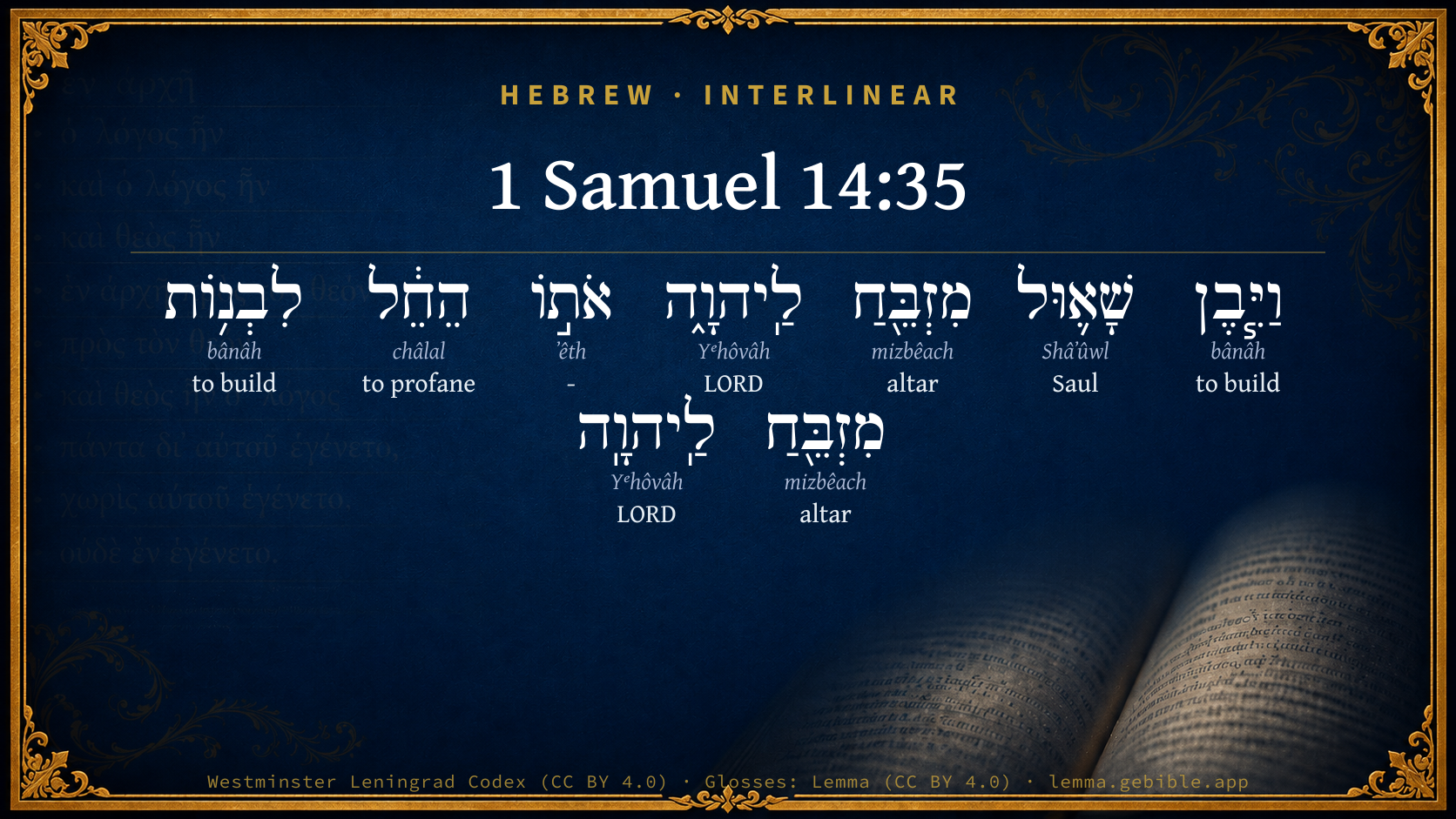
  1. וַיִּ֧בֶן bânâh H1129 “and · to build” Conjunction + Verb, Qal, Sequential Imperfect, 3rd Person, Masculine, Singular
  2. שָׁא֛וּל Shâʼûwl H7586 “Saul” Noun, Proper
  3. מִזְבֵּ֖חַ mizbêach H4196 “altar” Noun, Common, Masculine, Singular, Absolute
  4. לַֽיהוָ֑ה Yᵉhôvâh H3068 “to/for · LORD” Preposition + Noun, Proper
  5. אֹת֣וֹ ʼêth H853 “- · him” Particle, Direct Object + Suffix, Personal, 3rd Person, Masculine, Singular
  6. לִבְנ֥וֹת bânâh H1129 “to build” Preposition + Verb, Qal, Infinitive Construct
  7. מִזְבֵּ֖חַ mizbêach H4196 “altar” Noun, Common, Masculine, Singular, Absolute
  8. לַֽיהוָֽה Yᵉhôvâh H3068 “to/for · LORD” Preposition + Noun, Proper

About this verse

These counts appear in no published source. They are computed here, from the morphology-tagged text and Lemma’s own curated glosses. What Lemma adds →

9
words
6
distinct lemmas
Historical
section

Grammatical profile

  • 3 verbs
  • 5 nouns
  • 1 particle

Verb forms

  • וַיִּ֧בֶן Qal · Sequential Imperfect
  • הֵחֵ֔ל Hiphil · Perfect
  • לִבְנ֥וֹת Qal · Infinitive Construct

Repetition

Words recur within this verse — often emphatic in Hebrew:

  • וַיִּ֧בֶן to build H1129 ×2
  • מִזְבֵּ֖חַ altar H4196 ×2
  • לַֽיהוָ֑ה LORD H3068 ×2

Hebrew & Septuagint length

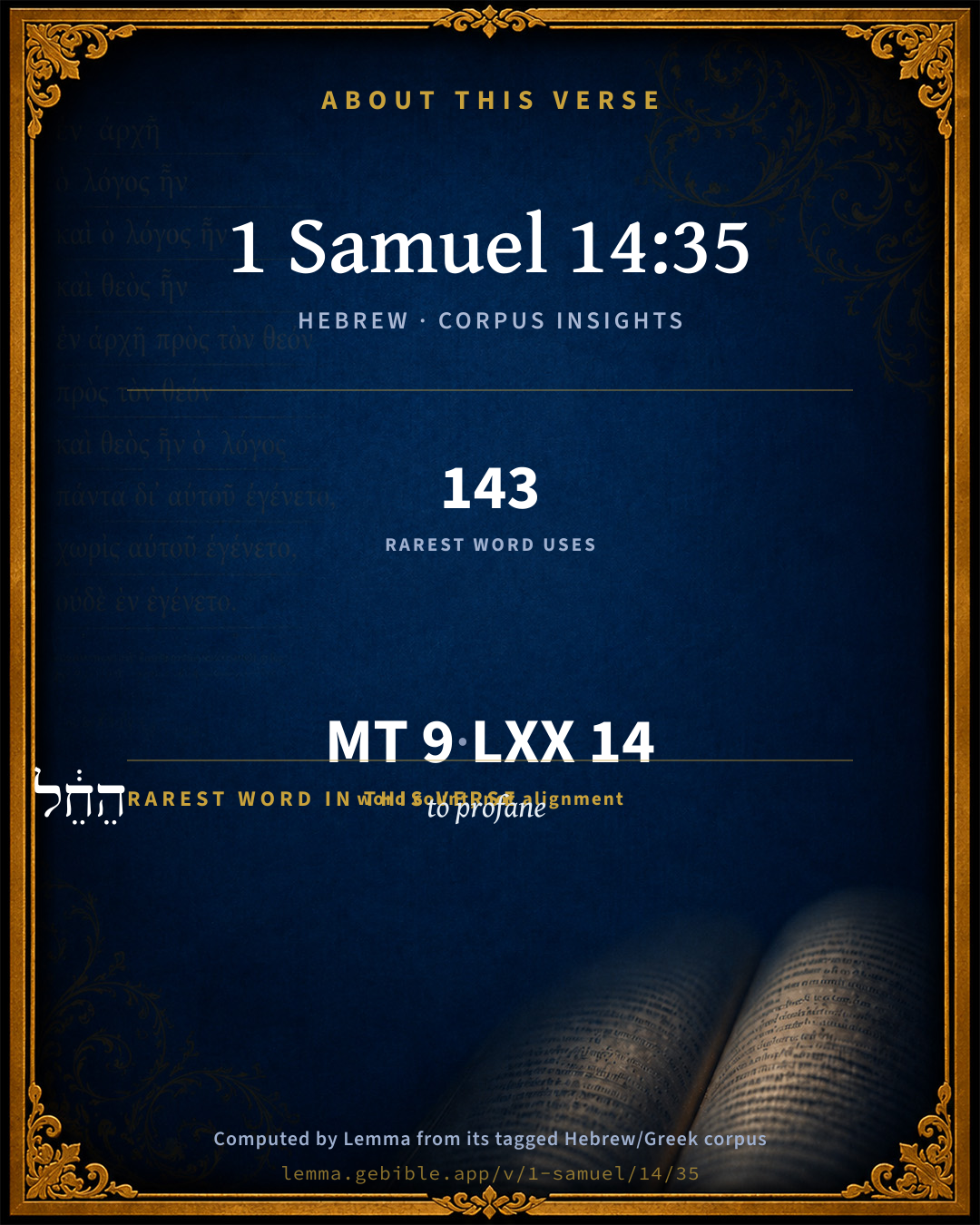
In English translation the verse runs 17 words from the Hebrew and 20 from the Septuagint (LXX English) — closely comparable.

A rough comparison of the two English renderings, which tokenize alike — not a word-level alignment.

Word counts can differ between the Hebrew and the Greek without any difference in meaning — e.g. the Hebrew direct-object marker אֵת has no separate Greek word, and Greek often adds the article ὁ.

In the original languages it is 9 Hebrew tokens and 14 Greek tokens — but the two are counted differently (Hebrew bundles its prefixes and suffixes into one token; the Greek is in lemma form), so that isn’t a like-for-like length.

Cross-references

6

Topical passages linked to 1 Samuel 14:35 in the Treasury of Scripture Knowledge — connected by theme and wording, ordered by reader-vote popularity; previews shown in the World English Bible.

  • 1 Samuel 7:17 His return was to Ramah, for there was his house; and there he judged Israel: and he built there an altar to Yahweh.
  • Judges 21:4 It happened on the next day that the people rose early, and built there an altar, and offered burnt offerings and peace-offerings.
  • 1 Samuel 7:9 Samuel took a sucking lamb, and offered it for a whole burnt-offering to Yahweh: and Samuel cried to Yahweh for Israel; and Yahweh answered him.
  • 1 Samuel 7:12 Then Samuel took a stone, and set it between Mizpah and Shen, and called the name of it Ebenezer, saying, Hitherto has Yahweh helped us.
  • Hosea 8:14 For Israel has forgotten his Maker and built palaces; And Judah has multiplied fortified cities; But I will send a fire on his cities, And it will devour its fortresses."
  • 2 Timothy 3:5 holding a form of godliness, but having denied the power thereof. Turn away from these, also.

Cross-references courtesy of OpenBible.info (CC BY 4.0).

Hebrew and Greek witnesses Masoretic Hebrew ↔ Greek Septuagint

The same verse in the two great witnesses to the Old Testament, shown verse-for-verse.

These are two independent witnesses, not word-aligned to each other, and the Septuagint is shown in lemma (dictionary) form.

Hebrew 1 Samuel 14:35 Masoretic · Westminster Leningrad Codex

וַיִּ֧בֶן שָׁא֛וּל מִזְבֵּ֖חַ לַֽיהוָ֑ה אֹת֣וֹ הֵחֵ֔ל לִבְנ֥וֹת מִזְבֵּ֖חַ לַֽיהוָֽה

Saul built an altar to Yahweh: the same was the first altar that he built to Yahweh.

World English Bible · Public Domain

Greek LXX 1 Samuel 14:35 Septuagint · lemma form

καί οἰκοδομέω ἐκεῖ σαούλ θυσιαστήριον ὁ κύριος οὗτος ἄρχω σαούλ οἰκοδομέω θυσιαστήριον ὁ κύριος

And Saul built an altar there to the Lord: this was the first altar that Saul built to the Lord.

LXX2012 (modern English Septuagint) · Public Domain

On this verse, The Pulpit Commentary discusses the Septuagint’s reading. Read the note in Commentary ↓

Hebrew: Westminster Leningrad Codex (CC BY 4.0). Greek: Septuagint (public domain); English from LXX2012 (modern English Septuagint) (Public Domain). How the Septuagint differs from the Hebrew →

Targum (Aramaic paraphrase)

1

The Targum is the ancient Jewish Aramaic paraphrase of the Hebrew Scriptures — an interpretive translation, not the Hebrew text itself. Onkelos (literal) and Pseudo-Jonathan (expansive) render the Torah, and Jonathan the Prophets. Coverage is partial: where no permissively-licensed English translation exists for a verse, only the Aramaic is shown. This is verse-level text, not a word-by-word alignment to the Hebrew.

  1. Targum Jonathan Prophets (Joshua–Malachi)
    וּבְנָא שָׁאוּל מַדְבְּחָא קֲדָם יְיָ יָתֵיהּ שָׁרֵי לְמִבְנֵי מַדְבְּחָא קֳדָם יְיָ:

    (no public-domain English translation for this verse)

    Targum Jonathan — Aramaic: “Mikraot Gedolot” (public domain). English: “Sefaria Community Translation” (CC0 1.0 (public-domain dedication)); “London "Chaldee Paraphrase," 1871” (public domain). Text via Sefaria.

Commentary

Notes on 1 Samuel 14:35 from classic Christian and Jewish commentators (each source and its license shown beneath its notes). The classic Christian expositions comment on the surrounding passage and are grouped to its opening verse, so a note may address several verses; the Jewish commentaries on the Tanakh (Rashi and others) are per-verse, so they appear only where the commentator wrote on this verse.

Lemma curates 59 commentaries, every one of them public domain or Creative Commons licensed, each selected and text-cleaned for this edition rather than reprinted as found. About our sources →

Trapp's Complete Commentary

John Trapp

1Sa 14:35 And Saul built an altar unto the LORD: the same was the first altar that he built unto the LORD.

Ver. 35. And Saul built an altar unto the Lord.] That they that would might thereon offer peaceofferings, as Vatablus here noteth.

The same was the first altar that he built,] sc., In obedience, saith Jerome: other altars he had built before, but in hypocrisy. Some think that he is here taxed with profaneness and impiety, in that he could never till now find in his heart to testify his thankfulness for any former victory, by building an altar unto the Lord.

John Trapp, A Commentary or Exposition upon All the Books of the Old and New Testament (1647–1656) — public domain. Text from a community e-Sword module.

Tyndale Open Study Notes

Tyndale Open Resources

14:35 first of the altars: This altar is the only one mentioned. David later built an altar that would become the site of God’s Temple (2 Sam 24:18-25).

Tyndale Open Study Notes — © Tyndale Open Resources, licensed CC BY-SA 4.0. Text via the HelloAO Bible API.

Geneva Bible (1599)

Geneva Bible translators

Or, of that stone began he to build an altar.

Geneva Bible (1599) marginal notes — public domain. Text via Bolls.life.

Adam Clarke's Commentary

Verse 35. Saul built an altar] And this we are informed was the first he had built; Samuel, as prophet had hitherto erected the altars, and Saul thought he had sufficient authority to erect one himself without the prophet, as he once offered sacrifice without him.

Adam Clarke's Commentary on the Bible (1810–1826) — public domain. Text from a community e-Sword/MySword module.

Ellicott's Commentary for English Readers

(35) The same was the first altar that he built . . .—More accurately, as in margin, the same he began to build as an altar. The great Jewish commentators are divided as to the precise meaning of the old Hebrew language of this verse. Abarbanel interprets the words, “that King Saul began to build, but did not finish.” The Midrash prefers to understand the statement as telling how “Saul began among the kings of Israel the building of altars.” The more obvious meaning, if we translate as in our English Version, seems to be that this was the first public acknowledgment King Saul made to God for the mercies and goodness vouchsafed to him.

A Bible Commentary for English Readers, edited by Charles John Ellicott (1878–1897) — public domain. Text from a community e-Sword module.

The Cambridge Bible for Schools and Colleges

gen. ed. J. J. S. Perowne

35. the same was the first altar] Lit. “it he began to build as an altar to Jehovah.” The E. V. probably gives the right sense. The altar was erected as a thank-offering for the victory. “The great stone” most likely formed part of it.

The Cambridge Bible for Schools and Colleges (gen. ed. J. J. S. Perowne; Cambridge University Press, 1878–1918) — public domain. Text from a community e-Sword module.

John Gill's Exposition

And Saul built an altar unto the Lord,.... To offer peace offerings upon, in thankfulness for the victory obtained over his enemies, or sin offerings to make atonement for the sin of the people, perhaps both, however the former:

the same was the first altar that he built unto the Lord; for though he had offered sacrifice at Gilgal, there was an altar ready built for him: or "he began to build"; he laid the first stone of it, and the builders built upon it; so some others say, that he was the first of the kings that built an altar to the Lord (d); others, the first of the judges that built one; though Gideon built one, it was for his own private use, not for all Israel, as this, so R. Isaiah; but Ben Gersom, and so Abarbinel, refer this to the great stone Saul ordered to be rolled to him, and take the sense to be, that that began to be built an altar to the Lord; that was the beginning of one; for he did not now stay to finish it, being eager on his pursuit of the Philistines, as follows.

(d) See Kimchi in loc.

John Gill's Exposition of the Whole Bible (1746–1763) — public domain (CC PDM 1.0). Text via the HelloAO Bible API.

Albert Barnes' Notes on the Bible

And Saul built ... - i. e., of the great stone which they had rolled to kill the oxen and sheep upon, he began to build an altar to Yahweh (see the margin); but he did not finish it (compare 1Ch 27:24), in his haste to pursue the Philistines that night.

Albert Barnes' Notes on the Bible (1834–1885) — public domain. Text from a community e-Sword/MySword module.

Haydock's Catholic Bible Commentary

First. Saul begins to exercise himself in acts of religion, which only belonged to a prophet, &c. He thought he might do so in quality of king, thus consecrating a monument of his victory to the God of armies. It was perhaps the very stone on which the oxen had been just before killed for the people. (Calmet)

George Leo Haydock (1774–1849), Haydock's Catholic Family Bible and Commentary, 1859 edition — public domain. Excludes Psalms (Douay-Rheims chapter numbering differs from Protestant) and Deuterocanonical books (Catholic canon only).

Matthew Poole's English Annotations

Either for a monument of the victory; or rather, for sacrifice, as the next words imply.

The same was the first altar, though he had occasion to do so oft ere this time. So this is quoted as another evidence of his neglect of God and his worship. It is true, Saul sacrificed before this, as at Gilgal; but that was upon an old altar, erected by others.

Matthew Poole's English Annotations on the Holy Bible (1683–1685) — public domain. Text from a community e-Sword/MySword module.

Whedon's Commentary on the Bible

Daniel D. Whedon

35. The same was the first altar that he built — Literally, It he began to build an altar to Jehovah. Compare margin. This, means, according to Grotius, that Saul commenced the building of the altar by laying the first stone himself. Hervey thinks he began to build an altar, but, in his haste to pursue the Philistines, did not finish it. But the previous sentence states that he did build the altar, and the previous verse implies that sacrifices were offered on it. The more probable meaning is the one conveyed by our version — this was the first altar, or the beginning of Saul’s altar building. The altar of the burnt offerings at Gilgal (1Sa_13:9) had been erected by others. It is very supposable and probable that Saul built many other altars to Jehovah.

Daniel D. Whedon (gen. ed.), Commentary on the Old and New Testaments (1874–1909) — public domain. Text from a community e-Sword module.

The Pulpit Commentary

And Saul built an altar unto Jehovah as a thank offering for the Divine favour in gaining so great a victory. The same was the first altar, etc. Literally, "As to it he began to build an altar unto Jehovah." On these words the question has arisen whether the meaning be that Saul began to build an altar, but with characteristic impetuosity left off before he had completed it; or whether on that occasion he commenced the custom followed by David (2Sa_24:25) of erecting altars as the patriarchs had done in old time. The latter interpretation is more in accordance with the usage of the Hebrew language, and is approved by the translations of the Septuagint and Vulgate.

The Pulpit Commentary (1880–1919), ed. H.D.M. Spence-Jones & Joseph S. Exell — public domain. Text from a community e-Sword module.

unfoldingWord translationNotes

Door43 World Missions Community

General Information:

Saul had told the people to bring their animals to a big stone to kill and eat.

Saul built an altar to Yahweh

It is unclear if Saul built this altar with the large stone that the people brought to him in 1 Samuel 14:33.

translationWords

Saul (OT)

altar

unfoldingWord translationNotes — © Distant Shores Media and the Door43 World Missions Community, licensed CC BY-SA 4.0. Source: git.door43.org/Door43/en_tn.

Rashi

Rabbi Shlomo Yitzchaki (Rashi)

It was the first of the altars. That altar was the first of the altars which Shaul built.

Rashi on the Tanakh — English translations: “The Judaica Press complete Tanach with Rashi, translated by A. J. Rosenberg” (CC BY 4.0); “Pentateuch with Rashi's commentary by M. Rosenbaum and A.M. Silbermann, 1929-1934” (public domain); “The Metsudah Tanach series, Lakewood, N.J” (CC BY 4.0); and “The Book of Joshua, Metsudah Publications, 1997” (CC BY 4.0). Text via Sefaria.

Lesson kit

Teaching starters — assembled from the data on this page, not authored interpretation. Every prompt links to the verse data it draws on. Edit before teaching.

1 Samuel, in the Historical, opens this verse with 9 words (6 distinct Hebrew lemmas). Its most distinctive word is châlal (“to profane”). A historical commentator’s framing appears above. Read the whole chapter for the surrounding context.

Discussion questions

  1. What does “to profane” (châlal) contribute to the verse as a whole?
  2. How does 1 Samuel 7:17, which shares this passage’s theme, read alongside this verse?
  3. What does the repetition of “to build” (2× in this one verse) do in this verse?
  4. These translations render this verse differently; the difference is in the English rendering, not the original. What questions does that raise?
  5. «וַיִּ֧בֶן» is a Qal Sequential Imperfect verb. How does that grammatical form shape the action described?
  6. Compare how Trapp's Complete Commentary and Tyndale Open Study Notes read this verse. Where do they agree or differ?

Things to notice

Reading settings

Reading text

Shown beneath each verse's original-language words.

Old Testament
Old Testament edition

Read the OT as the Masoretic Hebrew (MT) or the Greek Septuagint (LXX).

English shown for the Greek Septuagint (in the Hebrew ↔ Greek comparison).

Comparing translations? Open the Compare panel on any verse page to stack up to four side by side.