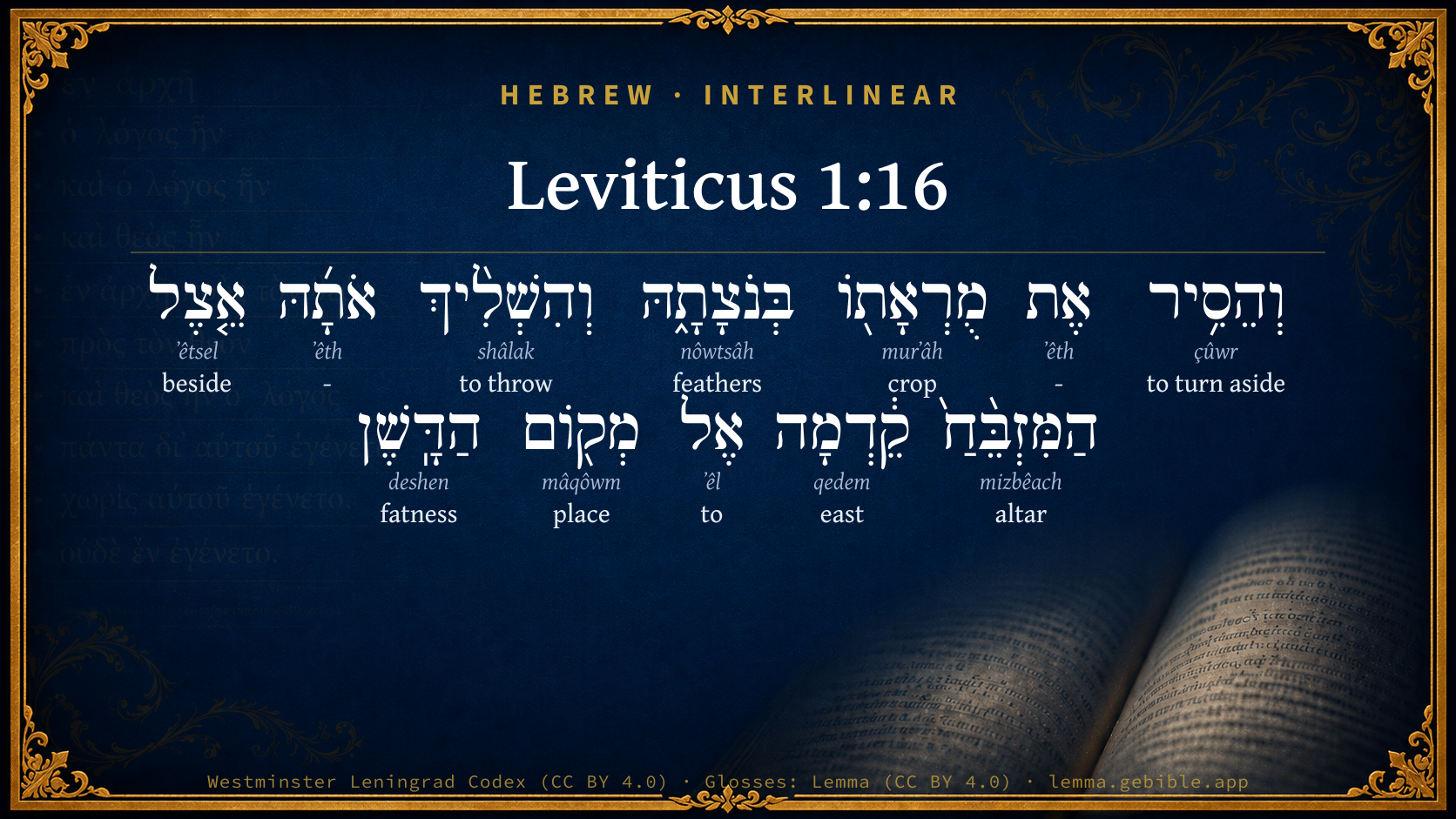
Leviticus 1:16

Hebrew (Westminster Leningrad Codex) Leviticus 1:16 appears in the Hebrew Old Testament. The text above is from the Westminster Leningrad Codex. Each word links to its Strong’s number, a concise gloss, and parsing drawn from the Open Scriptures Hebrew Bible morphology. Click any word for its full Brown-Driver-Briggs (BDB) entry.
Download image
Cite this verse

Leviticus 1:16 (World English Bible). Public Domain. Lemma interlinear Bible study tool, https://lemma.gebible.app/v/leviticus/1/16.

Show BibTeX & RIS
BibTeX
RIS
English Translation
and he shall take away its crop with its filth, and cast it beside the altar on the east part, in the place of the ashes.
World English Bible · Public Domain
Highlights
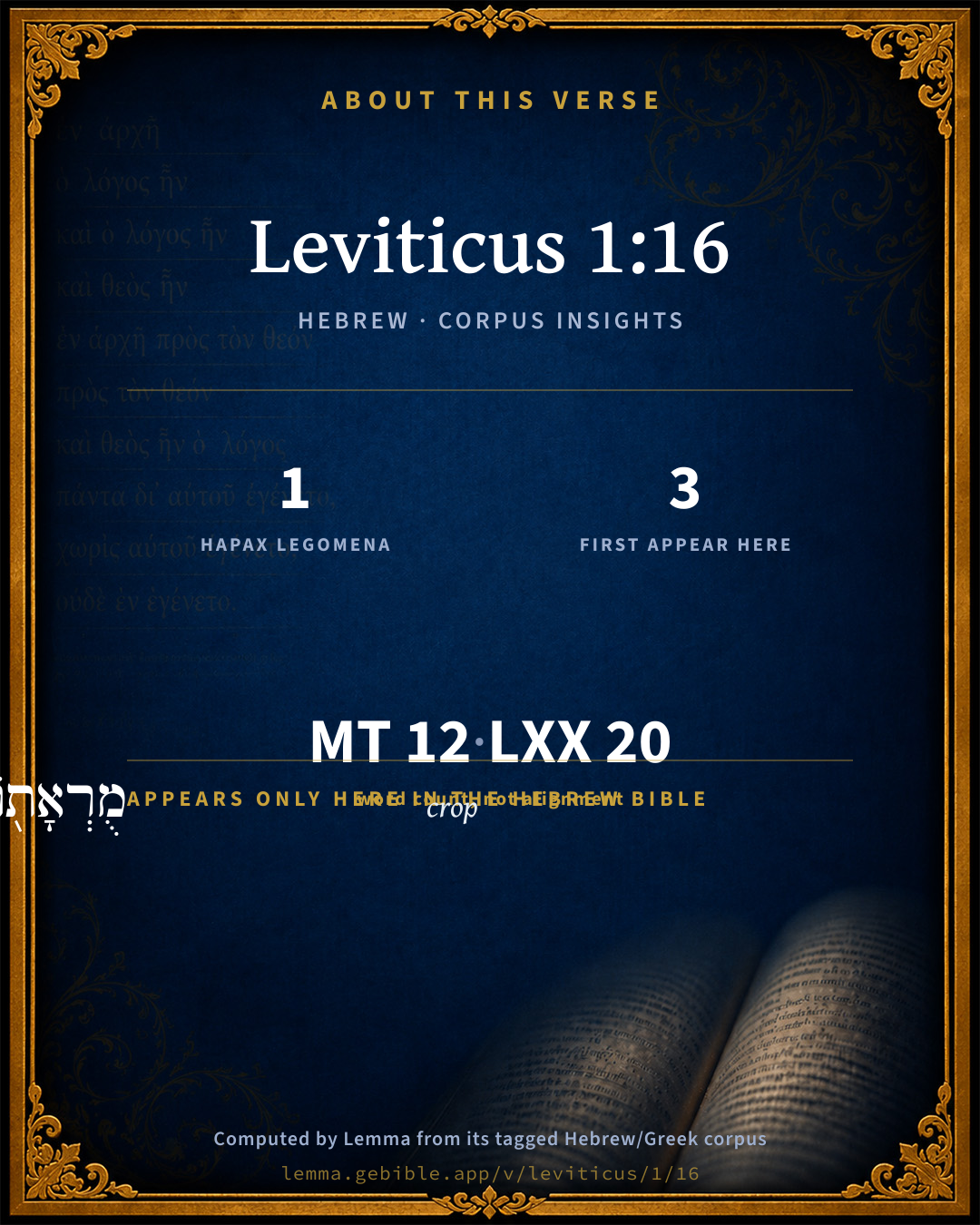
  • 1 hapax legomenon — only here in the Hebrew Bible
  • 3 first appearances in the Hebrew Bible
Full analysis ↓
Download a study sheet

One document with this verse’s original text, its word-by-word gloss line, the meaning frame, cross-references with their text, attributed commentary, and full source and license credits — printable, and it pastes into notes with its structure intact.

This verse Autodidact and up

Study sheet (.html) Plain text (.txt)

A passage Seminary Student

Up to 50 verses in one chapter. A passage sheet keeps up to 6 commentary sources and 12 cross-references per verse, in the order this page ranks them, and says so on the sheet whenever that leaves anything out. Ask for a single verse and you get the Autodidact verse sheet above.

Everything on this page stays free to read, with no account — the sheet is a download of what is already on screen, not access to it.

Want to remove ads? Support Godless Engineer
Compare translations 3

The same verse in 3 English versions, stacked beneath the original-language interlinear above. Click any original word for its lexicon entry.

Each is an independent rendering of the whole verse — the interlinear is not word-aligned to these translations.

Highlighted words mark where these versions differ — a whole-verse word diff, not a word-by-word alignment.

  • World English Bible Public Domain
    and he shall take away its crop with its filth, and cast it beside the altar on the east part, in the place of the ashes.
  • King James Version Public Domain
    And he shall pluck away his crop with his feathers, and cast it beside the altar on the east part, by the place of the ashes:
  • unfoldingWord Literal Text CC BY-SA 4.0
    And he shall remove its craw with its feathers, and he shall cast it beside the altar eastward to the place of the fatty ashes.

unfoldingWord Literal Text — © unfoldingWord, licensed CC BY-SA 4.0. Word-aligned USFM3 via Door43 (git.door43.org/unfoldingWord/en_ult).

Versions to compare (up to 4)

3 of 4 selected

Show all 18 translations

Every available English version of this verse, each an independent rendering of the whole verse.

  • World English Bible Public Domain
    and he shall take away its crop with its filth, and cast it beside the altar on the east part, in the place of the ashes.
  • Berean Standard Bible Public Domain
    And he is to remove the crop with its contents and throw it to the east side of the altar, in the place for ashes.
  • Majority Standard Bible Public Domain
    And he is to remove the crop with its contents and throw it to the east side of the altar, in the place for ashes.
  • King James Version Public Domain
    And he shall pluck away his crop with his feathers, and cast it beside the altar on the east part, by the place of the ashes:
  • American Standard Version (1901) Public Domain
    and he shall take away its crop with the filth thereof, and cast it beside the altar on the east part, in the place of the ashes:
  • Revised Version (1885) Public Domain
    and he shall take away its crop with the filth thereof, and cast it beside the altar on the east part, in the place of the ashes:
  • Geneva Bible (1599) Public Domain
    And he shall plucke out his maw with his fethers, and cast them beside the altar on the East part in the place of the ashes.
  • Douay-Rheims (1899) Public Domain
    But the crop of the throat, and the feathers he shall cast beside the altar at the east side, in the place where the ashes are wont to be poured out,
  • Young's Literal Translation Public Domain
    and he hath turned aside its crop with its feathers, and hath cast it near the altar, eastward, unto the place of ashes;
  • Literal Standard Version CC BY-SA 4.0
    and he has turned aside its crop with its feathers, and has cast it near the altar, eastward, to the place of ashes;
  • Unlocked Literal Bible CC BY-SA 4.0
    He must remove its crop with its contents, and throw it beside the altar on the east side, in the place for the ashes.
  • unfoldingWord Literal Text CC BY-SA 4.0
    And he shall remove its craw with its feathers, and he shall cast it beside the altar eastward to the place of the fatty ashes.
  • Darby Bible Public Domain
    And he shall remove its crop with its feathers, and cast it beside the altar on the east, into the place of the ashes;
  • World Messianic Bible Public Domain
    and he shall take away its crop and its feathers, and cast it beside the altar on the east part, in the place of the ashes.
  • Webster's Bible Public Domain
    And he shall pluck away its crop with its feathers, and cast it beside the altar on the east part, by the place of the ashes:
  • Free Bible Version CC BY-SA 4.0
    He must remove the crop and the feathers, and throw them to the east side of the altar into the ash pile.
  • Bible in Basic English Public Domain
    And he is to take away its stomach, with its feathers, and put it down by the east side of the altar, where the burned waste is put:
  • JPS Tanakh (1917) Public Domain
    And he shall take away its crop with the feathers thereof, and cast it beside the altar on the east part, in the place of the ashes.

Literal Standard Version (2020), Covenant Press — licensed CC BY-SA 4.0. Text via the HelloAO Bible API (eBible.org). Unlocked Literal Bible (unfoldingWord) — licensed CC BY-SA 4.0. Text via the HelloAO Bible API (eBible.org). unfoldingWord Literal Text — © unfoldingWord, licensed CC BY-SA 4.0. Word-aligned USFM3 via Door43 (git.door43.org/unfoldingWord/en_ult). Free Bible Version, Dr. Jonathan Gallagher — licensed CC BY-SA 4.0. Text via the HelloAO Bible API (eBible.org).

Word by word

More ways to search: Search by grammar → Find every occurrence → Compare this word →

Practice this passage: Drill this verse → Learn its vocabulary →

מֻרְאָת֖וֹ
murʼâh
H4760
“crop · his”
Noun, Common, Feminine, Singular, Construct + Suffix, Personal, 3rd Person, Masculine, Singular
Part of Speech
Noun
Type
Common
Gender
Feminine
Number
Singular
State
Construct
Full BDB Definition

Origin: apparently pass. causative participle of H7200

TWOT: 1239b

crop or craw (of a bird), alimentary canal (of a bird)
  1. וְהֵסִ֥יר çûwr H5493 “and · to turn aside” Conjunction + Verb, Hiphil, Sequential Perfect, 3rd Person, Masculine, Singular
  2. אֶת ʼêth H853 “-” Particle, Direct Object
  3. בְּנֹצָתָ֑הּ nôwtsâh H5133 “in/at · feathers · her” Preposition + Noun, Common, Feminine, Singular, Construct + Suffix, Personal, 3rd Person, Feminine, Singular
  4. וְהִשְׁלִ֨יךְ shâlak H7993 “and · to throw” Conjunction + Verb, Hiphil, Sequential Perfect, 3rd Person, Masculine, Singular
  5. אֹתָ֜הּ ʼêth H853 “- · her” Particle, Direct Object + Suffix, Personal, 3rd Person, Feminine, Singular
  6. אֵ֤צֶל ʼêtsel H681 “beside” Preposition
  7. הַמִּזְבֵּ֨חַ֙ mizbêach H4196 “the · altar” Particle, Definite Article + Noun, Common, Masculine, Singular, Absolute
  8. קֵ֔דְמָה qedem H6924 “east · toward” Adverb + Suffix, Demonstrative
  9. אֶל ʼêl H413 “to” Preposition
  10. מְק֖וֹם mâqôwm H4725 “place of” Noun, Common, Masculine, Singular, Construct
  11. הַדָּֽשֶׁן deshen H1880 “the · fatness” Particle, Definite Article + Noun, Common, Masculine, Singular, Absolute

About this verse

These counts appear in no published source. They are computed here, from the morphology-tagged text and Lemma’s own curated glosses. What Lemma adds →

12
words
11
distinct lemmas
Pentateuch
section

Notable vocabulary

1 hapax legomenon — a word that appears only here in the entire Hebrew Bible:

  • מֻרְאָת֖וֹ crop H4760

First appearance in Scripture

These words make their first canonical appearance in the Hebrew Bible here:

  • מֻרְאָת֖וֹ crop H4760
  • בְּנֹצָתָ֑הּ feathers H5133
  • הַדָּֽשֶׁן fatness H1880

Shared distinctive vocabulary

בְּנֹצָתָ֑הּ feathers H5133 occurs in 4 verses of the Hebrew Bible. Also found in:

Grammatical profile

  • 2 verbs
  • 5 nouns
  • 2 prepositions
  • 1 adverb
  • 2 particles

Verb forms

  • וְהֵסִ֥יר Hiphil · Sequential Perfect
  • וְהִשְׁלִ֨יךְ Hiphil · Sequential Perfect

Hebrew & Septuagint length

In English translation the verse runs 26 words from the Hebrew and 27 from the Septuagint (LXX English) — closely comparable.

A rough comparison of the two English renderings, which tokenize alike — not a word-level alignment.

Word counts can differ between the Hebrew and the Greek without any difference in meaning — e.g. the Hebrew direct-object marker אֵת has no separate Greek word, and Greek often adds the article ὁ.

In the original languages it is 12 Hebrew tokens and 20 Greek tokens — but the two are counted differently (Hebrew bundles its prefixes and suffixes into one token; the Greek is in lemma form), so that isn’t a like-for-like length.

Cross-references

6

Topical passages linked to Leviticus 1:16 in the Treasury of Scripture Knowledge — connected by theme and wording, ordered by reader-vote popularity; previews shown in the World English Bible.

  • Leviticus 4:12 even the whole bull shall he carry forth outside the camp to a clean place, where the ashes are poured out, and burn it on wood with fire. Where the ashes are poured out it shall be burned.
  • Leviticus 16:27 The bull for the sin offering, and the goat for the sin offering, whose blood was brought in to make atonement in the Holy Place, shall be carried forth outside the camp; and they shall burn their skins, their flesh, and their dung with fire.
  • Luke 1:35 The angel answered her, "The Holy Spirit will come on you, and the power of the Most High will overshadow you. Therefore also the holy one who is born from you will be called the Son of God.
  • Hebrews 13:11–14 For the bodies of those animals, whose blood is brought into the holy place by the high priest as an offering for sin, are burned outside of the camp.
  • 1 Peter 1:2 according to the foreknowledge of God the Father, in sanctification of the Spirit, that you may obey Jesus Christ and be sprinkled in his blood: Grace to you and peace be multiplied.
  • Leviticus 6:10–11 The priest shall put on his linen garment, and he shall put on his linen breeches upon his body; and he shall remove the ashes from where the fire has consumed the burnt offering on the altar, and he shall put them beside the altar.

Cross-references courtesy of OpenBible.info (CC BY 4.0).

Hebrew and Greek witnesses Masoretic Hebrew ↔ Greek Septuagint

The same verse in the two great witnesses to the Old Testament, shown verse-for-verse.

These are two independent witnesses, not word-aligned to each other, and the Septuagint is shown in lemma (dictionary) form.

Hebrew Leviticus 1:16 Masoretic · Westminster Leningrad Codex

וְהֵסִ֥יר אֶת מֻרְאָת֖וֹ בְּנֹצָתָ֑הּ וְהִשְׁלִ֨יךְ אֹתָ֜הּ אֵ֤צֶל הַמִּזְבֵּ֨חַ֙ קֵ֔דְמָה אֶל מְק֖וֹם הַדָּֽשֶׁן

and he shall take away its crop with its filth, and cast it beside the altar on the east part, in the place of the ashes.

World English Bible · Public Domain

Greek LXX Leviticus 1:16 Septuagint · lemma form

καί ἀποαἱρέω ὁ πρόλοβος σύν ὁ πτερόν καί ἐκβάλλω αὐτός παρά ὁ θυσιαστήριον κατά ἀνατολή εἰς ὁ τόπος ὁ σποδός

And he shall take away the crop with the feathers, and shall cast it forth by the altar toward the east to the place of the ashes.

LXX2012 (modern English Septuagint) · Public Domain

On this verse, The Cambridge Bible for Schools and Colleges discusses the Septuagint’s reading. Read the note in Commentary ↓

Hebrew: Westminster Leningrad Codex (CC BY 4.0). Greek: Septuagint (public domain); English from LXX2012 (modern English Septuagint) (Public Domain). How the Septuagint differs from the Hebrew →

Targum (Aramaic paraphrase)

2

The Targum is the ancient Jewish Aramaic paraphrase of the Hebrew Scriptures — an interpretive translation, not the Hebrew text itself. Onkelos (literal) and Pseudo-Jonathan (expansive) render the Torah, and Jonathan the Prophets. Coverage is partial: where no permissively-licensed English translation exists for a verse, only the Aramaic is shown. This is verse-level text, not a word-by-word alignment to the Hebrew. Some Onkelos verses here show an unreviewed machine translation (clearly flagged), not a published edition.

  1. Targum Onkelos Torah (Genesis–Deuteronomy)
    וְיַעֲדֵי יָת זְפָקֵיהּ בְּאוּכְלֵיהּ וְיִרְמֵי יָתַהּ לִסְטַר מַדְבְּחָא קִידוּמָא לַאֲתַר דְמוֹשְׁדִין קִטְמָא

    Unreviewed machine translation (Claude Sonnet 5) — not public domain confidence: high

    And he shall remove its crop with its filth, and he shall throw it beside the altar, on the east side, to the place where the ashes are poured out.

    Generated by an AI translate-then-audit pipeline and checked against an independent public-domain English translation of the underlying Hebrew for drift only. Not a published edition; pending human review.

    Aramaic base: public-domain Targum Onkelos (via Sefaria). The English above is the unreviewed machine translation, not public domain.

  2. Targum Pseudo-Jonathan Torah (Genesis–Deuteronomy)
    וְיַעֲדֵי יַת זְרוֹקְפֵיהּ בִּלְקָטֵיהּ וְיִטְלַק יָתָהּ לִסְטַר מַדְבְּחָא קִידוּמָא בַּאֲתַר דְמוֹקְדִין קִיטְמָא

    And he shall remove its gullet and the contents thereof, and throw it by the eastern side of the altar in the place where they burn the cinders.

    Targum Pseudo-Jonathan — Aramaic: “Targum Jonathan on Genesis” (public domain); “Targum Jonathan on Exodus” (public domain); “Targum Jonathan on Leviticus” (public domain); “Targum Jonathan on Numbers” (public domain); “Targum Jonathan on Deuteronomy” (public domain). English: “The Targum of Jonathan ben Uzziel, trans. J. W. Etheridge, London, 1862” (public domain). Text via Sefaria.

Commentary

Notes on Leviticus 1:16 from classic Christian and Jewish commentators (each source and its license shown beneath its notes). The classic Christian expositions comment on the surrounding passage and are grouped to its opening verse, so a note may address several verses; the Jewish commentaries on the Tanakh (Rashi and others) are per-verse, so they appear only where the commentator wrote on this verse.

Lemma curates 59 commentaries, every one of them public domain or Creative Commons licensed, each selected and text-cleaned for this edition rather than reprinted as found. About our sources →

Trapp's Complete Commentary

John Trapp

Lev 1:16 And he shall pluck away his crop with his feathers, and cast it beside the altar on the east part, by the place of the ashes:

Ver. 16. His crop with his feathers.] Or, The maw with the filth thereof - that is, the guts which receive the filth sent unto them from the maw - was plucked out, and the blood strained at the side of the altar. This signified those clots of blood wrung from our Saviour before his oblation upon the cross.

John Trapp, A Commentary or Exposition upon All the Books of the Old and New Testament (1647–1656) — public domain. Text from a community e-Sword module.

Joseph Benson's Commentary

Lev 1:16. With its feathers — Or, with its dung, or filth, contained in the crop and in the guts. On the east — Of the tabernacle. Here the filth was cast, because this was the remotest place from the holy of holies, which was in the west end; to teach us that impure things and persons should not presume to approach to God, and that they should be banished from his presence. The place of the ashes — Where the ashes fell down and lay, whence they were afterward removed without the camp.

Joseph Benson's Commentary on the Old and New Testaments (1811–1818) — public domain. Text from a community e-Sword module.

Geneva Bible (1599)

Geneva Bible translators

On the side of the court gate in the pans which stood with ashes, Exod. 17:3.

Geneva Bible (1599) marginal notes — public domain. Text via Bolls.life.

Adam Clarke's Commentary

Verse 16. Pluck away his crop with his feathers] In this sacrifice of fowls the head was violently wrung off, then the blood was poured out, then the feathers were plucked off, the breast was cut open, and the crop, stomach, and intestines taken out, and then the body was burnt. Though the bird was split up, yet it was not divided asunder. This circumstance is particularly remarked in Abram's sacrifice, Ge 15:10. See Clarke on Ge 15:10. See Ainsworth.

WE have already seen, on Le 1:2, that four kinds of animals might be made burnt-offerings to the Lord.

1. Neat cattle, such as bulls, oxen, cows, and calves.

2. He-goats, she-goats, and kids.

3. Rams, ewes, and lambs.

4. Pigeons and turtle-doves; and in one case, viz., the cleansing of the leper, sparrows or some small bird.

All these must be without spot or blemish - the most perfect of their respective kinds, and be wholly consumed by fire. The RICH were to bring the most costly; the POOR, those of least price. Even in this requisition of justice how much mercy was mingled! If a man could not bring a bullock or a heifer, a goat or a sheep, let him bring a calf, a kid, or a lamb. If he could not bring any of these because of his poverty, let him bring a turtle-dove, or a young pigeon, (see Le 5:7); and it appears that in cases of extreme poverty, even a little meal or fine flour was accepted by the bountiful Lord as a sufficient oblation; see Le 5:11. This brought down the benefits of the sacrificial service within the reach of the poorest of the poor; as we may take for granted that every person, however low in his circumstances, might be able to provide the tenth part of an ephah, about three quarts of meal, to make an offering for his soul unto the Lord. But every man must bring something; the law stooped to the lowest circumstances of the poorest of the people, but every man must sacrifice, because every man had sinned. Reader, what sort of a sacrifice dost thou bring to God? To Him thou owest thy whole body, soul, and substance; are all these consecrated to his service? Or has he the refuse of thy time, and the offal of thy estate? God requires thee to sacrifice as his providence has blessed thee. If thou have much, thou shouldst give liberally to God and the poor; If thou have but little, do thy diligence to give of that little. God's justice requires a measure of that which his mercy has bestowed. But remember that as thou hast sinned, thou needest a Saviour. Jesus is that lamb without spot which has been offered to God for the sin of the world, and which thou must offer to him for thy sin; and it is only through Him that thou canst be accepted, even when thou dedicatest thy whole body, soul, and substance to thy Maker. Even when we present ourselves a living sacrifice to God, we are accepted for his sake who carried our sins, and bore our sorrows. Thanks be to God, the rich and the poor have equal access unto him through the Son of his love, and equal right to claim the benefits of the great sacrifice!

Adam Clarke's Commentary on the Bible (1810–1826) — public domain. Text from a community e-Sword/MySword module.

Ellicott's Commentary for English Readers

(16) His crop with his feathers.—Just as in the case of quadrupeds the skin was flayed off the victim before it was put on the altar fire, so the feathers were removed from the bird before its body was placed on the altar. This is the natural sense which is to be expected from the context, since it can hardly be imagined that the victims would be burnt with the feathers, and thus cause an intolerable smell. The rendering, however, given in the margin, “with the filth thereof,” is now adopted by the greater number of expositors. As the two words filth and feathers resemble each other in Hebrew, it is probable that one of them has dropped out of the text. The maw, therefore, with its contents, as well as the feathers, were removed to the eastern side of the altar, where the ashes from the altar were thrown (Lev_6:3).

A Bible Commentary for English Readers, edited by Charles John Ellicott (1878–1897) — public domain. Text from a community e-Sword module.

The Cambridge Bible for Schools and Colleges

gen. ed. J. J. S. Perowne

16. take away its crop with the filth thereof] i.e. the bird is drawn as when made ready for cooking. The rendering of R.V. mg. (and so LXX. and Vulg.), as well as the Tal. Bab. (Zebaḥim 64 b), describes the removal of the feathers. It is probable that the bird was both cleaned and plucked.

on the east part, in the place of the ashes] The ashes to which the fire has reduced the Burnt-Offering (Lev_6:10).

The Cambridge Bible for Schools and Colleges (gen. ed. J. J. S. Perowne; Cambridge University Press, 1878–1918) — public domain. Text from a community e-Sword module.

John Gill's Exposition

And he shall pluck away his crop with his feathers,.... Or "with its meat", or "dung", as Onkelos renders it, meaning that which was in its crop; and so the Jerusalem Targum interprets it, "with its dung"; and Jonathan's paraphrase is, "with its collection", or what was gathered together in the crop; it includes the entrails, as Gersom observes:

and cast it beside the altar on the east part, by the place of the ashes; where the ashes of the burnt offering were put every day, and every time such an offering was made; and all this answered to the washing of the inwards, and legs of the other burnt offerings, and signified the same thing, the cleanness and purity of Christ, and of his people by him.

John Gill's Exposition of the Whole Bible (1746–1763) — public domain (CC PDM 1.0). Text via the HelloAO Bible API.

Albert Barnes' Notes on the Bible

His crop with his feathers - The weight of authority is in favor of the marginal rendering. It is most probable that the feathers were burned with the body, and that the wings, mentioned in Lev 1:17, were not mutilated.

The place of the ashes - The ashes were daily removed from the altar (except on certain holy days) and thrown into a heap on its eastern side. When the heap became inconveniently large, it was removed in vessels appropriated to the purpose (see Exo 27:3) to a spot without the camp. Lev 4:12; Lev 6:11.

Albert Barnes' Notes on the Bible (1834–1885) — public domain. Text from a community e-Sword/MySword module.

Haydock's Catholic Bible Commentary

Throat. Hebrew mierath, is rendered "the crop and its contents," by the Chaldean, Syriac, and Samaritan.

George Leo Haydock (1774–1849), Haydock's Catholic Family Bible and Commentary, 1859 edition — public domain. Excludes Psalms (Douay-Rheims chapter numbering differs from Protestant) and Deuterocanonical books (Catholic canon only).

Matthew Poole's English Annotations

With his feathers, or, with its dung or filth, to wit, contained in the crop, and in the guts.

On the east part, to wit, of the tabernacle. Here the filth was cast, because this was the remotest place from the holy of holies, which was in the west end; to teach us, that impure things and persons should not presume to approach to God, and that they should be banished from his presence.

By the place of the ashes; the place where the ashes fell down and lay, whence they were afterwards removed without the camp. See Lev 4:12; 6:10,11; 8:17.

Matthew Poole's English Annotations on the Holy Bible (1683–1685) — public domain. Text from a community e-Sword/MySword module.

Whedon's Commentary on the Bible

Daniel D. Whedon

16. Crop with his feathers — The Hebrew may be so rendered, but in the estimation of the best scholars it does not here signify feathers, but filth in the crop and connected viscera.

Place of the ashes — Rather, fat-ashes. The indestructible portions of the offering were to be taken from the altar and placed on the east side till they were removed without the camp. Chap.

Lev_6:11.

Daniel D. Whedon (gen. ed.), Commentary on the Old and New Testaments (1874–1909) — public domain. Text from a community e-Sword module.

The Pulpit Commentary

With his feathers, rather the contents of the crop. This and the ashes are to be placed beside the altar on the east part, as being furthest from the tabernacle and nearest to the entrance of the court, so that they might be readily removed.

God"s pleasure in man.

We believe

I THAT GOD IS A BEING OF SUPREME BLESSEDNESS. He is the ever-blessed God, the source and fountain of all joy. He who gives such boundless bliss to his creation must be divinely blessed. He could not give what he has not in himself.

II THAT SOME PART OF HIS JOY HE FINDS IN MAN. What constitutes the happiness of the Supreme? "The Lord will rejoice in his works;" but it is a larger truth that "the Lord taketh pleasure in his people"; (Psa_149:4) that "the Lord"s portion is his people". (Deu_32:9)

III THAT HIS GOOD PLEASURE IN US IS IN

1. Our complete but conscious consecration of ourselves. The "offering made by fire" was "of a sweet savour unto the Lord," not as typifying the annihilation of our self, absolute absorption of self in God (the Hindoo theory), but as expressing the offerer"s desire to dedicate himself and all that he had to God, voluntary, conscious devotion.

2. Our self-surrender to his Son our Saviour. That which, above all else, God says to us now is, "This is my beloved Son: hear ye him;" and the initial, essential, decisive step for us to take, in order to give him pleasure, is to "receive," to "believe in," to accept Jesus Christ as Teacher, Saviour, Lord, and Friend.

3. Our conformity to his revealed will, by

a. reverence; (Psa_147:11)

b. holy confidence in his pardoning love; (Psa_147:11)

c. patient endurance of wrong; (1Pe_2:20)

d. generous service of others. C. (Php_4:18 Heb_13:16)

The first part of this book, which may be called the spiritual statute-book of Israel as the congregation of the Lord, is occupied with the laws of sacrifice, chapters 1-7. The underlying fact is that of sin as separation from God; but the book, as regulating the intercourse between the sinful people and the holy object of their worship, is itself a constituent part of the gracious covenant made with Israel. While it deepens the sense of sin, it provides the means of reconciliation and sanctification, and therefore the laws prescribed, while, as laws, restraining liberty and giving form to religious acts, at the same time embody in themselves the grace of God in the covenant relation between Jehovah and his people.

The Pulpit Commentary (1880–1919), ed. H.D.M. Spence-Jones & Joseph S. Exell — public domain. Text from a community e-Sword module.

Keil & Delitzsch

C. F. Keil & F. Delitzsch

He then took out בּנצתהּ את־מראתו, i.e., according to the probable explanation of these obscure words, "its crop in (with) the foeces thereof,"

(Note: This is the rendering adopted by Onkelos. The lxx, on the contrary, render it ἀφελεῖ τὸν πρόλοβον σὺν τοῖς πτεροῖς, and this rendering is followed by Luther (and the English Version, Tr.), "its crop with its feathers." But the Hebrew for this would have been ונצתו. In Mishnah, Sebach. vi. 5, the instructions are the following: "et removet ingluviem et pennas et viscera egredentia cum illa." This interpretation may be substantially correct, although the reference of בנוצתה to the feathers of the pigeon cannot be sustained on the ground assigned. For if the bird's crop was taken out, the intestines with their contents would unquestionably come out along with it. The plucking off of the feathers, however, follows from the analogy of the flaying of the animal. Only, in the text neither intestines nor feathers are mentioned; they are passed over as subordinate matters, that could readily be understood from the analogy of the other instructions.)

and threw it "at the side of the altar eastwards," i.e., on the eastern side of the altar, "on the ash-place," where the ashes were thrown when taken from the altar (Lev 6:3). He then made an incision in the wings of the pigeon, but without severing them, and burned them on the altar-fire (Lev 1:17, cf. Lev 1:9).

The burnt-offerings all culminated in the presentation of the whole sacrifice upon the altar, that it might ascend to heaven, transformed into smoke and fragrance. Hence it is not only called עלה, the ascending (see Gen 8:20), but כּליל, a whole-offering (Deu 33:10; Ps. 51:21; Sa1 7:9). If the burning and sending up in the altar-fire shadowed forth the self-surrender of the offerer to the purifying fire of the Holy Ghost; the burnt-offering was an embodiment of the idea of the consecration and self-surrender of the whole man to the Lord, to be pervaded by the refining and sanctifying power of divine grace. This self-surrender was to be vigorous and energetic in its character; and this was embodied in the instructions to choose male animals for the burnt-offering, the male sex being stronger and more vigorous than the female. To render the self-sacrifice perfect, it was necessary that the offerer should spiritually die, and that through the mediator of his salvation he should put his soul into a living fellowship with the Lord by sinking it as it were into the death of the sacrifice that had died for him, and should also bring his bodily members within the operations of the gracious Spirit of God, that thus he might be renewed and sanctified both body and soul, and enter into union with God.

Keil & Delitzsch — Biblical Commentary on the Old Testament (1861–1891) — public domain (CC PDM 1.0). Text via the HelloAO Bible API. (Old Testament only.)

unfoldingWord translationNotes

Door43 World Missions Community

He must

"The priest must"

its crop with its contents

A crop is a pouch in the bird's throat where pre-digested food is stored.

throw it beside the altar

Here "it" refers to the crop and its contents.

it will produce a sweet aroma for Yahweh

Yahweh being pleased with the sincere worshiper who offered the sacrifice is spoken of as if God were pleased with the aroma of the burning sacrifice. See how you translated this in Leviticus 1:9. (See: Metaphor)

it will be an offering made to him by fire

This can be stated in active form. AT: "it will be a burnt offering to me" or "it will be a burnt offering to Yahweh" (See: Active or Passive)

translationWords

altar

priest

burnt offering

Yahweh

unfoldingWord translationNotes — © Distant Shores Media and the Door43 World Missions Community, licensed CC BY-SA 4.0. Source: git.door43.org/Door43/en_tn.

Rashi

Rabbi Shlomo Yitzchaki (Rashi)

מראתו [AND HE SHALL REMOVE] ITS CROP — The word is connected in meaning with the word רעי in Rabbinical Hebrew (or the Biblical ראי; cf. Nahum 3:6); it thus denotes the place of the רעי, the digested food, i. e. the crop (Sifra, Vayikra Dibbura d'Nedavah, Section 7 9).

בנצתה means together with its entrails (not with its feathers which meaning the word נוצה usually has). The word נוצה is really an expression for anything that is loathsome. Similar is (Lamentations 4:15) “[depart, depart, touch not:] for they are become loathsome (נצו) and are fled away”.) That is also what Onkelos means when he translates באוכליה, “with the digested food” found in the entrails (excrement). This, too, is the interpretation of the verse given by Abba José ben Chanan who states: he removes the stomach (being the organ which contains digested food) together with it (the crop). But our Rabbis, of blessed memory, taking נוצה; in its usual sense of “feathers”, say: with a knife he cuts out around the crop an opening like a flap and removes it together with the feathers on the skin (of that spot) (Sifra, Vayikra Dibbura d'Nedavah, Section 7 9; Zevachim 65a). — In the case of the burnt offering of the cattle which eats only from the crib of its owner it is stated, (v. 13) “But he shall lave the inwards and the legs with water: and [the priest] shall offer it”; in the case of a fowl, however, which feeds itself from what it picks up of other people’s property (lit., “of robbery”) it states, “he shall cast the entrails away”, because it (the bird) eats that which is stolen (Leviticus Rabbah 3 4).

אצל המזבח קדמה BESIDE THE ALTAR ON THE EAST — i. e. at the east of the כבש (the inclined ascent leading to the top of the altar which was on the south of the altar) (Sifra, Vayikra Dibbura d'Nedavah, Chapter 9 3).

אל מקום הדשן BY THE PLACE OF THE ASHES — i. e. that place where they deposited the ashes removed from the altar (תרומת הדשן) each morning (cf. Rashi on Leviticus 6:3, 4) and the ashes removed from the inner altar and the candelabrum (Meilah 12a;Sifra, Vayikra Dibbura d'Nedavah, Chapter 9 3). All these miraculously sunk there in their place (i. e. on the very spot where they were deposited) (Yoma 21a).

Rashi on the Tanakh — English translations: “The Judaica Press complete Tanach with Rashi, translated by A. J. Rosenberg” (CC BY 4.0); “Pentateuch with Rashi's commentary by M. Rosenbaum and A.M. Silbermann, 1929-1934” (public domain); “The Metsudah Tanach series, Lakewood, N.J” (CC BY 4.0); and “The Book of Joshua, Metsudah Publications, 1997” (CC BY 4.0). Text via Sefaria.

Ramban (Nachmanides)

Rabbi Moshe ben Nachman (Ramban / Nachmanides)

AND HE SHALL REMOVE ‘ETH MURATHO B’NOTZATHAH.’ “Muratho refers to the place of the digested food, namely ‘its crop.’ B’notzathah means ‘together with its entrails.’ The word notzah is a term for anything which is loathsome. Similarly: for ‘natzu’ (they are become loathsome) and are wandered away. That is what Onkelos intended in translating ‘b’notzathah’ as b’uchleih (with its digested food). This is also the interpretation of Aba Yosei ben Chanan who said that he removes the stomach together with it [i.e., the crop]. But our Rabbis have said: he cuts out with a knife an opening around the crop like a flap, and removes it together with the feathers [on the skin].” This is Rashi’s language.But it is not correct. For the word notzah in all places only means actual feathers. Similarly, for ‘natzu’ and are wandered away means that they have acquired feathers [wings] to fly away from their places and go into exile, and there too they will [constantly] wander, not finding a resting-place. Similarly: for ‘natzoh’ (she must fly away) and get away. is derived from the original root meaning “feathers” — hence: “she must fly away.” The Jerusalem Targum rendered [the above-mentioned verse: for ‘natzu’ and are wandered away]: “for they are ‘quarrelsome’ and have also wandered away.” The Targum thus derived the word natzu from the expression, when men ‘yinatzu’ (strive) together, and the verse is thus stating that “they strive with all the nations and wander away from them, and do not continue to live among them.” This is a correct interpretation. But the word notzah in the sense of “loathsome” as the Rabbi [Rashi] has it, is not found. The interpretation of Aba Yosei which made it incumbent upon the priest to take also the stomach with the crop, is [not because he considers the word b’notzathah to mean “the place of its entrails,” as Rashi understood him, but rather] because the crop and the gullet together with the stomach, comprising the organs for the digestion of food [in the bird], are all included in the term muratho, because in the stomach the food turns into r’ie (dung). Aba Yosei thus does not differ at all with the First Sage who says that he should take it with the “feathers,” for we have been taught in a Mishnah of the sixth chapter of Tractate Zebachim [with reference to the order of the burnt-offering of the bird]: “He [i.e. the priest] came then to the body, and removed the crop and the feathers and the entrails that came forth with the crop, and cast them on the place of ashes.” This Mishnah is in accordance with the teaching of Aba Yosei and yet it mentions “the feathers!” to mean with “its feathers,” and not, as Rashi explained it, that Aba Yosei interprets it to mean “the place of its digested food, namely the crop.”Onkelos’ opinion [in translating b’notzathah as b’uchleih, is not because he considered this to be the Aramaic rendition of the word b’notzathah, so that you might think that he is of the opinion that the Hebrew word means “the place of its digested food,” as Rashi thought, but rather Onkelos’ opinion] is like that of the Sages, that he removed only the crop and its feathers together with the food therein which is the mur’ah [but he did not remove its entrails]. Since the priest takes hold of the crop and removes the food therein with it, therefore Onkelos rendered it: “and he shall remove yath zfokeih b’uchleih,” the expression being as if it had said: “and he shall remove yath uchleih bizfokeih,” as yath zfokeih b’uchleih, did not put it in the order of the wording of the Hebrew; instead, it is as if he had inverted it and rendered it yath uchleih bizfokeih, as the Aramaic uchleih is the equivalent of the Hebrew muratho, and the Aramaic bizfokeih is the equivalent of the Hebrew b’notzathah, as explained in the text. The reason for this change is, as explained by Ramban, because the food (muratho) is only removable by means of taking away the crop (zfokeih). Ramban then brings a number of proofs to illustrate that it is Onkelos’ habit to change the order of the Hebrew wording when it appears better to him to do so. for uchleih [according to Onkelos] is the Aramaic for the Hebrew muratho [as muratho is associated with the word r’ie — “dung,” and “food” turns into dung], whereas zfokeih is the translation for the Hebrew b’notzathah [as will be explained]. The verse [according to Onkelos] thus means as follows: he should remove the mur’ah, which is the food, with the plumage upon it, meaning that he takes the crop with its skin and the feathers upon it. In a similar way Onkelos translated [the Hebrew ‘ki sh’mi b’kirbo’ — for My Name is in him ]: arei bishmi meimreih (“for in My Name is his word”), which, according to the Hebrew, he should have rendered into Aramaic as follows: arei sh’mi b’meimreih (for My Name is in his word). But Onkelos changed the order of the wording because of a certain reason known to him., Verse 20 (towards the end — Vol. II, p. 413) where he explains Onkelos’ intent in that translation. So also he translated the verse: And the two ends of the two wreathen chains, 28:25. — “and the two wreathen chains of the two ends.” There are many other such cases.

Ramban (Nachmanides) on the Tanakh — English translation: “Commentary on the Torah by Ramban (Nachmanides). Translated and annotated by Charles B. Chavel. New York, Shilo Pub. House, 1971-1976” (CC BY 4.0). Text via Sefaria.

Lesson kit

Teaching starters — assembled from the data on this page, not authored interpretation. Every prompt links to the verse data it draws on. Edit before teaching.

Leviticus, in the Pentateuch, opens this verse with 12 words (11 distinct Hebrew lemmas). Its most distinctive word is murʼâh (“crop”). A historical commentator’s framing appears above. Read the whole chapter for the surrounding context.

Discussion questions

  1. How does “crop” (murʼâh) shape what this verse is saying?
  2. This verse holds 1 word here found nowhere else in the Hebrew Bible. What might the rare word draw attention to?
  3. 3 words here appear for the first time in Scripture. What is being introduced at this debut?
  4. Job 39:13 shares the word «feathers» with this verse. How do the two illuminate each other?
  5. The translations on this page render this verse differently — a whole-verse word diff, not a word-by-word alignment. What might account for the different wordings?
  6. The verb «וְהֵסִ֥יר» is Hiphil Sequential Perfect. How does its form color the action?
  7. Reading how Trapp's Complete Commentary and Joseph Benson's Commentary read this verse, where do the two commentators agree and where do they part?

Things to notice

Reading settings

Reading text

Shown beneath each verse's original-language words.

Old Testament
Old Testament edition

Read the OT as the Masoretic Hebrew (MT) or the Greek Septuagint (LXX).

English shown for the Greek Septuagint (in the Hebrew ↔ Greek comparison).

Comparing translations? Open the Compare panel on any verse page to stack up to four side by side.