
Exodus 29:13

Hebrew (Westminster Leningrad Codex) Exodus 29:13 appears in the Hebrew Old Testament. The text above is from the Westminster Leningrad Codex. Each word links to its Strong’s number, a concise gloss, and parsing drawn from the Open Scriptures Hebrew Bible morphology. Click any word for its full Brown-Driver-Briggs (BDB) entry.
Download image
Cite this verse

Exodus 29:13 (World English Bible). Public Domain. Lemma interlinear Bible study tool, https://lemma.gebible.app/v/exodus/29/13.

Show BibTeX & RIS
BibTeX
RIS
English Translation
You shall take all the fat that covers the innards, the cover of the liver, the two kidneys, and the fat that is on them, and burn them on the altar.
World English Bible · Public Domain
Highlights
  • 4 first appearances in the Hebrew Bible
Full analysis ↓
Download a study sheet

One document with this verse’s original text, its word-by-word gloss line, the meaning frame, cross-references with their text, attributed commentary, and full source and license credits — printable, and it pastes into notes with its structure intact.

This verse Autodidact and up

Study sheet (.html) Plain text (.txt)

A passage Seminary Student

Up to 50 verses in one chapter. A passage sheet keeps up to 6 commentary sources and 12 cross-references per verse, in the order this page ranks them, and says so on the sheet whenever that leaves anything out. Ask for a single verse and you get the Autodidact verse sheet above.

Everything on this page stays free to read, with no account — the sheet is a download of what is already on screen, not access to it.

Want to remove ads? Support Godless Engineer
Compare translations 3

The same verse in 3 English versions, stacked beneath the original-language interlinear above. Click any original word for its lexicon entry.

Each is an independent rendering of the whole verse — the interlinear is not word-aligned to these translations.

Highlighted words mark where these versions differ — a whole-verse word diff, not a word-by-word alignment.

  • World English Bible Public Domain
    You shall take all the fat that covers the innards, the cover of the liver, the two kidneys, and the fat that is on them, and burn them on the altar.
  • King James Version Public Domain
    And thou shalt take all the fat that covereth the inwards, and the caul that is above the liver, and the two kidneys, and the fat that is upon them, and burn them upon the altar.
  • unfoldingWord Literal Text CC BY-SA 4.0
    And you shall take all of the fat covering the entrails and the lobe above the liver and the two kidneys and the fat that is on them, and cause them to become smoke on the altar.

unfoldingWord Literal Text — © unfoldingWord, licensed CC BY-SA 4.0. Word-aligned USFM3 via Door43 (git.door43.org/unfoldingWord/en_ult).

Versions to compare (up to 4)

3 of 4 selected

Show all 18 translations

Every available English version of this verse, each an independent rendering of the whole verse.

  • World English Bible Public Domain
    You shall take all the fat that covers the innards, the cover of the liver, the two kidneys, and the fat that is on them, and burn them on the altar.
  • Berean Standard Bible Public Domain
    Take all the fat that covers the entrails and the lobe of the liver, and both kidneys with the fat on them, and burn them on the altar.
  • Majority Standard Bible Public Domain
    Take all the fat that covers the entrails and the lobe of the liver, and both kidneys with the fat on them, and burn them on the altar.
  • King James Version Public Domain
    And thou shalt take all the fat that covereth the inwards, and the caul that is above the liver, and the two kidneys, and the fat that is upon them, and burn them upon the altar.
  • American Standard Version (1901) Public Domain
    And thou shalt take all the fat that covereth the inwards, and the caul upon the liver, and the two kidneys, and the fat that is upon them, and burn them upon the altar.
  • Revised Version (1885) Public Domain
    And thou shalt take all the fat that covereth the inwards, and the caul upon the liver, and the two kidneys, and the fat that is upon them, and burn them upon the altar.
  • Geneva Bible (1599) Public Domain
    Also thou shalt take all the fat that couereth the inwardes, and the kall, that is on the liuer, and the two kidneis, and the fat that is vpon them, and shalt burne them vpon the altar.
  • Douay-Rheims (1899) Public Domain
    Thou shalt take also all the fat that covereth the entrails, and the caul of the liver, and the two kidneys, and the fat that is upon them, and shalt offer a burnt offering upon the altar:
  • Young's Literal Translation Public Domain
    and thou hast taken all the fat which is covering the inwards, and the redundance on the liver, and the two kidneys, and the fat which `is' on them, and hast made perfume on the altar;
  • Literal Standard Version CC BY-SA 4.0
    and you have taken all the fat which is covering the innards, and the redundance on the liver, and the two kidneys, and the fat which [is] on them, and have made incense on the altar;
  • Unlocked Literal Bible CC BY-SA 4.0
    You must take all the fat that covers the inner parts, and also take the covering of the liver and the two kidneys with the fat that is on them; burn it all on the altar.
  • unfoldingWord Literal Text CC BY-SA 4.0
    And you shall take all of the fat covering the entrails and the lobe above the liver and the two kidneys and the fat that is on them, and cause them to become smoke on the altar.
  • Darby Bible Public Domain
    And thou shalt take all the fat that covereth the inwards, and the net of the liver, and the two kidneys, and the fat that is upon them, and burn them upon the altar.
  • World Messianic Bible Public Domain
    You shall take all the fat that covers the innards, the cover of the liver, the two kidneys, and the fat that is on them, and burn them on the altar.
  • Webster's Bible Public Domain
    And thou shalt take all the fat that covereth the inwards, and the caul that is above the liver, and the two kidneys, and the fat that is upon them, and burn them upon the altar.
  • Free Bible Version CC BY-SA 4.0
    Take all the fat that covers the intestines, the best parts of the liver, and the two kidneys with their fat, and burn them on the altar.
  • Bible in Basic English Public Domain
    And take all the fat covering the inside of the ox, and the fat joining the liver and the two kidneys with the fat round them, and let them be burned on the altar;
  • JPS Tanakh (1917) Public Domain
    And thou shalt take all the fat that covereth the inwards, and the lobe above the liver, and the two kidneys, and the fat that is upon them, and make them smoke upon the altar.

Literal Standard Version (2020), Covenant Press — licensed CC BY-SA 4.0. Text via the HelloAO Bible API (eBible.org). Unlocked Literal Bible (unfoldingWord) — licensed CC BY-SA 4.0. Text via the HelloAO Bible API (eBible.org). unfoldingWord Literal Text — © unfoldingWord, licensed CC BY-SA 4.0. Word-aligned USFM3 via Door43 (git.door43.org/unfoldingWord/en_ult). Free Bible Version, Dr. Jonathan Gallagher — licensed CC BY-SA 4.0. Text via the HelloAO Bible API (eBible.org).

Word by word

More ways to search: Search by grammar → Find every occurrence → Compare this word →

Practice this passage: Drill this verse → Learn its vocabulary →

הַיֹּתֶ֨רֶת֙
yôthereth
H3508
“the · appendage”
Particle, Definite Article + Noun, Common, Feminine, Singular, Absolute
Part of Speech
Particle + Noun
Type
Common
Gender
Feminine
Number
Singular
State
Absolute
Full BDB Definition

Origin: act. participle of H3498

TWOT: 936e

appendage, overhang, protrusion, the caudate lobe of the liver of a sacrificial animal
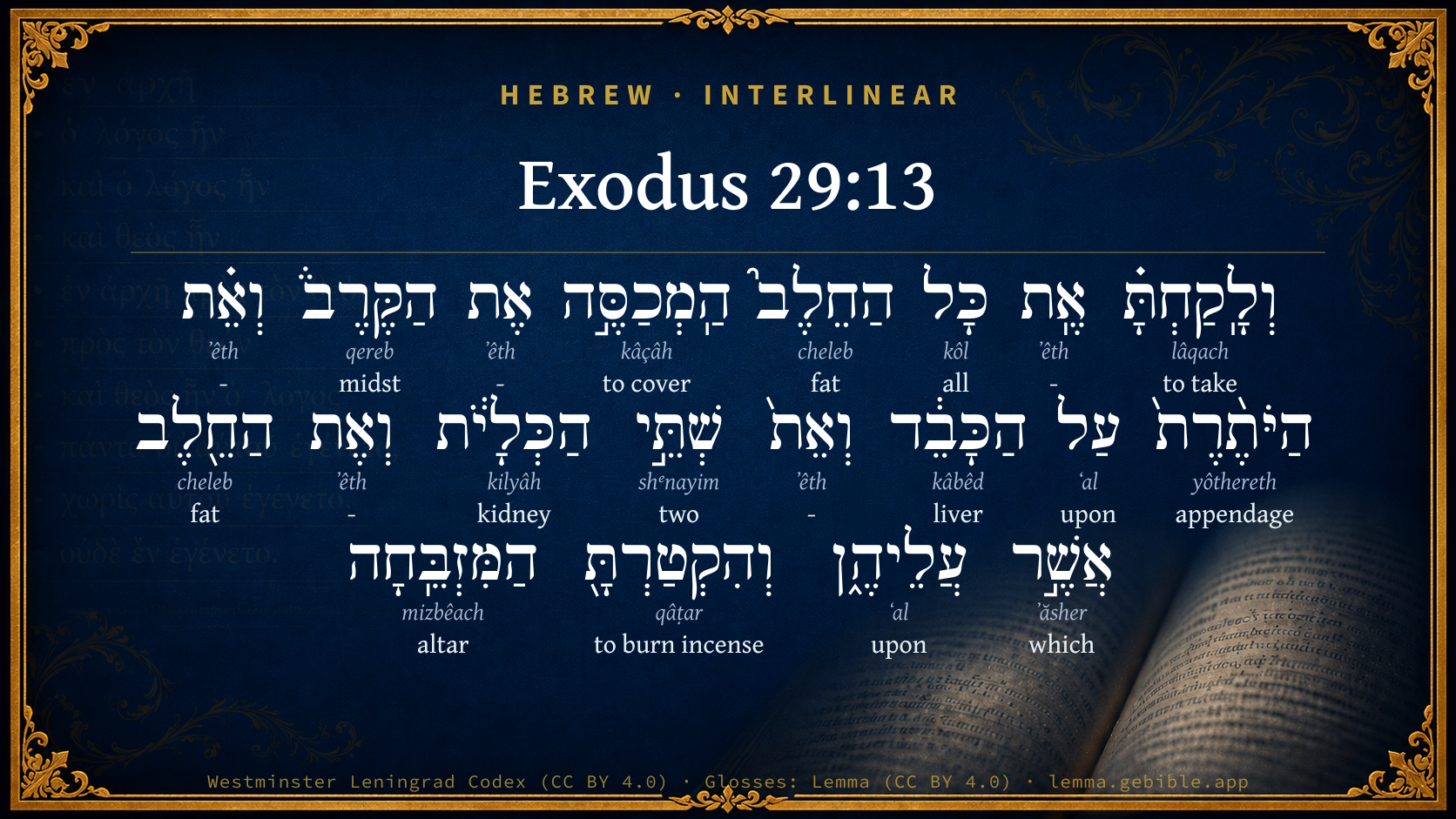
  1. וְלָֽקַחְתָּ֗ lâqach H3947 “and · to take” Conjunction + Verb, Qal, Sequential Perfect, 2nd Person, Masculine, Singular
  2. אֶֽת ʼêth H853 “-” Particle, Direct Object
  3. כָּל kôl H3605 “all of” Noun, Common, Masculine, Singular, Construct
  4. הַחֵלֶב֮ cheleb H2459 “the · fat” Particle, Definite Article + Noun, Common, Masculine, Singular, Absolute
  5. הַֽמְכַסֶּ֣ה kâçâh H3680 “the · covering” Particle, Definite Article + Verb, Piel, Participle Active, Masculine, Singular, Absolute
  6. אֶת ʼêth H853 “-” Particle, Direct Object
  7. הַקֶּרֶב֒ qereb H7130 “the · midst” Particle, Definite Article + Noun, Common, Masculine, Singular, Absolute
  8. וְאֵ֗ת ʼêth H853 “and · -” Conjunction + Particle, Direct Object
  9. עַל ʻal H5921 “upon” Preposition
  10. הַכָּבֵ֔ד kâbêd H3516 “the · liver” Particle, Definite Article + Noun, Common, Feminine, Singular, Absolute
  11. וְאֵת֙ ʼêth H853 “and · -” Conjunction + Particle, Direct Object
  12. שְׁתֵּ֣י shᵉnayim H8147 “two” Adjective, Cardinal number, Feminine, Dual, Construct
  13. הַכְּלָיֹ֔ת kilyâh H3629 “the · kidneys” Particle, Definite Article + Noun, Common, Feminine, Plural, Absolute
  14. וְאֶת ʼêth H853 “and · -” Conjunction + Particle, Direct Object
  15. הַחֵ֖לֶב cheleb H2459 “the · fat” Particle, Definite Article + Noun, Common, Masculine, Singular, Absolute
  16. אֲשֶׁ֣ר ʼăsher H834 “which” Particle, Relative
  17. עֲלֵיהֶ֑ן ʻal H5921 “upon · them” Preposition + Suffix, Personal, 3rd Person, Feminine, Plural
  18. וְהִקְטַרְתָּ֖ qâṭar H6999 “and · to burn incense” Conjunction + Verb, Hiphil, Sequential Perfect, 2nd Person, Masculine, Singular
  19. הַמִּזְבֵּֽחָה mizbêach H4196 “the · altar · toward” Particle, Definite Article + Noun, Common, Masculine, Singular, Absolute + Suffix, Demonstrative

About this verse

These counts appear in no published source. They are computed here, from the morphology-tagged text and Lemma’s own curated glosses. What Lemma adds →

20
words
14
distinct lemmas
Pentateuch
section

Notable vocabulary

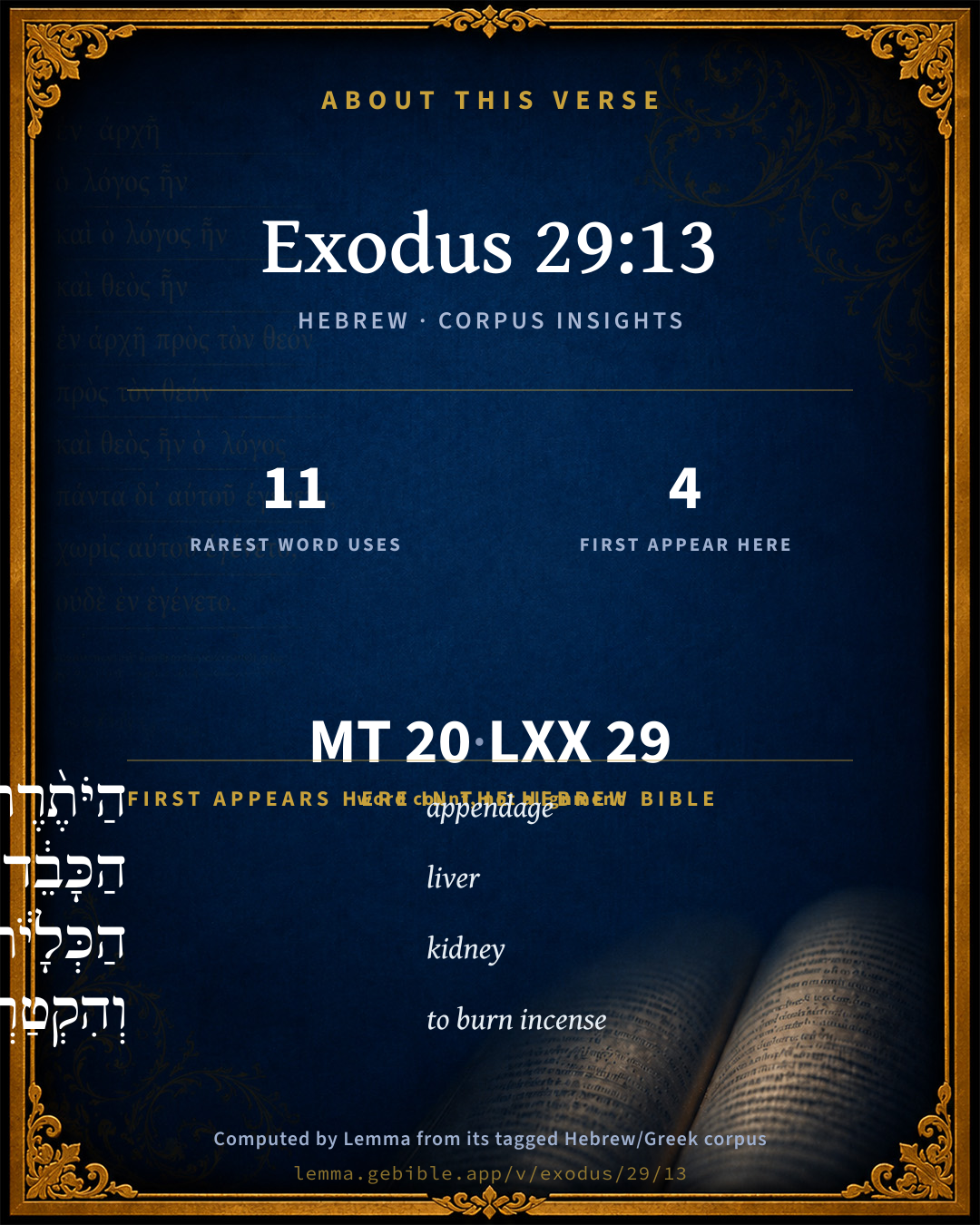
The rarest word here is הַיֹּתֶ֨רֶת֙ appendage H3508 — appearing just 11 times in the whole Hebrew Bible.

First appearance in Scripture

These words make their first canonical appearance in the Hebrew Bible here:

  • הַיֹּתֶ֨רֶת֙ appendage H3508
  • הַכָּבֵ֔ד liver H3516
  • הַכְּלָיֹ֔ת kidney H3629
  • וְהִקְטַרְתָּ֖ to burn incense H6999

Shared distinctive vocabulary

הַיֹּתֶ֨רֶת֙ appendage H3508 occurs in 11 verses of the Hebrew Bible. Also found in:

Grammatical profile

  • 3 verbs
  • 8 nouns
  • 1 adjective
  • 2 prepositions
  • 6 particles

Verb forms

  • וְלָֽקַחְתָּ֗ Qal · Sequential Perfect
  • הַֽמְכַסֶּ֣ה Piel · Participle Active
  • וְהִקְטַרְתָּ֖ Hiphil · Sequential Perfect

Repetition

Words recur within this verse — often emphatic in Hebrew:

  • הַחֵלֶב֮ fat H2459 ×2
  • עַל upon H5921 ×2

Hebrew & Septuagint length

In English translation the verse runs 31 words from the Hebrew and 36 from the Septuagint (LXX English) — closely comparable.

A rough comparison of the two English renderings, which tokenize alike — not a word-level alignment.

Word counts can differ between the Hebrew and the Greek without any difference in meaning — e.g. the Hebrew direct-object marker אֵת has no separate Greek word, and Greek often adds the article ὁ.

In the original languages it is 20 Hebrew tokens and 29 Greek tokens — but the two are counted differently (Hebrew bundles its prefixes and suffixes into one token; the Greek is in lemma form), so that isn’t a like-for-like length.

Cross-references

27

Topical passages linked to Exodus 29:13 in the Treasury of Scripture Knowledge — connected by theme and wording, ordered by reader-vote popularity; previews shown in the World English Bible.

  • Leviticus 3:3–4 He shall offer of the sacrifice of peace offerings an offering made by fire to Yahweh; the fat that covers the innards, and all the fat that is on the innards,
  • 1 Samuel 2:16 If the man said to him, They will surely burn the fat first, and then take as much as your soul desires; then he would say, No, but you shall give it me now: and if not, I will take it by force.
  • Exodus 29:18 You shall burn the whole ram on the altar: it is a burnt offering to Yahweh; it is a sweet savor, an offering made by fire to Yahweh.
  • Exodus 29:22 Also you shall take some of the ram's fat, the fat tail, the fat that covers the innards, the cover of the liver, the two kidneys, the fat that is on them, and the right thigh (for it is a ram of consecration),
  • Exodus 29:25 You shall take them from their hands, and burn them on the altar on the burnt offering, for a sweet savor before Yahweh: it is an offering made by fire to Yahweh.
  • Leviticus 1:9 but its innards and its legs he shall wash with water. The priest shall burn the whole on the altar, for a burnt offering, an offering made by fire, of a sweet savor to Yahweh.
  • Leviticus 1:15 The priest shall bring it to the altar, and wring off its head, and burn it on the altar; and its blood shall be drained out on the side of the altar;
  • Leviticus 3:9–10 He shall offer from the sacrifice of peace offerings an offering made by fire to Yahweh; its fat, the entire tail fat, he shall take away close to the backbone; and the fat that covers the inwards, and all the fat that is on the inwards,
  • Leviticus 3:14–16 He shall offer from it as his offering, an offering made by fire to Yahweh; the fat that covers the innards, and all the fat that is on the innards,
  • Leviticus 4:8–9 He shall take all the fat of the bull of the sin offering off of it; the fat that covers the innards, and all the fat that is on the innards,
  • Leviticus 4:26 All its fat he shall burn on the altar, like the fat of the sacrifice of peace offerings; and the priest shall make atonement for him concerning his sin, and he will be forgiven.
  • Leviticus 4:31 All its fat he shall take away, like the fat is taken away from off of the sacrifice of peace offerings; and the priest shall burn it on the altar for a sweet savor to Yahweh; and the priest shall make atonement for him, and he will be forgiven.
  • Leviticus 4:35 All its fat he shall take away, like the fat of the lamb is taken away from the sacrifice of peace offerings; and the priest shall burn them on the altar, on the offerings of Yahweh made by fire; and the priest shall make atonement for him concerning his sin that he has sinned, and he will be forgiven.
  • Leviticus 6:12 The fire on the altar shall be kept burning on it, it shall not go out; and the priest shall burn wood on it every morning: and he shall lay the burnt offering in order upon it, and shall burn on it the fat of the peace offerings.
  • Leviticus 7:3 He shall offer all of its fat: the fat tail, and the fat that covers the innards,
  • Leviticus 7:31 The priest shall burn the fat on the altar, but the breast shall be Aaron's and his sons'.
  • Leviticus 8:16 He took all the fat that was on the innards, and the cover of the liver, and the two kidneys, and their fat; and Moses burned it on the altar.
  • Leviticus 8:25 He took the fat, and the fat tail, and all the fat that was on the innards, and the cover of the liver, and the two kidneys, and their fat, and the right thigh;
  • Leviticus 9:10 but the fat, and the kidneys, and the cover from the liver of the sin offering, he burned upon the altar; as Yahweh commanded Moses.
  • Leviticus 9:19 and the fat of the ox and of the ram, the fat tail, and that which covers the innards, and the kidneys, and the cover of the liver:
  • Leviticus 16:25 The fat of the sin offering he shall burn on the altar.
  • Leviticus 17:6 The priest shall sprinkle the blood on the altar of Yahweh at the door of the Tent of Meeting, and burn the fat for a sweet savor to Yahweh.
  • Numbers 18:17 But the firstborn of a cow, or the firstborn of a sheep, or the firstborn of a goat, you shall not redeem; they are holy: you shall sprinkle their blood on the altar, and shall burn their fat for an offering made by fire, for a sweet savor to Yahweh.
  • Psalms 22:14 I am poured out like water. All my bones are out of joint. My heart is like wax; It is melted within me.
  • Isaiah 1:11 "What are the multitude of your sacrifices to me?," says Yahweh. "I have had enough of the burnt offerings of rams, And the fat of fed animals. I don't delight in the blood of bulls, Or of lambs, Or of male goats.
  • Isaiah 34:6 The sword of Yahweh is filled with blood, it is made fat with fatness, with the blood of lambs and goats, with the fat of the kidneys of rams; for Yahweh has a sacrifice in Bozrah, and a great slaughter in the land of Edom.
  • Isaiah 43:24 You have bought me no sweet cane with money, neither have you filled me with the fat of your sacrifices; but you have burdened me with your sins, you have wearied me with your iniquities.

Cross-references courtesy of OpenBible.info (CC BY 4.0).

Hebrew and Greek witnesses Masoretic Hebrew ↔ Greek Septuagint

The same verse in the two great witnesses to the Old Testament, shown verse-for-verse.

These are two independent witnesses, not word-aligned to each other, and the Septuagint is shown in lemma (dictionary) form.

Hebrew Exodus 29:13 Masoretic · Westminster Leningrad Codex

וְלָֽקַחְתָּ֗ אֶֽת כָּל הַחֵלֶב֮ הַֽמְכַסֶּ֣ה אֶת הַקֶּרֶב֒ וְאֵ֗ת הַיֹּתֶ֨רֶת֙ עַל הַכָּבֵ֔ד וְאֵת֙ שְׁתֵּ֣י הַכְּלָיֹ֔ת וְאֶת הַחֵ֖לֶב אֲשֶׁ֣ר עֲלֵיהֶ֑ן וְהִקְטַרְתָּ֖ הַמִּזְבֵּֽחָה

You shall take all the fat that covers the innards, the cover of the liver, the two kidneys, and the fat that is on them, and burn them on the altar.

World English Bible · Public Domain

Greek LXX Exodus 29:13 Septuagint · lemma form

καί λαμβάνω πᾶς ὁ στέαρ ὁ ἐπί ὁ κοιλία καί ὁ λοβός ὁ ἧπαρ καί ὁ δύο νεφρός καί ὁ στέαρ ὁ ἐπί αὐτός καί ἐπιτίθημι ἐπί ὁ θυσιαστήριον

And you shall take all the fat that is on the belly, and the lobe of the liver, and the two kidneys, and the fat that is upon them, and shall put them upon the altar.

LXX2012 (modern English Septuagint) · Public Domain

On this verse, The Cambridge Bible for Schools and Colleges discusses the Septuagint’s reading. Read the note in Commentary ↓

Hebrew: Westminster Leningrad Codex (CC BY 4.0). Greek: Septuagint (public domain); English from LXX2012 (modern English Septuagint) (Public Domain). How the Septuagint differs from the Hebrew →

Targum (Aramaic paraphrase)

2

The Targum is the ancient Jewish Aramaic paraphrase of the Hebrew Scriptures — an interpretive translation, not the Hebrew text itself. Onkelos (literal) and Pseudo-Jonathan (expansive) render the Torah, and Jonathan the Prophets. Coverage is partial: where no permissively-licensed English translation exists for a verse, only the Aramaic is shown. This is verse-level text, not a word-by-word alignment to the Hebrew.

  1. Targum Onkelos Torah (Genesis–Deuteronomy)
    וְתִסַב יָת כָּל תַּרְבָּא דְחָפֵי יָת גַוָא וְיָת חִצְרָא דִעַל כַּבְדָא וְיָת תַּרְתֵּין כָּלְיָן וְיָת תַּרְבָּא דִי עֲלֵיהֶן וְתַסֵיק לְמַדְבְּחָא:

    (no public-domain English translation for this verse)

    Targum Onkelos — Aramaic: “Onkelos Genesis” (public domain); “Onkelos Exodus” (public domain); “Onkelos Leviticus” (public domain); “Onkelos Numbers” (public domain); “Onkelos Deuteronomy” (public domain). English: “Sefaria Community Translation” (CC0 1.0 (public-domain dedication)); “J.W. Etheridge. The Targums of Onkelos and Jonathan Ben Uzziel on the Pentateuch. London: Longmans, Green, 1862” (public domain). Text via Sefaria.

  2. Targum Pseudo-Jonathan Torah (Genesis–Deuteronomy)
    וְתִיסַב יַת כָּל תַּרְבָּא דְחָפֵי עַל בְּנֵי גַוָא וְיַת דְּמִשְׁתְּאַר עַל חֲצַר כַּבְדָא וְיַת תַּרְתֵּין כּוֹלְיַין וְיַת תַּרְבָּא דִעֲלֵיהוֹן וּתְסַדֵּר עַל מַדְבְּחָא

    And thou shalt take all the fat that covereth the inwards, and what remaineth upon the caul of the liver, and the two kidneys, and the fat which is upon them, and set them in order upon the altar.

    Targum Pseudo-Jonathan — Aramaic: “Targum Jonathan on Genesis” (public domain); “Targum Jonathan on Exodus” (public domain); “Targum Jonathan on Leviticus” (public domain); “Targum Jonathan on Numbers” (public domain); “Targum Jonathan on Deuteronomy” (public domain). English: “The Targum of Jonathan ben Uzziel, trans. J. W. Etheridge, London, 1862” (public domain). Text via Sefaria.

Commentary

Notes on Exodus 29:13 from classic Christian and Jewish commentators (each source and its license shown beneath its notes). The classic Christian expositions comment on the surrounding passage and are grouped to its opening verse, so a note may address several verses; the Jewish commentaries on the Tanakh (Rashi and others) are per-verse, so they appear only where the commentator wrote on this verse.

Lemma curates 59 commentaries, every one of them public domain or Creative Commons licensed, each selected and text-cleaned for this edition rather than reprinted as found. About our sources →

Trapp's Complete Commentary

John Trapp

Exo 29:13 And thou shalt take all the fat that covereth the inwards, and the caul [that is] above the liver, and the two kidneys, and the fat that [is] upon them, and burn [them] upon the altar.

Ver. 13. All the fat that covereth.] God must have the very best of the best; since Christ offered himself, and the best parts he had.

John Trapp, A Commentary or Exposition upon All the Books of the Old and New Testament (1647–1656) — public domain. Text from a community e-Sword module.

Tyndale Open Study Notes

Tyndale Open Resources

29:13 The fat was considered the best part and so was given to God.

Tyndale Open Study Notes — © Tyndale Open Resources, licensed CC BY-SA 4.0. Text via the HelloAO Bible API.

Ellicott's Commentary for English Readers

(13) Thou shalt take all the fat that covereth the inwards.—Whole burnt offerings were, comparatively speaking, of rare occurrence in the ancient world. Usually, parts only of the victims were consumed by fire upon the altar; the greater portion was either eaten by the priests and the worshippers, or burnt elsewhere than on the altar. Among the parts regarded as most fitting to be consumed on the altar, the fat always held a high place. This is to be accounted for either by its being considered a delicacy, or by the readiness with which it caught fire and kindled into a clear bright blaze.

The caul that is above the liver—i.e., the membrane which covers the upper portion of the liver, sometimes called “the little omentum.”

A Bible Commentary for English Readers, edited by Charles John Ellicott (1878–1897) — public domain. Text from a community e-Sword module.

The Cambridge Bible for Schools and Colleges

gen. ed. J. J. S. Perowne

13. The parts of the sin-offering which were regularly consumed upon the altar: see Lev_4:8 f. On the parts in question, see more fully on Lev_3:4.

the fat that covereth the entrails] i.e., probably, what is called technically the ‘great omentum,’ a highly fatty membrane, which in ruminants covers the whole of the paunch, and extends partially over the intestines. See Leviticus in SBOT., Plate opp. to p. 4, and p. 65; EB. iv. 4206.

the caul (i.e. net) upon the liver] the appendix (Heb. the redundance) upon the liver, i.e., as Moore in the Orient. Studien Th. Nöldeke gewidmet (1906), ii. 761 ff., has convincingly shewn, what is called technically the lobus caudatus, or tail-shaped lobe, a small finger-shaped appendix—in the Mishna, Tamid iv. 3, it is actually called ‘the finger of the liver’—projecting from the liver close to the right kidney (cf. Lev_3:4, to be rendered as RVm.). This, as Moore shews, is how the term was understood by the oldest interpreters, LXX., Onk., Pesh., and in the Mishna: LXX. ὁ λοβὸς does not mean, as Bochart and many others supposed, ‘the greater lobe’ of the liver itself, but ‘the lobe’ κατʼ ἐξοχήν, i.e. this appendix, which was specially important in ancient divination (cf. Aesch. P. V. 495; Eurip. Electra, 828: see also Jastrow in O.T. and Semitic Studies in memory of W. R. Harper, 1908, ii. 289, 294, 326, in a paper on Bab. liver-divination)1[210]. It was no doubt this ancient significance of the lobus caudatus which led to its being specially selected for consumption upon the altar. The rend, caul (i.e. net, the ‘lesser omentum’) is first found in Jerome (reticulum).

[210] Both Etruscan and Babylonian models of the liver, as mapped out for diviners, shew the lobus caudatus very distinctly (Moore, 768): see an ill. of a Bab. model in Jeremias, ATLAO. 358 (2590) = Gressmann, Altor. Texte u. Bilder zum AT. (1909), ii. 51.

burn them] consume them in sweet smoke: Heb. hiḳṭir, lit. make odorous (the cogn. Arab, means to exhale odour in roasting), or turn into sweet smoke (cf. the Greek κνίση, of the steam of a burning sacrifice, as Il. i. 317). The word is always used of burning either a sacrificial offering or incense; and must be distinguished from sâraph, the ordinary Heb. word for burn (i.e. to destroy by fire) vv. 14, 32, &c. In Ex. hiḳṭir recurs vv. 18, 25, Exo_30:7-8; Exo_30:20, Exo_40:27 : it is frequent in Lev. (Exo_1:9; Exo_1:13, &c.), and also occurs elsewhere (as 2Ki_16:15).

The Cambridge Bible for Schools and Colleges (gen. ed. J. J. S. Perowne; Cambridge University Press, 1878–1918) — public domain. Text from a community e-Sword module.

John Gill's Exposition

And thou shalt take all the fat that covereth the inwards,.... That covered the skin or caul, in which the bowels are contained, called the "omentum", which generally has a pretty deal of fat upon it:

and the caul that is above the liver; which seems to design the diaphragm or midriff; but the Septuagint renders it, "the lobe of the liver"; and Ben Melech says it is to be interpreted with the liver, for he says he took a little of the liver with the caul:

and the two kidneys, and the fat that is upon them, and burn them upon the altar; the Targum of Jonathan is, lay them in order on the altar; it is not easy to say, since fat is taken both in a good and bad sense, what is designed by the burning of it: as fat often designs the best, it being burned on the altar may signify that the best is to be given to the Lord, and we are to honour him with the best things we have, which should be devoted to his service; or as fat renders insensible, and stupefies and makes men heavy, and inclines to a carnal and vicious disposition, and the inward parts and reins being the seat of carnal desires, affections, and lusts; it may denote that the inward part of man is very wickedness, and that the inward corruptions of nature, and the carnal affections and fleshly lusts, are to be mortified and destroyed, at least the power of them to be subdued and restrained.

John Gill's Exposition of the Whole Bible (1746–1763) — public domain (CC PDM 1.0). Text via the HelloAO Bible API.

Haydock's Catholic Bible Commentary

Burnt-offering, (incensum.) To evaporate like incense. (Menochius) --- God requires what is most fat and delicious. (Calmet) --- The Persians never reserved any of the victims for their idols, except the caul. (Strabo xv.)

George Leo Haydock (1774–1849), Haydock's Catholic Family Bible and Commentary, 1859 edition — public domain. Excludes Psalms (Douay-Rheims chapter numbering differs from Protestant) and Deuterocanonical books (Catholic canon only).

Matthew Poole's English Annotations

The parts which in all sacrifices were burned unto God, Lev 3:3; 4:19, to signify either the mortification of their inward and most beloved lusts, or the dedication of the best of all sacrifices, and of their inward and best parts, to God and his service.

Matthew Poole's English Annotations on the Holy Bible (1683–1685) — public domain. Text from a community e-Sword/MySword module.

Whedon's Commentary on the Bible

Daniel D. Whedon

13. Fat… caul… kidneys — See notes on Lev_3:3-4.

Daniel D. Whedon (gen. ed.), Commentary on the Old and New Testaments (1874–1909) — public domain. Text from a community e-Sword module.

The Pulpit Commentary

Thou shalt take all the fat, etc. Among all nations who have offered sacrifices, it has been very usual to select certain parts of the victim only for burning upon the altar, and to dispose otherwise of the remainder. The Greeks commonly burnt on the altar the thighs and the fat only. The Romans burnt certain parts of the intestines only, and called them prosecta, prosiciae, or ablegmina. In Egypt, according to Herodotus, the greater part of the body was burnt; but the head, the neck, the shoulders, and the lower part of the legs, as well as the paunch, were reserved and not burnt (Heb 2:40). The fat was generally regarded as the best part of the offering, and most acceptable to the gods. This was probably on account of its burning with a bright flame and helping to consume the rest of the offering. The caul that is above the liver. Probably the membrane which covers the upper part of the liver, sometimes called "the small omentum." (reticulum jecoris, Vulg.)

The Pulpit Commentary (1880–1919), ed. H.D.M. Spence-Jones & Joseph S. Exell — public domain. Text from a community e-Sword module.

Rashi

Rabbi Shlomo Yitzchaki (Rashi)

החלב המכסה את הקרב THE FAT THAT COVERETH THE INWARDS — this is the membrane upon the maw (Tosefta Chullin 9:3) which is called tele in old French

ואת היתרת This is the lobe of the liver which is called abris in old French

על הכבד — Take with it (with the lobe) some of the liver also (cf. Sifra, Vayikra Dibbura d'Nedavah, Section 14 8).

Rashi on the Tanakh — English translations: “The Judaica Press complete Tanach with Rashi, translated by A. J. Rosenberg” (CC BY 4.0); “Pentateuch with Rashi's commentary by M. Rosenbaum and A.M. Silbermann, 1929-1934” (public domain); “The Metsudah Tanach series, Lakewood, N.J” (CC BY 4.0); and “The Book of Joshua, Metsudah Publications, 1997” (CC BY 4.0). Text via Sefaria.

Ramban (Nachmanides)

Rabbi Moshe ben Nachman (Ramban / Nachmanides)

AND THOU SHALT TAKE ALL THE FAT THAT COVERETH THE INWARDS. “This is the membrane upon the maw which is called tele [in old French].” This is Rashi’s language. In my opinion, the expression the fat that covereth the inwards is indeed a reference to the membrane [upon the maw]. But when it says [as it does here], ‘all’ the fat that covereth the inwards, it alludes to two kinds of fat which are there: to the fat of that membrane, and to the heavy fat which is upon the inwards, as it is said in Seder Vayikra: the fat that covereth the inwards, and the fat that is upon the inwards. Thus it is clear that there are two kinds of fat upon the inwards — at times Scripture mentions them both, and at other times it includes them as one under the term “all” [as it says here]. Thus by saying here, all the fat that covereth the inwards, He already included the fat that is upon the inwards. Similarly in the actual fulfillment of this command He says, And he took all the fat that was upon the inwards, and the lobe of the liver, 8:16. thus including [the two kinds of fat upon the inwards] in the phrase, ‘all’ the fat that was upon the inwards. But further in this section He says, And thou shalt take of the ram the fat, and the fat tail, and the fat that covereth the inwards. Here the first “fat” mentioned without explanation, means the fat upon the inwards.

Ramban (Nachmanides) on the Tanakh — English translation: “Commentary on the Torah by Ramban (Nachmanides). Translated and annotated by Charles B. Chavel. New York, Shilo Pub. House, 1971-1976” (CC BY 4.0). Text via Sefaria.

Lesson kit

Teaching starters — assembled from the data on this page, not authored interpretation. Every prompt links to the verse data it draws on. Edit before teaching.

Exodus, in the Pentateuch, opens this verse with 20 words (14 distinct Hebrew lemmas). Its most distinctive word is yôthereth (“appendage”). A historical commentator’s framing appears above. Read the whole chapter for the surrounding context.

Discussion questions

  1. What does “appendage” (yôthereth) contribute to the verse as a whole?
  2. 4 words make their first appearance in Scripture here. What does this debut establish?
  3. How does Exodus 29:22, which shares the word «appendage», read alongside this verse?
  4. What does the repetition of “fat” (2× in this one verse) do in this verse?
  5. These translations render this verse differently; the difference is in the English rendering, not the original. What questions does that raise?
  6. «וְלָֽקַחְתָּ֗» is a Qal Sequential Perfect verb. How does that grammatical form shape the action described?
  7. Compare how Trapp's Complete Commentary and Tyndale Open Study Notes read this verse. Where do they agree or differ?

Things to notice

Reading settings

Reading text

Shown beneath each verse's original-language words.

Old Testament
Old Testament edition

Read the OT as the Masoretic Hebrew (MT) or the Greek Septuagint (LXX).

English shown for the Greek Septuagint (in the Hebrew ↔ Greek comparison).

Comparing translations? Open the Compare panel on any verse page to stack up to four side by side.