
1 Kings 2:28

Hebrew (Westminster Leningrad Codex) 1 Kings 2:28 appears in the Hebrew Old Testament. The text above is from the Westminster Leningrad Codex. Each word links to its Strong’s number, a concise gloss, and parsing drawn from the Open Scriptures Hebrew Bible morphology. Click any word for its full Brown-Driver-Briggs (BDB) entry.
Download image
Cite this verse

1 Kings 2:28 (World English Bible). Public Domain. Lemma interlinear Bible study tool, https://lemma.gebible.app/v/1-kings/2/28.

Show BibTeX & RIS
BibTeX
RIS
English Translation
The news came to Joab; for Joab had turned after Adonijah, though he didn't turn after Absalom. Joab fled to the Tent of Yahweh, and caught hold on the horns of the altar.
World English Bible · Public Domain
Download a study sheet

One document with this verse’s original text, its word-by-word gloss line, the meaning frame, cross-references with their text, attributed commentary, and full source and license credits — printable, and it pastes into notes with its structure intact.

This verse Autodidact and up

Study sheet (.html) Plain text (.txt)

A passage Seminary Student

Up to 50 verses in one chapter. A passage sheet keeps up to 6 commentary sources and 12 cross-references per verse, in the order this page ranks them, and says so on the sheet whenever that leaves anything out. Ask for a single verse and you get the Autodidact verse sheet above.

Everything on this page stays free to read, with no account — the sheet is a download of what is already on screen, not access to it.

Want to remove ads? Support Godless Engineer
Compare translations 3

The same verse in 3 English versions, stacked beneath the original-language interlinear above. Click any original word for its lexicon entry.

Each is an independent rendering of the whole verse — the interlinear is not word-aligned to these translations.

Highlighted words mark where these versions differ — a whole-verse word diff, not a word-by-word alignment.

  • World English Bible Public Domain
    The news came to Joab; for Joab had turned after Adonijah, though he didn't turn after Absalom. Joab fled to the Tent of Yahweh, and caught hold on the horns of the altar.
  • King James Version Public Domain
    Then tidings came to Joab: for Joab had turned after Adonijah, though he turned not after Absalom. And Joab fled unto the tabernacle of the LORD, and caught hold on the horns of the altar.
  • unfoldingWord Literal Text CC BY-SA 4.0
    And the report came to Joab, for Joab had turned aside after Adonijah, but he had not turned aside after Absalom. And Joab fled to the tent of Yahweh, and he grasped the horns of the altar.

unfoldingWord Literal Text — © unfoldingWord, licensed CC BY-SA 4.0. Word-aligned USFM3 via Door43 (git.door43.org/unfoldingWord/en_ult).

Versions to compare (up to 4)

3 of 4 selected

Show all 18 translations

Every available English version of this verse, each an independent rendering of the whole verse.

  • World English Bible Public Domain
    The news came to Joab; for Joab had turned after Adonijah, though he didn't turn after Absalom. Joab fled to the Tent of Yahweh, and caught hold on the horns of the altar.
  • Berean Standard Bible Public Domain
    When the news reached Joab, who had conspired with Adonijah but not with Absalom, he fled to the tent of the LORD and took hold of the horns of the altar.
  • Majority Standard Bible Public Domain
    When the news reached Joab, who had conspired with Adonijah but not with Absalom, he fled to the tent of the LORD and took hold of the horns of the altar.
  • King James Version Public Domain
    Then tidings came to Joab: for Joab had turned after Adonijah, though he turned not after Absalom. And Joab fled unto the tabernacle of the LORD, and caught hold on the horns of the altar.
  • American Standard Version (1901) Public Domain
    And the tidings came to Joab; for Joab had turned after Adonijah, though he turned not after Absalom. And Joab fled unto the Tent of Jehovah, and caught hold on the horns of the altar.
  • Revised Version (1885) Public Domain
    And the tidings came to Joab: for Joab had turned after Adonijah, though he turned not after Absalom. And Joab fled unto the Tent of the LORD, and caught hold on the horns of the altar.
  • Geneva Bible (1599) Public Domain
    Then tidings came to Ioab: (for Ioab had turned after Adoniiah, but he turned not after Absalom) and Ioab fled vnto the Tabernacle of the Lord, and caught hold on the hornes of the altar.
  • Douay-Rheims (1899) Public Domain
    And the news came to Joab, because Joab had turned after Adonias, and had not turned after Solomon: and Joab fled into the tabernacle of the Lord and laid hold on the horn of the altar.
  • Young's Literal Translation Public Domain
    And the report hath come unto Joab -- for Joab hath turned aside after Adonijah, though after Absalom he did not turn aside -- and Joab fleeth unto the tent of Jehovah, and layeth hold on the horns of the altar.
  • Literal Standard Version CC BY-SA 4.0
    And the report has come to Joab—for Joab has turned aside after Adonijah, though he did not turn aside after Absalom—and Joab flees to the tent of YHWH, and lays hold on the horns of the altar.
  • Unlocked Literal Bible CC BY-SA 4.0
    The news came to Joab, for Joab had supported Adonijah, though he had not supported Absalom. So Joab fled to the tent of Yahweh and took hold of the horns of the altar.
  • unfoldingWord Literal Text CC BY-SA 4.0
    And the report came to Joab, for Joab had turned aside after Adonijah, but he had not turned aside after Absalom. And Joab fled to the tent of Yahweh, and he grasped the horns of the altar.
  • Darby Bible Public Domain
    And the report came to Joab (for Joab had turned after Adonijah, though he had not turned after Absalom); and Joab fled to the tent of Jehovah, and caught hold of the horns of the altar.
  • World Messianic Bible Public Domain
    This news came to Joab; for Joab had followed Adonijah, although he didn’t follow Absalom. Joab fled to the LORD’s Tent, and held onto the horns of the altar.
  • Webster's Bible Public Domain
    Then tidings came to Joab: for Joab had turned after Adonijah, though he turned not after Absalom. And Joab fled to the tabernacle of the LORD, and caught hold on the horns of the altar.
  • Free Bible Version CC BY-SA 4.0
    When Joab heard the news he ran to the Lord's Tent and grabbed hold of the horns of the altar. (He had not supported Absalom's rebellion but he had supported Adonijah.)
  • Bible in Basic English Public Domain
    And news of this came to Joab; for Joab had been one of Adonijah's supporters, though he had not been on Absalom's side. Then Joab went in flight to the Tent of the Lord, and put his hands on the horns of the altar.
  • JPS Tanakh (1917) Public Domain
    And the tidings came to Joab; for Joab had turned after Adonijah, though he turned not after Absalom. And Joab fled unto the Tent of the LORD, and caught hold on the horns of the altar.

Literal Standard Version (2020), Covenant Press — licensed CC BY-SA 4.0. Text via the HelloAO Bible API (eBible.org). Unlocked Literal Bible (unfoldingWord) — licensed CC BY-SA 4.0. Text via the HelloAO Bible API (eBible.org). unfoldingWord Literal Text — © unfoldingWord, licensed CC BY-SA 4.0. Word-aligned USFM3 via Door43 (git.door43.org/unfoldingWord/en_ult). Free Bible Version, Dr. Jonathan Gallagher — licensed CC BY-SA 4.0. Text via the HelloAO Bible API (eBible.org).

Word by word

More ways to search: Search by grammar → Find every occurrence → Compare this word →

Practice this passage: Drill this verse → Learn its vocabulary →

אֲדֹנִיָּ֔ה
ʼĂdônîyâh
H138
“Adonijah”
Noun, Proper
Part of Speech
Noun
Type
Proper
Full BDB Definition

Origin: from H113 and H3050

TWOT: None

Adonijah = "my lord is Jehovah" - fourth son of David and Solomon's rival for the throne - Levite sent by Jehoshaphat to teach the Law - a chief of the people who co-operated with Nehemiah
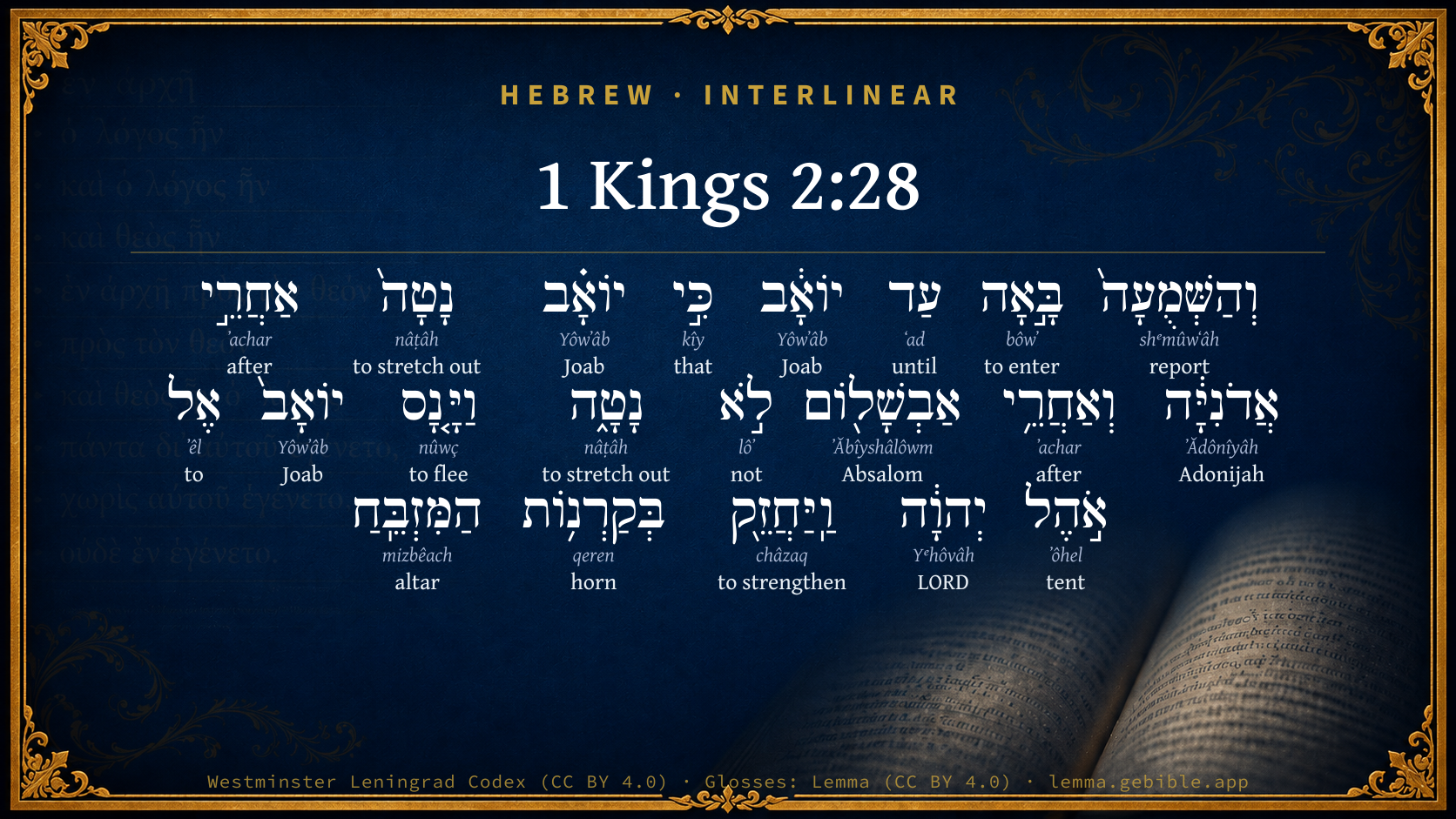
  1. וְהַשְּׁמֻעָה֙ shᵉmûwʻâh H8052 “and · the · report” Conjunction + Particle, Definite Article + Noun, Common, Feminine, Singular, Absolute
  2. בָּ֣אָה bôwʼ H935 “to enter” Verb, Qal, Perfect, 3rd Person, Feminine, Singular
  3. עַד ʻad H5704 “until” Preposition
  4. יוֹאָ֔ב Yôwʼâb H3097 “Joab” Noun, Proper
  5. כִּ֣י kîy H3588 “that” Conjunction
  6. יוֹאָ֗ב Yôwʼâb H3097 “Joab” Noun, Proper
  7. נָטָה֙ nâṭâh H5186 “to stretch out” Verb, Qal, Perfect, 3rd Person, Masculine, Singular
  8. אַחֲרֵ֣י ʼachar H310 “after” Preposition
  9. וְאַחֲרֵ֥י ʼachar H310 “and · after” Conjunction + Preposition
  10. אַבְשָׁל֖וֹם ʼĂbîyshâlôwm H53 “Absalom” Noun, Proper
  11. לֹ֣א lôʼ H3808 “not” Particle, Negative
  12. נָטָ֑ה nâṭâh H5186 “to stretch out” Verb, Qal, Perfect, 3rd Person, Masculine, Singular
  13. וַיָּ֤נָס nûwç H5127 “and · to flee” Conjunction + Verb, Qal, Sequential Imperfect, 3rd Person, Masculine, Singular
  14. יוֹאָב֙ Yôwʼâb H3097 “Joab” Noun, Proper
  15. אֶל ʼêl H413 “to” Preposition
  16. אֹ֣הֶל ʼôhel H168 “tent of” Noun, Common, Masculine, Singular, Construct
  17. יְהוָ֔ה Yᵉhôvâh H3068 “LORD” Noun, Proper
  18. וַֽיַּחֲזֵ֖ק châzaq H2388 “and · to strengthen” Conjunction + Verb, Hiphil, Sequential Imperfect, 3rd Person, Masculine, Singular
  19. בְּקַרְנ֥וֹת qeren H7161 “in/at · horns of” Preposition + Noun, Common, Both, Plural, Construct
  20. הַמִּזְבֵּֽחַ mizbêach H4196 “the · altar” Particle, Definite Article + Noun, Common, Masculine, Singular, Absolute

About this verse

These counts appear in no published source. They are computed here, from the morphology-tagged text and Lemma’s own curated glosses. What Lemma adds →

21
words
17
distinct lemmas
Historical
section

Shared distinctive vocabulary

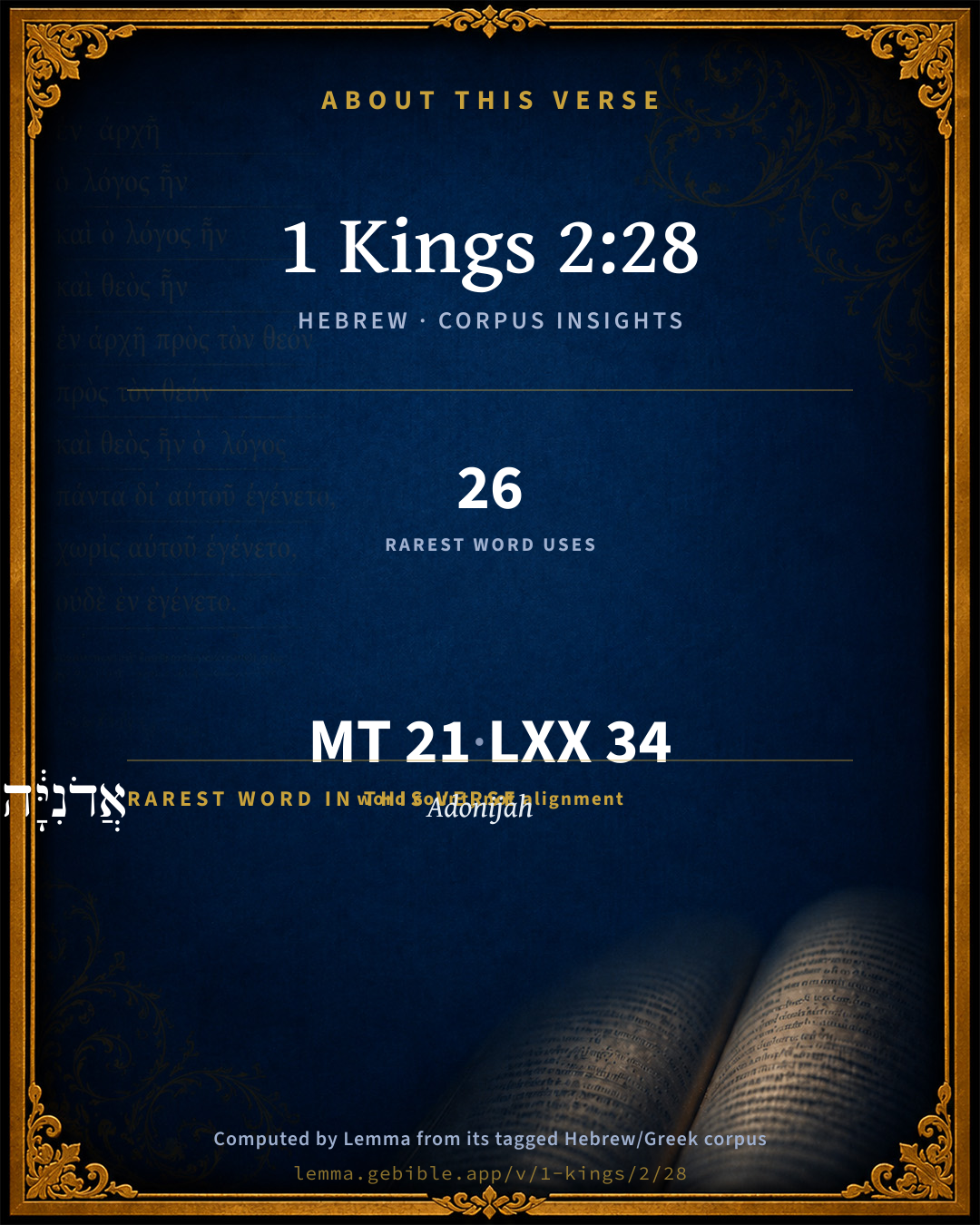
אֲדֹנִיָּ֔ה Adonijah H138 occurs in 26 verses of the Hebrew Bible. Also found in:

Grammatical profile

  • 5 verbs
  • 10 nouns
  • 4 prepositions
  • 1 conjunction
  • 1 particle

Verb forms

  • בָּ֣אָה Qal · Perfect
  • נָטָה֙ Qal · Perfect
  • נָטָ֑ה Qal · Perfect
  • וַיָּ֤נָס Qal · Sequential Imperfect
  • וַֽיַּחֲזֵ֖ק Hiphil · Sequential Imperfect

Repetition

Words recur within this verse — often emphatic in Hebrew:

  • יוֹאָ֔ב Joab H3097 ×3
  • נָטָה֙ to stretch out H5186 ×2
  • אַחֲרֵ֣י after H310 ×2

Hebrew & Septuagint length

In English translation the verse runs 33 words from the Hebrew and 39 from the Septuagint (LXX English) — closely comparable.

A rough comparison of the two English renderings, which tokenize alike — not a word-level alignment.

Word counts can differ between the Hebrew and the Greek without any difference in meaning — e.g. the Hebrew direct-object marker אֵת has no separate Greek word, and Greek often adds the article ὁ.

In the original languages it is 21 Hebrew tokens and 34 Greek tokens — but the two are counted differently (Hebrew bundles its prefixes and suffixes into one token; the Greek is in lemma form), so that isn’t a like-for-like length.

Cross-references

7

Topical passages linked to 1 Kings 2:28 in the Treasury of Scripture Knowledge — connected by theme and wording, ordered by reader-vote popularity; previews shown in the World English Bible.

  • 1 Kings 1:7 He conferred with Joab the son of Zeruiah, and with Abiathar the priest: and they following Adonijah helped him.
  • 1 Kings 1:50 Adonijah feared because of Solomon; and he arose, and went, and caught hold on the horns of the altar.
  • 2 Samuel 18:2 David sent forth the people, a third part under the hand of Joab, and a third part under the hand of Abishai the son of Zeruiah, Joab's brother, and a third part under the hand of Ittai the Gittite. The king said to the people, I will surely go forth with you myself also.
  • Exodus 27:2 You shall make its horns on its four corners; its horns shall be of one piece with it; and you shall overlay it with brass.
  • Deuteronomy 32:35 Vengeance is mine, and recompense, At the time when their foot shall slide: For the day of their calamity is at hand, The things that are to come on them shall make haste.
  • 2 Samuel 17:25 Absalom set Amasa over the host instead of Joab. Now Amasa was the son of a man, whose name was Ithra the Israelite, who went in to Abigail the daughter of Nahash, sister to Zeruiah, Joab's mother.
  • 2 Samuel 18:14–15 Then said Joab, I may not wait thus with you. He took three darts in his hand, and thrust them through the heart of Absalom, while he was yet alive in the midst of the oak.

Cross-references courtesy of OpenBible.info (CC BY 4.0).

Hebrew and Greek witnesses Masoretic Hebrew ↔ Greek Septuagint

The same verse in the two great witnesses to the Old Testament, shown verse-for-verse.

These are two independent witnesses, not word-aligned to each other, and the Septuagint is shown in lemma (dictionary) form.

Hebrew 1 Kings 2:28 Masoretic · Westminster Leningrad Codex

וְהַשְּׁמֻעָה֙ בָּ֣אָה עַד יוֹאָ֔ב כִּ֣י יוֹאָ֗ב נָטָה֙ אַחֲרֵ֣י אֲדֹנִיָּ֔ה וְאַחֲרֵ֥י אַבְשָׁל֖וֹם לֹ֣א נָטָ֑ה וַיָּ֤נָס יוֹאָב֙ אֶל אֹ֣הֶל יְהוָ֔ה וַֽיַּחֲזֵ֖ק בְּקַרְנ֥וֹת הַמִּזְבֵּֽחַ

The news came to Joab; for Joab had turned after Adonijah, though he didn't turn after Absalom. Joab fled to the Tent of Yahweh, and caught hold on the horns of the altar.

World English Bible · Public Domain

Greek LXX 1 Kings 2:28 Septuagint · lemma form

καί ὁ ἀκοή ἔρχομαι ἕως ιωαβ ὁ υἱός σαρουια ὅτι ιωαβ εἰμί κλίνω ὀπίσω αδωνίας καί ὀπίσω σαλωμών οὐ κλίνω καί φεύγω ιωαβ εἰς ὁ σκήνωμα ὁ κύριος καί καταἔχω ὁ κέρας ὁ θυσιαστήριον

And the report came to Joab son of Saruia; for Joab had turned after Adonias, and he went not after Solomon: and Joab fled to the tabernacle of the Lord, and caught hold of the horns of the altar.

LXX2012 (modern English Septuagint) · Public Domain

On this verse, Haydock's Catholic Bible Commentary discusses the Septuagint’s reading. Read the note in Commentary ↓

Hebrew: Westminster Leningrad Codex (CC BY 4.0). Greek: Septuagint (public domain); English from LXX2012 (modern English Septuagint) (Public Domain). How the Septuagint differs from the Hebrew →

Targum (Aramaic paraphrase)

1

The Targum is the ancient Jewish Aramaic paraphrase of the Hebrew Scriptures — an interpretive translation, not the Hebrew text itself. Onkelos (literal) and Pseudo-Jonathan (expansive) render the Torah, and Jonathan the Prophets. Coverage is partial: where no permissively-licensed English translation exists for a verse, only the Aramaic is shown. This is verse-level text, not a word-by-word alignment to the Hebrew.

  1. Targum Jonathan Prophets (Joshua–Malachi)
    וּבְסוֹרָתָא מְטַת עַד יוֹאָב אֲרֵי יוֹאָב אִתְפְּנִי בָּתַר אֲדוֹנִיָה וּבָתַר אַבְשָׁלוֹם לָא אִתְפְּנִי וְאַפִּיךְ יוֹאָב לְמַשְׁכְּנָא דַייָ וְאַתְקֵיף בְּקַרְנַת מַדְבְּחָא:

    (no public-domain English translation for this verse)

    Targum Jonathan — Aramaic: “Mikraot Gedolot” (public domain). English: “Sefaria Community Translation” (CC0 1.0 (public-domain dedication)); “London "Chaldee Paraphrase," 1871” (public domain). Text via Sefaria.

Commentary

Notes on 1 Kings 2:28 from classic Christian and Jewish commentators (each source and its license shown beneath its notes). The classic Christian expositions comment on the surrounding passage and are grouped to its opening verse, so a note may address several verses; the Jewish commentaries on the Tanakh (Rashi and others) are per-verse, so they appear only where the commentator wrote on this verse.

Lemma curates 59 commentaries, every one of them public domain or Creative Commons licensed, each selected and text-cleaned for this edition rather than reprinted as found. About our sources →

Jamieson, Fausset & Brown

Robert Jamieson, A. R. Fausset & David Brown

JOAB SLAIN. (1Ki. 2:28-45)

Then tidings came to Joab--The execution of these sentences respectively on Adonijah and Abiathar prepared Joab for his fate. Death, due to his great crimes (Num 35:33), would long ago have been inflicted, had not his power and popularity with the army been too formidable for the old king. He now fled to the altar, which, though a recognized asylum, afforded no sanctuary to the rebel and murderer (Exo 21:14). And, as he refused to leave it, he seems to have cherished some faint hope that a religious scruple would have been felt at the thought of violating the sanctity of the place by bloodshed. Benaiah, not liking to assume any responsibility, referred the matter to Solomon, who determined that the law should take its course (Deu 19:13).

Jamieson, Fausset & Brown — Commentary Critical and Explanatory on the Whole Bible (1871) — public domain (CC PDM 1.0). Text via the HelloAO Bible API.

Trapp's Complete Commentary

John Trapp

1Ki 2:28 Then tidings came to Joab: for Joab had turned after Adonijah, though he turned not after Absalom. And Joab fled unto the tabernacle of the LORD, and caught hold on the horns of the altar.

Ver. 28. For Joab had turned after Adonijah.] And that was his bane. If men do not cast away all their transgressions - that "all" is a little word but of large extent - they perish undoubtedly. Many here, like Benhadad, recover of one disease and die of another.

And caught hold.] See on 1Ki 1:50.

John Trapp, A Commentary or Exposition upon All the Books of the Old and New Testament (1647–1656) — public domain. Text from a community e-Sword module.

The Biblical Illustrator

Joseph S. Exell

1Ki_2:28

Joab had turned after Adonijah.

The peril of protracted temptation

Joab was Davids nephew, the second of the three sons of his sister Zeruiah. His youngest brother, Asahel, famous for his swiftness in running, was killed by Abner at the battle of Gibeon. The oldest, Abishai, a brave, fierce, revengeful man, was always at his uncles side, and rendered him invaluable service. But Joab, greatest in military prowess, as well as most statesmanlike, reached the place of power next the king himself. He treacherously killed Abner, partly in revenge for his brothers death and partly lest he should hold under David the same post of commander-in-chief that he had held under Saul. The king was grieved and outraged at this act, and compelled Joab to attend Abners funeral in sackcloth and with rent robe. Still, induced, no doubt, by his pre-eminent fitness, he gave him Abners place. Joab had fairly won this by accepting the challenge of David to scale the rock of Jebus and thus capture the fortress that was to become the national capital So far as defence and conquest are concerned he may be called the founder of the kingdom. Joab was loyal to his sovereign through a long life. He was loyal against many temptations to be otherwise. From the time of Abners death David feared his impetuous, passionate nephews; indeed, he said at the funeral, I am this day weak, though anointed king; and these men the sons of Zeruiah are too hard for me (2Sa_3:39). Joab could not have been uninfluenced by this fact; it is difficult for an inferior to retain respect for a superior who he knows fears him, or whom he regards as in any essential particular a weaker man than himself. Moreover, he was in the secret of his masters great crime--guilty, indeed, as an accessory, but not so guilty as the principal, and so with another consciousness of superiority which worked against his devotion. And monarchy was new in Israel. The king reigned more by virtue of his personal power than of an established habit of obedience on the part of his people. There were the incessant intrigues against the throne that to this day mark all Oriental governments. A score of times Joab must have been solicited to join the fortunes of this or that pretender, to accept anything that he chose to ask, to escape the growing ill-will of his sovereign and avenge the repeated slights that he had suffered. Against all solicitations he had stood firm year after year. But now David is near his end--in fact, is almost comatose. It is known that he has promised the succession to a younger son, Solomon. The legitimist party, who favour the oldest son, Adonijah, determine not to wait for the kings death, but to at once seize the throne. It is particulariy odious treason against a dying and presumably helpless man. And it is especially pitiful to find the aged Joab engaged in it. A few years before he had resisted the pretensions of the fascinating and popular Absalom, and at the risk of his own life had put him to death, as he deserved. But meanwhile his moral fibre has deteriorated. He lacks the robust virtue of other years. Even the thought of his dying sovereign and of the great things that they had passed through together cannot hold him to loyalty. So he turns after Adonijah, though he had not turned after Absalom. The theory is commonly held that old men and women are safe from temptation. We talk about character being formed, settled, fixed. We speak of unassailable virtue. We devote all our skill and energy to safeguarding the young, which is right; but we neglect to throw any protection about the middle-aged, which is wrong. We treat ourselves in the same fashion, assuming that, say, after middle life we are in small peril of going astray. We accordingly subject our virtues to strain to which we would not have thought of exposing them twenty or thirty years earlier. Hence every community is frequently shocked by acts of amazing folly, vice, and even crime on the part of those who were supposed to have outlived all temptation in such directions. Hence we have the proverb, Count no man happy until he is dead--until he has passed beyond the possibility of throwing away by one stupendous blunder or sin the accumulated good reputation of three or four score years. We say of such a man, He was old enough to know better, which is in effect a confession that knowing better by no means carries with it the strength to do better. Hamlet regards it as the gravamen of his mothers offence in her criminal marriage with the king, that she had passed the age when she could plead the excuse of impetuous passions. History, literature, our own observation unite to demonstrate that, while youth is imperilled by temptation, age is not safe, and to give some countenance to the rather harsh maxim that there is no fool like an old fool. The fact is, that the danger that lurks in temptation is not a matter of age at all. Personality is of course the main thing. We are tempted accordingly to our heredity, our appetites, our constitutional or acquired weaknesses, our individual proclivities toward this or that sin. These vary at different periods of life. Hence some temptations are strongest in youth, others in maturity, others in old age. There is a sense, too, in which youth is weaker to resist than maturity or age. The moral fibre, like the physical, is not yet toughened. Physicians tell us that the period of greatest peril to life, after infancy, is from eighteen to twenty-five or thirty years. All vital organs have developed rapidly; one looks most robust; he will quickly take high physical training in any direction, and, if he endures it, gain marvellous power. But at the same time, he lacks high efficiency to resist or throw off disease. Add to this such imprudence as must accompany the unthinking conviction that nothing can harm him--that he may eat and sleep and exercise as irregularly as he pleases--and it is not marvellous that so many young men die.in their years of greatest promise and apparently highest vitality. They are carried off by disease before they have learned their own powers of endurance, or, knowing them, gained the moral courage to live well within them. It is not an irrational solicitude, therefore, that parents feel for the health of their sons and daughters even after they are old enough to be supposed to wisely care for themselves. Here the moral and spiritual nature affords a close analogy to the physical. Time brings to the soul certain qualifications to resist temptation that nothing else can bring, such as an intelligent fear of doing wrong and an accurate conception of its pernicious consequences. Especially it brings the habit of resisting the wrong and doing the right. And it is to that settled habit more than to anything else, except the immediate grace of God, that we all owe our moral safety. But, whatever the age, the real peril of temptation lies in its being long continued. It was not because Joab was old that he turned after Adonijah, while a few years before he had not turned after Absalom, but because at that time the temptation of disloyalty to his king had not been long enough at work to undermine his powers of resistance. When, however, Adonijah raised the standard of revolt and invited Joab to join him, the soliciting voice had spoken so many times, and each time more alluringly, that his ability to say no had been exhausted. He threw away reputation, honour, life itself, not because he was a weak old man--for he was not that--but because he had exposed himself through a series of years to the temptation that he had always hitherto been able to master, but that now at last mastered him. The fact is--and herein lies the reason for the young standing so grandly as they do--that few are swept away by the first attack of temptation. The fortress of our instinctive love of the right and our careful early training is not usually carded by assault, but by sapping and mining. The bravest army ever marshalled cannot for ever stand such dogged attacks from an enemy with resources sufficient to keep them up indefinitely. Nor can the strongest human nature stand such attacks of temptation. No matter how confident you and I are of the quality of our moral fibre, we will act unwisely in subjecting it to too prolonged a strain. Indeed, this law holds throughout all nature. We speak, for instance, of the life of a steel rail, meaning the period during which it can do its work. The incessant hammering on it of locomotive and car wheels finally changes the relation of its molecules until their coherence is so weakened that the strength of the metal is gone. Suddenly there is an unaccountable railway accident. It means only that rail or bridge or locomotive had been strained, not too hard, but too long. They stood through Absaloms day, but could not stand through Adonijahs. Bacteriologists say that the germs of many or most diseases exist in our bodies while we are in good health; but we are able to resist them. There comes a time, however, when such resistance is weakened by that clogging of the system that we call a cold, and we have pneumonia; or when our foes are reinforced by impure water, and we nave typhoid fever, we can withstand for a long time--a marvellously long time--the poison of a foul atmosphere, but the most robust constitution will finally succumb to it. We are horrified by stories of plagues and pestilences, as the yellow fever, cholera, the black death. They sweep over a country with awful devastation. But they pass by, and, after all, do not kill one where bad ventilation and unsanitary drainage, with their endless persistence, kill tern The mighty storms that sweep the Matterhorn throw down with awful crash only the rocks that the constantly trickling and freezing rills of water have through years or centuries insensibly crowded to the edge of the cliff. We may be too proud to believe that we who have withstood so long can ever yield, but this is the very pride that goeth before destruction. I do not allow myself to look at a bad picture, said Sir Peter Lely, the artist, for if I do my brush is certain to take a hint from it. The only safe way to treat a temptation that has begun to meet us frequently is the way of this wise book: Avoid it, pass not by it, turn from it, and pass on. And even this counsel, good as we at once recognise it to be, we will not heed unless we seek Divine.grace. And that is ready: God is faithful, who will not suffer you to be tempted above that ye are able; but will with the temptation make also the way of escape, that ye may be able to endure it. Trust Him and you shall not turn after either Absalom or Adonijah. (T. S. Hamlin, D. D.)

The vitality of sin

We sometimes think that we have done with a sin, because it is dormant for a time. We think that it is dead, that under no circumstances can we be troubled with it any more. But it is very often only in a state of suspended animation Circumstances are against its showing its vitality, but that vitality is there, and will show itself when circumstances are favourable. In a lump of ice delivered to a restaurant lately there was embedded a frog. After having been on exhibition for some time the ice was smashed, and the frog was like a stone. It was put near the stove, and in two hours it was as lively as possible. It had been ten months frozen up. Many a sin that we thought dead has got near some stove--some warm temptation--and we have had sad experience of its tenacity of life. (Quiver.)

Joab fled unto the tabernacle of the Lord.--

Ineffective repentance

Joab had passed a proud and prosperous life, without submitting himself to the authority, or seeking the favour of God. He was a cruel, revengeful, and imperious man. He suffered his own vindictive spirit to imbrue his hands in causeless blood, in his long and prospered life, he might have been the instrument of vast blessings to others. But the man who lives without God cannot live as a blessing to his fellow-men. The blessing of God is not with any thing that he does. Joab comes to old age, and his character remains entirely unchanged. He engages with Adonijah in his unnatural rebellion against the aged king, to whose cause he had been so faithful while the power was with him, and thus prepares himself for the punishment which must in justice overtake him. David delivers him over to Solomon his son, with the injunction, thou knowest what Joab did to me, etc. He fled to Gibeon, and concealed himself for protection in the tabernacle of the Lord, and caught hold on the horns of the altar. But there was no protection for impenitent guilt as the altar. The Divine law was, in regard to the murderer, thou shalt take him even from Mine altar, that he may die. And Joab, the aged rebel, perishes in guilt, even while he clings to the altar for protection. No desire for God led him to the tabernacle. A fear of punishment drove him thither. He had no longing to be a doorkeeper in the house of the Lord. He would far rather dwell in the tents of ungodliness. How very important is the admonition which is here furnished! What multitudes, like Joab, attempt to compensate for a life of sin, by an ineffectual attempt to return to God in the hour of death, and encourage themselves to hope, that their wicked and persevering neglect of Him will be wholly forgotten, if they ask His forgiveness, when they can rebel no longer! Their hearts are in the world, and they will live to that. But their future, everlasting safety, can only be with God, and they will still endeavour to die in peace with Him.

I. Such a running at the last to the tabernacle is entirely deficient in the proper motive of obedience. The distinguishing motive of an acceptable return to God, is a love for His character, and a desire for His service. This must always be the principle which guides a sinner in a true return of his soul to God. A godly sorrow for sin respects the honour of God which is involved in transgression. It sees the love sir Jesus, and the hatefulness of the sin which has repaid it; and turns back with mourning, for that which has crucified the Lord of Glory.

II. Such an apparent return to God in our last hours is ineffective, because it allows no time to accomplish the important work. I do not speak now of the man who has never heard the blessed tidings of a Saviour, until this late hour; but of the man whose life has been passed amidst the full privileges of the Gospel, and who has no new message to be delivered to him in the hour of his death. Such a one has professed that he had no time to perfect this return to God in his life and health, though he acknowledged it to be necessary; and he will, in fact, have no time to do it in the hours of sickness, and age, and death. It is vain to say that God may then pluck him in a moment as a brand from the burning. So He might have done at any previous time of his life. But He did not do it then; and there is not the slightest ground for hope that He will, do it now.

III. This projected repentance is ineffective for good, because it is itself an act of rebellion against God. He has, in abundant mercy, opened a way for sinful men to return to Him in peace. He gives them all the opportunities, all the means, and all the assistance, which they need in order to perfect this return to His favour, and then solemnly warns them that it must be done in a limited and appointed time. But what does the man do, who still looks for a more convenient season for his reconciliation unto God, but directly contradict and falsify these positive assertions of the God of Truth? And of what more positive act of rebellion against God can man be guilty, than is involved in this determination which says, man and his Creator. And what would be the effect of Gods acceptance of this wilfully postponed submission to Himself, but giving countenance to rebellion against Himself, and showing a fickleness of government, the supposition of which is impossible?

IV. Such a proposed return is ineffective, because its allowed success would overturn all the purposes of God in regard to men, for which the Gospel has provided. Its acceptance by Him would altogether annihilate the design and operation of the Gospel The great purpose of God, in the gift of His Son, is the restoration of man frown sin to obedience; the cleansing of him from guilt and condemnation, that he may serve God in holiness and righteousness before him all the days of his life. The proper and designed operation of the Gospel is to annihilate the actual rebellion of the world; to reduce its living inhabitants into subjection to their Creator, and thus to restore His dominion here, in perfect and eternal peace. How foolish and false is that hope which can only stand upon the annihilation of the very purposes and power upon which itself depends! Nay, which can be indulged in fact and form only, because some others at least, are supposed to be guided by better principles to a safer course! The very expectation, therefore, which plans such a return to God, shuts up against itself the avenue of mercy, destroys the design and usefulness of the Gospel, and, like the scorpion in his circle of fire, puts an end to itself. (S. H. Tyng, D. D.)

Religion the last quest of the godless

During an epidemic of cholera I remember being called up, at dead of night, to pray with a dying person. He had spent the Sabbath in going out upon an excursion, and at three on Monday morning I was standing by his bed. There was no Bible in the house, and he had often ridiculed the preacher; but before his senses left him he begged his servant to send for me. What could I do? He was unconscious; and there I stood, musing sadly upon the wretched condition of a man who had wickedly refused Christ and yet superstitiously fled to his minister. (C. H. Spurgeon.)

Repentance unavailing

Of Antiochus, the great persecutor of the Jewish people, it is told that during his last illness he vowed he would become a Jew himself, and go through all the world that was inhabited and declare the power of God, yet, continues the historian, for all this, his pains would not cease, for the just judgment of God was upon him.

The Biblical Illustrator, edited by Joseph S. Exell (c. 1880s–1900s) — public domain. Text from a community e-Sword module.

Joseph Benson's Commentary

1Ki 2:28. Then tidings came to Joab — Concerning Adonijah’s death, and Abiathar’s deposition. And Joab fled unto the tabernacle of the Lord — This makes it appear that Joab had had a hand in the counsel mentioned 1Ki 2:22, as Solomon suspected. And caught hold on the horns of the altar — It appears from this and some other instances, that it was now become a custom among the Israelites, though by no divine law, to flee to the altar of the Lord, as to an asylum; however, by Solomon’s treatment of Joab on this occasion, it appears, that this privilege was only allowed for some misdemeanours, and not for capital offences, especially murder. And Solomon (1Ki 2:31) showed that the altar had better be stained with the blood of a murderer, than be polluted with his touch, in seeking an asylum from it, and thereby escaping the punishment which the divine laws required to be inflicted on him.

Joseph Benson's Commentary on the Old and New Testaments (1811–1818) — public domain. Text from a community e-Sword module.

Whedon's Commentary on the Bible

Daniel D. Whedon

DEATH OF JOAB, 1Ki_2:28-35.

28. Tidings came to Joab — Woful tidings to the old commander — old, but ambitions still. Knowledge of Adonijah’s death and Abiathar’s banishment left him no room for hope, for he saw at once that he was implicated in the guilt of treason. Strange that the stern old warrior, who had been so nobly loyal to his king during Absalom’s rebellion, should now be implicated in conspiracy! But his ambition paved his way to ruin. See note on 1Ki_1:7.

Fled unto the tabernacle — Which was at Gibeon. This seemed to be his only hope of safety. See note on chap. 1Ki_1:50. At Gibeon he slew Amasa, (2Sa_20:8,) and there he is himself slain.

Daniel D. Whedon (gen. ed.), Commentary on the Old and New Testaments (1874–1909) — public domain. Text from a community e-Sword module.

The Preacher's Complete Homiletical Commentary

Joseph S. Exell (gen. ed.)

CRITICAL AND EXPLANATORY NOTES.—

1Ki_2:30. Nay, but I will die here—A defiance of the king’s message, thinking that Solomon dared not order his execution there. But Joab had placed himself outside the protection of the altar (Exo_21:14; Deu_19:11-13).

HOMILETICS OF 1Ki_2:28-34

THE RETRIBUTION OF BLOOD

Life is a Divine gift, bequeathed as a sacred trust to humanity, to be jealously guarded and carefully cultured. It is susceptible of the loftiest rapture, or the most abject misery. To violate the body, which is the curiously-wrought casket of the life-principle, and to rob it of its priceless jewel, is a sacrilege and a crime. Only He who gave life has an absolute right to resume it. Murder is an unpardonable outrage on humanity; it is the ghastly policy of the cruel tyrant, the final resource of the baffled coward. It is a gross Insult to the great Giver of all life, and an offence against the Divine law which cannot go unpunished. The murderer forfeits his own life, and exposes himself to a righteous retribution which sooner or later will fall upon him with overwhelming power. The blood of the innocent victim clamours with unceasing voice for vengeance, and clamours not in vain. Terrible will be the wrath-vials poured upon the head of the blood-shedder, and which he is utterly powerless to avert.

I. The retribution of blood, though delayed, is inevitable. Years had passed away since Joab had recklessly shed the blood of Abner and A masa; but the crime was not forgotten, nor could it go for ever unrequited. Mere lapse of time has no power to change the nature of things; it weakens nothing; it strengthens nothing. Before Him who is the same yesterday, to-day, and for ever, the sin a generation old is as new as at the time of its committal, even as the holy aspiration that may be rising from the soul at this moment will be had in remembrance a thousand years hence as it is at this instant of time. Nor can the good deeds of one part of our life atone for the heinous crimes committed at another period. Joab deserved well of his king and country. He was brave and victorious in war; he did much towards the building and beautifying of Jerusalem; he clung faithfully to David in his distresses; and devoted himself to promote the best weal of Israel. But his noblest virtues were unable to ward off the punishment due to his old sins. “It is not in the power of all our deserts to buy off one sin, either with God or man; where life is so deeply forfeited, it admits of no redemption.” Often when least expected the stroke of vengeance falls. The long, deep, silent pause in the tempest is most to be dreaded: the storm-king is but gathering strength for a more terrific onset.

II. The retribution of blood is perpetually dreaded. “Then tidings came.… And Joab fled unto the tabernacle of the Lord, and caught hold on the horns of the altar” (1Ki_2:28). The conscience spoke, and the soul was filled with fear. “The wicked flee when no man pursueth.” No man pursued Adam amid the bowers of Paradise, yet he fled. “I heard thy voice in the garden, and was afraid.” No man pursued Cain when the world was in the morning of youth, yet he fled. No man pursued Joab as yet, though the sword of vengeance was busy with those around him, and yet he fled. There was that within him which told him he could not always escape. Oh, what a hell of misery is often carried in the breast of the sinner! His conscience creates the image of his righteous avenger who is ever threatening and ever pursuing him. It is a mere phantom, but none the less real, none the less near, none the less alarming on that account. He cannot escape it; he cannot destroy it. Neither oceans nor continents can separate him from it; it is not at his heels, it is in his heart; it has become a part of himself. He hears the visionary pursuer in every sound. The whispering wind, the rustling leaf, the creak of a swinging branch, the chirp of an insect, seem to betray to his disturbed imagination the immediate presence of the avenger.

“Suspicion always haunts the guilty mind;

The thief doth fear each bush an officer.”—Shakespeare.

III. The retribution of blood respects not the protection of the most sacred asylums. “Behold, he is by the altar … Go fall upon him” (1Ki_2:29). It had become the custom for malefactors to flee to the altar for safety, though there was no law on the subject, except for accidental homicides. But for the murderer the altar offered no protection (Exo_21:14). There is no citadel, however massive; no cavern, however gloomy; no seclusion, however remote; no spot on earth, however sacred, that can screen the trembling victim from the remorseless avenger of blood. There are some sins too great for any human sanctuary to shelter. But there is a refuge to which the worst transgressor may run, and be assured of safety, pardon, and hope. Christ is that refuge. The victims offered and the blood shed on the altar of the tabernacle, and which sanctified it as a place of refuge, typified the atonement made for the sins of the whole world by the shedding of the blood of Christ, the Paschal Lamb. None, however guilty, but may, by believing in Christ, obtain salvation. Unspeakably happy are they who have taken sanctuary in Him.

“Betake thee to thy Christ, then, and repose

Thyself in all extremities, on those

His everlasting arms,

Wherewith he girds the heavens, and upholds

The pillars of the earth.”—Quarles.

IV. The retribution of blood is in harmony with the Divine law. “And the Lord shall return his blood upon his own head” (1Ki_2:32). We are set in the midst of a system of laws which, in their ever active operation, press upon us at all points. While we act in harmony with them they minister to our well-being; but when we violate them they are inexorable in their revenge.

1. Retribution is in harmony with the law of causation. We are to-day the result of our conduct yesterday, and the cause of our conduct to-morrow; and thus our present actions must ever be the seeds of future recompense.

2. It is in harmony with the law of conscience. It is the province of conscience to approve or condemn. No action of our life is ever lost. Memory reproduces every detail of the past; and conscience smiles or frowns according to its actual character.

3. It is in harmony with the law of righteousness. Divine justice binds itself to punish the wicked and reward the good. “Be not deceived; God is not mocked; whatsoever a man soweth, that shall he also reap.”

“Heaven is most just, and of our pleasant vices

Makes instruments to scourge us.”

V. The retribution of blood sometimes reaches, in its effects, beyond its immediate victim. “Their blood shall therefore return upon the head of Joab and upon the head of his seed for ever” (1Ki_2:33). It is a sentiment frequently set forth in the Old Testament that innocent blood cries to God for vengeance, and that if suffered to go unpunished it brings down a curse and judgment upon the land. This idea seemed present to the mind of David, and influenced his conduct; hence, at the time of Abner’s murder, he publicly implored that the judgment of this innocent blood might be averted from his house and kingdom, and that it might rest upon Joab and upon his house (2Sa_3:28-29). The murderer hands down the stigma of his guilt to his posterity. The history makes no further mention of the descendants of Joab; they sink into inglorious oblivion. What becomes of the children of our great criminals? If it were possible to trace the career of sin in its darkest exploits, what a terrible record would be made!

VI. The retribution of blood is essential to the maintenance of good government. “But upon David, and upon his seed, and upon his house, and upon his throne, shall there be peace for ever from the Lord” (1Ki_2:33). Either from motives of friendship, or fearing the consequences because of Joab’s popularity with the army, David had hesitated to punish the murderer as he deserved; but knowing the power of this man to disturb the peace of the kingdom—an instance of which had just been exhibited in his siding with the treasonable attempt of Adonijah—the dying monarch charged his son to execute upon him the judgment of heaven on the first occasion that justified him in so acting. All government is at an end where crime is allowed to go unpunished; authority is insulted and defied, and anarchy and terror prevail. “It is a foolish niceness,” says Bishop Hall, “to put more shame in the doing of justice than in the violating of it. In one act Solomon approved himself both a good magistrate and a good son, fulfilling at once the will of a father and the charge of God.” A negligent magistrate will bear the woe of the sin that he is not careful to avenge. Favour to the offender is cruelty to the favourer. The throne is only secure when it sends forth justice irrespective of persons (Pro_25:5).

VII. The retribution of blood is inexorable and complete.—“So Benaiah the son of Jehoiada went up, and fell upon him and slew him” (1Ki_2:34). The voice of blood can be silenced only by adequate retribution (Gen_9:6). Retribution overtook Joab on the very scene of the most treacherous of his murders; for the tabernacle, at whose altar he perished, was then at Gibeon, and it was at the “great stone which is in Gibeon” that Joab slew Amasa (2Sa_20:8-10). The sword of justice may be for a while mercifully suspended; but when it falls, terrible indeed is the havoc it occasions. The sins of an impenitent life return in vengeance upon the sinner. “Society is like the echoing hills. It gives back to the speaker his words; groan for groan, song for song. With what measure ye mete, it shall be measured to yon again.” Though human laws cannot be satisfied with anything less than blood for blood, yet if the greatest sinner, even a murderer, fly to the horns of the Divine altar, he shall never be dragged thence.

VIII. The retribution of blood does not extend further than to answer the purpose of God. “And he was buried in his own house in the wilderness” (1Ki_2:4). Vengeance did not extend to the dead body of Joab. It is not for man to lay the iniquity upon the bones, whatever God may do. It is a fiendish cruelty that offers the least indignity to a lifeless corpse. Joab was buried in his own family sepulchre attached to his country seat, and in a manner befitting a great warrior, a peer of Israel, and a near relative of the king. “Death puts an end to all quarrels: Solomon stays the penalty when Heaven is satisfied: the revenge that survives death, and will not be shut up in the coffin, is barbarous and unbeseeming true lsraelites.” The funeral of Joab would suggest to the spectators many solemn reflections on fallen greatness, and the inability of high social status and deeds of valour to screen the wrongdoer from severe retribution.

LEARN—

1. The preciousness of human life.

2. That no misery is so great as that of the murderer.

3. That Christ can pardon the greatest sinner.

GERM NOTES ON THE VERSES

1Ki_2:28-34. The terrible end of Joab.

1. He dies conscious of his guilt, without peace and pardon.

2. Even in the very jaws of death he is defiant, rough, and proud.

3. He does not leave the world like a hero, but like a criminal. How differently David dies! (1Ki_2:2).—Lange.

Of all expositors, Pellican only justifies Joab to have been a most faithful servant to David, and seemeth to tax it as a point of ingratitude in David towards him to appoint him to be slain; by his example warning all courtiers of their uncertain condition. But Joab certainly now received according to his deserts for his bloodshed and faction, which must not go unpunished.—Mayer.

1Ki_2:28. “For Joab turned after Adonijah.” And that was his bane. If men do not cast away all their transgressions—that “all” is a little word, but of large extent—they perish undoubtedly. Many here, like Benhadad, recover of one disease and die of another.—Trapp.

“Joab fled, and caught hold on the horns of the altar.” An evil conscience can put to flight a hero who never yielded to the enemy in a single bloody field. Fond Joab, hadst thou formerly sought for counsel from the tabernacle, thou hadst not now needed to seek it for refuge; if thy devotions had not been wanting to that altar, thou hadst not needed it as a shelter. It is the fashion of our foolish presumption to look for protection where we have not cared to yield obedience. Even a Joab clings fast to God’s altar in his extremity, which, in his prosperity, he regarded not. The worst men would be glad to make use of God’s ordinances for their advantage. Miserable Joab! what help canst thou expect from that sacred pile? Those horns, that were sprinkled with the blood of beasts, abhor to be touched by the blood of men. That altar was for the expiation of sin by blood, not for the protection of the sin of blood. If Adonijah fled thither and escaped, it is murder that pursues thee more than conspiracy. God hath no sanctuary for a wilful homicide.—Bishop Hall.

1Ki_2:30. “Nay; but I will die here.” The sullen stubbornness of crime.

1. It gloomily accepts the inevitable.

2. It expects no mercy.

3. Is indifferent about desecrating the most sacred place.

4. Seeks, in dying, to throw the utmost odium on those who inflict the punishment.

1Ki_2:31. “That thou mayest take away the innocent blood.” David had never formally pardoned Joab; and, indeed, it may be questioned whether by the law there was any power of pardoning a murderer (see Num_35:16-34; Deu_19:10). The utmost that the king could do was to neglect to enforce the law. Even in doing this he incurred a danger. Unpunished murder was a pollution to the land (Num_35:33), and might bring a judgment upon it like the famine which had been sent a few years before this on account of Saul and of his bloody house, “because he slew the Gibeonites” (2Sa_21:1). Or the judgment might fall upon the negligent monarch, or his house, as punishment fell upon Eli and his house, fur not chastising the wickedness of his sons (1Sa_3:13).—Speaker’s Comm.

1Ki_2:32. “Who fell upon two men more righteous and better than he”—who had done Joab no wrong, nor meant him any, and, had they lived, might probably have done David better service. If the blood shed be not only innocent but excellent, the life more valuable than common lives, the crime is the more heinous. Joab is put to death for the murder of Abner and Amasa, rather than for his treasonable adherence to Adonijah.

1Ki_2:34. “So Benaiah went up and slew him.” Joab must have been old and infirm at this time; and now he bleeds for Abner, he bleeds for Amasa, and he bleeds for Uriah. The two former he murdered; of the blood of the latter he was not innocent. Yet he had done the state much service, and they knew it; but he was a murderer, and vengeance would not suffer him to live.—Dr. A. Clarke.

1Ki_2:35. The reward of a tried fidelity.

1. That there are crises when fidelity is severely tried.

1. In times of national distress and rebellion.

2. In times of personal affliction and helplessness.

3. In times of secret temptation and outrageous threatening.

2. That the maintenance of fidelity in times of trial has a good influence on the unstable.

1. Rebellion is more easily suppressed.

2. The authority of government is more firmly established.

3. It is an education to fit for nobler and more important service.

3. That fidelity severely tried is sure to meet with reward.

1. It secures the satisfaction of an approving conscience for duty done.

2. It wins the confidence and generosity of the highest authorities.

3. It conducts to positions of high honour and responsibility. A faithful man makes himself indispensable.

4. It exalts the character of the office disgraced by the unfaithfulness of others.

The Preacher's Complete Homiletical Commentary (gen. ed. Joseph S. Exell; Funk & Wagnalls, c. 1892) — public domain (pre-1929). A full-Bible homiletical/sermon-outline anthology covering 65 of 66 books (2 John is absent from the source module). Text from a community e-Sword module.

Tyndale Open Study Notes

Tyndale Open Resources

2:28-29 Following Adonijah’s example (1:50), Joab hoped to find mercy by grasping the horns of the altar according to the provisions of the law of Moses (Exod 21:12-14; Num 35:22-25; Deut 19:4-5). But because Joab was a murderer, he could not claim clemency (see 2 Sam 3:27; 18:14; 20:10).

Tyndale Open Study Notes — © Tyndale Open Resources, licensed CC BY-SA 4.0. Text via the HelloAO Bible API.

Geneva Bible (1599)

Geneva Bible translators

He took Adonijah’s part when he would have usurped the kingdom, 1 Kings 1:7.

Geneva Bible (1599) marginal notes — public domain. Text via Bolls.life.

Adam Clarke's Commentary

Verse 28. Tidings came to Joab] He heard that Adonijah had been slain and Abiathar banished, and probably he had heard of David's dying charge to Solomon. Fearing therefore for his personal safety, he takes refuge at the tabernacle, as claiming Divine protection, and desiring to have his case decided by God alone; or perhaps a spark of remorse is now kindled; and, knowing that he must die, he wishes to die in the house of God, as it were under the shadow, that he might receive the mercy of the Almighty.

Adam Clarke's Commentary on the Bible (1810–1826) — public domain. Text from a community e-Sword/MySword module.

Ellicott's Commentary for English Readers

(28) Joab had turned.—It is strange that Joab should have been in no danger or anxiety immediately after the actual failure of the conspiracy; and it is also notable that, although the real motive for putting him to death was to punish his support of Adonijah, now renewed, yet Solomon’s words in pronouncing sentence on him refrain from mention of anything except the old crimes dwelt upon in the dying charge of David. Possibly this was done to bring Joab’s case within the emphatic declaration of the Law, that no sanctuary should protect the wilful and treacherous murderer, and that innocent blood, so shed and left unavenged, would pollute the land (Exo_21:14; Num_35:33). It is significant, moreover, of the increased power of the monarchy, even in hands young and yet untried, that the old captain of the host, who had been “too hard” for David, even before David’s great sin, should now fall, as it would seem, without a single act of resistance or word of remonstrance on his behalf, after a long career of faithful service, only once tarnished by disloyalty. It has been noticed that if (as is probable) the “Tabernacle of the Lord” at Gibeon is meant, Joab falls close to the scene of his murder of Amasa, “at the great stone in Gibeon” (2Sa_20:18).

A Bible Commentary for English Readers, edited by Charles John Ellicott (1878–1897) — public domain. Text from a community e-Sword module.

The Cambridge Bible for Schools and Colleges

gen. ed. J. J. S. Perowne

28–35. Flight of Joab and his death. Benaiah succeeds him as captain of the host (Not in Chronicles)

28. Then tidings came to Joab] The Hebrew says ‘And the tidings came to Joab’, i.e. of Abiathar’s banishment, and he felt that his own turn was soon to come.

turned after] i.e. Took the side of. It was Joab, who being on David’s side, slew Absalom (2Sa_18:14). This crime, though never brought forward, no doubt instigated David to advise, and Solomon to provide that Joab should be taken out of the way. All the ancient versions except the Chaldee, have here ‘For Joab had turned after Adonijah, and had not turned after Solomon.’

the tabernacle of the Lord] The word here, as elsewhere, is the ordinary word for a tent, and if thus translated gives to the English reader a better notion of what the structure was.

horns of the altar] See above on 1Ki_1:50. Joab fled for sanctuary to the same place and in the same fashion as Adonijah had done.

The Cambridge Bible for Schools and Colleges (gen. ed. J. J. S. Perowne; Cambridge University Press, 1878–1918) — public domain. Text from a community e-Sword module.

John Gill's Exposition

And it was told King Solomon that Joab was fled unto the tabernacle of the Lord,.... This account was brought him very probably by some of his courtiers:

and, behold, he is by the altar; to which he betook himself for refuge, laying hold on the horns of it:

then Solomon sent Benaiah the son of Jehoiada, saying, go, fall upon him; slay him; Josephus (g) says, the orders were to cut off his head; but perhaps it might be only to lay hold on him, and take him thence, and bring him to Solomon to have judgment passed upon him; for the Targum is,

"exercise your power over him,''

take him into custody; and certain it is that the first orders were not to slay him, at least upon the spot where he was.

(g) Antiqu. l. 8. c. 1. sect. 4.

John Gill's Exposition of the Whole Bible (1746–1763) — public domain (CC PDM 1.0). Text via the HelloAO Bible API.

Albert Barnes' Notes on the Bible

Joab followed the example of Adonijab (margin reference). The tabernacle was now at Gibeon 1Ki 3:4; 1Ch 16:39.

Albert Barnes' Notes on the Bible (1834–1885) — public domain. Text from a community e-Sword/MySword module.

Haydock's Catholic Bible Commentary

Joab. The Latin manuscripts, except one, and almost all the ancient editions of Sixtus, &c., read Solomon. "And a messenger came to Solomon that Joab," &c. --- Solomon. Hebrew, "Absalom." Septuagint vary. The difference is of little consequence. (Calmet)

George Leo Haydock (1774–1849), Haydock's Catholic Family Bible and Commentary, 1859 edition — public domain. Excludes Psalms (Douay-Rheims chapter numbering differs from Protestant) and Deuterocanonical books (Catholic canon only).

Matthew Poole's English Annotations

Tidings came to Joab, concerning Adonijah’s death, and Abiathar’s deposition.

The tabernacle of the Lord then was at Gibeon, 1Ki 3:4, compared with 2Ch 1:3,5. Caught hold on the horns of the altar; of which see before, 1Ki 1:50.

Matthew Poole's English Annotations on the Holy Bible (1683–1685) — public domain. Text from a community e-Sword/MySword module.

The Pulpit Commentary

Then tidings Heb. And the report, etc. Not necessarily of Abiathar"s deposition, but certainly of Adonijah"s death came to Joab, for Joab had turned after same expression as in Exo_23:2; Jud_1:9:3 Adonijah, though lit., and he turned not after Absalom. The LXX (Cod. Vat.), Vulg., and all ancient versions except the Chald., here read Solomon, which Ewald and Thenius adopt. This reading is perhaps too summarily dismissed by most commentators, as involving a statement which would be self evident and superfluous. But it is not so. The meaning would then be that Joab had inclined to Adonijah, and had not, subsequently, gone over to the side of Solomon information which is much less obvious than that he had not "gone after Absalom." The Arabic version may thus be nearest the truth, which reads, "Neither did he love Solomon." Somewhat similarly Josephus. And Joab fled unto the tabernacle of the Lord, and caught hold of the horns of the altar. As Adonijah had done before him. (1Ki_1:50) His flight is almost certain evidence of his guilt. ("Joab vero seipsum prodidit." Munster.) Why should he flee, if conscious of innocence? Solomon had acted generously before, and Joab would not be aware of David"s dying instructions. His two assassinations had remained so long unpunished that he would hardly expect to be called to an account for them now. We have here, therefore, another indication of a second conspiracy, and it is an old belief (Theodorot, al. ) that Joab had suggested to Adonijah the plan of marriage with Abishag. Some have asked why Joab should flee to the altar when his crimes deprived him of the right of the sanctuary. But a drowning man grasps at a straw. It is probable that he never thought of his murders, but only of his treason. According to the Rabbis, death at the altar ensured him burial amongst his fathers (Munster). But, if this were so, it would hardly enter into his calculations.

The Pulpit Commentary (1880–1919), ed. H.D.M. Spence-Jones & Joseph S. Exell — public domain. Text from a community e-Sword module.

unfoldingWord translationNotes

Door43 World Missions Community

General Information:

King Solomon orders Benaiah to execute Joab.

The news came to Joab

"Joab heard what Solomon did after he had become king"

the horns of the altar

The horns of the altar symbolized Yahweh's power and protection. (See: Metonymy)

It was told King Solomon that Joab had fled

This can be translated in active form. AT: "Someone told King Solomon that Joab had fled" (See: Active or Passive)

translationWords

Joab

Absalom

tent of meeting

altar

unfoldingWord translationNotes — © Distant Shores Media and the Door43 World Missions Community, licensed CC BY-SA 4.0. Source: git.door43.org/Door43/en_tn.

Rashi

Rabbi Shlomo Yitzchaki (Rashi)

And the report reached Yoav. The report of Dovid’s charge, that he had commanded to kill him, and he knew that Shlomo hated him.

For Yoav had sided with Adoniyah, but he had not sided with Avsholom. At the end of the matter; however, he did seek to turn after him, but he was fearful that trace of Dovid[’s might] was still present.

Rashi on the Tanakh — English translations: “The Judaica Press complete Tanach with Rashi, translated by A. J. Rosenberg” (CC BY 4.0); “Pentateuch with Rashi's commentary by M. Rosenbaum and A.M. Silbermann, 1929-1934” (public domain); “The Metsudah Tanach series, Lakewood, N.J” (CC BY 4.0); and “The Book of Joshua, Metsudah Publications, 1997” (CC BY 4.0). Text via Sefaria.

Lesson kit

Teaching starters — assembled from the data on this page, not authored interpretation. Every prompt links to the verse data it draws on. Edit before teaching.

1 Kings, in the Historical, opens this verse with 21 words (17 distinct Hebrew lemmas). Its most distinctive word is ʼĂdônîyâh (“Adonijah”). A historical commentator’s framing appears above. Read the whole chapter for the surrounding context.

Discussion questions

  1. The word ʼĂdônîyâh carries the sense “Adonijah.” How does it shape the verse?
  2. How does 2 Samuel 3:4, which shares the word «Adonijah», read alongside this verse?
  3. What does the repetition of “Joab” (3× in this one verse) do in this verse?
  4. These translations render this verse differently; the difference is in the English rendering, not the original. What questions does that raise?
  5. «בָּ֣אָה» is a Qal Perfect verb. How does that grammatical form shape the action described?
  6. Compare how Jamieson, Fausset & Brown and Trapp's Complete Commentary read this verse. Where do they agree or differ?

Things to notice

Reading settings

Reading text

Shown beneath each verse's original-language words.

Old Testament
Old Testament edition

Read the OT as the Masoretic Hebrew (MT) or the Greek Septuagint (LXX).

English shown for the Greek Septuagint (in the Hebrew ↔ Greek comparison).

Comparing translations? Open the Compare panel on any verse page to stack up to four side by side.