Judges 6:32

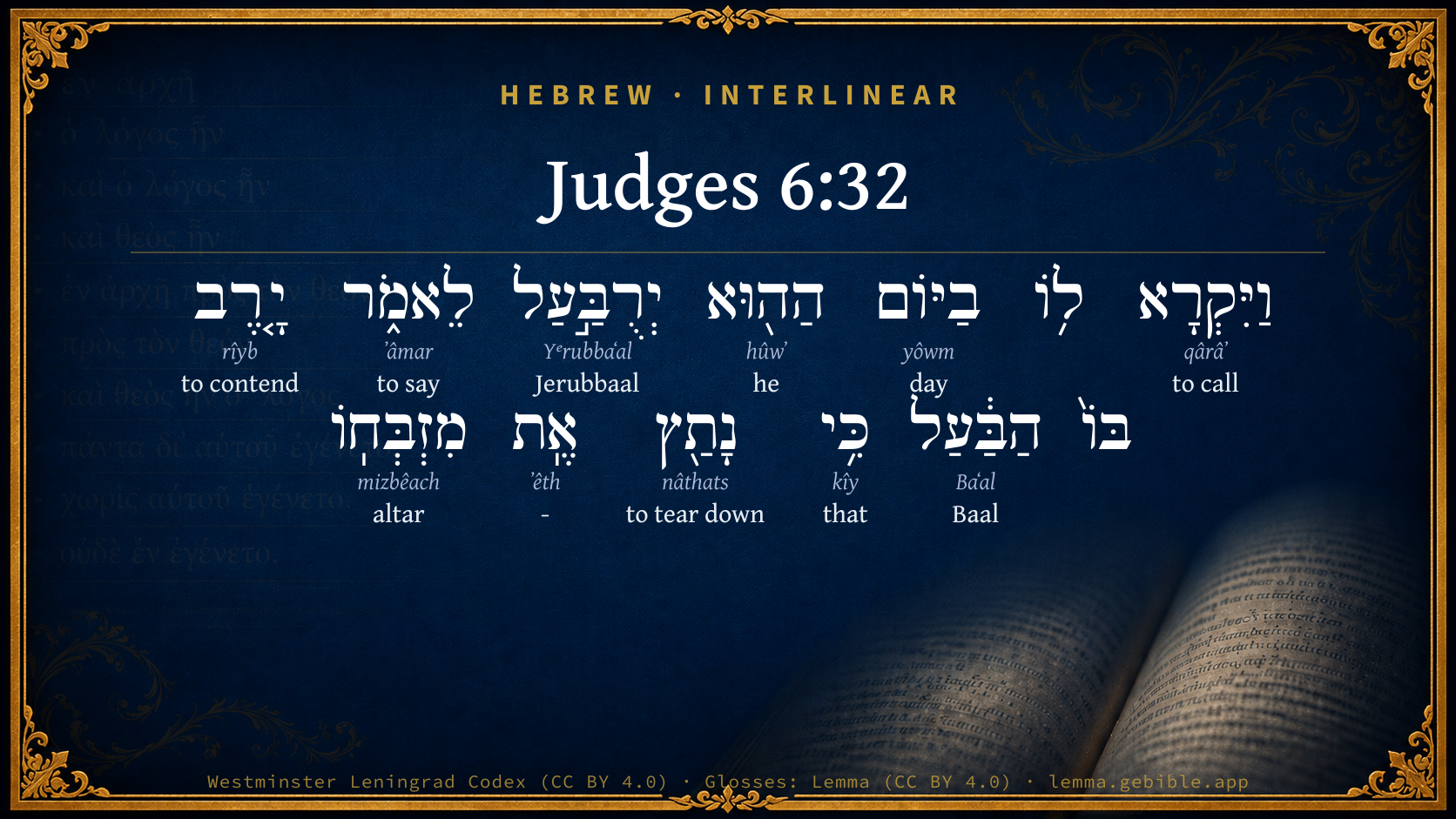
Hebrew (Westminster Leningrad Codex) Judges 6:32 appears in the Hebrew Old Testament. The text above is from the Westminster Leningrad Codex. Each word links to its Strong’s number, a concise gloss, and parsing drawn from the Open Scriptures Hebrew Bible morphology. Click any word for its full Brown-Driver-Briggs (BDB) entry.
Download image
Cite this verse

Judges 6:32 (World English Bible). Public Domain. Lemma interlinear Bible study tool, https://lemma.gebible.app/v/judges/6/32.

Show BibTeX & RIS
BibTeX
RIS
English Translation
Therefore on that day he named him Jerubbaal, saying, Let Baal contend against him, because he has broken down his altar.
World English Bible · Public Domain
Highlights
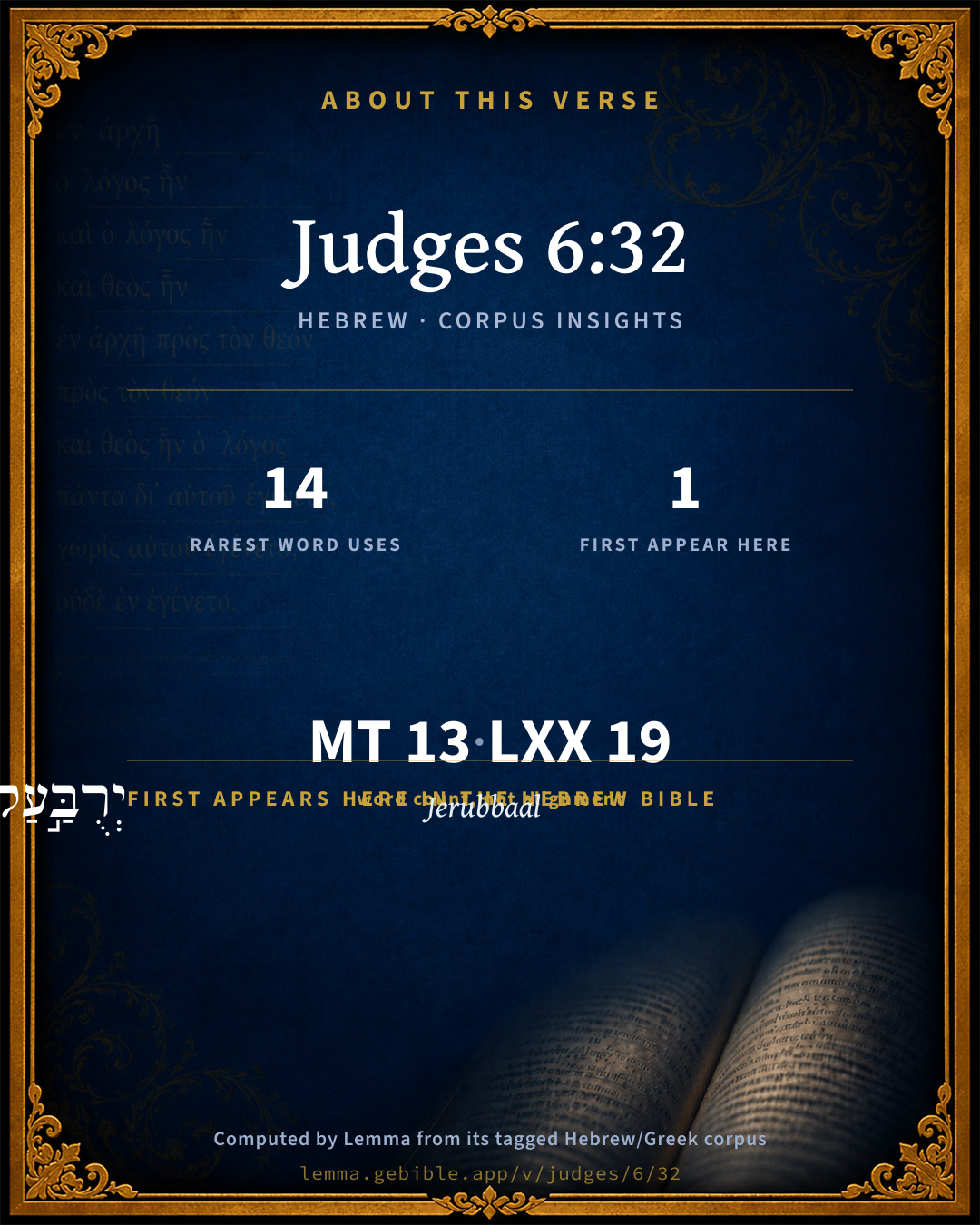
  • 1 first appearance in the Hebrew Bible
Full analysis ↓
Download a study sheet

One document with this verse’s original text, its word-by-word gloss line, the meaning frame, cross-references with their text, attributed commentary, and full source and license credits — printable, and it pastes into notes with its structure intact.

This verse Autodidact and up

Study sheet (.html) Plain text (.txt)

A passage Seminary Student

Up to 50 verses in one chapter. A passage sheet keeps up to 6 commentary sources and 12 cross-references per verse, in the order this page ranks them, and says so on the sheet whenever that leaves anything out. Ask for a single verse and you get the Autodidact verse sheet above.

Everything on this page stays free to read, with no account — the sheet is a download of what is already on screen, not access to it.

Want to remove ads? Support Godless Engineer
Compare translations 3

The same verse in 3 English versions, stacked beneath the original-language interlinear above. Click any original word for its lexicon entry.

Each is an independent rendering of the whole verse — the interlinear is not word-aligned to these translations.

Highlighted words mark where these versions differ — a whole-verse word diff, not a word-by-word alignment.

  • World English Bible Public Domain
    Therefore on that day he named him Jerubbaal, saying, Let Baal contend against him, because he has broken down his altar.
  • King James Version Public Domain
    Therefore on that day he called him Jerubbaal, saying, Let Baal plead against him, because he hath thrown down his altar.
  • unfoldingWord Literal Text CC BY-SA 4.0
    And one called him on that day Jerubbaal, saying, “May Baal contend against him, since he tore down his altar.”

unfoldingWord Literal Text — © unfoldingWord, licensed CC BY-SA 4.0. Word-aligned USFM3 via Door43 (git.door43.org/unfoldingWord/en_ult).

Versions to compare (up to 4)

3 of 4 selected

Show all 18 translations

Every available English version of this verse, each an independent rendering of the whole verse.

  • World English Bible Public Domain
    Therefore on that day he named him Jerubbaal, saying, Let Baal contend against him, because he has broken down his altar.
  • Berean Standard Bible Public Domain
    So on that day Gideon was called Jerubbaal, that is to say, “Let Baal contend with him,” because he had torn down Baal’s altar.
  • Majority Standard Bible Public Domain
    So on that day Gideon was called Jerubbaal, that is to say, “Let Baal contend with him,” because he had torn down Baal’s altar.
  • King James Version Public Domain
    Therefore on that day he called him Jerubbaal, saying, Let Baal plead against him, because he hath thrown down his altar.
  • American Standard Version (1901) Public Domain
    Therefore on that day he called him Jerubbaal, saying, Let Baal contend against him, because he hath broken down his altar.
  • Revised Version (1885) Public Domain
    Therefore on that day he called him Jerubbaal, saying, Let Baal plead against him, because he hath broken down his altar.
  • Geneva Bible (1599) Public Domain
    And in that day was Gideon called Ierubbaal, that is, Let Baal pleade for himselfe because he hath broken downe his altar.
  • Douay-Rheims (1899) Public Domain
    He answered them: Are you the avengers of Baal, that you fight for him? he that is his adversary, let him die before to morrow light appear: if he be a god, let him revenge himself on him that hath cast down his altar.
  • Young's Literal Translation Public Domain
    And he calleth him, on that day, Jerubbaal, saying, `The Baal doth plead against him, because he hath broken down his altar.'
  • Literal Standard Version CC BY-SA 4.0
    And he calls him, on that day, Jerubba‘al, saying, “The Ba‘al pleads against him, because he has broken down his altar.”
  • Unlocked Literal Bible CC BY-SA 4.0
    Therefore on that day they called Gideon “Jerub Baal,” because he said, “Let Baal defend himself against him,” because Gideon broke down Baal's altar.
  • unfoldingWord Literal Text CC BY-SA 4.0
    And one called him on that day Jerubbaal, saying, “May Baal contend against him, since he tore down his altar.”
  • Darby Bible Public Domain
    Therefore on that day he was called Jerubba'al, that is to say, "Let Ba'al contend against him," because he pulled down his altar.
  • World Messianic Bible Public Domain
    Therefore on that day he named him Jerub-Baal, saying, “Let Baal contend against him, because he has broken down his altar.”
  • Webster's Bible Public Domain
    Therefore on that day he called him Jerubbaal, saying, Let Baal plead against him, because he hath thrown down his altar.
  • Free Bible Version CC BY-SA 4.0
    That day Gideon was called Jerub-baal, which means “Let Baal fight with him,” because he had torn down his altar.
  • Bible in Basic English Public Domain
    So that day he gave him the name of Jerubbaal, saying, Let Baal take up his cause against him because his altar has been broken down.
  • JPS Tanakh (1917) Public Domain
    Therefore on that day he was called Jerubbaal, saying: 'Let Baal contend against him, because he hath broken down his altar.'

Literal Standard Version (2020), Covenant Press — licensed CC BY-SA 4.0. Text via the HelloAO Bible API (eBible.org). Unlocked Literal Bible (unfoldingWord) — licensed CC BY-SA 4.0. Text via the HelloAO Bible API (eBible.org). unfoldingWord Literal Text — © unfoldingWord, licensed CC BY-SA 4.0. Word-aligned USFM3 via Door43 (git.door43.org/unfoldingWord/en_ult). Free Bible Version, Dr. Jonathan Gallagher — licensed CC BY-SA 4.0. Text via the HelloAO Bible API (eBible.org).

Word by word

More ways to search: Search by grammar → Find every occurrence → Compare this word →

Practice this passage: Drill this verse → Learn its vocabulary →

יְרֻבַּ֣עַל
Yᵉrubbaʻal
H3378
“Jerubbaal”
Noun, Proper
Part of Speech
Noun
Type
Proper
Full BDB Definition

Origin: from H7378 and H1168

TWOT: None

Jerubbaal = "let Baal contend" - name given to Gideon by his father when he destroyed the altar of Baal
  1. וַיִּקְרָא qârâʼ H7121 “and · to call” Conjunction + Verb, Qal, Sequential Imperfect, 3rd Person, Masculine, Singular
  2. בַיּוֹם yôwm H3117 “in/at the · day” Preposition, Determined + Noun, Common, Masculine, Singular, Absolute
  3. הַה֖וּא hûwʼ H1931 “the · he” Particle, Definite Article + Pronoun, Personal, 3rd Person, Masculine, Singular
  4. לֵאמֹ֑ר ʼâmar H559 “to say” Preposition + Verb, Qal, Infinitive Construct
  5. יָ֤רֶב rîyb H7378 “to contend” Verb, Qal, Jussive, 3rd Person, Masculine, Singular
  6. הַבַּ֔עַל Baʻal H1168 “the · Baal” Particle, Definite Article + Noun, Proper
  7. כִּ֥י kîy H3588 “that” Conjunction
  8. נָתַ֖ץ nâthats H5422 “to tear down” Verb, Qal, Perfect, 3rd Person, Masculine, Singular
  9. אֶֽת ʼêth H853 “-” Particle, Direct Object
  10. מִזְבְּחֽוֹ mizbêach H4196 “altar · his” Noun, Common, Masculine, Singular, Construct + Suffix, Personal, 3rd Person, Masculine, Singular

About this verse

These counts appear in no published source. They are computed here, from the morphology-tagged text and Lemma’s own curated glosses. What Lemma adds →

13
words
11
distinct lemmas
Historical
section

Notable vocabulary

The rarest word here is יְרֻבַּ֣עַל Jerubbaal H3378 — appearing just 14 times in the whole Hebrew Bible.

First appearance in Scripture

This word makes its first canonical appearance in the Hebrew Bible here:

  • יְרֻבַּ֣עַל Jerubbaal H3378

Shared distinctive vocabulary

יְרֻבַּ֣עַל Jerubbaal H3378 occurs in 13 verses of the Hebrew Bible. Also found in:

Grammatical profile

  • 4 verbs
  • 4 nouns
  • 1 pronoun
  • 2 prepositions
  • 1 conjunction
  • 1 particle

Verb forms

  • וַיִּקְרָא Qal · Sequential Imperfect
  • לֵאמֹ֑ר Qal · Infinitive Construct
  • יָ֤רֶב Qal · Jussive
  • נָתַ֖ץ Qal · Perfect

Hebrew & Septuagint length

In English translation the verse runs 21 words from the Hebrew and 20 from the Septuagint (LXX English) — closely comparable.

A rough comparison of the two English renderings, which tokenize alike — not a word-level alignment.

Word counts can differ between the Hebrew and the Greek without any difference in meaning — e.g. the Hebrew direct-object marker אֵת has no separate Greek word, and Greek often adds the article ὁ.

In the original languages it is 13 Hebrew tokens and 19 Greek tokens — but the two are counted differently (Hebrew bundles its prefixes and suffixes into one token; the Greek is in lemma form), so that isn’t a like-for-like length.

Cross-references

5

Topical passages linked to Judges 6:32 in the Treasury of Scripture Knowledge — connected by theme and wording, ordered by reader-vote popularity; previews shown in the World English Bible.

  • 1 Samuel 12:11 Yahweh sent Jerubbaal, and Bedan, and Jephthah, and Samuel, and delivered you out of the hand of your enemies on every side; and you lived in safety.
  • Judges 7:1 Then Jerubbaal, who is Gideon, and all the people who were with him, rose up early, and encamped beside the spring of Harod: and the camp of Midian was on the north side of them, by the hill of Moreh, in the valley.
  • 2 Samuel 11:21 who struck Abimelech the son of Jerubbesheth? Didn't a woman cast an upper millstone on him from the wall, so that he died at Thebez? Why did you go so near the wall?' then shall you say, 'Your servant Uriah the Hittite is dead also.'"
  • Jeremiah 11:13 For according to the number of your cities are your gods, Judah; and according to the number of the streets of Jerusalem have you set up altars to the shameful thing, even altars to burn incense to Baal.
  • Hosea 9:10 I found Israel like grapes in the wilderness. I saw your fathers as the first ripe in the fig tree at its first season; But they came to Baal Peor, and consecrated themselves to the shameful thing, And became abominable like that which they loved.

Cross-references courtesy of OpenBible.info (CC BY 4.0).

Hebrew and Greek witnesses Masoretic Hebrew ↔ Greek Septuagint

The same verse in the two great witnesses to the Old Testament, shown verse-for-verse.

These are two independent witnesses, not word-aligned to each other, and the Septuagint is shown in lemma (dictionary) form.

Hebrew Judges 6:32 Masoretic · Westminster Leningrad Codex

וַיִּקְרָא ל֥וֹ בַיּוֹם הַה֖וּא יְרֻבַּ֣עַל לֵאמֹ֑ר יָ֤רֶב בּוֹ֙ הַבַּ֔עַל כִּ֥י נָתַ֖ץ אֶֽת מִזְבְּחֽוֹ

Therefore on that day he named him Jerubbaal, saying, Let Baal contend against him, because he has broken down his altar.

World English Bible · Public Domain

Greek LXX Judges 6:32 Septuagint · lemma form

καί καλέω αὐτός ἐν ὁ ἡμέρα ἐκεῖνος ιαρβααλ λέγω δικάζω ἐν αὐτός ὁ βααλ ὅτι κατααἱρέω ὁ θυσιαστήριον αὐτός

And he called it in that day Jerobaal, saying, Let Baal plead thereby, because his altar has been thrown down.

LXX2012 (modern English Septuagint) · Public Domain

On this verse, Ellicott's Commentary for English Readers discusses the Septuagint’s reading. Read the note in Commentary ↓

Hebrew: Westminster Leningrad Codex (CC BY 4.0). Greek: Septuagint (public domain); English from LXX2012 (modern English Septuagint) (Public Domain). How the Septuagint differs from the Hebrew →

Targum (Aramaic paraphrase)

1

The Targum is the ancient Jewish Aramaic paraphrase of the Hebrew Scriptures — an interpretive translation, not the Hebrew text itself. Onkelos (literal) and Pseudo-Jonathan (expansive) render the Torah, and Jonathan the Prophets. Coverage is partial: where no permissively-licensed English translation exists for a verse, only the Aramaic is shown. This is verse-level text, not a word-by-word alignment to the Hebrew.

  1. Targum Jonathan Prophets (Joshua–Malachi)
    וּקְרָא לֵיהּ בְּיוֹמָא הַהוּא יְרֻבַּעַל לְמֵימָר יִתְפְּרַע לֵיהּ בַּעֲלָא אֲרֵי תְּרַע יַת אֱגוֹרֵיהּ:

    (no public-domain English translation for this verse)

    Targum Jonathan — Aramaic: “Mikraot Gedolot” (public domain). English: “Sefaria Community Translation” (CC0 1.0 (public-domain dedication)); “London "Chaldee Paraphrase," 1871” (public domain). Text via Sefaria.

Commentary

Notes on Judges 6:32 from classic Christian and Jewish commentators (each source and its license shown beneath its notes). The classic Christian expositions comment on the surrounding passage and are grouped to its opening verse, so a note may address several verses; the Jewish commentaries on the Tanakh (Rashi and others) are per-verse, so they appear only where the commentator wrote on this verse.

Lemma curates 59 commentaries, every one of them public domain or Creative Commons licensed, each selected and text-cleaned for this edition rather than reprinted as found. About our sources →

Trapp's Complete Commentary

John Trapp

Jdg 6:32 Therefore on that day he called him Jerubbaal, saying, Let Baal plead against him, because he hath thrown down his altar.

Ver. 32. He called him Jerubbaal,] i.e., A man against whom Baal is to strive and contend: a title of honour; as were those of Iconomachus and Iconoelastes, image breakers, though given by way of disgrace to some of the Greek emperors.

John Trapp, A Commentary or Exposition upon All the Books of the Old and New Testament (1647–1656) — public domain. Text from a community e-Sword module.

Joseph Benson's Commentary

Jdg 6:32. He called his name Jerubbaal — That is, Let Baal plead. The meaning is, either that Joash called Gideon so, Jdg 8:1, in remembrance of this noble exploit, and to put a brand on Baal; or that his countrymen gave him this name. For, as Houbigant observes, the Hebrew may be rendered, On that day they gave him the name of Jerubbaal. It is a probable conjecture, that that Jerombalus, whom Sanchoniathon (one of the most ancient of all the heathen writers) speaks of as priest of Jao, (a corruption of Jehovah,) and to whom he was indebted for a great deal of knowledge, was this Jerubbaal.

Joseph Benson's Commentary on the Old and New Testaments (1811–1818) — public domain. Text from a community e-Sword module.

Adam Clarke's Commentary

Verse 32. He called him Jerubbaal] That is, Let Baal contend; changed, 2Sa 11:21, into Jerubbesheth, he shall contend against confusion or shame; thus changing baal, lord, into bosheth, confusion or ignominy. Some think that Jerubbaal was the same with Jerombalus, who, according to Sanchoniatho and Porphyry, was a priest of Jevo. But the history of Sanchoniatho is probably a forgery of Porphyry himself, and worthy of no credit.

Adam Clarke's Commentary on the Bible (1810–1826) — public domain. Text from a community e-Sword/MySword module.

Ellicott's Commentary for English Readers

(32) He called him.—Rather, people called him, he got the name of. The phrase is impersonal. (Vocatus est, Vulg.; hiess man ihn, Luther.)

Jerubbaal.—The name meant, “Let Baal strive;” but might also mean, “let it be striven with Baal,” or “Baal’s antagonist,” and this gave the name a more ready currency. It is possible that the name may have been yet more allusive, since from the Palmyrene inscriptions it appears that there was a deity named Jaribolos (Mover’s Phönizier, 1:434). If in 2Sa_11:21 we find the name Jerubbesheth, this is only due to the fondness of the Jews for avoiding the names of idols, and changing them into terms of insult. It was thus that they literally interpreted the law of Exo_23:13 (comp. Jos_23:7). It was a part of that contumelia numinum with which the ancients charged them (Plin. xiii. 9). I have adduced other instances in Language and Languages, p. 232. (Longmans.) Bosheth means “shame,” i.e., “that shameful thing,” and was a term of scorn for Baal (Hos_9:10; Jer_11:13). We have two other instances of this change in the case of the sons of Saul. Whether from a faithless syncretism, or a tendency to downright apostasy, he called one of his sons Esh-baal, i.e., “man of Baal,” and another Merib-baal (1Ch_8:33-34); but the Jews angrily and contemptuously changed these names into Ishbosheth and Mephibosheth (2Sa_2:10; 2Sa_4:4). Ewald, however, and others have conjectured that both Baal and Bosheth may, at one time, have had more harmless associations (see especially 2Sa_5:20), and it appears that there was a Baal among the ancestors of Saul (1Ch_8:30). The LXX. write the name Hierobalos; and Eusebius (Praep. Evang. i. 9), quoting from Philo Byblius, tells us that a Gentile historian named Sanchoniatho, of Berytus, whom he praises for his accuracy in Jewish history and geography, had received assistance “from Hierombalos, the priest of the god Iao.” Some have supposed that this is an allusion to Gideon, under the name Jerubbaal.

A Bible Commentary for English Readers, edited by Charles John Ellicott (1878–1897) — public domain. Text from a community e-Sword module.

The Cambridge Bible for Schools and Colleges

gen. ed. J. J. S. Perowne

32. on that day he called him Jerubbaal] Or with a slight change, he was called; in consequence of the foregoing episode the people give Gideon a new name. This is explained to mean ‘Let Baal contend against him’; but the explanation will not hold good, for (a) if Jerub-baal is connected with the verb rîb ‘contend,’ which is questionable, the meaning must be ‘Baal contends,’ without any further thought of ‘against him’: (b) of course Baal did not contend against Gideon, the point of the story is Baal’s impotence. The explanation given in the text rests, not upon a scientific etymology, but upon an assonance, as often elsewhere in the O.T. (e.g. Gen_4:1, Exo_2:10); Jerub-baal suggested the shrewd remark of Joash in Jdg_6:31, let Baal contend. Originally, no doubt, the name had quite another significance, and baal, i.e. ‘lord,’ referred to Jehovah. In early days baal could be used without offence in this way; thus we find such names as Ish-baal, Merib-baal, Baal-yada in the families of Saul and David, whose loyalty to Jehovah was above suspicion; one of David’s heroes was even called Baal-jah. But the dangerous associations of the title led the prophets to discountenance this usage (see especially Hos_2:16), and it was given up; the names just mentioned were altered to Ish-bosheth (‘shame’), Mephi-bosheth, El-yada1[36]. Jerub-baal was allowed to stand, because the general drift of the present narrative (as distinct from the explanation given in this verse) suggested the interpretation ‘Adversary of Baal,’ cf. LXX. cod. A δικαστήριον τοῦ Βάαλ; nevertheless in 2Sa_11:21 the name is changed to Jerub-besheth. If the name, then, originally had nothing to do with the Canaanite Baal, and therefore was not given to Gideon in consequence of the episode related here, we can only suppose that the story grew out of a fanciful etymology. For linguistic reasons many scholars consider that Jerub-baal is not connected with the verb rîb ‘contend2[37] ,’ and that the proper spelling is Jeru-baal, i.e. ‘Baal (Jehovah) founds,’ like Jeru-el, Jeri-yahu; none of the forms in the LXX have the doubled letter (Ἀρβάαλ, Ἰαρβάλ, Ἰεροβάαλ, etc.).

[36] Cf. 1Ch_9:39-40; 1Ch_14:7; 1Ch_12:5 with 2Sa_2:8; 2Sa_4:4; 2Sa_5:16.

[37] The imperfect of rîb is not yârôb (whence jerub) but yârîb; cf. the pr. name Jeho-yarib 1Ch_24:7.

The Cambridge Bible for Schools and Colleges (gen. ed. J. J. S. Perowne; Cambridge University Press, 1878–1918) — public domain. Text from a community e-Sword module.

John Gill's Exposition

Then all the Midianites, and the Amalekites, and the children of the east,.... The Arabians, Jdg 6:3 were gathered together; not as being alarmed with this fact of Gideon in destroying the altar of Baal, and so came to avenge it; but it was their usual time of gathering together to come into Canaan, being harvest time, as appears by Gideon being employed in threshing, to fetch away the increase of the earth, as they had done for some years past:

and went over; the river Jordan, which lay between the Midianites and the Israelites:

and pitched in the valley of Jezreel; a very large, delightful, and fruitful plain; of which See Gill on Hos 1:5; a very proper place for such a large number to pitch on, and from whence they might receive much; and a suitable place to bring the increase of the land to, from the several parts of it, which was the business they came upon; and as this lay on the borders of Issachar and Manasseh, it was not far from Gideon, and this gave him an opportunity of exerting himself, and executing his commission.

John Gill's Exposition of the Whole Bible (1746–1763) — public domain (CC PDM 1.0). Text via the HelloAO Bible API.

Albert Barnes' Notes on the Bible

He called him - i. e. “He was called” Jerubbaal, as being the person against whom it was popularly said that Baal might strive. See margin.

Albert Barnes' Notes on the Bible (1834–1885) — public domain. Text from a community e-Sword/MySword module.

Haydock's Catholic Bible Commentary

CHAPTER VI.

Altar. Protestants, "Therefore on that day he called him Jerubbaal, saying, let Baal plead against him, because he hath thrown down his altar." Septuagint (Alexandrian) says that he then styled it (auto, the altar,) "the judgment-seat of Baal," Dikasterion Baal. But the Vatican copy leaves Terobaal; and this title rather belonged to Gedeon. (Haydock) --- David, out of horror for the name of Baal, calls him Jeruboseth, 2 Kings xi. 21. "Let confusion plead," &c. For the same reason, Esbaal and Meribaal are called Isboseth and Miphiboseth in Scripture. We read that Sanconiathon consulted "Jerombaal, priest of the god Jao," concerning the antiquities of Phœnicia, which has led some to conclude that he had seen Jerobaal. The work, however, of that author is generally supposed to be a fabrication of Porphyrius, and was unknown to Josephus. It contains a multitude of fabulous accounts, intermixed with some truths, which might be taken from the Bible. Gedeon was no priest, and we may suppose little concerned about the Phœnician affairs or antiquities. (Calmet)

George Leo Haydock (1774–1849), Haydock's Catholic Family Bible and Commentary, 1859 edition — public domain. Excludes Psalms (Douay-Rheims chapter numbering differs from Protestant) and Deuterocanonical books (Catholic canon only).

Matthew Poole's English Annotations

He called him, i.e. Joash called Gideon so, Jdg 7:1, in remembrance of this noble exploit, and to put a brand upon Baal.

Matthew Poole's English Annotations on the Holy Bible (1683–1685) — public domain. Text from a community e-Sword/MySword module.

Whedon's Commentary on the Bible

Daniel D. Whedon

32. He called him Jerubbaal — The Baal-fighter. The subject or the verb called is indefinite — one called him, like the subject of cast down in the preceding verse. The idea is, that from that day Jerubbaal became Gideon’s common but honourable name. “When it became apparent to the people that Baal could not do him any harm, Jerubbaal became a Baal-fighter, one who had fought against Baal.” — Keil.

Daniel D. Whedon (gen. ed.), Commentary on the Old and New Testaments (1874–1909) — public domain. Text from a community e-Sword module.

The Pulpit Commentary

Jerubbaal, i.e. Jarov Baal, let Baal plead. In Jud_1:7:1 8:29, 35 9:1, etc., Jerubbaal is used as the synonym of Gideon, just as in English history Coeur de Lion is used as a synonym for Richard. The name Jerubbaal appears as Jerubbesheth; besheth or bosheth, meaning shame, i.e. a shameful idol, being substituted for Baal, as in the name Ishbosheth, for Eshbaal. (see 2Sa_2:8 1Ch_8:33)

The Pulpit Commentary (1880–1919), ed. H.D.M. Spence-Jones & Joseph S. Exell — public domain. Text from a community e-Sword module.

John Wesley's Explanatory Notes

He called - Joash called Gideon so, chap. viii, 29, in remembrance of this noble exploit, and to put a brand upon Baal. Jerub-baal - That is, Let Baal plead. It is a probable conjecture, that that Jerombalus, whom Sanchoniathon, (one of the most ancient of all the Heathen writers) speaks of as a priest of Jao, (a corruption of Jehovah) and to whom he was indebted for a great deal of knowledge, was this Jerub-baal.

John Wesley, Explanatory Notes Upon the Whole Bible (1754–1765) — public domain. Text via the GEBible commentary corpus.

Rashi

Rabbi Shlomo Yitzchaki (Rashi)

Fight against him. Against Gidon. In relation to רַיב, "fight", the proper term is עִם, or אֶת, or בּוֹ, "with" [him], as in "he fought with Lavan". However, לוֹ, lit. "to", is not the proper term. Every לוֹ mentioned here is interpreted as "for his sake."

Rashi on the Tanakh — English translations: “The Judaica Press complete Tanach with Rashi, translated by A. J. Rosenberg” (CC BY 4.0); “Pentateuch with Rashi's commentary by M. Rosenbaum and A.M. Silbermann, 1929-1934” (public domain); “The Metsudah Tanach series, Lakewood, N.J” (CC BY 4.0); and “The Book of Joshua, Metsudah Publications, 1997” (CC BY 4.0). Text via Sefaria.

Lesson kit

Teaching starters — assembled from the data on this page, not authored interpretation. Every prompt links to the verse data it draws on. Edit before teaching.

Judges, in the Historical, opens this verse with 13 words (11 distinct Hebrew lemmas). Its most distinctive word is Yᵉrubbaʻal (“Jerubbaal”). A historical commentator’s framing appears above. Read the whole chapter for the surrounding context.

Discussion questions

  1. How does “Jerubbaal” (Yᵉrubbaʻal) shape what this verse is saying?
  2. This is the first place “Jerubbaal” appears in Scripture (first appears here). What does its debut here establish?
  3. How does Judges 7:1, which shares the word «Jerubbaal», read alongside this verse?
  4. These translations render this verse differently. What is at stake in choosing one wording over another?
  5. «וַיִּקְרָא» is a Qal Sequential Imperfect verb. How does that grammatical form shape the action described?
  6. Compare how Trapp's Complete Commentary and Joseph Benson's Commentary read this verse. Where do they agree or differ?

Things to notice

Reading settings

Reading text

Shown beneath each verse's original-language words.

Old Testament
Old Testament edition

Read the OT as the Masoretic Hebrew (MT) or the Greek Septuagint (LXX).

English shown for the Greek Septuagint (in the Hebrew ↔ Greek comparison).

Comparing translations? Open the Compare panel on any verse page to stack up to four side by side.