
2 Kings 12:9

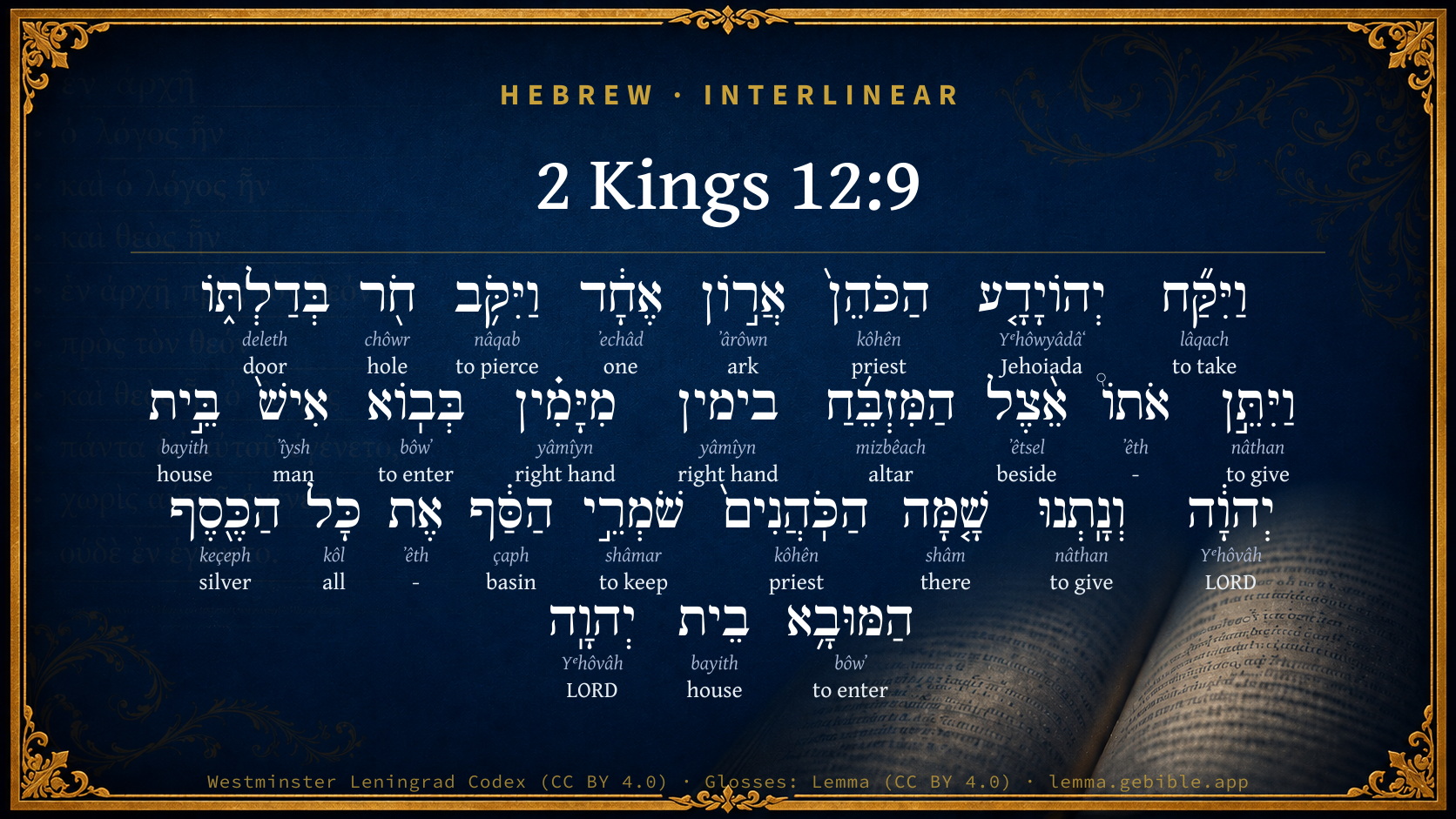
Hebrew (Westminster Leningrad Codex) 2 Kings 12:9 appears in the Hebrew Old Testament. The text above is from the Westminster Leningrad Codex. Each word links to its Strong’s number, a concise gloss, and parsing drawn from the Open Scriptures Hebrew Bible morphology. Click any word for its full Brown-Driver-Briggs (BDB) entry.
Download image
Cite this verse

2 Kings 12:9 (World English Bible). Public Domain. Lemma interlinear Bible study tool, https://lemma.gebible.app/v/2-kings/12/9.

Show BibTeX & RIS
BibTeX
RIS
English Translation
But Jehoiada the priest took a chest, and bored a hole in the lid of it, and set it beside the altar, on the right side as one comes into the house of Yahweh: and the priests who kept the threshold put therein all the money that was brought into the house of Yahweh.
World English Bible · Public Domain
Download a study sheet

One document with this verse’s original text, its word-by-word gloss line, the meaning frame, cross-references with their text, attributed commentary, and full source and license credits — printable, and it pastes into notes with its structure intact.

This verse Autodidact and up

Study sheet (.html) Plain text (.txt)

A passage Seminary Student

Up to 50 verses in one chapter. A passage sheet keeps up to 6 commentary sources and 12 cross-references per verse, in the order this page ranks them, and says so on the sheet whenever that leaves anything out. Ask for a single verse and you get the Autodidact verse sheet above.

Everything on this page stays free to read, with no account — the sheet is a download of what is already on screen, not access to it.

Want to remove ads? Support Godless Engineer
Compare translations 3

The same verse in 3 English versions, stacked beneath the original-language interlinear above. Click any original word for its lexicon entry.

Each is an independent rendering of the whole verse — the interlinear is not word-aligned to these translations.

Highlighted words mark where these versions differ — a whole-verse word diff, not a word-by-word alignment.

  • World English Bible Public Domain
    But Jehoiada the priest took a chest, and bored a hole in the lid of it, and set it beside the altar, on the right side as one comes into the house of Yahweh: and the priests who kept the threshold put therein all the money that was brought into the house of Yahweh.
  • King James Version Public Domain
    But Jehoiada the priest took a chest, and bored a hole in the lid of it, and set it beside the altar, on the right side as one cometh into the house of the LORD: and the priests that kept the door put therein all the money that was brought into the house of the LORD.
  • unfoldingWord Literal Text CC BY-SA 4.0
    And Jehoiada the priest took a box and bored a hole in its lid, and he put it beside the altar, on the right side. When a man came the house of Yahweh, then the priests keeping the threshold put into there all of the silver brought the house of Yahweh.

unfoldingWord Literal Text — © unfoldingWord, licensed CC BY-SA 4.0. Word-aligned USFM3 via Door43 (git.door43.org/unfoldingWord/en_ult).

Versions to compare (up to 4)

3 of 4 selected

Show all 18 translations

Every available English version of this verse, each an independent rendering of the whole verse.

  • World English Bible Public Domain
    But Jehoiada the priest took a chest, and bored a hole in the lid of it, and set it beside the altar, on the right side as one comes into the house of Yahweh: and the priests who kept the threshold put therein all the money that was brought into the house of Yahweh.
  • Berean Standard Bible Public Domain
    Then Jehoiada the priest took a chest, bored a hole in its lid, and set it beside the altar on the right side as one enters the house of the LORD. There the priests who guarded the threshold put all the money brought into the house of the LORD.
  • Majority Standard Bible Public Domain
    Then Jehoiada the priest took a chest, bored a hole in its lid, and set it beside the altar on the right side as one enters the house of the LORD. There the priests who guarded the threshold put all the money brought into the house of the LORD.
  • King James Version Public Domain
    But Jehoiada the priest took a chest, and bored a hole in the lid of it, and set it beside the altar, on the right side as one cometh into the house of the LORD: and the priests that kept the door put therein all the money that was brought into the house of the LORD.
  • American Standard Version (1901) Public Domain
    But Jehoiada the priest took a chest, and bored a hole in the lid of it, and set it beside the altar, on the right side as one cometh into the house of Jehovah: and the priests that kept the threshold put therein all the money that was brought into the house of Jehovah.
  • Revised Version (1885) Public Domain
    But Jehoiada the priest took a chest, and bored a hole in the lid of it, and set it beside the altar, on the right side as one cometh into the house of the LORD: and the priests that kept the door put therein all the money that was brought into the house of the LORD.
  • Geneva Bible (1599) Public Domain
    Then Iehoiada the Priest tooke a chest and bored an hole in the lid of it, and set it beside the altar, on the right side, as euery man commeth into the Temple of the Lord. And the Priestes that kept the doore, put therein all the money that was brought into the house of the Lord.
  • Douay-Rheims (1899) Public Domain
    And Joiada the high priest took a chest and bored a hole in the top, and set it by the altar at the right hand of them that came into the house of the Lord, and the priests that kept the doors put therein all the money that was brought to the temple of the Lord.
  • Young's Literal Translation Public Domain
    and Jehoiada the priest taketh a chest, and pierceth a hole in its lid, and putteth it near the altar, on the right side, as one cometh in to the house of Jehovah, and the priests keeping the threshold have put there all the money that is brought in to the house of Jehovah.
  • Literal Standard Version CC BY-SA 4.0
    and Jehoiada the priest takes a chest, and pierces a hole in its lid, and puts it near the altar, on the right side, as one comes into the house of YHWH, and the priests keeping the threshold have put all the money there that is brought into the house of YHWH.
  • Unlocked Literal Bible CC BY-SA 4.0
    Instead, Jehoiada the priest took a chest, bored a hole in its lid, and set it beside the altar, on the right side as one comes into the house of Yahweh. The priests who were guarding the temple entrance put into it all the money that was brought to the house of Yahweh.
  • unfoldingWord Literal Text CC BY-SA 4.0
    And Jehoiada the priest took a box and bored a hole in its lid, and he put it beside the altar, on the right side. When a man came the house of Yahweh, then the priests keeping the threshold put into there all of the silver brought the house of Yahweh.
  • Darby Bible Public Domain
    And Jehoiada the priest took a chest, and bored a hole in the lid, and set it beside the altar, on the right side as one comes into the house of Jehovah; and the priests that kept the door put into it all the money brought into the house of Jehovah.
  • World Messianic Bible Public Domain
    But Jehoiada the priest took a chest and bored a hole in its lid, and set it beside the altar, on the right side as one comes into the LORD’s house; and the priests who kept the threshold put all the money that was brought into the LORD’s house into it.
  • Webster's Bible Public Domain
    But Jehoiada the priest took a chest, and bored a hole in the lid of it, and set it beside the altar, on the right side as one cometh into the house of the LORD: and the priests that kept the door put in it all the money that was brought into the house of the LORD.
  • Free Bible Version CC BY-SA 4.0
    Jehoiada the priest took a large wooden box, cut a hole in its lid, and placed it on the right side of the altar next to the entrance to the Lord's Temple. There the priests who guarded the doorway put all the money brought into the Lord's Temple into the collection box.
  • Bible in Basic English Public Domain
    But Jehoiada the priest took a chest, and making a hole in the cover of it, put it by the altar, on the right side when one comes into the house of the Lord; and the priests who kept the door put in it regularly all the money which was taken into the house of the Lord.
  • JPS Tanakh (1917) Public Domain
    (12-10) And Jehoiada the priest took a chest, and bored a hole in the lid of it, and set it beside the altar, on the right side as one cometh into the house of the LORD; and the priests that kept the threshold put therein all the money that was brought into the house of the LORD.

Literal Standard Version (2020), Covenant Press — licensed CC BY-SA 4.0. Text via the HelloAO Bible API (eBible.org). Unlocked Literal Bible (unfoldingWord) — licensed CC BY-SA 4.0. Text via the HelloAO Bible API (eBible.org). unfoldingWord Literal Text — © unfoldingWord, licensed CC BY-SA 4.0. Word-aligned USFM3 via Door43 (git.door43.org/unfoldingWord/en_ult). Free Bible Version, Dr. Jonathan Gallagher — licensed CC BY-SA 4.0. Text via the HelloAO Bible API (eBible.org).

Word by word

More ways to search: Search by grammar → Find every occurrence → Compare this word →

Practice this passage: Drill this verse → Learn its vocabulary →

חֹ֖ר
chôwr
H2356
“hole”
Noun, Common, Masculine, Singular, Absolute
Part of Speech
Noun
Type
Common
Gender
Masculine
Number
Singular
State
Absolute
Full BDB Definition

Origin: the same as H2352

TWOT: 758a

hole, cave
  1. וַיִּקַּ֞ח lâqach H3947 “and · to take” Conjunction + Verb, Qal, Sequential Imperfect, 3rd Person, Masculine, Singular
  2. יְהוֹיָדָ֤ע Yᵉhôwyâdâʻ H3077 “Jehoiada” Noun, Proper
  3. הַכֹּהֵן֙ kôhên H3548 “the · priest” Particle, Definite Article + Noun, Common, Masculine, Singular, Absolute
  4. אֲר֣וֹן ʼârôwn H727 “ark” Noun, Common, Both, Singular, Absolute
  5. אֶחָ֔ד ʼechâd H259 “one” Adjective, Cardinal number, Masculine, Singular, Absolute
  6. וַיִּקֹּ֥ב nâqab H5344 “and · to pierce” Conjunction + Verb, Qal, Sequential Imperfect, 3rd Person, Masculine, Singular
  7. בְּדַלְתּ֑וֹ deleth H1817 “in/at · door · his” Preposition + Noun, Common, Feminine, Singular, Construct + Suffix, Personal, 3rd Person, Masculine, Singular
  8. וַיִּתֵּ֣ן nâthan H5414 “and · to give” Conjunction + Verb, Qal, Sequential Imperfect, 3rd Person, Masculine, Singular
  9. אֹתוֹ֩ ʼêth H853 “- · him” Particle, Direct Object + Suffix, Personal, 3rd Person, Masculine, Singular
  10. אֵ֨צֶל ʼêtsel H681 “beside” Preposition
  11. הַמִּזְבֵּ֜חַ mizbêach H4196 “the · altar” Particle, Definite Article + Noun, Common, Masculine, Singular, Absolute
  12. בימין yâmîyn H3225 “in/at the · right hand” Preposition, Determined + Noun, Common, Feminine, Singular, Absolute
  13. מִיָּמִ֗ין yâmîyn H3225 “from · right hand” Preposition + Noun, Common, Feminine, Singular, Absolute
  14. בְּבֽוֹא bôwʼ H935 “in/at · to enter” Preposition + Verb, Qal, Infinitive Construct
  15. אִישׁ֙ ʼîysh H376 “man” Noun, Common, Masculine, Singular, Absolute
  16. בֵּ֣ית bayith H1004 “house of” Noun, Common, Masculine, Singular, Construct
  17. יְהוָ֔ה Yᵉhôvâh H3068 “LORD” Noun, Proper
  18. וְנָֽתְנוּ nâthan H5414 “and · to give” Conjunction + Verb, Qal, Perfect, 3rd Person, Common, Plural
  19. שָׁ֤מָּה shâm H8033 “there · toward” Adverb + Suffix, Demonstrative
  20. הַכֹּֽהֲנִים֙ kôhên H3548 “the · priests” Particle, Definite Article + Noun, Common, Masculine, Plural, Absolute
  21. שֹׁמְרֵ֣י shâmar H8104 “keeping” Verb, Qal, Participle Active, Masculine, Plural, Construct
  22. הַסַּ֔ף çaph H5592 “the · basin” Particle, Definite Article + Noun, Common, Masculine, Singular, Absolute
  23. אֶת ʼêth H853 “-” Particle, Direct Object
  24. כָּל kôl H3605 “all of” Noun, Common, Masculine, Singular, Construct
  25. הַכֶּ֖סֶף keçeph H3701 “the · silver” Particle, Definite Article + Noun, Common, Masculine, Singular, Absolute
  26. הַמּוּבָ֥א bôwʼ H935 “the · entered” Particle, Definite Article + Verb, Hophal, Participle Passive, Masculine, Singular, Absolute
  27. בֵית bayith H1004 “house of” Noun, Common, Masculine, Singular, Construct
  28. יְהוָֽה Yᵉhôvâh H3068 “LORD” Noun, Proper

About this verse

These counts appear in no published source. They are computed here, from the morphology-tagged text and Lemma’s own curated glosses. What Lemma adds →

29
words
22
distinct lemmas
Historical
section

Notable vocabulary

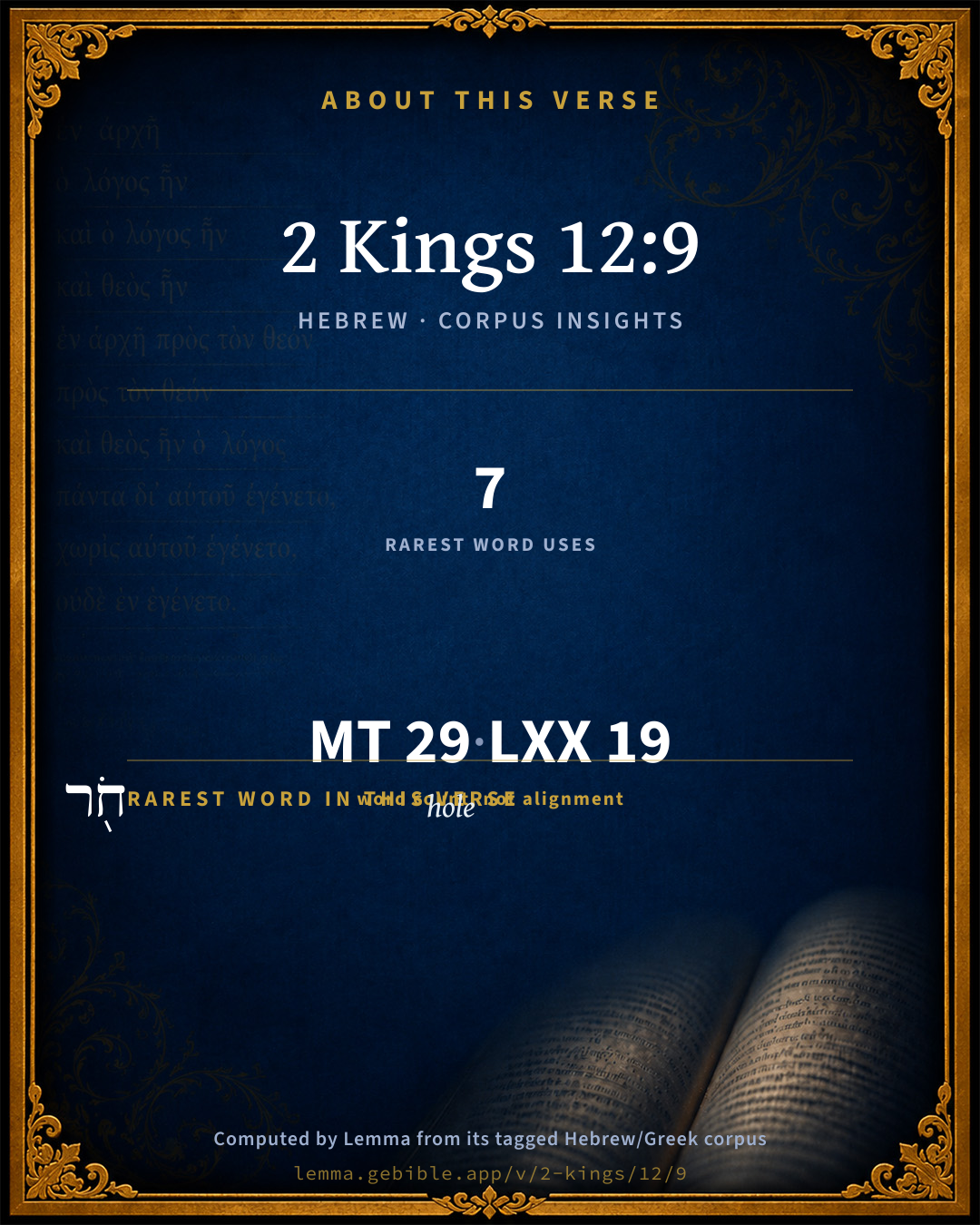
The rarest word here is חֹ֖ר hole H2356 — appearing just 7 times in the whole Hebrew Bible.

Shared distinctive vocabulary

חֹ֖ר hole H2356 occurs in 7 verses of the Hebrew Bible. Also found in:

Grammatical profile

  • 7 verbs
  • 17 nouns
  • 1 adjective
  • 1 preposition
  • 1 adverb
  • 2 particles

Verb forms

  • וַיִּקַּ֞ח Qal · Sequential Imperfect
  • וַיִּקֹּ֥ב Qal · Sequential Imperfect
  • וַיִּתֵּ֣ן Qal · Sequential Imperfect
  • בְּבֽוֹא Qal · Infinitive Construct
  • וְנָֽתְנוּ Qal · Perfect
  • שֹׁמְרֵ֣י Qal · Participle Active
  • הַמּוּבָ֥א Hophal · Participle Passive

Repetition

Words recur within this verse — often emphatic in Hebrew:

  • הַכֹּהֵן֙ priest H3548 ×2
  • וַיִּתֵּ֣ן to give H5414 ×2
  • בימין right hand H3225 ×2
  • בְּבֽוֹא to enter H935 ×2
  • בֵּ֣ית house H1004 ×2
  • יְהוָ֔ה LORD H3068 ×2

Hebrew & Septuagint length

In English translation the verse runs 54 words from the Hebrew and 56 from the Septuagint (LXX English) — closely comparable.

A rough comparison of the two English renderings, which tokenize alike — not a word-level alignment.

Word counts can differ between the Hebrew and the Greek without any difference in meaning — e.g. the Hebrew direct-object marker אֵת has no separate Greek word, and Greek often adds the article ὁ.

In the original languages it is 29 Hebrew tokens and 19 Greek tokens — but the two are counted differently (Hebrew bundles its prefixes and suffixes into one token; the Greek is in lemma form), so that isn’t a like-for-like length.

Cross-references

11

Topical passages linked to 2 Kings 12:9 in the Treasury of Scripture Knowledge — connected by theme and wording, ordered by reader-vote popularity; previews shown in the World English Bible.

  • Mark 12:41 Jesus sat down opposite the treasury, and saw how the multitude cast money into the treasury. Many who were rich cast in much.
  • 1 Chronicles 15:24 Shebaniah, and Joshaphat, and Nethanel, and Amasai, and Zechariah, and Benaiah, and Eliezer, the priests, did blow the trumpets before the ark of God: and Obed-edom and Jehiah were doorkeepers for the ark.
  • Psalms 84:10 For a day in your courts is better than a thousand. I would rather be a doorkeeper in the house of my God, Than to dwell in the tents of wickedness.
  • Jeremiah 35:4 and I brought them into the house of Yahweh, into the chamber of the sons of Hanan the son of Igdaliah, the man of God, which was by the chamber of the princes, which was above the chamber of Maaseiah the son of Shallum, the keeper of the threshold.
  • Luke 21:1 He looked up, and saw the rich people who were putting their gifts into the treasury.
  • 2 Kings 22:4 Go up to Hilkiah the high priest, that he may sum the money which is brought into the house of Yahweh, which the keepers of the threshold have gathered of the people:
  • 2 Kings 23:4 The king commanded Hilkiah the high priest, and the priests of the second order, and the keepers of the threshold, to bring forth out of the temple of Yahweh all the vessels that were made for Baal, and for the Asherah, and for all the host of the sky, and he burned them outside of Jerusalem in the fields of the Kidron, and carried the ashes of them to Bethel.
  • 2 Kings 25:18 The captain of the guard took Seraiah the chief priest, and Zephaniah the second priest, and the three keepers of the threshold:
  • 1 Chronicles 15:18 and with them their brothers of the second degree, Zechariah, Ben, and Jaaziel, and Shemiramoth, and Jehiel, and Unni, Eliab, and Benaiah, and Maaseiah, and Mattithiah, and Eliphelehu, and Mikneiah, and Obed-edom, and Jeiel, the doorkeepers.
  • 2 Chronicles 24:8–14 So the king commanded, and they made a chest, and set it outside at the gate of the house of Yahweh.
  • Jeremiah 52:24 The captain of the guard took Seraiah the chief priest, and Zephaniah the second priest, and the three keepers of the threshold:

Cross-references courtesy of OpenBible.info (CC BY 4.0).

Hebrew and Greek witnesses Masoretic Hebrew ↔ Greek Septuagint

The same verse in the two great witnesses to the Old Testament, shown verse-for-verse.

These are two independent witnesses, not word-aligned to each other, and the Septuagint is shown in lemma (dictionary) form.

Hebrew 2 Kings 12:9 Masoretic · Westminster Leningrad Codex

וַיִּקַּ֞ח יְהוֹיָדָ֤ע הַכֹּהֵן֙ אֲר֣וֹן אֶחָ֔ד וַיִּקֹּ֥ב חֹ֖ר בְּדַלְתּ֑וֹ וַיִּתֵּ֣ן אֹתוֹ֩ אֵ֨צֶל הַמִּזְבֵּ֜חַ בימין מִיָּמִ֗ין בְּבֽוֹא אִישׁ֙ בֵּ֣ית יְהוָ֔ה וְנָֽתְנוּ שָׁ֤מָּה הַכֹּֽהֲנִים֙ שֹׁמְרֵ֣י הַסַּ֔ף אֶת כָּל הַכֶּ֖סֶף הַמּוּבָ֥א בֵית יְהוָֽה

But Jehoiada the priest took a chest, and bored a hole in the lid of it, and set it beside the altar, on the right side as one comes into the house of Yahweh: and the priests who kept the threshold put therein all the money that was brought into the house of Yahweh.

World English Bible · Public Domain

Greek LXX 2 Kings 12:9 Septuagint · lemma form

καί συνφωνέω ὁ ἱερεύς ὁ μή λαμβάνω ἀργύριον παρά ὁ λαός καί ὁ μή ἐνἰσχύω ὁ βεδεκ ὁ οἶκος

And Jodae the priest took a chest, and bored a hole in the lid of it, and set it by the altar in the house of a man belonging to the house of the Lord, and the priests that kept the door put therein all the money that was found in the house of the Lord.

LXX2012 (modern English Septuagint) · Public Domain

Hebrew: Westminster Leningrad Codex (CC BY 4.0). Greek: Septuagint (public domain); English from LXX2012 (modern English Septuagint) (Public Domain). How the Septuagint differs from the Hebrew →

Targum (Aramaic paraphrase)

1

The Targum is the ancient Jewish Aramaic paraphrase of the Hebrew Scriptures — an interpretive translation, not the Hebrew text itself. Onkelos (literal) and Pseudo-Jonathan (expansive) render the Torah, and Jonathan the Prophets. Coverage is partial: where no permissively-licensed English translation exists for a verse, only the Aramaic is shown. This is verse-level text, not a word-by-word alignment to the Hebrew.

  1. Targum Jonathan Prophets (Joshua–Malachi)
    וְאִיטְפָסוּ כַּהֲנַיָא בְּדִיל דְלָא לְמִסַב כַּסְפָּא מִן עַמָא וּבְדִיל דְלָא לְתַקְפָא יַת בִּדְקָא דְבֵיתָא:

    (no public-domain English translation for this verse)

    Targum Jonathan — Aramaic: “Mikraot Gedolot” (public domain). English: “Sefaria Community Translation” (CC0 1.0 (public-domain dedication)); “London "Chaldee Paraphrase," 1871” (public domain). Text via Sefaria.

Commentary

Notes on 2 Kings 12:9 from classic Christian and Jewish commentators (each source and its license shown beneath its notes). The classic Christian expositions comment on the surrounding passage and are grouped to its opening verse, so a note may address several verses; the Jewish commentaries on the Tanakh (Rashi and others) are per-verse, so they appear only where the commentator wrote on this verse.

Lemma curates 59 commentaries, every one of them public domain or Creative Commons licensed, each selected and text-cleaned for this edition rather than reprinted as found. About our sources →

Trapp's Complete Commentary

John Trapp

2Ki 12:9 But Jehoiada the priest took a chest, and bored a hole in the lid of it, and set it beside the altar, on the right side as one cometh into the house of the LORD: and the priests that kept the door put therein all the money [that was] brought into the house of the LORD.

Ver. 9. But Jehoiada the priest took a chest.] This he did by the king’s appointment, {2Ch 24:8} and it took good effect. {2Ki 12:9-10}

John Trapp, A Commentary or Exposition upon All the Books of the Old and New Testament (1647–1656) — public domain. Text from a community e-Sword module.

The Biblical Illustrator

Joseph S. Exell

2Ki_12:9

And Jehoiada the priest took a chest.

The first contribution-box

This chapter takes us away from those confusions up in northern Palestine, which seemed to be getting a little overcrowded with murder and warfare and theft. There is a deep spiritual apathy in the city and the land everywhere. The people have still idolatrous practices; around on some of the hills there are altars and groves where decorous men and women would think it not nice to go. The worst of this terrible ungodliness is found in the greediness of the priests. Evidently they are self-seekers of the vile sort. They exhaust all the income of the sanctuary, slender as it is, in their own emoluments and perquisites. The king is inefficient, as should be expected; what could a little boy do? The temple is all out of repair; there are breaches in many parts of the building. A dull period of sixteen years has been slowly drifting along. The picture is not encouraging; but let us turn ourselves to the instruction it offers for us in these modern times. The force of the story will come out in a series of observations.

I. Sometimes religious depression shows itself in material dilapidations. Everything is running behind-hand in the public spirit of the town, the city, or the congregation.

1. It is a bad sign when the church edifice is going into ruinous condition. Can it be said that the zeal of the Lord is eating any one up there?

2. It is a worse sign when the income of any congregation has begun to fail. In the story here, somebody must have pushed up that little seven-year-old king Jehoash to try to collect some money, for he issued a call almost at once for help to put the temple under repair. But it all came to nothing; the house of the Lord continued to discourage and chill the devotions far more than to awake them, because it was so forlorn and unclean.

3. It is a worse sign still when the minister and the employees exhaust the funds in their own uses and luxuries. That was the trouble during those sad sixteen years of Jehoashs infancy. Money went in, but the priests swallowed it up.

4. It is the worst sign of all when the peoples heart is unmoved; when everybody knows and nobody cares about the cheerlessness of the facts or the prospects.

II. Sometimes the speediest relief is found in the peoples taking the reform wholly into their own hands.

1. In this case, it was the young king and the people who did the work, though the high-priest organised the new movement, under royal direction. Let us look into the whole facts and philosophy of this uprising of the community there in Jerusalem. The religious and ordained officers in the congregation of the temple cheerfully arose to say, Let anybody do this great and needed thing that can do it better than we can. They consented to receive none of the money, and they withdrew from ordering the repairs. In that historic hour there came first to light the earliest contribution-box used in the service of God. Was there ever anything imagined so rude or inartistic as an instrument of devotion?

2. But before you smile at the prosaic expedient, pause a moment to do simple justice to one of Gods instruments of good. From that day the contribution-box has been an institution for the Church under the Old Testament and the New, probably as well known as any other in the range of our experience. It deserves now and then a decent eulogy. Its record is honourable and fair.

(1) The contribution-box exhibits the wide reach of religious obligation. This one stood beside the altar.

(2) The contribution-box kindles the fires of love and hope in the believers heart. For it seems to say, All are at work now, and all together; what are you doing for your Lord?

(3) The contribution-box keeps good and true men up to the exact end in view.

(4) The contribution-box develops and commissions the most capable workers in the Lords cause. When men have given hopeful hearts and open hands alike to the service of the Master, it is not necessary to guard them; they will surely deal faithfully.

III. Sometimes piety is brought back to its level under a fresh impulse of material prosperity. This is a reflection also that we might expect to be suggested by the history here.

1. The philosophy underlying such a conclusion is simple. We are all creatures of human build and constitutional weakness in relation to the practical world we live in. When the church is repulsive and the services dull, when the carpets are soiled with long using, when the prayer-circle is languishing; then, good friends, it is almost hopeless for even the best of saints to try and keep up his spirits.

2. The relief is close at hand.

3. The facts, which might be offered in illustration, are without limit. (C. S. Robinson, D. D.)

.

The Biblical Illustrator, edited by Joseph S. Exell (c. 1880s–1900s) — public domain. Text from a community e-Sword module.

Joseph Benson's Commentary

2Ki 12:9. Jehoiada the priest took a chest — By the king’s order, 2Ch 24:8. And set it beside the altar — In the court of the priests. Upon comparing the passage in Chronicles, just referred to, with this, it seems probable that it was first placed by the altar, and afterward removed thence to the gate of the court, for the people’s greater satisfaction, that they might come thither, and put in their money with their own hands.

Joseph Benson's Commentary on the Old and New Testaments (1811–1818) — public domain. Text from a community e-Sword module.

Tyndale Open Study Notes

Tyndale Open Resources

12:9-11 Joash’s solution for securing and distributing the money for Temple repairs included placing a large chest at an accessible place to receive the people’s contributions. When Joash informed the people of the need for a tax and voluntary offerings to complete the repairs, they “gladly brought their money and filled the chest with it” (2 Chr 24:9-10). With sufficient funds on hand, the money was given to the construction supervisors and the repair and restoration of the Temple began.

Tyndale Open Study Notes — © Tyndale Open Resources, licensed CC BY-SA 4.0. Text via the HelloAO Bible API.

Geneva Bible (1599)

Geneva Bible translators

That is, on the South side.

Or, vessel.

Geneva Bible (1599) marginal notes — public domain. Text via Bolls.life.

Adam Clarke's Commentary

Verse 9. Jehoiada - took a chest] This chest was at first set beside the altar, as is here mentioned; but afterwards, for the convenience of the people, it was set without the gate; see 2Ch 24:8.

Adam Clarke's Commentary on the Bible (1810–1826) — public domain. Text from a community e-Sword/MySword module.

Ellicott's Commentary for English Readers

(9) But.—And.

Jehoiada the priest took a chest.—By order of the king (2Ch_24:8).

Beside the altar, on the right side as one cometh into the house of the Lord.—Chronicles says: “in the gate of the house of the Lord outwards.” This can hardly refer to the same position. It probably describes where the chest, which became a permanent feature of the sanctuary, stood in the time after the return from the Captivity. The chronicler adds that offerings were asked by proclamation throughout the country, and that the princes and people readily contributed.

Put.—Rather, used to put. The chest was kept locked, and the Levitical doorkeepers received the money from those who offered it, and dropped it at once into the chest. This obviated all suspicion of a possible misapplication of the contributions.

A Bible Commentary for English Readers, edited by Charles John Ellicott (1878–1897) — public domain. Text from a community e-Sword module.

The Cambridge Bible for Schools and Colleges

gen. ed. J. J. S. Perowne

9. But Jehoiada the priest took a chest] The Chronicler says ‘At the king’s commandment they made a chest’. It is manifest that both king and priests were at one in changing the plan for raising a repair-fund. But it is not without interest to note that the narrative of Chronicles, which is assumed to bring the priest into prominence everywhere, here omits Jehoiada’s name from the story.

set it beside the altar] In Chronicles it is said to have been ‘set without at the gate of the house of the Lord’. The altar spoken of here is the brasen altar for burnt offerings which was outside the temple, in the court, before the porch of the temple. So the description in Chronicles appears to be a little less exact than in the verse before us. But the words which are added here ‘on the right side as one cometh into the house of the Lord’ may have given rise to the Chronicler’s more vague description ‘at the gate of the house of the Lord’. The account in Kings is to be preferred as drawn from some contemporary record and compiled earlier than the narrative in Chronicles.

all the money that was brought] In 2Ch_24:9-10 we are told that when the chest was set ‘they made a proclamation through Judah and Jerusalem to bring in to the Lord the collection that Moses, the servant of God, laid upon Israel in the wilderness. And all the princes and all the people rejoiced, and brought in, and cast into the chest, until they had made an end’. While the money had been given by individuals at their homes, and with no united action, the preparations had languished. The new arrangement put life into the work. The givers saw that others were giving as well as they, and found that a sum was being gathered of which regular account was kept, so that there was now some hope that the work would be completed. Josephus exactly hits the feeling which would be created in this way when he says πολὺν ἄργυρον καὶ χρυσὸν φιλοτιμούμενοι καὶ συνεισφέροντες ἤθροισαν. The spirit of cooperation was invoked and the contributors saw that success was likely to attend what they were doing. Hence their zealous efforts. The history is not without its value in our own days.

The Cambridge Bible for Schools and Colleges (gen. ed. J. J. S. Perowne; Cambridge University Press, 1878–1918) — public domain. Text from a community e-Sword module.

John Gill's Exposition

And they gave the money, being told, into the hands of them that did the work, that had the oversight of the house of the Lord,.... Who were appointed overseers of the workmen employed in the repairs of the temple; which overseers were laymen, and not priests, they being discharged from any concern in the repairs: this money "told", Kimchi interprets of its being coined; he supposes money coined and uncoined to be brought, which was put in separate bags; and that, which was not coined, they coined it before they delivered it to the overseers to pay the workmen with:

and they laid it out to the carpenters and builders that wrought upon the house of the Lord; paid them with it, some that wrought in cutting the timber, and others in building with it.

John Gill's Exposition of the Whole Bible (1746–1763) — public domain (CC PDM 1.0). Text via the HelloAO Bible API.

Albert Barnes' Notes on the Bible

The priests that kept the door - The north door into the priests’ court Eze 40:35-43 seems to be intended, not the door of the temple building. The chest must have been placed a little to the right of this north door, between it and the altar of burnt-offering, so that the people could see it from the doorway. The people were not ordinarily allowed to go within the doorway into this court, which belonged to the priests and Levites only.

Albert Barnes' Notes on the Bible (1834–1885) — public domain. Text from a community e-Sword/MySword module.

Haydock's Catholic Bible Commentary

By the altar, yet without the enclosure, that any person might freely put in what he thought proper, 2 Paralipomenon xxiv. 8. Priests were still appointed to watch, that no fraud was committed: and they counted the money which the law ordained to be paid. Josephus (Jewish Wars vi. 5.) speaks of many coffers; one might be near the altar, and another out of the door. (Menochius)

George Leo Haydock (1774–1849), Haydock's Catholic Family Bible and Commentary, 1859 edition — public domain. Excludes Psalms (Douay-Rheims chapter numbering differs from Protestant) and Deuterocanonical books (Catholic canon only).

Matthew Poole's English Annotations

Jehoiada the priest, by the king’s consent, 2Ch 24:8.

Beside the altar, in the priests’ court.

Object. It was placed without at the gate of the house of the Lord, 2Ch 24:8.

Answ. Either, first, It was first placed by the altar, and afterwards thence removed to the gate of the court, for the people’s greater satisfaction, that they might come thither, and put in their money with their own hands. Or, secondly, That place 2 Chron speaks of the gate of the temple strictly so called, nigh unto which the altar of burnt-offerings was. Or, thirdly, It was placed near the entrance into the priests’ court, which was over against the altar, and not far from it; so as the people standing in their own court might either put their money into it, or see when the priests put it in.

The priests that kept the door; the door of the priests’ court, which, together with the temple and all its utensils, was committed to the charge of the priests and Levites, Num 18:4; 1Ch 9:26, &c.

Matthew Poole's English Annotations on the Holy Bible (1683–1685) — public domain. Text from a community e-Sword/MySword module.

Whedon's Commentary on the Bible

Daniel D. Whedon

9. Jehoiada… took a chest — This, according to 2Ch_24:8, was done “at the king’s commandment,” and was a much more popular measure than the one tried before. It provided that the contributions be audited and used by other persons besides the priests. Their’s was the trespass money and sin money, (2Ki_12:16,) but the chest was to receive the contributions for the repairing of the temple. “It was expected,” says Keil, “that the people would give more, when the collection was appointed for the special purpose of repairing the temple, than when they were to give the legal and voluntary payments only to the priests, whereby no giver knew how much of it might be applied for building.”

The priests… put therein all the money — Chronicles, however, seems to show that the people cast their money in the chest with their own hand. It may all have passed through the priests’ hands, but so publicly and with such oversight of interested parties as prevented all chance for embezzlement. There is not the slightest evidence that the priests and Levites had been guilty of any dishonesty in former collections, and yet there might have been suspicions.

Daniel D. Whedon (gen. ed.), Commentary on the Old and New Testaments (1874–1909) — public domain. Text from a community e-Sword module.

The Pulpit Commentary

But Jehoiada the priest took a chest. The writer of Chronicles says, "At the king"s commandment, they made a chest". (2Ch_24:8) The suggestion was probably the king"s, but the ecclesiastical and civil authorities worked harmoniously in the business. And bored a hole in the lid of it as hundreds of thousands have done since his timeand set it beside the altar, on the right side as one cometh into the house of the Lord. The altar intended is, of course, the altar of burnt offering, which was in the court of the temple, directly opposite the porch. The chest was placed outside the sanctuary, (2Ch_24:8) and, indeed, outside the porch, on the right hand as one entered into the court by the north door. It was thus very conspicuous. And the priests that kept the doori.e. the door of the courtput therein all the money that was brought into the house of the Lord. The priests received the money from those who offered, at the gate of the court, and, proceeding to the chest, dropped it in through the aperture. A man could not see that all which he had given was put in, but he reckoned on the good faith of the priest, and was satisfied.

The Pulpit Commentary (1880–1919), ed. H.D.M. Spence-Jones & Joseph S. Exell — public domain. Text from a community e-Sword module.

unfoldingWord translationNotes

Door43 World Missions Community

Instead, Jehoiada

"Instead of the priests collecting the money, Jehoiada"

on the right side as one comes into the house of Yahweh

"on the right side of the entrance to the temple"

put into it

"put into the chest" or "put in the box"

the money that was brought

This can be stated in active form. AT: "the money that people brought" (See: Active or Passive)

put the money in bags and then count it

Many versions put this in a more logical order such as "count the money and put it in bags."

put the money in bags

Possible meanings are 1) "put the money in bags" or 2) "tied up the money in bags" .

the money found

"the money that they found in the chest"

translationWords

priest

altar

house of God

temple

king

scribe

high priest

unfoldingWord translationNotes — © Distant Shores Media and the Door43 World Missions Community, licensed CC BY-SA 4.0. Source: git.door43.org/Door43/en_tn.

Lesson kit

Teaching starters — assembled from the data on this page, not authored interpretation. Every prompt links to the verse data it draws on. Edit before teaching.

2 Kings, in the Historical, opens this verse with 29 words (22 distinct Hebrew lemmas). Its most distinctive word is chôwr (“hole”). A historical commentator’s framing appears above. Read the whole chapter for the surrounding context.

Discussion questions

  1. What does “hole” (chôwr) contribute to the verse as a whole?
  2. 1 Samuel 14:11 shares the word «hole» with this verse. How do the two illuminate each other?
  3. “priest” occurs 2× in this one verse. What is the effect of the repetition?
  4. These translations render this verse differently; the difference is in the English rendering, not the original. What questions does that raise?
  5. The verb «וַיִּקַּ֞ח» is Qal Sequential Imperfect. How does its form color the action?
  6. Reading how Trapp's Complete Commentary and The Biblical Illustrator read this verse, where do the two commentators agree and where do they part?

Things to notice

Reading settings

Reading text

Shown beneath each verse's original-language words.

Old Testament
Old Testament edition

Read the OT as the Masoretic Hebrew (MT) or the Greek Septuagint (LXX).

English shown for the Greek Septuagint (in the Hebrew ↔ Greek comparison).

Comparing translations? Open the Compare panel on any verse page to stack up to four side by side.