Deuteronomy 27:5

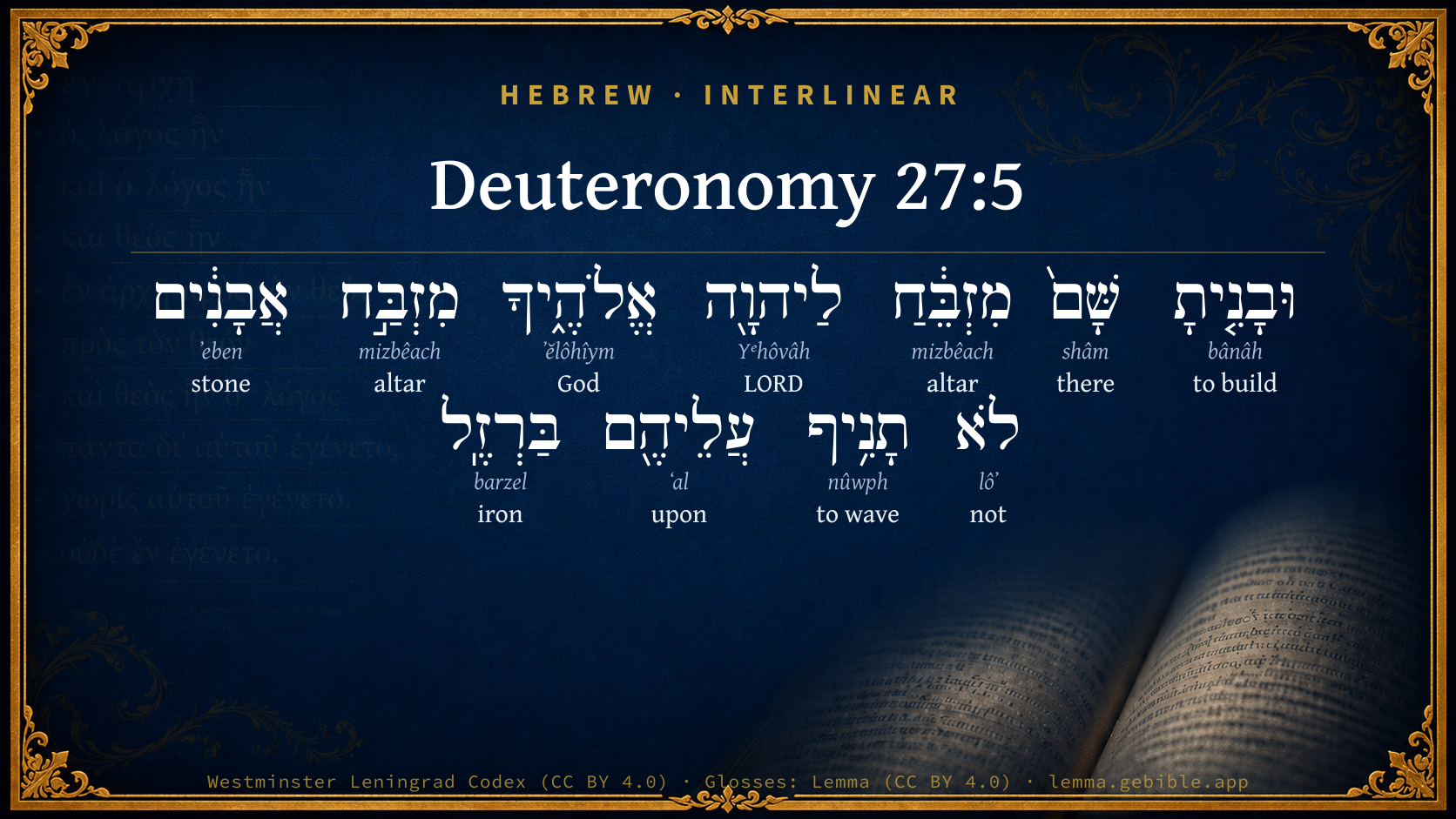
Hebrew (Westminster Leningrad Codex) Deuteronomy 27:5 appears in the Hebrew Old Testament. The text above is from the Westminster Leningrad Codex. Each word links to its Strong’s number, a concise gloss, and parsing drawn from the Open Scriptures Hebrew Bible morphology. Click any word for its full Brown-Driver-Briggs (BDB) entry.
Download image
Cite this verse

Deuteronomy 27:5 (World English Bible). Public Domain. Lemma interlinear Bible study tool, https://lemma.gebible.app/v/deuteronomy/27/5.

Show BibTeX & RIS
BibTeX
RIS
English Translation
There shall you build an altar to Yahweh your God, an altar of stones: you shall lift up no iron [tool] on them.
World English Bible · Public Domain
Download a study sheet

One document with this verse’s original text, its word-by-word gloss line, the meaning frame, cross-references with their text, attributed commentary, and full source and license credits — printable, and it pastes into notes with its structure intact.

This verse Autodidact and up

Study sheet (.html) Plain text (.txt)

A passage Seminary Student

Up to 50 verses in one chapter. A passage sheet keeps up to 6 commentary sources and 12 cross-references per verse, in the order this page ranks them, and says so on the sheet whenever that leaves anything out. Ask for a single verse and you get the Autodidact verse sheet above.

Everything on this page stays free to read, with no account — the sheet is a download of what is already on screen, not access to it.

Want to remove ads? Support Godless Engineer
Compare translations 3

The same verse in 3 English versions, stacked beneath the original-language interlinear above. Click any original word for its lexicon entry.

Each is an independent rendering of the whole verse — the interlinear is not word-aligned to these translations.

Highlighted words mark where these versions differ — a whole-verse word diff, not a word-by-word alignment.

  • World English Bible Public Domain
    There shall you build an altar to Yahweh your God, an altar of stones: you shall lift up no iron [tool] on them.
  • King James Version Public Domain
    And there shalt thou build an altar unto the LORD thy God, an altar of stones: thou shalt not lift up any iron tool upon them.
  • unfoldingWord Literal Text CC BY-SA 4.0
    And there you shall build an altar to Yahweh your God, an altar of stones; you shall not brandish an iron tool on them.

unfoldingWord Literal Text — © unfoldingWord, licensed CC BY-SA 4.0. Word-aligned USFM3 via Door43 (git.door43.org/unfoldingWord/en_ult).

Versions to compare (up to 4)

3 of 4 selected

Show all 18 translations

Every available English version of this verse, each an independent rendering of the whole verse.

  • World English Bible Public Domain
    There shall you build an altar to Yahweh your God, an altar of stones: you shall lift up no iron [tool] on them.
  • Berean Standard Bible Public Domain
    Moreover, you are to build there an altar to the LORD your God, an altar of stones. You must not use any iron tool on them.
  • Majority Standard Bible Public Domain
    Moreover, you are to build there an altar to the LORD your God, an altar of stones. You must not use any iron tool on them.
  • King James Version Public Domain
    And there shalt thou build an altar unto the LORD thy God, an altar of stones: thou shalt not lift up any iron tool upon them.
  • American Standard Version (1901) Public Domain
    And there shalt thou build an altar unto Jehovah thy God, an altar of stones: thou shalt lift up no iron `tool' upon them.
  • Revised Version (1885) Public Domain
    And there shalt thou build an altar unto the LORD thy God, an altar of stones: thou shalt lift up no iron tool upon them.
  • Geneva Bible (1599) Public Domain
    And there shalt thou build vnto the Lord thy God an altar, euen an altar of stones: thou shalt lift none yron instrument vpon them.
  • Douay-Rheims (1899) Public Domain
    And thou shalt build there an altar to the Lord thy God, of stones which iron hath not touched,
  • Young's Literal Translation Public Domain
    and built there an altar to Jehovah thy God, an altar of stones, thou dost not wave over them iron.
  • Literal Standard Version CC BY-SA 4.0
    and built an altar there to your God YHWH, an altar of stones; you do not wave iron over them.
  • Unlocked Literal Bible CC BY-SA 4.0
    There you must build an altar to Yahweh your God, an altar of stones; but you must raise no iron tool to work the stones.
  • unfoldingWord Literal Text CC BY-SA 4.0
    And there you shall build an altar to Yahweh your God, an altar of stones; you shall not brandish an iron tool on them.
  • Darby Bible Public Domain
    And there shalt thou build an altar to Jehovah thy God, an altar of stones; thou shalt not lift up an iron [tool] upon them;
  • World Messianic Bible Public Domain
    There you shall build an altar to the LORD your God, an altar of stones. You shall not use any iron tool on them.
  • Webster's Bible Public Domain
    And there shalt thou build an altar to the LORD thy God, an altar of stones: thou shalt not lift up any iron tool upon them.
  • Free Bible Version CC BY-SA 4.0
    Also build a stone altar there to the Lord your God, an altar of stones. Don't use any stone tools in its construction.
  • Bible in Basic English Public Domain
    There you are to make an altar to the Lord your God, of stones on which no iron instrument has been used.
  • JPS Tanakh (1917) Public Domain
    And there shalt thou build an altar unto the LORD thy God, an altar of stones; thou shalt lift up no iron tool upon them.

Literal Standard Version (2020), Covenant Press — licensed CC BY-SA 4.0. Text via the HelloAO Bible API (eBible.org). Unlocked Literal Bible (unfoldingWord) — licensed CC BY-SA 4.0. Text via the HelloAO Bible API (eBible.org). unfoldingWord Literal Text — © unfoldingWord, licensed CC BY-SA 4.0. Word-aligned USFM3 via Door43 (git.door43.org/unfoldingWord/en_ult). Free Bible Version, Dr. Jonathan Gallagher — licensed CC BY-SA 4.0. Text via the HelloAO Bible API (eBible.org).

Word by word

More ways to search: Search by grammar → Find every occurrence → Compare this word →

Practice this passage: Drill this verse → Learn its vocabulary →

תָנִ֥יף
nûwph
H5130
“to wave”
Verb, Hiphil, Imperfect, 2nd Person, Masculine, Singular
Part of Speech
Verb
Stem
Hiphil
Form
Imperfect
Person
2nd Person
Gender
Masculine
Number
Singular
Full BDB Definition

Origin: a primitive root

TWOT: 1329 , 1330

to move to and fro, wave, besprinkle - (Qal) to besprinkle, sprinkle - (Polel) to wave, brandish (in threat) - (Hiphil) to swing, wield, wave - to wield - to wave or shake (the hand) - to wave (hand) - to shake or brandish against - to swing to and fro - to wave (an offering), offer - to shed abroad - (Hophal) to be waved
  1. וּבָנִ֤יתָ bânâh H1129 “and · to build” Conjunction + Verb, Qal, Sequential Perfect, 2nd Person, Masculine, Singular
  2. שָּׁם֙ shâm H8033 “there” Adverb
  3. מִזְבֵּ֔חַ mizbêach H4196 “altar” Noun, Common, Masculine, Singular, Absolute
  4. לַיהוָ֖ה Yᵉhôvâh H3068 “to/for · LORD” Preposition + Noun, Proper
  5. אֱלֹהֶ֑יךָ ʼĕlôhîym H430 “God(s) · your” Noun, Common, Masculine, Plural, Construct + Suffix, Personal, 2nd Person, Masculine, Singular
  6. מִזְבַּ֣ח mizbêach H4196 “altar of” Noun, Common, Masculine, Singular, Construct
  7. אֲבָנִ֔ים ʼeben H68 “stones” Noun, Common, Feminine, Plural, Absolute
  8. לֹא lôʼ H3808 “not” Particle, Negative
  9. עֲלֵיהֶ֖ם ʻal H5921 “upon · them” Preposition + Suffix, Personal, 3rd Person, Masculine, Plural
  10. בַּרְזֶֽל barzel H1270 “iron” Noun, Common, Masculine, Singular, Absolute

About this verse

These counts appear in no published source. They are computed here, from the morphology-tagged text and Lemma’s own curated glosses. What Lemma adds →

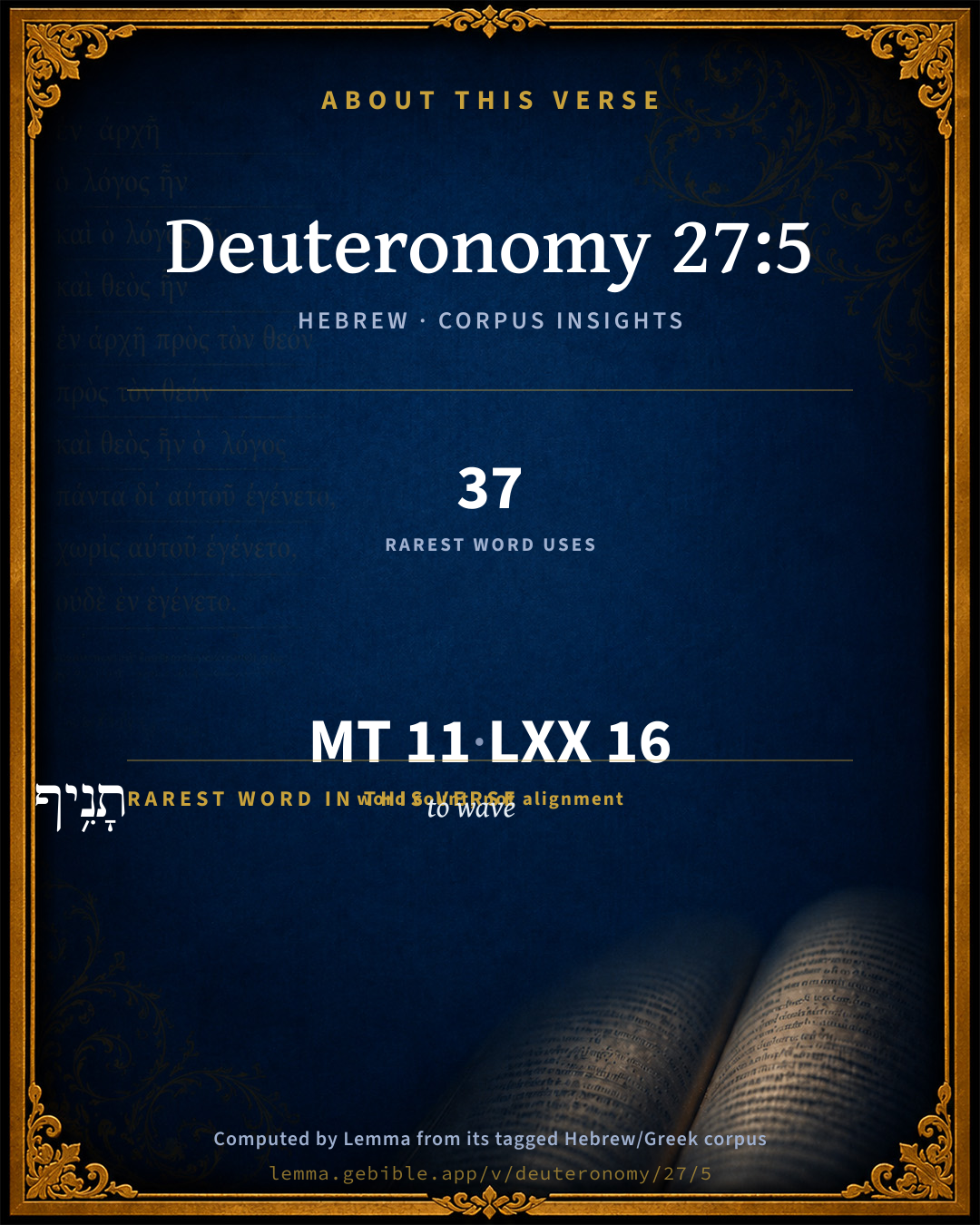
11
words
10
distinct lemmas
Pentateuch
section

Shared distinctive vocabulary

תָנִ֥יף to wave H5130 occurs in 35 verses of the Hebrew Bible. Also found in:

Grammatical profile

  • 2 verbs
  • 6 nouns
  • 1 preposition
  • 1 adverb
  • 1 particle

Verb forms

  • וּבָנִ֤יתָ Qal · Sequential Perfect
  • תָנִ֥יף Hiphil · Imperfect

Repetition

A word recurs within this verse — often emphatic in Hebrew:

  • מִזְבֵּ֔חַ altar H4196 ×2

Hebrew & Septuagint length

In English translation the verse runs 23 words from the Hebrew and 24 from the Septuagint (LXX English) — closely comparable.

A rough comparison of the two English renderings, which tokenize alike — not a word-level alignment.

Word counts can differ between the Hebrew and the Greek without any difference in meaning — e.g. the Hebrew direct-object marker אֵת has no separate Greek word, and Greek often adds the article ὁ.

In the original languages it is 11 Hebrew tokens and 16 Greek tokens — but the two are counted differently (Hebrew bundles its prefixes and suffixes into one token; the Greek is in lemma form), so that isn’t a like-for-like length.

Cross-references

4

Topical passages linked to Deuteronomy 27:5 in the Treasury of Scripture Knowledge — connected by theme and wording, ordered by reader-vote popularity; previews shown in the World English Bible.

  • Exodus 20:25 If you make me an altar of stone, you shall not build it of hewn stones; for if you lift up your tool on it, you have polluted it.
  • Exodus 24:4 Moses wrote all the words of Yahweh, and rose up early in the morning, and built an altar under the mountain, and twelve pillars for the twelve tribes of Israel.
  • 1 Kings 18:31–32 Elijah took twelve stones, according to the number of the tribes of the sons of Jacob, to whom the word of Yahweh came, saying, Israel shall be your name.
  • Joshua 8:30–31 Then Joshua built an altar to Yahweh, the God of Israel, in Mount Ebal,

Cross-references courtesy of OpenBible.info (CC BY 4.0).

Hebrew and Greek witnesses Masoretic Hebrew ↔ Greek Septuagint

The same verse in the two great witnesses to the Old Testament, shown verse-for-verse.

These are two independent witnesses, not word-aligned to each other, and the Septuagint is shown in lemma (dictionary) form.

Hebrew Deuteronomy 27:5 Masoretic · Westminster Leningrad Codex

וּבָנִ֤יתָ שָּׁם֙ מִזְבֵּ֔חַ לַיהוָ֖ה אֱלֹהֶ֑יךָ מִזְבַּ֣ח אֲבָנִ֔ים לֹא תָנִ֥יף עֲלֵיהֶ֖ם בַּרְזֶֽל

There shall you build an altar to Yahweh your God, an altar of stones: you shall lift up no iron [tool] on them.

World English Bible · Public Domain

Greek LXX Deuteronomy 27:5 Septuagint · lemma form

καί οἰκοδομέω ἐκεῖ θυσιαστήριον κύριος ὁ θεός σύ θυσιαστήριον ἐκ λίθος οὐ ἐπιβάλλω ἐπί αὐτός σίδηρος

And you shall build there an altar to the Lord your God, an altar of stones; you shall not lift up iron upon it.

LXX2012 (modern English Septuagint) · Public Domain

Hebrew: Westminster Leningrad Codex (CC BY 4.0). Greek: Septuagint (public domain); English from LXX2012 (modern English Septuagint) (Public Domain). How the Septuagint differs from the Hebrew →

Targum (Aramaic paraphrase)

2

The Targum is the ancient Jewish Aramaic paraphrase of the Hebrew Scriptures — an interpretive translation, not the Hebrew text itself. Onkelos (literal) and Pseudo-Jonathan (expansive) render the Torah, and Jonathan the Prophets. Coverage is partial: where no permissively-licensed English translation exists for a verse, only the Aramaic is shown. This is verse-level text, not a word-by-word alignment to the Hebrew.

  1. Targum Onkelos Torah (Genesis–Deuteronomy)
    וְתִבְנֵי תַמָן מַדְבְּחָא קֳדָם יְיָ אֱלָהָךְ מַדְבַּח אַבְנִין לָא תְרִים עֲלֵיהוֹן פַּרְזְלָא

    (no public-domain English translation for this verse)

    Targum Onkelos — Aramaic: “Onkelos Genesis” (public domain); “Onkelos Exodus” (public domain); “Onkelos Leviticus” (public domain); “Onkelos Numbers” (public domain); “Onkelos Deuteronomy” (public domain). English: “Sefaria Community Translation” (CC0 1.0 (public-domain dedication)); “J.W. Etheridge. The Targums of Onkelos and Jonathan Ben Uzziel on the Pentateuch. London: Longmans, Green, 1862” (public domain). Text via Sefaria.

  2. Targum Pseudo-Jonathan Torah (Genesis–Deuteronomy)
    וְתִבְנוּן תַּמָן מַדְבְּחָא קֳדָם יְיָ אֱלָהָכוֹן מַדְבַּח אַבְנִין לָא תְרִים עֲלֵיהוֹן פַּרְזְלָא

    and you shall build there an altar before the Lord your God, an altar of stone, not lifting up iron upon it.

    Targum Pseudo-Jonathan — Aramaic: “Targum Jonathan on Genesis” (public domain); “Targum Jonathan on Exodus” (public domain); “Targum Jonathan on Leviticus” (public domain); “Targum Jonathan on Numbers” (public domain); “Targum Jonathan on Deuteronomy” (public domain). English: “The Targum of Jonathan ben Uzziel, trans. J. W. Etheridge, London, 1862” (public domain). Text via Sefaria.

Commentary

Notes on Deuteronomy 27:5 from classic Christian and Jewish commentators (each source and its license shown beneath its notes). The classic Christian expositions comment on the surrounding passage and are grouped to its opening verse, so a note may address several verses; the Jewish commentaries on the Tanakh (Rashi and others) are per-verse, so they appear only where the commentator wrote on this verse.

Lemma curates 59 commentaries, every one of them public domain or Creative Commons licensed, each selected and text-cleaned for this edition rather than reprinted as found. About our sources →

Trapp's Complete Commentary

John Trapp

Deu 27:5 And there shalt thou build an altar unto the LORD thy God, an altar of stones: thou shalt not lift up [any] iron [tool] upon them.

Ver. 5. Thou shalt build an altar.] For burnt offerings, &c. {Deu 27:6-7} God teacheth them thereby, that righteousness, impossible to the law, was to be sought in Christ, figured by that altar and those sacrifices. Thus the moral law drove the Jews to the ceremonial, which was their gospel, as it doth now drive us to Christ, who is indeed "the end of the law for righteousness to every one that believeth." {Rom 10:4}

John Trapp, A Commentary or Exposition upon All the Books of the Old and New Testament (1647–1656) — public domain. Text from a community e-Sword module.

Tyndale Open Study Notes

Tyndale Open Resources

27:5 natural, uncut stones: Archaeological research has uncovered a number of Canaanite altars, all built of hewn blocks. In contrast to this practice, the Israelites were to build their altars only of rough field stones (Exod 20:22-26; see “Altars” Theme Note).

Tyndale Open Study Notes — © Tyndale Open Resources, licensed CC BY-SA 4.0. Text via the HelloAO Bible API.

Geneva Bible (1599)

Geneva Bible translators

The altar should not be curiously wrought, because it should continue but for a time: for God would have but one altar in Judah.

Geneva Bible (1599) marginal notes — public domain. Text via Bolls.life.

Jamieson, Fausset & Brown

Robert Jamieson, A. R. Fausset & David Brown

there shalt thou build an altar . . . of whole stones--The stones were to be in their natural state, as if a chisel would communicate pollution to them. The stony pile was to be so large as to contain all the conditions of the covenant, so elevated as to be visible to the whole congregation of Israel; and the religious ceremonial performed on the occasion was to consist: first, of the elementary worship needed for sinful men; and secondly, of the peace offerings, or lively, social feasts, that were suited to the happy people whose God was the Lord. There were thus, the law which condemned, and the typical expiation--the two great principles of revealed religion.

Jamieson, Fausset & Brown — Commentary Critical and Explanatory on the Whole Bible (1871) — public domain (CC PDM 1.0). Text via the HelloAO Bible API.

Ellicott's Commentary for English Readers

(5) An altar of stones.—Rashi propounds the theory that these stones were taken from Jordan. But there is nothing to countenance this theory in the words of the text.

A Bible Commentary for English Readers, edited by Charles John Ellicott (1878–1897) — public domain. Text from a community e-Sword module.

The Cambridge Bible for Schools and Colleges

gen. ed. J. J. S. Perowne

5. no iron] Exo_20:25, tool (ḥéreb), which would have polluted the altar. The later D’s substitution of iron is striking. See on Deu_8:9.

5–7. Cp. E, Exo_20:24 f. with Driver’s notes.

The Cambridge Bible for Schools and Colleges (gen. ed. J. J. S. Perowne; Cambridge University Press, 1878–1918) — public domain. Text from a community e-Sword module.

John Gill's Exposition

And there shall thou build an altar to the Lord thy God,.... On the same mountain, though not of the same stones. Jarchi's note is,"after that (the setting up of the plastered stones) thou shalt bring from thence (from Jordan) others, and build of them an altar on Mount Ebal;''but Josephus (t) places this altar not on Mount Ebal, but between that and Gerizim. This altar, he says, was ordered to be built towards the rising sun, not far from the city of Shechem, between two mountains, Gerizim and Ebal; but the text is express, that it was to be built where the stones were set up, which was on Mount Ebal, and there it was built, Jos 8:30; an altar of stones; of whole stones, as in Deu 27:6, not broken, nor hewed, but rough as they were when taken out of the quarry:

thou shalt not lift up any iron tool upon them; to hew them, and make them smooth; See Gill on Exo 20:25;

(t) Ut supra. (Antiqu. l. 4. c. 8. sect. 44.)

John Gill's Exposition of the Whole Bible (1746–1763) — public domain (CC PDM 1.0). Text via the HelloAO Bible API.

Haydock's Catholic Bible Commentary

Stones: the same as those which composed the monument, (Calmet) or rather different from them, (Menochius) as those were polished, ver. 2.

George Leo Haydock (1774–1849), Haydock's Catholic Family Bible and Commentary, 1859 edition — public domain. Excludes Psalms (Douay-Rheims chapter numbering differs from Protestant) and Deuterocanonical books (Catholic canon only).

Whedon's Commentary on the Bible

Daniel D. Whedon

5. And there shalt thou build an altar — The altar was to be built upon Ebal, the mountain from which the curses were to be proclaimed.

Thou shalt not lift up any iron tool upon them — Comp. Exo_20:25.

As at the conclusion of the covenant on Sinai (see Exo_24:11) burnt offerings and peace offerings were presented to Jehovah, so on the establishment of the people in the land they are solemnly to ratify anew their covenant with their God.

Daniel D. Whedon (gen. ed.), Commentary on the Old and New Testaments (1874–1909) — public domain. Text from a community e-Sword module.

The Pulpit Commentary

Vers. 5-7. Besides the monumental stones, an altar of whole stones, on which no tool had passed (cf. Exo_20:22) was to be erected, and burnt offerings and peace offerings were to be presented as at the establishment of the covenant at Sinai, followed by the statutory festive entertainment. (cf. Exo_24:5)

The Pulpit Commentary (1880–1919), ed. H.D.M. Spence-Jones & Joseph S. Exell — public domain. Text from a community e-Sword module.

Lesson kit

Teaching starters — assembled from the data on this page, not authored interpretation. Every prompt links to the verse data it draws on. Edit before teaching.

Deuteronomy, in the Pentateuch, opens this verse with 11 words (10 distinct Hebrew lemmas). Its most distinctive word is nûwph (“to wave”). A historical commentator’s framing appears above. Read the whole chapter for the surrounding context.

Discussion questions

  1. What does “to wave” (nûwph) contribute to the verse as a whole?
  2. How does Exodus 20:25, which shares the word «to wave», read alongside this verse?
  3. What does the repetition of “altar” (2× in this one verse) do in this verse?
  4. These translations render this verse differently; the difference is in the English rendering, not the original. What questions does that raise?
  5. «וּבָנִ֤יתָ» is a Qal Sequential Perfect verb. How does that grammatical form shape the action described?
  6. Compare how Trapp's Complete Commentary and Tyndale Open Study Notes read this verse. Where do they agree or differ?

Things to notice

Reading settings

Reading text

Shown beneath each verse's original-language words.

Old Testament
Old Testament edition

Read the OT as the Masoretic Hebrew (MT) or the Greek Septuagint (LXX).

English shown for the Greek Septuagint (in the Hebrew ↔ Greek comparison).

Comparing translations? Open the Compare panel on any verse page to stack up to four side by side.