
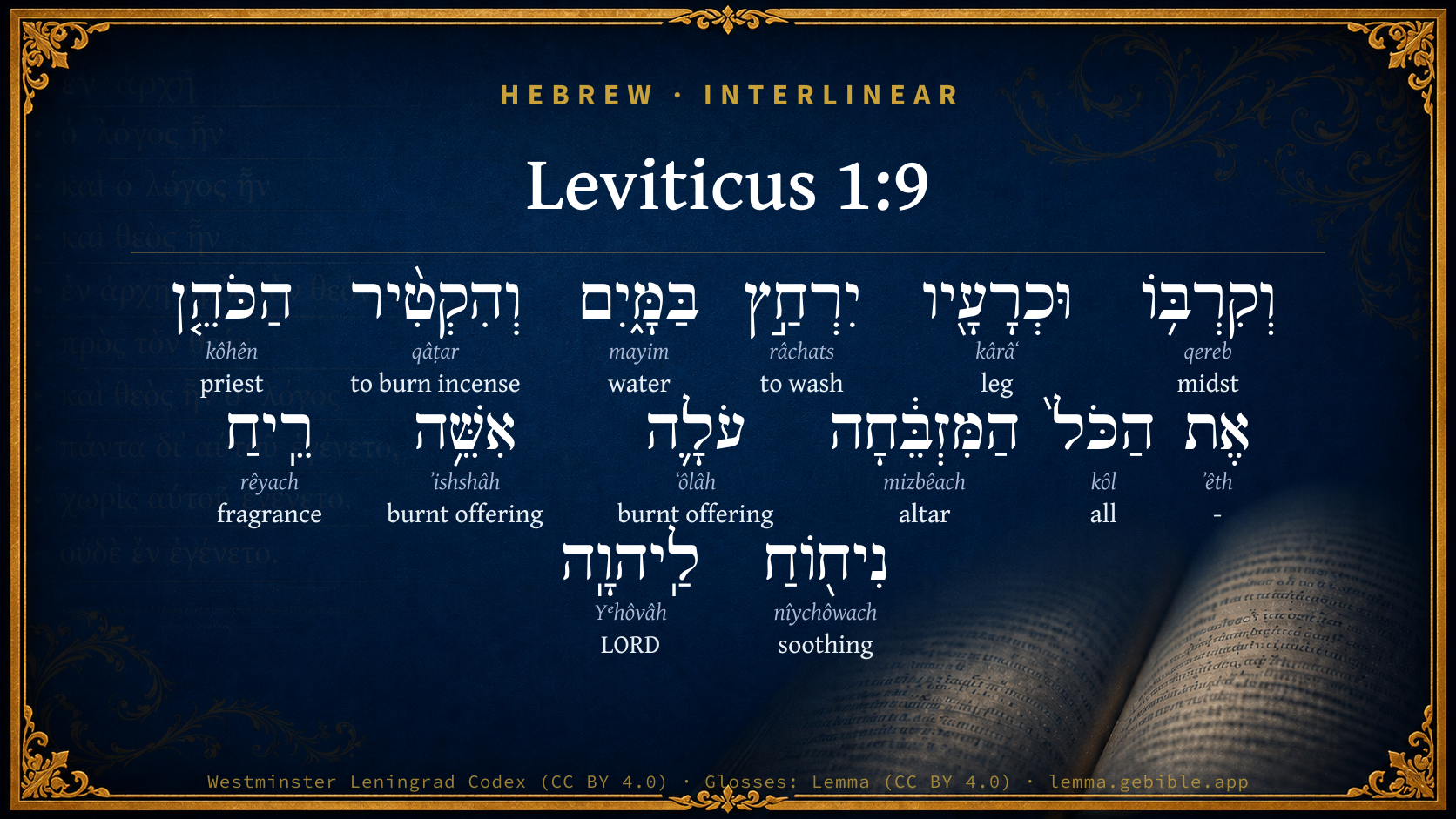
Leviticus 1:9

Hebrew (Westminster Leningrad Codex) Leviticus 1:9 appears in the Hebrew Old Testament. The text above is from the Westminster Leningrad Codex. Each word links to its Strong’s number, a concise gloss, and parsing drawn from the Open Scriptures Hebrew Bible morphology. Click any word for its full Brown-Driver-Briggs (BDB) entry.
Download image
Cite this verse

Leviticus 1:9 (World English Bible). Public Domain. Lemma interlinear Bible study tool, https://lemma.gebible.app/v/leviticus/1/9.

Show BibTeX & RIS
BibTeX
RIS
English Translation
but its innards and its legs he shall wash with water. The priest shall burn the whole on the altar, for a burnt offering, an offering made by fire, of a sweet savor to Yahweh.
World English Bible · Public Domain
Download a study sheet

One document with this verse’s original text, its word-by-word gloss line, the meaning frame, cross-references with their text, attributed commentary, and full source and license credits — printable, and it pastes into notes with its structure intact.

This verse Autodidact and up

Study sheet (.html) Plain text (.txt)

A passage Seminary Student

Up to 50 verses in one chapter. A passage sheet keeps up to 6 commentary sources and 12 cross-references per verse, in the order this page ranks them, and says so on the sheet whenever that leaves anything out. Ask for a single verse and you get the Autodidact verse sheet above.

Everything on this page stays free to read, with no account — the sheet is a download of what is already on screen, not access to it.

Want to remove ads? Support Godless Engineer
Compare translations 3

The same verse in 3 English versions, stacked beneath the original-language interlinear above. Click any original word for its lexicon entry.

Each is an independent rendering of the whole verse — the interlinear is not word-aligned to these translations.

Highlighted words mark where these versions differ — a whole-verse word diff, not a word-by-word alignment.

  • World English Bible Public Domain
    but its innards and its legs he shall wash with water. The priest shall burn the whole on the altar, for a burnt offering, an offering made by fire, of a sweet savor to Yahweh.
  • King James Version Public Domain
    But his inwards and his legs shall he wash in water: and the priest shall burn all on the altar, to be a burnt sacrifice, an offering made by fire, of a sweet savor unto the LORD.
  • unfoldingWord Literal Text CC BY-SA 4.0
    And he shall wash its innards and its legs with water. And the priest shall cause everything to become smoke on the altar, a burnt offering, a gift of a scent of pleasing to Yahweh.

unfoldingWord Literal Text — © unfoldingWord, licensed CC BY-SA 4.0. Word-aligned USFM3 via Door43 (git.door43.org/unfoldingWord/en_ult).

Versions to compare (up to 4)

3 of 4 selected

Show all 18 translations

Every available English version of this verse, each an independent rendering of the whole verse.

  • World English Bible Public Domain
    but its innards and its legs he shall wash with water. The priest shall burn the whole on the altar, for a burnt offering, an offering made by fire, of a sweet savor to Yahweh.
  • Berean Standard Bible Public Domain
    The entrails and legs must be washed with water, and the priest shall burn all of it on the altar as a burnt offering, an offering made by fire, a pleasing aroma to the LORD.
  • Majority Standard Bible Public Domain
    The entrails and legs must be washed with water, and the priest shall burn all of it on the altar as a burnt offering, a food offering, a pleasing aroma to the LORD.
  • King James Version Public Domain
    But his inwards and his legs shall he wash in water: and the priest shall burn all on the altar, to be a burnt sacrifice, an offering made by fire, of a sweet savor unto the LORD.
  • American Standard Version (1901) Public Domain
    but its inwards and its legs shall he wash with water: and the priest shall burn the whole on the altar, for a burnt-offering, an offering made by fire, of a sweet savor unto Jehovah.
  • Revised Version (1885) Public Domain
    but its inwards and its legs shall he wash with water: and the priest shall burn the whole on the altar, for a burnt offering, an offering made by fire, of a sweet savour unto the LORD.
  • Geneva Bible (1599) Public Domain
    But the inwardes thereof and the legges thereof he shall wash in water, and the Priest shall burne all on the altar: for it is a burnt offering, an oblation made by fire, for a sweete sauour vnto the Lord.
  • Douay-Rheims (1899) Public Domain
    The entrails and feet being washed with water: and the priest shall burn them upon the altar for a holocaust, and a sweet savour to the Lord.
  • Young's Literal Translation Public Domain
    and its inwards and its legs he doth wash with water; and the priest hath made perfume with the whole on the altar, a burnt-offering, a fire-offering of sweet fragrance to Jehovah.
  • Literal Standard Version CC BY-SA 4.0
    and he washes its innards and its legs with water; and the priest has made incense with the whole on the altar, a burnt-offering, a fire-offering of refreshing fragrance to YHWH.
  • Unlocked Literal Bible CC BY-SA 4.0
    But its inner parts and its legs he must wash with water. Then the priest will burn everything on the altar as a burnt offering. It will produce a sweet aroma for me; it will be an offering made to me by fire.
  • unfoldingWord Literal Text CC BY-SA 4.0
    And he shall wash its innards and its legs with water. And the priest shall cause everything to become smoke on the altar, a burnt offering, a gift of a scent of pleasing to Yahweh.
  • Darby Bible Public Domain
    but its inwards and its legs shall he wash in water; and the priest shall burn all on the altar, a burnt-offering, an offering by fire to Jehovah of a sweet odour.
  • World Messianic Bible Public Domain
    but he shall wash its innards and its legs with water. The priest shall burn all of it on the altar, for a burnt offering, an offering made by fire, of a pleasant aroma to the LORD.
  • Webster's Bible Public Domain
    But his inwards and his legs shall he wash in water: and the priest shall burn all on the altar, to be a burnt-sacrifice, an offering made by fire, of a sweet savor to the LORD.
  • Free Bible Version CC BY-SA 4.0
    You shall wash the insides and legs with water, and the priest shall burn all of it on the altar as a burnt offering, a food offering, to be accepted by the Lord.
  • Bible in Basic English Public Domain
    But its inside parts and its legs are to be washed with water, and it will all be burned on the altar by the priest for a burned offering, an offering made by fire, for a sweet smell to the Lord.
  • JPS Tanakh (1917) Public Domain
    but its inwards and its legs shall he wash with water; and the priest shall make the whole smoke on the altar, for a burnt-offering, an offering made by fire, of a sweet savour unto the LORD.

Literal Standard Version (2020), Covenant Press — licensed CC BY-SA 4.0. Text via the HelloAO Bible API (eBible.org). Unlocked Literal Bible (unfoldingWord) — licensed CC BY-SA 4.0. Text via the HelloAO Bible API (eBible.org). unfoldingWord Literal Text — © unfoldingWord, licensed CC BY-SA 4.0. Word-aligned USFM3 via Door43 (git.door43.org/unfoldingWord/en_ult). Free Bible Version, Dr. Jonathan Gallagher — licensed CC BY-SA 4.0. Text via the HelloAO Bible API (eBible.org).

Word by word

More ways to search: Search by grammar → Find every occurrence → Compare this word →

Practice this passage: Drill this verse → Learn its vocabulary →

וּכְרָעָ֖יו
kârâʻ
H3767
“and · legs · his”
Conjunction + Noun, Common, Both, Dual, Construct + Suffix, Personal, 3rd Person, Masculine, Singular
Part of Speech
Conjunction + Noun
Type
Common
Gender
Both
Number
Dual
State
Construct
Full BDB Definition

Origin: from H3766

TWOT: 1044a

leg
  1. וְקִרְבּ֥וֹ qereb H7130 “and · midst · his” Conjunction + Noun, Common, Masculine, Singular, Construct + Suffix, Personal, 3rd Person, Masculine, Singular
  2. יִרְחַ֣ץ râchats H7364 “to wash” Verb, Qal, Imperfect, 3rd Person, Masculine, Singular
  3. בַּמָּ֑יִם mayim H4325 “in/at the · water(s)” Preposition, Determined + Noun, Common, Masculine, Plural, Absolute
  4. וְהִקְטִ֨יר qâṭar H6999 “and · to burn incense” Conjunction + Verb, Hiphil, Sequential Perfect, 3rd Person, Masculine, Singular
  5. הַכֹּהֵ֤ן kôhên H3548 “the · priest” Particle, Definite Article + Noun, Common, Masculine, Singular, Absolute
  6. אֶת ʼêth H853 “-” Particle, Direct Object
  7. הַכֹּל֙ kôl H3605 “the · all” Particle, Definite Article + Noun, Common, Masculine, Singular, Absolute
  8. הַמִּזְבֵּ֔חָה mizbêach H4196 “the · altar · toward” Particle, Definite Article + Noun, Common, Masculine, Singular, Absolute + Suffix, Demonstrative
  9. עֹלָ֛ה ʻôlâh H5930 “burnt offering” Noun, Common, Feminine, Singular, Absolute
  10. אִשֵּׁ֥ה ʼishshâh H801 “burnt offering of” Noun, Common, Masculine, Singular, Construct
  11. רֵֽיחַ rêyach H7381 “fragrance of” Noun, Common, Masculine, Singular, Construct
  12. נִיח֖וֹחַ nîychôwach H5207 “soothing” Noun, Common, Masculine, Singular, Absolute
  13. לַֽיהוָֽה Yᵉhôvâh H3068 “to/for · LORD” Preposition + Noun, Proper

About this verse

These counts appear in no published source. They are computed here, from the morphology-tagged text and Lemma’s own curated glosses. What Lemma adds →

14
words
14
distinct lemmas
Pentateuch
section

Notable vocabulary

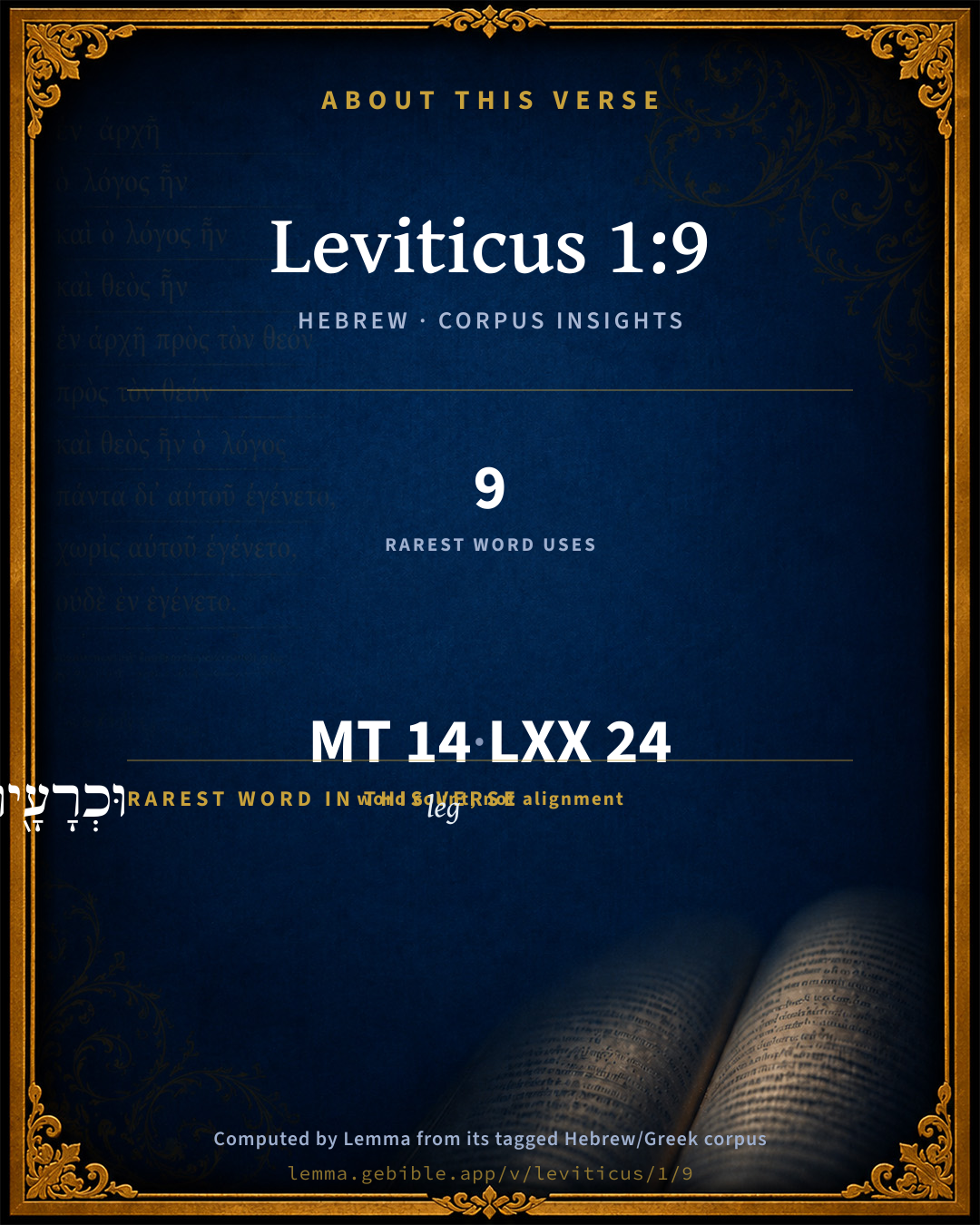
The rarest word here is וּכְרָעָ֖יו leg H3767 — appearing just 9 times in the whole Hebrew Bible.

Shared distinctive vocabulary

וּכְרָעָ֖יו leg H3767 occurs in 9 verses of the Hebrew Bible. Also found in:

Grammatical profile

  • 2 verbs
  • 11 nouns
  • 1 particle

Verb forms

  • יִרְחַ֣ץ Qal · Imperfect
  • וְהִקְטִ֨יר Hiphil · Sequential Perfect

Hebrew & Septuagint length

In English translation the verse runs 35 words from the Hebrew and 35 from the Septuagint (LXX English) — the same length.

A rough comparison of the two English renderings, which tokenize alike — not a word-level alignment.

Word counts can differ between the Hebrew and the Greek without any difference in meaning — e.g. the Hebrew direct-object marker אֵת has no separate Greek word, and Greek often adds the article ὁ.

In the original languages it is 14 Hebrew tokens and 24 Greek tokens — but the two are counted differently (Hebrew bundles its prefixes and suffixes into one token; the Greek is in lemma form), so that isn’t a like-for-like length.

Cross-references

19

Topical passages linked to Leviticus 1:9 in the Treasury of Scripture Knowledge — connected by theme and wording, ordered by reader-vote popularity; previews shown in the World English Bible.

  • Genesis 8:21 Yahweh smelled the sweet savor. Yahweh said in his heart, "I will not again curse the ground any more for man's sake, because the imagination of man's heart is evil from his youth; neither will I ever again strike everything living, as I have done.
  • Leviticus 1:13 but the innards and the legs he shall wash with water. The priest shall offer the whole, and burn it on the altar. It is a burnt offering, an offering made by fire, of a sweet savor to Yahweh.
  • Ephesians 5:2 Walk in love, even as Christ also loved you, and gave himself up for us, an offering and a sacrifice to God for a sweet-smelling fragrance.
  • Exodus 29:18 You shall burn the whole ram on the altar: it is a burnt offering to Yahweh; it is a sweet savor, an offering made by fire to Yahweh.
  • Leviticus 3:11 The priest shall burn it on the altar: it is the food of the offering made by fire to Yahweh.
  • Ezekiel 20:41 As a sweet savor will I accept you, when I bring you out from the peoples, and gather you out of the countries in which you have been scattered; and I will be sanctified in you in the sight of the nations.
  • 2 Corinthians 2:15 For we are a sweet aroma of Christ to God, in those who are saved, and in those who perish;
  • Exodus 29:25 You shall take them from their hands, and burn them on the altar on the burnt offering, for a sweet savor before Yahweh: it is an offering made by fire to Yahweh.
  • Leviticus 1:17 He shall tear it by its wings, but shall not divide it apart. The priest shall burn it on the altar, on the wood that is on the fire. It is a burnt offering, an offering made by fire, of a sweet savor to Yahweh.
  • Leviticus 8:21 He washed the innards and the legs with water; and Moses burned the whole ram on the altar. It was a burnt offering for a sweet savor. It was an offering made by fire to Yahweh; as Yahweh commanded Moses.
  • Leviticus 9:14 He washed the innards and the legs, and burned them on the burnt offering on the altar.
  • Numbers 15:8–10 When you prepare a bull for a burnt offering, or for a sacrifice, to accomplish a vow, or for peace-offerings to Yahweh;
  • Psalms 51:6 Behold, you desire truth in the inward parts. You teach me wisdom in the inmost place.
  • Psalms 66:15 I will offer to you burnt offerings of fat animals, With the offering of rams, I will offer bulls with goats. Selah.
  • Jeremiah 4:14 Jerusalem, wash your heart from wickedness, that you may be saved. How long shall your evil thoughts lodge within you?
  • Ezekiel 20:28 For when I had brought them into the land, which I swore to give to them, then they saw every high hill, and every thick tree, and they offered there their sacrifices, and there they presented the provocation of their offering; there also they made their sweet savor, and they poured out there their drink-offerings.
  • Matthew 23:25–28 "Woe to you, scribes and Pharisees, hypocrites! For you clean the outside of the cup and of the platter, but within they are full of extortion and unrighteousness.
  • Philippians 4:18 But I have all things, and abound. I am filled, having received from Epaphroditus the things that came from you, a sweet-smelling fragrance, an acceptable and well-pleasing sacrifice to God.
  • Zechariah 13:7 "Awake, sword, against my shepherd, And against the man who is close to me," says Yahweh of Hosts. Strike the shepherd, and the sheep will be scattered; And I will turn my hand against the little ones.

Cross-references courtesy of OpenBible.info (CC BY 4.0).

Hebrew and Greek witnesses Masoretic Hebrew ↔ Greek Septuagint

The same verse in the two great witnesses to the Old Testament, shown verse-for-verse.

These are two independent witnesses, not word-aligned to each other, and the Septuagint is shown in lemma (dictionary) form.

Hebrew Leviticus 1:9 Masoretic · Westminster Leningrad Codex

וְקִרְבּ֥וֹ וּכְרָעָ֖יו יִרְחַ֣ץ בַּמָּ֑יִם וְהִקְטִ֨יר הַכֹּהֵ֤ן אֶת הַכֹּל֙ הַמִּזְבֵּ֔חָה עֹלָ֛ה אִשֵּׁ֥ה רֵֽיחַ נִיח֖וֹחַ לַֽיהוָֽה

but its innards and its legs he shall wash with water. The priest shall burn the whole on the altar, for a burnt offering, an offering made by fire, of a sweet savor to Yahweh.

World English Bible · Public Domain

Greek LXX Leviticus 1:9 Septuagint · lemma form

ὁ δέ ἐγκοίλιος καί ὁ πούς πλύνω ὕδωρ καί ἐπιτίθημι ὁ ἱερεύς ὁ πᾶς ἐπί ὁ θυσιαστήριον κάρπωμα εἰμί θυσία ὀσμή εὐωδία ὁ κύριος

And the entrails and the feet they shall wash in water, and the priests shall put all on the altar: it is a burnt offering, a sacrifice, a smell of sweet savor to the Lord.

LXX2012 (modern English Septuagint) · Public Domain

On this verse, Adam Clarke's Commentary discusses the Septuagint’s reading. Read the note in Commentary ↓

Hebrew: Westminster Leningrad Codex (CC BY 4.0). Greek: Septuagint (public domain); English from LXX2012 (modern English Septuagint) (Public Domain). How the Septuagint differs from the Hebrew →

Targum (Aramaic paraphrase)

2

The Targum is the ancient Jewish Aramaic paraphrase of the Hebrew Scriptures — an interpretive translation, not the Hebrew text itself. Onkelos (literal) and Pseudo-Jonathan (expansive) render the Torah, and Jonathan the Prophets. Coverage is partial: where no permissively-licensed English translation exists for a verse, only the Aramaic is shown. This is verse-level text, not a word-by-word alignment to the Hebrew. Some Onkelos verses here show an unreviewed machine translation (clearly flagged), not a published edition.

  1. Targum Onkelos Torah (Genesis–Deuteronomy)
    וְגַוֵיהּ וּכְרָעוֹהִי יְחַלֵל בְּמַיָא וְיַסֵק כַּהֲנָא יָת כּוֹלָא לְמַדְבְּחָא עֲלָתָא קוּרְבַּן דְמִתְקַבֵּל בְּרַעֲוָא קֳדָם יְיָ

    Unreviewed machine translation (Claude Sonnet 5) — not public domain confidence: high

    And its innards and its legs he shall rinse with water, and the priest shall offer up the whole of it on the altar, a burnt offering, an offering that is accepted with favor before the Lord.

    Generated by an AI translate-then-audit pipeline and checked against an independent public-domain English translation of the underlying Hebrew for drift only. Not a published edition; pending human review.

    Aramaic base: public-domain Targum Onkelos (via Sefaria). The English above is the unreviewed machine translation, not public domain.

  2. Targum Pseudo-Jonathan Torah (Genesis–Deuteronomy)
    וּכְרִיסָא וְרִיגְלוֹי יְחַלֵיל בְּמַיָא וְיִסַק כַּהֲנָא יַת כּוֹלָא לְמַדְבְּחָא עֲלָתָא הוּא קָרְבַּן דְמִתְקַבֵּיל בְּרַעֲוָא קֳדָם יְיָ

    And he shall wash the inwards and his legs with water; and the priest shall offer the whole upon the altar of burnt offering an oblation to be accepted with grace before the Lord.

    Targum Pseudo-Jonathan — Aramaic: “Targum Jonathan on Genesis” (public domain); “Targum Jonathan on Exodus” (public domain); “Targum Jonathan on Leviticus” (public domain); “Targum Jonathan on Numbers” (public domain); “Targum Jonathan on Deuteronomy” (public domain). English: “The Targum of Jonathan ben Uzziel, trans. J. W. Etheridge, London, 1862” (public domain). Text via Sefaria.

Commentary

Notes on Leviticus 1:9 from classic Christian and Jewish commentators (each source and its license shown beneath its notes). The classic Christian expositions comment on the surrounding passage and are grouped to its opening verse, so a note may address several verses; the Jewish commentaries on the Tanakh (Rashi and others) are per-verse, so they appear only where the commentator wrote on this verse.

Lemma curates 59 commentaries, every one of them public domain or Creative Commons licensed, each selected and text-cleaned for this edition rather than reprinted as found. About our sources →

Trapp's Complete Commentary

John Trapp

Lev 1:9 But his inwards and his legs shall he wash in water: and the priest shall burn all on the altar, [to be] a burnt sacrifice, an offering made by fire, of a sweet savour unto the LORD.

Ver. 9. Shall he wash.] Shadowing Christ’s perfect purity {Heb 7:26} and our entire sanctification. {Eze 26:19 Heb 10:22}

Of a sweet savour unto the Lord.] The burning and broiling of the beasts could yield no sweet savour; but thereto was added wine, oil, and incense, by God’s appointment, and then there was a savour of rest in it. Our prayers, as from us, would never please; but as indited by the Spirit, and presented by Christ, they are highly accepted in heaven.

John Trapp, A Commentary or Exposition upon All the Books of the Old and New Testament (1647–1656) — public domain. Text from a community e-Sword module.

Tyndale Open Study Notes

Tyndale Open Resources

1:9 The offering was washed with water to remove dirt or debris that might contaminate the offering. Washing was also part of purification from ritual uncleanness, a prerequisite for Tabernacle service (6:27; 11:28). • special gift: The Hebrew term (’isheh) has traditionally been rendered “offering made by fire.” Although the offering was to be burned (1:13, 17), recent scholarship suggests that the word had the more generic meaning of “gift.” • pleasing aroma to the Lord (literally a restful odor; also in 1:13, 17): Pagan people of the ancient Near East believed that their gods smelled the offerings because they needed to eat them to sustain their lives. Although God’s response is sometimes represented in language that reflects the cultural setting (e.g., 21:6; Num 28:2), the Bible is clear that God did not need offerings as food (Ps 50:9-13). Instead, they pleased him as sincere offerings for the purpose of atonement.

Tyndale Open Study Notes — © Tyndale Open Resources, licensed CC BY-SA 4.0. Text via the HelloAO Bible API.

Geneva Bible (1599)

Geneva Bible translators

Or a savor of rest, which pacifieth the anger of the Lord.

Geneva Bible (1599) marginal notes — public domain. Text via Bolls.life.

Jamieson, Fausset & Brown

Robert Jamieson, A. R. Fausset & David Brown

but his inwards and his legs shall he wash in water, &c.--This part of the ceremony was symbolical of the inward purity, and the holy walk, that became acceptable worshippers.

a sweet savour unto the Lord--is an expression of the offerer's piety, but especially as a sacrificial type of Christ.

Jamieson, Fausset & Brown — Commentary Critical and Explanatory on the Whole Bible (1871) — public domain (CC PDM 1.0). Text via the HelloAO Bible API.

Adam Clarke's Commentary

Verse 9. An offering - of a sweet savour] אשה ריח ניחוח ishsheh reiach nichoach, a fire-offering, an odour of rest, or, as the Septuagint express it, θυσια οσμη ευωδιας, "a sacrifice for a sweet-smelling savour;" which place St. Paul had evidently in view when he wrote Eph 5:2: "Christ hath loved us, and hath given himself for us an offering, και θυσιαν - εις οσμην ευωδιας, and a sacrifice, for a sweet-smelling savour," where he uses the same terms as the Septuagint. Hence we find that the holocaust, or burnt-offering, typified the sacrifice and death of Christ for the sins of the world.

Adam Clarke's Commentary on the Bible (1810–1826) — public domain. Text from a community e-Sword/MySword module.

Ellicott's Commentary for English Readers

(9) But his inwards.—Before, however, the cut-up victim was thus arranged to be burnt, the stomach, the bowels, and the feet had to be thoroughly cleansed. In the time of the second Temple, the washing had to be repeated three times before the ablution was deemed complete.

And the priest shall burn.—The word here used is not the one generally used to denote consuming by fire, but it originally signifies to make a fume or vapour by incense. It is used in connection with all sacrifices (Lev_2:2; Lev_2:9; Lev_3:5; Lev_3:11; Lev_4:10; Lev_4:19; Lev_6:8; Lev_7:5, &c.) and the idea intended to be conveyed thereby is, that man upon earth fitly brought his gift to God in heaven, by causing the odour emitted from the burning sacrifice to ascend in a sweet-smelling savour to heaven.

A Bible Commentary for English Readers, edited by Charles John Ellicott (1878–1897) — public domain. Text from a community e-Sword module.

The Cambridge Bible for Schools and Colleges

gen. ed. J. J. S. Perowne

9. a sweet savour] a soothing odour (McNeile on Exo_29:18). The word ‘savour’ in old English is applied to the smell as well as the taste of a thing. See HDB. Art. Savour and Driver’s note (C.B.) on Exo_29:18.

The Cambridge Bible for Schools and Colleges (gen. ed. J. J. S. Perowne; Cambridge University Press, 1878–1918) — public domain. Text from a community e-Sword module.

John Gill's Exposition

But the inwards and his legs shall he wash in water,.... This was first done in a room in the court of the temple, called , "the room of the washers", or the washing room, where they washed the inwards of the holy things (a); and after that they washed them upon the marble tables between the pillars, where they washed them three times at least (b); and whereas this is said to be done "in water"; Maimonides (c) observes,"not in wine, nor in a mixture of wine and water, nor in other liquids:''the washing of the inwards and legs denoted the internal purity of Christ's heart, and the external holiness of his life and conversation, and the saints' purification by him both in heart and life: with Philo the Jew (d) these things had a mystical meaning; by the washing of the inwards was signified that lusts were to be washed away, and such spots removed as were contracted by surfeiting and drunkenness, very harmful to the lives of men; and by the washing of the feet was signified that we should no more walk upon the earth, but mount up to the air, and pass through that, even to heaven:

and the priest shall burn all on the altar; all the other pieces, as well as the inwards and legs, excepting the skin, which denoted the painful sufferings of Christ, and the extent of them to all parts of his body; and indeed his soul felt the fire of divine wrath, and became an offering for sin:

to be a burnt sacrifice, an offering made by fire; that is, all the parts of the bullock were burnt on the altar, that it might appear to be a whole burnt offering consumed by fire:

of a sweet savour unto the Lord: he accepting of it, and smelling a sweet savour of rest in it, as an atonement for sin, typical of the sacrifice of Christ, which is to God for a sweet smelling savour, Eph 5:2 the Jewish doctors (e) gather from hence, that whether a man offers much or little, it matters not, if his heart is but directed to God; which Maimonides explains thus (f), he that studies in the law, it is all one as if he offered a burnt offering, or a meat offering, or a sin offering, concerning which this phrase is used.

(a) Misn. Middot, c. 5. sect. 2. Maimon Beth Habechirah, c. 5. sect. 17. (b) Ib. c. 3. sect. 5. & Tamid, c. 4. sect. 2. Piske, Tosaphot Middot, Art. 23. (c) Hilchot Hakorbanot, c. 6. sect. 6. Vid. T. Bab. Zebachim, fol. 22. 1. (d) De Victimis, p. 839. (e) Misn. Menachot, c. 13. sect. 11. T. Bab. Shebuot, fol. 15. 1. (f) In Misn. ib.

John Gill's Exposition of the Whole Bible (1746–1763) — public domain (CC PDM 1.0). Text via the HelloAO Bible API.

Albert Barnes' Notes on the Bible

The parts which were washed were the stomach, and bowels, and feet, divided from the carcass at the knee-joint.

The priest shall burn - The verb here translated burn, is applied exclusively to the burning of the incense, to the lights of the tabernacle, and to the offerings on the altar. The primary meaning of its root seems to be to exhale odor. (See the margin of Lev 24:2; Exo 30:8). The word for burning in a common way is quite different, and is applied to the burning of those parts of victims which were burned without the camp (Lev 4:12, Lev 4:21; Num 19:5, etc.). The importance of the distinction is great in its bearing on the meaning of the burnt-offering. The substance of the victim was regarded not as something to be consumed, but as an offering of a sweet-smelling savor sent up in the flame to Yahweh.

Albert Barnes' Notes on the Bible (1834–1885) — public domain. Text from a community e-Sword/MySword module.

Haydock's Catholic Bible Commentary

Sweet. Not that the Deity can take delight in sweet odours; but he is pleased with the devotion of men. For their advancement in piety, he required these sacrifices; 1. to keep the people from idolatry; 2. to teach them to consecrate their body and effects to him, as well as their souls, to serve justice unto sanctification; (Romans vi. 19; John iv. 24) as without the help of exterior observances, the mind will hardly rise to the contemplation of truth; 3. to prefigure the greater mysteries of the Christian religion, of which the law was only a shadow, incapable of conferring justifying grace. (John i. 17; Galatians iii. 11.) (Worthington) --- The law was our pedagogue, in Christ, that we might be justified by faith, ver. 24.

George Leo Haydock (1774–1849), Haydock's Catholic Family Bible and Commentary, 1859 edition — public domain. Excludes Psalms (Douay-Rheims chapter numbering differs from Protestant) and Deuterocanonical books (Catholic canon only).

Matthew Poole's English Annotations

His inwards and his legs shall he wash, to signify the universal and perfect purity both of the inwards, or the heart, and of the legs, or ways, or actions, which was in Christ, and which should be in all Christians.

The priest shall burn all; not only the parts now mentioned, but all the rest, the trunk of the body, and the shoulders, as is apparent from the practice or execution of these precepts.

Of a sweet savour; not in itself, for so it rather caused a stink, but as it represented Christ’s offering up himself to God as a sweet-smelling savour, Eph 5:2; and to admonish us of the excellent virtue of Divine institution, without which God values no worship, though never so glorious, and by which even the meanest things, are precious and acceptable to God.

Matthew Poole's English Annotations on the Holy Bible (1683–1685) — public domain. Text from a community e-Sword/MySword module.

Whedon's Commentary on the Bible

Daniel D. Whedon

9. His inwards — The intestines, because they contained impurities, could not be burned until they had first been cleansed. According to Maimonides the ablution was three times repeated. Thus there is strikingly set forth that inward holiness required by God of all his people, and the provision made for its attainment in the washing of regeneration and the renewing of the Holy Ghost. “I will put my law in their inwards, and write it in their hearts.” Jer_31:33. “Having our hearts sprinkled from an evil conscience.” Heb_10:22.

And his legs — The lower parts, below the knees, having contracted defilements in walking, were unfit to lay upon the altar until cleansed. “Lord, not my feet only.” — Peter.

All on the altar — Of most of the other offerings a portion might be given to the Lord in the persons of his priests, and a part might be given back to the offerer to share with his friends, (Lev_7:15;) but the burnt offering must all lie upon the altar till the fire has changed it into an odour of sweet smell, and wafted it, on the curling smoke, to heaven. The spiritual import of this self-dedicatory sacrifice is obvious. If we would obtain a thorough and pervasive holiness through all our collective powers and parts, we must, without mental reservation, surrender ourselves entirely unto the God of peace till, through the Holy Ghost, he sanctifies us wholly. Rom_12:1; 1Th_5:23.

An offering made by fire — The term ishsheh is generic of every kind of sacrifice by fire, and once even where no fire is used except for baking. Lev_24:7; Lev_24:9.

A sweet savour unto the Lord — The anthropomorphism so clearly implied here is scarcely to be avoided. It is impossible for us to form a conception of pure spirit. Hence our ideas naturally clothe themselves in material forms, and we think of Jehovah as a man whose nostrils are regaled with the delicious odours diffused through the air. Stripped of its impressive imagery, and expressed in the cold phrase of modern philosophy, the Orientalism becomes this: God receives with delight every true act of worship.

Daniel D. Whedon (gen. ed.), Commentary on the Old and New Testaments (1874–1909) — public domain. Text from a community e-Sword module.

The Pulpit Commentary

The priest shall burn all on the altar, etc. The fourth and last part of the sacrifice. The word employed is not the common term used for destroying by fire, but means "make to ascend." The life of the animal has already been offered in the blood; now the whole of its substance is "made to ascend" to the Lord. Modern science, by showing that the effect of fire upon the substance of a body is to resolve it into gases which rise from it, contributes a new illustration to the verse. The vapour that ascends is not something different from that which is burnt, but the very thing itself, its essence; which, having ascended, is of a sweet savour unto the Lord, that is, acceptable and well-pleasing to him. The burnt offering, the meat offering, and the peace offering, are sacrifices of sweet savour; (in Lev_2:2 Lev_3:5) the expression is not used with regard to the sin offering and trespass offering. St. Paul applies it to the sacrifice of Christ, Eph_5:2, "As Christ also loved us, and gave himself for us an offering and a sacrifice to God for a sweet-smelling savour;" thus indicating, in an incidental manner, the connection between the Jewish sacrifices and the sacrifice of Christ, as type and antitype.

Our reasonable service.

The burnt offering appears to have been the most general of the sacrifices presented to Jehovah, and to have had the widest significance. Its spiritual counterpart is furnished in Rom_12:1. Meditation upon the prophetic symbol will abed light upon the "living sacrifice" of the gospel dispensation.

I THE NATURE OF THE CHRISTIAN OFFERING AS THUS SYMBOLIZED.

1. It is a surrender to God of something that belongs to us. Property inherited and acquired is the material of the sacrifice. Not only what has come to us by natural endowment, but that which is the result of toil the cattle that were given to us, and the produce we have reared. God demands our hearts, our minds, our talents; and he looks for the devotion to him of any increment that effort may secure. Just as Barnabas sold his land and laid the price at the apostles" feet, and the Apostle Paul commanded that each Corinthian should "lay by him in store as God hath prospered him.

2. It is a voluntary surrender. The man "shall put his band upon the head of the burnt offering," to evince his willingness to part with the animal. All "the cattle on a thousand bills" are really owned by Jehovah, yet does he treat man as proprietor, and does not take by violence the necessary sacrifices for his glory, but leaves it to man freely to recognize his God, and to pay his just dues. "Voluntary" in no wise excludes the force of motives, since every decision has motives, as an antecedent if not as an efficient cause. Freedom implies absence, not of inducements, but of constraint. Man has the power to withhold from the service of God his faculties and possessions. He is ever appealed to in Scripture as a reasonable individual, capable of deciding to what purposes his abilities shall be devoted. "Yield yourselves unto God.

3. The surrender must be complete. It was not possible to offer part of a goat or lamb, the victim must be given in its entirety. The blood is sprinkled round about, and "all" the parts are burnt upon the altar. The disciple must follow the Lord fully. No putting of the hand to the plough and looking hack. No keeping back part of the price. The believer is bought by Christ, body and soul. The reason why many seem to have offered themselves to God in vain, is because they have done it in a halfhearted way, they have not "sought him with their whole desire.

II THE MANNER IN WHICH THE OFFERING IS DEVOTED TO GOD.

1. By the death of the victim. Death is the total renunciation of present enjoyment the extremest proof of an intention to set one"s self apart for a certain object. If it does not suffice to prove sincerity and entire consecration, then proof is impossible. "All that a man hath will he give for his life." Like the apostle, it behoves Christians to "die daily." At baptism there was the emblem of death to the world. "Old things have passed away." Our death to sin, however, resembles the crucifixion of our Lord, a lingering painful death. We mortify the deeds of the body, crucify the flesh, deny ourselves. "If any man will lose his life he shall save it.

2. By cleansing water and purifying fire. "Sanctify them through thy truth: thy word is truth." "Having these promises, let us cleanse ourselves from all filthiness of the flesh and spirit." "Every one shall be salted with fire." "The trial of your faith which is much more precious than of gold that perisheth, though it be tried with fire." All that is earthly is consumed. The smoke, rising from the material sacrifice, reminds us of the pure metal that is free from dross, and remains to "praise, honour, and glory." Learn to welcome the tribulations of your lot as being the discipline that makes the surrender of yourselves complete. Martyrs have experienced actual flames, the fire may assume another shape to you. Perhaps temptations assail you, and difficulties wear away your strength. Glorify God in the fires. Fire is an emblem of the Holy Spirit, and as Christ offered himself through the Eternal Spirit, so does his Spirit abide with his people, to hallow them, to put away sin, to make them pleasing unto God.

3. By means of the ordained mediator. The priest must take the slain animal to perform the necessary rites. Otherwise, however free from fault, the offering will bring loss, not gain, to the offerer. If all believers are now "a holy priesthood, to offer up spiritual sacrifices," they are only "acceptable to God by Jesus Christ." Our Saviour must be our "Daysman," to come between us and God, and present us to his Father. His life, death, and intercession must be the inspiration of our lives, the spring of our hopes, the constraining influence that shall make us dedicate all we have and are to God. "No man cometh unto the Father but by me." We determine to know nothing save Christ and him crucified. "In Christ Jesus" we "are made nigh.

III THE EFFECT OF THE OFFERING.

1. It pleases God. Anthropomorphic expressions are employed, not to degrade the Almighty, but to clarify our conceptions, and to make the truth plain to the dullest eyed. "It is a sweet savour unto the Lord." The smell is repulsive, and cannot be supposed to be grateful in itself to him who is a Spirit. But it is the disposition to honour and please God that he delights to observe in his children. A parent may admire the rudest sketch if his little one brings it as a token of love, and may esteem the commonest fare a banquet, and ill-dressed food a feast, if regard and affection have contributed to its preparation. The agony and wounds of the Redeemer were not watched by the Father with unmingled delight. As we shudder at the spectacle of the Holy One made a curse for us, and yet rejoice in the all-sufficiency of his burden-bearing; so the Father felt the keenest pangs that rent the breast of his beloved Son, and only joyed in the sublime manifestation of filial devotion, content to endure torture and insult that the blot on his Father"s world through the presence of sin might be erased even at such infinite cost. Wherein we are partakers if the sufferings of Christ our Sacrifice is fragrant to the Father. The apostles, in preaching the gospel, became "unto God a sweet savour of Christ." If we walk in love, we cause the incense of love to ascend with sweet odour to heaven. (Eph_5:2) Jesus ministered to the wants of many, and the Philippians, in supplying the necessities of Paul, Christ"s servant, were an "odour of a sweet smell, a sacrifice well-pleasing unto God.

2. It procures for the offerer satisfaction of conscience and the favour of God. The sacrifice is accepted, communion is re-established, sin is covered. There is an inward contentment in all religious acts that is of itself evidence of the reality of religion, and its adaptation to our circumstances. Never did any man abstain from selfish, sinful gratification, or pursue the rugged path of holiness and virtue, without being solaced by the consciousness of having done what was right, what was in harmony with the noblest dictates of his nature. The self-denying, God-serving life is the happiest and most blessed life. Then do we walk in the light of God"s countenance, and drink of the river of his pleasures. S.R.A.

The Pulpit Commentary (1880–1919), ed. H.D.M. Spence-Jones & Joseph S. Exell — public domain. Text from a community e-Sword module.

Scofield Reference Notes

C. I. Scofield

sweet savour

The sweet savour offerings are so called because they typify Christ in His own perfections, and in His affectionate devotion to the Father’s will. The non-sweet savour offerings typify Christ as bearing the whole demerit of the sinner. Both are substantial. In our place Christ, in the burnt-offering, makes good our lack of devotedness, and, in the sin- and trespass-offerings, suffers because of our disobediences.

The Scofield Reference Bible (1917 edition), notes by C. I. Scofield — public domain. Text from a community e-Sword module.

Rashi

Rabbi Shlomo Yitzchaki (Rashi)

עלה [AND THE PRIEST SHALL CAUSE ALL TO ASCEND IN FUMES ON THE ALTAR, TO BE] A BURNT OFFERING — i. e. only with the intention that it should be an עולה shall he burn it (and not that it should be an offering of another class. The words are to be translated: he shall burn it as an עולה) (Sifra, Vayikra Dibbura d'Nedavah, Chapter 6 10).

אשה AS A FIRE OFFERING — When he slaughters it he shall slaughter it with the intention of making a fire of it (i. e. having in mind the fact that it is to become a prey to the flames, not that it will become charred flesh) (Sifra, Vayikra Dibbura d'Nedavah, Chapter 6 10). The word אשה wherever it occurs, is connected with אש, feuchère in O. F.

ניחוח (of the root נוח, “to repose”, “to draw satisfaction from …”) — an odour of ניחוח: one that causes satisfaction to Me by the knowledge that I gave commands and that My will was executed (Sifra, Vayikra Dibbura d'Nedavah, Chapter 6 10; Zevachim 46b).

Rashi on the Tanakh — English translations: “The Judaica Press complete Tanach with Rashi, translated by A. J. Rosenberg” (CC BY 4.0); “Pentateuch with Rashi's commentary by M. Rosenbaum and A.M. Silbermann, 1929-1934” (public domain); “The Metsudah Tanach series, Lakewood, N.J” (CC BY 4.0); and “The Book of Joshua, Metsudah Publications, 1997” (CC BY 4.0). Text via Sefaria.

Ramban (Nachmanides)

Rabbi Moshe ben Nachman (Ramban / Nachmanides)

A BURNT-OFFERING. “[He shall burn it] with the intention that it should be a burnt-offering [and not an offering of another category]. ‘ISHEIH’ (A FIRE-OFFERING). When he slaughters it he should slaughter it with the intention of [burning it by] fire, [as will be explained further on]. Wherever the word isheih occurs, it is an expression of fire. PLEASING — it is pleasing to Me that I have commanded and My will was done.” This is the language of Rashi.Now the Rabbi did not explain what is meant by “the intention of [burning it by] fire.” In the Gemara the Rabbis have said: “this is to exclude kabobo, which may not be done.” Now the commentators. explained this to mean that he should slaughter it with the intention of placing it on flames burning the pile of wood upon the altar, and not of placing it upon dying coals which are in the process of being extinguished. To me it appears that the intention he needs to have is that the fire should burn it completely, and not that it should just be roasted there a little, the word kabobo being similar to the expression of the Rabbis in the chapter entitled “A stubborn and rebellious son: ” “k’basar kiba (like partly-roasted meat) which thieves eat.” In Tractate Erubin we also find: “v’nichbeiv (let him roast it) and eat it.” Now some books have a reading in Tractate Zebachim: “this is to exclude gabobo (straw), which may not be done.” Accordingly the meaning thereof is that he should have the intention to put it on a fire of wood, as it is written, on the wood that is on the fire, and he should not intend to put it upon a fire made of stubble and straw, similar to that which we have been taught [in a Mishnah]: “If a double-stove had been heated with stubble and gabobo.”Now this verse mentions a reason for the offerings, namely, that they are a fire-offering, of a pleasing odor unto the Eternal. The Rabbi [Moshe ben Maimon] wrote in the Moreh Nebuchim that the reason for the offerings is because the Egyptians and the Chaldeans in whose lands the children of Israel were strangers and sojourners, used always to worship the herd and the flock, the Egyptians worshipping the sheep and the Chaldeans worshipping the demons whom they imagined as assuming the form of goats. To this day men of India never slaughter the herd. It was for this reason that He commanded [Israel] to slaughter these three species [of cattle: the herd, the flock, and the goats], to the Revered Name, so that it be known that the very act which the idol-worshippers considered to be the utmost sin [i.e., slaughtering the above species], that same act should be done as an offering before the Creator, and through it Israel’s sins would be forgiven. For such is the way to cure people of false beliefs, which are the diseasees of the human soul, for all diseases and sicknesses are healed by medicines which are antithetical to them. These are the words [the Rabbi Moshe ben Maimon], and he expounded them at great length.But these words are mere expressions, healing casually a severe wound and a great difficulty, and making the table of the Eternal polluted, [as if the offerings were intended only] to remove false beliefs from the hearts of the wicked and fools of the world, when Scripture says that they are the food of the offering made by fire, for a pleasing odor. Moreover, [if the offerings were meant to eliminate] the foolish [ideas] of the Egyptians, their disease would not thereby be cured. On the contrary, it would increase the cause of sorrow, for since the intention of the above-mentioned wicked ones was to worship the constellations of the sheep and the ox, which according to their opinion possess certain powers [over human affairs], and which is why they abstain from eating them in deference to their power and strength, then if these species are slaughtered to the Revered Name, it is a mark of respect and honor to [these constellations]. These worshippers themselves were in the habit of so doing, as He has said, And they shall no more sacrifice their sacrifices unto the satyrs, 17:7. and those who made the [golden] calf sacrificed to it. Now the Rabbi [Moshe ben Maimon] mentions that the idol-worshippers used to sacrifice to the moon on the days of new-moon, and to the sun when it rose in a particular constellation known to them from their books. The disease of idolatry would surely have been far better cured if we were to eat [these animal-deities] to our full, which would be considered by them forbidden and repugnant, and something they would never do!Furthermore, when Noah came out of the ark with his three sons, there were as yet no Chaldeans or Egyptians in the world, yet he brought an offering, which was pleasing to G-d, as concerning it Scripture says, And the Eternal smelled the pleasing odor, and on account of it He said in His heart, ‘I will not again curse the ground any more for man’s sake.’ Abel likewise brought of the first-born of his flock and of the fat thereof. And the Eternal had regard unto Abel and to his offering., 4:4. Yet there was as yet not the slightest trace at all of idol-worship in the world! Balaam said, ‘I have prepared the seven altars, and I have offered up a bullock and a ram on every altar.’ His intent then was not to eradicate from [Balak’s mind] evil beliefs, nor was he commanded to bring the offerings. Instead, Balaam did so in order to approach G-d so that he would be reached by His communication. The Scriptural expression concerning the offerings is, My food which is presented unto Me for offerings made by fire, for a pleasing odor unto Me. Far be it that they should have no other purpose and intention except the elimination of idolatrous opinions from the minds of fools! It is far more fitting to accept the reason for the offerings which scholars say, namely that since man’s deeds are accomplished through thought, speech and action, therefore G-d commanded that when man sins and brings an offering, he should lay his hands upon it in contrast to the [evil] deed [committed]. He should confess his sin verbally in contrast to his [evil] speech, and he should burn the inwards and the kidneys [of the offering] in fire because they are the instruments of thought and desire in the human being. He should burn the legs [of the offering] since they correspond to the hands and feet of a person, which do all his work. He should sprinkle the blood upon the altar, which is analogous to the blood in his body. All these acts are performed in order that when they are done, a person should realize that he has sinned against his G-d with his body and his soul, and that “his” blood should really be spilled and “his” body burned, were it not for the loving-kindness of the Creator, Who took from him a substitute and a ransom, namely this offering, so that its blood should be in place of his blood, its life in place of his life, and that the chief limbs of the offering should be in place of the chief parts of his body. The portions [given from the sin-offering to the priests], are in order to support the teachers of the Torah, so that they pray on his behalf. The reason for the Daily public Offering is that it is impossible for the public [as a whole] to continually avoid sin. Now these are words which are worthy to be accepted, appealing to the heart as do words of Agadah. of the Torah, but which teach and edify on all subjects concerning the Torah. The Agadic literature is contained primarily in the Midrashim, as well as in the Talmud. It would appear that Ramban uses the term Agadah here in contradistinction to the Torath Kohanim previously mentioned, which is primarily a book of Halachah (law). There in the Torath Kohanim the purpose of the burnt-offering is as explained above; in the Agadah — in Vayikra Rabbah — it is assigned another purpose, as explained further on.By way of the Truth, [the mystic teachings of the Cabala], there is a hidden secret contained in the offerings. You may be introduced to it by that which our Rabbis have said in the Sifre 143. — The Sifre is the Tannaitic Midrash on the Books of Numbers and Deuteronomy. It is equivalent to the Torath Kohanim [or Sifra] on the Book of Leviticus, and the Mechilta on the Book of Exodus. and at the end of Tractate Menachoth: “Shimon ben Azai said: Come and see what is written in the section of the offerings! It does not say with reference to them E-il (G-d), nor Elokecha (thy G-d), nor Elokim (G-d), nor Sha-dai (Almighty), nor Tze-baoth (G-d of ‘Hosts’), but only, Yod Hei — the Proper name of G-d [the Tetragrammaton — ‘Eternal’] — in order not to give an opponent [i.e., a believer in plurality] an occasion for a point of attack. ), — In his work on the Torah “Meshech Chochmah” (at the beginning of Seder Shoftim) Rabbi Meir Simchah explains the intent of Shimon ben Azai’s words in the following pertinent way: “It is known that the name Elokim means Master of all (natural) forces, or the Force of forces (see Ramban, Vol. I, p. 25). Hence if the name Elokim or E-il had been used in the section of the offerings it would have given an opportunity to the opponents [of the belief in the true Unity of G-d] that He is in need of food [i.e., in need of replenishing His powers]. Therefore only the Tetragrammaton is used in this whole section in order to indicate that His Existence is the only true Existence, and that everything exists only through His true Existence, for they are all in need of Him, but He is not in need of them nor of any of them.” Perhaps you might say that He is in need of food, Scripture therefore says, If I were hungry, I would not tell thee; for the world is Mine, and the fullness thereof. I have only commanded you to bring the offerings in order that My Will should be said and fulfilled.” In the beginning of Torath Kohanim we also find: 2:5. “Rabbi Yosei says: Wherever an offering is mentioned by Scripture, the Tetragrammaton is used, in order not to give an opportunity for heretics to rebel” [by finding pluralistic allusions against the principle of Unity]. These are the words of the Rabbis of blessed memory.Now it is true that in the section of the Torah where the offerings are commanded it does not say E-il or Elokim (G-d). But we do find [elsewhere in Scripture] verses as follows: and thou shalt offer burnt-offerings thereon unto the Eternal ‘Elokecha’ (thy G-d); the bread of ‘Elokeihem’ (their G-d), they do offer; thou shalt sanctify him [the priest], for he offereth the bread of ‘Elokecha’ (thy G-d)., Verse 8. In the psalm mentioned above it is written, Offer unto ‘Elokim’ (G-d) the offering of thanksgiving. It is further written: For our fathers have acted treacherously, and done that which was evil in the sight of the Eternal our G-d, and have forsaken Him … Also they have closed the doors of the porch, and put out the lamps, and have not burned incense nor offered burnt-offerings in the holy place unto ‘Elokei’ (the G-d of) Israel. (the G-d of Israel) is used in connection with the burnt-offering, instead of the Proper Divine Name.But the whole subject is explained in the Torah [itself], as it is said, My offering, My bread ‘l’ishai’ (for My fire-offerings), [vowelled with a patach] means, “for My ishim — fires,” as alluded to further on. See also my Hebrew commentary, p. 13. and it is said, the food of ‘isheh’ (the fire offering), meaning that the offerings are the food of isheh, and from it they are for the ishim — the word isheh being an expression for “fire.” Now Rabbi Abraham ibn Ezra wrote that isheih is an adjectival noun, meaning “a fire-offering,” qualifying the word “all” [and the priest shall cause ‘all’ to ascend in fumes]; (all) to ascend in fumes on the altar ‘olah’, (a burnt-offering) ‘isheih’ … Now the word isheih which is in the masculine, is the adjective to the word hakol which is also in the masculine, and not to the word olah which is in the feminine. and in the case of the meal-offering where it says, and the priest shall cause to ascend in fumes the memorial-portion of it upon the altar, ‘isheih’ (a fire-offering), of a pleasing odor unto the Eternal, [the word isheih] is adjectival to the word kometz [“handful” — mentioned in the first part of the verse]. But this is not so. Rather, the word isheih is a noun like eish (fire), and olah isheih [mentioned in Verse 9 before us] is like olath eish (a burnt-offering of fire), of a pleasing odor unto the Eternal, and so are all similar expressions, their meaning being like lechem isheh (the food of the fire-offering)., 3:11. In other words, although here in Verse 9 it is stated isheih, and so also in many other places, the word is yet to be understood as isheh, which is surely a noun and not an adjectival noun (as Ibn Ezra explained it). The reason, however, why He did not say eish but said isheih [comprised of the letters: alef, shin, hei] is [to allude to] the plain meaning thereof, as it hath been shown thee in the mount at the Giving of the Torah, which refers to the offering in the attribute of justice. The slaughtering [of the offering] must be to the Name of the Eternal alone, meaning that [he who slaughters it] must have no intention to do so to anything else in the world, save unto the Name of the Eternal only, this being the meaning of the expression ‘olah hu … isheh hu’ (it is a burnt-offering … a fire-offering)… (burnt-offering) also means “ascending” — thus alluding to its ascension to the highest emanation. Hence the expression, it is an ‘olah’ unto the Eternal … That is why the verse says, For the ‘ishei’ (fire-offerings) of the Eternal, the bread of their G-d, they offer, and they shall be holy, for the offering of their G-d is unto the ‘ishei of the Eternal; and therefore the Rabbis have said that in [the sections of the Torah giving] the commands for the offerings, it does not mention E-il or Elokim (G-d), but a fire-offering unto the Eternal, a pleasing odor unto the Eternal, for the intention must be unto the Eternal alone, and he who performs the acts of offering it up should have no other intent or thought save only to the Proper Name [i.e., the Tetragrammaton]. This is the sense of the saying of the Sages: “Scripture has ordered all these Services to be devoted to the Proper Name.”And in the Torath Kohanim 4:6 (end of chapter). it is said: “Unto the Eternal — unto Him Who created the world.” It is this which the psalm states: Offer unto G-d the offering of thanksgiving, and pay thy vows unto the Most High; For the Eternal is the Most High, Fearful, a Great King over all the earth. The vow [to bring the offering] may also only be taken unto the Proper Name. It is this which the psalm states, G-d, thy G-d, am I. I will not reprove thee for thy offerings, is here like the Proper Name — “the Eternal” (Ma’or V’shamesh). This is obvious from the following words of Ramban. just as He said, I am the Eternal thy G-d. This is the sense of the whole psalm wherein it says, ‘E-il Elokim Hashem’ (G-d, G-d, the Eternal) hath spoken, and called the earth etc., using the full Divine Name. (On “the full Divine Name” see in Vol. I, p. 66). in reference to the world,. and mentioning therein the offerings. It is with reference to this too that it is said [speaking of the offerings], They shall come up with acceptance on Mine altar, and I will glorify My glorious house, meaning to say that the offerings shall be brought for acceptance, which is upon His altar, and He will then glorify His glorious house when they go up for a pleasing odor, the word nicho’ach (pleasing) being derived from the expressions: ‘nachah’ (there rests) the spirit of Elijah on Elisha; ‘vatanach’ (and there rested) the spirit upon them. Likewise all terms of korban (offering) [from the root ‘karav’, near] are expressions of approaching, and unity. Therefore, it says, Nor did they offer burnt-offerings in the holy place unto the G-d of Israel, for the burnt-offering in the holy place is to the G-d of Israel. The angel taught Manoah the concept of the offerings when he said, Though thou detain me, I will not eat of thy bread, meaning that if Manoah were to make him food he would not accept it from him, as it would be unfit and an offering which is an abomination to G-d. But if thou wilt make ready a burnt-offering, unto G-d alone thou must offer it. Then will it be for acceptance as the fire-offerings of the Eternal, as indeed the angel of the Eternal ascended in the flame of the altar., 20. Thus is the subject [of the offerings] explained and clarified. May the good Lord pardon!

Ramban (Nachmanides) on the Tanakh — English translation: “Commentary on the Torah by Ramban (Nachmanides). Translated and annotated by Charles B. Chavel. New York, Shilo Pub. House, 1971-1976” (CC BY 4.0). Text via Sefaria.

Ibn Ezra

Rabbi Abraham ibn Ezra

He shall wash [its innards and its legs] in water. A non-kohein may wash, thus, it needs to add the word kohein regarding the burning on the altar.

A fire-offering. אשה is an adjective, meaning as a fire-offering, and it is the description of the word all in the phrase and the kohein shall burn it all on the altar.

Ibn Ezra on the Tanakh — English translations: “Sefaria Community Translation” (CC0 1.0 (public-domain dedication)); “Yalkut, Sifsei Chachomim Chumash, Metsudah Publications, 2009” (CC BY 4.0); and “Commentary of Ibn Ezra on Isaiah - trans. by M. Friedlander, 1873” (public domain). Text via Sefaria.

Lesson kit

Teaching starters — assembled from the data on this page, not authored interpretation. Every prompt links to the verse data it draws on. Edit before teaching.

Leviticus, in the Pentateuch, opens this verse with 14 words (14 distinct Hebrew lemmas). Its most distinctive word is kârâʻ (“leg”). A historical commentator’s framing appears above. Read the whole chapter for the surrounding context.

Discussion questions

  1. What does “leg” (kârâʻ) contribute to the verse as a whole?
  2. Exodus 12:9 shares the word «leg» with this verse. How do the two illuminate each other?
  3. These translations render this verse differently. What is at stake in choosing one wording over another?
  4. The verb «יִרְחַ֣ץ» is Qal Imperfect. How does its form color the action?
  5. Reading how Trapp's Complete Commentary and Tyndale Open Study Notes read this verse, where do the two commentators agree and where do they part?

Things to notice

Reading settings

Reading text

Shown beneath each verse's original-language words.

Old Testament
Old Testament edition

Read the OT as the Masoretic Hebrew (MT) or the Greek Septuagint (LXX).

English shown for the Greek Septuagint (in the Hebrew ↔ Greek comparison).

Comparing translations? Open the Compare panel on any verse page to stack up to four side by side.