
2 Kings 23:12

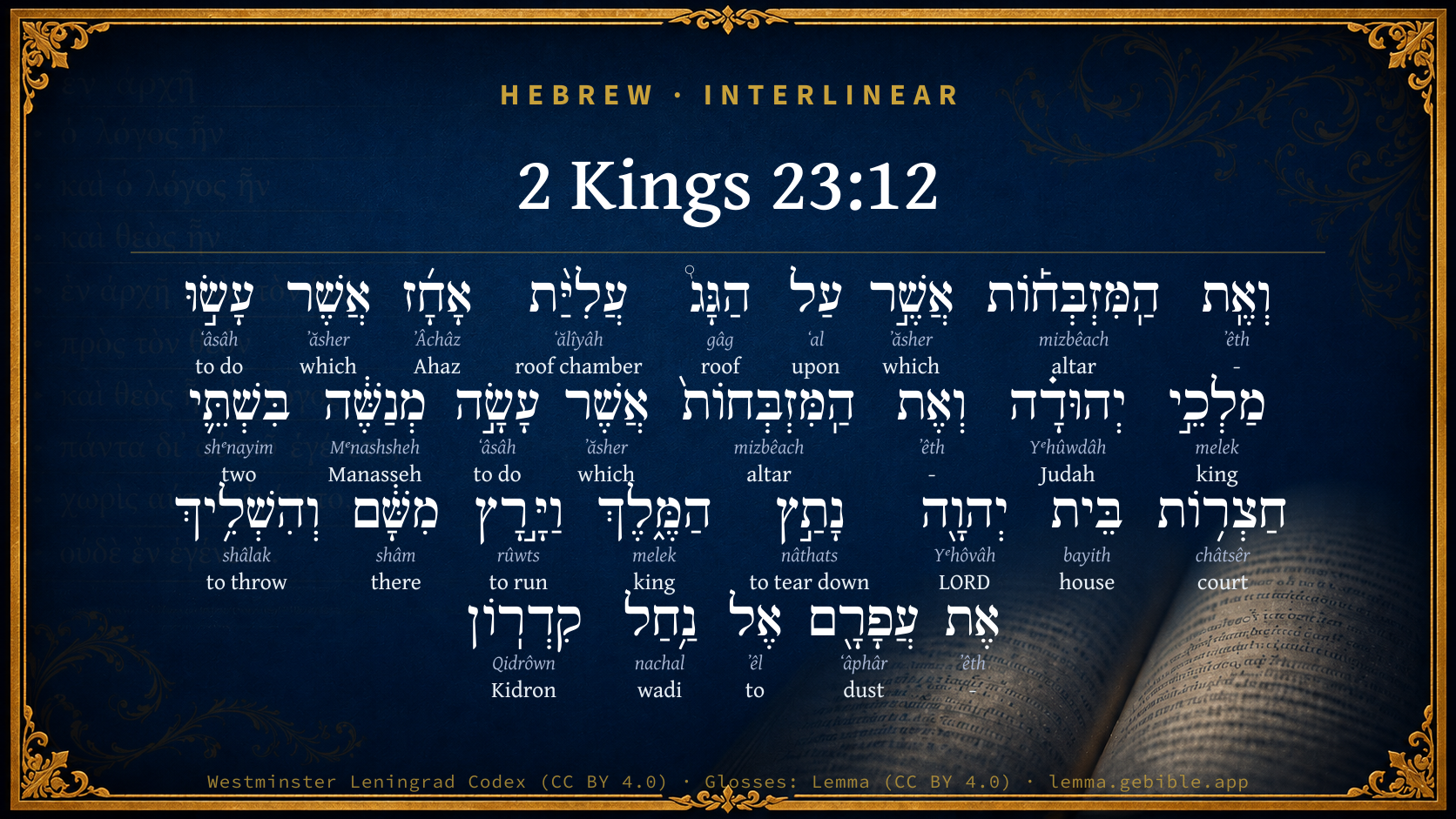
Hebrew (Westminster Leningrad Codex) 2 Kings 23:12 appears in the Hebrew Old Testament. The text above is from the Westminster Leningrad Codex. Each word links to its Strong’s number, a concise gloss, and parsing drawn from the Open Scriptures Hebrew Bible morphology. Click any word for its full Brown-Driver-Briggs (BDB) entry.
Download image
Cite this verse

2 Kings 23:12 (World English Bible). Public Domain. Lemma interlinear Bible study tool, https://lemma.gebible.app/v/2-kings/23/12.

Show BibTeX & RIS
BibTeX
RIS
English Translation
The altars that were on the roof of the upper chamber of Ahaz, which the kings of Judah had made, and the altars which Manasseh had made in the two courts of the house of Yahweh, did the king break down, and beat [them] down from there, and cast the dust of them into the brook Kidron.
World English Bible · Public Domain
Download a study sheet

One document with this verse’s original text, its word-by-word gloss line, the meaning frame, cross-references with their text, attributed commentary, and full source and license credits — printable, and it pastes into notes with its structure intact.

This verse Autodidact and up

Study sheet (.html) Plain text (.txt)

A passage Seminary Student

Up to 50 verses in one chapter. A passage sheet keeps up to 6 commentary sources and 12 cross-references per verse, in the order this page ranks them, and says so on the sheet whenever that leaves anything out. Ask for a single verse and you get the Autodidact verse sheet above.

Everything on this page stays free to read, with no account — the sheet is a download of what is already on screen, not access to it.

Want to remove ads? Support Godless Engineer
Compare translations 3

The same verse in 3 English versions, stacked beneath the original-language interlinear above. Click any original word for its lexicon entry.

Each is an independent rendering of the whole verse — the interlinear is not word-aligned to these translations.

Highlighted words mark where these versions differ — a whole-verse word diff, not a word-by-word alignment.

  • World English Bible Public Domain
    The altars that were on the roof of the upper chamber of Ahaz, which the kings of Judah had made, and the altars which Manasseh had made in the two courts of the house of Yahweh, did the king break down, and beat [them] down from there, and cast the dust of them into the brook Kidron.
  • King James Version Public Domain
    And the altars that were on the top of the upper chamber of Ahaz, which the kings of Judah had made, and the altars which Manasseh had made in the two courts of the house of the LORD, did the king beat down, and brake them down from thence, and cast the dust of them into the brook Kidron.
  • unfoldingWord Literal Text CC BY-SA 4.0
    And the king tore down the altars that on the roof, the upper chamber of Ahaz, that the kings of Judah had made and the altars that Manasseh had made in the two courts of the house of Yahweh. And he ran from there and threw their dust into the Valley of Kidron.

unfoldingWord Literal Text — © unfoldingWord, licensed CC BY-SA 4.0. Word-aligned USFM3 via Door43 (git.door43.org/unfoldingWord/en_ult).

Versions to compare (up to 4)

3 of 4 selected

Show all 18 translations

Every available English version of this verse, each an independent rendering of the whole verse.

  • World English Bible Public Domain
    The altars that were on the roof of the upper chamber of Ahaz, which the kings of Judah had made, and the altars which Manasseh had made in the two courts of the house of Yahweh, did the king break down, and beat [them] down from there, and cast the dust of them into the brook Kidron.
  • Berean Standard Bible Public Domain
    He pulled down the altars that the kings of Judah had set up on the roof near the upper chamber of Ahaz, and the altars that Manasseh had set up in the two courtyards of the house of the LORD. The king pulverized them there and threw their dust into the Kidron Valley.
  • Majority Standard Bible Public Domain
    He pulled down the altars that the kings of Judah had set up on the roof near the upper chamber of Ahaz, and the altars that Manasseh had set up in the two courtyards of the house of the LORD. The king pulverized them there and threw their dust into the Kidron Valley.
  • King James Version Public Domain
    And the altars that were on the top of the upper chamber of Ahaz, which the kings of Judah had made, and the altars which Manasseh had made in the two courts of the house of the LORD, did the king beat down, and brake them down from thence, and cast the dust of them into the brook Kidron.
  • American Standard Version (1901) Public Domain
    And the altars that were on the roof of the upper chamber of Ahaz, which the kings of Judah had made, and the altars which Manasseh had made in the two courts of the house of Jehovah, did the king break down, and beat `them' down from thence, and cast the dust of them into the brook Kidron.
  • Revised Version (1885) Public Domain
    And the altars that were on the roof of the upper chamber of Ahaz, which the kings of Judah had made, and the altars which Manasseh had made in the two courts of the house of the LORD, did the king break down, and beat them down from thence, and cast the dust of them into the brook Kidron.
  • Geneva Bible (1599) Public Domain
    And the altars that were on the top of the chamber of Ahaz, which the Kings of Iudah had made, and the altars which Manasseh had made in the two courts of the house of the Lord did the King breake downe, and hasted thence, and cast the dust of them in the brooke Kedron.
  • Douay-Rheims (1899) Public Domain
    And the altars that were upon the top of the upper chamber of Achaz, which the kings of Juda had made, and the altars which Manasses had made in the two courts of the temple of the Lord, the king broke down: and he ran from thence, and cast the ashes of them into the torrent Cedron.
  • Young's Literal Translation Public Domain
    And the altars that `are' on the top of the upper chamber of Ahaz, that the kings of Judah made, and the altars that Manasseh made in the two courts of the house of Jehovah, hath the king broken down, and removeth thence, and hath cast their dust unto the brook Kidron.
  • Literal Standard Version CC BY-SA 4.0
    And the altars that [are] on the top of the upper chamber of Ahaz, that the kings of Judah made, and the altars that Manasseh made in the two courts of the house of YHWH, the king has broken down, and removes from there, and has cast their dust into the Brook of Kidron.
  • Unlocked Literal Bible CC BY-SA 4.0
    Josiah the king destroyed the altars that were on the roof of the upper chamber of Ahaz, which the kings of Judah had made, and the altars that Manasseh had made in the two courts of the temple of Yahweh. Josiah smashed them into pieces and threw them into the Kidron Valley.
  • unfoldingWord Literal Text CC BY-SA 4.0
    And the king tore down the altars that on the roof, the upper chamber of Ahaz, that the kings of Judah had made and the altars that Manasseh had made in the two courts of the house of Yahweh. And he ran from there and threw their dust into the Valley of Kidron.
  • Darby Bible Public Domain
    And the king broke down the altars that were on the roof of the upper chamber of Ahaz, which the kings of Judah had made, and the altars that Manasseh had made in the two courts of the house of Jehovah, and he shattered them, [removing them] from thence, and cast the powder of them into the torrent of Kidron.
  • World Messianic Bible Public Domain
    The king broke down the altars that were on the roof of the upper room of Ahaz, which the kings of Judah had made, and the altars which Manasseh had made in the two courts of the LORD’s house, and beat them down from there, and cast their dust into the brook Kidron.
  • Webster's Bible Public Domain
    And the altars that were on the top of the upper chamber of Ahaz, which the kings of Judah had made, and the altars which Manasseh had made in the two courts of the house of the LORD, did the king beat down, and broke them down from thence, and cast the dust of them into the brook Kidron.
  • Free Bible Version CC BY-SA 4.0
    He demolished the altars that the kings of Judah had set up on the roof near the upper chamber of Ahaz, and the altars Manasseh had placed in the two courtyards of the Lord's Temple. The king smashed them to pieces and scattered them in the Kidron Valley.
  • Bible in Basic English Public Domain
    And the altars on the roof of the high room of Ahaz, which the kings of Judah had made, and the altars which Manasseh had made in the two outer squares of the house of the Lord, were pulled down and crushed to bits, and the dust of them was put into the stream Kidron.
  • JPS Tanakh (1917) Public Domain
    And the altars that were on the roof of the upper chamber of Ahaz, which the kings of Judah had made, and the altars which Manasseh had made in the two courts of the house of the LORD, did the king break down, and beat them down from thence, and cast the dust of them into the brook Kidron.

Literal Standard Version (2020), Covenant Press — licensed CC BY-SA 4.0. Text via the HelloAO Bible API (eBible.org). Unlocked Literal Bible (unfoldingWord) — licensed CC BY-SA 4.0. Text via the HelloAO Bible API (eBible.org). unfoldingWord Literal Text — © unfoldingWord, licensed CC BY-SA 4.0. Word-aligned USFM3 via Door43 (git.door43.org/unfoldingWord/en_ult). Free Bible Version, Dr. Jonathan Gallagher — licensed CC BY-SA 4.0. Text via the HelloAO Bible API (eBible.org).

Word by word

More ways to search: Search by grammar → Find every occurrence → Compare this word →

Practice this passage: Drill this verse → Learn its vocabulary →

קִדְרֽוֹן
Qidrôwn
H6939
“Kidron”
Noun, Proper
Part of Speech
Noun
Type
Proper
Full BDB Definition

Origin: from H6937

TWOT: None

Kidron = "dark" - a stream east of Jerusalem
  1. וְאֶֽת ʼêth H853 “and · -” Conjunction + Particle, Direct Object
  2. הַֽמִּזְבְּח֡וֹת mizbêach H4196 “the · altars” Particle, Definite Article + Noun, Common, Masculine, Plural, Absolute
  3. אֲשֶׁ֣ר ʼăsher H834 “which” Particle, Relative
  4. עַל ʻal H5921 “upon” Preposition
  5. הַגָּג֩ gâg H1406 “the · roof” Particle, Definite Article + Noun, Common, Masculine, Singular, Absolute
  6. עֲלִיַּ֨ת ʻălîyâh H5944 “roof chamber of” Noun, Common, Feminine, Singular, Construct
  7. אָחָ֜ז ʼÂchâz H271 “Ahaz” Noun, Proper
  8. אֲשֶׁר ʼăsher H834 “which” Particle, Relative
  9. עָשׂ֣וּ ʻâsâh H6213 “to do” Verb, Qal, Perfect, 3rd Person, Common, Plural
  10. מַלְכֵ֣י melek H4428 “kings of” Noun, Common, Masculine, Plural, Construct
  11. יְהוּדָ֗ה Yᵉhûwdâh H3063 “Judah” Noun, Proper
  12. וְאֶת ʼêth H853 “and · -” Conjunction + Particle, Direct Object
  13. הַֽמִּזְבְּחוֹת֙ mizbêach H4196 “the · altars” Particle, Definite Article + Noun, Common, Masculine, Plural, Absolute
  14. אֲשֶׁר ʼăsher H834 “which” Particle, Relative
  15. עָשָׂ֣ה ʻâsâh H6213 “to do” Verb, Qal, Perfect, 3rd Person, Masculine, Singular
  16. מְנַשֶּׁ֔ה Mᵉnashsheh H4519 “Manasseh” Noun, Proper
  17. בִּשְׁתֵּ֛י shᵉnayim H8147 “in/at · two” Preposition + Adjective, Cardinal number, Feminine, Dual, Construct
  18. חַצְר֥וֹת châtsêr H2691 “courts of” Noun, Common, Both, Plural, Construct
  19. בֵּית bayith H1004 “house of” Noun, Common, Masculine, Singular, Construct
  20. יְהוָ֖ה Yᵉhôvâh H3068 “LORD” Noun, Proper
  21. נָתַ֣ץ nâthats H5422 “to tear down” Verb, Qal, Perfect, 3rd Person, Masculine, Singular
  22. הַמֶּ֑לֶךְ melek H4428 “the · king” Particle, Definite Article + Noun, Common, Masculine, Singular, Absolute
  23. וַיָּ֣רָץ rûwts H7323 “and · to run” Conjunction + Verb, Qal, Sequential Imperfect, 3rd Person, Masculine, Singular
  24. מִשָּׁ֔ם shâm H8033 “from · there” Preposition + Adverb
  25. וְהִשְׁלִ֥יךְ shâlak H7993 “and · to throw” Conjunction + Verb, Hiphil, Perfect, 3rd Person, Masculine, Singular
  26. אֶת ʼêth H853 “-” Particle, Direct Object
  27. עֲפָרָ֖ם ʻâphâr H6083 “dust · their” Noun, Common, Masculine, Singular, Construct + Suffix, Personal, 3rd Person, Masculine, Plural
  28. אֶל ʼêl H413 “to” Preposition
  29. נַ֥חַל nachal H5158 “wadi of” Noun, Common, Masculine, Singular, Construct

About this verse

These counts appear in no published source. They are computed here, from the morphology-tagged text and Lemma’s own curated glosses. What Lemma adds →

30
words
23
distinct lemmas
Historical
section

Notable vocabulary

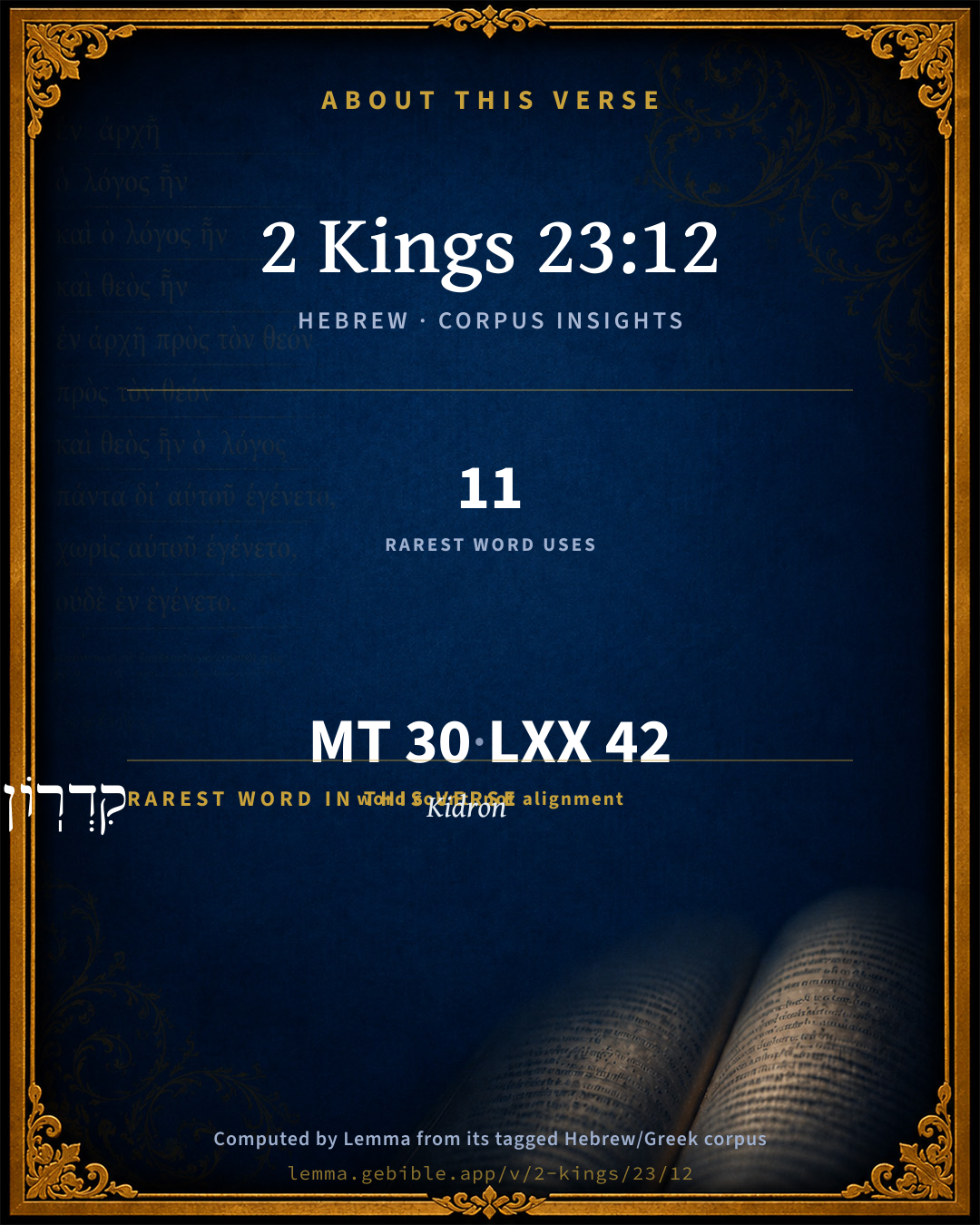
The rarest word here is קִדְרֽוֹן Kidron H6939 — appearing just 11 times in the whole Hebrew Bible.

Shared distinctive vocabulary

קִדְרֽוֹן Kidron H6939 occurs in 10 verses of the Hebrew Bible. Also found in:

Grammatical profile

  • 5 verbs
  • 15 nouns
  • 1 adjective
  • 2 prepositions
  • 1 adverb
  • 6 particles

Verb forms

  • עָשׂ֣וּ Qal · Perfect
  • עָשָׂ֣ה Qal · Perfect
  • נָתַ֣ץ Qal · Perfect
  • וַיָּ֣רָץ Qal · Sequential Imperfect
  • וְהִשְׁלִ֥יךְ Hiphil · Perfect

Repetition

Words recur within this verse — often emphatic in Hebrew:

  • הַֽמִּזְבְּח֡וֹת altar H4196 ×2
  • עָשׂ֣וּ to do H6213 ×2
  • מַלְכֵ֣י king H4428 ×2
  • אֲשֶׁ֣ר which H834 ×3

Hebrew & Septuagint length

In English translation the verse runs 57 words from the Hebrew and 57 from the Septuagint (LXX English) — the same length.

A rough comparison of the two English renderings, which tokenize alike — not a word-level alignment.

Word counts can differ between the Hebrew and the Greek without any difference in meaning — e.g. the Hebrew direct-object marker אֵת has no separate Greek word, and Greek often adds the article ὁ.

In the original languages it is 30 Hebrew tokens and 42 Greek tokens — but the two are counted differently (Hebrew bundles its prefixes and suffixes into one token; the Greek is in lemma form), so that isn’t a like-for-like length.

Cross-references

9

Topical passages linked to 2 Kings 23:12 in the Treasury of Scripture Knowledge — connected by theme and wording, ordered by reader-vote popularity; previews shown in the World English Bible.

  • 2 Kings 21:5 He built altars for all the host of the sky in the two courts of the house of Yahweh.
  • Jeremiah 19:13 and the houses of Jerusalem, and the houses of the kings of Judah, which are defiled, shall be as the place of Topheth, even all the houses on whose roofs they have burned incense to all the host of the sky, and have poured out drink-offerings to other gods.
  • Zephaniah 1:5 those who worship the host of the sky on the housetops, those who worship and swear by Yahweh and also swear by Malcam,
  • 2 Chronicles 33:5 He built altars for all the host of the sky in the two courts of the house of Yahweh.
  • Deuteronomy 22:8 When you build a new house, then you shall make a battlement for your roof, that you don't bring blood on your house, if any man fall from there.
  • 2 Kings 21:21–22 He walked in all the way that his father walked in, and served the idols that his father served, and worshiped them:
  • 2 Kings 23:4 The king commanded Hilkiah the high priest, and the priests of the second order, and the keepers of the threshold, to bring forth out of the temple of Yahweh all the vessels that were made for Baal, and for the Asherah, and for all the host of the sky, and he burned them outside of Jerusalem in the fields of the Kidron, and carried the ashes of them to Bethel.
  • 2 Kings 23:6 He brought out the Asherah from the house of Yahweh, outside of Jerusalem, to the brook Kidron, and burned it at the brook Kidron, and beat it to dust, and cast the dust of it on the graves of the common people.
  • 2 Chronicles 33:15 He took away the foreign gods, and the idol out of the house of Yahweh, and all the altars that he had built in the mountain of the house of Yahweh, and in Jerusalem, and cast them out of the city.

Cross-references courtesy of OpenBible.info (CC BY 4.0).

Hebrew and Greek witnesses Masoretic Hebrew ↔ Greek Septuagint

The same verse in the two great witnesses to the Old Testament, shown verse-for-verse.

These are two independent witnesses, not word-aligned to each other, and the Septuagint is shown in lemma (dictionary) form.

Hebrew 2 Kings 23:12 Masoretic · Westminster Leningrad Codex

וְאֶֽת הַֽמִּזְבְּח֡וֹת אֲשֶׁ֣ר עַל הַגָּג֩ עֲלִיַּ֨ת אָחָ֜ז אֲשֶׁר עָשׂ֣וּ מַלְכֵ֣י יְהוּדָ֗ה וְאֶת הַֽמִּזְבְּחוֹת֙ אֲשֶׁר עָשָׂ֣ה מְנַשֶּׁ֔ה בִּשְׁתֵּ֛י חַצְר֥וֹת בֵּית יְהוָ֖ה נָתַ֣ץ הַמֶּ֑לֶךְ וַיָּ֣רָץ מִשָּׁ֔ם וְהִשְׁלִ֥יךְ אֶת עֲפָרָ֖ם אֶל נַ֥חַל קִדְרֽוֹן

The altars that were on the roof of the upper chamber of Ahaz, which the kings of Judah had made, and the altars which Manasseh had made in the two courts of the house of Yahweh, did the king break down, and beat [them] down from there, and cast the dust of them into the brook Kidron.

World English Bible · Public Domain

Greek LXX 2 Kings 23:12 Septuagint · lemma form

καί ὁ θυσιαστήριον ὁ ἐπί ὁ δῶμα ὁ ὑπερῷον αχαζ ὅς ποιέω βασιλεύς ιουδα καί ὁ θυσιαστήριον ὅς ποιέω μανασσῆς ἐν ὁ δύο αὐλή οἶκος κύριος καί κατααἱρέω ὁ βασιλεύς καί κατασπάω ἐκεῖθεν καί ῥίπτω ὁ χοῦς αὐτός εἰς ὁ χειμάρρους κεδρων

And the altars that were on the roof of the upper chamber of Achaz, which the kings of Juda had made, and the altars which Manasses had made in the two courts of the house of the Lord, did the king pull down and forcibly remove from thence, and cast their dust into the brook of Kedron.

LXX2012 (modern English Septuagint) · Public Domain

On this verse, Ellicott's Commentary for English Readers discusses the Septuagint’s reading. Read the note in Commentary ↓

Hebrew: Westminster Leningrad Codex (CC BY 4.0). Greek: Septuagint (public domain); English from LXX2012 (modern English Septuagint) (Public Domain). How the Septuagint differs from the Hebrew →

Targum (Aramaic paraphrase)

1

The Targum is the ancient Jewish Aramaic paraphrase of the Hebrew Scriptures — an interpretive translation, not the Hebrew text itself. Onkelos (literal) and Pseudo-Jonathan (expansive) render the Torah, and Jonathan the Prophets. Coverage is partial: where no permissively-licensed English translation exists for a verse, only the Aramaic is shown. This is verse-level text, not a word-by-word alignment to the Hebrew.

  1. Targum Jonathan Prophets (Joshua–Malachi)
    וְיַת אֱגוֹרַיָא דִי עַל אִגַר עִלִית אָחָז דַעֲבָדוּ מַלְכַיָא דְבֵית יְהוּדָה וְיַת אֱגוֹרַיָא דַעֲבַד מְנַשֶׁה בְּתַרְתֵּין דָרַת בֵּית מַקְדְשָׁא דַייָ תְּרַע מַלְכָּא וְאַרְחֵיק מִתַּמָן וּרְמָא יַת עֲפַרְהוֹן לְנַחֲלָא דְקִדְרוֹן:

    (no public-domain English translation for this verse)

    Targum Jonathan — Aramaic: “Mikraot Gedolot” (public domain). English: “Sefaria Community Translation” (CC0 1.0 (public-domain dedication)); “London "Chaldee Paraphrase," 1871” (public domain). Text via Sefaria.

Commentary

Notes on 2 Kings 23:12 from classic Christian and Jewish commentators (each source and its license shown beneath its notes). The classic Christian expositions comment on the surrounding passage and are grouped to its opening verse, so a note may address several verses; the Jewish commentaries on the Tanakh (Rashi and others) are per-verse, so they appear only where the commentator wrote on this verse.

Lemma curates 59 commentaries, every one of them public domain or Creative Commons licensed, each selected and text-cleaned for this edition rather than reprinted as found. About our sources →

Trapp's Complete Commentary

John Trapp

2Ki 23:12 And the altars that [were] on the top of the upper chamber of Ahaz, which the kings of Judah had made, and the altars which Manasseh had made in the two courts of the house of the LORD, did the king beat down, and brake [them] down from thence, and cast the dust of them into the brook Kidron.

Ver. 12. And the altars that were on the top.] See Jer 19:13 Zep 1:5. Ahaz was ειδωλομανης.

And the altars which Manasseh had made.] These, after his repentance, he cast out of the city, {2Ch 33:15} but not so thoroughly abolished; hence they became snares to his successors.

And brake them down from thence.] Or, Ran from thence; quam citissime potuit discedens illinc, {a} he got out of those loathsome places as soon as he could.

Into the brook Kidron,] i.e., The town ditch.

{a} Vatab.

John Trapp, A Commentary or Exposition upon All the Books of the Old and New Testament (1647–1656) — public domain. Text from a community e-Sword module.

Joseph Benson's Commentary

2Ki 23:12. The altars on the top of the upper chamber, &c. — “Read,” says Mr. Locke, “the altars on the house-top.” According to Jeremiah, chap. Jer 32:29, they were so mad upon their idols, that they were not content with their numerous public high places and altars, but made others upon their house-tops for the worship of Baal and others of their false gods. And the altars which Manasseh had made in the two courts, &c. — We learn from 2Ch 33:13-15, that when Manasseh repented he took away all the altars he had built in the mount of the house of the Lord, and in Jerusalem; and it is probable those in the court of the priests, and in that of the people, were then removed; but, it seems, Amon set them up again in the very place where Manasseh had erected them, and therefore they are here called his altars. And cast the dust of them into the brook Kidron — To show his detestation of them, and to abolish the very remembrance of them.

Joseph Benson's Commentary on the Old and New Testaments (1811–1818) — public domain. Text from a community e-Sword module.

Tyndale Open Study Notes

Tyndale Open Resources

23:12 upper room of Ahaz: Roof-top altars were used for astral worship (Jer 19:13; Zeph 1:5) and rituals associated with Baal (Jer 32:29).

Tyndale Open Study Notes — © Tyndale Open Resources, licensed CC BY-SA 4.0. Text via the HelloAO Bible API.

Geneva Bible (1599)

Geneva Bible translators

Or, valley.

Geneva Bible (1599) marginal notes — public domain. Text via Bolls.life.

Jamieson, Fausset & Brown

Robert Jamieson, A. R. Fausset & David Brown

the altars that were on the top of the upper chamber of Ahaz--Altars were reared on the flat roofs of houses, where the worshippers of "the host of heaven" burnt incense (Zep 1:5; Jer 19:13). Ahaz had reared altars for this purpose on the oleah, or upper chamber of his palace, and Manasseh on some portion of the roof of the temple. Josiah demolished both of these structures.

Jamieson, Fausset & Brown — Commentary Critical and Explanatory on the Whole Bible (1871) — public domain (CC PDM 1.0). Text via the HelloAO Bible API.

Adam Clarke's Commentary

Verse 12. On the top of the upper chamber] Altars built on the flat roof of the house. Such altars were erected to the sun, moon, stars, &c.

Adam Clarke's Commentary on the Bible (1810–1826) — public domain. Text from a community e-Sword/MySword module.

Ellicott's Commentary for English Readers

(12) And the altars that were on the top (roof) of the upper chamber of Ahaz.—The roof of an upper chamber in one of the Temple courts. perhaps built over one of the gateways (comp. Jer_35:4), appears to be meant. The altars were for star-worship, which was especially practised on housetops. (Comp. Jer_19:13; Jer_32:29; Zep_1:5.)

Brake them down from thence.—The Targum has removed from thence; the LXX. pulled them down from thence (κατέσπασεν). The Hebrew probably means ran from thence; marking the haste with which the work was done. The clause thus adds a vivid touch to the narrative. It is hardly necessary to alter the points with Kimchi and Thenius, so as to read, he caused to run from thence; i.e., hurried them away.

Cast the dust of them.—Over the wall of the Temple enclosure, into the ravine beneath.

A Bible Commentary for English Readers, edited by Charles John Ellicott (1878–1897) — public domain. Text from a community e-Sword module.

The Cambridge Bible for Schools and Colleges

gen. ed. J. J. S. Perowne

12. the altars that were on the top [R.V. roof] of the upper chamber of Ahaz] This chamber must also have been erected on some of the buildings (perhaps over a gateway), by which the temple was encircled. It was evidently intended for the worship of the host of heaven. Altars on the roof are mentioned in Zep_1:5, and there it is expressly said that they were erected for this worship. Cf. also Jer_19:13; Jer_32:29. The worship of the heavenly host was therefore introduced into Judah as early as Ahaz’s time.

the altars which Manasseh had mode] See above 2Ki_21:4-5.

did the king beat down [R.V. break], and brake [R.V. beat] them down from thence] The former verb is rendered ‘break down’ in verses 7, 8 and 15, and that being rendered here consistently, the second verb must be translated differently. It will be seen from the margin both of A.V. and R.V. that the latter may also be rendered ‘he ran’, and this, which is a very well-supported translation, expresses the haste and eagerness manifested to complete the work of destruction.

The Cambridge Bible for Schools and Colleges (gen. ed. J. J. S. Perowne; Cambridge University Press, 1878–1918) — public domain. Text from a community e-Sword module.

John Gill's Exposition

And the high places that were before Jerusalem,.... Not only that were within the city, and at the gates of it, but what were without it:

which were on the right hand of the mount of corruption: the mount of Olives, so called from the idolatry and corrupt worship performed in it, by way of reproach, with a small alteration of the letters of the word for at the right hand, or south of this mountain, as the Targum; though others say (q), on the north side of the mount of Olives, four furlongs or half a mile from Jerusalem, were high places:

which Solomon king of Israel had builded for Ashtoreth the abomination of the Zidonians, and for Chemosh the abomination of the Moabites, and for Milcom the abomination of the children of Ammon; of which See Gill on Kg1 11:5, Kg1 11:7.

did the king defile; by casting unclean things into them. Rauwolff (r) says,"before Mount Zion toward the south, at the other side of the rivulet Kidron, lies the mount of transgression, called Mashith, Kg2 23:13, this is higher and steeper than any hereabout; there you still see some old walls of habitations, wherein the concubines of Solomon did live;''and Mr. Maundrell (s) observes, that below the hill stands now a village called Siloe, where it is said he kept them.

(q) Vid Adrichom. Theatrum T. S. p. 171. (r) Travels, par. 3. c. 4. p. 233. (s) Journey from Aleppo, &c. p. 102.

John Gill's Exposition of the Whole Bible (1746–1763) — public domain (CC PDM 1.0). Text via the HelloAO Bible API.

Haydock's Catholic Bible Commentary

Upper chamber, to be nearer the host of heaven, which they adored. (Haydock) --- We are assured that the Arabs also adored the sun, and offered incense to it on the tops of their houses. The prophets often upbraid the people with this practice, Jeremias xix. 13., and Sophonias i. 5. (Calmet) --- It is wonderful that Ezechias had not before removed these remnants of his father’s infidelity; and still more that Manasses, after his repentance, had not destroyed what he had unlawfully erected in the courts of the priests and of the people. But Amon might have restored them. --- Ran. This shews the zeal of the king. Hebrew and Septuagint, "and thence he broke or tore them."

George Leo Haydock (1774–1849), Haydock's Catholic Family Bible and Commentary, 1859 edition — public domain. Excludes Psalms (Douay-Rheims chapter numbering differs from Protestant) and Deuterocanonical books (Catholic canon only).

Matthew Poole's English Annotations

On the top of the upper chamber of Ahaz, i.e. upon the roof of the king’s house. They were so mad upon their idols, that they were not content with all their public high places and altars, but made others upon their house-tops, for the worship of the heavenly bodies. See Jer 19:13; Zep 1:5.

Which Manasseh had made.

Quest. How could this be, when Manasseh had taken them away before, 2Ch 33:15?

Answ. Either these altars were not so fully destroyed as they should have been, the foundations of them being left through the neglect of the officers appointed to do that work, upon which Amon built his new altars; or if they were wholly rooted out, Amon’s new altars are called by his father’s name, because they were built by his example, and in the very same place where his father’s altars were; as the wells which Isaac digged in the same place where Abraham had digged them before, were therefore called by their ancient names, Gen 26:18. See more on the next verse.

In the two courts; the priests’ and the people’s. See 2Ki 21:5.

Cast the dust of them into the brook Kidron; partly to show his detestation of them, and partly to abolish the very remembrance of them as far as he could.

Matthew Poole's English Annotations on the Holy Bible (1683–1685) — public domain. Text from a community e-Sword/MySword module.

Whedon's Commentary on the Bible

Daniel D. Whedon

12. On the top — On the roof, which in many Oriental houses is a large, flat, solid surface, much frequented by the people, especially in the cool of the day.

Upper chamber of Ahaz — Whether this was in the temple, or in some out-building of the court, cannot be determined; it was called after Ahaz, probably because he built it and used it for observing the stars and burning incense to the host of heaven. Compare Jer_19:13; Zep_1:5; and note on 2Ki_17:16. For this same purpose, also, had the later kings of Judah, namely, Manasseh and Amon, kept altars there.

Altars which Manasseh had made — See 2Ki_21:5.

Daniel D. Whedon (gen. ed.), Commentary on the Old and New Testaments (1874–1909) — public domain. Text from a community e-Sword module.

The Pulpit Commentary

And the altars that were on the top of the upper chamber of Ahaz. It would seem that "the upper chamber of Ahaz" was within the temple precincts, since the pollutions spoken of, both before and after, are pollutions belonging to the temple. It may have been erected on the flat roof of one of the gates, or on the top of a store-chamber. Altars upon roofs were a new form of idolatry, apparently connected with the worship of the "host of heaven" (see Jer_19:13; Zep_1:5) Which the kings of Judahi.e. Manasseh and Amen, perhaps also Ahazhad made, and the altars which Manasseh had made in the two courts of the house of the Lord. (see above, 2Ki_21:4, 2Ki_21:5) As Manasseh, on his repentance, merely "cast these altars out of the city", (2Ch_33:15) it was easy for Amen to replace them. They belonged to the worship of the "host of heaven." Did the king beat down, and brake them down from thence, and east the dust of them into the brook Kidron (comp. ver. 6, and the comment ad loc.).

The Pulpit Commentary (1880–1919), ed. H.D.M. Spence-Jones & Joseph S. Exell — public domain. Text from a community e-Sword module.

John Wesley's Explanatory Notes

The top - Upon the roof of the king's house. They were so mad upon their idols, that they were not content with all their publick high places and altars, but made others upon their house-tops, for the worship of the heavenly bodies. Cast - To shew his detestation of them: and to abolish the very remembrance of them.

John Wesley, Explanatory Notes Upon the Whole Bible (1754–1765) — public domain. Text via the GEBible commentary corpus.

unfoldingWord translationNotes

Door43 World Missions Community

Josiah the king destroyed ... Josiah smashed ... The king ruined ... He broke ... he filled

Josiah would have commanded his workers to do these things. It is likely that Hilkiah and the priests who assisted him did these things. AT: "Josiah the king commanded them to destroy ... They smashed ... He had them ruin ... He had them break ... they filled" (See: Metonymy)

Kidron Valley

place name. See how you translated this in 2 Kings 23:4. (See: How to Translate Names)

filled those places with the bones of human beings

"covered the ground with human bones so people could not use it as a shrine anymore"

translationWords

king

Ahaz

Manasseh

court

temple

Yahweh

high place

corrupt

Solomon

Israel

false god

Sidon

Moab

Ammon

Asherah

unfoldingWord translationNotes — © Distant Shores Media and the Door43 World Missions Community, licensed CC BY-SA 4.0. Source: git.door43.org/Door43/en_tn.

Rashi

Rabbi Shlomo Yitzchaki (Rashi)

He quickly removed them from there. And he eliminated them from there.

Rashi on the Tanakh — English translations: “The Judaica Press complete Tanach with Rashi, translated by A. J. Rosenberg” (CC BY 4.0); “Pentateuch with Rashi's commentary by M. Rosenbaum and A.M. Silbermann, 1929-1934” (public domain); “The Metsudah Tanach series, Lakewood, N.J” (CC BY 4.0); and “The Book of Joshua, Metsudah Publications, 1997” (CC BY 4.0). Text via Sefaria.

Lesson kit

Teaching starters — assembled from the data on this page, not authored interpretation. Every prompt links to the verse data it draws on. Edit before teaching.

2 Kings, in the Historical, opens this verse with 30 words (23 distinct Hebrew lemmas). Its most distinctive word is Qidrôwn (“Kidron”). A historical commentator’s framing appears above. Read the whole chapter for the surrounding context.

Discussion questions

  1. What does “Kidron” (Qidrôwn) contribute to the verse as a whole?
  2. 2 Samuel 15:23 shares the word «Kidron» with this verse. How do the two illuminate each other?
  3. “altar” occurs 2× in this one verse. What is the effect of the repetition?
  4. These translations render this verse differently. What is at stake in choosing one wording over another?
  5. The verb «עָשׂ֣וּ» is Qal Perfect. How does its form color the action?
  6. Reading how Trapp's Complete Commentary and Joseph Benson's Commentary read this verse, where do the two commentators agree and where do they part?

Things to notice

Reading settings

Reading text

Shown beneath each verse's original-language words.

Old Testament
Old Testament edition

Read the OT as the Masoretic Hebrew (MT) or the Greek Septuagint (LXX).

English shown for the Greek Septuagint (in the Hebrew ↔ Greek comparison).

Comparing translations? Open the Compare panel on any verse page to stack up to four side by side.