
2 Kings 11:18

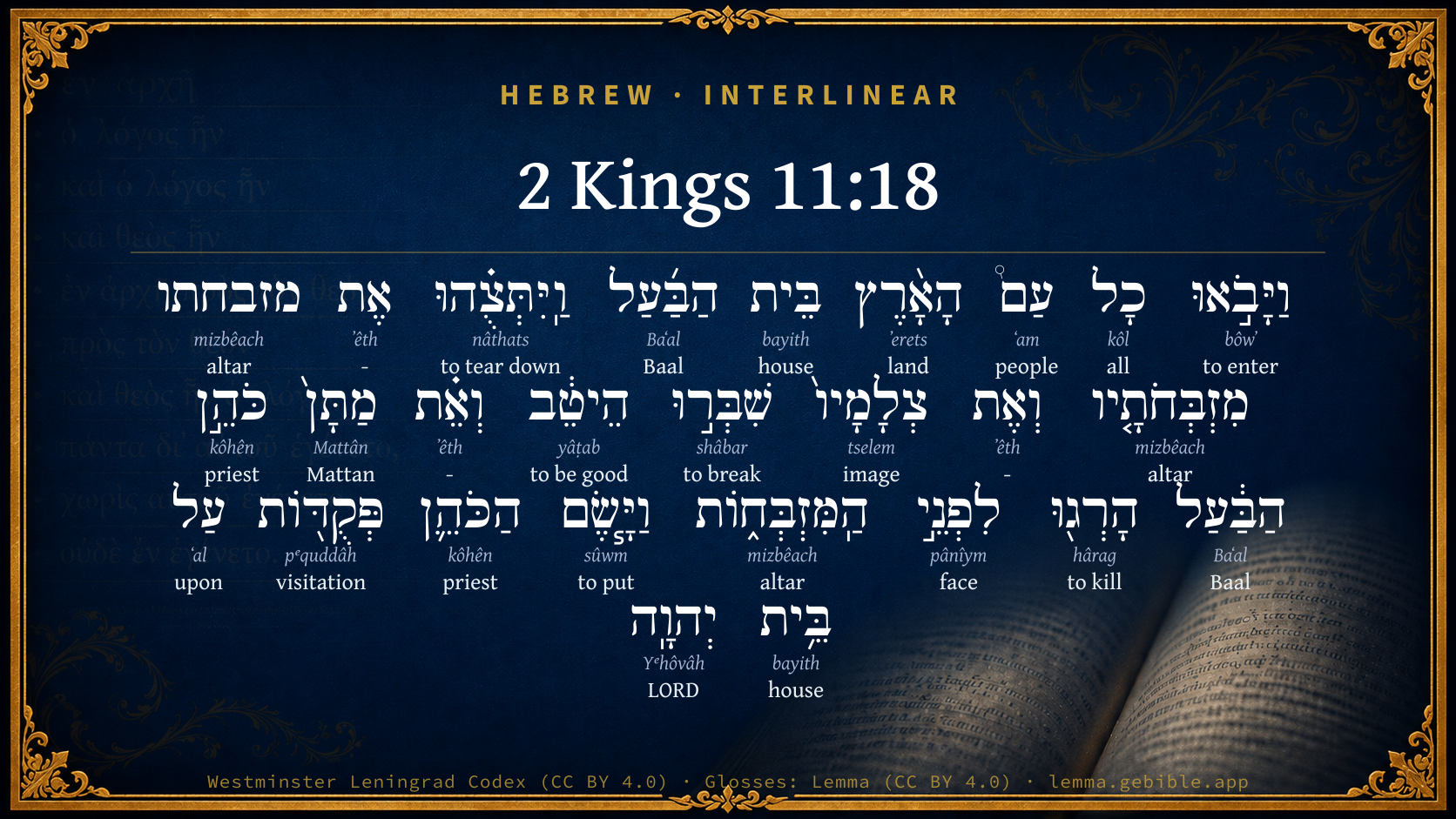
Hebrew (Westminster Leningrad Codex) 2 Kings 11:18 appears in the Hebrew Old Testament. The text above is from the Westminster Leningrad Codex. Each word links to its Strong’s number, a concise gloss, and parsing drawn from the Open Scriptures Hebrew Bible morphology. Click any word for its full Brown-Driver-Briggs (BDB) entry.
Download image
Cite this verse

2 Kings 11:18 (World English Bible). Public Domain. Lemma interlinear Bible study tool, https://lemma.gebible.app/v/2-kings/11/18.

Show BibTeX & RIS
BibTeX
RIS
English Translation
All the people of the land went to the house of Baal, and broke it down; his altars and his images broke they in pieces thoroughly, and killed Mattan the priest of Baal before the altars. The priest appointed officers over the house of Yahweh.
World English Bible · Public Domain
Highlights
  • 1 first appearance in the Hebrew Bible
Full analysis ↓
Download a study sheet

One document with this verse’s original text, its word-by-word gloss line, the meaning frame, cross-references with their text, attributed commentary, and full source and license credits — printable, and it pastes into notes with its structure intact.

This verse Autodidact and up

Study sheet (.html) Plain text (.txt)

A passage Seminary Student

Up to 50 verses in one chapter. A passage sheet keeps up to 6 commentary sources and 12 cross-references per verse, in the order this page ranks them, and says so on the sheet whenever that leaves anything out. Ask for a single verse and you get the Autodidact verse sheet above.

Everything on this page stays free to read, with no account — the sheet is a download of what is already on screen, not access to it.

Want to remove ads? Support Godless Engineer
Compare translations 3

The same verse in 3 English versions, stacked beneath the original-language interlinear above. Click any original word for its lexicon entry.

Each is an independent rendering of the whole verse — the interlinear is not word-aligned to these translations.

Highlighted words mark where these versions differ — a whole-verse word diff, not a word-by-word alignment.

  • World English Bible Public Domain
    All the people of the land went to the house of Baal, and broke it down; his altars and his images broke they in pieces thoroughly, and killed Mattan the priest of Baal before the altars. The priest appointed officers over the house of Yahweh.
  • King James Version Public Domain
    And all the people of the land went into the house of Baal, and brake it down; his altars and his images brake they in pieces thoroughly, and slew Mattan the priest of Baal before the altars. And the priest appointed officers over the house of the LORD.
  • unfoldingWord Literal Text CC BY-SA 4.0
    And all of the people of the land went the house of Baal, and they tore down his altar, and they shattered his images thoroughly, and they killed Mattan, the priest of Baal, to the face of the altars. And the priest appointed officers over the house of Yahweh.

unfoldingWord Literal Text — © unfoldingWord, licensed CC BY-SA 4.0. Word-aligned USFM3 via Door43 (git.door43.org/unfoldingWord/en_ult).

Versions to compare (up to 4)

3 of 4 selected

Show all 18 translations

Every available English version of this verse, each an independent rendering of the whole verse.

  • World English Bible Public Domain
    All the people of the land went to the house of Baal, and broke it down; his altars and his images broke they in pieces thoroughly, and killed Mattan the priest of Baal before the altars. The priest appointed officers over the house of Yahweh.
  • Berean Standard Bible Public Domain
    So all the people of the land went to the temple of Baal and tore it down. They smashed the altars and idols to pieces, and they killed Mattan the priest of Baal in front of the altars. And Jehoiada the priest posted guards for the house of the LORD.
  • Majority Standard Bible Public Domain
    So all the people of the land went to the temple of Baal and tore it down. They smashed the altars and idols to pieces, and they killed Mattan the priest of Baal in front of the altars. And Jehoiada the priest posted guards for the house of the LORD.
  • King James Version Public Domain
    And all the people of the land went into the house of Baal, and brake it down; his altars and his images brake they in pieces thoroughly, and slew Mattan the priest of Baal before the altars. And the priest appointed officers over the house of the LORD.
  • American Standard Version (1901) Public Domain
    And all the people of the land went to the house of Baal, and brake it down; his altars and his images brake they in pieces thoroughly, and slew Mattan the priest of Baal before the altars. And the priest appointed officers over the house of Jehovah.
  • Revised Version (1885) Public Domain
    And all the people of the land went to the house of Baal, and brake it down: his altars and his images brake they in pieces thoroughly, and slew Mattan the priest of Baal before the altars. And the priest appointed officers over the house of the LORD.
  • Geneva Bible (1599) Public Domain
    Then all the people of the lande went into the house of Baal, and destroyed it with his altars, and his images brake they downe courageously, and slewe Mattan the Priest of Baal before the altars: and the Priest set a garde ouer the house of the Lord.
  • Douay-Rheims (1899) Public Domain
    And all the people of the land went into the temple of Baal, and broke down his altars, and his images they broke in pieces thoroughly: they slew also Mathan the priest of Baal before the altar. And the priest set guards in the house of the Lord.
  • Young's Literal Translation Public Domain
    And all the people of the land go in to the house of Baal, and break it down, its altars and its images they have thoroughly broken, and Mattan priest of Baal they have slain before the altars; and the priest setteth inspectors over the house of Jehovah,
  • Literal Standard Version CC BY-SA 4.0
    And all the people of the land go to the house of Ba‘al, and break it down; they have thoroughly broken its altars and its images, and they have slain Mattan priest of Ba‘al before the altars; and the priest sets inspectors over the house of YHWH,
  • Unlocked Literal Bible CC BY-SA 4.0
    So all the people of the land went to the house of Baal and tore it down. They smashed Baal's altars and his idol figures to pieces, and they killed Mattan, the priest of Baal, in front of those altars. Then Jehoida the priest appointed guards over the temple of Yahweh.
  • unfoldingWord Literal Text CC BY-SA 4.0
    And all of the people of the land went the house of Baal, and they tore down his altar, and they shattered his images thoroughly, and they killed Mattan, the priest of Baal, to the face of the altars. And the priest appointed officers over the house of Yahweh.
  • Darby Bible Public Domain
    Then all the people of the land went into the house of Baal, and broke it down: his altars and his images they broke in pieces completely, and slew Mattan the priest of Baal before the altars. And the priest appointed officers over the house of Jehovah.
  • World Messianic Bible Public Domain
    All the people of the land went to the house of Baal, and broke it down. They broke his altars and his images in pieces thoroughly, and killed Mattan the priest of Baal before the altars. The priest appointed officers over the LORD’s house.
  • Webster's Bible Public Domain
    And all the people of the land went into the house of Baal, and broke it down; his altars and his images they broke wholly in pieces, and slew Mattan the priest of Baal before the altars. And the priest appointed officers over the the house of the LORD.
  • Free Bible Version CC BY-SA 4.0
    Everyone went to the Temple of Baal and tore down its altars and smashed the idols to pieces. They killed Mattan, the priest of Baal, right in front of the altar. Then Jehoiada the priest had guards posted at the Lord's Temple.
  • Bible in Basic English Public Domain
    Then all the people of the land went to the house of Baal and had it pulled down: its altars and images were all broken to bits, and Mattan, the priest of Baal, they put to death before the altars. And the priest put overseers over the Lord's house.
  • JPS Tanakh (1917) Public Domain
    And all the people of the land went to the house of Baal, and broke it down; his altars and his images broke they in pieces thoroughly, and slew Mattan the priest of Baal before the altars. And the priest appointed officers over the house of the LORD.

Literal Standard Version (2020), Covenant Press — licensed CC BY-SA 4.0. Text via the HelloAO Bible API (eBible.org). Unlocked Literal Bible (unfoldingWord) — licensed CC BY-SA 4.0. Text via the HelloAO Bible API (eBible.org). unfoldingWord Literal Text — © unfoldingWord, licensed CC BY-SA 4.0. Word-aligned USFM3 via Door43 (git.door43.org/unfoldingWord/en_ult). Free Bible Version, Dr. Jonathan Gallagher — licensed CC BY-SA 4.0. Text via the HelloAO Bible API (eBible.org).

Word by word

More ways to search: Search by grammar → Find every occurrence → Compare this word →

Practice this passage: Drill this verse → Learn its vocabulary →

מַתָּן֙
Mattân
H4977
“Mattan”
Noun, Proper
Part of Speech
Noun
Type
Proper
Full BDB Definition

Origin: the same as H4976

TWOT: None

Mattan = "a gift" - a priest of Baal in Jerusalem in the time of Athaliah - father of Shephatiah in the time of Jeremiah
  1. וַיָּבֹ֣אוּ bôwʼ H935 “and · to enter” Conjunction + Verb, Qal, Sequential Imperfect, 3rd Person, Masculine, Plural
  2. כָל kôl H3605 “all of” Noun, Common, Masculine, Singular, Construct
  3. עַם֩ ʻam H5971 “people of” Noun, Common, Masculine, Singular, Construct
  4. הָאָ֨רֶץ ʼerets H776 “the · land” Particle, Definite Article + Noun, Common, Both, Singular, Absolute
  5. בֵּית bayith H1004 “house of” Noun, Common, Masculine, Singular, Construct
  6. הַבַּ֜עַל Baʻal H1168 “the · Baal” Particle, Definite Article + Noun, Proper
  7. וַֽיִּתְּצֻ֗הוּ nâthats H5422 “and · to tear down · him” Conjunction + Verb, Qal, Sequential Imperfect, 3rd Person, Masculine, Plural + Suffix, Personal, 3rd Person, Masculine, Singular
  8. אֶת ʼêth H853 “-” Particle, Direct Object
  9. מזבחתו mizbêach H4196 “altars · his” Noun, Common, Masculine, Plural, Construct + Suffix, Personal, 3rd Person, Masculine, Singular
  10. מִזְבְּחֹתָ֤יו mizbêach H4196 “altars · his” Noun, Common, Masculine, Plural, Construct + Suffix, Personal, 3rd Person, Masculine, Singular
  11. וְאֶת ʼêth H853 “and · -” Conjunction + Particle, Direct Object
  12. צְלָמָיו֙ tselem H6754 “images · his” Noun, Common, Masculine, Plural, Construct + Suffix, Personal, 3rd Person, Masculine, Singular
  13. שִׁבְּר֣וּ shâbar H7665 “to break” Verb, Piel, Perfect, 3rd Person, Common, Plural
  14. הֵיטֵ֔ב yâṭab H3190 “to be good” Verb, Hiphil, Infinitive Absolute
  15. וְאֵ֗ת ʼêth H853 “and · -” Conjunction + Particle, Direct Object
  16. כֹּהֵ֣ן kôhên H3548 “priest of” Noun, Common, Masculine, Singular, Construct
  17. הַבַּ֔עַל Baʻal H1168 “the · Baal” Particle, Definite Article + Noun, Proper
  18. הָרְג֖וּ hârag H2026 “to kill” Verb, Qal, Perfect, 3rd Person, Common, Plural
  19. לִפְנֵ֣י pânîym H6440 “to/for · face(s) of” Preposition + Noun, Common, Both, Plural, Construct
  20. הַֽמִּזְבְּח֑וֹת mizbêach H4196 “the · altars” Particle, Definite Article + Noun, Common, Masculine, Plural, Absolute
  21. וַיָּ֧שֶׂם sûwm H7760 “and · to put” Conjunction + Verb, Qal, Sequential Imperfect, 3rd Person, Masculine, Singular
  22. הַכֹּהֵ֛ן kôhên H3548 “the · priest” Particle, Definite Article + Noun, Common, Masculine, Singular, Absolute
  23. פְּקֻדּ֖וֹת pᵉquddâh H6486 “visitations” Noun, Common, Feminine, Plural, Absolute
  24. עַל ʻal H5921 “upon” Preposition
  25. בֵּ֥ית bayith H1004 “house of” Noun, Common, Masculine, Singular, Construct
  26. יְהוָֽה Yᵉhôvâh H3068 “LORD” Noun, Proper

About this verse

These counts appear in no published source. They are computed here, from the morphology-tagged text and Lemma’s own curated glosses. What Lemma adds →

27
words
20
distinct lemmas
Historical
section

Notable vocabulary

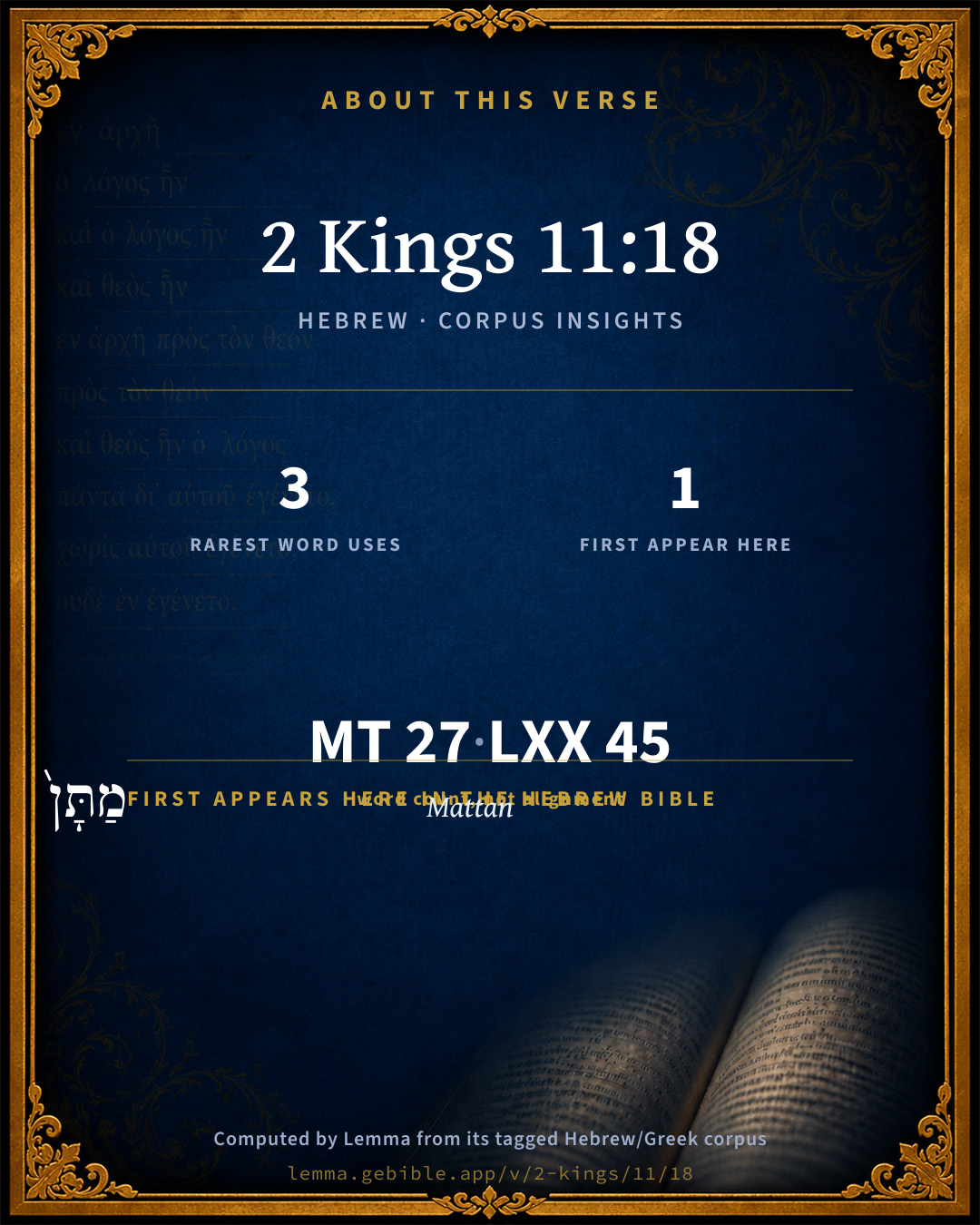
The rarest word here is מַתָּן֙ Mattan H4977 — appearing just 3 times in the whole Hebrew Bible.

First appearance in Scripture

This word makes its first canonical appearance in the Hebrew Bible here:

  • מַתָּן֙ Mattan H4977

Shared distinctive vocabulary

מַתָּן֙ Mattan H4977 occurs in 3 verses of the Hebrew Bible. Also found in:

Grammatical profile

  • 6 verbs
  • 17 nouns
  • 1 preposition
  • 3 particles

Verb forms

  • וַיָּבֹ֣אוּ Qal · Sequential Imperfect
  • וַֽיִּתְּצֻ֗הוּ Qal · Sequential Imperfect
  • שִׁבְּר֣וּ Piel · Perfect
  • הֵיטֵ֔ב Hiphil · Infinitive Absolute
  • הָרְג֖וּ Qal · Perfect
  • וַיָּ֧שֶׂם Qal · Sequential Imperfect

Repetition

Words recur within this verse — often emphatic in Hebrew:

  • מזבחתו altar H4196 ×3
  • בֵּית house H1004 ×2
  • הַבַּ֜עַל Baal H1168 ×2
  • כֹּהֵ֣ן priest H3548 ×2

Hebrew & Septuagint length

In English translation the verse runs 45 words from the Hebrew and 49 from the Septuagint (LXX English) — closely comparable.

A rough comparison of the two English renderings, which tokenize alike — not a word-level alignment.

Word counts can differ between the Hebrew and the Greek without any difference in meaning — e.g. the Hebrew direct-object marker אֵת has no separate Greek word, and Greek often adds the article ὁ.

In the original languages it is 27 Hebrew tokens and 45 Greek tokens — but the two are counted differently (Hebrew bundles its prefixes and suffixes into one token; the Greek is in lemma form), so that isn’t a like-for-like length.

Cross-references

17

Topical passages linked to 2 Kings 11:18 in the Treasury of Scripture Knowledge — connected by theme and wording, ordered by reader-vote popularity; previews shown in the World English Bible.

  • Deuteronomy 12:3 and you shall break down their altars, and dash in pieces their pillars, and burn their Asherim with fire; and you shall cut down the engraved images of their gods; and you shall destroy their name out of that place.
  • 1 Kings 18:40 and Elijah said to them, Take the prophets of Baal; don't let one of them escape. They took them; and Elijah brought them down to the brook Kishon, and killed them there.
  • 2 Kings 10:26 They brought forth the pillars that were in the house of Baal, and burned them.
  • 2 Kings 18:4 He removed the high places, and broke the pillars, and cut down the Asherah: and he broke in pieces the brazen serpent that Moses had made; for to those days the children of Israel did burn incense to it; and he called it Nehushtan.
  • Deuteronomy 13:5 That prophet, or that dreamer of dreams, shall be put to death, because he has spoken rebellion against Yahweh your God, who brought you out of the land of Egypt, and redeemed you out of the house of bondage, to draw you aside out of the way which Yahweh your God commanded you to walk in. So shall you put away the evil from the midst of you.
  • Exodus 32:20 He took the calf which they had made, and burnt it with fire, ground it to powder, and scattered it on the water, and made the children of Israel drink of it.
  • Deuteronomy 13:9 but you shall surely kill him; your hand shall be first on him to put him to death, and afterwards the hand of all the people.
  • 2 Kings 9:25–28 Then said [Jehu] to Bidkar his captain, Take up, and cast him in the portion of the field of Naboth the Jezreelite; for remember how that, when I and you rode together after Ahab his father, Yahweh laid this burden on him:
  • 2 Kings 23:4–6 The king commanded Hilkiah the high priest, and the priests of the second order, and the keepers of the threshold, to bring forth out of the temple of Yahweh all the vessels that were made for Baal, and for the Asherah, and for all the host of the sky, and he burned them outside of Jerusalem in the fields of the Kidron, and carried the ashes of them to Bethel.
  • 2 Kings 23:10 He defiled Topheth, which is in the valley of the children of Hinnom, that no man might make his son or his daughter to pass through the fire to Molech.
  • 2 Kings 23:14 He broke in pieces the pillars, and cut down the Asherim, and filled their places with the bones of men.
  • 2 Chronicles 21:17 and they came up against Judah, and broke into it, and carried away all the substance that was found in the king's house, and his sons also, and his wives; so that there was never a son left him, save Jehoahaz, the youngest of his sons.
  • 2 Chronicles 23:17–20 All the people went to the house of Baal, and broke it down, and broke his altars and his images in pieces, and killed Mattan the priest of Baal before the altars.
  • 2 Chronicles 34:4 They broke down the altars of the Baals in his presence; and the sun-images that were on high above them he hewed down; and the Asherim, and the engraved images, and the molten images, he broke in pieces, and made dust of them, and strewed it on the graves [of those] who had sacrificed to them.
  • 2 Chronicles 34:7 He broke down the altars, and beat the Asherim and the engraved images into powder, and hewed down all the sun-images throughout all the land of Israel, and returned to Jerusalem.
  • Isaiah 2:18 The idols shall utterly pass away.
  • Zechariah 13:2–3 It will come to pass in that day, says Yahweh of Hosts, that I will cut off the names of the idols out of the land, and they will no more be remembered; and also I will cause the prophets and the spirit of impurity to pass out of the land.

Cross-references courtesy of OpenBible.info (CC BY 4.0).

Hebrew and Greek witnesses Masoretic Hebrew ↔ Greek Septuagint

The same verse in the two great witnesses to the Old Testament, shown verse-for-verse.

These are two independent witnesses, not word-aligned to each other, and the Septuagint is shown in lemma (dictionary) form.

Hebrew 2 Kings 11:18 Masoretic · Westminster Leningrad Codex

וַיָּבֹ֣אוּ כָל עַם֩ הָאָ֨רֶץ בֵּית הַבַּ֜עַל וַֽיִּתְּצֻ֗הוּ אֶת מזבחתו מִזְבְּחֹתָ֤יו וְאֶת צְלָמָיו֙ שִׁבְּר֣וּ הֵיטֵ֔ב וְאֵ֗ת מַתָּן֙ כֹּהֵ֣ן הַבַּ֔עַל הָרְג֖וּ לִפְנֵ֣י הַֽמִּזְבְּח֑וֹת וַיָּ֧שֶׂם הַכֹּהֵ֛ן פְּקֻדּ֖וֹת עַל בֵּ֥ית יְהוָֽה

All the people of the land went to the house of Baal, and broke it down; his altars and his images broke they in pieces thoroughly, and killed Mattan the priest of Baal before the altars. The priest appointed officers over the house of Yahweh.

World English Bible · Public Domain

Greek LXX 2 Kings 11:18 Septuagint · lemma form

καί εἰςἔρχομαι πᾶς ὁ λαός ὁ γῆ εἰς οἶκος ὁ βααλ καί κατασπάω αὐτός καί ὁ θυσιαστήριον αὐτός καί ὁ εἰκών αὐτός συντρίβω ἀγαθῶς καί ὁ ματθαν ὁ ἱερεύς ὁ βααλ ἀποκτείνω κατά πρόσωπον ὁ θυσιαστήριον καί τίθημι ὁ ἱερεύς ἐπισκοπός εἰς ὁ οἶκος κύριος

And all the people of the land went into the house of Baal, and tore it down, and completely broke in pieces his altars and his images, and they killed Mathan the priest of Baal before the altars. And the priest appointed overseers over the house of the Lord.

LXX2012 (modern English Septuagint) · Public Domain

On this verse, Haydock's Catholic Bible Commentary discusses the Septuagint’s reading. Read the note in Commentary ↓

Hebrew: Westminster Leningrad Codex (CC BY 4.0). Greek: Septuagint (public domain); English from LXX2012 (modern English Septuagint) (Public Domain). How the Septuagint differs from the Hebrew →

Targum (Aramaic paraphrase)

1

The Targum is the ancient Jewish Aramaic paraphrase of the Hebrew Scriptures — an interpretive translation, not the Hebrew text itself. Onkelos (literal) and Pseudo-Jonathan (expansive) render the Torah, and Jonathan the Prophets. Coverage is partial: where no permissively-licensed English translation exists for a verse, only the Aramaic is shown. This is verse-level text, not a word-by-word alignment to the Hebrew.

  1. Targum Jonathan Prophets (Joshua–Malachi)
    וְעָלוּ כָל עַמָא דְאַרְעָא לְבֵית בְּעָלָא וְסַתְּרוּהִי וְיַת אֱגוֹרוֹהִי וְיַת צַלְמוֹהִי תְּבִירוּ יָאוּת וְיַת מַתַּן כּוּמְרַיָא דִבְעָלָא קְטַלוּ קֳדָם אֱגוֹרָא וּמַנֵי כַּהֲנָא מַטְרָן עַל בֵּית מַקְדְשָׁא דַיְיָ:

    (no public-domain English translation for this verse)

    Targum Jonathan — Aramaic: “Mikraot Gedolot” (public domain). English: “Sefaria Community Translation” (CC0 1.0 (public-domain dedication)); “London "Chaldee Paraphrase," 1871” (public domain). Text via Sefaria.

Commentary

Notes on 2 Kings 11:18 from classic Christian and Jewish commentators (each source and its license shown beneath its notes). The classic Christian expositions comment on the surrounding passage and are grouped to its opening verse, so a note may address several verses; the Jewish commentaries on the Tanakh (Rashi and others) are per-verse, so they appear only where the commentator wrote on this verse.

Lemma curates 59 commentaries, every one of them public domain or Creative Commons licensed, each selected and text-cleaned for this edition rather than reprinted as found. About our sources →

Trapp's Complete Commentary

John Trapp

2Ki 11:18 And all the people of the land went into the house of Baal, and brake it down; his altars and his images brake they in pieces thoroughly, and slew Mattan the priest of Baal before the altars. And the priest appointed officers over the house of the LORD.

Ver. 18. And brake it down.] As Israel had done before them.

And the priest.] Jehoiada. See on 2Ki 11:9.

Over the house of the Lord.] Which the sons of that wicked woman Athaliah, perhaps her bastards, had broken up, and bestowed all the dedicated things of the house of the Lord upon Balaam. {2Ch 24:7} So that there was but need of officers, or offices, to set things in order again.

John Trapp, A Commentary or Exposition upon All the Books of the Old and New Testament (1647–1656) — public domain. Text from a community e-Sword module.

Joseph Benson's Commentary

2Ki 11:18. All the people went into the house of Baal — They began immediately to make good their covenant in part, by destroying the worship of Baal, which had been introduced in Judah by Jehoram, (2Ki 8:18,) and was continued by Ahaziah, 2Ki 8:27. And slew the priest of Baal before the altars — To which possibly he fled for refuge, or rather he was brought thither as a fit sacrifice to his god. The priest appointed officers over the house of the Lord — To see that the service was regularly performed by the proper persons, in due time, and according to the instituted manner. See the margin.

Joseph Benson's Commentary on the Old and New Testaments (1811–1818) — public domain. Text from a community e-Sword module.

Tyndale Open Study Notes

Tyndale Open Resources

11:18 The temple of Baal may be the temple discovered in Ramat Rahel about three miles south of Jerusalem. As Jehu destroyed Baal worship in the northern kingdom (10:18-27) so the people of Judah tore . . . down this pagan temple and executed its priest. • Jehoiada . . . stationed guards at the Temple as a precaution against further reprisal by those loyal to Athaliah and her false religion.

Tyndale Open Study Notes — © Tyndale Open Resources, licensed CC BY-SA 4.0. Text via the HelloAO Bible API.

Geneva Bible (1599)

Geneva Bible translators

Even in the place where he had blasphemed God, and thought to have been helped by his idol, there God poured his vengeance upon him.

To wit, Jehoiada.

Geneva Bible (1599) marginal notes — public domain. Text via Bolls.life.

Adam Clarke's Commentary

Verse 18. His altars and images brake they in pieces] It is probable that Athaliah had set up the worship of Baal in Judah, as Jezebel had done in Israel; or probably it had never been removed since the days of Solomon. It was no wonder that Jehoiada began his reform with this act, when we learn from 2Ch 24:7, that the sons of Athaliah, that wicked woman, had broken up the house of God; and also all the dedicated things of the house of the Lord did they bestow upon Baalim.

Adam Clarke's Commentary on the Bible (1810–1826) — public domain. Text from a community e-Sword/MySword module.

Ellicott's Commentary for English Readers

(18) All the people of the land went into the house of Baal.—Immediately after the covenant had been renewed, of which the extirpation of the foreign Baal-worship was a consequence. In the fervour of their newly-awakened enthusiasm for Jehovah, the assembly may have hurried off at once to the work of demolition. It seems to be implied that the “house of Baal” stood on the Temple mount, in ostentatious rivalry with the sanctuary of Jehovah. (Comp, the introduction of idolatrous altars into the Temple itself by Manasseh, 2Ki_21:4-5; 2Ki_21:7; 2Ki_23:12.) This house of Baal had, perhaps, been built by Athaliah. (Comp. 1Ki_16:31-32.)

His altars . . . his images.—Or, its (the Temple’s) altars . . . its images.

And the priest appointed officers over the house of the Lord.—The obviously close connection of this statement with what precedes, almost proves that the sanctuary of Baal had stood within the Temple precincts, probably in the outer court. After the destruction of it, Jehoiada appointed certain overseers—probably Levites of rank—to prevent any future desecration of the Temple by the practice of idolatrous rites (comp. Eze_8:5-16), or by wanton attacks of the Baal-worshippers, who might be cowed, but were certainly not exterminated (comp. 2Ch_24:7); and to see that the legitimate cultus was properly carried out. (The sentence tells us what was done some time afterwards, in consequence of the reformation; thus finishing the subject in hand at the expense of the strict order of time.)

Mattan.—Mattan is short for Mattanbaal, “gift of Baal,” a Phœnician name occurring in Punic and Assyrian inscriptions (the Muthumballes of Plautus). Comp. also Mitinna and Mattén, as names of Tyrian kings (Inscr. of Tig. Pil. ii.; Herod. Vii. 98).

A Bible Commentary for English Readers, edited by Charles John Ellicott (1878–1897) — public domain. Text from a community e-Sword module.

The Cambridge Bible for Schools and Colleges

gen. ed. J. J. S. Perowne

18. went into [R.V. to] the house of Baal] Athaliah had set up Baal worship in Judah after the fashion of the northern kingdom. We are told also in 2Ch_24:7 that the sons of Athaliah had broken up (i.e. broken into) the house of God, and bestowed the dedicated things of the house of the Lord upon the Baalim. It is clear from this that the house of Baal was not any portion of the temple which had been appropriated to the idolatrous worship, but a separate building, into which spoils from the temple had been conveyed. It may have been on the same hill with the temple, though of that we cannot be certain. There can however be no doubt that the Baal worship had not extended largely in Judah. Hence the readiness of the people of the land, called to Jerusalem by some festival, to go to the Baalite edifice and destroy it.

brake they in pieces throughly] That there should be no chance of a restoration. The multitude were no doubt helped in their destruction by the military force with which, in these doings, they had been in such close combination.

Mattan the priest of Baal] We read of no other priest of Baal in Judah, and so we may conclude that though the court favoured idolatry, it found no great favour with the rest of the kingdom. Otherwise we should have heard of an array of priests like that of Jezebel in Samaria.

And the priest appointed officers over the house of the Lord] From this necessity we may gather that the regular ministrations in the temple had been interfered with by the introduction of the Baalim. The Chronicler gives fuller details on this matter, and the two accounts have so much verbal similarity in other parts that we cannot avoid the conclusion that both writers used a common source of information. He says (2Ch_23:18-19) ‘Jehoiada appointed the offices of the house of the Lord by the hand of the priests, the Levites, whom David had distributed in the house of the Lord, to offer the burnt offerings of the Lord, as it is written in the law of Moses, with rejoicing and with singing, as it was ordained by David. And he set the porters at the gates of the house of the Lord that none which was unclean in any thing should enter in’.

The Cambridge Bible for Schools and Colleges (gen. ed. J. J. S. Perowne; Cambridge University Press, 1878–1918) — public domain. Text from a community e-Sword module.

John Gill's Exposition

And he took the rulers over hundreds, and the captains, and the guard,.... Of which Kg2 11:4 and all the people of the land; as many as were assembled together on this occasion:

and they brought down the king from the house of the Lord; the temple, which was built on an eminence:

and came by the way of the gate to the king's house; the gate of the royal palace, where the king's guards were placed, and did their duty: and he sat on the throne of the kings: where the kings of Judah used to sit, and this finished the formality of his being made king.

John Gill's Exposition of the Whole Bible (1746–1763) — public domain (CC PDM 1.0). Text via the HelloAO Bible API.

Albert Barnes' Notes on the Bible

A temple had been built to Baal at Jerusalem itself by Athaliah, Ahaziah, or Jehoram. According to Josephus, it was constructed in the reign of Jehoram. Its exact position is uncertain.

Images - The word used here is not the same as in 2Ki 10:26, but a word which implies likeness. The Phoenicians had fashioned images, besides their unfashioned pillar-idols.

The priest appointed ... - The temple worship having been discontinued during Athaliah’s rule, it devolved on Jehoiada now to re-establish it (see marginal reference). He had already summoned the Levites out of all the cities of Judah 2Ch 23:2, and had made use of them in the events of the day. He therefore proceeded at once to assign the custody of the temple to a particular course, before conducting the young king to the palace.

Albert Barnes' Notes on the Bible (1834–1885) — public domain. Text from a community e-Sword/MySword module.

Haydock's Catholic Bible Commentary

Altar. Many of the sacred ornaments belonging to the temple had been transported to the house of Baal, probably on Mount Olivet, where Solomon had formerly erected such buildings, 3 Kings xi. 5., and 2 Paralipomenon xxiv. 7. The reform of the state justly, therefore, began with the destruction of this profane and sacrilegious place. --- Lord, according to the former regulations, which had been lately ill observed, to prevent any thing unclean from coming in, 2 Paralipomenon xxiii. 19. (Calmet) --- Septuagint, "the priest placed overseers (Greek: episkopons) in the house of the Lord. (Haydock)

George Leo Haydock (1774–1849), Haydock's Catholic Family Bible and Commentary, 1859 edition — public domain. Excludes Psalms (Douay-Rheims chapter numbering differs from Protestant) and Deuterocanonical books (Catholic canon only).

Matthew Poole's English Annotations

Before the altar; to which possibly he fled for refuge; or rather, he was brought thither as a fit sacrifice to his God.

Officers over the house of the Lord; of which see more particularly, 2Ch 23:18,19.

Matthew Poole's English Annotations on the Holy Bible (1683–1685) — public domain. Text from a community e-Sword/MySword module.

Whedon's Commentary on the Bible

Daniel D. Whedon

18. Went into the house of Baal — So firmly had the worship of Baal fastened itself upon the whole Israelitish nation that Jerusalem, as well as Samaria, had its temple to this god. Jehu destroyed the Baal worship in Samaria, (compare 2Ki_10:18-28;) Jehoiada and his adherents that in Jerusalem.

Appointed officers over the house of the Lord — Reorganized the temple service, which had been partially interrupted and disturbed by the revolution effected in the kingdom.

Daniel D. Whedon (gen. ed.), Commentary on the Old and New Testaments (1874–1909) — public domain. Text from a community e-Sword module.

The Pulpit Commentary

And all the people of the landi.e. all those who had come up to Jerusalem from the various cities of Judah to help Jehoiada (see 2Ch_23:2) went into the house of Baal. According to Josephus, "the house of Baal" hero mentioned was built by Jehoram and Athaliah in the reign of the former ("Ant. Jud:," 9:7. But, if this was the case, it is rather strange that the writer of Chronicles, who enumerates so many of the evil acts of Jehoram, (2Ch_21:4, 2Ch_21:6, 2Ch_21:11) does not mention it. The present narrative shows that the temple was in, or very near, Jerusalem; but there is nothing to fix the site of it. And brake it down Josephus says they "razed it to the ground" (kateskayan)his altars and his images brake they in pieces thoroughly. It was common among the heathen to have several altars in one temple, and not uncommon to have several images even of the same god, especially if he was a god worshipped under different forms, as Baal was (whence the word "Baalim"). The Baalim of this temple are mentioned by the writer of Chronicles. (see 2Ch_24:7) And slew Mattan the priest of Baal before the altars. The name "Mattan" recalls that of the last King of Judah, which was originally Mattaniah, equivalent to "gift of Jehovah". (2Ki_24:17) Mattan would be simply "gift." We may presume that, though only called "priest," he was the high priest. And the priesti.e. Jehoiadaappointed officers over the house of the Lord. The parallel passage of Chronicles (2Ch_23:18, 2Ch_23:19) explains this statement. We are there told that "Jehoiada appointed the offices of the house of the Lord by the hand of the priests the Levites... to offer the burnt offerings of the Lord, as it is written in the Law of Moses, with rejoicing and with singing, as it was ordained by David. And he set the porters at the gates of the house of the Lord, that none which was unclean in anything should enter in." During Athaliah"s reign the temple service had ceased; breaches had been broken in the outer walls; and neither the priests nor the porters had served in their regular order; there had been no morning or evening sacrifice, and no antiphonal psalm-singing. Jehoiada re-established the regular courses and the worship.

The Pulpit Commentary (1880–1919), ed. H.D.M. Spence-Jones & Joseph S. Exell — public domain. Text from a community e-Sword module.

Rashi

Rabbi Shlomo Yitzchaki (Rashi)

Assignments. Appointed to watch at the location of their watch according to their charge, because Atalyohu had abolished the order of the watches in the Beis [Hamikdosh].

Rashi on the Tanakh — English translations: “The Judaica Press complete Tanach with Rashi, translated by A. J. Rosenberg” (CC BY 4.0); “Pentateuch with Rashi's commentary by M. Rosenbaum and A.M. Silbermann, 1929-1934” (public domain); “The Metsudah Tanach series, Lakewood, N.J” (CC BY 4.0); and “The Book of Joshua, Metsudah Publications, 1997” (CC BY 4.0). Text via Sefaria.

Lesson kit

Teaching starters — assembled from the data on this page, not authored interpretation. Every prompt links to the verse data it draws on. Edit before teaching.

2 Kings, in the Historical, opens this verse with 27 words (20 distinct Hebrew lemmas). Its most distinctive word is Mattân (“Mattan”). A historical commentator’s framing appears above. Read the whole chapter for the surrounding context.

Discussion questions

  1. The word Mattân carries the sense “Mattan.” How does it shape the verse?
  2. This is the first place “Mattan” appears in Scripture (first appears here). What does its debut here establish?
  3. How does 2 Chronicles 23:17, which shares the word «Mattan», read alongside this verse?
  4. What does the repetition of “altar” (3× in this one verse) do in this verse?
  5. These translations render this verse differently; the difference is in the English rendering, not the original. What questions does that raise?
  6. «וַיָּבֹ֣אוּ» is a Qal Sequential Imperfect verb. How does that grammatical form shape the action described?
  7. Compare how Trapp's Complete Commentary and Joseph Benson's Commentary read this verse. Where do they agree or differ?

Things to notice

Reading settings

Reading text

Shown beneath each verse's original-language words.

Old Testament
Old Testament edition

Read the OT as the Masoretic Hebrew (MT) or the Greek Septuagint (LXX).

English shown for the Greek Septuagint (in the Hebrew ↔ Greek comparison).

Comparing translations? Open the Compare panel on any verse page to stack up to four side by side.