Judges 21:4

Hebrew (Westminster Leningrad Codex) Judges 21:4 appears in the Hebrew Old Testament. The text above is from the Westminster Leningrad Codex. Each word links to its Strong’s number, a concise gloss, and parsing drawn from the Open Scriptures Hebrew Bible morphology. Click any word for its full Brown-Driver-Briggs (BDB) entry.
Download image
Cite this verse

Judges 21:4 (World English Bible). Public Domain. Lemma interlinear Bible study tool, https://lemma.gebible.app/v/judges/21/4.

Show BibTeX & RIS
BibTeX
RIS
English Translation
It happened on the next day that the people rose early, and built there an altar, and offered burnt offerings and peace-offerings.
World English Bible · Public Domain
Download a study sheet

One document with this verse’s original text, its word-by-word gloss line, the meaning frame, cross-references with their text, attributed commentary, and full source and license credits — printable, and it pastes into notes with its structure intact.

This verse Autodidact and up

Study sheet (.html) Plain text (.txt)

A passage Seminary Student

Up to 50 verses in one chapter. A passage sheet keeps up to 6 commentary sources and 12 cross-references per verse, in the order this page ranks them, and says so on the sheet whenever that leaves anything out. Ask for a single verse and you get the Autodidact verse sheet above.

Everything on this page stays free to read, with no account — the sheet is a download of what is already on screen, not access to it.

Want to remove ads? Support Godless Engineer
Compare translations 3

The same verse in 3 English versions, stacked beneath the original-language interlinear above. Click any original word for its lexicon entry.

Each is an independent rendering of the whole verse — the interlinear is not word-aligned to these translations.

Highlighted words mark where these versions differ — a whole-verse word diff, not a word-by-word alignment.

  • World English Bible Public Domain
    It happened on the next day that the people rose early, and built there an altar, and offered burnt offerings and peace-offerings.
  • King James Version Public Domain
    And it came to pass on the morrow, that the people rose early, and built there an altar, and offered burnt offerings and peace offerings.
  • unfoldingWord Literal Text CC BY-SA 4.0
    And it happened the next day that the people arose early and built an altar there and offered burnt offerings and peace offerings.

unfoldingWord Literal Text — © unfoldingWord, licensed CC BY-SA 4.0. Word-aligned USFM3 via Door43 (git.door43.org/unfoldingWord/en_ult).

Versions to compare (up to 4)

3 of 4 selected

Show all 18 translations

Every available English version of this verse, each an independent rendering of the whole verse.

  • World English Bible Public Domain
    It happened on the next day that the people rose early, and built there an altar, and offered burnt offerings and peace-offerings.
  • Berean Standard Bible Public Domain
    The next day the people got up early, built an altar there, and presented burnt offerings and peace offerings.
  • Majority Standard Bible Public Domain
    The next day the people got up early, built an altar there, and presented burnt offerings and peace offerings.
  • King James Version Public Domain
    And it came to pass on the morrow, that the people rose early, and built there an altar, and offered burnt offerings and peace offerings.
  • American Standard Version (1901) Public Domain
    And it came to pass on the morrow, that the people rose early, and built there an altar, and offered burnt-offerings and peace-offerings.
  • Revised Version (1885) Public Domain
    And it came to pass on the morrow, that the people rose early, and built there an altar, and offered burnt offerings and peace offerings.
  • Geneva Bible (1599) Public Domain
    And on the morow the people rose vp and made there an altar, and offred burnt offrings and peace offrings.
  • Douay-Rheims (1899) Public Domain
    And rising early the next day, they built an altar: and offered there holocausts, and victims of peace, and they said:
  • Young's Literal Translation Public Domain
    And it cometh to pass on the morrow, that the people rise early, and build there an altar, and cause to ascend burnt-offerings and peace-offerings.
  • Literal Standard Version CC BY-SA 4.0
    And it comes to pass on the next day, that the people rise early, and build an altar there, and cause burnt-offerings and peace-offerings to ascend.
  • Unlocked Literal Bible CC BY-SA 4.0
    The next day the people got up early and built an altar there and offered burnt offerings and peace offerings.
  • unfoldingWord Literal Text CC BY-SA 4.0
    And it happened the next day that the people arose early and built an altar there and offered burnt offerings and peace offerings.
  • Darby Bible Public Domain
    And on the morrow the people rose early, and built there an altar, and offered burnt offerings and peace offerings.
  • World Messianic Bible Public Domain
    On the next day, the people rose early and built an altar there, and offered burnt offerings and peace offerings.
  • Webster's Bible Public Domain
    And it came to pass on the morrow, that the people rose early, and built there an altar, and offered burnt-offerings, and peace-offerings.
  • Free Bible Version CC BY-SA 4.0
    The next day they got up early, built an altar, and brought burnt offerings and friendship offerings.
  • Bible in Basic English Public Domain
    Then on the day after, the people got up early and made an altar there, offering burned offerings and peace-offerings.
  • JPS Tanakh (1917) Public Domain
    And it came to pass on the morrow that the people rose early, and built there an altar, and offered burnt-offerings and peace-offerings.

Literal Standard Version (2020), Covenant Press — licensed CC BY-SA 4.0. Text via the HelloAO Bible API (eBible.org). Unlocked Literal Bible (unfoldingWord) — licensed CC BY-SA 4.0. Text via the HelloAO Bible API (eBible.org). unfoldingWord Literal Text — © unfoldingWord, licensed CC BY-SA 4.0. Word-aligned USFM3 via Door43 (git.door43.org/unfoldingWord/en_ult). Free Bible Version, Dr. Jonathan Gallagher — licensed CC BY-SA 4.0. Text via the HelloAO Bible API (eBible.org).

Word by word

More ways to search: Search by grammar → Find every occurrence → Compare this word →

Practice this passage: Drill this verse → Learn its vocabulary →

מִֽמָּחֳרָ֔ת
mochŏrâth
H4283
“from · morrow”
Preposition + Noun, Common, Feminine, Singular, Absolute
Part of Speech
Preposition + Noun
Type
Common
Gender
Feminine
Number
Singular
State
Absolute
Full BDB Definition

Origin: from the same as H4279

TWOT: 1185b

the morrow, the day after
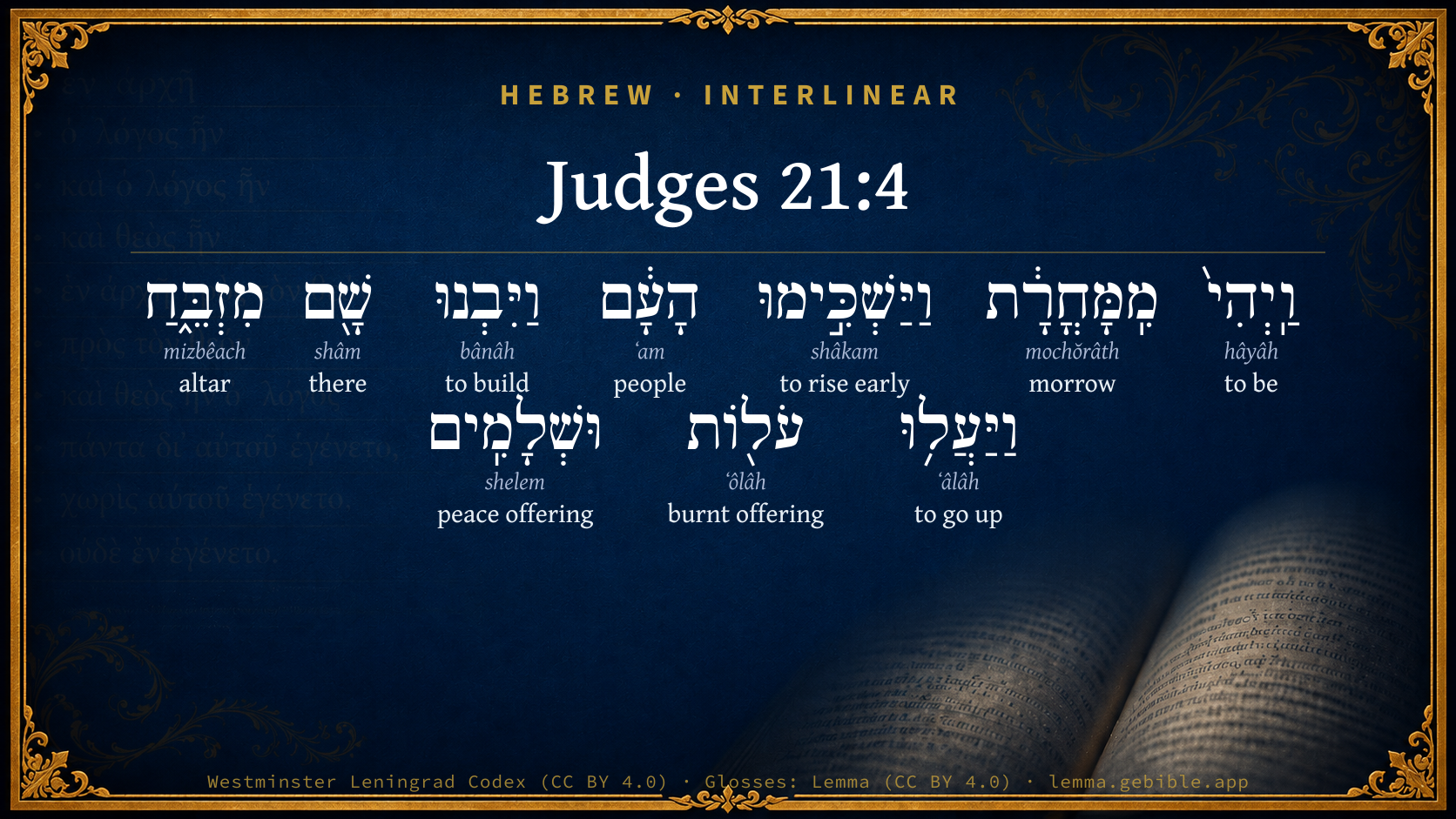
  1. וַֽיְהִי֙ hâyâh H1961 “and · to be” Conjunction + Verb, Qal, Sequential Imperfect, 3rd Person, Masculine, Singular
  2. וַיַּשְׁכִּ֣ימוּ shâkam H7925 “and · to rise early” Conjunction + Verb, Hiphil, Sequential Imperfect, 3rd Person, Masculine, Plural
  3. הָעָ֔ם ʻam H5971 “the · people” Particle, Definite Article + Noun, Common, Masculine, Singular, Absolute
  4. וַיִּבְנוּ bânâh H1129 “and · to build” Conjunction + Verb, Qal, Sequential Imperfect, 3rd Person, Masculine, Plural
  5. שָׁ֖ם shâm H8033 “there” Adverb
  6. מִזְבֵּ֑חַ mizbêach H4196 “altar” Noun, Common, Masculine, Singular, Absolute
  7. וַיַּעֲל֥וּ ʻâlâh H5927 “and · to go up” Conjunction + Verb, Hiphil, Sequential Imperfect, 3rd Person, Masculine, Plural
  8. עֹל֖וֹת ʻôlâh H5930 “burnt offerings” Noun, Common, Feminine, Plural, Absolute
  9. וּשְׁלָמִֽים shelem H8002 “and · peace offerings” Conjunction + Noun, Common, Masculine, Plural, Absolute

About this verse

These counts appear in no published source. They are computed here, from the morphology-tagged text and Lemma’s own curated glosses. What Lemma adds →

10
words
10
distinct lemmas
Historical
section

Shared distinctive vocabulary

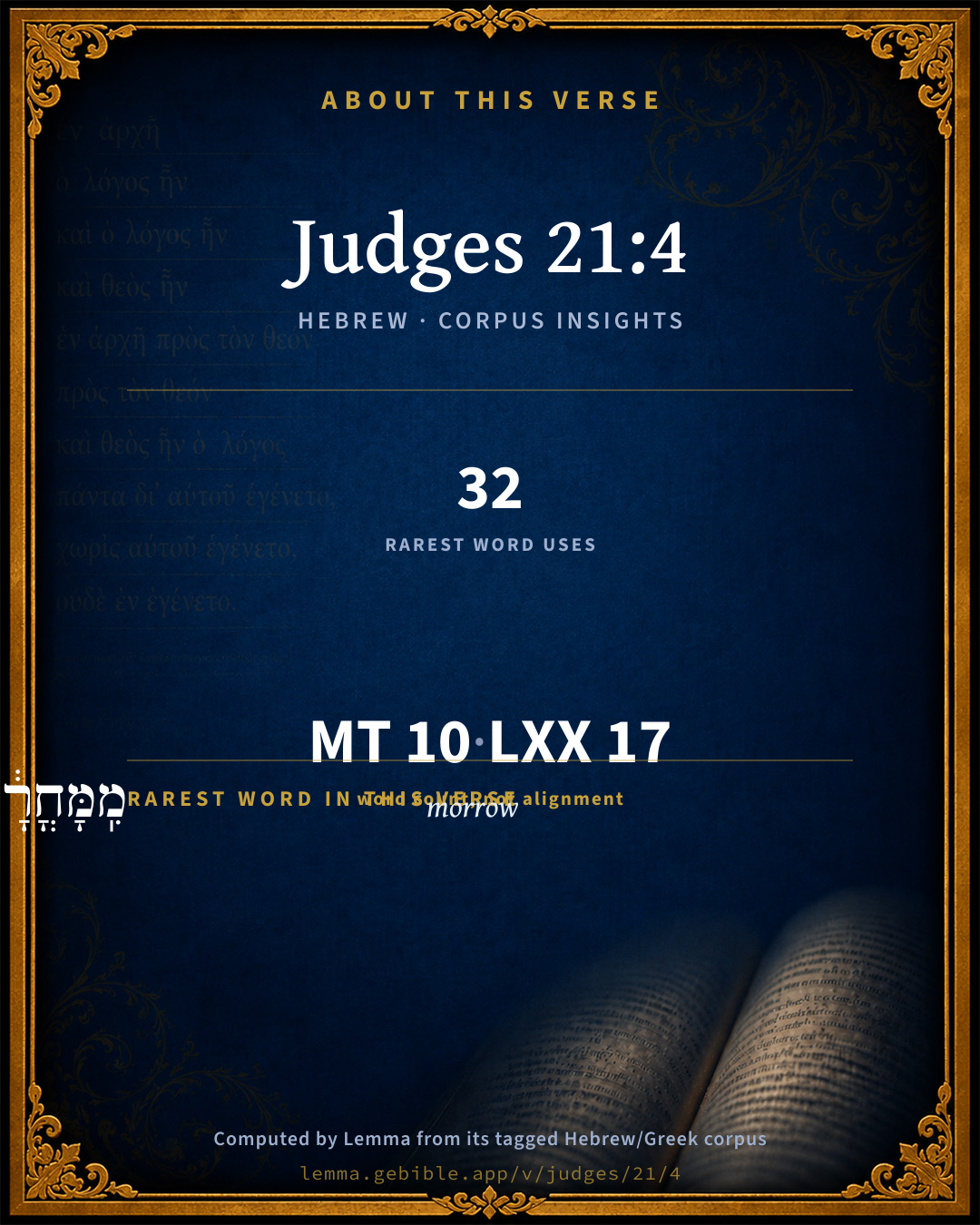
מִֽמָּחֳרָ֔ת morrow H4283 occurs in 32 verses of the Hebrew Bible. Also found in:

Grammatical profile

  • 4 verbs
  • 5 nouns
  • 1 adverb

Verb forms

  • וַֽיְהִי֙ Qal · Sequential Imperfect
  • וַיַּשְׁכִּ֣ימוּ Hiphil · Sequential Imperfect
  • וַיִּבְנוּ Qal · Sequential Imperfect
  • וַיַּעֲל֥וּ Hiphil · Sequential Imperfect

Hebrew & Septuagint length

In English translation the verse runs 22 words from the Hebrew and 28 from the Septuagint (LXX English) — closely comparable.

A rough comparison of the two English renderings, which tokenize alike — not a word-level alignment.

Word counts can differ between the Hebrew and the Greek without any difference in meaning — e.g. the Hebrew direct-object marker אֵת has no separate Greek word, and Greek often adds the article ὁ.

In the original languages it is 10 Hebrew tokens and 17 Greek tokens — but the two are counted differently (Hebrew bundles its prefixes and suffixes into one token; the Greek is in lemma form), so that isn’t a like-for-like length.

Cross-references

8

Topical passages linked to Judges 21:4 in the Treasury of Scripture Knowledge — connected by theme and wording, ordered by reader-vote popularity; previews shown in the World English Bible.

  • 2 Samuel 24:25 David built there an altar to Yahweh, and offered burnt offerings and peace-offerings. So Yahweh was entreated for the land, and the plague was stayed from Israel.
  • Exodus 20:24–25 You shall make an altar of earth for me, and shall sacrifice on it your burnt offerings and your peace-offerings, your sheep and your oxen. In every place where I record my name I will come to you and I will bless you.
  • Judges 6:26 and build an altar to Yahweh your God on the top of this stronghold, in the orderly manner, and take the second bull, and offer a burnt offering with the wood of the Asherah which you shall cut down.
  • 2 Samuel 24:18 Gad came that day to David, and said to him, Go up, rear an altar to Yahweh in the threshing floor of Araunah the Jebusite.
  • 1 Kings 8:64 The same day did the king make the middle of the court holy that was before the house of Yahweh; for there he offered the burnt offering, and the meal-offering, and the fat of the peace-offerings, because the brazen altar that was before Yahweh was too little to receive the burnt offering, and the meal-offering, and the fat of the peace-offerings.
  • Psalms 78:34–35 When he killed them, then they inquired after him. They returned and sought God earnestly.
  • Hosea 5:15 I will go and return to my place, until they acknowledge their offense, And seek my face. In their affliction they will seek me earnestly."
  • Hebrews 13:10 We have an altar from which those who serve the holy tabernacle have no right to eat.

Cross-references courtesy of OpenBible.info (CC BY 4.0).

Hebrew and Greek witnesses Masoretic Hebrew ↔ Greek Septuagint

The same verse in the two great witnesses to the Old Testament, shown verse-for-verse.

These are two independent witnesses, not word-aligned to each other, and the Septuagint is shown in lemma (dictionary) form.

Hebrew Judges 21:4 Masoretic · Westminster Leningrad Codex

וַֽיְהִי֙ מִֽמָּחֳרָ֔ת וַיַּשְׁכִּ֣ימוּ הָעָ֔ם וַיִּבְנוּ שָׁ֖ם מִזְבֵּ֑חַ וַיַּעֲל֥וּ עֹל֖וֹת וּשְׁלָמִֽים

It happened on the next day that the people rose early, and built there an altar, and offered burnt offerings and peace-offerings.

World English Bible · Public Domain

Greek LXX Judges 21:4 Septuagint · lemma form

καί γίγνομαι ὁ ἐπαύριον καί ὀρθρίζω ὁ λαός καί οἰκοδομέω ἐκεῖ θυσιαστήριον καί ἀναφέρω ὁλοκαύτωσις καί τέλειος

And it came to pass on the morrow that the people rose up early, and built there an altar, and offered up whole burnt offerings and peace offerings.

LXX2012 (modern English Septuagint) · Public Domain

Hebrew: Westminster Leningrad Codex (CC BY 4.0). Greek: Septuagint (public domain); English from LXX2012 (modern English Septuagint) (Public Domain). How the Septuagint differs from the Hebrew →

Targum (Aramaic paraphrase)

1

The Targum is the ancient Jewish Aramaic paraphrase of the Hebrew Scriptures — an interpretive translation, not the Hebrew text itself. Onkelos (literal) and Pseudo-Jonathan (expansive) render the Torah, and Jonathan the Prophets. Coverage is partial: where no permissively-licensed English translation exists for a verse, only the Aramaic is shown. This is verse-level text, not a word-by-word alignment to the Hebrew.

  1. Targum Jonathan Prophets (Joshua–Malachi)
    וַהֲוָה מִיוֹמָא דְבַתְרוֹהִי וְאַקְדִימוּ עַמָא וּבְנוֹ תַמָן מַדְבְּחָא וְאַסִיקוּ עֲלַוָן וְנִכְסַת קוּדְשִׁין:

    (no public-domain English translation for this verse)

    Targum Jonathan — Aramaic: “Mikraot Gedolot” (public domain). English: “Sefaria Community Translation” (CC0 1.0 (public-domain dedication)); “London "Chaldee Paraphrase," 1871” (public domain). Text via Sefaria.

Commentary

Notes on Judges 21:4 from classic Christian and Jewish commentators (each source and its license shown beneath its notes). The classic Christian expositions comment on the surrounding passage and are grouped to its opening verse, so a note may address several verses; the Jewish commentaries on the Tanakh (Rashi and others) are per-verse, so they appear only where the commentator wrote on this verse.

Lemma curates 59 commentaries, every one of them public domain or Creative Commons licensed, each selected and text-cleaned for this edition rather than reprinted as found. About our sources →

Trapp's Complete Commentary

John Trapp

Jdg 21:4 And it came to pass on the morrow, that the people rose early, and built there an altar, and offered burnt offerings and peace offerings.

Ver. 4. And built there an altar.] Either for a monument and memorial of the victory, {a} as Jos 8:30 Jdg 6:24, or else by reason of the multitude of their sacrifices, {b} as 1Ki 8:64.

{a} Diodat.

{b} Junius

John Trapp, A Commentary or Exposition upon All the Books of the Old and New Testament (1647–1656) — public domain. Text from a community e-Sword module.

Joseph Benson's Commentary

Jdg 21:4. The people rose early and built there an altar — It is likely that they erected a new altar upon this present occasion, when such a multitude of sacrifices were to be offered by all the people of Israel, that the ordinary altar was not sufficient to receive them. Thus Solomon did when he dedicated the temple, 1Ki 8:64. And, by the direction of God, it was frequently done in other places besides at the house of God.

Joseph Benson's Commentary on the Old and New Testaments (1811–1818) — public domain. Text from a community e-Sword module.

Geneva Bible (1599)

Geneva Bible translators

According to their custom, when they would consult with the Lord.

Geneva Bible (1599) marginal notes — public domain. Text via Bolls.life.

Adam Clarke's Commentary

Verse 4. Built there an altar] This affords some evidence that this was not a regular place of worship, else an altar would have been found in the place; and their act was not according to the law, as may be seen in several places of the Pentateuch. But there was neither king nor law among them, and they did whatever appeared right in their own eyes.

Adam Clarke's Commentary on the Bible (1810–1826) — public domain. Text from a community e-Sword/MySword module.

Ellicott's Commentary for English Readers

(4) Built there an altar.—We find David doing the same at the threshing-floor of Araunah (2Sa_24:25), and Solomon at Gibeon. Unless the entire tabernacle had, for the time, been removed to Bethel, there was no regular altar there. It has been suggested that in any case this altar must have been necessitated by the multitude of sacrifices required for the holocausts and the food of the people. (See Note on Jdg_20:26.) Probably there is some other reason unknown to us.

A Bible Commentary for English Readers, edited by Charles John Ellicott (1878–1897) — public domain. Text from a community e-Sword module.

The Cambridge Bible for Schools and Colleges

gen. ed. J. J. S. Perowne

4. built there an altar] But an altar must have existed in the sanctuary at Beth-el when the sacrifices were offered before, Jdg_20:26. Either these words, or the whole verse, must be a gloss, due perhaps to a recollection of 2Sa_24:25 and ch. Jdg_20:26.

The Cambridge Bible for Schools and Colleges (gen. ed. J. J. S. Perowne; Cambridge University Press, 1878–1918) — public domain. Text from a community e-Sword module.

John Gill's Exposition

And it came to pass on the morrow, that the people rose early,.... The day after their fasting and prayer, and a sense of their present case and circumstances being deeply impressed upon their minds, they rose early in the morning to acts of devotion, and exercises of religion, hoping that being in the way of their duty, the difficulties with which they were perplexed would be removed:

and built there an altar; if this place was Bethel, as Kimchi reasons, there Jacob had built an altar; but that in such a course of years might have been demolished: and if it was Shiloh, there was the tabernacle, and so the altar of the Lord there; wherefore this either signifies the repairing of that, being in ruins, which is not likely, since it was but lately used, Jdg 20:26 or the building of a new one, which to do in the tabernacle was not unlawful, especially when the number of sacrifices required it, which it is highly probable was the case now, as it was at the dedication of the temple, Kg1 8:64 though the above mentioned writer thinks, that building an altar signifies, as in many places, only seeking the Lord; but the use for which it was built is expressed:

and offered burnt offerings and peace offerings; both to atone for the sins they had been guilty of in the prosecution of the war, and to return thanks for victory given, and to implore fresh favours to be bestowed upon them.

John Gill's Exposition of the Whole Bible (1746–1763) — public domain (CC PDM 1.0). Text via the HelloAO Bible API.

Albert Barnes' Notes on the Bible

It is not certain whether the brass altar was at Bethel at this time, or whether it may not have been elsewhere, e. g., at Shiloh with the tabernacle. Some, however, think that the altar here mentioned was “additional” to the brass altar, in consequence of the unusual number of sacrifices caused by the presence of the whole congregation (compare 1Ki 8:64 note).

Albert Barnes' Notes on the Bible (1834–1885) — public domain. Text from a community e-Sword/MySword module.

Haydock's Catholic Bible Commentary

Altar, within the tabernacle, to suffice for the number of victims as Solomon did; (3 Kings viii. 64.; Tirinus) or out of the court, by God’s dispensation, as they were defiled with blood; (Numbers xxxi. 24.; Calmet) though this is not certain, as four months elapsed between the battle and the reconciliation of the remaining Israelites with their brethren: (chap. xx. 47.) so that during that interval, they might have committed the massacres in the different cities, and still have had time to be purified seven days, as the law required, before they could be allowed to enter the camp or the tabernacle. (Haydock) --- Some think that one altar was prescribed only during the sojournment in the desert. See Serarius. (Menochius)

George Leo Haydock (1774–1849), Haydock's Catholic Family Bible and Commentary, 1859 edition — public domain. Excludes Psalms (Douay-Rheims chapter numbering differs from Protestant) and Deuterocanonical books (Catholic canon only).

Matthew Poole's English Annotations

Built there an altar; not for a monument of the victory, as some say, but for sacrifices, as the next words show.

Quest. What need was there of this, when the ordinary altar was there, to which also they seem to be restrained, Deu 16:2?

Answ. They are not there restrained to one altar, but to one place of worship, as is expressed; and therefore there might be in that place more altars than one, when the multitude of sacrifices so required, which was the case 1Ki 8:61; and probably at this time, when all the tribes being met, they had many sacrifices to offer, some in common for all, and some peculiar to every tribe. Nay, other altars might be, and ofttimes were, erected in other places, by David, direction or dispensation; as Jdg 6:21,26; 1Sa 7:9,17; 11:15; 16:2,5.

Matthew Poole's English Annotations on the Holy Bible (1683–1685) — public domain. Text from a community e-Sword/MySword module.

Whedon's Commentary on the Bible

Daniel D. Whedon

4. Built there an altar — The altar on which they had sacrificed a few days before (Jdg_20:26) was perhaps not large enough for the purposes of the present occasion, or there may have been thought something meritorious in the building of a new altar there.

Daniel D. Whedon (gen. ed.), Commentary on the Old and New Testaments (1874–1909) — public domain. Text from a community e-Sword module.

The Pulpit Commentary

Offered burnt offerings and peace offerings. See Jud_1:20:26, note.

The Pulpit Commentary (1880–1919), ed. H.D.M. Spence-Jones & Joseph S. Exell — public domain. Text from a community e-Sword module.

John Wesley's Explanatory Notes

An altar - Not for a monument of the victory, but for sacrifices, as the next words shew. There might be in that place more altars than one, when the multitude of sacrifices be required, which was the case, 1 Kings viii, 64, and probably at this time, when all the tribes being met, they had many sacrifices to offer, some in common for all, and some peculiar to every tribe.

John Wesley, Explanatory Notes Upon the Whole Bible (1754–1765) — public domain. Text via the GEBible commentary corpus.

unfoldingWord translationNotes

Door43 World Missions Community

The people of Israel said, "Which of all the tribes of Israel did not come up in the assembly to Yahweh?"

The people are referring back to the assembly of the Israelites at Mizpah before they attacked the Benjamites.

For they had made an important promise concerning anyone who did not come up to Yahweh at Mizpah. They said, "He would certainly be put to death."

This is background information to explain to the reader the promise that the Israelites had made at Mizpah before they attacked the Benjamites. (See: Background Information)

He would certainly be put to death

Here "He" refers to anyone who did not go to Mizpah. This can be stated in active form. AT: "We will certainly kill that person" (See: Active or Passive)

translationWords

altar

burnt offering

peace offering

Israel

tribe

assembly

Yahweh

Mizpah

die

unfoldingWord translationNotes — © Distant Shores Media and the Door43 World Missions Community, licensed CC BY-SA 4.0. Source: git.door43.org/Door43/en_tn.

Lesson kit

Teaching starters — assembled from the data on this page, not authored interpretation. Every prompt links to the verse data it draws on. Edit before teaching.

Judges, in the Historical, opens this verse with 10 words (10 distinct Hebrew lemmas). Its most distinctive word is mochŏrâth (“morrow”). A historical commentator’s framing appears above. Read the whole chapter for the surrounding context.

Discussion questions

  1. What does “morrow” (mochŏrâth) contribute to the verse as a whole?
  2. How does Genesis 19:34, which shares the word «morrow», read alongside this verse?
  3. The translations on this page render this verse differently — a whole-verse word diff, not a word-by-word alignment. What might account for the different wordings?
  4. «וַֽיְהִי֙» is a Qal Sequential Imperfect verb. How does that grammatical form shape the action described?
  5. Compare how Trapp's Complete Commentary and Joseph Benson's Commentary read this verse. Where do they agree or differ?

Things to notice

Reading settings

Reading text

Shown beneath each verse's original-language words.

Old Testament
Old Testament edition

Read the OT as the Masoretic Hebrew (MT) or the Greek Septuagint (LXX).

English shown for the Greek Septuagint (in the Hebrew ↔ Greek comparison).

Comparing translations? Open the Compare panel on any verse page to stack up to four side by side.