Exodus 29:18

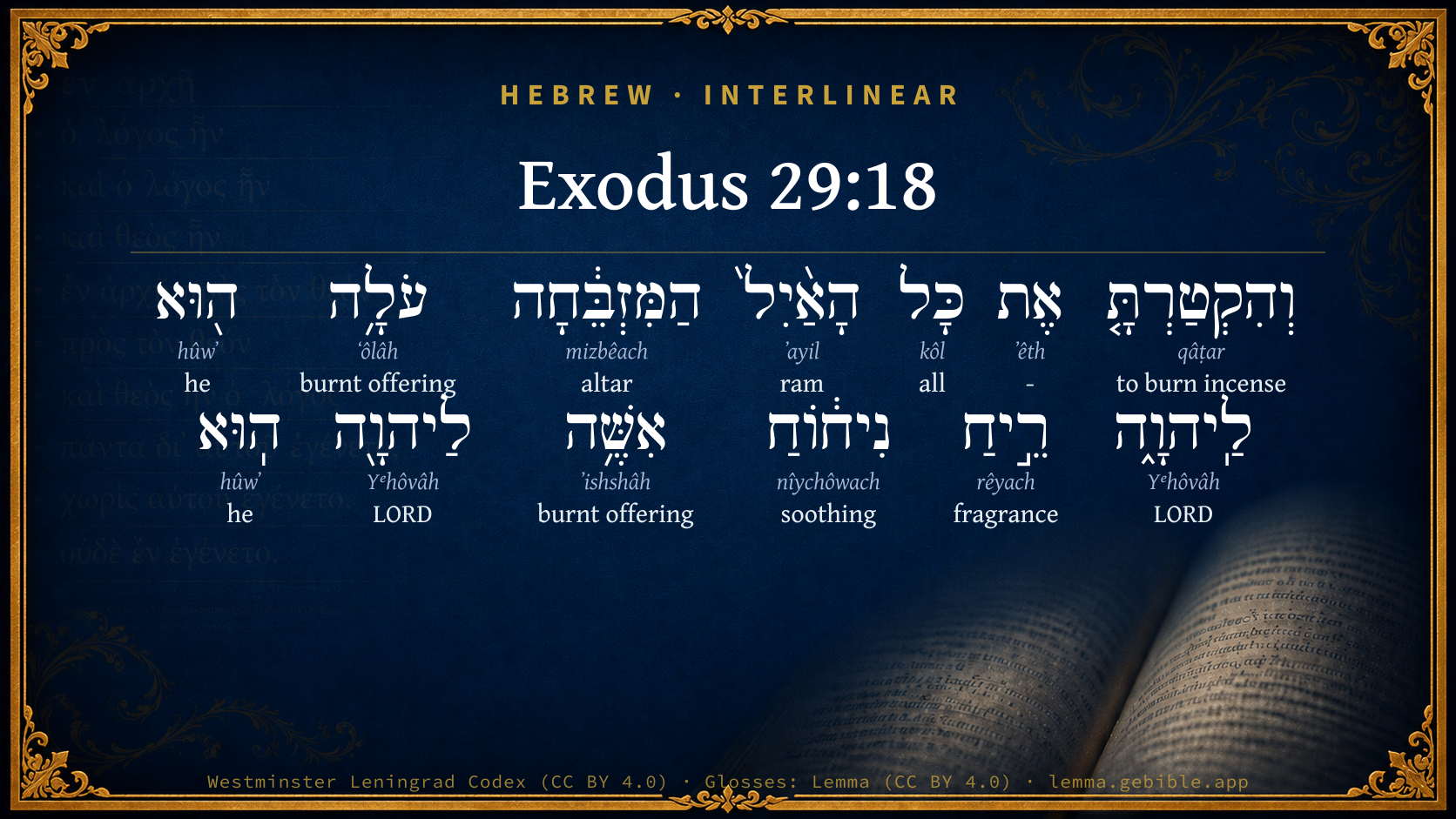
Hebrew (Westminster Leningrad Codex) Exodus 29:18 appears in the Hebrew Old Testament. The text above is from the Westminster Leningrad Codex. Each word links to its Strong’s number, a concise gloss, and parsing drawn from the Open Scriptures Hebrew Bible morphology. Click any word for its full Brown-Driver-Briggs (BDB) entry.
Download image
Cite this verse

Exodus 29:18 (World English Bible). Public Domain. Lemma interlinear Bible study tool, https://lemma.gebible.app/v/exodus/29/18.

Show BibTeX & RIS
BibTeX
RIS
English Translation
You shall burn the whole ram on the altar: it is a burnt offering to Yahweh; it is a sweet savor, an offering made by fire to Yahweh.
World English Bible · Public Domain
Highlights
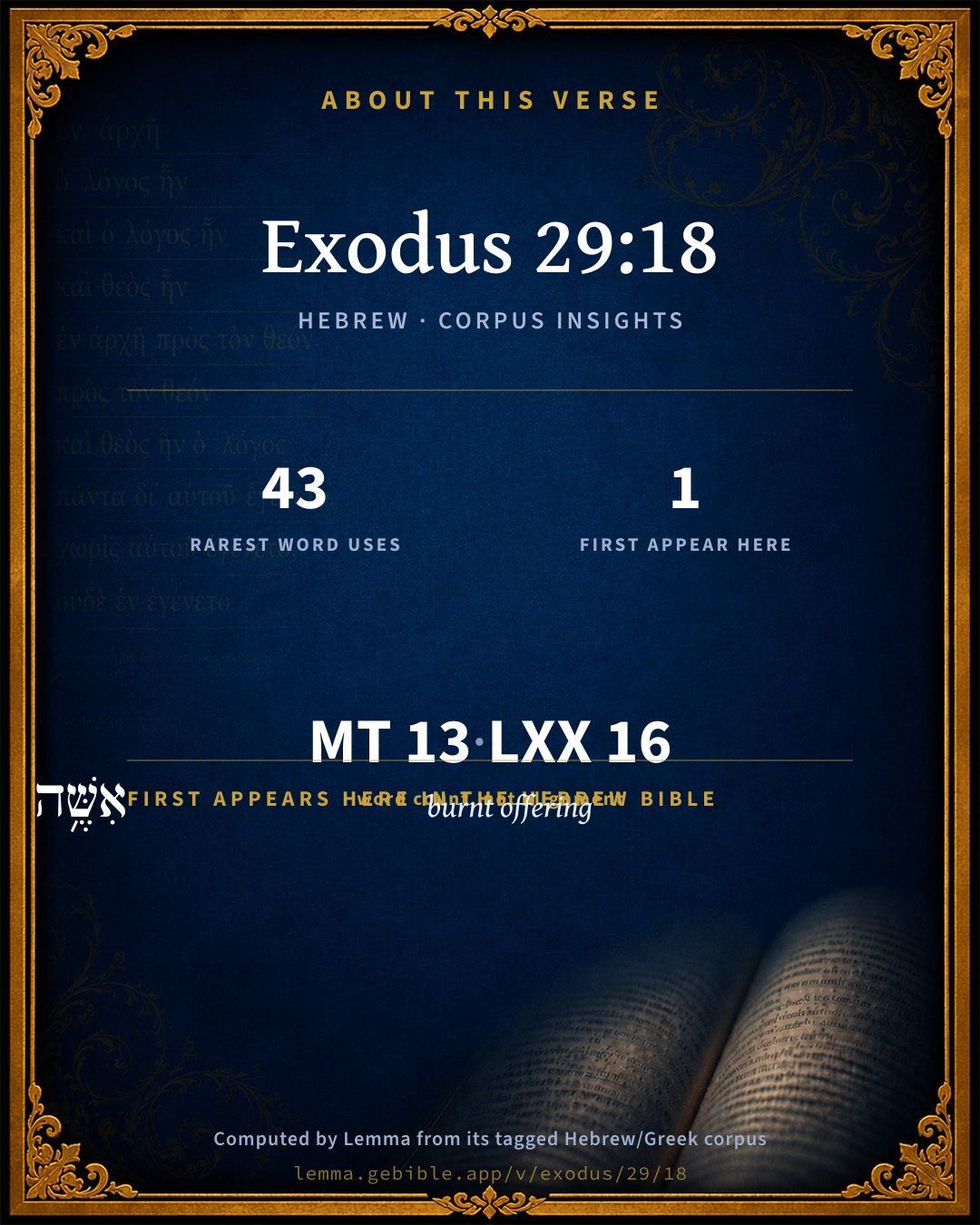
  • 1 first appearance in the Hebrew Bible
Full analysis ↓
Download a study sheet

One document with this verse’s original text, its word-by-word gloss line, the meaning frame, cross-references with their text, attributed commentary, and full source and license credits — printable, and it pastes into notes with its structure intact.

This verse Autodidact and up

Study sheet (.html) Plain text (.txt)

A passage Seminary Student

Up to 50 verses in one chapter. A passage sheet keeps up to 6 commentary sources and 12 cross-references per verse, in the order this page ranks them, and says so on the sheet whenever that leaves anything out. Ask for a single verse and you get the Autodidact verse sheet above.

Everything on this page stays free to read, with no account — the sheet is a download of what is already on screen, not access to it.

Want to remove ads? Support Godless Engineer
Compare translations 3

The same verse in 3 English versions, stacked beneath the original-language interlinear above. Click any original word for its lexicon entry.

Each is an independent rendering of the whole verse — the interlinear is not word-aligned to these translations.

Highlighted words mark where these versions differ — a whole-verse word diff, not a word-by-word alignment.

  • World English Bible Public Domain
    You shall burn the whole ram on the altar: it is a burnt offering to Yahweh; it is a sweet savor, an offering made by fire to Yahweh.
  • King James Version Public Domain
    And thou shalt burn the whole ram upon the altar: it is a burnt offering unto the LORD: it is a sweet savor, an offering made by fire unto the LORD.
  • unfoldingWord Literal Text CC BY-SA 4.0
    and cause all of the ram to become smoke on the altar. It is a burnt offering to Yahweh. It is a scent of appeasement, a fire offering to Yahweh.

unfoldingWord Literal Text — © unfoldingWord, licensed CC BY-SA 4.0. Word-aligned USFM3 via Door43 (git.door43.org/unfoldingWord/en_ult).

Versions to compare (up to 4)

3 of 4 selected

Show all 18 translations

Every available English version of this verse, each an independent rendering of the whole verse.

  • World English Bible Public Domain
    You shall burn the whole ram on the altar: it is a burnt offering to Yahweh; it is a sweet savor, an offering made by fire to Yahweh.
  • Berean Standard Bible Public Domain
    Then burn the entire ram on the altar; it is a burnt offering to the LORD, a pleasing aroma, an offering made by fire to the LORD.
  • Majority Standard Bible Public Domain
    Then burn the entire ram on the altar; it is a burnt offering to the LORD, a pleasing aroma, a food offering to the LORD.
  • King James Version Public Domain
    And thou shalt burn the whole ram upon the altar: it is a burnt offering unto the LORD: it is a sweet savor, an offering made by fire unto the LORD.
  • American Standard Version (1901) Public Domain
    And thou shalt burn the whole ram upon the altar: it is a burnt-offering unto Jehovah; it is a sweet savor, an offering made by fire unto Jehovah.
  • Revised Version (1885) Public Domain
    And thou shalt burn the whole ram upon the altar: it is a burnt offering unto the LORD: it is a sweet savour, an offering made by fire unto the LORD.
  • Geneva Bible (1599) Public Domain
    So thou shalt burne the whole ram vpon the altar: for it is a burnt offering vnto the Lord for a sweete sauour: it is an offering made by fire vnto the Lord.
  • Douay-Rheims (1899) Public Domain
    And thou shalt offer the whole ram for a burnt offering upon the altar: it is an oblation to the Lord, a most sweet savour of the victim of the Lord.
  • Young's Literal Translation Public Domain
    and thou hast made perfume with the whole ram on the altar. It `is' a burnt-offering to Jehovah, a sweet fragrance; a fire-offering it `is' to Jehovah.
  • Literal Standard Version CC BY-SA 4.0
    and you have made incense with the whole ram on the altar. It [is] a burnt-offering to YHWH, a refreshing fragrance; it [is] a fire-offering to YHWH.
  • Unlocked Literal Bible CC BY-SA 4.0
    on the altar. Then burn the whole ram. It will be a burnt offering to Yahweh, a sweet aroma, an offering made to Yahweh by fire.
  • unfoldingWord Literal Text CC BY-SA 4.0
    and cause all of the ram to become smoke on the altar. It is a burnt offering to Yahweh. It is a scent of appeasement, a fire offering to Yahweh.
  • Darby Bible Public Domain
    and thou shalt burn the whole ram upon the altar: it is a burnt-offering to Jehovah -- a sweet odour; it is an offering by fire to Jehovah.
  • World Messianic Bible Public Domain
    You shall burn the whole ram on the altar: it is a burnt offering to the LORD; it is a pleasant aroma, an offering made by fire to the LORD.
  • Webster's Bible Public Domain
    And thou shalt burn the whole ram upon the altar: it is a burnt-offering to the LORD: it is a sweet savor, an offering made by fire to the LORD.
  • Free Bible Version CC BY-SA 4.0
    Then burn all of the ram on the altar. It is a burnt offering to the Lord to be accepted by him.
  • Bible in Basic English Public Domain
    And let them all be burned on the altar as a burned offering to the Lord: a sweet smell, an offering made by fire to the Lord.
  • JPS Tanakh (1917) Public Domain
    And thou shalt make the whole ram smoke upon the altar; it is a burnt-offering unto the LORD; it is a sweet savour, an offering made by fire unto the LORD.

Literal Standard Version (2020), Covenant Press — licensed CC BY-SA 4.0. Text via the HelloAO Bible API (eBible.org). Unlocked Literal Bible (unfoldingWord) — licensed CC BY-SA 4.0. Text via the HelloAO Bible API (eBible.org). unfoldingWord Literal Text — © unfoldingWord, licensed CC BY-SA 4.0. Word-aligned USFM3 via Door43 (git.door43.org/unfoldingWord/en_ult). Free Bible Version, Dr. Jonathan Gallagher — licensed CC BY-SA 4.0. Text via the HelloAO Bible API (eBible.org).

Word by word

More ways to search: Search by grammar → Find every occurrence → Compare this word →

Practice this passage: Drill this verse → Learn its vocabulary →

נִיח֔וֹחַ
nîychôwach
H5207
“soothing”
Noun, Common, Masculine, Singular, Absolute
Part of Speech
Noun
Type
Common
Gender
Masculine
Number
Singular
State
Absolute
Full BDB Definition

Origin: from H5117

TWOT: 1323c

soothing, quieting, tranquillising
  1. וְהִקְטַרְתָּ֤ qâṭar H6999 “and · to burn incense” Conjunction + Verb, Hiphil, Sequential Perfect, 2nd Person, Masculine, Singular
  2. אֶת ʼêth H853 “-” Particle, Direct Object
  3. כָּל kôl H3605 “all of” Noun, Common, Masculine, Singular, Construct
  4. הָאַ֨יִל֙ ʼayil H352 “the · ram” Particle, Definite Article + Noun, Common, Masculine, Singular, Absolute
  5. הַמִּזְבֵּ֔חָה mizbêach H4196 “the · altar · toward” Particle, Definite Article + Noun, Common, Masculine, Singular, Absolute + Suffix, Demonstrative
  6. עֹלָ֥ה ʻôlâh H5930 “burnt offering” Noun, Common, Feminine, Singular, Absolute
  7. ה֖וּא hûwʼ H1931 “he” Pronoun, Personal, 3rd Person, Masculine, Singular
  8. לַֽיהוָ֑ה Yᵉhôvâh H3068 “to/for · LORD” Preposition + Noun, Proper
  9. רֵ֣יחַ rêyach H7381 “fragrance of” Noun, Common, Masculine, Singular, Construct
  10. אִשֶּׁ֥ה ʼishshâh H801 “burnt offering” Noun, Common, Masculine, Singular, Absolute
  11. לַיהוָ֖ה Yᵉhôvâh H3068 “to/for · LORD” Preposition + Noun, Proper
  12. הֽוּא hûwʼ H1931 “he” Pronoun, Personal, 3rd Person, Masculine, Singular

About this verse

These counts appear in no published source. They are computed here, from the morphology-tagged text and Lemma’s own curated glosses. What Lemma adds →

13
words
11
distinct lemmas
Pentateuch
section

First appearance in Scripture

This word makes its first canonical appearance in the Hebrew Bible here:

  • אִשֶּׁ֥ה burnt offering H801

Shared distinctive vocabulary

נִיח֔וֹחַ soothing H5207 occurs in 43 verses of the Hebrew Bible. Also found in:

Grammatical profile

  • 1 verb
  • 9 nouns
  • 2 pronouns
  • 1 particle

Verb forms

  • וְהִקְטַרְתָּ֤ Hiphil · Sequential Perfect

Repetition

Words recur within this verse — often emphatic in Hebrew:

  • לַֽיהוָ֑ה LORD H3068 ×2
  • ה֖וּא he H1931 ×2

Hebrew & Septuagint length

In English translation the verse runs 28 words from the Hebrew and 31 from the Septuagint (LXX English) — closely comparable.

A rough comparison of the two English renderings, which tokenize alike — not a word-level alignment.

Word counts can differ between the Hebrew and the Greek without any difference in meaning — e.g. the Hebrew direct-object marker אֵת has no separate Greek word, and Greek often adds the article ὁ.

In the original languages it is 13 Hebrew tokens and 16 Greek tokens — but the two are counted differently (Hebrew bundles its prefixes and suffixes into one token; the Greek is in lemma form), so that isn’t a like-for-like length.

Cross-references

18

Topical passages linked to Exodus 29:18 in the Treasury of Scripture Knowledge — connected by theme and wording, ordered by reader-vote popularity; previews shown in the World English Bible.

  • Genesis 8:21 Yahweh smelled the sweet savor. Yahweh said in his heart, "I will not again curse the ground any more for man's sake, because the imagination of man's heart is evil from his youth; neither will I ever again strike everything living, as I have done.
  • Genesis 22:2 He said, "Now take your son, your only son, whom you love, even Isaac, and go into the land of Moriah. Offer him there for a burnt offering on one of the mountains which I will tell you of."
  • Genesis 22:7 Isaac spoke to Abraham his father, and said, "My father?" He said, "Here I am, my son." He said, "Here is the fire and the wood, but where is the lamb for a burnt offering?"
  • Genesis 22:13 Abraham lifted up his eyes, and looked, and saw that behind him was a ram caught in the thicket by his horns. Abraham went and took the ram, and offered him up for a burnt offering instead of his son.
  • Exodus 29:25 You shall take them from their hands, and burn them on the altar on the burnt offering, for a sweet savor before Yahweh: it is an offering made by fire to Yahweh.
  • Leviticus 1:17 He shall tear it by its wings, but shall not divide it apart. The priest shall burn it on the altar, on the wood that is on the fire. It is a burnt offering, an offering made by fire, of a sweet savor to Yahweh.
  • Leviticus 9:24 There came forth fire from before Yahweh, and consumed the burnt offering and the fat upon the altar: and when all the people saw it, they shouted, and fell on their faces.
  • 1 Samuel 7:9 Samuel took a sucking lamb, and offered it for a whole burnt-offering to Yahweh: and Samuel cried to Yahweh for Israel; and Yahweh answered him.
  • 1 Kings 3:4 The king went to Gibeon to sacrifice there; for that was the great high place: a thousand burnt offerings did Solomon offer on that altar.
  • 1 Kings 18:38 Then the fire of Yahweh fell, and consumed the burnt offering, and the wood, and the stones, and the dust, and licked up the water that was in the trench.
  • Psalms 50:8 I don't rebuke you for your sacrifices. Your burnt offerings are continually before me.
  • Isaiah 1:11 "What are the multitude of your sacrifices to me?," says Yahweh. "I have had enough of the burnt offerings of rams, And the fat of fed animals. I don't delight in the blood of bulls, Or of lambs, Or of male goats.
  • Jeremiah 6:20 To what purpose comes there to me frankincense from Sheba, and the sweet cane from a far country? your burnt offerings are not acceptable, nor your sacrifices pleasing to me.
  • Jeremiah 7:21–22 Thus says Yahweh of Hosts, the God of Israel: Add your burnt offerings to your sacrifices, and eat you flesh.
  • Mark 12:33 and to love him with all the heart, and with all the understanding, with all the soul, and with all the strength, and to love his neighbor as himself, is more important than all whole burnt offerings and sacrifices."
  • Ephesians 5:2 Walk in love, even as Christ also loved you, and gave himself up for us, an offering and a sacrifice to God for a sweet-smelling fragrance.
  • Philippians 4:18 But I have all things, and abound. I am filled, having received from Epaphroditus the things that came from you, a sweet-smelling fragrance, an acceptable and well-pleasing sacrifice to God.
  • Hebrews 10:6–10 In whole burnt offerings and sacrifices for sin you had no pleasure.

Cross-references courtesy of OpenBible.info (CC BY 4.0).

Hebrew and Greek witnesses Masoretic Hebrew ↔ Greek Septuagint

The same verse in the two great witnesses to the Old Testament, shown verse-for-verse.

These are two independent witnesses, not word-aligned to each other, and the Septuagint is shown in lemma (dictionary) form.

Hebrew Exodus 29:18 Masoretic · Westminster Leningrad Codex

וְהִקְטַרְתָּ֤ אֶת כָּל הָאַ֨יִל֙ הַמִּזְבֵּ֔חָה עֹלָ֥ה ה֖וּא לַֽיהוָ֑ה רֵ֣יחַ נִיח֔וֹחַ אִשֶּׁ֥ה לַיהוָ֖ה הֽוּא

You shall burn the whole ram on the altar: it is a burnt offering to Yahweh; it is a sweet savor, an offering made by fire to Yahweh.

World English Bible · Public Domain

Greek LXX Exodus 29:18 Septuagint · lemma form

καί ἀναφέρω ὅλος ὁ κριός ἐπί ὁ θυσιαστήριον ὁλοκαύτωμα κύριος εἰς ὀσμή εὐωδία θυσίασμα κύριος εἰμί

And you shall offer the whole ram on the altar, a whole burnt offering to the Lord for a sweet smelling savor: it is an offering of incense to the Lord.

LXX2012 (modern English Septuagint) · Public Domain

On this verse, The Cambridge Bible for Schools and Colleges discusses the Septuagint’s reading. Read the note in Commentary ↓

Hebrew: Westminster Leningrad Codex (CC BY 4.0). Greek: Septuagint (public domain); English from LXX2012 (modern English Septuagint) (Public Domain). How the Septuagint differs from the Hebrew →

Targum (Aramaic paraphrase)

2

The Targum is the ancient Jewish Aramaic paraphrase of the Hebrew Scriptures — an interpretive translation, not the Hebrew text itself. Onkelos (literal) and Pseudo-Jonathan (expansive) render the Torah, and Jonathan the Prophets. Coverage is partial: where no permissively-licensed English translation exists for a verse, only the Aramaic is shown. This is verse-level text, not a word-by-word alignment to the Hebrew.

  1. Targum Onkelos Torah (Genesis–Deuteronomy)
    וְתַסֵיק יָת כָּל דִכְרָא לְמַדְבְּחָא עֲלָתָא הוּא קֳדָם יְיָ לְאִתְקַבָּלָא בְרַעֲוָא קֻרְבָּנָא קֳדָם יְיָ הוּא:

    (no public-domain English translation for this verse)

    Targum Onkelos — Aramaic: “Onkelos Genesis” (public domain); “Onkelos Exodus” (public domain); “Onkelos Leviticus” (public domain); “Onkelos Numbers” (public domain); “Onkelos Deuteronomy” (public domain). English: “Sefaria Community Translation” (CC0 1.0 (public-domain dedication)); “J.W. Etheridge. The Targums of Onkelos and Jonathan Ben Uzziel on the Pentateuch. London: Longmans, Green, 1862” (public domain). Text via Sefaria.

  2. Targum Pseudo-Jonathan Torah (Genesis–Deuteronomy)
    וְתַסִיק יַת כָּל דִּכְרָא לְמַדְבְּחָא עֲלָתָא הוּא קֳדָם יְיָ לְאִתְקַבָּלָא בְּרַעֲוָא קוּרְבָּנָא קֳדָם יְיָ הוּא

    And thou shalt offer the whole ram upon the altar, it is a holocaust before the Lord to be accepted with favour, an oblation it is before the Lord.

    Targum Pseudo-Jonathan — Aramaic: “Targum Jonathan on Genesis” (public domain); “Targum Jonathan on Exodus” (public domain); “Targum Jonathan on Leviticus” (public domain); “Targum Jonathan on Numbers” (public domain); “Targum Jonathan on Deuteronomy” (public domain). English: “The Targum of Jonathan ben Uzziel, trans. J. W. Etheridge, London, 1862” (public domain). Text via Sefaria.

Commentary

Notes on Exodus 29:18 from classic Christian and Jewish commentators (each source and its license shown beneath its notes). The classic Christian expositions comment on the surrounding passage and are grouped to its opening verse, so a note may address several verses; the Jewish commentaries on the Tanakh (Rashi and others) are per-verse, so they appear only where the commentator wrote on this verse.

Lemma curates 59 commentaries, every one of them public domain or Creative Commons licensed, each selected and text-cleaned for this edition rather than reprinted as found. About our sources →

Trapp's Complete Commentary

John Trapp

Exo 29:18 And thou shalt burn the whole ram upon the altar: it [is] a burnt offering unto the LORD: it [is] a sweet savour, an offering made by fire unto the LORD.

Ver. 18. The whole ram.] See Rom 12:1, {See Trapp on "Rom 12:1"}

John Trapp, A Commentary or Exposition upon All the Books of the Old and New Testament (1647–1656) — public domain. Text from a community e-Sword module.

Tyndale Open Study Notes

Tyndale Open Resources

29:18 pleasing aroma: Such language is anthropomorphism, describing God with human terms and experiences. God’s delight in an appropriately offered sacrifice is like a human’s enjoyment of a pleasing smell.

Tyndale Open Study Notes — © Tyndale Open Resources, licensed CC BY-SA 4.0. Text via the HelloAO Bible API.

Geneva Bible (1599)

Geneva Bible translators

Or, savor of rest, which causeth the wrath of God to cease.

Geneva Bible (1599) marginal notes — public domain. Text via Bolls.life.

Adam Clarke's Commentary

Verse 18. It is a burnt-offering] See Clarke on Le 7:1, &c.

Adam Clarke's Commentary on the Bible (1810–1826) — public domain. Text from a community e-Sword/MySword module.

Ellicott's Commentary for English Readers

(18) Thou shalt burn the whole ram upon the altar.—A burnt offering, as representing self- sacrifice, was entirely acceptable to God; the whole might be consumed upon the altar. It was otherwise with sin offerings, of which only certain parts could be thus offered. (Comp. above, Exo_29:14; and see Lev_4:12; Lev_4:21, &c.)

A sweet savour.—Comp. Gen_8:21 and Note ad loc. It was a general heathen notion that the gods were actually delighted with the odour of the sacrifices offered to them; but there are no just grounds for taxing the Hebrews with such coarse and materialistic ideas. The expression, as used in this place, in Gen_8:21, and in Leviticus and Numbers repeatedly, is metaphorical. (Comp. Exo_5:21.)

A Bible Commentary for English Readers, edited by Charles John Ellicott (1878–1897) — public domain. Text from a community e-Sword module.

The Cambridge Bible for Schools and Colleges

gen. ed. J. J. S. Perowne

18. a burnt offering] see Leviticus 1.

a sweet savour] a soothing odour (McNeile), lit. an odour of rest giving, i.e. one composing and acceptable to the Deity. It is a technical expression for the fragrant odour emitted by a burning sacrifice, and is doubtless a survival from the time when the deity was supposed to be actually placated by the smell of the sacrificial smoke (see on v. 13). It is used, repeatedly by P (Lev_1:9; Lev_Exo_1:13 &c.), and once by J (Gen_8:21). Comp. the erêshê tâbu, or ‘goodly odour,’ offered to the Bab. gods (EB. iv. 4119; cf. Del. HWB. 121, 140a). ‘Sweet savour’ is a paraphrase based upon the rend. of LXX. ὀσμὴ εὐωδίας ‘an odour of a sweet smell’ (Php_4:18). Note that ‘savour’ in Old English meant not only taste (Mat_5:13), but smell, as Joe_2:20, and 2Co_2:14; 2Co_2:16 for ὀσμή: see DB., s.v.

an offering made by fire] in the Heb. one word,—as we might say, a firing. Another expression of the priestly terminology, used often by P (Lev_1:9; Lev_1:13; Lev_1:17, &c.), and occurring also twice besides (Deu_18:1, 1Sa_2:28).

The Cambridge Bible for Schools and Colleges (gen. ed. J. J. S. Perowne; Cambridge University Press, 1878–1918) — public domain. Text from a community e-Sword module.

John Gill's Exposition

And thou shalt burn the whole ram upon the altar,.... For which reason his head, his pieces, his inwards, and his legs, were to be put together, and laid in order upon the altar:

it is a burnt offering unto the Lord; offered up to him, and accepted by him, as follows:

it is a sweet savour; or "a smell of rest" (y), in which God acquiesces, and rests, and takes delight and pleasure; it is, as the Septuagint version:

for a smell of sweet savour, or a sweet smelling savour; which phrase the apostle makes use of, and applies to the sacrifice of Christ, Eph 5:2,

an offering made by fire unto the Lord; which being consumed by fire ascended upwards to the Lord, and became acceptable to him, as the sacrifice of his own Son, in his fiery sufferings and death, was unto him.

(y) "odor quietis", Montanus, Fagius, Vatablus, Cartwright, Piscator.

John Gill's Exposition of the Whole Bible (1746–1763) — public domain (CC PDM 1.0). Text via the HelloAO Bible API.

Haydock's Catholic Bible Commentary

Victim. Hebrew ishe, means a whole burnt-offering.

George Leo Haydock (1774–1849), Haydock's Catholic Family Bible and Commentary, 1859 edition — public domain. Excludes Psalms (Douay-Rheims chapter numbering differs from Protestant) and Deuterocanonical books (Catholic canon only).

Matthew Poole's English Annotations

A sweet savour, Heb. a savour of rest, wherewith God will be well pleased, and for which, as representing Christ who offered up himself, he will graciously accept of the offerings of the priests for themselves, and for the people.

Matthew Poole's English Annotations on the Holy Bible (1683–1685) — public domain. Text from a community e-Sword/MySword module.

The Pulpit Commentary

Thou shalt burn the whole ram upon the altar. This became the general law of the burnt-offering. (Lev_1:9, Lev_1:13, Lev_1:17) It indicated that self-sacrifice was wholly acceptable to God; whereas in sin-offerings there was a taint of evil which rendered all but certain parts of the victim unacceptable (ver. 14). A sweet savour. This is not to be understood in the coarse sense in which heathen writers used similar expressions, meaning by them (as it would seem) that the gods were really pleased with the odour of sacrifices. No candid mind can ascribe to the Hebrews such anthropomorphism. Evidently no more is meant than that the offering would be pleasing to God. See Gen_8:21; Lev_1:9, Lev_1:13, Lev_1:17, etc.

The Pulpit Commentary (1880–1919), ed. H.D.M. Spence-Jones & Joseph S. Exell — public domain. Text from a community e-Sword module.

Rashi

Rabbi Shlomo Yitzchaki (Rashi)

ריח נחוח AS A PLEASING ODOUR — as a gratification of spirit before Me — that I commanded and My will was carried out (Zevachim 46b).

אשה AN OFFERING MADE BY FIRE a term connected with the word אש, fire: it denotes the burning of the parts which had been placed on the fire (cf. Rashi on Leviticus 1:9).

Rashi on the Tanakh — English translations: “The Judaica Press complete Tanach with Rashi, translated by A. J. Rosenberg” (CC BY 4.0); “Pentateuch with Rashi's commentary by M. Rosenbaum and A.M. Silbermann, 1929-1934” (public domain); “The Metsudah Tanach series, Lakewood, N.J” (CC BY 4.0); and “The Book of Joshua, Metsudah Publications, 1997” (CC BY 4.0). Text via Sefaria.

Lesson kit

Teaching starters — assembled from the data on this page, not authored interpretation. Every prompt links to the verse data it draws on. Edit before teaching.

Exodus, in the Pentateuch, opens this verse with 13 words (11 distinct Hebrew lemmas). Its most distinctive word is nîychôwach (“soothing”). A historical commentator’s framing appears above. Read the whole chapter for the surrounding context.

Discussion questions

  1. What does “soothing” (nîychôwach) contribute to the verse as a whole?
  2. The word “burnt offering” first appears here in Scripture. What is being introduced at this debut?
  3. Genesis 8:21 shares the word «soothing» with this verse. How do the two illuminate each other?
  4. “LORD” occurs 2× in this one verse. What is the effect of the repetition?
  5. The translations on this page render this verse differently — a whole-verse word diff, not a word-by-word alignment. What might account for the different wordings?
  6. The verb «וְהִקְטַרְתָּ֤» is Hiphil Sequential Perfect. How does its form color the action?
  7. Reading how Trapp's Complete Commentary and Tyndale Open Study Notes read this verse, where do the two commentators agree and where do they part?

Things to notice

Reading settings

Reading text

Shown beneath each verse's original-language words.

Old Testament
Old Testament edition

Read the OT as the Masoretic Hebrew (MT) or the Greek Septuagint (LXX).

English shown for the Greek Septuagint (in the Hebrew ↔ Greek comparison).

Comparing translations? Open the Compare panel on any verse page to stack up to four side by side.