1 Kings 8:31

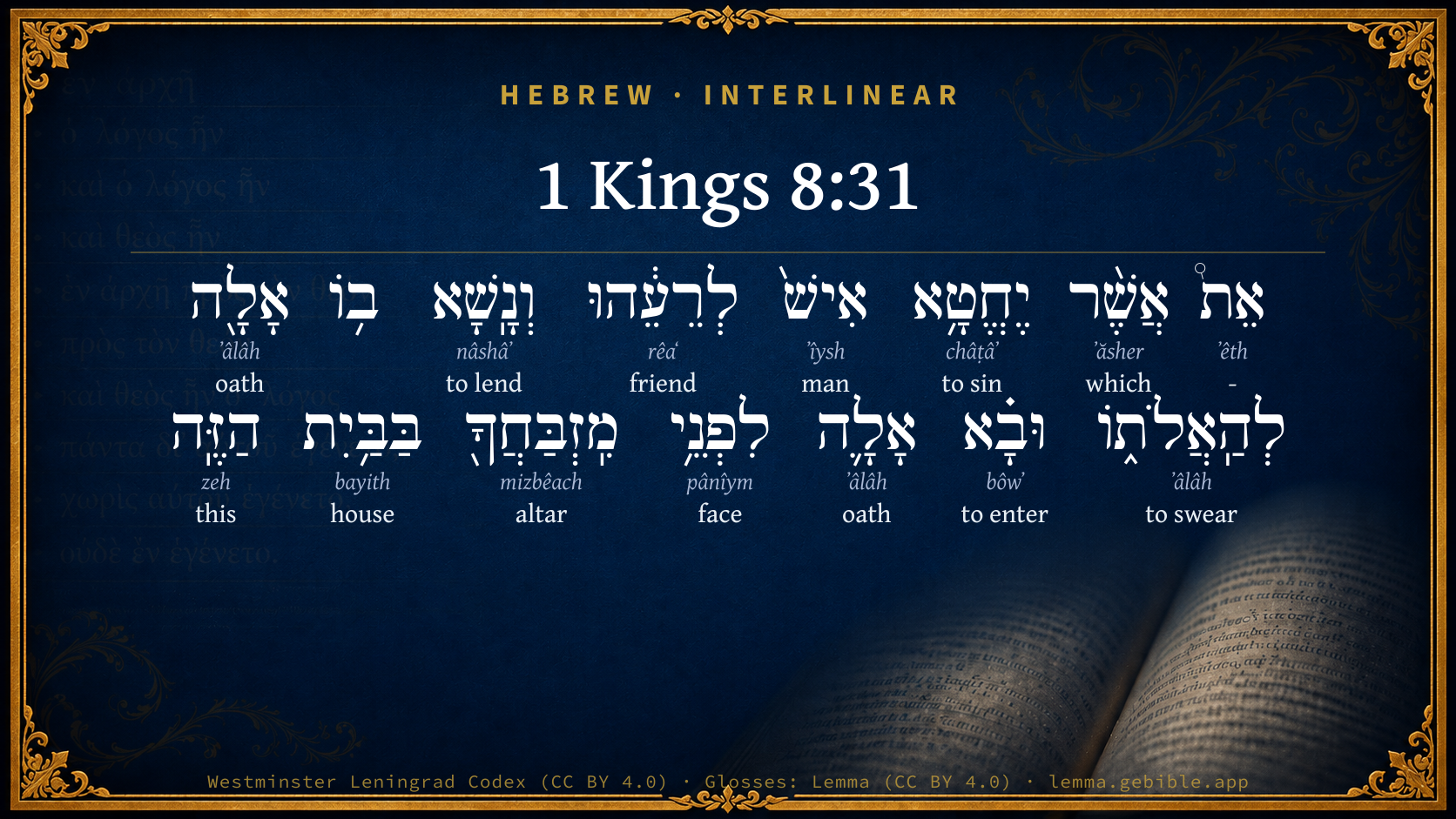
Hebrew (Westminster Leningrad Codex) 1 Kings 8:31 appears in the Hebrew Old Testament. The text above is from the Westminster Leningrad Codex. Each word links to its Strong’s number, a concise gloss, and parsing drawn from the Open Scriptures Hebrew Bible morphology. Click any word for its full Brown-Driver-Briggs (BDB) entry.
Download image
Cite this verse

1 Kings 8:31 (World English Bible). Public Domain. Lemma interlinear Bible study tool, https://lemma.gebible.app/v/1-kings/8/31.

Show BibTeX & RIS
BibTeX
RIS
English Translation
If a man sin against his neighbor, and an oath be laid on him to cause him to swear, and he come [and] swear before your altar in this house;
World English Bible · Public Domain
Download a study sheet

One document with this verse’s original text, its word-by-word gloss line, the meaning frame, cross-references with their text, attributed commentary, and full source and license credits — printable, and it pastes into notes with its structure intact.

This verse Autodidact and up

Study sheet (.html) Plain text (.txt)

A passage Seminary Student

Up to 50 verses in one chapter. A passage sheet keeps up to 6 commentary sources and 12 cross-references per verse, in the order this page ranks them, and says so on the sheet whenever that leaves anything out. Ask for a single verse and you get the Autodidact verse sheet above.

Everything on this page stays free to read, with no account — the sheet is a download of what is already on screen, not access to it.

Want to remove ads? Support Godless Engineer
Compare translations 3

The same verse in 3 English versions, stacked beneath the original-language interlinear above. Click any original word for its lexicon entry.

Each is an independent rendering of the whole verse — the interlinear is not word-aligned to these translations.

Highlighted words mark where these versions differ — a whole-verse word diff, not a word-by-word alignment.

  • World English Bible Public Domain
    If a man sin against his neighbor, and an oath be laid on him to cause him to swear, and he come [and] swear before your altar in this house;
  • King James Version Public Domain
    If any man trespass against his neighbor, and an oath be laid upon him to cause him to swear, and the oath come before thine altar in this house:
  • unfoldingWord Literal Text CC BY-SA 4.0
    Whoever sins, a man against his neighbor, and he lifts an oath against him to adjure him, and an oath comes to the face of your altar in this house,

unfoldingWord Literal Text — © unfoldingWord, licensed CC BY-SA 4.0. Word-aligned USFM3 via Door43 (git.door43.org/unfoldingWord/en_ult).

Versions to compare (up to 4)

3 of 4 selected

Show all 18 translations

Every available English version of this verse, each an independent rendering of the whole verse.

  • World English Bible Public Domain
    If a man sin against his neighbor, and an oath be laid on him to cause him to swear, and he come [and] swear before your altar in this house;
  • Berean Standard Bible Public Domain
    When a man sins against his neighbor and is required to take an oath, and he comes to take an oath before Your altar in this temple,
  • Majority Standard Bible Public Domain
    When a man sins against his neighbor and is required to take an oath, and he comes to take an oath before Your altar in this temple,
  • King James Version Public Domain
    If any man trespass against his neighbor, and an oath be laid upon him to cause him to swear, and the oath come before thine altar in this house:
  • American Standard Version (1901) Public Domain
    If a man sin against his neighbor, and an oath be laid upon him to cause him to swear, and he come `and' swear before thine altar in this house;
  • Revised Version (1885) Public Domain
    If a man sin against his neighbour, and an oath be laid upon him to cause him to swear, and he come and swear before thine altar in this house:
  • Geneva Bible (1599) Public Domain
    When a man shall trespasse against his neighbour, and he lay vpon him an othe to cause him to sweare, and the swearer shall come before thine altar in this house,
  • Douay-Rheims (1899) Public Domain
    If any man trespass against his neighbour, and have an oath upon him, wherewith he is bound: and come because of the oath before thy altar to thy house,
  • Young's Literal Translation Public Domain
    that which a man sinneth against his neighbour, and he hath lifted up upon him an oath to cause him to swear, and the oath hath come in before Thine altar in this house,
  • Literal Standard Version CC BY-SA 4.0
    that which a man sins against his neighbor, and he has lifted up an oath on him to cause him to swear, and the oath has come in before Your altar in this house,
  • Unlocked Literal Bible CC BY-SA 4.0
    If a man sins against his neighbor and is required to swear an oath, and if he comes and swears an oath before your altar in this house,
  • unfoldingWord Literal Text CC BY-SA 4.0
    Whoever sins, a man against his neighbor, and he lifts an oath against him to adjure him, and an oath comes to the face of your altar in this house,
  • Darby Bible Public Domain
    If a man have sinned against his neighbour, and an oath be laid upon him to adjure him, and the oath come before thine altar in this house;
  • World Messianic Bible Public Domain
    “If a man sins against his neighbor, and an oath is laid on him to cause him to swear, and he comes and swears before your altar in this house,
  • Webster's Bible Public Domain
    If any man shall trespass against his neighbor, and an oath be laid upon him to cause him to swear, and the oath come before thy altar in this house:
  • Free Bible Version CC BY-SA 4.0
    When someone sins against another and is required to take an oath before your altar in this Temple,
  • Bible in Basic English Public Domain
    If a man does wrong to his neighbour, and has to take an oath, and comes before your altar to take his oath in this house:
  • JPS Tanakh (1917) Public Domain
    If a man sin against his neighbour, and an oath be exacted of him to cause him to swear, and he come and swear before Thine altar in this house;

Literal Standard Version (2020), Covenant Press — licensed CC BY-SA 4.0. Text via the HelloAO Bible API (eBible.org). Unlocked Literal Bible (unfoldingWord) — licensed CC BY-SA 4.0. Text via the HelloAO Bible API (eBible.org). unfoldingWord Literal Text — © unfoldingWord, licensed CC BY-SA 4.0. Word-aligned USFM3 via Door43 (git.door43.org/unfoldingWord/en_ult). Free Bible Version, Dr. Jonathan Gallagher — licensed CC BY-SA 4.0. Text via the HelloAO Bible API (eBible.org).

Word by word

More ways to search: Search by grammar → Find every occurrence → Compare this word →

Practice this passage: Drill this verse → Learn its vocabulary →

וְנָֽשָׁא
nâshâʼ
H5378
“and · to lend”
Conjunction + Verb, Qal, Sequential Perfect, 3rd Person, Masculine, Singular
Part of Speech
Conjunction + Verb
Stem
Qal
Form
Sequential Perfect
Person
3rd Person
Gender
Masculine
Number
Singular
Full BDB Definition

Origin: a primitive root [perhaps identical with H5377 , through the idea of imposition]

TWOT: 1424

to lend on interest or usury, be a creditor - (Qal) creditor (participle) - (Hiphil) to act as a creditor
  1. אֵת֩ ʼêth H853 “-” Particle, Direct Object
  2. אֲשֶׁ֨ר ʼăsher H834 “which” Particle, Relative
  3. יֶחֱטָ֥א châṭâʼ H2398 “to sin” Verb, Qal, Imperfect, 3rd Person, Masculine, Singular
  4. אִישׁ֙ ʼîysh H376 “man” Noun, Common, Masculine, Singular, Absolute
  5. לְרֵעֵ֔הוּ rêaʻ H7453 “to/for · friend · his” Preposition + Noun, Common, Masculine, Singular, Construct + Suffix, Personal, 3rd Person, Masculine, Singular
  6. אָלָ֖ה ʼâlâh H423 “oath” Noun, Common, Feminine, Singular, Absolute
  7. לְהַֽאֲלֹת֑וֹ ʼâlâh H422 “to swear · him” Preposition + Verb, Hiphil, Infinitive Construct + Suffix, Personal, 3rd Person, Masculine, Singular
  8. וּבָ֗א bôwʼ H935 “and · to enter” Conjunction + Verb, Qal, Sequential Perfect, 3rd Person, Masculine, Singular
  9. אָלָ֛ה ʼâlâh H423 “oath” Noun, Common, Feminine, Singular, Absolute
  10. לִפְנֵ֥י pânîym H6440 “to/for · face(s) of” Preposition + Noun, Common, Both, Plural, Construct
  11. מִֽזְבַּחֲךָ֖ mizbêach H4196 “altar · your” Noun, Common, Masculine, Singular, Construct + Suffix, Personal, 2nd Person, Masculine, Singular
  12. בַּבַּ֥יִת bayith H1004 “in/at the · house” Preposition, Determined + Noun, Common, Masculine, Singular, Absolute
  13. הַזֶּֽה zeh H2088 “the · this” Particle, Definite Article + Pronoun, Demonstrative, Masculine, Singular

About this verse

These counts appear in no published source. They are computed here, from the morphology-tagged text and Lemma’s own curated glosses. What Lemma adds →

15
words
13
distinct lemmas
Historical
section

Notable vocabulary

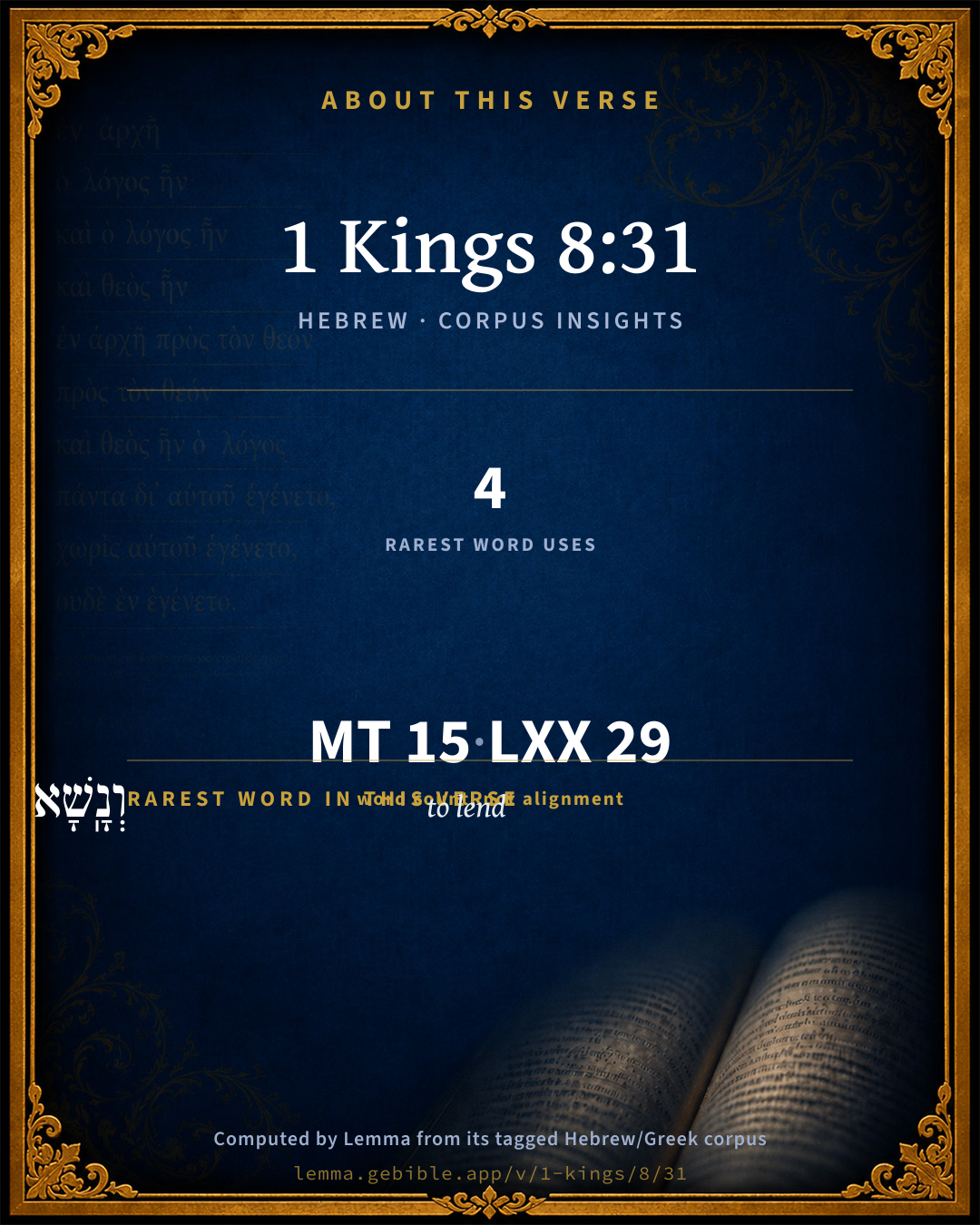
The rarest word here is וְנָֽשָׁא to lend H5378 — appearing just 4 times in the whole Hebrew Bible.

Shared distinctive vocabulary

וְנָֽשָׁא to lend H5378 occurs in 4 verses of the Hebrew Bible. Also found in:

Grammatical profile

  • 4 verbs
  • 7 nouns
  • 1 pronoun
  • 1 preposition
  • 2 particles

Verb forms

  • יֶחֱטָ֥א Qal · Imperfect
  • וְנָֽשָׁא Qal · Sequential Perfect
  • לְהַֽאֲלֹת֑וֹ Hiphil · Infinitive Construct
  • וּבָ֗א Qal · Sequential Perfect

Repetition

A word recurs within this verse — often emphatic in Hebrew:

  • אָלָ֖ה oath H423 ×2

Hebrew & Septuagint length

In English translation the verse runs 30 words from the Hebrew and 35 from the Septuagint (LXX English) — closely comparable.

A rough comparison of the two English renderings, which tokenize alike — not a word-level alignment.

Word counts can differ between the Hebrew and the Greek without any difference in meaning — e.g. the Hebrew direct-object marker אֵת has no separate Greek word, and Greek often adds the article ὁ.

In the original languages it is 15 Hebrew tokens and 29 Greek tokens — but the two are counted differently (Hebrew bundles its prefixes and suffixes into one token; the Greek is in lemma form), so that isn’t a like-for-like length.

Cross-references

5

Topical passages linked to 1 Kings 8:31 in the Treasury of Scripture Knowledge — connected by theme and wording, ordered by reader-vote popularity; previews shown in the World English Bible.

  • Exodus 22:8–11 If the thief isn't found, then the master of the house shall come near to God, to find out if he hasn't put his hand to his neighbor's goods.
  • Leviticus 5:1 "'If anyone sins, in that he hears the voice of adjuration, he being a witness, whether he has seen or known, if he doesn't report it, then he shall bear his iniquity.
  • Numbers 5:16–22 The priest shall bring her near, and set her before Yahweh;
  • 2 Chronicles 6:22–23 If a man sin against his neighbor, and an oath is laid on him to cause him to swear, and he comes and swears before your altar in this house;
  • Proverbs 30:9 Lest I be full, deny you, and say, 'Who is Yahweh?' Or lest I be poor, and steal, And so dishonor the name of my God.

Cross-references courtesy of OpenBible.info (CC BY 4.0).

Hebrew and Greek witnesses Masoretic Hebrew ↔ Greek Septuagint

The same verse in the two great witnesses to the Old Testament, shown verse-for-verse.

These are two independent witnesses, not word-aligned to each other, and the Septuagint is shown in lemma (dictionary) form.

Hebrew 1 Kings 8:31 Masoretic · Westminster Leningrad Codex

אֵת֩ אֲשֶׁ֨ר יֶחֱטָ֥א אִישׁ֙ לְרֵעֵ֔הוּ וְנָֽשָׁא ב֥וֹ אָלָ֖ה לְהַֽאֲלֹת֑וֹ וּבָ֗א אָלָ֛ה לִפְנֵ֥י מִֽזְבַּחֲךָ֖ בַּבַּ֥יִת הַזֶּֽה

If a man sin against his neighbor, and an oath be laid on him to cause him to swear, and he come [and] swear before your altar in this house;

World English Bible · Public Domain

Greek LXX 1 Kings 8:31 Septuagint · lemma form

ὅσος ἄν ἁμαρτάνω ἕκαστος ὁ πλησίον αὐτός καί ἐάν λαμβάνω ἐπί αὐτός ἀρά ὁ ἀράομαι αὐτός καί ἔρχομαι καί ἐκἀγορεύω κατά πρόσωπον ὁ θυσιαστήριον σύ ἐν ὁ οἶκος οὗτος

Whatsoever trespasses any one shall commit against his neighbor,—and if he shall take upon him an oath so that he should swear, and he shall come and make confession before your altar in this house,

LXX2012 (modern English Septuagint) · Public Domain

On this verse, The Pulpit Commentary discusses the Septuagint’s reading. Read the note in Commentary ↓

Hebrew: Westminster Leningrad Codex (CC BY 4.0). Greek: Septuagint (public domain); English from LXX2012 (modern English Septuagint) (Public Domain). How the Septuagint differs from the Hebrew →

Targum (Aramaic paraphrase)

1

The Targum is the ancient Jewish Aramaic paraphrase of the Hebrew Scriptures — an interpretive translation, not the Hebrew text itself. Onkelos (literal) and Pseudo-Jonathan (expansive) render the Torah, and Jonathan the Prophets. Coverage is partial: where no permissively-licensed English translation exists for a verse, only the Aramaic is shown. This is verse-level text, not a word-by-word alignment to the Hebrew.

  1. Targum Jonathan Prophets (Joshua–Malachi)
    יַת דְיֵחוּב גְבַר לְחַבְרֵיהּ וְיִרְשֵׁי בֵיהּ מוּמֵי לְאוֹמָיוּתֵיהּ וְיֵתֵי וְיוֹמִינֵיהּ קֳדָם מַדְבְּחָךְ בְּבֵיתָא הָדֵין:

    (no public-domain English translation for this verse)

    Targum Jonathan — Aramaic: “Mikraot Gedolot” (public domain). English: “Sefaria Community Translation” (CC0 1.0 (public-domain dedication)); “London "Chaldee Paraphrase," 1871” (public domain). Text via Sefaria.

Commentary

Notes on 1 Kings 8:31 from classic Christian and Jewish commentators (each source and its license shown beneath its notes). The classic Christian expositions comment on the surrounding passage and are grouped to its opening verse, so a note may address several verses; the Jewish commentaries on the Tanakh (Rashi and others) are per-verse, so they appear only where the commentator wrote on this verse.

Lemma curates 59 commentaries, every one of them public domain or Creative Commons licensed, each selected and text-cleaned for this edition rather than reprinted as found. About our sources →

Trapp's Complete Commentary

John Trapp

1Ki 8:31 If any man trespass against his neighbour, and an oath be laid upon him to cause him to swear, and the oath come before thine altar in this house:

Ver. 31. And an oath be laid upon him, to cause him to swear.] An oath may lawfully be taken for the help of truth in necessity, and not else. Hence the Hebrew word Nishbang is a passive, and signifieth rather to be sworn, than to swear.

And the oath come before thine altar.] That sign of God’s presence there. Amongst us, he that sweareth, layeth his hand on a Bible, for like cause.

John Trapp, A Commentary or Exposition upon All the Books of the Old and New Testament (1647–1656) — public domain. Text from a community e-Sword module.

Albert Barnes' Notes on the Bible

The oath come before ... - “The oath” is equivalent to “the man who swears the oath.” A slight alteration in the present Hebrew text gives the sense “and he (the accused) go and swear before thine altar,” etc. The threats and the promises, the punishments and calamities of 1Ki 8:31-38 were distinctly named in the Law. See the margin reference.

Albert Barnes' Notes on the Bible (1834–1885) — public domain. Text from a community e-Sword/MySword module.

Joseph Benson's Commentary

1Ki 8:31. If any man, &c. — He now puts divers cases in which he supposed application would be made to God in prayer, in or toward this house of prayer; and first that of God’s being appealed to by an oath for the determining of any controverted right between man and man. If any man trespass against his neighbour — If a man be accused of a trespass. And an oath be laid upon him — Either by the judge, or by the party accusing him, or by the accused person himself, claiming the privilege of perjuring himself by an oath from the trespass laid to his charge, which was usual when there were no witnesses. Solomon seems here to refer chiefly to the case of those who were accused of denying that which was said to be deposited with them by their neighbour. And the oath come before thine altar — Where God, who was appealed to as a witness, was supposed to be especially present. Hence the heathen were wont to swear at their altars; calling on their gods to witness to the truth of what they said, and to punish them if they uttered any falsehood therein.

Joseph Benson's Commentary on the Old and New Testaments (1811–1818) — public domain. Text from a community e-Sword module.

Tyndale Open Study Notes

Tyndale Open Resources

8:31-32 Solomon asked that God render the proper decision and carry out justice in court cases when the litigant’s innocence could not be determined due to a lack of witnesses (cp. Exod 22:7-12). Perhaps Solomon realized that later officials would not have the special wisdom God had given him (1 Kgs 3:12; e.g., 3:16-27).

Tyndale Open Study Notes — © Tyndale Open Resources, licensed CC BY-SA 4.0. Text via the HelloAO Bible API.

Geneva Bible (1599)

Geneva Bible translators

To wit, the judge or neighbor.

Hebrew, the oath.

Geneva Bible (1599) marginal notes — public domain. Text via Bolls.life.

Adam Clarke's Commentary

Verse 31. If any man trespass against his neighbour] Solomon puts here seven cases, in all of which the mercy and intervention of God would be indispensably requisite; and he earnestly bespeaks that mercy and intervention on condition that the people pray towards that holy place, and with a feeling heart make earnest supplication.

The FIRST case is one of doubtfulness; where a man has sustained an injury, and charges it on a suspected person, though not able to bring direct evidence of the fact, the accused is permitted to come before the altar of God, and purge himself by his personal oath. Solomon prays that God may not permit a false oath to be taken, but that he will discover the truth, so that the wicked shall be condemned, and the righteous justified.

Adam Clarke's Commentary on the Bible (1810–1826) — public domain. Text from a community e-Sword/MySword module.

Ellicott's Commentary for English Readers

(31, 32) If any man trespass.—These verses deal with the simplest exemplification of the sacredness of the Temple in the case of the oath of expurgation of one accused of crime (see Exo_22:7). Of these oaths, and the sophistical distinctions between the various forms of them, we have Our Lord’s notice in Mat_23:16-22. Such an oath has a twofold force—a force purely spiritual, inasmuch as it solemnly recognises the Presence of God, and by such recognition shames all falsehood as a kind of sacrilege; and a force which is “of the Law,” inasmuch as the invocation of God’s punishment in case of falsehood appeals to godly fear. Solomon prays that God will accept the oath under both aspects, and by His judgment distinguish between the innocent and the guilty.

A Bible Commentary for English Readers, edited by Charles John Ellicott (1878–1897) — public domain. Text from a community e-Sword module.

The Cambridge Bible for Schools and Colleges

gen. ed. J. J. S. Perowne

31. If any man trespass] Here Solomon enters on a series of specific petitions, the first of which is concerning any case of trespass, in which he implores that God would uphold the sanctity of an oath. The sense of ‘trespass’ in this verse must be = ‘be supposed to have trespassed.’ The person presumed to have offended is to be challenged to take an oath, and to God is left the punishment of the guilty and the acquittal of the innocent. Cf. Exo_22:7-11.

and the oath come] It is better to take both words as verbs and supply a copulative. Render “and he come and swear.”

The Cambridge Bible for Schools and Colleges (gen. ed. J. J. S. Perowne; Cambridge University Press, 1878–1918) — public domain. Text from a community e-Sword module.

John Gill's Exposition

If any man trespass against his neighbour,.... By being unfaithful in a trust committed to him, or the like:

and an oath be laid upon him to cause him to swear; he denying that ever anything was committed to his trust, and there being no witnesses of it, the judge obliges him to take an oath he never had any:

and the oath come before thine altar in this house; where it was taken, as in the presence of God, and as appealing to him: hence in corrupt times they came to swear by the altar, Mat 23:20 and so the Heathens used to take their oaths in the temples of their gods, and at their altars, as the instances of Callicrates (c) and Hannibal (d) show, and others Grotius refers to; yea, they also laid hold on the altar, at least touched it when they swore (e) to give the greater sanction to the oath.

(c) Cornel. Nep. Vit. Dion. l. 10. c. 8. (d) Ib. Hannibal. l. 23. c. 2. (e) Vid. Lydii Dissert de Jurament. c. 4. sect. 7.

John Gill's Exposition of the Whole Bible (1746–1763) — public domain (CC PDM 1.0). Text via the HelloAO Bible API.

Haydock's Catholic Bible Commentary

Oath. In certain cases, an oath would clear a person, Exodus xxii. 11. Solomon prays that perjury may be disclosed. --- Altar. It was customary to touch the altar, when a person took an oath, as Hannibal did. K. Latinus says; Tango aras mediosque ignes et Numina testor---

Nulla dies pacem hanc Italis nec fœdera rumpet. (Virgil, Æneid xii. 201.)

George Leo Haydock (1774–1849), Haydock's Catholic Family Bible and Commentary, 1859 edition — public domain. Excludes Psalms (Douay-Rheims chapter numbering differs from Protestant) and Deuterocanonical books (Catholic canon only).

Matthew Poole's English Annotations

If any man trespass, i.e. if he be accused of a trespass.

An oath be laid upon him; either by the judge, or by the party accusing him, or by the accused person himself; which was usual, when there were no witnesses. See Exo 22:8,11; Num 5:12,15, &c.

And the oath come before thine altar in this house; for here God, who was appealed to as witness, was especially present. Hence the heathens used to swear at their altars.

Matthew Poole's English Annotations on the Holy Bible (1683–1685) — public domain. Text from a community e-Sword/MySword module.

Whedon's Commentary on the Bible

Daniel D. Whedon

31. An oath be laid upon him — According to the requirement of the law in Exo_22:7-11, which provided that if a man suspect his neighbour of any kind of trespass, and has no evidence to convict him, he can require him to make oath of his integrity. This clear reference to the laws of the Pentateuch, as well as many other expressions in this prayer, serve also to confute rationalism in the assertion of a late origin of the books of Moses.

Daniel D. Whedon (gen. ed.), Commentary on the Old and New Testaments (1874–1909) — public domain. Text from a community e-Sword module.

The Pulpit Commentary

If any man trespass The force of the Hebrew (which begins somewhat abruptly) rva tae (LXX osa a aJmarth) is probably, As for that which, or in all cases in which, i.e., when (as Ewald, 333 a). The chronicler, as usual, simplifies by reading against his neighbour, and an oath be laid Heb. and he (the neighbour) lay an oath, i.e., prescribe a form of adjuration, such as that in Deu_21:7 upon him to cause him to swear, and the oath come This translation cannot be maintained. For in the Heb. there is no def. art., as there would be if hl; a; were noun and nominative; and, moreover in that case the verb, to agree with the feminine noun, would be ha; B; And as no other meaning can be extracted from the words as they stand, we are driven to suspect a slight corruption of the text, either

(1) the omission of w between the words, which in that case would have stood hlaw abw, and would mean, "and he (the accused) come and swear a conjecture which is supported by the LXX, kai elqh kai ejxagoreush, or

(2) the omission of the preposition b, which would yield hlab abw = and he (the accused) enters into the oath, an expression found in Neh_10:29 and Eze_17:13 before thine altar in this house. Despite the last words, the altar of sacrifice before the house is probably meant. This was the altar of the Jewish layman, and, moreover it was one visible sign of the covenant. Psa_1:5 Exo_24:6-8; cf. Exo_20:24. The altar which afforded shelter to the manslayer, in the same way lent sanctity to the oath. The practice of swearing by the altar (Mat_23:18) is of later date.

The Pulpit Commentary (1880–1919), ed. H.D.M. Spence-Jones & Joseph S. Exell — public domain. Text from a community e-Sword module.

John Wesley's Explanatory Notes

Trespass - If he be accused of a trespass. Laid on him - Either by the judge, or by the party accusing him, or by the accused person himself: which was usual, when there were no witnesses. Thine altar - For here God, who was appealed to as witness, was especially present. Hence the Heathens used to swear at their altars.

John Wesley, Explanatory Notes Upon the Whole Bible (1754–1765) — public domain. Text via the GEBible commentary corpus.

unfoldingWord translationNotes

Door43 World Missions Community

is required to swear

This can be stated in active form. AT: "someone requires him to swear" (See: Active or Passive)

upon his own head

Here "head" refers to the whole person. AT: "on him" (See: Synecdoche)

give to him according to his righteousness

"to give him what he deserves because he is righteous"

translationWords

sin

neighbor

oath

altar

judge

condemn

head

righteous

innocent

unfoldingWord translationNotes — © Distant Shores Media and the Door43 World Missions Community, licensed CC BY-SA 4.0. Source: git.door43.org/Door43/en_tn.

Rashi

Rabbi Shlomo Yitzchaki (Rashi)

Should a person sin against his fellow man. One who has intimate relations with a married woman.

And is liable that a curse. Just as the water examines her, so does the water examine him.

And is liable. An expression of a creditor.

And the curse comes before your altar. “And the Kohein shall stand the woman before Adonoy.”

Rashi on the Tanakh — English translations: “The Judaica Press complete Tanach with Rashi, translated by A. J. Rosenberg” (CC BY 4.0); “Pentateuch with Rashi's commentary by M. Rosenbaum and A.M. Silbermann, 1929-1934” (public domain); “The Metsudah Tanach series, Lakewood, N.J” (CC BY 4.0); and “The Book of Joshua, Metsudah Publications, 1997” (CC BY 4.0). Text via Sefaria.

Lesson kit

Teaching starters — assembled from the data on this page, not authored interpretation. Every prompt links to the verse data it draws on. Edit before teaching.

1 Kings, in the Historical, opens this verse with 15 words (13 distinct Hebrew lemmas). Its most distinctive word is nâshâʼ (“to lend”). A historical commentator’s framing appears above. Read the whole chapter for the surrounding context.

Discussion questions

  1. How does “to lend” (nâshâʼ) shape what this verse is saying?
  2. How does 1 Samuel 22:2, which shares the word «to lend», read alongside this verse?
  3. What does the repetition of “oath” (2× in this one verse) do in this verse?
  4. These translations render this verse differently. What is at stake in choosing one wording over another?
  5. «יֶחֱטָ֥א» is a Qal Imperfect verb. How does that grammatical form shape the action described?
  6. Compare how Trapp's Complete Commentary and Albert Barnes' Notes on the Bible read this verse. Where do they agree or differ?

Things to notice

Reading settings

Reading text

Shown beneath each verse's original-language words.

Old Testament
Old Testament edition

Read the OT as the Masoretic Hebrew (MT) or the Greek Septuagint (LXX).

English shown for the Greek Septuagint (in the Hebrew ↔ Greek comparison).

Comparing translations? Open the Compare panel on any verse page to stack up to four side by side.