Deuteronomy 16:21

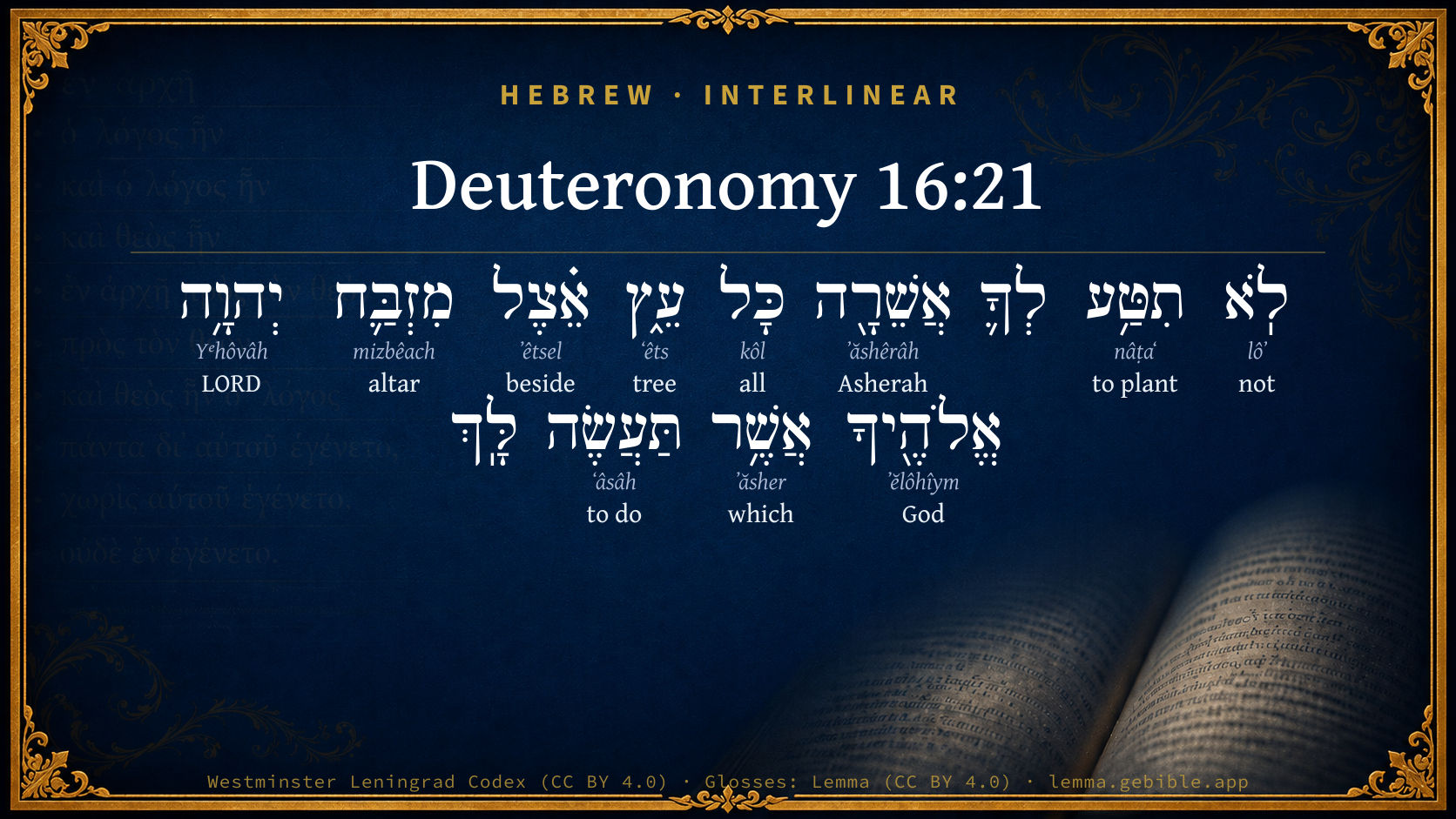
Hebrew (Westminster Leningrad Codex) Deuteronomy 16:21 appears in the Hebrew Old Testament. The text above is from the Westminster Leningrad Codex. Each word links to its Strong’s number, a concise gloss, and parsing drawn from the Open Scriptures Hebrew Bible morphology. Click any word for its full Brown-Driver-Briggs (BDB) entry.
Download image
Cite this verse

Deuteronomy 16:21 (World English Bible). Public Domain. Lemma interlinear Bible study tool, https://lemma.gebible.app/v/deuteronomy/16/21.

Show BibTeX & RIS
BibTeX
RIS
English Translation
You shall not plant you an Asherah of any kind of tree beside the altar of Yahweh your God, which you shall make you.
World English Bible · Public Domain
Download a study sheet

One document with this verse’s original text, its word-by-word gloss line, the meaning frame, cross-references with their text, attributed commentary, and full source and license credits — printable, and it pastes into notes with its structure intact.

This verse Autodidact and up

Study sheet (.html) Plain text (.txt)

A passage Seminary Student

Up to 50 verses in one chapter. A passage sheet keeps up to 6 commentary sources and 12 cross-references per verse, in the order this page ranks them, and says so on the sheet whenever that leaves anything out. Ask for a single verse and you get the Autodidact verse sheet above.

Everything on this page stays free to read, with no account — the sheet is a download of what is already on screen, not access to it.

Want to remove ads? Support Godless Engineer
Compare translations 3

The same verse in 3 English versions, stacked beneath the original-language interlinear above. Click any original word for its lexicon entry.

Each is an independent rendering of the whole verse — the interlinear is not word-aligned to these translations.

Highlighted words mark where these versions differ — a whole-verse word diff, not a word-by-word alignment.

  • World English Bible Public Domain
    You shall not plant you an Asherah of any kind of tree beside the altar of Yahweh your God, which you shall make you.
  • King James Version Public Domain
    Thou shalt not plant thee a grove of any trees near unto the altar of the LORD thy God, which thou shalt make thee.
  • unfoldingWord Literal Text CC BY-SA 4.0
    You shall not plant for yourselves an Asherah, any pole, beside the altar of Yahweh your God, which you shall make for yourself.

unfoldingWord Literal Text — © unfoldingWord, licensed CC BY-SA 4.0. Word-aligned USFM3 via Door43 (git.door43.org/unfoldingWord/en_ult).

Versions to compare (up to 4)

3 of 4 selected

Show all 18 translations

Every available English version of this verse, each an independent rendering of the whole verse.

  • World English Bible Public Domain
    You shall not plant you an Asherah of any kind of tree beside the altar of Yahweh your God, which you shall make you.
  • Berean Standard Bible Public Domain
    Do not set up any wooden Asherah pole next to the altar you will build for the LORD your God,
  • Majority Standard Bible Public Domain
    Do not set up any wooden Asherah pole next to the altar you will build for the LORD your God,
  • King James Version Public Domain
    Thou shalt not plant thee a grove of any trees near unto the altar of the LORD thy God, which thou shalt make thee.
  • American Standard Version (1901) Public Domain
    Thou shalt not plant thee an Asherah of any kind of tree beside the altar of Jehovah thy God, which thou shalt make thee.
  • Revised Version (1885) Public Domain
    Thou shalt not plant thee an Asherah of any kind of tree beside the altar of the LORD thy God, which thou shalt make thee.
  • Geneva Bible (1599) Public Domain
    Thou shalt plant thee no groue of any trees neere vnto the altar of the Lord thy God, which thou shalt make thee.
  • Douay-Rheims (1899) Public Domain
    Thou shalt plant no grove, nor any tree near the altar of the Lord thy God:
  • Young's Literal Translation Public Domain
    `Thou dost not plant for thee a shrine of any trees near the altar of Jehovah thy God, which thou makest for thyself,
  • Literal Standard Version CC BY-SA 4.0
    You do not plant an Asherah of any trees for yourself near the altar of your God YHWH, which you make for yourself,
  • Unlocked Literal Bible CC BY-SA 4.0
    You must not set up for yourselves an Asherah, any sort of pole, beside the altar of Yahweh your God that you will make for yourself.
  • unfoldingWord Literal Text CC BY-SA 4.0
    You shall not plant for yourselves an Asherah, any pole, beside the altar of Yahweh your God, which you shall make for yourself.
  • Darby Bible Public Domain
    Thou shalt not plant thyself an Asherah of any wood near unto the altar of Jehovah thy God, which thou shalt make thee.
  • World Messianic Bible Public Domain
    You shall not plant for yourselves an Asherah of any kind of tree beside the LORD your God’s altar, which you shall make for yourselves.
  • Webster's Bible Public Domain
    Thou shalt not plant thee a grove of any trees near to the altar of the LORD thy God, which thou shalt make for thee.
  • Free Bible Version CC BY-SA 4.0
    Don't ever set up a wooden Asherah pole next to the altar you build for the Lord your God,
  • Bible in Basic English Public Domain
    Let no holy tree of any sort be planted by the altar of the Lord your God which you will make.
  • JPS Tanakh (1917) Public Domain
    Thou shalt not plant thee an Asherah of any kind of tree beside the altar of the LORD thy God, which thou shalt make thee.

Literal Standard Version (2020), Covenant Press — licensed CC BY-SA 4.0. Text via the HelloAO Bible API (eBible.org). Unlocked Literal Bible (unfoldingWord) — licensed CC BY-SA 4.0. Text via the HelloAO Bible API (eBible.org). unfoldingWord Literal Text — © unfoldingWord, licensed CC BY-SA 4.0. Word-aligned USFM3 via Door43 (git.door43.org/unfoldingWord/en_ult). Free Bible Version, Dr. Jonathan Gallagher — licensed CC BY-SA 4.0. Text via the HelloAO Bible API (eBible.org).

Word by word

More ways to search: Search by grammar → Find every occurrence → Compare this word →

Practice this passage: Drill this verse → Learn its vocabulary →

אֲשֵׁרָ֖ה
ʼăshêrâh
H842
“Asherah”
Noun, Proper
Part of Speech
Noun
Type
Proper
Full BDB Definition

Origin: from H833

TWOT: 183h

Ashera(h) = "groves (for idol worship)" - a Babylonian (Astarte)-Canaanite goddess (of fortune and happiness), the supposed consort of Baal, her images - the goddess, goddesses - her images - sacred trees or poles set up near an altar
  1. לֹֽא lôʼ H3808 “not” Particle, Negative
  2. תִטַּ֥ע nâṭaʻ H5193 “to plant” Verb, Qal, Imperfect, 2nd Person, Masculine, Singular
  3. כָּל kôl H3605 “all of” Noun, Common, Masculine, Singular, Construct
  4. עֵ֑ץ ʻêts H6086 “tree” Noun, Common, Masculine, Singular, Absolute
  5. אֵ֗צֶל ʼêtsel H681 “beside” Preposition
  6. מִזְבַּ֛ח mizbêach H4196 “altar of” Noun, Common, Masculine, Singular, Construct
  7. יְהוָ֥ה Yᵉhôvâh H3068 “LORD” Noun, Proper
  8. אֱלֹהֶ֖יךָ ʼĕlôhîym H430 “God(s) · your” Noun, Common, Masculine, Plural, Construct + Suffix, Personal, 2nd Person, Masculine, Singular
  9. אֲשֶׁ֥ר ʼăsher H834 “which” Particle, Relative
  10. תַּעֲשֶׂה ʻâsâh H6213 “to do” Verb, Qal, Imperfect, 2nd Person, Masculine, Singular

About this verse

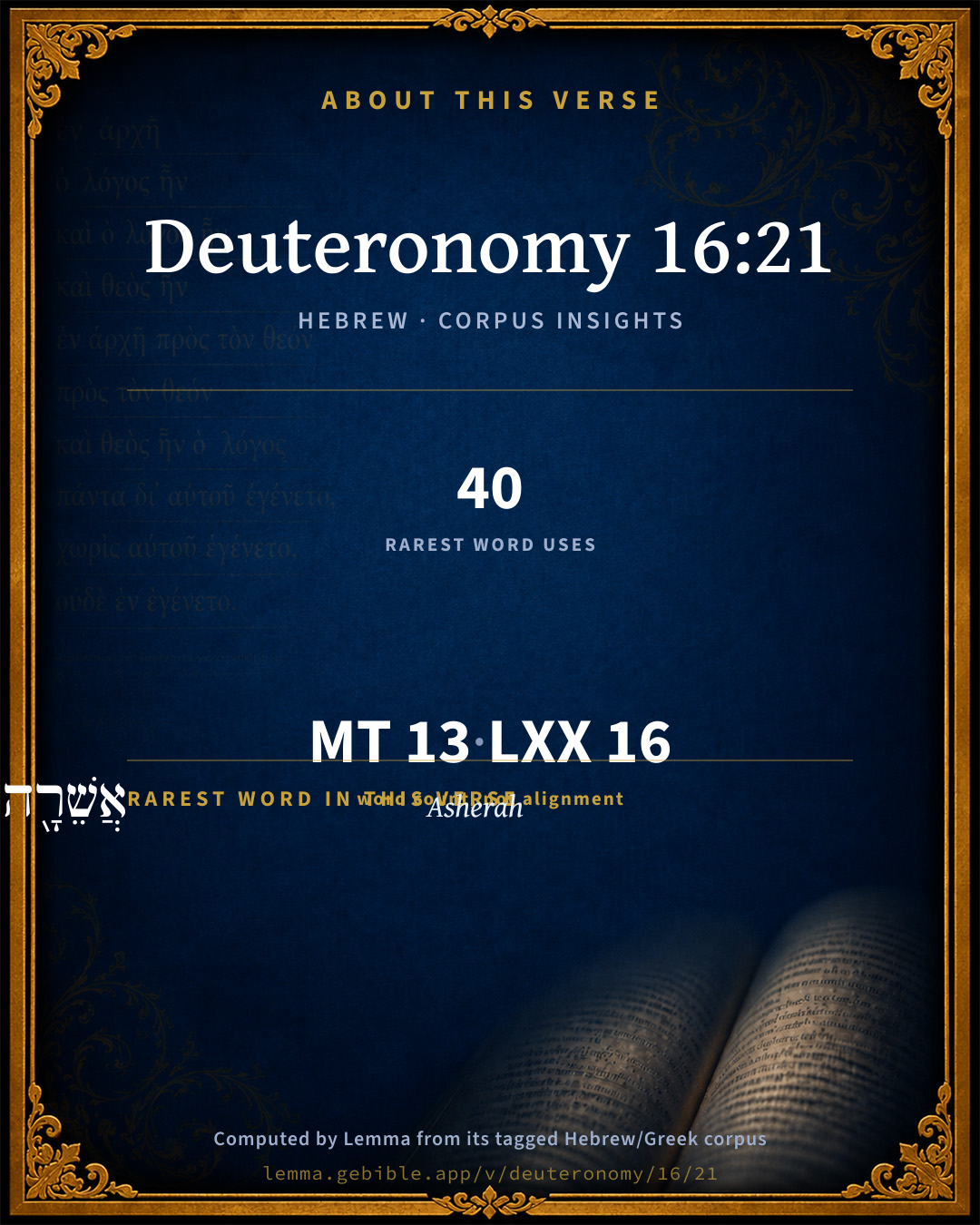
These counts appear in no published source. They are computed here, from the morphology-tagged text and Lemma’s own curated glosses. What Lemma adds →

13
words
11
distinct lemmas
Pentateuch
section

Shared distinctive vocabulary

אֲשֵׁרָ֖ה Asherah H842 occurs in 40 verses of the Hebrew Bible. Also found in:

Grammatical profile

  • 2 verbs
  • 6 nouns
  • 3 prepositions
  • 2 particles

Verb forms

  • תִטַּ֥ע Qal · Imperfect
  • תַּעֲשֶׂה Qal · Imperfect

Hebrew & Septuagint length

In English translation the verse runs 24 words from the Hebrew and 22 from the Septuagint (LXX English) — closely comparable.

A rough comparison of the two English renderings, which tokenize alike — not a word-level alignment.

Word counts can differ between the Hebrew and the Greek without any difference in meaning — e.g. the Hebrew direct-object marker אֵת has no separate Greek word, and Greek often adds the article ὁ.

In the original languages it is 13 Hebrew tokens and 16 Greek tokens — but the two are counted differently (Hebrew bundles its prefixes and suffixes into one token; the Greek is in lemma form), so that isn’t a like-for-like length.

Cross-references

8

Topical passages linked to Deuteronomy 16:21 in the Treasury of Scripture Knowledge — connected by theme and wording, ordered by reader-vote popularity; previews shown in the World English Bible.

  • 2 Chronicles 33:3 For he built again the high places which Hezekiah his father had broken down; and he reared up altars for the Baals, and made Asheroth, and worshiped all the host of the sky, and served them.
  • 2 Kings 17:16 They forsook all the commandments of Yahweh their God, and made them molten images, even two calves, and made an Asherah, and worshiped all the host of the sky, and served Baal.
  • Exodus 34:13 but you shall break down their altars, and dash in pieces their pillars, and you shall cut down their Asherim;
  • 2 Kings 21:3 For he built again the high places which Hezekiah his father had destroyed; and he reared up altars for Baal, and made an Asherah, as did Ahab king of Israel, and worshiped all the host of the sky, and served them.
  • Judges 3:7 The children of Israel did that which was evil in the sight of Yahweh, and forgot Yahweh their God, and served the Baals and the Asheroth.
  • 1 Kings 14:15 For Yahweh will strike Israel, as a reed is shaken in the water; and he will root up Israel out of this good land which he gave to their fathers, and will scatter them beyond the River, because they have made their Asherim, provoking Yahweh to anger.
  • 1 Kings 16:33 Ahab made the Asherah; and Ahab did yet more to provoke Yahweh, the God of Israel, to anger than all the kings of Israel who were before him.
  • Deuteronomy 7:5 But thus shall you deal with them: you shall break down their altars, and dash in pieces their pillars, and hew down their Asherim, and burn their engraved images with fire.

Cross-references courtesy of OpenBible.info (CC BY 4.0).

Hebrew and Greek witnesses Masoretic Hebrew ↔ Greek Septuagint

The same verse in the two great witnesses to the Old Testament, shown verse-for-verse.

These are two independent witnesses, not word-aligned to each other, and the Septuagint is shown in lemma (dictionary) form.

Hebrew Deuteronomy 16:21 Masoretic · Westminster Leningrad Codex

לֹֽא תִטַּ֥ע לְךָ֛ אֲשֵׁרָ֖ה כָּל עֵ֑ץ אֵ֗צֶל מִזְבַּ֛ח יְהוָ֥ה אֱלֹהֶ֖יךָ אֲשֶׁ֥ר תַּעֲשֶׂה לָּֽךְ

You shall not plant you an Asherah of any kind of tree beside the altar of Yahweh your God, which you shall make you.

World English Bible · Public Domain

Greek LXX Deuteronomy 16:21 Septuagint · lemma form

οὐ φυτεύω σεαυτοῦ ἄλσος πᾶς ξύλον παρά ὁ θυσιαστήριον κύριος ὁ θεός σύ ὅς ποιέω σεαυτοῦ

You shall not plant for yourself a grove; you shall not plant for yourself any tree near the altar of your God.

LXX2012 (modern English Septuagint) · Public Domain

On this verse, The Pulpit Commentary discusses the Septuagint’s reading. Read the note in Commentary ↓

Hebrew: Westminster Leningrad Codex (CC BY 4.0). Greek: Septuagint (public domain); English from LXX2012 (modern English Septuagint) (Public Domain). How the Septuagint differs from the Hebrew →

Targum (Aramaic paraphrase)

2

The Targum is the ancient Jewish Aramaic paraphrase of the Hebrew Scriptures — an interpretive translation, not the Hebrew text itself. Onkelos (literal) and Pseudo-Jonathan (expansive) render the Torah, and Jonathan the Prophets. Coverage is partial: where no permissively-licensed English translation exists for a verse, only the Aramaic is shown. This is verse-level text, not a word-by-word alignment to the Hebrew.

  1. Targum Onkelos Torah (Genesis–Deuteronomy)
    לָא תִצוֹב לָךְ אֲשֵׁרַת כָּל אִילָן בִּסְטַר מַדְבְּחָא דַיְיָ אֱלָהָךְ דִי תַעְבֶּד לָךְ

    (no public-domain English translation for this verse)

    Targum Onkelos — Aramaic: “Onkelos Genesis” (public domain); “Onkelos Exodus” (public domain); “Onkelos Leviticus” (public domain); “Onkelos Numbers” (public domain); “Onkelos Deuteronomy” (public domain). English: “Sefaria Community Translation” (CC0 1.0 (public-domain dedication)); “J.W. Etheridge. The Targums of Onkelos and Jonathan Ben Uzziel on the Pentateuch. London: Longmans, Green, 1862” (public domain). Text via Sefaria.

  2. Targum Pseudo-Jonathan Torah (Genesis–Deuteronomy)
    הֵיכְמָא דְלֵיתֵיכוֹן רַשָּׁאִין לְמִנְצוֹב אֲשֵׁירָתָא לִסְטַר מַדְבְּחָא דַיְיָ הֵיכְדֵין לֵיתֵיכוֹן רַשָּׁאִין לִמְזַוְוגָא בְּדִינָא גַבְרָא טִפְּשָׁא עִם דַּיָינַיָא חַכִּימַיָא לְמַלִיפָא לְכוֹן יַת דְּתַעַבְּדוּן לְכוֹן

    As it is not allowed you to plant a grove by the side of the Lord’s altar, so is it not allowed you to associate in judgment a fool with a wise judge to teach that which you are to do.

    Targum Pseudo-Jonathan — Aramaic: “Targum Jonathan on Genesis” (public domain); “Targum Jonathan on Exodus” (public domain); “Targum Jonathan on Leviticus” (public domain); “Targum Jonathan on Numbers” (public domain); “Targum Jonathan on Deuteronomy” (public domain). English: “The Targum of Jonathan ben Uzziel, trans. J. W. Etheridge, London, 1862” (public domain). Text via Sefaria.

Commentary

Notes on Deuteronomy 16:21 from classic Christian and Jewish commentators (each source and its license shown beneath its notes). The classic Christian expositions comment on the surrounding passage and are grouped to its opening verse, so a note may address several verses; the Jewish commentaries on the Tanakh (Rashi and others) are per-verse, so they appear only where the commentator wrote on this verse.

Lemma curates 59 commentaries, every one of them public domain or Creative Commons licensed, each selected and text-cleaned for this edition rather than reprinted as found. About our sources →

The Cambridge Bible for Schools and Colleges

gen. ed. J. J. S. Perowne

Deu_16:21-22. Against the Use of ’Asherim and Maṣṣeboth

21. Thou shalt not plant thee an Asherah] plant, because the ’Asherah (see general note following) was either a mast or artificial tree.

of any kind of tree] The Heb. construction is not in the genitive but in apposition; translate therefore: an ’Asherah, any tree or any timber.

beside the altar of the Lord thy God] No doubt, the Heb. may mean either the (one), or any, altar (for the latter see Exo_20:26, where my altar in the light of Exo_20:24 must mean any of my altars). Yet the former meaning being the more natural, and there being no trace elsewhere in D of the permission of other altars after the settlement of Israel in Canaan was achieved, it is precarious to suppose (Steuernagel) that we have here the expression of a different school of deuteron. reform from that which appears in ch. 12: one viz. which permitted more than one sanctuary and sought only to secure the purity of worship at these.

22. Neither shalt thou set thee up a pillar] raise for thyself a Maṣṣebah (see general note following) or standing-stone.

which the Lord thy God hateth] Similarly Deu_12:31, but with the addition there of abomination, which is wanting here but found in the next verse.

General Note on the ’Asherah and Maṣṣebah

Two symbols or inhabitations of deity erected in sanctuaries throughout the Semitic world: frequently combined in the O.T. as present in Canaanite sanctuaries, and at first erected also by Israel but afterwards forbidden to them.

1. The ’Ashçrah (plur. ’Ashçrim, see Deu_12:3 and elsewhere, but ’Ashçrôth 2Ch_19:3; 2Ch_33:3), artificial tree or mast set up like the maṣṣeboth by the altars of Semitic sanctuaries, a work of man’s fingers (Isa_17:8 : cp. 1Ki_14:15; 1Ki_16:13, 2Ki_21:3), wooden (Deu_16:21, Jdg_6:26, the wood of the ’A.; cp. the verbs used of it: plant, Deu_16:21, rise, Isa_27:9, pluck up, Mic_5:14, cut down, Deu_7:5, Jdg_6:25 f., Jdg_6:30, 2Ki_18:4; 2Ki_23:14, 2Ch_14:2, burn, here, 2Ki_23:6; 2Ki_23:15, in distinction from the breaking of the stone maṣṣebôth). Unlike the maṣṣebah the ’Asherah is never described as a sanctioned or tolerated part of Jehovah’s sanctuaries. There was one by the altar of the Ba‘al belonging to his father, which Gideon cut down (Jdg_6:25 ff.); Ahab made the or an ’Asherah for the altar of the Ba‘al in Samaria (1Ki_16:33), which appears to have been left by Jehu when he burned the maṣṣeboth there (2Ki_10:26 ff.; see however end of this note), for it still stood under Jehoahaz (2Ki_13:6). The deuteronomic editor of Kings says that in Judah Rehoboam raised maṣṣeboth and ’Asherim on every high hill and under every spreading tree (1Ki_14:23): Jehoshaphat is said to have removed them (2Ch_14:2; 2Ch_17:6; 2Ch_19:3), but they were restored by Joash (id. Deu_24:18). Their removal is stated as part of Hezekiah’s reforms (2Ki_18:4), but Manasseh, besides building altars to the Ba‘al, made an ’Asherah (id. Deu_21:3), and by the prophets they are counted among the idolatrous sins of Israel (Mic_5:14, Jer_17:2, Isa_27:9). That they were dedicated to Jehovah is implied in the prohibition, Deu_16:21. The command to cut them down in Exo_34:13 is a later insertion: there is no record of a law against them before D. Like the standing-stone the mast (or tree for which it stood) was frequently identified with the deity, and was probably the female counterpart to the stone. Several passages seem to imply that there was a goddess called ’Asherah (prophets of the ’A., 1Ki_18:19, image of the ’A., id. Deu_15:13, 2Ki_21:7, vessels of the ’A., id. Deu_23:4, and even houses, i.e. tents or deckings, id. Deu_23:7 : cp. the veiled ‘Asherah below). Her existence has been denied by, among others, W. R. Smith (Rel. Sem. 171 f.). But his reason, that every altar, to whatever deity it belonged, had an ’Asherah is hardly sufficient to prove an exclusively generic meaning for the name. Recent Assyriology appears to put beyond doubt the name ’Asherah as that of a Canaanite goddess and to give good reasons for her identification with ’Ashtoreth (cp. Jdg_3:7, 1Ki_18:19). The Ass. name is Ashratu or Ashirtu, and in the Tell-el-Amarna letters we find a man’s name ‘Abd-’Ashratum, ‘the worshipper of ’Asherah.’

‘The double meaning which ’Asherah has as “sacred pole” and as the name of the goddess (= ‘Ashtoreth) is now placed beyond doubt by the witness of the Tell-el-Amarna tablets (Ashirtu = Ishtar) and finds its explanation in a representation of the veiled Ishtar-Ashera, as a bust running into a pillar in the fashion of the Hermes, discovered by von Oppenheim at Ras el-‘Ain, the source of the Khabur’ (Winckler and Jensen, 3rd ed. of Schrader’s KAT 276, see also deut 245, 248, 258, 421, 432 f.).

That the ’Asherah represented a female deity (in distinction from the male character of the maṣṣeboth) is perhaps the reason of the less tolerance which it received in Israel.

2. The Maṣṣebah (thing set upright) standing-stone (plural maṣṣeboth, Deu_12:3), such as that raised by Jacob as the witness of his bargain with Laban (Gen_31:49; Gen_31:51) and at Rachel’s grave (id. Gen_35:20), or by Absalom in his own memory (2Sa_18:18); but usually of the large monoliths (R.V. marg. obelisks) beside the altars of Semitic shrines. They were regarded as the habitation of a deity (see Gen_28:22 below), but in the sense of being his embodiment; and so in ritual ‘spoken of and treated as the God himself’ (W. R. Smith, Rel. Sem. 85); ‘in them one saw the deity present at the altar, and to them the worshippers directed their hands and their prayers’ (Nowack, Hebr. Arch. ii. 18). That they stood in Canaanite sanctuaries is frequently stated in the O.T. (here, Deu_7:5, Exo_23:24; and for the house of the Ba‘al in Samaria, 2Ki_10:26 f.).

Specimens were recently discovered at Gezer by Mr R. A. S. Macalister—in one high place a row of 10, divided into 7 and 3, of which only the stumps of two remain, and the rest vary in height from 5 ft 5 ins. to 10 ft 6 ins., the largest being 4 ft 7 ins. broad by 2 ft 6 ins. thick, and in another high place a row of 4 with the stump of a fifth; at Ta‘anak by Prof. Sellin two rows of 5 each, with a pair at a little distance; and at Megiddo (Tell-el-Mutesellim) by Dr Schumacher one pair. In the high-place at Petra there are 2 great Maṣṣeboth 6 metres high, hewn out of the living rock. Those at Gezer are roughly hewn from (with one exception) the local rock, the upper end of one worked to a sharp point, and the slopes ‘polished by having been kissed, anointed, rubbed or otherwise handled,’ and another ‘carefully shaped to a rounded form’: both probably phallic (PEF. Quart. Statement, 1903, 25 ff.; Bible Side-lights from Gezer, 57 ff.).

In the earliest times maṣṣeboth were erected by the Hebrews: by Jacob (Gen_28:18; Gen_28:22 E, Gen_35:14 f. J) in memory of God’s appearance to him, and to be God’s-house = Beth-el (cp. Gk βαιτύλιον and βαίτυλος, ‘animated stone,’ through the Phoenician). Because of the verb we should also read maṣṣebah, for the mizbeaḥ, altar, which Jacob set up at Shechem and called God, the God of Israel (Gen_33:20, E). According to E (to whom most of the O.T. notices of maṣṣeboth are due) Moses put up 12 with the altar which he built on Ḥoreb1[138]. Hosea (Hos_3:4, Hos_10:1) implies that maṣṣebôth were as regular parts of Jehovah’s sanctuaries in N. Israel as altars and sacrifices2[139]. With such a recognition of the maṣṣeboth in the worship of Jehovah the command in Hos_12:3 to destroy the maṣṣeboth of the Canaanite sanctuaries is of course compatible. But the same cannot be said of the injunction in Deu_16:22 not to set up a maṣṣebah beside the altar of Jehovah, which Jehovah thy God hateth (cp. Mic_5:13). This is another of the many marks that the deuteron. legislation is later than Hosea. It is possible, however, that there had never been a maṣṣebah in the Temple of Jerusalem. In 2Ki_10:26 f. Jehu is said to have burned the maṣṣeboth in the house of the Ba‘al in Samaria, but because of the verb some read instead the ’Asherah. On the whole subject see especially W. R. Smith, Rel. Sem., 1st ed., 186 ff., 437 f.; G. F. Moore, ‘Massebah’ in EB.

[138] We read also of great stones set up by Joshua in Jehovah’s sanctuary at Shechem as a witness against the people (Jos_24:26 E) and at Gilgal as memorials of the passage of Jordan (id. Jos_4:5), at Mizpeh and Gibeon (1Sa_7:12; 2Sa_20:8).

[139] According to Isa_19:19, a maṣṣebah shall be erected in Egypt as a symbol of her people’s acknowledgement of Jehovah; but the date of this prediction is uncertain; and the writer may be speaking metaphorically. The two bronze columns Yakin and Bo‘az (1Ki_7:21) were probably from their names ‘He foundeth’ and ‘In him is strength’ symbols of the Deity, but they did not stand in the inner sanctuary. W. R. Smith, Rel. Sem. 191 n. and 468, takes them as altar-pillars with hearths on their tops.

Deu_16:21 to Deu_17:7. Isolated Group of Laws on Worship

This group of laws against heathen symbols and blemished sacrifices and the worship of other gods—all of them abominations to, or hated by, Jehovah—is quite isolated, between two sets of laws on judicial procedure, Deu_16:18-20 and Deu_17:8 ff.; and we have seen reasons (above p. 173) for supposing that the whole group originally stood between Deu_12:29-31 and Deu_13:1-18. The notes below will show that there are both similarities and dissimilarities between the two separated sections. The reason which Steuernagel gives for supposing that Deu_16:21 is by another author than that of ch. 12, with a different aim of reform—viz. because he speaks only of an altar and does not use the formulas found in 12 for the One Altar—is not convincing. With regard to this and the other dissimilarities of the present section from Deu_12:29 to Deu_13:18 it must be remembered that within the latter there are also dissimilarities. Throughout the form of address is in the Sg.: there are some editorial additions.

The Cambridge Bible for Schools and Colleges (gen. ed. J. J. S. Perowne; Cambridge University Press, 1878–1918) — public domain. Text from a community e-Sword module.

The Biblical Illustrator

Joseph S. Exell

Deu_16:21-22

Thou shalt not plant thee a grove.

Idolatry forbidden

I. Idolatry is enticing. This on many accounts.

1. By its prevalence. In some form or other it is the most popular religion in the world. Men bow down to the idols of luxury, ambition, pleasure, and avarice. For all people will walk everyone in the name of his god (Mic_4:5).

2. By its use. We naturally forsake God and cling to sin. Evil inclination leads to wrong choice, and men choose darkness rather than light.

II. Idolatry is treason against God. God is the sum of all moral qualities, the proprietor of all resources, and the giver of all existences. What more rational than to worship Him? Nothing belies God nor degrades man like the worship of images and statues.

III. Idolatry must be utterly forsakes. We must neither join the worshippers nor sanction the worship. Plant no grove of trees, for truth loves light and reproves darkness. (J. Wolfendale.)

Neither shalt thou set up any image.

Images forbidden

Thus imagery is forbidden--even religious imitation and attempted reproduction of things Divine and inexpressible. We are prone to do something to show our handiwork in Gods sanctuary; it pleases us to try to add something to the circle; it delights us to run one rim of gilt around the refined gold which burns with the image and superscription of God. We are told not to interfere; we must keep our hands off everything. We must learn to stand still; sometimes to do everything by doing nothing; and we must learn to rebuke our inventive faculty and become learned in the utterance of simple prayer. God will have His altar untouched: He will have human attention undistracted by any human devices. The altar is to stand alone in its simple dignity--most adorned when unadorned. There must be no attempt to link true religion and false religion, inspired worship and idolatrous worship, groves humanly planted and altars Divinely built. The Lord will have a time for Himself, and place for Himself, a gift for Himself, an altar for Himself. Why for Himself? Because He is the Lord, and because He means to train the human mind and heart without distraction towards the highest sublimity of law. Who will not set up his reason against the altar, and delight because his religion is rational?--as well hold up a candle to the sun, because all fire is of the same quality; because there is but one fire in the universe, and that is God. The sun says, Thou shalt not light a candle in my presence. We do it, but the candle is literally of no service in the presence of the midday sun. Jesus Christ is the Light of the world--the Sun of the great firmament of the soul--and He alone can light the space that is to be illumined. Who will not throw the little flower of self-approval upon the altar, saying, I am not as other men: I fast, I pay tithes, I do not practise extortion: I am not as the publicans are? The Lord has forbidden all groves and all images and all distractions. Only one man is permitted near the altar; only one soul is heard in heaven. His name?--the broken-hearted sinner! (J. Parker, D. D.)

.

The Biblical Illustrator, edited by Joseph S. Exell (c. 1880s–1900s) — public domain. Text from a community e-Sword module.

Joseph Benson's Commentary

Deu 16:21. Thou shalt not plant thee a grove — To plant groves in honour of the true God, was a part of primitive worship, as we see by the example of Abraham, Gen 21:33. But the Gentiles having abused this custom, and made trees and groves, dedicated to their idols, the scenes of the most vile and abominable superstitions, God saw fit to prohibit the Israelites from planting any such groves near the place of divine worship, lest they should have taken occasion from hence to blend the worship of idols, and the impure rites of heathenism, with the service of the true God.

Joseph Benson's Commentary on the Old and New Testaments (1811–1818) — public domain. Text from a community e-Sword module.

Tyndale Open Study Notes

Tyndale Open Resources

16:21-22 Asherah pole . . . sacred pillars: See study note on 7:5; see also 12:3; Isa 27:8-9; Mic 5:13-15.

Tyndale Open Study Notes — © Tyndale Open Resources, licensed CC BY-SA 4.0. Text via the HelloAO Bible API.

Jamieson, Fausset & Brown

Robert Jamieson, A. R. Fausset & David Brown

Thou shalt not plant thee a grove--A grove has in Scripture a variety of significations--a group of overshadowing trees, or a grove adorned with altars dedicated to a particular deity, or a wooden image in a grove (Jdg 6:25; Kg2 23:4-6). They might be placed near the earthen and temporary altars erected in the wilderness, but they could not exist either at the tabernacle or temples. They were places, which, with their usual accompaniments, presented strong allurements to idolatry; and therefore the Israelites were prohibited from planting them.

Jamieson, Fausset & Brown — Commentary Critical and Explanatory on the Whole Bible (1871) — public domain (CC PDM 1.0). Text via the HelloAO Bible API.

Adam Clarke's Commentary

Verse 21. Thou shalt not plant thee a grove, &c.] We have already seen that groves were planted about idol temples for the purpose of the obscene worship performed in them. (See Clarke on De 12:3.) On this account God would have no groves or thickets about his altar, that there might be no room for suspicion that any thing contrary to the strictest purity was transacted there. Every part of the Divine worship was publicly performed, for the purpose of general edification.

Adam Clarke's Commentary on the Bible (1810–1826) — public domain. Text from a community e-Sword/MySword module.

Ellicott's Commentary for English Readers

(21) Thou shalt not plant thee a grove.—Heb., ashêrah, sometimes used of images, but here evidently of the grove itself. The worship of Jehovah allowed of no secret rites; and nothing that could lead to the abominations of heathen idolatry could be permitted near Jehovah’s altar.

A Bible Commentary for English Readers, edited by Charles John Ellicott (1878–1897) — public domain. Text from a community e-Sword module.

John Gill's Exposition

Neither shalt thou set up any image,.... Graven or molten, of man, beast, fish, or fowl; the word signifies a "statue or pillar" (c) which was set up for idolatry; for, as Aben Ezra observes, what was not set up for idolatry was not forbidden, as when erected in memory of any action or remarkable event; see Jos 22:10, &c.

which the Lord thy God hateth; as he does every species, of idolatry, or that has any tendency to it; it being so opposite to his being, perfections, and glory; and therefore nothing should be done like it, because it is so hateful to him.

(c) Sept. "statuam", V. L. Pagninus, Montanus, Tig. vers. Fagius, Drusius, Grotius, Junius & Tremellius, Piscator; so Ainsworth.

Next: Deuteronomy Chapter 17

John Gill's Exposition of the Whole Bible (1746–1763) — public domain (CC PDM 1.0). Text via the HelloAO Bible API.

Haydock's Catholic Bible Commentary

Tree. The pagans had consecrated different sorts of trees to their idols. They always planted groves near their temples, to increase the reverential awe, and but too often to hide the abominations which were there committed. The Hebrews frequently imitated them in these particulars. Yet Hecateus observes, that no tree was to be seen near the temple of Jerusalem.

George Leo Haydock (1774–1849), Haydock's Catholic Family Bible and Commentary, 1859 edition — public domain. Excludes Psalms (Douay-Rheims chapter numbering differs from Protestant) and Deuterocanonical books (Catholic canon only).

Matthew Poole's English Annotations

Because this was the practice of idolaters, 1Ki 15:13, and might be an occasion of reviving idolatry. See Jdg 3:7; 1Ki 14:23; 1Ki 16:33; 18:19.

Matthew Poole's English Annotations on the Holy Bible (1683–1685) — public domain. Text from a community e-Sword/MySword module.

Whedon's Commentary on the Bible

Daniel D. Whedon

21. Thou shalt not plant thee a grove… near unto the altar — Literally, as an Asherah. The prohibition is equivalent to, “Thou shalt not set up any wooden column of Asherah.”

Daniel D. Whedon (gen. ed.), Commentary on the Old and New Testaments (1874–1909) — public domain. Text from a community e-Sword module.

The Pulpit Commentary

Vers. 21, 22. In all states, the highest crime of which the judge has to take note is that of treason against the supreme Rower; and, under the theocracy, the act most distinctly treasonable was idolatry. In proceeding, therefore, to give some practical admonitions as to the things to be observed in the administration of justice, Moses begins by denouncing and forbidding this most flagrant form of iniquity.

Thou shalt not plant thee a grove of any trees; thou shalt not plant, i.e. place or set up, an asherah of any wood. The asherah was an idol of wood in the form of a pillar, usually placed by the side of the altars of Baal. It was the symbol of Astarte, the great Canaanitish goddess, the companion and revealer of Baal. The two are usually associated in the Old Testament (cf. Jud_1:2:13 6:28; 1Ki_18:19; 2Ki_23:4) The rendering "grove" has been taken from the LXX and the Vulgate; but that it is an error is evident from 1Ki_14:23; 2Ki_17:10; and Jer_17:2; where the asherah is said to be under a green tree; and from the use of such words as make, set up, cause to stand, build, to denote the action of producing an asherah (cf. 1Ki_14:15 1Ki_16:33; 2Ki_17:16 2Ki_17:10; 2Ch_33:19; 1Ki_14:23) none of which are appropriate to the planting of a grove. Here, indeed, the word "plant" is used, but this is only because, as the asherah was sunk in the earth that it might stand firm, it might be figuratively said to be planted, just as nails driven in are said to be planted. (Ecc_12:11, where the same verb is used; comp. also Isa_51:16; Amo_9:15; Dan_11:25)

Vers. 21, 22. (See Homily, Deu_5:8-10, on "The second commandment," and also Homily, Deuteronomy 13., on "Temptations to idolatry to be resisted.

Vers. 21, 22. The pathways to temptation to be shunned.

A rash and hare-brained pilot may venture as near as he can to a sunken reef, but a wise captain will prefer plenty of sea-room. It is no proof of wisdom to tamper with temptation. One cannot handle pitch without being defiled.

I GOD WISHES TO IMPART TO MEN HIS OWN FEELING TOWARDS IDOLATRY. (Ver. 22.) To be like God is the summit of every good man"s ambition. This is God"s intention also. But the attainment can only gradually be made. We must have God"s thoughts rooted in us; we must cultivate similar feelings; we must cherish similar purposes or we cannot be like him in character. Idolatry corrupts the soul and generates death. To know and worship God leads up to richest life.

II EXTERNAL AIDS TO IDOLATRY MUST BE CAREFULLY AVOIDED. A stone which is a stumbling-block to a child has no peril for a strong man; for the sake of the young and the weak, the stone should be taken out of the way. It is wise and noble to abstain from self-indulgences which will imperil the piety of others. A shady grove would be pleasant enough for worshippers in the scorching climate of the East; nevertheless, if it shall tend in the least measure to lure the ignorant into idolatry, we will forego the pleasure. This is Godlike, to deny self in order to bless others. If umbrageous groves make my weak brother to offend, I will endure the noontide heat so long as life shall last. Our mental tastes, our love of the beautiful, our desire for pleasure, all must give way to honest endeavor for the moral elevation of the race.

III GOD"S FATHERLY KINDNESS IS EXPRESSED IN THESE PLAIN PRECEPTS. We might reach these wise maxims as reasonable deductions from moral principles; yet they come to us clothed with irresistible authority, when they appear as the revealed will of God, A twofold light blends to point out the path of human conduct, viz. the light of conscience and the light of Scripture; yet these twin rays emanate from the selfsame sun. D.

The Pulpit Commentary (1880–1919), ed. H.D.M. Spence-Jones & Joseph S. Exell — public domain. Text from a community e-Sword module.

John Wesley's Explanatory Notes

Thou shalt not plant - Because this was the practice of idolaters, and might be an occasion of reviving idolatry.

John Wesley, Explanatory Notes Upon the Whole Bible (1754–1765) — public domain. Text via the GEBible commentary corpus.

Keil & Delitzsch

C. F. Keil & F. Delitzsch

"Thou shalt not plant thee as asherah any wood beside the altar of Jehovah." נטע, to plant, used figuratively, to plant up or erect, as in Ecc 12:11; Dan 11:25; cf. Isa 51:16. Asherah, the symbol of Astarte (see at Exo 34:13), cannot mean either a green tree or a grove (as Movers, Relig. der Phnizier, p. 572, supposes), for the simple reason that in other passages we find the words עשׂה, make (Kg1 14:15; Kg1 16:33; Kg2 17:16; Kg2 21:3; Ch2 33:3), or הצּיב, set up (Kg2 17:10), העמיד, stand up (Ch2 33:19), and בּנה, build (Kg1 14:23), used to denote the erection of an asherah, not one of which is at all suitable to a tree or grove. But what is quite decisive is the fact that in Kg1 14:23; Kg2 17:10; Jer 17:2, the asherah is spoken of as being set up under, or by the side of, the green tree. This idol generally consisted of a wooden column; and a favourite place for setting it up was by the side of the altars of Baal.

Keil & Delitzsch — Biblical Commentary on the Old Testament (1861–1891) — public domain (CC PDM 1.0). Text via the HelloAO Bible API. (Old Testament only.)

Scofield Reference Notes

C. I. Scofield

grove

The groves (Heb. Asherim) so often mentioned in the OT were devoted to the worship of Ashtereth, the Babylonian goddess Ishtar, the Aphrodite of the Greeks, the Roman Venus. CF.

(See Scofield "Jdg 2:13").

The Scofield Reference Bible (1917 edition), notes by C. I. Scofield — public domain. Text from a community e-Sword module.

unfoldingWord translationNotes

Door43 World Missions Community

You must not

Here "You" refers to all the people of Israel. (See: Forms of You)

any sacred stone pillar, which Yahweh your God hates

The phrase "which Yahweh your God hates" is giving more information about the sacred stone pillar. AT: "any sacred stone pillar because Yahweh your God hates them" (See: Distinguishing versus Informing or Reminding)

sacred stone pillar

This refers to pillars that are idols used to worship false gods.

translationWords

Asherah

altar

holy

column

unfoldingWord translationNotes — © Distant Shores Media and the Door43 World Missions Community, licensed CC BY-SA 4.0. Source: git.door43.org/Door43/en_tn.

Rashi

Rabbi Shlomo Yitzchaki (Rashi)

לא תטע לך אשרה THOU SHALT NOT PLANT THEE AN ASHERA — This is intended to make one liable to punishment regarding it from the very moment that he plants it (the Ashera); even though he does not worship it he transgresses a negative command by the mere planting of it (Sifrei Devarim 145:1).

לא תטע לך אשרה כל עץ אצל מזבח ה' אלהיך THOU SHALT NOT PLANT THEE AN ASHERA, ANY TREE NEAR UNTO THE ALTAR OF THE LORD THY GOD — This is a prohibition addressed to one who would plant a tree or build a house on the Temple mount (הר הבית) (Sifrei Devarim 145:1).

Rashi on the Tanakh — English translations: “The Judaica Press complete Tanach with Rashi, translated by A. J. Rosenberg” (CC BY 4.0); “Pentateuch with Rashi's commentary by M. Rosenbaum and A.M. Silbermann, 1929-1934” (public domain); “The Metsudah Tanach series, Lakewood, N.J” (CC BY 4.0); and “The Book of Joshua, Metsudah Publications, 1997” (CC BY 4.0). Text via Sefaria.

Ramban (Nachmanides)

Rabbi Moshe ben Nachman (Ramban / Nachmanides)

THOU SHALT NOT PLANT THEE AN ASHEIRAH. Any tree planted at the entrance of a house of G-d is called asheirah. Possibly because it ordereth the way aright, G-d is called etc.” Ramban’s further language about the prohibition of planting a tree near the altar of G-d, clearly shows that he is speaking here of a House of G-d. directing people’s “steps” [to worship], it is called [asheirah] from the word ‘ashurai’ (my steps) have held fast to Thy paths., 17:5. Scripture thus admonishes not to plant a tree beside the altar of G-d for beauty and to think that it is an honor and glory to G-d’s altar. He prohibited it because it was a custom of the idolaters to plant trees at the entrances of their idol’s temples, as it is written, further, and throw down the altar of Baal that belongs to thy father, and cut down the asheirah that is by it. Now Rashi wrote: “Thou shalt not plant thee an asheirah. This is intended to make one liable [to punishment] from the very moment of planting; and even if he does not worship it, he transgresses a negative commandment for planting it. And thou shalt not plant any kind of tree beside the altar of the Eternal thy G-d. This is an admonition against planting [trees] or building a [wooden] house on the Temple mount.” If so, Scripture is stating: “thou shalt not plant thee an asheirah ‘nor’ missing in the word kol (any) which should be v’kol (nor any). Thus, Rashi interprets the verse: we may not plant a tree for an idolatrous purpose anywhere, “nor any” tree, even for beauty’s sake, beside the altar of G-d. Ramban agrees to all that. However, Rashi adds that “building a [wooden] house on the Temple mount” is likewise prohibited; Ramban points out that this is forbidden only by law of the Rabbis. any kind of tree beside the altar of the Eternal.” But building a [wooden] house on the Temple mount is [prohibited by] Rabbinic ordinance based on Scriptural support, for Scripture prohibited only the “planting” — “thou shalt not plant thee an asheirah [prohibiting the planting anywhere of trees intended for idol-worship], nor shalt thou plant thee any tree [for whatever purpose] beside the altar of the Eternal thy G-d.”

Ramban (Nachmanides) on the Tanakh — English translation: “Commentary on the Torah by Ramban (Nachmanides). Translated and annotated by Charles B. Chavel. New York, Shilo Pub. House, 1971-1976” (CC BY 4.0). Text via Sefaria.

Lesson kit

Teaching starters — assembled from the data on this page, not authored interpretation. Every prompt links to the verse data it draws on. Edit before teaching.

Deuteronomy, in the Pentateuch, opens this verse with 13 words (11 distinct Hebrew lemmas). Its most distinctive word is ʼăshêrâh (“Asherah”). A historical commentator’s framing appears above. Read the whole chapter for the surrounding context.

Discussion questions

  1. What does “Asherah” (ʼăshêrâh) contribute to the verse as a whole?
  2. How does Exodus 34:13, which shares the word «Asherah», read alongside this verse?
  3. The translations on this page render this verse differently — a whole-verse word diff, not a word-by-word alignment. What might account for the different wordings?
  4. «תִטַּ֥ע» is a Qal Imperfect verb. How does that grammatical form shape the action described?
  5. Compare how The Cambridge Bible for Schools and Colleges and The Biblical Illustrator read this verse. Where do they agree or differ?

Things to notice

Reading settings

Reading text

Shown beneath each verse's original-language words.

Old Testament
Old Testament edition

Read the OT as the Masoretic Hebrew (MT) or the Greek Septuagint (LXX).

English shown for the Greek Septuagint (in the Hebrew ↔ Greek comparison).

Comparing translations? Open the Compare panel on any verse page to stack up to four side by side.