Ezekiel 6:5

Hebrew (Westminster Leningrad Codex) Ezekiel 6:5 appears in the Hebrew Old Testament. The text above is from the Westminster Leningrad Codex. Each word links to its Strong’s number, a concise gloss, and parsing drawn from the Open Scriptures Hebrew Bible morphology. Click any word for its full Brown-Driver-Briggs (BDB) entry.
Download image
Cite this verse

Ezekiel 6:5 (World English Bible). Public Domain. Lemma interlinear Bible study tool, https://lemma.gebible.app/v/ezekiel/6/5.

Show BibTeX & RIS
BibTeX
RIS
English Translation
I will lay the dead bodies of the children of Israel before their idols; and I will scatter your bones round about your altars.
World English Bible · Public Domain
Download a study sheet

One document with this verse’s original text, its word-by-word gloss line, the meaning frame, cross-references with their text, attributed commentary, and full source and license credits — printable, and it pastes into notes with its structure intact.

This verse Autodidact and up

Study sheet (.html) Plain text (.txt)

A passage Seminary Student

Up to 50 verses in one chapter. A passage sheet keeps up to 6 commentary sources and 12 cross-references per verse, in the order this page ranks them, and says so on the sheet whenever that leaves anything out. Ask for a single verse and you get the Autodidact verse sheet above.

Everything on this page stays free to read, with no account — the sheet is a download of what is already on screen, not access to it.

Want to remove ads? Support Godless Engineer
Compare translations 3

The same verse in 3 English versions, stacked beneath the original-language interlinear above. Click any original word for its lexicon entry.

Each is an independent rendering of the whole verse — the interlinear is not word-aligned to these translations.

Highlighted words mark where these versions differ — a whole-verse word diff, not a word-by-word alignment.

  • World English Bible Public Domain
    I will lay the dead bodies of the children of Israel before their idols; and I will scatter your bones round about your altars.
  • King James Version Public Domain
    And I will lay the dead carcases of the children of Israel before their idols; and I will scatter your bones round about your altars.
  • unfoldingWord Literal Text CC BY-SA 4.0
    I will lay the dead bodies of the people of Israel before their idols, and scatter your bones around your altars.

unfoldingWord Literal Text — © unfoldingWord, licensed CC BY-SA 4.0. Word-aligned USFM3 via Door43 (git.door43.org/unfoldingWord/en_ult).

Versions to compare (up to 4)

3 of 4 selected

Show all 18 translations

Every available English version of this verse, each an independent rendering of the whole verse.

  • World English Bible Public Domain
    I will lay the dead bodies of the children of Israel before their idols; and I will scatter your bones round about your altars.
  • Berean Standard Bible Public Domain
    I will lay the corpses of the Israelites before their idols and scatter your bones around your altars.
  • Majority Standard Bible Public Domain
    I will lay the corpses of the Israelites before their idols and scatter your bones around your altars.
  • King James Version Public Domain
    And I will lay the dead carcases of the children of Israel before their idols; and I will scatter your bones round about your altars.
  • American Standard Version (1901) Public Domain
    And I will lay the dead bodies of the children of Israel before their idols; and I will scatter your bones round about your altars.
  • Revised Version (1885) Public Domain
    And I will lay the carcases of the children of Israel before their idols; and I will scatter your bones round about your altars.
  • Geneva Bible (1599) Public Domain
    And I will lay the dead carkeises of the children of Israel before their idoles, and I will scatter your bones round about your altars.
  • Douay-Rheims (1899) Public Domain
    And I will lay the dead carcasses of the children of Israel before your idols: and I will scatter Sour bones round about your altars,
  • Young's Literal Translation Public Domain
    And put the carcases of the sons of Israel before their idols, And scattered your bones round about your altars.
  • Literal Standard Version CC BY-SA 4.0
    And I have put the carcasses of the sons of Israel before their idols, || And I have scattered your bones around your altars.
  • Unlocked Literal Bible CC BY-SA 4.0
    I will lay the dead bodies of the people of Israel before their idols, and scatter your bones around your altars.
  • unfoldingWord Literal Text CC BY-SA 4.0
    I will lay the dead bodies of the people of Israel before their idols, and scatter your bones around your altars.
  • Darby Bible Public Domain
    and I will lay the dead bodies of the children of Israel before their idols; and I will scatter your bones round about your altars.
  • World Messianic Bible Public Domain
    I will lay the dead bodies of the children of Israel before their idols. I will scatter your bones around your altars.
  • Webster's Bible Public Domain
    And I will lay the dead carcasses of the children of Israel before their idols; and I will scatter your bones about your altars.
  • Free Bible Version CC BY-SA 4.0
    I will put the dead bodies of you Israelites in front of your idols and scatter your bones around your altars.
  • Bible in Basic English Public Domain
    And I will put the dead bodies of the children of Israel in front of their images, sending your bones in all directions about your altars.
  • JPS Tanakh (1917) Public Domain
    And I will lay the carcasses of the children of Israel before their idols; and I will scatter your bones round about your altars.

Literal Standard Version (2020), Covenant Press — licensed CC BY-SA 4.0. Text via the HelloAO Bible API (eBible.org). Unlocked Literal Bible (unfoldingWord) — licensed CC BY-SA 4.0. Text via the HelloAO Bible API (eBible.org). unfoldingWord Literal Text — © unfoldingWord, licensed CC BY-SA 4.0. Word-aligned USFM3 via Door43 (git.door43.org/unfoldingWord/en_ult). Free Bible Version, Dr. Jonathan Gallagher — licensed CC BY-SA 4.0. Text via the HelloAO Bible API (eBible.org).

Word by word

More ways to search: Search by grammar → Find every occurrence → Compare this word →

Practice this passage: Drill this verse → Learn its vocabulary →

פִּגְרֵי֙
peger
H6297
“corpses of”
Noun, Common, Masculine, Plural, Construct
Part of Speech
Noun
Type
Common
Gender
Masculine
Number
Plural
State
Construct
Full BDB Definition

Origin: from H6296

TWOT: 1732a

corpse, carcass, monument, stela - corpse (of man) - carcass (of animals)
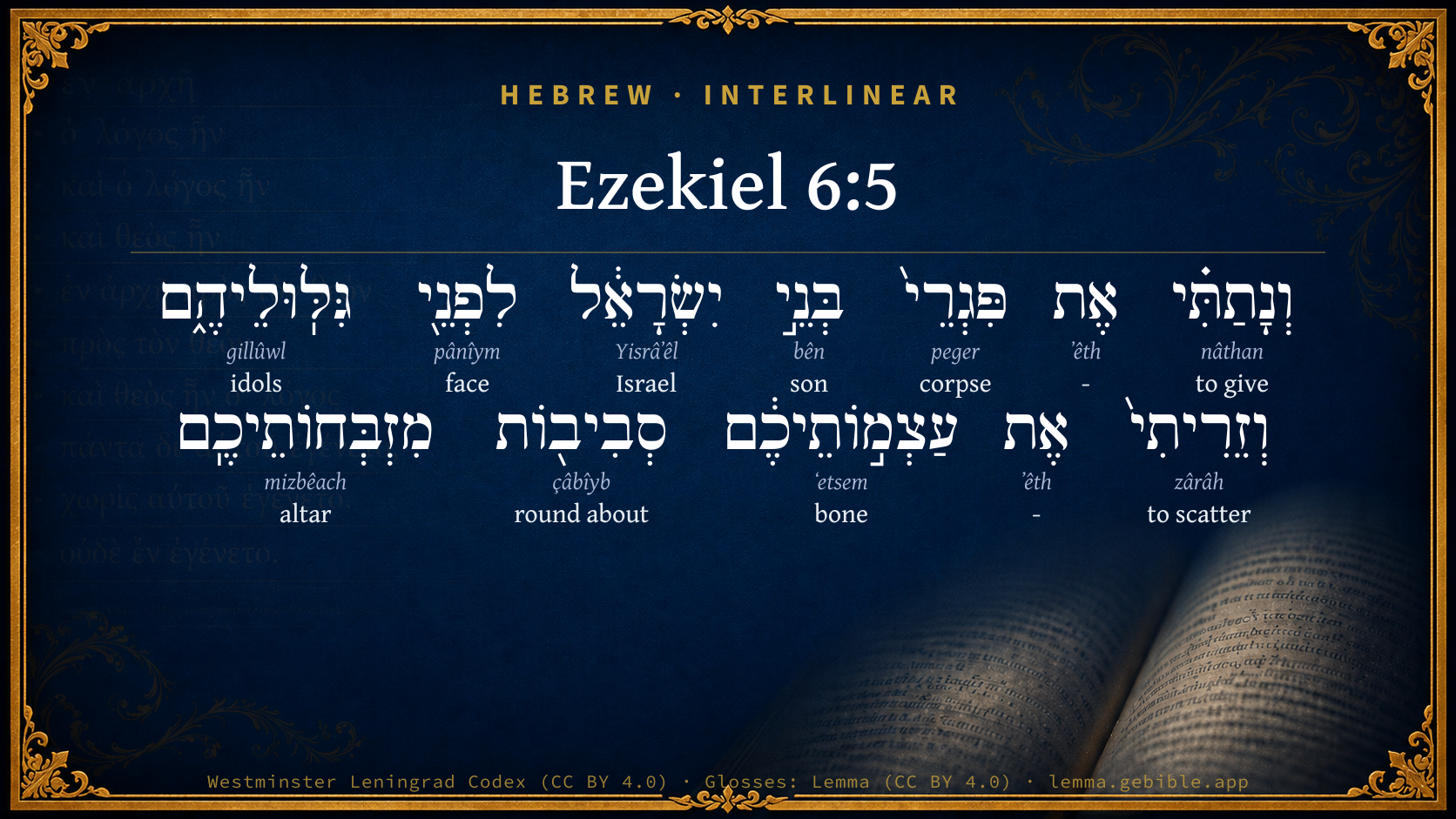
  1. וְנָתַתִּ֗י nâthan H5414 “and · to give” Conjunction + Verb, Qal, Sequential Perfect, 1st Person, Common, Singular
  2. אֶת ʼêth H853 “-” Particle, Direct Object
  3. בְּנֵ֣י bên H1121 “sons of” Noun, Common, Masculine, Plural, Construct
  4. יִשְׂרָאֵ֔ל Yisrâʼêl H3478 “Israel” Noun, Proper
  5. לִפְנֵ֖י pânîym H6440 “to/for · face(s) of” Preposition + Noun, Common, Both, Plural, Construct
  6. גִּלּֽוּלֵיהֶ֑ם gillûwl H1544 “idols · their” Noun, Common, Masculine, Plural, Construct + Suffix, Personal, 3rd Person, Masculine, Plural
  7. וְזֵרִיתִי֙ zârâh H2219 “and · to scatter” Conjunction + Verb, Piel, Sequential Perfect, 1st Person, Common, Singular
  8. אֶת ʼêth H853 “-” Particle, Direct Object
  9. עַצְמ֣וֹתֵיכֶ֔ם ʻetsem H6106 “bones · your” Noun, Common, Feminine, Plural, Construct + Suffix, Personal, 2nd Person, Masculine, Plural
  10. סְבִיב֖וֹת çâbîyb H5439 “surroundings of” Noun, Common, Both, Plural, Construct
  11. מִזְבְּחוֹתֵיכֶֽם mizbêach H4196 “altars · your” Noun, Common, Masculine, Plural, Construct + Suffix, Personal, 2nd Person, Masculine, Plural

About this verse

These counts appear in no published source. They are computed here, from the morphology-tagged text and Lemma’s own curated glosses. What Lemma adds →

12
words
11
distinct lemmas
Prophets
section

Notable vocabulary

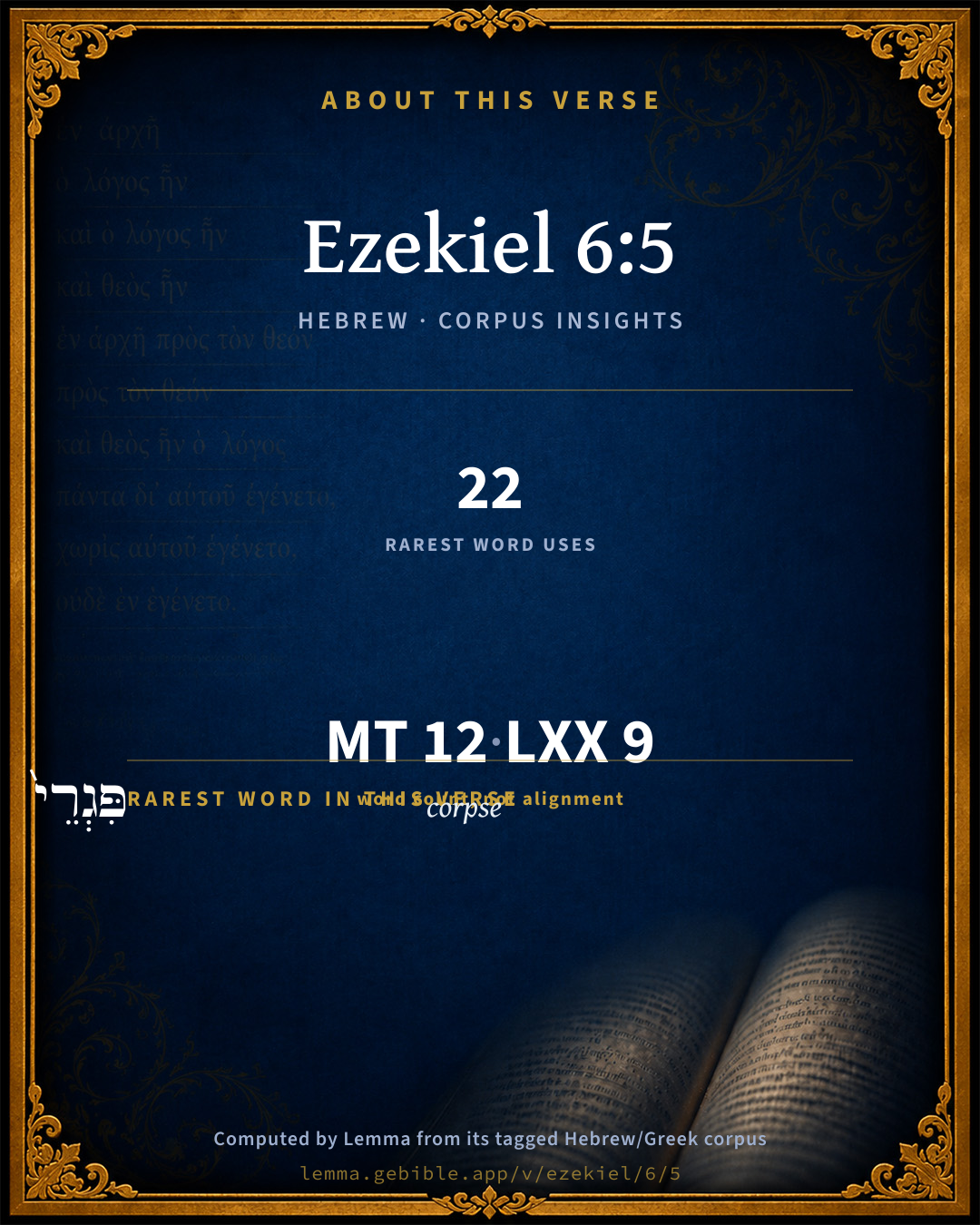
The rarest word here is פִּגְרֵי֙ corpse H6297 — appearing just 22 times in the whole Hebrew Bible.

Shared distinctive vocabulary

פִּגְרֵי֙ corpse H6297 occurs in 21 verses of the Hebrew Bible. Also found in:

Grammatical profile

  • 2 verbs
  • 8 nouns
  • 2 particles

Verb forms

  • וְנָתַתִּ֗י Qal · Sequential Perfect
  • וְזֵרִיתִי֙ Piel · Sequential Perfect

Hebrew & Septuagint length

In English translation the verse runs 24 words from the Hebrew and 10 from the Septuagint (LXX English) — the Septuagint runs noticeably shorter here. See the side-by-side →

A rough comparison of the two English renderings, which tokenize alike — not a word-level alignment.

Word counts can differ between the Hebrew and the Greek without any difference in meaning — e.g. the Hebrew direct-object marker אֵת has no separate Greek word, and Greek often adds the article ὁ.

In the original languages it is 12 Hebrew tokens and 9 Greek tokens — but the two are counted differently (Hebrew bundles its prefixes and suffixes into one token; the Greek is in lemma form), so that isn’t a like-for-like length.

Cross-references

3

Topical passages linked to Ezekiel 6:5 in the Treasury of Scripture Knowledge — connected by theme and wording, ordered by reader-vote popularity; previews shown in the World English Bible.

  • 2 Kings 23:14 He broke in pieces the pillars, and cut down the Asherim, and filled their places with the bones of men.
  • 2 Kings 23:16 As Josiah turned himself, he spied the tombs that were there in the mountain; and he sent, and took the bones out of the tombs, and burned them on the altar, and defiled it, according to the word of Yahweh which the man of God proclaimed, who proclaimed these things.
  • Jeremiah 8:1–2 At that time, says Yahweh, they shall bring out the bones of the kings of Judah, and the bones of his princes, and the bones of the priests, and the bones of the prophets, and the bones of the inhabitants of Jerusalem, out of their graves;

Cross-references courtesy of OpenBible.info (CC BY 4.0).

Hebrew and Greek witnesses Masoretic Hebrew ↔ Greek Septuagint

The same verse in the two great witnesses to the Old Testament, shown verse-for-verse.

Here the Septuagint runs noticeably shorter than the Hebrew — LXX2012 (modern English Septuagint) 10 words vs World English Bible 24. A rough length comparison of the two English translations, not a word-level alignment — read both below.

These are two independent witnesses, not word-aligned to each other, and the Septuagint is shown in lemma (dictionary) form.

Hebrew Ezekiel 6:5 Masoretic · Westminster Leningrad Codex

וְנָתַתִּ֗י אֶת פִּגְרֵי֙ בְּנֵ֣י יִשְׂרָאֵ֔ל לִפְנֵ֖י גִּלּֽוּלֵיהֶ֑ם וְזֵרִיתִי֙ אֶת עַצְמ֣וֹתֵיכֶ֔ם סְבִיב֖וֹת מִזְבְּחוֹתֵיכֶֽם

I will lay the dead bodies of the children of Israel before their idols; and I will scatter your bones round about your altars.

World English Bible · Public Domain

Greek LXX Ezekiel 6:5 Septuagint · lemma form

καί διασκορπίζω ὁ ὀστέον σύ κύκλος ὁ θυσιαστήριον σύ

And I will scatter your bones round about your altars,

LXX2012 (modern English Septuagint) · Public Domain

Hebrew: Westminster Leningrad Codex (CC BY 4.0). Greek: Septuagint (public domain); English from LXX2012 (modern English Septuagint) (Public Domain). How the Septuagint differs from the Hebrew →

Targum (Aramaic paraphrase)

1

The Targum is the ancient Jewish Aramaic paraphrase of the Hebrew Scriptures — an interpretive translation, not the Hebrew text itself. Onkelos (literal) and Pseudo-Jonathan (expansive) render the Torah, and Jonathan the Prophets. Coverage is partial: where no permissively-licensed English translation exists for a verse, only the Aramaic is shown. This is verse-level text, not a word-by-word alignment to the Hebrew.

  1. Targum Jonathan Prophets (Joshua–Malachi)
    וְאֶתֵּן יַת פִּגְרֵי בְּנֵי יִשְׂרָאֵל קֳדָם פִּגּוּר טַעֲוַתְהוֹן וַאֲבַדֵר יַת גַרְמֵיכוֹן סִחְרָנוּת אֱגוֹרֵיכוֹן:

    (no public-domain English translation for this verse)

    Targum Jonathan — Aramaic: “Mikraot Gedolot” (public domain). English: “Sefaria Community Translation” (CC0 1.0 (public-domain dedication)); “London "Chaldee Paraphrase," 1871” (public domain). Text via Sefaria.

Commentary

Notes on Ezekiel 6:5 from classic Christian and Jewish commentators (each source and its license shown beneath its notes). The classic Christian expositions comment on the surrounding passage and are grouped to its opening verse, so a note may address several verses; the Jewish commentaries on the Tanakh (Rashi and others) are per-verse, so they appear only where the commentator wrote on this verse.

Lemma curates 59 commentaries, every one of them public domain or Creative Commons licensed, each selected and text-cleaned for this edition rather than reprinted as found. About our sources →

Trapp's Complete Commentary

John Trapp

Eze 6:5 And I will lay the dead carcases of the children of Israel before their idols; and I will scatter your bones round about your altars.

Ver. 5. And I will lay the dead carcases of the children of Israel, &c.] That in the very places where they have sinned there they may suffer. So in the valley of Hinnom, and at Pilate’s praetorium, &c.

John Trapp, A Commentary or Exposition upon All the Books of the Old and New Testament (1647–1656) — public domain. Text from a community e-Sword module.

Geneva Bible (1599)

Geneva Bible translators

In contempt of their power and force, which shall neither be able to deliver you nor themselves.

Geneva Bible (1599) marginal notes — public domain. Text via Bolls.life.

Jamieson, Fausset & Brown

Robert Jamieson, A. R. Fausset & David Brown

carcasses . . . before . . . idols--polluting thus with the dead bones of you, the worshippers, the idols which seemed to you so sacrosanct.

Jamieson, Fausset & Brown — Commentary Critical and Explanatory on the Whole Bible (1871) — public domain (CC PDM 1.0). Text via the HelloAO Bible API.

Adam Clarke's Commentary

Verse 5. Will scatter your bones round about your altars.] This was literally fulfilled by the Chaldeans. According to Baruch, Baruch 2:24, 25, they opened the sepulchres of the principal people, and threw the bones about on every side.

Adam Clarke's Commentary on the Bible (1810–1826) — public domain. Text from a community e-Sword/MySword module.

John Calvin's Commentaries

By these words the Prophet signifies that God’s wrath would be manifest, because he impresses certain marks by which it may be judged that the Israelites had provoked his anger; because they had departed from the pure and genuine order of the law. He says, therefore, I will place the carcases of the sons of Israel before their idols, when the carcases were so mingled with the idols, hence it appeared that God was greatly offended. For we know that it was detestable in all sacrifices that either human bones or carcases should be joined with the victims: so that the religion of the Israelites was openly condemned by this sign, so that unless they had been utterly blind, they would acknowledge all their worship to have been abominable. We understand, therefore, the design of God when he says, that he would cast the carcases of the sons of Israel before their idols: as if he had said, I will defile all your rites which seem to you sacred, and I will make them stink even before the unbelievers. But how? for the altar is polluted by contact with a carcase; but the carcases shall be cast there, that the contagion may spread to the altars. And I will sprinkle, says he, your bones around your altars Lastly, he signifies that he would profane those sacred rites which the Israelites had fabricated for themselves with their carcases: by which he understands that they would be doubly disgraced whilst they defiled by their pollutions what they had thought beautiful. The Prophets constantly proclaimed that these rites were folly and an abomination, but still those who were attached to those superstitions pleased themselves. When, therefore, God’s servants effected nothing by their sacred admonitions, at length a real and actual proof was added, when their altars were polluted, and that, too, with their own defilement. For in this God’s remarkable vengeance appeared, as I have formerly said.

John Calvin's Commentaries (1540-1563) — public domain. Text from the Calvin Translation Society English edition (1840s-50s) via the Christian Classics Ethereal Library (ccel.org). Calvin's coverage is partial (roughly two-thirds of the Bible); uncommented books and verses are honest gaps, never fabricated. The 19th-century editor's footnotes and remarks are omitted so the notes are faithfully Calvin's own voice.

The Cambridge Bible for Schools and Colleges

gen. ed. J. J. S. Perowne

5. The same had already been threatened by Jer_8:1-2.

The Cambridge Bible for Schools and Colleges (gen. ed. J. J. S. Perowne; Cambridge University Press, 1878–1918) — public domain. Text from a community e-Sword module.

John Gill's Exposition

In all your dwelling places your cities shall be laid waste,.... Which denotes that the desolation should be general, wherever they had cities and places to dwell in; the idolatry being universal, as is said in Jer 2:28;

and the high places shall be desolate; meaning such as were in cities; as, before, such as were built upon mountains and hills; see Kg2 23:5;

that your altars may be laid waste and desolate; as they must be, the cities being destroyed in which they were set up:

and your idols may be broken and cease, and your images may be cut down; such as were made of gold and silver, or of wood and stone; the same words are used for them as in Eze 6:4;

and your works may be abolished; not only the works of their hands, but of their brain; whatever they had devised, and was contrary to the pure word and worship of God.

John Gill's Exposition of the Whole Bible (1746–1763) — public domain (CC PDM 1.0). Text via the HelloAO Bible API.

Haydock's Catholic Bible Commentary

Bones. The Chaldeans violated the tombs, Baruch ii. 24., and Jeremias viii. 1. (Calmet)

George Leo Haydock (1774–1849), Haydock's Catholic Family Bible and Commentary, 1859 edition — public domain. Excludes Psalms (Douay-Rheims chapter numbering differs from Protestant) and Deuterocanonical books (Catholic canon only).

Matthew Poole's English Annotations

Lay before their idols; expose to open shame, while the carcasses of idolaters recall to mind their shameful folly and sin.

Carcasses; either of such as are newly slain, or such as the Chaldeans did dig out of their graves, in spite, contempt, or covetousness, hoping to find some costly ornaments buried with them. So God fulfills that of Lev 26:30.

I will scatter your bones, as unworthy to be laid up in earth, who had so highly provoked the God of heaven; they are made dung who served dunghill gods. You shall thus be a defilement to your supposed sacred altars and worship, and an abhorrence to beholders.

Matthew Poole's English Annotations on the Holy Bible (1683–1685) — public domain. Text from a community e-Sword/MySword module.

Whedon's Commentary on the Bible

Daniel D. Whedon

5. They will die in their idolatry, and their high places “will be deserted.” Their wooden dolls will not be able even to protect their own altars from the pollution of dead men’s bones. “Where there had been the sweet savor of incense there should be the sickening odor of the carcasses of the slain.” — Plumptre.

Daniel D. Whedon (gen. ed.), Commentary on the Old and New Testaments (1874–1909) — public domain. Text from a community e-Sword module.

John Wesley's Explanatory Notes

And - Thus the idols were upbraided with their inability to help their worshippers, and the idolaters, with the folly of trusting in them.

John Wesley, Explanatory Notes Upon the Whole Bible (1754–1765) — public domain. Text via the GEBible commentary corpus.

Lesson kit

Teaching starters — assembled from the data on this page, not authored interpretation. Every prompt links to the verse data it draws on. Edit before teaching.

Ezekiel, in the Prophets, opens this verse with 12 words (11 distinct Hebrew lemmas). Its most distinctive word is peger (“corpse”). The Greek Septuagint runs shorter here. A historical commentator’s framing appears above. Read the whole chapter for the surrounding context.

Discussion questions

  1. How does “corpse” (peger) shape what this verse is saying?
  2. Genesis 15:11 shares the word «corpse» with this verse. How do the two illuminate each other?
  3. Compared with the Hebrew, the Septuagint runs shorter here. What questions does that raise?
  4. The translations on this page render this verse differently — a whole-verse word diff, not a word-by-word alignment. What might account for the different wordings?
  5. The verb «וְנָתַתִּ֗י» is Qal Sequential Perfect. How does its form color the action?
  6. Reading how Trapp's Complete Commentary and Geneva Bible (1599) read this verse, where do the two commentators agree and where do they part?

Things to notice

Reading settings

Reading text

Shown beneath each verse's original-language words.

Old Testament
Old Testament edition

Read the OT as the Masoretic Hebrew (MT) or the Greek Septuagint (LXX).

English shown for the Greek Septuagint (in the Hebrew ↔ Greek comparison).

Comparing translations? Open the Compare panel on any verse page to stack up to four side by side.