
Leviticus 4:35

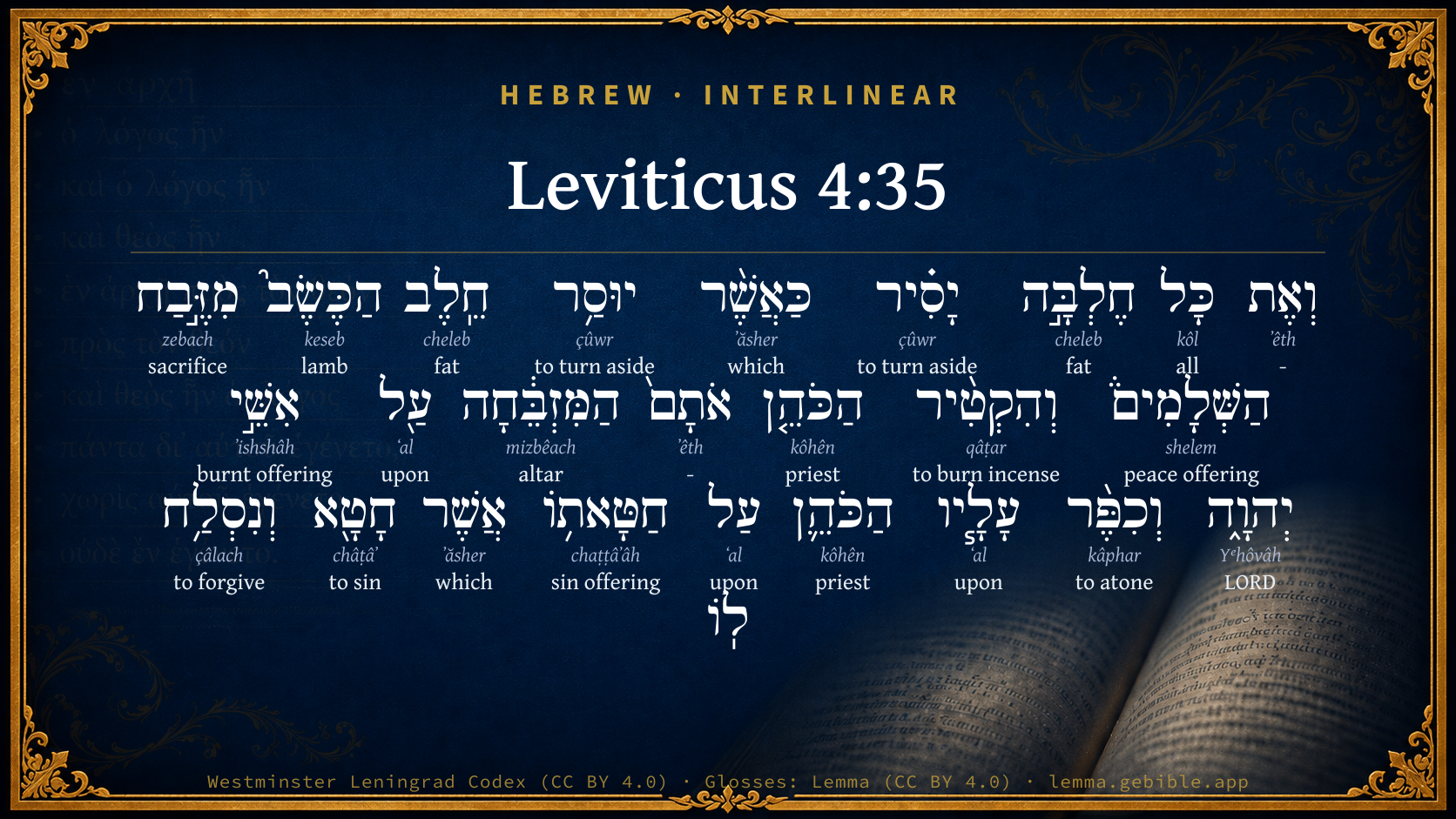
Hebrew (Westminster Leningrad Codex) Leviticus 4:35 appears in the Hebrew Old Testament. The text above is from the Westminster Leningrad Codex. Each word links to its Strong’s number, a concise gloss, and parsing drawn from the Open Scriptures Hebrew Bible morphology. Click any word for its full Brown-Driver-Briggs (BDB) entry.
Download image
Cite this verse

Leviticus 4:35 (World English Bible). Public Domain. Lemma interlinear Bible study tool, https://lemma.gebible.app/v/leviticus/4/35.

Show BibTeX & RIS
BibTeX
RIS
English Translation
All its fat he shall take away, like the fat of the lamb is taken away from the sacrifice of peace offerings; and the priest shall burn them on the altar, on the offerings of Yahweh made by fire; and the priest shall make atonement for him concerning his sin that he has sinned, and he will be forgiven.
World English Bible · Public Domain
Download a study sheet

One document with this verse’s original text, its word-by-word gloss line, the meaning frame, cross-references with their text, attributed commentary, and full source and license credits — printable, and it pastes into notes with its structure intact.

This verse Autodidact and up

Study sheet (.html) Plain text (.txt)

A passage Seminary Student

Up to 50 verses in one chapter. A passage sheet keeps up to 6 commentary sources and 12 cross-references per verse, in the order this page ranks them, and says so on the sheet whenever that leaves anything out. Ask for a single verse and you get the Autodidact verse sheet above.

Everything on this page stays free to read, with no account — the sheet is a download of what is already on screen, not access to it.

Want to remove ads? Support Godless Engineer
Compare translations 3

The same verse in 3 English versions, stacked beneath the original-language interlinear above. Click any original word for its lexicon entry.

Each is an independent rendering of the whole verse — the interlinear is not word-aligned to these translations.

Highlighted words mark where these versions differ — a whole-verse word diff, not a word-by-word alignment.

  • World English Bible Public Domain
    All its fat he shall take away, like the fat of the lamb is taken away from the sacrifice of peace offerings; and the priest shall burn them on the altar, on the offerings of Yahweh made by fire; and the priest shall make atonement for him concerning his sin that he has sinned, and he will be forgiven.
  • King James Version Public Domain
    And he shall take away all the fat thereof, as the fat of the lamb is taken away from the sacrifice of the peace offerings; and the priest shall burn them upon the altar, according to the offerings made by fire unto the LORD: and the priest shall make an atonement for his sin that he hath committed, and it shall be forgiven him.
  • unfoldingWord Literal Text CC BY-SA 4.0
    And all of its fat he shall remove, just as the fat of the lamb is removed from the sacrifice of the peace offerings. And the priest shall cause them to become smoke on the altar above the gifts of Yahweh. And the priest will make atonement for him for his sin that he sinned, and it will be forgiven to him.

unfoldingWord Literal Text — © unfoldingWord, licensed CC BY-SA 4.0. Word-aligned USFM3 via Door43 (git.door43.org/unfoldingWord/en_ult).

Versions to compare (up to 4)

3 of 4 selected

Show all 18 translations

Every available English version of this verse, each an independent rendering of the whole verse.

  • World English Bible Public Domain
    All its fat he shall take away, like the fat of the lamb is taken away from the sacrifice of peace offerings; and the priest shall burn them on the altar, on the offerings of Yahweh made by fire; and the priest shall make atonement for him concerning his sin that he has sinned, and he will be forgiven.
  • Berean Standard Bible Public Domain
    And he shall remove all the fat, just as the fat of the lamb is removed from the peace offerings, and he shall burn it on the altar along with the offerings made by fire to the LORD. In this way the priest will make atonement for him for the sin he has committed, and he will be forgiven.
  • Majority Standard Bible Public Domain
    And he shall remove all the fat, just as the fat of the lamb is removed from the peace offerings, and he shall burn it on the altar along with the food offerings to the LORD. In this way the priest will make atonement for him for the sin he has committed, and he will be forgiven.
  • King James Version Public Domain
    And he shall take away all the fat thereof, as the fat of the lamb is taken away from the sacrifice of the peace offerings; and the priest shall burn them upon the altar, according to the offerings made by fire unto the LORD: and the priest shall make an atonement for his sin that he hath committed, and it shall be forgiven him.
  • American Standard Version (1901) Public Domain
    and all the fat thereof shall he take away, as the fat of the lamb is taken away from the sacrifice of peace-offerings; and the priest shall burn them on the altar, upon the offerings of Jehovah made by fire; and the priest shall make atonement for him as touching his sin that he hath sinned, and he shall be forgiven.
  • Revised Version (1885) Public Domain
    and all the fat thereof shall he take away, as the fat of the lamb is taken away from the sacrifice of peace offerings; and the priest shall burn them on the altar, upon the offerings of the LORD made by fire: and the priest shall make atonement for him as touching his sin that he hath sinned, and he shall be forgiven.
  • Geneva Bible (1599) Public Domain
    And he shall take away all the fat thereof, as the fatte of the lambe of the peace offrings is taken away: then the Priest shall burne it vpon the altar with the oblations of the Lord made by fire, and the Priest shall make an atonement for him concerning his sinne that he hath committed, and it shalbe forgiuen him.
  • Douay-Rheims (1899) Public Domain
    All the fat also he shall take off, as the fat of the ram that is offered for peace offerings is wont to be taken away: and shall burn it upon the altar, for a burnt sacrifice of the Lord: and he shall pray for him and for his sin, and it shall be forgiven him.
  • Young's Literal Translation Public Domain
    and all its fat he turneth aside, as the fat of the sheep is turned aside from the sacrifice of the peace-offerings, and the priest hath made them a perfume on the altar, according to the fire-offerings of Jehovah, and the priest hath made atonement for him, for his sin which he hath sinned, and it hath been forgiven him.
  • Literal Standard Version CC BY-SA 4.0
    and he turns aside all its fat, as the fat of the sheep is turned aside from the sacrifice of the peace-offerings, and the priest has made them an incense on the altar, according to the fire-offerings of YHWH, and the priest has made atonement for him, for his sin which he has sinned, and it has been forgiven him.”
  • Unlocked Literal Bible CC BY-SA 4.0
    He will cut away all the fat, just as the fat of the lamb is cut away from the sacrifice of peace offerings, and the priest will burn it on the altar on top of the offerings of Yahweh made by fire. The priest will make atonement for him for the sin he has committed, and the man will be forgiven.
  • unfoldingWord Literal Text CC BY-SA 4.0
    And all of its fat he shall remove, just as the fat of the lamb is removed from the sacrifice of the peace offerings. And the priest shall cause them to become smoke on the altar above the gifts of Yahweh. And the priest will make atonement for him for his sin that he sinned, and it will be forgiven to him.
  • Darby Bible Public Domain
    And he shall take away all the fat thereof, as the fat of the lamb is taken away from the sacrifice of peace-offering; and the priest shall burn them on the altar, with Jehovah's offerings by fire; and the priest shall make atonement for him concerning his sin which he hath sinned, and it shall be forgiven him.
  • World Messianic Bible Public Domain
    He shall remove all its fat, like the fat of the lamb is removed from the sacrifice of peace offerings. The priest shall burn them on the altar, on the offerings of the LORD made by fire. The priest shall make atonement for him concerning his sin that he has sinned, and he will be forgiven.
  • Webster's Bible Public Domain
    And he shall take away all its fat, as the fat of the lamb is taken away from the sacrifice of the peace-offerings; and the priest shall burn them upon the altar, according to the offerings made by fire to the LORD: and the priest shall make an atonement for his sin that he hath committed, and it shall be forgiven him.
  • Free Bible Version CC BY-SA 4.0
    He shall remove all its fat like the fat of the lamb is removed from the peace offerings and burn it on the altar to be accepted by the Lord. In this way the priest will make the man's sin right, and he will be forgiven.”
  • Bible in Basic English Public Domain
    And let him take away all its fat, as the fat is taken away from the lamb of the peace-offerings; and let it be burned by the priest on the altar among the offerings made by fire to the Lord: and the priest will take away his sin and he will have forgiveness.
  • JPS Tanakh (1917) Public Domain
    And all the fat thereof shall he take away, as the fat of the lamb is taken away from the sacrifice of peace-offerings; and the priest shall make them smoke on the altar, upon the offerings of the LORD made by fire; and the priest shall make atonement for him as touching his sin that he hath sinned, and he shall be forgiven.

Literal Standard Version (2020), Covenant Press — licensed CC BY-SA 4.0. Text via the HelloAO Bible API (eBible.org). Unlocked Literal Bible (unfoldingWord) — licensed CC BY-SA 4.0. Text via the HelloAO Bible API (eBible.org). unfoldingWord Literal Text — © unfoldingWord, licensed CC BY-SA 4.0. Word-aligned USFM3 via Door43 (git.door43.org/unfoldingWord/en_ult). Free Bible Version, Dr. Jonathan Gallagher — licensed CC BY-SA 4.0. Text via the HelloAO Bible API (eBible.org).

Word by word

More ways to search: Search by grammar → Find every occurrence → Compare this word →

Practice this passage: Drill this verse → Learn its vocabulary →

הַכֶּשֶׂב֮
keseb
H3775
“the · lamb”
Particle, Definite Article + Noun, Common, Masculine, Singular, Absolute
Part of Speech
Particle + Noun
Type
Common
Gender
Masculine
Number
Singular
State
Absolute
Full BDB Definition

Origin: apparently by transposition for H3532

TWOT: 949

lamb, young ram, sheep
  1. וְאֶת ʼêth H853 “and · -” Conjunction + Particle, Direct Object
  2. כָּל kôl H3605 “all of” Noun, Common, Masculine, Singular, Construct
  3. חֶלְבָּ֣ה cheleb H2459 “fat · her” Noun, Common, Masculine, Singular, Construct + Suffix, Personal, 3rd Person, Feminine, Singular
  4. יָסִ֗יר çûwr H5493 “to turn aside” Verb, Hiphil, Imperfect, 3rd Person, Masculine, Singular
  5. כַּאֲשֶׁ֨ר ʼăsher H834 “like/as · which” Preposition + Particle, Relative
  6. יוּסַ֥ר çûwr H5493 “to turn aside” Verb, Hophal, Imperfect, 3rd Person, Masculine, Singular
  7. חֵֽלֶב cheleb H2459 “fat of” Noun, Common, Masculine, Singular, Construct
  8. מִזֶּ֣בַח zebach H2077 “from · sacrifice of” Preposition + Noun, Common, Masculine, Singular, Construct
  9. הַשְּׁלָמִים֒ shelem H8002 “the · peace offerings” Particle, Definite Article + Noun, Common, Masculine, Plural, Absolute
  10. וְהִקְטִ֨יר qâṭar H6999 “and · to burn incense” Conjunction + Verb, Hiphil, Sequential Perfect, 3rd Person, Masculine, Singular
  11. הַכֹּהֵ֤ן kôhên H3548 “the · priest” Particle, Definite Article + Noun, Common, Masculine, Singular, Absolute
  12. אֹתָם֙ ʼêth H853 “- · them” Particle, Direct Object + Suffix, Personal, 3rd Person, Masculine, Plural
  13. הַמִּזְבֵּ֔חָה mizbêach H4196 “the · altar · toward” Particle, Definite Article + Noun, Common, Masculine, Singular, Absolute + Suffix, Demonstrative
  14. עַ֖ל ʻal H5921 “upon” Preposition
  15. אִשֵּׁ֣י ʼishshâh H801 “burnt offerings of” Noun, Common, Masculine, Plural, Construct
  16. יְהוָ֑ה Yᵉhôvâh H3068 “LORD” Noun, Proper
  17. וְכִפֶּ֨ר kâphar H3722 “and · to atone” Conjunction + Verb, Piel, Sequential Perfect, 3rd Person, Masculine, Singular
  18. עָלָ֧יו ʻal H5921 “upon · him” Preposition + Suffix, Personal, 3rd Person, Masculine, Singular
  19. הַכֹּהֵ֛ן kôhên H3548 “the · priest” Particle, Definite Article + Noun, Common, Masculine, Singular, Absolute
  20. עַל ʻal H5921 “upon” Preposition
  21. חַטָּאת֥וֹ chaṭṭâʼâh H2403 “sin offering · his” Noun, Common, Feminine, Singular, Construct + Suffix, Personal, 3rd Person, Masculine, Singular
  22. אֲשֶׁר ʼăsher H834 “which” Particle, Relative
  23. חָטָ֖א châṭâʼ H2398 “to sin” Verb, Qal, Perfect, 3rd Person, Masculine, Singular
  24. וְנִסְלַ֥ח çâlach H5545 “and · to forgive” Conjunction + Verb, Niphal, Sequential Perfect, 3rd Person, Masculine, Singular

About this verse

These counts appear in no published source. They are computed here, from the morphology-tagged text and Lemma’s own curated glosses. What Lemma adds →

26
words
18
distinct lemmas
Pentateuch
section

Notable vocabulary

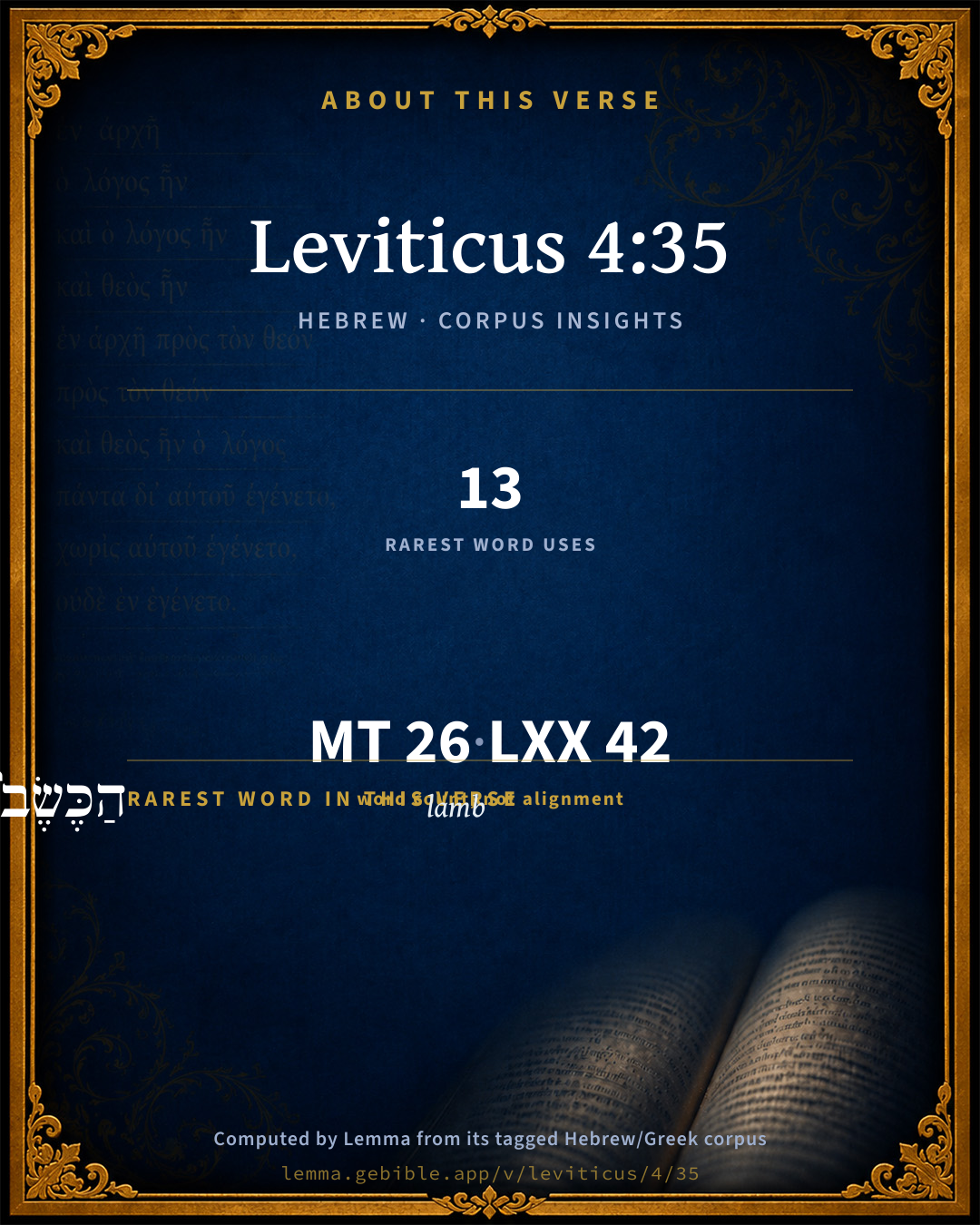
The rarest word here is הַכֶּשֶׂב֮ lamb H3775 — appearing just 13 times in the whole Hebrew Bible.

Shared distinctive vocabulary

הַכֶּשֶׂב֮ lamb H3775 occurs in 13 verses of the Hebrew Bible. Also found in:

Grammatical profile

  • 6 verbs
  • 12 nouns
  • 4 prepositions
  • 4 particles

Verb forms

  • יָסִ֗יר Hiphil · Imperfect
  • יוּסַ֥ר Hophal · Imperfect
  • וְהִקְטִ֨יר Hiphil · Sequential Perfect
  • וְכִפֶּ֨ר Piel · Sequential Perfect
  • חָטָ֖א Qal · Perfect
  • וְנִסְלַ֥ח Niphal · Sequential Perfect

Repetition

Words recur within this verse — often emphatic in Hebrew:

  • עַ֖ל upon H5921 ×3
  • חֶלְבָּ֣ה fat H2459 ×2
  • יָסִ֗יר to turn aside H5493 ×2
  • הַכֹּהֵ֤ן priest H3548 ×2
  • כַּאֲשֶׁ֨ר which H834 ×2

Hebrew & Septuagint length

In English translation the verse runs 59 words from the Hebrew and 59 from the Septuagint (LXX English) — the same length.

A rough comparison of the two English renderings, which tokenize alike — not a word-level alignment.

Word counts can differ between the Hebrew and the Greek without any difference in meaning — e.g. the Hebrew direct-object marker אֵת has no separate Greek word, and Greek often adds the article ὁ.

In the original languages it is 26 Hebrew tokens and 42 Greek tokens — but the two are counted differently (Hebrew bundles its prefixes and suffixes into one token; the Greek is in lemma form), so that isn’t a like-for-like length.

Cross-references

37

Topical passages linked to Leviticus 4:35 in the Treasury of Scripture Knowledge — connected by theme and wording, ordered by reader-vote popularity; previews shown in the World English Bible.

  • Leviticus 4:26 All its fat he shall burn on the altar, like the fat of the sacrifice of peace offerings; and the priest shall make atonement for him concerning his sin, and he will be forgiven.
  • Leviticus 4:20 Thus shall he do with the bull; as he did with the bull of the sin offering, so shall he do with this; and the priest shall make atonement for them, and they shall be forgiven.
  • Leviticus 6:7 The priest shall make atonement for him before Yahweh, and he will be forgiven concerning whatever he does to become guilty."
  • Leviticus 14:18 The rest of the oil that is in the priest's hand he shall put on the head of him who is to be cleansed, and the priest shall make atonement for him before Yahweh.
  • Leviticus 1:1–6 Yahweh called to Moses, and spoke to him out of the Tent of Meeting, saying,
  • Leviticus 4:30–31 The priest shall take some of its blood with his finger, and put it on the horns of the altar of burnt offering; and the rest of its blood he shall pour out at the base of the altar.
  • Leviticus 5:6 and he shall bring his trespass offering to Yahweh for his sin which he has sinned, a female from the flock, a lamb or a goat, for a sin offering; and the priest shall make atonement for him concerning his sin.
  • Leviticus 5:10 He shall offer the second for a burnt offering, according to the ordinance; and the priest shall make atonement for him concerning his sin which he has sinned, and he shall be forgiven.
  • Leviticus 5:13 The priest shall make atonement for him concerning his sin that he has sinned in any of these things, and he will be forgiven; and the rest shall be the priest's, as the meal offering.'"
  • Leviticus 9:7 Moses said to Aaron, "Draw near to the altar, and offer your sin offering, and your burnt offering, and make atonement for yourself, and for the people; and offer the offering of the people, and make atonement for them; as Yahweh commanded."
  • Leviticus 12:8 If she cannot afford a lamb, then she shall take two turtledoves, or two young pigeons; the one for a burnt offering, and the other for a sin offering: and the priest shall make atonement for her, and she shall be clean.'"
  • Leviticus 14:53 but he shall let the living bird go out of the city into the open field. So shall he make atonement for the house; and it shall be clean."
  • Leviticus 16:1–34 Yahweh spoke to Moses, after the death of the two sons of Aaron, when they drew near before Yahweh, and died;
  • Numbers 15:25 The priest shall make atonement for all the congregation of the children of Israel, and they shall be forgiven; for it was an error, and they have brought their offering, an offering made by fire to Yahweh, and their sin-offering before Yahweh, for their error:
  • Romans 3:24–26 being justified freely by his grace through the redemption that is in Christ Jesus;
  • Romans 4:25 who was delivered up for our trespasses, and was raised for our justification.
  • Romans 5:6–11 For while we were yet weak, at the right time Christ died for the ungodly.
  • Romans 5:15–21 But the free gift isn't like the trespass. For if by the trespass of the one the many died, much more did the grace of God, and the gift by the grace of the one man, Jesus Christ, abound to the many.
  • Romans 8:1 There is therefore now no condemnation to those who are in Christ Jesus, who don't walk according to the flesh, but according to the Spirit.
  • Romans 8:3–4 For what the law couldn't do, in that it was weak through the flesh, God did, sending his own Son in the likeness of sinful flesh and for sin, he condemned sin in the flesh;
  • Romans 10:4 For Christ is the fulfillment of the law for righteousness to everyone who believes.
  • 2 Corinthians 5:21 For him who knew no sin he made to be sin on our behalf; so that in him we might become the righteousness of God.
  • Ephesians 1:6–7 to the praise of the glory of his grace, by which he freely bestowed favor on us in the Beloved,
  • Ephesians 5:2 Walk in love, even as Christ also loved you, and gave himself up for us, an offering and a sacrifice to God for a sweet-smelling fragrance.
  • Colossians 1:14 in whom we have our redemption, the forgiveness of our sins;
  • Hebrews 1:3 His Son is the radiance of his glory, the very image of his substance, and upholding all things by the word of his power, when he had by himself made purification for our sins, sat down on the right hand of the Majesty on high;
  • Hebrews 4:14 Having then a great high priest, who has passed through the heavens, Jesus, the Son of God, let us hold tightly to our confession.
  • Hebrews 7:26 For such a high priest was fitting for us: holy, guiltless, undefiled, separated from sinners, and made higher than the heavens;
  • Hebrews 9:14 how much more will the blood of Christ, who through the eternal Spirit offered himself without blemish to God, cleanse your conscience from dead works to serve the living God?
  • 1 Peter 1:18–19 knowing that you were redeemed, not with corruptible things, with silver or gold, from the useless way of life handed down from your fathers,
  • 1 Peter 2:22 who did not sin, "neither was deceit found in his mouth."
  • 1 Peter 2:24 who his own self bore our sins in his body on the tree, that we, having died to sins, might live to righteousness; by whose stripes you were healed.
  • 1 Peter 3:18 Because Christ also suffered for sins once, the righteous for the unrighteous, that he might bring you to God; being put to death in the flesh, but made alive in the spirit;
  • 1 John 1:7 But if we walk in the light, as he is in the light, we have fellowship with one another, and the blood of Jesus Christ, his Son, cleanses us from all sin.
  • 1 John 2:2 And he is the atoning sacrifice for our sins, and not for ours only, but also for the whole world.
  • 1 John 4:9–10 By this was God's love revealed in us, that God has sent his one and only Son into the world that we might live through him.
  • Revelation 1:5–6 and from Jesus Christ, the faithful witness, the firstborn of the dead, and the ruler of the kings of the earth. To him who loves us, and washed us from our sins by his blood;

Cross-references courtesy of OpenBible.info (CC BY 4.0).

Hebrew and Greek witnesses Masoretic Hebrew ↔ Greek Septuagint

The same verse in the two great witnesses to the Old Testament, shown verse-for-verse.

These are two independent witnesses, not word-aligned to each other, and the Septuagint is shown in lemma (dictionary) form.

Hebrew Leviticus 4:35 Masoretic · Westminster Leningrad Codex

וְאֶת כָּל חֶלְבָּ֣ה יָסִ֗יר כַּאֲשֶׁ֨ר יוּסַ֥ר חֵֽלֶב הַכֶּשֶׂב֮ מִזֶּ֣בַח הַשְּׁלָמִים֒ וְהִקְטִ֨יר הַכֹּהֵ֤ן אֹתָם֙ הַמִּזְבֵּ֔חָה עַ֖ל אִשֵּׁ֣י יְהוָ֑ה וְכִפֶּ֨ר עָלָ֧יו הַכֹּהֵ֛ן עַל חַטָּאת֥וֹ אֲשֶׁר חָטָ֖א וְנִסְלַ֥ח לֽוֹ

All its fat he shall take away, like the fat of the lamb is taken away from the sacrifice of peace offerings; and the priest shall burn them on the altar, on the offerings of Yahweh made by fire; and the priest shall make atonement for him concerning his sin that he has sinned, and he will be forgiven.

World English Bible · Public Domain

Greek LXX Leviticus 4:35 Septuagint · lemma form

καί πᾶς αὐτός ὁ στέαρ περιαἱρέω ὅς τρόπος περιαἱρέω στέαρ πρόβατον ἐκ ὁ θυσία ὁ σωτήριον καί ἐπιτίθημι αὐτός ὁ ἱερεύς ἐπί ὁ θυσιαστήριον ἐπί ὁ ὁλοκαύτωμα κύριος καί ἐκἱλάσκομαι περί αὐτός ὁ ἱερεύς περί ὁ ἁμαρτία ὅς ἁμαρτάνω καί ἀποἵημι αὐτός

And he shall take away all his fat, as the fat of the lamb of the sacrifice of peace-offering is taken away, and the priest shall put it on the altar for a whole burnt offering to the Lord; and the priest shall make atonement for him for the sin which he sinned, and it shall be forgiven him.

LXX2012 (modern English Septuagint) · Public Domain

Hebrew: Westminster Leningrad Codex (CC BY 4.0). Greek: Septuagint (public domain); English from LXX2012 (modern English Septuagint) (Public Domain). How the Septuagint differs from the Hebrew →

Targum (Aramaic paraphrase)

2

The Targum is the ancient Jewish Aramaic paraphrase of the Hebrew Scriptures — an interpretive translation, not the Hebrew text itself. Onkelos (literal) and Pseudo-Jonathan (expansive) render the Torah, and Jonathan the Prophets. Coverage is partial: where no permissively-licensed English translation exists for a verse, only the Aramaic is shown. This is verse-level text, not a word-by-word alignment to the Hebrew.

  1. Targum Onkelos Torah (Genesis–Deuteronomy)
    וְיָת כָּל תַּרְבַּהּ יֶעְדֵי כְּמָא דִי מִתַּעְדָא תְרַב אִמְרָא מִנִכְסַת קוּדְשַׁיָא וְיַסֵק כַּהֲנָא יַתְהוֹן לְמַדְבְּחָא עַל קֻרְבָּנַיָא דַיְיָ וִיכַפֵּר עֲלוֹהִי כַהֲנָא עַל חוֹבְתֵהּ דִי חָב וְיִשְׁתְּבֵק לֵהּ

    (no public-domain English translation for this verse)

    Targum Onkelos — Aramaic: “Onkelos Genesis” (public domain); “Onkelos Exodus” (public domain); “Onkelos Leviticus” (public domain); “Onkelos Numbers” (public domain); “Onkelos Deuteronomy” (public domain). English: “Sefaria Community Translation” (CC0 1.0 (public-domain dedication)); “J.W. Etheridge. The Targums of Onkelos and Jonathan Ben Uzziel on the Pentateuch. London: Longmans, Green, 1862” (public domain). Text via Sefaria.

  2. Targum Pseudo-Jonathan Torah (Genesis–Deuteronomy)
    וְיַת כָּל תַּרְבָּא יַעֲדֵי הֵיכְמָא דְאִתְעֲדָא תְּרֵיב אִימַר מְנִיכְסַת קוּדְשַׁיָא וְיַסִיק יַתְהוֹן כַּהֲנָא לְמַדְבְּחָא עַל קוּרְבָּנַיָא דַיְיָ וִיכַפֵּר עֲלוֹי כַּהֲנָא עַל חוֹבְתֵיהּ דְחַב וְיִשְׁתְּבֵק לֵיהּ

    And all the fat he shall remove, as the fat of the lamb of the sanctified victims was removed, and the priest shall burn it at the altar with the oblations of the Lord, and the priest shall make atonement for him on account of the sin that he hath sinned, and it shall be forgiven him.

    Targum Pseudo-Jonathan — Aramaic: “Targum Jonathan on Genesis” (public domain); “Targum Jonathan on Exodus” (public domain); “Targum Jonathan on Leviticus” (public domain); “Targum Jonathan on Numbers” (public domain); “Targum Jonathan on Deuteronomy” (public domain). English: “The Targum of Jonathan ben Uzziel, trans. J. W. Etheridge, London, 1862” (public domain). Text via Sefaria.

Commentary

Notes on Leviticus 4:35 from classic Christian and Jewish commentators (each source and its license shown beneath its notes). The classic Christian expositions comment on the surrounding passage and are grouped to its opening verse, so a note may address several verses; the Jewish commentaries on the Tanakh (Rashi and others) are per-verse, so they appear only where the commentator wrote on this verse.

Lemma curates 59 commentaries, every one of them public domain or Creative Commons licensed, each selected and text-cleaned for this edition rather than reprinted as found. About our sources →

Trapp's Complete Commentary

John Trapp

Lev 4:35 And he shall take away all the fat thereof, as the fat of the lamb is taken away from the sacrifice of the peace offerings; and the priest shall burn them upon the altar, according to the offerings made by fire unto the LORD: and the priest shall make an atonement for his sin that he hath committed, and it shall be forgiven him.

Ver. 35. According to the offerings.] Or, Upon the offerings; or, Besides the burnt offerings daily offered to the Lord.

John Trapp, A Commentary or Exposition upon All the Books of the Old and New Testament (1647–1656) — public domain. Text from a community e-Sword module.

Geneva Bible (1599)

Geneva Bible translators

Or, besides the burnt offerings, which were daily offered to the Lord.

Geneva Bible (1599) marginal notes — public domain. Text via Bolls.life.

Jamieson, Fausset & Brown

Robert Jamieson, A. R. Fausset & David Brown

it shall be forgiven him--None of these sacrifices possessed any intrinsic value sufficient to free the conscience of the sinner from the pollution of guilt, or to obtain his pardon from God; but they gave a formal deliverance from a secular penalty (Heb 9:13-14); and they were figurative representations of the full and perfect sin offering which was to be made by Christ.

Next: Leviticus Chapter 5

Jamieson, Fausset & Brown — Commentary Critical and Explanatory on the Whole Bible (1871) — public domain (CC PDM 1.0). Text via the HelloAO Bible API.

Ellicott's Commentary for English Readers

(35) According to the offerings made by fire.—Better, upon the offerings made by fire. As the daily morning sacrifice was offered first every day, and as it continued burning on the altar all the forenoon, no fresh or special fire was to be kindled for it, but it was to be upon the fire sacrifices which had already been placed there before. (See Lev_3:5; Lev_5:12.) The flesh of the sin offering, both for the prince and for the individual members of the community, was not burnt without the camp, as was the case with the flesh of the sacrifice for the high priest and for the whole congregation, but was the perquisite of the priests, and was eaten by them (Lev_6:26-30). This is in harmony with the law. The sinner who brought the sin offering could not partake of it. Hence the priest was not permitted to eat of the flesh of the sin offering which he offered for himself, or of the flesh of the congregational sin offering, because he was a member of the congregation.

A Bible Commentary for English Readers, edited by Charles John Ellicott (1878–1897) — public domain. Text from a community e-Sword module.

The Cambridge Bible for Schools and Colleges

gen. ed. J. J. S. Perowne

35. upon the offerings] ‘after the manner of’ R.V. mg. Either the portions are to be burnt upon the remains of sacrifices already offered, or in the same way as other fire-offerings.

The Cambridge Bible for Schools and Colleges (gen. ed. J. J. S. Perowne; Cambridge University Press, 1878–1918) — public domain. Text from a community e-Sword module.

Haydock's Catholic Bible Commentary

For a. Hebrew may be "according to, like (Haydock) upon, besides, after the holocausts." (Calmet) See chap. iii. 5.

George Leo Haydock (1774–1849), Haydock's Catholic Family Bible and Commentary, 1859 edition — public domain. Excludes Psalms (Douay-Rheims chapter numbering differs from Protestant) and Deuterocanonical books (Catholic canon only).

Matthew Poole's English Annotations

Shall burn them, i.e. the fat; but he useth the plural number, because the fat was of several kinds, as we saw Lev 4:8,9.

According to the offerings made by fire; Heb. upon the offerings, together with them, or after them; because the burnt-offerings were to have the first place. See Poole "Lev 3:5".

Matthew Poole's English Annotations on the Holy Bible (1683–1685) — public domain. Text from a community e-Sword/MySword module.

John Wesley's Explanatory Notes

Burn them - The fat; but he useth the plural number, because the fat was of several kinds, as we saw ver. 8, 9. upon the offerings, together with them, or after them; because the burnt- offerings were to have the first place.

John Wesley, Explanatory Notes Upon the Whole Bible (1754–1765) — public domain. Text via the GEBible commentary corpus.

Rashi

Rabbi Shlomo Yitzchaki (Rashi)

כאשר יוסר חלב הכבש [AND HE SHALL REMOVE ALL THE FAT THEREOF] AS THE FAT OF THE LAMB IS REMOVED — the fat portions of which have been augmented by the addition of the fat-tail (cf. v. 9): thus, too, does a sin-offering, whenever it is brought as she-lamb, require the fat-tail to be removed together with the other fat portions (cf. Sifra, Vayikra Dibbura d'Chovah, Chapter 11 4).

על אשי ה׳ means upon the fire-pyres which are made for the Lord; foailles in O. F.

Rashi on the Tanakh — English translations: “The Judaica Press complete Tanach with Rashi, translated by A. J. Rosenberg” (CC BY 4.0); “Pentateuch with Rashi's commentary by M. Rosenbaum and A.M. Silbermann, 1929-1934” (public domain); “The Metsudah Tanach series, Lakewood, N.J” (CC BY 4.0); and “The Book of Joshua, Metsudah Publications, 1997” (CC BY 4.0). Text via Sefaria.

Lesson kit

Teaching starters — assembled from the data on this page, not authored interpretation. Every prompt links to the verse data it draws on. Edit before teaching.

Leviticus, in the Pentateuch, opens this verse with 26 words (18 distinct Hebrew lemmas). Its most distinctive word is keseb (“lamb”). A historical commentator’s framing appears above. Read the whole chapter for the surrounding context.

Discussion questions

  1. The word keseb carries the sense “lamb.” How does it shape the verse?
  2. Genesis 30:32 shares the word «lamb» with this verse. How do the two illuminate each other?
  3. “upon” occurs 3× in this one verse. What is the effect of the repetition?
  4. These translations render this verse differently. What is at stake in choosing one wording over another?
  5. The verb «יָסִ֗יר» is Hiphil Imperfect. How does its form color the action?
  6. Reading how Trapp's Complete Commentary and Geneva Bible (1599) read this verse, where do the two commentators agree and where do they part?

Things to notice

Reading settings

Reading text

Shown beneath each verse's original-language words.

Old Testament
Old Testament edition

Read the OT as the Masoretic Hebrew (MT) or the Greek Septuagint (LXX).

English shown for the Greek Septuagint (in the Hebrew ↔ Greek comparison).

Comparing translations? Open the Compare panel on any verse page to stack up to four side by side.