
Deuteronomy 12:5

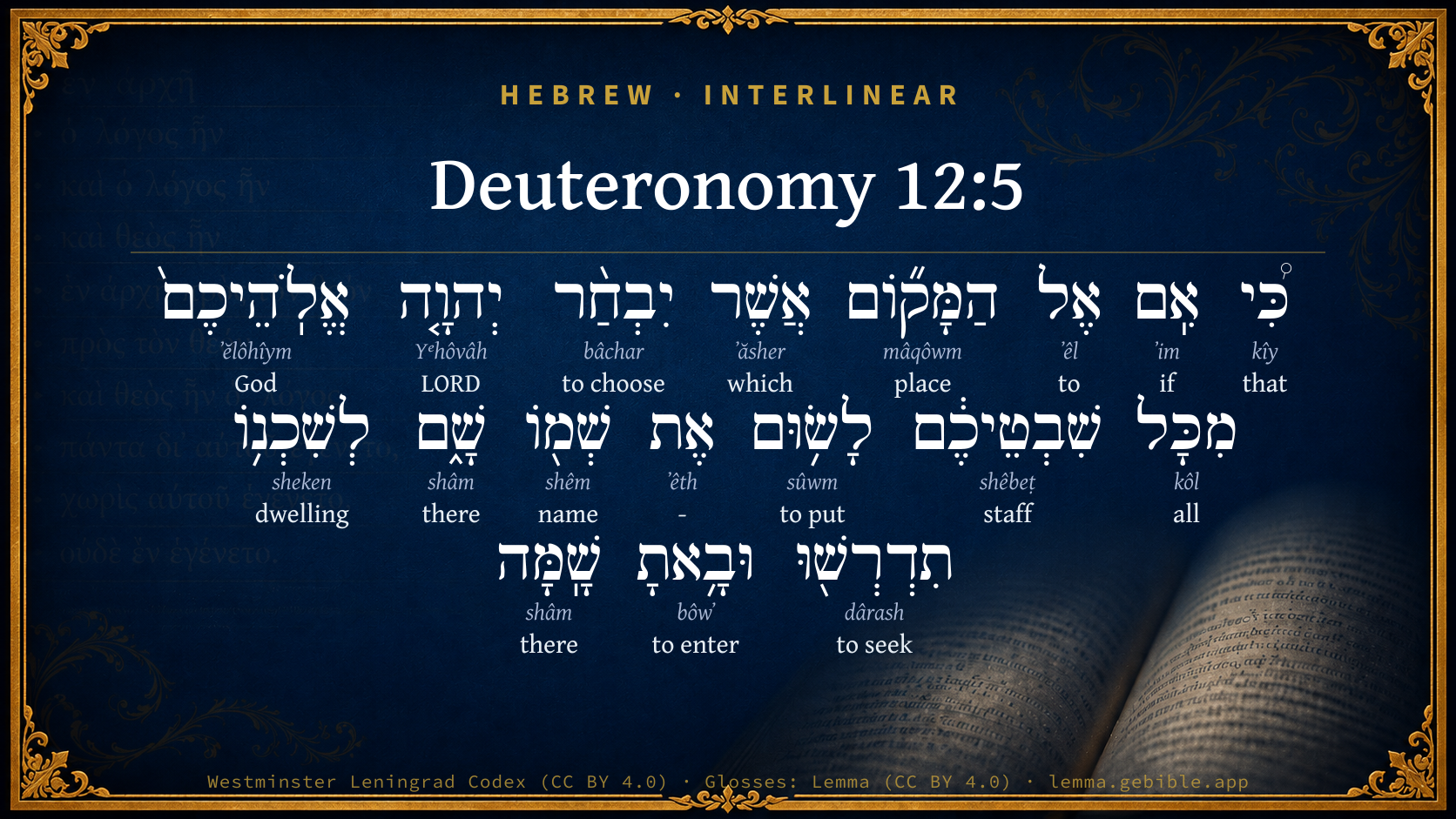
Hebrew (Westminster Leningrad Codex) Deuteronomy 12:5 appears in the Hebrew Old Testament. The text above is from the Westminster Leningrad Codex. Each word links to its Strong’s number, a concise gloss, and parsing drawn from the Open Scriptures Hebrew Bible morphology. Click any word for its full Brown-Driver-Briggs (BDB) entry.
Download image
Cite this verse

Deuteronomy 12:5 (World English Bible). Public Domain. Lemma interlinear Bible study tool, https://lemma.gebible.app/v/deuteronomy/12/5.

Show BibTeX & RIS
BibTeX
RIS
English Translation
But to the place which Yahweh your God shall choose out of all your tribes, to put his name there, even to his habitation shall you seek, and there you shall come;
World English Bible · Public Domain
Highlights
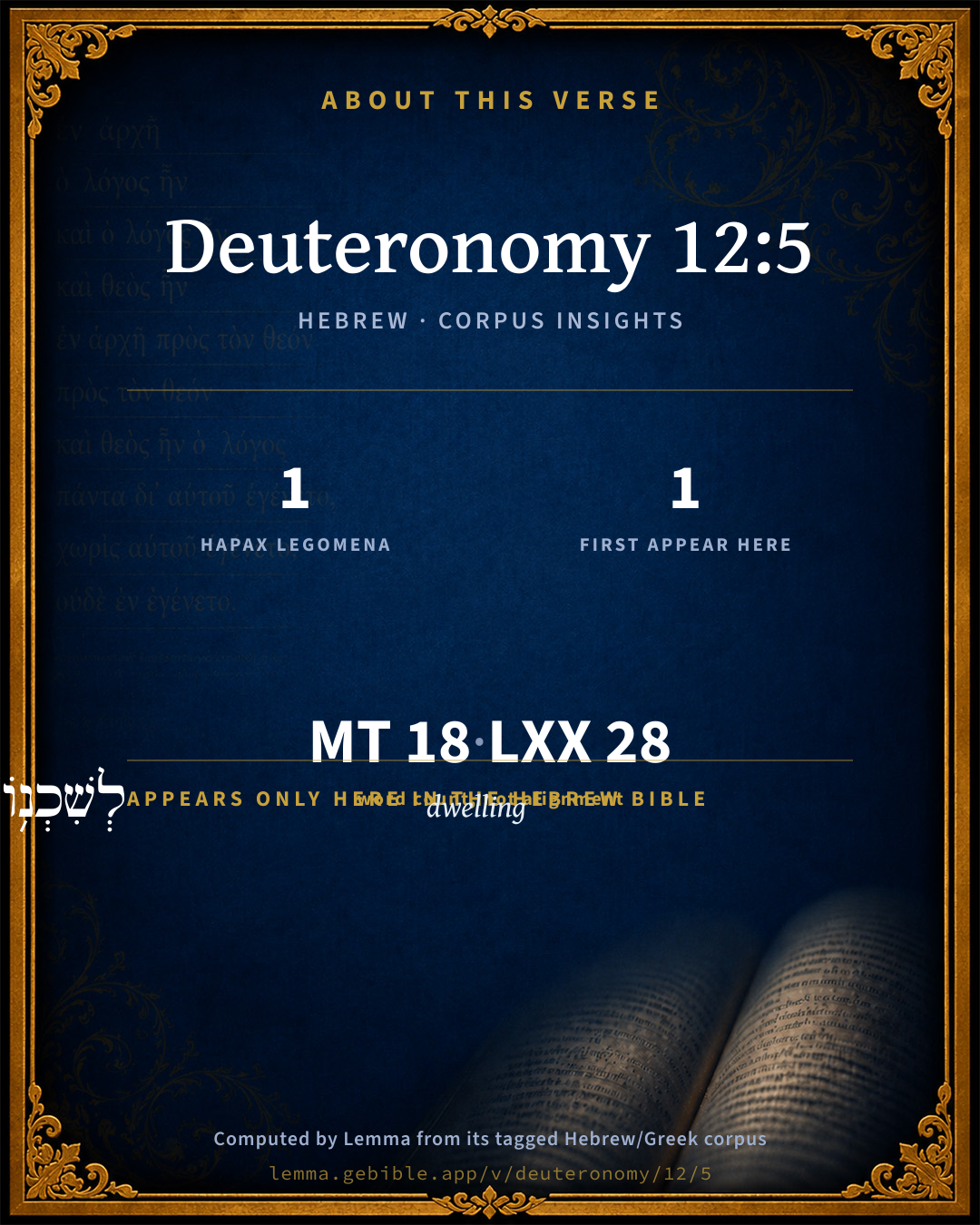
  • 1 hapax legomenon — only here in the Hebrew Bible
  • 1 first appearance in the Hebrew Bible
Full analysis ↓
Download a study sheet

One document with this verse’s original text, its word-by-word gloss line, the meaning frame, cross-references with their text, attributed commentary, and full source and license credits — printable, and it pastes into notes with its structure intact.

This verse Autodidact and up

Study sheet (.html) Plain text (.txt)

A passage Seminary Student

Up to 50 verses in one chapter. A passage sheet keeps up to 6 commentary sources and 12 cross-references per verse, in the order this page ranks them, and says so on the sheet whenever that leaves anything out. Ask for a single verse and you get the Autodidact verse sheet above.

Everything on this page stays free to read, with no account — the sheet is a download of what is already on screen, not access to it.

Want to remove ads? Support Godless Engineer
Compare translations 3

The same verse in 3 English versions, stacked beneath the original-language interlinear above. Click any original word for its lexicon entry.

Each is an independent rendering of the whole verse — the interlinear is not word-aligned to these translations.

Highlighted words mark where these versions differ — a whole-verse word diff, not a word-by-word alignment.

  • World English Bible Public Domain
    But to the place which Yahweh your God shall choose out of all your tribes, to put his name there, even to his habitation shall you seek, and there you shall come;
  • King James Version Public Domain
    But unto the place which the LORD your God shall choose out of all your tribes to put his name there, even unto his habitation shall ye seek, and thither thou shalt come:
  • unfoldingWord Literal Text CC BY-SA 4.0
    But to the place that Yahweh your God will choose out of all your tribes to put his name there, you shall search for his dwelling, and there you shall go.

unfoldingWord Literal Text — © unfoldingWord, licensed CC BY-SA 4.0. Word-aligned USFM3 via Door43 (git.door43.org/unfoldingWord/en_ult).

Versions to compare (up to 4)

3 of 4 selected

Show all 18 translations

Every available English version of this verse, each an independent rendering of the whole verse.

  • World English Bible Public Domain
    But to the place which Yahweh your God shall choose out of all your tribes, to put his name there, even to his habitation shall you seek, and there you shall come;
  • Berean Standard Bible Public Domain
    Instead, you must seek the place the LORD your God will choose from among all your tribes to establish as a dwelling for His Name, and there you must go.
  • Majority Standard Bible Public Domain
    Instead, you must seek the place the LORD your God will choose from among all your tribes to establish as a dwelling for His Name, and there you must go.
  • King James Version Public Domain
    But unto the place which the LORD your God shall choose out of all your tribes to put his name there, even unto his habitation shall ye seek, and thither thou shalt come:
  • American Standard Version (1901) Public Domain
    But unto the place which Jehovah your God shall choose out of all your tribes, to put his name there, even unto his habitation shall ye seek, and thither thou shalt come;
  • Revised Version (1885) Public Domain
    But unto the place which the LORD your God shall choose out of all your tribes to put his name there, even unto his habitation shall ye seek, and thither thou shalt come:
  • Geneva Bible (1599) Public Domain
    But ye shall seeke the place which the Lord your God shall chose out of all your tribes, to put his Name there, and there to dwell, and thither thou shalt come,
  • Douay-Rheims (1899) Public Domain
    But you shall come to the place, which the Lord your God shall choose out of all your tribes, to put his name there, and to dwell in it:
  • Young's Literal Translation Public Domain
    but unto the place which Jehovah your God doth choose out of all your tribes to put His name there, to His tabernacle ye seek, and thou hast entered thither,
  • Literal Standard Version CC BY-SA 4.0
    rather—that you seek after the place which your God YHWH chooses out of all your tribes to put His Name there, for His Dwelling Place, and you have entered there,
  • Unlocked Literal Bible CC BY-SA 4.0
    But to the place that Yahweh your God will choose out of all your tribes to put his name, that will be the place where he lives, and it is there that you will go.
  • unfoldingWord Literal Text CC BY-SA 4.0
    But to the place that Yahweh your God will choose out of all your tribes to put his name there, you shall search for his dwelling, and there you shall go.
  • Darby Bible Public Domain
    but unto the place which Jehovah your God will choose out of all your tribes to set his name there, his habitation shall ye seek, and thither thou shalt come;
  • World Messianic Bible Public Domain
    But to the place which the LORD your God shall choose out of all your tribes, to put his name there, you shall seek his habitation, and you shall come there.
  • Webster's Bible Public Domain
    But the place which the LORD your God shall choose out of all your tribes to put his name there, even his habitation shall ye seek, and thither thou shalt come:
  • Free Bible Version CC BY-SA 4.0
    No, you must go to the place the Lord your God will choose from the territory of all your tribes where he will live with you. That's where you must go.
  • Bible in Basic English Public Domain
    But let your hearts be turned to the place which will be marked out by the Lord your God, among your tribes, to put his name there;
  • JPS Tanakh (1917) Public Domain
    But unto the place which the LORD your God shall choose out of all your tribes to put His name there, even unto His habitation shall ye seek, and thither thou shalt come;

Literal Standard Version (2020), Covenant Press — licensed CC BY-SA 4.0. Text via the HelloAO Bible API (eBible.org). Unlocked Literal Bible (unfoldingWord) — licensed CC BY-SA 4.0. Text via the HelloAO Bible API (eBible.org). unfoldingWord Literal Text — © unfoldingWord, licensed CC BY-SA 4.0. Word-aligned USFM3 via Door43 (git.door43.org/unfoldingWord/en_ult). Free Bible Version, Dr. Jonathan Gallagher — licensed CC BY-SA 4.0. Text via the HelloAO Bible API (eBible.org).

Word by word

More ways to search: Search by grammar → Find every occurrence → Compare this word →

Practice this passage: Drill this verse → Learn its vocabulary →

לְשִׁכְנ֥וֹ
sheken
H7933
“to/for · dwelling · him”
Preposition + Verb, Qal, Infinitive Construct + Suffix, Personal, 3rd Person, Masculine, Singular
Part of Speech
Preposition + Verb
Stem
Qal
Form
Infinitive Construct
Full BDB Definition

Origin: from H7931

TWOT: 2387a

dwelling
  1. כִּ֠י kîy H3588 “that” Conjunction
  2. אִֽם ʼim H518 “if” Conjunction
  3. אֶל ʼêl H413 “to” Preposition
  4. הַמָּק֞וֹם mâqôwm H4725 “the · place” Particle, Definite Article + Noun, Common, Masculine, Singular, Absolute
  5. אֲשֶׁר ʼăsher H834 “which” Particle, Relative
  6. יִבְחַ֨ר bâchar H977 “to choose” Verb, Qal, Imperfect, 3rd Person, Masculine, Singular
  7. יְהוָ֤ה Yᵉhôvâh H3068 “LORD” Noun, Proper
  8. אֱלֹֽהֵיכֶם֙ ʼĕlôhîym H430 “God(s) · your” Noun, Common, Masculine, Plural, Construct + Suffix, Personal, 2nd Person, Masculine, Plural
  9. מִכָּל kôl H3605 “from · all of” Preposition + Noun, Common, Masculine, Singular, Construct
  10. שִׁבְטֵיכֶ֔ם shêbeṭ H7626 “staffs · your” Noun, Common, Masculine, Plural, Construct + Suffix, Personal, 2nd Person, Masculine, Plural
  11. לָשׂ֥וּם sûwm H7760 “to put” Preposition + Verb, Qal, Infinitive Construct
  12. אֶת ʼêth H853 “-” Particle, Direct Object
  13. שְׁמ֖וֹ shêm H8034 “name · his” Noun, Common, Masculine, Singular, Construct + Suffix, Personal, 3rd Person, Masculine, Singular
  14. שָׁ֑ם shâm H8033 “there” Adverb
  15. תִדְרְשׁ֖וּ dârash H1875 “to seek” Verb, Qal, Imperfect, 2nd Person, Masculine, Plural
  16. וּבָ֥אתָ bôwʼ H935 “and · to enter” Conjunction + Verb, Qal, Sequential Perfect, 2nd Person, Masculine, Singular
  17. שָֽׁמָּה shâm H8033 “there · toward” Adverb + Suffix, Demonstrative

About this verse

These counts appear in no published source. They are computed here, from the morphology-tagged text and Lemma’s own curated glosses. What Lemma adds →

18
words
17
distinct lemmas
Pentateuch
section

Notable vocabulary

1 hapax legomenon — a word that appears only here in the entire Hebrew Bible:

  • לְשִׁכְנ֥וֹ dwelling H7933

First appearance in Scripture

This word makes its first canonical appearance in the Hebrew Bible here:

  • לְשִׁכְנ֥וֹ dwelling H7933

Grammatical profile

  • 5 verbs
  • 6 nouns
  • 1 preposition
  • 2 conjunctions
  • 2 adverbs
  • 2 particles

Verb forms

  • יִבְחַ֨ר Qal · Imperfect
  • לָשׂ֥וּם Qal · Infinitive Construct
  • לְשִׁכְנ֥וֹ Qal · Infinitive Construct
  • תִדְרְשׁ֖וּ Qal · Imperfect
  • וּבָ֥אתָ Qal · Sequential Perfect

Repetition

A word recurs within this verse — often emphatic in Hebrew:

  • שָׁ֑ם there H8033 ×2

Hebrew & Septuagint length

In English translation the verse runs 32 words from the Hebrew and 35 from the Septuagint (LXX English) — closely comparable.

A rough comparison of the two English renderings, which tokenize alike — not a word-level alignment.

Word counts can differ between the Hebrew and the Greek without any difference in meaning — e.g. the Hebrew direct-object marker אֵת has no separate Greek word, and Greek often adds the article ὁ.

In the original languages it is 18 Hebrew tokens and 28 Greek tokens — but the two are counted differently (Hebrew bundles its prefixes and suffixes into one token; the Greek is in lemma form), so that isn’t a like-for-like length.

Cross-references

25

Topical passages linked to Deuteronomy 12:5 in the Treasury of Scripture Knowledge — connected by theme and wording, ordered by reader-vote popularity; previews shown in the World English Bible.

  • Deuteronomy 12:11 then it shall happen that to the place which Yahweh your God shall choose, to cause his name to dwell there, there shall you bring all that I command you: your burnt offerings, and your sacrifices, your tithes, and the heave-offering of your hand, and all your choice vows which you vow to Yahweh.
  • Deuteronomy 26:2 that you shall take of the first of all the fruit of the ground, which you shall bring in from your land that Yahweh your God gives you; and you shall put it in a basket, and shall go to the place which Yahweh your God shall choose, to cause his name to dwell there.
  • 2 Chronicles 7:12 Yahweh appeared to Solomon by night, and said to him, I have heard your prayer, and have chosen this place to myself for a house of sacrifice.
  • Deuteronomy 16:2 You shall sacrifice the Passover to Yahweh your God, of the flock and the herd, in the place which Yahweh shall choose, to cause his name to dwell there.
  • 1 Kings 8:29 that your eyes may be open toward this house night and day, even toward the place of which you have said, My name shall be there; to listen to the prayer which your servant shall pray toward this place.
  • Deuteronomy 12:13 Take heed to yourself that you don't offer your burnt offerings in every place that you see;
  • Psalms 78:68 But chose the tribe of Judah, Mount Zion which he loved.
  • Psalms 132:13–14 For Yahweh has chosen Zion. He has desired it for his habitation.
  • Psalms 87:2–3 Yahweh loves the gates of Zion more than all the dwellings of Jacob.
  • Isaiah 66:1–2 Thus says Yahweh, heaven is my throne, and the earth is my footstool: what manner of house will you build to me? and what place shall be my rest?
  • 1 Kings 8:16 Since the day that I brought forth my people Israel out of Egypt, I chose no city out of all the tribes of Israel to build a house, that my name might be there; but I chose David to be over my people Israel.
  • 1 Kings 8:20 Yahweh has established his word that he spoke; for I am risen up in the room of David my father, and sit on the throne of Israel, as Yahweh promised, and have built the house for the name of Yahweh, the God of Israel.
  • 1 Kings 8:27 But will God in very deed dwell on the earth? behold, heaven and the heaven of heavens can't contain you; how much less this house that I have built!
  • Colossians 2:9 For in him all the fullness of the Godhead dwells bodily,
  • Numbers 7:89 When Moses went into the Tent of Meeting to speak with Yahweh, he heard his voice speaking to him from above the mercy seat that was on the ark of the Testimony, from between the two cherubim: and he spoke to him.
  • Hebrews 12:22 But you have come to Mount Zion, and to the city of the living God, the heavenly Jerusalem, and to innumerable hosts of angels,
  • Exodus 15:2 Yah is my strength and song, He has become my salvation: This is my God, and I will praise him; My father's God, and I will exalt him.
  • Exodus 25:22 There I will meet with you, and I will tell you from above the mercy seat, from between the two cherubim which are on the ark of the testimony, all that I command you for the children of Israel.
  • 1 Kings 14:21 Rehoboam the son of Solomon reigned in Judah. Rehoboam was forty-one years old when he began to reign, and he reigned seventeen years in Jerusalem, the city which Yahweh had chosen out of all the tribes of Israel, to put his name there: and his mother's name was Naamah the Ammonitess.
  • 1 Chronicles 22:1 Then David said, This is the house of Yahweh God, and this is the altar of burnt-offering for Israel.
  • John 4:20–22 Our fathers worshiped in this mountain, and you Jews say that in Jerusalem is the place where people ought to worship."
  • Acts 7:48–50 However, the Most High doesn't dwell in temples made with hands, as the prophet says,
  • Ephesians 2:20–22 being built on the foundation of the apostles and prophets, Christ Jesus himself being the chief cornerstone;
  • Joshua 9:27 That day Joshua made those wood cutters and drawers of water for the congregation, and for the altar of Yahweh, to this day, in the place which he should choose.
  • Joshua 18:1 The whole congregation of the children of Israel assembled themselves together at Shiloh, and set up the tent of meeting there: and the land was subdued before them.

Cross-references courtesy of OpenBible.info (CC BY 4.0).

Hebrew and Greek witnesses Masoretic Hebrew ↔ Greek Septuagint

The same verse in the two great witnesses to the Old Testament, shown verse-for-verse.

These are two independent witnesses, not word-aligned to each other, and the Septuagint is shown in lemma (dictionary) form.

Hebrew Deuteronomy 12:5 Masoretic · Westminster Leningrad Codex

כִּ֠י אִֽם אֶל הַמָּק֞וֹם אֲשֶׁר יִבְחַ֨ר יְהוָ֤ה אֱלֹֽהֵיכֶם֙ מִכָּל שִׁבְטֵיכֶ֔ם לָשׂ֥וּם אֶת שְׁמ֖וֹ שָׁ֑ם לְשִׁכְנ֥וֹ תִדְרְשׁ֖וּ וּבָ֥אתָ שָֽׁמָּה

But to the place which Yahweh your God shall choose out of all your tribes, to put his name there, even to his habitation shall you seek, and there you shall come;

World English Bible · Public Domain

Greek LXX Deuteronomy 12:5 Septuagint · lemma form

ἀλλά ἤ εἰς ὁ τόπος ὅς ἄν ἐκλέγω κύριος ὁ θεός σύ ἐν εἷς ὁ φυλή σύ ἐπιὀνομάζω ὁ ὄνομα αὐτός ἐκεῖ ἐπικαλέω καί ἐκζητέω καί εἰςἔρχομαι ἐκεῖ

But in the place which the Lord your God shall choose in one of your cities to name his name there, and to be called upon, you⌃ shall even seek him out and go there.

LXX2012 (modern English Septuagint) · Public Domain

Hebrew: Westminster Leningrad Codex (CC BY 4.0). Greek: Septuagint (public domain); English from LXX2012 (modern English Septuagint) (Public Domain). How the Septuagint differs from the Hebrew →

Targum (Aramaic paraphrase)

2

The Targum is the ancient Jewish Aramaic paraphrase of the Hebrew Scriptures — an interpretive translation, not the Hebrew text itself. Onkelos (literal) and Pseudo-Jonathan (expansive) render the Torah, and Jonathan the Prophets. Coverage is partial: where no permissively-licensed English translation exists for a verse, only the Aramaic is shown. This is verse-level text, not a word-by-word alignment to the Hebrew.

  1. Targum Onkelos Torah (Genesis–Deuteronomy)
    אֱלָהֵן לְאַתְרָא דִי יִתִּרְעֵי יְיָ אֱלָהֲכוֹן מִכָּל שִׁבְטֵּיכוֹן לְאַשְׁרָאָה שְׁכִנְתֵּהּ תַּמָן לְבֵית שְׁכִנְתֵּהּ תִּתְבְּעוּן וְתֵיתוּן לְתַמָן

    (no public-domain English translation for this verse)

    Targum Onkelos — Aramaic: “Onkelos Genesis” (public domain); “Onkelos Exodus” (public domain); “Onkelos Leviticus” (public domain); “Onkelos Numbers” (public domain); “Onkelos Deuteronomy” (public domain). English: “Sefaria Community Translation” (CC0 1.0 (public-domain dedication)); “J.W. Etheridge. The Targums of Onkelos and Jonathan Ben Uzziel on the Pentateuch. London: Longmans, Green, 1862” (public domain). Text via Sefaria.

  2. Targum Pseudo-Jonathan Torah (Genesis–Deuteronomy)
    אֱלָהֵן בְּאַרְעָא דְיִתְרְעֵי מֵימְרָא דַיְיָ אֱלָהָכוֹן מִן כָּל שִׁבְטֵיכוֹן לְאַשְׁרָאָה שְׁכִינְתֵּיהּ תַּמָּן לְבֵית שְׁכִינְתֵּיהּ תִּתְבְּעוּן וְתֵיתוּן תַּמָּן

    But in the land which the Word of the Lord your God will choose out of all your tribes for His Shekinah to dwell there, unto the place of His Shekinah shall you have recourse, and come thither,

    Targum Pseudo-Jonathan — Aramaic: “Targum Jonathan on Genesis” (public domain); “Targum Jonathan on Exodus” (public domain); “Targum Jonathan on Leviticus” (public domain); “Targum Jonathan on Numbers” (public domain); “Targum Jonathan on Deuteronomy” (public domain). English: “The Targum of Jonathan ben Uzziel, trans. J. W. Etheridge, London, 1862” (public domain). Text via Sefaria.

Commentary

Notes on Deuteronomy 12:5 from classic Christian and Jewish commentators (each source and its license shown beneath its notes). The classic Christian expositions comment on the surrounding passage and are grouped to its opening verse, so a note may address several verses; the Jewish commentaries on the Tanakh (Rashi and others) are per-verse, so they appear only where the commentator wrote on this verse.

Lemma curates 59 commentaries, every one of them public domain or Creative Commons licensed, each selected and text-cleaned for this edition rather than reprinted as found. About our sources →

Trapp's Complete Commentary

John Trapp

Deu 12:5 But unto the place which the LORD your God shall choose out of all your tribes to put his name there, [even] unto his habitation shall ye seek, and thither thou shalt come:

Ver. 5. And thither shalt thou come.] In token of a holy communion with God.

John Trapp, A Commentary or Exposition upon All the Books of the Old and New Testament (1647–1656) — public domain. Text from a community e-Sword module.

The Biblical Illustrator

Joseph S. Exell

Deu_12:5-6

Unto His habitation shall ye seek.

The Gospel of the holy places

I. God was pleased to choose out certain places to stand in a special relation of holiness unto himself under the Old Testament. This holiness of places was two-fold, either transient and merely for the present time, or else more permanent.

1. The transient holiness of places was where the Lord gave visible appearances of Himself in His glorious majesty to the eyes of His servants; such places were holy during the time of such Divine appearances (Exo_3:5; Exo_19:11-25; Jos_5:15 2Pe_1:18).

2. There was also a more abiding holiness of places under the law.

(1) The land of Canaan (Zec_2:12).

(2) The cities of refuge.

(3) The tabernacle, the temple, the ark, and all the places where they came (2Ch_8:11).

(4) Jerusalem was very eminent as being the place of the temple, and ark, and all the public worship thereunto belonging (Psa_76:2; Psa_87:2).

II. What is the ground of this holiness of these places, and how are we to conceive of it?

1. The Lord is said to choose these places to set His name there, and therefore they are called His habitation.

(1) Here were the standing symbols and tokens of His presence.

(2) In these places were visible appearances of His glory upon special occasions (Exo_40:34; Num_12:5; 1Ki_8:10-11; Isa_6:1).

(3) These places had their typical significations of Christ and Gospel mysteries.

(4) These places were appointed by God to be parts, yea, principal parts, of His worship (Exo_20:24; Eze_20:40).

(5) They were, by Gods appointment, the seat of all the public church worship of those times.

2. Thither shalt thou seek, i.e. for answers and oracles from the holy places, and from the priest by Urim and Thummim (Exo_25:22; Num_7:8-9; Num_27:21).

3. Thither shalt thou come, i.e. at all the appointed festivals, three times a year (Exo_23:14; Exo_23:17), and whensoever they offered sacrifice (Deu_12:6).

Lessons:

1. The cessation of this holiness of places under the New Testament (Joh_4:21-23; Mat_18:22; 1Ti_2:8; Mal_1:11). Every place is now a Judaea, every house a Jerusalem, every congregation a Zion.

2. Learn to present your worship unto God by Jesus Christ, for He is the true Temple and Tabernacle (Heb_7:25; 1Pe_1:21; Joh_14:6; Col_3:17).

3. Remember that there is a church worship (Act_2:42; Act_20:7).

4. Labour everyone, that his soul may be a habitation for the Lord, a temple of the Holy Ghost. (S. Mather.)

The Biblical Illustrator, edited by Joseph S. Exell (c. 1880s–1900s) — public domain. Text from a community e-Sword module.

Joseph Benson's Commentary

Deu 12:5. To put his name there — That is, to set up his worship there, and which he shall call by his name, as his house, or his dwelling-place; namely, where the ark should be, the tabernacle, or temple: which was first Shiloh, and then Jerusalem. There is not one precept in all the law of Moses so largely inculcated as this, to bring all their sacrifices to that one altar. And how significant was this appointment! They must keep to one place, in token of their belief, that there is one God, and one Mediator between God and man. It not only served to keep up the notion of the unity of the Godhead, but the one only way of approach to God, and communion with him in and by his Son.

Joseph Benson's Commentary on the Old and New Testaments (1811–1818) — public domain. Text from a community e-Sword module.

Tyndale Open Study Notes

Tyndale Open Resources

12:5 his name will be honored: The name of the Lord represents the Lord himself. God lived among his people in a designated location by placing his name there (see Exod 3:13-14).

Tyndale Open Study Notes — © Tyndale Open Resources, licensed CC BY-SA 4.0. Text via the HelloAO Bible API.

Matthew Henry's Commentary

There is not any one particular precept (as I remember) in all the law of Moses so largely pressed and inculcated as this, by which they are all tied to bring their sacrifices to that one altar which was set up in the court of the tabernacle, and there to perform all the rituals of their religion; for, as to moral services, then, no doubt, as now, men might pray every where, as they did in their synagogues. The command to do this, and the prohibition of the contrary, are here repeated again and again, as we teach children: and yet we are sure that there is in scripture no vain repetition; but all this stress is laid upon it, 1. Because of the strange proneness there was in the hearts of the people to idolatry and superstition, and the danger of their being seduced by the many temptations which they would be surrounded with. 2. Because of the great use which the observance of this appointment would be of to them, both to prevent the introducing of corrupt customs into their worship and to preserve among them unity and brotherly love, that, meeting all in one place, they might continue both of one way and of one heart. 3. Because of the significancy of this appointment. They must keep to one place, in token of their belief of those two great truths, which we find together (Ti1 2:5), That there is one God, and one Mediator between God and man. It not only served to keep up the notion of the unity of the Godhead, but was an intimation to them (though they could not stedfastly discern it) of the one only way of approach to God and communion with him, in and by the Messiah.

Let us now reduce this long charge to its proper heads.

I. It is here promised that when they were settled in Canaan, when they had rest from their enemies, and dwelt in safety, God would choose a certain place, which he would appoint to be the centre of their unity, to which they should bring all their offerings, Deu 12:10, Deu 12:11. Observe, 1. If they just be tied to one place, they should not be left in doubt concerning it, but should certainly know what place it was. Had Christ intended, under the gospel, to make any one place such a seat of power as Rome pretends to be, we should not have been left so destitute of instruction as we are concerning the appointed place. 2. God does not leave it to them to choose the place, lest the tribes should have quarrelled about it, each striving, for their secular advantage, to have it among them; but he reserves the choice to himself, as he does the designation of the Redeemer and the institution of holy ordinances. 3. He does not appoint the place now, as he had appointed mounts Gerizim and Ebal, for the pronouncing of the blessings and curses (Deu 11:29), but reserves the doing of it till hereafter, that hereby they might be made to expect further directions from heaven, and a divine conduct, after Moses should be removed. The place which God would choose is said to be the place where he would put his name, that is, which he would have to be called his, where his honour should dwell, where he would manifest himself to his people, and make himself known, as men do by their names, and where he would receive addresses, by which his name is both praised and called upon. It was to be his habitation, where, as King of Israel, he would keep court, and be found by all those that reverently sought him. The ark was the token of God's presence, and where that was put there God put his name, and that was his habitation. It contained the tables of the law; for none must expect to receive favours from God's hand but those that are willing to receive the law from his mouth. The place which God first chose for the ark to reside in was Shiloh; and, after that place had sinned away its honours, we find the ark at Kirjath-jearim and other places; but at length, in David's time, it was fixed at Jerusalem, and God said concerning Solomon's temple, more expressly than ever he had said concerning any other place, This I have chosen for a house of sacrifice, Ch2 7:12. Compare Ch2 6:5. Now, under the gospel, we have no temple that sanctifies the gold, no altar that sanctifies the gift, but Christ only; and, as to the places of worship, the prophets foretold that in every place the spiritual incense should be offered, Mal 1:11. And our Saviour has declared that those are accepted as true worshippers who worship God in sincerity and truth, without regard either to this mountain or Jerusalem, Joh 4:23.

II. They are commanded to bring all their burnt-offerings and sacrifices to this place that God would choose (Deu 12:6 and again Deu 12:11): Thither shall you bring all that I command you; and (Deu 12:14), There thou shalt offer thy burnt offerings; and (Deu 12:27), The flesh and the blood must be offered upon the altar of the Lord thy God. And of their peace-offerings, here called their sacrifices, though they were to eat the flesh, yet the blood was to be poured out upon the altar. By this they were taught that sacrifices and offerings God did not desire, nor accept, for their own sake, nor for any intrinsic worth in them, as natural expressions of homage and adoration; but that they received their virtue purely from that altar on which they were offered, as it typified Christ; whereas prayers and praises, as much more necessary and valuable, were to be offered every day by the people of God wherever they were. A devout Israelite might honour God, and keep up communion with him, and obtain mercy from him, though he had not an opportunity, perhaps, for many months together, of bringing a sacrifice to his altar. But this signified the obligation we Christians are under to offer up all our spiritual sacrifices to God in the name of Jesus Christ, hoping for acceptance only upon the score of his mediation, Pe1 2:5.

III. They are commanded to feast upon their hallowed things before the Lord, with holy joy. They must not only bring to the altar the sacrifices which were to be offered to God, but hey must bring to the place of the altar all those things which they were appointed by the law to eat and drink, to the honour of God, in token of their communion with him, Deu 12:6. Their, tithes, and heave-offerings of their hand, that is, their first-fruits, their vows, and free-will-offerings, and firstlings, all those things which were to be religiously made use of either by themselves or by the priests and Levites, must be brought to the place which God would choose; as all the revenues of the crown, from all parts of the kingdom, are brought into the exchequer. And (Deu 12:7): There you shall eat before the Lord, and rejoice in all that you put your hands unto; and again (Deu 12:12), You shall rejoice before the Lord, you, and your sons, and your daughters. Observe here, 1. That what we do in the service of God and to his glory redounds to our benefit, if it be not our own fault. Those that sacrifice to God are welcome to eat before him, and to feast upon their sacrifices: he sups with us, and we with him, Rev 3:20. If we glorify God, we edify ourselves, and cultivate our own minds, through the grace of God, by the increase of our knowledge and faith, the enlivening of devout affections, and the confirming of gracious habits and resolutions: thus is the soul nourished. 2. That work for God should be done with holy joy and cheerfulness. You shall eat and rejoice, Deu 12:7, and again, Deu 12:12 and Deu 12:18. (1.) Now while they were before the Lord they must rejoice, Deu 12:12. It is the will of God that we should serve him with gladness; none displeased him more than those that covered his altar with tears. Mal 2:13. See what a good Master we serve, who has made it our duty to sing at our work. Even the children and servants must rejoice with them before God, that the services of religion might be a pleasure to them, and not a task or drudgery. (2.) They must carry away with them the grateful relish of that delight which they found in communion with God; they must rejoice in all that they put their hands unto, Deu 12:7. Some of the comfort which they must take with them into their common employments; and, being thus strengthened in soul, whatever they did they must do it heartily and cheerfully. And this holy pious joy in God and his goodness, with which we are to rejoice evermore, would be the best preservative against the sin and snare of vain and carnal mirth and a relief against the sorrows of the world.

IV. They are commanded to be kind to the Levites. Did they feast with joy? The Levites must feast with them, and rejoice with them, Deu 12:12, and again, Deu 12:18; and a general caution (Deu 12:19), Take heed that thou forsake not the Levite as long as thou livest. There were Levites that attended the altar as assistants to the priests, and these must not be forsaken, that is, the service they performed must be constantly adhered to; no other altar must be set up than that which God appointed; for that would be to forsake the Levites. But this seems to be spoken of the Levites that were dispersed in the country to instruct the people in the law of God, and to assist them in their devotions; for it is the Levite within their gates that they are here commanded to make much of. It is a great mercy to have Levites near us, within our gates, that we may ask the law at their mouth, and at our feasts to be a check upon us, to restrain excesses. And it is the duty of people to be kind to their ministers that give them good instructions and set them good examples. As long as we live we shall need their assistance, till we come to that world where ordinances will be superseded; and therefore as long as we live we must not forsake the Levites. The reason given (Deu 12:12) is because the Levite has no part nor inheritance with you, so that he cannot grow rich by husbandry or trade; let him therefore share with you in the comfort of your riches. They must give the Levites their tithes and offerings, settled on them by the law, because they had no other maintenance.

V. They are allowed to eat common flesh, but not the flesh of their offerings, in their own houses, wherever they dwelt. What was any way devoted to God they must not eat at home, Deu 12:13, Deu 12:17. But what was not so devoted they might kill and eat of at their pleasure, Deu 12:15. And this permission is again repeated, Deu 12:20-22. It should seem that while they were in the wilderness they did not eat the flesh of any of those kinds of beasts that were used in sacrifice, but what was killed at the door of the tabernacle, and part of it presented to God as a peace-offering, Lev 17:3, Lev 17:4. But when they came to Canaan, where they must live at a great distance from the tabernacle, they might kill what they pleased for their own use of their flocks and herds, without bringing part to the altar. This allowance is very express, and repeated, lest Satan should take occasion from that law which forbade the eating of their sacrifices at their own houses to suggest to them, as he did to our first parents, hard thoughts of God, as if he grudged them: Thou mayest eat whatsoever thy soul lusteth after. There is a natural regular appetite, which it is lawful to gratify with temperance and sobriety, not taking too great a pleasure in the gratification, nor being uneasy if it be crossed. The unclean, who might not eat of the holy things, yet might eat of the same sort of flesh when it was only used as common food. The distinction between clean persons and unclean was sacred, and designed for the preserving of the honour of their holy feasts, and therefore must not be brought into their ordinary meals. This permission has a double restriction: - 1. They must eat according to the blessing which God had given them, Deu 12:15. Note, It is not only our wisdom, but our duty, to live according to our estates, and not to spend above what we have. As it is unjust on the one hand to hoard what should be laid out, so it is much more unjust to lay out more than we have; for what is not our own must needs be another's, who is thereby robbed and defrauded. And this, I say, is much more unjust, because it is easier afterwards to distribute what has been unduly spared, and so to make a sort of restitution for the wrong, than it is to repay to wife, and children, and creditors, what has been unduly spent. Between these two extremes let wisdom find the mean, and then let watchfulness and resolution keep it. 2. They must not eat blood (Deu 12:16, and again, Deu 12:23): Only be sure that thou eat not the blood (Deu 12:24), Thou shalt not eat it; and (Deu 12:25), Thou shalt not eat it, that it may go well with thee. When they could not bring the blood to the altar, to pour it out there before the Lord, as belonging to him, they must pour it out upon the earth, as not belonging to them, because it was the life, and therefore, as an acknowledgment, belonged to him who gives life, and, as an atonement, belonged to him to whom life is forfeited. Bishop Patrick thinks one reason why they were forbidden thus strictly the eating of blood was to prevent the superstitions of the old idolaters about the blood of their sacrifices, which they thought their demons delighted in, and by eating of which they imagined that they had communion with them.

VI. They are forbidden to keep up either their own corrupt usages in the wilderness or the corrupt usages of their predecessors in the land of Canaan.

1. They must not keep up those improper customs which they had got into in the wilderness, and which were connived at in consideration of the present unsettledness of their condition (Deu 12:8, Deu 12:9): You shall not do after all the things that we do here this day. Never was there a better governor than Moses, and one would think never a better opportunity of keeping up good order and discipline than now among the people of Israel, when they lay so closely encamped under the eye of their governor; and yet it seems there was much amiss and many irregularities had crept in among them. We must never expect to see any society perfectly pure and right, and as it should be till we come to the heavenly Canaan. They had sacrifices and religious worship, courts of justice and civil government, and, by the stoning of the man that gathered sticks on the sabbath day, it appears there was great strictness used in guarding the most weighty matters of the law; but being frequently upon the remove, and always at uncertainty, (1.) They could none of them observe the solemn feasts, and the rites of cleansing, with the exactness that the law required. And, (2.) Those among them that were disposed to do amiss had opportunity given them to do it unobserved by the frequent interruptions which their removals gave to the administration of justice. But (says Moses) when you come to Canaan, you shall not do as we do here. Note, When the people of God are in an unsettled condition, that may be tolerated and dispensed with which would by no means be allowed at another time. Cases of necessity are to be considered while the necessity continues; but that must not be done in Canaan which was done in the wilderness. While a house is in the building a great deal of dirt and rubbish are suffered to lie by it, which must all be taken away when the house is built. Moses was now about to lay down his life and government, and it was a comfort to him to foresee that Israel would be better in the next reign than they had been in his.

2. They must not worship the Lord by any of those rites or ceremonies which the notions of Canaan had made use of in the service of their gods, Deu 12:29-32. They must not so much as enquire into the modes and forms of idolatrous worship. What good would it do to them to know those depths of Satan? Rev 2:24. It is best to be ignorant of that which there is danger of being infected by. They must not introduce the customs of idolaters, (1.) Because it would be absurd to make those their patterns whom God had made their slaves and captives, cut off, and destroyed from before them. The Canaanites had not flourished and prospered so much in the service of their gods as that the Israelites should be invited to take up their customs. Those are wretchedly besotted indeed who will walk in the way of sinners, after they have seen their end. (2.) Because some of their customs were most barbarous and inhuman, and such as trampled, not only upon the light and law of nature, but upon natural affection itself, as burning their sons and their daughters in the fire to their gods (Deu 12:31), the very mention of which is sufficient to make it odious, and possess us with a horror of it. (3.) Because their idolatrous customs were an abomination to the Lord, and the translating of them into his worship would make even that an abomination and an affront to him by which they should give him honour, and by which they hoped to obtain his favour. The case is bad indeed when the sacrifice itself has become an abomination, Pro 15:8. He therefore concludes (Deu 12:32) with the same caution concerning the worship of God which he had before given concerning the word of God (Deu 4:2): "You shall not add thereto any inventions of your own, under pretence of making the ordinance either more significant or more magnificent, nor diminish from it, under pretence of making it more easy and practicable, or of setting aside that which may be spared; but observe to do all that, and that only, which God has commanded." We may then hope in our religious worship to obtain the divine acceptance when we observe the divine appointment. God will have his own work done in his own way.

Matthew Henry's Commentary on the Whole Bible (1708–1710) — public domain (CC PDM 1.0). Text via the HelloAO Bible API.

Jamieson, Fausset & Brown

Robert Jamieson, A. R. Fausset & David Brown

unto the place which the Lord your God shall choose . . . to put his name there . . . thou shalt come--They were forbidden to worship either in the impure superstitious manner of the heathen, or in any of the places frequented by them. A particular place for the general rendezvous of all the tribes would be chosen by God Himself; and the choice of one common place for the solemn rites of religion was an act of divine wisdom, for the security of the true religion. It was admirably calculated to prevent the corruption which would otherwise have crept in from their frequenting groves and high hills--to preserve uniformity of worship and keep alive their faith in Him to whom all their sacrifices pointed. The place was successively Mizpeh, Shiloh, and especially Jerusalem. But in all the references made to it by Moses, the name is never mentioned. This studied silence was maintained partly lest the Canaanites within whose territories it lay might have concentrated their forces to frustrate all hopes of obtaining it; partly lest the desire of possessing a place of such importance might have become a cause of strife or rivalry amongst the Hebrew tribes, as about the appointment to the priesthood (Num. 16:1-30).

Jamieson, Fausset & Brown — Commentary Critical and Explanatory on the Whole Bible (1871) — public domain (CC PDM 1.0). Text via the HelloAO Bible API.

Ellicott's Commentary for English Readers

(5) But unto the place which the Lord your God shall choose out of all your tribes.—The very form of the order proves its antiquity. No one who was acquainted with the removal of that “place” from Shiloh to Nob, from Nob to Gibeon, from Gibeon to Jerusalem, could have written with such utter unconsciousness of later history as these words imply. It is noticeable that in the reading of this precept in the times of our Lord, the Jews seem to have arrived at the came state of unconsciousness. They could not conseive of the presence or worship of Jehovah anywhere but at Jerusalem. (See on this topic St. Stephen’s speech in Acts 7, and the incidental proofs it contains of God’s presence with Israel in many places, in reply to the accusation made against Stephen of preaching the destruction of the one idolized seat of worship at Jerusalem.)

A Bible Commentary for English Readers, edited by Charles John Ellicott (1878–1897) — public domain. Text from a community e-Sword module.

John Gill's Exposition

But unto the place which the Lord your God,.... The Targum of Jonathan is, that the Word of the Lord your God:

shall choose out of all your tribes to put his name there; to place his tabernacle, set up his worship, take up his residence, and cause the Shechinah, or his divine Majesty, to dwell there, as the next clause explains it; out of what tribe it should be chosen, and where it should be, is not said. Maimomides (b) gives three reasons for it; he says there are three great mysteries why the place is not clearly, but obscurely mentioned;1) lest the Gentiles should seize upon it, and make war for the sake of it, supposing this place to be the end of the law; 2) lest they in whose hands the place then was should by all means waste and destroy it; 3) which is the chief, lest every tribe should desire to have it in its own lot and jurisdiction; and so strifes might arise among them on account of it, as happened to the priesthood:

even unto his habitation shall ye seek; the temple at Jerusalem is meant, where the Lord took up his dwelling, and whither men were to come and seek unto him by prayer and supplication for whatsoever they needed, and to inquire of him in matters doubtful, and they wanted counsel in:

and thither thou shall come: with sacrifices of every sort, where they were to be slain and offered to the Lord, and become acceptable to him, as is more largely declared in the following part of this chapter.

(b) Moreh Nevochim, par. 3. c. 45. p. 475.

John Gill's Exposition of the Whole Bible (1746–1763) — public domain (CC PDM 1.0). Text via the HelloAO Bible API.

Albert Barnes' Notes on the Bible

“To put his name there” means to manifest to men His divine presence. The Targumists rightly refer to the Shechinah; but the expression comprehends all the various modes in which God vouchsafed to reveal Himself and His attributes to men.

The purpose of the command of the text is to secure the unity, and through unity the purity of the worship of God. That there should be one national center for the religion of the people was obviously essential to the great ends of the whole dispensation. Corruption began as soon as the precepts of the text were relaxed or neglected: Compare the case of Gideon, Jdg 8:27; of Micah, Judg. 18; of Jeroboam, 1Ki 12:26 ff.

The words “the place which the Lord shall choose to put His Name there” suggest Jerusalem and Solomon’s temple to our minds. But though spoken as they were by a prophet, and interpreted as they are by the Psalms (e. g. Psa 78:67-69), they have a proper application to the temple, yet they must not be referred exclusively to it. The text does not import that God would always from the first choose one and the same locality “to put His Name there,” but that there would always be a locality so chosen by Him; and that there the people must bring their sacrifices, and not offer them at their pleasure or convenience elsewhere. Neither does the text forbid the offering of sacrifices to God at other places than the one chosen by Him “to put His Name there” on proper occasions and by proper authority (compare Deu 27:5-6; Jdg 6:24; Jdg 13:16; 1Ki 3:4; 1Ki 18:31). The text simply prohibits sacrifices at any other locality than that which should be appointed or permitted by God for the purpose.

Albert Barnes' Notes on the Bible (1834–1885) — public domain. Text from a community e-Sword/MySword module.

Haydock's Catholic Bible Commentary

It, where the ark was to be kept. (Haydock) --- Before the building of the temple, it was removed from one tribe or place to another. Jerusalem was thenceforward styled the city of the great king, Psalm xlvii. 1, 9.

George Leo Haydock (1774–1849), Haydock's Catholic Family Bible and Commentary, 1859 edition — public domain. Excludes Psalms (Douay-Rheims chapter numbering differs from Protestant) and Deuterocanonical books (Catholic canon only).

Matthew Poole's English Annotations

To put his name there, i.e. to set up hiss worship there, or which he shall call by his name, as his house, or dwelling-place, &c., to wit, where the ark should be, the tabernacle, or temple; which was first Shiloh, Jos 18:1, next and especially Jerusalem.

Matthew Poole's English Annotations on the Holy Bible (1683–1685) — public domain. Text from a community e-Sword/MySword module.

Whedon's Commentary on the Bible

Daniel D. Whedon

5. The place which the Lord… shall choose — It was a wise provision to have for the nation a common religious centre. During the wilderness wandering the divine Presence had been manifested in the pillar of cloud by day and in the pillar of fire by night. After the construction of the tabernacle, that was the place for the divine manifestation. On the conquest of the land, the sanctuary was at Shiloh, (Jos_18:1; comp. Jer_7:12,) where it remained during the whole time of the Judges. David set up the ark of the covenant on Zion in Jerusalem, which he had selected as the capital of his kingdom, and there he built an altar for sacrifice. 2Sa_6:17; 1Ch_16:1. It was announced to David that he should build an altar on the threshingfloor of Araunah, and this was to be the site of the temple. 2Sa_24:18. “I have chosen this place to myself for a house of sacrifice.” 2Ch_7:12.

To put his name there — That is, to make his presence known.

Even unto his habitation — The place where the sanctuary of Jehovah was established was considered his dwellingplace.

Daniel D. Whedon (gen. ed.), Commentary on the Old and New Testaments (1874–1909) — public domain. Text from a community e-Sword module.

The Pulpit Commentary

Vers. 5-9. Public worship.

A necessity of our spiritual life. Prompted by a community of privileges, interests, feelings, hopes, duties, temptations, aspirations; "One Lord, one faith, one baptism". (Eph_4:3-7) It is required in it

I THAT GOD BE PRESENT WITH HIS PEOPLE. We meet in his Name. His presence is promised. (Mat_18:20) Without that presence sought and obtained, worship is in vain.

II THAT IT BE PURE AND SCRIPTURAL. Not "will-worship"; (Col_2:23) not corrupted by the ingrafting upon it of heathen superstitions. Christianity has often been thus corrupted. The papal mariolatry and worship of images, with the wholesale importation into Christianity of rites and ceremonies drawn from paganism, is a glaring instance. God forbids any mixture of the old worship with the new. The very names of the gods of the Canaanites were to be destroyed (ver. 3). Worldliness, not less than superstition, may intrude itself into worship, and destroy its purity. (Joh_2:13-17; Jam_2:2, Jam_2:3)

III THAT IT BE ORDERLY. (Ver. 8.) Paul pleads for order in the Christian Church. (1Co 11:, 1Co_11:12)

IV THAT IT GIVE EXPRESSION TO THE VARIED WANTS OF THE RELIGIOUS NATURE. (Vers. 6, 7.) The prescribed sacrifices constituted a complex medium for the expression of the complex life and aspirations of the nation. It is to be noted that, save on days specially devoted to the remembrance of sins, a predominatingly joyful tone pervaded the services. This tone of joy should characterize yet more decidedly the services of Christians, coming before the Lord, as they are commanded to do, "to offer up spiritual sacrifices" (Php_4:4; Col_3:16; 1Pe_2:5)

V THAT IT BE ASSOCIATED WITH REMEMBRANCE OF THE POOR. (Vers. 7, 12, 18; Deu_16:11, Deu_16:14) One of the first effects of Christ"s love in a heart should be to open it up in sympathy and kindness to all in need. J.O. (Act_2:45 Act_4:34, Act_4:35; Rom_15:25; 1Co_12:26; 2Co_8:9)

Vers. 5-28. Characteristic signs of Jehovah"s worship.

All the religious institutions of Moses were bulwarks against the idolatry of the period, and were admirably suited to the intellectual and moral condition of the people. The worship of the true God was characterized by

I A SINGLE, GOD-SELECTED SHRINE. As the heathen had gods many, they had plurality of temples, altars, and shrines. The single, central temple of Jehovah promoted at least two worthy objects.

1. It kept alive in the peoples memory the unity of God. In that age, so addicted to idolatry, this was of the first importance. Intellectual belief in the one God would not, in itself, go for much; yet it would be the foundation for reverence, love, and loyalty.

2. It promoted most vitally the unity o the nation. In the absence of representative institutions and periodic literature, the common worship of the people at a central shrine was the most active factor in national unity. On this largely, as an instrument, the strength and safety of the nation depended. In the absence of this cementing element, the tribes would speedily have become factions distinct entities like the Canaanites who had preceded them.

II GOD"S WORSHIP WAS CHARACTERIZED BY PROFUSE AND VARIOUS OFFERINGS. Every event in the life of the Hebrews to be connected with God, and to be associated with religion. Earth was to be joined to heaven by vital arteries of intercommunication. Thus the favor and benediction of God would be enjoyed in every circumstance of daily existence, and a joyous sense of God"s fatherhood be kept alive. The arrangement would check avarice and earthly-mindedness. It would make conscience tenderly alive to sin, and promote in a thousand ways practical righteousness.

III GOD"S WORSHIP WAS A DELIGHTFUL OCCUPATION. "Ye shall eat before the Lord... and shall rejoice." In observing the rites of idolatry, the Canaanites practiced wanton self-mutilations. They stained the altars with their own blood. They made their children to pass through the fire. This was the invention of the diabolic spirit. But in God"s temple is the sunshine of joy, the light of his face. For man"s hunger he prepares a "feast of fat things," fat things "full of marrow," "wines on the lees well refined.

At prodigious cost to himself, he has supplied the "bread of life," and living water from deep wells of salvation. And his gracious voice greets every comer thus, "Eat, O friends... yea, drink abundantly

IV GOD"S WORSHIP HALLOWS ALL RELATIONSHIPS AND BRIGHTENS ALL PURSUITS. In the temple, men became conscious of a Divine presence, and felt within the stirrings of a new life. Religion developed their better nature. It made them acquainted with new relationships, and opened their eyes to the value of old ones. It created new and more generous emotions. Fountains of kindly feeling were unsealed within them, and sweet waters of practical kindness flowed out to the poor and the stranger. A new light beautified all toil, and they rejoiced in all they put their hand unto. Those who had been the ministrants of this fresh life and joy the Levites were to have a special place in their sympathy and regard. Sacred ties of generous affection were to knit them in one brotherhood.

V THE WORSHIP OF GOD SANCTIFIES THE COMMON MEAL, The recognition of God and his claims allows us to enjoy all the provision of God with thankfulness and content. Every meal reminds us of God, and leads to fellowship with him. Each meal becomes a minor sacrament, and all food is consecrated to highest use. In this state of mind, excess of every kind becomes impossible, and the amplest enjoyment is not incompatible with vigorous piety.

VI THE WORSHIP OF GOD TEACHES THE SUPERIOR WORTH OF HUMAN LIFE. All the requirements of the Levitical Law set forth the sacredness of life. Highest sanctions surrounded all life. The lives of inferior animals were generously cared for. But when the life of men was to be sustained, and sustained in richest vigor, the lives of animals were to be sacrificed. Yet even while this was done, the minds of men were to be impressed with a sense of the value of life; hence the blood of victims was to be poured upon the earth. As in redemption, so in daily sustentation, we are taught the costly price at which our life is procured. So high a value has God set upon man, that large sacrifices of herds and flocks are daily made for his behalf.

VII CEREMONIAL LAWS POSSESSED AN ELASTICITY TO SUIT MEN"S ACTUAL NEEDS. Every moral law had an innate power and value, which never allowed a concession. To infringe a moral law, even the least, became a personal loss. But ritual law possessed a value only as the type and memorial of better things. Righteousness is of higher value than human convenience, but ritual is the servant of expediency. The showbread was for the priests; yet David, in his hunger, might eat thereof and not sin. During the exigencies of desert life, circumcision was often deferred, the Passovers were irregularly observed, and to a large extent the Hebrews became "a law unto themselves." If the Law of the Spirit of life" be within us, we shall discern when ritual may be profitably used and when it may be suspended.

VIII THE WORSHIP OF GOD WAS FRUITFUL IN BLESSING. The design of God in every particular was solely the good of families, that "it may be well with thee, and with thy children." We do well to write this with a diamond pen on memory and heart, that God"s claims and man"s advantage are identical. The plan of human life is laid on the lines of righteousness, and along these lines alone is the road to immortal bliss. We cannot add to or take from the commands of God, without injury to ourselves and dishonor to him. D.

The Pulpit Commentary (1880–1919), ed. H.D.M. Spence-Jones & Joseph S. Exell — public domain. Text from a community e-Sword module.

John Wesley's Explanatory Notes

To put his name there - That is, to set up his worship there, and which he shall call by his name, as his house, or his dwelling- place; namely, where the ark should be, the tabernacle, or temple: which was first Shiloh, and then Jerusalem. There is not one precept in all the law of Moses, so largely inculcated as this, to bring all their sacrifices to that one altar. And how significant is, that appointment? They must keep to one place, in token of their belief. That there is one God, and one Mediator between God and man. It not only served to keep up the notion of the unity of the godhead, but the one only way of approach to God and communion with him in and by his son.

John Wesley, Explanatory Notes Upon the Whole Bible (1754–1765) — public domain. Text via the GEBible commentary corpus.

unfoldingWord translationNotes

Door43 World Missions Community

the place that Yahweh your God will choose out of all your tribes to put his name

Here "his name" refers to God himself. Yahweh will choose one location where he will live and people will come to worship him there. (See: Metonymy)

it is there that you will go

They will go to worship where God decides.

the offerings presented by your hand

Here "hand" represents the whole person. AT: "the offerings that you present" (See: Synecdoche)

your offerings for vows, your freewill offerings

"your offerings to fulfill a vow, your voluntary offerings." These are types of offerings.

the firstborn of your herds and flocks

God requires that the people give him every firstborn male of their livestock.

translationWords

Yahweh

God

tribe

name

life

burnt offering

sacrifice

tenth

hand

vow

freewill offering

firstborn

flocks

unfoldingWord translationNotes — © Distant Shores Media and the Door43 World Missions Community, licensed CC BY-SA 4.0. Source: git.door43.org/Door43/en_tn.

Rashi

Rabbi Shlomo Yitzchaki (Rashi)

לשכנו תדרשו AFTER HIS RESIDENCE SHALL YE INQUIRE — This refers to the Tabernacle at Shiloh. (Sifrei Devarim 62:3)

Rashi on the Tanakh — English translations: “The Judaica Press complete Tanach with Rashi, translated by A. J. Rosenberg” (CC BY 4.0); “Pentateuch with Rashi's commentary by M. Rosenbaum and A.M. Silbermann, 1929-1934” (public domain); “The Metsudah Tanach series, Lakewood, N.J” (CC BY 4.0); and “The Book of Joshua, Metsudah Publications, 1997” (CC BY 4.0). Text via Sefaria.

Ramban (Nachmanides)

Rabbi Moshe ben Nachman (Ramban / Nachmanides)

UNTO HIS HABITATION SHALL YE SEEK. The meaning thereof is that you are to come from distant countries asking, “Where is the road leading to the House of G-d?,” and you should say to one another, ‘Come ye, and let us go up to the mountain of the Eternal, to the House of the G-d of Jacob,’ similar to the expression, They shall inquire concerning Zion with their faces hit herward. And in the Sifre it is stated: 62. “Ye shall seek — seek [the place where G-d intended that His House be built] through the command of the prophet. I might think that you are to wait until the prophet tells you [when and where to build it]; Scripture therefore states, unto His habitation shall ye seek, and thither thou shalt come — seek and find [the place], and afterwards the prophet will tell you [whether your choice is the correct one]. And so you find it in the case of David etc.” ” (Psalms 132:1-5). And whence do you know that he did it only by command of the prophet? Because it says, And Gad [the prophet] came that day to David, and said unto him: ‘Go up, rear an altar on the threshing-floor of Aravnah the Jebusite.’ (II Samuel 24:18) (Sifre, R’eih 62).And by way of the Truth, [the mystic teachings of the Cabala], l’shichno (unto His habitation) shall ye seek means that you are to inquire after His Glory [that abides there]; and thither thou shalt come to appear before the Lord, Eternal G-d, the G-d of Israel. It is on the basis of this expression here [l’shichno — unto His habitation] that the Sages have spoken of the Shechinah (“Divine Presence”).

Ramban (Nachmanides) on the Tanakh — English translation: “Commentary on the Torah by Ramban (Nachmanides). Translated and annotated by Charles B. Chavel. New York, Shilo Pub. House, 1971-1976” (CC BY 4.0). Text via Sefaria.

Lesson kit

Teaching starters — assembled from the data on this page, not authored interpretation. Every prompt links to the verse data it draws on. Edit before teaching.

Deuteronomy, in the Pentateuch, opens this verse with 18 words (17 distinct Hebrew lemmas). Its most distinctive word is sheken (“dwelling”). A historical commentator’s framing appears above. Read the whole chapter for the surrounding context.

Discussion questions

  1. The word sheken carries the sense “dwelling.” How does it shape the verse?
  2. 1 word here appears nowhere else in the Hebrew Bible. Why might the author reach for such rare wording?
  3. This is the first place “dwelling” appears in Scripture (first appears here). What does its debut here establish?
  4. How does Deuteronomy 12:11, which shares this passage’s theme, read alongside this verse?
  5. What does the repetition of “there” (2× in this one verse) do in this verse?
  6. These translations render this verse differently. What is at stake in choosing one wording over another?
  7. «יִבְחַ֨ר» is a Qal Imperfect verb. How does that grammatical form shape the action described?
  8. Compare how Trapp's Complete Commentary and The Biblical Illustrator read this verse. Where do they agree or differ?

Things to notice

  • 1 word in this verse appears nowhere else in the Hebrew Bible.
  • 1 word makes its first canonical appearance in Scripture here.
  • This verse counts 18 Hebrew ↔ 28 Greek words.
  • These translations choose different wording for 13 words in this verse.
  • “there” occurs 2× in this single verse.

Reading settings

Reading text

Shown beneath each verse's original-language words.

Old Testament
Old Testament edition

Read the OT as the Masoretic Hebrew (MT) or the Greek Septuagint (LXX).

English shown for the Greek Septuagint (in the Hebrew ↔ Greek comparison).

Comparing translations? Open the Compare panel on any verse page to stack up to four side by side.